11.15.2025 GRD Andrewlavage Program Notes

Page 1


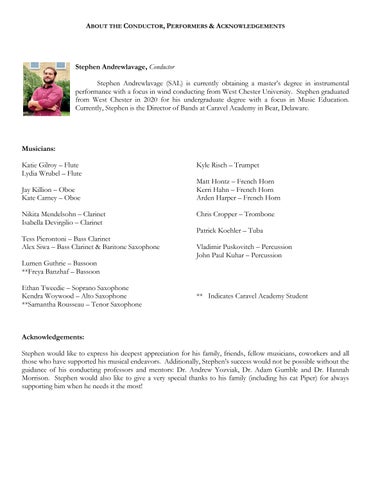
Stephen Andrewlavage, Conductor

Stephen Andrewlavage (SAL) is currently obtaining a master’s degree in instrumental performance with a focus in wind conducting from West Chester University. Stephen graduated from West Chester in 2020 for his undergraduate degree with a focus in Music Education. Currently, Stephen is the Director of Bands at Caravel Academy in Bear, Delaware.

Musicians:

Katie Gilroy – Flute

Lydia Wrubel – Flute

Jay Killion – Oboe

Kate Carney – Oboe

Nikita Mendelsohn – Clarinet

Isabella Devirgilio – Clarinet

Tess Pierontoni – Bass Clarinet

Alex Siwa – Bass Clarinet & Baritone Saxophone

Lumen Guthrie – Bassoon

**Freya Banzhaf – Bassoon

Ethan Tweedie – Soprano Saxophone

Kendra Woywood – Alto Saxophone

**Samantha Rousseau – Tenor Saxophone

Kyle Risch – Trumpet

Matt Hontz – French Horn

Kerri Hahn – French Horn

Arden Harper – French Horn

Chris Cropper – Trombone

Patrick Koehler – Tuba

Vladimir Puskovitch – Percussion

John Paul Kuhar – Percussion

** Indicates Caravel Academy Student

Acknowledgements:

Stephen would like to express his deepest appreciation for his family, friends, fellow musicians, coworkers and all those who have supported his musical endeavors. Additionally, Stephen’s success would not be possible without the guidance of his conducting professors and mentors: Dr. Andrew Yozviak, Dr. Adam Gumble and Dr. Hannah Morrison. Stephen would also like to give a very special thanks to his family (including his cat Piper) for always supporting him when he needs it the most!

Serenade(2019)

Saxophonist, composer and young educator Katahj Copley has already made an impressive legacy in less than a decade. With over 100 compositions, and commissions from all over the globe, Katahj is an inspiration, helping young students discover emotion through music.

Centered around the idea of growth and discovering love, Copley’s “Nonet for Winds” was originally written to be an “anti-serenade”. Each movement depicts a different phase of a developing relationship from uncertainty to hope for a new beginning. The somber introduction is met with fluttering interjections, before gracefully melting away. The playful second and blissful third movement lift our spirits as our characters explore and begin to develop a bond together. Movement IV: Dance evokes joy and celebration as the two characters admit their love!

Canzon Primi Toni A 8 (1597)

As one of the most influential composers of his time, Giovanni Gabrieli played a crucial role in shifting modality from the established Renaissance style to early Baroque. As the organist and composer at St. Mark’s Basilica, he was among the first to explore the astounding acoustics of the hall. He was known for configuring multiple choirs all over the basilica to create “special dialogues”.

Canzon Primi Toni A 8 is an excerpt from Gabrieli’s sacred collection: Symphoniae Sacrae. The book is comprised of sacred vocal music set to Latin hymns, which offer a variety of choir and voice-part orchestrations. British trombonist, conductor, arranger and educator: Eric Crees (B. 1952) analyzed and transcribed Gabrieli’s composition for modern use and application. While Crees’ edition is intended to be for brass choir, varied instrumentation options are available for each part.

H2O (2020)

Alexander Lamont Miller is an American born oboist and composer. Despite obtaining his bachelors and masters in Oboe Performance from Juilliard, Miller has never received any formal composition training. Alex Miller’s compositional inspirations are largely based on his involvement in various orchestral and chamber groups. Miller began writing H2O in 2020 at the beginning of the pandemic. While in quarantine at his Lake Michigan cottage, he drew inspiration from the powers of nature that surrounded him. Miller’s goal was to compose a work dedicated to “our most primary need; H2O” and it’s changing properties. The first movement: Ice Music is divided into two complimenting motives. Sharp shimmering timbres are matched with a robust melody, portraying the power of glaciers. The second movement depicts the eerie feeling of being underwater. The mood immediately shifts from slow undulations to an intense finale of organized chaos. During the third movement, disjointed sixteenth notes bubble through the woodwinds causing “nearly atonal madness”. The intensity and pressure continue to build until the final statement concludes, and steam is launched into the air.

Turn static files into dynamic content formats.

Create a flipbook
Issuu converts static files into: digital portfolios, online yearbooks, online catalogs, digital photo albums and more. Sign up and create your flipbook.
11.15.2025 GRD Andrewlavage Program Notes by WCU Wells School of Music - Issuu