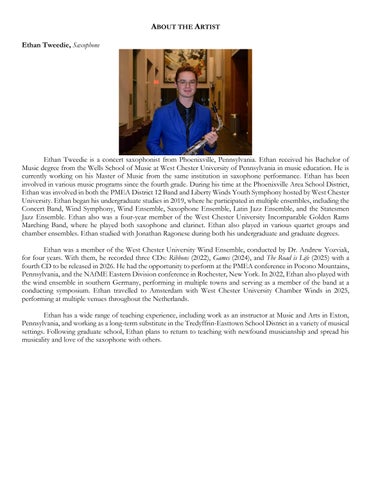
Ethan Tweedie, Saxophone
ABOUT THE ARTIST

Ethan Tweedie is a concert saxophonist from Phoenixville, Pennsylvania. Ethan received his Bachelor of Music degree from the Wells School of Music at West Chester University of Pennsylvania in music education. He is currently working on his Master of Music from the same institution in saxophone performance. Ethan has been involved in various music programs since the fourth grade. During his time at the Phoenixville Area School District, Ethan was involved in both the PMEA District 12 Band and Liberty Winds Youth Symphony hosted by West Chester University. Ethan began his undergraduate studies in 2019, where he participated in multiple ensembles, including the Concert Band, Wind Symphony, Wind Ensemble, Saxophone Ensemble, Latin Jazz Ensemble, and the Statesmen Jazz Ensemble. Ethan also was a four-year member of the West Chester University Incomparable Golden Rams Marching Band, where he played both saxophone and clarinet. Ethan also played in various quartet groups and chamber ensembles. Ethan studied with Jonathan Ragonese during both his undergraduate and graduate degrees.
Ethan was a member of the West Chester University Wind Ensemble, conducted by Dr. Andrew Yozviak, for four years With them, he recorded three CDs: Ribbons (2022), Games (2024), and The Road is Life (2025) with a fourth CD to be released in 2026. He had the opportunity to perform at the PMEA conference in Pocono Mountains, Pennsylvania, and the NAfME Eastern Division conference in Rochester, New York In 2022, Ethan also played with the wind ensemble in southern Germany, performing in multiple towns and serving as a member of the band at a conducting symposium. Ethan travelled to Amsterdam with West Chester University Chamber Winds in 2025, performing at multiple venues throughout the Netherlands.
Ethan has a wide range of teaching experience, including work as an instructor at Music and Arts in Exton, Pennsylvania, and working as a long-term substitute in the Tredyffrin-Easttown School District in a variety of musical settings. Following graduate school, Ethan plans to return to teaching with newfound musicianship and spread his musicality and love of the saxophone with others.
PROGRAM NOTES
MELODIESFORSAXOPHONE(1995)
Philip Glass is one of the most notable composers in the contemporary era. Often referred to as a minimalist, Glass still preferred to use the phrase, “music with repetitive structures” to describe his music. Glass studied with Darius Milhaud and Nadia Boulanger. Following his studies, he formed the Philip Glass Ensemble in New York and began to make minimalist music. Since then, Glass has composed a grand wealth of music, including fourteen symphonies, thirteen concerti, and over thirty operas, as well as music for film. Most of Glass’s early work involved repetitive iterations of brief melodies, although the technique is something he never stopped utilizing in his music. While not one of his earlier pieces, Melodies for Saxophone follows this compositional technique throughout its duration. Melodies for Saxophone was initially written for a theatrical adaptation of Jean Genet’s Prisoner of Love. The work consists of thirteen separate movements that elaborates upon thirteen different melodies. Following Glass’s compositional styles, these melodies are put through transpositions and rhythmic modulations. The most notable recording of this work is by Andrew Sterman of the Rascher Quartet, who Glass worked with closely during his compositional career and recorded the whole piece over all four primary saxophones. Following closely with its origin as incidental music for a play and Sterman’s separation among multiple saxophones, this piece will be performed intermittently throughout the recital and on both alto and soprano saxophone.
SONATAFORALTOHORNANDPIANO(1943)
Paul Hindemith (1895-1963) is widely considered to be the foremost German composer of his generation. Hindemith has written multiple sonatas for every major instrument and most have become part of those instruments’ standard repertoire. Hindemith studied in Germany until World War II where he was exiled to Switzerland and then to the United States in 1940. The 1940’s were considered the peak of Hindemith’s career where he published works such as Symphony in E Flat, The Four Temperaments, and Symphonic Metamorphosis. Published in 1943, Sonata for Alto Horn and Piano is originally written for the E-flat horn, or tenor horn, but has been performed many times on saxophone as well. This piece features four contrasting movements that feature both slow and melancholic moments as well as rapid energetic sections. The piece is most known for having a poem preceding the fourth and final movement titled “Das Posthorn”. This is a spoken dialogue between the soloist and the pianist. The composer’s translation is as follows:
The Posthorn (Dialogue)
Horn Player:
Is not the sounding of a horn to our busy souls (even as the scent of blossoms wilted long ago, or the discolored folds of musty tapestry, or crumbling leaves of ancient yellowed tomes) like a sonorous visit from those ages which counted speed by straining horses' gallop, and not by lightening prisoned up in cables; and when to live and learn they ranged the countryside, not just the closely printed pages?
The cornucopia’s gift calls forth in us a pallid yearning, melancholy longing.
Pianist:
The old is good not just because it's past,
nor is the new supreme because we live with it, and never yet a man felt greater joy than he could bear or truly comprehend. Your task it is, amid confusion, rush, and noise to grasp the lasting, calm, and meaningful, and finding it anew, to hold and treasure it.
BALLADEFORALTOSAXOPHONEANDORCHESTRA(1938)
Henri Tomasi was a French conductor and composer who specialized in writing theatrical music and solo works for wind instruments, specifically woodwind instruments. As a conductor, Tomasi was one of the first conductors for radio, and by 1940, Tomasi was a highly sought after guest conductor for orchestras. Despite his career taking place during the modernist movement, Tomasi’s music is mainly tonal and lyrical. He has stated his own distaste for modernist techniques, saying, “Although I haven't shirked from using the most modern forms of expression, I've always been a melodist at heart. I can't stand systems and sectarianism. I write for the public at large. Music that doesn't come from the heart isn't music.” Tomasi’s Ballade for Alto Saxophone and Orchestra was written for his friend Marcel Mule, one of the leading French saxophonists at the time. Like other works from Tomasi, Ballade utilizes melodies from medieval troubadours, and is based on the French poem “Argument” by Suzanne Malard, Tomasi’s wife. The work in conjunction with the poem compares the saxophone to a melancholic clown, and the piece showcases both somber moments and cheerful, almost comedic moments as the clown tells his story to the night.
Argument
“Sur un vieux thème anglais, long, maigre et flegmatique
Comme lui, Un clown raconte son histoire spleenétique
A la nuit ;
L’ombre de son destin, le long des quais, zigzague,
Et le goût
De mégot qu’en sa bouche ont pris de vieilles blagues
Le rend fou…
Fuir son habit trop large et sa chair monotone
En n’étant,
Entre la joie et la douleur, qu’un saxophone
Hésitant !
Son désespoir au fond d’une mare sonore,
Coule à pic,
Et le clown se résigne à faire rire encore
Le public !”
Argument (Approximate English)
“On an old English theme, long, gaunt, and phlegmatic
Like himself, a clown tells his melancholic tale
To the night;
The shadow of his fate zigzags along the docks,
And the taste
Of cigarette butts old jokes that have taken root in his mouth
Drives him mad…
To flee his oversized costume and his monotonous flesh
By being,
Between joy and pain, nothing but a saxophone
Hesitating!
His despair at the bottom of a pool of sound,
Flows straight down,
And the clown resigns himself to making the audience laugh
Once again!”
ACKNOWLEDGEMENTS
I would like to thank the many people who have helped me throughout my musical journey: my parents and brother for their constant support in all of my musical endeavors; my girlfriend Kaitlyn for her unending encouragement; my accompanist Ron Stabinsky for his preparation and rehearsal time; Professors Jonathan Ragonese and Mark Allen for their advice and support throughout the preparation process and their overall educational support. I would also like to thank my past educators: William Bonnell, Justin McAdams, and my high school private teacher Richard Harris Finally, I would like to thank the West Chester University ensemble directors Dr. Adam Gumble, Dr. Greg Martin, Dr. Hannah Morrison, and Dr. Andrew Yozviak for their guidance and assistance throughout all of my West Chester career