04.25.2026 GRD Whitman Program Notes

Page 1


hot and resize to match this box (1x1.5”)

ABOUT THE ARTISTS

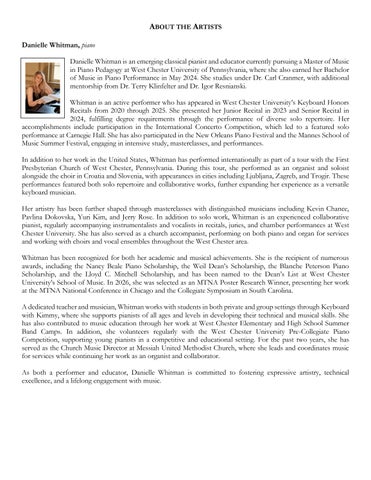
Danielle Whitman is an emerging classical pianist and educator currently pursuing a Master of Music in Piano Pedagogy at West Chester University of Pennsylvania, where she also earned her Bachelor of Music in Piano Performance in May 2024. She studies under Dr. Carl Cranmer, with additional mentorship from Dr. Terry Klinfelter and Dr. Igor Resnianski.

Whitman is an active performer who has appeared in West Chester University’s Keyboard Honors Recitals from 2020 through 2025. She presented her Junior Recital in 2023 and Senior Recital in 2024, fulfilling degree requirements through the performance of diverse solo repertoire. Her accomplishments include participation in the International Concerto Competition, which led to a featured solo performance at Carnegie Hall. She has also participated in the New Orleans Piano Festival and the Mannes School of Music Summer Festival, engaging in intensive study, masterclasses, and performances.

In addition to her work in the United States, Whitman has performed internationally as part of a tour with the First Presbyterian Church of West Chester, Pennsylvania. During this tour, she performed as an organist and soloist alongside the choir in Croatia and Slovenia, with appearances in cities including Ljubljana, Zagreb, and Trogir. These performances featured both solo repertoire and collaborative works, further expanding her experience as a versatile keyboard musician.

Her artistry has been further shaped through masterclasses with distinguished musicians including Kevin Chance, Pavlina Dokovska, Yuri Kim, and Jerry Rose. In addition to solo work, Whitman is an experienced collaborative pianist, regularly accompanying instrumentalists and vocalists in recitals, juries, and chamber performances at West Chester University. She has also served as a church accompanist, performing on both piano and organ for services and working with choirs and vocal ensembles throughout the West Chester area.

Whitman has been recognized for both her academic and musical achievements. She is the recipient of numerous awards, including the Nancy Beale Piano Scholarship, the Weil Dean’s Scholarship, the Blanche Peterson Piano Scholarship, and the Lloyd C. Mitchell Scholarship, and has been named to the Dean’s List at West Chester University’s School of Music. In 2026, she was selected as an MTNA Poster Research Winner, presenting her work at the MTNA National Conference in Chicago and the Collegiate Symposium in South Carolina.

A dedicated teacher and musician, Whitman works with students in both private and group settings through Keyboard with Kimmy, where she supports pianists of all ages and levels in developing their technical and musical skills. She has also contributed to music education through her work at West Chester Elementary and High School Summer Band Camps. In addition, she volunteers regularly with the West Chester University Pre-Collegiate Piano Competition, supporting young pianists in a competitive and educational setting. For the past two years, she has served as the Church Music Director at Messiah United Methodist Church, where she leads and coordinates music for services while continuing her work as an organist and collaborator.

As both a performer and educator, Danielle Whitman is committed to fostering expressive artistry, technical excellence, and a lifelong engagement with music.

JohannSebastianBach(1685-1750)

Partita No. 1 in B-flat Major, BWV 825

Johann Sebastian Bach’s Partita No. 1 in B-flat Major, BWV 825 is the first of his six keyboard partitas, published between 1726 and 1731 as part of the Clavier-Übung I. These works represent a high point of the Baroque dance suite, combining stylized courtly dances with sophisticated counterpoint, structural clarity, and expressive depth. Each movement reflects both its dance origins and Bach’s ability to elevate the form into a richly artistic and intellectually engaging composition.

The Praeludium serves as a brilliant and inviting introduction to the suite. Built on continuous, flowing passagework, it creates a sense of perpetual motion while outlining a clear harmonic framework. The texture alternates between hands in a way that suggests dialogue, and despite its technical demands, the movement maintains a sense of lightness, balance, and elegance.

The Allemande offers a more introspective and lyrical contrast. Traditionally a moderate German dance, it unfolds in a continuous stream of sixteenth notes, enriched by expressive ornamentation. Bach weaves multiple voices into a seamless texture, creating a sense of quiet intensity and reflective depth, where melodic lines emerge organically from within the contrapuntal fabric.

The Corrente introduces a lively and animated character. Faster and more rhythmically driven than the Allemande, it features buoyant motion and playful interplay between voices. Its lightness and clarity are balanced by subtle rhythmic complexities, giving the movement both charm and sophistication.

The Sarabande forms the emotional center of the suite. As a slow, stately dance in triple meter, it emphasizes expressive weight on the second beat, creating a sense of gravity and introspection. Rich harmonic language and elaborate ornamentation heighten its emotional depth, allowing for a highly personal and nuanced interpretation.

The paired Menuet I–II provide contrast through elegance and symmetry. Menuet I presents a graceful, courtly character with balanced phrasing and refined simplicity. Menuet II offers a contrasting texture and tonal color, often lighter and more delicate, before the return of Menuet I reinforces the structural symmetry typical of Baroque dance suites.

The Giga brings the suite to an energetic and virtuosic conclusion. Characterized by its lively compound meter and fugal textures, it showcases Bach’s contrapuntal mastery through imitative lines and intricate rhythmic interplay. The movement’s momentum and brilliance create a joyful and exhilarating close to the suite.

NikolaiMedtner(1880-1951)

6 Fairy Tales (Skazki), Op. 51 – Nos. 2 & 4

Nikolai Medtner’s Fairy Tales, or Skazki, are among his most characteristic and imaginative works. Rather than depicting specific narratives, these pieces evoke the atmosphere of storytelling suggesting moods, characters, and unfolding drama through purely musical means. Deeply rooted in the Romantic tradition, Medtner’s style is marked by dense textures, intricate counterpoint, and a highly developed sense of motivic unity.

No. 2 of Op. 51 is often associated with the story of Cinderella, tracing her journey from quiet hardship to fleeting transformation.

The piece opens with a gentle, introspective character, reflecting Cinderella’s subdued life with her stepfamily. A singing melodic line suggests her inner voice humble, yet full of longing. As the music gradually shifts, a sense of anticipation emerges, hinting at the possibility of change.

A more radiant and expressive section evokes the magic of the royal ball, where the music blossoms with elegance and light. This moment of beauty is brief, however, as urgency soon takes over. The texture becomes more restless, capturing the rush of midnight as Cinderella flees in her carriage, the magic quickly fading. The piece closes with a return to a quieter atmosphere, leaving behind the lingering impression of a fleeting dream.

In contrast, No. 4 feels like a sudden surge of motion and tension, as if the music is already in the middle of something unfolding. From the very beginning, it pushes forward with urgency bold gestures cutting through the texture and rhythms that seem to jostle against one another rather than sit still.

As it develops, the piece feels almost like a journey through shifting landscapes. Layers of sound weave in and out, sometimes colliding, sometimes aligning, creating a sense of constant forward drive. Even when the music becomes more intricate or dense, it never really settles; instead, it keeps pressing ahead, as if searching for resolution.

Within all this intensity, brief moments of calm appear like flashes of light lyrical passages that momentarily soften the momentum before the motion gathers itself again. These contrasts give the piece a sense of emotional depth, making it feel not just structured, but lived-in and expressive, like a story that unfolds in real time.

Together, these two pieces demonstrate Medtner’s unique ability to merge poetic imagination with rigorous compositional technique, resulting in music that feels both spontaneous and structurally cohesive.

ClaudeDebussy(1862-1918)

Ballade

Claude Debussy’s Ballade is an early work that offers insight into the evolution of his compositional voice. Originally composed in the late 19th century and later revised, the piece reflects the influence of Romantic composers such as Chopin and Liszt, while also revealing the beginnings of Debussy’s distinctive harmonic language.

Rather than following a strict structure, the piece unfolds freely, almost like a story being improvised in real time. Its opening theme is lyrical and expressive, but it never stays fixed for long, instead shifting and reshaping itself as the music moves through different moods and textures.

As it develops, the harmonies begin to blur and drift, creating a hazy, color-rich sound world. Lighter, delicate passages come and go like passing thoughts, while fuller climaxes briefly expand the space before fading back into something more intimate.

Throughout, melody and accompaniment blend more than they contrast, with each layer contributing to the overall mood. Even though it predates Debussy’s mature style, the Ballade already hints at his later focus on tone color, fluid harmony, and atmosphere over strict form.

FranzSchubert(1797-1828)

Piano Sonata in A Major, D. 664, Op. 120

Franz Schubert’s Piano Sonata in A Major, D. 664, composed in 1819, is one of his most lyrical and intimate works for the piano. Written during a period of relative personal happiness, the sonata reflects a sense of warmth, clarity, and effortless melodic invention that is characteristic of Schubert at his best.

The first movement, Allegro moderato, opens with a sense of effortless grace, as if the music is simply beginning to sing. Its themes feel naturally lyrical, unfolding like a voice shaping a long, unbroken line. Beneath this calm surface, the accompaniment moves gently forward, giving the music a quiet sense of flow. Even within its classical sonata-allegro framework, Schubert stretches the space with warm harmonic shifts and expansive melodic breathing, making everything feel unhurried and open.

The Andante shifts the atmosphere inward, as though the music has turned its attention to reflection. The melody is simple and direct, yet it carries a quiet emotional weight that grows through subtle changes in harmony and phrasing. Nothing feels exaggerated; instead, meaning seems to emerge gradually, shaped by delicate shading and the soft interplay of texture and dynamics.

The final movement, Allegro, arrives with a brighter, more playful energy. Light, rhythmic motion gives it a buoyant character, almost dance-like in its spontaneity. Even as it sparkles with momentum, moments of lyricism briefly surface, reminding us of the reflective world from earlier. In the end, the movement feels like a joyful release bringing the sonata to a close with warmth, clarity, and charm.

ACKNOWLEDGEMENTS

First and foremost, I would like to thank my family. To my mom, dad, Amanda, and Allison thank you for everything you do. Your unconditional love, patience, and support have carried me through every stage of my growth. Thank you for always believing in me, encouraging me to pursue my passions, and for always having my back. With a loving heart, I also extend my gratitude to my extended family. Your continued belief in me and your encouragement have meant more than words can express.

I would like to thank my friends who are here today. Your presence, support, and belief in me no matter what a constant source of strength and joy throughout this journey have been.

I am deeply grateful to my employers, including Kim Carney, Messiah United Methodist Church, and Sandor Kadar, for the meaningful opportunities and experiences you have given me. Each of you has shaped me as a performer, educator, and pedagogist, and I carry those lessons with me into my future endeavors.

To my past educators, I would like to first thank Dr. Cranmer for always working with me and helping me grow as an artist. Your encouragement and guidance have been invaluable throughout my development.

I would also like to thank Dr. Resnianski for your unwavering support, education, and dedication as a pedagogist. Your influence has helped pave the way for me as I grow into the future and into my role as an upcoming educator. I would like to express my gratitude to Dr. Vincent Craig and Dr. Terry Klinfelter for your guidance, mentorship, and the foundation you helped build in my musical and academic journey.

Finally, I would like to thank the rest of the West Chester University Wells School of Music faculty. Your instruction, inspiration, and dedication have profoundly shaped my growth. I am grateful for everything you have taught me and for inspiring me to continue striving, learning, and growing as a musician and educator.

Turn static files into dynamic content formats.

Create a flipbook