04.25.2026 GRD Arscott Program Notes

Page 1


ABOUT THE ARTIST

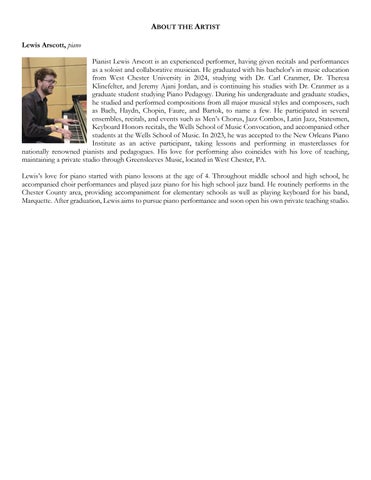
Pianist Lewis Arscott is an experienced performer, having given recitals and performances as a soloist and collaborative musician. He graduated with his bachelor's in music education from West Chester University in 2024, studying with Dr. Carl Cranmer, Dr. Theresa Klinefelter, and Jeremy Ajani Jordan, and is continuing his studies with Dr. Cranmer as a graduate student studying Piano Pedagogy. During his undergraduate and graduate studies, he studied and performed compositions from all major musical styles and composers, such as Bach, Haydn, Chopin, Faure, and Bartok, to name a few. He participated in several ensembles, recitals, and events such as Men’s Chorus, Jazz Combos, Latin Jazz, Statesmen, Keyboard Honors recitals, the Wells School of Music Convocation, and accompanied other students at the Wells School of Music. In 2023, he was accepted to the New Orleans Piano Institute as an active participant, taking lessons and performing in masterclasses for nationally renowned pianists and pedagogues. His love for performing also coincides with his love of teaching, maintaining a private studio through Greensleeves Music, located in West Chester, PA.

Lewis’s love for piano started with piano lessons at the age of 4. Throughout middle school and high school, he accompanied choir performances and played jazz piano for his high school jazz band. He routinely performs in the Chester County area, providing accompaniment for elementary schools as well as playing keyboard for his band, Marquette. After graduation, Lewis aims to pursue piano performance and soon open his own private teaching studio.

PreludeandFugueinFminor, BWV857,JohannSebastianBach(1685 - 1750)

Johann Sebastian Bach was a prolific and influential composer during the Baroque period of music. He wrote The Well Tempered Clavier, a two-volume work, each consisting of 24 preludes and fugues. His F minor prelude and fugue from Book 1, notable for its somber and melancholic mood, consists of many intertwining melodies. A stable pulse is surrounded by gentle, developing arpeggios in the prelude. The four-voice fugue consists of a tonally ambiguous and chromatic subject which Bach bases the work around.

PianoSonatainDmajor,Hob.XVI:19,JosephHaydn(1732 - 1809)

In 1766, after taking over as full Kapellmeister for the Esterházy family, Haydn began to write more expressive, experimental music, as opposed to the light and carefree sonatas reflective of the Galant style. Interestingly, this piano sonata, written in 1767, is a divertimento, which is a light and entertaining composition. The first movement has a declamatory-like opening in the first theme of the exposition, featuring quick melodic intervals in the upper melody and a stately bass melody accompanying underneath. The second theme uses repeating single notes and broken octave accompaniment to push and pull the melody along. A typical slow movement follows, featuring a delicate and gentle melody in A major. The third movement, a theme and variations, is an exciting finale that bounces around the piano with brisk staccato notes and virtuosic scales.

2Nocturnes,Op.33,GabrielFauré(1845 - 1924)

Gabriel Fauré, my favorite composer, was a French composer, organist, pianist, and teacher. After displaying remarkable musical talent as a young boy, he attended the École Niedermeyer music college in Paris at the age of nine. Among his teachers was Camille Saint-Saëns, a well-known composer of the Romantic era. Fauré’s compositional style is described as linking Romanticism to early 20th century modernism.

The nocturnes are regarded as Fauré’s greatest musical works. First published under the Irish composer John Field in the 19th century, a nocturne is a character piece that is evocative of the night, with intimate, pensive, and often melancholic moods. A great admirer of Chopin’s piano music, Fauré modeled these pieces on Chopin’s own nocturnes.

The first nocturne, in Eb minor, opens with a slow, cold, and foreboding theme. It is followed by an agitated second theme that features a recurring bass motif in the left hand. Floating, intertwining, and wandering melodies appear after the second theme that completely change the musical texture, providing a light and carefree mood. The coda is the most interesting part of the piece, as it returns with the material from the opening, in a trickling, vigilant character.

The second nocturne also opens with a slower theme, this time capturing a warm and joyful feeling that can be heard in the duet-like melodies in the right hand. A turbulent and fast section appears in the parallel minor key, where new and intense melodic duets unfold. Finally, the last section is introduced with a light trill, where the theme of the first section is sung once again.

BalladeNo.3inAbmajor,Op.47,FrédéricChopin(1810 - 1849)

Among Frederic Chopin’s wide selections of piano compositions such as his nocturnes, etudes, mazurkas, waltzes, and more, his four ballades are regarded to be some of the most important pieces of his works. A ballade is generally described to be “narrative” in character, featuring multiple distinct sections that build in emotional intensity. Chopin’s third ballade is rather operatic in character and does not shy away from dramatic themes. The introductory section is in two parts; a warm, welcoming mood that has consecutive lyrical melodies in contrasting registers, and a strong, exclamatory section that feels like it is rocking back and forth on water. Decorative ornamentation and rising arpeggios that follow briefly change the key from Ab major to C major, a recurring key that is present in other sections. As the

first section closes with the same theme from the very beginning, the next section unfolds with a two-note figure, in a “limping” rhythm that feels like a dance. The rhythmic accent of the figure is felt differently in each section, as the first-note accent of the figure emphasizes the first note with beautiful chords ringing out above, and the second part emphasizing more melodic, minor melodies on the second-note accent. The remainder of the sections feature sweeping arpeggios, and an intense coda that elaborates on themes in a grand manner.

RhapsodieEspagnole(SpanishRhapsody),S.254,FranzLiszt(1811 - 1886)

Liszt’s unique compositional brilliance is on full display in his Rhapsodie Espagnole, a tribute to the traditional Spanish music he heard when touring Spain and Portugal in 1858. The work begins with loud chords jumping down to a rumbly bass tremolo, which sweeps the music up to the higher register. A harp-like cadenza ensues, creating heavy anticipation of what is yet to come. The first main theme is based on a known historical melody called Folies d’Espagne, a melody that is suggested to arise from a dance in the Iberian Peninsula. Liszt introduces this theme in a focused, single note melody, and gathers more momentum and variation until the texture covers nearly the entire range of the keyboard. The middle section is based on another theme, the Jota Aragonesa. The jota is a style of music and dance originating in Spain, primarily from the Aragon region. It is characterized by a 3/4 time signature, and makes use of a fast tempo, filled with agile rhythms and quick ornaments. Its carefree and effervescent nature is evident in this agile tempo. After a lyrical and reflective break, Liszt unites the two themes in a grand synthesis in a daring, imaginative ending.

Turn static files into dynamic content formats.

Create a flipbook
04.25.2026 GRD Arscott Program Notes by WCU Wells School of Music - Issuu