ABOUT THE ARTISTS
Jacob Springer, conductor

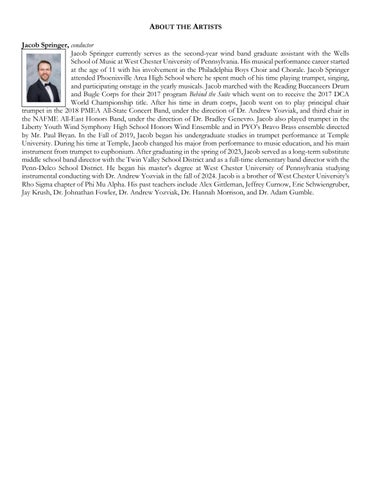
Jacob Springer currently serves as the second-year wind band graduate assistant with the Wells School of Music at West Chester University of Pennsylvania. His musical performance career started at the age of 11 with his involvement in the Philadelphia Boys Choir and Chorale. Jacob Springer attended Phoenixville Area High School where he spent much of his time playing trumpet, singing, and participating onstage in the yearly musicals. Jacob marched with the Reading Buccaneers Drum and Bugle Corps for their 2017 program Behind the Suite which went on to receive the 2017 DCA World Championship title. After his time in drum corps, Jacob went on to play principal chair trumpet in the 2018 PMEA All-State Concert Band, under the direction of Dr. Andrew Yozviak, and third chair in the NAFME All-East Honors Band, under the direction of Dr. Bradley Genevro. Jacob also played trumpet in the Liberty Youth Wind Symphony High School Honors Wind Ensemble and in PYO’s Bravo Brass ensemble directed by Mr. Paul Bryan. In the Fall of 2019, Jacob began his undergraduate studies in trumpet performance at Temple University. During his time at Temple, Jacob changed his major from performance to music education, and his main instrument from trumpet to euphonium. After graduating in the spring of 2023, Jacob served as a long-term substitute middle school band director with the Twin Valley School District and as a full-time elementary band director with the Penn-Delco School District. He began his master’s degree at West Chester University of Pennsylvania studying instrumental conducting with Dr. Andrew Yozviak in the fall of 2024. Jacob is a brother of West Chester University’s Rho Sigma chapter of Phi Mu Alpha. His past teachers include Alex Gittleman, Jeffrey Curnow, Eric Schwiengruber, Jay Krush, Dr. Johnathan Fowler, Dr. Andrew Yozviak, Dr. Hannah Morrison, and Dr. Adam Gumble.
OctetNo.2inE-flatMajor, JosefMysliveček(1737-1781)
JOSEF MYSLIVEČEK was born in Prague in 1737 to a family of millers. He initially entered the family trade as a master miller before dedicating himself to music. In 1763, he traveled to Venice to study with G.B. Pescetti, quickly finding success with his first opera, Semiramide. The Italians, struggling with his surname, affectionately dubbed him "Il Boemo" (The Bohemian). A prolific composer, he enjoyed a major triumph with Il Bellerofonte in Naples and maintained a close, though eventually strained, friendship with Wolfgang Amadeus Mozart. Despite his early fame and influence on the young Mozart, Mysliveček’s later works failed to find an audience. Following a series of operatic failures in 1780, he died in Rome in 1781 in abject poverty
OCTET NO. 2 IN E-FLAT MAJOR stands among Josef Mysliveček’s mature works as the second of his Three Octets for Wind Instruments. Interestingly, these compositions might at first be attributed to Mozart, but proof of Mysliveček’s authorship is supported by the inscription of his name and an identical theme that exists between the second movement of the third octet and the second movement of his piano concerto. The octets differ from other unpublished works for winds by Mysliveček as they are written in three-movement sonata form as opposed to the form of a serenade. The confident maturity with which these pieces are composed places the approximate date of composition in Mysliveček’s culminating period of creative activity, likely between 1774 and 1776. Crucially, this timeframe places the composition of Mysliveček’s Three Octets for Wind Instruments several years before Mozart composed his major wind serenades, making Mysliveček a key pioneer of the Harmoniemusik genre.
Sources: Daniel E. Freeman (leading Mysliveček scholar) & Dr. Camillo Schoenbaum (Austrian-Czech musicologist)
SerenadeforWindNonet,KatahjCopley(b. 1998)
KATAHJ COPLEY was born in Carrollton, Georgia on January 15th, 1998. Since the 2017 premiere of his first work, Spectra, Copley has composed more than 100 works for chamber ensemble, wind ensemble, and orchestra. Copley earned two bachelor’s degrees in music education and composition from the University of West Georgia in 2021. In 2023 he earned a master’s degree in composition from the University of Texas at Austin and is currently completing his doctoral studies in composition at Michigan State University. His music has been commissioned and performed by a wide range of college, professional, and community ensembles, including “The President’s Own” United States Marine Band, the Cavaliers Brass, the Atlanta Wind Symphony, and the California Band Director Association. Regarding music, Copley shares the following, “Music for me has always been this impactful thing in my life. It can soothe, it can enrage, it can quiet, and it can evoke emotions that are beyond me and this world we live in. I believe that music is the ultimate source of freedom and imagination. The most freedom I have had as a musician was through composing. Composition is like me opening my heart and showing the world my drive, my passion, and my soul.”
Sources: KatahjCopleyMusic.com, African Diaspora Music Project (ADMP)
SERENADE FOR WIND NONET was written in 2019, and originally conceived as an “anti-serenade”, focusing on personal growth following heartache. Katahj Copley writes the following regarding the piece…
“This is a piece originally seen as an anti-serenade. I wanted to write about the idea of a relationship going bad. However, I took that idea and decided to go in a different route. Instead of this being a piece for the love of someone or the breakup of someone...this is the growth of a person from heartache. The first movement is written from the perspective of someone out of a relationship, hence the rather somber beginning; however, the movement shifts into a change of mood for the person- a more hopeful mood. Second movement is a quirky encounter between two people - they are both shy and don’t know what the future holds for them. The third movement is a scene for a first date for the couple. The final movement begins with the clarinet and is rather slow, however as the movement progresses, it gets faster and louder until the end. This movement represents the pacing of the couple so that they finally admit their love for one another.”
Description written by Katahj Copley; found on KatahjCopleyMusic.com
LegendNo.6,Op.59,AntonínDvořák(1841-1904) arr.MichaelAllen
ANTONÍN DVOŘÁK is regarded as one of the great nationalist Czech composers of the 19th century, recognized today as Smetana's true heir by Czech and international musicologists alike. His musical training began in 1847 at his village school, where his talent was quickly recognized, eventually leading him to graduate from the Prague Organ School in 1859 as a trained organist. While supporting himself through teaching and playing violin in the Provisional Theatre orchestra, Dvořák composed privately, studying everyone from Mozart to Wagner. After a self-described "mad period" from 1866–71, during which he destroyed much of his earlier work and refocused toward new classicism and Slavonic folklore, his compositional voice matured and his reputation grew. When political tensions hampered his reception in Germany and Austria, Dvořák found strong support in England and America, eventually accepting the post of artistic director and professor of composition at the National Conservatory of Music in New York City. He returned to Bohemia in 1895 to focus on family and composition, and passed away on May 1st, 1904, buried among a host of famous Czechs in the Vyšehrad cemetery.
Source: Klaus Döge (prominent German musicologist & leading Dvořák scholar)
LEGEND NO. 6, OP. 59 is the 6th installment in The Legends of Antonín Dvořák. It was the success of his first series of Slavonic Dances that inspired Dvořák to write the Legends, and so the two collections of compositions are intimately related. Both collections of pieces were originally written for piano duet and were then immediately scored for orchestra. Despite the relationship between the works, as Bartoš notes, they are “diametrically opposed” to each other. In contrast to the rhythmic, elemental brilliance of the Slavonic Dances, the Legends are more modest, embracing an overall aesthetic that leans into chamber-like intimacy and daintiness. The general mood of the Legends is marked by a more epic and meditative character, crafting a world of rich, colorful, and original sonorities. As a rule, Dvořák never “repeats a thought without giving it at least in details a different nuance of expression or color”. (Bartoš)
Source: František Bartoš (major Czech musicologist and composer)
ACKNOWLEDGEMENTS
TO MY FAMILY
Thank you so much to my parents, Jonathan and Mary Jo Springer, for supporting me so much through my musical career. Thank you so much for driving me to all the rehearsals and supporting me through all the experiences. Thank you, dad, for teaching me to play trumpet and thank you, mom, for teaching me to sing. One of my greatest blessings in life is that I get to carry on the Springer family business of sharing music with the next generation, and I have both of you to thank for that. Thank you so much to my little brothers, Sean, Andrew, and Ben. We’ve been around for all seasons of each other’s lives, and I can’t begin to express how proud I am of the fine young men you’re all turning into. I’m grateful to be your big brother. Thank you for sitting through so many of my concerts and for putting up with me all these years.
TO THE FACULTY
Thank you so much to the esteemed faculty of West Chester University. To Dr. Yozviak for inviting me to West Chester and guiding me through my master’s degree. You’ve done more for me than words can articulate, and for that I will forever be grateful. To Dr. Morrison for all the extra lessons, wisdom, and support you’ve offered me simply out of kindness. To Dr. Gumble for all the support, the wise words, and the laughter in between. Dr. Yozviak, Dr. Morrison, and Dr. Gumble, I am so extremely grateful to have spent these last two years with you all. Thank you for helping me find confidence and clarity at times when I couldn’t find it myself. My time at West Chester has been more than I ever could have dreamed, and I will forever thank you all for this experience.
To Professor Skoniczin and Dr. Fowler for all the playing and conducting opportunities in Brass Ensemble and Tuba/Euphonium Ensemble. Thank you for all the guidance and the lessons over these last two years. To Professor Bryan for all the years of music making and support throughout my time with Bravo Brass, Temple University, and beyond. Monday night rehearsals with Bravo Brass got me through each week as a trumpet player, and I thank you for welcoming me into the ensemble.
TO THE MUSICIANS
Lastly, thank you so much to all the musicians that played on my recital. I quite literally could not have done this without all of you, and I’m extremely grateful for all the time and energy that you have sacrificed to bring this experience to life Thank you, everyone!