03.28.2026 GRD Puskovitch Program Notes

Page 1


About the Artist

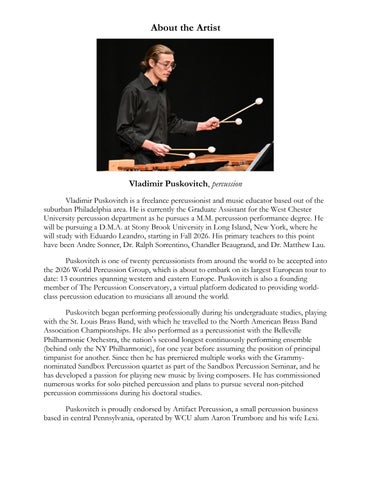
Vladimir Puskovitch, percussion

Vladimir Puskovitch is a freelance percussionist and music educator based out of the suburban Philadelphia area. He is currently the Graduate Assistant for the West Chester University percussion department as he pursues a M.M. percussion performance degree. He will be pursuing a D.M.A. at Stony Brook University in Long Island, New York, where he will study with Eduardo Leandro, starting in Fall 2026. His primary teachers to this point have been Andre Sonner, Dr. Ralph Sorrentino, Chandler Beaugrand, and Dr. Matthew Lau.

Puskovitch is one of twenty percussionists from around the world to be accepted into the 2026 World Percussion Group, which is about to embark on its largest European tour to date: 13 countries spanning western and eastern Europe. Puskovitch is also a founding member of The Percussion Conservatory, a virtual platform dedicated to providing worldclass percussion education to musicians all around the world.

Puskovitch began performing professionally during his undergraduate studies, playing with the St. Louis Brass Band, with which he travelled to the North American Brass Band Association Championships. He also performed as a percussionist with the Belleville Philharmonic Orchestra, the nation’ s second longest continuously performing ensemble (behind only the NY Philharmonic), for one year before assuming the position of principal timpanist for another. Since then he has premiered multiple works with the Grammynominated Sandbox Percussion quartet as part of the Sandbox Percussion Seminar, and he has developed a passion for playing new music by living composers. He has commissioned numerous works for solo pitched percussion and plans to pursue several non-pitched percussion commissions during his doctoral studies.

Puskovitch is proudly endorsed by Artifact Percussion, a small percussion business based in central Pennsylvania, operated by WCU alum Aaron Trumbore and his wife Lexi.

Program Notes

Asanga (1997), Kevin Volans | http://kevinvolans.com

“The Sanskrit title Asanga means 'freedom from attachment' I wrote the piece as a gift for Robyn Schulkowsky on the death of her father. It was written with no conscious techniques or concept.” Kevin Volans

I had the honor of interviewing Robyn Schulkowsky (the premiere performer and for whom the piece was written) this year, to gain insight as I wrote a paper analyzing various performances of this solo. Volans is vague in telling the performer what drums to choose, with the only instruction in the score being to use “four low drums (including bass drum) and two tom-toms, plus two high metal plates or extremely high skins.” Performers typically choose to play instead with two bongos, two congas, one tom-tom, and a bass drum, with two high metals, but Schulkowsky told me that was not the sound that Volans was writing for. The two worked closely together for many years, performing as a duo and also with Schulkowsky championing his three percussion solos, so Volans was quite accustomed to the very low-pitched drums that Schulkowsky had built for a different piece. This information, along with clarification regarding a typo in the music when it came to the high metals, gave me the confidence and ability to perform an interpretation of Asanga that was as informed and creatively appropriate as possible.

Marimbology (1993), Gunther Schuller | https://www.guntherschullersociety.org

“Marimbology was written in the summer of 1993 on commission from New Music Marimba, Percussive Arts Society, William Moersch, Robert Van Sice, and Nancy Zeltsman, with a grant from the Meet-theComposer/Reader’ s Digest Commissioning Program. The work is in four contrasting movements, exploiting not only the wonderfully rich sonorities of the five-octave marimba, but its remarkable technical/virtuosic and expressive capacities. The opening movement, marked Scherzando, begins with a light trickle of high register sounds (like a tiny high-lying mountain spring), gradually running its course into the lower register, growing dynamically along the way, and eventually evolving into a jaunty scherzo in asymmetrical meters and odd rhythmic patterns. But soon the piece reverses itself, the long downward opening run now heading upwards (like running a film backwards) to a “sudden-death” chordal climax. The second movement, Rhapsody, explores the darker and more harmonic qualities of the marimba. The middle section consists of one-hand tremolo pedal points accompanying the dramatic fanfare-like gestures. The movement ends on a quiet, contemplative note. The ensuing Sarabande is stately in character, closing with a chorale-like passage and a wispy “after-thought.”

The Finale, Toccata, features a plethora of ragtimey syncopations and jazzy swing. It is a virtuoso tour-de-force which stretches the technical boundaries of marimba playing to its farthest limits.” Gunther Schuller

This performance of Marimbology has been registered with The Gunther Schuller Society as a part of celebrating his centennial, with 100 performances in 2025 and 2026. Schuller, born in New York in 1925, was a prodigy horn player and award-winning composer, as well as an author, educator, and “musical visionary.” An advocate for diversity, equity, and inclusion, Schuller believed that “all musics are created equal,” and he created a compositional language that blended techniques of jazz and classical music that was dubbed “Third Stream.”

Program Notes Cont.

lingering bloom (2026) * ∆, Robert Maggio | www.robertmaggio.com

“lingering bloom is a quiet meditation on resonance, memory, and gradual transformation. Built from slowly unfolding polychords, repeated tones, and delicate chromatic inflections, the piece allows sound to accumulate, blur, and subtly change color over time, inviting the listener to focus on the vibraphone’ s natural bloom and decay. A steady underlying pulse anchors the music while surface activity ebbs and flows, expanding toward moments of greater density before receding into stillness. Throughout, resonance is treated as an expressive partner rather than a byproduct, with overlapping tones creating a sense of suspended motion and gentle harmonic drift. The piece closes not with a definitive ending but with sound that gradually thins and fades, suggesting an afterimage something lingering just beyond the moment it disappears.” Robert Maggio

Robert Maggio is an award-winning composer regarded as writing music that is smart, vital, and inventive, and he has created a diverse and substantial body of work. As a believer that new music thrives when it takes root in an audience of passionate listeners, Maggio has been an artist in residence for school districts, arts councils, dance companies, community choirs and bands, and professional ensembles. He has also had compositions performed by numerous professional and university orchestras in the United States, and he has been commissioned to write new scores for many dance companies. Maggio earned degrees from Yale University and the University of Pennsylvania, and he is now a Professor in the Department of Music Theory, History and Composition at West Chester University’ s Wells School of Music.

miniatures (2026) * ∆, John Belkot

“miniatures for vibraphone was commissioned by and written especially for Vladimir Puskovitch. The intent being to add to this piece many more miniatures unnamed and have a little folio from which to curate. This movement is much about self discovery for the instrument. How does it resonate? For how long? When does the sound decay? The instrument is certainly still alive much longer than we physically can hear.” John Belkot

John Belkot is a composer and entrepreneur. He has a business in Royersford and two fish. He also has degrees in composition from Susquehanna University and the Peabody Institute of the Johns Hopkins University, where he was the Graduate Assistant for the composition department and a Music Theory Fellow. He has taught at Peabody, Johns Hopkins, Loyola University, and Harford Community College. His principal teachers include Michael Hersch, Kevin Puts, Altin Volaj, and Patrick Long.

lock without a key… (2025) * ∆, Louis Raymond-Kolker | https://www.louisraymondkolker.com

“lock without a key is a short work for solo vibraphone, designed as a puzzle without a solution. Gestures in the music follow patterns that seems to imply questions, but are in effect meaningless- or at least, at present, unanswered.” Louis Raymond-Kolker

Louis Raymond-Kolker is a composer and percussionist from Austin, Texas. He is a member of Inside Out Steelband, Larkspur Percussion Duo, and the Austin Percussion Collective. He teaches percussion, composition, and music theory at High Point University in North Carolina.

Louis actively works to facilitate the creation and performance of new music, and fosters connections between composer, performers, and audiences. His compositions blend a sense of sentimentality, vivid imagery, and treating silly things seriously (and vice versa). As a performer, Louis specializes on steelpan, the national instrument of Trinidad and Tobago, and regularly premieres new works for instruments in the steelpan family.

Program Notes Cont.

Inside the House of D (2025) * ∆, Daisy Waters | https://www.daisywatersmusic.com

“Inside the House of D is a solo work for a percussionist, playing a combined set of metal keyboard instruments. This work is inspired by the Women’ s House of Detention, which was, for half of the 20th century, the sole prison for incarcerated women in New York City. However, because of the systemic discrimination against the LGBTQ+ community that infested all parts of the 20th century criminal legal system, the “House of D” was populated overwhelmingly by lesbians and transmasculine people. Thus, the prison and the surrounding Greenwich Village became a center for queer life in midcentury New York, and despite discrimination and awful living conditions for queer women, inside and outside the prison, the communities these people built and the riots and uprisings that they partook in helped to define queerness and queer liberation the entire nation over.The work is in five movements, each movement drawing on a different piece of historian Hugh Ryan’ s 2023 book The Women’ s House of Detention to tell different parts of the story of the House of D. The movements, with illuminating quotes from the book, are as follows:

I. “A promise unke(m)pt...”: “Public outcry sweeps in like the ocean, upends everything, and rushes out, leaving the correctional system jumbled, but no less dysfunctional. In fact, reform almost always comes with increased funding or more square footage for human cages, meaning that when the system relapses to cruelty, it’ s usually bigger than it was before.”

II. “Life only makes sense seven times...”: “In the spring of 1931, a sixteen-year-old Elaine B. published a short lyric essay in her Sacramento High School yearbook. ‘Oh, what is Life? ’she cried at the beginning, before enumerating the joys that made up hers: ‘Tiny happinesses that help to make life for me are many – and various... The wind that stirs strange unmanageable longings within me... the road that leads ahead – when a friend walks by my side.’”

III. “Caged lavender... (This is no garden)”: “I used to love this garden. I’d sit by the koi pond, do interviews on my cell phone, and think what a beautiful oasis it was – what a gift the Village had given the city. Now, I can ’ t look at it without hearing [activist] Jay Toole’ s voice describing the brutal physicals that doctors had inflicted upon her there, when the garden was a prison called the Women’ s House of Detention.”

IV. “Painted as/by monsters...”: “In 1956, the Department of Corrections finally codified in writing the process for segregating queer women and transmasculine people. ... Technically, this policy remained in effect at least until 1964, when a researcher reported that queer women in the prison were not only segregated, they were forced to wear a ‘D ’ on their clothing, for deviant.”

V. “No one is free until we all are.”: “Again and again and again, the Women’ s House of Detention was the place where Black liberation, women ’ s liberation, and gay liberation came together to battle the carceral state. This support was not one way. When Huey P. Newton, cofounder of the Black Panthers, was freed from jail in the spring of 1970, he announced that one of his goals for the party was to make common cause with feminist and gay liberation.””

Daisy Waters

Daisy Waters is a contemporary classical percussionist, composer, pianist, and songwriter specializing in solo and chamber percussion literature and a wide variety of genre-bending compositions for percussion and other instrumental and vocal disciplines. She has composed over 150 original works and arrangements for mediums encompassing solo percussion, chamber ensembles, large ensembles, strings, and many more. Waters has received degrees from the University of North Texas and the University of Illinois.

* Commissioned by Vladimir Puskovitch ∆ World premiere

Turn static files into dynamic content formats.

Create a flipbook