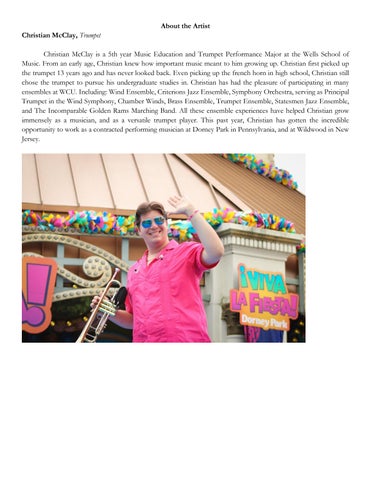
Christian McClay, Trumpet
About the Artist
Christian McClay is a 5th year Music Education and Trumpet Performance Major at the Wells School of Music. From an early age, Christian knew how important music meant to him growing up. Christian first picked up the trumpet 13 years ago and has never looked back. Even picking up the french horn in high school, Christian still chose the trumpet to pursue his undergraduate studies in. Christian has had the pleasure of participating in many ensembles at WCU. Including: Wind Ensemble, Criterions Jazz Ensemble, Symphony Orchestra, serving as Principal Trumpet in the Wind Symphony, Chamber Winds, Brass Ensemble, Trumpet Ensemble, Statesmen Jazz Ensemble, and The Incomparable Golden Rams Marching Band. All these ensemble experiences have helped Christian grow immensely as a musician, and as a versatile trumpet player. This past year, Christian has gotten the incredible opportunity to work as a contracted performing musician at Dorney Park in Pennsylvania, and at Wildwood in New Jersey.

TrumpetConcertoinA-flatMajor(1950)
Alexander Arutunian was born in Armenia toward the end of the romantic era in 1920. He wrote his most memorable work of his career yet in 1950 called “Concerto for Trumpet and Orchestra in A-Flat Major”. His concerto was written in a period of cultural nationalism in Soviet Armenia. Due to its bold and ambitious virtuosity, this concerto clearly pulls influences from Eastern European folk influence.
Although labeled a concerto, this piece has one continuous long movement with many contrasting sections. It moves seamlessly through the different moods and sections throughout the 15-minute duration. It opens with a bold and dramatic call/fanfare which sets up the raw energy that is held throughout the piece. It quickly moves to the fast-opening theme, which then leads to the first slow, lyrical section. Followed by a development and reimagining of the first theme. Followed by a different slow section that includes a cup mute before a recap of the original theme. After the recapitulation, there is a written cadenza that was premiered by Timofei Dokschitzer.
Alexander Arutunian’s Trumpet Concerto has cemented itself as one of the most memorable and important pieces of trumpet repertoire and placed itself within the Canon of music for aspiring students, and for professional soloists around the world.
TrioforTrumpet,Violin,andPiano,Mvt.1(1992)
Composer Eric Ewazen was born in Cleveland, Ohio in 1954. He began his journey as a pianist, and then started learning multiple instruments including trumpet, trombone, and cello. He is an alumnus from both the Eastman School of Music, and the Julliard School of Music. Ewazen is a passionate composer within the solo repertoire for many instruments, as well as chamber works
Ewazen’s gorgeous “Trio for Trumpet, Violin, and Piano” was written in 1992 and premiered at the Juilliard School. For the first movement, is peaceful and has a calm demeanor throughout the work. The two solo voices work together to create rich harmonies, with the opening thematic material being passed around. The piano functions as a rhythmic motor, as well as an echo to the themes of the piece. This is done through arpeggiated lines to support the two instrument voices throughout the movement.
OutofNowhere(1951)
Written in 1931, Johnny Green’s Out of Nowhere” has become a standard in the jazz repertoire. This specific work was a bridge for jazz tradition, and popular song. The lyrical head melody reflects the traditional aspect, while the rich harmonic structure of the chord changes was a rather new sound for its time that became popular over time. This blend of ideas can help a musician improvise over this song with a clear and deliberate attitude.
VesperalefromtheTootSuite(1981)
French pianist, Claude Bolling, born in 1930 was known for his genre crossing ideas in his works. Blending classical structures, with harmonic and rhythmic inflections that are more known in the jazz idiom. Bolling's movement, “Vesperale” from his Toot Suite is a great example of following this form.
Written in 1981 for trumpet virtuoso, Maruice Andre. A work where each movement is written for a different horn and style. Bolling’s 5th movement, “Vesperale” is the most lyrical work within the suite. As opposed to his other virtuosic and fast paced movements, Vesperale takes a different turn and reflects a softer, more intimate setting. The setting draws from French impressionism with its harmonic structure, and slow, lyrical jazz ballads. The word “Vesperale” comes from the word “Vesper” which is translated to “evening” in Latin. And Bolling wants to paint a picture of a tranquil evening for this beautiful movement.
Fee-Fi-Fo-Fum(1964)
Wayne Shorter’s “Fee-Fi-Fo-Fum” was ambitious and a bold step into the hard bop scene that dominated the early 1960’s. With a mysterious head melody, and unpredictable harmonic and chord structure, this was an exciting addition to the standard repertoire. Instead of virtuosic lines in the melody, it emphasizes metric tension. Often having strong, accented notes on off beats to create more color and tension. The melody, and chord structure is also quite chromatic, giving an extra level of difficulty, as well as excitement for spontaneous improvisation.
WestGrandBlues(2025)
Written for the West Grand Brass Band-Philly, I wanted to write a piece that was inspired by music I grew up listening to. That would be New Orleans, Traditional jazz music. The energy I feel whenever I listen to a street band playing in the NOLA style would always excite me as a kid. Thus, I wanted to create a piece of my own that would recreate that excitement, as well as pay respect to the tradition of the artform. With the trumpet carrying the main melody throughout, the saxophone representing a jazz clarinet jazz obligato, and tailgating trombones interjecting with smears and sliding accented notes. To the bass line in the Sousaphone, and the drums keeping the rhythmic energy moving forward. This polyphony creates the magic that became so popular back in the early 1900s.
Acknowledgements
I would like to sincerely thank everyone who has been there to help and support me through my musical journey thus far. First off, I would like to thank my mother and brother for always supporting my musical endeavors..(and putting up with listening to me practice loudly at home); My other family and friends for traveling to WCU to attend this event; My incredible accompanist, Olivia, as well as the other fantastic musicians that performed alongside with me; My girlfriend Rachel and her family for their constant support and encouragement; Professors Rob Skoniczin, John Swana, and Dr. Dobrzelewski for their advice and musical instruction; The Trumpet studio for all the great feedback I’ve received over the last 5 years; And lastly, thank you to all the West Chester University ensemble directors Dr. Yozviak, Dr. Morrison, Professor Paul Bryan, Professor Jonathan Ragonese, Dr. Martin, and Dr. Gumble for all of your guidance and direction you gave while I was in your ensembles!