
Our
Rogues, Sinners and Saints
Afrikaner,
Indigenous and Slave Ancestors
JAMES GREEN
Afrikaner,




Copyright © 2024 by James Green
All rights reserved.
No portion of this book may be reproduced in any form without written permission from the publisher or author except as permitted by Australian copyright law.
This publication is designed to provide accurate and authoritative information regarding the subject matter covered. It is sold with the understanding that neither the author nor the publisher is engaged in rendering legal, investment, accounting or other professional services.
While the publisher and author have used their best efforts in preparing this book, they make no representations or warranties concerning the accuracy or completeness of the contents of this book and expressly disclaim any implied warranties of merchantability or fitness for a particular purpose. No warranty may be created or extended by sales representatives or written sales materials. The advice and strategies contained herein may not be suitable for your situation.
You should consult with a professional when appropriate. Neither the publisher nor the author shall be liable for any loss of profit or any other commercial damages, including but not limited to special, incidental, consequential, personal, or other damages.
Edited by Dedrie Green and Callum Scott; Fatal Impact Productions.
2nd Edition 2025.
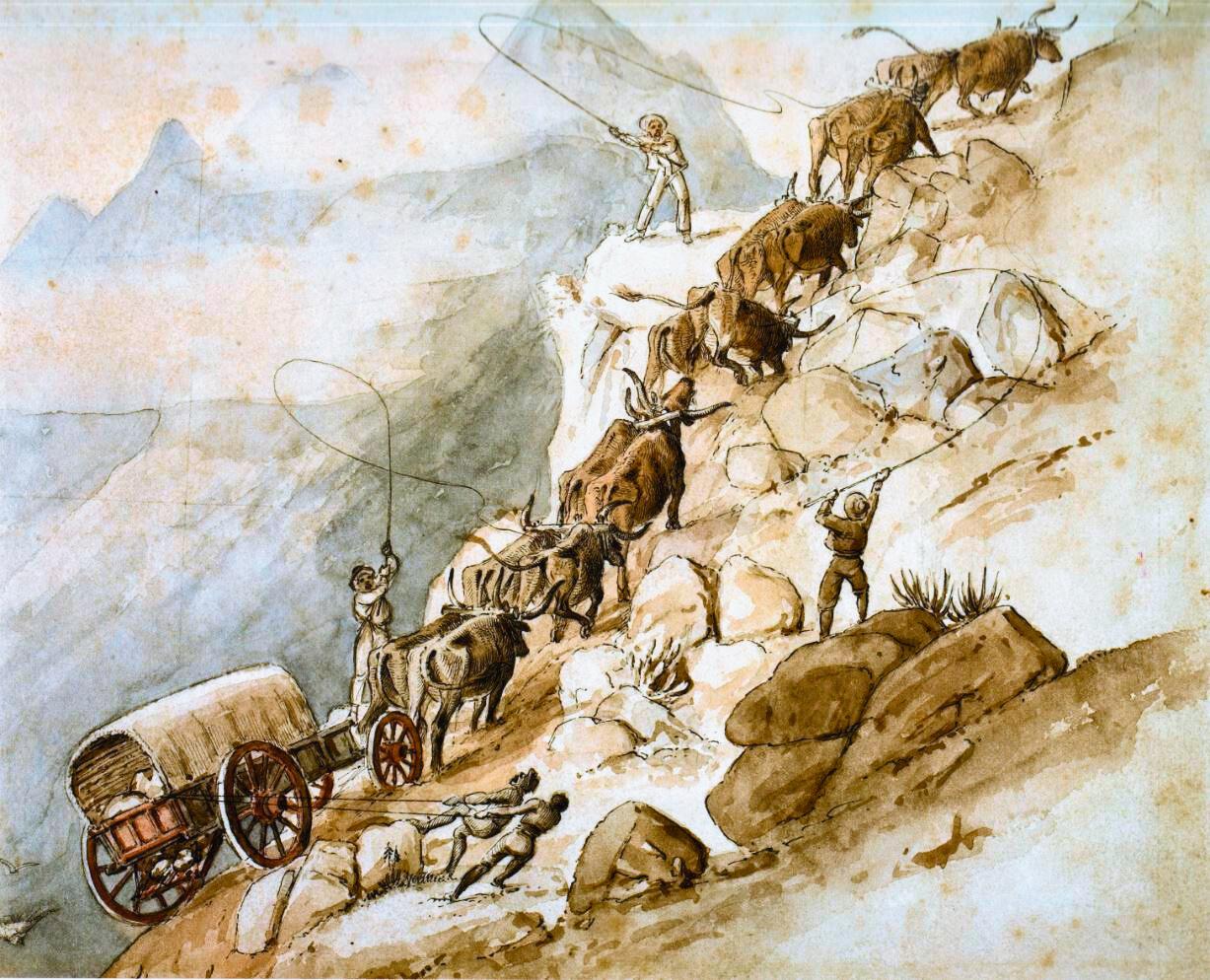
Book Cover: Charles Collier Michell. Boers; Wikipedia https://en.wikipedia.org/wiki/Boers
This book is lovingly dedicated to all the Afrikaners, Indigenous People and Enslaved People we are connected to in our family trees, especially the cherished living members of the Green and Beukes families.
May you embark on this journey through our shared history, experiencing both the joy and the heartache I encountered along the way. As you explore the distant and immediate past, I hope you discover echoes of our common ancestors within yourselves, perhaps even recognising threads of their spirit in your own life.
You may indeed share strands of DNA that bind us together across generations!
My mother and father met in January 1946 at the traffic lights in front of the Johannesburg City Hall. They were married a week later, and I was born in November 1946. By the time I was eleven, four more siblings had joined our family.
To support the Green family, my father worked on mining projects, moving from one small town to another, while my mother was busy raising the rapidly growing family.
The mining and industrial towns were lively and filled with activity, surrounded by the untouched veld. We grew to love the pristine African environment right at our doorstep. In those days, living on the right side of the Apartheid ‘colour bar’, the towns and rural areas were safe we had the freedom to roam and explore the veld without restriction.
My father had a captivating charm when he was sober, but his struggles with PTSD from the war led him to rely on alcohol. When he was drunk, he became violent; the family suffered because of this. In those days, such violence was all too often brushed aside and hidden from view. Although it was a challenging dynamic, it encouraged us to seek understanding and find healthier ways to cope with adversity.
My father struggled with something else; he lacked education and had grown up in an impoverished environment. His mantra was, ‘I needed to get out of there and make something of my life’. This rubbed off on us.
He put tremendous pressure on his sons to excel academically his daughters were exempt from this pressure! My mother, on the other hand, was a loving and gentle soul who encouraged us to write good essays for school and shared the most captivating stories with us. My siblings and I have a vivid imagination and write well, which may be attributed to my mother’s influence.
Education in our Apartheid community was authoritarian and conservative. We had excellent teachers in all subjects except history, where we were inundated with the National Party government's biased perspective on 'white' history. My parents, who supported the Nationalist Party, were never overtly racist.
Thanks to a mining company, I was able to attend university on a bursary, where I studied Chemical Engineering and eventually earned a PhD. This paved the way for an academic career, followed by a corporate career in synthetic fuels during the thriving South African economy of the 1960s and 1970s.
My wife, Dedrie, qualified and worked as a Speech Therapist in South Africa, then as a Mathematics and Physics Teacher after obtaining an Honours Degree in Physics while raising our two children, Peter and Hilda.
In 1987, we took a significant leap and emigrated to Australia, concerned about becoming second-class citizens in the emerging ‘Rainbow Nation1.’ We never looked back and have enjoyed living in the ‘Lucky Country.’ My wife, Dedrie, had a fulfilling teaching career in Australia, while I worked for an oil and gas company. Later, we teamed up to start a risk management company, assisting companies in lowering their risks in the chemical, oil, and gas industries.
COVID-19 turned life upside down, leaving me feeling trapped at home in Melbourne, Victoria. In the midst of it all, my only escape was my computer and long discussions with my wife, Dedrie, and our Chihuahua. This downtime gave me an opportunity for reflection, encouraging me to dig into our South African family history and uncover the captivating, yet complex narrative of our past.
As I gathered the compelling stories of our ancestors, I discovered deeply moving tales of resilience and reinvention. They spoke of courageous individuals desperate for safety, daring adventurers propelled by their ambitions, and those who confronted danger with unwavering strength. Each narrative reflects the extraordinary circumstances that led individuals to make remarkable, yet often regrettable, choices to survive.
These narratives include our own family story, that of the Green family family members that we knew and loved and who had difficult and tragic lives. Our descendants may thank us for passing on these stories, as well as the stories about our struggles in the days of Apartheid.
We have not concealed our own Green family stories of family violence, violence and mental health issues, painful as they are in the retelling; neither have we hidden our stories of suffering in the explosive racial environment in the Apartheid state.
I believe that sharing these experiences can help the reader connect with us; don’t we all have such stories to tell? Telling our own stories of violence and abuse is as necessary for healing as are the stories told by the Aboriginal and Indigenous Peoples around the globe.
Throughout my research, I immersed myself in the rich tapestry of our ancestral history. I discovered a varied cast of characters: some were rogues and renegades, while others wielded considerable influence as 'movers and shakers,' and a few became symbols of resistance, even martyrs. That is the reason for the title of this book: ‘Rogues, Sinners and Saints Our Afrikaner, Indigenous and Slave Ancestors.’
This collection of stories was inspired by the extensive historical records found in South African and Dutch genealogical archives. My research skills proved valuable in this shift of focus from technical to historical and genealogical literature.
Genealogical programs such as 'My Heritage,' 'Geni,' and 'Family Search' provided a wealth of information and helped me build many branches of our family tree. I verified most branches against birth, marriage, and death certificates available in the databases.
I used various resources for my research, including books about our ancestors who migrated to the Cape from the seventeenth century onward, as well as postgraduate theses from several universities in South Africa and the Netherlands. Additionally, I consulted newspaper archives that documented some of my ancestors' crimes and political involvements. The stories are primarily organised chronologically, starting from 1600, with referenced materials cited throughout the book.
As you explore these accounts, it may be necessary to overlook and occasionally forgive the embellishments inherent in reconstructing our ancestors' lives. Deciphering ancient records, often mere fragments found on weathered parchment, demands creative interpretation. Nevertheless, a captivating narrative remains enjoyable, even if embellished for the sake of enduring empathy, enjoyment and entertainment.
Each ancestor belongs to a specific branch of either Dedrie's (my wife's) or my family tree. Like most Afrikaners, we are somehow related through the family trees. I am distantly related to Dedrie as well, through the Beukes family trees. Dedrie’s Dutch family tree intersects with her South African one in the late 19th Century. There are many fascinating rogues, sinners, and saints in her Dutch ancestors that I could have included, but I have limited it to a few with whom I had immediate access.
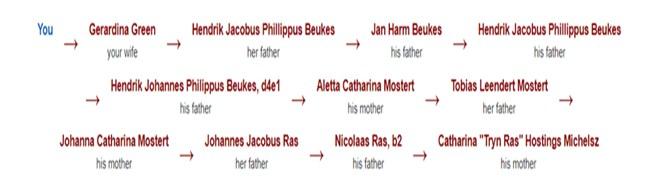
At the end of each story, I have included the branch of the family tree, taken directly from the Geni.com database. An example of such a branch is given below.
The research into our ancestors gave me a different perspective on the history that our teachers and historians taught us. During our impressionable years, we were brainwashed and indoctrinated by our family, relatives, the church, academics and politicians, into believing that we ‘whites’ were the ‘Herrenvolk' a master race, superior to the Indigenes and African tribes.
Those were the days of ‘grand Apartheid.’ We were led to believe that the Indigenes were savages, merely a step above the baboons that roamed the veld but were able to learn simple concepts and needed to be brought into the Christian fold. We also were led to believe that the African tribes were primitive pastoralists, bad farmers, and fierce warriors, very superstitious and believed in witchcraft.
The information collected in our research verified that our forebears were constantly at war with the Indigenous communities and pastoral African tribes, all vying for the same land and resources. The information also revealed the complex cultural and social dynamics at play between the communities.
The stories in this book have given us a new historical perspective. The Indigenous people and African tribes had a richness to their culture and wisdom far greater than what we believed. Their land and environmental management practices were far superior to those of the colonisers.
It’s a sobering thought that many of our ancestors were also slave owners and that some of the slaves were our very own ancestors. It also dawned on me as my research progressed that I was an Aboriginal person, in the Australian sense of the word. In Australia, a trace of Aboriginal DNA qualifies one as Aboriginal.
I have added figures throughout the text for illustration purposes. The references that appear throughout may slow the reader down, but they are necessary to confirm the veracity of the stories. These references are found in the Bibliography.
Dutch, Afrikaans and other foreign language terms and derogatory terms are italicised. Most of these terms are explained in the Bibliography and References Section, Page. 281. Where italicised terms are not explained in the Bibliography and References section, they are explained in the text. Some of the italicised Afrikaans terms appear in most English language dictionaries as well. Zulu, Xhosa and Ndebele names and terms are italicised. Many terms that were previously considered acceptable during the Apartheid era have evolved into language that reflects contemporary social and political values. Ship names and the Afrikaans or Dutch names of farms are italicised.
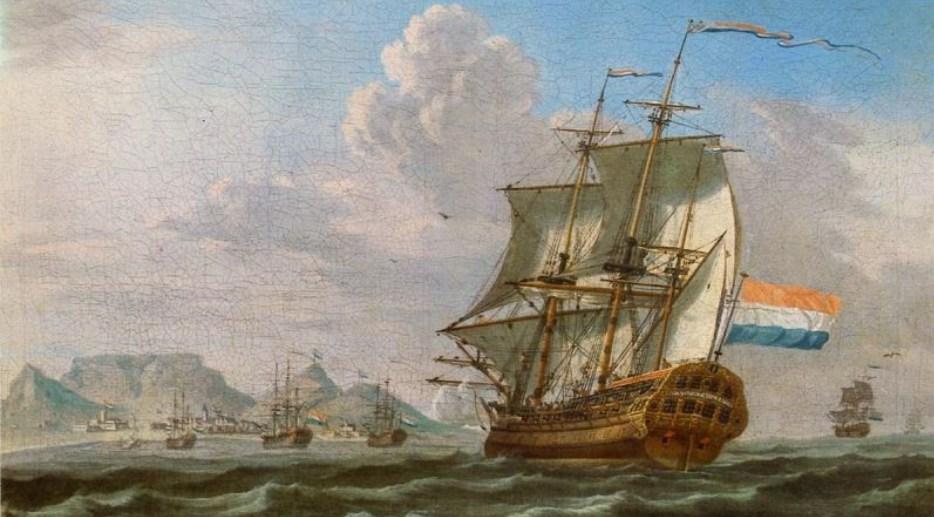
The Dutch East India Company (Vereenigde Oostindische Compagnie–or VOC2) played an enormous role in the lives of our first ancestors who arrived at the Cape.
The VOC established a refreshment station at the Cape in 1652 for several reasons. The Cape provided a strategic halfway point for VOC ships travelling between the Netherlands and the East Indies, allowing for rest, refuelling, and replenishment of supplies. The station served as a crucial source of fresh water, vegetables, and meat for VOC ships, enabling them to resupply and continue their long voyages.
The VOC was my ancestors' curse! But, without the VOC, I would have no stories to tell. Also, there could be no story without slavery3 . Like many families around the world whose ancestors owned slaves, we see our ancestors as slaves themselves, who were chained to the dictates of a morally corrupt power. Some of those slaves were our ancestors! I have uncovered stories about our early slave family member, Groote Catrijn and a slave employed by my ancestor Gerrit Smit September van Bugis.
Then, there is the story of the VOC's relationships with the Indigenous Khoekhoen4 people, particularly Eva van Meerhof a servant of the founder of the refreshment station, Jan van Riebeeck, and employed by the VOC as an interpreter. I am sure that there are more stories to be uncovered about the San5 and Khoekhoen people in our family trees!
Founded in 1602 by the States General of the Netherlands, the VOC emerged as the pioneer of modern corporations and a global juggernaut with unprecedented power. Operating beyond the confines of legality, it waged wars, imprisoned dissenters, and administered gruesome forms of torture and execution (Figure 1 below).
Beyond its mercantile exploits, the VOC delved into the abhorrent trade of human lives. Enslaved people became commodities, trafficked across continents for profit. Viewing themselves as superior beings, the VOC's
controllers ruthlessly exploited this human misery to amass wealth and resources. To them, enslaved people were mere spoils of war, traded in markets scattered across the globe to meet the insatiable demand for labour (Figure 2 below).
Not only that, they sent large numbers of slaves to keep their new refreshment station alive7. These hapless people built the colony with blood, sweat and tears some were our first ancestors.
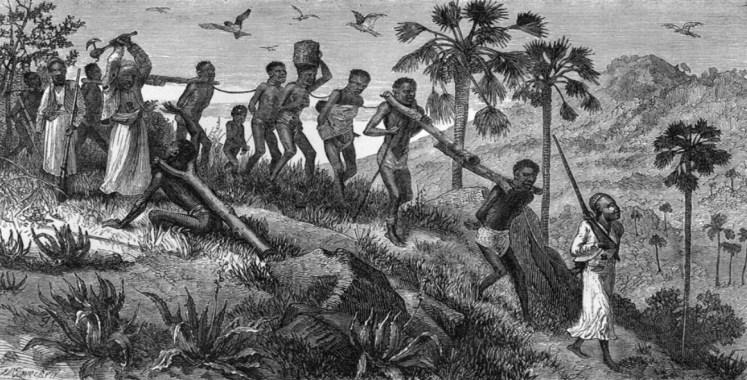
The brutality of slavery under the VOC knew no bounds. Enslaved individuals toiled under the lash, enduring unimaginable suffering in their quest for survival. Punishments for minor transgressions were severe, with whippings and forced labour on Robben Island being commonplace.
Such harsh measures were aimed at deterring rebellion and maintaining control, with the VOC sparing no cruelty to uphold its authority.
In rural areas, slaves faced the harshest treatment. Forced to toil in wheat fields and vineyards, they endured relentless beatings and backbreaking labour, often to the point of exhaustion and death. Those who survived the incessant punishment were cast aside in their old age to become shepherds. They broke them in body and spirit and reduced their lives to remnants of their former selves.
The VOC emerges as the quintessential antagonist in these narratives, shaping the destinies of my ancestors with its insatiable greed and brutality. Yet, amidst the darkness, it also inadvertently gave rise to heroes and martyrs, individuals who stood defiant against its tyranny. Thus, while the VOC looms large as one of history's most malevolent forces, it also serves as a testament to the resilience and courage of those who dared to resist its oppression.
Many South Africans, particularly Afrikaners, may find it both surprising and unsettling to discover that some of their earliest ancestors were, in fact, slaves. This revelation can evoke a range of emotions, as it challenges longstanding perceptions of identity and heritage. During the Apartheid era, such lineage would have tragically influenced social classification, labelling individuals as ‘Non-white’ or ‘Coloured.’ It's a poignant reminder of the complex and often painful history that shapes our understanding of who we are today.
It came as a surprise to me that Groote Catrijn9 , my ninth great-grandmother, is a slave ancestor who entered the world in 1631 in Bengal, near the bustling city of Chennai, India.
Her origins remain shrouded in mystery. She may have been born into slavery or later captured and enslaved by the Dutch. Some speculate she hailed from a lower-caste Indian family, while others suggest her family may have been prisoners of war. Regardless, historical documents reveal that the VOC transported Groote Catrijn from Pullicat to Batavia in 1645 alongside 2117 other enslaved individuals. Batavia, once the grand hub of VOC operations in Asia, is now present-day Jakarta, Indonesia.
In Batavia, Groote Catrijn found companionship with Claes van Malabar, another enslaved individual under the ownership of the VOC's stablemaster at Fort Rijswijck.
Despite the laws prohibiting such unions, Groote Catrijn and Claes lived together as a de facto husband and wife.
Tragedy struck on the afternoon of October 8, 1656.
A seemingly innocuous dispute over a meal escalated into a violent altercation that resulted in Groote Catrijn fatally injuring Claes. Groote Catrijn had arrived at the stable in the fort's garden with a pot of cooked chicken and pork for them to share, a meal that Claes had requested. However, Claes ‘politely’ informed her that he had already eaten and was not hungry. Groote Catrijn, who had a short temper, became agitated. She grabbed him, shook him, and called him a ‘stupid motherfucker.’
The fight escalated.
An enraged Claes fought back and threw her to the ground. She feared that he would rape her, which had happened often. In a blind fury, Groote Catrijn turned her body around and rolled away before he could fall on top of her. She managed to grab hold of a heavy, sharp piece of cobblestone. In an instant, the robust woman hurled the stone, aiming at his testicles.
The stone hit him with considerable force, just above the pubic area. The sharpened end penetrated his bladder, sending a stream of blood and urine onto the floor. Claes, bleeding profusely, lay writhing on the floor.
People rushed outside to stop the fight. Groote Catrijn shaking and shaken up was arrested on the spot, and they
took the injured Claes into the infirmary. Four days later, on the night of October 12, 1656, Claes died.
Arrested and charged with murder, Groote Catrijn faced a grim fate. The VOC Council of Justice, meticulous in its record-keeping, documented her sensational trial. Yet, amidst the looming spectre of execution by strangulation, a glimmer of hope emerged. Groote Catrijn exercised her right to appeal, ultimately leading to a remarkable turn of events.
On November 18, 1656, Governor-General Joan Maetsuyker reviewed her case and granted her a pardon. The reasons for this clemency remain a matter of speculation, but it spared Groote Catrijn from the gallows. Instead, she received a sentence of exile to the Cape of Good Hope, where she would spend the remainder of her days as a company-owned enslaved individual.
Thus began Groote Catrijn's new chapter at the Cape, where she became the first recorded female slave convict. Despite the hardships she faced, she displayed remarkable resilience, serving as a washerwoman for several commanders and their families within the confines of the fort.
Yet, her story took another unexpected turn with the arrival of Hans Christoffel Snijman, my ninth greatgrandfather, a soldier stationed at the Cape. Hans's duties included being a sentry at the Fort De Goede Hoop, the forerunner of the Cape Town Castle. Like Hans, I, too, experienced the monotony of sentry duty at the Cape Town Castle during my military service in South Africa. Hans
would leave his post to find some entertainment. He would sneak out every night and go to Groote Catrijn's living quarters. This behaviour did not go undetected!
Hans's clandestine rendezvous with Groote Catrijn led to his downfall, resulting in a conviction for fornication and subsequent banishment to Robben Island. Tragically, he perished there, leaving Groote Catrijn to raise their child, Christoffel Snijman, my ancestor. Despite facing further scrutiny and trials, Groote Catrijn found solace in the pardon of Governor-General Joan Maetsuycker, allowing her to rebuild her life and eventually marry a freed slave, Anthonij Jansz van Bengale.
Yet, fate dealt a cruel blow, claiming the lives of Groote Catrijn and her family in a series of tragic events between December 1682 and February 1683. Amidst the devastation, Christoffel Snijman emerged as the sole survivor, later marrying a European Huguenot woman, Margot de Savoye, my ninth great-grandmother from Ghent, Belgium. Thus, through triumph and tragedy, Groote Catrijn's legacy endures, woven into the fabric of my ancestry.
Our relationship with Groote Catrijn10 .

‘Eva’
Many South Africans, particularly Afrikaners, may also find it both surprising and unsettling to discover that some of their earliest ancestors were, in fact, Indigenes. This revelation can evoke a range of emotions, as it challenges longstanding perceptions of identity and heritage. During the Apartheid era, such lineage would have tragically influenced social classification, labelling individuals as ‘Nonwhite’ or ‘Coloured.’ It's a poignant reminder of the complex and often painful history that shapes our understanding of who we are today.
Krotoa11 (Figure 3 below), one of my ninth greatgrandmothers, affectionately known as ‘Eva’ among the early settlers at the Cape, holds a special place in our family tree as one of our Indigene ancestors. She hailed from the Khoekhoe or Hottentot12 people.
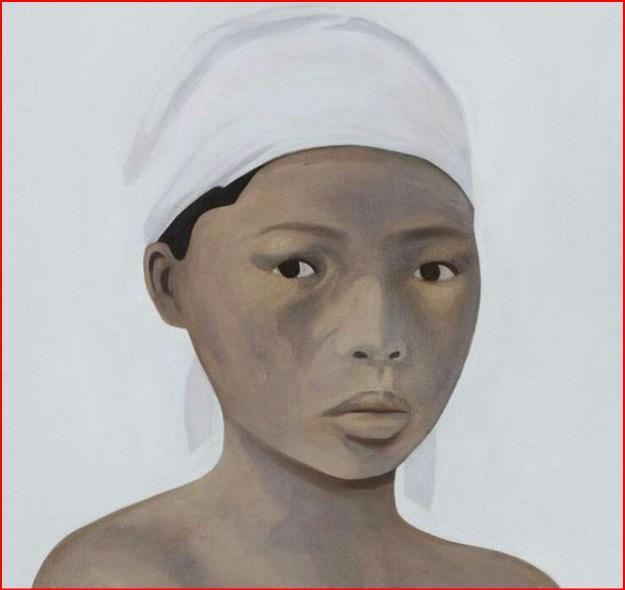
Figure 3: Krotoa13 - 'Eva.’
Krotoa was born into the Strandloper (also known as the Goringhaicona) clan, made up of wanderers from other clans (Goringhaiqua, Gorachoqua, Cochoqua) who settled at the Camissa River mouth in Table Bay to trade with passing ships under the leadership of her uncle Herrie. She also enjoyed a special relationship with the clan that her sister married into – the Cochoqua.
Yet, the story of Eva is a complex one, being retold by ‘Rainbow Nation’ historians. Although she is widely recognised as part of the Khoekhoe community, early descriptions of these people, taught in our history classes in the Apartheid era, placed her in the intriguing category of
the so-called Strandloper ‘savages’. The first VOC Commander, Jan van Riebeeck called them wretched, miserable Calibans14 naming them the ‘Watermen’. They supposedly had no cattle and lived on mussels, roots, and herbs dug out of the ground.
The ‘Rainbow Nation’ historians unveil another narrative about Eva, her family, and the Strandlopers. This story has also changed my view of my ancestry and my identity as an Afrikaner bearing an English name. I, too, am ‘Coloured.’ I, too, have Strandloper blood; it comes up in my DNA! With ancestries being revealed by historians and genealogists nowadays, many ‘White’ Afrikaners would have to become comfortable with being labelled ‘Coloured.’
But Eva was far from being an ordinary Strandloper. She emerged as a latter-day celebrity known for her association with Jan van Riebeeck, the first VOC Commander of the Cape. Her name graced the pages of VOC journals and diaries as early as 1652, making her one of the most extensively documented women in early South African history. Notably, she was the first woman to be mentioned by her Khoekhoen tribal name in the early European records of the Cape Town settlement she was ‘Krotoa’.
To truly grasp the depth of Eva's story, we must journey back to her uncle, Herrie Autshumao15 , of the Strandlopers clan, who lived on the shores of Table Bay, near the present-day Cape Town Castle also my 11th great-uncle. ‘Herrie’s’ story is equally fascinating.
But what did we know about these early ancestors?
I attended Wynberg Boys' High School, located on land that was once home to the Khoekhoen. There, I had the privilege of learning history from an outstanding teacher who navigated the history syllabus mandated by the Department of Education in the Cape Province. Our textbook was full of the exploits of the Europeans and the spice trade but presented the Cape as a largely uncharted territory before the arrival of Jan van Riebeeck. It was inhabited by the Khoekhoen pastoralists, Strandlopers, and Black pastoralists in the interior.
Unfortunately, these groups were labelled as 'savages', pre-medieval beings Herrie’s Strandlopers were placed at the bottom of the hierarchy. Although our teacher in the 1960s offered a differing perspective, he told us to adhere closely to the textbook to ensure we passed the exam.
Before van Riebeeck arrived, surprisingly, many ships16 rounded the Cape of Good Hope in the era before the VOC established the refreshment station in 1652. We weren’t taught that. We knew our European history well, that, in the 17th century, the East Indies was a vibrant marketplace, where English, French, and Dutch VOC ships ventured across the seas to trade silver, gold and manufactured goods for spices. The VOC dominated this trade, with Batavia now modern-day Jakarta serving as its hub.
In Batavia, the air was rich with the aromas of pepper, nutmeg, and cloves, alongside textiles, tea, coffee, and ceramics. This dynamic city was the heart of a vast trading
network that connected Asia, stimulated cultural exchange and an era of exploration that would shape the world.
We now know that Herrie played a major part in the early development of the port of Cape Town. Contrary to our history textbooks, Cape Town was a bustling port long before van Riebeeck's arrival. Patric Tariq Mellet17 , with Melissa Steyn, tell us that the Strandlopers and other Khoekhoen people contributed substantially to establishing the port. So, Jan van Riebeeck was not the hero figure stepping into a land filled with awe-struck savages (Figure 5 below). The Khoekhoen and Strandlopers were not childlike, primitive beings speaking in rapid clicks, that were close to the sounds that animals and birds make.
Herrie’s role was truly remarkable. He was a key player in the port's growth.
In the early 17th century, the waters around the Cape were a hub of maritime activity, with Dutch ships stopping frequently. English ships also began to arrive in increasing numbers, with their presence growing significantly between 1610 and 1620.
With this surge, the English began to seriously consider colonisation, recognising the untapped potential of this halfway point around the Cape. Rather than simply pursuing colonisation, at which they were good at, they chose to invest in the local port infrastructure and establish a cooperative relationship with Herrie and the Strandlopers.
Herrie, a young man in 1630, frequented the harbour in Table Bay with his clan members. They would see ships18 entering Table Bay (Figure 4 below) and move to the shore to meet the people19 leaving the ship at the docks or arriving on shore by boat. He would stand out, waving, welcoming, with a huge smile on his face. He made friends with all and sundry, particularly the English and caught the eye of those managing stevedoring and chandlering operations.
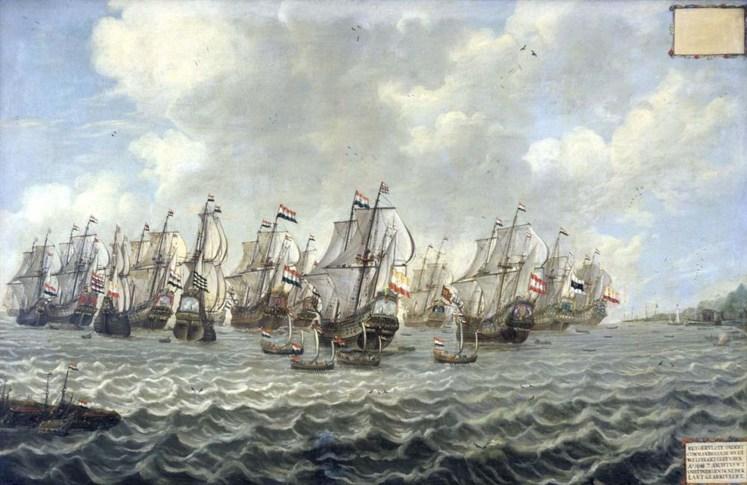
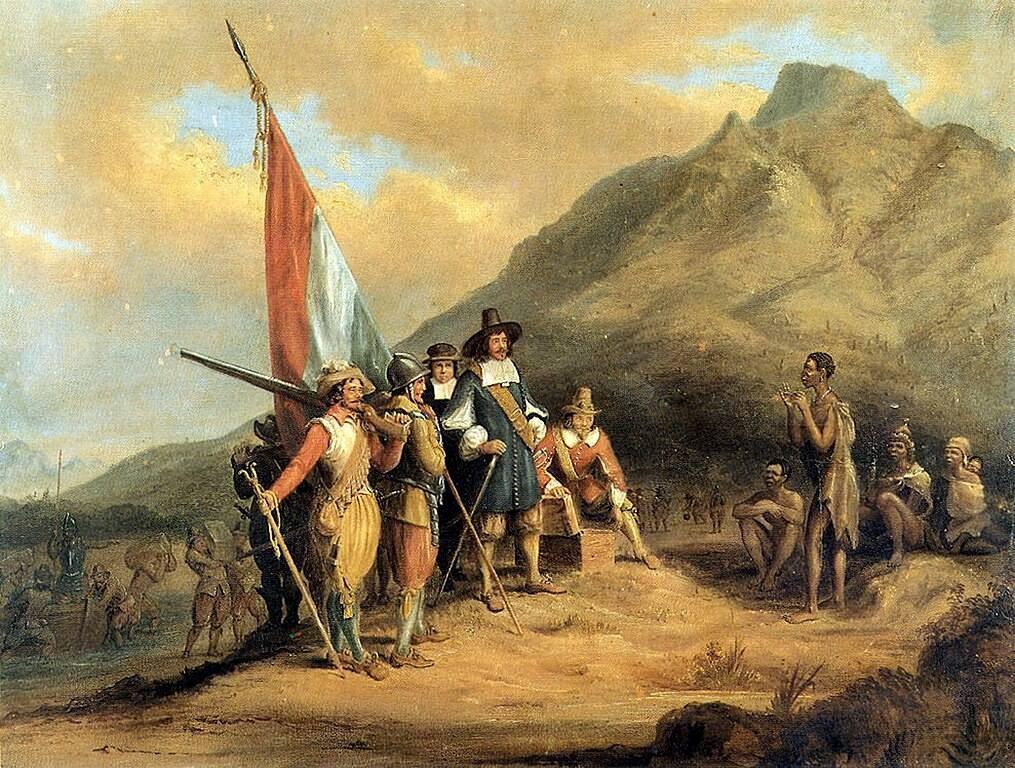
5: Savages ‘Herrie’ Autshumao, Jan van Riebeeck and Watermans20 .
The friendship grew until the English decided to develop a stronger relationship with Herrie and his 60-strong Goringhaicona (Strandlopers). The Strandlopers, who had by that time settled on the banks of the Camissa river (a river that now runs under the city) and beach, were to remain there until the arrival of Jan van Riebeeck some 20 years later.
The Cape in Herrie’s day was vibrant and bustling. Picture two to three ships arriving monthly in Table Bay, their crews flooding ashore for stays ranging from a few days to over a week. European visitors speaking diverse languages and goods were a common sight, challenging the notion of a land filled with savages, barely more advanced than the wild animals that inhabited the peninsula, the seashore, and the slopes of Table Mountain. When he returned from Vietnam, Jan van Riebeeck’s entire fleet spent weeks in Table Bay in
a port that had the amenities and facilities to accommodate the visitors from the ships.
Patric Tariq Mellet21, a Cape Town-born heritage activist, provides a fascinating insight into the importance of the port before the arrival of Jan van Riebeeck Herrie’s stamping ground:
Each European power seemed to have had their own trusted man who performed a range of tasks, including keeping mail and passing it on to other ships. Ships had even developed a gun-signal protocol for summoning their hired hands.
But let’s stop and look at some of the dynamics of the Dutch and other European shipping of this magnitude. Let’s also look at the probable impact on the Khoena and then lets also keep in mind the improbability of the cock ‘n bull history that has been handed down to us over the years, with the collaboration of our academic institutions.
There are detailed records from that time that show how competitive the Europeans were and the dominance of the VOC. The ships underwent design changes to make journeys safer and to increase the size and types of cargo carried to South and Southeast Asia. There were many economic losses and deaths on the ships. This led to improvements in shipbuilding technology and the development of stopping points, which transitioned from basic refreshment posts to ship repair facilities.
The primary purpose of the shipping was to transport company officials and large numbers of troops to support the wars in South and Southeast Asia. The Dutch were engaged in conflicts against the English, Portuguese, and Muslim Sultanates, necessitating the reinforcement of their factories and significant bases in India, Sri Lanka, and Batavia.
Factories lined the Indian and Bengal Coasts, extending from Myanmar to Thailand, Cambodia, Vietnam, Malaysia, Taiwan, Japan, and Indonesia. The Dutch East India Company, with state powers granted by the Dutch States General, relied on thousands of troops who required time ashore at strategic stops. Long voyages often led to illness, grumpiness, and conflicts among soldiers and officials. By 1615, it was certain that troops had already taken shore leave at the Cape of Good Hope.
The English first tried to set up a trading colony at Table Bay using freed convicts and local cooperation, even bringing Chief Xhore to London. That early settlement failed, but Xhore then became an important trade facilitator for several European powers, though he refused to work for the Dutch and was killed by them. To replace him, the English supported Harry (Herrie), taking him to Jakarta for orientation and then helping him become the main trader for ships passing the Cape, first on Robben Island and later near the Camissa River.
So, Herrie and his co-workers were not the docile savages (Figure 6 below) with a few sheep and cattle to trade for a few trinkets and a bit of cloth.
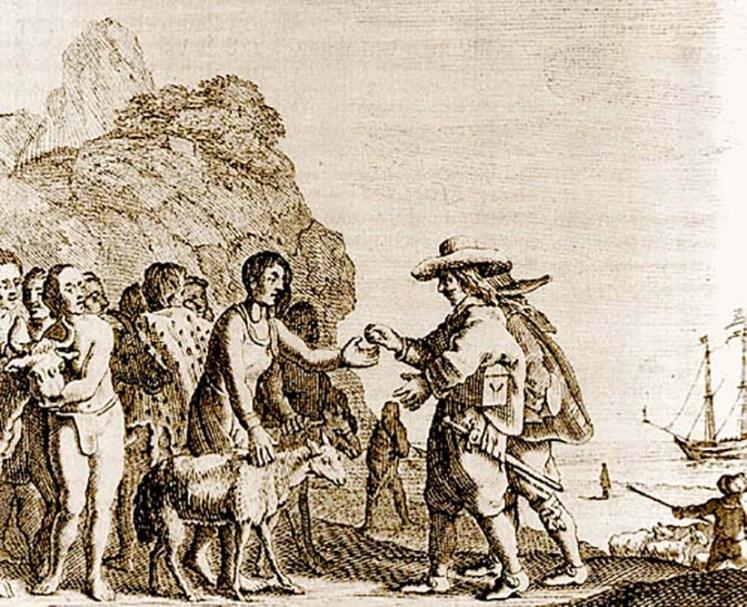
In 1630, he journeyed to Banten (Bantam) in Java with the English, where he picked up English, French, and Dutch. He also gained experience in chandlering helping supply ships and their crews with provisions and equipment and stevedoring loading and unloading cargo from ships.
But ‘Herrie’ also saw how badly the VOC treated the locals!
Herrie was highly skilled as a trader and port master. The many ships arriving regularly at the Cape required excellent management skills and good facilities. Apart from trading activities, the ships often needed repairs. There were workshops with the necessary equipment to repair the ships, often severely damaged in the storms that frequent the Cape.
Large numbers of soldiers and officials needed accommodation and entertainment on shore all managed by Herrie. People needed care; sickness was rife, and sick people were often left behind, cared for by the Strandlopers.
The shrewd and astute ‘Commander22’, as he became known, was also a good linguist and politician who played off the English against their enemies, the VOC. He also served as a good buffer between the European traders and the Khoekhoen23 along the west coast and the interior, who had large herds of thousands of cattle and sheep.
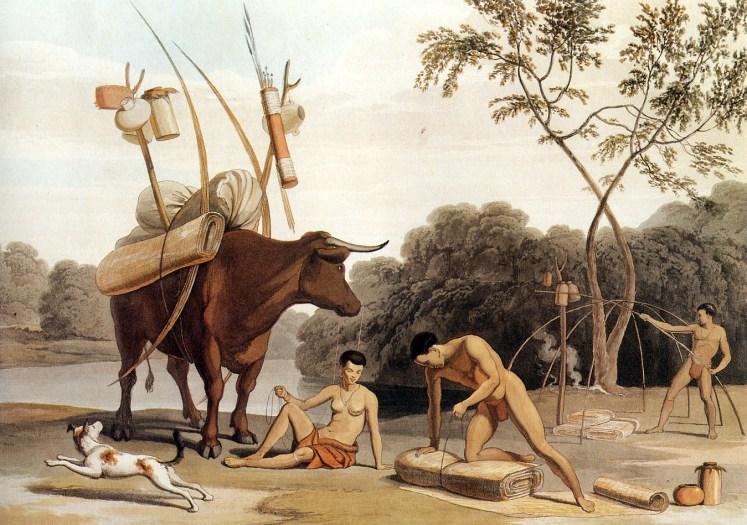
We can only imagine what the scene on the docks was like for ships24 arriving. Herrie dressed in European clothes (Figure 8 below) would boldly step out to meet the ships’ crew. ‘The Governor’, mentioned in English, French and VOC letters and diaries, would be accompanied by the
Strandlopers with bleating sheep, lowing cattle, colourful baskets brimming with fresh fruit and vegetables, and barrels gleaming with clear water would be carted to the ships.
‘Herrie’, ever the charismatic chandler, would have moved seamlessly between English, French or Dutch and the melodic clicks of the Strandloper language.
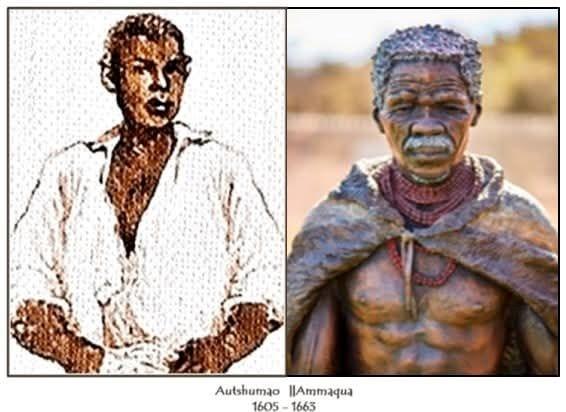
On the 7th of April 1652, Jan van Riebeeck landed at the Cape. The VOC, authorised by the Dutch States General, established the permanent settlement and took over the administration of services and the natural resources of the port.
Upon arrival, his initial tasks included establishing a fort the ‘Fort de Goede Hoop’, improving the harbour
facilities, planting crops like cereals, fruits, and vegetables, and obtaining livestock from the Khoekhoen people.
The first people that Van Riebeeck met would have been Herrie and the Strandlopers. Painter Charles Bell,25 over two hundred years later (Figure 5 above), imagined that that first meeting was between civilised Europeans and a bunch of savages. This is also what we believed, told by our historians and teachers. We thought that the Strandlopers were slightly more advanced than the baboons who frequented Table Mountain.
Herrie was immediately demoted no longer the ‘Commander.’ Van Riebeeck put his stamp on all proceedings from henceforth, but he still used and manipulated Herrie as translator and go-between the VOC and the Khoekhoen clans. Unlike the British, the VOC had a cunning policy in their dealings with the Indigenes, probably learned in Batavia. Van Riebeeck’s approach was, as noted in his diary, ‘First to creep and then to go…to win their favour…and to draw them to us.’
Van Riebeeck’s diary mentions the giving of ‘treats’ many times presents of tobacco, a ‘bellyful of rice,’ and ‘as much arrack or brandy as they could drink.’ There was no goodwill in this matter. Here is a typical extract that explains the VOC approach:
Gave them some tobacco. More bread, rice, and arrack should be at hand, as they draw the natives towards us, who continually say that the English gave them whole bags of bread, much tobacco, and whole cans filled with arrack and wine we ought, therefore, to be better provided to outdo the English if we wish to draw the natives towards us, otherwise
not an animal will be had, which may, if natives are humoured, cost so little that we could afford to add to the price some bread, tobacco, wine, or arrack." When we remember that the price given per head for cattle was ordinarily two copper plates, and for sheep "as much tobacco and wire as the sheep is long with the tail.
‘Herrie’, said Van Riebeeck:
Likes the English better than he does us a characteristic of most natives who have tried both being always full of them no doubt he has persuaded the natives to keep their cattle back until the arrival of the English, as he seems to know pretty exactly when their fleet will be here from India.’
Herrie, though, refused to be the submissive Khoekhoen that Van Riebeeck wanted. Like Van Riebeeck, he was also a cunning businessman feathering his nest. He did not easily give up his position as the ‘Commander’ at the port people still listened to him, liked him, and they missed the daily parties down at the docks.
Herrie wanted to be the sole go-between the VOC and all the Khoekhoen clans in the Cape Peninsula and, indeed, right up the west coast. However, he was thwarted by Van Riebeeck, who had studied tribal politics in the region, knew who was jealous of whom, and which clans and tribes hated each other. Van Riebeeck discovered that they mostly disliked each other. He got to know all the tribes with the following picturesque names:
The Saldanhars’ (Saldanha being the Portuguese captain who had given his name to this region in the 1500s); the Gorachouquas (the tobacco thieves); the Chainouquas; the Hesaquas; the regular Dagga-
makers (marijuana-makers) of the Hamcumquar; the Namaquas, and many more.
He realised that the Khoekhoen would do almost anything to get hold of tobacco, copper, and arrack brandy. He cleverly used their greed and their hatred of each other to serve the interests of the VOC. He had several good Khoekhoe spies in the fort to do his dirty work.
The VOC became increasingly suspicious of Herrie and tried to outsmart him by banishing him to Robben Island from time to time and bringing him back again when they needed him. But his wealth continued to increase, and they could not determine how he continued to line his pockets at their expense.
Van Riebeck’s distrust showed in his diary: ‘Herrie was also in the fort pretending that he had urged the natives now here (in the fort) to bring cattle; we pretended we believed him.’ The VOC finally decided to cut him out of their dealings with the other Khoekhoen clans completely and started to build up their local herd of cattle and sheep.
The VOC had to guard the cattle and sheep pens day and night. The Khoekhoen were masters of deception. Both parties were. They played games with one another while they raided each other’s herds of cattle and flocks of sheep. This was to become a familiar theme in South African history ‘We’ll steal your stuff if you steal ours.’
In the year 1653, tension reached a boiling point on a tranquil Sunday morning, the sun shining down on the fort,
as VOC officials sat listening to a sermon. Outside the tranquil walls, a shocking scene unfolded. A herd of fortytwo cattle prized milch-cows and sturdy draught oxen were peacefully grazing under the care of a young herd-boy. Suddenly, chaos erupted! The ‘Watermen’ swooped in. They ruthlessly murdered the boy, stealing silently away with the cattle. The refreshment station had been struggling; the herd of cattle had been their hope for survival.
A rumour started to spread that Herrie was the brain behind the chaos. It was said that just as the sermon reached its climax, he pulled a disappearing act worthy of a magician, leaving everyone scratching their heads. Soldiers were dispatched to chase after the nimble ‘Watermen’ (Strandlopers). They trudged through the heavy sand of the Cape Flats, huffing and puffing, while the ‘Watermen’ and their cattle made a graceful exit over the hills, laughing all the way to the horizon.
It was an awful blow to van Riebeeck. ‘We have lost the pantaloons being unbreeched’, he says in his diary and by the “Watermen” too, whom we had kindly treated. Besides, we have been cruelly deceived in our interpreter Herrie, whom we had always maintained as the chief of the lot, who had always dined at our table as a friend of the house, and been dressed in Dutch clothes.’
On one occasion, about five or six years after arrival, Van Riebeeck was looking for certain cattle thieves. They decided to get Herrie on the job: Van Riebeeck’s diary states with duplicity: ‘Herrie will therefore be brought over from the island and employed for the purpose, but well secured.
Golden promises as big as mountains will be made to him, but none will be held binding.’
Herrie helped them find the perpetrators. They welcomed him back into the This was typical of the commander’s political morality. Herrie must have helped them because somehow, he was welcomed back into the settlement. But Herrie must have been involved in the thievery, because Van Riebeeck wrote, ‘When they freed him, he was trembling like a lapdog owing to his bad conscience.’
But Herrie was always suspected of being the key person behind the raid on the VOC herd in 1653. They were just waiting to garner sufficient evidence to corner him. In 1658, they resurrected the 5-year-old cold case against him. He was tried in a summary kangaroo court and sentenced to life imprisonment on Robben Island that took Herrie from hero status to zero. They confiscated his wealth. The VOC had had enough. They made plans to insulate the settlement from Khoekhoen thievery. That was probably the start of Apartheid in South Africa.
Just before the arrival of Van Riebeeck, Eva came onto the scene. Herrie was riding the crest of the wave at the port. This bustling, animated world became Eva's playground and classroom. From an early age, she followed her uncle like an inquisitive shadow, asking question after question that exasperated Herrie. Whether aboard ships or interpreting for traders, Eva had an uncanny knack for blurting out the right answers before Herrie could! But Herrie adored his pintsized assistant, who was always one step ahead even if that
step occasionally landed them in amusing misunderstandings.
Eva had a remarkable aptitude for languages, coupled with a keen intellect and sharp wit it was a family thing. Her education unfolded at what could be termed 'Docks University,' with Herrie serving as her esteemed professor and the thousands of sailors and VOC employees frequenting Table Bay as her language tutors. It was an immersive on-the-job training experience unlike any other.
Just before van Riebeeck’s arrival, as Cape Town thrummed with life, young Eva became a luminous presence on the docks, a linguistic prodigy who left the port workers and traders in awe. She shadowed Herrie, seamlessly helping him as an interpreter.
Eva’s aptitude for languages was nothing short of genius. She was Fluent in Dutch and Portuguese and had a working knowledge of English, French and Danish. Yet, her brilliance extended beyond European tongues. Thanks to her clan’s extensive trading networks with inland communities, she also acquired a deep understanding of various Khoekhoen dialects and picked up African languages when the slave ships started to arrive at the docks.
When Van Riebeeck arrived, it all changed. Herrie was no longer considered the ‘Governor’, yet the little precocious ten-year-old still helped with communication on the docks. Then the smallpox arrived. The port looked like a field hospital; the sick and dying were everywhere.
After the epidemic, Eva found herself as a housemaid in the van Riebeeck household within the fort. Here, she quickly proved her worth to the governor and the VOC managers and became known as the 'Oroǀõas' (Ward-girl) by the Khoekhoen clans. Soon, her command of languages elevated her to the role of van Riebeek's official interpreter.
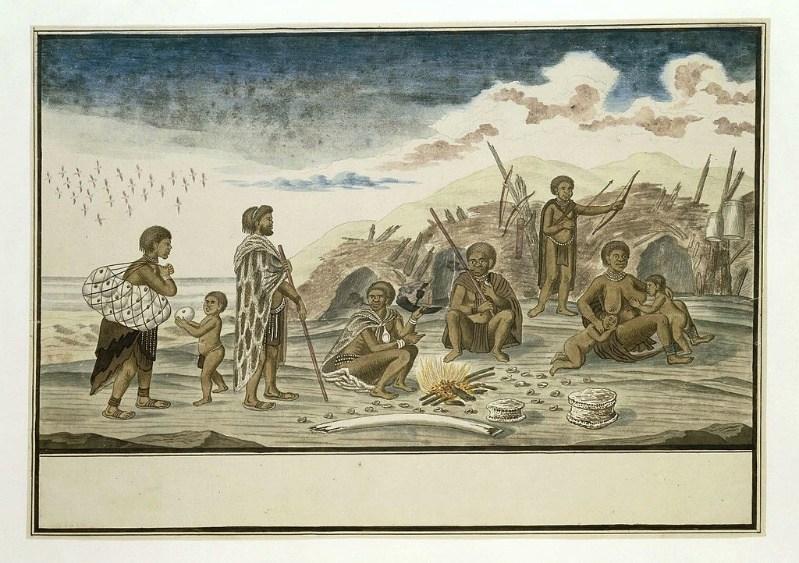
Figure 9: Eva's People.
But Eva was more than just the interpreter. Eva was also the resident diplomat extraordinaire half linguist, half gobetween. She made herself indispensable to the VOC. For six remarkable years, she was the VOC's chief interpreter and negotiator, bridging the two unlike worlds with amazing skill.
She was first mentioned in van Riebeeck's diary in October 1657, where he noted, ‘The commander spent the day conversing with the Saldanhars, using a girl named Eva,
aged 15 or 16. She has served the commander's wife since the beginning and is mastering Dutch.’
On March 28, 1658, the VOC ship, the Amersfoort, arrived in Table Bay, burdened not with goods but with the profound weight of human suffering. Aboard were 174 souls shackled together; they were torn from their homes and families, shackled by cruelty and despair. The ship had intercepted a rogue slave vessel, capturing half of its human cargo a mosaic of voices speaking Portuguese and African languages like Umbundu, Kimbundu, and Kikongose. This linguistic diversity was another barrier, isolating them further in their misery, as the foreign shores of Table Bay offered a grim promise of backbreaking toil. This was the start of the slave trade to South Africa.
Eva accompanied VOC personnel on board to help with communication. As she watched the poor individuals disembark, the cries of the women filled the air, their wails resonating with a profound sadness. I believe it would have pierced her heart. She would have observed the grimaces etched on the faces of the men, their silent suffering evident as they were harshly prodded by the guards (Figure 10 below).
At that time, Eva was leading a double life. The friendly relationship between van Riebeeck and Eva began to slowly wear thin as he discovered that 'something was rotten in the Fort de Goede Hoop.’ He grew suspicious of her when he observed her conversing in whispered tones with Doman, a Khoekhoe Clan Chief temporarily living in the fort.
Doman had taken over from Herrie as one of the two interpreters employed by Van Riebeeck the other being Eva. Although Van Riebeeck’s diary said that Doman ‘ seems to be well-disposed towards us’ and ‘is serving the Hon. Company better than anybody else up to the present at any rate’ Van Riebeeck started to have grounds to suspect Doman.
Rijckloff van Goens, Van Riebeeck’s trusted advisor on defence and strategy, orchestrated a pivotal journey for Doman in April 1657, taking him to the bustling Dutch trading posts in Java. This was no casual expedition; its purpose was to immerse Doman in the commercial mechanics of the VOC.
However, the true impact of this voyage was far more profound. In Java, Doman bore witness to the harsh reality of Dutch imperial dominance local Bantamese communities, once free and proud, were now subdued under VOC rule. These scenes of resistance and subjugation had an impact on Doman, reshaping his perception of the VOC not as benign traders, but as a looming threat to the Khoekhoe way of life. His loyalty to the VOC changed.
Doman would be the leader in the first Khoekhoen uprising against the VOC. Eva was his trusted informant within the fort.
What sort of a game was Eva playing at the fort? She was such a manipulator Van Riebeeck was like ‘putty’ in her hands! Eva, with her sharp intellect and cunning, turned his flaws to her advantage. As a go-between the VOC and the
Khoekhoen commercially and politically, she danced a delicate line, adeptly concealing her daring, while pretending to be naive. When cornered, she wielded tears like a weapon, a poignant performance that often left van Riebeeck too exasperated to punish her. All he did was shout and curse her, leaving her unscathed and victorious.
Amid the pervasive corruption festering within the VOC, van Riebeeck himself was a rogue and as corrupt as those under his command. The culture of moonlighting where individuals indulged in shadowy, often illicit pursuits alongside their official roles was rampant throughout the VOC world. Punishments for those flouting company policy ranged from brutal floggings to torturous forced labour, even death if caught too many times. Van Riebeeck had narrowly escaped such disgrace in his prior post. He had salvaged his reputation through rigorous counselling and retraining and had to face VOC's ‘Performance Reviews’ much more frequently.
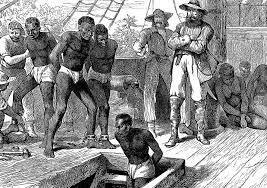
10: Dreadful Cargo26 .
Van Riebeeck followed VOC trading policy and practices rigorously, but was probably moonlighting, and was never caught; Eva was his key contact and go-between with the Khoekhoen. She was a key spokesperson for both parties in the initial vigorous trade with the VOC, exchanging livestock for iron and copper goods, tobacco, and beads. When this trade relationship deteriorated as the VOC took land from the Khoekhoen and wanted more livestock than the Khoekhoen were willing to provide, Eva was there to help negotiations.
She had to smooth ruffled feathers when rumours arose among the Khoekhoen that the VOC were intent on exploiting them and taking their land, as they had done in other parts of the VOC-dominated world.
Whose side was Eva on?
Van Riebeeck's diary entry, dated June 21, 1658, reveals his growing apprehension about Eva and her close
association with Doman—also, where did her allegiance lie? As the days passed, van Riebeeck's trust in the Khoekhoen dwindled rapidly. In one entry, he describes a complaint lodged by a man named Jan Reijnierssen, who reported that his male and female slaves had absconded overnight, taking with them blankets, clothing, rice, tobacco, and other provisions. Van Riebeeck turned to Doman, asking whether he knew the runaway slaves' whereabouts and whether the Khoekhoen would help to find them.
The verdict remains uncertain, but some online sleuthing suggests that Doman may have nonchalantly shrugged his shoulders, uttering, 'I don't know.' Such a response would likely have infuriated the egotistical commander. As fate would have it, Eva happened to be nearby, seemingly always within earshot of any significant commotion within the fort. The Commander may have thundered, 'Are our slaves not being harboured by the moerkneuker (motherfucker) Hottentots (Khoekhoen)!'
Eva, displaying remarkable composure, responded, 'Is this your opinion, Mr Commandant?' 'Yes!' he bellowed. She then continued in flawless Dutch, 'I'll tell you straight, Commander, Doman cannot be trusted. He divulged everything you said in your chambers the day before yesterday to the Hottentots. When I admonished him for it, he retorted, 'I am a Hottentot, not a Dutchman, but you, Eva, seek favour with the commander.' Now, my intuition tells me that the Fat Captain of the Kaapmans tribe is harbouring the slaves. '
Enraged, the commander demanded, 'What does the captain intend to do with those slaves?' Eva calmly responded, 'He plans to present them to the Cochoquas, another tribe, to maintain their alliance. The Cochoquas, in turn, will pass the slaves to the Hancumquas, a distant tribe.' The Hancumquas are known for cultivating the soil to grow dagga (cannabis), a dried herb highly valued by the Hottentots, who chew it for intoxication. Hence, they require slave labour to tend to their fields.'
Doman, possessing a shrewdness akin to Eva's, seized this opportunity to withdraw from the fort discreetly. His disdain for the Dutch had been festering, particularly since his travels to Batavia, where he had seen firsthand their ruthless treatment of the locals.
Tensions between the Khoekhoen and the settlers intensified. With Doman squarely in the VOC's sights, the Khoekhoen faced imminent eviction from their grazing lands, which they had frequented for centuries. Then, the conflict escalated!
In 1659, the European settler farmers voiced their concerns over escalating cattle theft, prompting an urgent council meeting with Jan van Riebeeck. Rumours swirled that Doman had allegedly incited the Gorachouquas (the tobacco thieves) to seize more cattle during rainy weather, exploiting the settlers' inability to use their flintlock muskets due to wet fuses.
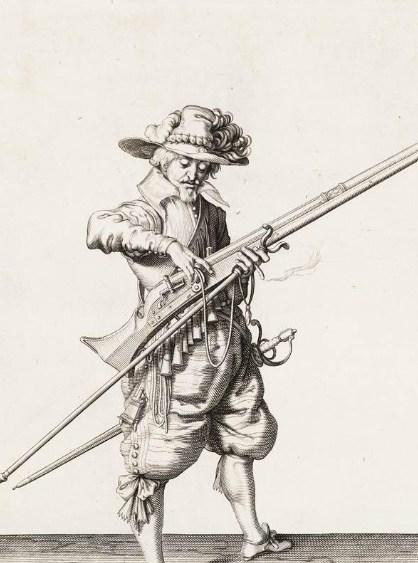
In response, VOC reinforcements arrived, leading to further skirmishes. Despite the relentless efforts of the Khoekhoe, they proved no match for the formidable VOC
muskets (Figure 11 below). The conflict persisted for another year until all parties collectively realised that a ceasefire and truce were imperative. Just to be sure, the VOC built a fence to keep the Khoekhoen out (Figure 12 below).
During the war, Doman sustained severe injuries, while Eva unexpectedly reappeared in van Riebeeck's diary in January 1661. Van Riebeeck notes that Eva, the interpreter, returned to live in his house, abandoning her traditional skins and readopting the Dutch way of dressing. This suggests that she may have aligned herself with her people during the cattle conflict but resumed her services as an interpreter once hostilities ceased.
Van Riebeeck had a soft spot for Eva. Some historians suggest that there may have been some relationship between the little Strandloper and the commander. Van Riebeeck observed that Eva appeared to ‘grow weary of her people again.’ He graciously allowed her to return to the fort to resume her role as translator and go-between, saying, ‘to get better service from her.’ He concludes in a conciliatory tone, noting, 'She seems to have become so accustomed to the Dutch diet and lifestyle that she will likely never fully relinquish it.'
Eva's life dramatically turned in 1662 when van Riebeeck departed from the Cape, replaced by Commander Wagenaer. Eva was baptised and married a versatile Danish surgeon, who also practised as a barber Pieter van Meerhof my 9th great-grandfather. Pieter's skills were in high demand in the hazardous shipping and construction environment, where he often performed amputations, cut hair and trimmed beards.
Commander Wagenaer noted that Eva’s union was ‘The first marriage contracted here according to Christian usage with a native.’ The VOC allowed marriages between Europeans, Khoekhoen and freed slaves in those early days. A year later, Eva and Pieter van Meerhof and their two children went to live on Robben Island, where he was appointed superintendent and ‘pest controller’. Surprisingly, surgeon Pieter’s job was as a VOC pest control supervisor; he probably fell out with the administration. His job was to get rid of snakes, spiders and similar creatures.
But Eva was a complex person, full of contradictions. She emerged as a figure of fascination and controversy as she got older, revered by some and condemned by others. Her story laces together admiration and scorn, painting a vivid picture of a tragic life.
During Eva’s stay on Robben Island in 1673, a Dutch visitor to the Cape, Willem ten Rhijne, described her as a remarkable individual, 'a masterpiece of nature.' He noted her embrace of Christianity, her fluency in multiple languages, and her extensive knowledge of the Holy Scriptures. He commended her skill in various womanly crafts and highlighted her marriage to one of the company's surgeons.
However, Wagenaer offered a differing view in his 1671 diary entry. He described Eva as spiralling into selfdestruction, describing her as 'drinking herself to death' and condemning her for 'vile unchastity.'
The exact timeline of Eva's descent into alcoholism remains unclear. However, it's known that she was heavily
pregnant upon her arrival at Robben Island, and, according to various accounts, she was often drunk. During this chaotic period, there was serious family violence; Pieter reportedly beat Eva when she was drunk.
On one occasion, Pieter sought the help of a surgeon from the mainland after severely beating and injuring Eva. He claimed she had fallen off a chair and struck her head on a wall, resulting in a three-day coma with a fractured skull. The attending surgeon wrote that ‘such injuries are not typically associated with a simple fall from a chair.’
Pieter had many strings to his bow! He was deeply involved in the slave trade, voyaging to Madagascar to barter for slaves, then returning and engaging in sex in sex on arrival with an inebriated Eva. During his absence, another child was born, expanding their family.
Tragically, Pieter met his demise during one of his slaving expeditions in Madagascar.
Eva's brief marriage to Pieter, lasting only three tumultuous years, set the stage for a dramatic turn in her life. After Pieter's tragic demise, the VOC allowed Eva to leave the isolation of Robben Island and return to the mainland. But the world she returned to was far removed from the one she had once known a fractured, prejudice-laden society where she was no longer under the protective wing of the VOC. Now, Eva was left to confront these harsh realities on her own, navigating a landscape that had grown increasingly hostile and unwelcoming.
With 'illegitimate' children in tow, Eva faced rejection from the European elite, who now dominated the social hierarchy. She also had to find her place among the manumitted Blacks and transient lower classes, predominantly men. Despite these challenges, Eva found solace in her drinking companions and sexual partners.
Eva likely battled depression, increasingly relying on alcohol self-medicating a habit ingrained since her early years. She eventually spiralled into a life of crime, finding herself on the wrong side of the law. Her descent into darkness continued until the church intervened, removing her children from her care. Mansell Upham27 recounts how the church council accused Eva of drunkenness and engaging in animalistic behaviour at night, reverting to her 'native habits.'
In 1669, under the cover of night, VOC police, called by the church council, forcibly seized her three children while they were asleep. She heard them coming and fled from her dwelling, disappearing into the night. The police sealed her dwelling to prevent her from entering. Cornelius de Cretzir, the fiscal (chief law officer), then ordered her arrest. On February 10, 1669, Eva was apprehended and thrown into the ‘black hole’ dungeon at the Castle of Good Hope, which had replaced De Fort de Goede Hoop.
From then on, Eva became an outcast, shunned by the society that once celebrated her. On March 26, 1669, the fiscal banished her, without trial, to Robben Island, where she remained until her death on July 29, 1674. VOC records finally vilified her as a ‘deceitful whore and a vixen.’ Upon her demise, the VOC Commander's Journal described her
'irregular life,' stating that she finally found peace through death.
Schapera28 , in 1933, quotes Eva’s epitaph:
Hence, in order not to be accused of tolerating her adulterous and debauched life, she had at various times been relegated to Robben Island, where, though she could obtain no drink, she abandoned herself to immorality. Pretended reformation induced the Authorities many times to call her back to the Cape, but as soon as she returned, she like the dogs, always returned to her own vomit, so that finally she quenched the fire of her sensuality by death ... affording a manifest example that nature, however closely and firmly muzzled by imprinted principles, nevertheless at its own time triumphing over all precepts, again rushes back to its inborn qualities.
Eva's children, Pieternella van Meerhof and Salomon van Meerhof, were sent to Mauritius in 1677.
Eva may have passed some of her genes all the way down to us.
In our own ‘white’ family, descendants of Eva, we had a remarkably resilient aunt whose intelligence and good humour shone despite the hardships she faced. She endured abuse as a child, grappled with serious domestic violence in her marriage, and struggled with the weight of alcoholism. On unannounced visits, we occasionally encountered her in bed, in a drunken state with an equally drunken man. They were having sex while we made tea in the kitchen! Reminds me a bit of Eva!
We were led to believe in Apartheid South Africa that most Indigenes were inherently stupid, incipient drunkards and sexually promiscuous. Fortunately, such racial stereotyping and profiling are ever so slowly disappearing in South African communities, and also in our Australian communities.
Eva would be OK today! Our relationship with Eva:
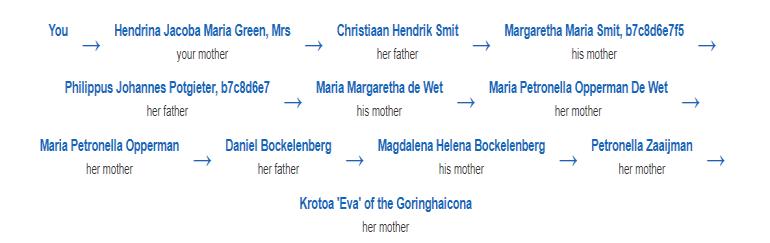
Many of my ancestors were slave owners. September van Bugis was one of my fourth great-grandfather, Oupa30 Erasmus Smit's slaves. The ‘Rainbow Nation’ recognises September van Bugis as one of their heroes in the struggle for freedom.
The record of ownership can be found in the Cape Slave Muster Rolls31 . My relationship to Erasmus Smit is given in the Genie.10 Database.

September would have faced the harshest treatment as Erasmus’s slave. He would have been forced to toil on the Smit family’s farm, enduring relentless beatings. He would have had to work to the point of exhaustion and close to death on many occasions. He was eventually sold as an old and broken man, becoming a shepherd.
But September was more than a slave. He was also a spiritual leader amongst the slaves; one of the few who could read and write accidentally caught up in a dreadful murder that occurred in Cape Town in 1760.
In that year, a group of runaway enslaved men, led by Fortuin, camped on Table Mountain near the Cape Peninsula, close to Cape Town. Fortuin had fled from his
injured master, Cornelis Verwey, following a violent altercation that had occurred six months earlier. This clash had left both men with wounds, both physical and emotional. Fearing the wrath of the VOC and the looming threat of torture and execution, Fortuin sought refuge in the shadows, facing a path filled with peril and uncertainty.
As Fortuin journeyed toward freedom, his charisma and resilience attracted a diverse group of fellow fugitives, each carrying the weight of their own struggles and pain. Together, they had a deep bond rooted in their shared experiences of suffering and oppression. This connection became a protective shield for them, offering moments of solace and support against the harsh realities of their world.
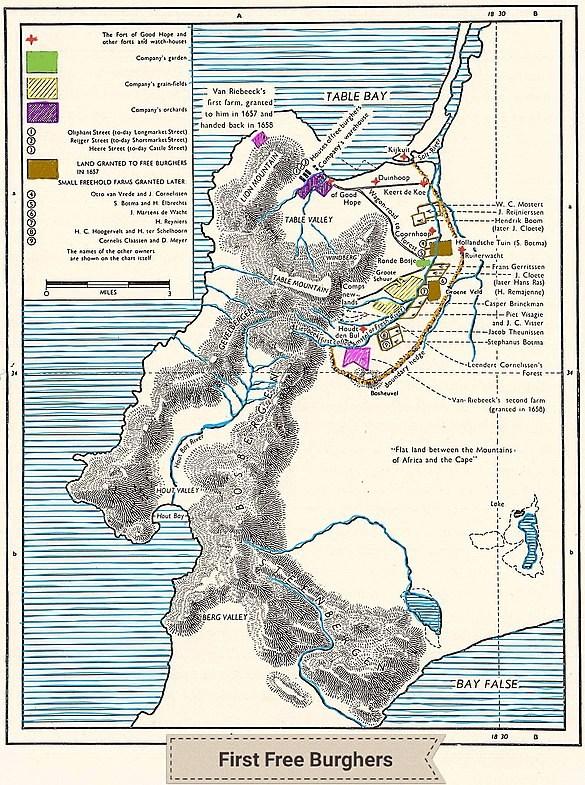
As they journeyed towards the sanctuary of Hangklip (Figure 4 below), nestled along False Bay, the ragtag band knew their path was perilous. To navigate the dangers ahead, they sought the means to defend themselves. Their gaze fell upon the affluent abode of one Michiel Smuts (Figure 13 Below). In the heart of Cape Town, Smuts, a figure of local influence and prosperity, resided amidst the trappings of VOC privilege. As a VOC bookkeeper and former commissioner, Smut's wealth and connections made him the perfect target for their desperate plan.
Nestled within the verdant embrace of Cape Town Gardens, the Smuts' residence stood as a testament to the spoils of exploitation and corruption. Within its luxurious confines, Michiel Smuts, alongside his wife Susanna de Cock and their two children, revelled in the comforts provided by
their ill-gotten gains extracted through the toil of enslaved labourers.
Fortuin and his band of renegades forged a pact with Alexander, one of Smuts' slaves. Guided by Alexander's insider knowledge, the gang plotted their daring intrusion; they were ready to change the lives of the Smuts household forever.
Before Fortuin and his gang descended on the Smuts's house, Alexander threatened the other slaves at the house with death if they were to alert Smuts or raise the alarm. A servant was tasked with letting the gang into the house after dark.
And they did.
Amidst the splendour of their decorated chamber, Mr Smuts and his wife Susanna lounged in the luxurious house. Adorned walls boasted no less than twenty-five paintings, while glistening silver and gold ornaments whispered tales of lavish indulgence all fruits of a global conspiracy woven by the VOC and its cohorts.
In an explosion of violence, the serenity of their luxury was shattered. Fortuin and his cohorts descended upon the unsuspecting couple, filled with hate and seeking revenge and weapons. Despite Smuts' desperate resistance, he stabbed a member of the gang clean through his hand; a swift blow from Fortuin sent him crashing to the ground, dazed and vulnerable. Once on the ground, Fortuin deftly slit Smuts's throat.
With ruthless efficiency, the gang silenced Susanna's cries for help, their hands staining crimson as they carried out their grim task. Even the innocent slumber of the Smuts' children offered no refuge from their brutality as the gang's blades moved swiftly to extinguish their young lives.
In the aftermath of their bloody rampage, the once serene abode bore witness to a scene of unspeakable horror, a grim tableau that reverberated through the corridors of power, striking fear into the hearts of the VOC oppressors who ruled with impunity.
Fortuin and his gang took off with three flintlock pistols, some gunpowder and shot, clothes, silver cutlery, jewellery, and food for the long road ahead.
Fleeing northward, the fugitives sought refuge amidst the shifting sands of the 'Cape Flats'. Their journey led them to Plattekloof (Figure 14 Below, nestled at the western edge of the Tygerberg, where they hoped to find medical assistance for the injured member of their party. They knew that Fortuin's brother, September, a well-known healer, resided there. They knew that he would help them and possibly hide them. He was a slave freed by Erasmus Smit.
Arriving under cover of darkness, their hopes were somewhat dashed by a sobering reality. September, worn down by the relentless toil of enslavement and the cruel lash of oppression, languished in poor health. Like so many of his brethren, his body bore the scars of servitude, his spirit tested by the unyielding cruelty of his masters.
Yet, despite his suffering, September welcomed his brother and their comrades with open arms, his voice a beacon of warmth amidst the shadows of despair. In their Buginese tongue, he greeted his kin, his words carrying the weight of shared struggle and resilience.
With practised hands and a healer's touch, September tended to the wounded hand. Amidst the darkness of their plight, his gentle ministrations offered a glimmer of hope, a reminder that even in the darkest of times, the light of compassion still shines bright.
September's reputation had preceded him in the region as a skilled healer and sage counsellor, revered by both slaves and free alike. His wisdom and compassion transcended the bounds of his enslavement, earning him a place of honour among those who sought solace and guidance in those terrible times. In an era where education was a rare privilege, September's ability to read and write set him apart, granting him elevated status among his kinsfolk.
With the wound tended and spirits uplifted, Fortuin and his companions embarked once more on their quest for freedom, courageous again and with newfound determination. Their journey towards Hangklip promised freedom.
Yet, fate's capricious hand intervened once more as they encountered slave woodcutters in the waning light of dusk. Hunger gnawing at their bellies, the gang's demands for sustenance were met with reluctant compliance from the weary woodcutters. Amidst shared rations and the warming
glow of brandy, tales of hardship and defiance flowed freely, binding them together.
The woodcutters extended a wary invitation for Fortuin and his band to spend the night. Yet, as the potent brew of brandy lulled the weary travellers into a stupor, treachery stirred in the shadows.
Under the cloak of darkness, one of the woodcutters slunk away, hastening to the nearby camp of the VOC commandos. With a heart filled with betrayal and thoughts of a good reward, he divulged the whereabouts of the sleeping fugitives, weaving a tale of deceit that would seal their fate.
Assured of the reward awaiting him, the woodcutter vanished into the night, his conscience drowned by the promise of a brighter future. As the first light of dawn broke upon the horizon, the thunderous gallop of hooves heralded the arrival of the VOC commando unit, and they unleashed their wrath upon the unsuspecting camp.
Caught unawares and in the grip of slumber, Fortuin and his comrades stood no chance against the merciless onslaught of their assailants. Bound and battered, they were dragged into the heart of the encampment, their cries drowned by the crack of sjamboks and the stench of betrayal that hung heavy in the air.
With fervour, the soldiers unleashed a barrage of sjambok32 lashes upon the hapless fugitives, their blows fuelled by a thirst for confession. They singled out the weakest among
them, branding his flesh until his cries echoed in surrender. Under the spectre of unbearable torture, he confessed to the murder of the Smuts family, his words a damning chorus that sealed their fate.
With their guilt laid bare, the soldiers dispensed swift retribution, executing the condemned with chilling efficiency. One by one, they fell beneath the cold gaze of their executioners, payback for the blood spilled in the halls of the Smuts' residence. Yet, amid the carnage, Fortuin and a lone comrade were spared the final embrace of death, reserved for further interrogation within the grim confines of the Cape Town Castle, a place of no hope.
Meanwhile, a detachment of the commando unit set forth to apprehend September at Plattekloof farm, driven by suspicions of his alleged role in orchestrating a rebellion that had been simmering for some time. Unbeknownst to the fugitives, September's shadow loomed large in the eyes of the VOC, his very existence a threat to their fragile order. Upon his arrest, their fears were seemingly confirmed as they uncovered damning evidence in the form of the ‘Upas Stellenbosch Letter’ (Figure 15 below). This document would seal September's fate.
The supposed damning contents of the letter laid bare the atrocities perpetrated by the VOC towards the slaves. The letter also pleads with September to lead the Bugis people out of their suffering. Upas meant a spiritual leader; the VOC interpreted this as the leader of an impending rebellion! With this pretext in hand, they swiftly arrested him
on charges of murder and treason, whisking him away to the dreaded confines of the ‘Castle’ for interrogation.
Despite September's protestations of innocence, his pleas fell on deaf ears. The Council of Justice, swayed by the ‘damning’ evidence of the letter, condemned both Fortuin and September to a gruesome fate. Bound to the torture rack, they endured unspeakable agony as red-hot pincers seared their flesh, each torturous moment one step closer to death.
In a merciful twist of fate, Fortuin was granted the solace of a swift death blow, while September faced a far crueller fate. Bound to the torture rack, his body wracked with pain; he endured the agonising ordeal of having his bones systematically broken, from his head to his feet. Yet, amidst the torment, September remained resolute, his silent defiance a testament to his unyielding spirit.
Historical records show that September did not utter a single cry of pain. His dying words were, 'There is no god but Allah, and Muhammad is His Messenger.'
These final words, a solemn declaration of faith, have echoed through the annals of history, a poignant reminder of his unwavering devotion. Many, many years later, in the wake of his martyrdom, the Cape Town City Council erected a shrine in his honour, commemorating September van Bugis a martyr and spiritual leader. This is supported by the testimony of scholars like Shaykh Seraj Hendricks, meaning September's legacy endures as a beacon of hope and
resilience in the Hall of Heroes within the heart of the modern ‘Rainbow Nation’ .
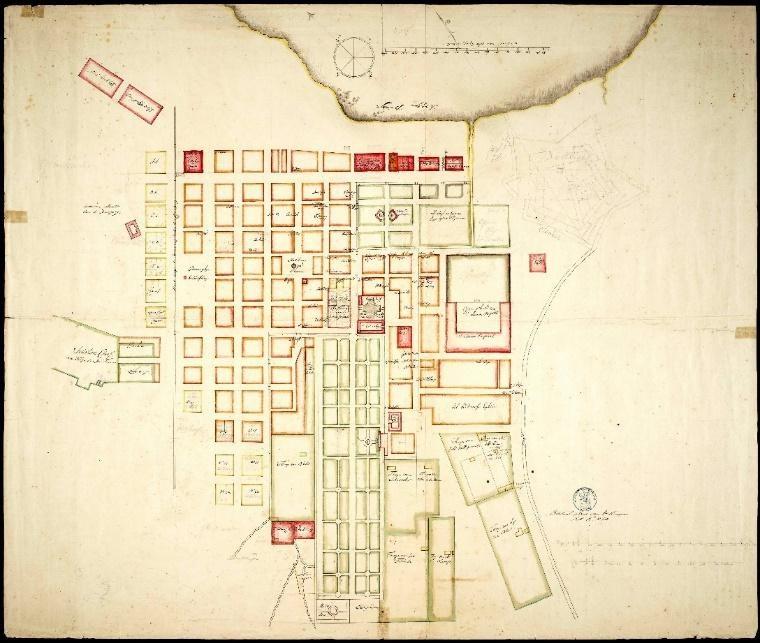
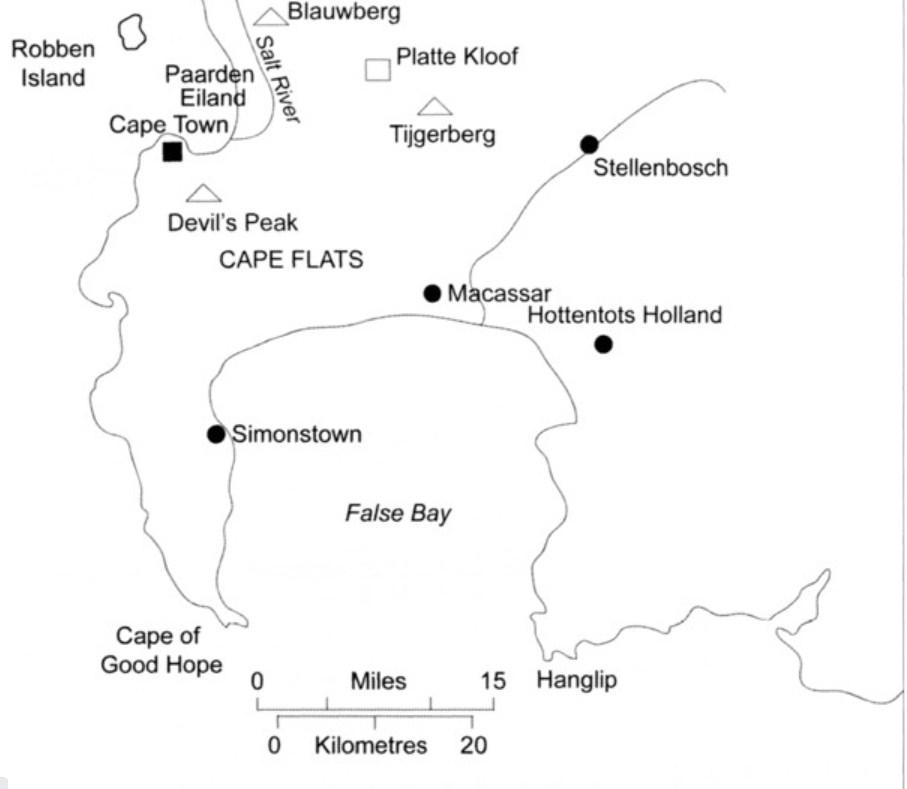
Figure 14: September's residence.
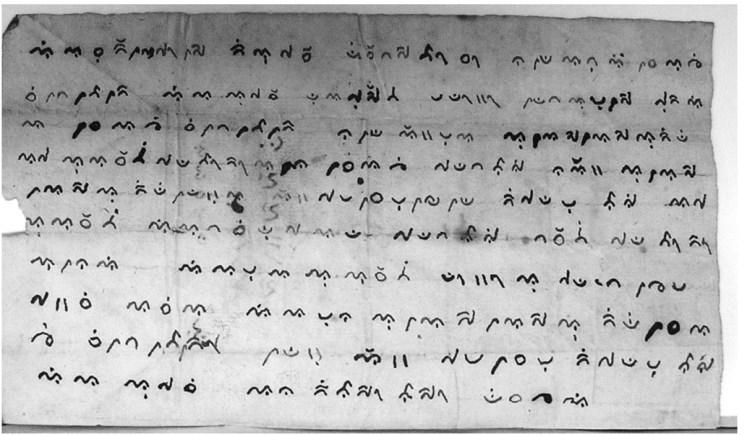
Figure 15: The Stellenbosch letter34 .
The Cape Town City Council has erected a shrine (Figure 16 below) next to a shooting range on Philip Kgosana Drive
(De Waal Drive) in Cape Town to remember September the martyr – the very same September van Bugis.

The late historian36 Achmat Davids, in his unpublished manuscript Slaves, Sheikhs, Sultans, and Saints, supports Shaykh Hendricks' argument that the man known as 'September van Bugis' is the mysterious saint buried on Devil's Peak, known to his followers as Shaykh Abdal Qadir' (Figure 17 below).
So, Erasmus's enslaved person, September, is now recognised as a martyr and spiritual leader in the 'Hall of Heroes' by the modern ‘Rainbow Nation’ .
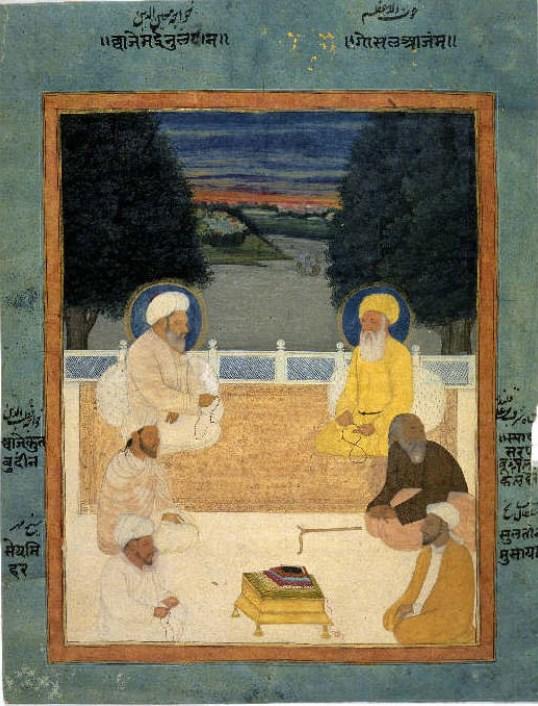
The Huguenots were quite the characters in our Afrikaner family histories! These French Protestants of the Reformed (Calvinist) tradition were welcomed with open arms at the VOC refreshment station. Not only did they bring some skills and know-how, but they also brought with them women, in very short supply at that time.
As the years passed, their influence blossomed. By the twentieth century, South Africa was shaped by an array of prominent business, political, and social leaders who bore French surnames names that were often perceived as more prestigious than their Dutch, German, or English counterparts! It wasn't until later in my life that I stumbled upon a fascinating revelation: our family has a deep-rooted connection to the very first Huguenots who arrived at the VOC refreshment station.
The story of the Huguenots is one of resilience and struggle amid religious turmoil. As they sought to practice their Protestant faith in France and Wallonia (southern Belgium), their growing influence sparked fierce opposition from the Catholic majority, igniting the intense French Wars of Religion from 1562 to 1598. These years were marked by battles, betrayals, and a desperate fight for survival.
The conflict finally subsided with the signing of the Edict of Nantes, a remarkable agreement that granted the Huguenots certain freedoms and rights. It was a moment of
hope, allowing them to practice their beliefs openly. However, this hope was short-lived. In 1685, King Louis XIV often referred to as the Sun King cast a dark shadow over the Huguenots by revoking the edict. He boldly proclaimed, “One faith, one law, and one king,” ushering in a period of dreadful persecution that drove many Huguenots to flee their homeland in search of safety and freedom.
Their journey was marked by courage, as they sought refuge in foreign lands, carrying with them their faith and a determination to survive against all odds. The legacy of the Huguenots is a testament to the enduring human spirit in the face of adversity, reminding us of the struggles for religious freedom that resonate through history.
Many Huguenots converted to Catholicism or fled. Those fleeing had a torrid time, indeed.
My 7th great-grandfather, Jean Prieur Du Plessis, was born in Poitiers, Poitou-Charentes, France, in 1638 and arrived at the Cape from Europe in 1685.
He was a renowned and skilled surgeon.
Jean Prieur had staunch Calvinist beliefs. He refused to convert to Catholicism. He found himself in a dire predicament: abandon his faith and freedom or endure a gruesome fate, possibly death at the stake. He witnessed his home and the local church engulfed in flames while some of his neighbours suffered at the stake, their screams silenced forever by the flames, but never to be forgotten.
But Jean Prieur was resilient and independent and sought to seek refuge in a land where he could worship freely, in a society where he would be accepted and treated justly. Daily, his friends and neighbours fled to the borders of France and the seaports, escaping the persecution of Catholics. Huguenots fled clandestinely, disguising themselves as beggars, travelling merchants, gypsies, soldiers, and shepherds, while women dressed as men, dyeing their faces to avoid detection.
Jean Prieur remained hidden in Poitiers for three years amidst heightened surveillance and danger. Soldiers guarded every exit while informants eagerly turned in fugitives for rewards. Witnessing the capture of friends and family, he lived in constant fear, venturing out only under cover of darkness to evade hostility and persecution.
During the mass exodus of Huguenots from Europe, over 400,000 sought refuge in Switzerland, Germany, England, America, and the Cape of Good Hope. Eventually, Jean Prieur secured passage on a ship to St. Thomas in what is now the US Virgin Islands, captained by a sympathiser.
In St. Thomas, Jean Prieur married another Huguenot, my seventh great-grandmother, Marie (Madeleine) Mentanteau, in June 1687. They then sailed to Amsterdam and joined the Waalse (Walloon) Church, finding sanctuary in a Calvinist haven.
On January 8, 1688, Jean Prieur gladly swore allegiance to the VOC in Middelburg, Zeeland, eager to start anew as a Vryburgher38 at the Cape. He and Marie set sail on the Oosterland for the Cape, welcomed by the VOC in Table Bay. Medical professionals were scarce in Stellenbosch and Drakenstein, making Jean Prieur's skills highly sought after.
Many prominent families boast of having a link to Jean Prieur10 .

Step back in time to the bustling streets of Ghent in the late 17th century, where my 9th great-grandfather, Jacques, was making waves as a successful merchant and entrepreneur. In 1688, driven by ambition and a spirit of adventure, Jacques set sail for the distant shores of the Cape. There, in the magnificent Drakenstein area, he embarked on an exciting new venture establishing a vineyard that would become legendary.
This vineyard, known as De Savoye Farm, would grow to be a cornerstone of the region's wine heritage and is now celebrated as Vrede and Lust Wine Farms in the picturesque Franschhoek valley. Jacques's legacy continues to flourish, as the vines he planted years ago still yield exquisite wines enjoyed by many.
Three Nortier brothers, Daniel, Jacob, and Jean, came out on the same ship as Jean Prieur in 1688 on the ship the Oosterland. Daniel was Dedrie's seventh great-grandfather! On the day they landed, Jacques was out on the jetty looking for farm workers. There, on the jetty, he offered both Daniel and Jacob a job. They were skilled farmers and had also worked as carpenters rare commodities at the Cape.
Despite his success, Jacques was an abrasive man. He was deeply religious, but often fought with anyone over the most trivial matters, except on Sundays, when he became quiet and contemplative, as was expected of a good Christian. In Flanders, he welcomed Huguenot pastors into his home, where they held home services, but going out to church became too hazardous. During those services, the records
say, he sang psalms so loudly during the day that neighbours complained! Rumours had it that he even picked a fight with the local Catholic vigilantes (particularly Jesuits) who bore a grudge against him, even threatening his life.
His wife, Christine du Pont, my ninth great-grandmother, tragically passed away in Belgium during childbirth, a fate not uncommon in those times. Jacques remarried and then departed for the Cape, bringing all his children with him. He came as a refugee and with business plans!
But Jacques did not leave his touchy ways behind. In Franschhoek, he clashed with various figures, including the governor, Willem Adriaan van der Stel. It must have been a serious clash, because the next thing, he ended up in the dungeon in the Cape Town Castle to calm him down. Immediately, upon his release, he found himself embroiled in a bitter feud with Reverend Pierre Simmond, a conflict that is still talked about to this day.
It all began with a rumour circulating in Stellenbosch and Drakenstein, claiming that Jacques, the new businessman at the Cape, was a bankrupt, fleeing his creditors in Belgium and seeking refuge from them at the Cape. This hurt him and tarnished his image deeply, leaving him in a combative mood, spoiling for a fight with anyone who just as much raised an eyebrow.
As a consequence of his sanctimonious pretence and posturing, Reverend Simmond, the spiritual leader of the community, placed Jacques under 'Censure' the most severe form of rebuke that can be levelled at a member of the congregation. Having served as an Elder in a Calvinist
church in my younger days, I understand the gravity of being placed under 'Censure.' According to the 30th article of the Westminster Confession of 1646, 'Censure' entails admonition, suspension from the sacrament of the Lord's Supper for a time, and ultimately, excommunication from the church.
It was a devastating punishment for my deeply devout ancestor. He came with so much hope, then he had to swallow the complete loss of respect and standing within the congregation. He was denied Holy Communion forced to sit in the pews with bowed head while the congregation partook of the wine and bread!
But Jacques wanted revenge, not against the church against the Reverend. He wrote a letter to the Church Council in the Netherlands, itemising his grievances against Reverend Simmond, most of which were trivial. He even accused Simmonds of importing an oven for baking bread and profiting from the congregation by charging them to use it. He implicated Simmonds's wife. He accused her of engaging in dubious, underhanded transactions that exploited the congregation.
Reverend Simmonds ‘tithed’ his congregation each parishioner giving one-tenth of their earnings to support him and his family. Jacques objected to this 'tithing practice’ in his letter. Jacques accused Simmond of ruling autocratically, ‘Akin to a Pope or a Bishop.’ The entire congregation turned against Jacques. They thought the letter to the Netherlands was ‘preposterous and scandalous’. The ill-feeling and antagonism lasted for months, and then matters escalated.
During a baptismal service, attended by Jacques, his wife Marie-Madeleine le Clercq, and daughter MargueriteThérèse as witnesses, a shouting match erupted. Jacques and his family started shouting and insulting Simmond. They demanded his expulsion from the church, declaring he deserved ‘damnation éternelle’ (‘eternal damnation’). Words like ‘tartufle’ (‘hypocrite’), Judas, ‘caffre’ (‘infidel’), and ‘faux berger’ (‘false shepherd’) were hurled at Simmond. Jacques sarcastically threatened that his influential friends would know how to deal with this 'le beau petit Monsieur' (‘the handsome little gentlemen’), teaching him a lesson ‘À ne jamais oublier' (‘never to be forgotten’).
Simmond, taken aback by the outburst, swiftly and dramatically penned a thirty-seven-page complaint to the Church Council about Jacques, in the most beautiful French rhetoric, now preserved in Church Council archives in Stellenbosch. He was at war with the De Savoye family!
In response, the combined church councils of the Cape, Stellenbosch, and Drakenstein adopted a softer, conciliatory tone. They urged the 'accommodation' of Jacques within the church, advocating for reconciliation and lifting Jacques' ‘Censure’ as a starting point for resolving the dispute. Everyone knew that Jacques was a wealthy and influential man, and the church needed him!
Despite these efforts, Jacques continued to be ‘extrêmement difficile’ (‘extremely difficult’). He frequently found himself embroiled in trivial court cases, losing his temper over the smallest thing. He sued someone for stealing a handsaw, and someone sued him for not paying his workers' wages in full.
Others took him to court for neglecting to maintain a sand bar and the road leading to his farm.
Uncertain of how to manage such an antagonistic individual, Governor van der Stel sought advice from the VOC in Rotterdam. The reply was diplomatic but did not offer a concrete way forward for the governor. The reply was: 'His nature can only be effectively altered and improved by time, kind intercourse, and treatment. We readily entrust this to your discretion.'
Despite his prickly nature, Jacques was generous to a fault. He donated land to construct his region's first Huguenot church and parish. Today, that land comprises part of the Plaisir de Merle Vineyards, renowned for producing excellent wines like the Plaisir de Merle Cabernet Sauvignon.
So, at least Jacques left us something pleasant to savour.
Here is our link to Jacques.
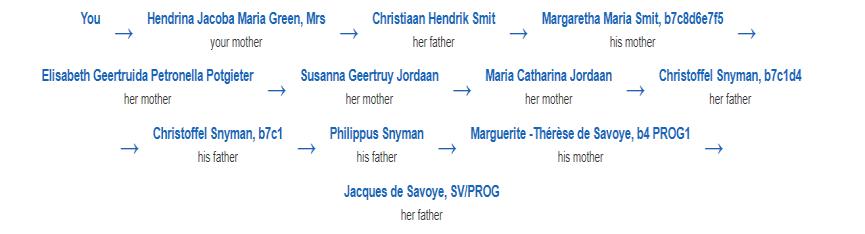
Jacob Nortje, employed by Jacques and Dedrie's ancestral uncle, never flourished. Jacob committed suicide in 1734. After slitting his wrist, he bled to death on the bank of the Berg River. He may have had PTSD or depression that we will never know. Oh, that the records had more to tell!
My seventh great-grandmother, Anna Prevost, entered the world in Marcq-en-Barœul, Nord, Nord-Pas-de-Calais, Picardie, France. She was baptised in the Huguenot church in Guines in 1681, just before the revocation of the religious edict that led to the exile of my Huguenot ancestors. Anna's father, Charles Prevost, a master wheelwright, and his wife, Marie le Fevre, faced a stark choice either convert to Catholicism or leave; they refused to convert to Catholicism, so leaving became their only option.
Despite Marie's advanced pregnancy, she and Charles departed under the cloak of darkness, taking their children, including seven-year-old Anna, with them. Did they join the ghostly procession of fugitives creeping along country lanes? Did they navigate through forests toward the Netherlands? Or did they find passage on a 'friendly' vessel along the French coast? The historical records offer no clues. What is certain is that they arrived in Middelburg, Netherlands, before embarking for the Cape in 1688 aboard the ship Die Schelde.
Tragedy struck even before they set sail, with two of the children dying suddenly. It was an ominous start to a journey fraught with peril and stress. Yet, my Huguenot ancestors were no strangers to adversity on a monumental scale; they faced it with resilience and courage!
Young Anna likely huddled below deck with her family as violent storms assailed their vessel before reaching the Cape Verde Islands (Figure 18 below) in the central Atlantic
Ocean, off the west coast of Africa. Here, they were compelled to halt their journey to repair their battered ship.
Unbeknownst to the passengers and crew, the island harboured pirates. Portuguese authorities swiftly rowed out to warn the captain upon their arrival. The news of lurking pirates instilled terror among the passengers and crew, especially upon learning that it was an English pirate ship notorious for its merciless exploits on the high seas (Figure 19below). Consequently, the captain wasted no time weighing anchor and setting sail away from the perilous island.
After narrowly escaping English pirates in a severely damaged ship, they encountered another storm near Table Bay. Miraculously, they navigated through it with minimal further damage to the vessel and its occupants. After enduring fifteen gruelling weeks at sea, the ship finally limped into the Cape Harbour, showing the wear and tear of the arduous voyage.
The VOC warmly received Marie and Charles upon their arrival. The family settled in the quaint village of Stellenbosch, where Anna blossomed into an intelligent, resilient teenager. At age 15, she crossed paths with my seventh great-grandfather, Schalk van der Merwe, and they tied the knot in 1696. Records indicate that Anna was pregnant almost every year for about seventeen years.
A high-ranking VOC official persuaded Simon van der Stel to grant the farm, De Hoop, nestled between the Berg
River and the Drakenstein Mountains, to the young couple as a wedding gift, giving them a head start in their new life.
Their journey began auspiciously with immediate family members gifting them eight plough oxen, two heifers, a horse with saddle and accessories, a wagon and yoke, and essential farming implements. These acts of generosity were lifelines for the newlyweds, who were deeply appreciative.
As the sun dipped below the horizon, painting the sky in hues of orange and purple, Anna and Schalk navigated the rugged path to 'De Hoop' farm in their heavily laden wagon. They were excited and optimistic about the new adventure that lay ahead. Right beside them, a few newly acquired slaves shuffled in shackles, their expressions a mix of apprehension and fortitude. After enduring several gruelling days on the rough road, they finally arrived at dusk, gazing wide-eyed at the untamed wilderness that stretched before them a landscape full of both promise and uncertainty.
Pitching a large tent, they settled down for the night as the Southern Cross adorned the sky. This was a wilderness that teemed with antelope, leopards, and baboons in the mountains while elephants roamed freely. They fell asleep with the bark of baboons and the howling of jackals. With the morning star bidding farewell to the night, they eagerly commenced clearing the area for their new home.
For many weeks, everyone toiled tirelessly, utilising wood and other materials sourced from the surrounding mountain slopes to construct their house. Schalk spared no one from the backbreaking work, wielding a sjambok on any idlers. He
kept his musket close at hand due to the constant threat of attack by local Khoisan39 people, prowling leopards, serval cats, or desperate fugitives.
Once the house was built, they set about transferring their furniture from the wagons into their new abode. Finally, they could begin earning a living and supplying the insatiable VOC with meat, grain, and whatever their fertile land could yield for the corporate machine.
Months later, Schalk embarked early one morning with a group of slaves to complete the ploughing of the fields. Walking alongside two oxen pulling the plough, Schalk marvelled at the sight of the beautiful black earth being turned. 'Things couldn't be better, ' he thought, as the tilled land beckoned with promise: 'At last, we're making progress.
However, Schalk's reverie was abruptly shattered by the sharp bang and whistle of a musket fired near the house. Turning towards the source of the sound, he was stunned to see three elephants charging towards him. Behind them emerged Anna, cursing and shouting at the top of her voice, brandishing the musket.
As the elephants thundered past him, Schalk threw himself in front of the oxen, hoping to present a smaller target to the colossal beasts. Breathless and beside herself, Anna reached Schalk, explaining what had happened. 'The beasts were scratching themselves against the wall of the house, ' she exclaimed. 'I heard a creaking sound, saw the wall moving, and realised they were about to bring the house down. I fired at the nearest one, and the next thing, there
was a gaping hole in the wall, and the house collapsed. They sure got a bigger fright than me!'
Their dream lay in tatters, shattered by the relentless force of nature, in this case, three itchy elephants just looking for some relief. Despite the incessant hard work, the blistered hands, and the dreadful sunburn, Schalk and Anna refused to succumb to despair. Instead, they resolved to rebuild with renewed determination.
In no time at all, they reconstructed their house and resumed their efforts. Over the years, they prospered and expanded their farming business, eventually acquiring the farms 'Wittenberg' and 'De Sagte Valleij' in the 'Land of Waveren.'
Yet, their lives remained fraught with danger. Whether threatened by wild animals or subject to raids by the Khoisan, peril lurked around every corner. As Schalk tended to the farm, he also served as the VOC commander for the region, leading numerous attacks against the Khoisan.
The raids conducted by the Khoisan across the Drakenstein region and beyond began to weigh heavily on the settlers' peace of mind, including Schalk and Anna’s. The consensus was that the Khoisan had to be eradicated. Thus, a dark chapter in the saga of the Green family tree unfolded.
In 1777, the VOC Council of Policy openly sanctioned the extermination of the San, wherever and whenever encountered. It marked a genocidal moment in which my
ancestors played a regrettable role, a sombre stain on the legacy of the Green family ancestors.
Anna is linked to us in another branch of the family tree.
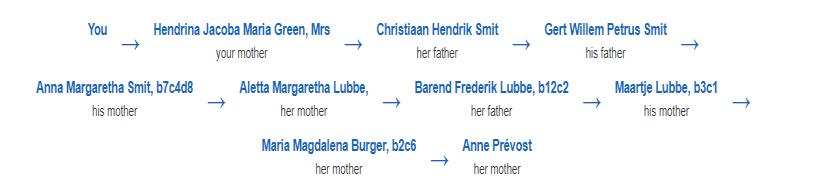
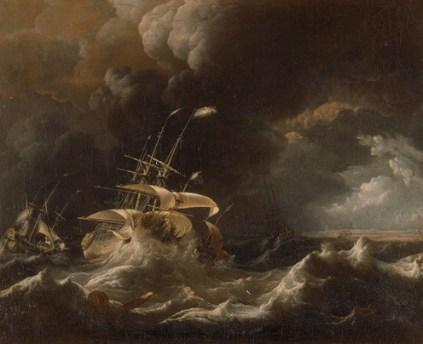
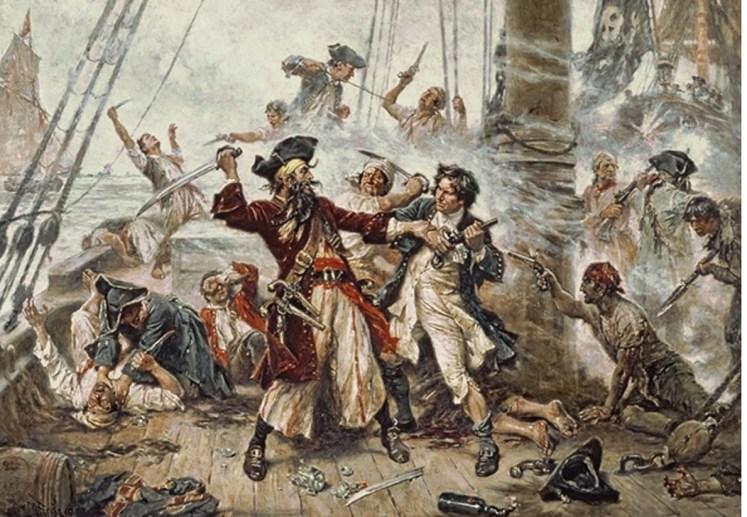
Maria Mouton42 stands out as a prominent yet dark figure in our family history, a fifth great-aunt and another descendant of our Huguenot lineage.
In 1714, Maria found herself accused by the VOC of the murder of Frans Jooste, aka 'Schurf', a charge that ultimately led to her conviction and execution. But to understand Maria's actions, one must delve into her tumultuous upbringing.
Born into instability, Maria was the daughter of Jacques Mouton, a Huguenot who sought refuge in the Cape in 1699, fleeing the religious tumult of Flanders. Jacques, accompanied by his new wife, Marie de Villiers, and young Maria, embarked on a fresh start at the Cape after divorcing42 his first wife a decision met with societal and religious censure in those times.
Tragedy struck early in Maria's life when her mother, Marie, succumbed to complications following the birth of her sister, Margaretha. Left without a mother, Maria experienced her father's remarriage to Francina Bevarnagie, a Flemish settler, further adding to the upheaval in her formative years.
Growing up on a remote parcel of land in the 'Land van Waverin', in the upper Breede Rivier, bestowed upon her father by VOC Governor Willem Adriaan van der Stell, Maria experienced a rugged existence. The landscape, the veritable 'Wild West' of Southern Africa, teemed with outlaws, fugitive slaves, indigenous Khoekhoen, and untamed wildlife. Governor van der Stell tasked Jacques with the
arduous mission of clearing the land for cattle rearing and wheat cultivation.
Nestled within a horseshoe-shaped valley, the 'Land van Waveren' was flanked by imposing mountains, with access limited to a perilous pass ill-suited for wagons. Despite the natural challenges, Maria, alongside her family and slaves, toiled ceaselessly, tending to the land, reaping wheat, and tending to their cattle a livelihood often overshadowed by the ever-present threat of conflict.
The simmering tensions between the settlers and the indigenous Khoekhoen frequently erupted into skirmishes as the latter felt encroached upon by the settlers' burgeoning livestock trade. In this volatile environment, Maria and her kin grappled with the dual demands of agricultural labour and the defence of their homestead, navigating troubled and stressful times fraught with uncertainty and danger.
Maria's upbringing was marked by hardship and isolation, devoid of education and leisure. In a foreign and perilous land, she found herself navigating life with a new mother, sister, and a hostile local population. Despite her intelligence, Maria yearned for a safer and more fulfilling existence.
Under Jacques's devout guidance, their household centred around prayers and Bible readings during meals, punctuated by the solemn melodies of psalms. Annually, they embarked on pilgrimages to Stellenbosch or Drakenstein for Holy Communion, offering a brief respite from their secluded existence. During one of these journeys in 1706, Maria, then a vibrant sixteen-year-old, caught the attention of 'Schurf' Jooste.
A rough-hewn man from Lippstadt, Germany, Schurf had transitioned from a VOC soldier to a Vryburgher, acquiring a land grant in 'Waveren' at the foot of the Elandskloof pass. Despite his coarse demeanour, Schurf was renowned for his farming prowess, boasting a substantial herd of sheep and cattle and cultivating wheat with the help of his slaves, Titus and Fortuijn.
Driven by a desire for a wife, Schurf's thoughts turned incessantly to Maria despite their seventeen-year age gap a common occurrence in an era where older men often wed young brides or emancipated slave women. Despite his rough edges, Schurf was deemed respectable, God-fearing, and reliable a favourable match by the standards of the time. With Jacques's consent, Maria and Schurf were wed in 1706.
Maria relocated to Schurf's homestead at the base of the Elandskloof Pass, another remote enclave concealed by mountains and accessible only through treacherous passes. Yet, amidst the solitude and rugged terrain, Maria embarked on a new chapter of her life, bound to her husband in marriage and the challenges of frontier existence.
Managing the farm in the eighteenth century proved to be arduous, gruelling labour for Schurf, Maria, and particularly their two slaves, Titus and Fortuijn. Maria found herself reliant solely on Schurf and the two slaves for companionship; a situation worsened when she gave birth to Jacob in 1710 and Francois in 1712.
Right from the start, Schurf controlled Maria and the slaves with an iron hand and the lash of the sjambok. He was a brutal, merciless figure, subjecting the fiercely independent Maria to beatings to enforce obedience and compelling her
to wear worn-out, tattered garments even when they ventured out.
Their union swiftly deteriorated into a loveless, degrading arrangement marred by violence and coercion. Then, in 1714, Schurf vanished mysteriously, leaving no trace of his whereabouts.
After a few weeks, their closest neighbour, Jacques, grew concerned about the absence of their regular visits. Sensing something was amiss, he decided to journey to his friend's farm to investigate. Upon arriving at the property, he stumbled upon an unusual sight a social gathering. Maria was entertaining three slave men and two slave women, and they were revelling and drinking wine together, a behaviour considered highly unconventional for the time. Most settlers would have viewed this as aberrant conduct, stirring a mix of fear and anger. It was acceptable for a man to behave in such a way, though!
Approaching Maria, Jacques greeted her politely, asking, 'Hello Maria, what can we do for you?' Maria responded with equal civility, 'Good day, Jacques. How may we assist you?' Jacques then inquired, 'Maria, where is Schurf? I haven't seen him for days.' Maria's response was swift: 'I don't know, Jacques. We're all terribly concerned, and we've been searching for him diligently'.
Jacques remained sceptical, observing the scene before him, and remarked, 'But you all seem rather unconcerned. While Schurf is missing, here you are, enjoying yourselves?' Maria, displaying a hint of defiance, retorted, 'These are my slaves and my companions; I associate with them as I see fit. Besides, it is Saturday!'
Jacques was not pleased with Maria's flippant tone, especially considering the rumours circulating in the region about her relationship with Titus. Undeterred by Maria's response, he continued, 'A leopard might have taken him, or worse, a Hottentot might have slit his throat. And there's also the possibility of Pieter getting involved! We both know how much Pieter despised Schurf'.
Before his disappearance, Schurf had leased Pieter, a slave, from a neighbouring farmer. Pieter was notorious among the locals for his insolence and laziness. Jacques knew that Schurf had often disciplined him harshly with the sjambok. Moreover, Pieter had vanished around the same time as Schurf.
Growing increasingly suspicious, Jacques concealed his doubts from Maria and promptly visited Landdrost (Magistrate) Nicolaas van den Heuvel in Stellenbosch, sharing his concerns. After hearing Jacques's account of the encounter with Maria and the suspicious gathering, the landdrost (magistrate) also harboured suspicions.
Unbeknown to Jacques, Maria and her accomplices had orchestrated Schurf's demise!
Several weeks before Jacques's visit, Maria had a clandestine meeting with Pieter, who was hiding nearby. Offering him a deal, she said, 'I want to strike a deal with you, Pieter. I'll ensure your freedom in three years if you do a "small" job for me kill that wretched Schurf!' Pieter declined, much to Maria's fury. Turning to her lover, Titus, she expressed her frustration, exclaiming, 'Damn him to hell'!
Titus then proposed a plan to Maria, suggesting that he would take matters into his own hands and shoot Schurf while he was in the wheat fields. Whispering to Maria, he assured her, 'Schurf will drop like a bloubok (blue buck antelope). Then, we'll dispose of the body by dumping it down one of the warthog or porcupine holes.' Titus then enlisted Fortuijn's help, who eagerly agreed to assist.
The culmination of their plan occurred on a scorching afternoon in 1714.
Amid a heated argument, Schurf lunged at Maria with a stick, prompting her to flee to the threshing shed, with him in hot pursuit, intent on violence. Titus, who was cleaning the house floor, heard her cries for help and sprang into action. Seizing Schurf's loaded 'Snaphaan' (musket - Figure 20 below), he dashed into the shed, took aim, and fired. Titus's marksmanship was true, and the shot tore through Schurf's shoulder blade, leaving him mortally wounded and sprawled on the ground, blood gushing from the gaping wound.
Hearing the gunshot, Fortuijn rushed into the shed and, grabbing a hefty plough tail, delivered several blows to Schurf's neck until the life ebbed from his body. Satisfied that Schurf was dead, Fortuijn concealed the corpse in a warthog's lair, burying it underground with the help of Titus and Maria.
Isaac Visagie, a neighbour, arrived on horseback after hearing the gunshots and commotion. As he approached the farmhouse, Maria intercepted him, wearing a disarming smile. She casually explained that Schurf was out hunting and would return shortly. Oblivious to the grisly truth, Isaac left after a brief visit.
Shortly after Schurf's disappearance, Pieter, the runaway slave, joined a band of fugitive slaves bound for the Xhosas along the East Coast. However, discord arose within the group, leading Pieter to return to ‘Waveren’. Suspected of involvement in thefts and other crimes committed in the area, Pieter was apprehended by VOC soldiers, and, under interrogation, he was asked if he knew anything about the disappearance of Schurf. He then implicated Maria, Titus, and Fortuin in Schurf's disappearance.
With Pieter's revelations, Maria, Titus, and Fortuijn became prime suspects. Local authorities promptly arrested them in 1714, and an investigation ensued, gathering evidence and witness testimonies. All three were detained in the 'Castle’, while Pieter remained under suspicion of collusion.
The local authorities proceeded with two rounds of interrogation and appearances before the Court of Justice. If the truth did not emerge during the initial questioning, a follow-up session involving gruesome torture was standard procedure for the VOC, boasting a purported 100% success rate.
During the court proceedings, Maria, in tearful testimony, recounted her ordeal, claiming, 'I endured merciless beatings and mistreatment, driving me to seek solace from Titus. I found more kinship with the younger slaves than with Schurf. She lamented, 'The violence shattered our marriage, leaving me with no choice but to seek comfort from Titus. Not only that, I was forced to wear the same dirty and tattered dress for ten long years.’
Maria further disclosed how she desperately approached Pieter and requested him to eliminate Schurf, and then approached Titus. She then said that Schurf’s disappearance was a mystery.
Despite Maria's emotional testimony, the presiding judge dismissed her grievances, including those about her clothing, stating that it was common for women to wear the same attire for years. Dissatisfied with Maria's responses, the court deemed a more aggressive approach necessary and resorted to further interrogation.
After relentless interrogation, Maria eventually admitted that her two slaves were responsible for the deed but absolved herself of any involvement. The interrogators remained unsatisfied, poised for one final attempt to extract the truth. They decided to employ torture until Maria provided a satisfactory confession.
The fiscal56 Ordered Pieter to be thrown into the castle's infamous 'black pit' dungeon43 while Titus and Fortuijn were placed in the adjacent front dungeon44. An eavesdropper strategically positioned overhead heard Pieter pleading with Titus 'No betrayals!'
On August 15, 1714, all three accused were dragged to the dreaded 'pain room'. Confronted with imminent horror, Maria and Titus confessed immediately. Fortuijn, however, remained defiant until threatened with the removal of an eye, at which point he relented and confessed.
Sentenced to death, their executions were designed to be the most gruesome and agonising imaginable. Maria was bound to a pole, half-strangled, scorched, and then slowly strangled to death by the executioner, enduring excruciating
pain. Her body was then displayed in public, fastened to a forked post until it decomposed.
Titus met a similarly gruesome fate. He was impaled while alive, then decapitated, and his right hand severed before his body was displayed on a pole beyond the boundaries of his late master's property.
What disgusted the court most at their trial was that Maria had willingly had a carnal relationship with her co-accused, a slave, Titus of Bengal. This was ‘just not done it was not respectable!’
Nigel Penn45 describes the impact of her actions on Cape society: ‘Her lustful and murderous conduct, her intercourse with a dark-skinned bondsman, was a betrayal of both her gender and her social group; colonial society was threatened by her actions’.
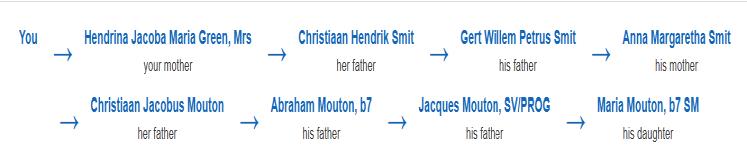

Our ancestors played significant roles in the growth and development of the Cape Colony, from the start in 1652 to the demise of the VOC a period of 150 years. Key players were employees of the VOC, coming from the Netherlands, Germany, and Scandinavia, including the French and Belgian Huguenots who fled religious persecution.
The VOC granted them land so they could retire as independent farmers. Each received a plot of approximately 12 hectares, along with a twelve-year exemption from property taxes and loans for seeds and agricultural tools. In return, they had to commit to living in the settlement and then the colony for at least twenty years.
In the early days of the settlement, the land shown in the following map was allocated to the Vrijburghers.
Most of our ancestral families migrated into the interior in the latter part of the seventeenth century in search of more abundant and better grazing land. Some were the Trekboers nomadic farmers; others the Grensboers (border settlers, farmers), who moved to the eastern border of the colony, where they clashed with African tribes over land. The extent of the colony at the end of the VOC era is shown below.
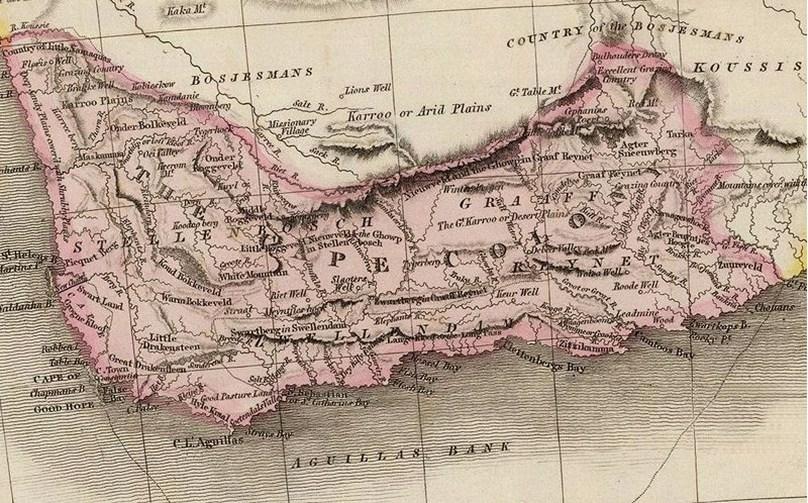
Figure 21: Map of the frontier 180646 .
Dedrie’s ancestral Beukes family did not join the mass exodus of Boers47 who left the colony in 1836, migrating into what would become Natal, the Orange Free State and the Transvaal. They were tenured Trekboers until the outbreak of the Anglo-Boer War in 1899.
Vrijburgher ancestors that speak to us from the family tree branches are Jacob Cloeten, Geertje Aeltje Gerritz, ‘Grof’ Visser, Gerrit Willemse, Gerrit Coetzee, Mayken Hendricksz, and Tryn Ras.
Trekboer ancestors from the family tree branches are Hendrik (Dirk) Beukes, Hester Venter, Gerrit Beukes, and Dirk Beukes.
A Grensboer ancestor from the family tree branches is Jacobus Potgieter.
Jacob Cloeten, our ninth great-grandfather, and his wife, Fijtje Raderotjes, our ninth great-grandmother, hold significant places in our family history. Jacob enjoyed favour from the VOC and was among the earliest settlers in the Cape to acquire land. On October 10, 1657, he was granted titles to 17 hectares of land (Figure 12 above). By December of the same year, he possessed 40 head of cattle and 146 sheep, marking him the first permanent and materially successful immigrant in the Cape.
Even though Jacob enjoyed the support of the VOC, the authorities saw him as a cunning rogue. Renowned for his knack for bending VOC rules to his advantage, he often found himself on the wrong side of the law. His illegal bartering with the Khoekhoen people for prohibited maize and dealings with dubious characters landed him in hot water. With little regard for the VOC's regulations, he would eagerly board ships the moment they docked from Batavia or the Netherlands, putting his personal gain above all else.
Under the cover of night, Jacob would stealthily board newly anchored ships, inspecting their goods by the flickering lantern light. He had connections with every arriving vessel and friends in every VOC destination, including high-ranking VOC personnel. On numerous occasions, he would set out, with sacks of goods, in the dead of night to meet with Khoekhoen traders—meetings probably arranged by contacts at the fort, such as Eva, my ancestor.
His evasion of punishment for these trespasses remains a mystery; the VOC apparently turned a blind eye.
Jacob's management style left much to be desired, and it wasn’t long before tensions boiled over. His team filed multiple lawsuits against him for unpaid wages, highlighting his neglect. Fortunately, the staff eventually received their overdue payments, but the experience served as a stark reminder that certain facets of human nature like the struggle for fairness remain timeless!
Early on, conflicts arose between settlers and the Khoekhoen over grazing land and territory (Figure 22 below). Jacob found himself deeply embroiled in this ongoing struggle despite also engaging in trade with the Khoekhoen. His farm encroached upon prime Khoekhoen grazing land (Figure 12 above), leading to open conflicts between settlers and the Khoekhoen. These tensions simmered over the years until erupting into a full-scale war around 1659-60 against the Khoekhoen led by Doman.
Meanwhile, back in the Cape, Commander Jan van Riebeeck became aware of the looming uprising in the regional areas. In response, he dispatched their few horses and matchlock muskets to help counter the escalating cattle raids. However, their limited resources proved insufficient to address the situation, leading to a dangerous escalation with the Khoekhoen gaining the upper hand.
For years, the Commander had fervently sought horses as much as food to quell the Khoekhoen attacks. In his journal, he wrote, 'Horses are as necessary as bread in our mouths',
repeatedly requesting more horses from Batavia or the Netherlands to suppress any uprising and stem the financial losses incurred by the VOC. Despite his pleas, the VOC head office in Amsterdam consistently ignored his demands.
Meanwhile, the local Khoekhoen chief, Doman Nommoa, reached his breaking point with settlers encroaching on their land. He seized seven of the VOC's draught oxen from Jacob's farm in a bid to deter the settlers and reclaim their grazing territory.
In response to this perceived act of banditry, van Riebeeck dispatched an armed militia from the Cape to recover the cattle. While most local settlers sought refuge in the fort, fearing the impending conflict, Jacob and his family chose to defend their farm.
The Khoekhoen remained undeterred by van Riebeeck's show of strength, aware of the VOC's limited horse resources. Jan van Riebeeck had a strategic trick of his own. The message got out that horses were on their way. Van Riebeeck had a single horse available, which he cunningly used to show that they would have superior military prowess when their horses arrived. He wanted to show that the Khoekhoen had no chance when faced with the speed of horses, combined with the firepower of the muskets. He wanted to show them who the boss was!
The VOC records state that:
The commander, galloping along the near bank towards the farms of the Vryburghers, soon disappeared from their view. His
purpose was also to demonstrate the speed of the horses, which caused great awe among them…Commander Van Riebeeck noted with satisfaction that the local population were astonished and impressed by horses because of the ‘miracles’ of speed at which they performed…
With only a single horse available, daily skirmishes ensued, escalating into the first Khoekhoen-Dutch War. Doman employed cunning tactics, only attacking on rainy days to exploit the damp gunpowder in Dutch muskets.
The tides of fortune began to turn when the muchanticipated shipment of sixteen ‘speedy’ horses finally galloped off the ship from Batavia, just as the conflict was reaching a fever pitch. Tension hung thick in the air; the uprising threatened to upend everything they had built. Realising the stakes were too high to ignore, the VOC had made the pivotal decision to send the swift steeds from Batavia just in time.
One morning, not long before the arrival of the sixteen horses, Jacob and his friend were tending to the cattle on Jacob's farm when they spotted a group of Khoekhoen approaching. Doman led about a dozen Khoekhoen, outnumbering Jacob and a friend, who found themselves unarmed. To their surprise, shots rang out from the farmhouse. Looking up, they saw puffs of smoke at the window. The women inside had grabbed two muskets— always ready and loaded, thrusting them through the window and supported by the window ledge they started firing at will. The women were out of line, as far as the men were
concerned, loading, ramming and handing the muskets to the men were acceptable, but firing?
The whistling musket balls proved effective, and the Khoekhoen, having previously witnessed the devastating power of these weapons, quickly retreated. Their weapons were no match for the muskets, reflecting a grim reality where muskets and gunpowder held sway.
It was shortly after this domestic skirmish that the arrival of the sixteen horses tipped the balance, and the conflict ended with relative peace for the next few years. The horses proved to be the game-changer. In the truce agreement that followed, the Khoekhoen lost some land to the settlement and could only enter VOC territory via designated tracks, leading to a significant decrease in theft and attacks.
However, Jacob's peaceful existence was short-lived, as he met with foul play and was murdered outside the 'Castle.'
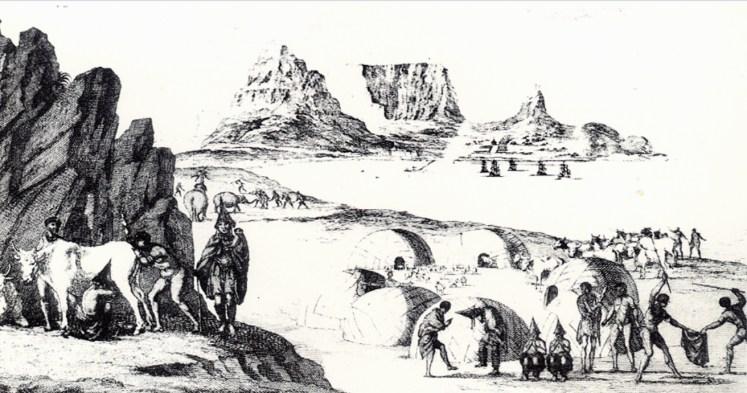
Figure 22: Dispute48 - grazing land.
On the 23rd of May 1693, there is an entry in the Journal of the Cape Governor, Simon Van der Stel:
This evening, between the hours of 8 and 9, was murdered, not far from the castle near the butchery, Jacob Cloeten, corporal in the service of the Hon. Company, the oldest of the Comp’s servants, having helped to lay the foundation of this colony, having been the first Freeman, though having later returned to the service of the Company... he was found badly mistreated with three blows to the head and two stab wounds to the chest, all five mortal, over and above twenty-five lesser wounds, he was found lying in his blood with his sword at his side still in its scabbard so that the attack must have been treacherous, as he was still very agile and as fit as a twenty-five-year-old young man.
His killer was never found or apprehended.
Many Afrikaner families have a family tree branch linking them to Jacob.
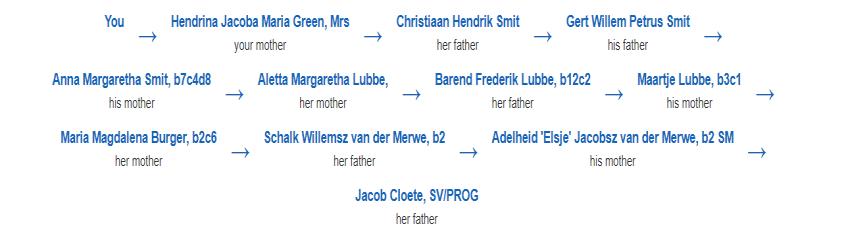
My eleventh-generation grandfather, Jan Coenraad Visser, known as 'Grof' (‘Ruffian’), embarked for the Cape from Ommen in the Netherlands in 1658 aboard the ship Dordrecht. A soldier and retired priest by trade, tall, blond with long hair, and powerfully built, he persuaded the VOC to enlist him as a hunter despite his advanced age.
Grof roamed the slopes of the Bosbergen (Bush Mountains) and the banks of the river as it snaked its way down to Table Bay. He traversed the lush landscapes, resplendent with shrubs, reeds, and ferns, venturing into the dense forests cloaking the mountain slopes. I often envisage him wandering through his hunting grounds, solitary yet invigorated by the wilderness surrounding him.
Today, Grof's hunting grounds are part of the Fynbos (Cape Floral Kingdom), now a World Heritage Site. Here, he would have encountered proteas, ericas, and restios on the mountain slopes, along with blue and red disa orchids nestled in the gulleys exotic flora he would never have encountered back in the Netherlands. In those temperate rainforests, he would have witnessed the bustling flocks of birds in the magnificent trees, sadly felled daily to replace the masts of ships snapped by the fierce south-easterly winds at sea.
Grof, the hunter, provided the VOC with much-needed protein, his shots resounding along the Liesbeeck River. On open ground, he would encounter large herds of antelope,
zebra, and wildebeest mingling with ostriches alongside flocks of partridges and guineafowl. In the woods, he would startle warthogs, porcupines, and other small animals hiding in the undergrowth.
Grof faced numerous predators in his hunting expeditions: lions, leopards, wild cats, and hyenas lurked in the shadows while barking baboons on the mountainside. Grof often encountered hyenas, who had developed a taste for the burgeoning cattle population near the Liesbeeck River, and he dispatched many of them.
The VOC provided well for Grof, financing the passage for his wife, Geertje Aeltje Gerritz, my ninth greatgrandmother and their three children, who arrived on the 4th of February 1662. However, upon arrival, they discovered that Grof had fathered a child with the slave woman Lijsbeth van Bengal. Records are silent about the impact of this discovery. Such occurrences were common during that era, with many children being born from unions between male settlers and local women. Despite this revelation, Grof's marriage endured, and they lived harmoniously for many years.
However, tragedy struck when Grof's wife, Geertjie, was beheaded by the slave Claes van Malabar in 1692.
Geertjie needed firewood to bake bread, a process that required starting early in the afternoon to allow the bread to rise and bake properly. However, Claes, preoccupied with searching for stray cattle that morning, returned late with the firewood. Geertjie, frustrated by his tardiness, scolded him
upon his return. Enraged by her reaction and past conflicts between them, Claes uttered a menacing remark, telling her to fetch the wood herself. A heated argument ensued, during which Claes allegedly insulted her.
In a fit of anger, Geertjie attempted to strike him with a stick, prompting Claes to strike her in the face with an axe he had picked up. Consumed by years of pent-up rage, Claes continued to attack Geertjie with the axe until her head was nearly severed.
One of the female slaves, Maria, heard Geertjie's bloodcurdling screams and rushed into the room, immediately traumatised by the horrific scene that awaited her in the kitchen.
Grof, along with a visiting ship's carpenter and sailor, were gambling in the lounge when they heard Maria's screams. They ran into the kitchen and found Claes still standing over his victim, relentlessly hacking at the lifeless body. The room resembled a slaughterhouse, with blood splattered everywhere on the walls, on the floor.
At nine o'clock that night, Grof pounded on the locked gates of the 'Castle' and demanded to see Governor Simon van der Stel urgently. The guards escorted him to the governor, who, upon hearing the dreadful news, summoned the fiscal, his slave assistants, and eight soldiers to arrest the murderer.
When the chief surgeon examined the corpse, he was confronted with a truly horrific sight. Geertjie's body lay half
on her right side and half on her back, bearing numerous open axe wounds, including defensive injuries on the arm she used to shield herself from the deadly blows. She was practically decapitated.
On the 18th of March 1692, the unrepentant Claes was sentenced to be 'broken on the wheel.' The punishment was carried out three days later, and by one o'clock, he was dead, his corpse left on the wheel to decompose.
Overwhelmed with grief, Grof sought solace in his domestic slave, Maria. He went on to have three more children with Maria and continued to hunt in the valley of our ancestors.
Our link to Grof is shown in the following family tree branch.

Dedrie’s family tree leads to Gerrit Willemse, an immigrant from Leeuwarden, Friesland, Netherlands, who arrived in 1690, at the time of Governor Simon van der Stel, a few years after the first French Huguenots arrived.
Gerrit, a ‘lime burner’ and ‘livestock farmer’ by trade, was granted a free voyage and a piece of land to farm. On the 9th of April 1691, he married Dedrie’s ninth-generation grandmother, Maria Cornelisse50, daughter of slave women Catrijn van Malabar.
Several years after the marriage, Isaac Pietersz, a free Black man, took residence with Gerrit and Maria on the condition that he worked as a handyman. However, it wasn’t long before Isaac and Gerrit quarrelled. In September 1713, Isaac appeared before the local magistrate, charged with ‘various offences51 and stealing wine’ after being found by a VOC patrol hiding under Maria's bed.
But this was just the tip of a torrid iceberg.
The legal documents and minutes taken by Landdrost Nicolaas van der Heuvel show that Isaac had a troubled past. Gerrit complained that Isaac had become very cocky in fact, he had become both master and guardian the ‘top dog’ in the house, with intolerable habits. He said, ‘As the master in the house and guardian…I found him to be intolerable51. He kept bossing me around, and Maria kept ignoring me. ’
At his trial, the truth came out. The landdrost (magistrate) heard that ‘Isaac loved both Maria and wine with equal passion and stole wine regularly, such as from the farmer Richardus Adolphus Rigt.’
However, Gerrit did not initially explain the bizarre love triangle involving himself, Isaac, and Maria–a ménage à trois gone wrong. He initially only mentioned that ‘Isaac had great familiarity with Maria.’
Tales say that Gerrit was a heavy sleeper, particularly after a few mugs of the potent Cape wine the slaves drank. While he slept, Maria would sneak into the slave quarters at the back and snuggle beside the strong and macho Isaac. The lovemaking would last late into the night. Gerrit would not stir when Maria sneaked back and fell asleep, waking up long after Gerrit had got up to tend the vineyard outside.
Maria’s clandestine visits to Isaac’s bed became habitual, with Gerrit snoring blissfully through the night. However, one night, Gerrit lay snoring with one eye half-open. Unbeknownst to Maria, Gerrit was not as unaware as she thought he was. He had woken up several times in the past to find her absent and had an inkling of what had been going on. On that particular night, Gerrit watched as Maria quietly left the bed and tiptoed out of the room.
Gerrit waited for about half an hour before slipping out of bed noiselessly and slowly making his way to Isaac’s bed in the slave quarters. As he got closer, he could not believe what he heard - the gasps and sounds of Maria and Isaac making love.
When Isaac spotted Gerrit’s silhouette in the doorway, he jumped out of bed, stark naked, ran up to Gerrit, grabbed him by the hair, tripped him, and dragged the protesting Gerrit out of the house. Standing in the front doorway, he shouted at the cowering figure on the ground, ‘Leave this house and never come back, or I will kill you!’
And that is precisely what Gerrit did. He left, becoming homeless - a sad, dejected Gollum-like figure seen scrounging around the settler houses in Stellenbosch village. Not long after Gerrit’s humiliating departure, Maria and Isaac defied convention and got married, which was unheard of back then. However, this was to be the final straw.
Unfortunately, within that small, narrow-minded society, racial bias soon reared its ugly head in the burgeoning rumour mill. And it wasn't long before the local authorities got wind of the ‘salacious’ story and decided to intervene for the sake of everyone’s so-called moral standing. The VOC dispatched a unit of men to arrest Isaac for ‘other crimes.’
As the trial progressed, the story's magnitude grew, and news of the illicit ménage à trois spread far and wide. The VOC did not tolerate such dissent, so when the local magistrate learned that Isaac had fathered ‘two illegitimate brown children’ with Maria, Isaac was found guilty. He was tied to a pole, flogged, and banished to Robben Island to break rocks, although not as part of a chain gang.
In today’s terms, this kind of marital imbroglio would be splashed across the news cycle and social media, with squads
of reporters outside the courthouse waiting for more on the scandalous affair of the heart.
Amber Heard and Johnny Depp’s marital woes were small potatoes compared to Isaac, Maria and Gerrit’s bizarre love triangle!
VOC documents report51:
It was Isaac’s bad character. His owners were not to blame for his bizarre behaviour. He was adopted, cared for, and educated by the wife of Vryburgher Matthjis Diedriks a Black boy a freed slave. We tried to teach him good virtues for nine years, but he left our household to go vagabonding. While looking after him, he was rebellious and a real scoundrel.
The branch of our family tree leading to Gerrit Willemse is shown below.
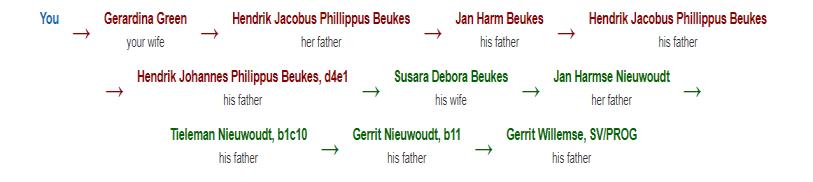
An ancestral cousin of mine, Gerrit Coetzee52, found himself entangled in a troubling accusation of bestiality involving a twenty-five-year-old Khoekhoen woman named Caatjie (‘Kitten’). This accusation led to his trial and eventual death sentence by the VOC, culminating in his drowning in Table Bay on the 23rd of September, 1733.
Here's what unfolded:
Caatjie, who had been in a tumultuous relationship with Gerrit, was visiting the farm of the freed Black Claas van Malabar in Drakenstein. There, she attended a gathering in the house, joined by several other guests from diverse backgrounds. It seemed to be a pleasant gathering, with everyone keeping their alcohol intake moderate and behaving appropriately.
However, the atmosphere changed with Gerrit's sudden arrival.
Caatjie, feeling fatigued, had sought rest in the wagon shed with her infant child. Gerrit was inebriated and in a foul mood, as was often the case, and angrily inquired about Caatjie's whereabouts. Another guest directed him to the shed, setting off a series of unfortunate events.
According to those familiar with the couple, they were experiencing discord in their relationship at the time.
Caatjie's version of events recounted her lying on a makeshift bed in the drafty wagon shed, covered by a sheepskin cloak, while a flickering wax candle provided dim illumination. Suddenly, Gerrit barged in, asking for sex. Due to his inebriation and hostile demeanour, she refused. Gerrit, incensed, left the shed and approached an old mare and her foal tethered nearby.
From this point, we must turn to the court records to piece together the rest of the narrative.
Caatjie's testimony before the appalled court painted a harrowing picture. She recounted how she heard the distressed horses braying in terror, prompting her to step outside and witness Gerrit's horrifying actions firsthand. According to her detailed testimony, Gerrit stood on a block, engaging in an unspeakable act with the red-brown mare 'against nature', as she described it. Gerrit held the horse's tail and restrained it with a rope around its neck, seemingly oblivious to Caatjie's presence as she observed the scene unfold from a distance.
With a mixture of horror and disbelief, Caatjie approached closer for a clearer view, unable to comprehend the scene before her eyes. Finally, unable to contain her shock, she cried out to Gerrit, questioning his actions in a moment of sheer incredulity. Once Gerrit finished, he nonchalantly re-tied the mare to the pole and departed without a word, leaving Caatjie to rush to the house and alert others to the appalling sight.
In her closing testimony, delivered with the solemnity of a nun, Caatjie emphasised that she could clearly discern Gerrit's actions under the bright light of the full moon, adding a poignant detail to her account.
While Caatjie's testimony was deemed credible and meticulously detailed, the court, tainted by biases of the time, regarded her as a heathen and thus considered her evidence only as half-proof. Despite her status, her account aligned with the testimonies of two others present that night, who confirmed hearing Caatjie's outcry and witnessing the aftermath of Gerrit's actions. These corroborating details lent weight to Caatjie's narrative, underscoring the gravity of the incident.
The trial was marred by flawed and contradictory evidence. Caatjie asserted that the incident occurred early in the evening, while the other two witnesses claimed it happened at dawn.
Initially, Gerrit vehemently denied all allegations, stating that he had engaged in sexual relations with Caatjie before visiting Claas's farm. He refuted the accusation of soliciting her for sex in the shed, asserting that he had already satisfied his desires earlier that day. Gerrit maintained that he remained with Caatjie until dawn, leaving only as the sun began to rise. However, to the astonishment of the court, Gerrit later confessed to having engaged in intercourse with a horse on a previous occasion.
Adding to the trial's incredulity, two local settlers, Johannes Pretorius and Abraham Le Roux, provided
testimony53. They recounted an incident eight months prior when they stumbled upon Gerrit copulating with a grey mare in a vineyard. The mare was positioned behind a quince hedge in a ditch, subjected to Gerrit's dubious advances. Appalled by the scene, the witnesses swiftly departed.
This damning testimony sealed Gerrit's fate, leading to a conviction of bestiality in the first degree. According to the law, the punishment was death by drowning in Table Bay. Thus, Gerrit met his watery end following his equestrian sex romp of 1733.
If only the defence had questioned the inconsistencies between Caatje’s and other eyewitnesses' statements Gerrit may have lived, forever cured of his horse fetish!
Interestingly enough, this scandalous episode underscores that no member of the Green family has ever pursued a career as a jockey. Our connection to Gerrit is well-documented10 in Geni.com.
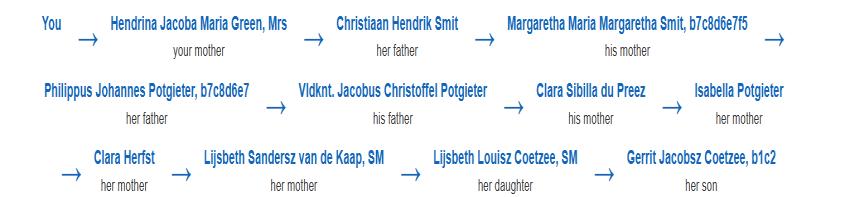
Mayken Hendricksz54 van den Bergh looms as a big skeleton in the Green family's closet, a career criminal with strong sociopathic tendencies. She was married to my eleventh-generation grandfather, Thieleman Hendriks, her partner both in love and in crime.
One fateful afternoon, Mayken and Thieleman found themselves embroiled in an ugly brawl when their wagon collided with Hans Ras's bridal wagon. Returning from the same wedding, all parties were 'motherless drunk'. A dispute over right of way spiralled into a booze-fuelled race between the wagons. Whips cracked, curses flew, and in the chaos, Hans Ras's wagon swerved dangerously, grinding to a halt by the roadside. Drunken and enraged, people poured onto the road, ready for a fight.
As tempers flared, Thieleman, much to Hans's ire, hurled scathing insults. In a drunken frenzy, Hans lunged at him, toppling both men to the ground. Struggling, Hans found himself stabbed in the ribs by Thieleman's knife, the blade snapping off in his flesh. The scuffle escalated into an all-out brawl, with Mayken leading the charge against the occupants of the opposing wagon.
This clash marked the first recorded vehicular accident at the Cape and was just the beginning of Mayken's legal troubles. Known for her foul mouth, she would hurl abuse at accusers before judges and the VOC Court of Justice members. Like many career criminals, Mayken operated a bar called Taps55, where dubious activities ran rampant day and night, spawning scandal after scandal.
Rumours circulated about her, including one that claimed she was a workhouse prostitute with a father who had spent years locked away in various prisons. Enraged by such accusations, Mayken once bit a woman's nose off during a brutal fight. After Thieleman's death in 1673, Mayken descended further into crime, engaging in illicit activities such as bartering, smuggling, and theft.
Despite warnings from a local police officer, Mayken persisted. Her downfall came on June 1, 1677, when VOC officials caught her stealing rice amid critical food shortages. As an example to others, Mayken faced severe punishment: a rice sack over her head, a public flogging, and branding with the gallows symbol on her back. The geweldiger56 (policeman) warned her to stop and threatened her with the gallows if she persisted.
Unrepentant, Mayken continued to defy authority, prompting the VOC to exile her to Robben Island before deporting her to Mauritius on July 27, 1677. Described in VOC archival notes as 'a terrible thief and pest' in the community, Mayken's sentence revealed the hypocrisy of the presiding judge and law officers, who themselves were corrupt.
Our connection to Mayken is shown below.
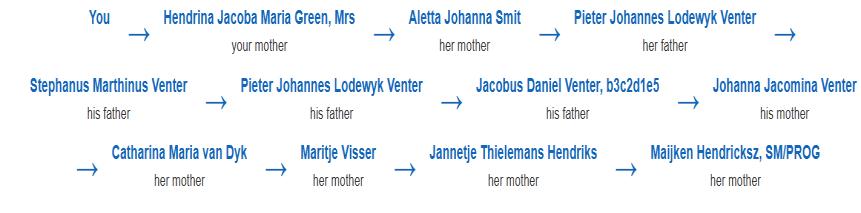
Tryn Ras57, Dedrie's eleventh-generation grandmother, hailed from Lubek, Germany, and was renowned for her fierceness and boldness. Widowed at the early age of twentytwo, she took matters into her own hands, disguising herself as a man and clandestinely boarding a sailing ship bound for the Cape in 1662.
Already a Vryburgher soldier in desperate solitude, Hans Ras was living in the Cape when Tryn arrived. Within two months of her arrival, they wed, and for nine blissful years, they shared their lives until tragedy struck: a lion claimed Hans's life.
The tale unfolds with a Khoekhoen man named Witbooi, who served as a herder for Tryn and Hans.
One fateful morning, Hans and Witbooi saddled up their two Javanese ponies to confront a notorious lioness that had been preying on their cattle, venturing dangerously close to their homestead. This lioness, a seasoned predator with numerous kills to her name, had kept the entire household on edge the previous night with her ominous grunts and roars, prowling around the stone corral where the cattle huddled in fear.
Despite the unfavourable conditions strong southeasterly winds whipping up clouds of dust, obscuring the rising sun they were determined to track the beast downwind, hoping to evade her keen senses.
Hans prepared his long, heavy matchlock musket (Figure 11 above), securing it to his saddle with its forked stick
support, brimming with confidence in his ability to bring down the lioness. With twelve powder charges in his bandolier and a pocketed belt for holding individual cartridges, Hans meticulously ensured that his fuse and powder satchel remained dry.
In his mind, armed with a weapon capable of striking down prey at a distance of 1000 feet, failure seemed inconceivable.
Hans bid Tryn farewell with a kiss, assuring her not to worry, and comforted her with the promise of a swift return. Confident in their plan to locate the lioness's den, Hans brimmed with assurance, explaining to Tryn that with Witbooi's tracking skills and his own marksmanship, they would swiftly neutralise the lioness and her pride if necessary!
Led by Witbooi's sharp eyes, they soon discovered tracks not far from the house, leading to a thicket near the base of a small hillock. Through the tangled scrub, some fifty meters away, Witbooi spotted the glimmering golden patches of the lioness. He signalled to Hans, his hand moving slowly from side to side.
Positioned downwind of the lions, the fierce southeasterly wind whipped dust into their faces, forcing them to squint as they surveyed the scene. Determined to take down the lioness first before dealing with the rest of the pride, Hans dismounted and secured his musket in the fork of the musket's forked support.
Hans meticulously primed the musket despite the stinging dust, pouring powder down the barrel from a wooden
cylinder in his bandolier. He carefully loaded the lead ball and tow, using his rammer to ensure a tight fit.
With anticipation mounting, Hans pulled the trigger, awaiting the telltale flash, smoke, and the projectile's whistle. As the thump of the ball reached his ears, he leapt up, hopeful that his shot had struck true, creating a lethal wound. Though musket balls packed a powerful punch, capable of causing massive injury or even instant death, their unreliability and slow reload time left little room for error, especially when faced with a charging lion.
Unfortunately for poor Hans, the lead ball had only inflicted a minor injury to the lion's thigh. Before Hans could fully reload, the wounded and enraged beast closed the fiftymeter distance in a flash, pouncing onto the screaming Hans.
Witbooi, lying low on his stomach just a few meters away, heard the gruesome crunch of the lion's teeth as they sank into Hans' shoulder and chest. With horror, he watched as the lioness' teeth began to sink deeper into his torso. Seizing his chance, Witbooi sprinted to his pony, leapt into the saddle, and galloped away in a cloud of dust, swept up by the howling southeaster.
Tryn, standing outside, spotted the approaching cloud of dust and recognised it as Witbooi. As the horse pulled up, Witbooi leapt off, shouting, 'The lion has taken the boss!’ Tryn's heart sank as she demanded to know where Hans was. Witbooi pointed in the direction he had come from. Without hesitation, Tryn pushed Witbooi aside, mounted his horse, and rode into the relentless wind.
When Tryn returned hours later, blood soaked her hands, clothes, and hair. Dismounting from her horse, she delivered
a chilling declaration to Witbooi and her terrified children, 'I have killed her; she has slain my Hans; now I have slain her.' Tryn never divulged how she had managed to kill the lioness, but her feat became legendary in the region, and she was regarded with a mix of awe and fear, akin to a lioness herself.
Yet, Tryn's fortunes with her husbands did not improve. After Hans's tragic demise, she wed Francois Champelaer van Ghent, a relatively unsuccessful farmer, who met his end at the hands of marauding Khoekhoen in July 1673. Her next husband, Swedish-born Laurens Cornelissen, brought her to the Table Valley, where they had two daughters. Tragically, Laurens met his end when he was trampled by a herd of elephants while hunting hippos at nearby Zeekoeivlei.
Tryn, disillusioned by the fate of her husbands, resolved to take her destiny into her own hands by acquiring land and becoming a farmer. According to some historical records, there were rumours of a romantic connection between Tryn and the Governor, Simon van der Stel, although nothing was ever proven. Nonetheless, it's widely believed that Simon granted her twenty-five morgen (approximately 21 hectares) of land at the base of Steenberg Mountain. While the nature of this grant remains speculative, it marked a significant milestone as Tryn became the first woman in South Africa to own land.
Today, the Steenberg farm is owned by the mining company JCI. It has been transformed into a championship golf estate, the prestigious Steenberg Hotel, and a renowned winery. Local lore even speaks of the ghost of Tryn Ras, who is said to wander the historic buildings under the cloak of night. Some claim to have glimpsed her ghostly figure
gracefully traversing the moonlit vineyards, perhaps keeping watch for lions and prospective husbands alike.
Tryn’s branch in our family tree follows.

Dirk Beukes58, my wife Dedrie’s sixth-generation grandfather, worked as a knegt (European farm overseer) in 1725 for Jacob Cloete, a member of the VOC Council of Authority. Dirk was no ordinary overseer; he ended up playing a significant role in the start of a war! We could be related to this particular Jacob Cloete, but I have yet to find the connection.
On June 20th of that year, Dirk arrived at Jacob's farm on the Olifants River with three teams of oxen to sow Jacob’s wheat fields. He was tired, having walked many kilometres alongside his lumbering ox wagon and plodding oxen to reach the farm. The journey had been pleasant, with the raw, dramatic beauty of the Cedarberg mountains etched against the pale blue sky in the distance.
Dirk was in high spirits. He unhitched his oxen at the kraal, leaving his wagon at the wheat field gate, and walked to the farmhouse.
The farmhouse (Figure 24 below)was rough and simple, with two rooms and a tiny kitchen. The floors were a mixture of clay and cattle dung, the walls were made of mud and stone, and the roof was thatched. Jacob occasionally occupied the farmhouse with his large family, so there was a place for Dirk to sleep and cook dinner on a large fireplace in the kitchen.
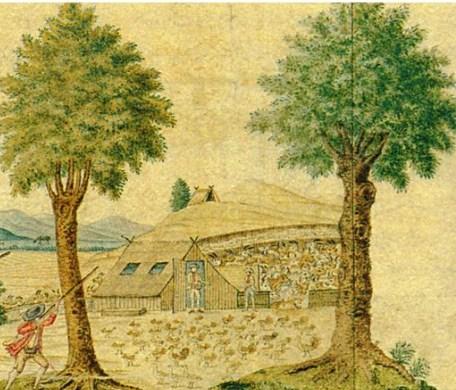
After dinner, Dirk threw off his boots and collapsed onto the simple bed, a wooden framework strung with unplaited rawhide strips and covered with sheepskin duvets. Next to his bed was a bedside table made from an ox skull. He propped up his loaded musket against the skull, keeping it within easy reach.
The next morning, the cold air and the sound of turtle doves woke him from his much-needed slumber. He dressed, pulled on his boots, and ducked into the kitchen to fix himself some breakfast.
But just as the fire began to cook his meal, all hell broke loose. A large group of Khoekhoen suddenly thundered through the front gate of the property towards the kraal,
where Dirk’s oxen were grazing. Amid much shouting, gesticulating, and a musket shot, the raiding party mustered fourteen of his oxen and drove them down to the flooded river. Dirk peered through a hole in the farmhouse wall, his large blue eyes wide with fright.
When the Khoekhoen reached the river, they drove the oxen into the swollen waters and crossed behind the bellowing beasts as they swam to the other side. Dirk grabbed his loaded musket, jumped onto his mare, and galloped down to the river.
His horse plunged headlong into the swirling water, with Dirk gripping her belly with his legs. Waving his musket, he cursed and shouted, calling them every name under the sun and threatening them with violent retribution from above while his trusty mare swam gallantly, keeping both their heads above water.
Meanwhile, some Khoekhoen gathered on the bank, waiting for Dirk to emerge. They brandished their muskets and several ugly-looking knives, shouting, ‘Come and get us, you piece of shit!’
Dirk had a terrible temper and knew he had to calm down quickly and hatch a plan if he was to get out of this situation alive. He hadn’t anticipated the Khoekhoen becoming this aggressive, nor did he know that two local farmers had stolen cattle from the Khoekhoen in the first place.
In an abrupt moment of clarity, Dirk realized they meant business and would not hesitate to kill him. He tipped his
hat, flashed them a smile, and threw down his musket. Their leader gave a conciliatory nod and, in a mixture of Dutch and Khoekhoen, explained that two local farmers had recently stolen some of their cattle, and this was an act of revenge. He then asked Dirk if he knew them.
Dirk did not flinch; he did not let on that these two farmers were his good friends. Instead, he tried to play dumb. However, the Khoekhoen were not easily convinced. Suddenly, one of them cursed, withdrew a large knife, grabbed Dirk, wrestled him to the ground, and placed the sharp blade against the soft flesh of Dirk’s exposed throat. Dirk swore, invoking the name of the Lord, ‘Before God, I will do my utmost to help you recover your stolen cattle.’
What else could he do with a large, sharp knife at his throat, already drawing a trickle of blood?
Dirk’s invocation of the divine did the trick; for the Khoekhoen, the assistance of God would surely help bring their cattle back. He implored them to return the oxen they had taken, to which they replied, ‘Only when we get ours back.’ And with that, they were gone.
Two days later, the Khoekhoen returned to the farm. Dirk had just led his remaining oxen into the paddock when the gang of Khoekhoen galloped through the gate again, shouting and bristling with anger.
They accused Dirk of complicity with the two farmers who had stolen their cattle, then described in gruesome detail how they would dismember him limb by limb and feed his
remains to the dogs. However, this time, they did not have muskets with them. Dirk did not need any further encouragement; he was prepared for this.
He sprinted to the farmhouse and into the kitchen through the back door, with the Khoekhoen following on foot. He slammed the bottom half of the door shut, and before they could break it down, he grabbed his loaded musket, always kept near at hand.
A well-directed shot through the open door made them back off and run for their horses. The Khoekhoen feared armed Trekboers, who were excellent marksmen, as were their women.
Out of musket range, they rounded up the remaining oxen and galloped off, driving the animals toward the river. Shouting and gesticulating, they vowed to return soon.
Dirk's horse was ready and saddled for such an occasion, so he jumped into the saddle and furiously galloped after them. When he arrived at the riverbank, he saw his remaining oxen swimming across the raging water, with Khoekhoen whips cracking above their heads.
Before Dirk could do anything, the Khoekhoen galloped off with all his oxen into the distance. This time, Dirk thought better of tackling them; he was unsure whether they were armed and had learned some valuable lessons from the previous encounter.
Dirk wasted no time getting to the nearest village, Stellenbosch, to file a complaint with the local magistrate.
Dirk’s account of the theft spread rapidly throughout the colony, fuelling all sorts of theories and whipping people into a panic. People were saying, ‘The Khoekhoen want to drive all the Trekboers back over the border into the colony!’ At that point, many Trekboers were living in Khoekhoen territory, outside the colony.
Before long, the Khoekhoen burned ten farms and took 700 cattle and 3,000 sheep from the Trekboers.
The frontier erupted in flames as the Khoekhoen uprising gained momentum. The local magistrate raised commandos from the surrounding districts to deal with the escalating crisis. Fear and outrage spread throughout the northern frontier as settlers drove their livestock southward and abandoned their farms. Reports of robbery and murder spread from one lonely farm to another.
The assembled VOC commandos eventually attacked the marauding Khoekhoen, who were no match for the wellarmed, trained commandos with their modern weapons. From Piketberg to Namaqualand, from the west coast to the Bokkeveld, the settlers rallied, and the commandos dispersed and routed the bands of Khoekhoen. Stolen cattle and sheep were confiscated from the Khoekhoen and redistributed to their rightful owners, including any aggrieved Khoekhoen.
An uneasy peace returned to the frontier, but everyone knew it would not last. Even though Dirk had inadvertently started the war, he was glad to have his oxen back and
continued, with hope in his heart, to till the fields for his employers.
We believe that Hendrik Beukes, shown in the following branch of the family tree, is the ancestor involved.
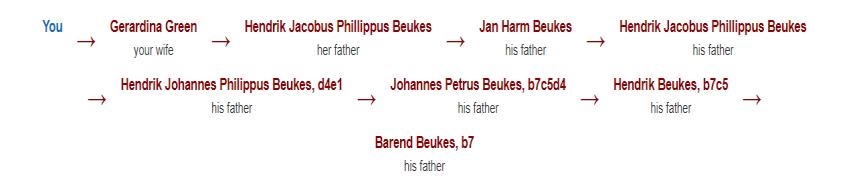
My distant first cousin, Hester Venter, recounts her harrowing experiences and hardships as she and her fellow travellers ventured deeper into the interior of South Africa in the eighteenth century. Hester was a pietist, an extremely religious woman, and, like many Trekboer women, believed she was mystically married to Jesus Christ.
Hester, like many women on the frontier, faced isolation and marginalisation. Despite this, she spent her days helping to sow and harvest grain and vegetables. She had eleven children and, in addition, had to help her husband, Tjaart van der Walt, defend their property against the Khoekhoen and the San almost daily. Visitors to Tjaart and Hester’s farm would have found them to be much like the Amish in the USA.
So, why was Hester so religious and a pietist60? I believe it was due to the brand of Christianity from the Dutch Second Reformation and the German Pietistic movement, which reached the Cape in the eighteenth century and provided the escapism and false sense of security they desperately needed.
Hester and her husband found themselves on the northeastern border of the colony in the 1790s. The country was in turmoil and revolt, embroiled in bitter conflict with the Khoisan across every point of the compass. The area faced constant attacks, with homesteads burned during the day, livestock stolen, and people killed61 . Sir John Barrow, who was tasked with reconciling the Boer settlers and the native
Black population as well as reporting on the interior of the country, described the situation as follows:
An inhabitant of Sneeuwberg has not only the continual apprehension of losing his property, but he lives in a state of perpetual danger. Should he depart to the distance of five hundred yards from his house, he is under the necessity of carrying a musquet. He can neither plough nor sow nor reap without his arms. If he would gather a few greens in his garden, he must take his gun in his hand. To bear a life of such constant dread and anxiety, a man must be accustomed to it from his infancy or unacquainted with one that is better.
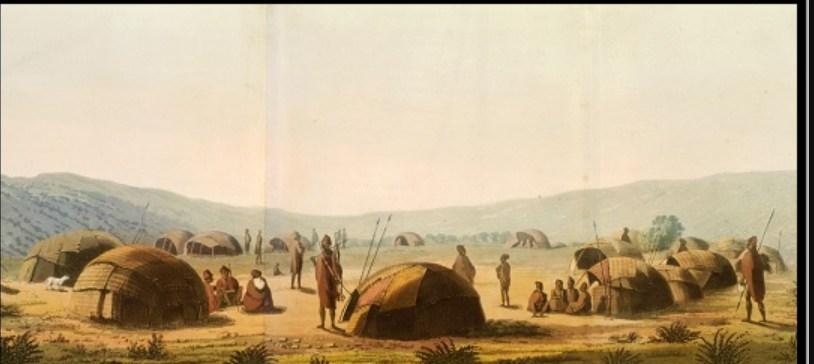
After one of the Khoisan raids (Figure 25 above) in the 1790s, Hester was moved to write the following in Dutch–translated into English, still sung in the Gereformeerde [Reformed] Church to this day:
That great God, that strong shield, Who still wants to have mercy on us?
But thou, wicked, mighty people, You put it in your own strength, That God who can protect us, You so constantly deviate from that,
And so work by your own strength, And make the enemy your might, His counsel will perish, God's church will also stand, O militant church that sighs here, Taking refuge in her weeping, So to the high Supreme Lord Who rules everything according to his will.
Barrow describes how deeply religious the frontier community were as they fought for survival in all the chaos and violence:
A book of any kind is rarely seen in any of the farmer's houses, except the Bible and William Sluiter's Gezangen or songs out of the Bible done into verse by the Stemehold and Hopkins of Holland. They affect to be very religious and carry at least the devotion of religion as far as most zealous bigots. They never sit down to table without a long grace before meat pronounced with an audible voice by the youngest of the family, and every morning before daylight one of William Sluiter's Gezangen is drawled out in full chorus by an assemblage of the whole family. In their attendance at church, they are scrupulously exact, though the performance of this duty costs many of them a journey of several days. Those who live at a distance of a fortnight or three weeks from the nearest church generally go with their families once a year. They would attend church or a service without fail, where practicable, even though the journey to church could take days. Those who lived too far away would attend Holy Communion once a year.
Hester became an iconic figure in the Dutch Reformed Church (the ‘Dopper’ Church). Her fortitude and piety provided a role model for the pioneers who trekked into the interior en masse and, indeed, a role model for many Afrikaner women in the 20th Century.
Our relationship with Hester Venter is shown below.
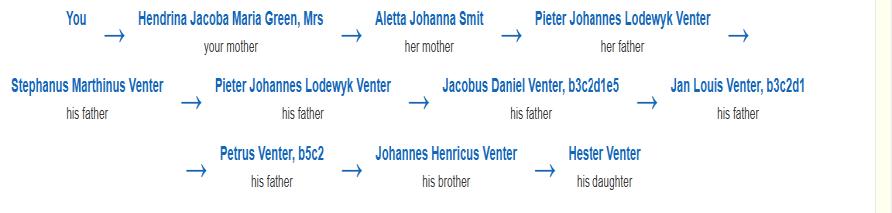
Gerrit Beukes, a great-uncle of Dedrie’s, trekked towards Swellendam, becoming a Grensboer [border farmer] along the Breede River. One day, in August 1788, while out searching for a runaway Khoekhoen servant, who went by the name of ‘April’ - named after the month he was born in - he noticed suspiciously that a large group of Khoisan had gathered at a kraal near his farm.
Little did Gerrit know, he was on the brink of witnessing history in the making. Undetected by the group, Gerrit dismounted, tethered his horse to a nearby tree, and ascended a small kopje63 (hillock). Concealed behind a large rock, he observed the assembly with keen interest. Among them stood a figure he recognised, one Jan Paerl, the offspring of a European father and Khoekhoen mother. He was an unconventional preacher and political leader who often embodied the very teachings he espoused.
Jan, attired in a blend of European and indigenous garments, addressed the crowd with fervour, wielding a knobkierie (wooden club) as he spoke. Gerrit, privy to local rumours, knew of Jan's usual message: a prophecy of a messiah who would liberate the Khoisan from VOC oppression and usher in a new era of prosperity. However, on this particular day, Jan's sermon took a more radical turn.
His words reverberated in a mixture of Dutch and the Khoekhoen dialect as he proclaimed an insurrection. Jan preached that the time had come for the Khoekhoen to reclaim their land and livestock by force. He prophesied the resurrection of former Khoekhoen tribes and leaders,
promising divine intervention to expel the white settlers and bestow unparalleled wealth and abundance upon his followers. It was a vision of biblical proportions, offering liberation from poverty and suffering.
Jan conveyed to his Khoekhoen followers a vision of reclaimed lost possessions and livestock in the impending utopia. However, there was a caveat: they must slaughter their white cattle immediately, discard their European garments, construct new straw huts with dual entrances, and retreat to the mountains to await the Messiah's arrival.
Having observed this unsettling scene, Gerrit discreetly withdrew, mounted his horse, and rode off undetected. Despite suspecting Jan's involvement in his servant's disappearance, Gerrit chose to keep his observations to himself for reasons unknown.
Yet Jan Paerl had ignited a fire. Khoekhoen families abandoned their employee farms in droves, eager to hasten the advent of the Messiah. A sense of unease permeated the colony, and rumours soon reached Swellendam, the provincial capital, of Khoekhoen plans to eradicate all Christians, under Jan Paerl's leadership, culminating in an assault on the Drostdy on October 25, 1788.
Swift to act, the VOC mobilised commandos to quell the Khoekhoen uprising. With the aid of informants, the commandos raided rebel hideouts, swiftly extinguishing the revolt. Many Khoekhoen perished that day, and Jan Paerl's aspirations of messianic glory lay shattered.
So, what became of Jan Paerl, you might wonder? He was promptly apprehended by the VOC, and at his trial, the
judge deemed his actions more indicative of madness than sedition. This fortunate verdict spared him the death penalty, and he served his sentence in prison. However, Jan's saga did not end there; years later, he resurfaced as a labourer in Stellenbosch. But recognition of his past caught up with him, leading to his reincarceration as the delusional Messiah who nearly incited insurrection. Someone recognised ‘Our Loving Lord’64 as he was also called.
Despite his tumultuous history, Jan persisted in his struggle against the VOC. Today, history regards him favourably, with the ‘Rainbow Nation’ recognising the Khoisan (Khoekhoen and San) people as the 'First Nations'. Jan Paerl64 is celebrated as an emblem of democracy and the South African constitution, embodying the ideals of the ‘Rainbow Nation’ espoused by figures like Desmond Tutu.
Gerrit’s branch in our family tree is as follows.

In my history class at Wynberg Boys High School, Mr. Tasker recounted the tale of the first diamond discovered near Kimberley, the capital city of South Africa's Northern Cape Province, by Erasmus, the son of Daniel Jacob. As the story goes, Erasmus stumbled upon a bright pebble near the dam on his father's farm when he was just fifteen years old, back in the summer of 1866. This region boasts a rich history of 19th-century diamond mines, including the famous handdug Big Hole.
According to records from that era, a family friend named Schalk van Niekerk visited a month or two later and noticed Erasmus and his siblings playing games with some stones. Among them was a huge and luminous pebble. Schalk immediately recognised it as a massive diamond worth a fortune, and he requested to borrow it to show to a friend.
Enter O'Reilly, a big-game hunter and acquaintance of Schalk's, who became heavily involved in the story. O'Reilly, known for his cunning and greed, took the diamond on a covert journey to the towns of Hopetown and Colesberg in the Northern Cape province, attempting to sell it on the fly. While he was successful in his endeavour, this was merely the beginning of the diamond's epic journey.
After a series of tumultuous events, the diamond eventually found its way into the hands of Queen Victoria. It was later sold to Sir Philip Wodehouse, the governor of the Cape Colony, for £500. Dubbed the Eureka Diamond, it was transported to the UK in 1870, where it was cut into
a cushion-shaped 'brilliant' and passed through numerous hands over the years.
Then came the South African diamond rush that changed everything forever. Soon, a diverse array of individuals from various backgrounds descended upon the area, including local Boer farmers and diggers from Britain, America, Australia, Germany, and Russia. Dedrie's great-greatgrandfather, Dirk Beukes, observed with both interest and dismay as people swarmed into Griqualand in pursuit of diamond fortunes.
By the late 1870s, conflicts over ownership of the diamond fields had escalated, sparking open warfare between the Griquas, Trekboers, and Boer Republics. In 1870, Transvaal President Marthinus Pretorius asserted that the diamond fields belonged to the Boers, a claim that smacked of nepotism and racism, favouring his inner circle. The Griquas said the fields belonged to them; waiting in the wings was the British Cape Colonial Government and the British Colonial Secretary further afield.
The rest, as they say, is history.
But we know what Dirk thought of it all, according to the stories that made their way to us.
Dirk Beukes did not like how the Griqua chief Nicolas Waterboer65 ‘ran’ to the Cape government for protection against the Boers, even though they were close neighbours and some of his cousins had married Griquas. Diamond mania was the cause of all of it. Dirk thought that the greediest was Nicolas Waterboer 'a wealthy, astute, and greedy Baster66 (Griqua).’
After much squabbling and argument, the hugely unpopular Keate67 ruled in favour of Nicolas Waterboer a stab in the back according to our Beukes family! These events were to remain a thorn in the flesh of the Beukes clan to this very day.
The shout went up, ‘Waterboer wanted it all.’ He claimed an enormous amount of land 425,000 hectares for the Griquas and 175,000 hectares for himself. To add insult to injury, after some sly dealings with the British, according to the Beukes family, Waterboer was given five farms of 6,000 morgen (5,100 hectares) one for each of his sisters and rights to another eight farms.
Waterboer (Figure 27, below) was happy with that. The Beukes clan was not. One of those farms just happened to be Dirk Beukes’s farm, ‘Bulfontein’ (Figure 26: ‘Bulfontein’, below)!
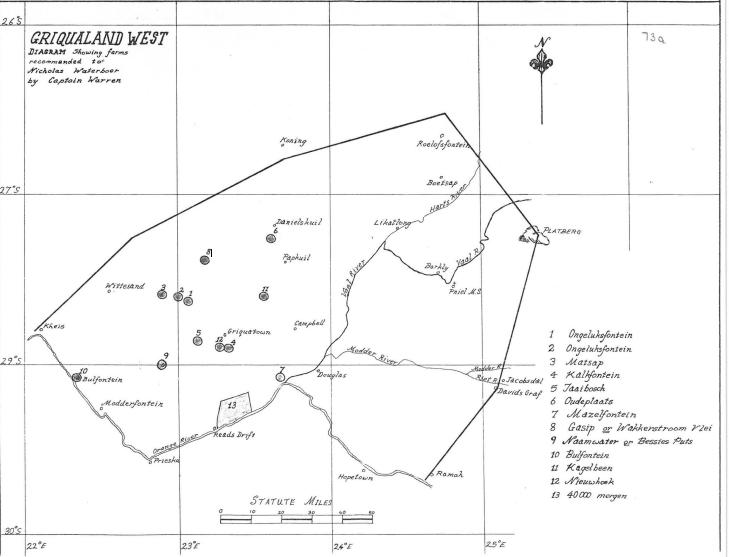
Figure 26: ‘Bulfontein’68 .
Dedrie’s father, also Dirk Beukes, told us about the day Waterboer arrived to claim the farm: ‘Waterboer and his mob rode up to my Oupa, who was busy in the paddock with the cattle. He was quite an imposing, well-known figure on his horse (Figure 28 below). Without dismounting, he shouted, “Dirk, Bulfontein is mine; it was given to me by the government. Pack your things now and leave. Andries, my son, will take over your farm as soon as you get your backside out of here.”
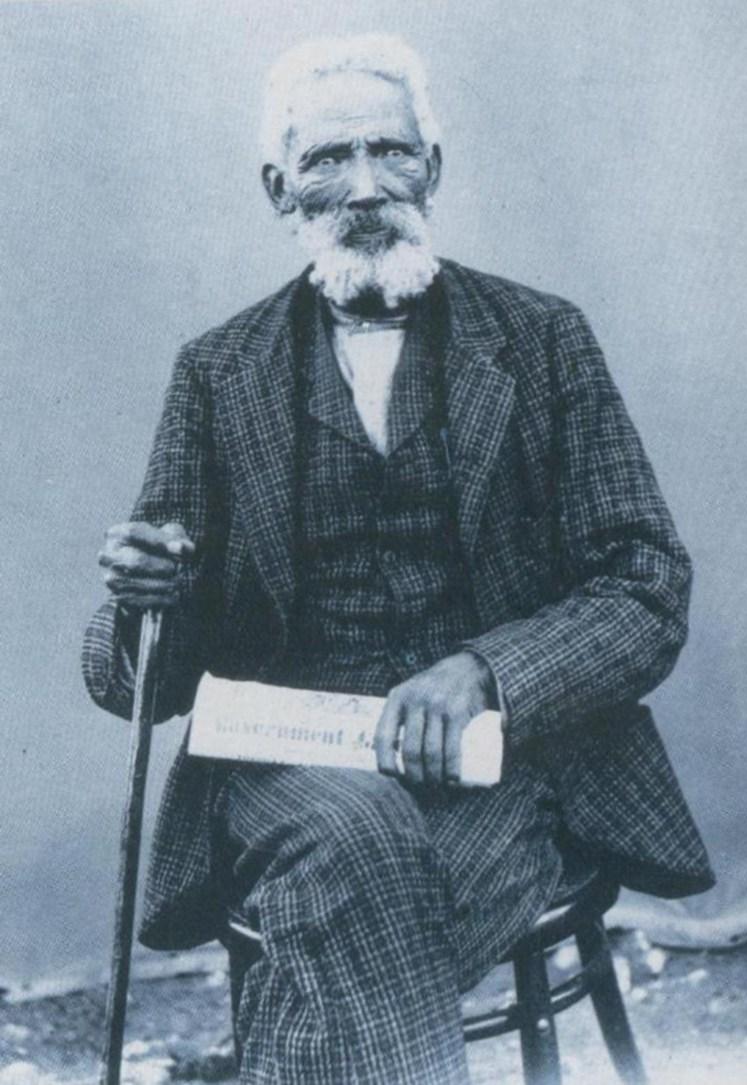
Trying to subdue a mounting rage, Oupa squinted at Waterboer, wondering if he had heard correctly. Then he said, “Please, Waterboer, stop talking rubbish; come in for a cup of coffee; let’s talk it over. Waterboer, in a measured, cold voice, slowly repeated his words to my Oupa without dismounting.
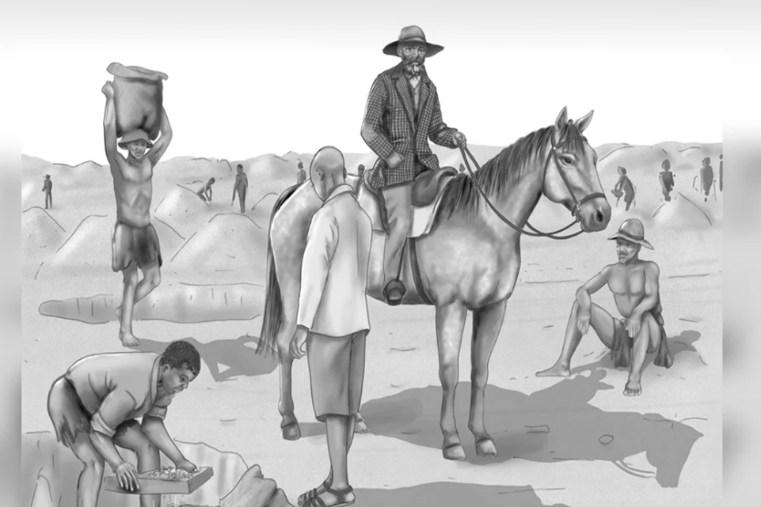
28: Nicolaas Waterboer at the ‘Diggings’69 .
Now, Oupa was equally persuasive, clever and slow to anger. But his intelligence would take a back seat when he passed his tolerance threshold then he could turn into a rogue. Oupa saw red and charged Waterboer, swinging and cracking his whip, each crack sounding like a rifle shot. Few people would have stood their ground when confronted with such a sight: a raging bull of a man cracking a whip that would slice an arm.’
But Dirk somehow held on to ‘Bulfontein’ this we know from the stories that Dedrie’s father told us. The Dirk Beukes who lived at ‘Bulfontein’ is Dedrie’s ancestor, in the following branch of the family tree.
‘Soldier, rest! thy warfare o’er, Sleep the sleep that knows not breaking. Dream of battled fields no more, Days of danger, nights of waking.
Sir Walter Scott
In 1811, my third great-grandfather, Sergeant Jacob Potgieter, came to blows with the Xhosas and was critically wounded by a Xhosa assegai (spear) during the Fourth Frontier War. My grandfather, Oupa Chris, regaled us with the tragic story many times over the years as we drank coffee and listened in terrified awe.
The British were trying to control migration along the expanding border of the Cape Colony. Together with the Grensboers, or Border Farmers, in the Swellendam and Graaff-Reinet districts, they aimed to maintain some degree of peace with the Xhosa people. The Xhosa were crossing the border with their cattle, seeking greener pastures on the other side.
As tensions grew, conflicts became inevitable. The farmers within the colony asserted their claim over the grazing land, while the Xhosa resented the newcomers for taking control of what they considered their ancestral land. This situation created a complicated and charged atmosphere that was bound to escalate.
The Xhosa were not only striving to reclaim their grazing land, but their actions also stemmed from a deep sense of frustration and loss. In this tumultuous time, some tribal clans resorted to burning farms and murdering families, driven by a fierce struggle to reclaim their land.
In response, farmers found themselves caught in a cycle of fear and revenge, leading them to shoot any Xhosa and Khoekhoen they encountered. This tragic situation resulted in horrific violence and a heartbreaking escalation of tensions between the clans and the colonials. Our migrating ancestors would come into such conflicts with the Xhosa and the tribes in the interior, until most of their grazing land was taken from them.
But, in 1811, the Earl of Caledon, Lieutenant-General Sir John Francis Cradock, vowed to clean up the Zuurveld (Figure 29 below) - the ‘colonial land’ reclaimed by the Xhosa after they had lost the land in a previous war, and resolve the conflict once and for all.
The frontier wars had started when Jacobus Potgieter was only ten years old, and he was still young when he joined the commandos against the Xhosa in the Second and Third Cape Frontier Wars. At the age of forty-two, he was called up again to fight in the Fourth Frontier War.
.



Jacobus joined Andries Stockenström’s commando unit from Graaff-Reinet. Andries was tasked by the high command to specifically target the imiDange Xhosa clan, known for their ruthless tactics, expert cattle thievery, and numerous atrocities committed against the farmers and their families.
The Xhosa people were a formidable adversary, and it’s easy to see why. Their deep connection to the land gave them an unparalleled understanding of the countryside, allowing them to navigate its complexities with ease. Armed with an incredible skill in camouflage, they blended seamlessly into their surroundings, striking with stealth and surprise. Engaging with the terrain in such a dynamic way made every confrontation a high-stakes game of strategy and skill. It’s no wonder they were a challenging foe! They would conceal themselves in dense thickets by wrapping themselves in
animal-hide cloaks, which blended into the yellow-brown bush. (Figure 32 below).
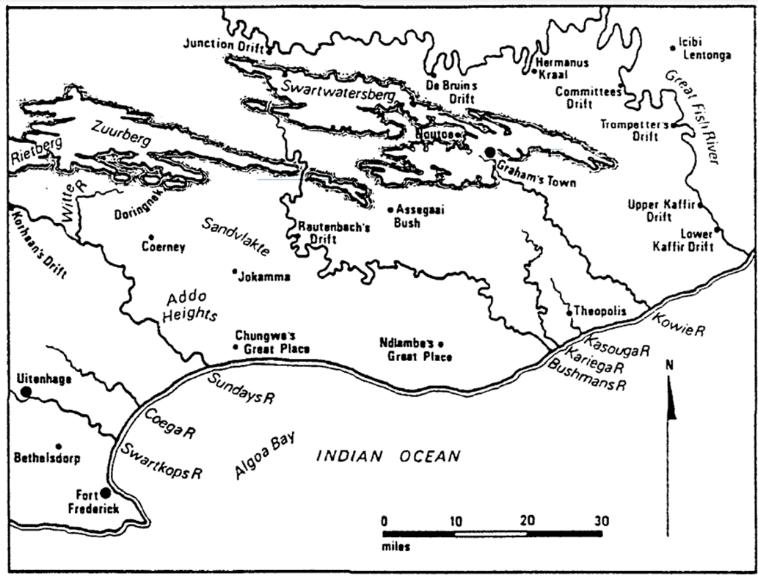
30: Map of the massacre71 .
On Christmas Day 1811, four columns totalling 871 men, including the middle-aged Jacobus, advanced on the Xhosa kraals. The Fourth Frontier War had begun in earnest, and Andries’ commando unit joined forces with British soldiers, riding into the Rietbergen in the Zuurveld.
The Rietbergen, a rugged, hilly area close to the coast, spans about sixty kilometres long and twenty kilometres wide. Tribespeople led by Chief Xasa, Chief Habana, Chief Chungwa, and Chief Ndlambe hid in the many thickets in the area, waiting to ambush the commandos as they passed. (Figure 31, below).
The commandos on horseback were anxious as they made their way through the Rietbergen, their eyes scanning in all directions for the elusive Xhosa as they rode in and out of the kloofs. When one of the commandos passed through a thicket within five hundred yards of the Witte River, assegais rained down on them, though only one man was wounded. Someone in the commando unit recognised the ambush party as Chief Chungwa’s men. Hastily, the commando unit sent an envoy ahead to persuade the chief and his people to leave peacefully.
The rest of the unit warily approached Chungwa’s kraal (Figure 30 above), hoping to enter without bloodshed.
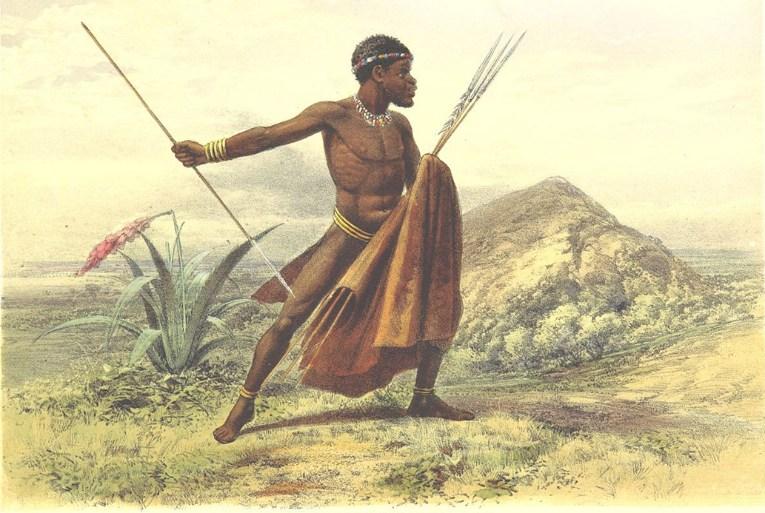
The kraal was near a thicket. As they passed, a Xhosa messenger jumped out and shouted that the chief needed a day to consider their request. Ignoring the messenger, the commando unit entered Chungwa’s kraal and became suspicious when they saw that his men were dressed for war, adorned with ornaments and blue crane feathers. Outnumbered, the commandos left immediately.
Overnight, the men in the commando unit regained courage and returned to Chief Chungwa’s kraal the next morning. They were dismayed to see that the force in the kraal had grown even larger, and another chief, Chief Ndlambe, appeared dressed in his finest war regalia. Chief Ndlambe, one of the most obstinate chiefs in the Zuurveld, stood shouting and waving his assegai. The kraal was surrounded by dense vegetation, and the men were on edge. Suddenly, hordes of Xhosa tribesmen emerged from the bush. (Figure 30 above).
Chief Ndlambe cried out, ‘Here is no honey; I will eat honey, and to procure it, I will cross the rivers Sunday, Koega, and Zwartkops. This country is mine; I won it in war and shall maintain it.’ He stamped his foot, shook his assegai, and blew a horn. On this signal, a few hundred warriors charged the commando unit, who, in disbelief, turned and fled at full gallop. They escaped unscathed but enraged, calling for reinforcements to seek Xhosa blood after the humiliation.
On December 27th, Andries Stockenström, disobeying orders from the British, took matters into his own hands to ensure that the Xhosa didn’t cross north of the Zuurberg. Convinced that the Xhosa were planning to loot and burn more farms, he set off with Jacobus and 23 other men. They rode along an animal track, now known as the Zuurberg Pass, and followed the trail to the Doring Nek Pass along the modern-day R335 Road, ever vigilant and scrutinising all thickets as they rode with trepidation.
Along the way, a party of Xhosa suddenly appeared and approached them on a patch of open ground. They recognised the Xhosa as part of the imiDange clan Chief Xasa’s men. Andries Stockenström had previously met with the chief and assumed they would respect him as a ‘friend and benefactor of the coloured races’.
Andries Stockenström, an educated and peaceful man with progressive views for his time, dismounted and beckoned the rest of his party to follow. The Xhosa appeared peaceful, so the rest of the men dismounted and approached
unarmed. Andries spent about half an hour pleading with them to return to their land without bloodshed.
Oupa Kobus, the Sergeant in charge, watched uneasily; he felt that something was not right. ‘Pasop (be careful)!, he shouted as the Xhosas formed a circle around them, edging closer, centimetre by centimetre. Then they shouted as one and rushed in, their assegais flashing in the sun with each cut and thrust.
They stabbed the landdrost and eight burghers to death Oupa Kobus was ‘speared through’, according to my Oupa Chris. He died from his wounds. Jan Christiaan Greyling, Philip Botha, Isaak van Heerden, Jacobus du Plessis, Willem Pretorius, Pieter Botha, and Michiel Hattingh including the interpreter Philip Buys met a similar fate.
Four wounded burghers miraculously escaped. ‘How?’ It was not said, but they killed five or six of their attackers.

The news shocked the entire colony.
On the 2nd of January, Colonel Graham led the Cape Town Rifles into the Addo rainforest on foot. They searched every thicket they encountered; the orders were to kill all male Xhosa and seize their cattle.
They scoured the thickets but had little success. The Xhosa hid in the bush, behind rocks, in caves and the many kloofs, much too wily for the heavily armed soldiers. After five days of gruelling work, the parties had only eliminated fourteen Xhosa, including old Chief Chungwa, whom they found hiding under a bush.
Historians recount the massacre:
Mr. Stockenström and fourteen of his men fell, pierced by innumerable wounds. ... Two, who not being able to get on horseback, crept into the thicket and eluded the search of the Caffers (kaffirs), until darkness enabled them to re-cross the mountains to the spot where they had that morning started. One of these two men was my acquaintance Paul du Plessis of Zwagershoek73 .
Oupa Kobus’s death is documented in a letter to the Governor of the Cape Colony, translated from Dutch74 . This was not the end of the conflict—it continued to worsen.
On February 13th, two divisions of burghers and Khoisan soldiers entered the Zuurberg and Rietbergen, one from the north and the other from the south. They met at the Sundays River, formed several small search parties, and scoured the country from west to east. Mounted patrols guarded the flanks. Over twelve exhausting days, the soldiers cleared the kloofs and thickets of all Xhosa, wounding and killing many. Women and children were taken prisoner, and hundreds of cattle were confiscated. The Xhosa eventually retreated across the Fish River, beaten but determined to fight another day.
And they did many wars were to follow. The Sixth Frontier War would be the catalyst for thousands of our fellow Afrikaners to leave the border and settle further inland.
This branch of our family tree shows Vldknt Potgieter.

The Great Trek represents a remarkable chapter in our history, showcasing the resilience and determination of our ancestors as they embarked on a northward journey by wagon from the Cape Colony into the heart of South Africa, beginning in 1836. Driven by a desire to break free from British colonial rule, this movement emerged from the rising tensions between our ancestors and the British.
They called themselves Voortrekkers ‘pioneers or ‘pathfinders’ in Dutch and Afrikaans. They founded several autonomous Boer republics, including the South African Republic (or Transvaal), the Orange Free State, and the Natalia Republic. This trek shaped new communities and altered the landscape of the region, impacting the Northern Ndebele people and marking a significant moment in the decline of the Zulu Kingdom.
Our Voortrekker family members who ‘speak’ to us from branches in our family tree are Lang Hans van Rensburg, Andries Potgieter, 'Grootvoet' ('Bigfoot') Potgieter, and Piet Retief.
Our history lessons at school were filled with the heroic yet tragic tales of Piet Retief and the terrible massacres that followed. One of our teachers would weep in front of a sniggering class as this story was recounted.
Andries Potgieter was celebrated for his achievements against the Zulus, but he was also criticised for his terrible
temper and his stubbornness, embodying a ‘my way or the highway’ attitude. Every history teacher had the same story to tell about Andries Potgieter’s stubbornness.
A first cousin four times removed, 'Lang Hans' ('Tall James') van Rensburg, wanted to leave the Cape Colony. Like thousands of other Voortrekkers, he had grown tired of the British and the Xhosa causing carnage around him. Thousands of people were leaving the frontier to seek safer areas they could call their own.
He was also an adventurous businessman; he dreamed of becoming wealthy by hunting ivory loaded onto ships in Delagoa Bay would get fabulous prices in Europe. With his family’s worldly possessions packed into an ox wagon, he headed northward with nine other families in tow. With them, they had 450 head of cattle, 3,000 sheep and 30 horses. They met up with another larger group led by Louis Trichardt at the Caledon River.
The combined groups lumbered northward, passing present-day Standerton and then Middelburg in Mpumalanga (Transvaal). When they entered the 'land of milk and honey,' they saw the country as something to possess and exploit. They were God-fearing people, though and would have also been in awe of the wonders before them.
In their diaries, the Voortrekkers seldom mentioned the trees, flowers, grasses, insects, birds, fish, or animals they encountered. However, they believed nature was God's creation. They would have been astounded by the beautiful hues of blue, red, white, and yellow flowers that shared the veld with the grasses and trees morning glories, impala lilies, kudu lilies, krantz aloes, leopard orchids, pyjama flowers, and more (Figure 35 below). They would have been
astounded by the magnificent trees, too, like the giant Baobabs (Figure 36below).
But Lang Hans's greed had the upper hand, and he was obsessed with selling or bartering ivory in Delagoa Bay.
They travelled through stunningly beautiful landscapes, their gaze extending to the blue-grey mountains on the distant horizon, with brown and orange tints embedded into a blue sky studded with fleecy clouds. These clouds would develop into towering black cumulus, heralding an afternoon thunderstorm. Early mornings were brilliantly bright and cool, but as the day wore on, the temperature would rise, the sun beating down on their burnt and blistered European skins.
The journey would sometimes get tough (Figure 34, below) as the animal tracks led them into the hills and the mountains.
The Voortrekkers were excellent marksmen, capable of spotting a nervous animal camouflaged among the greygreen bushes and yellow grass. Before the suspicious animal could skitter away, they would stealthily stalk it, sometimes on horseback, always staying upwind and sufficiently silent. The 'go-away' birds often tried to warn the restless animals, swivelling their heads in all directions, attempting to locate the source of uneasiness.
Lang Hans and his Voortrekkers felt no twinges of conscience about killing wild animals or San people, as they believed the Scriptures granted them the right to do so. Lang Hans and the religious Voortrekkers ardently believed that when God said, 'Be fruitful and multiply; fill the earth and
subdue it; have dominion over the fish of the sea, over the birds of the air, and over every living thing that moves on the earth', He meant that they should profit from it and could kill anything in their path.
They claimed to kill mercifully and for food or products, never for pleasure. 'Surely God would not object to the profits the products brought in' passed through Lang Hans's mind.
They were well equipped, especially for ivory. Their 'Sannas' (muskets) were powerful muskets from the Netherlands, capable of killing elephants (Figure 37 below). They had both four- and eight-bore muskets. The four-bore muskets fired a tenth of a kilogram (four ounces) ball, and the eight-bore muskets a fifth of a kilogram (eight ounces) ball. These muskets required about three grams of powder. The four-bore musket could kill an elephant at short range, while the eight-bore musket could bring down elephants at a greater distance.
Tension eventually built between the parties, particularly between the two leaders. Lang Hans and his party hunted elephants and animals with abandon, which annoyed Louis Trichardt.
Trichardt insisted, 'We want to spare our ammunition for defending ourselves against the kaffirs75 , if necessary', Trichardt probably kept saying to Lang Hans. 'These reckless hunting sprees use far too much ammunition'. Near the Gompies and Olifants Rivers, Trichardt finally confronted Lang Hans about this waste. Lang Hans, quick-tempered and
argumentative, shouted, 'I am man enough to care for my party'.
This reaction was enough for the men to go their separate ways as bitter enemies. Lang Hans left in a huff, his train of wagons snaking into the horizon where the blue-grey mountains jaggedly pierced the sky. To this day, the location is still called 'Strydpoort' (Quarrel Pass).
Once Lang Hans and his men got further north, they became heavily involved in elephant hunting also eying the country for a place to settle permanently.
The area where Lang Hans hunted elephants was the leading centre of the ivory trade at the time. Records show that hunters killed 23,000 elephants in 1761, and the numbers were even higher by the mid-19th century. The elephant herds would become almost extinct in a relatively short time.
During their extensive elephant hunts, Lang Hans and his men trekked to the Soutpansberg Mountains and then toward Delagoa Bay, the hub of the ivory trade. Their oxen-drawn wagons lumbered on, wheels creaking, interspersed with the crack of whips and shouts of 'vorentoe' (on you go) as they encouraged the oxen to increase their speed ever so slightly.
At some point, they entered Chief Shoshogana's territory in Mozambique. Shoshogana was the leader of the Shangaan Empire and a member of a Zulu clan that had fought against Shaka, lost and fled into Mozambique with his followers. He was a ferocious and formidable warrior, feared by many.
Before entering Chief Shoshogana's territory, some friendly Shangaans informed Lang Hans that they could not cross the flooded rivers in the area. Consequently, they changed direction and trekked further north to Inhambane instead of Delagoa Bay. They continued for several days under bright, humid, sunny skies, plagued by mosquitoes and tsetse flies. Undeterred and optimistic, they began each day with a solemn prayer and the singing of psalms, imploring God to be with them.
For reasons unknown, Lang Hans decided to camp close to Shoshogana's village on the banks of a tributary of the Limpopo River. His party arrived in the evening and had no time to camp in their usual laager (circular wagon) formation. This proved to be a fatal mistake. They spread their wagons out under the giant baobab trees: four wagons on the north side and five on the south side of the tributary.
Later that night, one of Shoshogana's guerrilla units, commanded by Malitel, attacked the laager. Out of nowhere, in the dead of night, the camp dogs began barking savagely and yelping, then went completely silent. This woke Lang Hans, and he knew exactly what it meant. He remembered the night attacks on the eastern frontier. He jumped out of his wagon and heard shouting and screaming, followed by gunshots. The shouting drew nearer from the south. He recognised the shouts in Dutch. The people in the southern wagons were in dire peril.
The guerrilla unit overran the first wagons in deadly silence. Those who escaped ran to the other wagons. They regrouped into four separate groups near each of the wagons, but three of the four groups were overwhelmed
before they could fire a shot. The deadly glint of spears danced in the moonlight, followed by furtive movements and then the swift death rattles of men, women and children ringing out into the darkness. Most of the Shangaan warriors were Zulus, trained by Shaka before they fled with Chief Shoshogana. They were notoriously merciless and used their weapons with deadly efficiency.
Lang Hans and his wagon were the fourth and last group attacked. They grabbed their muskets and began firing into the dark, which had come alive with Shangaan warriors. They managed to keep the attacking guerrilla unit at bay, but by early morning, their ammunition started to run out. The Shangaans then changed tactics, approaching under the cover of some of the trekkers' herded cattle.
Hand-to-hand combat ensued, but the Voortrekkers were no match for the highly trained guerrilla unit. Every man, woman, and child was either speared or clubbed to death, except for two van Wyk children: a six-year-old boy and a four-year-old girl.
The story goes that one of the Shangaans took pity on the two children cowering behind a wagon wheel. He hid them under his shield, cared for them, and brought them to a safe place. Beyond that, their fate remains a mystery, and there has been much conjecture.
Several theories exist about why Shoshogana killed Lang Hans and his people. One theory suggests that the Shangaans had no cattle or sheep because they'd all been killed by tsetse flies and other diseases. Another theory suggests that
Shoshogana coveted the ironwork used to build the settlers' wagons, so he had them all killed.
Either way, Jan Pretorius, a military commander for the Voortrekkers, eventually led a heavily armed search party to find Lang Hans and his people. While searching, they came across a Shangaan village near Chief Shoshogana's settlement. The villagers produced binoculars and a mirror that someone recognised as belonging to Lang Hans. After further forceful interrogation and threats, the Shangaans revealed their knowledge of the ambush and precisely where it had occurred.
The tombstones are still there to tell the story.
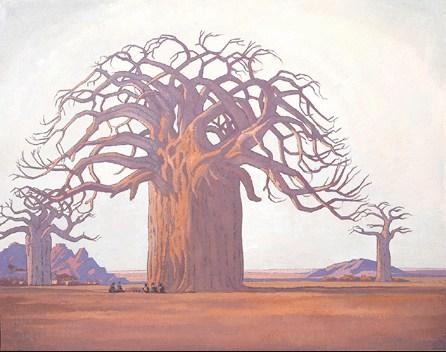
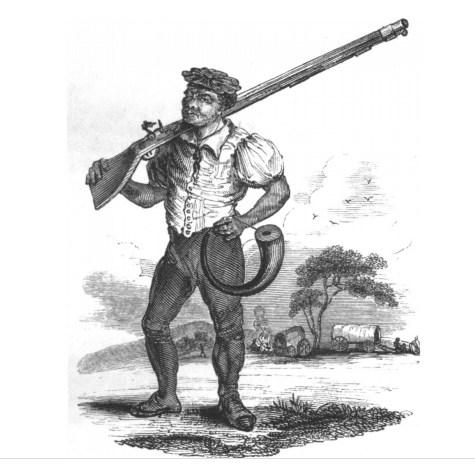
The story of ‘Piet Retief’ is never easy to tell or listen to!
Piet Retief, my fourth great-uncle and leader of the trek, left his farm in the Winterberg in 1837 and joined a party of thirty other wagons. They trekked across the Orange River out of the Cape Colony into Natal and established a camp with fifty-four wagons near the Drakensberg mountains. They were mightily impressed with the region!
After Retief led his band over the Drakensberg Mountains, he convinced other Voortrekker leaders, Gerrit Maritz and Andries Potgieter, to join him in January 1838.
They respected the Zulus greatly and hoped to negotiate with them in good faith. Piet Retief decided to deal directly with Dingane, the Zulu Chief. So he visited him at his kraal at Mgungundlovu (Figure 38, below).
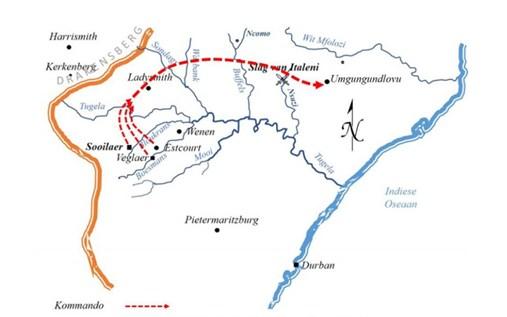
38: Dingane's Kraal80 .
The Zulus cannily agreed to let the Boers settle in principle; in return, they had to recover cattle stolen by a rival. Only then would Dingane sign a binding treaty.
They promptly recovered 700 cattle and drew up a treaty that outlined areas in Natal where they could settle, together with a harbour. They set off for Mgungundlovu in high spirits - trusting that God would finally bring them into ‘the promised land’ [‘die gelofte land’].
Francis Owen, a missionary who was a confidant of Dingane, warned Retief and the Voortrekkers that they could not trust Dingane. Despite these warnings, Retief accepted Dingane's invitation81 to come with the treaty and witness an exceptional dancing performance by his soldiers.
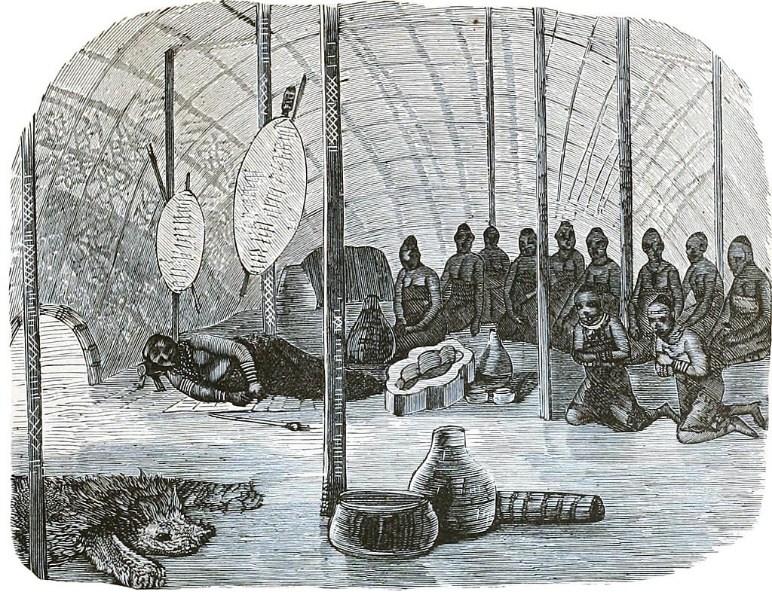
When they arrived, Dingane's envoy asked them to leave their flintlocks beside the Euphorbia trees at the Mgungundlovu entrance before entering. They were there to sign the agreement, drink beer, and feast. No arms were allowed, as they all came in friendship. Retief, 100 men and boys and their Khoisan servants entered unarmed, ready to party!
Retief sat down with Dingane and his captains. The other Voortrekkers and their servants seated themselves a short distance away. They all started to drink Tshwala [a traditional Zulu sorghum beer].
Dingane ordered the dance to begin. The dancing warriors moved closer and closer to the men who were enjoying the Tshwala. Retief did not like them dancing so close, so he asked Dingane, 'King Dingaan, please move the dancers a bit further away?'
Dingane amiably nodded his head and then suddenly stood up and started singing in a sonorous voice, in Zulu, ‘Drink, o drink the beer; your burning throats long for it; drink as much as you can, since tomorrow you will no longer drink' [‘Phuza, o phuza ubhiya, umphimbo wakho ovuthayo ubulangazelele, phuza kakhulu ngangokuno kwenzeka, ngoba kusasa ngeke usaphuza].
Dingane then whistled, as the Zulus do when they attack, and shouted, ‘For me, my warriors, grab them, grab hold of them, and kill, kill the wizards!’
They dragged Retief and his men to the execution rock called 'Matiwane' and hurled them to death Stephanus Smit, another of my ancestors, among them. Dedrie's ancestors thrown from ‘Matiwane’ were Johannes Beukes and Josef Breytenbach.
Thus, our families and the fledgeling Boer nation entered one of the darkest periods in our history. Dingane sent his impis to kill the remaining Voortrekkers encamped in laagers at Doringkop, Bloukrans, Moordspruit, Rensburgspruit, and other sites near present-day Weenen [‘Weeping’].
As the Zulus prepared to strike, those camping were waiting for Retief and his fellow commandos to return from the peacekeeping mission to Dingane. They were blissfully unaware that Dingane had killed them all.
Those waiting were on a high, enjoying the beautiful surroundings the towering Drakensberg mountains silhouetted against a pale blue sky and the unsurpassable beauty of the veld. But it was already too late! Ten thousand Zulu warriors trotted out of Mgungundlovu, barefooted and chanting, armed with spears and shields, to do the bidding of Dingane.
Then, they fell deathly silent as they approached the Voortrekker encampments.
As night fell on the 16th of February 1838, those in the 78 wagons in the Retief laager became progressively anxious as the commandos failed to arrive. Smaller laagers along the Bushman and Tugela Rivers were oblivious to this growing
anxiety, including members of my Smit family who were camping under trees at the confluence of the Bushman and Tugela Rivers.
During the afternoon, the camping Voortrekkers brought their livestock closer to the camps, placing guards to protect the animals against predators. Then, as night fell, they had supper; the elders read to their families from the Bible and sang psalms before bed.
My mother, Hendrina Smit, told me that her family sang Psalm 102, 'But thou, O Lord, shall endure forever, and thy remembrance unto all generations. Thou shalt arise and have mercy upon Zion: for the time to favour her, yea, the set time, is come' their voices drifting off through the night and the smoke of the campfires.
They prayed, thanking God that ‘finally, they had entered into the land of milk and honey, and He had made the heart of Dingane benevolent and friendly’. Gradually, all became silent, and the campfires smouldered and then died.
During that night, hundreds of Voortrekker men, women and children lost their lives.
Piet Retief stands out in this branch of our family tree.

My Potgieter family were prominent Voortrekker leaders with a wanderlust and a thirst for adventure. A party of two hundred families led by my distant first cousin, Andries Potgieter, trekked out of the Tarka area in early 1836. Around the same time, my third great-uncle, Koos 'Grootvoet' ('Bigfoot') Potgieter, led a smaller party from Graaf Reinet. Both men would become heavily involved in battles with the Zulu population.
‘Bigfoot’ and his fellow Voortrekkers had learned key military strategies during their first few years in the region, especially at the Battle of Italeni in April 1838, which stood them in good stead for their next confrontation with the Zulus. The most important lesson they learned was that the Zulus were masterful in guerrilla warfare, with a particular aptitude for ambushes.
At Italeni, ‘Bigfoot’ and his band of brothers also discovered that their horses could be easily upset by gunfire and were not as sure-footed as mountain goats on rocky terrain. Galloping towards the enemy while firing unwieldy 'Sannas' proved to be a flawed tactic. Their horses lost their footing and fell or threw their riders at critical moments. They were determined not to make that mistake again.
After the defeat at Italeni, a large group of Voortrekkers led by Andries Pretorius arrived in Zululand from the Cape with sixty-four wagons. A heavily armed commando unit comprising 464 men prepared to confront Dingane, the king of the Zulu Kingdom, who had assassinated his half-brother,
the mighty warrior Shaka. They appointed ‘Bigfoot’ as one of the six commandants in charge.
In November 1838, humiliated after their loss at Italeni, they began their move against Dingane, leading to the Battle of Blood River. The commando unit and ox wagons moved slowly toward the Ncome River, practising wagon defence tactics every evening for a week. The circular formation of the wagons could be a formidable force if executed properly, much like a Viking shield wall used as both a defensive and offensive military strategy.
Determined not to be duped again, they halted their advance to uMgungundlovu on December 15, 1838, forty km from the gorge at Italeni, to take stock of their past mistakes. They were cautious and wiser, no longer underestimating the might of the Zulu nation and their cunning figurehead, Dingane.
On that same day, a scouting party brought alarming news of a large Zulu force in the rugged terrain to the east. The Zulus intended to lure the commando unit into another deadly trap. Everyone was on high alert, acutely aware of the Zulus' overwhelming numbers.
The Voortrekkers hastily drew their ox wagons into a semicircular formation on the banks of the Ncome River, fortifying their position as the Zulus approached at a slow, menacing pace. Movable wooden barriers and ladders were placed between the wagon wheels, allowing mounted men to charge out on horseback and quickly close to prevent the Zulus from entering.
They had brought valuable weaponry: two smoothbore, short-barreled artillery pieces strategically positioned at the corners of the wagon formation. To top it off, they had a six-pound naval carronade called 'Grietjie' (Little Margaret), capable of firing devastating grapeshot into advancing armies.
As evening approached, a thick mist settled over the wagon site, though the sky above remained clear and cold. My mother told us that the Zulus were afraid to attack that night, spooked by the eerie glow of lamps that the Voortrekkers hung on sjamboks around the wagon formation. She shared many such stories, some true, some perhaps embellished.
At dawn, the tension was palpable as the Zulus gathered in full force. During the night, six Zulu battalions, an estimated twenty thousand soldiers led by Dambuza, had crossed the Ncome River. They massed ominously just beyond the forbidding wagon formation. The elite forces of senior Zulu general Ndlela waited on the other side of the river, effectively splitting the army in two.
As the sun rose that Sunday morning, a Voortrekker eyewitness described the scene: 'All of Zululand was there, as far as the eye could see'. I'm sure Uncle ‘Bigfoot’ felt a surge of dread, if not sheer panic, when he saw the formidable 'Black and White Shield Regiments' of General Ndlela massed on the far side of the river, with thousands of Dambuza's men also waiting along a stretch of the river containing a large hippo pool.
The reports described it as a stunning day, with the sky clear and the sun already bright in the bluest of skies. As the massed Zulu regiments started their advance, the Voortrekkers bowed their heads in prayer. Led by Sarel Celliers, they took a solemn vow before God to build a church if granted victory. They promised that they and their descendants would forever observe December 16 as a day of thanksgiving.
Then, with hearts pounding and breaths held, they braced themselves as the Zulus charged.
All hell broke loose.
The Zulus surged forward with a great cry, rapidly encircling the wagon formation. Witnesses described the scene as terrifying beyond measure, as wave after wave of Zulus charged, only to be cut down by an unforgiving barrage from the muskets and the 'Grietjie'. Battalion after battalion—some thirty-six in total, each a thousand men strong threw themselves at the wagon formation. The air quickly filled with acrid smoke from the munitions, surrounding the wagons in an eerie blanket punctuated by the flickering yellow flames of musket fire.
The cannons delivered a devastating payload of grapeshot, broken pot legs, and stones, cutting great swathes through the Zulu ranks. A dense cloud of smoke formed on one side of the wagon formation, a result of the rapid fire, still conditions, and humidity. The Zulus charged through this black smoke, the cannons thundering amidst the flashing musket fire.
The scene was grotesque, surreal, and drenched in blood. My Uncle ‘Bigfoot’ kept firing his musket until it was red hot, at a rate of four shots a minute, maiming and killing the unfortunate Zulus within a seventy-five-meter radius. From the start, everyone was involved; muskets were fired and loaded in rotation by men, and we were told that servants helped as well.
The cannon shots and withering musket fire finally took their toll. After two hours and four waves of attack, with sporadic lulls in the fighting that provided crucial opportunities for reloading and brief moments of rest, a group of riders charged out on horseback to engage the Zulus head-on. This tactic caused the decimated Zulu battalions to scatter in confusion.
Then, the riders charged through the openings between the wagons, plunging headlong into the disintegrating Zulu army. The impetus was too great; the Zulus turned and started to retreat at a running pace. The mounted Voortrekkers pursued the fleeing Zulus, hunting them down for three hours. After the final retreat, the battleground was strewn with dead and dying Zulus.
Only three members of the Voortrekker commandos were wounded. But, as many people in former colonies have experienced, spears, shields, and clubs are no match for guns and gunpowder.
History teachers taught us that the victory at Blood River was attributed to the 'helping hand of God' after Uncle ‘Bigfoot’ and his fellow Voortrekkers implored the Almighty to help them defeat the Zulus. However, we now know it was
superior firepower, not divine intervention, that led to the Zulu nation's defeat that day.
Uncle ‘Bigfoot’ and the other Voortrekkers proclaimed the region the Natalia Republic. However, the British eventually dashed the Voortrekkers' dreams in Natal and crushed the Zulus. In 1879, under the Union Jack, a British column led by Lord Chelmsford finally defeated the Zulus at Gingindlovu.
This serves as a reminder that there is always a bigger fish, just waiting to devour the victorious (Figure 40 below).
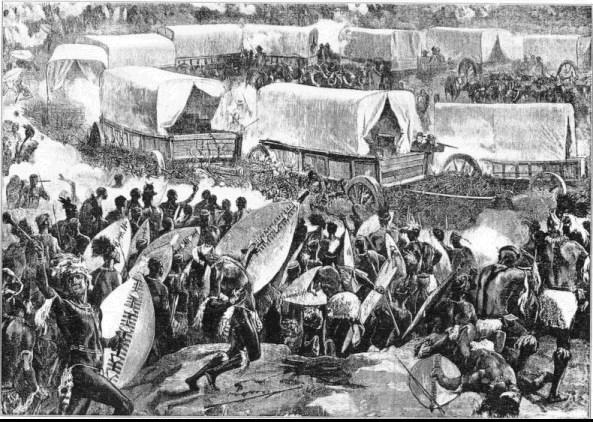
This branch of our family tree shows Grootvoet Potgieter. Whether he had enormous feet is open to debate!

This branch of our family tree shows Andries Potgieter. He was the main wringer and ‘mover and shaker’ known for his querulous nature and quick temper. He always had a falling out with someone!
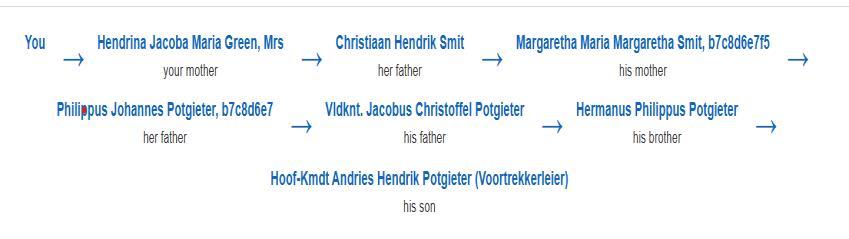
Dedrie's ancestor, Jakob Beukes, accompanied my distant first cousin, Commandant Andries Potgieter, into the area beyond the Vet River towards the Vaal River, where a horrific incident occurred. In August 1836, despite peace agreements with local Black chiefs, a renegade Ndebele patrol attacked part of Potgieter's party, killing six men, two women, and six children along the Vaal River.
And it did not stop there.
Mzilikazi was originally a lieutenant of Zulu Chief Shaka, with whom he quarrelled. Facing the threat of ritual execution, Mzilikazi fled northward with a loyal group of his followers, eventually arriving in the Transvaal region about ten years before the Voortrekkers. There, he founded the Ndebele Kingdom, now called Matabeleland, which is now part of Zimbabwe.
Mzilikazi would become the Transvaal's 'Attila the Hun', attacking and plundering any tribe that resisted his might. His rise to complete domination of the region was meteoric, a period of devastation and wholesale murder known as the Mfecane, or ‘The Crushing’, as Mzilikazi built his Ndebele empire.
Like the Russians during foreign invasions, Mzilikazi employed a scorched-earth policy to maintain a safe distance from surrounding tribes. This strategy involved destroying crops and other means of subsistence, effectively enacting ethnic cleansing on a grand scale. According to mid-20thcentury history textbooks, this method left the region so depopulated that the Voortrekkers could occupy and take
ownership of the entire Highveld area without opposition in the 1830s.
Without a peace agreement with the Voortrekkers, Mzilikazi had other plans for the intruders. So, in 1836, as the Voortrekkers neared the modern-day town of Heilbron, Mzilikazi sent a battalion of five thousand of his Ndebele warriors to attack them.
Khoisan tribespeople warned the Voortrekkers about the approaching battalion of Ndebele warriors two days in advance. In response, they formed a defensive position with fifty wagons arranged into two semi-circles: forty wagons on the outer circle and ten wagons in a smaller inner circle.
The location chosen for the wagon formation was strategic, on an incline just south of an oblong hill that would become known as Vegkop (Conflict Hill), providing an unobstructed view over the veld. The innermost wagons protected the women and children, while the outer circle formed an impassable barricade. They secured the front wheel of each wagon to the rear wheel of the next using chains and thongs, filling the gaps with flesh-ripping thorntree branches.
On the morning of the attack, tension hung thick in the air. Andries Potgieter, sensing the impending danger, sent a scouting party to confront the advancing Ndebele battalion. Armed with muskets and mounted on horseback, the Voortrekkers hoped to drive back the enemy, but the Ndebele were undeterred. Their sheer numbers, outnumbering the Voortrekkers by 150 to one, struck fear into every heart.
Jakob Beukes and his heavily pregnant wife, Johanna, were seated under the shade of a large thorn bush between the two circles of wagons when the news of the imminent attack arrived. The shock was too much for Johanna, who went into labour, delivering their son Barend Hendrik just as the Ndebele surged forward. The sound of drumming on shields and war cries drowned out the cries of the newborn baby. Assegais were raised, and the Ndebele were ready to strike.
Amid the chaos, preacher Sarel Celliers' voice rose above the noise, reciting Psalm 50, verse 15: ‘And call upon Me in the day of trouble: I will deliver thee, and thou shalt glorify Me’. His words brought a momentary calm, dispelling fear and instilling courage. Jakob, and likely Johanna too, joined in singing Psalm 130, verse 1: ‘From the depths of my distress... Oh Lord, observe my anguish’.
Voortrekker men, women, and children took up their posts, cleaning muskets and preparing ammunition. Women and children poured black gunpowder into bowls and placed them alongside bags of buckshot. With experience from frontier wars, they were ready to fire their muskets at a rate of four shots per minute.
The Ndebele encircled the wagon formation in three groups, just outside musket range, while another group began rounding up the livestock. Ravenously hungry from their long march, they butchered about eighty oxen and devoured the meat raw, horrifying the Voortrekkers. Once sated, the Ndebele honed their assegai heads on stones, their bloodlust rising as tension inside the wagon formation reached a breaking point.
Voortrekker orders were to hold fire until the Ndebele were within twenty to thirty meters. Suddenly, the Ndebele launched their attack from all sides, their full battle dress a terrifying sight. Adorned in animal skins and tails, they advanced with large shields and assegais; the drumming and fearsome battle cries growing louder.
The Ndebele charged shoulder-to-shoulder. When the Voortrekkers opened fire with buckshot, it was impossible not to hit multiple warriors with each shot. Yet, the Ndebele kept charging, stepping over the bodies of their fallen comrades. Those who survived reached the thorn trees forming the outer perimeter of the wagon formation. They tried removing the branches or cutting the thongs with their assegais but to no avail.
Next, the Ndebele attempted to dislodge individual wagons by pulling them out of the formation or overturning them. These efforts failed, though some wagons were moved by as much as thirty centimetres. Ndebele warriors placed shields on the branches to climb over them onto the wagons. Others tried creeping underneath the branches into the wagon formation, but none succeeded in entering alive.
Within the confines of the wagon formation, the horses became frightened by the commotion and ran around, kicking up dust clouds. The dust and smoke significantly reduced visibility for the terrified Voortrekkers; it was almost impossible to distinguish between the ghostly horses and would-be attackers.
The attack lasted for half an hour. When the Ndebele realised they were not gaining access to the laager (circular
wagon enclosure) and were losing more and more men, they changed their tactics. Their stabbing assegais were ineffective, so they resorted to throwing them over the wagons and into the centre of the formation (Figure 41 below).
However, the firepower became too much for the Ndebele, and they withdrew, capturing all the Voortrekkers' livestock: 100 horses, 5,100 head of cattle, and 50,000 sheep. More than a thousand Ndebele assegais had landed in the centre of the wagon formation, wounding and killing some Voortrekkers, including one of my first cousins four times removed, Nicolaas Potgieter. Outside the wagon formation, more than four hundred dead Ndebele lay scattered on the bloodied ground.
Andries Potgieter immediately set out to retaliate and retrieve the stolen livestock. The regiment caught up with Mzilikazi at the Ndebele settlement of Mosega, where they killed many Ndebele and took 7,000 cattle. They then chased the Ndebele into what is now modern-day Zimbabwe, where they still reside.
Andries Potgieter then went to the aid of the Voortrekkers in Natal and took part in the Battle of Italeni. He was blamed for this defeat, so short-tempered and easily crossed, he left in a huff with his commando unit and founded the town of Potchefstroom in the Transvaal.
Today, Potchefstroom is known as a city of academic thought, boasting five tertiary institutions, 30 schools and a number of research bureaus and training centres a far cry from the violence and mayhem that ultimately led to its creation.
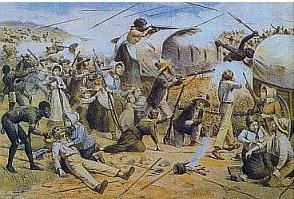
Figure 41: Vegkop83 .
Andries Potgieter in this branch of our family tree.
The Orange Free State and the Transvaal (South African Republic) were independent Boer republics in 19th-century southern Africa, established by our Boer ancestors after they had trekked inland to escape British rule. These republics excluded Black African and Indigenous people from church and state. These republics existed until 1902, when they were defeated in the Anglo-Boer Wars.
Our families had finally found a home in these republics after the long migration from the Cape Colony, which finally became a British Colony in 1806 as a result of the outcomes of the Napoleonic Wars.
In 1836, thousands of Boers decided that British rule was not appealing! They packed their waggons and lumbered off into the veld. They weren’t keen on discussing things such as the abolition of slavery or agreeing to kowtow to Queen Victoria!
They established the republics in the 1850s after stifling any dissent from the local inhabitants. They set up shop, thinking they’d finally found their peaceful slice of paradise only for gold and diamonds to show up uninvited, causing a commotion. Suddenly, everyone wanted a piece of the action, and tensions flared up everywhere.
My grandfather, Chris Smit, and great-grandfather, Gerrit Smit, joined the Bethal Commando, along with many of my
uncles, to fight the British in 1899. Dedrie's family were rebels from the Cape Colony who allied with the Boer forces.
The Anglo-Boer War forever transformed our families' political, cultural, and social lives. Our grandparents, greatgrandparents, great-uncles, and aunts endured profound suffering during and after the conflict. Many were sent to concentration camps, where they succumbed to illness and deplorable conditions. Our families lost everything, and these stories will be told down the generations.
My Oupa, Chris Smit, was a great storyteller and a hero. We would visit our ancestral family farm, 'Alexander', with great anticipation, knowing that Oupa Chris was more than willing to share his war experiences with many inquisitive grandchildren.
He liked talking to my father, Cecil, a Second World War veteran,
My father and grandfather would swap stories for hours while we children and other adults would hang on their lips, our eyes out on stalks. My mother would listen but not participate; the women and children occupied space as audience members only back then; those were different times. However, we would always ask her to explain some of the more technical details of the stories afterwards. She would enlighten us, filling in the gaps. She was also an excellent storyteller and never missed the juicy bits!
Oupa Chris always began with something about the gold rush in 1886 and how it changed everything so quickly, transforming the South African Republic (ZAR) into a global hub for adventurers and greedy corporations protected by powerful nations. He would then stretch back on his rawhide chair, spit out his chewing tobacco, and stare into the distance. It was as if he stared right through us. Then he would say, ‘We would lose everything; we returned to a barren, burned farm and a farmhouse with broken walls and cattle dung lying a foot deep in a makeshift kraal beside the ruins.
And why did they want that gold’? Oupa would spit some green-yellow sputum-tobacco mix, and we would watch the trajectory of the globule as it hit the ground next to his chair and exploded. My mother would be disgusted, but we were fascinated. Oupa would continue, ‘The khakis (imperial forces) wanted to expand their Empire until they brought everyone on Earth under the yoke. They were power-mad; nothing would stop them!’
It was time for a smoke, so Oupa filled his pipe with aromatic 'Boxer' tobacco while my mother and father would each light a more civilised cigarette. Then, with clouds of smoke billowing into the air, Oupa resumed his story, with his devoted audience waiting in anticipation for the next bit.
‘The khakis wanted all the Transvaal's gold, but they needed dynamite, machines, and kaffirs to dig it up. Their ambition was to expand their Empire and dominate the world, so we Boers stood in their way. That's where your Uncle Paul (Paul Kruger–President of the ZAR—a fourth cousin twice removed) played a crucial role. In 1896, he opened the largest dynamite factory in the world!’
‘But the khakis were relentless. They desired our land and resources and denied us any voice in governance. It was inevitable that they wanted war. I'll never forget the ultimatum! Uncle Paul issued it in October 1899, giving the khakis forty-eight hours to leave, but they didn't budge. And so, the war began.
My father Willem Smit, my brother-in-law, and your great-uncles from the farm ('Alexander' near Bethal) saddled
up. We joined the Bethal Commando unit to strike the first blow against the khakis in Natal.
There were twenty-one thousand of us. Pa Gerrit was sixty-two years old, an old man who was as strong as a lion and wanted to fight the khakis.
Ladysmith was one of our finest. We besieged the town for about four months. Finally, French and his chief of staff, Haig, arrived on the last train to leave down to Port Natal. They lay flat on the floor to escape the bullets flying over their heads. We aimed for the whites of their eyes when they stuck their heads up to see where we were!
The khakis nearly lost their nerve stuck there in Ladysmith! Even though they wanted to break out, they could not. Their horses and oxen got so weak that they could not stand up. Boer spies told us that their water was muddy and filthy, and there was also typhoid and dysentery. We felt sorry for them—even though they were khakis, they were Christians. So on Christmas Day 1899, we fired a carrier shell without a fuse into Ladysmith, which contained a Christmas pudding, two Union Jack flags, and the message ‘compliments of the season.
My memory is a bit blurred. So many things happened after Ladysmith. We could not keep them there forever. More and more of them came until we found ourselves at Pieters Hill (Figure 42 below).
I remember us being on the hill with them coming up. We were still on our horses. The khakis were on their knees and lay in wait amongst their cannons. Our men jumped off their horses and fired into the khakis on the ground. Then they
rose as one and fixed bayonets. It was terrible when the sun glinted on those bayonets, and they started to march towards us. Then their bugler sounded the attack, and they surged forward like a wave on the sea. I trembled as I thought about a bayonet blade thrust between my shoulder blades - man, I was shaking like a leaf.
Before we could do anything, the shells started to land among us - thick and fast! We did not see their artillery creep up between those foot soldiers! Next thing - there was smoke and flames everywhere. “Surely God would not allow the whole Bethal Commando to be obliterated”, I thought. It was the most frightening thing I ever saw. The Khaki cannon shells rained down on the crest of our hill - where we were all lying behind rocks and in the rock forts we had built for ourselves.
Smoke was everywhere, and earth and stones came raining down on us. The sound was like thunder; I will never forget how loud it was. I could not hear my voice when I shouted to my father, hiding behind a rock beside me. The poor horses were going mad. The shrapnel killed many of them. I don't know how many of those poor horses I had to shoot. Suddenly, the cannon fire ceased, and the khakis headed straight for us, coming up the hill - their bayonets flashing in the sun. Before I could move, they were on us. Our group of men ran down the hill in any direction - firing as we went. We ran like a pack of dogs. We were not so foolish as to fight these khakis with our pocket knives!
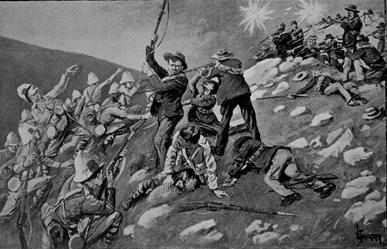
Those that stood their ground were run through, like a knife through butter. If the blade did not get them - they fought hand to hand - then we got the better of them. There were hordes of them - so, in the end, most of those who could not run away were finished! Many of us escaped that day - but the khakis killed many Bethal Commando men. That was it; the khakis had the upper hand from then on.’
At this point in the story, Ouma85 (Grandma) Heila would call, ‘Come and eat before the food gets cold’. We'd gather around the enormous dining room table and feast on generous servings of guinea fowl, mutton, roast potatoes, and vegetables.
Afterwards, our parents, aunts, uncles, and elders would retire for an afternoon nap while we played outside, eagerly awaiting the next instalment of Oupa's stories.
At 4:0 pm, we'd reconvene behind the outside kitchen wall in the yard for coffee and koeksisters86 . Ouma Heila would
pour us the most aromatic, intensely sweet brew, which we enjoyed with at least three heaped teaspoons of sugar. We'd slurp the coffee out of large mugs and gobble down koeksisters. We all knew another story was coming, and we couldn't simultaneously eat, drink, and concentrate! My mother would chide us to ‘stop slurping your coffee’, but we were merely mimicking Oupa.
Oupa would begin. ‘After Ladysmith, we retreated into the Transvaal, and the khakis came after us, marching from Volksrust into the Transvaal. There were just too many of them, and they brought more and more artillery from Durban. So General Louis Botha sent our Bethal Commando to the Eastern Transvaal - we knew then that we needed to fight them on a broad front.
We attacked their camps like a swarm of bees. First, they would scramble as we galloped at full speed towards them, bullets whizzing past their heads. Then, we would jump off our horses, lie down in the grass and take aim. We were far better marksmen than the khakis were - in no time, there would be many of them lying dead or carried by stretcherbearers who bandaged them up. We never aimed at those who were wounded or at their stretcher-bearers!
Then, with a shaky voice and a few tears, Oupa would say, 'This was the end of the line for my father, Oupa Gerrit. He was old, my father - in his sixties, but still strong. I loved the old man. He amused us night after night with his concertina. We would sing all sorts of things. Some of those songs were dirty, like ‘Ou Tante Koba’ (‘Old Aunt Koba’), who was old but still very sexy.
General Buller, the leader of the khakis, knew that we held a critical position up on a kopje on the farm ‘Bergendal87’. He hit us hard. It was 11:0 am when they attacked our position with howitzers and field artillery for three hours.
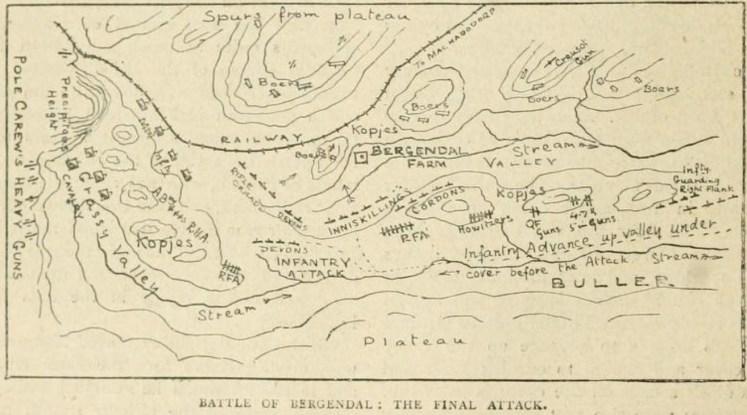
Figure 43: Battle of Bergendal They even had 4.7-inch naval guns. The shells ploughed up the land and filled the air with yellow smoke, shrapnel, and rock fragments. In addition, the heavy shells from the naval guns blew to pieces some heavy blocks of rock near us. The rock fragments were just as dangerous as the shrapnel.
It was terrible. The British infantry fixed bayonets and charged over the open veld to our position, just like the Zulus used to do. One thousand five hundred khakis shouting with those bayonets glinting in the sun? Soon, the khakis were on us. We lay flat on his stomach with bullets flying over our heads like angry bees. But we kept up the steady and accurate fire from when the British infantry began their advance across the open terrain until they were upon us. Shooting the
khakis in the open veld was like shooting an impala on the run.
We stood up and emptied our magazines. But they kept coming. We were doomed. We fled, some on horseback and some on foot. Shells burst above our heads; many fell, fighting the khakis with knives, fists, feet, or rifle butts.
Oupa Gerrit came across a wounded khaki lying on his back, who screamed to him, "Help me, please. Water, water!" My father loved all living creatures; that is a Smit thing! He cradled the dying man's head and gave him a drink of water! I was behind him. Then we got separated. I came across a riderless horse, jumped on it, and tried to see my father in the chaos. He was gone. I galloped away fleeing towards Machadodorp, where we stayed until the twenty-eighth. Why do I remember it so well?
Many of us hid in a farmhouse at the edge of town that Friday. My stepbrother, Abraham Zietsman, and, lucky, my father too. But the khakis knew where we were hiding; spies told them all they needed to know.’
Oupa Chris then told about his father's capture.
‘I was on horseback, approaching our hideout. I knew that the biltong (beef jerky) and food from a farm just outside the town would go down well. I stopped dead in my tracks when I saw a khaki dragging someone out of the front door. All they saw of me were my horse's hooves and a dust cloud as I turned around and galloped away. Being a small guy, I soon became a tiny target!
They took my stepbrother and my father from that house. I rode hard until I got to Waterval Boven, where I joined up with many stragglers who had also escaped the khakis.
From then on, we had a hard time. I re-joined the remaining Boers from the Bethal commando unit (Figure 44 below), where we operated in the veld. We knew every inch of the land the kopjes and riverbeds. We would hide in a riverbed with just our hats visible. I would sleep in that riverbed - and guess who I would dream of? Your Ouma Lettie. She was my girlfriend then, hiding there at "Alexander”’.
My mother would then cry at the mention of her mother, Lettie, who died from peritonitis when she was only four. We would cry with her.
‘We were always camouflaged in the high grass. The khakis could not see us; it was always too late. Before they knew it, a Mauser bullet would find them. We never missed. Most of us could hit a target 200 yards away on a good day!
We covered great distances, attacking the khakis where we could. Then, they started building blockhouses between the railway stations. Finally, the trains came up through Natal, bringing more soldiers and canons. We would choose a moonless night, look for a section of the railway line with a curve in it, and then put rocks onto the tracks, or, if there were a straight section, we would remove the sleepers.
The train would come around the bend at great speed, with the engine billowing steam, and before you could blink an eye, the coaches would start derailing. We would sit on the side of a kopje or lie behind rocks. Then, as the coaches
turned over, the train would halt, and you would see khakis scrambling everywhere. We would pick them off like guinea fowl during these skirmishes, but they were brave and never ran away.
Sometimes, our commando unit would operate close to Bethal, and then I would return to “Alexander” at night. Then a hug and a kiss from Lettie would be enough to get me through the next day!’
Oupa would continue, wiping a tear away that threatened to roll down his cheek.
‘The last days of the war were the most desperate for us. The colonial Australians were sent after us under Colonel Williams. They chased us down, and those colonials could ride like us and shoot like us. They had a reputation for shooting straight and not taking many prisoners.
One day, they attacked us at dawn. Stragglers from other commando units in the area had joined us overnight. We were exhausted from being on the move over the veld for many days. We were hungry, and some of the men were sick. Sometimes, I was so tired that I would fall asleep on my horse.
I survived, day after endless, relentless day, becoming as thin as a reed; my eyes bulged in my head; I looked like a stick insect. In the end, I hid most of the time.
We never found out how the colonials knew where we were that morning. I had just crawled out of my tent on the side of the kopje when I saw the dust kicked up by their horses' hooves.
The Australian colonials started firing when they were about a thousand yards away. I jumped onto my horse before you could sneeze, and after a few shots in their direction, I galloped out, followed by a few others. They took thirty-nine prisoners. We rode hard until we got to Trichardt's camp. We had just settled down in the dusk when we heard thundering hooves again. So, we were back on our horses before they could catch us, except for eight of our captured men. We fled into a nearby ravine, which they tried to block. It was getting dark, and most of us hid wherever we could.
A few of us found a rocky path out of the ravine. Unfortunately, the rest were not that lucky; they searched the ravine, extricating men from their hiding places one by one until they captured nearly two hundred prisoners.
That night, we galloped hard until we could go no further and again sought sanctuary in another ravine. We got off our exhausted horses and fell asleep on the hard ground. That daring escape from the colonials finished us!
The sound of hooves clambering up the path woke me the next morning. As I started to focus, I looked straight into the eyes of an Australian soldier; they wore hats you could not miss! He said, "It's over, man– it's over". He waved his Lee Enfield in my face. Then he said, "Get up, you little rat "fore I put another hole in yer head”. I sprang into life before he could put his finger on that trigger.
That was on March 23, 1902.
We were the last Boers to show any resistance, and the rest surrendered a month later. So, I joined Oupa Gerrit and all
of us who lived at "Alexander" in the Standerton concentration camp’.
Then, Mom was allowed to tell her story. She would tell us about the teacup in our cabinet at home, which she had inherited from her grandmother. ‘Ouma Griet buried her crockery in the local creek, so the English never got that’. She never referred to them as khakis but as 'English'. She had served in the Union of South Africa Women's Auxiliary as a parachute packer during the Second World War and had become more anglicised than her other family.
‘Before they took my Ouma and all those other terrified people hiding on the farm, there were lonely, frightening days and nights at “Alexander”. Everyone feared the coming of the English. They often came, looking for any men hiding out on the farm. They would appear on the kopje in front of the farmhouse. A few would be kind and respectful, but one of the soldiers in particular used to grab one of the women and did horrible things to them.
Then, one day, they arrived with two wagons, telling them they all had to go to the Standerton camp. They told them to just bring their clothes and as much as they could put in a sack. My mother, my aunties and my Ouma screamed and pleaded with them. The children were all crying but to no avail. There must have been fifty people there, all women and children; remember, the men were all out in the veld! As the wagons trundled up the hill, they looked back at the flames (Figure 45 below). They torched the farmhouse, and they killed the sheep and cattle, even Ouma's fowls.
They were herded like cattle into the trucks at the Trichardt station in bitterly cold weather. They were hungry, and some were sick - some would die!
They were made to sleep in dilapidated tents when they arrived at the Standerton camp. There was no soap to wash themselves with. The drinking water was filthy, and they had to sleep on the floor because there were no mattresses. There was very little fuel to make a fire with, so the stronger women and sick men had to go outside the camp to collect firewood.’
Then Mom would then tell us about Emily Hobhouse (Figure 47 below), whom she called a saint.
‘Emily Hobhouse was shocked to the core by the conditions in the Standerton camp. Terrible! So, she stood in front of the British Parliament and gave them what for! She was considered to be a big troublemaker, but many women and children died of typhoid and starved to death, such as our relatives, the Harmse boys (Figure 47, below), only two and four years old, who both died of typhoid. They may have looked like poor Lizzie van Zyl (Figure 46, below), our first cousin on the Smit side of the family. Skin and bones like a Holocaust inmate in one of Hitler’s camps!
If it weren't for Emily, many more would have died! She got her way eventually. Inmates got medical attention, soap, straw to sleep on, and enough kettles to boil drinking water. She got clothes for the sick and starving children and supplied pregnant women with mattresses. Yes, our Afrikaner nation would have been much smaller if it wasn't for Emily Hobhouse’.
In a time when parents did not shield children from talking about life's horrors, my mother would answer our questions, one by one, ‘What about women and children sitting in darkened farmhouses while the Boers struggled against the English?’ we would ask. We knew the story that she would tell again, for the umpteenth time. And even though I heard these stories many times as a child, I never tired of them, and I still don't.
I last saw Oupa Chris in 1954 on his deathbed in the Springs Hospital near Johannesburg. He cut up a piece of biltong for me and said, with a twinkle in his eye, ‘Jimmy, when you come to the farm again, I will tell you some more stories about the war’.
Now, I'm telling his stories to you.
This is the branch of the family tree that shows my grandfather and great-grandfather.

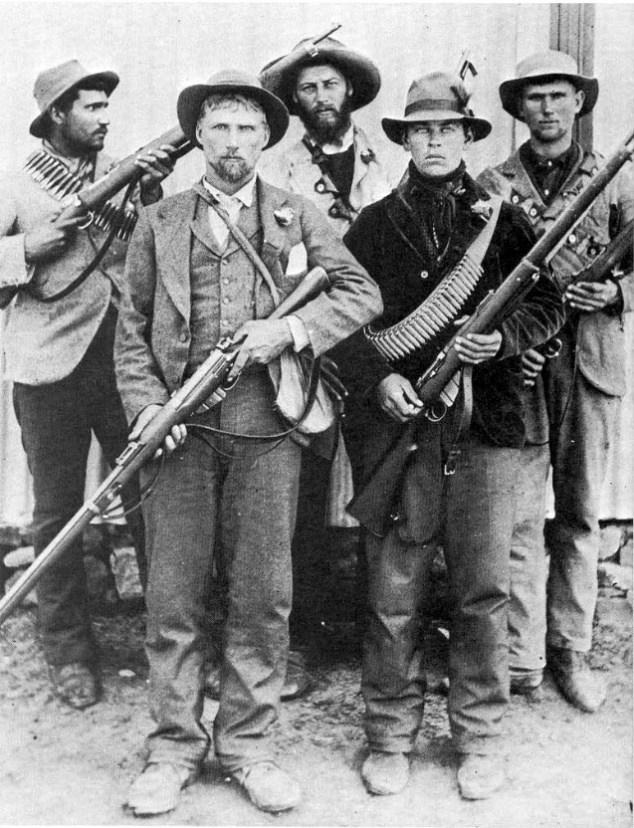
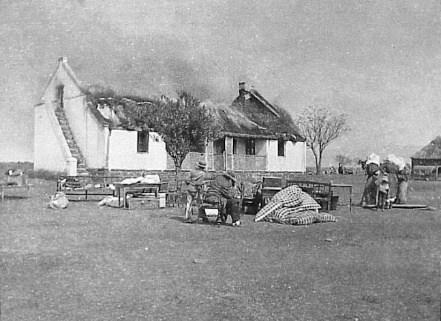
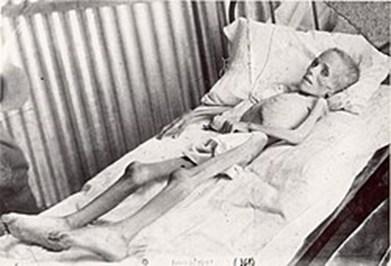
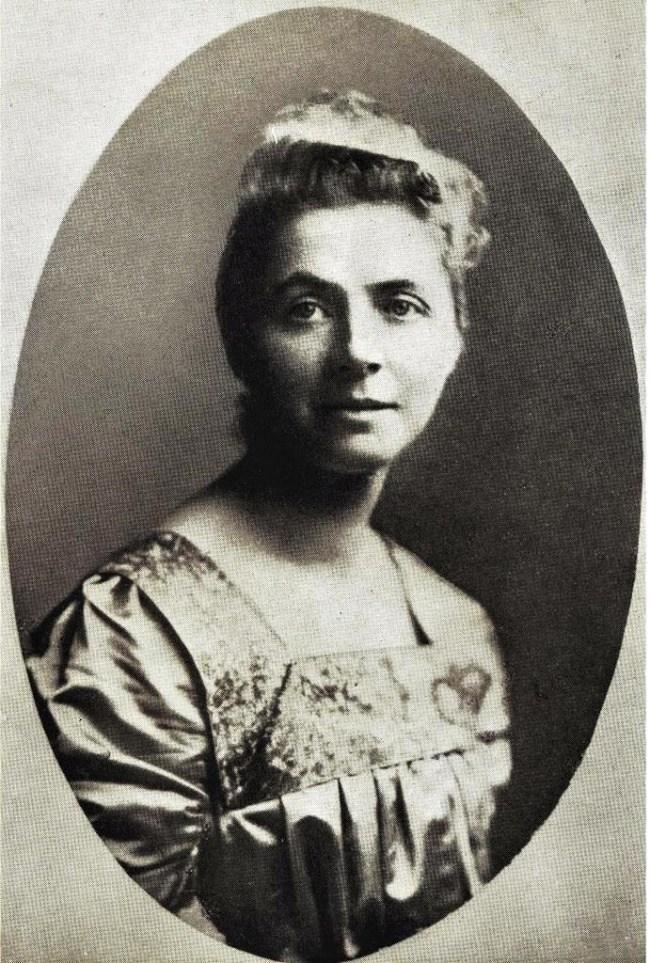
The Green Family stories are about people Dedrie and I knew born in the late 19th and early 20th Century: my grandmother, Granny Green; my mother ‘Kotie’ (Hendrina) Smit; my father ‘Jimmy’ (Cecil) Green; my mother-in-law ‘Dina’ (Gerardina) Alers; my father-in-law ‘Dirk’ (Hendrik) Beukes; and my cousin ‘Fanie’ (Stephanus Venter.
I chose to share the stories of family violence, mental health struggles, and the tragedy of suicide within my own family because they deeply resonate with my experiences. For many years, I’ve grappled with PTSD stemming from the violence I witnessed, but through determination and resilience, I’ve discovered ways to cope and move forward.
During my time at Wynberg Boys High School in South Africa, I witnessed the profound impact of mental health challenges due to PTSD on our headmaster. When the pressures of the classroom became overwhelming, he occasionally resorted to banging his head against the wall, which left many of us unsure of how to respond. It was heartbreaking to see him in such distress, especially when he broke down in tears after a difficult incident involving the girls’ school. The laughter of the boys in those moments was cruel.
My empathy was heightened by my own experiences I understood all too well the internal battles he was facing. My father, a war veteran, fought his demons, and those struggles
left an indelible mark on me. In sharing these stories, I hope to shed light on the often-hidden battles many people face and to foster compassion for those who are suffering.
My granny lived in Newlands, next to Sophiatown, known to us as ‘die Gat’ (the hole) in Johannesburg (Figure 48 below). Newlands is hugely different now, having undergone gentrification over the years. Still, back then, it was a dangerous place to live, much like the Gorbals in Glasgow used to be.
Granny Green lived there because she was desperately poor, among the 'poor whites' of Johannesburg with her family. These 'poor whites' were devastated by the Rinderpest, the Anglo-Boer War, and the depression that followed. They were the lowest rung of Afrikaner society, pitied by the well-off Afrikaners living in the more opulent suburbs of Johannesburg.
My grandfather, Cecil Green, was an alcoholic miner, dying of silicosis from years of underground work in the mines. On New Year's Day in 1937, he argued with his friend at the pub. His friend felled him with a single blow, and Grandpa died a few hours later in the hospital.
Granny Green's tiny house was dirty and untidy, much to my mother's disgust, though she put on a brave face when we visited. To us children, it was paradise. We revelled in the clutter. Outside, there were broken-down car wrecks in various stages of disassembly. Our joy knew no bounds when our cousins, Auntie Cath's children, were there. There was no greater pleasure than playing 'house-house' in those wrecks.
Granny would shout from the back door, 'Jist made a cuppa for your father; come and get it!'
'We would pour out of one of the car wrecks and seat ourselves around the small, rickety table, which rocked whenever anyone leaned against it.
Granny would boil the water on the Primus stove, the first pressurised-burner kerosene (paraffin) stove on the market. She would pour a little methylated spirit into the spirit cup, strike a match, and then vigorously work the pump until the flame was well established. Five or six pairs of eyes followed every action of hers as we watched in awe of the little stove.
She then added boiling water to the teapot, which held several teaspoons of 'Joko' tea leaves. After that, she poured the pitch-black brew through a tea strainer into tin mugs, adding a splash of milk from a dirty milk jug covered by a filthy old doily. As far as my mother was concerned, the trouble with drinking tea at Granny's was the distinct lack of hygiene. We only became aware of the effect this had on my mother when, on our way back in the car, she would say, 'I was as sick as a dog after that tea. The milk was rotten.' Somehow, we never noticed!
Granny Green was less than five feet tall and very kind and loving to us; she was our favourite granny.
She would let us sample her snuff and then laugh until tears ran down her face; at that point, we would start sneezing uncontrollably, our faces also smeared with tears. Granny Green earned a pittance at a local garment-making
business, which she called 'the factory', but she always had a penny or two to spare for us to buy a lolly at the local Indian corner store.
She also looked after her teenage children, Uncle Johnny and Aunt Mary, raising them in those crime-ridden suburbs. Johnny would turn to crime and drugs in later years, becoming an addict and dying in a motorcycle accident. But in those days, in the early 1950s, Uncle Johnny was my hero!
Uncle Johnny would whisk me away on the back of his bike, eager to find what mischief awaited us. We would dismount and hurl stones into 'die Gat' (‘the Hole’) which was Sophiatown. In that desolate chasm, a 10-gallon drum repurposed as a brazier glared at us with eerie 'orange eyes' through the smoke. Amidst the haze, people of all races, colours, and creeds pushed their bikes and went about their daily lives.
Below us, they were oblivious to the reckless antics of the naughty kids above. We were too young to understand the potential harm our actions could cause, and frankly, we didn't care. If anyone noticed, we would jump back on the bike and race away to the safer, more familiar confines of Newlands.
Sophiatown was a blight on the growth of the Apartheid State, and visiting it left an indelible mark on me. The overwhelming poverty and palpable uncertainty were almost too much for my young mind to process. I grappled with understanding why this was happening to them and not to me. Occasionally, I would travel by train and tram from
Germiston station with my mother. As the train passed Sophiatown, it was met with a hail of stones. The tram conductor would shout for us to duck as the stones smashed on the sides of the tram, some striking passengers on the landing. Eventually, the government decided to redevelop the area, forcibly relocating the entire population to the suburbs.
Huddleston, an English bishop who lived in Sophiatown throughout the 1940s and 50s, described Sophiatown as:
Home was a row of corrugated iron shacks built in the restricted area behind someone else's house. It was not much of a home: hot in summer when the sun struck down on the iron roof, and there was no ceiling to protect you; cold in winter because the wind penetrated the joints and angles, and there were no walls save the iron itself.
Sophiatown was frightening and mysterious like a vast cauldron of some weird broth boiling away, giving off acrid smoke. Granny warned us not to go there, fearing we would get lost or killed and never be heard from again. But we did because Sophiatown was different, a place of many possibilities.
We were too young to appreciate Sophiatown's unique buzz and culture. 'There always seemed to be a party on the go', said a former editor of Drum magazine, one of the few voices allowed in the South African townships in the 1950s. Little did we know that Sophiatown was home to scores of shebeens (speakeasies). The Shebeen Queens ran these bars, selling potent skokiaan, a local spirit much like the moonshine made by hillbillies. The 1927 Liquor Act
prohibited Africans and Indians from entering bars, let alone hosting them, but this did little to stop Sophiatown's residents. They reacted by setting up these shebeens, which were far better than the socially sanctioned bars!
The Johannesburg of my youth, in the 1950s, was a crime - and gangster-ridden city, with Sophiatown as the crime epicentre. The local gangsters spoke a mixture of Afrikaans, English, and Zulu, known as 'tsotsitaal'. Some of the wellknown gangs in Sophiatown were the 'Americans', 'Russians', 'the Gestapo', 'Berliners', and 'Vultures'. These gangs patrolled the streets. George Mbalweni, also known as 'Kort Boy' (Short Boy), a member of the 'Americans', said, 'If you could not fight, you could not stay in Sophiatown. It's like New York there's fighting all the time in Sophiatown. You can't stay if you can't box'.
When we lived in Germiston, we had a servant named Gladys, whose boyfriend lived in Sophiatown. She stayed in a servant's room at the back of our house. One night, while some friends were visiting us, a fight broke out among several of her visitors in our backyard. We later learned that this fight was a continuation of a tsotsi (gangster–criminal) brawl that had started in Sophiatown.
We were oblivious to the commotion outside until Gladys banged on the front door. My father opened the door to find a hysterical, bloodied Gladys screaming, 'Help, Baas (Boss)! The tsotsis are killing Johannes.’ Before my father knew it, our front garden was filled with highly intoxicated men and women fighting all over our yard.
My father and a visitor, both intoxicated, charged out, and hand-to-hand combat ensued. My mother and I watched the confrontation through a crack in the open door. Then, as if someone had brandished a magic wand, it all ended. The yard emptied instantly, and we got the full story from Gladys. She told us that the 'Russians' gang had come to help her boyfriend and taken him back to Sophiatown.
In 1955, the government forcefully relocated the Sophiatown community: the Black people to Meadowlands in Soweto, the Indian community to Lenasia, and the Chinese community to central Johannesburg. Thus ended a 'multicultural' experiment in South Africa!
Bulldozers razed the shacks to the ground in the 1960s. The lower economic Afrikaner suburb of 'Triomf' (Triumph) emerged. One of the 'hot spots' was removed as the Native (Urban Areas) Act, passed in 1923, was applied with an iron hand. Strict apartheid cast its pall over the entire country. All cities were now 'White’; Black people could not own a square centimetre of land. Every Black person was monitored; all Black residents were compelled to carry permits or 'passes' containing their fingerprints, photographs, and their White employer's name. Failure to produce the permit resulted in immediate arrest or deportation to where they came from.
Gone is the place where my Granny Green raised her family in the rough, tough neighbourhoods of Johannesburg, mingling with people from all walks of life. They say adversity is the making of a person, and in this case, Granny Green stands as a pillar of strength in our family history. Her legacy lives on in us all.
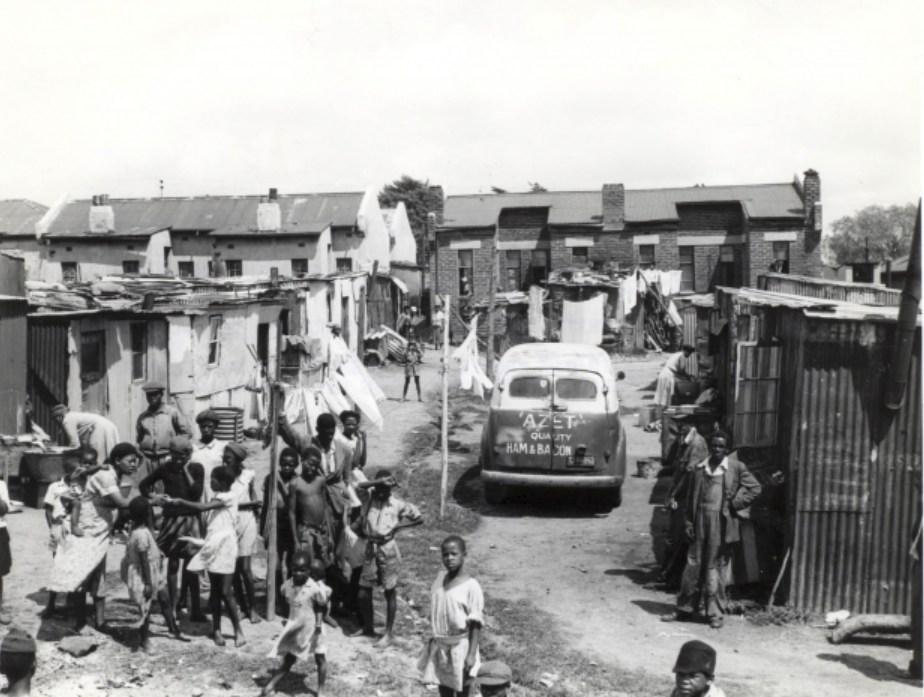
My father had post-traumatic stress disorder (PTSD), brought on by domestic violence in his childhood and traumatising war experiences. Now and then, he would talk about it. He struggled with anxiety and hyper-irritability throughout his life. Like many men in his position, he selfmedicated with alcohol.
As a family, we unwittingly suffered from his PTSD, too, with the worst affected being my mom and me. She and I would talk for hours after she experienced a beating. I would sit and listen as she cried on our neighbour’s shoulder. She would say, ‘The bastard is so cruel and nasty to me, I wish I could kill myself!’ Her neighbour would comfort her while I sat with a heavy heart. I was only eight.
I saw him beat her many times. My father would hit her with full force, and she would cry and wail hysterically. I would cower in the corner. He never hit me then.
On one occasion, after a ferocious beating, she ran out the front door with my sisters and brothers following, all screaming and crying. I went into my father’s wardrobe, took out his shotgun, and loaded it. I approached the kitchen, determined to put an end to the violence. The door was slightly ajar, and I could see my father sitting on a chair with his back to me, sobbing. I walked back to the wardrobe and put the shotgun away.
One of my earliest memories is of my mother crying hysterically, throwing her clothes on the bed, and packing a suitcase. My father had come home drunk, and she was
desperate to leave. I cried, panicked, and threw myself around her legs, begging her to stay.
Another memory is from a party at one of Father’s old army mates, whom we called Uncle Piet. The party was wilder than my mother had expected and got completely out of hand late at night. Father and Uncle Piet had drunk too much, and when they started to run out of booze, they staggered out to buy more. Mother was in tears, threatening to go home.
At that point, Uncle Piet’s wife, Nancy, spotted her father staggering up the driveway, as drunk as a lord. She screamed at him, ‘You pig, you filthy drunken pig, you sexually violated us; we’ll teach you a lesson’! She then ran into the kitchen and grabbed a pot of boiling water, screaming hysterically, ‘Grab him, grab the swine - let’s kill him once and for all!’ As they dragged him into the house, my mother could take no more of this, so she grabbed us, ran down the driveway, and we walked all the way home, us protesting the whole way. I was keen to see them deal with Nancy’s father!
My father did not come home that night. When he arrived the following day, looking dishevelled and bleary-eyed, my mother was packing her things. While she wept, cursed, and packed, we clung to her legs, begging her not to go. All the kids were on the floor. My father was crying, too. ‘Please don’t go’, we all pleaded. Mother gave in, and we all sat on the bed and wept; my father, with the saddest, remorseful face, sat in complete silence for once.
Mom told me years later that she knew when they first got married that he was a heavy drinker; she had felt sorry for
him and resolved to help him get off the booze. Isn’t that an old story? She failed. In Dad’s case, the violence continued until her dying day.
A girlfriend once said to me, ‘You hate your father’. That wasn’t entirely true; we had a love-hate relationship. When I remember how kind and gentle he could be, especially when he returned from the Methodist church in Messina, humming one of the hymns he sang, I miss him. But when I think of searching for his half-empty bottles of cheap wine hidden behind furniture and throwing them out when he wasn’t around, the disgust returns.
I visited my father just before he died. I took leave from my job in Melbourne to see him. He was in hospice care, dying from liver failure. Jet-lagged and feeling very weary and emotional, I walked into his neat single room in a nursing home in Johannesburg. He turned his frail, wasted figure around as I entered. His dark eyes lit up when he recognised me and then tears came to both of us.
He was suffering, slightly drugged to take the edge off, but still awake. He slowly sat up and positioned himself against the pillows. We looked out the window at the beautiful trees and the sunny garden outside.
Slowly, we talked. The conversation was desultory at first, but then he opened up. ‘I love the trees and the flowers outside. I think of Mom a lot now. I’ll be following her soon’, he said. I wanted to hold and comfort him, but the emotional distance was still too great. The last time I hugged him, some forty years ago, he was as stiff as a ramrod, and his hands were cold and sweaty.
After we had spoken for a while, he said, ‘I shouldn’t have drunk so much. That’s what ruined my liver. Why did I hit your mother and hurt her so much?’ The pain in his eyes revealed that he was finally confronting this harsh reality, possibly for the first time. Such realisations can shatter even the strongest of minds.
Those scenes of domestic violence surged back to me with haunting clarity, crashing over me like relentless waves. The memories that tormented me in my earlier years the heart-wrenching screams and wailing of my mother as we peered through the half-open door; she lay on the floor, clutching her stomach. Time has not dulled those images.
As we spoke, he did not ask me for forgiveness. It never occurred to him that he had inflicted so much pain on me as well. I suffered terribly during those early teenage years, serving as my mother’s sounding board, her confidant. Only now have I forgiven him and can finally see his good side, for he did have a good side.
As I sat at his bedside, our conversation turned to his own father. ‘My father was dying of miners’ phthisis, you know. I used to fetch him from the pub every day. The old bastard was as drunk as a lord. I had to support him. If I said a word, he would hit me with his walking stick anywhere and everywhere. I hated the bastard with a hatred so deep; you cannot understand.’ But I did understand.
Those years underground at City Deep Mine, where my grandfather was a shift boss, destroyed him. He breathed in the toxic dust; the air was so thick you could barely see a few feet ahead. The brutal coughing fits began at night, lasting
for hours. Then, the doctors diagnosed him with phthisis. He never worked again, dying an invalid. He drank every day until he couldn’t stand. That was the end of him, too.
Then, our talk shifted to his war years. We conversed for a long time, but the topic of his own father resurfaced repeatedly. ‘Who was he, and where did he come from?’ I asked. He repeated what he had told me some years back, ‘My father came from Winburg in the Free State. He and his brother used to speak to each other in Yiddish! Who speaks Yiddish? only the Jews. I always thought my father was Jewish.’ My mother told us he was Irish!
As I listened to him recount these memories, the weight of our shared past pressed down on me, a mixture of sorrow and understanding that bound us together that day. Not long after, Dad went into a coma and never recovered.
I've always loved telling stories, a trait I inherited from my mother. But it's not the only thing I inherited from her; I also inherited her anxiety, a panic attack disorder, and a tendency to catastrophise. Determined to understand this better, I delved into Google and AI for answers. Is it the way our brains are structured? Is it genetic biochemistry? I may have found some answers, which I will share.
My mother was prone to anxiety, panic attacks, and a tendency to catastrophise situations, as the following incident reveals.
One morning in 1969, a police car swung into our driveway, and two burly policemen got out and made their way to the front door. I saw them from my bedroom window upstairs and shouted, ‘Ma, the police are here at the front door!” I ran down the stairs as my mother, with a shaky hand, lit a cigarette and opened the door. The policeman, cap in hand, said, ‘It’s your son, Mrs. Green. Come, we have him in the back of the car.’
‘No, no!‘ my mother screamed. Sobbing, she was helped by the other police officer, who led her to the car. The back door opened, and Chris, my brother, very slowly emerged. Before he could get out properly, my mother slapped him across the face, shouting, “You little bastard, what have you done again? What have you done?’ The police officer intervened, grabbing her hand before she could deliver another slap, and said, ‘He’s been in an accident, Mrs Green; he’s hurt his leg and maybe has a concussion. He says he’s
okay, but maybe you should call an ambulance if he gets sick or something later on.’
Chris had recently come out of the army and was walking around like a fish out of water in an army ‘great-coat’, causing my mother much anxiety. Still, she had some good reasons for being suspicious. Chris was busy re-adjusting to civilian life after fighting on the Angolan border, and he looked as if he was escaping from something or about to attack someone. Fortunately, he got out of that phase quickly.
And, prone to panic attacks!
Another cause of my mother’s anxiety and depression was my father’s drinking and abusive behaviour, which never ceased. She often confided in me, saying she felt ‘dead inside; Dad had killed me inside.’
Scientific studies92 have shown that anxiety disorders, such as panic disorder, post-traumatic stress disorder (PTSD), and generalized anxiety disorder (GAD), increase the risk of heart disease by 26%, particularly heart failure and coronary artery disease.
My mother developed severe heart trouble at the age of 59. Ten years later, she needed oxygen to stay alive. One night, my father heard a strange noise in the bedroom. When he went to check, she had passed. My mother was gone at 69. Did my father ever think he might have had something to do with her untimely death? Possibly he kept that sort of information to himself.
Not long after my mother died, he married another woman, Dolores, who lived in the same retirement village. He stopped drinking and, I believe, never abused her.
Everyone loved my mother. She was a loving, kind person who attracted people to her, often those who were down and out or traumatised. She worked at a children’s home for orphans in Johannesburg. There, a little girl, Francis, became attached to her and followed her everywhere. Francis had been dreadfully abused by her drunken mother, who burned her with cigarettes. My mother quickly recognised that Francis was looking for a mother figure, and having lost her mother at the age of four, she understood Francis’s suffering and adopted her.
Trauma93,94 is something that many families must contend with, both immediate and transgenerational. It’s encouraging to see that such trauma is now being recognised globally. I only wish that some of the rogues, sinners and saints in our ancestral family tree branches could have confronted and dealt with their own traumatic experiences.
It’s hard to ignore the past, but understanding more about trauma has allowed me to make peace with the past. That said, my mother is one of the saints in our family, and I can see her kindness reflected in both my son, Peter and daughter, Hilda, who have a passion for looking after strays!
‘Blood-redthealoesflank thewindingroad.
Asifaflamewithleapingsparkseachfire-lilyglows. Butnothing,nothingstirs…only abreezethatflows thatseemstopauseandwaverthere thegrass-seedgrows.
Above,theblue,bluesky; andfarbelow,thefallingstream driftsthroughtheorchardswith aflashofgreen.
Andnosoundbreaksthehoveringpeace ofthisstillmountainscene.
NowafteralltheyearsI’llopen agateagain.
Wherehavemypaths tillnownotled tobringmetothisfarmroadgate withallillusionsshed buthope,hopeinmyheart andcleardreamsinmyhead?
Thegatestandsin amaroela’sshade.
Awholenessinme,harmony andnobitterness,nohate.
Iliftthecatch…andinmyheart openagate.
—UysKrige,SouthAfricanPoet
The farm Alexander in the Transvaal holds a monumental place in the heart and history of the Green family. This cherished land was in my ancestors possession since before the Anglo-Boer War and perhaps even longer. It’s not just a piece of land; it’s a tapestry woven with the threads of our ancestors' struggles and triumphs.
Imagine my great-grandparents working the fields while surviving the Rinderpest pandemic that swept across the land before the war. As conflict erupted, the farm transformed into a secret guerrilla base, a sanctuary amidst the chaos. Our family endured dark times, like their harrowing experience in the British Standerton Concentration Camp, yet they emerged with resilience, determined to continue farming on this land for over a century.
But the farm has seen its share of heartbreak too. My grandmother passed away when my mother was just four, leaving a void that stayed with her all her life. at Tragedy struck when I was little, when my uncle suffered a fatal shotgun accident at the front gate of the farm. And then there was the shocking murder of my cousin in 2010, a stark reminder of the violence that overshadowed the postApartheid era.
The farm Alexander is more than just land; it was a testament to our family’s enduring spirit, a place where joy and sorrow coexisted, and where each corner whispered stories of those who came before us. Now, the farm is owned by a petrochemical company that intends to
transform it into a giant open-cast coal mine to utilise the low-grade coal that lies beneath its surface.
Let’s go back to the beginning.
With a large and steadily growing family, my parents could not afford the luxuries of a holiday to Durban, Kruger Park, or anywhere else in post-war South Africa. The exception was a trip to Alexander to visit Oupa, Ouma, and our Venter cousins.
In the earlier years, we travelled from Germiston Station to Trichardt Station, where Uncle Thys would pick us up in his dark green Ford pickup. In later years, the whole family would squeeze into my father’s Ford Prefect, including our fox terrier, ‘Spotty’. This was a source of great excitement for us and huge stress for my mother and father, who had to contend with us fighting in the back and a dog that suffered from car sickness.
We would travel through Kinross, and from there, the roads were unpaved. The car would veer from side to side and vibrate dreadfully as the packed pickup traversed the corrugations. This was never good for the dog. ‘Spotty’ would sporadically spew on the back floor of the car. I will remember that smell to my dying day.
Our excitement would know no bounds when we arrived at the farm gate. It was always quite a feat to open and close the gate by slipping the looped wire over the top of a barbed wire entwined gatepost. My father would put the car through
its paces as we descended the knoll down to the farmhouse in the distance.
My anxious mother would, without fail, hysterically advise my father to avoid the road down to the farm coal mine, as plunging into the mine workings would result in all of us meeting our Maker prematurely. As the car approached the farmhouse, figures would emerge from the house as soon as the car’s sound was heard, accompanied by the blaring horn.
Led by our eldest cousin Fanie, he and the rest of our cousins would sprint through the front gate, running wildly to meet us, arms flailing, shouting repeatedly, ‘It’s Aunt ‘Rita’ and Uncle Cecil!’ As the car ground to a halt in front of the gate, the kids were joined by my Oupa Chris and Ouma Heila, along with a cohort of growling and snapping dogs.
Those dogs were vicious! Visitors could never decide if the bared teeth were signs of frenetic affection or a desire to rip them to shreds. First, we had to carry ‘Spotty’ from the car and gently introduce him to the other dogs. After some growling, snapping, and biting, followed by sniffing and whining, all the dogs would be driven off, including ‘Spotty’ , whom they accepted as one of the pack in an amazingly short space of time.
After the elaborate family greetings were over, Fanie would always lead us into some adventure or high-risk activity somewhere on the farm, usually far from the farmhouse where the adults couldn’t see us.
All the children, led by Fanie, would madly dash for the barns, the stone-walled cattle and sheep kraals, and the farm machinery sheds. The first stop would be the cattle kraal, which we would enter with shouts and great gusto. If we were early enough, we would rush into the milking area to assist with milking. There, we would be greeted goodnaturedly by the Ndebele farmhands and invited to try our hand at milking, squirting streams of milk into buckets. Tails swished, heads moved; bovine eyes, not so dull, sized us up, with hooves clattering against the milking pail. I can still feel those teats, with milk shooting into the bucket, making a swish-swish sound!
We would explore every nook and cranny of the farm, spending hours climbing onto old, disused ploughs, rakes, tractors, trailers, rusted trucks, and combine harvesters all stored under blue gum trees. As far as the adults were concerned, we were out of sight and out of mind.
We would be up at dawn on the first day of the visit and out of the house into the farmyard as the shades of darkness lifted. The invigoratingly cold early morning Highveld air filled our city lungs as we raced to enjoy the early morning machinations of farm life. The sharp call of turtle doves pierced the crisp morning air.
As the sun peeped above the horizon, the green cornfields would gradually emerge from the grey landscape, revealing an orderly sweep of green fields extending to the horizon. Next to them, the sunflower fields would mimic the rising sun in torrents of green and yellow, gently sloping down to
the creek in the west and then, in a northerly direction, to the stone-walled kraal.
In spring, clumps of black wattles in the fields would add their yellow glory. At Easter, all the families visiting the farm would go for walks, savouring the simple beauty of the cosmos flowers (Figure 49 below) along the farm roads and the edges of the sunflower and cornfields. Those were truly joyful occasions!
Within the kraal, the red-brown Afrikaner cattle, with their great horns curving downward, would lazily jostle each other, bellowing to be let out, awaiting a leisurely day in the veld. Unafraid, we would walk amongst the cattle, feeling mud and cow dung squelch between our toes, then clamber up and over the stone walls to join the cattle and farmhands as they cracked their whips and urged the cattle on.
But there was a dark side to our visits.
Fanie and I would furtively sneak up to the shed next to the farmhouse and peer through a crack between the locked doors when justice was to be delivered. In the 1950s, much of rural South Africa was still a feudal society. Farmers would summarily mete out justice to their staff without involving the police.
At ‘Alexander’, offenders were tried, convicted, and sentenced to a thrashing in the shed. The tribunal consisted of Oupa Chris, Ouma Heila, Oom (Uncle) Thys, and other farmworkers who supported the system of instant justice.
Theft, insubordination, or loitering on the farm could result in a beating.
They used a sjambok for this appalling punishment. I will never forget the cries of the young Ndebele between the methodical cracks of the sjambok. The wailing grew louder and louder as Oupa shouted in Zulu, ‘Why are you here? Where are you from, you thief!’
I returned from Australia to visit the farm in 1990. We drove up to the huge, padlocked gate and the farmhouse, now surrounded by towering barbed wire security fences. We disembarked from the car to inspect the gate, only to be greeted by a pack of snarling, barking dogs that appeared from nowhere. They kept jumping up against the gate, their snarling cacophony and bared fangs ensuring we kept a good distance from the entrance.
Distant shouting interrupted the din. A khaki-clad figure appeared from the farmhouse and walked toward the gate.
It was Fanie, lashing out at the dogs with a walking stick! The dogs retreated, protesting and snarling, led by a bitch with the largest teats I had ever seen. ‘They won’t bite, I assure you,’ he said, a huge grin on his face. ‘They only bite kaffirs they don’t know’. I winced at the blatant racial bias he still displayed. Many of my Afrikaner relatives and friends in South Africa at that time were still stuck in the old ways.
We shook hands and hugged again. He was the enthusiastic cousin I had always loved to visit. I introduced him to my wife’s parents, Dirk and Dina Beukes, who had
accompanied me on this trip. Fanie beckoned us to follow him. We were thankful to get back into the car, looking in all directions to ensure there was sufficient distance between us and the vicious pack of dogs.
I recalled my disappointment at seeing a monstrous building on the horizon that now obscured the once pristine, rolling green veld. This monstrosity was the Kriel Power Station. On the way to the farm, we also passed the huge Sasol petrochemical and synthetic fuel plants and the encroaching informal settlements. It felt as if the once formidable ‘Alexander’ now cringed in the shadow of these industrial monoliths.
We all entered the house from the veranda. It was still the old farmhouse that I remembered, modernised here and there but essentially the same. Inside, we were greeted with laughter, hugs, and kisses. After lunch, Oom Thys and my father-in-law Dirk launched into a serious political discussion, which rapidly degenerated into an unpleasant mudslinging match. Those were the days when right-wing parties had splintered into several incompatible factions, with internecine fighting the order of the day. This caused a huge division between those who wanted societal change and those who wanted to maintain the status quo.
To prevent an all-out feud, I suggested visiting the farm cemetery, a mandatory diversion during visits. It took some effort to calm everyone down again and usher them out by the back door to the cemetery. The cemetery, located among magnificent blue gum and black wattle trees, told the stories of the tragedies forever etched in the marble headstones.
A small, yellow-brown, rectangular grave told the story of my grandmother, who died from peritonitis when my mother was four years old. We would weep with her when she recounted how an old lady at the funeral gave her a peppermint when she repeatedly asked when her mother would return home. It was a turning point in her life, and when I tell people her story, it still brings a tear to my eye.
The blue granite headstones of my grandfather Christiaan, my great-grandfather Stephanus Venter, and my step-greatgrandfather Zietsman brought a smile to my face as I remembered Oupa Chris’s stories of the Anglo-Boer War.
That trip to the cemetery was incredibly significant for me because it was the last time I saw Fanie alive.

One Sunday morning, completely out of the blue, my cousin Fanie met his demise at the hands of local farm attackers on the land of our beloved ‘Alexander’ .
The local tabloid report gave a graphic and sensational description of Fanie’s murder. The headline read: ‘Executed Bethal Farmer Fanie Venter’s mom, Hannetjie Venter, 79, walked 4 km to get help’ .
These are the details, as reported in the local tabloid:
Bethal – February 7th, 2010 – An elderly Afrikaner Bethal farm woman had to walk four kilometres to get help after three farm attackers had killed her son, execution-style on Sunday-morning –a popular time for farm-attackers – and stole her mobile phone so she couldn’t call for help. Hannetjie Venter, 79, didn’t see them kill her son Fanie but did hear the single shot the robbers had fired into his head.
A friend of the family, Sakkie Pretorius says her ordeal started at about 08:30. He says ‘Hannetjie saw the gunmen – apparently three of them – and tried to warn Fanie who was busy elsewhere on the farmyard.
He probably didn’t hear her. One of the men put his hand over her mouth. Fanie, who always carried a firearm, was caught unawares, and was shot in the head.
When she got to him, one of the men said her son was ‘just sleeping’. But there was blood everywhere, and she could see that he was dead, according to Pretorius. The robbers held a gun to her head and forced her to unlock the safe. She asked: ‘Why don’t you shoot me as well?’
The farm attackers could have looted all the contents of the homestead at their leisure – but they only stole a shotgun, mobile phones, money and Hannetjie’s handbag’.
Francois van Dijk, a neighbour, said, ‘because the robbers stole the Venters’ mobile phones and Hannetjie can’t drive, she and their dog walked about four kilometres to Van Dijk’s house to get help
She got here at about 10:00. She walked all the way. It was very traumatic for her.’ Van Dijk immediately alerted the police and neighbours, but the men – who’d arrived in a car – were long gone.
After reading the report, I tried to contact the local police in Bethal to obtain information about the murder and the whereabouts of my aunt, but I found nothing zero leads. Then, on a recent visit to South Africa, I discovered that ‘Alexander’ lay in ruins. The farm, once vibrant and alive, was abandoned, with gates padlocked and secured with heavy chains.
When I contacted my other cousin, Fanie’s sister, who lived in Western Australia, she confirmed the tragic events leading to the torture and death of Fanie, her eldest brother. Her voice trembled as she recounted how their mother, Hannetjie, never recovered from the traumatic experience, could no longer bear to run the farm and died soon after.
SASOL, a petrochemical giant, acquired the rights to mine the underground coal reserves on the farm and surrounding areas. As the poet Robert Frost wrote, ‘Nothing gold can stay’, but in this case, the green turned into a different kind of gold a ‘giant’ that will bring environmental destruction to what was once a haven of natural beauty and family joy.
Nature’s first green is gold, Her hardest hue to hold.
Her early leaf’s a flower; But only so an hour. Then leaf subsides to leaf. So Eden sank to grief, So dawn goes down to day. Nothing gold can stay.
Robert Frost96:
Would my Oupa Chris and Ouma Lettie be devastated at such a grotesque transformation? A dream, once so full of hope and promise, is now replaced by a nightmare of the voracious greed of a faceless corporation. The VOC never really went away; it just mutated, growing into a monstrous force that devoured the legacy my grandparents had left behind.
The land that once echoed with the laughter of children and the lowing of cattle now lies silent, a testament to the relentless march of progress that respects neither memory nor love. The heart of ‘Alexander’ was not just broken; it was shattered beyond repair, leaving behind only the ghosts of what once was.
‘Blouboskraal’ or ‘Black
‘The bush was grey
A week to-day
Olive-green and brown and grey
But now the spring has come this way
With blossoms for the wattle’.
—Veronica Mason97

Figure 50: Black wattle flowering98 .
My wife, Dedrie, grew up on the enchanting farm
‘Blouboskraal’ in the Eastern Transvaal, now Mpumalanga. In the early days of our marriage, we cherished frequent, lengthy visits to this idyllic sanctuary.
The journey to Blouboskraal was always an adventure, mainly when the rains came. Spring and summer brought powerful thunderstorms, turning the farm road treacherous. We would navigate the slippery, mud-soaked road, our vehicle slithering from side to side, nearly losing control, until finally, the sight of flowering black wattles (Figure 50 above) signalled our arrival at the homestead.
In summer, the wattle displays were breathtaking, their golden blossoms contrasting against a backdrop of brooding grey cumulus clouds. Upon our arrival, we would often remark on their beauty. Dedrie’s parents, Dirk and Dina Beukes, would nod in agreement, though with a note of exasperation, we would be told, ‘They are a great nuisance, a pest in fact, and impossible to eradicate. Their only use is being turned into charcoal or used in a tannery’.
The black wattles thrived in ‘Blouboskraal’s’ hospitable embrace, creating a veritable arboretum, a wattle nirvana. Despite efforts to remove them, roots and all, they would stealthily reappear in some unsuspecting corner of the farm.
To reach ‘Blouboskraal’, we would journey to the top of the escarpment, a few kilometres from the crossroads leading either to the escarpment town of Waterval Boven or the historic transport rider town of Lydenburg. There, Dirk and Dina tended to their cattle, sheep, and fowls, planted corn and sunflowers, and supplied eggs to many locals.
Those days were blissful, untouched by the demands of modern life. We played tennis on a clay court that her father had crafted from ant heaps and, later, on an all-weather court, his pride and joy.
Our mornings and evenings were filled with walks along farm tracks, by the Swartkoppies Creek, through sunflower and corn fields, and amidst pine plantations. The invigoratingly crisp Highveld air filled our lungs as we raced to embrace the early morning routines of farm life. The sharp call of turtle doves pierced the quiet, crisp morning air, and the landscape gradually unveiled itself with the rising sun. We always returned for mandatory teatimes, for we were all devoted tea drinkers!
Dedrie and I would explore the ancient stone ruins of ‘Blouboskraal’ on the farm, also known as Adam’s Calendar, and the numerous sites of skirmishes and battles during the Anglo-Boer War scattered on the farm and across the farm boundary.
Dedrie’s mother, Dina, along with the servants, prepared three sumptuous meals each day. Dina was a true culinary artist; large pots and pans simmered and boiled all day on an ancient but reliable Ellis coal stove. The tantalising aroma of cooking would waft through the sprawling farmhouse, and Dina would summon us to the table with a melodic voice specially tuned for mealtimes. No one dared be late!
Those were the days of simple joys and profound contentment, where every visit to ‘Blouboskraal’ was a journey into the heart of family and the timeless beauty of nature.
Dedrie’s father, Dirk, would say grace after we were all seated in our designated chairs. The evening meal would begin with a Bible reading and the singing of a psalm. He would then pray, though we could never quite catch the words he mumbled while conversing with the Almighty.
The kitchen table was the heart of the home during the day, a place where we gathered for discussions, gossip, and warmth in the winter. During summer storms, lightning would sometimes find a frightening path down the chimney, creating a dazzling blue-white orb above the stove. We would stare, startled out of our wits and deafened by the accompanying thunderclap.
The north-facing lounge was furnished with a comfortable sofa, where we would gravitate at various times of the day to meditate. The panoramic view from the windows was perfect for reflection. The gently rising, undulating countryside, traversed by a silvery line the road to Lydenburg is etched forever in my memory. The yellowtinged veld would turn light brown in winter and delicate green in spring and summer. Clumps of eucalyptus and wattle trees punctuated the landscape, dark and grey with bright patches of yellow flowers in early summer.
We were all enthusiastic tennis players, spending many hours practising against the shed wall that bordered the tennis court. Dina had been a formidable player, but after being seriously injured in a car accident, her mobility was limited. We always gave her a double bounce during tennis, much to our disadvantage. She would shuffle up to the ball and hit it with great force and pinpoint accuracy; we could never get to it. She beamed with pleasure when she delivered these ‘cannonballs,’ as we called them.
During our walks on the property, the unexpected often occurred. Wild animals roamed the farm, and many of them were nocturnal hunters and very wary. Once, my son, Peter, and daughter, Hilda, were walking far ahead of me when they
peered into a large porcupine hole. Suddenly, the ground reverberated with vicious snarling and growling they had stumbled upon a serval cat lair! We sprinted for our lives to put enough space between us and the fierce serval cat.
On another occasion, a mongoose leapt out of a bush in front of Hilda and Peter, and before they knew it, the dogs were onto it: a belligerent fox terrier and a schipperke. I swung my solid leather walking stick furiously at the dogs, but they ignored me. The more I shouted, screamed, and swung the stick, the more they continued with their ghastly intent. Sadly, it all ended quickly. We carried the warm, limp body of the mongoose home with the dogs complacently in tow.
Before Dedrie and I were married, we would head up to the higher ground in her Volkswagen Beetle, armed with a picnic blanket and some good snacks. We thought we were alone and undetected. But unbeknownst to us, her younger brothers had noticed our stealthy departure and set out to follow our tracks. On hands and knees, they snuck closer and closer, armed with binoculars. We never saw them or suspected anything only to be told in later years that they had come close to us and learned much from the experience! They were different times, I suppose.
Those early visits to the farm with Dedrie were magical. I will never forget the magnificence and resilience of those black wattles. In later years, they became a symbol of endurance for us, their beauty infusing us with a sense of enchanted longing and a profound appreciation for the enduring power and beauty of nature. The black wattles, much like our memories, stood tall and resilient, a testament
to the unyielding passage of time and the timeless beauty of cherished moments.
Dedrie’s mother, Dina, the third daughter of Dutch immigrants, grew up in the Johannesburg suburb of Norwood. She was one of the first Afrikaner women to obtain a master’s degree in biochemistry, an exceptionally rare accomplishment in the 1930s. Dina met her husband, Dirk, at university. They married and moved to farm in the Orange Free State on a property called ‘Ergenisspruit’ (‘Frustration Creek’).
Their early farming days were filled with adversity. The soil was poor, yields were low, and imported turkeys from the USA died as chicks. Dina experienced many miscarriages before finally giving birth to Dedrie, who was fortunate to survive. However, both mother and daughter developed a high fever after the birth, leading to hearing and dental problems later in life. Dedrie’s brother, Kobus, was born four years later. When it became clear there would be no more children, her parents adopted Gerard.
The challenges of ‘Ergenisspruit’ proved too much for Dedrie’s parents, prompting a move to ‘Blouboskraal’, where they managed a joint farming business. Dina farmed poultry while Dirk operated a mixed farming business. They delivered eggs to Machadodorp, Waterval Boven, and beyond and were regarded as prominent community members, deeply involved with the local schools and the Dutch Reformed Church.
In jest, Dirk sometimes described Dina as a ‘good wife’ but not a ‘nice wife.’ We never really understood what he meant. Like her forbears, she was profoundly religious, and
her sharp intellect and targeted judgment made us avoid religious discussions, as she would ‘chew you up and spit you out’ in a second. We were always on our guard when it came to religion, and Dedrie and I developed tactics to shield ourselves from her watchful eye and penetrating questions about religious matters.
Dina insisted that I join the Dutch Reformed Church when we got married. Both Dedrie and I struggled with the concept that we were ‘born sinful’ and may only ‘possibly’ be one of those ‘predestined to salvation’. Much of the harshness and austerity of that brand of religion eventually drove us away from the church.
However, Dina’s acumen and great sense of humour stood her in good stead when philosophical matters or scientific questions arose. She was a formidable opponent in an argument, and we had to back off when she took the high moral ground. But we could agree on many things, and our conversations were often hilarious and stimulating. I learned a lot from Dina during our long chats around the kitchen table, and I saw her sharp intellect and warm humour reflected in my wife, Dedrie.
Dina’s family and ancestors were truly inspirational. Their personalities and traits mirrored in Dina tremendous care and love for others. Dedrie, my daughter Hilda, share the same qualities a love and caring for others, often the ‘down and outs’. There is Oupa Christiaan Alers, who was the first male ‘midwife’ in the Netherlands, just after the Napoleonic Wars, who used to deliver babies for the poor who could not pay him. Then there was Corrie ten Boom, who rescued Jews during the holocaust; she just escaped Auschwitz by chance.
At about the same time as Oupa Kobus was fighting the Xhosas in South Africa, Christiaan Alers, Dedrie’s Alers family ancestor, grew up in the tumult and aftermath of the Napoleonic Wars that swept across Europe. He probably witnessed poverty and suffering on a large scale.
Christiaan, born in 1802, grew up in Rotterdam, where poverty was rife in the early years of the new century99, and many left for a better life in the New World. The Napoleonic Wars had left the country exhausted. There would be grinding poverty in the region until the 1850s due to the poor state of the economy at the time, and the cost of living for many families in the towns exceeded their income100 .
Despite the dire condition of the economy, Christiaan somehow had the means to pursue an education in Rotterdam, where he qualified as a surgeon and served as a ship’s surgeon of the third class with the Marine Corps. In 1824, he was admitted to The Hague as a rural surgeon, later undergoing training as a male midwife in 1825.
When Christiaan completed his midwifery training, he was one of the first male midwives to practise in the Netherlands. He eventually settled in Hillegersberg, a neighbourhood of Rotterdam, where he established himself as one of three midwives.
His early years in Hillegersberg were marked by formidable challenges, with life being cheap and conditions hazardous. Tragically, his first two wives, Johanna Kelk and sister Jacoba Hendrika Kelk, passed away at the young ages of thirty-two and thirty-eight, respectively. He then married
Margaretha Langenberg in 1840, who would later become Dedrie’s third-generation great-grandmother.
Over his lifetime, Christiaan fathered seventeen children, some of whom tragically died at a young age, while others went on to lead remarkable lives. Renowned for his competence, sobriety, and respectability, Christiaan often treated patients without charge, reflecting his compassionate nature and dedication to serving the sick and impoverished. Moreover, he earned a reputation for safely delivering babies, a feat considered challenging in his era.
Following Christiaan’s passing, his practice’s financial records revealed numerous outstanding debts owed by destitute patients, underscoring his reputation as a benevolent medical practitioner.
There were many well-meaning, arrogant and misguided people, such as the Dutch poet Elizabeth Wolff101, who wrote about the poor:
Good God! Is it really the case that this scum of the nation, living in vice and poverty, in wantonness and sorrow, in excesses and illness, should stem from the same origin as the civilised parts of the people! Are these really creatures formed by Your likeness? Are these people really more than beasts! Are they entitled to eternal happiness! They know of no virtuousness, nor are they able to reason soundly – no more than convulsions of humanity they seem to be.
But Christiaan delivered babies even if they were ‘living in vice and poverty, in wantonness and sorrow, in excesses and illness’ and even if they could not pay!
In stark contrast, his colleague Wilhelmus Cramer was plagued by issues of alcoholism, incompetence, and paranoia. Cramer's erratic behaviour and questionable professional conduct led to widespread concern among local authorities. In fact, the mayor of Hillegersberg expressed apprehensions about Cramer's moral conduct in a letter to the midwifery commission in The Hague, citing instances of alcohol abuse and professional inadequacy that rendered him unfit for his duties:
‘I am concerned about the moral behaviour of W. Cramer, surgeon, and midwife here... It is publicly known that he is guilty of abuse of strong drink and, therefore, must on several occasions be considered wholly unfit for the exercise of his profession, and even for those who still find the irresponsible folly to call upon his help if it is to be reckoned dangerous.’
In the tapestry of our family history, Christiaan Alers emerges as a revered saint, his legacy woven with threads of compassion and courage. A medical pioneer, philanthropist, and attentive father of a bustling brood, he stands as a beacon of virtue amidst the trials of life.
When I ponder the essence of goodness, it is Christiaan's unwavering altruism that comes to mind, a guiding light in the shadowed valleys of adversity, a testament to the resilience of the human spirit.
Dedrie’s Dutch ancestors lived in the Rotterdam suburb of Hillegersberg. The clearest of photographs, taken in 1885, shows her great-grandfather and great-great-grandfather Robertus102 (Figure 51, below).
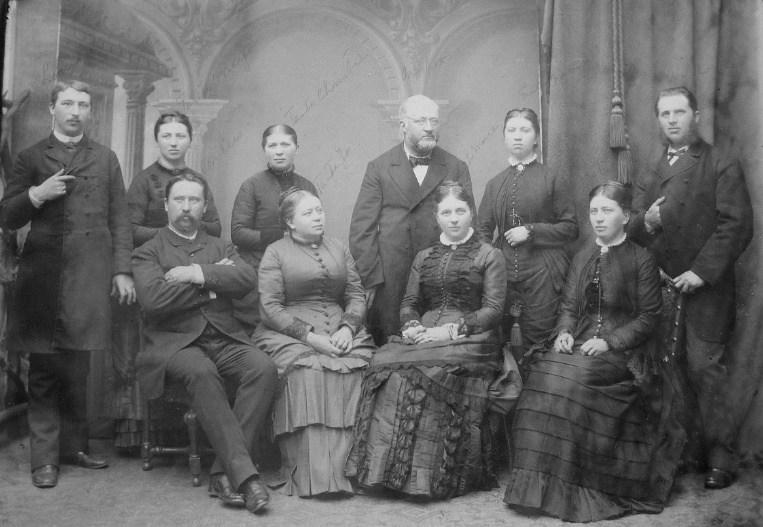
Figure 51: Alers family, Hillegersberg (1885) – Flickr; courtesy of Wytze Alers.
Christiaan practised in Straatweg (
Figure 52, below), now the site of a home for disabled children.
Figure 52: Christiaan's Home in Straatweg – Flickr; courtesy of Wytze Alers.
Figure 53: Christiaan Johannes Alers 1802 – 1878 –Flickr; courtesy of Wytze Alers.
My wife Dedrie's great-great-aunt, Corrie ten Boom, was among the first female watchmakers in the Netherlands. She gained international renown not only for her skill but also for her boundless compassion. In the dark days of the Nazi hunt, she became a beacon of hope, rescuing countless Jewish lives. Her written accounts of those harrowing times testify to her courage and unwavering humanity.
Like many Dutch and Afrikaner families, Corrie was a staunch Christian who believed that 'love thy neighbour' meant loving all her neighbours, regardless of who they were. Corrie not only understood this principle but also
practised it by running programs for people with mental health issues.
When Germany occupied Holland during the Second World War, the Nazis began rounding up and deporting Jewish people in Corrie's neighbourhood. Corrie and her family were outraged. In 1942, a Jewish woman named Beje arrived at their house, desperately seeking help. Beje's husband had been arrested, and her son was in hiding. She was afraid to return to her home. Corrie's family hid her, telling Beje, 'In this household, God's people are always welcome.’
After that, they began to shelter neighbours, family, and friends, mainly Jewish people. The biggest risk was sheltering Jewish individuals, as the Gestapo had zero tolerance for this ethnic group, and anyone aiding and abetting Jewish people could end up in the extermination camps themselves.
However, they soon realised that the growing number of people knocking at their door would raise suspicion. Despite this, they persevered, following their Bible's teaching to 'love thy neighbour as thyself103'.
The Dutch Resistance helped Corrie's family build a tiny, secret room next to Corrie's bedroom called 'De Schuilplaats' ('The Hiding Place' - also the title of her famous book), which could accommodate five or six hungry and desperate individuals (Figure 56 below).
The room had a false wall. Visitors brought bricks hidden in newspapers and briefcases to construct it. It was threequarters of a meter deep, with built-in ventilation and a
sliding panel inside a cupboard, which allowed a panicstricken refugee to crawl inside on their hands and knees.
A buzzer warned the hiding refugees if danger loomed. Those upstairs would put their ears to the wall, listening for the sounds of jackboots and sticks tapping the floors and walls. They knew the Gestapo and their dogs were expert at extricating people from any enclosures. They must have been terrified!
At first, nobody noticed the nondescript people arriving at the watchmaker's house, mistaking them for shop customers. At night, frightened, exhausted people tapped on the window, furtively looking up and down the dimly lit street to see if any danger lurked. Every refugee was welcomed with the words, 'In this household, God's people are always welcome'. Some even arrived hidden inside grandfather clocks.
Corrie’s house could accommodate many people in many rooms. Still, as the number of refugees grew, food became a problem. Non-Jewish Dutch people bought food with coupons, but they needed more. Corrie had to obtain ration cards from the Food Office every day for her own family, so she took a chance by getting Fred Koonstra, the Food Office manager, on board with her selfless endeavour. She was going to ask him for five food cards, but when their eyes met, he recognised her she was the one who had helped his disabled daughter. Corrie took a massive leap of faith and said without flinching, 'A hundred cards, please, Sir'. From then on, Corrie received one hundred cards daily.
While they hid Jews, they also managed to get kosher food and honoured the Jewish Sabbath!
Everything fell apart when a Dutch informant, Jan Vogel, alerted the Germans about Corrie and her family. The Gestapo raided the house in 1944. There were eight refugees in the house at the time of the raid, but fortunately, they escaped to the secret room and safely fled through a window two days later.
On February 28, 1944, the Gestapo arrested the entire family. They found so-called 'resistance' materials and ration cards stashed away. Corrie and her family refused to give any information about the eight Jews hiding in the house.
Corrie, her sister Betsie, and their father the main suspects—were sent to Scheveningen prison. Corrie spent several months in solitary confinement, where the Gestapo tried to force her to reveal where she hid the Jews, but she did not budge.
Eventually, all were released except for Corrie and Betsie, who ended up in the notorious Ravensbrück concentration camp in Germany.
Ravensbrück was a hellhole. The inmates suffered freezing cold conditions in rudimentary dwellings. They starved and were exposed to vermin. They were used as guinea pigs for medical experiments. They also had to endure backbreaking physical labour daily (Figure 55 below).
Corrie and Betsie looked after their fellow inmates, constantly lifting their spirits and secretly sharing Bible readings with them. Many Jewish people accepted the
Christian religion under those desperate conditions because it gave them hope.
Betsie had pernicious anaemia, making prison life especially harsh for her. She died on December 16, whispering to Corrie, 'There is no pit so deep that God's love is not deeper still'. Records indicate that Betsie may have been subjected to medical experiments conducted by the Gestapo. In 1942 and 1943, selected inmates were infected with poisonous gas, gangrene, or other bacteria and given a series of 'cures' that often resulted in death or severe longterm damage. Some inmates even received experimental bone transplants; others had healthy limbs amputated just to see how their bodies would respond.
When it came to managing the inmates in the concentration camps, the Gestapo meticulously kept records that included names, birth dates, addresses where captured, destinations, and medical information. However, occasionally, a Gestapo soldier or employee would fill out an inmate record incorrectly or tick the wrong box. This happened to Corrie, who was released on New Year's Day 1945 without explanation and returned to Haarlem shortly before the end of the war. All the other inmates in the camp of her age and older were executed the following week.
Corrie returned to Holland during the 'Hunger Winter', a terrible famine that killed thousands. She set up a shelter for disabled people and those with mental illnesses whom the Nazis had targeted for extermination.
After the war, Corrie founded and operated institutional homes for recovering Holocaust survivors. She became well-
known as a public speaker, spreading the message of forgiveness and reconciliation.
Corrie never stopped caring. After the war, she opened a rehabilitation centre in Bloemendaal to care for concentration camp survivors and some local Nazi collaborators who struggled to find work. She appeared in more than sixty countries, urging reconciliation as a path to healing. During this time, Corrie104 wrote 'The Hiding Place', the story of their rescues, saying, 'Books do not age as you and I do. They will speak still when you and I are gone to generations we will never see.’
In 1953, the Knesset, Israel's parliament, passed a law creating ‘Yad Vashem’ as the country's Martyrs' and Heroes' Memorial Authority. Its tasks included commemorating the six million Jews killed by the Nazis and their collaborators during the Holocaust, paying tribute to Jewish resistance fighters, and honouring those 'high-minded Gentiles' who risked their lives to save Jews. The title 'Righteous Among the Nations’ is taken from Jewish tradition, describing nonJews who helped the Jewish people in times of need.
Corrie was honoured as a ‘High-Minded Gentile’ and became an honorary Israeli citizen. To us, in the Green family, she is one of our most loved and honoured saints.
In later years, I realised what a powerful influence my father-in-law, Dirk, had on us. He was a brilliant, remarkable, and eccentric man with a fantastic memory. He had a stocky build, a round face, intense blue eyes, and a loud, booming voice that carried for miles.
Dirk was well-educated and exceptionally well-read for a farmer. His favourite author was Louis Bromfield106 , who was an American writer, conservationist, and bestselling novelist in the 1920s. He reinvented himself as a farmer in the late 1930s. He became one of the earliest advocates for sustainable and organic agriculture in the United States.
Bromfield’s writings formed the basis of Dirk's philosophy on life, and he could quote his works verbatim. He covered those books in brown wrapping paper and Sellotape. Some pages, yellowing with age, had comments scribbled on them and little pieces of written commentary stuck to sentences underlined in pencil.
He often lay on the conjugal double bed, listening to the barely audible voice of Maria Callas from a small transistor radio on his bedside chest of drawers. If any of us entered the room, Dirk would start with, ‘Did you know that…’ This would usually lead to something Bromfield wrote. His voice would rise to a high crescendo as he harangued us with Bromfield’s views on ecology, agriculture, humanity, and the animal and plant kingdoms of the world.
He would quote Bromfield verbatim from the texts When the Rains Came, Pleasant Valley and Malabar Farm, with a
faraway look in his eyes. His voice would rise, and he would tell us time and again that Louis Bromfield made Malabar Farm the most famous farm in the world. Farmers, conservationists, politicians, businesspeople, and Hollywood celebrities like Humphrey Bogart and Lauren Bacall visited the farm in Ohio to see how Bromfield transformed impoverished farmland into a beautiful, highly productive farm using natural conservation practices considered best practice to this day.
Dirk would tell us how he tried to implement Bromfield’s ideas on sustainable agriculture, combining conservationminded farming methods with modern technology. How he had rotated and diversified his crops, built up the soil, and tried to control pests naturally instead of using insecticides, but to no avail. ‘My problem is’, he would always say, ‘At “Blouboskraal” the soil is too poor, so I bought a transport business, and your Ma farmed with the fowls and baked cakes.’
Dirk understood plants. During a visit to Australia, he noticed that a lemon tree in our Melbourne garden wasn’t thriving. Furtively, he bought a bottle of a 'sustainable chemical,' as he called it, which restored that tree to the greenest and most productive it had ever been. I later learned it was potassium permanganate, something he had learned from reading Bromfield.
Dirk often spoke about Albert Schweitzer’s ‘Reverence for Life’ philosophy107 based on ahimsa, the Hindu principle of non-violence. He frequently quoted Schweitzer, saying wistfully, ‘Ethics is nothing other than a reverence for life, and reverence for life affords me my fundamental principle
of morality, namely, that good consists in maintaining, assisting, and enhancing life, and to destroy, harm, or hinder life is therefore evil’.
Dirk’s remarkable memory astounded us all. He would recite Sir Walter Scott’s narrative poem The Lady of the Lake in a strong Afrikaans accent a far cry from the Scotsman who wrote it! I often wondered how someone educated in an Afrikaans-Dutch school in the 1930s in a small rural Orange Free State town could recite such a poem or even have the interest and inclination to do so.
He would recite from memory:
Boon nature scattered, free and wild, Each plant or flower, the mountain’s child. Here, eglantine embalmed the air, Hawthorn and hazel mingled there; The primrose, pale and violet flower Found in each cliff a narrow bower; Foxglove and nightshade, side by side, Emblems of punishment and pride, Grouped their dark hues with every stain The weather-beaten crags retain.
Dedrie and I disagreed with his ultra-right-wing politics, and when he spoke about the betrayal of the Afrikaners by their political leaders and the worldwide conspiracy, his voice would start rising, and his eloquence would jump a quantum. We would often make a hasty retreat and try to steer the discussion to a more manageable topic.
Dirk and Dina said their final farewell to us in March 2006. Dina had suffered a stroke, and Dirk had Cancer, which had spread throughout his entire body. They had sold
‘Blouboskraal’ and were living in a flat behind Gerhard’s house in Middleburg. In the flat, they cared for Tante (Aunt) Hilda, who was bedridden and suffering from Dementia. Gerard overheard them discussing a ‘final’ plan. It was not until the morning of the first of March that it became clear to Gerard what the ‘final’ plan meant.
He initially ignored the three shots of the .22 rifle, assuming that Dirk was outside and was shooting at some predator cats that were after birds in the backyard. When he realised that it was unusually quiet next door, he went to investigate. The three bodies told the story.
Strong, independent and courageous, they decided to leave the world together; they were not going to be a burden to anybody they could no longer look after each other.
I discovered a letter in one of Dirk’s Bromfield books, Pleasant Valley when it arrived in Melbourne. There, the reason for their ‘final’ plan is described.
Now, when the wattles bloom along our walk beside the Yarra River in Victoria, I remember the black wattle blooms in the Transvaal, blooming in early summer. Those dark grey wattles in the veld would be on fire - in a blaze of yellowagainst the background of the blue bush. Then, I would always think of Dirk and his reverence for life.
Anglo-Boer War enthusiasts visit ‘Blouboskraal” to this day. The farm abuts the hills where the Boers and Empire fought the last major battle of the Anglo-Boer War the Battle of Helvetia.
Dirk would often tell us the story of the Battle of Helvetia108 .
Boer troops under Commandants Chris Muller and Ben Viljoen won a surprise victory over the British forces of Major Stapleton Lynch Cotton, the Kings’ Liverpool Regiment. The Boers attacked them from east and west in the dark before daybreak on a foggy twenty-ninth of December 1900.
Part of the regiment camped on a hillside a little distance above the farmhouse on the eve of the twenty-eighth of December 1900. According to local historians and accounts from General Ben Viljoen himself, their commando passed near the kopje, just below the ‘Blouboskraal’ farmhouse, in the early hours of the morning and stealthily approached the forts built on another kopje nearby.
Accounts were that the soldiers were heavily involved in early New Year and millennial celebrations. They most had imbibed excessively—snoring heard for some distance, as old-timers in the area told! What followed was a complete surprise, resulting in a significant loss of life.
The first thing that the ill-fated Liverpudlians became aware of were the orange flashes of Mauser fire and the whizzing and wining of ricocheting bullets. I am almost sure that they were taken entirely by surprise.
The contagion spread as the Boers moved in from the east. Lynch Cotton was wounded, and he surrendered with over fifty men killed.
I spent many hours exploring those rocky mini forts the regiment had built before this event, just before the turn of the century. It did not take much effort to find many spent bullets, some dum-dums, others flattened where they hit the rocks. I have pieces of broken glass, ceramics, and porcelain in my collection of such artefacts.
As I sat on the rocks, poking my walking stick down the porcupine and serval cat holes, I wondered whether the Liverpudlians were running around in their underwear or pyjamas, trying to work out where the ‘bloody Boers’ were.
Some are buried in a cemetery on the side of the farm, next to the Lydenburg road.
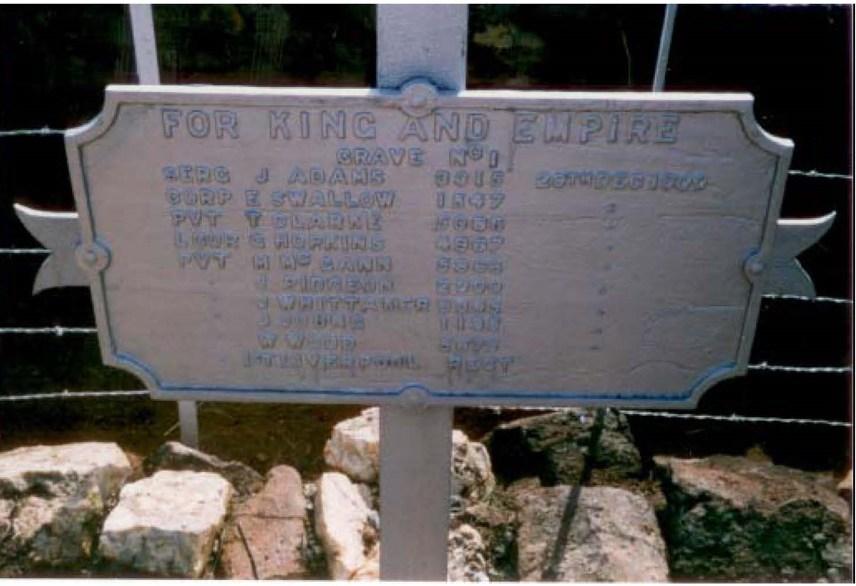
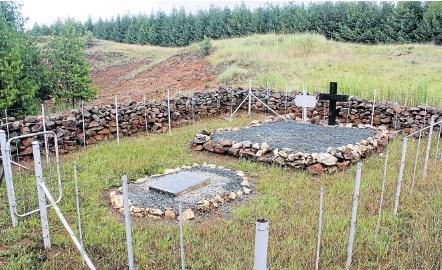
One morning, one of the farm workers summoned us to the cemetery. A local sangoma [diviner] had tampered with some of the graves the previous evening. They had exhumed some of the bodies. Skeletal remains were strewn over the ground, covered by bits of tattered khaki. The boots they buried them in had partially survived eighty+ years of exposure to the underground elements.
We were horrified and disgusted! The farm labourers hastily went ahead to rebury the skeletons.
Left behind were a perfectly preserved front incisor and part of the hip girdle belonging to whom, I wondered? Was it Private Swallow or one of the other names on the headstone in the cemetery? I pocketed the tooth surreptitiously for safekeeping. Today, this tooth lies perfectly preserved in a box in a cupboard in my house in Melbourne, with the bits of crockery and those spent Mauser bullets!
I have often thought of contacting the descendants of these unfortunate men. Would I pass on that tooth and bit of hip? Would that bit of hip belong to Sergeant J Adams, Corporal E Swallow, Privates T Clarke, J Pidgeon, J Whittaker, J Young or W Wood? Only the sangoma would know!
We returned to Dedrie’s parents' farm in 2014, a pilgrimage to a place that once brimmed with life and memories. We took the ‘Goedewil’ farm turnoff from the main road to Lydenburg, following the same track we had driven decades before. But now, pine trees planted by the paper milling company had swallowed the entire farm. As we approached the farmhouse turnoff, we found that the magnificent black wattles were gone. We stopped the car at the overgrown entrance to ‘Blouboskraal’, our hearts heavy and brushing away tears.
The farmhouse had been torn down and cleared, along with the sheds and outbuildings. We walked over the remnants of the foundations and the once-pristine tennis court. We shed a tear for a past that we knew was irretrievable, preserved only in our memories.
Now, only an empty space existed where Dirk, Dina, and Dedrie’s siblings, Kobus and Gerard, had once welcomed us so generously all long gone now.
We climbed back into the car and drove slowly along the road, gazing once more at the gentle hill with its dark silver line leading to Lydenburg. Whenever we see a wattle bloom, we will never forget ‘Blouboskraal’, pausing to honour the memories of Dirk, Dina, Kobus, and Gerard. Their spirits
linger in the wattle’s golden glow, an eternal reminder of the place and people we loved.
We are all broken, that’s how the light gets in.
—ErnestHemingway
We grew up during the final life and death struggle that originated from more than 400 years of conflict between our mixed-race Afrikaner ancestors and the People of colour a struggle that would see the Rainbow Nation emerge and see Apartheid dismantled.
The following stories are deeply embedded in my consciousness; sharing them is a cathartic experience. Can we forgive our ancestors for what they left us with? Can we ever erase the violent spectres that haunt us to this day? I believe we can!
In the Apartheid state, interracial violence always appalled me.
In the 1960s, outside a pub with a group of friends, I saw People of colour (‘Coloureds’ derogatory term) being sjambokked on a Friday night by the local police officer, for lying around drunk, simply being a nuisance! After the beating, limp, half-dead bodies of men and women were tossed headfirst into the back of a police van. Some of my classmates would be offered the chance to ‘Have a go!’ with the sjambok, which they took. I noticed the sadistic glee with which they continued to beat the rolling vomiting person on the ground scenes that still haunt me in the dead of night.
Coming home from classes at university, I needed to go to the toilet as I alighted from the bus. The nearest toilet was under the Johannesburg City Hall. When I arrived, I had to push my way through a crowd that had formed outside the entrance. As I entered the door, I saw four or five White men surrounding a Black man who was lying on the floor with a White person on top of him. He was fighting for his life I saw the terror in his face blood streaming out of his nose and through broken teeth. His eyes were pleading with me to help him.
It was too much for me. I shouted, ‘Stop! Leave him alone; please—leave him alone. One of the men turned on me and said, ‘If you don’t bugger off you ‘bliksem’ (Afrikaans
curse word), we ‘gonna’ kill you when we’ve finished with this cheeky kaffir. I beat a hasty retreat.
On a Friday night, while travelling home by car with a friend, we were hailed by a Black man standing on the side of the road. He was holding up his right arm. In the light beam, we saw that he was distressed and needed help. I swung the car off the road. As soon as we came to a halt, he came running up to the car, shouting, Baas [Master] help: they’ve broken my arm the tsotsis [criminals]’. His arm was very badly broken, swinging backwards and forwards.
We had to get him to the hospital; he was crying in pain! We drove into ‘Emergency’ at the Johannesburg General Hospital and rushed him to the reception room. The nursing sister immediately came to our aid, gently taking the weeping man’s arm.
Then pandemonium broke loose dogs, followed by burly policemen in blue uniforms, burst into the room. They dragged a Black man in; he was barely conscious. Police dogs had bitten him in multiple locations on his entire body. His legs had numerous puncture holes in them. Blood ran down his legs. His clothes were torn to pieces.
The Nursing Sister tried to intervene as the police officers dragged the injured man over the floor, and he fell flat onto his stomach while I cowered in a corner. The Nursing Sister jumped between the police and the injured man to prevent them from beating him further with the sjambok they were brandishing. The policeman swore at her, grabbing her by her collar, and then slapped her with such force that she fell
against the back wall, weeping, and sank to the floor. They then tore her veil off her head.
I dared not look up. I was helpless.
We lived within a stone’s throw from Sharpeville in the 1960s, in Vanderbijlpark – in the last house next to an open piece of veld that separated us from Sharpeville. We were told that Sharpeville was a terrible place and forbidden to go near it.
It was built by the government in 1943 – supposedly ‘healthier’ than nearby Topville, which was overcrowded and where people were dying of illnesses such as pneumonia. In 1958, when we moved into our house across from Sharpeville, the government were forcibly moving 10,000 new neighbours into Sharpeville.
It was a crime-ridden place with widespread unemployment. Children joined crime gangs instead of attending school. ‘Central’ situated within the ‘location’ was a new police station, swarming with police who checked passes, deported thousands of illegal residents, and raided the unlawful shebeens.
Every day, my father brought the ‘Star’ newspaper home from work, full of the terrible struggle in the country – Black people and People of colour against the police state. I would read the paper, lying on my stomach on the lounge carpet, after he finished reading it and drank his cup of tea, which I made daily, at 5 o’clock sharp.
I read about the increased militancy of the Pan-Africanist Congress (PAC), a splinter group created by the African
National Congress (ANC) the year before. In January 1960, the entire country was shocked by the massacre of police in Cato Manor, a ‘location’ outside Durban.
The ‘Star’ showed (Figure 51 above) how police broke up protests and demonstrations, giving a detailed account of the police massacre in Cato Manor – where nine policemen were killed and disembowelled when they intervened at a gathering of the ANC.
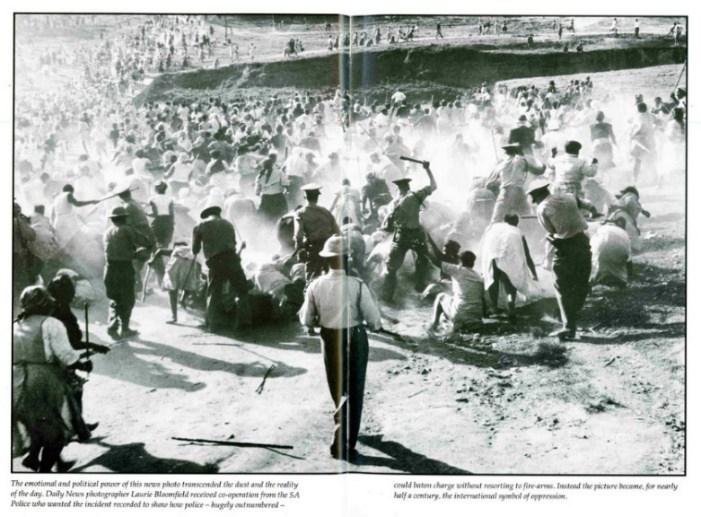
After Cato Manor, everyone in our town, Vanderbijlpark, was frightened. But not us. To us, it was a glorious, exciting threat. The ‘unrest’ dominated our games. We were also members of gangs but had to attend school – there was no truancy amongst us – we were terrified of the cane, which the headmaster, Mr Kloppers, used unsparingly.
After school, we would play ‘police’ versus the ‘Coonjacks (derogatory term for Black persons)’. We would be armed with toy sub-machine guns, sjamboks, Lee-Medford rifles and pangas! We fought many a battle in the blue gum plantations surrounding Vanderbijlpark.
Sometimes, after school, our gang would cross the open piece of veld and sneak up to ‘no man’s land’ - the Sharpeville informal settlement to see what was happening.
Just before the fateful day of the massacre on Monday, the 2nd March 1960, our gang camped under the blue gum trees that marked the border between the Sharpeville and our Vanderbijlpark suburb – CE4. We reconnoitred the area to determine the strength of the ‘enemy’. We noticed a large gathering of people in the distance. They were shouting, and the women were ululating. We were hidden and undetectable in a ditch, with our heads occasionally bobbing out to get a better look.
Suddenly, we were startled by the shriek and thunderous roar of three Sabre Jets, which flew some thirty metres above the ground at great speed towards the gathering. The ground shook beneath us. The jets roared upwards just before passing close to the crowd – a spectacular, awe-inspiring manoeuvre. Everywhere, people ran for their lives in all directions.
Then the ‘Harvard Trainer’ jets arrived, the unmistakable rumble and snarl of their engines drowning the shouting and screaming of the fleeing crowd. Without hesitation, we left
the ditch as fast as we could run, across the veld and back home. That night, we excitedly told grim-faced parents what we had seen there in Sharpeville.
The Monday morning of the massacre, we were at school in the playground when the Sabres and the Harvards flew over our school towards Sharpeville, a few kilometres away. Then we saw the army trucks driving past, filled with evacuees. The school principal’s voice blared over the loudspeaker: ‘Children, today the army trucks will pick you up and take you into Vanderbijlpark, where your parents will be waiting
Few had telephones in those days, and no email, mobile, Internet or WhatsApp? We would have to find each other by instinct! We went back to our classes. Just before the ‘home time’ bell rang, the Principal’s voice came over the loudspeaker again. ‘The danger is over, the unrest has passed – go home, but be careful. You never know what can be out there!
I rode my bike home, choosing the main highway into Vanderbijlpark. It was almost dead quiet – not a sound, except for the chirping of a sparrow. There was not a car on the road, and no one walked. Shoes, bags, and clothes littered the street. Here and there, blood stains. I rode past a machine gun post. The soldier waved to me and said, ‘You can go, son; the Blacks are gone’. [‘Gaan voort Boet – die kaffers (Black people) is almal weg]
I stepped on it, my bike weaving from side to side, tyres humming as I made my way home. My mother was back in
the kitchen when I arrived. She was dishevelled and still shaken from her ordeal. She told me, cigarette and hand pointing towards Sharpeville, how some 30,000 people came marching and singing as they went over the veld and towards the road, past our house that led into the town. She locked all the doors and hid under the bed in her bedroom.
Then, there was a loud banging on the front door, ‘Come quickly, everybody!’ [Kom gou julle!’] Then, a warning shot was fired to halt the approaching belligerent crowd. My mother and neighbours were bundled into the waiting Saracens (armoured vehicles).
The next day, there were many stories about the unrest. A friend whose dad was one of the doctors working at the Vereeniging Hospital told of the machine gun nests along the road to Vereeniging and how bodies were piled up along the road. We knew then that casualties were much higher than officially reported – it was a massacre (Figure 59, below)!
The official report110 on events that forever changed the political landscape in South Africa read:
On the 21st March 1960, a group of between 5,000 and 10,000 people converged on the local police station, offering themselves up for arrest for not carrying their passbooks. The Sharpeville police were not completely unprepared for the demonstration, as they had already driven smaller groups of more militant activists away the previous night.
PAC actively organized to increase turnout to the demonstration, distributing pamphlets and appearing in person to
urge people not to go to work on the day of the protest. Many of the civilians present attended voluntarily to support the protest, but there is evidence that the PAC also used coercive means to draw the crowd there, including the cutting of telephone lines into Sharpeville, and preventing bus drivers from driving their routes.
By 10:00, a large crowd had gathered, and the atmosphere was initially peaceful and festive. Fewer than twenty police officers were present in the station at the start of the protest. Later the crowd grew to about 20,000, and the mood was described as ‘ugly’, prompting about 130 police reinforcements, supported by four Saracen armoured personnel carriers, to be rushed in. The police were armed with firearms, including Sten submachine guns and Lee–enfield rifles. There was no evidence that anyone in the gathering was armed with anything other than stones..,
… the protesters responded by hurling stones (striking three policemen) and rushing the police barricades. F-86 Sabre jets and Harvard Trainers approached to within 30 metres (98 ft) of the ground, flying low over the crowd in an attempt to scatter it. Police officers attempted to use tear gas to repel these advances, but it proved ineffectual, and the police fell back on the use of their batons. At about 13:00 the police tried to arrest a protester, and the crowd surged forward. The police began shooting shortly thereafter’.
In defence of police action, the news reports said, ‘Policemen present had received public order training. Some of them had been on duty for over twenty-four hours without respite. Some insight into the mindset of those on the police force was provided by Lieutenant Colonel Pienaar, the commanding officer of the police reinforcements at Sharpeville, who said in his statement that ‘the native mentality does not allow them to gather for a peaceful demonstration. For them to gather means violence He also denied giving any order to fire and stated that he would not have done so.
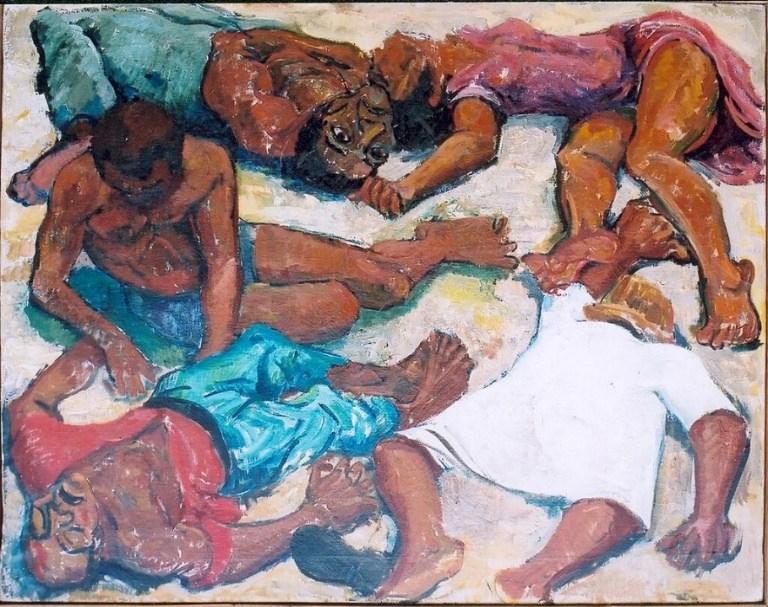
‘The true measure of any society can be found in how it treats its most vulnerable members’ – MahatmaGandhi112
I was involved in social work in the mines and Soweto during my university days in the 1960s.
On a Sunday morning, resplendent in our suits and ties, with religious tracts in our hands and a conspicuous bible, we would take the journey to the Durban Deep Mine near Roodepoort. We would be in the best spirits as we relished the idea of bringing hope and a good message in African languages to people from all over Africa.
We were zealous Christians!
We would be taken to the compound dormitories by the mine manager. Our first shock awaited us as we entered an alien world, a few kilometres away from our first-world, comfortable Johannesburg suburbs. Those bunks were stacked, layer after layer, extending to the roof. Those bunks would contain one or more figures under blankets, with heads on dirty pillows.
When they built these compounds, they reduced the space per worker from 300 to 200 cubic feet to save money. The logic was that the miners liked to huddle together, as was their custom, it was believed. Those ‘Boys’ (Black men) from the tropics found the highveld frost very cold, so they would huddle together for warmth!
The dormitories were criminally overcrowded. There were two work shifts in a twenty-four-hour period - while one shift was working, the other was asleep, which meant that beds had to be shared. Some mines removed partitions between bunks to allow more people to fit into the space available. The overcrowding led to bitter conflict, even amongst people of the same tribe. One miner resignedly said: ‘If you put a whole lot of cattle together in a kraal and overcrowd them, they will stamp and horn each other’.
After the shock of seeing the sleeping arrangements, our gazes would land on a circle of ‘konkas’ – used metal drums with holes in the sides – occupying the middle of the dormitory. These contained smouldering fires, serving as stoves or heaters. They would burn day and night throughout the year.
In the middle of the circle, greenish chunks of meat would be roasting on a rusted grill. Then the smell would hit. I would try not to retch – tears streaming down my face. Questioningly hostile stares from the tiers of concrete bunks would greet us as we entered the fetid, gloomy dormitory.
The ‘Boys’ (Black men) would be curled up in various positions in the bunks, mostly more than one in a single bunk. Some were unashamedly naked – we dared not look!
In our society, homosexual activity was considered an abomination. What we believed was happening under those dirty grey blankets was the dirtiest of ‘dirty’ in our minds. The religious literature (tracts) we handed out said: No, all wrong–not the way of the Lord!’
Jesus would have been less judgmental than we were. Our gospel did not address the suffering of these poor men deprived of healthy living conditions, leisure, and sex. It cried judgment from Leviticus in the Bible – ‘you shall not lie with a male as with a woman; it is an abomination’.
The frigid atmosphere would slowly disappear as the ‘Boys’ saw that we were there to speak of the uNkulunkulu [God in Zulu], Modimo [God in Sotho] or God in the myriad of other languages.
The ‘Boys’ (Black men) would slowly emerge from their bunks, extending cupped hands to us to receive the words of life in the tracts we were handing out.
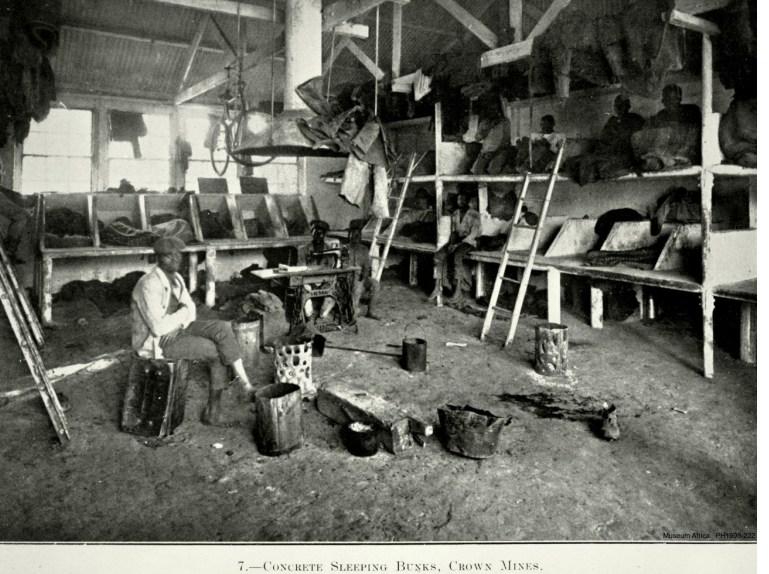
We would emerge from the dormitories (Figure 60, above) into the yard outside, where the ‘Boys’ would sit in groups drinking ‘kaffir’ beer and playing cards or listening to Radio Bantu (Black people’s radio). It was a hive of activity with Shangaans and Tsongas, well-known for their dances, dancing to the beat of drums and other musical instruments while someone would sing out a story in a high-pitched voice:
The earth will swallow us who burrow, And, if I die there underground, What does it matter? Who am I?
Dear Lord! all around me, every day, I see men stumble, fall and die.
Their songs reflected the accidents, illness, and death they faced daily.
On our visits, we were checked for TB (tuberculosis), rife due to the overcrowding in the little ‘cubby holes’. Anyone coughing or spitting was avoided like the plague!
The mine management was intensely paternalistic, controlling recreational activities, particularly beer drinking. Outside the compound, the shebeens did a flourishing trade! We were led to believe by religious leaders, teachers, politicians and our very own parents that the Bantu and indigenous peoples of South Africa, familiar with other uncivilised people and races, were naturally inclined to substance abuse and, thus, needed the ‘church’. Anything religious was allowed. Our main competitor was the African Zionist Church.
We would hand out tracts outside the shebeens and inside the compound, places sanctioned by the mine managers. The managers would carefully inspect our literature in case it was subversive or Marxist. In those days, the ANC and South African Communist Party actively infiltrated the compounds.
In Fanagalo (pidgin Zulu spoken on the mines and farms), we would say to a potential convert, ‘Iziwa ga lo Umsindisi’ (hear of the Saviour’), and then give them a tract (pamphlet) in their language. These tribesmen, from anywhere in Africa, would come to an abrupt halt when accosted in this manner.
Invariably, they would smile, accompanied by laughter and a handshake – the African way. We would point to the tract and then the sky, making them aware that they should read the tract - a pathway to ‘deliverance’, away from the ‘cavernous pit’ they would enter if they did not believe.
This was 1970, when the gold mining industry in South Africa was at its peak. We believed that conversion to Christianity was what these men in the gold mines needed to keep them happy.
By their admission, the large mining companies on the Rand and earlier in Kimberly were no different to the Nazis, Japanese and Soviets in their use of ‘slave labour’.
While we provided ‘spiritual’ sustenance, mine management thought they provided suitable physical care for the inmates.
A report on the welfare of the mineworkers in that era patronisingly stated:
It must not be forgotten that the average native is an untidy individual, and that food waste is removed daily ...it is impossible to prevent a good deal of porridge being scattered about after each meal. At any rate, the very fact of food being wasted indicates at least that the natives were not being underfed.
We were more concerned about their ‘spiritual hunger’ and assumed that the food given was best for them. The stench of carrion in the dormitories should have told us otherwise. Did Jesus not feed the multitudes with good food when they were hungry?
We visited the compound hospitals filled with those suffering and dying from TB, pneumonia, and many other diseases. As we mingled amongst the miners, we tried to avoid those coughing or wheezing, ‘Did they have TB or Silicosis?’ went through our minds.
It did not enter anyone’s mind then that influenza, TB, pneumonia, and poor health were due to their neglect and poor diet, overcrowding in unsanitary conditions and horrific working conditions.
The root cause of TB was never identified by the medical authorities. The health workers in the community believed that TB was a disease that miners brought from the rural areas and that miners’ lack of immunity and decadent lifestyles were to blame – political correctness of the day!
The politicians, social scientists and other experts believed that the Bantu were different, becoming ill due to ‘deculturation’ – that they could not adjust to modern urban living, therefore, prone to ill health. We were complicit in this belief -we believed that their conversion to Christianity would bring them into the fold and improve their lives.
Worst of all was the Silicosis. Many of those we encountered were in the early stages of the disease. They constantly checked the ‘Boys (Black men)’ for Silicosis- an epidemic – it was rife! Today, the concentration of Silica dust in the air is known to cause Silicosis. Constant and continuous exposure to excessive silica dust in the air causes dense fibrous nodules to replace the spongy lung tissue. There is no cause for Silicosis - to this day!
The mineworkers were blamed for not following proper preventative measures. But how could they have known how to look after themselves? They were not given any training or personal safety equipment to shield them from the dusty air.
My grandfather, Cecil Green, a miner, was an invalid and alcoholic, dying of Silicosis in 1937. Being ‘white’, he was given good medical attention with periodic X-rays and pensioned off, more fortunate than any Black or Person of colour miner who was never X-rayed. The medical authorities did not conduct post-mortems either. How many Black or Persons of colour miners died of this dreadful disease will never be known.
We witnessed Black miners being ‘dipped’ like sheep at some compounds, but ‘dipping’ did not prevent the killer diseases, Pneumonia, Influenza or Silicosis!
Many who could speak English confided in us. Baas, could you not talk to our Mine Captains about our danger?’ they would ask us. They often wondered if Jesu [Jesus] would protect them from the sicknesses, daily injury, and death they may face. Miners were killed in rockfalls, rock bursts, by moving machinery, failing conveyor belts and wire rope haulage failures – these accidents were feared more than the diseases.
In 1956, Black miners were twenty times more likely114 to die in South African Gold Mines than in Australian Coal Mines115 . Dr Simons said, ‘Thirty-six thousand men were killed in mining accidents by 1960. Untold others died from septicaemia and other diseases contracted because of accidental injury. Many more have lost limbs or eyes or have been otherwise disabled.’
I was part of an investigative team assessing the risks of toxic exposure to personnel working in a minerals processing plant in South Africa. I was shocked to witness people's exposure to highly toxic chemicals without the necessary personnel protection equipment.
One of our risk analysis sessions involved meeting in the electrolysis section of the plant. On entering the room, I realised that I would not last in the environment for longer than a few minutes. Ammonia concentration was so high in the room that my breath was taken away, and I started
coughing uncontrollably. The Ammonia stung my lungs, my face flushed – then my skin burned.
Then I noticed that the Black workers were cheerfully working without any protection. They were used to working in that environment. The management was aware of the possibilities of chronic cough, asthma, and lung fibrosis –but they turned a blind eye. I was forced to wear special breathing equipment when entering that environment. I was told they were used to the toxic chemicals – so they did not need the protective equipment!
To this day, poor living conditions still exist in mineworker accommodation despite attempts to address the horrific living conditions in the past. There is still a lack of access to water, poor sanitation, limited electricity, and poor roads at many mines.
In Kliptown, Darryl showed me that poverty, mental illness and criminality march in lockstep.
Kliptown is steeped in history – vicious but uplifting. The Freedom Charter was signed in 1955, where many of South Africa’s anti-Apartheid activists lived.
The Congress of the People, some 3,000 people, filled a square fenced off with chicken wire and gathered on the 26th of June 1955 to vent ideas of a society freed from Apartheid. This would be the ANC's Freedom Charter, which impeded the struggle against Apartheid. They believed that it was only a matter of time before their Phoenix would arise from the ashes of Apartheid.
People came from all over South Africa – Black people, People of colour, Indians and White people. They came by car, bus, bicycle, on foot and horseback. It lasted for one day – then the police broke up the meeting, arrested people, and photographed many to be put on a ‘watch list’.
Ten years on, Kliptown was forbidden ground for anything ‘political’. Most Whites were unwelcome, except those who did social or ‘religious’ work. And that was us –university students bringing a message of hope to the youth of Kliptown. We mainly were engineering or science students – conservative, religious and concerned.
In the heart of Kliptown (Figure 61, below), on a Friday night, our group of students would run a Christian Youth Club for teenage ‘People of colour. Our group comprised five members – including a group leader who would be the speaker and manage the proceedings.
One member of our group was usually a big, strong male who could manage any aggressive boys – the girls were always very timid and shy.
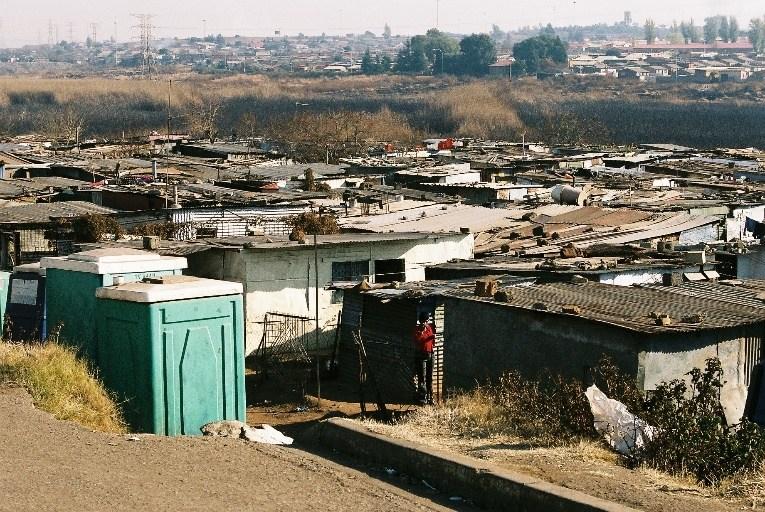
We would park our cars in the safe area around the mission church – safe from the superstitious neighbours and enter the little church, the sanctuary, as soon as possible. The church consisted of a hall and a vestry. A pulpit stood in the front of the church, where our group leader would address the club members, looking down at them seated in rough pews covered with scratches, carvings and sexually explicit
graffiti. A rickety piano, with half its lid missing, stood along the wall.
As we entered the church from the road, we would try to remain as inconspicuous as possible, covering our faces in the dusk and avoiding eye contact with any passers-by.
There were many ‘tsotsis’ (thugs and gangsters) around on a Friday night who would not hesitate to kill a mlungu [White person] for a ‘Rand (South African Currency)’ or two or for a warm jacket or jumper!
The group members would slip in from smoke-filled dark streets, enter the little church and sidle into the pews full of ballpoint pen scribbles and messages scratched into the wood. Messages read ‘Darryl loves Gladys’ or ‘Petrus likes dagga (marijuana)’.
We would start with a prayer and then the singing of choruses and a hymn or two. There would be sniggering, constant talking and giggling during the prayer and the singing, and we would have to shout, ‘Shuddup you lot –respect the Lord!’ when it got too bad.
Generally, those meetings were a lot of fun!
Then, the leader would give a talk. We had to find common ground – which was daunting! Our group came from the White suburbs and had no idea about the depraved environment in which these people lived or their awful home lives. I had some inkling of the Kliptown culture as I had
visited my grandmother as a child – she lived in similar surroundings.
It was a question of ‘how to reconcile the “Jesus” of White Johannesburg with a “Jesus” for the people in Kliptown The ‘message’ was often about the do’s and don’ts connected to good Christian behaviour, not about how to survive in a ghetto!
After the ‘message’ was delivered, there was more singing; the group loved that. They would sing with voices at full throttle: ‘Shout it if you love my Jesus – shout it if you love my Lord, etc…etc; not believing a single word they sang –but joining in for the thrill of it - our pianist belting out the notes on the piano – ending with Hallelujah!
Then we would play games. The chairs would be moved to one side, and we would play games such as volleyball, ‘capture the flag,’ or ‘defend the gate These games would be very physical, and we had to join in, suffering many bruises and often a bloody nose. All genders played. The boys touched the girls inappropriately, and the girls would complain hysterically, using the foulest language! They would threaten the boys in the most graphic terms; what they would do to them we had to intervene.
The girls were shy and withdrawn. The worst boy was Darryl. He would never look anyone in the eyes. If he was hauled up or reprimanded, he would turn around, pull out a knife, feel its blade with his forefinger, and say, ‘What can I do for you?’
On one occasion, Darryl ran over to one of the girls, touched her neck with the point of the knife, and shouted: ‘Let’s have sex sommer (Afrikaans: ‘just’) here!’
One member of our group was a big, powerful Afrikaner, Lukas. He knew what to do with Darryl. He rushed over to him, grabbed his arm, and jerked the knife from his hand. Then he shouted, ‘Say you’re sorry, Darryl, now, or I’ll break your arm!’ In a snivelling voice, Darryl dropped the knife and said, ‘Sorry man, sorry Then he started to cry; all eyes riveted on him. Order was quickly restored, and another round of volleyball started.
After games, we would end the meeting with everyone singing a final chorus at the top of their voices, and, after a last ‘hallelujah’, we would sit down to chat with the group members. This ‘chat’ was the most important event of the night. That was when we learned about their daily lives.
Darryl told us his father was a violent and cruel drunkard. He regularly beat him and his mother – even when sober. He raped his sister often in front of them while drunk. They would lie low while this was happening, minding their own business.
After such a chat, Darryl would settle down for a few weeks – and then trouble would start again.
One Friday night, neither Darryl nor his sister attended the meeting. We asked the reticent group if they were coming? One of the girls stood up and said – ‘Darryl’s dead, mister; his dad threw boiling water over him and beat him to
death with his knobkierie [wooden club]. His mother and sister have gone missing. The police are looking for him’.
The girls were crying. We were stunned and prayed for Darryl; there were no games that evening.
1 Rainbow Nation: The term was coined by Archbishop Desmond Tutu in the early 1990s to describe South Africa after the country's first democratic election in 1994. It refers to a country where people from different backgrounds come together to celebrate diversity and promote inclusivity.
2 Dutch East India Company https://en.wikipedia.org/w/index.php?title=Dutch_East_India_Company&oldid=1247029 623.
3 Slaves: Where the term ‘slaves’ is used, it is written in italics as it is considered an offensive term.
4 Khoekhoen : Indigenous tribe; Hottentots–a derogatory term.
5 San : Indigenous people. Originally known as the ‘Bushmen’ a derogatory term.
6 Public Domain: Kaapstad. (2023, January 1). In Wikipedia. https://af.wikipedia.org/wiki/Kaapstad.
7 Public Domain: Kaapstad. (2023, January 1). In Wikipedia. https://af.wikipedia.org/wiki/Kaapstad.
8 Public Domain: History of slavery. (2023, September 15). In Wikipedia.https://en.wikipedia.org/wiki/ History_of_slavery.
9 Upham, Mansell. (September 1994). ‘In hevigen woede...’ Part 1: Groote Catrijn: Earliest recorded female bandit at the Cape of Good Hope a study in upward mobility Capensis, Quarterly Journal of the Western Cape branch of the Genealogical Society of South Africa
10 Genealogy database: Geni.com.
11 Public Domain: Krotoa. (2023, August 5). In Wikipedia. https://en.wikipedia.org/wiki/Krotoa.
12 Hottentot: Derogatory racist term.
13 Eva or Krotoa: https://www.capetownmuseum.org.za/they-built-this-city/krotoa
14 Wikipedia contributors. (2025, May 15). Caliban. Wikipedia. https://en.wikipedia.org/wiki/Caliban
15 Wikipedia contributors. (2025, June 8). Autshumato. Wikipedia. https://en.wikipedia.org/wiki/Autshumato.
16 Table Bay shipping before 1652 and the route to Batavia: According to the Huygens register of VOC ships logbooks between 1600 – 1652, over 1072 Dutch ships rounded the Cape, and 334 of these ships are verified as stopping at the Cape, each for an average of 24 days' stayover, involving the visit of 54,110 crew and travellers Only 34 VOC ships are recorded as definitely not stopping at the Cape, with 704 VOC ships still under research. A further 432 ships from other European countries also travelled via Table Bay to India and Southeast Asia, of which 278 ships stopped off at the Cape, carrying 45,870 travellers who visited the Cape. Gaastra & Bruijn, maritime researchers at Leiden University in the Netherlands, provide the tables giving the numbers on board the ships for each decade between 1600 – 1652, which start with 111 per ship and increase over each decade to 200 per ship by 1650. Autshumao, and before him Xhore, and their communities of Khoe people, thus engaged far more Europeans and other nationalities over a half century, than the version that
says only 42 European ships came to the Cape before Jan van Riebeeck and had minimal contact with the Khoe. Evidence also shows that a trading and proto-port relationship existed between these almost 100,000 visits of Dutch, English, French, Portuguese and Danish travellers and the ship’s crews, including Africans, Arabs and Asians. With much more research to be done on ship logs and records, the numbers could easily be double what has so far been recorded. There were also two long-term stayovers of 344 travellers on the shipwrecked Mauritius Eylandt in 1644, who stayed at Table Bay for 4 months and the 90 travellers on the shipwrecked Nieuwe Haerlem in 1647, who stayed over for almost 1 year. Jan van Riebeeck was thus not the first European to engage the Khoe, nor the first to start the port which had evolved as a proto port over some time. Jan van Riebeeck however, was the founder of the Dutch Colony at the Cape of Good Hope.
17 Patric Tariq Mellet & Melissa Steyn. Cape Slavery & Indigene Heritage. https://camissapeople.wordpress.com/.
18 The Dutch fleet of 12 vessels in 1647 before returning from Batavia that stopped at Table Bay. (Unknown artist).
19 Khoekhoen traders, trading with Europeans (National Library of South Africa).
20 Thom H B edt. (1958). Journal of Jan van Riebeeck 1652 – 1662. Van Riebeeck Society; AA Balkema, Cape Town / Amsterdam and World History Commons. https://worldhistorycommons.org/journal-jan-van-riebeeck [accessed November 3, 2023]
21 Patric Tariq Mellet & Melissa Steyn. Cape Slavery & Indigene Heritage. https://camissapeople.wordpress.com/.
22 Patric Tariq Mellet: M.Sc. Cape Town born. Heritage activist (raised in District Six, Woodstock, Salt River)
23 Wikipedia contributors. (2025, June 26). Khoekhoe. https://en.wikipedia.org/wiki/Khoekhoe#/media/File:Samuel_Daniell_-_KoraKhokhoi_preparing_to_move_-_1805.jpg.
24 Table Bay shipping before 1652 and the route to Batavia:
According to the Huygens register of VOC ships logbooks between 1600 – 1652, over 1072 Dutch ships rounded the Cape, and 334 of these ships are verified as stopping at the Cape, each for an average of 24 days' stayover, involving the visit of 54,110 crew and travellers. Only 34 VOC ships are recorded as definitely not stopping at the Cape, with 704 VOC ships still under research. A further 432 ships from other European countries also travelled via Table Bay to India and Southeast Asia, of which 278 ships stopped off at the Cape, carrying 45,870 travellers who visited the Cape. Gaastra & Bruijn, maritime researchers at Leiden University in the Netherlands, provide the tables giving the numbers on board the ships for each decade between 1600 – 1652, which start with 111 per ship and increase over each decade to 200 per ship by 1650. Autshumao, and before him Xhore, and their communities of Khoe people, thus engaged far more Europeans and other nationalities over a half century, than the version that says only 42 European ships came to the Cape before Jan van Riebeeck and had minimal contact with the Khoe. Evidence also shows that a trading and proto-port relationship existed between these almost 100,000 visits of Dutch, English, French, Portuguese and Danish travellers and the ship’s crews, including Africans, Arabs and Asians. With much more research to be done on ship logs and records, the numbers could easily be double what has so far been recorded. There were also two long-term stayovers of 344 travellers on the shipwrecked Mauritius Eylandt in 1644, who stayed at Table Bay for 4 months and the 90 travellers on the shipwrecked Nieuwe Haerlem in 1647, who stayed over for almost 1 year.
Jan van Riebeeck was thus not the first European to engage the Khoe, nor the first to start the port which had evolved as a proto port over some time. Jan van Riebeeck however, was the founder of the Dutch Colony at the Cape of Good Hope.
25 Wikipedia contributors. (2025, April 17). Charles Davidson Bell. Wikipedia. https://en.wikipedia.org/wiki/Charles_Davidson_Bell
26 South African History Online. First slaves arrive in Cape Town. www.sahistory.org.za.
27 Upham, Mansell. (2024). The Fall of Eva Meerhoff, born Krotoa of the Goringhaicona (c. 1643-1674)
28 Schapera, I (ed) 1933. The Early Cape Hottentots. Cape Town.
29 Ten Years (Eighty Years' War). (2023, September 15). In Wikipedia. https://en.wikipedia.org/wiki/Ten_Years_(Eighty_Years%27_War)
30 Oupa:Grandfather. Also refers to ancestral grandfathers in the text.
31 Slave Muster-Rolls: https://www.eggsa.org/sarecords/index.php/musterrolls/cape-archives-vc-copies.
32 Sjambok : Rawhide whip.
33 Public Domain: File: Cape Town 1785. Jpg. In Wikipedia.
34 Koolhof, Sirtjo; Ross, Robert. (2005). Upas, The Context of a Slave's Letter September and the Bugis at the Cape of Good Hope. Archipel 70. Western Cape Archives, CJ 373, 141. Vol. 70 pp. 281-308. The letter:
‘This letter comes as a message from Stellenbosch you sent me. Brother September, I announce that I have been sick for two months and that no human medicine can cure me. Brother September, I seek encouragement from you because I know you care about our Buginese people. I request from you, brother, if you have compassion, for your Buginese race because I know from the time we spoke with our fellow Buginese people, you said we were suffering and that this concerned you, for we are a broken, suffering people in miserable conditions. And I just mention my illness; our fellow human beings make me suffer. Thus, my request to you, Brother September, if you are compassionate for your suffering Buginese compatriots, will you lead the children who came from this place?’
35 Photograph by Francois F. Swanepoel. ‘September's shrine in Cape Town.’
36 Tribute: Dr Achmat Davids. Boorhaanol Centre, Pentz Street, Bo-Kaap, Cape Town, 8001, South Africa.
37 Public Domain: Sufism. (2023, September 8). In Wikipedia. https://en.wikipedia.org/wiki/Sufism.
38 Vryburgher;Vrijburgher: Free Citizen. Also, a freed slave.
39 Khoisan: Khoekhoen and San – Indigenous people.
40 Public Domain: Ludolf Bakhuizen. In Wikipedia. https://sv.wikipedia.org/wiki/Ludolf_Bakhuizen.
41 Public Domain: Golden Age of Piracy. In Wikipedia. https://en.wikipedia.org/wiki/Golden_Age_of_Piracy.
42 Penn, Nigel. (2015). Murderers, Miscreants and Mutineers: Early Colonial Cape Lives (illustrated). Jacana Media. ISBN 1431422118, 9781431422111.
43 Castle of Good Hope. (2023). The Little House of Horrors. https://thelittlehouseofhorrors.com/castle-of-good-hope/.
44 Penn, Nigel. (November 2002). ‘The wife, the farmer and the farmer's slaves: Adultery and murder on a frontier farm in the early eighteenth century.’ Kronos, No. 28. University of Western Cape.
45 Nigel Penn. Murderers, Miscreants and Mutineers; Professor of History at the University of Cape Town.
46 Public Domain: History of the Cape Colony from 1806 to 1870. (2023, September 10). In Wikipedia. https://en.wikipedia.org/wiki/History_of_the_Cape_Colony_from_1806_to_1870.
47 Boers: Boer (Dutch: ‘husbandman,’ or ‘farmer’), a South African of Dutch, German, or Huguenot descent, especially one of the early settlers of the Transvaal and the Orange Free State. Today, descendants of the Boers are commonly referred to as Afrikaners.
48 Public Domain: Khoekhoe. (2023, August 18). In Wikipedia. https://en.wikipedia.org/wiki/Khoekhoe.
49 Public Domain: Fil:Erica - Fynbos - OlifantsOog Western Cape SA.JPG. In Wikipedia. https://commons.wikimedia.org/wiki/File:Erica_-_Fynbos__OlifantsOog_Western_Cape_SA.JPG.
50 Dedrie’s 8th great-grandmother: Daughter of freed slave Catrijn van Malabar.
51 Hattingh, J. Leon. (1981). Die Eerste Vryswartes van Stellenbosch 1679-1720, p. 60. Universiteit van Wes Kaapland.
52 Newton-King, Susan. (November 2007). Sodomy, Race and Respectability in Stellenbosch and Drakenstein, 1689 1762: The Story of a Family, Loosely Defined. Kronos, No. 33, pp. 6-44 (39 pages). Published By: University of Western Cape.
53 Johannes Pretorius and Abraham Le Roux testimony:
About eight months ago, while we were walking in the vineyard of Charles Marais, who lived in Drakenstein, we came across a terrible scene.
Gerrit was seen copulating with a grey mare belonging to Vryburgher Leendert van Saxen. The mare was standing in a ditch behind a quince hedge, and the poor creature was being mounted by Gerrit, who was making very suspicious copulatory movements… Gerrit went and lay, and then moved upon it as though he was using it’[‘Sig vervolgens daarop roerende als of hij deselve gebrijkte’]. We were so appalled that we could not watch the disgusting act any further and immediately went on our way.
54 Archives of the Cape of Good Hope. (August 16th 1659). Volume 7, Page 69 and Geni. (2007). https://www.geni.com/people/Mayken-Hendricksz-SMROG/368448691800012027.
55 Taps: By 1665, the Council of Policy realised that the small group of free burgers who paid annually for the right to purchase alcohol from the VOC and distribute it were gaining a considerable economic advantage without great effort. This was causing much unhappiness among those burghers whose efforts and agriculture failed. The Council consistently received requests from such burghers for permission to set up bars known as ‘taps’.
56 Geweldiger: Fiscal's law enforcement officers (1652-1840). Formal law enforcement began shortly after the Dutch East India Company established its Table Bay outpost in April 1652. By December that year, there had been enough problems to warrant the appointment of a geweldiger to ensure order and the security of the Fort de Goede Hoop. Michiel Gleve was the first geweldiger.
From 1653, the geweldiger reported to the fiscal, who was the outpost's chief law officer. The outpost began to develop into a colony in 1657. As the population grew, the geweldiger's duties increased, and by the mid-1680s he was assisted by a gang of convict slaves, An additional geweldiger was later appointed, and a third in 1776. In August 1780, after complaints about the geweldiger's convict slaves being sent to arrest Whites, the Van Plettenberg administration assigned a few White law enforcement officials, called geregtsdienaars to the fiscal's staff. From 1790, the Fiscal's men were headed by an onderschout (later called 'under-sheriff'). Jan Hendrik Matthysen was the first appointee. Cape Peninsula Urban Police. (2020, August 26). In Wikipedia. https://en.wikipedia.org/wiki/Cape_Peninsula_Urban_Police.
57 Cairns, Margaret. (1978,1979). Tryn Ras. FAMILIA Genealogical Society of South Africa (GSSA). Vol. 15(4). pp 97-98. http://www.e-family.co.za/ffy/exhibits/tryn-ras-by-margaretcairns.pdf.
58 Nigel Penn. (January 1995). The Northern Cape Frontier Zone, 1700-c.1815. Ph.D. Thesis, University of Cape Town.
59 Raper, P.E. & Boucher, M. (Eds.). 1988). Gordon, Robert Jacob: Cape Travels, 1777 to 1786. Volume 2.
Houghton: The Brenthurst Press.
60 Pietism: meant they had to surrender themselves to the Messiah, Jesus Christ, in a union with God. They pursued mystical experiences and promised to lead a holy life.
61 Barrow, J. (1806). Travels into the interior of South Africa, Vol 1 & 2, 2e ed. London: T Cadell & W Davies.
62 William Burchall, ‘View of a Bushman Kraal’, Travels in the Interior of Southern Africa. 2 vols. London, Longman, Hurst, Rees, Orme & Brown, 1822-1824. (Vol 2).
63 Kopje: KoBoer, (Dutch: “husbandman,” or “farmer”), a South African of Dutch, German, or Huguenot descent, especially one of the early settlers of the Transvaal and the Orange Free State. Today, descendants of the Boers are commonly referred to as Afrikaners.ppie (Afrikaans) or hillock.
64 Viljoen, Russel. (2006). Jan Paerl, a Khoikhoi in Cape Colonial Society 1761-1851. TANAP Monographs on the History of Asian-European Interaction. Vol (1). E-Book (PDF). ISBN: 978-90-47-41757-6.. https://brill.com/display/title/12799.
65 Public Domain: Nicolaas Waterboer. (2022, August 21). In Wikipedia. https://en.wikipedia.org/wiki/Nicolaas_Waterboer.
66 Baster : Derogatory – Coloured person; Griqua Nation.
67 Keate Award: The Cape Governor Barkly appointed the governor of Natal, Robert Keate, to address the ‘matter of ownership’ of the diamond fields.
68 Map attributed to Anthony Nevins White: The Stockenstrom Judgment, The Warren Report and the Griqualand West Rebellion 1876-8; Thesis – Master of Arts; Department of History; Rhodes University; Grahamstown;n1977.
69 Photograph attributed to: saheritagepublishers.co.za.
70 Public Domain: History of the Cape Colony from 1806 to 1870. (2023, September 10). In Wikipedia. https://en.wikipedia.org/wiki/History_of_the_Cape_Colony_from_1806_to_1870.
71 Map copied from: The Zuurveld, 1811-1820; Ben MacLennan; A Proper Degree of Terror; (Johannesburg: Ravan Press, 1986, Map 2, 42.
72Public Domain: Xhosa people. (2023, September 13). In Wikipedia. https://en.wikipedia.org/wiki/Xhosa_people.
73 Pringle, Thomas. (1866). ‘Narrative of a residence in South Africa’. Struik, Cape Town.
74 ‘The Death of Anders Stockenström and his party’; Report from Graaff-Reinet to the Governor at the Cape, Cape Archives document CO 2580/4.
His Excellency Lieutenant General, Sir John Francis Cradock K.B.H. Governor & Commander in Chief
Sir,
Having on the 1st Instant learnt of the melancholy and distressing report port of the Death of our landdrost, which Report, was confirmed on the 3rd, following by intelligence received from Lt. Col. Lyster, we consider it our duty to avail ourselves of the earliest opportunity of communicating to Your Excellency this ever to be lamented Event.
By the advice received from Lt. Col. Lyster, we are informed that on the 29th of December, the following persons were murdered by the Caffers74, the undermentioned persons viz: The Field Cornets Johan Chris. Grijling and Jacobus Potgieter and Burghers Philip Botha, Isaac van Heerden, Jacobus. du Plessies, Willem Pretorius, Piet Botha, Michiel Hatting, P. Bijs a Baster Hottentots and according to private accounts, two young Hottentots.
Cornelis. Erasmus and Andries. Krugel are wounded and Burgher C. Robberts succeeded in effecting his escape, finding that all further resistance was in vain.
This to us so afflicting and for the District so irreparable a Loss we most sincerely feel and most deeply regret, and as the presence of a landdrost is of so great moment, we humbly entreat Your Excellency to be pleased to fill the Vacancy as early as possible. In this hope we have the honour to be with the highest Esteem,
Sir,
Your Excellency's most obedient and humble servants; P. Maré and J.B. Rabie – signed; W.S.Pretorius and H.A. Meijntjes. Graaf Reinet, January 8th, 1812.
75 Kaffirs: Derogatory term for Black people; a racial slur in the ‘Rainbow Nation’.
76 Booyens, Harry. (2013). The Birth and Death of the Second America. Publisher: Cliffwood Fogge. Edition illustrated. ISBN 0992159016, 9780992159016.
77 Public Domain: Adenium multiflorum. In Wikipedia https://en.wikipedia.org/wiki/Adenium_multiflorum
78 Public Domain: Copyright protection has expired; Copyright Act No. 98 of 1978; Kremetart. In Wikipedia. https://af.wikipedia.org/wiki/Kremetart.
79 Unknown source.
80 Map from: ‘Die Groot Trek: Hoofstuk 8 Deel 7’; Federasie van Afrikaanse Kultuurvereniginge’
81 Dingane. (2023, September 21). In Wikipedia. https://en.wikipedia.org/wiki/Dingane.
82 Public Domain: Battle of Blood River. In Wikipedia. https://en.wikipedia.org/wiki/Battle_of_Blood_River.
83 Picture copied from eGGSA Documents: https://documents-ateggsa.org/main.php?g2_itemId=1504983.
84 Public Domain – copyright expired: Battle of the Tugela Heights. In Wikipedia. https://en.wikipedia.org/wiki/Battle_of_the_Tugela_Heights.
85 Ouma : Grandmother.
86 Koeksister: A sweet South African heritage delicacy - crisp pastry plaits are fried and dipped in an aromatic syrup! Pastries similar to these originated centuries ago in Batavia in the East and the recipe brought to South Africa by the enslaved people.
87 Battle of Bergendal. (2024, May 4). In Wikipedia. https://en.wikipedia.org/wiki/Battle_of_Bergendal
88 Public Domain: Second Boer War. (2023, September 22). In Wikipedia.https://en.wikipedia.org/wiki/Second_Boer_War.
89 Public Domain: Second Boer War. (2023, August 31). In Wikipedia. https://en.wikipedia.org/wiki/Second_Boer_War.
90Godby, Michael (2010). "Confronting Horror: Emily Hobhouse and the Concentration Camp Photographs of the South African War" (PDF). Department of Historical Studies. University of Cape Town. Retrieved 25 August 2016
91 Permission: South African History Online; SAHO; Photograph of Sophiatown street. Bob Gosani @ BAHA; Baileys African History Archive Subcollections: Drum Social Histories Country: South Africa.
92 Celano CM, Daunis DJ, Lokko HN, et al. Anxiety disorders and cardiovascular disease. Curr Psychiatry Rep. 2016;18(11):101. doi:10.1007/s11920-016-0739-5
93 DNA. (2023, September 21). In Wikipedia. https://en.wikipedia.org/wiki/DNA
94 Baggin, Julian. (2015). ‘Do your genes determine your entire life? The Guardian. https://www.theguardian.com/science/2015/mar/19/do-your-genes-determine-yourentire-life. Department of Psychology; N218 Elliott Hall; 75 East River Road; Minneapolis, MN 55455-0344; University of Minnesota.
95 Public Domain: (2023, May 17). Cosmos. In Wikipedia https://en.wikipedia.org/wiki/Cosmos_(plant).
96 Wikipedia contributors. (2024, September 27). Nothing Gold Can Stay (poem). In Wikipedia, The Free Encyclopedia. Retrieved 01:48, November 23, 2024.
97Mason, Veronica. ‘The Bush was grey a week today’: ‘Port Arthur and the making of a truly Australian poem’. Papers and Proceedings, 66(3), 46–62. https://search.informit.org/doi/10.3316/ielapa.
98 Starr, Forest and Kim. Biologists / Environmental Consultants.starrimages@hear.org.
99 Wikipedia contributors. (2024, May 25). Economic history of the Netherlands (1500–1815). In Wikipedia, The Free Encyclopedia. Retrieved 07:12, June 21, 2024, from https://en.wikipedia.org/w/index.php?title=Economic_history_of_the_Netherlands_(1500 %E2%80%931815)&oldid=1225583495
100 François Janse van Rensburg. (17 August 2015). Poor Relief in the Dutch Republic and the Case of Berkel en Rodenrijs, 1745-1812. Ph.D Thesis. Utrecht University.
101 Betje Wolff. (5th March, 2024). Wikipedia contributors. Wikipedia, The Free Encyclopedia.
Permanent link: https://en.wikipedia.org/w/index.php?title=Betje_Wolff&oldid=1211884113.
102 Dedrie’s Dutch ancestors – photograph; FLTR: Louis Frederik Christiaan Alers (1860 - 1940), Margaretha Alers (1850 - 1929), Cornelis Alers (1848 - 1934), Christina Apollonia
Alers (1846 - 1929), Johanna Christina Adriana Alers (1825 - 1920) – Kees’s Aunt, Jacobus Henricus Johannes Alers ( 1830 - 1899), Maria Margaretha Alers ( 1842 - 1918), Wilhelmina Johanna Maria Alers (1855 - 1937), Elizabeth Johanna Alers (1851 - 1921), Robertus Alers (1844 – 1919) – Kees’s Father
103 King James Bible: Matthew 22:37–39
104In Wikipedia. (2023 Update). Top 180 Corrie ten Boom Quotes. Page 3 - Quotefancy. https://quotefancy.com/corrie-ten-boom-quotes/page/3. The Hiding Place. (2023, August 22). https://en.wikipedia.org/wikiThe_Hiding_Place_(biography).
105 Public Domain: Creative Commons Attribution-Share Alike 3.0 Germany license; Attribution: Bundesarchiv, Bild 183-1985-0417-15 / CC-BY-SA 3.0.
106 Louis Bromfield. (2024, June 8). In Wikipedia https://en.wikipedia.org/wiki/Louis_Bromfield.
107 Albert Schweitzer. (2024, June 9). In Wikipedia. https://en.wikipedia.org/wiki/Albert_Schweitzer
108 Wessels, A. (2011). Boer Guerrilla and British Counter-Guerrilla Operations In South Africa, 1899 TO 1902. Scientia Militaria, 39(2). https://doi.org/10.5787/39-2-110
109 Photograph: The Cape Times, (1960), ‘Nine police massacred at Durban’, 25 January, [Available at the South African National Library, Cape Town Campus] jpg.
110 Sharpeville massacre. (2023, June 2). In Wikipedia https://en.wikipedia.org/wiki/Sharpeville_massacre.
111 Public Domain: Sharpeville massacre. (2023, August 12). In Wikipedia. https://en.wikipedia.org/wiki/Sharpeville_massacre.
112 Mahatma Gandhi Quote: “The true measure of any society can be found in how it treats its most vulnerable members.”. https://quotefancy.com/quote/856011/MahatmaGandhi-The-true-measure-of-any-society-can-be-found-in-how-it-treats-its-most
113 Public Domain: Photographer unknown, Workers in dormitory at Crown Mines, undated (Museum Africa, Johannesburg).
114 Risk calculation using data from Death in South African Mines - Dr H. J. Simons Associate Professor of Native Law and Administration, University of Cape Town* Detained during the South African State of Emergency in 1960.
115 Process Systems Risk Management; Ian Cameron & Raghu Raman.
116 Public Domain: Kliptown. (2023, February 15). In Wikipedia https://en.wikipedia.org/wiki/Kliptown.