IWA 80th Powerpoint

Page 1


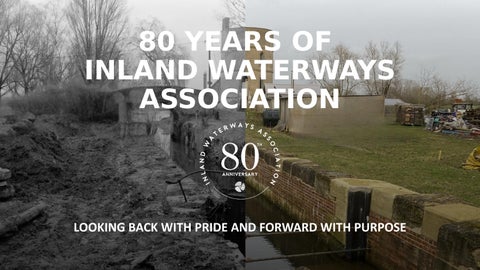
80 YEARS OF INLAND WATERWAYS ASSOCIATION

LOOKING BACK WITH PRIDE AND FORWARD WITH PURPOSE

INTRODUCTION

1940’S

1940’S – RALLIES AND EVENTS

Our story began in August 1945 at Tardebiggeon the Worcester and Birmingham Canal. After reading Tom Rolt’s book, Narrow Boat, Robert Aickman met Tom aboard his boat 'Cressy'.

The idea was planted for a national movement to protect and improve Britain’s waterways. In 1946, six people gathered in Aickman’s flat in Gower St, London, for the first official meeting of the Inland Waterways Association.

1940’S –CAMPAIGN ACTION

From the outset, IWA focused on waterways most at risk of loss.

Early campaigns included the Kennet and Avon Canal, the Stratford Canal and the Warwickshire Avon. This shaped decades of determined campaigning to prevent closure and neglect.

RESTORATION

IWA began fact-finding tours to true condition of the Aickman led a tour of waterways, including a passage Standedge Tunnel on the Narrow Canal, which had in 1944: the ground for future ambitions were laid.

1950’S

1950’S – RALLIES AND EVENTS

IWA held its first Boat Rally at Harborough. It attracted 120 boats large crowd, combining boating with festival. It proved that waterways capture national interest and public support.

Throughout the decade, organised trips members to explore working that were normally hidden from

1950’S –CAMPAIGN ACTION

The greatest threat of the decade came in 1955 with the Board of Survey report, which recommended the disposal of canals carrying no commercial traffic.

IWA campaigned intensively against these proposals. As a result, the 800 miles originally suggested for closure were reduced to just 90 miles in the final legislation

RESTORATION

restorations had not 1950s saw growing neglected waterways. trips, such as the Chelmer and Blackwater build understanding, practical knowledge underpin later restoration

1960’S

1960’S – RALLIES AND EVENTS

its National Rally at the Stourbridge Canal in direct proposed closure.

resistance from the British Commission, the 118 boat rally attracted national Volunteer action and public event into a decisive canal’s future.

CAMPAIGN ACTION

culminated in the 1968 Transport secured a future for many canals them as Cruiseways. The Act Inland Waterways Amenity Council, with IWA members playing perfect, the legislation marked a forward after years of

1960’S –RESTORATION

decade proved large scale volunteer restoration worked. The Lower Avon was reopened to Evesham in 1962. The Southern Stratford Canal followed in 1964 volunteers from various Waterways Societies, Boy Scouts, the Armed Services even prisoners from Winson Green (we can't find records of how they about it)! In 1968, Operation Ashton over 600 volunteers clear the Ashton in 48 hours: the power of coordinated volunteer action was clear.

1970’S

1970’S – RALLIES AND EVENTS

Volunteer working parties became a defining feature of the decade. Large scale events such as Ashtac in 1972 brought volunteers together in their hundreds, showing the growing strength and confidence of the waterways movement.

National Rallies and mass work parties demonstrated visible public support for restoration across the country.

1970’S –CAMPAIGN ACTION

Welshpool Bypass enquiry in 1971 was a campaigning success. IWA worked with Shropshire Union Canal Society to oppose proposed road scheme along the line of the Montgomery Canal. At the Public Enquiry, helped make the case for retaining the the route was rejected, protecting through the town and allowing restoration to proceed.

RESTORATION

the Waterway Recovery transformed canal coordinated national and turned volunteer reliable force for change. restorations followed, including the reopening in 1974, the Caldon Canal reopening and steady progress on as the River Great Ouse, reopened to Bedford in 1978.

1980’S

1980’S – RALLIES AND EVENTS

launched the first Canalway Venice. Held over the Holiday weekend, it combined a stalls and activities and flagship event. The bring waterways to a audience in the heart of

CAMPAIGN ACTION

Suffolk Broads Act of 1988

lengthy parliamentary campaign in played a leading role. The Act navigation interests alongside wildlife and cultural heritage, important shift from earlier where conservation alone took

1980’S –RESTORATION

While fewer major reopenings occurred in this decade, the foundations were laid for future successes. Continued volunteer activity, campaigning and partnership working ensured that restoration momentum was maintained and that threatened waterways remained firmly on the agenda.

1990’S

1990’S – RALLIES AND EVENTS

continued to raise awareness support for threatened waterways.

Rallies and local campaigns maintain public and political interest, in complex urban networks such Birmingham Canal Navigations.

1990’S –CAMPAIGN ACTION

campaigning included protest conferences, detailed cruising guides sustained branch activity.

this for the 50th Anniversary each brought by boat to Birmingham a representing their area and all waterways that IWA had saved over this

1990’S –CAMPAIGN ACTION

IWA played a long term role in securing the future of the Birmingham Canal Navigations.

These efforts raised the profile of the BCN and ensured the survival of many lesser used sections of the network.

This shows the completed waterways jigsaw being erected at the ICC Birmingham after cruising much of the network.

1990’S –RESTORATION

The reopening of the Kennet and Avon Canal in 1990 was a landmark achievement.

First identified as under threat in the 1940s, decades of campaigning and restoration culminated in its reopening by HM the Queen. The Basingstoke Canal followed in 1991 after years of volunteer effort, public campaigning and partnership working.

In the late 1990s, WRG volunteers and the Herefordshire & Gloucestershire Canal Trust began restoring the Over Basin, demonstrating highly effective, low-cost volunteer-led restoration.

2000’S

2000’S – RALLIES AND EVENTS

rallies, protest meetings and campaign remained central to IWA activity. such as rallies at Anderton and Ely build momentum and public support ambitious restoration projects at the the century.

2000’S –CAMPAIGN ACTION

From 2006 onwards, IWA led the Save our Waterways campaign in response to funding cuts to British Waterways and the Environment Agency.

Parliamentary lobbying, protest blockades and a campaign cruise past the Houses of Parliament highlighted the risks facing the network and mobilised support across the waterways community.

2000’S –RESTORATION

decade saw multiple major reopenings. Huddersfield Narrow Canal reopened in after being labelled an impossible restoration. 2002 so much progress. The Canal reopened, reconnecting communities across the Pennines. The Boat Lift reopened after major restoration, and the Ribble Link, reconnecting the Lancaster Canal to the network. In 2005, IWA took on management of the Chelmer and Blackwater Navigation, securing its long future.

2010’S

2010’S – RALLIES AND EVENTS

Volunteer Canal Camps and working parties continued to bring people together from across the Association. events combined skills, experience enthusiasm to tackle complex restoration challenges while strengthening national volunteer network.

2010’S –CAMPAIGN ACTION

campaigned for over a decade to mitigate the impact of HS2 on waterways.

Through evidence to parliamentary committees and sustained engagement with engineers and contractors, IWA secured route changes, improved crossings, noise mitigation and environmental enhancements, while continuing to press for further protections.

2010’S –RESTORATION

Major restoration successes continued. The Droitwich Canals fully reopened in 2011 after decades of effort. IWA fundraising and volunteer expertise drove the restoration of Inglesham Lock from 2010 onwards. Years of campaigning also helped deliver the formation of Canal and River Trust in 2012. In Scotland, sustained lobbying led to renewed investment and the reopening of key bridges, restoring navigability on vital routes.

2020’S

2020’S –CAMPAIGN ACTION

Campaigning in the early part of the 2020s focused on supporting waterways users and businesses through the impacts of Covid, then on the importance of protecting waterways heritage. Our Waterways for Today report published in 2022 was a key campaigning tool. IWA were founding members of Fund Britain's Waterways campaign and remain on the steering group. More recently we developed our Waterways Index which will form the framework for future campaigns.

2020’S –RESTORATION

hiatus due to Covid restrictions, returned in 2021 and continues to waterway restoration through Camps, training, and specialist

Regular work on the Lichfield, Berks, Cotswold, Wey & Arun, and canals among many others, has significantly advanced restoration efforts, side by side with local canal across the country.

CASE STUDY DROITWICH CANAL

The Droitwich Canals, abandoned in 1939 following an Act of Parliament and left derelict for decades, were brought back to life through more than 50 years of determined IWAled campaigning and volunteer effort. Beginning with IWA member Max Sinclair’s restoration campaign in 1959, volunteers cleared the first sections in the early 1970s and, through the Droitwich Canals Trust, restored Vines Park, the long pound and several locks. IWA funding helped complete key Junction Canal locks in 2001, and from 2005 a major £11 million partnership project, supported by IWA, pushed the restoration to completion. Much of the final engineering, including the Barge Lock in 2008, was carried out by IWA’s Waterway Recovery Group, leading to the full reopening of the Barge Canal in 2010 and the Junction Canal in 2011.

LOOKING BACK WITH PRIDE AND FORWARD WITH PURPOSE

The Inland Waterways founded in 1946 in risk that neglect would historic waterways canals and rivers remain because of 80 years campaigning, restoration volunteering. That now as it was then.

OUR STRATEGIC OBJECTIVES

Over the next 20 years, objectives will underpin

 To campaign for the regeneration of inland everyone to enjoy;

 To support the transformation navigable waterways living and business;

 To establish waterways asset and foreground campaigning as part localised climate

HOW WE WILL WORK INTO THE FUTURE

These objectives will be delivered five connected areas of work remains an effective national whole waterways network.

• Powerful Campaigning Build campaigns that win government and inspire

• Restoration Expertise

Create a recognised centre for canal and waterway

HOW WE WILL WORK INTO THE FUTURE

• Strong Volunteer Community

Grow and support a volunteer base.

• Environmental Leadership

Develop specialist knowledge users, restoration groups authorities.

• Sustainable Funding

Secure reliable, long-term support our work.

WHERE YOU COME IN

IWA’s future depends on members, volunteers, branches and supporters who all play a vital role in campaigning, restoring, caring for and speaking up for waterways. With your help, we can ensure Britain’s canals and rivers remain open, connected and thriving for the next 80 years.

FOR 80 YEARS, WE’VE LOVED OUR WATERWAYS - LET’S KEEP THEM FLOWING

Turn static files into dynamic content formats.

Create a flipbook
IWA 80th Powerpoint by The Inland Waterways Association - Issuu