For press enquiries contact: pressoffice@waterways.org.uk
All IWA national and branch committee volunteers can be contacted by email: firstname.lastname@waterways.org.uk
Nothing printed in Waterways may be construed as policy or an official announcement unless stated, otherwise IWA accepts no liability for any matter in the magazine. Although every care is taken with advertising matters no responsibility whatsoever can be accepted for any matter advertised. Where a photo credit includes a note such as CC-BY-SA, the image is made available under that Creative Commons licence; full details at www.creativecommons.org
Round-up of the latest happenings with IWA and our waterways
P11 Love your waterways
MP Phil Brickell talks about his passion for kayaking and his role on the APPG
P12 Photo competition
Enter the IWA Photo Competition 2025 and help us to promote our cause
P14 campaign update
Catch up with our latest activities and find out how you can get involved
P18 Navigation nightmare
IWA’s Navigation Committee reports on an annus horribilus for boaters
P20 heritage register
IWA is compiling a special register to highlight historic waterway sites at risk
P29 WRg Leadership day
Canal Camp leaders share updates and learn how to improve practices
P30 Branch focus
Shrewsbury District & North Wales Branch celebrates its 50th anniversary
P32 electrika 2025
The latest developments in electric propulsion on inland waterways
P35 Weil's disease
The disease that lurks in stagnant water
1. Your voice is counted when IWA speaks up for all those who enjoy the country’s canals and rivers
2. IWA lobbies national and local government and works with other organisations to repair, improve and protect our waterways heritage
3. Restoration is kept high priority through IWA’s Waterway Recovery Group
4. IWA campaigns to defend the waterways from unwelcome development
5. IWA branch Canal Clean-ups keep many waterways clear of rubbish
6. over 10,000 days of volunteering each year will be supported with the right training, tools and materials
7. IWA provides training in traditional and work site skills for the waterway restoration sector
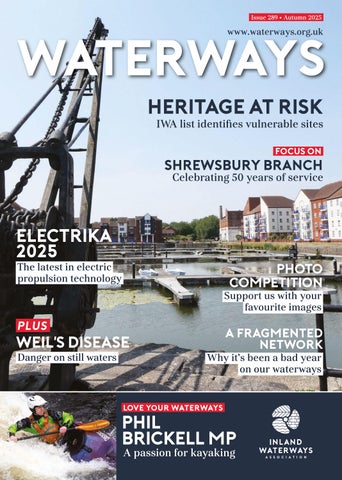
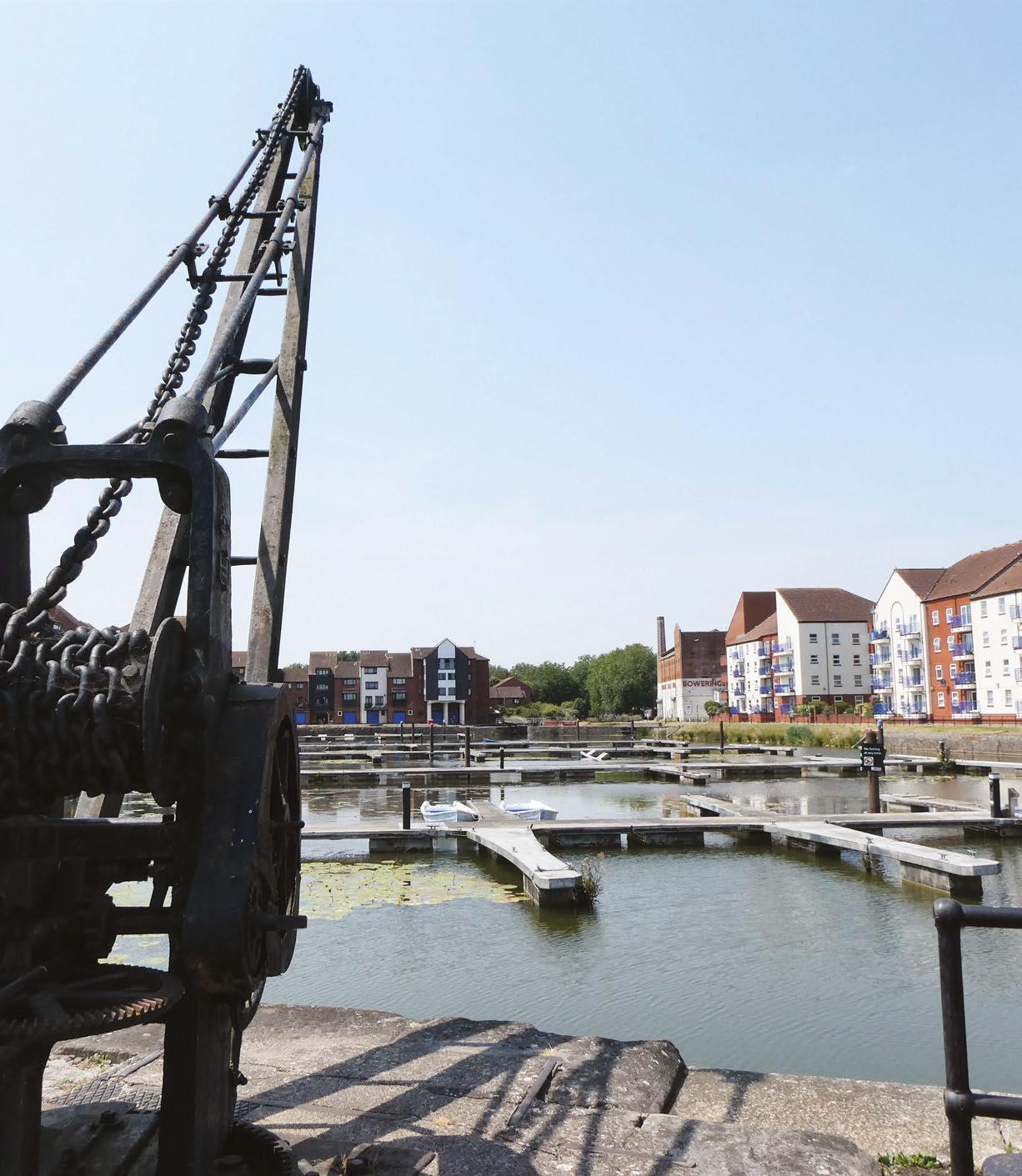
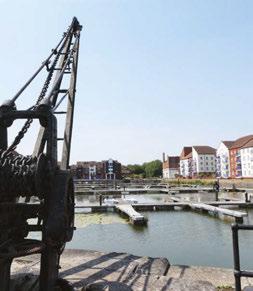
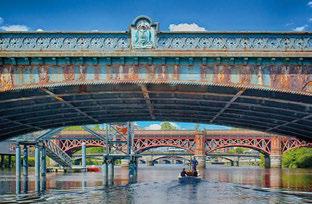
COVER PICTURE: Bridgwater Docks. GORDOn MCKERROw
Welcome from Mike Wills, IWA National Chair
Iam asking for your help.
Life as IWA national chair seems to be dominated by a huge demand on my personal time which is magnified by a constant flow of emails.
But in truth the biggest challenge, like that once recognised by Prime Minister Harold Macmillan, is “Events, dear boy, events.” While I would not use the same dated language today, there is no doubt that damaging incidents, changed circumstances, unexpected occurrences and particularly interactions with members, volunteers, sta and others, mean that there is li le time for either reflection or forward thinking.
This is a major concern because a critical part of my role includes developing and implementing a clearly articulated vision for IWA.
We are an organisation with clear long-term objectives seeking public benefit om a range of activities including conservation, restoration, education and research. Within this broad spectrum, the trustees have
developed shorter-term, high-level, strategic objectives:
1. To campaign for the protection and regeneration of inland waterways for everyone to enjoy
2. To support the transformation of previously navigable waterways into places for leisure, living and business
3. To establish waterways as an environmental asset and foreground in our campaigning as part of the response to localised climate change.
I hope you concur with the general thrust of these strategic objectives. We are all aware of the limited government funds available for the inland waterways. There are also increasing challenges for waterway restoration projects. However, we simply cannot let the successes that we have achieved over the last 79 years gradually recede.
I am engaging with our trustees and regional chairs on this topic and now I need your input. In no more than a sentence or two, can you email me what you think we should include in our overall vision for IWA? How should
we shape our campaigns over the next few years?
We are a membership organisation, and I would like to be er understand our members’ views, hence I value your input. Please understand if I am not able to reply to everyone – but I promise you I will read and consider every response.
mike.wills@waterways.org.uk
AGM date for your diary
The IWA’s annual general meeting will be held on Saturday, 27th September at the Jubilee Conference Centre, Nottingham NG7 2TU.
Welcome and registration will open from 10am, with refreshments available. The formal AGM will start at 11.30am followed by a presentation of IWA National Awards. A discussion on matters of current interest will follow after the formal meeting. Lunch will be available at 1pm from the university café. There will be plenty of time for networking and the opportunity to take part in afternoon activities starting at about 1.45pm.
For further details closer to the date waterways.org/uk/agm
IWA supports Cam Conservancy's call for urgent action
The Cam Conservancy has warned that it may “become unviable and inoperative” without support. The crisis threatens not just Cambridge river users, but the city’s economy and safety. And the problem isn’t contained to just one area.
The Cam Conservancy situation is symptomatic of a vulnerability that could threaten the national waterway network along with communities and businesses. Navigation authorities are under mounting financial pressures, along with the increasing problems associated with climate change.
IWA supports the Cam Conservancy’s urgent call for a comprehensive national review of waterways infrastructure. Our rivers and canals aren’t just recreational assets, they’re vital for local economies and the environment, an irreplaceable part of our national heritage and they must be well maintained to prevent flooding and risk to life. IWA is leading the Fund Britain’s Waterways coalition of more than 160 organisations to campaign for sufficient funding to safeguard the future of our waterways.
Missed opportunities as boating sector overlooked in Spending Review
IWA is disappointed that the government overlooked the inland waterways sector in the Chancellor’s 2025 Spending Review.
“Despite our detailed proposals and the sector’s substantial £4.41bn annual contribution to the economy, the absence of targeted support for sustainable boating is a missed opportunity,” said IWA Sustainable Boating Group chair, Bowman Bradley.
“Hydrotreated vegetable oil (HVO) stands out as a viable, cleaner alternative to diesel, offering up to 90% reduction in carbon emissions and compatibility with existing engines. The fact is that without fiscal incentives or infrastructure investment, its adoption remains limited. This inaction not only stalls our progress towards net zero but also does not help the livelihoods of 133,000 individuals employed within the sector.
“The government’s apparent failure to invest sensibly undermines its own environmental commitments and neglects the potential of our waterways to lead in sustainable transport.
“Substantial increases in investment in infrastructure were announced [in the Review], but the missing piece of the puzzle is delivery.”
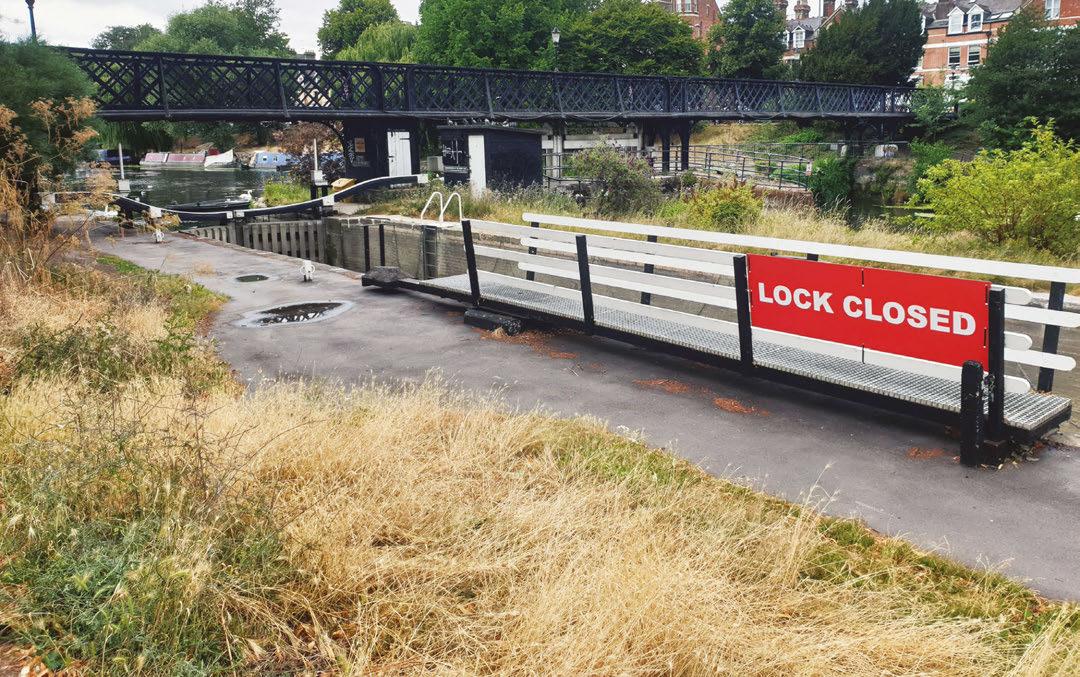
Jesus Lock, Cambridge.
Expert evidence on the benefits of canal restorations
In May, under the secretariat of IWA, the Waterways All Party Parliamentary Group (APPG) convened to hear expert evidence from the Wilts & Berks Canal Trust and the Buckingham Canal Society.
Thirteen MPs and their representatives attended to learn about the benefits of waterway restoration, citing the 50 canal restoration projects around the country. Martin Hollis, chair of the Wilts & Berks Canal Trust, cited the Kennet & Avon Canal to emphasise the benefits of such restorations:
• £92m/year GVA (Gross Value Added) increased economic activity
• 11.2m annual visits (up from 7.7m in 1995)
• 2,700 FTE jobs along canal corridor
• 1,230 FTE jobs from increased canalside activity such as hospitality
• Doubled canalside development
Martin explained that housing beside waterways attracts a 10% to 20% premium. Research also indicated that waterways users have higher life satisfaction and are more active.
Canal restorations also:
• deliver significant economic, health/well-being and nature/ biodiversity benefits
• have been shown to stimulate doubling of development and housebuilding
• alleviate flooding and (as a side benefit) increase agricultural productivity and yield.
Terry Cavender, executive officer of the Buckingham Canal Society, provided background on the society, explaining that although they are a charity, they need to think and act commercially to take advantage of opportunities, and ensure paperwork including insurance and health and safety is covered. He advised other restorations to: capture everything; manage the ‘now’; consider all of the restoration phases including the before/meanwhile uses, during and after; and have a vision that can evolve. Crucially there need to be sustainable funding plans. He told the assembled MPs they could help support waterways restorations by:
• Recognising canals as national infrastructure
• Supporting the funding of our waterways by encouraging Defra to review all of the waterways grants which needed to be indexlinked
• Ensuring the National Planning Policy Framework protected restoration routes and included restoration groups as statutory consultees
• Creating a national policy to use canals for flood alleviation and water transfer/supply.
MP Bill Esterson, chair of APPG, thanked the speakers and said he has been pleased to see developers investing in waterways sites in his constituency.
Lord German, as co-chair, raised the issue of leveraging these issues to get funding – there was a need to incentivise private development – and provide evidence that there’s a 10% to 20% uplift in property value, thanks to the proximity of a waterway.
Charlie Norman, IWA’s director of Campaigns & Public Affairs, said: “Canal restoration projects deliver huge benefits and deserve active support from voters, councils and parliament.
“It is also incredible how much volunteer expertise and time are devoted to restoration. This was a particularly well-attended and enjoyable APPG session with thanks to all who contributed.”
New charity to support Chelmer & blackwater navigation
IWA has completed the final details in setting up a new charity designed to increase support for the Chelmer & Blackwater Navigation in Essex. Last November, IWA’s trustees and the board of Essex Waterways Ltd announced plans for the charity to ensure the continued success of the navigation.
The share in Essex Waterways Ltd was transferred to Essex Waterways Navigation Trust on 31st March and the arrangements are now complete. Managed by IWA’s wholly owned subsidiary, Essex Waterways Ltd, the navigation has gone from a position of near bankruptcy and poor maintenance to a much-loved amenity enjoyed by locals and visitors alike. It is promoted as a star attraction by both Visit Essex and the local authorities.
The historic waterway has also provided significant employment with trip-boats and waterside businesses, as well as maintenance work. The navigation has become a model of efficient operation and sustainable management.
IWA and Essex Waterways Navigation Trust will maintain close relations, and some of the charitable activities performed by Essex Waterways Ltd will transfer to the new charity. Freehold ownership of the navigation remains with the Company of Proprietors of the Chelmer & Blackwater Navigation, established in 1793 by Act of Parliament, which has contracted Essex Waterways to manage the navigation for as long as Essex Waterways Ltd wishes to do so.
IWA national chair Mike Wills said: “After a joint review by both IWA’s trustees and the directors of Essex Waterways Ltd, a new chapter has started and all the final details have now been satisfactorily settled. IWA’s commitment to the navigation is undiminished, and we are pleased that it will stay connected as part of a wider IWA family.”
Roy Chandler, chair of Essex Waterways Ltd, said: “Taking on management of the Chelmer & Blackwater Navigation was a courageous decision by IWA’s trustees in 2005, and we are grateful for the confidence and support for our endeavours over the past 20 years. We believe that we have demonstrated how an inland navigation can be managed to a high standard on a modest budget, in sympathy with the local environment and with the support and goodwill of appreciative users.”
New memoir calls for action to secure the future of the waterways
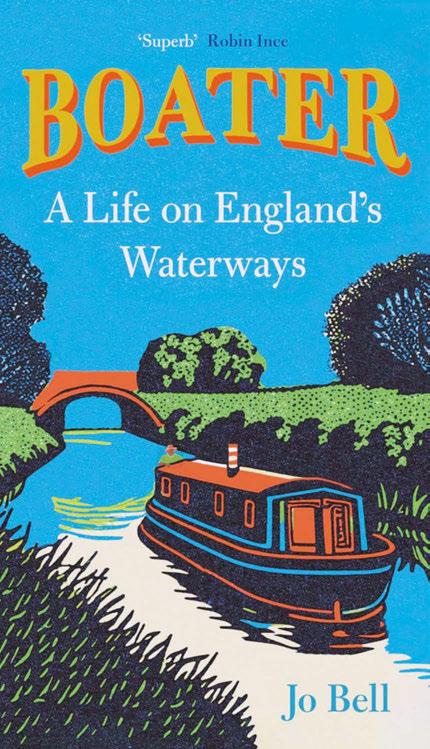
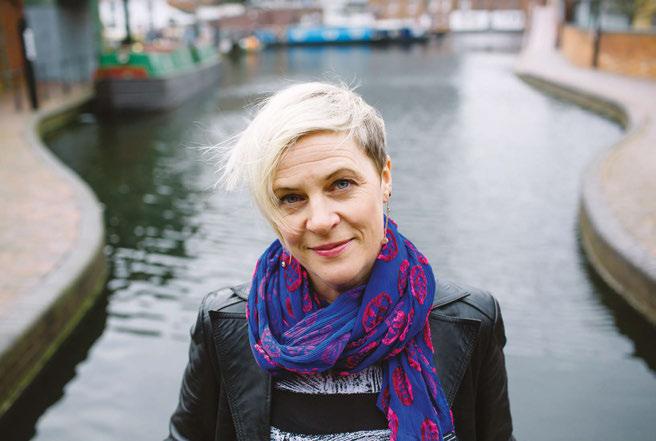
Archaeologist and poet Jo Bell brings scholarly detail and beautiful prose to her new book, which is part personal memoir, part history of the waterways and their people.
Boater layers fascinating, well-researched history with anecdotes from Bell’s life on narrowboat Tinker, telling the stories of engineers and entrepreneurs, navvies and boat people (both past and present). The book focuses on three key individuals: Thomas Telford, James Brindley and IWA founder L.T.C. Rolt. She acknowledges the inequity that was ever present in the system that brought the British canal system into being, founded as it was on cheap labour and low welfare conditions.
As well as celebrating the work of IWA and the canal restoration movement of the latter half of the 20th century, Bell highlights the threats which now face our waterways, calling for concerted action to save them for the future.
Boater by Jo Bell is published by HarperNorth. RRP:£16.99
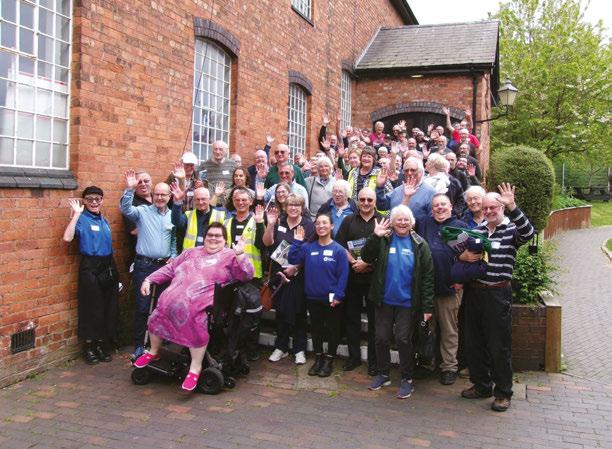
The Annual Waterways Restoration Conference at the National Waterways Museum Ellesmere Port was jointly organised by IWA and Canal & River Trust on 26th April.
A packed audience attended the event, which was held at the historic venue. Special thanks go to the excellent speakers and compere who made the conference inspiring and delightful, to IWA Chester & Merseyside Branch, all the volunteers who helped hugely throughout the day, and to the museum and archives teams.
Attendees came from far and wide to network, ask questions and give feedback. IWA chair Mike Wills committed the organisation to increasing its capacity to support restoration projects. He said challenges remain huge, however, and restoration groups are going to have to depend on each other more.
Slides of the conference can be downloaded from the IWA website. After the event there was a fascinating walk around Chester’s historic waterways, organised by John Herson of IWA Chester & Merseyside Branch and Chester Civic Trust.
Jo Bell
IWA responds to Independent Water Commission consultation
IWA has submitted a response to the Call for Evidence issued by the Independent Water Commission. Launched by the UK and Welsh governments in October 2024 the commission is chaired by Sir Jon Cunliffe, a former Deputy Governor of the Bank of England. It is tasked with carrying out the largest review of the water industry since privatisation.
Water resources management is becoming increasingly important for the future of the inland waterways. IWA’s Navigation Committee has previously responded to consultations on regional Water Resource Plans, various water companies’ Water Resource Management Plans, and the Fens, South Lincolnshire and SESRO (Abingdon) reservoirs. There are a number of proposals for water transfer schemes, of which the Grand Union Canal Transfer is the most advanced. Not only would these bring income to currently navigable or restored canals, they also make clear the role of canals as a part of the national infrastructure.
IWA’s response to the Call for Evidence makes the following points:
• There is a need for joined-up strategic water planning, across the country as a whole and with a multi-sector approach (including key users such as inland waterways as well as water companies)
• Inland waterways both navigable and capable of restoration must be seen as part of the national infrastructure and included in the picture
• Suggests a duty on water companies to consider navigable waterways in their strategic planning
• Navigation authorities do not have enough funds even to maintain the status quo, let alone invest for the future, especially in the face of climate change
rally for the Bridgewater Canal Postponed
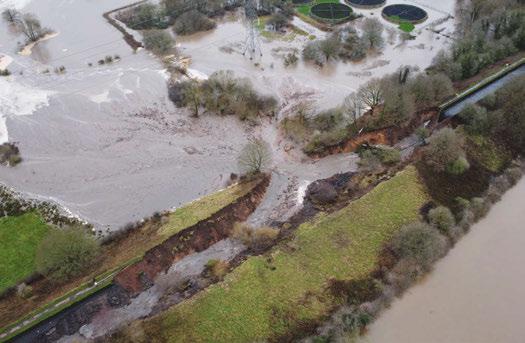
IWA had planned to invite boaters and canal users and lovers to Agden Bridge this August bank holiday in support of restoring the Bridgewater Canal, following the major breach of New Year’s Day that left a crucial section of the waterway impassable.
While the breach was not thought to be due to poor upkeep, it highlights a stark and growing reality: Britain’s historic waterways are increasingly vulnerable to the impacts of climate change. More frequent flash floods, intense rainfall, and prolonged dry spells are placing serious strain on even the best-managed stretches of canal.
The Bridgewater Canal, often referred to as England’s first modern canal, remains a vital part of the inland navigation route connecting the Northwest with the wider network. Its temporary closure is not just a regional issue but a national concern for connectivity, commerce, and heritage.
The August rally at Agden Bridge was to act both as a celebration of canal culture and a visible call for action. However, we have reluctantly had to postpone the Lymm
Horseshoe Falls on the River Dee, which supplies water to the Llangollen Canal, including water carried via the Llangollen Canal to the 21-acre Hurleston Reservoir, which holds 85 million gallons of public drinking water supply for south Cheshire.
• Abstraction laws need to consider canals and rivers as part of the same overall picture
• There is potential for mutual benefits from water transfer schemes, both for currently navigable waterways and restoration schemes
• There are already water transfer schemes on navigable waterways (Llangollen, Gloucester & Sharpness, Bridgwater & Taunton canals; Yorkshire Ouse and River Lee Navigation)
• The Grand Union Canal Water Transfer Scheme is an example of canals becoming essential parts of national infrastructure again
• There is a key role that some of the 500 miles of waterway restorations could play, in particular the main schemes where restorations and water transfer could go hand in hand (Cotswold Canals Severn-Thames Transfer scheme, Buckingham Arm and others)
• There are many advantages of an inland waterway over a buried pipeline and regeneration benefits along the route
• Water companies shoould liaise with restoration societies and/or IWA to understand the potential schemes and explore the wider benefits of individual schemes, considering if there are examples that could benefit from a revised Ofwat Innovation Fund.
event until next year because of the continuing and worsening water shortages, especially in the northwest, which is causing summer stoppages and making access difficult. This further highlights the fragility of the inland waterways network. This is especially disappointing given the recent surge of interest from boaters in local marinas and an increase in trader interest, for which we are grateful. Hopefully, everyone can come along in 2026 and show their support. The Bridgewater Canal Company has indicated that they intend to support the event in 2026.
Adr IA n rA yson
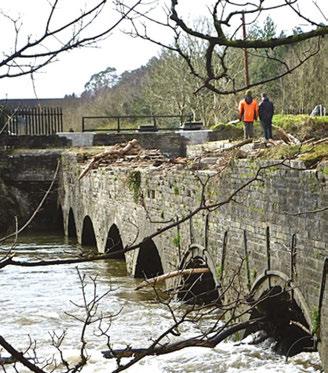
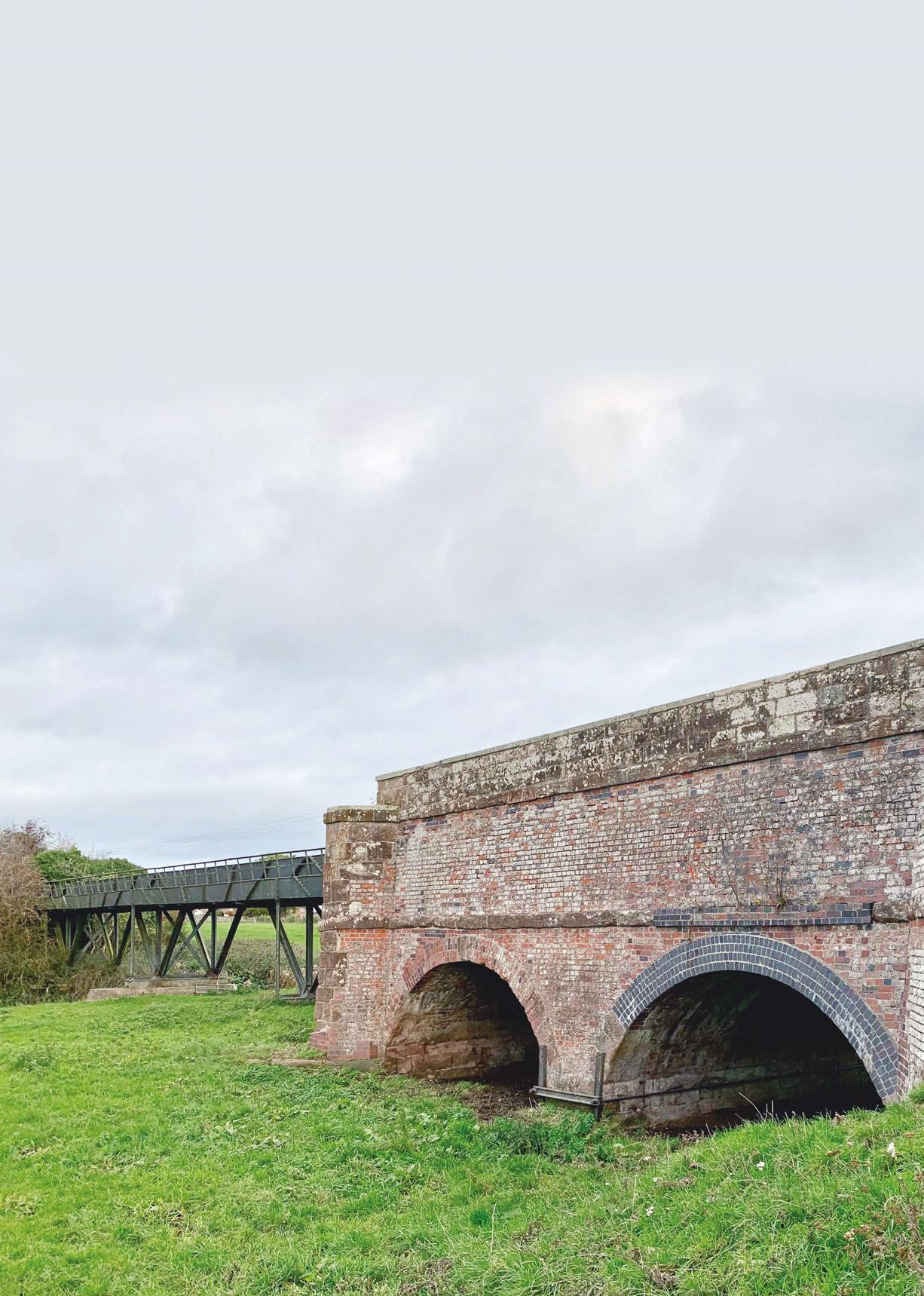
Bridgewater Canal Breach.
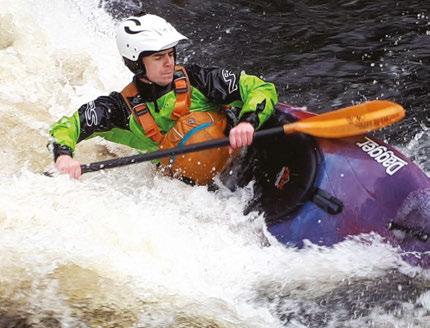
Phil Brickell MP
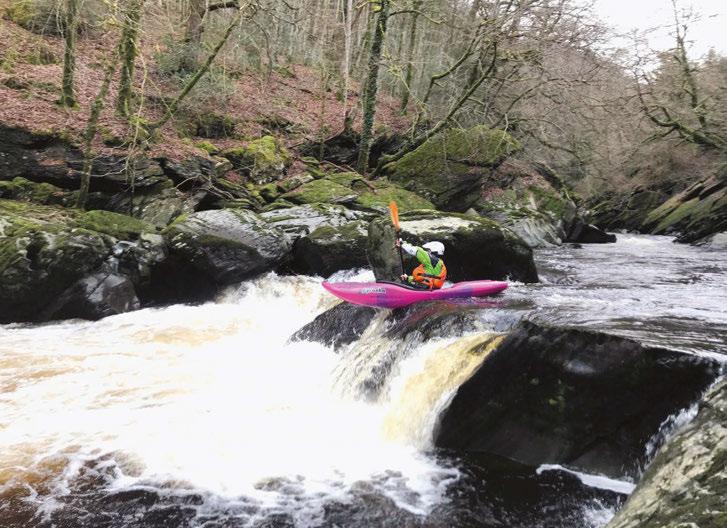
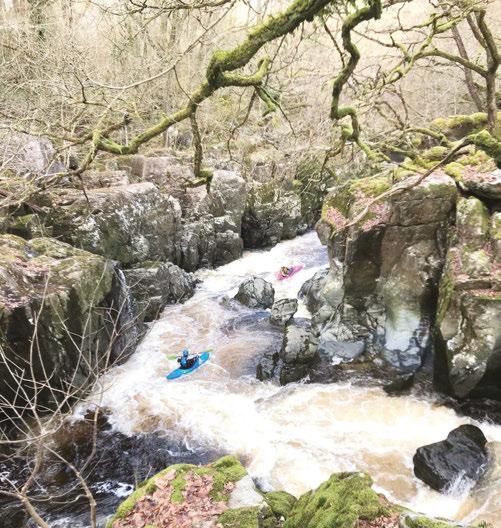
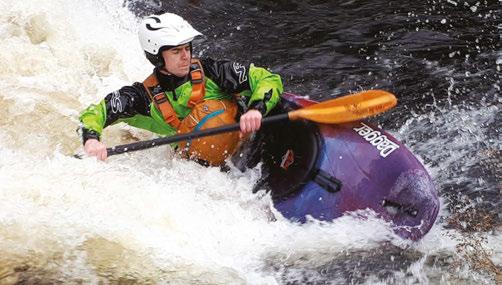
When not busy representing Bolton West and campaigning for our waterways, MP Phil Brickell enjoys nothing more than battling the elements in his kayak
How did you get into kayaking?
I first tried kayaking aged 11 at Patterdale Hall, an outdoor pursuits centre located next to Ullswater. Returning back home, I persuaded my parents to let me learn to kayak at Burrs Country Park, Bury, and I’ve been hooked ever since. Spending time on the water is so relaxing and lets me switch off from daily life.
Where has it taken you?
All over the world, from the epic rapids of Uganda’s White Nile to Nepal and across the Alps as well.
Any favourite spots?
The River Inn which carves its way through the Swiss and Austrian alps through some incredibly picturesque gorges.
What about here in the UK?
The upper Ribble near Settle and stretches of the River Ogwen in north Wales are stand-out stretches of water for me with some relentless but fun whitewater, framed by wonderful scenery. Kayaking allows me to reach places few other people can, something I always enjoy.
Did you know the oldest kayak is 450 years old?
I had no idea! I grew up reading about John ‘Rob Roy’ MacGregor who first pioneered British kayaking in wooden boats in the mid-19th century. A real highlight for me recently was seeing some really old craft when I visited Britain’s leading kayak manufacturer, Pyranha Kayaks, earlier this year.
What do you think about the current state of Britain’s waterways?
Our country is blessed with innumerable lakes, rivers, canals and streams. But the ecological vandalism we’ve seen from water companies and other polluters over the last few years has done real and lasting damage. Likewise, while there are 35,000 miles of rivers in England, fewer than four per cent of them have a right of navigation because of feudal arrangements with landowners. That needs to change.
What challenges and changes have you seen?
Just throughout my years kayaking I’ve noticed pollution getting worse. We’ve seen some very welcome measures to tackle this problem over the last year, not least the blocking of bonuses for water bosses who fail to meet their responsibilities when it comes to sewage discharges.
Another challenge is the lack of a statutory right of access. This is holding people back from being able to enjoy the immense physical and mental health benefits from time on the water.
The barriers preventing millions of people from enjoying and caring for their local rivers are a legacy of a bygone era, one which urgently needs replacing to allow everyone to connect with our rivers. The government will be bringing forward proposals to resolve this in the coming months, which I look forward to scrutinising.
You are a member of the Waterways All Party Parliamentary Group. As a busy newer member of parliament, why did you accept IWA’s invitation to join?
Many of our rivers offer a unique space for millions of people across the country to enjoy. From paddlers and swimmers to anglers and rowers, the appetite for water-based activity has surged over the past decade. The APPG provides a forum for parliamentarians with an interest in representing these people in the campaign for better access to higher quality and cleaner blue spaces.
Questions posed by Charlie Norman
2025 Photography Competition
IWA’s 2025 Photography Competition is now open for entries. And we are doing things a li le di erently this year. Rather than placing limitations on your entries with themed categories such as nature or
THE PRIZES
THE WINNER WILL RECEIVE a £25 voucher to spend in our shop and runners-up an IWA goody bag. Winning photos may also feature in our calendars and Christmas cards, as well as our other campaigning materials. Please submit your photos to campaigns@ waterways.org.uk.
Entries close 31st Dec 2025
winter, we are opening it up to any photo featuring our beautiful waterways. We want to see your best images of any aspect of life on our inland canals, rivers, lakes and reservoirs.
IWA relies on good quali images for our campaigns, and by sharing some of your favourite photographs you will be supporting our work. Here are some images to help inspire your entry!
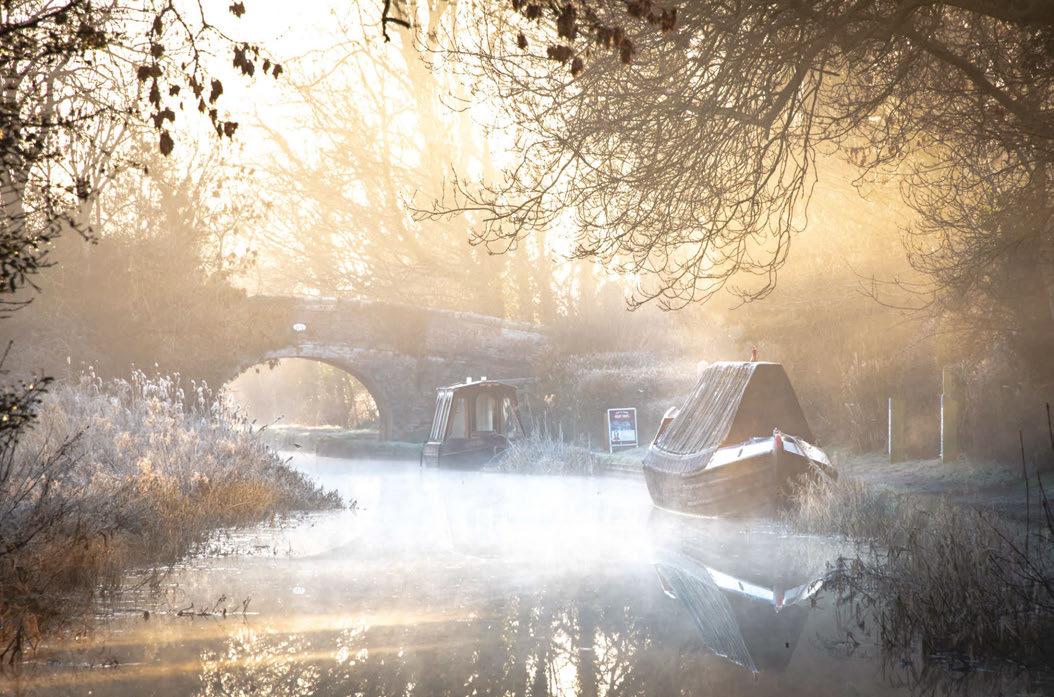
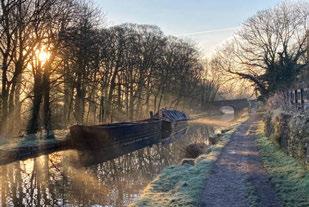
Misty morning on the Montgomery Canal at Maesbury Shropshire by S.W. Roberts
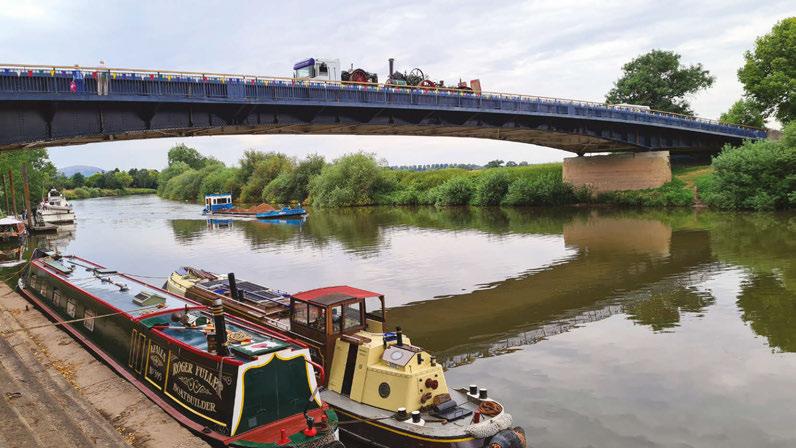
River Severn at Upton-uponSevern by Teresa Fuller
share your favourite photographs to support our campaigns
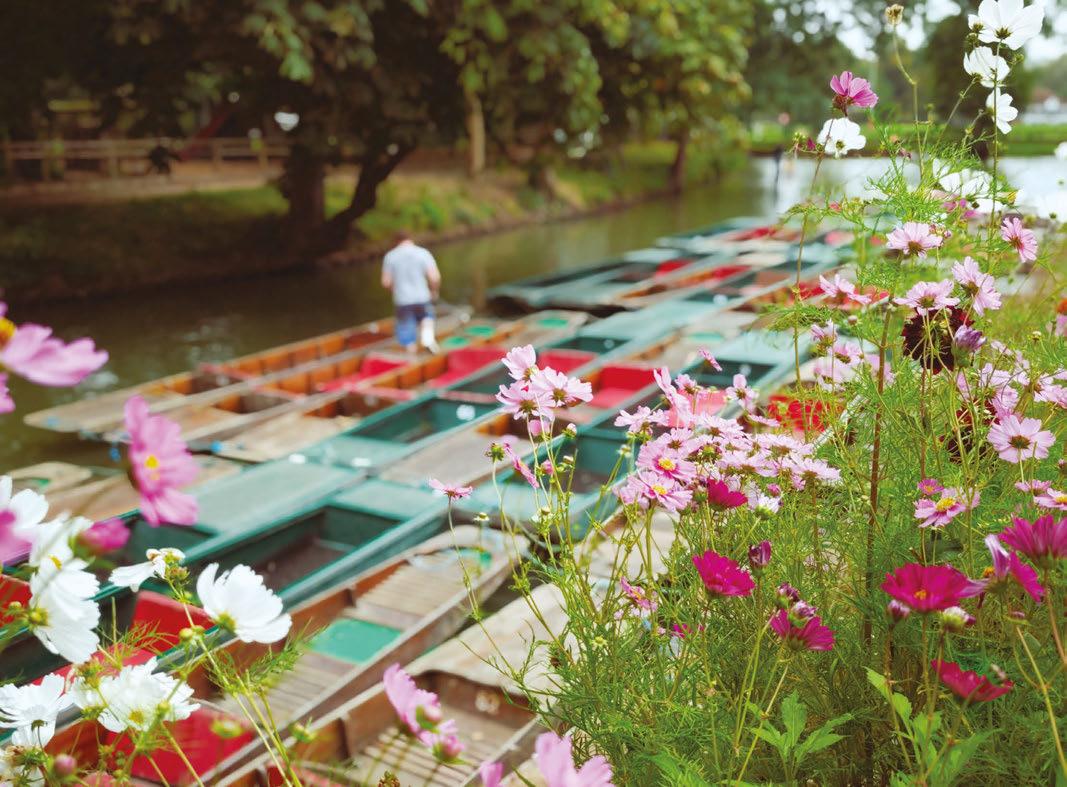
Oxford scene by Amy Young
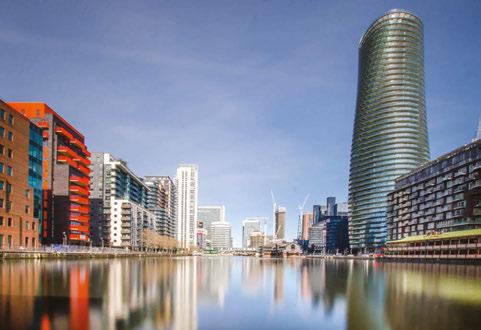
Millwall Inner Dock, Canary Wharf by Mark Caldon
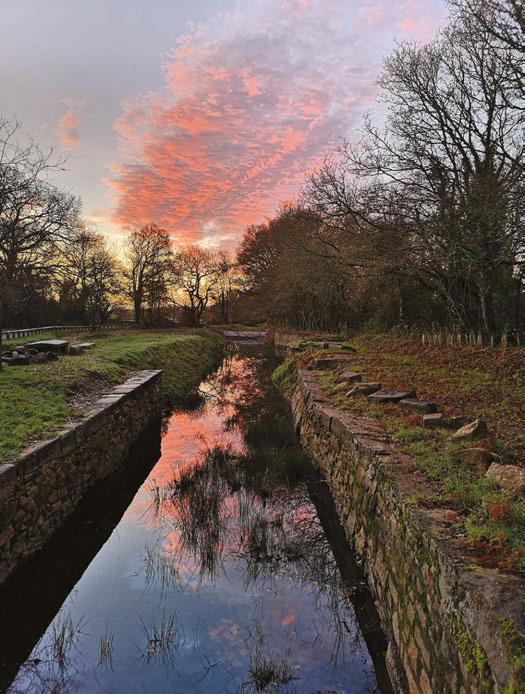
Stover Canal, Ventiford Basin, by Kerry Clarke
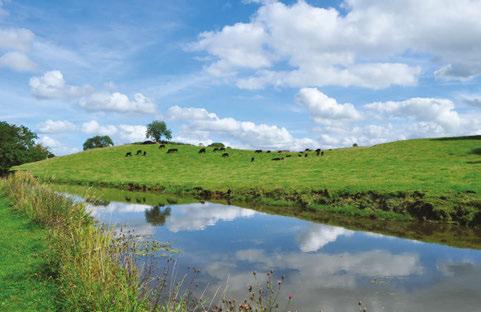
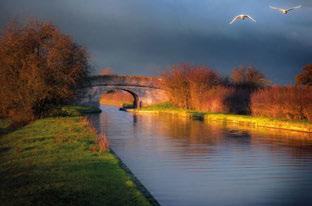
Summer on the Lancaster Canal while walking from Lancaster to Lake Windermere by David Coomber
The IWA needs your support more than ever. Here’s how you can help our cause…
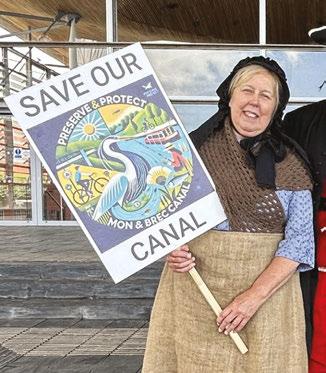
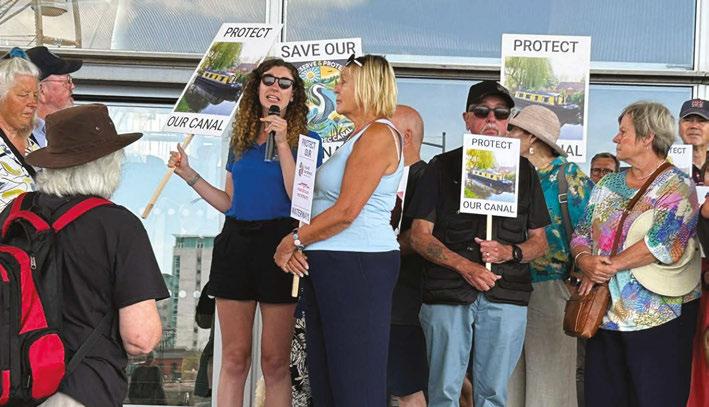
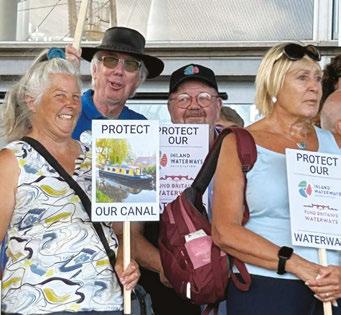
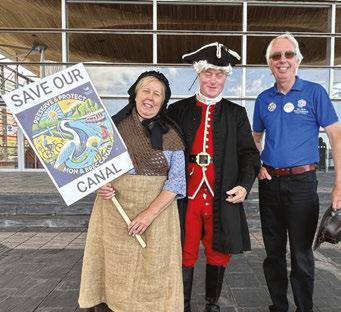
IWA campaigners from South Wales and beyond were out in force outside the Senedd to protest about the future of the Monmouthshire & Brecon Canal.
This beautiful, 225-year-old waterway faces threat – not from drought, but a flawed licensing decision that’s restricting its water supply. We’re calling for immediate, sensible and joined-up solutions that protect both canal and river as a single living system. Our political voice is really being raised due to tireless work from expert local campaigners.
IWA joined campaigners from the Preserve & Protect the Mon & Brec Canal group, local businesses and supporters in a broad show of unity outside the Senedd, urging the Welsh Government and Natural Resources Wales (NRW) to take immediate action to save the Monmouthshire & Brecon Canal.
Inside, IWA staff and volunteers watched the Senedd debate triggered by a petition from Cllr Jan Butler, which soared past 10,000 signatures. The message was clear: act now or risk losing one of Wales’s most cherished waterways.
Despite attracting more than 3m visitors a year and serving as the most visited attraction in the Brecon Beacons National Park, the canal faces closure, because of the licensing, and falling water levels caused by evaporation and leakage.
NRW has reduced the canal’s water extraction licence from the River Usk, breaking with a practice protected by an Act of Parliament since 1792. Meanwhile, Canal & River Trust is forced to spend £40,000 a week just to keep the canal navigable. It’s an unsustainable situation that threatens local jobs, tourism, heritage, wildlife and well-being.
Senedd member James Evans warned that the canal was “on the brink of closure”; Julie Morgan MS said the issue should “ring alarm bells”, while fellow MS Jane Dodds warned that closure could come “within months”.
We couldn’t agree more.
Huw Irranca-Davies, Deputy First Minister and Cabinet Secretary for Climate Change & Rural Affairs, acknowledged IWA’s historic role and called for collaboration to find a solution.
Local authorities and agencies are now in discussion, and we’ll be holding all parties to account. Mr Irranca-Davies told the Senedd that everyone must come together to look at all solutions.
Carolyn Thomas MS said that Ruth Jones MP, who is a member of the Waterways APPG, had written to her. She had clearly been following this issue so it is good to see that the APPG, for which IWA acts as secretariat, is playing an active role in these national debates.
Following the debate and a meeting with key stakeholders, Mr Irranca-Davies announced that the Welsh Government “intends to prioritise capital funding of up to £5m within its budget to upgrade the pumping station, which is supporting the current temporary agreement.”
A Welsh Government led “Task and Finish Group” will work with stakeholders to develop further options to build resilience in the canal’s capacity and identify how capital works and ongoing costs will be met.
Paul Thomas, IWA South West and South Wales Region Secretary, said: “We’re grateful to all our members who signed the petition, shared the message, and stood with us. We welcome Huw Irranca-Davies’s statement which shows that the Mon & Brec Canal is finally being taken seriously.”
Senedd Campaigners.
C Nor MAN Senedd Campaigners.
Fund Britain's Waterways Update:
FBW Campaign Cruise 2025
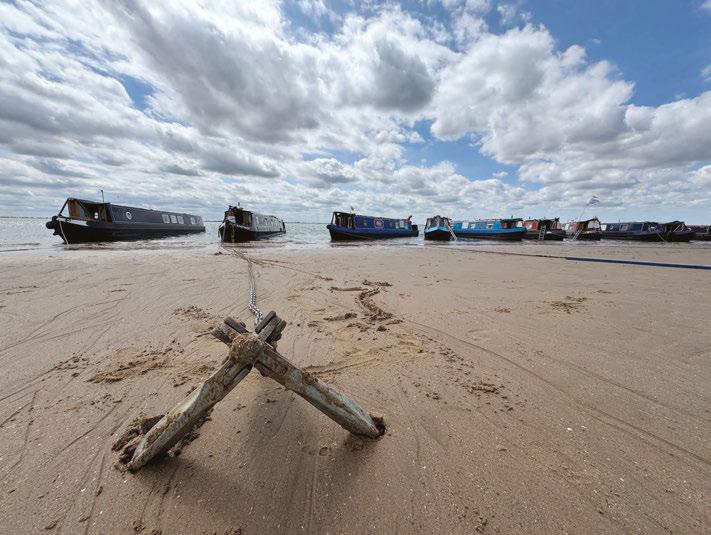
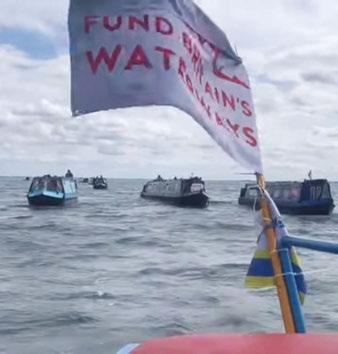
The second major highlight of the 2025 campaign cruise took place on Wednesday 25th June, when a flotilla of 14 narrowboats completed a 39-mile cruise om Boston to Wisbech across the Wash.
The journey consisted of a 20-mile route om Boston on an outgoing tide to a sandbank, Thief Sand, and then 19 miles om the sandbank on an incoming tide to Wisbech. It was delayed om the initial target date of 8th June by an unexpected two-week Environment Agency closure of the Boston Barrier for maintenance. The boaters had to wait for the next window of suitable tides, and then a couple more days for fair weather.
To see so many narrowboats making the crossing is highly unusual and demonstrates the determination of the campaigners to highlight the importance of the cause. The crossing a racted both regional and national BBC television coverage. BBC Look East covered the cruise on Thursday 26th June and BBC Breakfast showed a segment several times through the morning of Sunday 29th June. Some spectacular video clips, especially drone footage, can also be found on the Facebook group for the 2025 FBW campaign cruises: search for ‘Fund Britain’s Waterways – Cruises for 2025’.
The flotilla has now split up, with some boaters having other commitments a er three months of campaigning. Others have hosted a meeting with Paul Burrows, chief executive of the Middle Level Commissioners, and it is hoped that more activities can be arranged on the Great Ouse and the Cam to highlight financial di culties. Since the cruise is now drawing to an end, it is timely to look back on what has been achieved before the steering group meets to discuss the next steps in the Fund Britain’s Waterways Campaign.
Hazel Owen, leader of the flotilla, chair of the Association of Waterways Cruising Clubs and a member of the FBW steering group, summed up the cruise to date: “The journey of these boats and their crews has not been straightforward but has required dedication and tireless e orts, surmounting obstacles presented by failing in astructure and other challenging events along the way. The perseverance and shared mission of the boaters speak for all who care about the future of Britain’s beautiful and historically significant waterways, not only boaters but millions of other people too. They are united in seeking awareness, action and change.”
“The journey of these boats and their crews has not been straightforward but has required dedication and tireless e orts, surmounting obstacles presented by failing in astructure and other challenging events along the way”
How you can help
• WRITE TO LOCAL AND REGIONAL POLITICIANS, mayors and MPs, highlighting the benefits of waterways, the threat to them and the FBW campaign.
• SUPPORT THE BOATERS ALONG THE ROUTE of the campaign cruise and send photos to info@ fundbritainswaterways.org.uk for the website.
• SUPPORT FBW POSTS ON SOCIAL MEDIA by liking and sharing posts with the hashtag #FundBritainsWaterways, and post on social media yourself.
FBW flotilla on sandbank in the Wash waiting for the tide, 25th June 2025.
FBW flotilla on the Wash, 25th June 2025.
HAZEL OWEN
SHIRLEY SEFTON
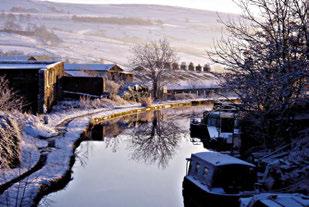
Code X152 Marple, Peak Forest
Photo by Nicola Turner
Code X150 New Mills, Peak Forest
Photo by Victor Gibbons
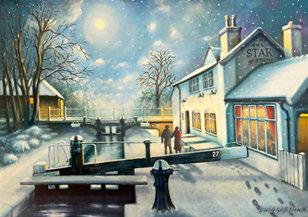
X158 Star Lock Inn
painting by Dave Gardham
X151 Fulbourne, Stre on
by Tim Lewis
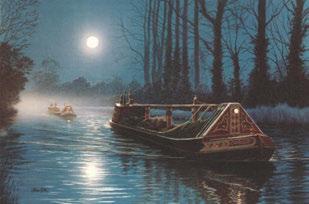
X159 Comet in the Moonlight
painting by Alan Firth
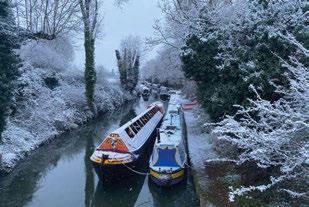
Code X157 Bridge 7 on a wintry Caldon Canal
Photo by Rosalind Kirk
A network agmented
2025 has been an annus horribilis for inland waterways and boaters. But is it a one-o series of unfortunate coincidences, or is it what we must now expect? IVOR CAPLAN and SUE O’HARE om IWA Navigation Commi ee examine the agmented state of our waterway network, its causes and e ects, and what IWA is doing about it
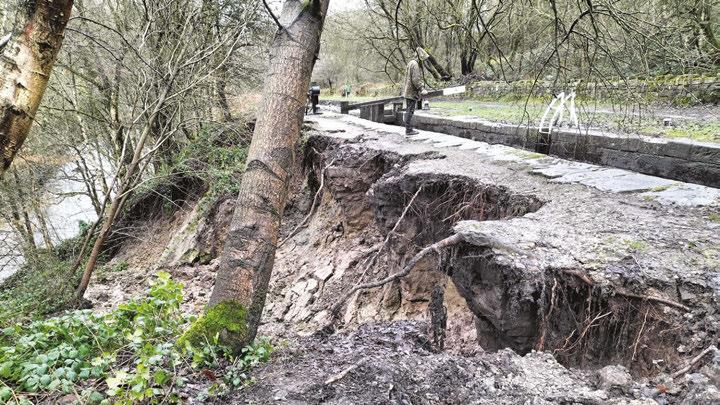
The year got o to a bad start with sustained heavy rainfall over north-west England during the New Year period, which led to a major breach of the Bridgewater Canal near Dunham Massey in Greater Manchester and a structural failure of the embankment supporting the side of Lock 11W on the Huddersfield Narrow Canal to the north-east of Manchester. The Bridgewater breach a racted widespread public a ention because of the drone footage and photos which were widely shared across both social and mainstream media.
The Bridgewater Canal forms part of the popular Cheshire Ring cruising circuit and is also an important north-south link between the Leeds & Liverpool Canal at
Leigh and the Trent & Mersey Canal at Preston Brook, as well as part of the eastwest routes across the Pennines on the Rochdale and Huddersfield narrow canals. Its closure therefore had an immediate impact and a ention was focused on the Macclesfield Canal as the obvious alternative route. Unfortunately, this too breached on 28th March near Bosley due to a leak in the canal bed. In an unrelated incident the Anderton Boat Li between the Trent & Mersey Canal and the River Weaver Navigation was closed because of mechanical issues at about the same time.
All of the above resulted in the disconnection of the network, particularly north-south. At the time of writing, the Canal & River Trust has recently reopened the Macclesfield Canal and
plans to reopen the Huddersfield Narrow Canal in August, but the privately owned Bridgewater Canal Company has stated that it does not expect to reopen the Bridgewater Canal before the end of 2026.
A major refurbishment of the Anderton Boat Li had been planned for its 150th anniversary but has been postponed due to rising costs. It is now closed till at least the end of the year pending major repairs.
It might appear om the above that the problems have been restricted to northwest England but this is not the case. The Worcester & Birmingham Canal was closed at Tardebigge Top Lock for the lock to be reconstructed, the Stratford-upon-Avon Canal was closed for work on one of the locks at Wilmcote, the River Severn closed at Bevere Lock, and the River Avon was closed for extensive work on two locks. This all happened at the same time, restricting movement in this area – particularly for hirers – and preventing boaters completing popular routes such as the Avon Ring.
More recently all three trans-Pennine canals have been closed owing to lack of water following the very dry spring, and restrictions on lock usage are being implemented more widely delaying planned cruises.
Alternative routes
The two alternative inland north-south routes are the Manchester Ship Canal, either to enable passage across the Mersey or for transit between Ellesmere Port and Manchester, and the tidal Trent. Neither of these is a well-used route by inland boaters and both have challenges. The Manchester Ship Canal requires extensive documentation and has now introduced restrictions on when leisure cra may access it. IWA has guidance for boaters wishing to make passage on its website and the Canal & River Trust is providing information days and support. In the case of the tidal Trent, the Try the Trent! group has resources to help boaters and is working with CRT on a buddying system.
However, the Vazon Railway Bridge on the Stainforth & Keadby Canal has su ered repeated failures which means that the safe inland route to and om the northern Trent has been unavailable. This has forced some boaters to make the hazardous passage around Trent Falls where the Ouse and Trent join to form the Humber.
At the time of writing Network Rail has agreed Vazon Bridge can be opened at any time, provided the temperature is below 15C, but both the Manchester Ship Canal and the Shropshire Union Canal to Ellesmere Port are closed because of low water levels, demonstrating the agili of the northg-south connections.
Causes and effects
There are two main causes for most of the above closures: extreme weather (both storms and drought) arising om
There are two main causes for most of the closures: extreme weather (both storms and drought) arising om climate change, and inadequate waterway funding.
climate change, and inadequate waterway funding. It has become clear that current and likely funding levels are insu cient even to maintain waterways in their current state, let alone prepare them for worsening e ects of climate change. Navigation authorities may well be aware of assets on their agile systems which need repairs or replacement work during their winter stoppage programmes, but simply don’t have the funding to do so. Hence there will inevitably be more emergency stoppages during the cruising season causing greater disruption.
Another issue is the substantially increased costs of complying with legislation. The strengthening of reservoir maintenance requirements post-Toddbrook has led to CRT having to divert substantial sums om waterways maintenance to reservoirs for several years now. Similarly the recent water abstraction laws have resulted in funds being diverted om maintenance to the provision of water for the Mon & Brec Canal.
The Cam Conservancy is at risk of becoming the first in recent years of a waterway being financially unviable given the cost of necessary repairs to the two locks into Cambridge, as well as other in astructure. The Basingstoke Canal is another whose position is precarious and the threat is that, without action, more waterways will be in similar positions.
The results of the year-on-year increasing closures are clear. Boaters are losing confidence in being able to successfully plan and implement extensive cruises away om home.
Although alternative routes such as the Trent have seen increased use, this does not compensate for the loss of normal tra c elsewhere. Hire-boat businesses are su ering disruption and events are having to be cancelled or moved. One of Navigation Commi ee’s greatest concerns is the general reduction in cruising, particularly to more challenging destinations. We believe that boat tra c actually assists with maintaining the condition of the waterways, for instance by keeping lock gear operable and reducing siltation in less used locations. As might be expected, IWA is greatly concerned by the situation. Navigation Commi ee has been monitoring it, collecting data and intervening directly with (for example) Network Rail about Vazon Bridge and CRT. IWA branches provide support on alternative routes and had organised a Rally for the Bridgewater, now postponed because of the agmented network. Through its leading role in Fund Britain’s Waterways, IWA is campaigning for funding to be increased in real terms as against the proposed substantial reduction for CRT and reductions or uncertain for other navigation authorities.
Issues such as more extreme climate with additional risks om drought or flooding, and increased legislation on pollution, sustainabili and health and safe , all emphasise this need. Under this umbrella campaign we will also a empt to identi specific concerns such as those mentioned above, which require urgent work to prevent a greater agmentation of the system in future.
Bridgewater breach.
Tardebigge Top Lock reconstruction.
Huddersfield Narrow Canal Lock 11W which was damaged in January.
DUNCAN ROBERTS
Campaign to identify heritage sites at risk
IWA’s Heritage Advisory Panel has been working to identi waterways heritage sites that it considers to be at risk. It has worked with local branches to compile a list of the most vulnerable waterways, buildings and structures across the country. Panel chair HUGH PEARMAN explains the reasoning behind the selections
The list forms the first step in a wider campaign to identi and map the risks to our waterways. Through this we will be er understand, track and raise awareness of the threats facing our canals and rivers. Only IWA can build this comprehensive picture of the state of all our 5,000 miles of navigable waterways across England Scotland and Wales. The list is by no means exhaustive but represents a crosssection of threatened waterways heritage.
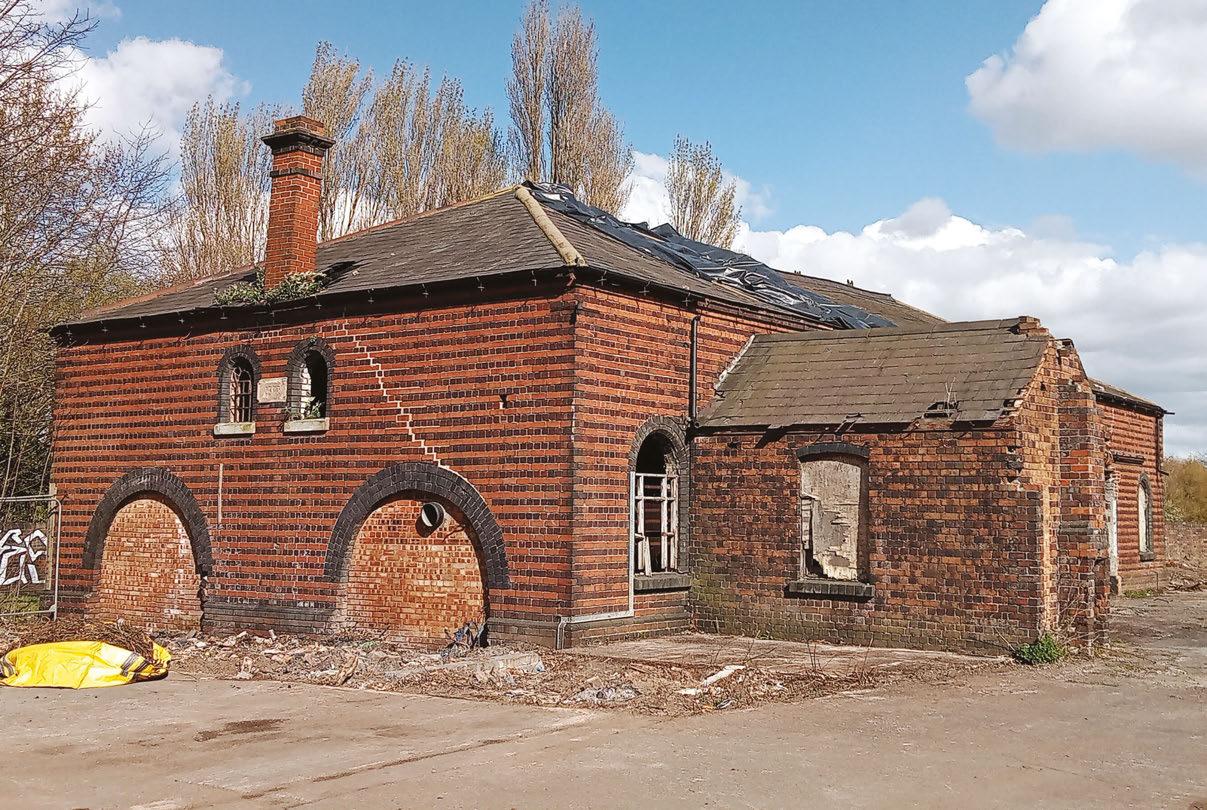
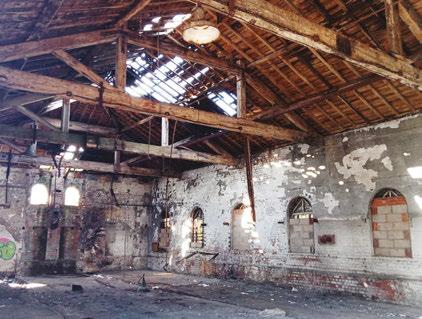
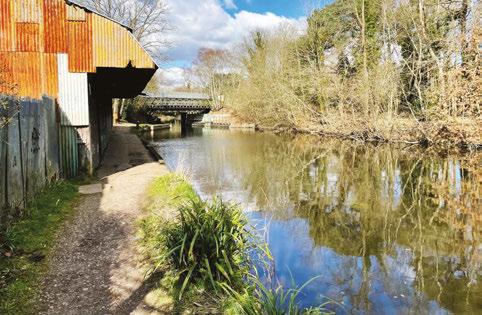
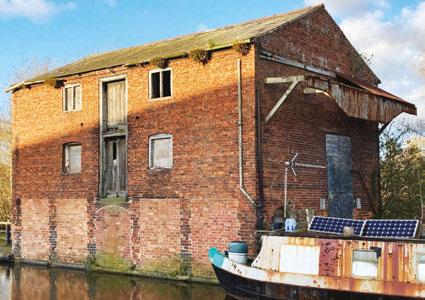
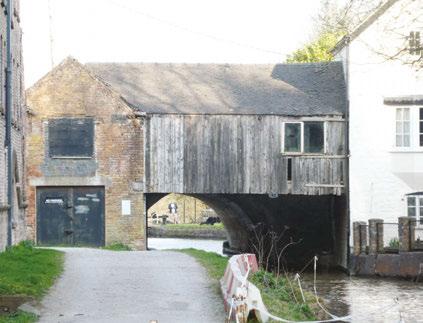
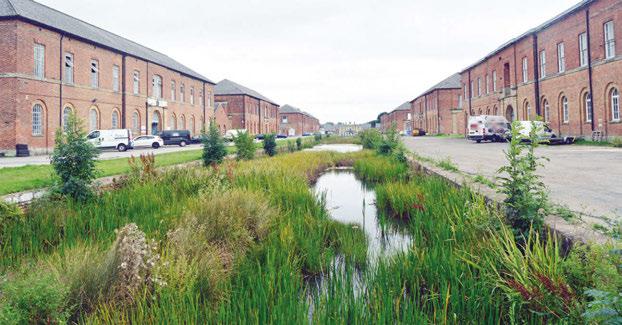
The biggest category contains those waterway-related buildings or complexes which fall out of use for a long time when a new use is not easily found and so it declines into disrepair: prime examples include Oliver’s Mill in Stoke, the Shroppie company warehouse in Burslem, the Straddle Warehouse at Cheddleton on the Caldon, the boat shed on the Basingstoke, the Tipton Gauging House, Ellesmere warehouse on the Llangollen and Weedon Bec Ordnance Depot Arm of the Grand Union.
Historic sites under threat
• Hanwell lock flight and side ponds, GUC
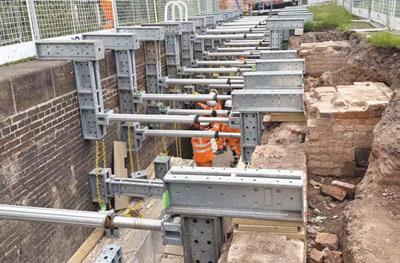
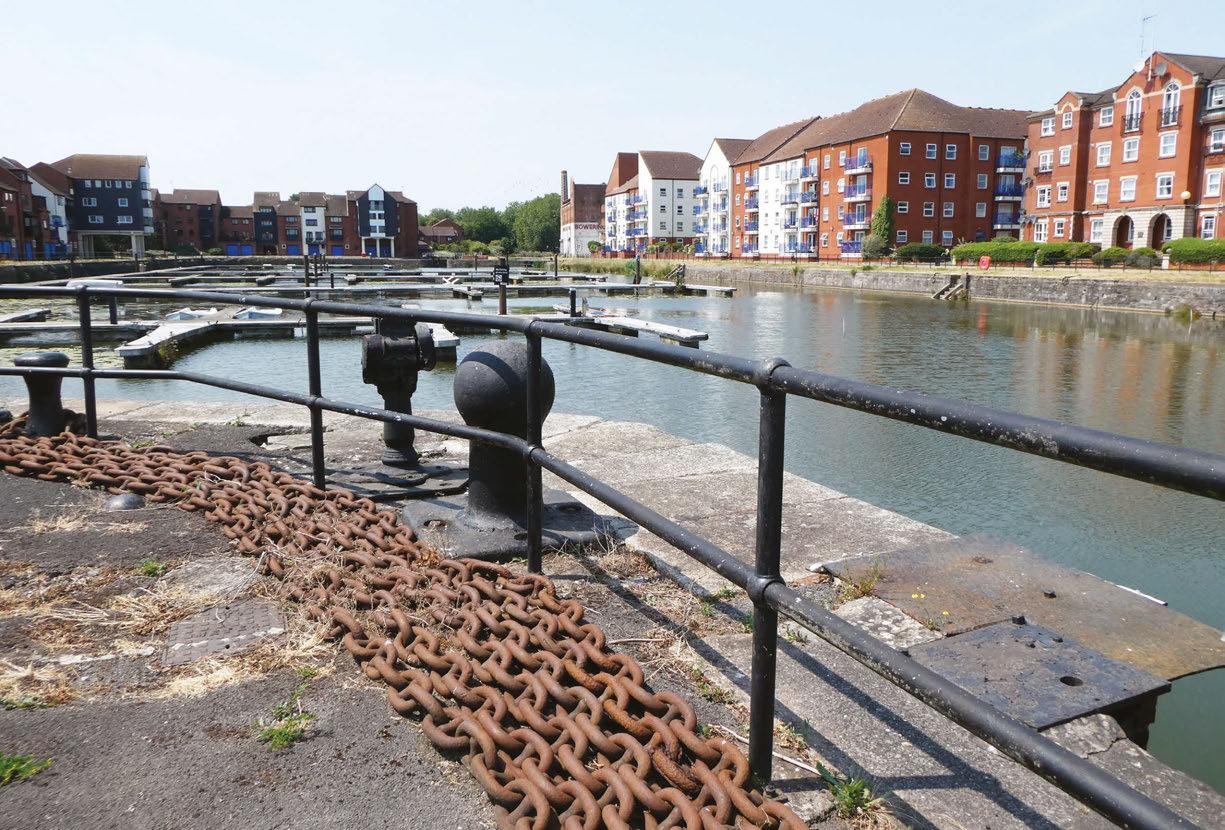
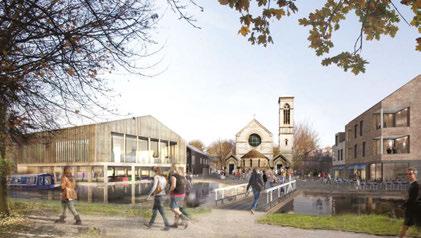
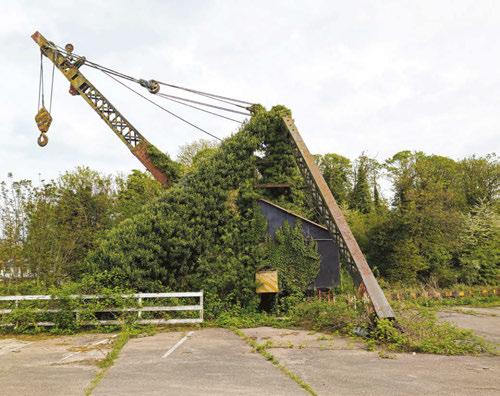
• Bridgwater Docks, Somerset
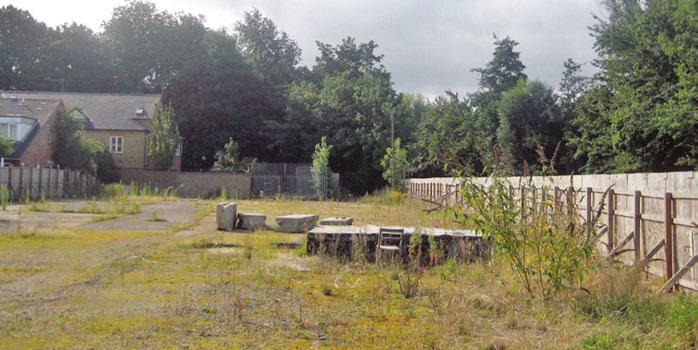
• Jericho Wharf, Oxford
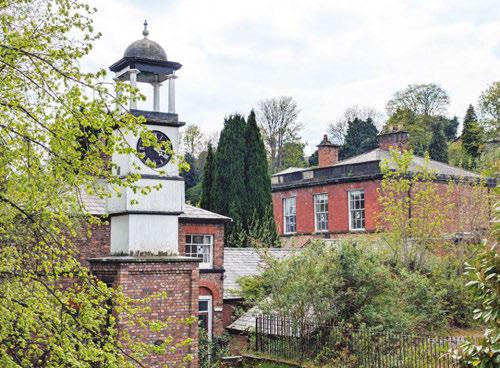
• Navigation Yard, Northwich (River Weaver)
• Chester River Lock (Shropshire Union)
• High Peak Junction transhipment warehouse (Cromford Canal)
• Summit Bridge, Lancaster Canal South (abandoned L&L section)
• Ellesmere warehouse, Llangollen Canal
• Tipton Gauging House, BCN
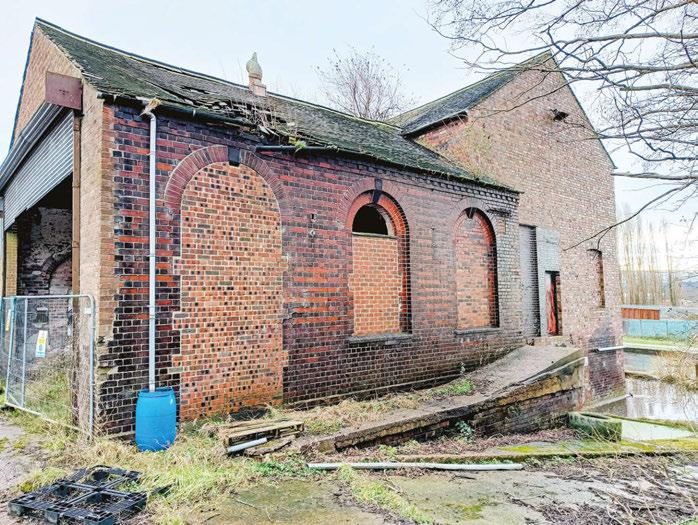
• Oliver’s Mill, Stoke on Trent (T&M)
• Straddle warehouse, Cheddleton (Caldon Canal)
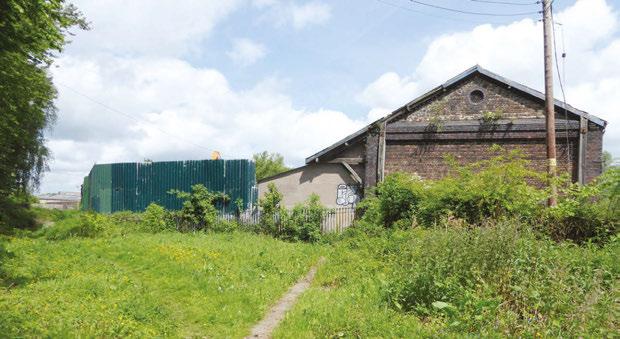
• Shropshire Union Co warehouse on infilled Burslem Arm, Trent & Mersey Canal
Built in 1873 by the Birmingham Canal Navigations the Grade II-listed building was in service until 1959.
IVOR CAPLAN
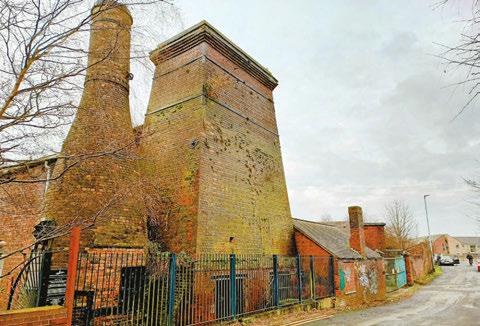
OLIVER’S MILL
Built in 1909 on the Trent & Mersey Canal in Middleport, the site has a two-storey workshop and two Grade II-listed calcining kilns used to fire flints for pottery until circa 1964.
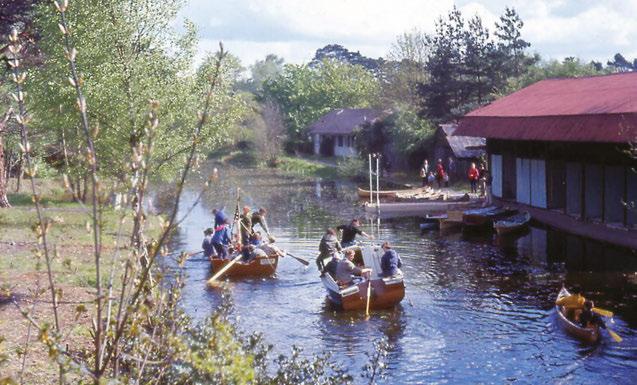
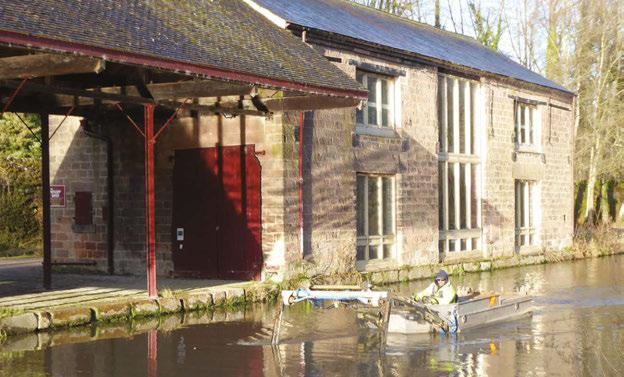
The High Peak transhipment warehouse on the Cromford (a World Heritage Site) is not at immediate risk but is now standing vacant, having previously been used as an outdoor-pursuits centre and hostel.
THE SHROPSHIRE UNION CANAL CO WAREHOUSE
HIGH PEAK TRANSHIPMENT WAREHOUSE
Known as The Wharf Shed, the warehouse was built circa 1850 between the railway and the Cromford Canal. Part of it was recently used as a study centre and bunkhouse.
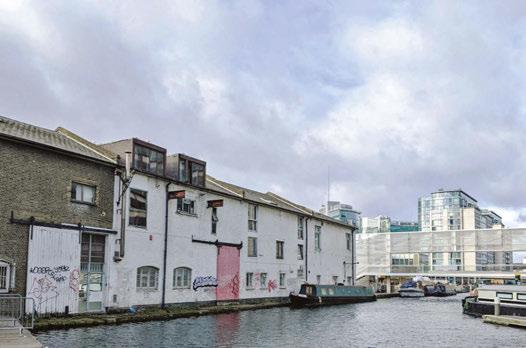
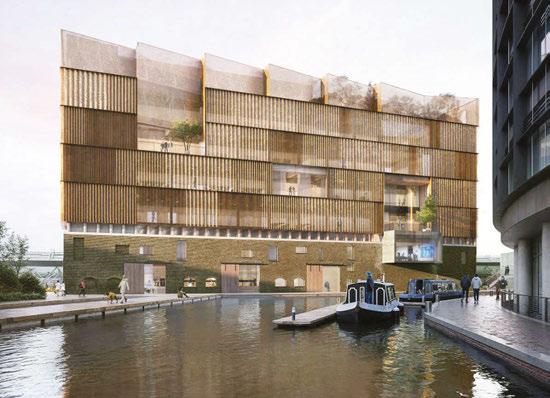
In other cases, a very radical change of use is proposed, as with The Bays warehouses at Paddington Basin – the last remaining canal-working buildings there. There are plans to have a new hospital research department built on top of them. This is quite interesting in that the original buildings are proposed for restoration as a ‘plinth’ for the new building. But this needs watching in case the authorities backtrack on these plans .
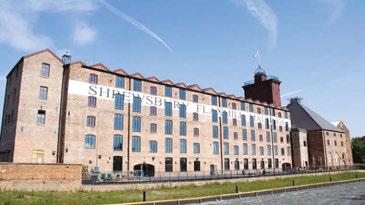
There are shining examples of heritage buildings being saved, such as the Shrewsbury Flaxmill Maltings, now a museum and workspace, on the disused Shrewsbury Canal (see opposite), The restoration of Wappenshall Junction and its buildings on the same canal, led by the Shrewsbury & Newport Canals Trust, is another case in point, as is the Stourbridge Bonded Warehouse which was restored along with the canal arm into Stourbridge.
ELLESMERE WAREHOUSE
Located on the Llangollen Canal, the building dates from the early 19th century.
THE STRADDLE WAREHOUSE
Spanning the canal, the Grade II-listed warehouse allowed direct loading of goods across the canal.
The old Shropshire Union Co warehouse on the infilled Burslem Arm.
WEEDON BEC ORDNANCE DEPOT
Built during the Napoleonic Wars, the depot features a canal spur, storehouses, magazines and defensive walls.
Shrewsbury Flaxmill Malting:
The revival of a waterside icon
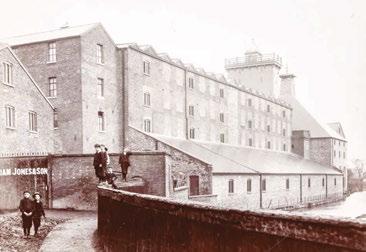
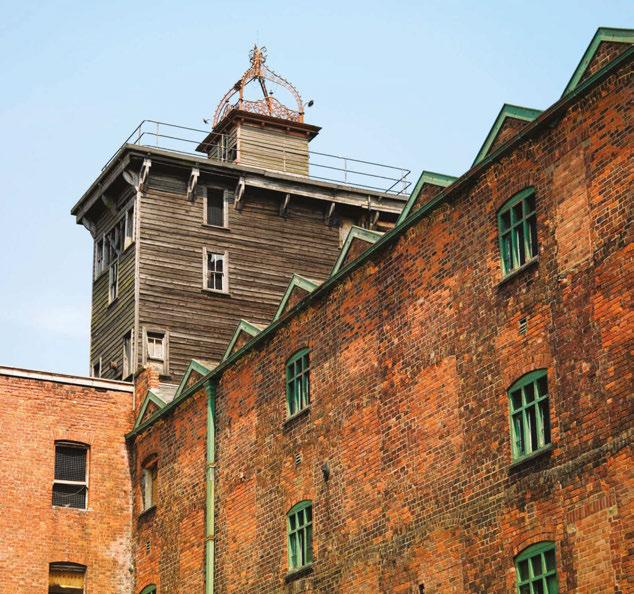
Hailed as the world’s first iron- amed building, Shrewsbury Flaxmill Maltings has undergone a remarkable transformation, proving that with enough support and funding, a once-derelict building can enjoy a new life as a major a raction.
Built in 1797, the Shrewsbury Flaxmill is o en referred to as the “grandparent of the modern skyscraper.” Its iron- ame construction, pioneered by engineer Charles Bage and funded by local entrepreneur John Marshall and other businessmen marked a turning point in architectural design. Its primary function was processing flax into linen – a booming industry in the late 18th and early 19th centuries.
The mill operated as a flax-spinning factory until the 1880s and was later converted into a maltings, supplying malt for the brewing industry until its closure in 1987. Its location was no accident. The mill’s position near the Shrewsbury Canal, which opened in 1797 – the same year the mill began operation – was crucial. The canal provided a lifeline for transporting raw flax, coal, and other goods, linking it with broader trade networks across the Midlands. Though the canal eventually fell into disuse and closed in 1944, its role in the mill’s history is undeniable. Today, there are plans to reinstate a section of the canal as part of wider heritage regeneration.
A er decades of neglect in the la er part of the 20th century, the site faced the threat of demolition until a coalition of organisations stepped in to save it. Led by Historic England, in partnership with Shropshire Council and the Friends of the Flaxmill Maltings, the restoration became one of the most ambitious heritage projects in the UK.
The National Lo ery Heritage Fund provided £20.7m for the restoration while Historic England invested over £10m. Additional support came om the Marches Local Enterprise Partnership and philanthropic contributions.
More than 15 buildings on the site have now been stabilised or restored, including the iconic Main Mill and Kiln. In 2022, the site reopened to the public with a visitor centre, exhibition spaces, and o ce accommodation.
THE BAYS WAREHOUSES
The historic industrial buildings are situated on the GUC in London.
Shrewsbury Flaxmill Maltings today and in its heyday as a maltings mill (above).
The impressive new frontage.
The new visitor centre.
ABERDULAIS AQUEDUCT
The canal terminus buildings at Cromford – now comprising a cafe, shop and events space – and very recently the rescue om near-total dereliction of Aqueduct Co age at Lea Wood, also on the Cromford, to a visitor centre and exhibition space for the local wildlife trust are other prime examples.
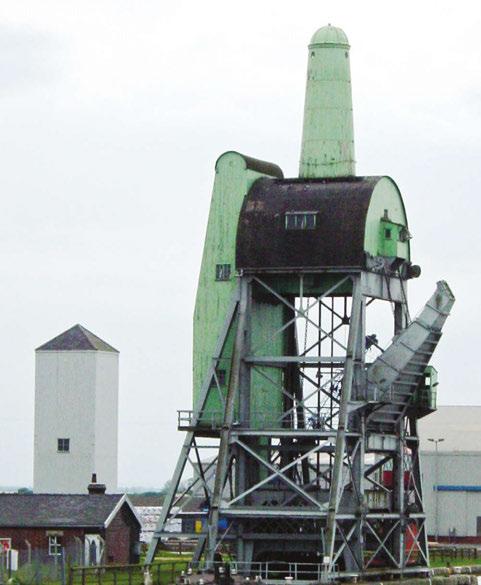
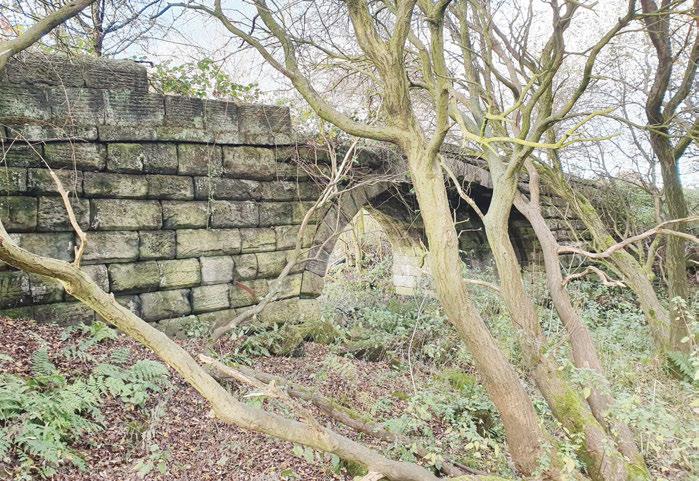
Related to this category is when waterways working structures fall out of use – either because their function is no longer needed, as with the (listed) tub boat hoist in Goole Docks which was dependent on the export coal trade along the Aire & Calder – or with the four aqueducts on the list which are deteriorating because their canals are out of use (in the case of the Montgomery, being restored in sections) and so maintenance and repair are minimal.
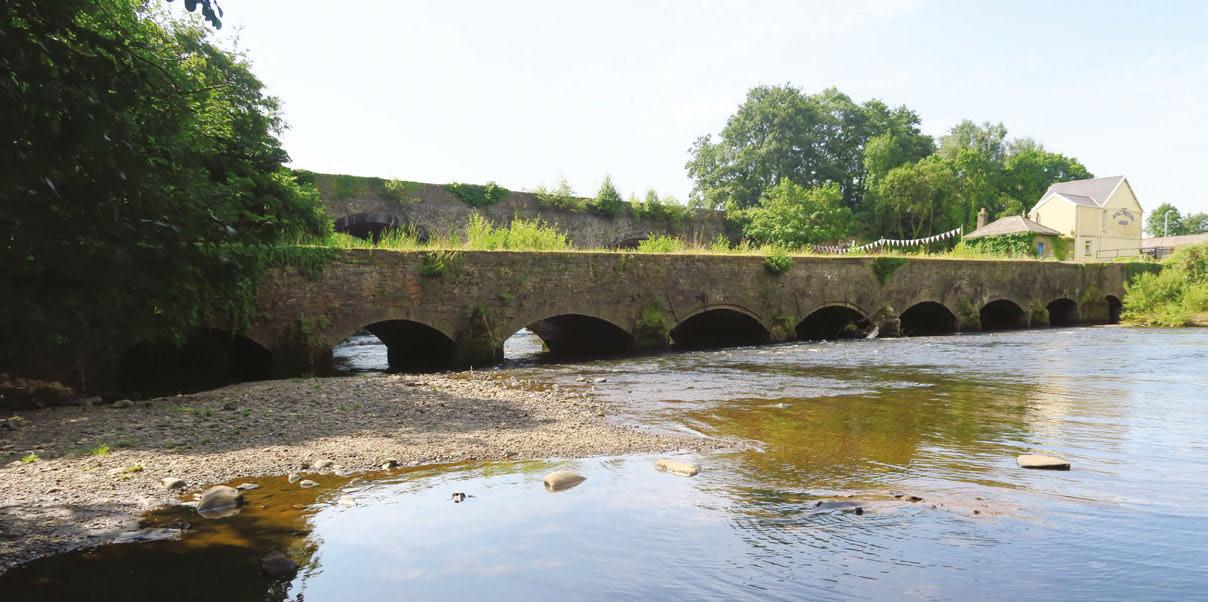
Damage can result om storms for instance, especially with the one at Aberdulais on the Neath and Tennant canals. Even when there is realistically li le prospect of their canals being restored to navigation in the foreseeable
Completed in 1824, the aqueduct is part of the Tennant Canal, near the junction with the Neath Canal.
TOM PUDDING BOAT-LIFT
The Tom Pudding system was used to lift container barges to tip coal into waiting ships. Only one of the five original boat hoists survives today.
SUMMIT BRIDGE
Built in 1803, the Grade II-listed changeline bridge was once used for horsedrawn boats on the canal.
CWYCARN AQUEDUCT
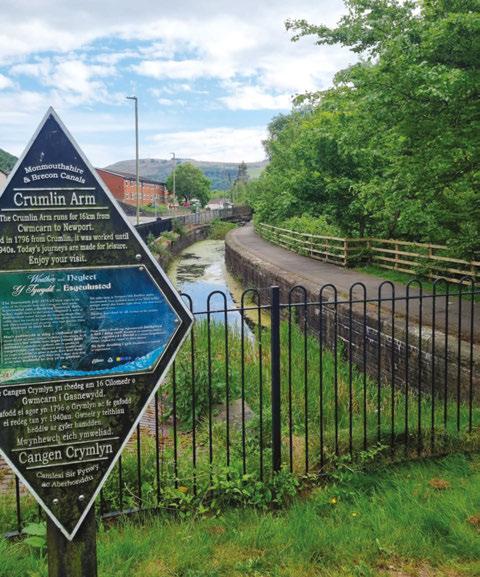
Built in 1790, it is on the now abandoned Crumlin Arm of the Mon & Brec Canal.
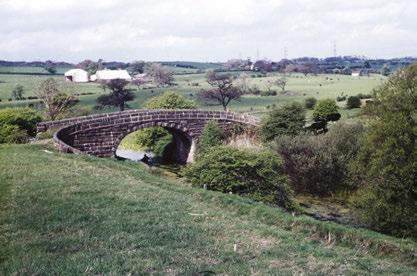
future, these structures are still important industrial monuments in their own right. An outlier here is small but interesting: the crumbling Summit Bridge on the ‘lost’ southern section of the Lancaster Canal (partly water, partly tramways) originally connected to the Leeds & Liverpool Canal.
LONGDON-ON-TERN AQUEDUCT
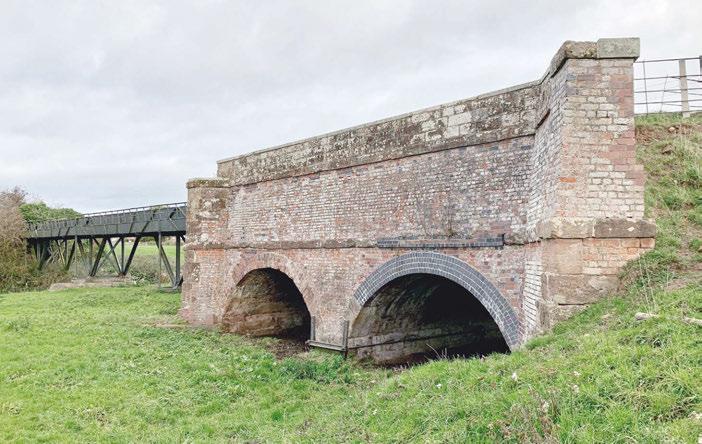
Designed
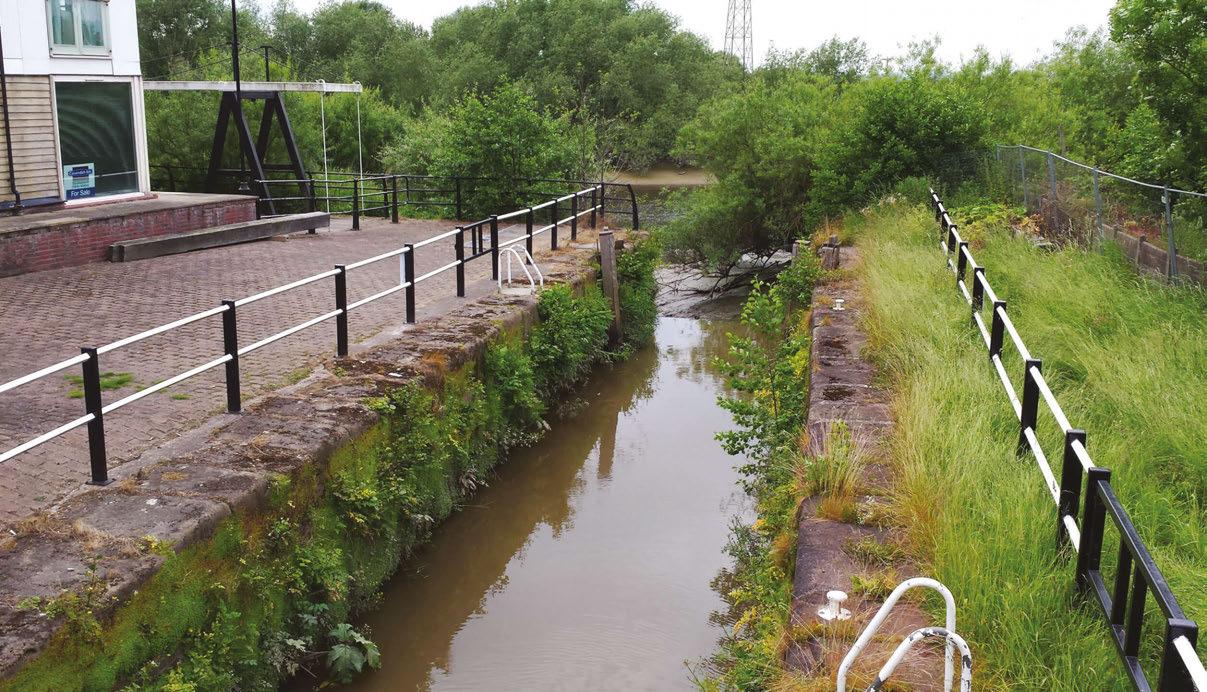
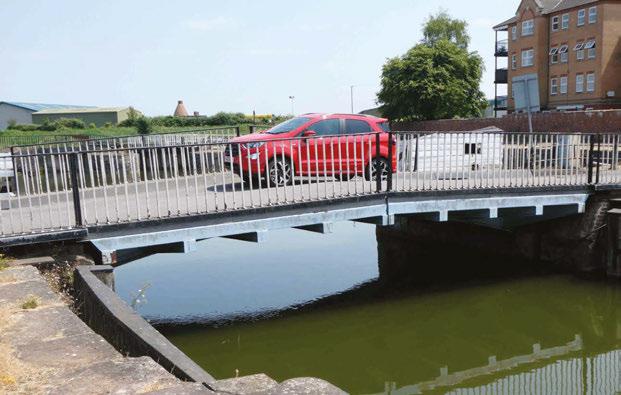
And then there are structures that are necessary for navigation that have e ectively been allowed to fall into disuse, such as the Dee Arm on the Shropshire Union Canal, or the bascule bridge and entrance locks at Bridgwater Docks in Somerset, where Canal & River Trust until a few years ago had a lease to run it as a marina but then relinquished it. In consequence the restored Bridgwater and Taunton Canal has no outlet to the tidal River Parre and on to the Bristol Channel.
At Hanwell Locks on the GUC, it’s the ingenious system of side ponds that are at risk, with access tricky as a lockside house was sold.
VRYNWY AQUEDUCT
Built in 1794, the stone- and-puddled-clay aqueduct carries the Montgomery Canal over the River Vyrnwy.
DEE LOCK
The lock on the Shropshire Union Canal shows signs of neglect.
by Thomas Telford, the cast iron structure carries the former Shrewsbury Canal over the River Tern.
BRIDGWATER DOCKS
The
Finally, wharfs sold to new owners without appropriate plans for their reuse are also at risk. Navigation Yard on the Weaver (sold last year, previously a BWB/CRT depot) has had an unsympathetic housing plan proposed while Jericho Wharf in Oxford has an absentee owner who has just le it emp for years. Compare that with historic and still-working wharfs such as Tooley’s in Banbury or Stone Boa ard on the Trent & Mersey.
NAVIGATION YARD
Established in 1871, the yard in Northwich served as a shipbuilding yard and later became HQ for the River Weaver Navigation Trust.
inland floating harbour was completed in 1841 as an extension of the Bridgwater & Taunton Canal. The Bridgwater Bascule Bridge (inset) links the two basins.
JERICHO WHARF
The Oxford site was once a bustling boatyard.
Waterway Recovery Group
locals in awe of WRGies at Langport
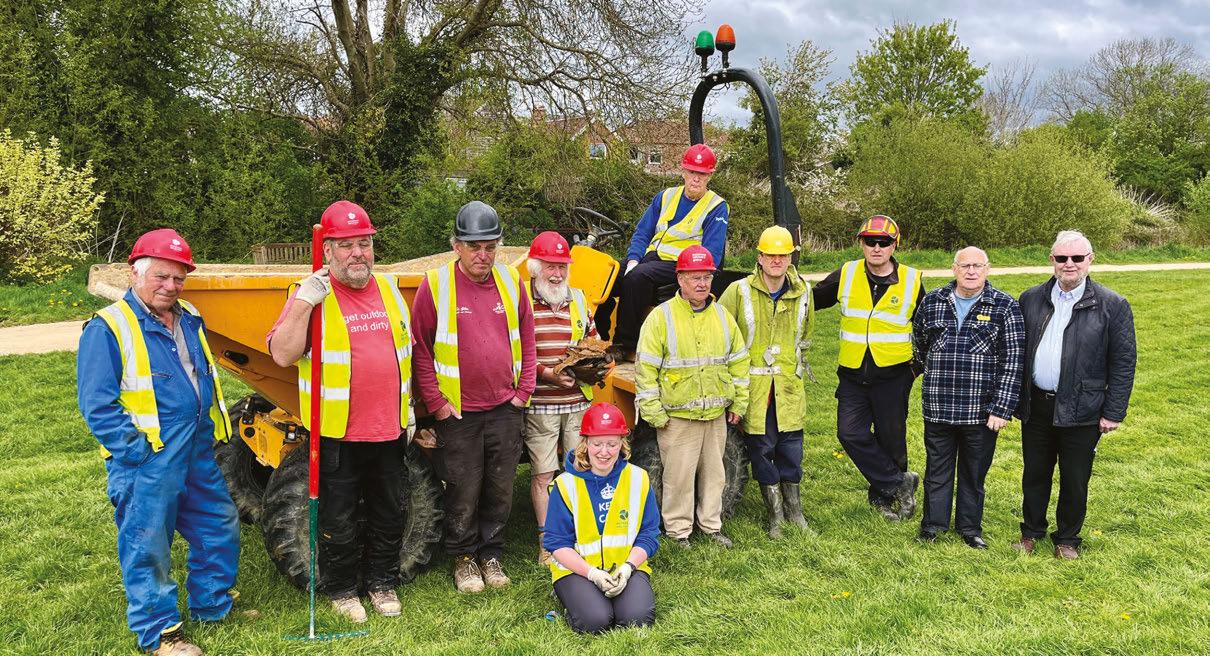
The busy riverside in Langport, Somerset, was the focus for the first Waterway Recovery Group (WRG) Canal Camp of 2025. The historic market town on the River Parrett has become a popular destination for locals and visitors thanks to its river regeneration project, completed in 2020. In fact, it has become so popular that its riverside paths were already worn down.
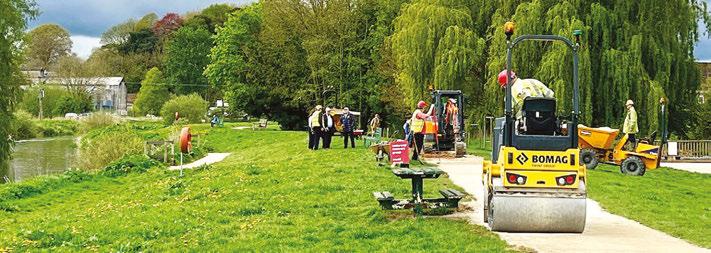
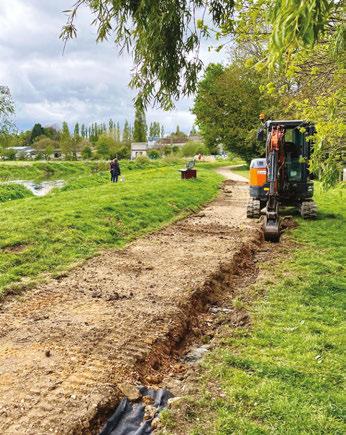
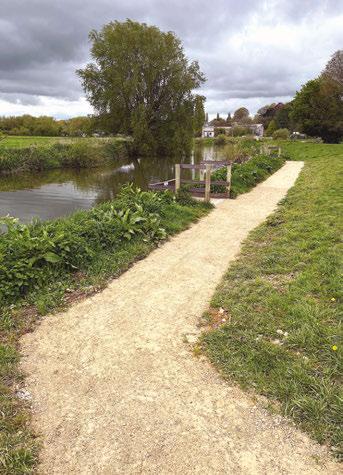
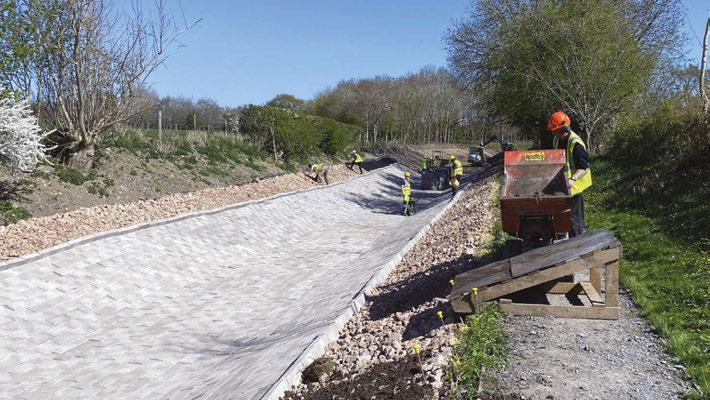
WRG’s brief was to upgrade and improve the network of paths that run alongside a ½-mile section of river from Bow Bridge to Huish Bridge, including Cocklemoor, an open meadow between town and river. A group of 10 WRG volunteers attended a 10-day camp across the Easter weekend.
With their mini digger, dumper and roller, plus barrows and hand tools, the team widened and relaid the paths using a combination of original and new path materials.
Langport’s town clerk, Gerard Tucker, who helped to organise the camp, said: “We estimate the paths are used by approximately 240,000 people per year, which means they are subject to a lot of wear and tear. They needed resurfacing and making wider so that people are less likely to walk on the grass. WRG had helped previously with our project –removing silt from a slipway and clearing trees – so we asked IWA if they could help again.
Gerard Tucker said that since WRG’s latest visit, the comments from those using the paths showed the importance of what has been achieved. “Locals are full of praise for the outstanding work the team undertook on our behalf. We are in awe of the fact that so many people give their time and skills to support communities many miles from home.”
WRG team leader David Evans said the team enjoyed their time in Langport. “Working in the centre of town is an unusual location for us. It was amazing to see so many people enjoying Cocklemoor and the River Parrett. The many compliments we received from walkers were much appreciated.”
A local trip boat operates on this section of the river (duchessofcocklemoor.co.uk).
Langport Canal Camp volunteers are welcomed by West Country Branch members Mike Slade (second right) and Ray Alexander (right).
ABove: Widening the path alongside the River Parrett.
BeLoW Left: Working on the main path through Cocklemoor, with the River Parrett to the left.
BeLoW: Reinstated path to accessible fishing platforms.
Leadership Teams Day
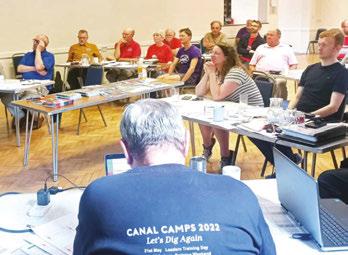
As WRG prepared for another busy and rewarding Canal Camp season, the WRG Leadership Teams Day offered a valuable chance to reflect, review and look ahead. This annual gathering brought together more than 30 WRG leaders and potential leaders – as well as representatives from local waterway restoration groups – to share updates, improve practices and exchange experiences. The focus remained firmly on making Canal Camps safer, more effective and enjoyable.
Practical improvements and on-site safety
The day began with a Health and Safety Report reviewing last year’s Canal Camps. A key message was reinforced throughout: no accident or near miss is too minor to report, as this helps to put in place the right protection and to manage risk. To support this, a new online incident system is in development to make reporting simpler and more accessible.
The definitions of ‘accident’, ‘incident’ and ‘near miss’ were explored through roleplaying exercises, based on real examples drawn from the latest accident reports. Some of the discussions based on the reports included the risks associated with refuelling practices, with ideas suggested to improve set-ups. Safe and sensible storage of fuel and other materials remains a key part of a safe restoration project and documentation is being reviewed to make sure these are embedded from the outset.
Personal Protective Equipment (PPE) and protection kits, especially hi-vis gear and gloves, are undergoing scrutiny. There was a renewed focus on both quality and suitability of PPE, acknowledging that equipment requirements vary between tasks, such as puncture protection for gloves used for scrub-bashing. One thing was clear: PPE requirements on site need continual assessment.
WRG conducted its annual pre-Canal Camp PPE audit on 21st June to ensure all kits were up to standard.
The general Risk Assessment for the Canal Camps document was reviewed and participants were invited to contribute ideas for improving it.
The roles of Camp Cook and Assistant Leader
The subject of working alone continues to evolve, with reviews underway to examine how Camp Cooks fit into the guidance. The role of the Assistant Leader was another key topic. it was agreed by both presenters and participants that being an effective assistant goes beyond task execution – it includes supporting the leader, championing inclusivity and creating a positive experience for all volunteers.
WRG standards and key messages
• LEADER WELL-bEiNG. Leadership teams are encouraged to seek support from fellow leaders or their duty director when facing challenges.
• PRE-CAmP COmmuNiCATiON. Early contact with volunteers and consistent use of the daily briefing card help set expectations and maintain engagement throughout the camp.
• DATA PROTECTiON Leaders are responsible for safeguarding personal and sensitive volunteer data. They must destroy it once it is no longer needed.
• POLiCy AWARENESS. Leaders were updated on iWA’s latest policy on Prevention of Sexual Harassment and Victimisation.
• ENViRONmENTAL AWARENESS. A current series in Navvies by Alex melson covers environmental considerations in restoration work and is essential reading.
• bONFiRES. When having bonfires, leaders were reminded to consult the Toolbox Talk: Waste management and you, especially regarding the D7 Exemption Certificate. Host societies should apply for the exemption.
• PubLiC AND mEDiA ENGAGEmENT. When communicating about restoration work, leaders are encouraged to refer to the Waterways for Today report. This helps connect their efforts to national campaigns like Fund britain’s Waterways and other iWA initiatives.
Canal Camp survey feedback
The afternoon closed with a review of the WRG Canal Camp Survey 2024. Feedback was overwhelmingly positive, with a number of enthusiastic comments. Areas for improvement were noted and thoughtfully discussed.
Notably, just under half of respondents (42%) expressed interest in learning more about leading on WRG Canal Camps – an encouraging sign for the future.
Feedback and ideas for the future
Alongside the formal sessions, attendees appreciated the opportunity to catch up informally with fellow leaders, something that rarely happens outside of camp settings. The social aspect of the day was seen as an important and enjoyable part of the event.
Several useful suggestions were made for future Leadership Teams Days including:
• A brief First Aid refresher
• Clarification around cooks’ paperwork requirements
• A dedicated risk assessment for Camp Cooks, tailored to kitchen layout, accommodation and local amenities
• Sessions exploring ways to improve the overall camp experience and support recruitment of new leaders, particularly those in their 30s and 40s
• Greater inclusion of perspectives from local restoration groups
• Exploring the possibility of the event being recognised as Continuing Professional Development, particularly for those with relevant safety or leadership qualifications These ideas will be taken forward for consideration in shaping future events.
A huge thank you to all participants for their insights, energy and contributions. Here’s to a safe, productive and inspiring Canal Camp season ahead!
BrANch FocuS
Shrewsbury District& North Wales
As it marks its 50th anniversary year, IWA’s Shrewsbury District & North Wales Branch continues to champion its extensive network of high-profile waterways, flagship restoration projects and spectacular World Heritage Sites
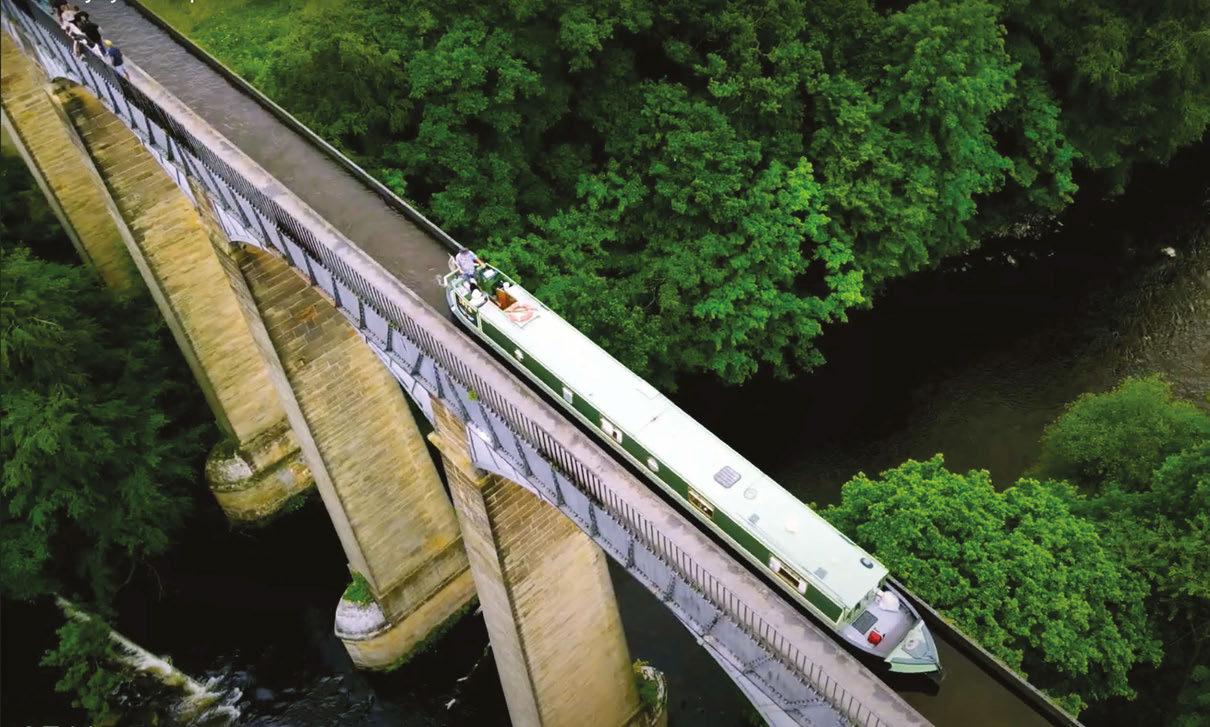
With both the Pontcysyllte Aqueduct and the world’s first cast iron bridge at Ironbridge, along with two of the busiest canals – the Llangollen and Shropshire Union – the Shrewsbury & North Wales Branch is rich in heritage and world-class visitor appeal.
“We’re undeniably fortunate in the beauty of our rural landscape and the popularity of our local canals,” says branch chair Michael Haig, “but that doesn’t lessen the amount of effort that IWA puts into its local network. In fact, the extent of the branch and the nature of its geography can be quite challenging when managing the branch.”
The branch covers a sprawling area, from Middlewich and the outskirts of Wolverhampton in the east to the midWales coast in the west. “Historically, we’ve also always had a good number of members affiliated to our branch who live out of the area,” says Michael. “People who moor their boats here and regularly cruise this part of the country like to keep tabs on what’s going on, and what better way to do that than to stay in touch with the local branch?
“The rural nature of the branch means there are few big urban centres either, so our members are quite widely dispersed. This can cause problems when, for example, we’re trying to encourage members to join in with volunteer activities or to organise socials. As a result, we tend to focus on a few annual events.
“On the plus side, though, the local canals provide the branch with a number of opportunities to get out and spread
the word at waterside events. The bestestablished canal festivals are at Norbury Junction and Whitchurch, while the relatively recent festival at Gnosall is growing its visitor numbers.
“The Norbury Festival was inaugurated by the Shrewsbury District & North Wales Branch back in 2004,” explains branch president Michael Limbrey. “It’s seen a couple of organisational changes since then, most recently in 2024 when Norbury Wharf Ltd took over the festival management and focused the event more on a gathering of trading and historic working boats.”
In 2023, the branch took on the operation of the visitor trip-boat at the Whitchurch Festival to support Whitchurch Waterway Trust, which organises the festival on the Whitchurch Arm.
Pontcysyllte pictured from above. GFAPMeDIA
A SUCS working party lining and blocking part of the Montgomery Canal.
Branch at a glance
Formed: 1975
Local waterways: Llangollen, Montgomery (partially navigable), Shropshire Union Main Line (south of Barbridge), Middlewich Branch, Shrewsbury & Newport (not presently navigable)
Membership: Over 300 members
Claim to fame: Branch area includes two World Heritage Sites – Pontcysyllte Aqueduct and Canal, and Ironbridge Gorge
Find out more: waterways.org.uk/ shrewsburynorthwales, facebook.com/ shrewsburynorthwales
“I’m not sure we quite realised what we were letting ourselves in for,” laughs Alison Smith, a keen boater and a member of the branch steering team. “ABC Boat Hire kindly lends the festival the use of one of its day-boats. We have to ensure that all our steerers are RYA certificated and maintain a boat crew of two at all times.
“The popularity of these trips took us by surprise. Managing queue control, while keeping our own branch stand adequately staffed, means we’re constantly looking out for additional volunteers. Fortunately, it’s very good fun, so do come and join us!”
The branch boasts more than 120 miles of navigable waterways, which is expanding thanks to the success of local restoration projects on the Montgomery and Shrewsbury & Newport canals, which the branch actively supports.
The 7-mile navigable length of the Montgomery Canal from Frankton to Gronwen Wharf was extended in 2023 by an extra 1¼ miles to Crickheath Basin. Volunteers from the Shropshire Union Canal Society, supported by IWA and
“The popularity of these trips took us by surprise. Managing queue control, while keeping our own branch stand adequately staffed, means we’re constantly looking out for additional volunteers. Fortunately, it’s very good fun, so do come and join us!”
Funding for this phase of the restoration is coming from a mix of public appeals, local waterways groups’ own fundraising activities and government grants, usually requiring at least partial match-funding with local money.
The canal in Wales is also benefitting from substantial government funding. In the next 12 months this will provide two new road-bridges and two nature reserves, which will contribute to protecting the canal’s nationally recognised ecological value.
The branch is a member of the Restore the Montgomery Canal Appeal! which in addition to raising over £1m for the construction of Schoolhouse Bridge is now closing in on its next target: a minimum of £250,000 for the next stage of the Shropshire Gap works.
It also sits on the Montgomery Canal Partnership which brings together the Canal & River Trust, local authorities, statutory agencies for the built and natural heritage, wildlife trusts and canal restoration groups.
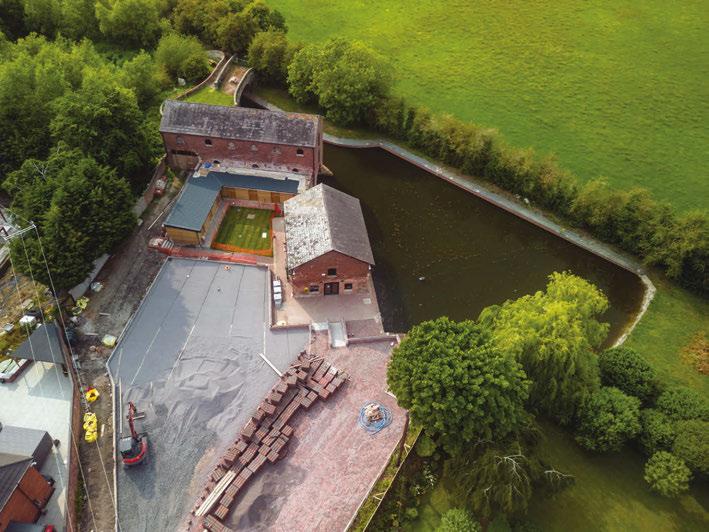
The other big restoration project supported financially by the branch is managed by the Shrewsbury & Newport Canals Trust, which is close to achieving the creation of a vibrant visitor and heritage centre from the derelict buildings at Wappenshall Wharf and is restoring two historic working boats, Bainton and Berkhampstead
In fact, fundraising for projects like these is one of the branch’s strengths. Its pictorial waterways calendar is the main revenue earner, while an annual lock wind and participation in seasonal pop-up charity Christmas card shops are other successful ways of generating funds.
Dates for the diary
Shrewsbury District & North Wales Branch will be participating in the following events this summer:
9th-10th August
Annual lock wind at Cholmondeston Lock
One of the main fundraising events in the branch’s calendar
30th-31st August
Whitchurch Canal Festival
The branch will be operating the festival’s visitor trip-boat
other local waterways groups, are now proceeding apace with efforts to close the ‘Shropshire Gap’ – the remaining 2 miles of dry canal from Crickheath, through the newly rebuilt Schoolhouse Bridge, to the Welsh border at Llanymynech.
20th-21st September
Shrewsbury Abbey Foregate Station
A canals exhibition featuring the branch and other local canal groups
Wappenshall Wharf, one of many historical sites in the area.
Norbury Festival May 2024. AL SMIth
Electrika 2025
JOnATHAn MOSSE reports on the event which is proving to be the go-to show for anyone interested in electrically propelled boats for the inland waterways
Spanning two of the hottest days of the year so far, the second gathering of electric narrowboat owners, industry experts and manufacturers took place at the Brinklow Aquavista Waterside and Marina in the form of Electrika 2025.
With more electric narrowboats on the canal network, together with rapidly increasing interest in sustainable boating, Electrika’s focus is to encourage and support the wider adoption of electric propulsion on the UK waterways.
This year’s event was bigger than last, with 14 new exhibitors, a full fleet of 10 showboats and entertainment on both nights. Electrika is proving to be the go-to show for anyone interested in electric boats for the inland waterways.
There is a market: over the past few years, a near-silent revolution has taken place, as a new generation of electric-propelled, hybrid craft have been launched on the UK waterways.
Adoption has been slowly but steadily gathering momentum. However, finding good information is difficult, even at national boat shows. Electrika 2025 provided a meeting point for early adopters, manufacturers and potential new owners to share information and real-life experience of this new technology.
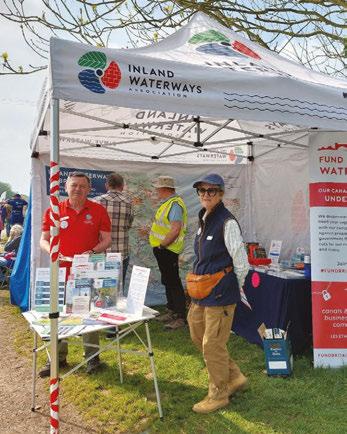
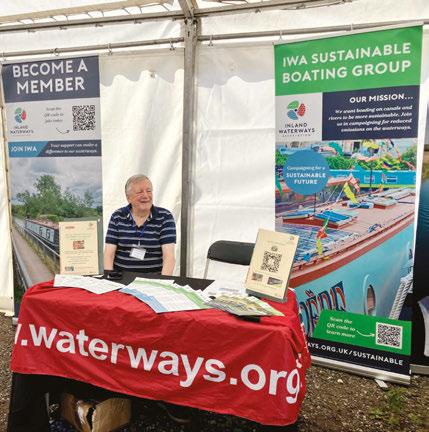
Organisers Paul and Kay Sumpner (winners of one of last year’s IWA/Towpath Talk Sustainable Boating Awards) gifted the IWA Sustainable Boating Group a stand in the heart of the exhibitors’ marquee as well as promoting the Fund Britain’s Waterways campaign. The SBG was also represented, albeit indirectly, in the programme of talks where Malcolm Bridge – an SBG member – gave a presentation on his experience of 10 years of electric narrowboating.
Also early adopters, Paul and Kay do their (electric) boating in their narrowboat Old Nick and record their exploits, thoughts and encounters around the inland waterways system in a useful blog which can be found at thesumpnersafloat.com.
Electrika is the creation of Ortomarine, a UK builder of electric narrowboats with a passion for encouraging the industry towards “going green”. Ortomarine, in collaboration with Aquavista, now the UK’s largest inland marina operator, organised and promoted this year’s event. Ortomarine’s commitment to greener boating was recognised in 2022 with a Boating Business Sustainability Award.
Aquavista’s involvement doesn’t stop with the provision of the site. Throughout the two days the staff worked tirelessly in the background, ensuring that everything from the toilets through to rubbish collection worked without a glitch. Everyone was made to feel welcome and nothing was too much trouble for its dedicated team.
A detailed account of the show could become tedious so, although still early days in the move towards sustainable boating, I’d rather explore trends and the specific directions that I believe the road to net zero is taking us.
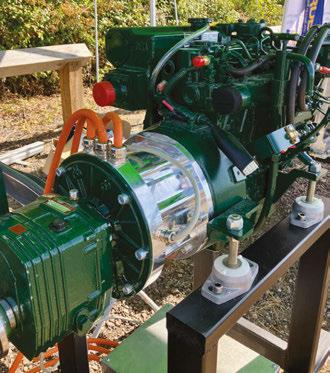
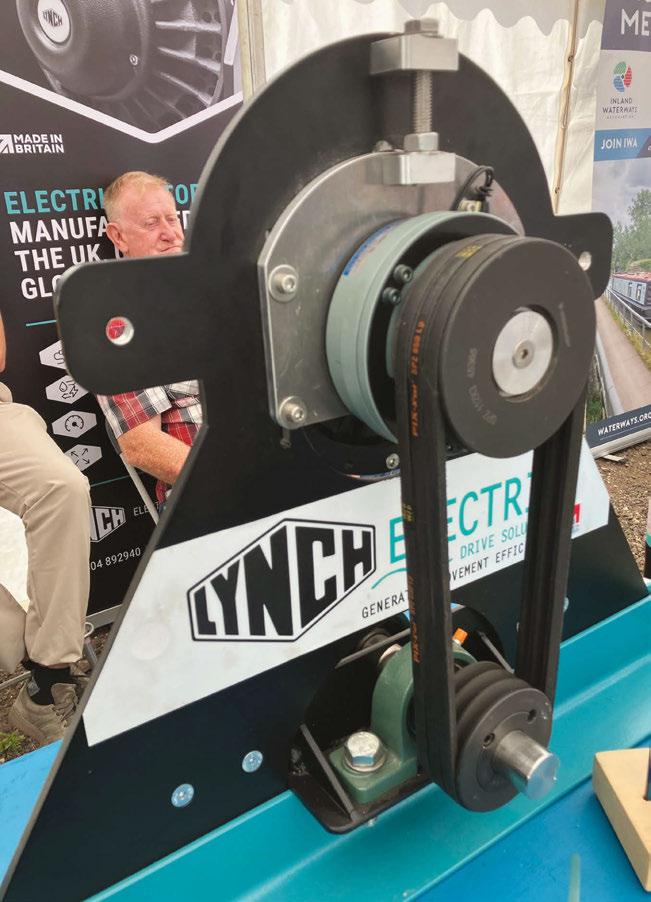
Lynch Motors, renowned for its product support, has been supplying electric drives for over 30 years.
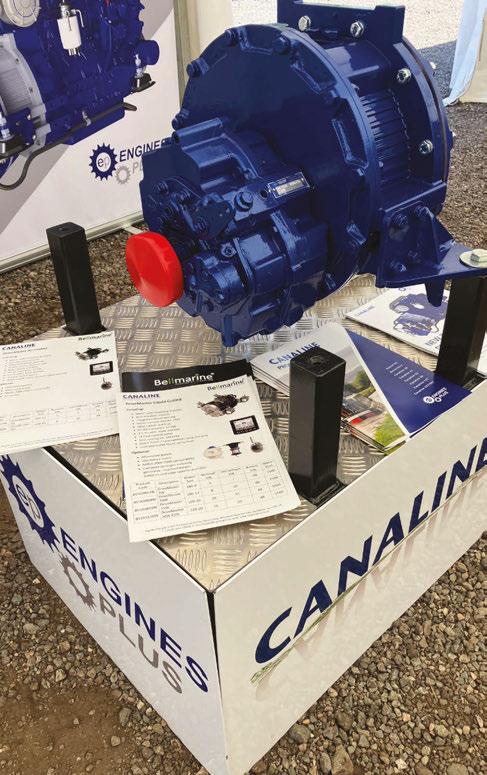
Canaline, a popular inland waterways engine supplier, displayed a hybrid unit and gearbox.
New boats, with all the mod cons, can often be found selling for eyewatering sums of money. In reality they’re inevitably commissioned, so the actual number of pound notes involved rarely meets the public gaze. Electric serial hybrid (rather than straight diesel drive) versions can cost considerably more: £50,000 is a likely ballpark figure.
Clearly there is an increasing number of people with an environmental conscience who are prepared to go that extra mile and I have nothing but admiration for their commitment to a greener future. Hand in hand, of course, is totally silent cruising and the chance to fully immerse yourself in the natural environment of our inland waterways.
The other approach is retro-fitting an existing vessel with electric drive. Two years ago, this would have been viewed as an extremely doubtful proposition on the grounds of price and embedded carbon alone.
The cost, again, would have been in the region of £50,000, and removing and disposing of what would probably have been a perfectly good diesel engine –environmental vandalism when all the labour and material costs of producing it are taken into account.
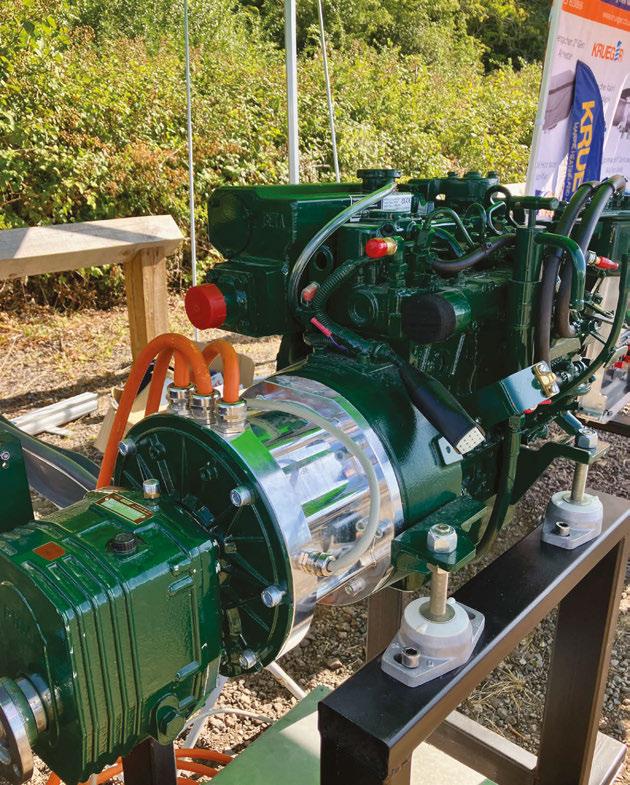
What we saw at Electrika 2025 were several versions of a much-simplified approach to retro-fitting electric propulsion: devices that could sit alongside an existing diesel engine in a complementary configuration
What we saw at Electrika 2025 were several versions of a much-simplified approach to retro-fitting electric propulsion: devices that could sit alongside an existing diesel engine in a complementary configuration. Nothing gets taken out; a relatively small (and potentially very versatile) device gets bolted in, converting a conventional boat to parallel hybrid drive.
Anyone with a hybrid car will know that it can run for relatively short bursts on electric drive from its built-in batteries. It has both a conventional internal combustion engine and a small electric motor coupled together in the drive train. This same principle is being employed in the retro-fitted boat devices.
Most boaters – even those of a non-technical disposition – will know that driving a boat is (in order) an engine, a gearbox, a propeller shaft and a propeller. A retro-fit electric drive unit is simply bolted in between the engine and gearbox, the additional 6ins (150mm) or so of its overall length accommodated by shortening the propeller shaft. If that’s not feasible, the same thing can often be achieved by moving the engine and its mounts 6ins forward.
This unit is effectively a motor/generator so with it in place a boat can now be diesel-propelled (by its original engine), electrically propelled or, when stationary, generate power to top up battery banks.
We can also take this one stage further, and certainly where new-build installations are concerned, by specifying a smaller-than-normal engine and running the diesel engine and the electric drive in tandem when full power is required.
The reality of canal cruising (proved time and time again by those with electric-drive boats with a display showing minute-by-minute power consumption) is that we use well shy of 5hp in a canal – a fraction of the power output of a typical narrowboat diesel!
Where power is needed, against a current or in tidal waters, electric and diesel drive are coupled together to provide maximum output. With this approach a year’s cruising could save overall diesel consumption of up to 30%. And think of all that peace and quiet!
Readers by now may be wondering where the power to do the ‘electric bit’ might be coming from. The answer is quite simply lithium ferrum phosphate batteries. In the last couple of years, the price of these has dropped below that of typical lead acid traction batteries.
A few numbers
At one end of the scale, you can buy an easily installed, retrofit electric-drive unit that does most of the things above for less than £8,000 including VAT. At the other end, a unit that ticks every box, together with sufficient battery capacity for three full days of cruising, would come to £13,000 plus VAT. Remember that with this comes the choice of three different propulsion modes, together with a high-power battery charger.
Lightning Craft supplies lithium batteries and a drive unit that ticks every box.
Bowman Bradley, chair of the Sustainable Boating Group, manning IWA’s stand at Electrika.
Weil's Disease
Don't ignore the symptoms
JONATHAN MOSSE warns of the dangers of this water-borne disease prevalent in rodent-infested waterways
Ireturned om a brief spell away to find that my neighbour was in hospital, at death’s door and with li le chance of pulling through. It was something of a shock, to say the least. Other residential boaters informed me that Ken had initially been laid low with flu-like symptoms before rapidly deteriorating and being rushed into A&E by his wife.
Apparently he’d not responded to the antibiotics he’d been prescribed on the basis that the symptom pa ern pre much seemed to suggest meningitis. Internal organs were giving up, one by one, and he was on life support including a ventilator and a kidney dialysis machine. Nothing much was working and the doctors advised his wife to summon near relatives to his bedside.
It was somewhere around this time that it was mentioned that he lived on a boat on the Forth & Clyde Canal and thoughts of Weil’s disease first entered the consultant’s mind. Although he’d worked on A&E for nearly 25 years, he’d never come across a case for real but this was the only possibili that had not been covered.
The appropriate antibiotic was administered and very slowly Ken started to show signs of recovery, though his survival remained touch and go for several days. His body had been totally debilitated by the disease, as most internal organs had become seriously weakened.
Over the ensuing weeks, Ken was taken o life support and the forest of tubes was progressively reduced as he got back his strength. A threeweek hospital stay was followed by three months of rest and recuperation. Eventually he was able to return to work.
From this experience it is clear that Weil’s disease (leptospirosis) is a serious, potentially life-threatening condition which can be contracted om canal- and other still-water sources, via cuts and scratches. Medical advice is to always wash your hands a er contact with the water. If you fall in, wash yourself thoroughly, or shower, and wash your wet clothes before wearing them again. Clean cuts and scratches with an antiseptic and protect them with a plaster.
The infection may seem like flu in the early stages and can occur two to four weeks a er exposure. If you experience any flu-like symptoms a er contact with the water, seek medical advice immediately and mention the possibili of Weil’s disease. Medical practitioners rarely come across the condition first hand and treatment requires a specific antibiotic. Leptospirosis is what is known as a zoonotic disease: infectious diseases that can be transmi ed between animals and humans. They can be caused by bacteria, viruses, fungi, parasites or other pathogens. Zoonotic diseases are a significant public health concern due to our close relationship with animals.
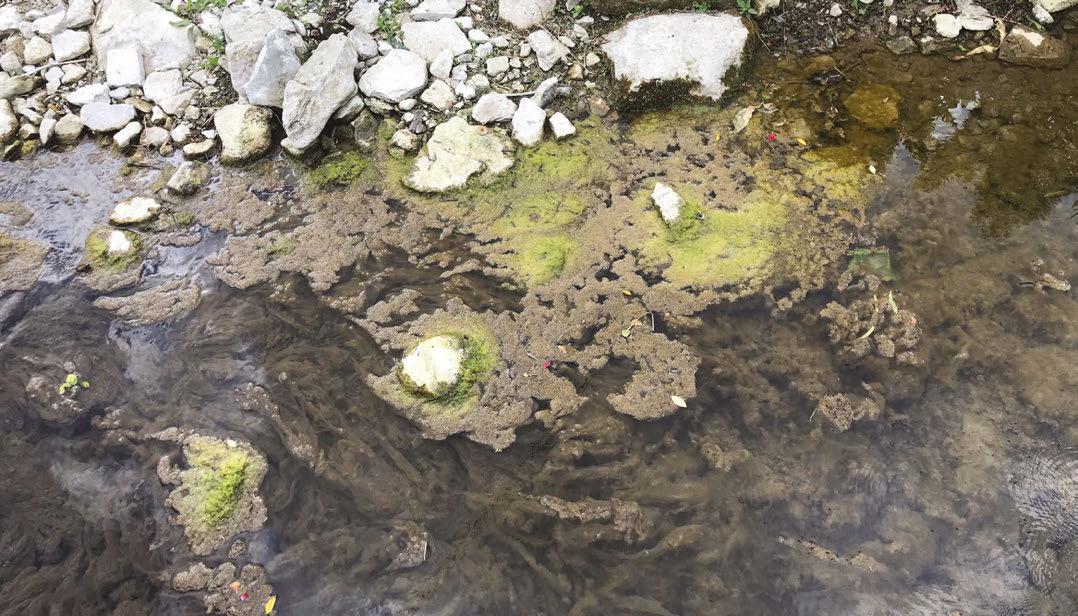
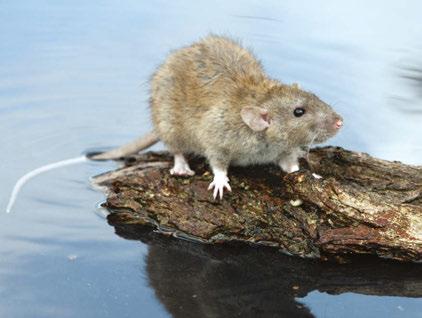
The pical situation where boaters come into contact with Weil’s disease is in still water where rat urine will o en be prevalent. Apart om rodents, it is carried by ca le, and dogs are routinely vaccinated against it. Unfortunately, this is not an option for humans.
More information is available at nhs.uk/conditions/leptospirosis.
DAVID POSNETT, founder of Friends of the Grand Union Canal, writes of his personal experience of Weil’s disease
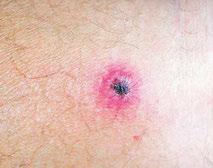
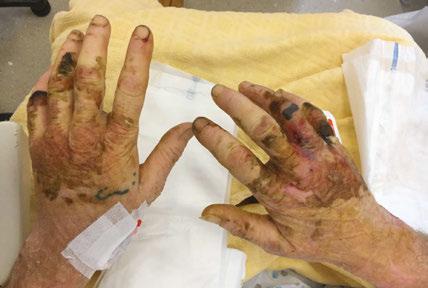
“I contracted Weil’s disease while li er picking, with scratched arms and wet clothes likely exposed to rat urine. Due to the Covid pandemic at the time, I couldn’t see a doctor immediately. By the time I reached hospital, I was 24 hours om death. I was admi ed for 11 days, turning bright orange as a result of liver failure, experiencing excruciating pain, unable to move, and delirious. It took more than two months to recover.
So, my warning to readers is to be aware of the key symptoms: fever, muscle pain, vomiting and yellowing of the skin or eyes. Get checked immediately. Early diagnosis can save your life. This disease is rare but extremely serious and easily misdiagnosed. Don’t ignore the signs like I did. Take symptoms seriously, especially if you’ve been in dir water or around rodent-infested areas.”