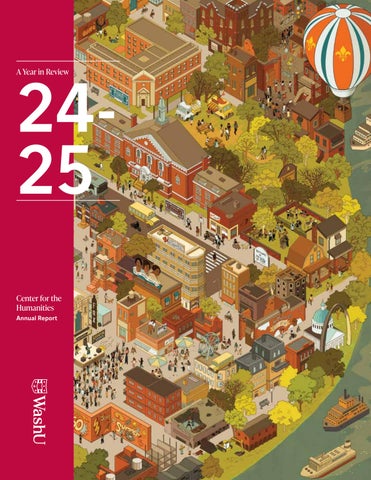
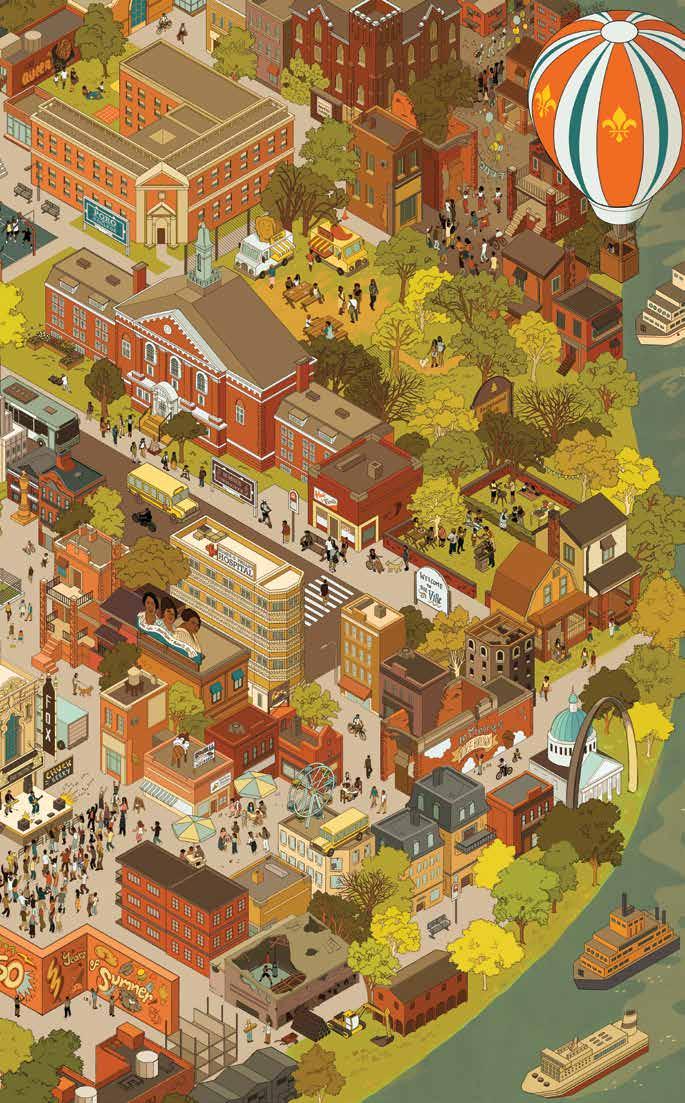
See page 8 to read more about this illustration, created by Sam Fox School graduate student Amy Selstad in collaboration with the Sumner Studiolab high school interns.
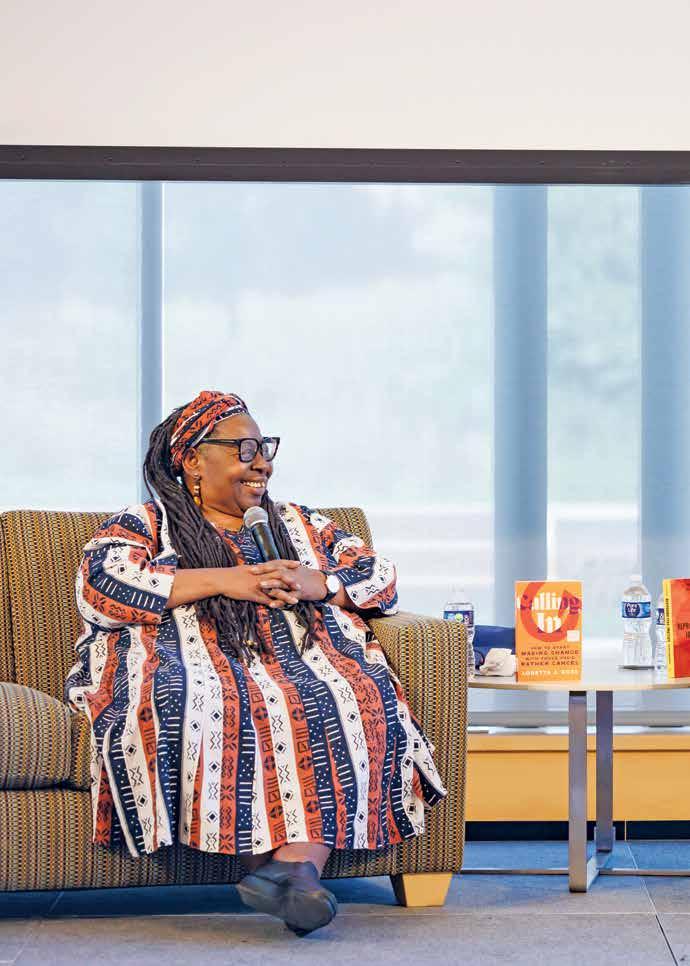
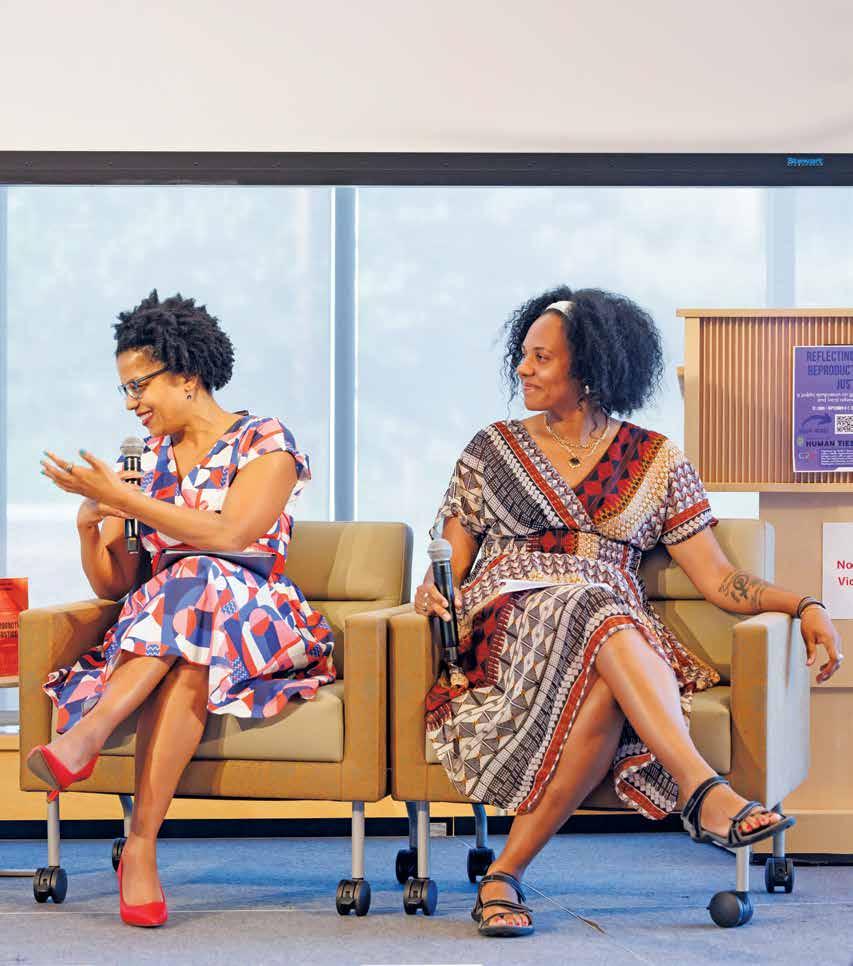
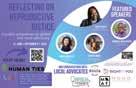
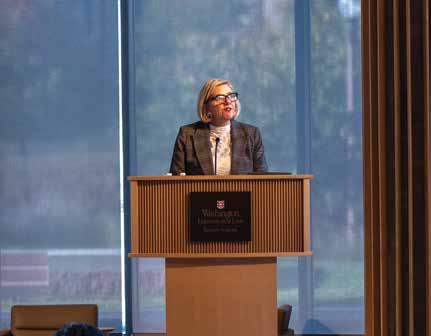
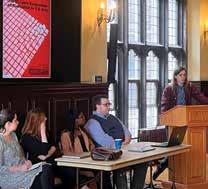
On this spread Reproductive justice pioneer Loretta Ross (left) headlined a September 2024 public symposium organized by Professor of Sociology Zakiya Luna (center) and Assistant Professor of Psychological and Brain Sciences Seanna Leath (right). Community members were invited into conversations with scholars and local and global activists about how to support reproductive justice in the current political climate.
03 Director’s Letter
How can a humanities center address urgent societal problems? 06 How can a humanities center prepare graduate students for the academy — and the world beyond?
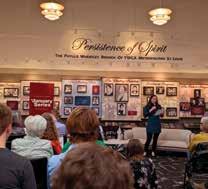
A Year in Posters
Sustaining a Humanities Future
Infrastructure has been on my mind recently as I think about how we at the Center for the Humanities and other entities with similar profiles build a sustainable humanities future. Infrastructure is at the heart of this humanities future, but building it, or indeed preserving it, seems elusive right now as the existence of the spaces and institutions that make up our humanities ecosystem are facing precarity or even extinction. While the general national panorama greatly preoccupies us, these cuts have impacted us right here at the center. During the spring of 2025, the National Endowment for the Humanities (NEH), one of the very few funding sources in the humanities, underwent a serious transformation. Eighty-five percent of existing grants were canceled, and the organization has since issued a new and radically different set of funding opportunities and priorities. The center’s NEH grant, Humanities@Work, was canceled without explanation. This grant was to help us create workforce development infrastructure for PhD students in the humanities, designing paid internships for students with community organizations in our region (which also received a stipend), so as to foster critical professional skills in students and strengthen their ties to the city and county.
We managed to secure stopgap funding and, with enormous success, placed eight interns in five nonprofit groups this summer (read much more about this program on pages 6 and 8). This grant fulfilled the university’s mission of being “in St. Louis, for St. Louis” by supporting organizations doing essential work in the St. Louis region. After a devastating May 16 tornado struck the city, especially devastating the northside, 4theVille, a cultural heritage development organization in north St. Louis, was one of the key community groups leading the effort to clean up the streets and get needed supplies to those impacted. This absorbing endeavor significantly set back their own cultural work. Humanities@ Work interns stepped in to support 4theVille’s mission, including research for their application to have Sumner High School recognized as a historic landmark, strategic planning for future Black cultural heritage initiatives in the neighborhood and elevating the organization’s fundraising capacity. 4theVille moved its crucial work forward, and our humanities graduate students gained invaluable and transferable skills as they plan for their professional futures.
This canceling of funding has been a challenge for the center, but it has also affected institutions much less resourced than our own
and has shut down much of the work of vibrant state and local humanities councils who have, for years, enhanced society through nonpartisan and locally facing public programs and grant-making that help preserve the country’s multifaceted heritage.
Humanists have, however, always done more with less, and we will persevere and weather these times as we have other periods of crisis. Here at the center, we will continue to do the work that drives us: engaging people in the study, research and work of the humanities, both within our institution and in our wider community. We will continue to build infrastructure in the form of research and community engagement for our undergraduate and graduate students and faculty, we will build a sustainable humanities future, and we will do it following the same values that have always motivated our work.
Stephanie Kirk Director,
Center for the Humanities Professor of Spanish, Comparative Literature and Women, Gender and Sexuality Studies
How can a humanities center address urgent societal problems?
Reproductive Justice Working Group
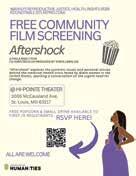
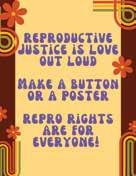
In the wake of the seismic Dobbs decision that permitted the criminalization of abortion in several U.S. states, including Missouri, the Reproductive Justice, Health, Rights Working Group was convened to marshal the expertise of WashU’s humanities and humanistic social science scholars in issues related to reproductive justice. Supported by humanities center staff from 2022 to 2025, this interdisciplinary group’s approach emphasized the role of humanistic inquiry in understanding and responding in real time to the shifting legal landscape around reproduction. In September 2024, the group organized the symposium Reflecting on Reproductive Justice: A Public Symposium on Global and Local Advocacy. Local, national and international frontline activists joined scholars from anthropology, law, social work, sociology and psychology, as the symposium welcomed the St. Louis community into conversations about the right to choose whether and how to form families and how to advocate for reproductive justice in the current political climate.
Faculty co-conveners: Zakiya Luna (Sociology) and Seanna Leath (Psychological and Brain Sciences); graduate student assistants: Ri’enna Boyd (Public Health) and Katherine Tighlman (Romance Languages and Literatures).
Environmental Arts and Humanities Working Group
Escalating environmental crises accelerated by human activity — climate change, resource depletion, and environmental injustice and displacement, to name only a few — have brought increased urgency to environmental scholarship. United by a shared interest in the intersections of culture and environment, the Environmental Arts and Humanities Working Group
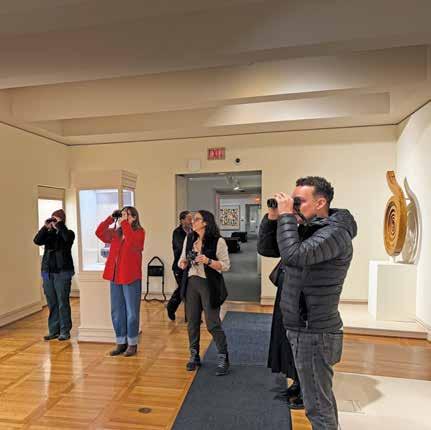
Through a series of events — including an art exhibition, lecture and guided “bird walk” through an art museum — the Environmental Arts and Humanities Working Group brought attention to the roots and impacts of environmental issues across the Americas.
“Bird walk” at the Saint Louis Art Museum
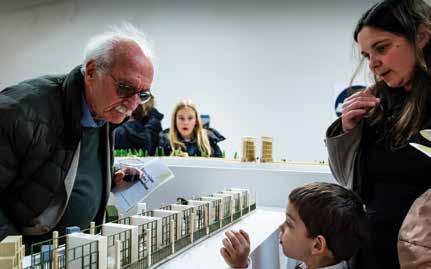
Extractivism in the Americas exhibit
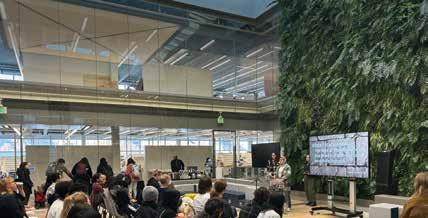
Lecture on desert aesthetics
brings together faculty whose expertise spans multiple disciplines and engages with diverse global contexts to draw attention to the roots of environmental issues and the cultural and political climates that shape how they manifest. In spring 2025, the working group launched an exhibit, Extractivism in the Americas, that examined the environmental and social impacts of extraction in the U.S., Canada and Latin America through curated photography, film, textiles and design artworks focused on mining, pipelines and other natural resource extraction. Funded by Here and Next (WashU’s strategic plan) as well as Arts & Sciences, the exhibition was hosted at Des Lee Gallery in St. Louis. Accompanying events included a scholarly lecture as well as guided tours.
Faculty conveners: Bret Gustafson (Anthropology), Derek Hoeferlin (Sam Fox School of Design & Visual Arts), Diana Montaño (History), Patricia Olynyk (Sam Fox School of Design & Visual Arts) and Ila Sheren (Art History and Archaeology).
“The
Unbearable Burden of Black Studies and the Enduring Fight for American Democracy”
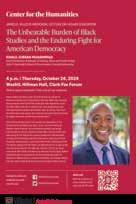
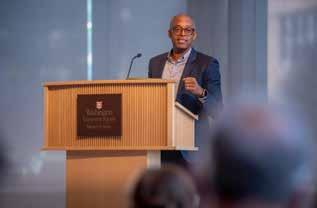
This year’s James E. McLeod Memorial Lecture on Higher Education was given by Khalil Gibran Muhammad, now a professor of African American studies and public affairs at Princeton University. In his talk, Muhammad spoke about the intensifying pushback to the field of Black studies and cited the field’s vitality as a litmus test for the health of a democracy. He concluded with an impassioned appeal for scholars and allies: “We must lead with confidence: that the everyday, mundane decisions we make as faculty, staff and administrators matter, otherwise our enemies would leave us alone… We must lead with facts: that the campuses we work on are better for the diversity our students bring to them. We must lead with courage: that some risks are worth taking in pursuit of justice and our own personal legacies. Finally, we must lead with hope: that our students will forge a better future for all of us.”
“Cannibal Capitalism: The View from Trump’s America”
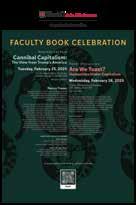
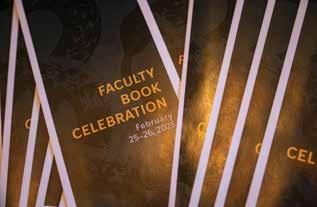
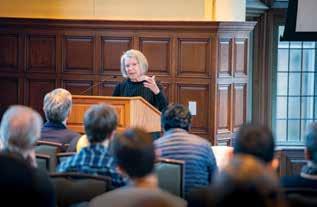
How can we act collectively to combat the increasingly oppressive effects of capitalism in today’s U.S. society? Nancy Fraser, the Henry and Louise A. Loeb Professor of Philosophy and Politics at the New School for Social Research, explored this question in her keynote lecture at the 2025 Faculty Book Celebration. Fraser’s most recent book, Cannibal Capitalism: How Our System Is Devouring Democracy, Care, and the Planet — and What We Can Do About It, provided the framework for her discussion.
Fraser concluded that shared concerns around labor exploitation — compensated as well as unwaged work — could provide the cohesion necessary for disparate interests to make a stand against the social, economic, ecological and political injustices of capitalism.
Support our annual lectures and programs! Ideas that cross disciplinary lines have a natural home at the Center for the Humanities, making us an ideal convener for events that speak to wide audiences and working groups that span fields. Help us continue to bring in thought leaders and leading academics to share their work with the on-campus and St. Louis community. See page 20 to learn how.
McLeod Lecture with Khalil Gibran Muhammad
Faculty Book Celebration with Nancy Fraser
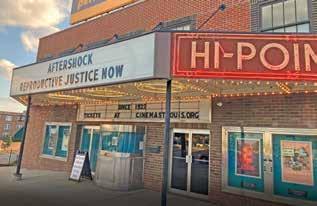
Public film screening at the reproductive justice symposium
How can a humanities center prepare graduate students for the academy — and the world beyond?
Humanities@Work
Many humanities PhDs now pursue careers beyond academia, taking on roles in consulting, government and policy research, libraries, cultural institutions and highered administration. While national and local data reflect this trend, graduate programs often aren’t designed to provide the training and support needed to pursue these professions. At WashU, the humanities center addresses this gap with the launch of Humanities@ Work, an experiential learning program funded by the National Endowment for the Humanities (NEH) that places graduate students in local mission-driven organizations for summer internships. Participating students spent the spring 2025 semester in careerdevelopment workshops before interviewing for positions with partner organizations doing crucial work in our region: 4theVille, Forest ReLeaf of Missouri, Griot Museum of Black History, Repertory Theatre of St. Louis and Trailnet. There, students worked with organizational mentors to collaborate on complex projects to help their respective host organizations meet crucial goals in research, program facilitation and strategic development. (Learn more about their projects on page 8.)
Humanities résumé workshop
How should a humanist approach the craft of résumé writing, a key document of the hiring process for careers outside of the professoriate? This spring, the humanities center invited Derek Attig, assistant dean for career and professional development in the Graduate College of the University of Illinois Urbana-Champaign, to instruct humanities graduate students on the conventions and flexibility of the résumé format to communicate
their skills and experiences. Alongside practical guidance on structure and formatting, they emphasized the résumé as an opportunity to communicate one’s story in a tailored, targeted fashion.
Article writing workshop
Publishing a scholarly journal article is often a new scholar’s first contribution to the ongoing conversations of their field. It helps to disseminate research, establish expertise and build networks. This spring, Lisa Voigt, professor of Spanish and Portuguese at Yale University, joined humanities center director Stephanie Kirk to guide graduate students in the process of planning, writing and revising a journal article, sharing their insights from their experiences as scholars and journal editors. The group then workshopped two in-progress articles by WashU grad students, which are now under review by journals in their fields.
Fellowships
Semester-long, residential Graduate Student Fellowships integrate PhD candidates into the humanities center’s intensive interdisciplinary community, which includes
undergraduates, postdoctoral students and junior and senior faculty. The time and space for focused writing and analysis and structured opportunities for feedback allow them to regularly discuss research progress, exchange feedback and participate in workshops, conversations and events that expand interdisciplinary perspectives and research strategies. The Divided City Graduate Summer Research Fellowship facilitates opportunities for graduate students to carry out publicly oriented scholarship that connects their research with audiences beyond the academy. Drawing students from the humanities, humanistic social sciences, art, urban design and landscape architecture, the 2025 fellows developed projects such as a publication of Yiddish poetry translations and art, the establishment of a community of practice for local K–12 teachers of German and the creation and screening of a stop-motion sand animation film that reflects a journey down the Mississippi River. (See page 14 for a list of this year’s fellows.)
The inaugural Humanities@ Work class of interns supported five St. Louis-based mission-driven organizations, whose efforts all aim to contribute to a thriving St. Louis region through work in youth education, environmental health, historic preservation, cultural heritage and theatrical performance.
Mentored professional experiences
Mentored professional experiences (MPE) provide opportunities for graduate students to apply their knowledge and skill sets to industry or organizational needs and to develop networks and literacies that complement their coursework and research. In the humanities center, graduate students pursuing an MPE work with staff mentors to learn more about the role of such centers at universities and to develop projects that engage with humanities impact reporting, project management, symposium and event planning, humanities program research and development, grant writing and/or community engagement. Graduate students Ashni Clayton (English) and Jillian Lepek (Art History and Archaeology) spent their MPEs as mentors for the Tyson Environmental Humanities Undergraduate Research Group, and Juana Torralbo Higuera (German) mentored the Banned Books Undergraduate Research Fellows (see more on pages 12 and 13), guiding them in the skills required to contribute to long-term research projects and collaborations. This
type of mentorship flexes teaching skills and also builds experience in one-on-one problem-solving and helping new researchers to conceptualize, design, carry out and write about a research project.
Ongoing support
Throughout the year, graduate students can turn to the humanities center for support for their academic goals. Proposal workshops for the Mellon/ACLS Dissertation Innovation Fellowship and ACLS Leading Edge Postdoctoral Fellowship paired WashU grad students with current and past recipients as well as proposal consultants to help them craft their own applications. The center saw an influx of graduate students in person on Thursday mornings for the Writing Commons, an opportunity for quiet, focused writing alongside peers, providing community and accountability. They were invited again to write in community during the Scholarly Writing Retreat, which takes place during the two weeks after Commencement, and a second Graduate Student Writing Retreat during the month of July.
Help us extend the life of Humanities@ Work! We believe this internship program will expand humanities graduate students’ career paths and enrich their academic experience. Recent NEH cuts unexpectedly canceled funding for this three-year pilot program after just one summer. Your gift can help keep it going! Learn more on page 20.
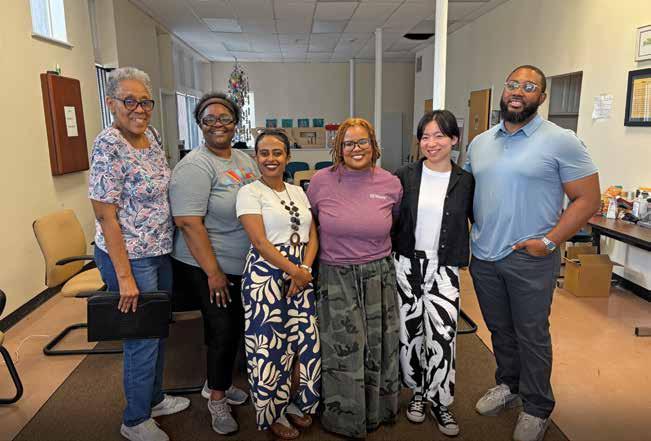
Humanities interns at 4theVille with their staff mentors
How can a humanities center engage meaningfully with community?
Humanities@Work
The Humanities@Work summer graduate internship program (described more fully on page 6) balances three core priorities: the needs of partner community organizations, the existing skill sets of humanities graduate students and the opportunities to expand their workplace capabilities. It’s a model of public humanities that emphasizes the mutually beneficial potential of such partnerships. The inaugural cohort of interns joined local mission-driven organizations 4theVille, Forest ReLeaf of Missouri, Griot Museum of Black History, Repertory Theatre of St. Louis and Trailnet. In summer 2025, interns exercised the skills they have learned while working toward a dissertation — collaboration, creative thinking, data collection and goal planning — on projects such as cataloguing the Griot’s collections, conducting community surveys for Trailnet to assess needed traffic-calming interventions in city streets, researching and implementing strategic planning and other organizational goals for 4theVille, and facilitating students and counselors at a performing arts camp for children at the Repertory Theatre’s Camp Rep. Sumner Studiolab
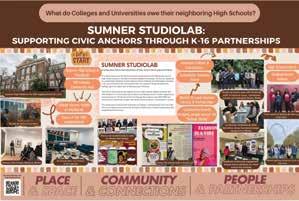
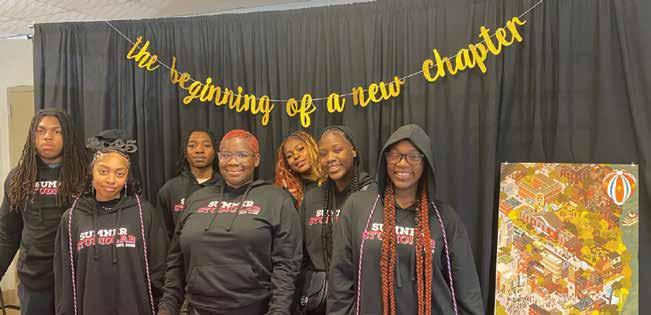
Established in 2022, the Sumner Studiolab is a community space in north St. Louis that offers public workshops, student internships and academic courses. Hosted at Sumner High School, the oldest high school for Black students west of the Mississippi, it is a collaboration between the Sumner Advisory Board, 4theVille and WashU’s Center for the Humanities and Office for Socially Engaged Practice (Sam Fox School of Design & Visual Arts). Led by Crystal Payne (English), this year’s six Sumner High School interns examined how art has been used to
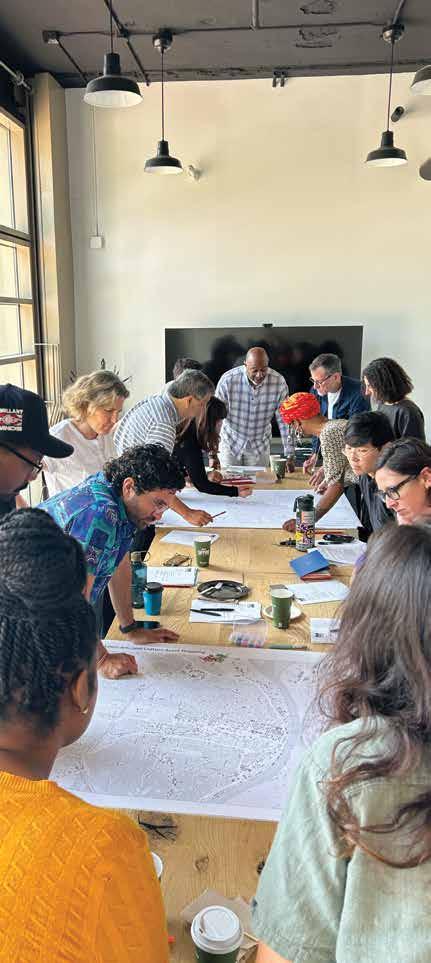
The Engaged City convenes scholars, community leaders, researchers and artists to create publicly accessible cultural maps of St. Louis that spatialize the individual and collective cultural knowledge bearers, organizations and community members in St. Louis.
The Engaged City
shape Sumner’s identity and to voice concerns, frustrations or love for the community. Together with a Sam Fox School graduate illustration student, interns produced a jigsaw puzzle that depicts their lives in St. Louis. Their work was informed by field trips to the Mildred Lane Kemper Art Museum, Griot Museum of Black History and Gateway Arch to discuss how history is encapsulated by everyday artwork and architecture.
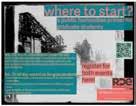
Where to Start? A Public Humanities Roundtable
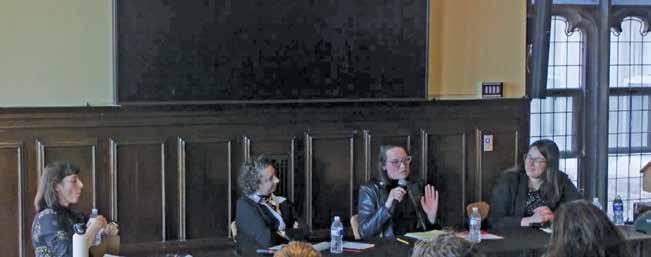
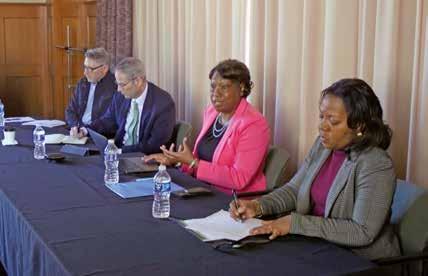
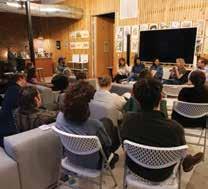
A roundtable discussion in spring 2025, part of a Mellon-funded workshop series for our RDE (Reimagining Doctoral Education in the Humanities) initiative, guided graduate students and faculty in reimagining their roles as scholars, collaborators and contributors to public life. Panelists reflected
on their experiences integrating public humanities with academic scholarship, emphasizing how community engagement, ethical collaboration and public impact can enrich scholarly work. The panel underscored the value of co-creating knowledge and urged graduate students to see public engagement as intellectually vital and professionally transformative. Together, the panelists stressed that public humanities demands reimagining academic norms — not just for graduate students but for the structures that evaluate and support their scholarly contributions.
The Engaged City
The Engaged City seeks to celebrate St. Louis’ cultural assets through an innovative collaborative mapping process that combines community
engagement and humanities research. Funded by the Mellon Foundation and WashU’s Office of the Provost, the project is a joint effort of the WashU Center for the Humanities, Center for the Study of Race, Ethnicity & Equity (CRE2) and Office for Socially Engaged Practice.
An advisory board, convened in fall 2024, comprises local artists, community leaders and scholars. This year, three Community Fellows in Residence will be selected to contribute their local expertise and creative skills to the digital and paper maps. The project also includes public workshops, academic courses and seed grants, all aimed at supporting local creative communities and celebrating the rich creative history of St. Louis.
Humanities@ Work is doing great work in the community, matching students with skills to mission-driven organizations that benefit from their experience and enthusiasm. The pilot program was unfortunately defunded during the spring 2025 cuts at the NEH, but you can help keep it going! See page 20 to learn more.
Where to Start? A Public Humanities Roundtable
Sumner High School interns at the Sumner Studiolab with coordinator Crystal Payne (center)
How can a humanities center support bold ideas for the humanities professions?
Cultivating Dynamic Academic Environments
Given the recent alarming developments and rapidly shifting landscape for higher education in the United States, this symposium’s conversations and panels were a useful resource for those seeking connections, methods and answers about how to move forward during these increasingly fraught times for research, humanistic inquiry and the future of our shared efforts. Organized in partnership with the Office of Public Scholarship and featuring faculty leaders from Arizona State University, Michigan State University, University of Michigan, University of Oregon, University of North Carolina and the Modern Language Association, this event centered discussions on supporting faculty through turbulent change, cultivating innovation and collaboration, working across disciplines and reaching the public with accurate narratives about the humanities.
Global Comparative Humanities Working Group and Comparative Methods Lecture Series
Funded by an Arts & Sciences SPEED Grant and supported by the humanities center, this faculty collaboration seeks to provide a truly global history of comparatism that can provide a framework for an expanded vision of the comparative humanities. The group’s new, original research will move the discussion beyond the Euro-Atlantic world, foregrounding moments in the history of early comparatism in Egypt, India, the early Soviet Union, Latin America and Eastern Europe. In spring 2025, the group launched a lecture and workshop series that convenes the WashU humanities community to discuss and strategize new research in comparative humanities with leading scholars in the field.
Faculty conveners: Jianqing Chen (East Asian Languages and Cultures; Film and Media Studies), Tili Boon Cuillé (Romance Languages and Literatures; Comparative Literature), Stephanie Kirk (Romance Languages and Literatures; Comparative Literature; Women, Gender and Sexuality Studies), Thembelani Mbatha (African and African American Studies), Erin McGlothlin (Germanic Languages and Literatures; Comparative Literature), Anca Parvulescu (English; Comparative Literature) and Tabea Linhard (Romance Languages and Literatures; Comparative Literature; Global Studies).
RDE Mini Grants
Redefining Doctoral Education in the Humanities (RDE) Mini Grants enable WashU graduate students in the humanities and humanistic social sciences to carry
out activities of their own design that enhance their scholarly work. Last year, 14 graduate students were awarded funds for a variety of purposes: to participate at professional conferences, learn a new pedological method, explore an innovative dissertation approach, host visits by influential scholars, launch a literary journal, train fellow graduate students in podcasting, organize a conference and conduct archival research. This program is supported by a Mellon-funded grant that seeks to build capacity for a variety of employment outcomes including and beyond the professoriate, foster interdisciplinary inquiry and intellectual community and engage with publics beyond campus.
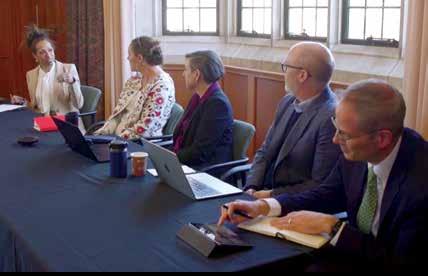
Faculty leaders from seven institutions came together in April 2025 to report on successes and generate new ideas for faculty leadership in the humanities, communicating with the public and supporting new forms of humanities work.
Cultivating Dynamic Academic Environments
Cultivating Dynamic Academic Environments
“Introducing” series
In fall 2024, the humanities center launched “Introducing,” a new series of workshops meant to help graduate students, postdocs and faculty gather together to explore ideas and approaches. The first workshop focused on psychoanalysis and featured a broad overview of the field, its history and development, and the impact it has had on the humanities. Harold Braswell, an associate professor of health care ethics at Saint Louis University, led the workshop, which 20 members of the WashU humanities community attended. Workshops on the scholar Hannah Arendt and affect theory are being planned for next academic year.
Modeling Interdisciplinary Inquiry
Postdoctoral Fellowship
This two-year fellowship, funded by an endowment from the Mellon Foundation, supports postdoctoral research that bridges disciplines across the humanities and humanistic social sciences in novel ways. The humanities center assumed direction of the program in fall 2024 from the former Interdisciplinary Project in the Humanities, which led the fellowship for 24 years. Alex Ullman (PhD, University of California, Berkeley) joined postdocs Danielle Williams (PhD, University of California, Davis) and Shirl Yang (PhD, University of Chicago), who organized “Technology and Society: An Interdisciplinary Conference on AI and Finance” in March 2025.
Ongoing workshops, retreats and grant funds
Throughout the year, the humanities center organizes programming to support humanities faculty and graduate students as they pursue new scholarly interests. Workshops were held to assist faculty in applying for fellowships from the National Endowment for the Humanities and the American Council of Learned Societies (ACLS), as was a workshop for graduate
students applying for the ACLS Leading Edge Fellowship. The center made more than 40 grants and awards to faculty and graduate students in 10 categories of funding (see full list on pages 16–17). The spring semester concluded, as always, with the Scholarly Writing Retreat, open to faculty, postdocs and graduate students to jump-start summer writing projects such as articles, book chapters, dissertation drafts, grant and book proposals and more.
Support our efforts to advance the humanities — through crisis and beyond! Actively advancing the humanities means investing in new research, interdisciplinary collaboration, public engagement and education reform. It means making them accessible, relevant and central to contemporary conversations. This is our charge, and you can help make it happen! Learn more about supporting our programming on page 20.
Virtual visit with Gabriela Jauregui
Public humanities workshop
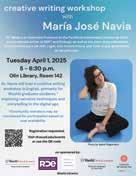
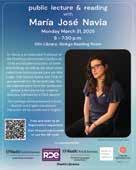
Visit with María José Navia
Archival research
Launch of Tern literary journal
Public Humanities, Poetry and Podcasts miniseminar
RDE Mini Grants
How can a humanities center cultivate
new humanists?
Merle Kling Undergraduate Honors Fellowship
Over the course of two years, students in the competitively awarded Kling Fellowship pursue a funded humanities research project of their own design and publish their findings in the Kling journal, Slideshow. In that time, they meet in a weekly seminar led by humanities center director Stephanie Kirk to present drafts of their work, peer-review one another’s writing, consider the role of the humanities at the university and in public life, and venture off campus to see humanities research in action around the St. Louis metro area. The 2024–25 cohort included 14 students whose majors include African and African American studies; American culture studies; art history; economics; English; French; global studies; history; political science; psychological and brain sciences; religious studies; and women, gender and sexuality studies (see pages 14–15 for a full listing). This highly interdisciplinary environment pushes students to think broadly about their research questions and audiences for their work.
“The Kling Fellowship gave me the freedom to design a project that extends beyond the boundaries of the departments in which I study to pursue my vision of interdisciplinary research. My project has taught me that every topic has multiple approaches — economic theory in conversation with humanistic analysis captures more nuances than either form of analysis alone.”
—Joy Hu, Class of 2025 (economics major; American culture studies and finance minors), “The Rush for Digital Gold: Regulatory Reactions to Cryptocurrency and New Financial Frontiers”
Banned Books Undergraduate Research Fellowship
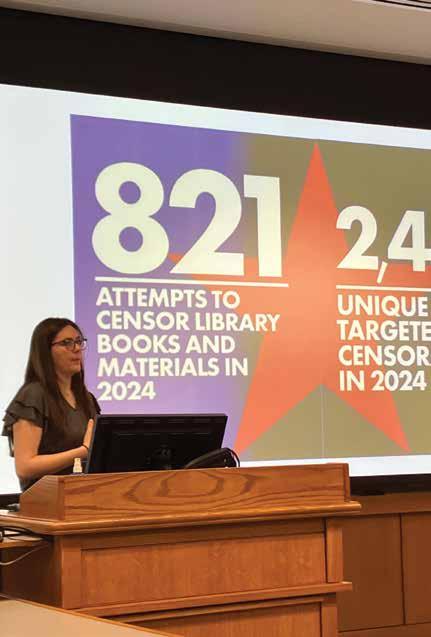
The practice of book banning — removing certain titles from library shelves, reading lists and K–12 curricula — continues to limit students’ access to published material. These challenges disproportionally target books that highlight marginalized communities and cover topics such as racism, sexuality, gender and history. In its second year, the Banned Books Undergraduate Research Fellowship welcomed seven undergraduates from disciplines across Arts & Sciences to conduct original humanities research into the historical and cultural contexts
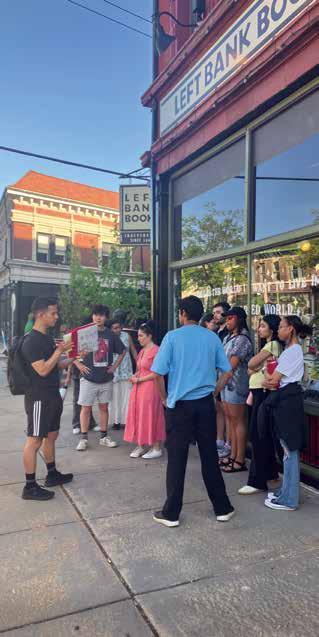
of book banning. With the direction of staff and a graduate student mentor, fellows learned how to interpret a complex issue unfolding in real time through careful consideration not only of banned texts but also of the laws and policies shaping student reading and learning, and the strategies and research conducted by advocacy groups. This year, they pursued individual projects such as examining the national political climate’s effect on local-level book bans, how bookstores and community members partner to resist censorship, and the history of U.S. censorship law, culminating in a public presentation of their work.
In addition to the longstanding Kling Undergraduate Research Fellowship, the humanities center introduced two opportunities for undergraduates to pursue their own research questions in community with other students and under the guidance of a graduate student mentor.
Banned Books Fellowship public presentation
Tyson Environmental Humanities Undergraduate Research Fellowship
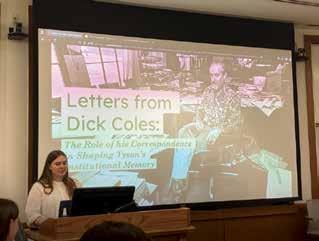
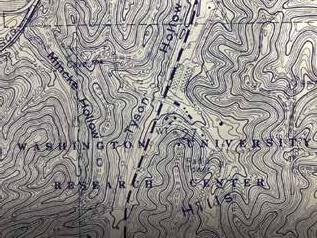
Faced with a dozen dusty boxes and a mandate to make sense of their contents, Tyson Environmental Humanities Undergraduate Research Fellows found themselves in a familiar place for new humanities researchers: How do you start? The students jumped midstream into a sprawling research project that investigates the history of WashU’s Tyson Research Center, a 2,000-acre environmental field station, via its archives. In its inaugural year, five Arts & Sciences undergraduates sorted through a sample of Tyson’s historical records, some of them
dating back to the site’s previous uses as a U.S. military installation and a commercial quarry. They gained experience in archival practices under the guidance of University Libraries staff and a graduate student mentor, processing a trove of maps and materials and developing their own site-based research projects. Their efforts have advanced the larger research work of the Tyson History Project, a collaboration between the Center for the Humanities, Tyson Research Center and University Libraries that aims to document, understand and present the history of Tyson’s human inhabitants over
millennia.
Support our undergraduate fellowships! The Center for the Humanities believes that research opportunities in the humanities are critical opportunities for all students, helping them develop skills critical for navigating today’s complex world. These fellowships allow Arts & Sciences students to learn how to assess archives, collaborate with community members, and conduct interviews and studies of complex problems. Learn more about how to support this programming on page 20.
the
Kling Fellows visit sites significant to St. Louis’ LGBTQ history
Tyson Fellows public presentation
Topographic map of Tyson Research Center from its archives
Center Fellows 2024–25
Faculty Fellows
Jianqing Chen
East Asian Languages and Cultures and Film and Media Studies
“Touchscreen Media: The Touch and Users in Contemporary China”
Becko Copenhaver
Philosophy
“Modern Memory: A History of the Philosophy of Memory in 17th- and 18-Century Europe”
Christopher Eng
English and Performing Arts
“White Gay Fantasies: A Queer Romance for Asiatic Presence”
Tabea Linhard
Romance Languages and Literatures, Comparative Literature and Thought, and Global Studies
“Agents’ Secrets”
Lynne Tatlock
Comparative Literature and Thought
“German Women’s Books for the ‘Reading Nation’ at the Chicago World Exhibition (1893): Toward an Alternative Literary History”
“Being and Jazz: An Existential Analysis of Charles Mingus”
Cora Chow
East Asian Languages and Cultures
“Shopfloor Autonomy: Automation and Gender in Labor Narratives of Late 20th-Century Hong Kong and South China”
Sushil Kumar Jha
Comparative Literature and Thought “Digital Window to India: Hindi Novels in Translation (1947–2024)”
Crystal Payne
English
“The Poetics of Home: Relation and Repatriation in Caribbean Literature”
Maurice Tetne
Romance Languages and Literatures “Bridging Continents: Tracing Louisiana and African Narratives in Literature and Films from 1800 to the Present”
Paco Tijerina
Romance Languages and Literatures
“Mineral Bodies: Violence, Extraction, and Possible Futures in Contemporary Mexican Literature”
Divided City Graduate Summer Research Fellows
Timilehin Alake
Comparative Literature and Thought “Home Songs: Sensory Memory, Diasporas, and the African Homelands”
Anne Brown
Sociology
“Uneven Power: Neighborhood Development Organizations and the Geography of Urban Equity in St. Louis and Beyond”
Rebecca Hanssens-Reed
Comparative Literature and Thought
“Duff’s Revival: Creating a Multidisciplinary Reading Series to Celebrate Craft & Community”
Asha Marie Larson-Baldwin
Sociology
“A Park as Racial Redress? Commemoration in Changing and Contested Community Landscapes”
Lauren Malone
Anthropology
“Bone Harpoons of the Lake Turkana Basin: Climatic Resilience & Cultural Heritage”
Stephanie Nebenfuehr
Comparative Literature and Thought
“The Divided Table: Illustrating the Rich Past of the Lewis Collaborative”
Carmen Ribaudo
Sam Fox School
“Sand Animating with River Semester”
Juana Torralbo and Kebei Wang
Comparative Literature and Thought
“A Community of Practice of Teachers of German in St. Louis and Missouri”
Tsering Wangmo
Anthropology
“Critical Reflections on Language in Collaborative Knowledge
Production”
Rebecca Weingart
Comparative Literature and Thought
“A Collaborative Translation Project of Yiddish Women’s Poetry”
Kling Undergraduate Honors
Research Fellows
Class of 2025
Andrew de las Alas
Global Studies
“Gateway to the East: Filipino Americans in a Black and White City”
Jeffrey Camille
Global Studies and Women, Gender and Sexuality Studies
“The Ideal Monster in ConflictRelated Sexual Violence”
Joy Hu
Economics
“The Rush for Digital Gold: Regulatory Reactions to Cryptocurrency and New Financial Frontiers”
Lena Levey
Religious Studies
“Sensual Desires and Bestial Indulgences: Sexual Sin as a Cause of the Flood in Midrash and Oryx and Crake”
Melina Marin
English Literature and French
“Navigating the Scare-ibbean: Tracing the Socio-Political Legacy of Monstrous Figures in the Caribbean”
Cecilia O’Gorman
English Literature
“The Self-Identification Trap”
Aja Topps-Harjo
Psychological and Brain Sciences, and African and African American Studies
“Dismantling the Master’s House with the Master’s Tools: An Examination of Black Women Scholars’ Pursuit of Equity within the Legal System” Class of 2026
Ryan Altman History and Political Science
Sonal Churiwal Women, Gender and Sexuality Studies and Political Science
Halla Jones Art History
Marissa Mathieson
American Culture Studies and Political Science
Avery Melton-Meaux English and Creative Writing
Emilio Parra-Garcia Women, Gender and Sexuality Studies
Lauren Perkins History
Banned Books Undergraduate Research Fellows
Astrid Burns
American Culture Studies
Richard Gimbel Undeclared
Maddie Gomez
English Literature and Political Science
Davin Hickman-Chow Biomedical Engineering
Mason Shaver Political Science and Educational Studies
Taylor Thomas Anthropology and Global Studies
Xinyuan Yu
Economics and Computer Science
Tyson Environmental Humanities Undergraduate Research Fellowship
Will Corbin Classics
Margaret Beltrami
Environmental Analysis and Educational Studies
Bergen Fields
Environmental Analysis and English
Lydia Pita
Environmental Analysis and Environmental Science
Deliah Zacks
Economics and Math
2024–25 Awards and Grants
Collaborative Research Seed Grant
A.J. Jones | Anthropology
The Experiential Ethnography
Studio: Aligning the Processes and Products of a Collaborative, Anticolonial Social Science
Faculty Seminar
Nancy Reynolds | Department of History
Lori Watt | Department of History and Program in Global Studies
Writing and Rethinking Biography
Grimm Travel Awards
Jiayi Chen | East Asian Languages and Cultures
Weaving “Brocades”: Reading Games in Early Modern China
Hyeok Hweon Kang | East Asian Languages and Cultures
Famine, Herring, and Floor Heating: Korea in the Little Ice Age
Kristina Kleutghen | Art History and Archaeology
Lens onto the World: Optical Devices, Art, Science, and Society in China
Peng Peng | Global Studies, Political Science
The End of History? Does China Model Threaten Liberal World Order?
Publication Grants
Fannie Bialek | Danforth Center on Religion and Politics
Indexing for Love in Time
Jianqing Chen | Department of East Asian Languages and Cultures and Program in Film and Media Studies
Editing for Touch Screen: Everyday Media in Contemporary China
Nathan Dize | Department of Romance Languages and Literatures
Open access for “Reading Subjects
Amidst Subjection in Jean D’Amérique’s Soleil à coudre and Emmelie Prophète’s Les Villages de Dieu,” co-authored article with Jocelyn Sutton Franklin (Wofford College)
René Esparza | Department of Women, Gender and Sexuality Studies
Proofreading for From Vice to Nice: Race, Sex, and the Gentrification of AIDS
Elizabeth Hunter | Performing Arts Department
Indexing for Enveloping Worlds: Toward a Discourse of Immersive Performance
Esther Viola Kurtz | Department of Music
Indexing for A Beautiful Fight: The Racial Politics of Capoeira in Backland Bahia
Melanie Micir | Department of English
Indexing for Contemporary Queer Modernism
Mabel Moraña | Department of Romance Languages and Literatures
Translation of Lineas de Fuga: Ciudadania, Frontera y Sujeto Migrante/Lines of Flight: Citizenship, Borders, and Migrant Subjects
Tim Parsons | Department of African and African American Studies
Indexing for Black 1968
Anca Parvulescu | Department of English
Indexing for Face and Form: Physiognomy in Literary Modernism
Anne Schult | Department of History
Translation of “Intellectual Migration(s),” a chapter first published in The Routledge Handbook of the History and Sociology of Ideas (2024)
Dalen Wakeley-Smith | Department of History
Image reproduction rights for Gypsy Madness: American Roma in New York City 1890–1945
Reading Groups
NEW
African Diaspora Literature and Culture
Convener: Julius Fleming (English)
Environmental Humanities
Working Group
Conveners: Rachael DeWitt (Center for the Humanities) and Bernadette Myers (English)
Language Pedagogy Reading Group
Convenor: Erika Conti (Romance Languages and Literatures)
Medical Anthropology
Reading Group
Graduate student convener: Gloria Fall (Anthropology)
Writing Pedagogy Reading Group
Convener: Terri Taylor (College Writing Program)
RENEWALS
Digital Humanities Reading Group
Graduate student convener: Rebecca Weingart (Comparative Literature and Thought)
Disability and Embodied Difference
Reading Group
Convener: A.J. Jones (Anthropology)
Early Modern Reading Group
Convener: Robert Henke (Performing Arts/Comparative Literature and Thought)
Ethnicity and Literature
Reading Group
Graduate student convener: Naomi Kim (English)
Finnegans Wake Reading Group
Graduate student convener: Max Carol (English)
Gender and Sexuality in Contemporary Latin
American Literature
Graduate student convener: Katherine Tilghman (Romance Languages and Literatures)
History of the Present
Convener: Shefali Chandra (History/Women, Gender and Sexuality Studies)
Latin American Andean Fictions Reading Group
Graduate student convener: Renzo Rivas Echarri (Romance Languages and Literatures)
Leyenkrayz: Yiddish Reading Group
Graduate student convener: Rebecca Weingart (Comparative Literature and Thought)
Graduate student convener: Trevin Corsiglia (Comparative Literature and Thought)
Sports and Society
Convener: Noah Cohen (American Culture Studies)
Summer Faculty Research Grant
Diana Montaño | Department of History
The White Boy’s Playground: Masculinity and Empire in the Popular Construction of Revolutionary Mexico
Summer Research Seed Grant
Diane Lewis | Program in Film and Media Studies
Kitchen Programmers: Women, Work, and Information Society in 1960s–1980s Japan
Symposium Grant
Marjan Wardaki | Department of History
Diana Montaño | Department of History
(De)Circulating the Histories of Technology: A Symposium on the Global South
Weiner Humanities Research Grant
Talia Dan-Cohen | Department of Anthropology
Storytelling in Science and Public Health Writing Groups
NEW
Global China and Media Studies
Graduate student convener: Xiaohan Hou (Comparative Literature and Thought)
RENEWALS
Design and Visual Culture Writing Group
Convener: Christopher Dingwall (Sam Fox School and Art History and Archaeology, affiliate)
Medieval Studies Writing Group
Convener: Jessica Rosenfeld (English)
Religion and Literature Writing Group
Graduate student convener: Naomi Kim (English)
Event
Co-sponsorships
“Copied Singularities: Tracking Animals in Early Modern Print” with Lisa Voight, Oct. 12, 2024, and graduate workshop. Organized by the Department of Romance Languages and Literatures.
“Black Bodies, Black Votes: Pre-Election Analysis” panel discussion, Oct. 24, 2024. Organized by the Department of African and African American Studies.
“Mountain (1966), Liu-Pi-Cha (1967) and Documentary Modernism in Taiwan” with Chang-Min Yu, Oct. 24, 2024. Film and Media Studies Colloquium Lecture Series. Organized by the Program in Film and Media Studies.
“The Reopening of Notre-Dame de Paris: Interdisciplinary Perspectives,” Nov. 12, 2024. Organized by French Connexions Center of Excellence.
“Un Afrofuturisme caribéen: Rencontre avec Michael Roch” (A Caribbean Afrofuturism: A Conversation with Michael Roch),” Nov. 21, 2024. Organized by French Connexions Center of Excellence.
Artist talk and concert with Nichole Mitchell, creative flutist/composer/ poet, Nov. 22, 2024. Organized by the Department of Music.
“The Third Reconstruction: Black Studies and the Search for the Beloved Community in the TwentyFirst Century” with Peniel E. Joseph, Feb. 27, 2025. Futures in Black Studies Colloquium Series. Organized by the Department of African and African American Studies.
“The Queen of MySpace: Tila Tequila and the Asian American Roots of Social Media” with Lisa Nakamura, Feb. 27, 2025. Film & Media Studies Colloquium Lecture Series. Organized by the Program in Film and Media Studies.
“Queer Career: Sexuality and Work in Modern America” with Margot Canaday, March 21, 2025. Organized by the Department of Women, Gender and Sexuality Studies.
“Toxic Tropics” reading, graphic novel workshop and graduate student meeting with Jessica Oublié, March 22–26, 2025. Organized by French Connexions Center of Excellence.
“Art, Scholarship & Community: Reflecting on the Past, Present and Future of Black Studies” with Lisa B. Thompson, March 26, 2025. Futures in Black Studies Colloquium Series. Organized by the Department of African and African American Studies.
“Imagining the Globe: The Sfera Project Between Merchants, Maps and Manuscripts” with Carrie Benes, March 26, 2025. Organized by the Department of History.
“Early American Literature Today” symposium, Sept. 18–20, 2025. Organized by the Department of English.
Other Contributions
“‘I’ve Known Rivers’: The Ecologies of Black Life and Resistance,” Association for the Study of the Worldwide African Diaspora 25th Anniversary Conference, Oct. 29–Nov. 2, 2025 in St. Louis.
“‘No One Is Free Until We All Are Free’: Activism, Advocacy, and Academic Freedom During LateStage Capitalism,” Black Women’s Studies Association Virtual Symposium, April 4–5, 2025.
WashU Heartland Minority Journalism Fellowship
Our Mission
At Washington University in St. Louis, the Center for the Humanities facilitates the labor of humanists by nurturing innovative research, transformative pedagogy and vibrant community engagement locally and globally.
Administrative staff
Stephanie Kirk Director, Center for the Humanities Professor, Department of Romance Languages and Literatures, with appointments in Comparative Literature, and Women, Gender and Sexuality Studies
Talia Dan-Cohen
Associate Director, Center for the Humanities
Associate Professor, Department of Anthropology
Alicia Dean Administrative Coordinator
Kathleen G. Fields Publications and Communications Manager
Meredith Kelling
Assistant Director for Student Research and Engagement
Caitlin McCoy
Finance Cluster Supervisor
Laura Perry
Assistant Director for Research and Public Engagement
Executive committee
Marlon Bailey Professor of African and African American Studies, and of Women, Gender and Sexuality Studies
Elizabeth Hunter Assistant Professor of Drama
Caroline Kita
Associate Professor of German and Comparative Literature and Performing Arts (Affiliate)
Thembelani Mbatha
Assistant Professor of African and African American Studies
Diana Montaño
Assistant Professor of History
Casey O’Callaghan Professor of Philosophy
Patricia Olynyk
Florence and Frank Bush Professor in Art, Sam Fox School
Jessica Rosenfeld
Associate Professor of English
Hayrettin Yücesoy
Associate Professor of Arabic and Islamic Studies, History (Affiliate), and Global Studies
Contact details
Center for the Humanities Washington University in St. Louis MSC 1071-153-207
One Brookings Drive, St. Louis, MO 63130-4899
(314) 935-5576
Umrath Hall, Room 217
cenhum@wustl.edu humanities.washu.edu
Get Involved
The Center for the Humanities is dedicated to advancing humanistic thinking, inquiry and scholarly production as activities essential to this university, the communities we serve and the broader world. Join us in this effort — we can’t wait to connect with you!
Sign up for our newsletters
Keep up with the latest humanities center news via our free monthly newsletter and our local events calendar, Humanities Broadsheet! Each is published monthly during the academic year, delivering the inside scoop on our programming, plus a lineup of campus and community events (lectures, readings, film screenings, performances, field trips and more!) sure to keep you engaged all month long.
Attend an event
Our public events offer the opportunity to engage with thought-provoking ideas, dynamic conversations and diverse perspectives that illuminate littleknown topics and offer new angles on important historical questions and current social issues. Join us to become part of a vibrant community that values curiosity, culture and conversation.
Partner with us
We seek to develop programming that reflects the interest and needs of our broader humanities community, and we warmly welcome WashU faculty, staff and students as well as community members to reach out to us. Let’s build something together!
Make a gift
A donation to the Center for the Humanities is an investment in the power of the humanities to understand the complexities of the past and present and to offer essential insights that inform the choices we make for the future. Throughout this publication, we’ve highlighted program areas that can be strengthened or continued by financial support. Gifts of any amount enable humanities research and the dissemination of new findings, scholarly exchanges, student research experiences and engagement with the greater public. In a time when meaningful conversation and critical thinking are more important than ever, your contribution helps ensure that the humanities remain a vibrant, accessible force for scholarship and connection.
To make a secure online gift, visit our giving page at gifts.washu.edu
To allocate your unrestricted gift for the humanities center, please type “Center for the Humanities” in the special designation box or scan the QR code below to be redirected to our giving page.
387
Humanities faculty members at WashU
12
Linear feet of archival items processed by Tyson Undergraduate Environmental Humanities Fellows
53
Faculty, graduate student and undergraduate student fellows in the center during 2024–25
391
Humanities and humanistic social sciences graduate students at WashU
30
Percentage of humanities PhDs nationally who go into careers such as business, government and public policy, nonprofit administration and arts and cultural organizations
500
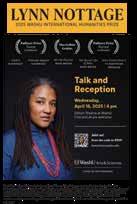
Registrations for International Humanities Prize award ceremony with 2025 recipient, playwright Lynn Nottage
7
Local community organizations that participated in “Reflecting on Reproductive Justice: A Public Symposium on Global and Local Advocacy”
$40,000
RDE Mini Grant awards made to support graduate student projects and training
10,046
Recorded book ban instances in the U.S. during the 2023–24 school year, according to PEN America
14,517 Miles
traveled by students enrolled in “The World of an Antique Bed: Material Culture and Digital Humanities” studiolab course during their research trip to China
1,120 Hours
worked by Humanities@Work graduate student interns during summer 2025
14 Manuscript workshops attended by Faculty and Graduate Student Fellows
twenty-eight Books published by humanities faculty in 2024
11
Artists participating in the Extractivism in the Americas exhibit, with works covering Canada, Colombia, Mexico City, Peru, Phoenix and St. Louis
44
Grants made to humanities faculty and graduate students via the internal funding program
Center for the Humanities
MSC 1071-153-207
Washington University in St. Louis 1 Brookings Drive St. Louis, MO 63130-4899
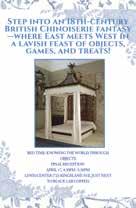
Bedtime stories
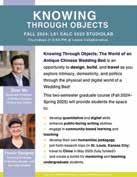
Using a 19th-century Chinese bed as a starting point, the 2024–25 studiolab “The World of an Antique Wedding Bed: Material Culture and Digital Humanities” combined digital tools with humanistic research methods to engage questions of intimacy, nuptials, curation and conservation, and global trade and cultural exchanges, led by Zhao Ma (East Asian Languages and Cultures) and Trevor Sangrey (Women, Gender and Sexuality Studies). A scene on the bed’s front panel depicts a wedding procession in late imperial China, with the bride and her dowry paraded to the groom’s home.