Innovation in Action








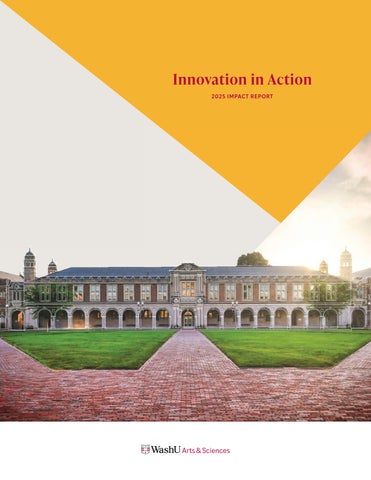
When I stepped into the role of dean in 2020, I challenged our school to embark on an ambitious path: creating a strategic plan that would elevate Arts & Sciences to a global model for research, teaching, and scholarship. We launched "The Decade of Arts & Sciences" in December 2021, and today I am pleased to share the tremendous impact we are having on WashU and our global community.
Led by new programmatic efforts and grounded in our core academic values, the Arts & Sciences Strategic Plan has made its mark on our school's research, culture, and community. More than 250 faculty members have been involved in our signature initiatives, with dozens participating in multiple projects. This high degree of engagement has ignited convergent breakthroughs, sparked innovative research across disciplines, advanced solutions for pressing global challenges, and enhanced our teaching to shape a new generation of leaders. As you will see, our world-class education and scholarship are empowering the brightest minds to build a better future for all.
While higher education faces numerous challenges, we remain undaunted. After reviewing this report, I hope you will agree that our impact is clear: the success of Arts & Sciences enriches every aspect of WashU, creating an environment where students and scholars think bigger, act bolder, and make a tangible difference in the world.





Feng Sheng Hu
Richard G. Engelsmann Dean of Arts & Sciences
Lucille P. Markey Distinguished Professor Washington University in St. Louis
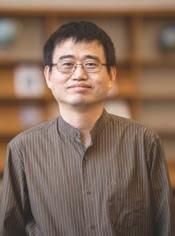
One of the boldest investments of the Arts & Sciences Strategic Plan has been the creation of the new Department of Statistics and Data Science (SDS), a close collaboration with the McKelvey School of Engineering. Under the leadership of renowned statistician and department chair Xuming He, the department has recruited some of the field’s most talented data scientists, including environmental statisticians Bo Li from the University of Illinois and Joe Guinness from Cornell University, as well as a cohort of assistant professors from various institutions, such as Yale and Stanford. With faculty launching groundbreaking research and collaborations across campus, the department has already established national prominence as a data science powerhouse that will catalyze transformation in the fields of artificial intelligence, public health, sustainability, and climate change.
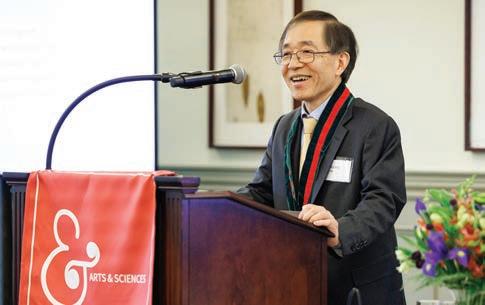
Xuming He was installed as the Kotzubei-Beckmann Distinguished Professor in April 2024.
Since implementing our Strategic Plan in 2022, Arts & Sciences has had three of its strongest years ever for external funding, setting new records and fueling ambitious proposals from faculty.
$60,000,000
$50,000,000
$40,000,000
$30,000,000
$20,000,000
$10,000,000
Total External Funding July
FY24
FY23
FY25
FY22
FY21
The Incubator for Transdisciplinary Futures (ITF) has quickly become a standout model for crossdisciplinary research and teaching. Created in 2022 as a signature initiative of the Arts & Sciences Strategic Plan, ITF works to build the university of the future by nurturing innovative academic partnerships that elevate transformative research across WashU. Since its launch, ITF has selected and provided seed funding to eight multiyear clusters to prototype new models of learning and research. These clusters have involved 150 faculty focused on transdisciplinary themes, such as mindfulness, trust in public health, and immersive technology. The clusters have gone on to secure 11 grants from external funders, totaling more than $17 million — an almost 9x return on investment. Six new courses have also been developed based on the clusters’ themes, and ITF is gaining national and international attention for promoting transdisciplinary research.
Arts & Sciences has made unprecedented investments in faculty recruitment, allowing us to hire exceptional scholars who have taken our academic departments to new heights.
PSYCHOLOGY GRADUATE PROGRAM
U.S. NEWS & WORLD REPORT
Arts & Sciences' first PhD program to break into the top 10 in the past 20 years
NEW TENURE-TRACK FACULTY HIRES SINCE 2022
Including two cluster hiring initiatives that fueled transformational growth across disciplines (see p. 11)
With the launch of the Center for Quantum Leaps (CQL), Arts & Sciences established a dynamic new frontier of scientific inquiry. CQL researchers are exploring the quantum realm, a subatomic space with rules and processes fundamentally different from classical physics. To do so, they are equipped with two powerful quantum diamond microscopes. These cuttingedge tools are fueling groundbreaking insights in medical research, computing, and quantum sensing. In addition to the microscopes, WashU has supported its quantum investment with new faculty members who are taking the university's quantum explorations to the next level.
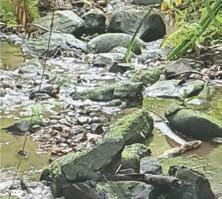
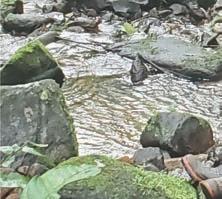
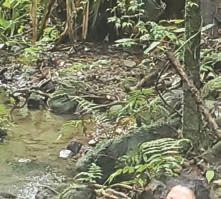
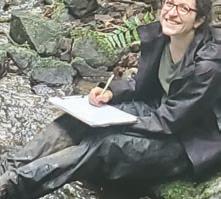

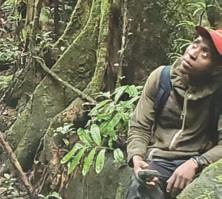
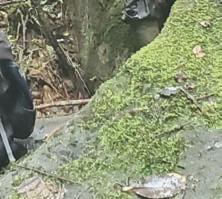
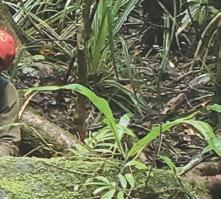
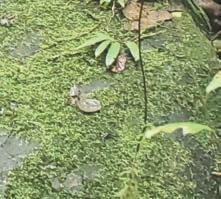
Combining the forces of WashU, the Missouri Botanical Garden, and the Saint Louis Zoo, the Living Earth Collaborative (LEC) serves as a global force for biodiversity research, advocacy, and education. The LEC has supported nearly 200 biodiversity fellows and funded seed grants for 32 research and conservation projects in 19 different countries, attracting more than $2 million in external funding.
In 2025, two world-renowned tropical biodiversity scientists joined the faculty: Lúcia Lohmann, the George Engelmann Professor of Botany; and Toby Pennington, the David and Dorothy Kemper Professor. Both are joint appointments with the Missouri Botanical Garden, where Lohmann is president. Their appointments have ignited new collaborations between the two institutions and put WashU — and the St. Louis region — at the center of global biodiversity.
Arts & Sciences scholars are contributing to promising research with the power to improve and save lives. Several recent projects have shown considerable promise and secured external funding:
• Seven members of the Department of Biology received Maximizing Investigators’ Research Awards (MIRA) from the National Institutes of Health in 2025 — the most the department has received in any year since the awards were established in 2015.
• Professor Meredith Jackrel is working with the McKelvey School of Engineering and WashU Medicine to develop vaccines to prevent Alzheimer’s disease, research funded by the National Institute on Aging.
• Postdoctoral research associate Maria F. Gonzalez-Aponte and professor Erik D. Herzog have made important discoveries about treatment for glioblastoma, an aggressive brain cancer with no known cure.
• Professor Gary Patti is spearheading a multi-omics production center that will help us better understand the roots of human diseases. The National Institutes of Health is investing $50 million into the project, with WashU receiving roughly $20 million.
• Two major projects are addressing how we fight infection: A team in the lab of associate professor Timothy Wencewicz successfully repurposed an antimalarial drug, turning it into a potent antibiotic. And a research group supported by our Incubator for Transdisciplinary Futures received nearly half a million dollars from the National Institutes of Health to work on new ways to fight infections that sometimes follow medical implants, such as joint replacements.
It is more important than ever for universities to connect their research and expertise with the interests and concerns of the public. The Program in Public Scholarship (PPS) has helped scholars share their work with general audiences through articles, books, and podcasts. The signature initiative has coached more than 50 Arts & Sciences faculty members and graduate students through the publishing process; conducted more than 30 workshops, seminars, and webinars; and assisted dozens of scholars in book development. Based on its rapid success, the program will move to the Office of the Provost in Fall 2025, expanding its support to all WashU schools.
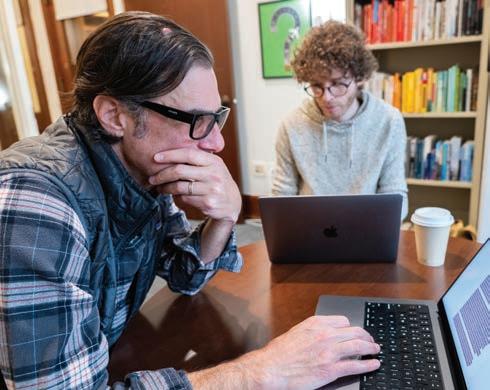

Literacies for Life and Career, a signature initiative of the Arts & Sciences Strategic Plan, is working to equip undergraduate students with a toolkit of personal and professional skills — called "literacies" — that will help them adapt and thrive in an evolving global workforce. These include applied problem solving, data analysis, intercultural and global fluency, and more. This innovative program is transforming the educational experience for our students and preparing them for competitive careers.
Already, 350 faculty members have selected literacies to incorporate into 631 first-year courses. By the 20262027 academic year, these skills will be integrated into all Arts & Sciences courses, ensuring undergraduates leave WashU ready to succeed in a complex and rapidly changing world.
Arts & Sciences has significantly ramped up efforts to engage first-year students in signature courses and experiential learning opportunities through enhanced faculty engagement, course innovation grants, and logistical support. In Fall 2024, nearly 240 first-year students participated in our signature Ampersand courses, which offer small, interdisciplinary classes with opportunities for hands-on fieldwork, research, and travel.
Ampersand programs have included travel to study hip-hop history in New York City, Holocaust representations in Germany, literary history in Ireland, environmental issues in Madagascar, and the history and culture of ancient Rome. Other courses tackle subjects including biotechnology, cancer care, medical anthropology, and global citizenship.
In addition to Ampersand programs, almost 700 Arts & Sciences students enrolled in First-Year Seminars and First-Year Opportunities in Fall 2024. These programs feature in-depth, semester-long classes reserved for first-year students.
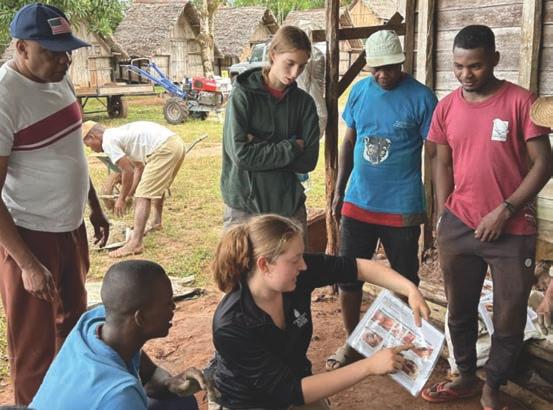


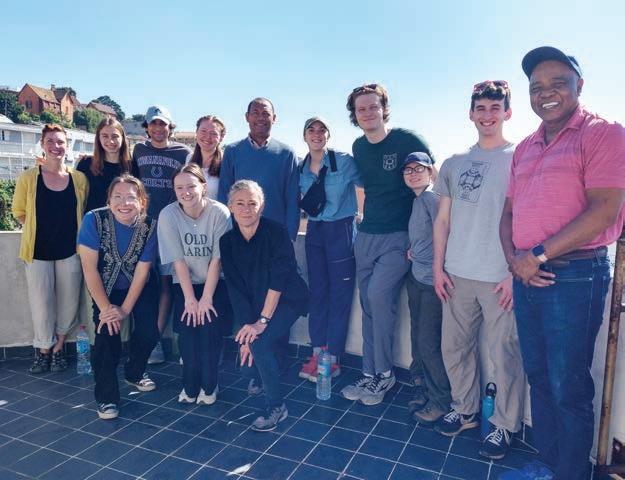
Students in the Ampersand program Path nder Fellows in Environmental Leadership traveled to Madagascar to research environmental challenges. Elizabeth Swords (pictured center) worked to improve the lives of villagers in rural Madagascar by teaching them how to build clay stoves.
Specialized undergraduate advisers refined their advising model to provide expert guidance on a range of fellowships and scholarships, helping students identify their accomplishments and develop plans that showcase their potential as scholars and citizens. Medical and law school applications have significantly benefited from this model, with medical school acceptances at more than twice the national rate.
85.5% 86%
FIRST-TIME MEDICAL SCHOOL APPLICANTS IN 2024
FIRST-TIME LAW SCHOOL APPLICANTS IN 2024
In 2024, Arts & Sciences launched the highly anticipated Program in Public Health & Society, which now offers an undergraduate major and minor. The program combines Arts & Sciences’ signature liberal arts education with hands-on public health experience through internships, community work, and independent projects. The program is a model of transdisciplinary learning, designed to prepare leaders for various career paths, including master’s degrees in public health, MDs, or PhDs in fields such as anthropology, biology, or political science.
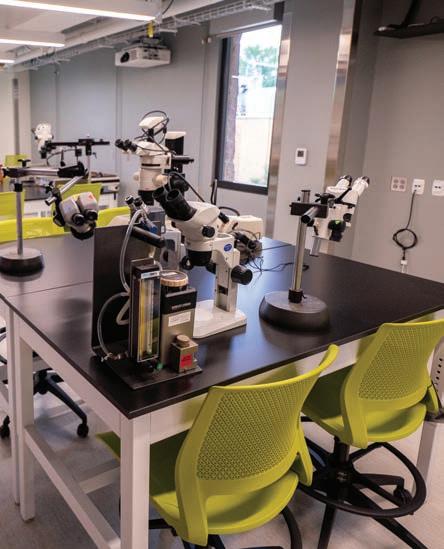
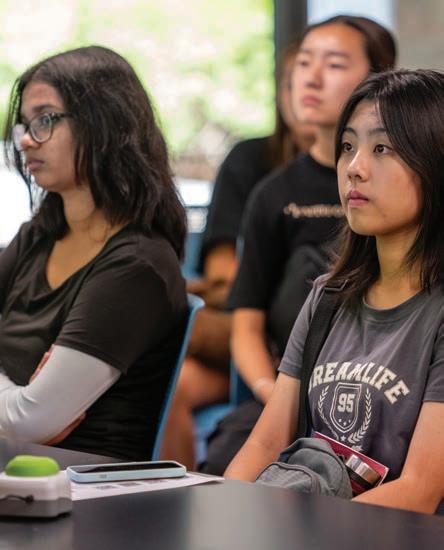
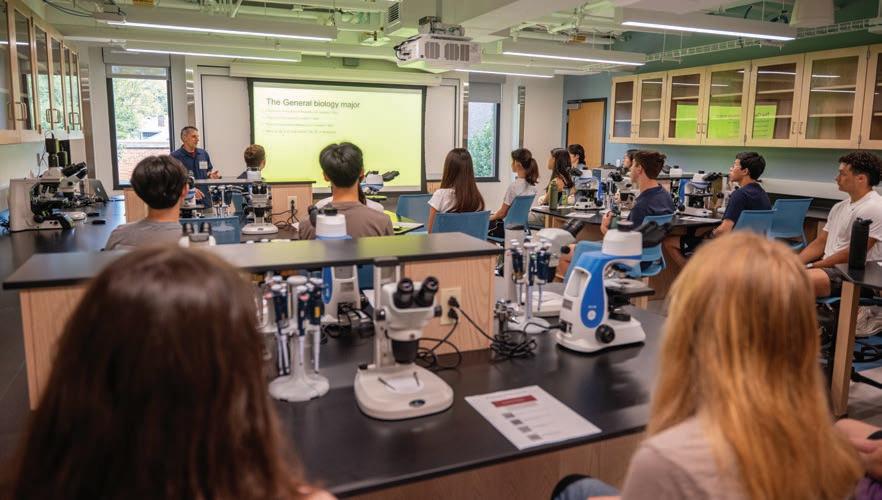
Arts & Sciences' undergraduate biology major attracts some of the best students to WashU each year, with roughly 30% of incoming students indicating an interest in the pre-health track. Making a significant investment in this critical academic program, Arts & Sciences recently debuted nine new biology teaching labs in Jolley Hall. These cutting-edge instructional spaces will provide students and instructors with state-of-the-art equipment and facilities to supercharge collaborative learning. They will also reduce class sizes, creating an enhanced experience for the more than 1,000 undergraduates taking lab courses each year. Expanding the biology department’s campus footprint also allows Arts & Sciences to transform its old teaching spaces into world-class research facilities for faculty.
The Dean’s Distinguished Graduate Fellowship program is helping Arts & Sciences recruit some of the nation's most talented graduate students to WashU. The Office of Graduate Studies (OGS) welcomed its fourth cohort to campus in Fall 2025, growing the total number of fellows to 44.
New and enhanced mentorship programs are facilitating unprecedented peer-to-peer and faculty support. The Peer Mentoring Program was redeveloped to include all 21 Arts & Sciences departments, with 39 student leaders organizing 50+ peer mentoring events last year. A new initiative, the Transdisciplinary Mentoring Communities , launched in Fall 2024 with 97 students and 16 faculty mentors — a tremendous uptake for a pilot program.
A&S CREATES established a new cohort-based graduate program with thematic content. The first cohort included 20 students focused on public scholarship, a vital way for our students to communicate their work to the world.
Through its signature research traineeship (NRT) program , the National Science Foundation invested $3 million in a new graduate student training program for aspiring scientists and educators who want to explore careers in quantum science at St. Louis-area research laboratories, private companies, and other facilities. “Linking Quantum Sensing Technologies across Disciplines” is led by Sophia Hayes, vice dean of graduate education, and Kater Murch, professor of physics.



ADVANCING SCHOLARS THROUGH COMPETITIVE EXCELLENCE AND
We launched ASCEND (Advancing Scholars through Competitive Excellence and Distinguished Achievement) to mobilize and empower PhD students to compete for prestigious external fellowships. The program, which provides modest financial incentives for students and their advisers to submit competitive external fellowship applications, expands research opportunities, fosters faculty mentorship, and helps Arts & Sciences attract and retain top-tier graduate talent. Since its launch in Summer 2024, ASCEND has already yielded powerful results:
• 130 competitive applications submitted
• More than $1 million in external funding generated
• $47,800 in incentive payments to students and advisers — a 20:1 return on investment
Arts & Sciences launched two cluster hiring initiatives to attract field-leading faculty on key topics, supercharging transdisciplinary research across campus.
In 2024, the Quantum Leaps hiring initiative led to the addition of four talented faculty members in the Department of Physics: Shaffique Adam, Karthik Ramanathan, Xi Wang, and Chuanwei Zhang. Edward Marti in the School of Medicine joined the group in 2025. These experts in quantum information, materials, and sensors have already begun exciting collaborations that will cement WashU’s reputation as a pioneer in this growing and highly competitive field. Ramanathan recently secured a $5 million grant from the Defense Advanced Research Projects Agency for a collaborative challenge to build a new neutrino detector using quantum instrumentation.
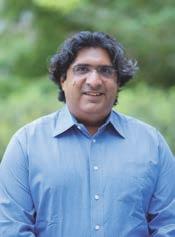

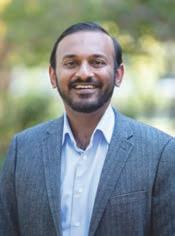
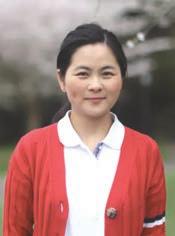
Another cluster initiative, Rules of Life, launched in 2025 and has already attracted commitments from five exceptional scientists who will use advanced computational and theoretical techniques to advance our knowledge of the systems that sustain life. The research cluster is the result of bold innovation and partnerships between the departments of chemistry, biology, and physics.
"Why does life on Earth work the way that it does? What are the rules by which life might exist or not exist in the universe? To tackle those problems, you really need the combination of chemistry, biology, physics, and other fields like data science," said Jen Heemstra, chair and professor of chemistry.
Two faculty members joined Arts & Sciences in Fall 2025: Zhiling “Zach” Zheng (Chemistry) and Trevor GrandPre (Physics). Three more are slated to begin in 2026: Judith Hoeller (Physics), Merlijn Staps (Biology), and James Holehouse (Biology).
Honorary awards to Arts & Sciences faculty members reached an all-time high with 871 cumulative lifetime awards. Since 2023, this includes:
• 5 elected to the American Academy of Arts & Sciences
• 3 elected to the National Academy of Sciences
• 5 recipients of National Science Foundation CAREER awards
• 1 recipient of the Pulitzer Prize
• 1 recipient of a Guggenheim Fellowship
Our undergraduates consistently thrive and earn well-deserved recognition on the national level, including several highly competitive awards. Since 2023, we have had:
• 1 recipient and 8 finalists for the Rhodes Scholarship
• 2 recipients and 7 finalists for the Truman Scholarship
• 10 Goldwater Scholarship recipients
• 35 recipients and 68 semi-finalists for Fulbright U.S. Student grants
• 2 Gates Cambridge Scholarship recipients
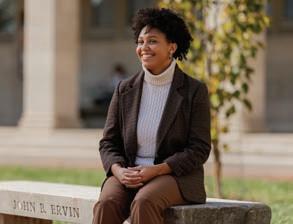
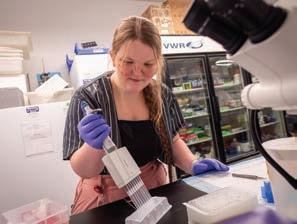
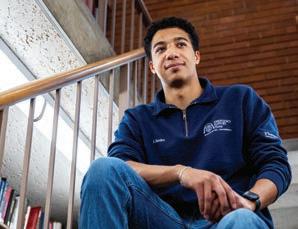
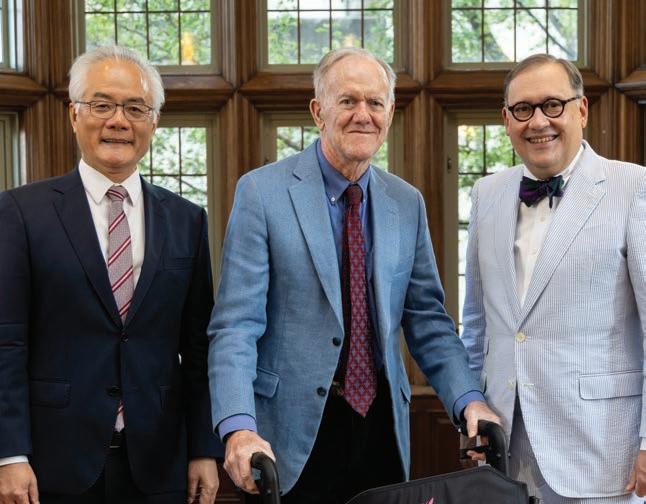
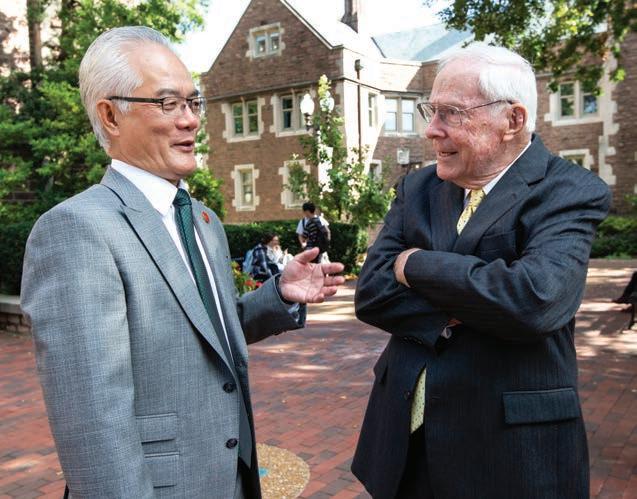
Enduring support from donors has helped sustain the vitality of the Arts & Sciences community and fuel "The Decade of Arts & Sciences."
In Fall 2024, Feng Sheng Hu was installed as the Richard G. Engelsmann Dean of Arts & Sciences, a major investment in Hu’s vision for the school and its future.
I am always motivated to look around the corner and find the next thing, learn the next thing. Arts & Sciences is such a big part of the university, and I’m very happy to be part of underwriting it.
Richard G. Engelsmann
A significant gift from John and Penelope Biggs to name the Department of Classics cemented the couple’s longstanding support of the department and WashU.
John Biggs It has been a tremendous privilege to support the Department of Classics over these past 40 years. I look forward to our gifts providing more fully the resources that will allow the classics department to serve as the shining beacon for other classics departments — a beacon that I believe it already is.
In November 2025, Toby Pennington will be installed as the David and Dorothy Kemper Professor in the biology department, a joint appointment with the Missouri Botanical Garden. A generous pledge from Distinguished Trustee David Kemper and his wife, Dorothy, along with the William T. Kemper Foundation, established the position to help WashU recruit a world-renowned scholar with deep expertise in plant science, biodiversity, and sustainability.
We are thrilled to welcome Toby Pennington. His exceptional knowledge and fervent enthusiasm will strategically position both WashU and the Garden for success as they confront urgent global challenges such as climate change.
David Kemper
Arts & Sciences is home to some of the brightest minds in the world. These recognitions are a testament to their valuable contributions to the academy and society.
Feng Sheng Hu
Deanna Barch
Ebba Segerberg
Sara Carron
Jeremy Goldmeier
Julie Rivinus
Jennifer Vines
Kailyn Williams
Center for the Literary Arts
• Co-Directors: Danielle Dutton, Ignacio Infante Center for Quantum Leaps
• Co-Directors: Kater Murch, David W. Piston Incubator for Transdisciplinary Futures
• Co-Directors: William Acree, Michael Frachetti
• Former Director: Betsy Sinclair
Literacies for Life and Career
• Co-Directors: Andrew Butler, Erin McGlothlin
• Former Director: Brian Carpenter
• Director of Curricular Innovation: Michelle DeLair
Living Earth Collaborative
• Co-Directors: Jonathan Losos, Crickette Sanz Program in Public Scholarship
• Co-Directors: Ian Bogost, Adia Harvey Wing eld
• Director of Public Scholarship: Christopher Schaberg
Public Health & Society
• Co-Directors: Tristram R. Kidder, Lindsay Stark
TRIADS
• Co-Directors: Tammy English, Bo Li
• Former Director: Jacob Montgomery