Steven Knapp
William Kristol
President, George Washington University Under Knapp’s leadership last summer, George Washington University added the Corcoran College of Art and Design to its ever-expanding real estate portfolio and plans to spend $80 million renovating the school’s building (also housing the former Corcoran Gallery of Art) on 17th Street NW. Knapp, who is GW’s 16th president and has held the job since 2007, has “prioritized enhancing the university’s partnerships with neighboring institutions.” He also serves on several high-profile boards, including the Economic Club of Washington, the Greater Washington Board of Trade and the Greater Washington Urban League. In 2012, an entrepreneurial service and learning fellowship, which grants awards ranging from $2,500 to $10,000, was established by the university in the names of Knapp and his wife. The Steven and Diane Robinson Knapp Fellowship recognizes, rewards and facilitates “creative public service and academic engagement.”
Founder and Editor, The Weekly Standard One would think that some of the people on the “Power 100” would have been run out of town long ago for bad advice, chief among them Bill Kristol, according to critics who say he has no concept of the possibility that he might be wrong about anything. But it’s been 25 years since he was dubbed “Dan Quayle’s Brain” by The New Republic, and his ideas are still influential with a significant portion of the Republican Party. Whether Kristol is playing the role of talking head on Sunday morning shows or penning his column for The Weekly Standard, much of what he says ends up becoming headline-worthy fodder. His neo-conservative positions have riled the realist foreign policy establishment and Democrats over the years, especially when he supported the second Iraq War and helped kill Bill Clinton’s chance of tackling health care in 1993. Most recently, under his Emergency Committee for Israel letterhead, he funneled more than $1 million into Arkansas senator Tom Cotton’s campaign, which was rumored to have come from Sheldon Adelson’s coffers. Kristol’s Weekly Standard also has the backing of right wing billionaire Phil Anschutz and will surely be turning Hillary Clinton into a punching bag on its pages throughout the 2016 election.
Howard Kohr Executive Director, American Israel Public Affairs Committee (AIPAC) Although AIPAC still exerts considerable influence, it used to be more careful about maintaining a sense of non-partisanship, smart enough to not pick fights it couldn’t win and reluctant to let any other socalled “pro-Israel” organizations gain traction in Washington, D.C., as it has with J Street. Led by Howard Kohr since 1997, critics are saying AIPAC has let things get out of hand and a number of its supporters are worried about how it has adopted a hard-line neo-conservative agenda, which risks eroding the bipartisan nature of its prior efforts. They cite the following three mistakes: 1) AIPAC’s opposition to Obama’s nomination of Chuck Hagel as secretary of defense, which they had to pull back; 2) AIPAC’s attempt to blow up Obama’s interim deal with Iran by pushing for greater sanctions, on which again they had to pull back; and 3) Their recent support of the Republican invitation to Israeli Prime Minister Benjamin Netanyahu to speak before Congress, which came off as unprecedented partisanship in support of a foreign leader over the president of the United States. Now, AIPAC is getting worried that the organization is increasingly viewed as a partisan appendage of neo-conservative Republicans in Congress. It still aspires to be nonpartisan but will have a hard time putting the “toothpaste back in the tube.”
WA S H I N G T O N L I F E
| may
2015
Christine Lagarde Managing Director, International Monetary Fund When Lagarde became the first female managing director of the International Monetary Fund, it was another of her own “firsts.” She was the first female chairman of her global law firm and the first female French finance minister. She told CNN earlier this year that the primary reason she wanted to do a good job was “because I don’t want to let my female colleagues around the globe down.” Though it’s laudable that she has cracked the glass ceiling and since 2011 has been guiding the slow but steady economic recovery that has seen low oil prices and interest rates, it remains to be seen whether she will be able to keep the post World War II global financial structure stable and in place.
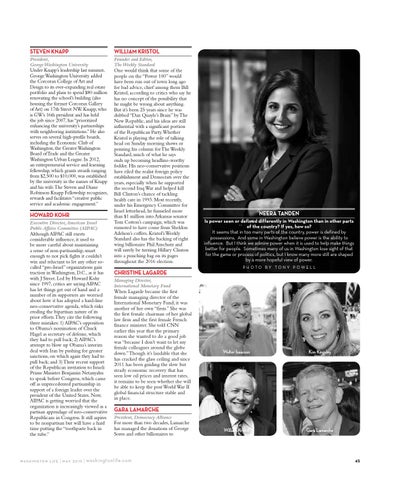
Neera Tanden Is power seen or defined differently in Washington than in other parts of the country? If yes, how so? It seems that in too many parts of the country, power is defined by possessions. And some in Washington believe power is the ability to influence. But I think we admire power when it is used to help make things better for people. Sometimes many of us in Washington lose sight of that for the game or process of politics, but I know many more still are shaped by a more hopeful view of power. p h o t o b y t o ny p o w e l l
Walter Isaacson
Kim Kingsley
William Kristol
Gara Lamarche
Gara Lamarche President, Democracy Alliance For more than two decades, Lamarche has managed the donations of George Soros and other billionaires to
| washingtonlife.com
45