Ideally, Congress needs to pass the USMCA before it leaves for summer recess, but Democratic opposition remains strong, suggesting that the deal could get put on ice as the country heads into the 2020 presidential elections.
PHOTO: PIXABAY / DAWITTIBEBU
USMCA CONTINUED • PAGE 9
fact, accounts for 80 percent of Mexico’s exports. Trump’s threat to impose a 5 percent tariff on those products would have amounted to a $17 billion tax on everything from refrigerators to jeans to avocados. Economists warned that the move would upend tightly woven supply chains between the U.S. and Mexico, raising prices for American companies and consumers. Trump’s surprise announcement stunned officials, both abroad and at home. The news dropped the same day that Trump issued an urgent call for Congress to ratify the USMCA — and in the middle of Vice President Mike Pence’s visit to Canada to discuss the pact with Trudeau. Members of Congress seemed blindsided. “Trade policy and border security are separate issues,” said Republican Sen. Charles Grassley of Iowa, warning that tariffs on Mexico would seriously jeopardize passage of the USMCA. Initially, AMLO responded to the president’s tariff Twitter screed with a snooty letter reminding him of the examples set by Abraham Lincoln and Franklin D. Roosevelt. And Mexico’s ambassador to the United States, Martha Bárcena, told reporters that the tariffs would have the perverse effect of spurring more migration by damaging the Mexican economy, similar to Trump’s decision to cut U.S. aid to Central America. “There is a clear limit to what we can negotiate, and the limit is Mexican dignity,”
PHOTO: U.S. STATE DEPARTMENT
The U.S. and Mexican flags fly outside the U.S. Embassy in Mexico City.
CREDIT: OFFICIAL WHITE HOUSE PHOTO BY SHEALAH CRAIGHEAD
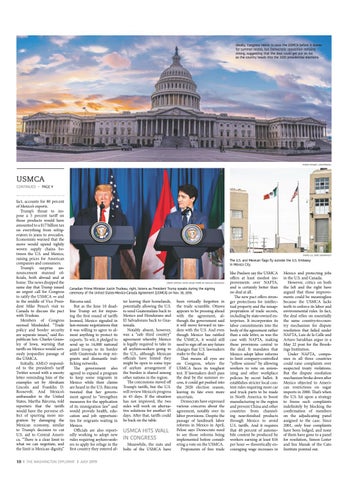
Canadian Prime Minister Justin Trudeau, right, listens as President Trump speaks during the signing ceremony of the United States-Mexico-Canada Agreement (USMCA) on Nov. 30, 2018.
Bárcena said. But as the June 10 deadline Trump set for imposing the first round of tariffs loomed, Mexico signaled in last-minute negotiations that it was willing to agree to almost anything to protect its exports. To wit, it pledged to send up to 14,000 national guard troops to its border with Guatemala to stop migrants and dismantle trafficking networks. The government also agreed to expand a program to keep some migrants in Mexico while their claims are heard in the U.S. Bárcena tweeted that her government agreed to “strengthen measures for the application of its immigration law” and would provide health, education and job opportunities for migrants waiting in Mexico. Officials are also reportedly working to adopt new rules requiring asylum-seekers to apply for refuge in the first country they entered af-
10 | THE WASHINGTON DIPLOMAT | JULY 2019
ter leaving their homelands, potentially allowing the U.S. to send Guatemalans back to Mexico and Hondurans and El Salvadorans back to Guatemala. Notably absent, however, was a “safe third country” agreement whereby Mexico is legally required to take in all asylum-seekers going to the U.S., although Mexican officials have hinted they might be open to some type of asylum arrangement if the burden is shared among other nations in the region. The concessions staved off Trump’s tariffs, but the U.S. will review Mexico’s progress in 45 days. If the situation has not improved, the two sides will work on alternative solutions for another 45 days. After that, tariffs could be back on the table.
USMCA HITS WALL IN CONGRESS
Meanwhile, the nuts and bolts of the USMCA have
been virtually forgotten in the trade scramble. Ottawa appears to be pressing ahead with the agreement, although the government said it will move forward in tandem with the U.S. And even though Mexico has ratified the USMCA, it would still need to sign off on any future changes that U.S. lawmakers make to the deal. That means all eyes are on Congress, where the USMCA faces its toughest test. If lawmakers don’t pass the deal by the summer recess, it could get pushed into the 2020 election season, leaving its fate even more uncertain. Democrats have expressed various concerns about the agreement, notably over its labor provisions. Despite the passage of landmark labor reforms in Mexico in April, Pelosi says Democrats need to see those reforms being implemented before considering a vote on the USMCA. Proponents of free trade
like Paulsen say the USMCA offers at least modest improvements over NAFTA, and is certainly better than no deal at all. The new pact offers stronger protections for intellectual property and the misappropriation of trade secrets, including by state-owned enterprises. It incorporates its labor commitments into the body of the agreement rather than a side letter, as was the case with NAFTA, making these provisions central to the deal. It mandates that Mexico adopt labor reforms to limit company-controlled “yellow unions” by allowing workers to vote on unionizing and other workplace policies by secret ballot. It establishes stricter local content rules requiring more car and truck parts to be made in North America to boost manufacturing in the region and prevent China and other countries from channeling near-finished products through Mexico to avoid U.S. tariffs. And it requires that 40 percent of automobile content be produced by workers earning at least $16 per hour — theoretically encouraging wage increases in
Mexico and protecting jobs in the U.S. and Canada. However, critics on both the left and the right have argued that those improvements could be meaningless because the USMCA lacks teeth to enforce its labor and environmental rules. In fact, the deal relies on essentially the same country-to-country mechanism for dispute resolution that failed under NAFTA, Luis de la Calle and Arturo Sarukhan argue in a May 22 post for the Brookings Institution. Under NAFTA, companies in all three countries could raise complaints over suspected treaty violations. But the dispute resolution mechanism broke down after Mexico objected to American restrictions on sugar imports in 2000. That’s when the U.S. hit upon a strategy to freeze such complaints indefinitely by blocking the confirmation of members on the adjudicating panel assigned to the case. Since 2001, only four complaints have been lodged, and none of them have gone to a panel for resolution, Simon Lester and Inu Manak of the Cato Institute pointed out.