

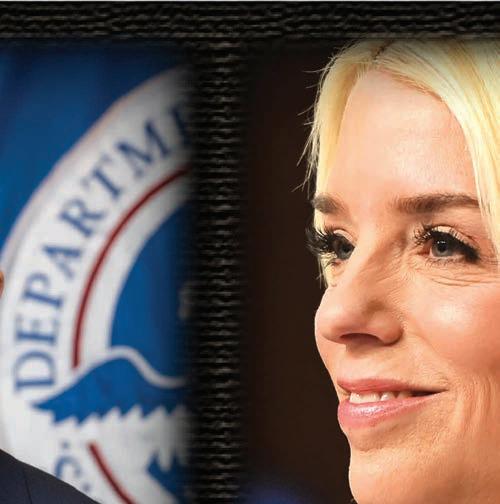





Trump’s Cabinet shuffle won’t aid LGBTQ Americans, PAGE 10





























ADDRESS PO Box 60664
Washington DC 20039
PHONE 202-747-2077
E-MAIL news@washblade.com
PUBLISHED BY Brown Naff Pitts Omnimedia, Inc.
PUBLISHER
LYNNE J. BROWN lbrown@washblade.com ext. 8075
KEVIN NAFF knaff@washblade.com ext. 8088
SR. NEWS REPORTER
LOU CHIBBARO JR. lchibbaro@washblade.com ext. 8079 WHITE HOUSE CORRESPONDENT JOE REBERKENNY jreberkenny@washblade.com ext. 9463
INTERNATIONAL NEWS EDITOR
MICHAEL K. LAVERS mlavers@washblade.com ext. 8093 POP CULTURE REPORTER
JOHN PAUL KING PHOTO EDITOR
MICHAEL KEY mkey@washblade.com ext 8084
CONTRIBUTING WRITERS
ISAAC AMEND, TINASHE CHINGARANDE, PETER ROSENSTEIN, PATRICK FOLLIARD, TERRI SCHLICHENMEYER, JOE PHILLIPS, EVAN CAPLAN, ANKUSH KUMAR, ESTEBAN RIOSECO, TOM SITUMO, AYMAN ECKFORD CREATIVE DESIGN/PRODUCTION
MEAGHAN JUBA production@azercreative.com
SALES & ADMINISTRATION
DIRECTOR OF SALES & MARKETING
STEPHEN RUTGERS srutgers@washblade.com ext. 8077
SR. ACCT. EXECUTIVE
BRIAN PITTS bpitts@washblade.com ext. 8089
CLASSIFIED ADVERTISING/ADMINISTRATION
PHILLIP G. ROCKSTROH prockstroh@washblade.com ext. 8092
NATIONAL ADVERTISING
RIVENDELL MEDIA
212-242-6863; sales@rivendellmedia.com
For distribution, contact Lynne Brown at 202-747-2077, ext. 8075.







Health center set to celebrate 40th anniversary of legal services program
By LOU CHIBBARO JR. | lchibbaro@washblade.com
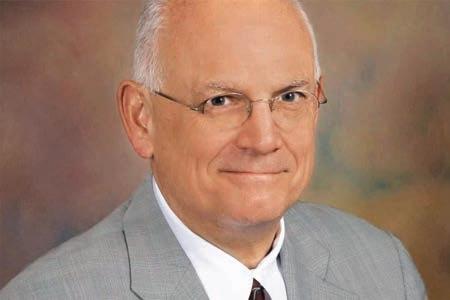
Whitman-Walker Health, the D.C.-based community healthcare center that specializes in HIV/AIDS and LGBTQ-related health services, announced it will present its annual Dale Edwin Sanders Award for Pro Bono Excellence to the international law firm McDermott Will & Schulte at a May 6 ceremony.
“This year’s award is especially significant as it coincides with the 40th anniversary of Whitman-Walker Health’s Legal Services Program, marking it as the nation’s longest running medical-legal partnership,” a statement released by Whitman-Walker says.
“As a national leader in public health, Whitman-Walker celebrates our partnership with McDermott to strengthen the health center and to enable Whitman-Walker to reach more medical and legal clients,” the statement adds.
“McDermott’s firm-wide commitment to Whitman-Walker’s medical-legal partnership demonstrates a shared vision to serve those most in need,” Amy Nelson,
Whitman-Walker’s director of Legal Services, says in the statement. “Our work protects individuals and families who face discrimination and hostility as they navigate increasingly complex administrative systems,” Nelson said.
“Pro bono legal services – like that of McDermott Will & Schulte – find solutions for people who have no place else to turn in the face of financial and health threats,” she added.
“Our partnership with Whitman-Walker Health is a treasured commitment to serving our neighbors and communities,” Steven Schnelle, one of the law firm’s partners said in the statement. “We are deeply moved by Whitman-Walker’s unwavering dedication to inclusion, respect, and equitable access to health care and social services,” he said.
The statement notes that the award for Pro Bono Excellence honors the legacy of the late gay attorney Dale Edwin Sanders. It says Sanders’s pro bono legal work for
Whitman-Walker clients “shaped HIV/AIDS law for more than four decades by securing key victories on behalf of individuals whose employment and patient rights were violated.”
It says the Whitman-Walker Legal Services program began during the early years of the AIDS epidemic in the 1980s at a time when people with AIDS faced widespread discrimination and often needed legal assistance. According to the statement, the program evolved over the years and expanded to advocate for transgender people and immigrants.
Referendum to take place April 21
By JOE REBERKENNY | jreberkenny@washblade.com
The Human Rights Campaign has endorsed a Virginia ballot initiative that would allow the state to redraw its congressional districts this year, ahead of the 2030 Census.
Currently, Virginia’s Redistricting Commission — a legislative body made up of eight legislators and eight citizens, evenly split between Republicans and Democrats — is responsible for redrawing congressional districts every 10 years following the Census. The proposed amendment would temporarily shift that authority to the Virginia General Assembly through 2030, before returning it to the commission in 2031.
Supporters say the push for the amendment comes in response to anti-democratic moves by several Republican-led state legislatures following demands from President Donald Trump, which have resulted in newly gerrymandered congressional maps that advocates argue disenfranchise pro-equality voters.
Under the proposed map in Virginia, Democrats could gain as many as four of the five seats currently held by Republicans in this fall’s midterm elections, when control of the narrowly divided House is up for grabs.
Six states — including Texas, Missouri, and North Carolina on the GOP side — enacted new maps last year at Trump’s behest. The most significant Democratic counter-effort so far has come from California.
HRC President Kelley Robinson issued a statement backing the measure, encouraging Virginia voters who support democracy to vote “yes,” saying it would ensure “the will of the people is heard.”
“Voters should choose their leaders, not the other way around. But anti-equality lawmakers around the country, in service to Donald Trump’s assaults on democracy, are trying to undermine our elections and engineer their preferred outcome in the midterms,” Robinson said. “The American people are ready to take Congress back from the anti-equality, anti-freedom politicians that have
been abusing their power to hurt all our communities and bend government to the will of a wannabe king.”
U.S. Rep. Don Beyer, who represents Virginia’s 8th Congressional District that encompasses much of Washington’s suburbs, including Alexandria, Arlington, Falls Church, and parts of eastern Fairfax County — has also voiced support for the measure. He has called Trump’s attempts to influence elections ahead of the November midterms
a “betrayal of our democracy,” emphasizing that while the fight is ongoing, this effort is a step toward correcting the situation.
“It’s not a done deal by any means,” Beyer said in an op-ed for the Cardinal News. “We have to effectively make the case that even though this seems unfair in Virginia, it’s totally fair for America, for those of us who believe that taking back the House is the most significant thing we can do to stop Donald Trump.”
Virginia Gov. Abigail Spanberger is another staunch supporter of the amendment, arguing that it would, through bipartisan means, help counterbalance Trump’s efforts in what remains an uphill battle.
“As early voting begins tomorrow on Virginia’s redistricting amendment, voters should know that Virginia’s approach is different. It is temporary, directly responsive to what other states decide to do, and — most importantly — it preserves Virginia’s bipartisan redistricting process for the future,” the first female governor of the state said
in a statement. “I supported the formation of Virginia’s bipartisan redistricting commission in 2020, and that support has not changed. What has changed is what we’re seeing in states across the country — and a president who says he is ‘entitled’ to more Republican seats before this year’s midterm elections.”
“Virginians have the opportunity to take action in response to this extraordinary moment in history,” she added. “That’s why, as a Virginia voter, I’m voting in favor of this amendment.”
Virginians for Fair Elections, the group responsible for marketing the initiative, has raised nearly $50 million dollars, according to the Virginia Public Access Project, a nonpartisan organization focusing on sharing public documents related to financial matters of the state. The ads notably feature former President Barack Obama, who supports the measure and has hailed it as a way to “level the playing field.”
In a recent Politico article, a person close to the White House, granted anonymity, suggested the outlook for Trump’s governing majority is weakening — particularly following the unraveling of the Iran war — underscoring why the administration is pushing Republican-led states to maximize their advantage ahead of the midterms.
“This war in Iran almost cements the fact that we lose the midterms in November — the Senate and House,” the person said.
According to The Economist, Trump holds a 37 percent approval rating, with 56 percent of respondents disapproving of his handling of the presidency.
This is not the first time Virginia has held a special election for a statewide ballot initiative. Most recently, in 1956, voters approved a measure that led to the use of public funds to provide tuition grants for students attending nonsectarian private schools.
Early voting is already underway in the Old Dominion, with Election Day set for April 21.











By JOE REBERKENNY | jreberkenny@washblade.com
President Donald Trump became famous for his use of the phrase “You’re fired!” while hosting the reality TV show “The Apprentice” in the early 2000s. However, during his time in the Oval Office, he has attempted to distance himself from that image.
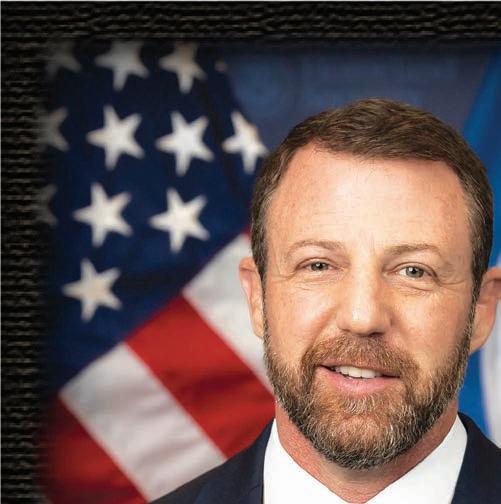
Despite those efforts, the phrase once again comes to mind as Trump has fired two high-level female Cabinet members within the past month: Pam Bondi and Kristi Noem. Their replacements — Todd Blanche at the Justice Department and Markwayne Mullin at the Department of Homeland Security — bring records that, while different in depth, both reflect limited support for LGBTQ protections and, in some cases, direct opposition.
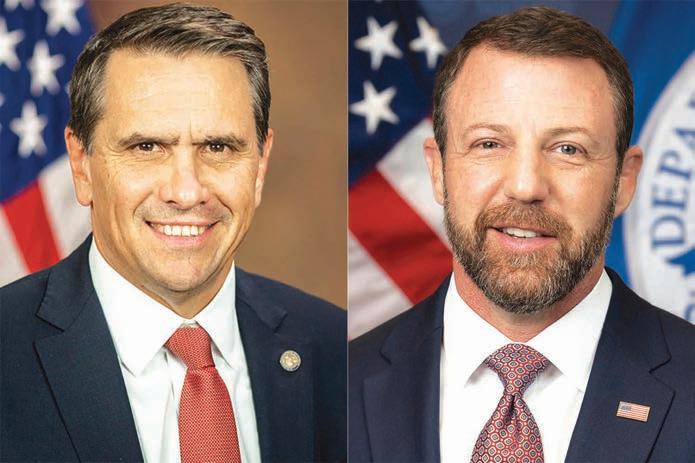
Todd Blanche
Acting attorney general
Little has been found regarding Todd Blanche’s LGBTQ record prior to his role as acting head of the Department of Justice. Unlike those who have worked within the Justice Department’s Civil Rights Division or served as state attorneys general, he has not developed a public-facing legal ideology on LGBTQ issues.
Blanche attended American University for his undergraduate studies — like fellow Trump attorney Michael Cohen — where he met his future wife, Kristin, who was studying at nearby Catholic University in D.C.
He began his legal career as an intern at the U.S. Attorney’s Office in Washington, which eventually became a full-time position. He later worked as a paralegal in the U.S. Attorney’s Office for the Southern District of New York while attending Brooklyn Law School at night. Blanche graduated cum laude in 2003. He and his wife later married and had two children.
Blanche left the U.S. attorney’s office in 2014, taking a job in the Manhattan office of the law firm WilmerHale. In September 2017, he moved to Cadwalader, Wickersham & Taft LLP, where he was a partner in the White Collar Defense and Investigations practice.
In his personal capacity, he represented several figures associated with Donald Trump and former New York City Mayor Rudy Giuliani, including Trump’s former campaign manager Paul Manafort, businessman Igor Fruman, and attorney Boris Epshteyn.
In 2024, Blanche switched from Democrat to Republican, aligning himself with Trump’s political orbit. He later served as Trump’s personal defense attorney in the New York State case that led to Trump’s 2024 conviction on 34 felony counts of falsifying business records to cover up hush-money payments to bisexual adult film star Stormy Daniels.
Now the highest-ranking official at the Justice Department, Blanche has played a central role in overseeing the department and has been involved in leadership decisions tied to several controversial actions affecting LGBTQ people.
In a letter to New York Attorney General Letitia James, Blanche declared that the Jus-
tice Department “will not sit idly by while you attempt to use your office to force harmful procedures on our most vulnerable population,” if legal action were taken against NYU Langone. The hospital had “permanently” ended a program earlier that month after the Trump-Vance administration threatened to pull all federal funding if it continued prescribing puberty blockers and hormones to minors.
Blanche wrote that “the Justice Department believes the law is clear, and anti-discrimination laws cannot be used to force NYU Langone to perform sex-rejecting procedures on children.”
“As just one example, your office’s position would require a hospital to prescribe certain medications for certain diagnoses, regardless of the hospital’s or its doctors’ independent medical determination about the propriety of such treatment,” he said.
Blanche also echoed his predecessor’s public stance on limiting LGBTQ-related protections at the federal level, aligning with Bondi’s sentiments in June 2025 regarding the U.S. Supreme Court’s 6–3 decision that restricted LGBTQ history lessions in schools and limits lower federal courts from issuing nationwide injunctions — rulings that have often blocked Trump administration policies.
Calling it “another great decision that came down today,” Blanche argued that the ruling “restores parents’ rights to decide their child’s education,” adding: “It seems like a basic idea, but it took the Supreme Court to set the record straight, and we thank them for that. And now that ruling allows parents to opt out of dangerous trans ideology and make the decisions for their children that they believe is correct.”
In December 2025, a Justice Department memo stated that, “effective immediately,” prisons and jails would no longer be held responsible for violations of standards meant to protect LGBTQ people from harassment, abuse, and rape under the Prison Rape Elimination Act. The law, passed unanimously by Congress in 2003, requires that incarcerated people be screened for their risk of sexual assault, including consideration of LGBTQ status, and applies to all correctional facilities.
Additionally, when the Justice Department, under Blanche’s deputy leadership and at Trump’s behest, attempted to force Children’s National Hospital in D.C. to turn over medical records related to gender-affirming care, U.S. District Judge Julie R. Rubin ruled that the effort “appears to have no purpose other than to intimidate and harass.”
Blanche is also described as having a “strong belief in executive authority.”
While Blanche’s record is defined more by recent actions than a long paper trail, Markwayne Mullin brings a more established history on LGBTQ issues from his time in Congress.
The head of the Department of Homeland Security has served in Congress since 2013, in both the U.S. House of Representatives and U.S. Senate. He has been actively engaged in shaping restrictions and aligns with broader cultural rhetoric that frames anti-LGBTQ speech as protected expression.
In May 2016, Mullin criticized the Department of Education and the Justice Department’s “Dear Colleague” letter on transgender students, arguing that trans girls should not use girls’ restrooms in public schools.
By January 2021, Mullin and then-Hawaii Congresswoman Tulsi Gabbard had introduced a bill to prevent trans women from participating in women’s sports.
Mullin was not recorded as voting on the final passage of the Respect for Marriage Act, which codified federal recognition of same-sex and interracial marriage.
In 2023, Mullin received a rating of just 6 percent from the Human Rights Campaign.
While serving in the Senate and as a member of the Health, Education, Labor, and Pensions (HELP) Committee, Mullin has been a vocal critic of policies aimed at expanding LGBTQ inclusion in federal programs. He has participated in broader Republican efforts questioning equity-based implementation of the Older Americans Act, including guidance related to sexual orientation and gender identity in aging services, arguing such policies could have unintended consequences.
Mullin also makes history as the first Native American — and a citizen of the Cherokee Nation — to lead the Department of Homeland Security.
He was among the 147 Republicans who voted to overturn the 2020 presidential election results despite no evidence of widespread fraud, and was present in the House on Jan. 6.
The Pride flag will once again fly over the Stonewall National Monument in New York following a court order requiring the National Park Service to raise it over the site.
The decision follows a lawsuit filed by Lambda Legal and the Washington Litigation Group in the U.S. District Court for the Southern District of New York, which challenged the removal as unconstitutional under the Administrative Procedure Act and argued that the government unlawfully targeted the LGBTQ community.
In February, the NPS removed the Pride flag from the Stonewall National Monument, the first national monument dedicated to LGBTQ rights and history in the U.S. The move followed a Jan. 21 memorandum issued by President Donald Trump-appointed NPS Director Jessica Bowron restricting which flags may be flown at national parks. The directive limited displays to official government flags, with narrow exceptions for those deemed to serve an “official purpose.”
Plaintiffs successfully argued that the Pride flag meets that standard, given Stonewall’s status as the birthplace of the modern LGBTQ rights movement. They also contended that the policy violated the APA by bypassing required public input and improperly applying agency rules.
The lawsuit named Interior Secretary Doug Burgum, Bowron, and Amy Sebring, superintendent of Manhattan sites for the NPS, as defendants. Plaintiffs included the Gilbert Baker Foundation, Village Preservation, Equality New York, and several individuals.
The court found that the memorandum — while allowing
limited exceptions for historical context purposes — was applied unlawfully in this case. As part of the settlement, the NPS is required to rehang the Pride flag on the monument’s official flagpole within seven days, where it will remain permanently.

“The sudden, arbitrary, and capricious removal of the Pride flag from the Stonewall National Monument was yet another act by this administration to erase the LGBTQ+ community,” said Karen Loewy, co-counsel for plaintiffs and Lambda Legal’s Senior Counsel and Director of Constitutional Law Practice. “Today, the government has pledged to restore this important symbol back to where it belongs.”
“This is a complete victory for our clients and for the
LGBTQ+ community,” said Alexander Kristofcak, lead counsel for plaintiffs and a lawyer with Washington Litigation Group. “The government has acknowledged what we argued from day one: the Pride flag belongs at Stonewall. The flag will be restored and it will fly officially and permanently. And we will remain vigilant to ensure that the government sticks to the deal.”
“Gilbert Baker created the Rainbow Pride flag as a symbol of hope and liberation,” said Charles Beal, president of the Gilbert Baker Foundation. “Today, that symbol is restored to the place where it belongs, standing watch over the birthplace of the modern LGBTQ+ rights movement.”
“The government tried to erase an important symbol of the LGBTQ+ community, and the community said no,” said Amanda Babine, executive director of Equality New York. “Today’s accomplishment proves that when we stand together and fight back, we win.”
“The removal of the Pride flag from Stonewall was an attempt to erase LGBTQ+ history and undermine the rule of law,” said Andrew Berman, executive director of Village Preservation. “This settlement restores both.”
With Loewy on the complaint are Douglas F. Curtis, Camilla B. Taylor, Omar Gonzalez-Pagan, Kenneth D. Upton Jr., Jennifer C. Pizer, and Nephetari Smith from Lambda Legal. With Kristofcak on the complaint are Mary L. Dohrmann, Sydney Foster, Kyle Freeny, James I. Pearce, and Nathaniel Zelinsky from Washington Litigation Group.
JOE REBERKENNY
The White House submitted its 2027 budget request to Congress last month, outlining a push for the Federal Bureau of Investigation to “proactively” target what it describes as “extremism” related to gender — raising concerns about the potential for law enforcement to target LGBTQ people.
The Trump-Vance administration’s 2027 budget request, submitted to Congress on April 4, proposes a dramatic increase in national security and law enforcement spending, while reducing foreign aid and restructuring multiple domestic security programs. In total, the administration is requesting $2.16 trillion in discretionary budget authority (including mandatory resources), a 15.3 percent increase over the 2026 proposal.
Central to the proposal is the creation of a new “NSPM-7 Joint Mission Center,” a direct follow-up to the September 2025 National Security Presidential Memorandum 7 (NSPM7). The directive instructs the Justice Department, the FBI, and other national security agencies to combat what the administration defines as “political violence in America,” effectively reshaping the Joint Terrorism Task Force network to focus on “leftist” political ideologies, according to reporting by independent journalist Ken Klippenstein
The American Civil Liberties Union has characterized NSPM-7 as a way for President Donald Trump to intimidate his political enemies.
In a press release following the memorandum, Hina Shamsi, director of the ACLU’s National Security Project, said, “President Trump has launched yet another effort to investigate and intimidate his critics,” and had described the move as an “intimidation tactic against those standing up for human rights and civil liberties.”
The proposed mission center would include personnel from 10 federal agencies tasked with targeting “domes-
tic terrorists” associated with a wide range of ideologies. Among them is what the administration labels “extremism” related to gender, alongside categories such as “anti-Americanism,” “anti-capitalism,” “anti-Christianity,” and “support for the overthrow of the U.S. government.” The document also cites “hostility toward those who hold traditional American views” on family, religion, and morality — language LGBTQ advocates have increasingly warned could be used to frame queer and transgender rights movements as ideological threats.
The mission center is one component of a proposed $166 million increase in the FBI’s counterterrorism budget.
In total, the FBI would receive $12.5 billion for salaries and expenses under the proposal, a $1.9 billion increase. Planned investments include unmanned aerial systems operations and counter-drone capabilities, counterterrorism efforts, and security preparations for the 2028 Summer Olympics in Los Angeles. The budget also cites 67,000 FBI arrests since Jan. 20, 2026, which it describes as a 197 percent increase from the prior year.
When Congress passed the USA PATRIOT Act in 2001, it also enacted 18 U.S.C. § 2331(5), which defines domestic terrorism as activities involving acts dangerous to human life that violate criminal laws and are intended to intimidate or coerce civilians or influence government policy through violence. That statutory definition has not changed.
However, federal agencies have historically categorized domestic terrorism threats into groups such as racially or ethnically motivated violent extremism, anti-government or anti-authority violent extremism, and other threats, including those tied to bias based on religion, gender, or sexual orientation.
The language in the budget suggests a shift in how those categories are interpreted and applied — particularly by
explicitly linking “extremism” to gender and to perceived opposition to “traditional” views — without any corresponding change to federal law. Only Congress has the power to change the definition of domestic terrorism by passing legislation.
The budget document states:
“DT lone offenders will continue to pose significant detection and disruption challenges because of their capacity for independent radicalization to violence, ability to mobilize discretely, and access to firearms. Additionally, in recent years, heinous assassinations and other acts of political violence in the United States have dramatically increased. Commonly, this violent conduct relates to views associated with anti-Americanism, anti-capitalism, and anti-Christianity; support for the overthrow of the U.S. government; extremism on migration, race, and gender; and hostility toward those who hold traditional American views on family, religion, and morality.”
This language echoes earlier actions by the Trump-Vance administration targeting trans people.
On the first day of his second term, President Trump signed Executive Order 14168, titled “Defending Women from Gender Ideology Extremism and Restoring Biological Truth to the Federal Government.”
The order establishes a strict binary definition of sex and withdraws federal recognition of trans people.
“It is the policy of the United States to recognize two sexes, male and female,” the order states. “‘Sex’ shall refer to an individual’s immutable biological classification as either male or female. ‘Sex’ is not a synonym for and does not include the concept of ‘gender identity.’”
Appropriations committees in both chambers are expected to begin hearings in the coming weeks.
JOE REBERKENNY










































FRIDAY,MAY15,2026@5PM



•StateRep.ClaireSnyder-Hall •NewCAMPRehobothExecutiveDirectorDr.RobinBrennan •Surpriseguest!



By LEON FERRARI
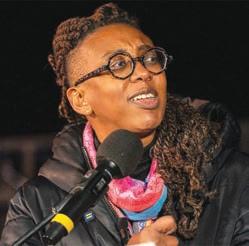
Erika Hilton, the first Black transgender woman elected to the Brazilian Congress, in April 2025 prepared to speak at the annual Brazil Conference at Harvard University and the Massachusetts Institute of Technology in Cambridge, Mass.
As part of her official diplomatic duties, Hilton required a diplomatic visa to enter the U.S. However, the U.S. Embassy in Brasília issued the document with a glaring discrepancy: the congresswoman’s gender was listed as “male,” directly contradicting her official Brazilian identification, which legally recognizes her gender as “female.”
Hilton in response canceled her participation in the conference and filed a formal report with the United Nations, characterizing the incident as a violation of the Brazilian state’s diplomatic prerogatives and an act of institutional transphobia. The Brazilian Foreign Ministry last month issued a new diplomatic passport to the congresswoman in an act of symbolic reparation, a move intended to reaffirm her official status and legal identity in the wake of the U.S. embassy’s actions.
Despite the restorative gesture from the Brazilian government, Hilton told the Washington Blade that she has no intention of entering the U.S. in the near future — at least not while President Donald Trump remains in the White House.
“I am afraid of what might happen to someone like me under an administration like Donald Trump’s,” Hilton said. “It is an authoritarian, anti-democratic government that has no respect for international law.”
“We’ve seen, for example, how ICE (U.S. Immigration and Customs Enforcement) acted with extreme violence against people who held tourist visas and were simply visiting the country,” she added. “There is a deep-seated fear of how people are treated by immigration authorities and law enforcement. All of this is terrifying, and it has convinced me that I should not set foot in the United States as long as a fascist government is in power.”
While her travel to the U.S. remains on hold, the congresswoman has been exceptionally active in Brazil.
Hilton last month made history once again by becoming the first trans woman elected to chair the Chamber of Deputies’ Commission on the Defense of Women’s Rights. This appointment marks the first time a trans person has led a standing committee in the Brazilian Congress — the latest milestone in a career defined by its pioneering spirit.
“This is a milestone in my story. It’s a milestone for that dreamy young girl who, at 14, was forced into sex work on a street corner to survive, and who today returns to make peace with her past. But even from where I stand now, I am looking back and pointing toward those who are still out there on those street corners, to remind them: we are capable of so much more. We are capable of building something far greater than the limited spaces that hatred and discrimination have reserved for us,” she told the Blade.
Unlike the Congressional Caucus for Women’s Issues in the U.S., which functions primarily as a platform for advocacy and lobbying, Brazil’s Commission on the Defense of Women’s Rights wields significant institutional power. Within the Brazilian legislative system, this body holds “conclusive authority,” a specialized power that allows it to bypass the general floor of the Chamber of Deputies. If the commission approves a bill, it can be sent directly to the Senate for a vote, bypassing a full house plenary session.
Beyond this autonomy, the commission possesses what is effectively a pocket veto: if it rejects a proposal on constitutional grounds or deems it detrimental to women’s protections, the bill is shelved immediately. This powerful committee has been the primary vehicle for landmark legislation, including the Equal Pay Act (Law 14,611/23) and critical laws targeting the political harassment of women.
Defining womanhood beyond biology
Hilton emphasizes that her election as chair of the Women’s Rights Commission was no easy feat, but a grueling struggle. The battle began within her own party, as she worked to convince colleagues that she was not only a viable candidate but an essential one.
The hostility intensified significantly following her nomination.
Far-right conservative sectors orchestrated what the congresswoman denounced as a systematic, sponsored wave of attacks that transcended social media, spilling into the very halls of Congress. The rhetoric her opponents used leaned heavily on biological determinism — a strategy that attempts to reduce womanhood to reproductive functions or genetic characteristics.
Hilton’s election on March 11 laid bare a deeply fractured Congress.
With 11 votes in her favor and 10 lawmakers casting blank ballots, the result served as
an explicit form of protest. In the context of these internal elections, the blank votes did not signal indecision; rather, they represented a calculated attempt by the opposition to strip the incoming chair of her political legitimacy. It was a clear warning that Hilton will face fierce institutional resistance throughout her tenure — a reality that has already manifested during her first weeks at the helm of the commission.
Hilton in her inaugural address promised an inclusive leadership.
“Here we will address the issues facing poor women, Black women, trans women, cis women, mothers, and breastfeeding women. All of them, without exception,” she said.
However, the most resonant moment of her speech was her historic tribute to Sojourner Truth, the Black abolitionist and human rights activist who, in 1851, delivered the iconic “Ain’t I a Woman?” speech at a women’s rights convention in the U.S. Paraphrasing Truth, Hilton argues that contemporary transphobia is deeply rooted in 19th century racism.
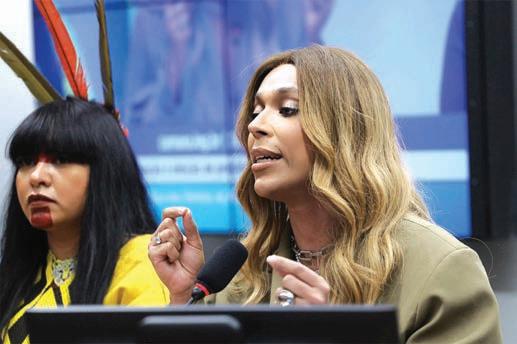
“Truth was a cisgender woman and a mother, but in that context, her biology did not grant her legitimacy or the right to challenge the status quo of womanhood because of her race. If we broaden our perspective, we must recall the eugenicist pseudo-science that deemed Black people inferior based on skull measurements, and the brutal gynecological experiments performed on enslaved women. Those women were not considered ‘women’ by the society of that era either,” Hilton told the Blade, explaining the historical framework behind her address.
“We, as trans women and travestis, are the targets of this historical moment,” she added. “I invoked Truth’s words to remind everyone that we are all victims of the same systemic oppression and the same denial of our right to our own identity — this did not start with us. Yesterday, she was targeted because of the color of her skin; today, I am targeted because of my body’s anatomy.”
Hilton concluded her inaugural address by reaffirming that her chairmanship will bring visibility to the identities that the commission has historically neglected. She emphasized that the trans struggle is a matter of survival in a country that leads the world in rates of violence against this community.
“We no longer accept being rendered invisible; we no longer accept having our identities violated. We refuse to live in a country that leads the world in killing us, by shooting us in the face, ripping out our hearts, and dragging us through the streets,” she declared.
Since Hilton became chair, committee sessions have been marked by an atmosphere of turmoil and legislative gridlock — a dire situation for a country that, over the past year, has set records for femicides. In Brazil, femicide is a specific legal classification for the murder of women motivated by gender, designed to ensure harsher criminal penalties.
Opposition lawmakers, who rarely attended commission sessions before Hilton’s election, have begun showing up en masse to coordinate attacks against her, prioritizing obstructionism over the urgent need to address gender-based violence.
Tensions reached a fever pitch on April 8 when right-wing Congresswoman Rosana Valle threatened Hilton by invoking one of the country’s most significant legal provisions: the Maria da Penha Law. Recognized by the United Nations as one of the most progressive pieces of legislation in the world, the statute was designed specifically to protect women from domestic and family violence.
Continues at washingtonblade.com.
VINCENZO MALO is a Health Services Ph.D. student at the University of Washington’s School of Public Health who studies affirming health systems.
Dr. HARRY BARBEE is an assistant professor in the Johns Hopkins Bloomberg School of Public Health whose research focuses on LGBTQ+ health, aging, and public policy.
What Chiles
Imagine if researchers found that coffee drinking increased your risk of death by more than 50%. The public health response would be immediate – regulations, warnings, a swift mobilization of policy to match the evidence. We would act, because protecting people from documented harm is what evidence-based policy exists to do.
The same logic is why Colorado banned conversion therapy. The science was clear: research from The Trevor Project and others shows that exposure to conversion therapy increases suicidal ideation among LGBTQ+ youth, and more than doubles suicide attempts for transgender youth. Every major medical organization in the country – the American Medical Association, the American Psychological Association, and the American Academy of Pediatrics – has condemned the practice.
Colorado looked at the evidence and did what public health is supposed to do. It intervened.
On March 31, 2026, the Supreme Court struck down that intervention 8-1 in the Chiles v. Salazar case, ruling that conversion therapy is protected speech.
This decision should alarm anyone who believes that science has a role in protecting human lives. The court did not dispute evidence. It did not produce contradicting research or question the methodology of the studies Colorado relied on. Instead, it decided that the ideological underpinnings of conversion therapy deserve more constitutional protection than the children being harmed by it. In doing so, it severed the fundamental link between what science tells us is dangerous and what the law is willing to prohibit.
That severance has consequences far beyond Colorado, as Supreme Court Justice Ketanji Brown Jackson noted in her dissent. More than 20 states and Washington, D.C. have enacted conversion therapy bans. The court majority’s reasoning – that regulating talk-based practices constitutes censorship – hands challengers a blueprint. The scientific consensus that built those protections did not change on March 31, but its power to hold them in place did.
For LGBTQ+ public health researchers like us, this ruling is a reckoning. And a personal one. Both of us came to public health because it offered a way to ask questions that matter: How can we help people live safe, healthy, and happy lives?
As a Ph.D. student and an assistant professor focused on LGBTQ+ health, we have been energized by the possibility that rigorous research could inform policies that protect LGBTQ+ people. The Chiles v. Salazar ruling forces us to recognize something uncomfortable: the possibility of research driving policy is real, but it is not automatic. Evidence reaches policy only when researchers advocate to put it there. As it turns out, scientific evidence itself is not enough.
This means the work of LGBTQ+ health researchers cannot stop at the journal article. It has to extend into the spaces where policy is actually made and public opinion is actually influenced. Researchers must work alongside educators, communicators, and community organizers to make evidence impossible to ignore or misrepresent.
As Sylvia Rivera observed in 1971, “our family and friends have also condemned us because of their lack of true knowledge.” More than 50 years later, misinformation about conversion therapy, gender-affirming care, and LGBTQ+ health still fills the gap that researchers leave when they stay silent.
We also want to say this directly to LGBTQ+ young people: Science has not abandoned you. The evidence of your worth, your health, and your right to be protected is overwhelming and it is not going anywhere. The researchers, clinicians, and advocates who built that evidence are still here and still working to ensure it translates into the protection you deserve.
The Chiles v. Salazar ruling is a serious setback. But it is not the end of the argument.
Science has shown us how conversion therapy causes harm. It has shown us clearly, repeatedly, and with the backing of every credible medical institution in the country. The Supreme Court chose to look away. The only response to that is to make looking away harder. To build a public, cross-sector, science-informed movement that refuses to let evidence be sidelined when lives are on the line.
The evidence is on our side. Now, we have to make sure it counts.
is a professor of law at University of Virginia School of Law.
Chiles v. Salazar a major setback for movement
In its recent decision in Chiles v. Salazar, the U.S. Supreme Court invalidated Colorado’s law prohibiting licensed counselors from engaging in efforts to change the sexual orientation or gender identity of minors. The decision, which puts into question similar laws in 22 other states, relied on the First Amendment to hold that the law violates counselors’ free speech rights. But the decision also strikes a blow against LGBTQ dignity, a point the court’s opinion does not even address.
The eight-member majority, which included Justices Elena Kagan and Sonia Sotomayor, who usually side with LGBTQ groups, justified its reasoning by suggesting that the law was one-sided: it permitted treatment that affirms LGBTQ identity but forbade treatment that seeks to change it. But the law is one-sided, as Justice Ketanji Brown Jackson’s lone dissent pointed out, because the medical evidence only supports one side: reams of research show that “survivors of conversion therapy continue to suffer from PTSD, anxiety, and suicidal ideation.” And major medical associations all agree, no evidence demonstrates the efficacy of conversion efforts. This isn’t surprising. Medicine often take sides — some treatments work, and some don’t.
But particularly concerning is the vision of LGBTQ identity that undergirds the majority opinion when compared to the dissent. Justice Jackson’s dissent explains that LGBTQ identity is simply “a part of the normal spectrum of human diversity” — not something to be “cured.” By contrast, for the majority, how best to help LGBTQ minors is “a subject of fierce public debate.” That can hardly be the case if LGBTQ identity stands on equal ground with straight, cisgender identity, or if LGBTQ people are as deserving of safety, rights, and dignity.
Indeed, the LGBTQ rights movement only began in earnest when advocates in the 1960s decided to end the “debate” over gay identity. Until then, community leaders would routinely cooperate with psychiatrists who were interested in researching homosexuality as a medical condition. A new generation of activists, led by Frank Kameny, a key movement founder, began arguing that this got the issue upside down: Rather than wondering if they could be “cured,” LGBTQ people had to assert a right to their identity. As Kameny put it—“we have been defined into sickness.” Only once the case was made that it was society that had to change, and not LGBTQ people, could LGBTQ consciousness, LGBTQ pride and LGBTQ rights develop. Their activism led to the first Pride parade in New York, and the official declassification of homosexuality as a disease in 1973.
The Supreme Court’s conservatives don’t just want to reignite this half-century old medical “debate”; they also treat medical claims that undermine LGBTQ identity very differently from those who support it. Last year, in an opinion backingTennessee’s law that banned gender affirming care for minors, the court sympathetically marched through the reasons Tennessee offered for “why States may rightly be skeptical” of such care, and cited three times, in some detail, to “health authorities in a number of European countries” (that is, some Nordic countries and the UK) that had curbed pediatric care. It failed to mention that most of Western Europe and every major American medical association provides access to this care.
In Chiles, by contrast, the court cites none of the evidence that Colorado amassed that conversion therapy harms LGBTQ children. None of the countries that the court had invoked to justify anti-trans policies allow conversion therapy in their health care systems (indeed, one of them criminalizes such practices). So rather than cite medical evidence, the court simply asked — why trust medical evidence at all? “What if,” asks the court, “reflexive deference to currently prevailing professional views [does] not always end well?” and cites an infamous 1927 Supreme Court case, Buck v. Bell.
In Buck, the Supreme Court embraced eugenic reasoning, backing a eugenic state law that allowed the sterilization of individuals with mental disabilities, on the grounds that such disabilities were hereditary. As Justice Oliver Wendell Holmes opined, “three generations of imbeciles are enough.” Look at what happens when we listen to medical expertise, today’s court seems to say, as an excuse to disregard the LGBTQ-affirming medical evidence they don’t like.
But the court has missed the key lesson of Buck. The law at issue in Buckdiscriminated against a certain group, seeking, through sterilization measures, to erase it from existence. Indeed, LGBTQ people (whom doctors of the day would have referred to as sexual “inverts”) were exactly the kind of people that the eugenic program of Bucksought to eliminate. Conversion therapy seeks similar erasure.
The lesson of the 1960s LGBTQ rights movement remains as relevant today as it was then. Without an unapologetic LGBTQ identity, LGBTQ Pride, LGBTQ rights and the LGBTQ movement itself can all founder. By supporting only the anti-LGBTQ side in this medical saga — and by suggesting that LGBTQ existence is subject to medical debate at all — the court is reaffirming, rather than repudiating, minority erasure.

is a longtime LGBTQ rights and Democratic Party activist. He writes regularly for the Blade.
I was disappointed when the Blade didn’t publish my response to a personal attack on me in a column by Hayden Gise, in last week’s print edition. They did publish it online. To be clear, I have no problem with people disagreeing with my columns and opinions. That is absolutely fair. But when they get into personal attacks, it often means they don’t have enough to say about the ideas they are trying to criticize.
In a recent column ‘Why the Democratic Socialists of America are right for D.C.,’ the author decided to attack me personally. Here is the response I wrote to her column:
“I am responding to a column by Hayden Gise who says in her column she is a transgender, lesbian, Jewish, Democratic Socialist, and supports having the Democratic Socialists of America (DSA) in Washington, DC. She is definitely as entitled to her view on this, as I am to mine. However, I was surprised she clearly felt it important to use the column to attack me personally, without even knowing me. What she didn’t do is respond to the issues in the DSA platform I wrote having a problem with, and which I asked candidates endorsed by the DSA to respond to. 1. Are they for the abolishment of the State of Israel? 2. What is their definition of a Zionist? 3. What is their definition of antisemitism? 4. Will they meet with Zionist organizations? 5. Do they support BDS? One needs to know when a candidate claims they are only a member of the local DSA, according to the DSA bylaws no person can be a member of a local DSA without being a member of the national organization. So Hayden Gise has a little better idea of who I am she should know: I was a teacher and a union member. I worked for the most progressive member of Congress at the time, Bella S. Abzug (D-N.Y.), and supported her when she introduced the Equality Act in 1974, to protect the rights of the LGBTQ community, and have fought for its passage

ever since. I have spent a lifetime fighting for civil rights, women’s rights, disability rights, and LGBTQ rights. I have no idea what Hayden Gise’s background is, or what her history of working for the causes she espouses is. But I would be happy to meet with her to find out. But she should know, I take a back seat to no one in the work I have done over my life fighting for equality, including economic equality, for all. So, I will not attack her, as I don’t know her, and contrary to her, don’t personally attack people I don’t know much about.
“I have, and will continue to attack, what the government of Israel is doing to the Palestinian people, and now to those in Lebanon and Iran. I will also attack the government of my own country, and the felon in the White House, and his sycophants in Congress, for what they are doing to our own people, and people around the world, and will continue to work hard to change things. However, I will also continue to stand for a two-state solution with the continued existence of the State of Israel, calling for a different government in Israel. I also strongly support the Palestinian people and believe they must have the right to their own free state.”
I have not heard from Gise, but I hope she knows that since she wrote her column indicating her support for Janeese Lewis George for mayor, her preferred candidate has attended a birthday party to celebrate a person who still refers to gay people as ‘fags.’
We should not personally attack people we don’t know as a way to criticize their views on an issue. Once again, I have no problem with people disagreeing with what I write, and having the Blade publish those contrary columns. But a plea to all who disagree with any columnist, or story: disagree with the issues and refrain from making personal attacks on the writer. That actually takes away from whatever point you are trying to make.

D.C.’s electronic music festival set for May 30-31
By EVAN CAPLAN

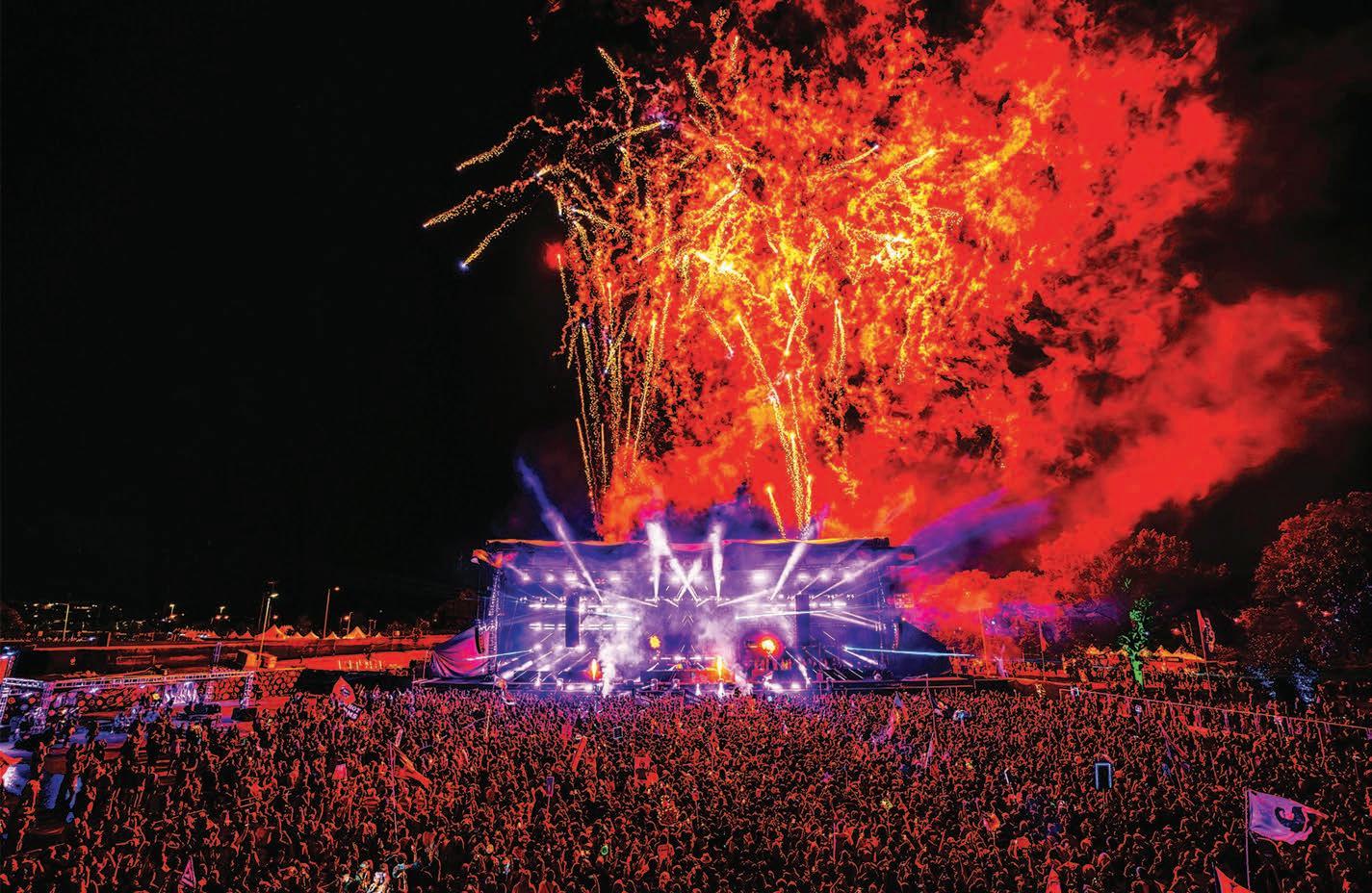
Aging RFK Stadium has come down, but the RFK grounds are still getting lit up. Welcome back to the stage Project GLOW, D.C.’s homegrown electronic festival, on May 30-31. Back for its fifth year on these musically inclined acres, Project GLOW returns with an even more diverse lineup, and one that continues to celebrate LGBTQ antecedents, attendees, and acts.
Project GLOW 2026 headliners include house and techno star Mau P, progressive house legend Eric Prydz, hard-techno favorite Sara Landry, and bass acts Excision b2b Sullivan King, among the lineup of trance, bass, house, techno, dubstep, and others for the fifth anniversary year.
President & CEO Pete Kalamoutsos — born and raised in D.C. — founded Club GLOW in 1999. In 2020, GLOW entered into a partnership with global entertainment company Insomniac Events to produce live events like Project GLOW, which kicked off in 2022.
As in past years, Project GLOW not only makes space, but is intentionally inclusive of the LGBTQ community, one of its most dedicated fan bases. The festival’s LGBTQ-focused Secret Garden stage blooms again — a more intimate dance area that stands on the strength of DJs and musicians who draw from the LGBTQ community. D.C.’s LGBTQ nightlife mastermind Ed Bailey is the creative mind behind Secret Garden again. He joined Project GLOW in 2023.
“Kalamoustos says that “he’s proud of his partnership with Ed Bailey, along with Capital Pride and [nightlife producer] Jake Resnikow. It’s amazing to collaborate with Bailey at the Secret Garden stage, especially after the curated lineup we worked on at Pride last year.”
The Secret Garden will be a bit different from other stages: Eternal (“At the Eternal stage, time stands still. Lose yourself in the dance of past, present, and future, surrendering to the eternal rhythm of the universe”) and Pulse (“Feel the rhythm of the beat pulse through your veins as the heartbeat of the crowd
synchronizes into one. Here, every moment vibrates with life as it guides you through a new dimension of euphoria”). The Secret Garden stage is in the round, surrounded by 16 shipping containers. The containers play canvas to muralists from around the world, who are coming in to paint them in a vibrant garden-style vibe. “We gave this stage some extra love with this layout,” K says, “ we finally cracked the code.”
K says that this will be the biggest lineup yet for the Secret Garden, featuring Nicole Moudaber b2b Chasewest, Riordan b2b Bullet Tooth, Ranger Trucco, Cassian, Eli & Fur, Cosmic Gate and Hayla. The stage is also the largest yet, featuring an expanded dance floor and 360-degree viewing.
Across all stages, K says that his goal for the fifth anniversary is “More art and fan interactive experience, more like a festival, strive to be like a Tomorrowland, as budget grows to add more experience.” Last year’s Project GLOW alone drew 40,000 attendees over two days.
K, however, was not satisfied with one festival this spring. GLOW recently announced a “pop-up” one-day event. Teaming up with Black Book Records, GLOW is set to throw a first-of-its-kind dance-music takeover of Pennsylvania Avenue, N.W., headlined by electronic music star Chris Lake. Set for April 18, this euphoric block party will feature bass and vibes blocks from the White House. Organizers expect as many as 10,000 fans to attend. Beyond music, there will be food, activations, and plenty of other activities taking place around 6th St and Pennsylvania Ave NW - a location familiar to many in the LGBTQ community, as this sits squarely inside the blocks of the Capital Pride party that takes place in DC every June.
Over the past two decades, Club GLOW has produced thousands of events, from club nights to large-scale festivals including Project GLOW, Moonrise Festival, and more. Club GLOW also operates Echostage.
Center Aging Monthly Luncheon With Yoga will be at 12 p.m. at the DC Center for the LGBT Community. Email Mac at maca@thedccenter.org if you require ASL interpreter assistance, have any dietary restrictions, or questions about this event.
GoGay DC will host “LGBTQ+ Social in the City” at 7 p.m. at Hotel Zena. This is a chance to relax, make new friends, and enjoy happy hour specials at this classic retro venue. Attendance is free and more details are available on Eventbrite.
Trans and Genderqueer Game Night will be at 7:00p.m. at the DC Center for the LGBT Community. This is a relaxing, laid-back evening of games and fun. All are welcome and there’ll be card and board games on hand. Feel free to bring your own games to share. For more details, visit the DC Center’s website.
GoGay DC will host “LGBTQ+ Community Brunch” at 11 a.m. at Freddie’s Beach Bar & Restaurant. This fun weekly event brings the DMV area LGBTQ+ community, including allies, together for delicious food and conversation. Attendance is free and more details are available on Eventbrite.
The DC Center for the LGBT Community will host “Sunday Supper on Saturday” at 2 p.m. It’s more than just an event; it’s an opportunity to step away from the busyness of life and invest in something meaningful, and enjoy delicious food, genuine laughter, and conversations that spark connection and inspiration. For more details, visit the Center’s website.
Sunday, April 19
GoGay DC will host “LGBTQ+ Community Lunch” at 11 a.m. at Federico Ristorante Italiano. This fun weekly event brings the DMV area LGBTQ+ community, including allies, together for delicious food and conversation. Attendance is free and more details are available on Eventbrite.
By TINASHE CHINGARANDE
Monday, April 20
Center Aging: Monday Coffee Klatch will be at 10 a.m. on Zoom. This is a social hour for older LGBTQ+ adults. Guests are encouraged to bring a beverage of choice. For more information, contact Adam (adamheller@thedccenter.org).
Tuesday, April 21
Center Bi+ Roundtable will be at 7 p.m. on Zoom. This is an opportunity for people to gather in order to discuss issues related to bisexuality or as Bi individuals in a private setting.Visit Facebook or Meetup for more information.
Senior Self Defense Class with Avi Rome will be at 12:30 p.m. This inclusive and beginner-friendly class, led by Instructor Avi Rome, offers a light warm-up, stretching, and instruction in basic techniques, patterns, and striking padded targets. Each session is designed to be adaptable for all ability and mobility levels, creating a welcoming space for everyone to build strength, confidence, and community through martial arts. For more details, visit the DC Center’s website.
Wednesday, April 22
Job Club will be at 6 p.m. on Zoom upon request. This is a weekly job support program to help job entrants and seekers, including the long-term unemployed, improve self-confidence, motivation, resilience and productivity for effective job searches and networking — allowing participants to move away from being merely “applicants” toward being “candidates.” For more information, email centercareers@ thedccenter.org or visit www.thedccenter.org/careers.
Asexual and Aromantic Group will meet at 7 p.m. on Zoom. This is a space where people who are questioning this aspect of their identity or those who identify as asexual and/or aromantic can come together, share stories and experiences, and discuss various topics. For more details, email supportdesk@thedccenter.org.
The DC Center’s Fresh Produce Program will be held all day at the DC Center for the LGBT Community. People will be informed on Wednesday at 5:00 pm if they are picked to receive a produce box. No proof of residency or income is required. For more information, email supportdesk@thedccenter.org or call 202-682-2245.
Virtual Yoga Class will be at 7 p.m. on Zoom. This free weekly class is a combination of yoga, breath work and meditation that allows LGBTQ+ community members to continue their healing journey with somatic and mindfulness practices. For more details, visit the DC Center’s website.
Team DC will host “Night of Champions Gala” on Saturday, April 18 at 6 p.m. at the Georgetown Marriott.
This will be an evening of celebration and inspiration as Team DC honors remarkable individuals and supports the next generation of LGBTQ student-athletes.
There will be opportunities to support Team DC through auctions. The Silent Auction items will offer an array of unique goods and experiences. Additionally, Team DC will feature an exclusive selection of live auction items for those looking to make a significant impact.
This year, Team DC will recognize six outstanding awardees who have made significant contributions to the LGBTQ community and sports:
• Trailblazer Award - Adam Peck, District Wrestling
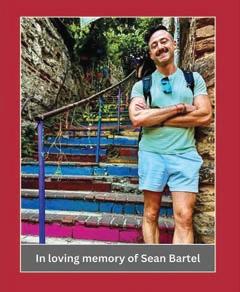
• Most Valuable Person Award - Sean Bartel (posthumously)
• Champion Award - Dan Martin
• Clark Ray Horizon Award - Manuel Montelongo, aka Mari Con Carne
• Bernard Jude Delia Award - Dr. Sara Varghai
• Platinum All Star Award - Centaur Motorcycle Club
To purchase tickets, visit Team DC’s website.



















Modern creative talks nightlife, coming out, and his personal queer heroes
FROM STAFF REPORTS
John Levengood (he/him) describes himself as a modern creative with a wide-ranging toolkit. He blends music, technology, civic duty, and a sharp sense of wit into a cohesive artistic identity. Known primarily as a recording artist and performer, he’s also a self-taught music producer and software engineer who embodies a generation of creators who build their own lanes rather than wait for one to appear.

Levengood, 32, who is single and identifies as gay and queer, is best known as a recording artist who has performed at Pride festivals across the country, including the main stages of World Pride DC, Central Arkansas Pride, and Charlotte Pride.
“Locally in the DMV, I’m known for turning heads at nightlife venues with my eye-catching sense of style. When I go out, I don’t try to blend in. I hope I inspire people to be themselves and have the courage to stand out,” he says.
He’s also known for hosting karaoke at Freddie’s Beach Bar in Arlington, Va., on Thursday nights. “I like to create a space where people feel comfortable expressing themselves, building community, and showcasing their talents.”
He also creates social media content from my performances and do interviews at LGBTQ+ bars and theatres in the DMV. Follow the Arlington resident @johnlevengood.
How long have you been out and who was the hardest person to tell?
I have been fully out of the closet since 2019. My parents were the hardest people to tell because my family has always been my rock and at the time I couldn’t imagine a world without them. Their reactions were extremely positive and supportive so I had nothing to fear all along. I remember sitting on the couch with my mom, dad, and sister in our hotel room in New Orleans during our winter vacation and being so nervous to tell them. After I finally mustered up the nerve and made the proclamation, I realized my dad had already fallen asleep on the couch. My mom promised to tell him when he woke up.
Who’s your LGBTQ hero?
My LGBTQ heroes are Harvey Milk for paving the way for gays in politics and Elton John for being a pioneer for the fabulous and authentic. My local heroes in the DMV are Howard Hicks, manager of Green Lantern, and Tony Rivenbark, manager of Freddie’s Beach Bar. Both of them are essential to creating spaces where I’ve felt welcome and safe since moving to the DMV.
What’s Washington’s best nightspot, past or present?
Trade tops the list for me because of the dance floor and outdoor space. It’s so nice to get a break from the music every once and a while to be able to have a conversation.
We live in challenging times. How do you cope?
I’m still figuring this out. What is working right now is writing music and spending time with family and friends. I’ve also been spending less time on social media going to the gym at least three times a week.
What streaming show are you binging?
After “Traitors” Season 4 ended, I was in a bit of a show hole, but “Stumble” has me in a laughing loop right now. The writing is so witty.
What do you wish you’d known at 18?
At 18, I wish I would have known how liberating it is to come out of the closet. It would have been nice to know some winning lottery numbers as well.
What are your friends messaging about in your most recent group chat?
We are planning our next trip to New York City. If you can believe it, I visited NYC for the first time in 2025 for Pride and I’ve been back every quarter since. Growing up in the country, I was subconsciously primed to be scared of the city. But my mind has been blown. I can’t wait to go back.
Why Washington?
It’s the closest metropolitan area to my family, but not too close. I love the museums, the diversity, the history, and the proximity to the beach and mountains. It’s also nice to live in a city with public transportation.
By PATRICK FOLLIARD
Celebrated for its site-specific, immersive productions, Rorschach Theatre puts on plays all over town. The unlikely spots have included greenhouses, church vestibules, closed retail spaces (including a vacant downtown big and tall men’s store) and historic locales like Rock Creek Cemetery’s Adams Memorial.
For its current offering “Dragon Play” (through May 17), a tale of love and longing, Rorschach is using a raw space in The Stacks at Buzzard Point, a new mixed-use neighborhood situated where the Anacostia and Potomac rivers meet.
Out sound designer Madeline ‘Mo’ Oslejsek considers all sites – whether traditional theatrical spaces or not – specific, particularly in terms of sound. She says, “Part of my practice is if you’re creating a soundscape for a theatrical production you’re also working with sound that already exists with the space.”
For instance, The Stacks space comes with its own unique qualities. It’s a large cement room that has a different reverberation, an echo.
“Some sounds (a car, dog bark) are planted or they might just happen. What starts as a live sound might be heard again as something recorded.”
Whip smart with a ready laugh, Oslejsek never set out to be a sound designer. She was going to direct. And now, the 2025 Helen Hayes Award nominee for Outstanding Sound Design (“Astro Boy and the God of Comics” at Flying V,) says, “Sound is
my bag. Sometimes it seems that I’m the only one in the room thinking about it.”
As an undergrad studying theater at Ohio Wesleyan University, she was first exposed to sound design, but it didn’t make a big impression.
In grad school at Royal Central School of Speech and Drama, University of London, she was interested in direction. But when students were offered a choice of three more specific tracks to choose from (performance, composition, and scenography, which includes sound design), Oslejsek was swayed.
“An introduction to scenography by the department head radically changed the course of my life,” she says.
What struck her most about sound was the subjectivity: “The core of my practice is that sound has no meaning until it’s experienced. All sound is noise. It’s just a pitch, active, or vocalization. It becomes real when you hear it and apply meaning to it. That’s very exciting to me.”
Today, Oslejsek and partner Caitlin Hooper, an actor and intimacy choreographer, are based in Baltimore but work primarily in D.C.
“It feels good to be in a place where art and queerness in art are celebrated. It’s not like that everywhere, and making that kind of work down the street from this White House where that’s not the vibe, is real resistance. That feels really meaningful.”
Also important to Oslejsek (who identifies alternately as
queer and lesbian) is “queer as a practice,” a concept suggesting that a queer identity or practice does not seek to replace other identities but to encompass and bridge them.

“I’m queer because I like women, but the work is more about making room for what everyone in the room hears,” she says. “Never do I want to come into a space thinking I have all the answers. That’s no fun.”
As its title might suggest, Jenny Connell Davis’ play directed by Rorschach’s Randy Baker is filled with magic. “Dragon Play,” blurs the past and present; one world bleeds into the next; and, of course, there are dragons. At 80 minutes with no intermission, the play moves in and out of different timelines; increasingly things start to overlap.
And it’s also about the magic of relationships – all kinds. There’s a line where the dragon girl asks a Texas boy what he dreams about and he replies “you, always you.”







By JOHN PAUL KING
In the years since “Schitt’s Creek” wrapped up its six season Emmy-winning run, nostalgia for it has grown deep – especially since the still painfully recent loss of its iconic leading lady, Catherine O’Hara, whose sudden passing prompted a social media wave of clips and tributes featuring her fan-favorite performance as the deliciously daft Moira Rose. Revisiting so many favorite scenes and funny moments from the show naturally reminded us of just how much we loved it, even needed it during the time it was on the air; it also reminded us of how much we miss it, and how much it feels now like something we need more than ever.
That, perhaps more than anything else, is why the arrival of “Big Mistakes” – the new Netflix series starring, co-created and co-written by Dan Levy – felt so welcome. We knew it wouldn’t be the Roses, but it seemed cut from the same cloth, and it had David Rose (or at least someone who seemed a lot like him) in the middle of a comically dysfunctional family dynamic, complete with a mother who gets involved in town politics and a catty sibling rivalry with his sister, and still nebbish-ly uncomfortable in his own gay shoes. Only this time, instead of running a pastor of the local
church, and instead of a collection of kooky small town neighbors to contend with, there are gangsters.

As it turns out, it really does feel cut from the same cloth, but the design is distinctly different. Set in a fictional New Jersey suburb, it centers on Nicky (Levy) and his sister Morgan (Taylor Ortega) – he openly gay with an adoring boyfriend (Jacob Gutierrez), yet still obsessive about keeping it all invisible to his congregation, and she drudging aimlessly through life as an underpaid schoolteacher after failing to achieve her New York dreams of show biz success – who inadvertently become enmeshed in a shady underworld when a
gesture for their dead grandmother’s funeral goes horribly awry.
They’re surrounded by a crew of equally compromised characters. There’s their mother Linda (Laurie Metcalfe), whose campaign to become the town’s mayor only intensifies her tendency to micromanage her children’s lives; Yusuf (Boran Kuzum), the Turkish-American mini-mart operator who pulls them into the criminal conspiracy yet is himself a victim of it; Max (Jack Innanen), Morgan’s livein boyfriend, who pushes her for a deeper commitment and is willing to go to couples’ therapy to prove it; Annette, his mother (Elizabeth Perkins), who lends her society standing toward helping Linda’s campaign against a misogynistic opponent (Darren Goldstein); and Ivan (Mark Ivanir), the seemingly ruthless crime boss who enslaves the siblings into his network but may really be just another slave in it himself. It’s a well-fleshed out assortment of characters that helps our own loyalties shift and adapt, generating at least a degree of empathy – if not always sympathy – that keeps everyone from coming off as a merely “blackand-white” caricature of expectations and typecasting.
To be sure, it’s an entertaining binge-watch,
full of distinctive characters – all inhabiting familiar, even stereotypical roles in the narrative – who are each given a degree of validation, both in writing and performance, as the show unspools its narrative. At the same time, it makes for a fairly bleak overall view of humanity, in which it’s difficult to place our loyalties with anyone without also embracing a kind of “dog eat dog” morality in which nobody is truly innocent – but nobody is completely to blame for their sins, anyway.
In this way, it’s a show that lets us off the hook in the sense that it places the idea of ethical guilt within a framework of relative evils as it permits us to forgive our own trespasses through our acceptance of its lovably amoral – when it comes right down to it - characters, each of whom has their own reasons and justifications for what they do. We relate, but we can’t quite shake the notion that, if all these people hadn’t been so caught up in their own personal dramas, none of them would have ended up in the compromised morality that they do, and that they are all therefore, at some level, to blame for whatever consequences they endure.



















Automakers still offer a few good traditional station wagons
By JOE PHILLIPS
As a teenager, one of the first cars I drove — and fell in love with — was our family’s hulking full-size wagon. It stretched over 19 feet in length and weighed a whopping 5,300 pounds. That’s three feet longer and 1,000 heavier than, say, a Ford Explorer today.
But this Leviathan felt safe and practical, especially when tootling around town with my crew or traveling solo cross-country. Of course, this hauler was also an eco-disaster.
Luckily, that’s not the case today. And even though the number of traditional station wagons keeps shrinking, automakers are still offering a few gems.
$54,000 | MPG: 23 city/31 highway
0 to 60 mph: 6.6 seconds
Cargo space: 51 cu. ft. (rear seats folded)

PROS: Elegant design. Composed handling. Top safety features.
CONS: So-so power. Modest rear legroom. Only two trim levels.
The 2026 Volvo V60 Cross Country doesn’t cry for attention — and that’s the point. This is the automotive equivalent of Kristen Stewart, a celebrity who’s confident in her own skin and sees no need to post about it.
Under the hood, there’s a four-cylinder turbo engine paired with a mild-hybrid system, producing 247 horsepower. You won’t outrun other drivers, but there is a sense of calm authority when accelerating. The standard all-wheel drive and 8.1 inches of ground clearance mean this wagon is ready for dirt roads, bad weather or a spontaneous weekend jaunt.
And inside? Scandinavian minimalism at its finest. Clean lines. Gorgeous materials. Google-based infotainment that mostly works — though occasionally the system could be a bit faster, at least for my taste. The ride is smooth, composed and quiet, even if acceleration feels more “measured sip” than “espresso shot.”
But here’s the twist: After more than a decade, this is the final Volvo wagon in the U.S. Its farewell tour ends in 2026. That alone gives it collector-car status.
$95,000 | MPG: 21 city/25 highway
0 to 60 mph: 3.4 seconds
Cargo space: 64.6 cu. ft. (rear seats folded)

PROS: Supercar vibe. Hybrid versatility. Stunning interior. CONS: Some fussy controls. Can feel heavy when cornering.
If the Volvo V60 Cross Country is subtle, the 2026 Mercedes-AMG E53 Wagon is a screamer. It’s like being at a Lil Nas X concert: flashy, high energy, and full of shock and awe.
This performance wagon — a plug-in hybrid, no less — pushes well over 500 horsepower (and in some configurations over 600 horsepower), launching from 0 to 60 mph as fast as a $300,000 Aston Martin supercar.
Yes, deep down, this is still a wagon. But you also can do a Costco run in something that could embarrass sports cars at a stoplight. That duality is delicious.
Inside, Mercedes leans all the way in. The high-tech Superscreen setup stretches across the dash. Ambient lighting glows like a curated art installation. The 4D surround-sound audio literally pulses through the seats. It’s immersive. Borderline excessive. And entirely the point.
Rear-axle steering helps mask the size of this car, but there’s no hiding the weight — it’s a big, powerful machine. Still, this hauler handles far better than physics suggests it should.
PORSCHE TAYCAN CROSS TURISMO
$121,000 | Range: 265 miles
0 to 60 mph: 2.8 seconds
Cargo space: 41 cu. ft. (rear seats folded)

PROS: Lightning fast. Space-age design. EV smoothness. CONS: Very pricey. Options add up quickly. Limited rear visibility.
The Porsche Taycan Cross Turismo completely rewrites the wagon formula. Fully electric. Shockingly fast. Designed like it belongs in the Louvre.
Performance is instant. Depending on trim level, you’re looking at 0-to-60 mph in less than 3 seconds. No exuberant engine noise — just that smooth, purring EV surge.
Handling? Pure Porsche. Low center of gravity thanks to the battery-pack placement. Precision that makes winding roads feel like choreography. And then — hello — there’s also a Gravel Mode for light off-road use.
Inside, the style is restrained but high-tech. Digital displays dominate, including a 10.3-inch passenger side touchscreen. Yet the layout feels intentional rather than overwhelming. Build quality is exceptional. Options, including leather-free materials and an active-leveling system for hard cornering, are endless — and expensive.
Range varies by model. But as with any EV, your lifestyle (and charging access) matters.
Overall, this is a wagon that looks and behaves like one helluva class act.
‘Drag









MAY 8-10, 2026

Audience favorite soprano Emily Noël joins an ensemble of viols and lute for this springtime program curated by Mary Springfels and narrated by Holly Twyford.
TICKETS: FOLGER.EDU/GARDEN


Find the perfect floor plan to fit your style and budget at an Erickson Senior Living®-managed community near you!
• Ashby Ponds® Ashburn, VA
• Greenspring® Springfield, VA
• Riderwood® Silver Spring, MD
• The Grandview Bethesda, MD
• Woodleigh Chase® Fairfax, VA
Call 1-800-711-8639 or visit EricksonSeniorLiving.com for your free brochure.
EricksonSeniorLiving.com








Straight out of the Gilded Age | Logan Circle Grande Dame.
$2,199,900
Step into timeless elegance with this circa-1890 stately residence overlooking vibrant Logan Circle. Perfectly positioned with two sides of striking bay windows and coveted southwestern exposure, this remarkable home is flooded with natural light, offering picturesque park views and an unmatched connection to one of DC’s most iconic neighborhoods. The main level showcases soaring 11-foot ceilings, rich hardwood floors, intricate custom woodwork, and two stunning fireplaces with exquisite mantlepieces. Grand yet inviting entertaining spaces blend historic charm with everyday comfort. The first upper level features a gracious primary suite with custom shutters and views of Logan Park, a full bath with an antique claw-foot tub, and a spacious second bedroom or family room with its own fireplace. The sweeping staircase leads to the top level, where three additional bedrooms and a second full bath provide flexibility for family, guests, or office space. The fully finished lower level—with a separate entrance—offers incredible versatility. Complete with a living room, table-space kitchen, sixth bedroom with en-suite full bath, and walk-out private patio access, it’s ideal as an in-law suite, guest quarters, or private workspace. Outside, enjoy beautifully landscaped gardens and a generous patio enclosed by a custom iron fence—perfect for entertaining or quiet relaxation. This is a rare opportunity to own one of Logan Circle’s last intact single-family residences—rich in history, character, and urban energy.








FERNANDO’S CLEANING
FOR SALE / DC
WASHINGTONBLADE.COM/ CLASSIFIEDS
and your ad will appear in print & online! If you need assistance, please email the text & image to: classifieds@washblade.com or call 202-747-2077 x 8092 leave a message!
PERSONAL & HOUSING SHARE ADS ARE STILL FREE!
*First 25 words or less. Each additional word at $1.00 each. Monday, 5 pm deadline for Friday’s print issue!
Residential & Commercial Cleaning, Reasonable Rates, Free Estimates, Routine, 1-Time, Move-In/Move-Out 202-486-6183 COUNSELING
KASPER’S LIVERY SERVICE Your Personal Limo/Uber Service

FOR
People. Individual/Couples counseling with a volunteer peer counselor. GMCC, serving our community since 1973. 202-580-8861
gaymenscounseling.org No fees. Donation requested. HANDYMAN
BRITISH REMODELING
Local licensed company with over 25 years of experience. Specializing in bathrooms, kitchens & all interior/exterior repairs. Drywall, paint, electrical, wallpaper, roofing & siding. Trevor 703-303-8699


WHERE DO YOU WANT TO GO. LET ME TAKE YOU THERE! Proper DC License & Livery Insured. Gay & Veteran Owner/Operator. Since 1987. 202-554-2471 www.KasperLivery.com
Please tell our advertisers, “I saw your ad in the Blade!”
RENT COLLEGE PARK, MD FURNISHED 1BR - BSMT. YOU MUST SEE THIS








NEW FABULOUSLY RENOVATED semi-private furnished basement apartment located in North College Park steps from City dining, Mom’s and other stores, easy access major roadways & only 10 min walk to Metro. $1745.00 per month ***All Utilities Included.*** bit.ly/4r79Qje email: cprental@ymail.com
LOGAN CIRCLE GRAND DAME

This circa-1890 stately Grand Dame commands a premier position overlooking life on Logan Circle. With two sides of broad bay windows on 3 levels, bathing the home in natural light--each framing beautiful views of the park--and a coveted fenced and private courtyard, you’ll have a front row seat to this historic neighborhood in downtown DC. 6 bedrooms/3 baths and private entry to lower level living. Andy Alderdice - 301.466.5898 andy4homes@gmail.com
Long & Foster Real Estate 202-234-4100
Luxury Real Estate SpecialistLicensed in MD, DC & VA Integrity. Experience. Commitment. Local.

PLACE YOUR AD TODAY! WashingtonBlade.com/classifieds
TALL, NICE LOOKING, WHITE MAN
iso tall, 20-something, well-hung, white dude ready to give up what between his legs to a top’s nice lips for some sheer delight. Sincere responses, please text me. I will get back to you. Available 24 hrs a day. CALL OR TEXT: 240-457-1292
Massage or Deep Tissue. Appts. Low Rates, 24/7, In-Calls.