Washington Blade, Volume 57, Issue 08, February 20, 2026
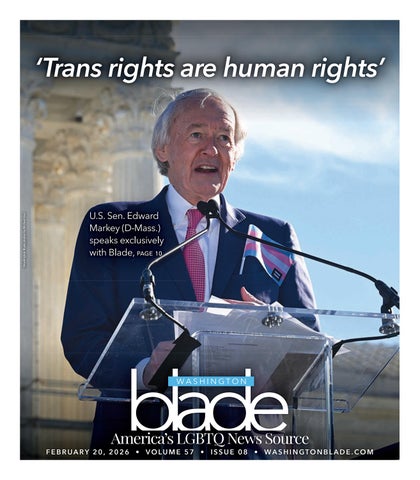
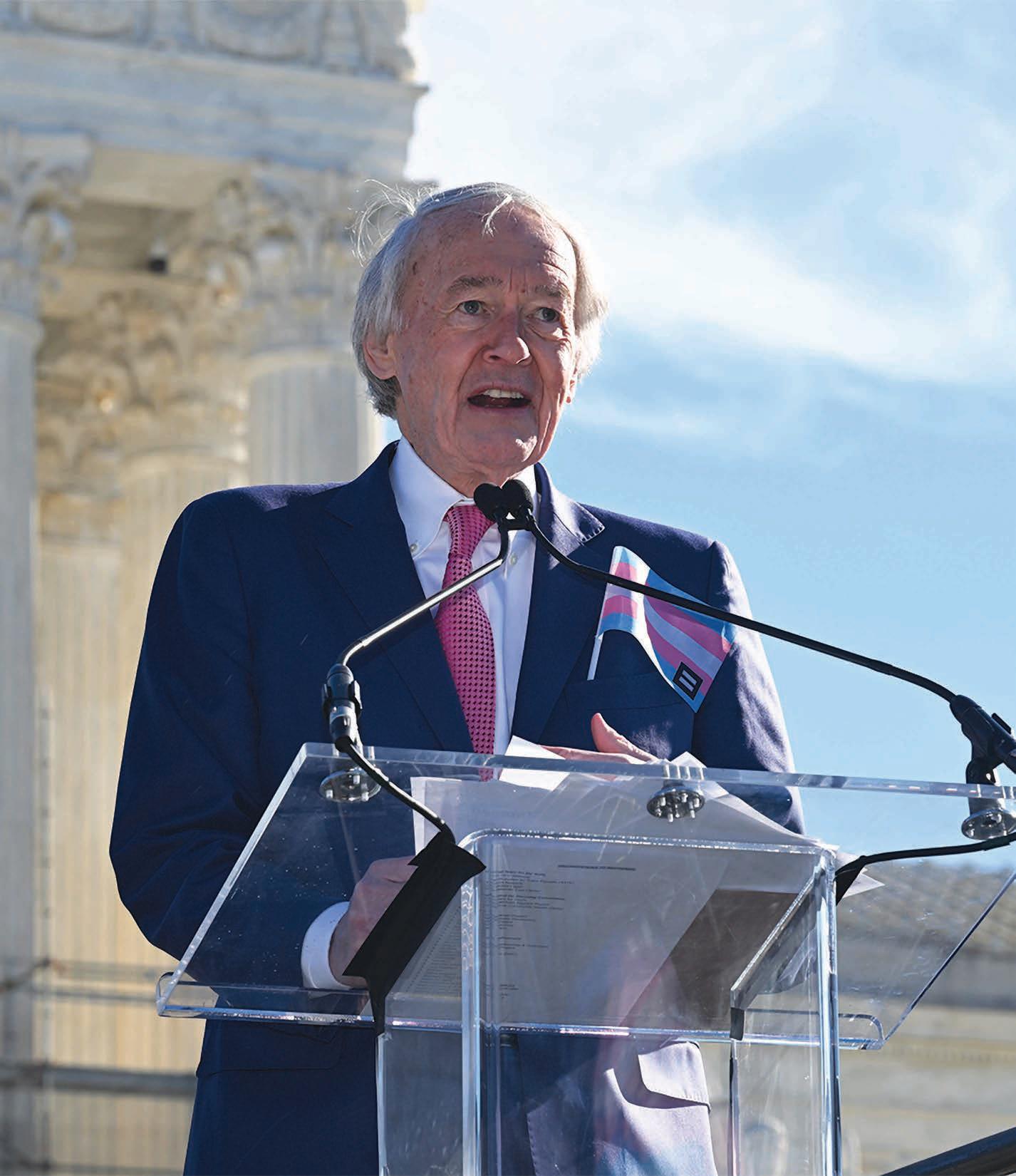
U.S. Sen. Edward Markey (D-Mass.) speaks exclusively with Blade, PAGE 10
or before 02/28/26.
ADDRESS PO Box 60664
Washington DC 20039
PHONE
202-747-2077
E-MAIL news@washblade.com
INTERNET washingtonblade.com
PUBLISHED BY Brown Naff Pitts Omnimedia, Inc.
PUBLISHER
LYNNE J. BROWN lbrown@washblade.com ext. 8075
EDITORIAL EDITOR
KEVIN NAFF
knaff@washblade.com ext. 8088
SR. NEWS REPORTER
LOU CHIBBARO JR. lchibbaro@washblade.com ext. 8079
WHITE HOUSE CORRESPONDENT
JOE REBERKENNY jreberkenny@washblade.com ext. 9463
INTERNATIONAL NEWS EDITOR
MICHAEL K. LAVERS mlavers@washblade.com ext. 8093
POP CULTURE REPORTER
JOHN PAUL KING
PHOTO EDITOR
MICHAEL KEY mkey@washblade.com ext 8084
CONTRIBUTING WRITERS
DANIEL ITAI, ISAAC AMEND, TINASHE CHINGARANDE, PETER ROSENSTEIN, PATRICK FOLLIARD, TERRI SCHLICHENMEYER, JOE PHILLIPS, EVAN CAPLAN, ANKUSH KUMAR, ESTEBAN RIOSECO, SAM KISIKA, ELVIS KAWEDO, DAWN ENNIS CREATIVE DESIGN/PRODUCTION
MEAGHAN JUBA production@azercreative.com
SALES & ADMINISTRATION
DIRECTOR OF SALES & MARKETING
STEPHEN RUTGERS srutgers@washblade.com ext. 8077
SR. ACCT. EXECUTIVE
BRIAN PITTS bpitts@washblade.com ext. 8089
CLASSIFIED ADVERTISING/ADMINISTRATION
PHILLIP G. ROCKSTROH prockstroh@washblade.com ext. 8092
NATIONAL ADVERTISING
RIVENDELL MEDIA 212-242-6863; sales@rivendellmedia.com
For distribution, contact
Adam Ebbin praised after Va. Senate farewell address
Gay lawmaker to take job in Spanberger administration
By LOU CHIBBARO JR.
Gay Virginia state Sen. Adam Ebbin (D-Alexandria) delivered his farewell address on Feb. 16 in the Senate chamber in Richmond following his decision to resign from his role as a lawmaker to take a position as senior advisor to Democratic ov. bigail Spanberger.
Ebbin, whose resignation was to take effect Feb. 18, received a standing ovation from his fellow senators. Several of them spoke after Ebbin’s address to praise him for his service in the Virginia Senate from 2012 to 2026.
Ebbin first won election to the irginia ouse of Delegates in as the first openly gay member of the General Assembly. He served in the House of Delegates from 2004 to 2012 before winning election to the Senate in 2011.
His Senate district includes Alexandria and parts of Arlington and Fairfax Counties.
“Serving in this body has been the greatest honor of my life,” Ebbin said in his farewell address. “Representing Northern Virginia in the General Assembly — my adopted home since 1989 — has been a responsibility I never took lightly,” he said.
“We are a 406-year-old institution,” he told his fellow lawmakers. “But, when I arrived, I had the distinct honor of being a first in the eneral ssembly, he said. Being an openly gay elected official years ago didn’t earn you book deals or talk show appearances — just a seat in a deep minority across the hall.”
Ebbin added, “Still, being out was a
fact that felt both deeply personal and unavoidably public. I was proud, but I was also very aware that simply being here carried a responsibility larger than myself.”
Ebbin has been credited with playing a lead role in advocating for LGBTQ rights in the General Assembly as well as speaking out against anti-LGBTQ proposals that have surfaced during his tenure in the legislature.
In his speech he also pointed to other issues he has championed as a lawmaker; including strengthening education programs, expanding access to healthcare, safeguarding the environment, and legislation to help stand up for
McPike wins special election for Va. House of Delegates seat
Gay Alexandria City Council member becomes legislature’s 8th LGBTQ member
By LOU CHIBBARO JR.
Gay Alexandria City Council member Kirk McPike emerged as the decisive winner in a Feb. 10 special election for a seat in the Virginia House of Delegates representing le andria.
McPike, a Democrat, received 81.5 percent of the vote in his race against Republican Mason Butler, according to the local publication ALX Now. e first won election to the le andria Council in . e will be filling the ouse of Delegates seat being vacated by Del. Eli abeth Bennett- arker D- lexandria), who won in another Feb. 10 special election for the Virginia Senate seat being vacated by gay state Sen. dam Ebbin D- le andria . Ebbin is resigning from his Senate to take a position with Virginia Gov. Abigail Spanberger’s administration.
working people.”
Among the LGBTQ rights legislation he pushed and mentioned in his speech was the Virginia Values Act of 2020, which bans discrimination based on sexual orientation and gender identity, among other categories.
“I’m particularly proud of our work ensuring Virginia modernized state law to protect LGBT people from discrimination in their daily lives, including in employment, housing, and public accommodations,” he said in his speech. “The Virginia Values Act of 2020 — my proudest achievement — established new protections for all Virginians,” he said. his law, the first of its kind in the South, passed with strong bipartisan support,” he stated. “And now — this November after years, irginians will finally be able to vote on the Marriage Equality Amendment, which will protect the ability to marry who you love. It’s time for our state constitution to accurately re ect the law of the land.
He was referring to a proposed state constitutional amendment approved by the General Assembly, but which must now go before voters in a referendum, to repeal a constitutional amendment approved by the legislators and voters in 2006 that bans same-sex marriage.
The U.S. Supreme Court’s Obergefell ruling legalizing same-sex marriage nationwide voided the irginia same-se marriage ban. But Ebbin and LGBTQ rights advocates have called on the General Assembly to take action to repeal the
amendment in case the Supreme Court changes its ruling on the issue.
In his new job in the Spanberger administration Ebbin will become a senior advisor at the Virginia Cannabis Control Authority, which regulates policies regarding marijuana possession and distribution.
Ebbin was among the lead sponsors of legislation in 2020 to decriminalize possession of marijuana and of current pending legislation calling for legalizing possession.
When I first entered the eneral ssembly, I saw too many lives upended by a simple marijuana charge — jobs lost, futures delayed, families hurt,” he said in his speech. “And for far too long, that harm was baked into our laws. That is no longer the case. The times have changed and so have our laws.”
Ebbin said he was also proud to have played some role in the changes in Virginia that now enable LGBTQ Virginians to serve in all levels of the state government “openly, authentically, and unapologetically.”
“I swore to myself that I wouldn’t leave until there was at least one more lesbian or gay General Assembly member,” Ebbin said in his speech. “But when I leave, I’m proud to say we will have an 8-member LGBTQ caucus.”
And he added, “And if anyone on the other side of the aisle wants to come out, you will be more than welcome — we’re still waiting on that first openly gay epublican.”
pon taking his th District seat in the ouse of Delegate, McPike will become the eighth out LGBTQ member of the Virginia General Assembly. Among those he will be joining is state Sen. Danica Roem (D-Manassas), who became the Virginia Legislature’s first transgender member when she won election to the House of Delegates in 2017 before being elected to the Senate in 2023.
“I look forward to continuing to work to address our housing crisis, the challenge of climate change, and the damaging impacts of the Trump administration on the immigrant families, LGBTQ+ Virginians, and federal employees who call Alexandria home,” McPike said in a statement after winning the Democratic nomina-
tion for the seat in a special primary held on an. . McPike, a longtime LGBTQ rights advocate, has served for the past 13 years as chief of staff for gay U.S. Rep. Mark Takano (D-Calif.) and has remained in that position during his tenure on the Alexandria Council. He said he will resign from that position before taking office in the ouse of Delegates.
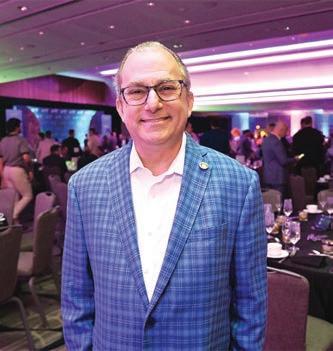
Outgoing Virginia state Sen. ADAM EBBIN (D-Alexandria) in 2024. (Washington Blade photo by Michael Key)
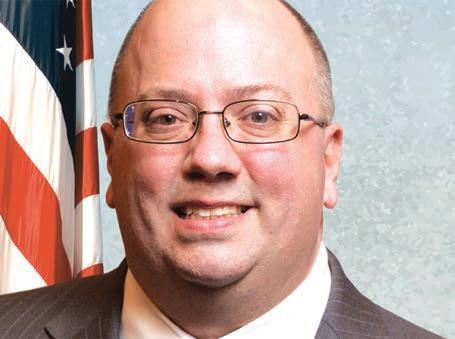
KIRK MCPIKE (Photo courtesy of the Alexandria City Council)
LGBTQ activists mourn Jesse Jackson
Prominent civil rights leader died on Feb. 17
By LOU CHIBBARO JR.
LGBTQ rights advocates have joined the nation s civil rights leaders in re ecting on the life and work of the Rev. Jesse Jackson, the famed U.S. civil rights leader whose family announced passed away on Feb. 17 at the age of 84.
Known as a follower and associate of African American civil rights leader Dr. Martin Luther King Jr., Jackson emerged in the 1960s as a leading civil rights advocate for the Black community and other minorities for decades throughout the U.S., including in Washington.
In a less known aspect of Jackson’s involvement in politics, following his campaigns for U.S. president in 1984 and 1988, ackson won election in as the District of Columbia’s shadow senator, a ceremonial position created to lobby Congress for D.C. statehood.
Jackson, who at that time had a home in D.C., received strong support from D.C. voters, including LGBTQ voters who became aware of Jackson’s support for LGBTQ issues. He served just one six-year term as the city’s shadow senator before choosing
not to run again.
An early supporter of marriage equality, Jackson was among the prominent speakers at the 1987 National March on Washington for Lesbian and Gay Rights. Jackson joined other speakers at a rally on the grounds of the U.S. Capitol.
During his run for president in 1988 the D.C. Gertrude Stein Democratic Club, an LGBTQ group that has since been renamed the Capital Stonewall Democrats, endorsed Jackson for president ahead of the city’s Democratic presidential primary.
he fight for ustice re uires courage, hope, and a relentlessness that will not be denied. Rev. Jesse Jackson embodied that fight every day, said elley obinson, president of the Human Rights Campaign, the nation’s largest LGBTQ advocacy organization.
“From disrupting political systems and building people power to helping this country imagine a freer future for all of us, ev. ackson was a force, obinson said in a statement. “His historic presidential campaigns paved the way for generations of Black leaders to imagine ourselves in rooms
ride ag raised again at Stonewall
ur ag represents dignity and human rights
By JOE REBERKENNY
ride ag was raised at the site of the Stonewall National Monument days after a National Park Service directive banned ying the ag at the birthplace of the LGBTQ rights movement in the U.S. he ag-raising was led by anhattan Borough President Brad Hoylman-Sigal and supported by other elected officials.
“The community should rejoice. We
have prevailed, oylman-Sigal said shortly after the ag was hoisted on eb. . ur ag represents dignity and human rights.
he ag now sits in Christopher Street Park, feet away from the Stonewall Inn, where in 1969 a police raid of the gay bar sparked outrage and led to a rising of LGBTQ people pushing back on NYPD
we were once told were closed to us.
Robinson added, “Reverand Jackson also stood up when it mattered; when it wasn’t easy and when it wasn’t popular. His support for marriage equality and for LGBTQ+ people affirmed a simple, powerful truth our liberation is bound together.
She also pointed to Jackson’s support for efforts to repeal California’s Proposition 8, a 2008 referendum passed by voters to ban same-se marriage in the state.
“Marriage is based on love and commitment, not on sexual orientation. I support the right for any person to marry the person of their choosing, obinson uoted ackson as saying in support of efforts that succeeded in overturning the California marriage ban.
The national organization PFLAG, which represents parents, friends, and allies of the LGBTQ community, released a statement from its president, Brian K. Bond, citing Jackson’s longstanding support for the LGBTQ community.
“Today, as we learn of the passing of Rev. Jesse Jackson, we mourn the loss of a gi-
brutality and unjust treatment.
Elected officials brought a new agpole with them, using plastic zip ties to attach it to the existing pole.
In , resident Barack bama declared the site a national monument. ne day before the planned re-raising of the ride ag, the ational ark Service installed only an merican ag on the agpole, which days prior had own a rainbow ag bearing the S logo. he directive removing the ag was put forward by Trump-appointed National Park Service Acting Director Jessica Bowron.
ant among us, Bond said in the statement.
“When many refused to acknowledge the existence and struggles of LGBTQ+ people, ev. ackson saw us, affirmed us, and demanded e uality inclusively, Bond said.
“In his address to the Democratic National Convention in 1984, Rev. Jackson named us specifically as part of the fabric of the merican uilt, Bond says in his statement.
The statement adds, “He has shown up for and marched with the LGBTQ+ movement through the AIDS crisis, marriage equality, and ever after. Rev. Jackson’s leadership and allyship for LGBTQ+ people will be felt profoundly by his PFLAG family. We will continue to honor his legacy as we continue to strive to achieve ustice and e uality for all.
AT WASHINGTONBLADE.COM
This comes one day after more than 20 LGBTQ organizations from across the country co-signed a letter to Interior Secretary Doug Burgum and General Services Administrator Ed Forst, demanding the ag be restored to the monument.
“It is our understanding that the policy provides limited exceptions for non-agency ags that provide historical context or play a role in historic reenactments. Simply put, we urge you to grant this ag an e ception and raise it once again, immediately, the letter read.
AT WASHINGTONBLADE.COM
I lawsuit filed against State Department for E records
Council for Global Equality, Physicians for Human Rights seeking data, documents
By MICHAEL K. LAVERS
The Council for Global Equality and hysicians for uman ights have filed a Freedom of Information Act lawsuit against the State Department for PEPFAR-related data and documents.
The groups, which Democracy Forward represents, filed the lawsuit in .S. District Court for the Southern District of New York on Feb. 11.
Then-President George W. Bush in 2003 signed legislation that created PEPFAR. UNAIDS Executive Director Winnie Byanyima last arch said E has saved million lives around the world.
The Trump-Vance administration in January 2025 froze nearly all U.S. foreign aid spending for at least 90 days. Secre-
tary of State Marco Rubio later issued a waiver that allowed PEPFAR and other life-saving humanitarian assistance programs to continue to operate during the freeze.
The Washington Blade has previously reported E -funded programs in Kenya and other African countries have been forced to suspend services and even shut down because of gaps in U.S. funding. HIV/AIDS activists have also sharply criticized the Trump-Vance administration over reported plans it will not fully fund E in the current fiscal year.
The lawsuit notes the Council for Global Equality and Physicians for Human
ights have filed several I re uests with the State Department for PEPFAR-related data and documents. The groups filed their most recent re uest on an. . n an. , , plaintiffs, through counsel, sent State a letter asking it to commit to prompt production of the re uested records, reads the lawsuit.
“State responded that the request was being processed but did not commit to any timeline for production.
“Plaintiffs have received no subsequent communication from State regarding this I re uest, it notes.
The State Department has yet to respond to the Blade’s request for comment on the lawsuit.
HIV/AIDS activists place Black Styrofoam cof ns in front of the State Depart ent on April 17, 2025, to protest the TrumpVance administration’s foreign aid cuts that impacted PEPFAR-funded programs. The Council for Global Equality and Physicians for u an ights ha e led a O A la suit that seeks the State Department’s PEPFARrelated documents and data. (Washington Blade photo by Michael Key)
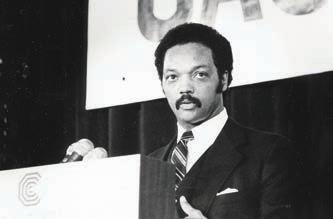
The Rev. JESSE JACKSON in 1983. (Washington Blade archive photo by Jim Marks)
arkey says transgender rights fight is ne t frontier Mass.
senator, 79, running for re-election
By JOE REBERKENNY
For more than half a century, U.S. Sen. Edward Markey (D-Mass.) has built a career around the idea that government can — and should — expand rights rather than restrict them. From pushing for environmental protections to consumer safeguards and civil liberties, the Massachusetts Democrat has long aligned himself with progressive causes.
In this political moment, as transgender Americans face a wave of federal and state-level attacks, arkey says this fight in particular demands urgent attention.
The Washington Blade spoke with Markey on Feb. 17 to discuss his reintroduction of the rans Bill of ights, his long record on LGBTQ rights, and his reelection campaign — a campaign he frames not simply as a bid for another term, but as part of a broader struggle over the direction of American democracy.
Markey’s political career spans more than five decades.
From 1973 to 1976, he served in the Massachusetts ouse of epresentatives, representing the 16th Middlesex District, which includes the Boston suburbs of Malden and Melrose, as well as the 26th Middlesex District.
In 1976, he successfully ran for Congress, winning the Democratic primary and defeating epublican ichard Daly in the general election by a 77-18 percent margin. He went on to serve in the .S. ouse of epresentatives for nearly four decades, from 1976 until 2013.
Markey in 2013 ran in the special election to fill an open Senate seat after ohn erry became secretary of state in the Obama-Biden administration. arkey defeated epublican Gabriel E. Gomez and completed the remaining months of erry s term. arkey took office on uly , , and has represented Massachusetts in the U.S. Senate ever since.
Over the years, Markey has built a reputation as a progressive Democrat focused on human rights. From environmental protection and consumer advocacy to civil liberties, he has consistently pushed for an expansive view of constitutional protections. In the Senate, he co-authored the reen ew Deal, has advocated for edicare for ll, and has broadly championed civil rights. is committee work has included leadership roles on Senate Foreign elations Committee and the Senate Health, Education, Labor and Pensions (HELP) Committee.
ow, amid what he describes as escalating federal attacks on trans Americans, Markey said the reintroduction of the Trans Bill of ights is not only urgent, but necessary for thousands of Americans simply trying to live their lives.
he first day Donald rump was in office, he began a relentless assault on the rights of transgender and nonbinary people,” Markey told the Blade. It started with E ecutive rder Defending women from gender ideology extremism and restoring biological
truth to the federal government.’ That executive order mandates that federal agencies define gender as an unchangeable male female binary determined by sex assigned at birth or conception.”
He argued that the executive action coincided with a sweeping legislative push in epublican-controlled statehouses.
ast year, we saw over , anti-trans bills across states and the federal government were introduced. In anuary of , to today, we’ve already seen 689 bills introduced,” he said. “The trans community needs to know there are allies who are willing to stand up for them and affirmatively declare that trans people deserve all of the rights to fully participate in public life like everyone else — so Trump and epublicans have tried hard over the last year to legislate all of these, all of these restrictions.”
Markey said the updated version of the rans Bill of ights is designed as a direct response to what he views as an increasingly aggressive posture from the Trump-Vance administration and its GOP congressional allies. He emphasized that the legislation reflects new threats that have emerged since the bill’s original introduction.
In order to respond to those developments, arkey worked with .S. ep. ramila ayapal D-Wash. to draft a revised version that would more comprehensively codify protections for trans Americans under federal law.
“What we’ve added to the legislation is this is all new,” he explained, describing how these proposed protections would fit into all facets of trans Americans’ lives. “This year’s version of it that Congresswoman ayapal and I drafted, there’s an anti-trans bias in the immigration system should be eliminated.”
roviders of gender affirming care should be protected from specious consumer and medical fraud accusations. The sexual and gender minority research office at the ational Institutes of Health should be reopened and remain operational,” he continued. “Military discharges or transgender and nonbinary veterans and reclassification of discharge status should be reviewed. Housing assignments for transgender and nonbinary people in govern-
ment custody should be based on their safety needs and involuntary, solitary or affirmative administrative confinement of a transgender or nonbinary individual because of their gender identity should be prohibited, so without it, all of those additional protections, and that’s ust to respond to the to the ever increasingly aggressive posture which Donald Trump and his mega epublicans are taking towards the transgender.”
he scope of the bill, he argued, re ects the breadth of challenges trans Americans face — from immigration and health care access to military service and incarceration conditions. In his view, the legislation is both a substantive policy response and a moral declaration.
On whether the bill can pass in the current Congress, Markey acknowledged the political hardships but insisted the effort itself carries as much significance as the bill s success.
Well, epublicans have become the party of capitulation, not courage,” Markey said. We need epublicans of courage to stand up to Donald Trump and his hateful attacks. But amid the relentless attacks on the rights and lives of transgender people across the country by rump and epublicans, it is critical to show the community that they have allies in Congress the rans Bill of ights is an affirmative declaration that federal lawmakers believe trans rights are human rights and the trans people have the right to fully participate in public life, just like everyone else.”
Even if the legislation does not advance in this congress, Markey said, it establishes a framework for future action.
“It is very important that Congresswoman ayapal and I introduce this legislation as a benchmark for what it is that we are going to be fighting for, not ust this year, but ne t year, he said when asked if the bill stood a legitimate chance of passing the federal legislative office when margins are so tight. “After we win the House and Senate to create a brand new, you know, oor for what we have to pass as legislation … We can give permanent protections.”
He framed the bill as groundwork for a future Congress in which Democrats regain control of both chambers, creating what he described as a necessary roadblock to what he views as the Trump-Vance administration’s increasingly restrictive agenda.
Markey also placed the current political climate within the longer arc of LGBTQ history and activism.
When asked how LGBTQ Americans should respond to the removal of the ride ag from the Stonewall ational onument the first national monument dedicated to recognizing the LGBTQ rights movement — Markey was unwavering.
“My message from Stonewall to today is that there has been an ongoing battle to change the way in which our country responds to the needs of the B and more specifically the transgender community,” he said. “When they
seek to take down symbols of progress, we have to raise our voices.”
“We can’t agonize,” Markey stressed. “We have to organize in order to ensure that that community understands, and believes that we have their back and that we’re not going away — and that ultimately we will prevail.”
Markey added, “That this hatefully picketed White House is going to continue to demonize the transgender community for political gain, and they just have to know that there’s going to be an active, energetic resistance, that that is going to be there in the Senate and across our country.”
Pam Bondi ‘is clearly part’ of Epstein cover up
Beyond LGBTQ issues, Markey also addressed controversy surrounding Attorney General Pam Bondi and the handling of the Epstein files, sharply critici ing the administration’s response to congressional inquiries.
“Well, Pam Bondi is clearly part of a cover up,” Markey said when asked about the attorney general’s testimony to Congress amid growing bipartisan outrage over the way the White House has handled the release of the Epstein files. She is clearly part of a whitewash which is taking place in the Trump administration ccording to the ew ork imes, Trump has been mentioned 38,000 times in the Epstein files which have been released thus far. There are still 3 million more pages that have yet to be released. So this is clearly a cover up. Bondi was nothing more than disgraceful in the way in which she was responding to our questions.”
“I think in many ways, she worsened the position of the Trump administration by the willful ignoring of the central questions which were being asked by the committee,” he added.
‘I am as energized as I have ever been’
As he campaigns for reelection, Markey said the stakes extend beyond any single issue or piece of legislation. He framed his candidacy as part of a broader fight for democracy and constitutional protections — and one that makes him, as a 79-year-old, feel more capable and spirited than ever.
“Well, I am as energized as I have ever been,” he said. “Donald Trump is bringing out the Malden in me. My father was a truck driver in Malden, Mass., and I have had the opportunity of becoming a United States senator, and in this fight, I am looking ahead and leading the way, affirming rights for the trans community, showing up to defend their rights when they are threatened from this administration.” He continued, reiterating his commitment not only to the trans community but to a future in which progressive and proactive pushes for expanded rights are seen, heard, and actualized.
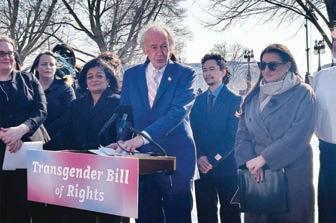
U.S. Rep. PRAMILA JAYAPAL (D-Wash.) and U.S. Sen. EDWARD MARKEY (D-Mass.), center, speak at a press conference outside the U.S. Capitol on Feb. 11, 2026. (Washington Blade photo by Joe Reberkenny)
Bise ual women on stereotypes, erasure, representation, and oy anel talks coming out, pop culture, and ueerness
By SPENCER MACNAUGHTON, TAYA STRAUSS, and SAM DONNDELINGER | Uncloseted
The number of openly LGBTQ American adults has skyrocketed in the past few years, but there’s one group that’s been leading the way en women, . percent of whom are bise ual.
Despite this increase, many bi women still feel deeply misunderstood. o understand this, ncloseted edia put together a panel of four bise ual women who spoke candidly about coming out, bi erasure and why biseuality is often treated as a phase or something that disappears the moment a woman dates a man.
SPENCER MACNAUGHTON: i everyone, I m Spencer acnaughton and today I am here with a panel of four bise ual women from across the nited States. hank you all so much for speaking with me and ncloseted today.
SOPHIE SANDBERG: hanks so much for having us.
SM: So I always like to start with people s coming out stories. So yeah, does somebody want to tell me their coming out story a little bit, or when you reali ed you were bi
SS: I think part of being bise ual was that it was a long coming out story and kind of a long period of coming out. I always dated cis men when I was in middle school and high school. I started having boyfriends really early and was kind of even boy cra y, I would say. But I did always notice these crushes on my friends, on girls, on more ueer and androgynous people I was seeing in the media. So, I would say I started noticing it myself in high school and definitely in college, but I didn t have to come out because I was in serious relationships with cis men and very straight-passing. So I didn t officially come out to everyone in my life until I was about .
SM: nd was that like, I know when I was closeted, I d hook up with girls, but I didn t want to be hooking up with girls, right nd it stressed me out. But was there a stressor on that I always wonder if the stress levels are the same or different as somebody who s bise ual because you can date people you re still genuinely interested in.
SS: eah, that s a good point, and I think this is something that differs between me and my lesbian friends. hey ll be like, yeah, I never en oyed it, I was so unhappy, and then suddenly everything made sense when I came out. nd for me, I did genuinely have love and connection with cis men who I was in relationships with and slept with, but I also did always have this kind of knowledge or curiosity or interest in sleeping with people who weren t cis men. So I think I was able to kind of have something genuine there, but also was always aware that there was more than ust that for me. If that makes sense.
SM: eah. elly, how about you
KELLIE WILSON: eah, so I actually really only reali ed that I was bi about a year and a half ago, and so I feel a little bit of imposter syndrome being on a bi panel because I m pretty new to this actually, and it was an interesting reali ation of learning that one of my friends that I had been growing closer with actually had feelings for myself and my husband. nd at the time it was kind of like a, whoa, I don t know what to do with this information. But over the course of the ne t few weeks and a bit of identity crisis and thinking about my past and my life and things like that, I reali ed oh, I have a crush on her too. nd that I ve probably had crushes on many women because there have been so many people in my life where I d see them and like, oh my gosh, they re ust, they are so cool. I love their vibe, they re so pretty. I really want to be friends with them. But then most of the time I wouldn t actually become friends with them because I d be too nervous when I was around them. here were absolutely signs and it ust never clicked because I think, kind of like what you were saying Sophie, I had been in a long-term relationship with a cis man since my freshman year in college, which, he was my first boyfriend, my first everything. We got engaged, we got married, we had kids. nd so there was never necessarily I don t know, there was no drive or reason for me to be uestioning it, and I think part of that was some internali ed biphobia from growing up in a very Christian, not fundamentalist, but gayness was of course a sin in the eyes of the church and all these things. It was something that I think I had internali ed enough that it never really crossed my mind because I had feelings for cis men, and so it was like, okay, yeah, I like men, I must be straight.
ABBY STEIN: I think it s a bit more complicated for me ust because I m also trans, and to add more to it, I grew up in a very gender-segregated community. So that played a very big role in this whole conversation. But the first, I guess, let s call him a boyfriend for now, was in this very religious school. I was in upstate ew ork, kind of in the middle of nowhere. I guess in some ways it was a coming out but in other ways in my mind I made sense of it by being like I m actually a girl. hen when, I guess when I was , I got married, arranged marriage, very much part of my community, to a woman, and I was very into that as well. So it s hard for me to be like okay at what point did I reali e both of these people have been very interesting and therefore it says something about my se uality. I don t know, I actually am having a hard time to be like the e act moment or even date or year.
Media published this article on Feb. 7.
SM: eah. nd how does, obviously coming out as trans, especially in a gendersegregated community is a very tall task that I m sure is an entirely different conversation, right Was coming out as bi, did it feel like even a thing after having come out as trans or how did that play into it all
AS: I think I struggled with it a lot more than with gender. eople tell me a lot, oh, you must have been struggling with your gender. nd I m like, no, I don t know. I think my gender, I was very comfortable with who I was and knew who I was since I was a child. Se uality, I think, I m still figuring out every day e actly what I do and don t like. nd it s a constant struggle and ourney. ot necessarily a struggle, sometimes a struggle. Sometimes a really great adventure. But it s definitely something that has been, I think, more complicated to me than gender.
KATIE MARIE: I thought that I was straight for a very long time, thought that I was ust an ally. I was married to a man for about years. I had the house, the picket fence, the master s degree, the ob, and I was still very, very unhappy at the end of every day. I am Indigenous. I started leaning back into my spirituality and started to really dig deep into understanding who I am. It was at that moment in time, I had a really beautiful dream. nd in that dream, I saw myself with a woman. I didn t know that she was a woman, funnily enough, I ust felt the energy. nd I awoke from that dream and immediately turned to the man who was my husband at that moment in time and said, I think I am interested in women. f course, whenever you first come out as bise ual in a situation like that I was from the South there are some negative implications that come with saying that you re bise ual, especially even from the gay community, right It s that implication that you can’t choose a side or that you must choose a side or some version of that
SM: ell me a little bit about the biggest misconceptions about bise ual women in society specifically. What are the stereotypes, the misconceptions that are perhaps most frustrating for you guys
KM: or me, I can speak to one. nd this was ust one that I e perienced very uickly was this idea that for some, because I was bise ual, I was going to now have se with everybody, right his idea that I can t choose a side, so I m ust gonna have relations with everyone and I ust can t make up my mind.
SM: stereotype of promiscuity.
KM: es, e actly. hat was a big one. nd it came through in my marriage, actually, that was one of the initial problems is my husband started assuming that I was going to have se ual relationships with all of my girl-
friends. nd that became a big barrier for me to have to overcome.
SS: I feel like there s a misconception, well, one, that bise ual women ust want to be with men. I feel like there s this misogynistic misconception that anyone who s bise ual actually wants to be with a cis man, whether it s a bise ual man or a bise ual woman.
SM: Interesting, I didn t know that.
SS: If you re a bise ual man you must really want to be with a man and if you are a bise ual woman you probably also ust really want to be with a man. But I think in general ust, yeah, people not fully understanding that bise uality is more uid and open than that.
KW: I think one of the things that I most often see would be on this idea of fluidity in levels of attraction and the bi cycle, right nd this idea that, oh, it s ust a phase, if you start off being more attracted to one gender and then it s shifting over time, that it s not gonna shift back. E isting in the middle space is not something that can happen. So I m also biracial. I m half black, half white, and I think that it s this consistent theme in society, like, you can t be both. nd I think that s really pervasive in the idea of stereotypes about bise ual women. ou ust have to pick one or you’re never gonna be enough of the other to fully fit. nd so it s sometimes easier to ust e ist in one space or the other. But then the internal e perience of that is where it gets more uncomfortable. ike, no, it s both. It s absolutely both.
AS: So I ve definitely had people saying, oh, your se uality by people I mean, literally my brother ust a few weeks ago your se uality is ust part of your entire personality that s ust very confused. nd I don t see it as that. I ust don t think that everything needs to fit in a very neat bo . So it all ties into this idea, for me it all makes sense, which is that I like to look at things and constantly e plore them and never decide that something has to be a specific way. nd it s like that with my se uality, it s that with the way I see my cultural and spiritual practices. nd I think that s beautiful.
SM: Well, I think it s really interesting what you said. nd I think it takes me back to what ellie was mentioning about the bi cycle, right Where people can be more interested in men one day, women the ne t day, anything in between, right But I also think, ellie, what you were mentioning is that there s people who won t accept that people can live in this gray one. I could imagine that s really frustrating.
(Bigstock photo)
dvocacy groups uestion S health agreements with African countries
B community could face further e clusion, discrimination
By SAM KISIKA
Some queer rights organizations have expressed concern that health agreements between the U.S. and more than a dozen African countries will open the door to further exclusion and government-sanctioned discrimination.
The Trump-Vance administration since December has signed five-year agreements with enya, ganda, and other nations that are worth a total of . billion.
enyan and gandan advocacy groups note the U.S. funding shift from NGO-led to a government-to-government model poses serious risks to LGBTQ people and other vulnerable populations in accessing healthcare due to existing discrimination based on sexual orientation.
ganda inority Shelters Consortium, et s Walk ganda, the enya uman ights Commission, and the Center for inority ights and Strategic itigation note the agreements’ silence on vulnerable populations in accessing health care threatens their safety, privacy, and confidentiality.
any B persons previously accessed I prevention and treatment, se ual and reproductive health services, mental health support, and psychosocial care through specialized clinics supported by s and partners such as S ID the .S. gency for International Development or E , et s Walk ganda Executive Director Edward Mutebi told Washington Blade.
e noted such speciali ed clinics, including the et s Walk edical Center, are trusted facilities for providing stigma-free services by health workers who are sensiti ed to ueer issues.
“Under this new model that sidelines s and Drop-in Centers DICs , there is a high-risk of these populations being
forced into public health facilities where stigma, discrimination, and fear of eposure are prevalent to discourage our community members from seeking care altogether, leading to late testing and treatment, utebi said. or B persons already living under criminali ation and heightened surveillance, the loss of community-based service delivery is not ust an access issue it is a full-blown safety issue.
ganda inority Shelters Consortium Coordinator ohn race said it is deeply troubling for the rump- ance administration to sideline s, which he maintains have been critical lifelines for marginalized communities through their speciali ed clinics funded by donors like the lobal und and S ID.
S ID officially shut down on uly , , after the White ouse dismantled it.
Grace notes the government-to-government funding framework will impact clinics that specifically serve the B community, noting their patients will have to turn to public systems that remain inaccessible or hostile to them.
SC is concerned that the gandan government, under this new arrangement, may lack both the political will and institutional safeguards to e uitably serve these populations, race said. Without civil society participation, there is a real danger of invisibility and neglect.
Grace also said the absence of accountability mechanisms or civil society oversight in the .S. agreement, which ganda signed on Dec. , would increase state-led discrimination in allocating health resources.
Center for inority ights and Strategic Litigation Legal Manager Michael Kioko notes the U.S. agreement with
enya, signed on Dec. , will help sustain the country s health sector, but it has a non-binding provision that allows Washington to withdraw or withhold the funding at any time without legal conse uences. e said it could affect key health institutions’ long-term planning for specialized facilities for targeted populations whose independent operations are at stake from NGOS the new agreement sidelines.
he agreement does not provide any assurance that so-called non-core services, such as rE , E , condoms, lubricants, targeted I testing, and S I prevention will be funded, especially given the Trump administration’s known opposition to funding these services for key populations, ioko said.
e adds the agreement s e clusionary structure could further impact NGO-run clinics for key populations that have already closed or scaled down due to loss of the .S. funding last year, thus reversing hard-won gains in I prevention and
treatment.
“The socio-political implications are also dire, ioko said. he agreement could be weaponized to incite discrimination and other LGBTQ-related health issues by anti- B voices in the parliament who had called for the re-authorization of the U.S. funding (PEPFAR) funding in , as a political mileage in the campaign trail.
Even as the agreement fails to safeguard speciali ed facilities for key populations, the enya uman ights Commission states continued access to healthcare services in public facilities will depend on the government’s commitment to maintain confidentiality, stigma-sensitive care, and targeted outreach mechanisms.
“The agreement requires compliance with applicable U.S. laws and foreign assistance policies, including restrictions such as the elms mendment on abortion funding, the enya uman ights Commission said in response to the Blade. ore broadly, funded activities must align with .S. e ecutive policy directives in force at the time. In the current .S. conte t, where e ecutive actions have narrowed gender recognition and reduced certain transgender protections, there is a foreseeable risk that funding priorities may shift.
ust seven days after enya and the .S. signed the agreement, the country s igh Court on Dec. suspended its implementation after two petitioners challenged its legality on grounds that it was negotiated in secrecy, lacks proper parliamentary approval, and violates enyans data privacy when their medical information is shared with merica.
The agreement the U.S. and Uganda signed has not been challenged.
European Parliament backs ‘full recognition of trans
women as women’
on-binding resolution outlines Commission on the Status of Women priorities
By MICHAEL K. LAVERS
The European Parliament on Feb. 11 adopted a transgender-inclusive resolution ahead of ne t month s . . Commission on the Status of Women meeting.
he resolution, which details the European Union’s priorities ahead of the meeting, specifically calls for the full
recognition of trans women as women.
“Their inclusion is essential for the effectiveness of any gender-e uality and anti-violence policies; call for recognition of and equal access for trans women to protection and support services, reads the resolution that Erin in the orning details.
he resolution, which is non-binding, passed by a - vote margin. Sity-eight s abstained.
The commission will meet in New York from March 10-21.
A sweeping executive order that President Donald rump signed shortly after he took office for a second time on an.
, , said the federal government s official policy is there are only two genders, male and female. he rumpVance administration has withdrawn the .S. from the . . B I Core roup, a group of U.N. member states that have pledged to support LGBTQ and intersex rights, and do ens of other . . entities.
The White House commemorates World AIDS Day in 2023. Health agreements the U.S. has signed with Uganda, Kenya, and other countries have sparked concern among queer rights groups. (Washington Blade photo by Michael Key)
Illustration
Trans sports bans rooted in eugenics
Key Supreme Court rulings will be future litmus tests
By EMMA CIESLIK
The United States and the world are waiting for the Supreme Court to hand down its decisions in two cases (Little v. Hecox and West Virginia v. BPJ) that would rule on whether young trans women can play women’s sports at their schools. As trans ournalist Erin eed e plained, these two cases are not just about transgender sports. These cases are litmus tests for trans rights at the nation’s highest courts and will have wide-reaching implications for the rights of trans and nonbinary people in the United States.
And these cases will impact cis women. s rien ummler reported for the th and them, anti-trans legislation and rulings threaten the rights of all women, especially cis women of color. The best example is the allegations that woman boxer Imane Khelif faced at the last Paris Olympics.
The gender policing that Khelif faced shows how sports bans that police who are considered a man or woman legitimize and mandate invasive medical testing, a form of medical abuse, against all women and girls who want to play sports. And let’s be clear — there is historical precedence for this.
The Nazi regime did use genetic screening in order to police who could have children as part of their “racial hygiene” programs, including marriage partner hereditary testing that agged anyone with “tainted” genetic lineages. While prisoners in concentration and detention camps were sub ected to horrifying medical e perimentation, a i officials e perimented with their own followers, facilitating reproduction only among people with desirable characteristics — notably those with blonde hair and blue eyes — and sterilizing those with undesirable genetics.
In fact, trans and gender non-conforming people were some of the first targeted by a i violence, with one of the first book burnings occurring in when a i youth and members of the Sturmabteilung ransacked the Institute for Se ual Science and burned one of the largest libraries of medical te ts about gender affirming care.
a i officials first e erted control over gender before extending this to race and religion.
nd this was not confined to a i ermany. s I ve written about before, the nited States has used eugenics to ustify the forced sterili ation of women of color, disabled women, poor women, and incarcerated women. Forced sterilization was one part of forced or coerced medical testing that targeted Black and Indigenous women. his medical violence, along with non-consensual experimentation including Dr. ames arion Sim s gynecological e perimentation on enslaved Black women, was rooted in systemic racism and medical
abuse, and has contributed to legacies of mistrust and health disparities in medical institutions and practitioners.
When sports organi ations, like the .S. lympic and aralympic Committee, reuire women to undergo se verification, they set a precedent of forced genetic testing that violates everyone’s privacy and could very well exclude many cis women from sports if they fall outside the bounds of what is defined as a woman.
The best example is cis women with Polycystic Ovary Syndrome. Some people with C S have hyperandrogenism, an e cess of androgen, or e perience hirsutism i.e. the development of more traditionally masculine features like increased muscle mass and more pronounced facial hair. andatory se verification may diagnose or out women as intersex without their consent. Differences of Se Development, another term used to describe interse e periences, is more common than most people would expect.
Would women with PCOS not be considered women? What about women with more pronounced facial hair or greater muscle mass because of natural variation? It’s important to note what is considered American standards of womanhood are rooted in White supremacy one of the reasons why women of color have been and will be targeted by anti-trans violence. he very people making these decisions are also beginning to ask these uestions. ccording to Erin in the orning, Supreme Court Justice Amy Coney Barrett is even worried about the implications of these two Supreme Court decisions. As Alejandra Carabello, a arvard aw educator, told Erin in the orning, a decision supporting anti-trans sports bans “could result in the segregation of women in a host of other areas of public life under the rationale that biologically, men are different and they need to be segregated.”
Barrett, a conservative ustice who was appointed by rump in , seems to acknowledge these risks, saying your whole position in this case depends on there being inherent differences.”
(Washington Blade photo by Michael Key)
How do we honor Renee Good, Alex Pretti?
Lives more than last 10 seconds captured on video
By CAREW PAPRITZ
Renee Good. Alex Pretti.
During this last year, I wondered who would be the first .S. citi en to be shot by our government. It was not a matter of if, but when. lways.
And now we know.
I thought it would be soldiers. But the masked men got there first. Because when you mix guns and protests, guns inevitably go off. he powers that be always knew it, hoped for it, and wanted it to happen.
Why Because masked men and guns instill fear. nd that s the point. sk yourself when’s the last time you saw masked men and guns in our cities, or anywhere for that matter. I always thought that men masked men with guns robbed banks. I was wrong.
Masked men want to rob us of our dignity as human beings. f our assurance in the calmness and contentment of our communities. hey want to rob us of our trust in our institutions, and our faith in each other. nd truly they want to rob us of the happiness and joy that we all constantly yearn to find in our lives.
But our only collective ability as a nation to push back is our protests. eaceful protests. s enee and le did.
But peaceful protests Because they are the perfect power to shame the cowardice of those that believe guns and force are the only true authority. ortunately, our last hope and fiercest ally is our Constitution, which gives us the power — and the right to protest.
How much more peaceful can you get when you hear Renee Good’s last words, “I’m not mad at you, Dude.” I may be mad at the system, the government, the powers of unknown people pulling the strings but not you personally. Dude. eaceful to the last word.
Yet, what becomes lost in the frantic pace of hair-trigger news cycles, of officials declaring impetuous damnations alongside johnny-on-the spot podcasters spouting their split-second opinions are the two human beings who have lost their lives. How habituated we’ve become as we instantly devour their instant obituaries. The sum of their lives declared in less than seconds of cellphone video. hey haven t ust lost their lives. hey ve lost all of their lives. nd now we watch over and over again as their death is re-revealed, re-churned, re-evaluated, and re-consumed. In that endless repetition, we forget the meaning of life itself.
We must remember that Renee and Alex believed in their communities, in the purpose of their work, in the happiness of their loves and lives, and in the dignity and
curiosity of life itself. hey were singular individuals who did not deserve to die at the end of a gun barrel for any reason, ever. ow fitting that enee was a poet. Sometimes in confronting the massiveness of loss in our lives, we look to our poetry and our psalms, our hymns and our lullabies, to find a moment of solace in our communal grief, and to remember Renee and Alex, for what they gave us in life.
Yet, at this moment, I cannot escape the reality of what was taken from them so soon, so violently and so forever. hey were exceptionally courageous and normal people, and for that reason, I must remember them through a poem to explain to me, and others, the une plainable.
I dream of this not happening. I dream this day and night. For none of this is real. And none of this is right.
I dream of these sons and daughters who now will not go home, and dream of their mothers and fathers, who now must stand alone.
I dream of all the owers that they will never hold — the kisses never shared again, the secrets to not be told.
I dream of all the sunsets that for them will never set, I dream of all the love they gave and now they must forget.
I dream of all their dinners with wine to never spill, or books to read, or bread to break or babies to be held.
I dream of each one still reaching in the middle of the night, for a hand that needs another to stop a nightmare s ight.
I dream of them not dreaming, which I could never do, for how can you not dream a dream that never will come true.
I dream of this not happening. I dream this day and night. For none of this is real nd none of this is right.
Carew Papritz is the award-winning author of “The Legacy Letters,” who inspires kids to read through his “I Love to Read” and the “First-Ever Book Signing” YouTube series.
PETER ROSENSTEIN
is a longtime LGBTQ rights and Democratic Party activist. He writes regularly for the Blade.
Gay Treasury Secretary’s silence on LGBTQ issues shows he is scum Scott Bessent is a betrayal to the community
We all know the felon in the White House is basically a POS. He is an evil, deranged, excuse for a man, out only for himself. But what is just as sad for me is the members of the LGBTQ community serving in his administration who are willing to stand by silently, while he screws the community in so many ways. The leader, with his silence on these issues, is the highest ranking “out” gay ever appointed to the Cabinet; the current secretary of the treasury, the scum who goes by the name, Scott Bessent.
to the United States, as it wouldn’t be safe for them, because of the felon’s policies.
Bessent has an interesting background based on his Wikipedia page. He is from South Carolina and is what I would call obscenely wealthy. ccording to his financial assets disclosure to the .S. ffice of overnment Ethics, Bessent’s net worth was at least $521 million as of Dec. 28, 2024; his actual net worth is speculated to be around $600 million. He married John Freeman, a former ew ork City prosecutor, in . hey have two children, born through surrogacy. I often wonder why guys like Bessent conveniently forget how much they owe to the activists in the LGBTQ community who fought for the right for them to marry and have those children. Two additional interesting points in the Wikipedia post are Bessent reportedly has a close friendship with Donald Trump’s brother obert, whose e -wife, Blaine rump, is the godmother of his daughter. The other is disgraced member of the U.S. House of Representatives, John Jenrette, is his uncle.
Bessent has stood silent during all the administrations attacks on the LGBTQ community. What does he fear? This administration has kicked members of the trans community out of the military. Those who bravely risked their lives for our country. The administration’s policies attacking them has literally put their lives in danger. This administration supports removing books about the LGBTQ community from libraries, and at one point even removed information from the Pentagon website on the Enola Gay, the plane that dropped the first atomic bomb, thinking it might refer to a gay person. It was actually named after Enola Gay Tibbets, the mother of the pilot, Col. aul ibbets. hat is how dumb they are. Bessent stood silent during WorldPride while countries around the world told their LGBTQ citizens to avoid coming
Now the administration has desecrated the one national monument saluting the LGBTQ community, Stonewall, in New York City, by ordering the removal of the rainbow ag. he monument honors the people who get credit for beginning the fight for e uality that now allows Bessent, and his husband and children, to live their lives to the fullest. That was before this administration he serves came into office. I hope his children will grow up understanding how disgusting their father’s lack of action was. That they learn the history of the LGBTQ community and understand the guts it took for a college student Zach Wahls, now running for the U.S. Senate from Iowa, to speak out for his “two moms” in the Iowa State Legislature in 2011, defending their right to marry.
Bessent is sadly representative of the slew of gays in the administration, all remaining silent on the attacks on the community. They are mostly members of the Log Cabin Republicans who have given up on their principles, if they ever had any, to be subservient to the felon, and the fascists around him, all for a job.
There are so many like them who supported the felon in the last election. Some who believed in Project 2025, others who didn’t bother to read it. Many continue to stand with him, with the sycophants in the Congress, and the incompetents and fascists in the administration, as they work to destroy our country and end the democracy that has served us so well for 250 years. To keep out all immigrants from a nation of immigrants. They all seem to forget it was immigrants who built our country, who fought against a king, and won. These sycophants now support the man who wants to be king. Who openly says, “I am president I can do anything only based on my own morality,” which history clearly shows us he has none.
I believe we will survive these horrendous times in American history. We have fought a king before and won. We have kept our country alive and thriving through a civil war. We the people will defeat the felon and his minions, along with the likes of those who stood by silently like Scott Bessent. They seem to forget “Silence = Death.”
Treasury Secretary SCOTT BESSENT (Washington Blade photo by Michael Key)
Gay man details secret struggle with bulimia
By KYLE RIDLEY
February is Eating Disorder Awareness Month
I was a “chubby” kid. A “husky” kid. Horrible terms that still make me cringe. Food issues stem through the family tree. I remember hearing a family member vomit when I was in elementary school; the residual scraps left floating in the toilet. I tried sticking my finger down my throat as a teen — an easy purge after a buffet binge. “Easy” being a sick way of looking at such a violent act to oneself, but the swiftness of an occasional act turning to addiction is frighteningly simple.
I was in my early 20s when I went on another diet in a series of crash diets, but this one hit different. I barely ate and worked out intensely each day. I decided to reward myself at the end of the week with a large pizza and breadsticks. Devouring a whole pizza (and more) was not new to me. I could down an alarming amount of food and hit the pillow in a haze. I didn’t know about nutrition, calories, or balance for many years to come. The meal went down the toilet, and I resumed my starvation diet. The calorie deficit pushed me closer to addiction’s ledge, and the hunger sent me over.
The sporadic binge turned to several a week — running to the local country store for a smattering of chips, candy, soda, honey buns, cookies, anything to fill me up. Soon, it was a regular appointment, arranging a home buffet to mindlessly stuff my body for hours til I knelt over the ceramic bowl.
The binge-n-purge cycle turned twice daily. If I couldn’t binge at home in private, I would gorge at buffets or in my car — throwing up in restaurants, grocery stores, lobby restrooms. I lived in a house with a septic tank at the start of my illness. I clogged the tank, causing vomit to rise to the surface of the soil. Fearing further damage, I started throwing up in trash bags, collecting them in large bins, and driving them to public toilets to dispose of them. This went on for seven years, all through college, internships, and my first corporate ob.
The older man I was with was losing himself at the same time, falling deeper into the abyss of severe depression he’d battled lifelong. We saw the best in each other at the start, and the worst by the demise. His bouts of darkness were beyond my repair, no matter how hard I tried to tackle the impossible fix. How is a 21-year-old supposed to convince a 46-year-old to seek treatment, talk him down from suicidal tendencies, get him to understand people love him? I couldn’t navigate it, and food seemed to be the one thing in my control.
It also became my reward and my excuse to treat myself in the face of any stress or accomplishment. He wants to kill himself: binge. I aced a test: binge. Work was rough: binge. Food was all I lived for. Friends, family, love all took a backseat. I was ruled by a hidden hunger I kept secret from nearly everyone, though my emaciated frame didn t go unnoticed.
I was productive through the battle, working full time, graduating college summa cum laude, landing a solid job and moving up the ladder. All common addict attributes. Bulimia consumed me ‘til I was nearly 30 — four years after splitting from my first
love, two years after he killed himself, and three years into a relationship with the man who would become my husband, and later my e -husband.
They say the difference between privacy and secrecy is that privacy is about respect, whereas secrecy has shame attached. So, let’s drop the shame and the secrets held far too long. It s been years since I spent my days, nights, and thousands of dollars gorging and purging for hours. Twelve years since I was face down in a toilet at my own will.
I was a TV producer for a decade, booking more than 15,000 segments through the years. I often received pitches for February’s Eating Disorder Awareness Month and made a point to share these stories every year. Still, every pitch and every spokesperson I booked was with a woman. The stigma surrounding body dysmorphia in men continues despite men representing up to 25 percent of people with eating disorders, with members of the LGBTQ+ community at a higher risk, according to the National Association of Anorexia Nervosa and Associated Disorders. Men are also more likely to not recogni e a problem, and their cases tend to be more severe by the time they see a doctor.
Living in secret and hiding is not living. It’s shamebased and the ultimate red flag that something needs to change. It will haunt you ‘til you are unrecognizable to yourself and everyone around you. You don’t need to share your story with the world, but opening
up to someone is a crucial step in recovery and healing. Living in lies and maintaining deception is the heaviest of burdens
Addiction is blinding. You are unable to see the joys, the freedoms, and opportunities awaiting when you’re solely focused on soothing your addiction’s rage. Living for the fix pushes every other interest out of focus. When you start to release the devil on your back, you make room for wings to spread and space to fly into passions suffocated far too long.
It’s taken a lot of work, therapy, reflection and learning. Not to say I’m recovered, not to say I’m healed. I’ll forever have this devil on my back. It’s about learning to quiet his rage, soothe his anxiety, and ensure his safety and love. It’s a lifelong path of healing more with each day, each year.
And there is always hope. Even in the deepest depths of despair and isolation and ‘I’ll-never-getbetter-ness.’ Whatever your circumstances, those tinges of hope are worth clinging to. They’ll carry you through.
I don’t know where I’ll be next year, let alone a future once so clear. nd I m okay. ou re okay. he other side isn’t perfect. Nothing is. But what a gift to make it there and experience life unshackled from your ghost.
here s so much to see.
Kyle Ridley is an Emmy Award winning journalist with more than two decades in print and television.
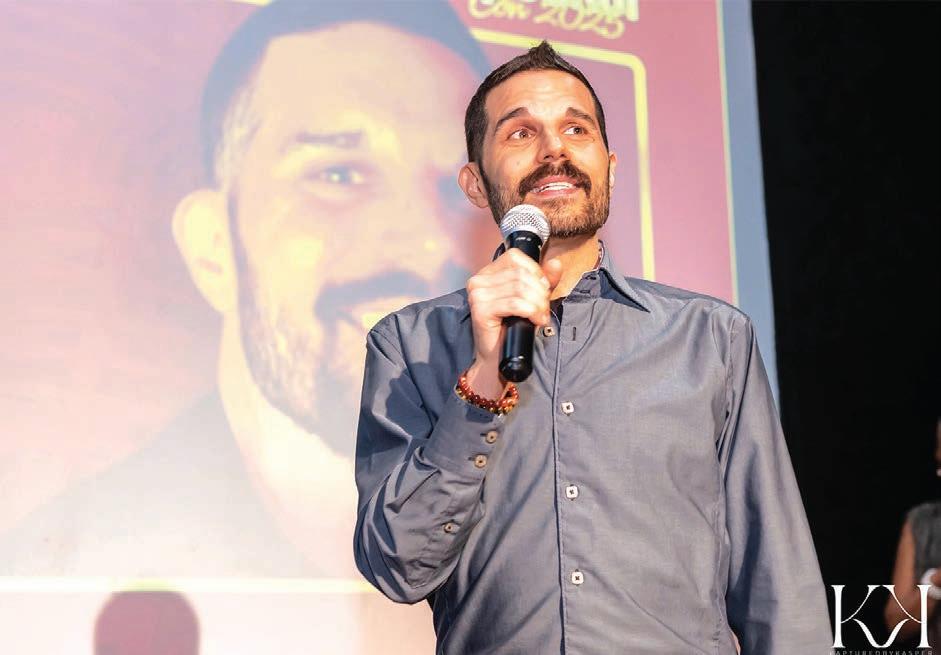
KYLE RIDLEY (Photo courtesy of Kaptured By Kasper)
COOKIES DC- WHERE CULTURE, CANNABIS, & COMMUNITY MEET
COOKIES, the world’s most popular cannabis brand - has planted its flag on U
Street -
Inspired by U Street’s rich history of musical innovation and the diversity of its residents.
Like music, cannabis transcends differences. It is one of the few things that bridge race, religion, politics, gender and sexuality.
Cookies DC is a celebration of what unites humanityA hub of culture, learning, healing and inspiration.
All products are lab tested, fully-legal, and locally sourced from licensed producers.
In DC, all cannabis is considered medicine, but no doctor’s visits are required.
VISIT OUR STORE OR GET FREE DELIVERY FOR A LIMITED TIME
CALENDAR |
By TINASHE CHINGARANDE
Friday, February 20
Center Aging Monthly Luncheon with Yoga will be at noon at the D.C. LGBTQ+ Community Center. Email Mac at maca@thedccenter.org if you require ASL interpreter assistance, have any dietary restrictions, or questions about this event.
Trans and Genderqueer Game Night will be at 7 p.m. at the D.C. Center. This will be a relaxing, laid-back evening of games and fun. All are welcome! We’ll have card and board games on hand. Feel free to bring your own games to share. For more details, visit the Center’s website.
GoGay DC will host “First Friday LGBTQ+ Community Social” at 7 p.m. at Hotel Zena. This is a chance to relax, make new friends, and enjoy happy hour specials at this classic retro venue. Attendance is free and more details are available on Eventbrite
Saturday, February 21
GoGay DC will host “LGBTQ+ Community Brunch” at 11 a.m. at Freddie’s Beach Bar & Restaurant. This fun weekly event brings the DMV area LGBTQ community, including allies, together for delicious food and conversation. ttendance is free and more details are available on Eventbrite.
LGBTQ People of Color will be at 7 p.m. on Zoom. This peer support group is an outlet for LGBTQ People of Color to come together and talk about anything affecting them in a space that strives to be safe and judgement free. There are all sorts of activities like watching movies, poetry events, storytelling, and just hanging out with others. For more information and events, visit thedccenter.org/poc or facebook.com/centerpoc.
Sunday, February 22
Queer Talk DC will host “The Black Gay Flea Market” at 1 p.m. at Doubles in Petworth. There will be more than 15 Black queer vendors from all over the DMV in one spot. The event’s organizers have reserved the large back patio for all vendors, and the speak easy for bar service, which will be serving curated cocktails made just for the event (cash bar.) DJ Fay and DJ Jam 2x will be spinning the entire event. For more details, visit Eventbrite.
Monday, February 23
“Center Aging: Monday Coffee Klatch” will be at 10 a.m. on Zoom. This is a social hour for older LGBTQ adults. Guests are encouraged to bring a beverage of choice. For more information, contact Adam at adamheller@thedccenter.org.
Tuesday, February 24
Coming Out Discussion Group will be at 7 p.m. on Zoom. This is a safe space to share experiences about coming out and discuss topics as it relates to doing so — by sharing struggles and victories the group allows those newly coming out and who have been out for a while to learn from others. For more details, visit the group’s Facebook
Genderqueer DC will be at 7 p.m. on Zoom. This is a support group for people who identify outside of the gender binary, whether you’re bigender, agender, gender uid, or ust know that you re not percent cis. For more details, visit www.genderqueerdc.org or Facebook.
Wednesday, February 25
Job Club will be at 6 p.m. on Zoom upon request. This is a weekly job support program to help job entrants and seekers, including the long-term unemployed, improve self-confidence, motivation, resilience and productivity for effective job searches and networking — allowing participants to move away from being merely “applicants” toward being “candidates.” For more information, email centercareers@thedccenter.org or visit www.thedccenter.org/careers.
Asexual and Aromantic Group will meet at 7 p.m. on Zoom. This is a space where people who are questioning this aspect of their identity or those who identify as asexual and/or aromantic can come together, share stories and experiences, and discuss various topics. For more details, email supportdesk@thedccenter.org
Thursday, February 26
The DC Center’s Fresh Produce Program will be held all day at the DC Center. To be more fair with who is receiving boxes, the program is moving to a lottery system. People will be informed on Wednesday at 5 p.m. if they are picked to receive a produce box. No proof of residency or income is required. For more information, email supportdesk@thedccenter.org or call 202-682-
Virtual Yoga Class will be at 7 p.m. on Zoom. This free weekly class is a combination of yoga, breathwork and meditation that allows LGBTQ community members to continue their healing journey with somatic and mindfulness practices. For more details, visit the DC Center’s website.
OUT & ABOUT
Sweat DC expands to Shaw
Sweat DC is officially e panding to Shaw, opening a new location at 1818 7th St., N.W., on Saturday, Feb. 28 — and they’re kicking things off with a high-energy, community-first launch event.
To celebrate, Sweat DC is hosting Sweat Fest, a free community workout and social on Saturday, March 14, at 10 a.m. at the historic Howard Theatre. The event features a group fitness class, live D , local food and wellness partners, and a mission-driven partnership with the Open Goal Project, which works to expand access to youth soccer for players from marginalized communities.
For more details, visit Sweat DC’s website.
José Zayas brings ‘The House of Bernarda Alba’ to GALA Hispanic Theatre
Gay Spanish playwright Federico García Lorca wrote masterpiece before 1936 execution
By PATRICK FOLLIARD
In Federico García Lorca’s “The House of Bernarda Alba,” now at GALA Hispanic Theatre in Columbia Heights, an impossibly oppressive domestic situation serves, in short, as an allegory for the repressive, patriarchal, and fascist atmosphere of 1930s Spain.
The gay playwright completed his final and arguably best work in 1936, just months before he was executed by a right-wing firing squad. “Bernarda Alba” is set in the same year, sometime during a hot summer in rural Andalusia, the heart of “España profunda” (the deep Spain), where traditions are deeply rooted and mores seldom challenged.
At Bernarda’s house, the atmosphere, already stifling, is about to get worse.
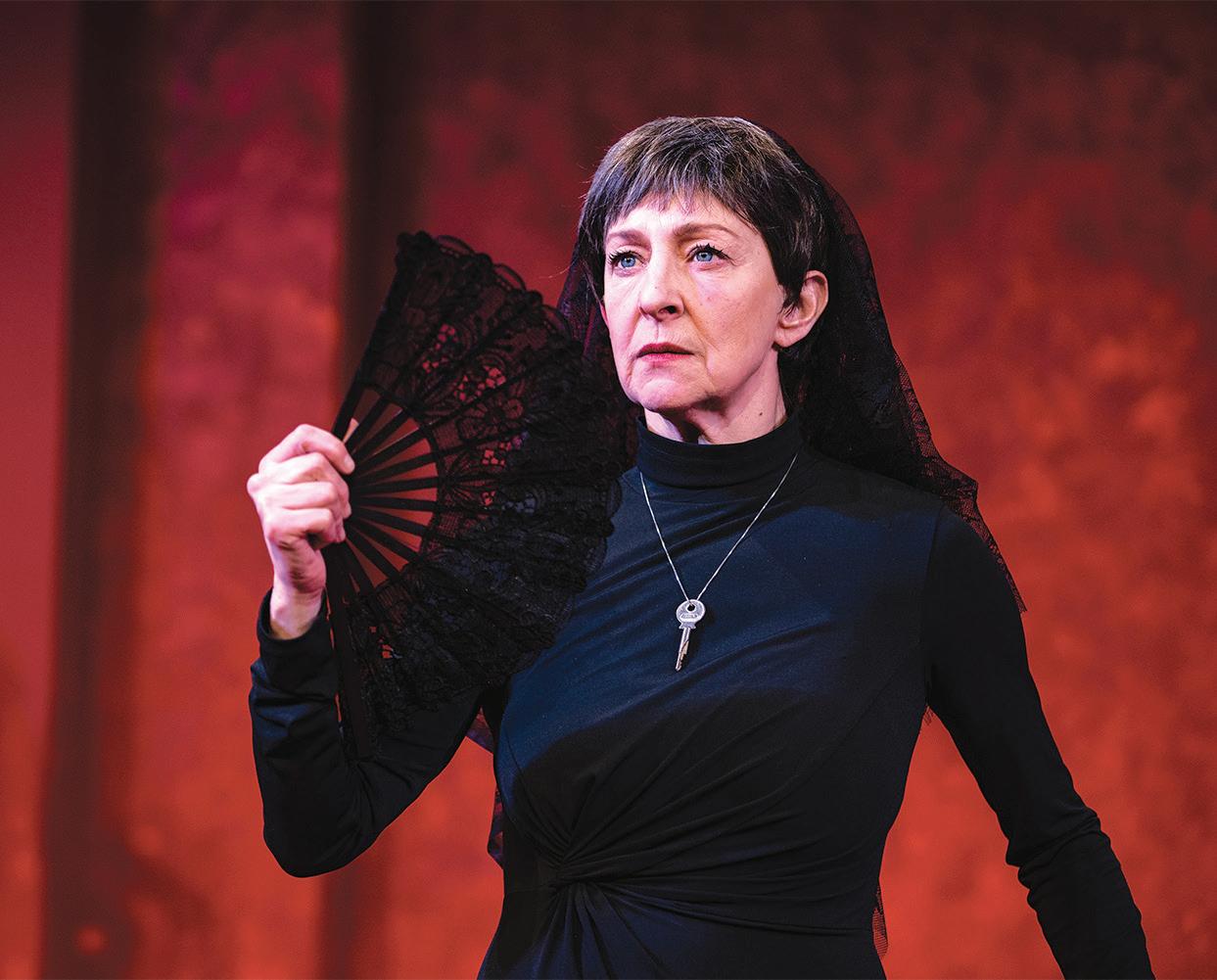
On the day of her second husband’s funeral, Bernarda Alba (superbly played by Luz Nicolás), a sixtyish woman accustomed to calling the shots, gathers her five unmarried daughters (ages ranging from 20 to 39) and matter-of-factly explain what’s to happen next.
She says, “Through the eight years of mourning not a breeze shall enter this house. Consider the doors and windows as sealed with bricks. That’s how it was in my father’s house and my grandfather’s. Meanwhile, you can embroider your trousseaux.”
It’s not an altogether sunny plan. While Angustias (María del Mar Rodríguez), Bernarda’s daughter from her first marriage and heiress to a fortune, is betrothed to a much younger catch, Pepe el Romano, who never appears on stage, the remaining four stand little chance of finding suitable matches. Not only are they dowry-less, but no men, eligible or otherwise, are admitted into their mother’s house.
There are no props.
In the airless room, women sit on straight back chairs sewing. They think of men, still. Two are fixated on their oldest siter’s hunky betrothed. Only Magdelena (Anna Malavé), the one sister who truly mourns their dead father, has given up on marriage entirely.
The severity of the place is alleviated by men’s distant voices, Koki Lortkipanidze’s original music, movement (stir crazy sisters scratching walls), and even a precisely executed beatdown choreographed by Lorraine Ressegger-Slone.
Lorca is a literary hero known for his mastery of both lyrical poetry and visceral drama; still, “Bernarda Alba’s” plotline might suit a telenovela. Despotic mother heads a house of adult daughters. Said daughters are churning with passions and jealousies. When sneaky Martirio (Giselle Gonzáles) steals the photo of Angustias’s fiancé all heck kicks off. Lots of infighting and high drama ensue. There’s even a batty grandmother (Alicia Kaplan) in the wings for bleak comic relief.
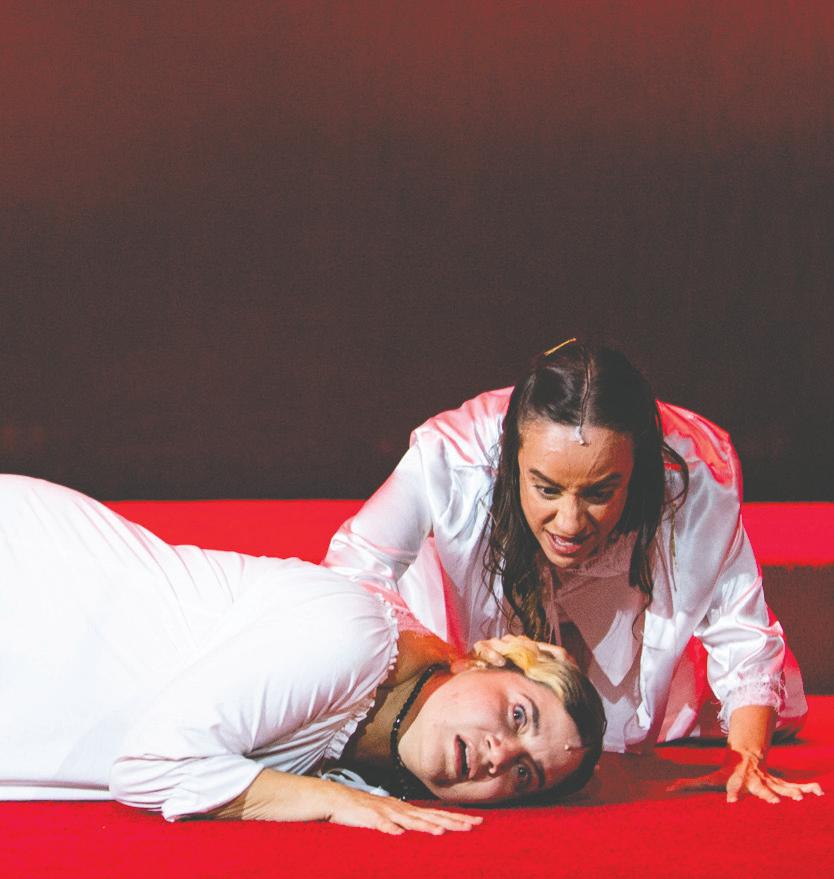
At GALA, the modern classic is lovingly staged by José Zayas. The New Yorkbased out director has assembled a committed cast and creative team who’ve manifested an extraordinarily timely 90-minute production performed in Spanish with English subtitles easily ready seen on multiple screens.
In Lorca’s stage directions, he describes the set as an inner room in Bernarda’s house; it’s bright white with thick walls. At GALA, scenic designer Grisele Gonzáles continues the one-color theme with bright red walls and floor and closed doors.
In a short yet telling scene, Bernarda’s youngest daughter Adela (María Coral) proves she will serve as the rebellion to Bernarda’s dictatorship. Reluctant to mourn, Adela admires her reflection. She has traded her black togs for a seafoam green party dress. It’s a dreamily lit moment (compliments of lighting designer Hailey Laroe.)
But there’s no mistaking who’s in charge. Dressed in unflattering widow weeds, her face locked in a disapproving sneer, Bernarda rules with an iron fist; and despite ramrod posture, she uses a cane (though mostly as a weapon during one of her frequent rages.)
Bernarda’s countenance softens only when sharing a bit of gossip with Poncia, her longtime servant convincingly played by Evelyn Rosario Vega.
Nicolás has appeared in “Bernarda Alba” before, first as daughter Martirio in Madrid, and recently as the mother in an English language production at Carnegie Melon University in Pittsburgh. And now in D.C. where her Bernarda is dictatorial, prone to violence, and scarily pro-patriarchy.
Words and phrases echo throughout Lorca’s play, all likely to signal a tightening oppression: “mourning,” “my house,” “honor,” and finally “silence.”
As a queer artist sympathetic to left wing causes, Lorca knew the of what he wrote. He understood the provinces, the dangers of tyranny, and the dimming of democracy. Early in Spain’s Civil War, Lorca was dragged to the the woods and murdered by Franco’s thugs. Presumably buried in a mass grave, his remains have never been found.
‘The House of Bernarda Alba’ Through March 1 | GALA Hispanic Theatre 3333 14th St., N.W. | $27-$52 | Galatheatre.org
LUZ NICOLÁS in ‘The House of Bernarda Alba’ at GALA Hispanic Theatre (Photo by Daniel Martinez)
adical reframing highlights the Wuthering highs and lows of a classic Emerald ennell s cinematic vision elicits strong reactions
By JOHN PAUL KING
If you’re a fan of “Wuthering Heights” — Emily Bront s oft-filmed novel about a doomed romance on the orkshire moors it s a given you re going to have opinions about any new adaptation that comes along, but in the case of filmmaker Emerald ennell s new cinematic vision of this venerable classic, they re probably going to be strong ones.
It s nothing new, really. Bront s book has elicited controversy since its first publication, when it sparked outrage among ictorian readers over its tragic tale of thwarted lovers locked into an obsessive uest for revenge against each other, and continuing to shock generations of readers with its depictions of emotional cruelty and violent abuse, its dysfunctional relationships, and its grim portrait of a deeply-embedded class structure which perpetuates misery at every level of the social hierarchy.
It s no wonder, then, that ennell s adaptation a true fangirl appreciation pro ect distinguished by the radical sensibilities which the third-time director brings to the mi has become a ash point for social commentators whose main e posure to the tale has been avored by decades of watered-down, romantici ed reinventions, almost all of which omit large portions of the novel to selectively shape what s left into a period tear erker about star-crossed love, often distancing themselves from the raw emotional core of the story by adhering to generic tropes of gothic romance and rarely doing ustice to the comple ity of its characters or, for that matter, its author s more comple intentions.
ennell s version doesn t e actly break that pattern she, too, elides much of the novel s sprawling plot to focus on the twisted entanglement between Catherine Earnshaw argot obbie , daughter of the now-impoverished master of the titular estate artin Clunes , and eathcliff acob Elordi , a lowborn child of unknown background origin that has been adopted by her father as a servant in the household. Both sub ected to the
whims of the elder Earnshaw s violent temper, they form a bond of mutual support in childhood which evolves, as they come of age, into something more yet regardless of her feelings for him, Cathy whose future status and security are at risk chooses to marry Edgar inton Sha ad atif , the financially secure new owner of a neighboring estate. eathcliff, devastated by her betrayal, leaves for parts unknown, only to return a few years later, with a mysteriously-obtained fortune. Imposing himself into Cathy s comfortable-but- oyless matrimony, he rekindles their now-forbidden passion and they become entwined in a torrid affair even as he openly courts inton s naive ward Isabella lison liver and plots to destroy the entire household from within. ne might almost say that these two are the poster couple for the relationship status it s complicated. and it s probably needless to say things don t go well for anybody involved.
While there is more than enough material in Wuthering eights that might easily be labeled as problematic in our contemporary udgments like the fact that it s a love story between two childhood friends, essentially raised as siblings, which becomes codependent and poisons every other relationship in their lives the controversy over ennell s version has coalesced less around the content than her casting choices. When the pro ect was announced, she drew criticism over the decision to cast obbie who also produced the film opposite the younger Elordi. In the end, the casting works though the age gap
might be mildly distracting for some, both actors deliver superb performances, and the chemistry they e ude soon renders it irrelevant.
nother controversy, however, is less easily dispelled. hough we never learn his true ethnic background, Bront s original te t describes eathcliff as having the appearance of a dark-skinned gipsy with black fire in his eyes the character has typically been played by distinctly nglo men, and conse uently, many modern observers have e pressed disappointment and in some cases, full-blown outrage over ennel s choice to use Elordi instead of putting an actor of color for the part, especially given the contemporary filter which she clearly chose for her interpretation for the novel.
In fact, it s that moderni ed perspective a view of history informed by social criticism, economic politics, feminist insight, and a seual candor that would have shocked the prim ictorian readers of Bront s novel that turns ennell s visually striking adaptation into more than ust a comfortably romantici ed period costume drama. rom her very opening scene a public hanging in the village where the death throes of the dangling body elicit lurid glee from the eagerly-gathered crowd she makes it oppressively clear that the th century was not a pleasant time to live the brutality of the era is a primal force in her vision of the story, from the harrowing abuse that forges its lovers codependent bond, to the rigidly maintained class structure that compels even those in the higher echelons especially women into a kind of slavery to the system, to the ine uities that fuel disloyalty among the vulnerable simply to preserve their own tenuous place in the hierarchy. It s a battle for survival, if not of the fittest then of the most ruthless.
t the same time, she applies a distinctly st century attitude of se -positivity to evoke the appeal of carnality, not ust for its own sake but as a taste of freedom she even
uses it to reframe eathcliff s cruel torment of Isabella by implying a consensual dom sub relationship between them, offering a fragment of agency to a character typically relegated to the role of victim. ost crucially, of course, it permits ennell to openly depict the se uality of Cathy and eathcliff as an e perience of transgressive oy albeit a tormented one made perhaps even more irresistible for them and for us by the sense of rebellion that comes along with it.
inally, while this Wuthering eights may not have been the one to finally allow eathcliff s racial identity to come to the forefront, ennell does employ some color-blind casting atif is mi ed-race white and akistani and ong Chau, understated but profound in the crucial role of elly, Cathy s longtime paid companion, is of ietnamese descent to illuminate the added pressures of being an other in a world weighted in favor of sameness.
Does all this contemporary hindsight into the fabric of Bront s epic novel make for a uintessential Wuthering eights Even allowing that such a thing were possible, probably not. While it presents a stylishly crafted and thrillingly cinematic take on this comple classic, richly enhanced by a superb and adventurous cast, it s not likely to satisfy anyone looking for a faithful rendition, nor does it reveal a new angle from which the romance at its center looks anything other than to ic indeed, it almost fetishi es the dysfunction. Even without the comple debate around eathcliff s racial identity, there s plenty here to prompt purists and revisionists alike to find fault with ennell s approach.
et for those looking for a new window into to this perennial classic, and who are comfortable with the radical ourish for which ennell is already known, it s an engrossing and intellectually stimulating e ploration of this iconic story in a new way and for cinema fans, that s more than enough reason to give Wuthering eights a chance.
A CELEBRATION OF BLACK EXCELLENCE IN MUSIC WITH SPECIAL GUESTS 17TH STREET DANCE
FEBRUARY 21 AT 5:00PM (ASL) THE HOWARD THEATRE 620 T STREET NW TICKETS & INFO AT GMCW.ORG GROUPS OF 10 OR MORE, CALL 202-293-1548
MARCH 25, 2026 AT 7:30PM (ASL) NATIONAL CITY CHRISTIAN CHURCH 5 THOMAS CIRCLE NW TICKETS & INFO AT GMCW.ORG GROUPS OF 10 OR MORE, CALL 202-293-1548
Dry January has isolated me from my friends Is
it possible to have social life without alcohol?
By MICHAEL RADKOWSKY
Dear Michael,
Some of my friends and I decided to do Dry January.
The six of us are a posse, we’ve been friends for years. Many boyfriends and even a husband or two have come and gone but we get together all the time and travel together. I think we all agreed that drinking is too big a part of our social lives and thought we’d give Dry January a shot.
So … I am feeling better and it’s only been three weeks. I’ve actually lost a little weight, and it’s nice not to wake up with a hangover four mornings a week. I’m pushing 40 and no surprise, my body feels relieved. But, I’m also the only one of us who is still doing it.
Which means they are all going out and I am not. So I am feeling lonely. I could oin them in going out but first of all, I don t really want to hang out with them when they’re drunk and I’m trying to be alcohol free; and also, there’s a part of me that is afraid I will give in to temptation and have a drink. And then it will be back to business as usual.
But, I spent this past weekend, and every night this week, alone. All of this has me thinking: what do I do in February? I really don’t want to start drinking again.
But, if I don’t, how do I stay part of my friend group? If they’re buzzed (or drunk) and I’m not, am I still going to fit in I’m disappointed in my friends. We were all in this together, I thought, but one thing after another came up for them.
Some special event where “everyone was drinking,” a work dinner where “I didn’t want to deal with everyone’s questions about why I wasn’t drinking,” “too much work stress not to have a martini,” etc. In the end they were all laughing about it and now they’re basically poking fun at me and essentially betting how long I will last. That doesn’t feel good. It’s like the whole thing was a whim or a joke to them.
Also, heavy alcohol use is pretty typical of our community. If I’m not drinking then how do I have a social life?
Appreciate your thoughts.
Michael replies:
It can be hard to be different. For example, to be gay in a straight world, or not to drink in a world where alcohol plays such a big part.
I’m a believer in living in a way that respects whom you actually are. This means doing what you think is important to do, even when there are consequences you don’t like. Only you can decide the boundary where the consequences of your living with integrity become intolerable.
Yes, many gay men drink a lot. So if you decide you don’t want to hang out where alcohol
is involved, you will be reducing your options for socializing.
Some possibilities:
• Discuss this situation with your friends. Ask them if they’re willing to spend some time with you and without alcohol. (Not all the time — that would be way too much to ask, given that they clearly enjoy drinking.) Perhaps if you explain why your request is important to you, they’ll be willing to lean in your direction at least some of the time. That they’re now mocking you for not drinking suggests I am a bit too optimistic about this possibility. But who knows? And, what have you to lose by asking?
• See if you can tolerate hanging out with people who are drinking without picking up a drink yourself, and if you can actually enjoy such interactions.
• Start looking for some new friends. There are, in fact, lots of gay men in this world whose social lives don’t revolve around alcohol (or other substances.)
On a separate but related note: given your fear that you will start drinking again, and your concerns about navigating life without alcohol, might you consider Alcoholics Anonymous to get some support?
I’ve seen AA and other 12-step groups help many friends and clients, and I think they work in two main ways.
First, attending meetings gives you support and a feeling of community. You’ll meet others who are working to be sober, hear their stories and share your own struggles with them. You’re likely to feel less alone in your effort to stop drinking, learn tools for staying sober, and make friends you can reach out to when you’re feeling vulnerable. You’ll also have a sponsor, your guide and advocate in the program, whom you talk with regularly.
Second, the program lays out “12 steps” of recovery that are a path to greater self-awareness and personal growth. Like good psychotherapy, the steps give you a framework for looking at your behavior patterns and taking responsibility for yourself.
If you are intrigued, the best way to learn more is to attend several 12-step meetings. here are many in our area, including gay groups for e ample, the riangle Club. s I mentioned, if you do get involved in , a side benefit is that you re likely to make some new friends who share your desire to build a life without alcohol.
Of course, making new friends does not have to mean cutting off your posse. But if you’re changing in ways that make them less of a great fit, it would be great to find some new folks who might be more on your wavelength to connect with.
Michael Radkowsky, Psy.D. is a licensed psychologist who works with couples and individuals in D.C., Maryland, Virginia, and New York. He can be found online at michaelradkowsky.com. All identifying information has been changed for reasons of confdentiality. Have a question? Send it to michael@michaelradkowsky.com
(Image via Bigstock/Prostock-studio)
Dry January has isolated me from my friends (Image via Bigstock/tilialucida)
Clash
New weekly
at Trade
Crimsyn and Tatianna hosted the new weekly drag show Clash at Trade (1410 14th Street, N.W.) on Saturday, Feb. 14. Performers included Aave, Crimsyn, Desiree Dik and Tatianna.
People. Individual/Couples counseling with a volunteer peer counselor. CC, serving our community since 1973. 202-580-8861
gaymenscounseling.org
No fees. Donation requested.
HANDYMAN
BRITISH REMODELING
Local licensed company with over 25 years of experience. Speciali ing in bathrooms, kitchens all interior e terior repairs. Drywall, paint, electrical, wallpaper, roofing siding. Trevor 703-303-8699
LEGAL SERVICES
ADOPTION, DONOR, SURROGACY
legal services. Catelyn represents LGBTQ clients in DC, MD & VA interested in adoption or A atters.
MODERN FAMILY FORMATION
Law Offices, Slattery Law, LLC. 240-245-7765
Catelyn@ModernFamilyFormation.com
LIMOUSINES
KASPER’S LIVERY SERVICE
Your Personal Uber/Limo Service
WHERE DO YOU WANT TO GO?
I can get you there!
Proper DC License & Livery Insured. Gay & Veteran Owner/Operator. Since 1987. 202-554-2471 www.KasperLivery.com
MOVING
GREAT SCOTT MOVING
ocal ong
Distance. et a reat ove at a reat rice call (301) 6992066
We’ve moved the Blade, Embassies the Smithsonian’s piano collection! greatscottmoving.com Let us move you!
IS tall, good-looking, well-hung, Hispanic or Puerto Rican male ready to e perience my hot, hungry mouth. ust rela and en oy my service Sincere responses, please te t me. I will get back to you. Available 24 hrs a day. Call or text: 240-457-1292
Swedish, assage or Deep issue. ppts. ow ates, , In-Calls.