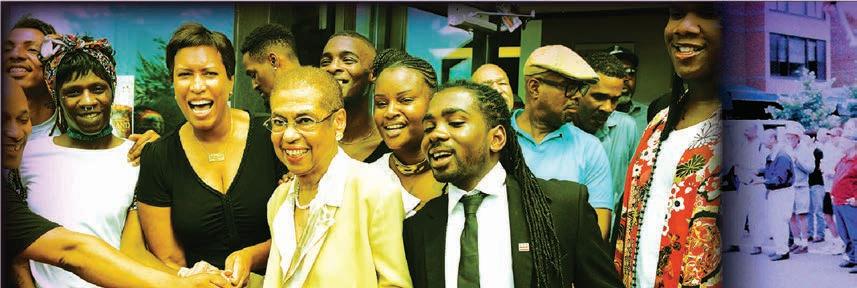









D.C. congressional delegate

















































































ADDRESS PO Box 60664
Washington DC 20039
PHONE
202-747-2077
news@washblade.com
INTERNET
washingtonblade.com
PUBLISHED BY Brown Naff Pitts Omnimedia, Inc.
PUBLISHER
LYNNE J. BROWN
lbrown@washblade.com ext. 8075
EDITORIAL
EDITOR
KEVIN NAFF
knaff@washblade.com ext. 8088
SR. NEWS REPORTER
LOU CHIBBARO JR. lchibbaro@washblade.com ext. 8079
WHITE HOUSE CORRESPONDENT
JOE REBERKENNY
jreberkenny@washblade.com ext. 9463
INTERNATIONAL NEWS EDITOR












Big Gay Smiles, City Dogs, Downtown Frederick, Ingleside, LGBTQ Counseling Collaborative, Sibley Hospital, Signature Theatre, Takoma Wellness Center, and Toll Brothers.
Capital Pride Alliance, DC Front Runners, Human Rights Campaign, Rainbow Families, SMYAL, Stonewall Sports, Team DC, The DC Center, Wild Side Media, and Modern Family Formation Law Offices

MICHAEL K. LAVERS mlavers@washblade.com ext. 8093
POP CULTURE REPORTER
JOHN PAUL KING
PHOTO EDITOR
MICHAEL KEY mkey@washblade.com ext 8084
CONTRIBUTING WRITERS
DANIEL ITAI, ISAAC AMEND, TINASHE CHINGARANDE, PETER ROSENSTEIN, PATRICK FOLLIARD, TERRI SCHLICHENMEYER, JOE PHILLIPS, EVAN CAPLAN, ANKUSH KUMAR, ESTEBAN RIOSECO, SAM KISIKA, ELVIS KAWEDO, DAWN ENNIS CREATIVE DESIGN/PRODUCTION
MEAGHAN JUBA production@azercreative.com
SALES & ADMINISTRATION
DIRECTOR OF SALES & MARKETING
STEPHEN RUTGERS srutgers@washblade.com ext. 8077
SR. ACCT. EXECUTIVE
BRIAN PITTS bpitts@washblade.com ext. 8089
CLASSIFIED ADVERTISING/ADMINISTRATION
PHILLIP G. ROCKSTROH prockstroh@washblade.com ext. 8092
NATIONAL ADVERTISING
RIVENDELL MEDIA 212-242-6863; sales@rivendellmedia.com
For distribution, contact Lynne Brown at 202-747-2077, ext. 8075. Distributed by Southwest




Dan Cox, a Republican who was resoundingly defeated by Democratic Gov. Wes Moore four years ago, has filed to run for governor again this year.
Cox’s candidacy was posted on the Maryland elections board website Friday; he did not immediately respond to an interview request.
Cox listed Rob Krop as his running mate for lieutenant governor.
In 2022, Moore got more than twice as many votes as Cox in the general election, 65% to 32%.
Cox, who at the time was a state delegate, aligned himself with the Make America Great Again movement. He raised money at President Donald Trump’s Mar-a-Lago resort and won Trump’s endorsement, and Trump participated in a telephone call for Cox’s supporters.
Cox scored a surprise Republican primary win over Kelly Schulz, a former state delegate who later ran two state agencies and was former Gov. Larry Hogan’s hand-picked successor.
After his loss, Cox reported less than $200 in his campaign account. He hasn’t raised significant money since. In his most recent filing this month, Cox attested that he did not raise or spend more than $1,000.
Cox joins a Republican field vying for a shot to take on Moore that includes retired bank executive Ed Hale Sr. and other lesser-known candidates.
Hogan, the most well-known Republican in Maryland, announced last week that he would not run for his old job.
FreeState Justice this week spoke with the Washington Blade about their priorities during this year’s legislative session in Annapolis that began on Jan. 14.
Ronnie L. Taylor, the group’s community director, on Wednesday said the organization continues to fight against discrimination against people with HIV/ AIDS. FreeState Justice is specifically championing a bill in the General Assembly that would expand access to PrEP in Maryland.
Taylor said FreeState Justice is working with state Del. Ashanti Martinez (D-Prince George’s County)
and state Sen. Clarence Lam (D-Arundel and Howard Counties) on a bill that would expand the “scope of practice for pharmacists in Maryland to distribute PrEP.” The measure does not have a title or a number, but FreeState Justice expects it will have both in the coming weeks.
FreeState Justice has long been involved in the fight to end the criminalization of HIV in the state.
Governor Wes Moore last year signed House Bill 39, which decriminalized HIV in Maryland.
The bill — the Carlton R. Smith Jr. HIV Modernization Act — is named after Carlton Smith, a long-time
David Reid named principal at Brownstein
By PETER ROSENSTEIN
The Comings & Goings column is about sharing the professional successes of our community. We want to recognize those landing new jobs, new clients for their business, joining boards of organizations and other achievements. Please share your successes with us at comingsandgoings@washblade.com.
The Comings & Goings column also invites LGBTQ+ college students to share their successes with us. If you have been elected to a student government position, gotten an exciting internship, or are graduating and beginning your career with a great job, let us know so we can share your success.
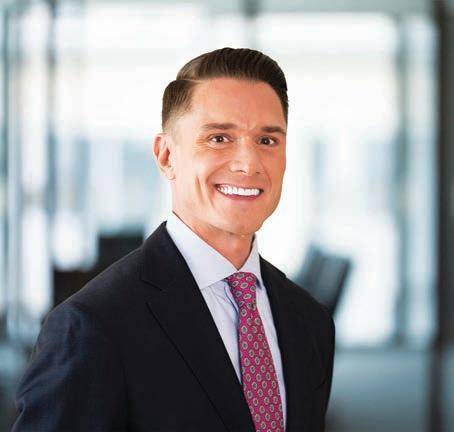
Congratulations to David Reid on his new position as Principal, Public Policy, with Brownstein Hyatt Farber Schreck. Upon being named to the position, he said, “I am proud to be part of this inaugural group of principals as the firm launches it new ‘principal, public policy’ title.”
Reid is a political strategist and operative. He is a prolific fundraiser, and skilled advocate for legislative and appropriations goals. He is deeply embedded in Democratic politics, drawing on his personal network on the Hill, in governors’ administrations, and throughout the business community, to build coalitions that drive policy successes for clients. His work includes
leading complex public policy efforts related to infrastructure, hospitality, gaming, health care, technology, telecommunications, and arts and entertainment.
Reid has extensive political finance experience. He leads Brownstein’s bipartisan political operation each cycle with Republican and Democratic congressional and national campaign committees and candidates. Reid is an active member of Brownstein’s pro-bono committee and co-leads the firm’s LGBT+ Employee Resource Group.
He serves as a Deputy National Finance Chair of the Democratic National Committee and is a member of the Finance Committee of the Democratic Governors Association, where he previously served as the Deputy Finance Director.
Prior to joining Brownstein, Reid served as the Washington D.C. and PAC finance director at Hillary for America. He worked as the mid-Atlantic finance director, for the Democratic Senatorial Campaign Committee and ran the political finance operation of a Fortune 50 global health care company.
Among his many outside involvements, Reid serves on the executive committee of the One Victory, and LGBTQ Victory Institute board, the governing bodies of the LGBTQ Victory Fund and Institute; and is a
LGBTQ activist known as the “mayor” of Baltimore’s Mount Vernon neighborhood who died in 2024. FreeState Justice said Marylanders prosecuted under Maryland Health-General Code § 18-601.1 have already seen their convictions expunged.
Taylor said FreeState Justice will continue to “oppose anti anti-LGBTQ legislation” in the General Assembly. Their website later this week will publish a bill tracker.
The General Assembly’s legislative session is expected to end on April 13.
SAM EPNER
DAVID REID
member of the board for Q Street. Congratulations also to Yesenia Alvarado Henninger of Helion Energy, president; Abigail Harris of Honeywell; Alex Catanese of American Bankers Association; Stu Malec, secretary ; Brendan Neal, t reasurer ; Brownstein’s David Reid; Amazon’s Suzanne Beall; Lowe’s’ Rob Curis; andCornerstone’s Christian Walker. Their positions have now been confirmed by the Q Street Board of Directors.

By LOU CHIBBARO JR. | lchibbaro@washblade.com
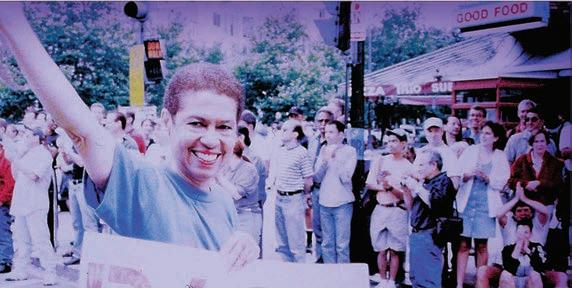
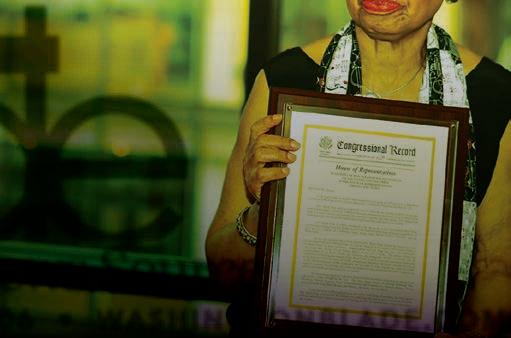
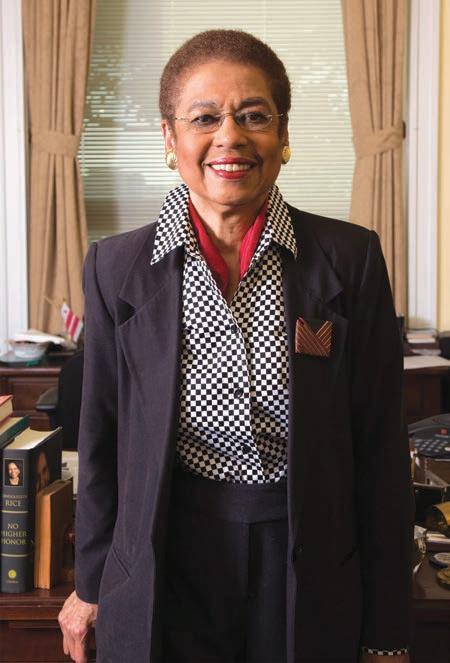
LGBTQ rights advocates reflected on D.C. Congressional Del. Eleanor Holmes Norton’s longstanding advocacy and support for LGBTQ rights in Congress following her decision last month not to run for re-election this year.
Upon completing her current term in office in January 2027, Norton, a Democrat, will have served 18 two-year terms and 36 years in her role as the city’s non-voting delegate to the U.S. House.
LGBTQ advocates have joined city officials and community leaders in describing Norton as a highly effective advocate for D.C. under the city’s limited representation in Congress where she could not vote on the House floor but stood out in her work on House committees and moving, powerful speeches on the House floor.
“During her more than three decades in Congress, Eleanor Holmes Norton has been a champion for the District of Columbia and the LGBTQ+ community,” said David Stacy, Vice President of Government Affairs for the Human Rights Campaign, the D.C.-based national LGBTQ advocacy organization.
al LGBTQ advocates familiar with Norton’s work, Stacy added, “We have been lucky to have such an incredible champion. As her time in Congress comes to an end, we honor her extraordinary impact in the nation’s capital and beyond by standing together in pride and gratitude.”
Norton has been among the lead co-sponsors and outspoken supporters of LGBTQ rights legislation introduced in Congress since first taking office, including the currently pending Equality Act, which would ban employment discrimination based on sexual orientation and gender identity.
Activists familiar with Norton’s work also point out that she has played a lead role in opposing and helping to defeat anti-LGBTQ legislation. In 2018, Norton helped lead an effort to defeat a bill called the First Amendment Defense Act introduced by Sen. Mike Lee (R-Utah), which Norton said included language that could “gut” D.C.’s Human Rights Act’s provisions banning LGBTQ discrimination.
Norton pointed to a provision in the bill not immediately noticed by LGBTQ rights organizations that would define D.C.’s local government as a federal government entity and allow potential discrimination against LGBTQ people based on a “sincerely held religious belief.”
“This bill is the latest outrageous Republican attack on the District, focusing particularly on our LGBT community and the District’s right to self-government,” Norton said shortly after the bill was introduced. “We will not allow Republicans to discriminate against the LGBT community under the guise of religious liberty,” she said. Records show supporters have not secured the votes to pass it in several congressional sessions.
In 2011, Norton was credited with lining up sufficient opposition to plans by some Republican lawmakers to attempt to overturn D.C.’s same-sex marriage law, that the Council passed and the mayor signed in 2010.
In 2015, Norton also played a lead role opposing attempts by GOP members of Congress to overturn another D.C. law protecting LGBTQ students at religious schools, including the city’s Catholic University, from discrimination such as the denial of providing meeting space for an LGBTQ organization.
More recently, in 2024 Norton again led efforts to defeat an attempt by Republican House members to amend the D.C. budget bill that Congress must pass to eliminate funding for the Mayor’s Office of LGBTQ Affairs and to prohibit the city from using its funds to enforce the D.C. Human Rights Act in cases of discrimination against transgender people.
Norton’s many years of service to all the citizens and residents of the District of Columbia,” said John Klenert, a member of the board of the LGBTQ Victory Fund. “Whether it was supporting its LGBTQ+ people for equal rights, HIV health issues, home rule protection, statehood for all 700,000 people, we could depend on her,” he said.
Ryan Bos, executive director of Capital Pride Alliance, the group that organizes D.C.’s annual LGBTQ Pride events, called Norton a “staunch” LGBTQ community ally and champion for LGBTQ supportive legislation in Congress.

“For decades, Congresswoman Norton has marched in the annual Capital Pride Parade, showing her pride and using her platform to bring voice and visibility in our fight to advance civil rights, end discrimination, and affirm the dignity of all LGBTQ+ people” Bos said. “We will be forever grateful for her ongoing advocacy and contributions to the LGBTQ+ movement.”
Howard Garrett, president of D.C.’s Capital Stonewall Democrats, called Norton a “consistent and principled advocate” for equality throughout her career. “She supported LGBTQ rights long before it was politically popular, advancing nondiscrimination protections and equal protection under the law,” he said.
“When Congress blocked implementation of D.C.’s domestic partnership registry, Norton led the fight to allow it to go into effect,” Stacey said. “When President Bush tried to ban marriage equality in every state and the District, Norton again stood up in opposition. And when Congress blocked HIV prevention efforts, Norton worked to end that interference in local control,” he said.
In reflecting the sentiment of many local and nation-
“The Republican amendment that would prohibit funds from being used to enforce anti-LGBTQ+ discrimination regulations and the amendment to defund the Mayor’s Office of LGBTQ+ Affairs are disgraceful attempts, in themselves, to discriminate against D.C.’s LGBTQ+ community while denying D.C. residents the limited governance over their local affairs to which they are entitled,” Norton told the Washington Blade.
In addition to pushing for LGBTQ supportive laws and opposing anti-LGBTQ measures Norton has spoken out against anti-LGBTQ hate crimes and called on the office of the U.S. Attorney for D.C. in 2020 to more aggressively prosecute anti-LGBTQ hate crimes.
“There is so much to be thankful for Eleanor Holmes
“Eleanor was smart, tough, and did not suffer fools gladly,” said Rick Rosendall, former president of the D.C. Gay and Lesbian Activists Alliance. “But unlike many Democratic politicians a few decades ago who were not reliable on LGBTQ issues, she was always right there with us,” he said. “We didn’t have to explain our cause to her.”
Longtime D.C. gay Democratic activist Peter Rosenstein said he first met Norton when she served as chair of the New York City Human Rights Commission. “She got her start in the civil rights movement and has always been a brilliant advocate for equality,” Rosenstein said.
“She fought for women and for the LGBTQ community,” he said. “She always stood strong with us in all the battles the LGBTQ community had to fight in Congress. I have been honored to know her, thank her for her lifetime of service, and wish her only the best in a hardearned retirement.”




By LOU CHIBBARO JR. | lchibbaro@washblade.com
The D.C. Council voted unanimously on Feb. 3 to approve a bill on its first of two required votes that requires health insurance companies to cover the costs of HIV prevention or PrEP drugs for D.C. residents at risk for HIV infection.
The vote to approve the PrEP D.C. Amendment Act came immediately after the 13-member Council voted unanimously again to approve an amendment that removed language in the bill added last month by the Council’s Committee on Health that would require insurers to fully cover only one PrEP drug.
The amendment, introduced jointly by Council members Zachary Parker (D-Ward 5), who first introduced the bill in February 2025, and Christina Henderson (I-AtLarge), who serves as chair of the Health Committee, requires insurers to cover all U.S. Food and Drug Administration approved PrEP drugs.
Under its rules, the D.C. Council must vote twice to approve all legislation, which must be signed by the D.C. mayor and undergo a 30-day review by Congress before it takes effect as a D.C. law.
Given its unanimous “first reading” vote of approval on Feb. 3, Parker told the Washington Blade he was certain the Council would approve the bill on its second and final vote expected in about two weeks.
Among those who raised concerns about the earlier version of the bill was Carl Schmid, executive director of the D.C.-based HIV+Hepatitis Policy Institute, who sent messages to all 13 Council members urging them to remove the language added by the Committee on Health requiring insurers to cover just one PrEP drug.
The change made by the committee, Schmidt told Council members, “would actually reduce PrEP options
for D.C. residents that are required by current federal law, limit patient choice, and place D.C. behind states that have enacted HIV prevention policies designed to remain in effect regardless of any federal changes.”
Schmid told the Washington Blade that although coverage requirements for insurers are currently provided through coverage standards recommended in the U.S. Affordable Care Act, known as Obamacare, AIDS advocacy organizations have called on D.C. and states to pass their own legislation requiring insurance coverage of PrEP in the event that the federal policies are weakened or removed by the Trump administration, which has already reduced or ended federal funding for HIV/ AIDS-related programs.
“The sticking point was the language in the markup that insurers only had to cover one regimen of PrEP,” Parker told the Blade in a phone interview the night before the Council vote. “And advocates thought that moved the needle back in terms of coverage access, and I agree with them,” he said.
In anticipation that the Council would vote to approve the amendment and the underlying bill, Parker, the Council’s only gay member, added, “I think this is a win for our community. And this is a win in the fight against HIV/AIDS.”
During the Feb. 3 Council session, Henderson called on her fellow Council members to approve both the amendment she and Parker had introduced and the bill itself. But she did not say why her committee approved the changes that advocates say weakened the bill and that her and Parker’s amendment would undo. Schmid speculated that pressure from insurance companies may have played a role in the committee change requiring
Lieutenant Gov. Ghazala Hashmi on Monday opened Equality Virginia’s annual Lobby Day in Richmond.
The Lobby Day was held at Virginia’s Capitol and was open to the public by RSVP. The annual event is one of the ways that Equality Virginia urges its supporters to get involved. It also offers informational sessions and calls to action through social media.
haman, and the group endorsed her for lieutenant governor.
Hashmi opposes anti-transgender legislation. She opposed a 2022 bill that sought to take away opportunities from trans athletes.

Hashmi, a former state senator, has been open about her support for the LGBTQ community and other marginalized groups. Her current adviser is Equality Virginia Executive Director Narissa Ra-
One of the focuses of this year’s Lobby Day was protecting LGBTQ students. Another was protecting trans youth’s access to gender-affirming care.
Advocates spent their day in meetings and dialogues with state legislators and lawmakers about legislative priorities and concerns.
SAM EPNER
coverage of only one PrEP drug.
“My goal for advancing the ‘PrEP DC Amendment Act’ is to ensure that the District is building on the progress made in reducing new HIV infections every year,” Henderson said in a statement released after the Council vote. “On Friday, my office received concerns from advocates and community leaders about language regarding PrEP coverage,” she said.
“My team and I worked with Council member Parker, community leaders, including the HIV+Hepatitis Policy Institute and Whitman-Walker, and the Department of Insurance, Securities, and Banking, to craft a solution that clarifies our intent and provides greater access to these life-saving drugs for District residents by reducing consumer costs for any PrEP drug approved by the U.S. Food and Drug Administration,” her statement concludes.
In his own statement following the Council vote, Schmid thanked Henderson and Parker for initiating the amendment to improve the bill. “This will provide PrEP users with the opportunity to choose the best drug that meets their needs,” he said. “We look forward to the bill’s final reading and implementation.”
A federal appeals court has ruled Montgomery County Public Schools did not violate a substitute teacher’s constitutional rights when it required her to use students’ preferred pronouns in the classroom.
The 4th U.S. Circuit Court of Appeals in a 2-1 decision it released on Jan. 28 ruled against Kimberly Polk.
The policy states that “all students have the right to be referred to by their identified name and/or pronoun.”
“School staff members should address students by the name and pronoun corresponding to the gender identity that is consistently asserted at school,” it reads. “Students are not required to change their permanent student records as described in the next section (e.g., obtain a court-ordered name and/or new birth certificate) as a prerequisite to being ad-
dressed by the name and pronoun that corresponds to their identified name. To the extent possible, and consistent with these guidelines, school personnel will make efforts to maintain the confidentiality of the student’s transgender status.”
The Washington Post reported Polk, who became a substitute teacher in Montgomery County in 2021, in November 2022 requested a “religious accommodation, claiming that the policy went against her ‘sincerely held religious beliefs,’ which are ‘based on her understanding of her Christian religion and the Holy Bible.’”
U.S. District Judge Deborah Boardman in January 2025 dismissed Polk’s lawsuit that she filed in federal court in Beltsville. Polk appealed the decision to the 4th Circuit.
FROM STAFF REPORTS

By JOE REBERKENNY | jreberkenny@washblade.com
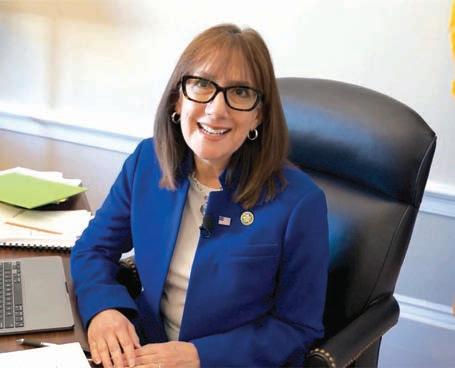
Rep. Andrea Salinas, the new vice chair of the Equality Caucus, sat down with the Blade to discuss the battles ahead as she demands protections for LGBTQ Americans.
Salinas is no stranger to government service. The daughter of a Mexican immigrant, she graduated from the University of California, Berkeley, and soon became a valued member of multiple Democratic offices — including working as a congressional aide to U.S. Sen. Harry Reid (D-Nev.) and U.S. Reps. Pete Stark (D-Calif.) and Darlene Hooley (D-Ore.). From there, she served six years in the Oregon House of Representatives before being elected to Congress, representing areas south of Salem and parts of southern Portland. With her new role in the Equality Caucus, Salinas vows to push protections for LGBTQ Americans in every room she enters.
The Washington Blade spoke with Salinas last week following her leadership announcement to discuss what the role means to her, why she — as a straight woman— feels it is her duty to fight for LGBTQ protections, and how she views the current state of the country.
When asked why she decided to take on a leadership role within the Equality Caucus, Salinas explained that she was already doing the work — but that the timing of the caucus’s outreach, coupled with what she described as a growing threat posed by the Trump-Vance administration, made the moment feel especially urgent.
“I was actually asked to take on this role because of the work I’ve already been doing. I didn’t seek out a title— the Congressional Equality Caucus came to me, and I was honored by that,” the Oregon representative told the Blade. “I’ve been a lifetime advocate, first as a mother and then as a legislator. With Trump back in office and the shackles off, kids are vulnerable right now, and they’re being attacked. We need champions, and with or without a title, I was going to do this work anyway.”
That work includes passing LGBTQ-related education policy during her time in the Oregon House of Representatives, requiring the Oregon Department of Education to train teachers on how to better support LGBTQ students. She also backed legislation aimed at preventing LGBTQ-related bullying and harassment, while using her platform to ensure educators had the skills needed to address trauma in the classroom. Salinas also pushed for Oregon’s 2013 conversion therapy ban and played a role in defending it.
Salinas said her personal motivation for expanding and protecting LGBTQ rights is rooted in the experiences of her daughter, Amelia.
“My daughter is queer, and she has known who she is since she was a child,” Salinas said. “She presents very masculine, and I’ve had to advocate for her her entire life — from whispers on soccer sidelines to fears about using the bathroom when she was just three or four years old. That kind of bullying and harassment stays with you as a parent. It became part of who I am, part of my ‘mama bear’ advocacy. When I entered public office, continuing that fight was the most natural thing in the world.”
That “mama bear” advocacy, she said, now extends far beyond her own family.
“Across this country, kids are vulnerable right now, and
Trump is attacking them,” she said. “My daughter was devastated after the 2024 election— she said, ‘They’re coming after us,’ and she was right. That fear is real, especially for transgender youth. Civil rights should be expanding, not being stripped away from certain communities. That’s why this fight feels so urgent.”
Since returning to the White House in 2024, the Trump administration has moved to roll back anti-discrimination protections, particularly those affecting transgender people. These efforts include barring transgender people from serving openly in the military, blocking access to gender-affirming medical care in federal health programs, challenging state laws that protect transgender students on religious grounds, and arguing that the Constitution entitles employers to discriminate against LGBTQ people based on religious beliefs — even in states with nondiscrimination laws.
For Salinas, the Equality Caucus’s most urgent task under the Trump-Vance administration is advancing what she called a long-sought but non-negotiable priority: the Equality Act.
The Equality Act would add explicit protections based on sexual orientation and gender identity to federal law. Despite more than five decades of debate on Capitol Hill, no version of the bill has yet become law.
“We have to keep pushing the Equality Act— there’s no way around that. No one should be discriminated against in housing, employment, credit, or healthcare because of who they are,” Salinas said. “Republicans are making LGBTQ identity a political wedge because they think it’s expedient, and that’s unacceptable. Sexual orientation and gender identity should not matter in determining someone’s access to opportunity. Yet here we are, still having to fight for that basic principle.”
Salinas added that advancing legislation like the Equality Act requires compassion— even when that compassion is not returned— and a commitment to education.
“We have to meet people where they are— Democrats, Republicans, independents, all of them. Until you know
a family, or understand someone’s lived experience, it can feel abstract and overwhelming,” she said. “Education, compassion, and empathy are essential to moving the dial. When people understand this is about human rights, not politics, conversations start to change. That’s how we build broader support.”
She also emphasized the need for a federal transgender bill of rights, which would provide explicit protections for transgender Americans amid what she described as an increasingly hostile federal environment.
“A transgender bill of rights would clarify that discrimination against transgender and nonbinary people is illegal — in employment, housing, credit, and healthcare,” Salinas said. “What’s happening right now, with efforts to criminalize doctors for providing evidence-based care, is unheard of and dangerous. We also need to ban conversion therapy nationwide, because states are increasingly trying to undo those protections through the courts. These safeguards are about ensuring people can live safely and with dignity. That should not be controversial.”
Mental health is another central focus of Salinas’s work. She said ensuring children have access to support— particularly LGBTQ youth— is critical to their longterm wellbeing.
After the Trump administration eliminated the LGBTQ-specific option from the 988 Suicide and Crisis Lifeline, Salinas said her reaction was one of outrage.
“When Trump shut down the 988 press-three option for LGBTQ youth, I was apoplectic,” she said. “It is one of the simplest, most upstream ways to save lives, and it felt arbitrary, cruel, and inhumane. We know the suicide risk among transgender youth is far higher than among non-LGBTQ kids. Connecting them with someone who understands their experience can be life-saving. This should be bipartisan, and I’m going to keep pushing to restore it.”
“You cannot be what you cannot see….” she added while reflecting on the handful of LGBTQ leaders who have— and continue to— navigate the halls of Congress to protect their community. “When Sarah McBride was elected, my daughter met with her and walked out glowing… joyful, hopeful, and excited about the future. That kind of representation changes lives. Electing LGBTQ leaders changes the trajectory for people across the country. Grassroots organizing and electoral power go hand in hand, and we need both.”
With Salinas’s experience in both the Oregon House of Representatives and the U.S. House of Representatives, she said that while one arena may reach more people, change often begins locally, especially when combating anti-LGBTQ attacks.
“I’ve seen how misinformation fuels fear at the local level— whether it’s school board fights or bathroom debates rooted in baseless claims. There is no data to support these scare tactics,” she said, echoing her past work with the Oregon Department of Education. “What actually helps is facts, education, and training teachers to better support LGBTQ students. I passed legislation in Oregon to give educators real tools to prevent bullying and harassment. That kind of work matters just as much as what we do in Congress.”

More than 40 openly LGBTQ athletes are expected to compete in the Milan Cortina Winter Olympics that open on Friday.

Outsports.com notes eight Americans — including speedskater Conor McDermott-Mostowy and figure skater Amber Glenn — are among the 44 openly LGBTQ athletes who will compete in the games. The LGBTQ sports website also reports Ellis Lundholm, a mogul skier from Sweden, is the first openly transgender athlete to compete in any Winter Olympics.
“I’ve always been physically capable. That was never a question,” Glenn told Outsports.com. “It was always a mental and competence problem. It was internal battles for so long: when to lean into my strengths and when to work on my weaknesses, when to finally let myself portray the way I am off the ice on the ice. That really started when I came out publicly.”
McDermott-Mostowy is among the six athletes who have benefitted from the Out Athlete Fund, a group that
has paid for their Olympics-related training and travel. The other beneficiaries are freestyle skier Gus Kenworthy, speed skater Brittany Bowe, snowboarder Maddy Schaffrick, alpine skier Breezy Johnson, and Paralympic Nordic skier Jake Adicoff.
Out Athlete Fund and Pride House Los Angeles – West Hollywood on Friday will host a free watch party for the opening ceremony.
“When athletes feel seen and accepted, they’re free to focus on their performance, not on hiding who they are,” Haley Caruso, vice president of the Out Athlete Fund’s board of directors, told the Los Angeles Blade.
Four Italian LGBTQ advocacy groups — Arcigay, CIG Arcigay Milano, Milano Pride, and Pride Sport Milano — have organized the games’ Pride House that will be located at the MEET Digital Culture Center in Milan.
Pride House on its website notes it will “host a diverse calendar of events and activities curated by associations, activists, and cultural organizations that share the values of Pride” during the games. These include an opening ceremony party at which Checcoro, Milan’s first LGBTQ chorus, will perform.
ILGA World, which is partnering with Pride House, is the co-sponsor of a Feb. 21 event that will focus on LGBTQ-inclusion in sports. Valentina Petrillo, a trans Paralympian, is among those will participate in a discussion that Simone Alliva, a journalist who writes for the Italian newspaper Domani, will moderate.
“The event explores inclusivity in sport — including amateur levels — with a focus on transgender people, highlighting the role of civil society, lived experiences, and the
voices of athletes,” says Milano Pride on its website.
The games will take place against the backdrop of the U.S. Olympic and Paralympic Committee’s decision to ban trans women from competing in women’s sporting events.
President Donald Trump last February issued an executive order that bans trans women and girls from female sports teams in the U.S. A group of Republican lawmakers in response to the directive demanded the International Olympics Committee ban trans athletes from women’s athletic competitions.
The IOC in 2021 adopted its “Framework on Fairness, Inclusion and Nondiscrimination on the Basis of Gender Identity and Sex Variations” that includes the following provisions:
• 3.1 Eligibility criteria should be established and implemented fairly and in a manner that does not systematically exclude athletes from competition based upon their gender identity, physical appearance and/or sex variations.
• 3.2 Provided they meet eligibility criteria that are consistent with principle 4 (“Fairness”, athletes should be allowed to compete in the category that best aligns with their self-determined gender identity.
• 3.3 Criteria to determine disproportionate competitive advantage may, at times, require testing of an athlete’s performance and physical capacity. However, no athlete should be subject to targeted testing because of, or aimed at determining, their sex, gender identity and/or sex variations.
MICHAEL K. LAVERS
Chinese authorities have detained two men after they shared an artificially altered image that linked queer identity with a specific city.
The Washington Post on Jan. 21 reported the men — who are 29 and 33 — circulated an AI-generated picture depicting pandas engaging in samesex behavior in Chengdu, a major city in southwestern China often referred to as the “panda capital” due to its association with giant panda conservation. Local officials described the sharing of the image as “malicious,” and police in Chengdu took the men into custody.
Authorities also suspended the two men’s social media accounts, accusing them of spreading misinformation presented as legitimate news. According to the Post, the artificially generated image was posted alongside a fabricated headline, giving the appearance of an authentic news report. The image depicted two male pandas mating.
According to an official police report, police said the fabricated image was presented in the format of a legitimate news article and accompanied by a false headline. The caption read, “Chengdu: Two male Sichuan giant pandas successfully mate for the first time without human intervention,” authorities said.
Chinese regulators have in recent years tightened oversight of AI and online content.
Under the Interim Measures for the Administration of Generative Artificial Intelligence Services, issued in 2023, providers and users of generative AI systems are required to comply with existing laws, adhere to social and ethical standards, and refrain from producing or disseminating false or misleading information. Additional rules that took effect on Sept. 1, 2025, require online platforms to clearly label AI-generated content, a measure authorities have said is intended to curb misinformation and maintain order in digital spaces.
Police under Chinese law are permitted to impose administrative detention of up to 15 days for offenses deemed to disrupt public order, a category that includes the fabrication or dissemination of false information online. Such cases are handled outside the criminal court system and do not require formal prosecution.
According to a statement the Chengdu Public Security Bureau’s Chenghua branch released, police opened an investigation after receiving public reports that online accounts were spreading false information about the city. Authorities
said officers collected evidence shortly afterward and placed the two individuals under administrative detention.
China decriminalized homosexuality in 1997 when it removed consensual same-sex sexual relations from the country’s criminal code. The Chinese Society of Psychiatry in 2001 formally removed homosexuality from its list of mental disorders. Despite those changes, same-sex relationships remain unrecognized under Chinese law, and there are no legal protections against discrimination based on sexual orientation or gender identity. Public advocacy for LGBTQ rights remains tightly restricted, with authorities continuing to limit community organizing, public events and online expression related to sexual minority issues.
Within China’s LGBTQ community, transgender and gender non-conforming people remain among the most vulnerable. Under current regulations, access to gender-affirming surgery is subject to strict requirements, including being at least 18 years old, unmarried, obtaining parental consent and having no criminal record — procedures that are required in order to legally change one’s gender on official documents.
China’s system of online governance places responsibility on both users and
platforms to prevent the spread of prohibited content. Social media companies are required to conduct real-name verification, monitor user activity and remove posts that violate regulations, while individuals can be punished for content authorities determine to have caused public misunderstanding or social disruption.
“Actually, at least three similar incidents have occurred in Chengdu recently, all involving netizens posting on social media linking Chengdu with homosexuality, resulting in legal repercussions. This isn’t just about giant pandas. I think the local police’s reaction was somewhat excessive,” said Renn Hao, a Chinese queer activist. “The content was actually praising Chengdu’s inclusivity, and there was no need to punish them with regulations like ‘maliciously spreading false information.’”
“This situation reflects the strict censorship of LGBT related content in the area,” they added. “This censorship makes LGBT-related content increasingly invisible, and people are even more afraid to post or mention it. This not only impacts the LGBTQ+ community in China but also hinders public understanding and awareness of this group.”
ANKUSH
KUMAR



is a writer based in the D.C. area. He is a transgender man and was featured in National Geographic’s ‘Gender Revolution’ documentary. He serves on the board of the LGBT Democrats of Virginia. Contact him on Instagram at @isaacamend
We are most readily accepted when framed as victims
In the current media and political climate, stories of trans suffering move quickly. Stories of trans ambition do not.
A trans teenager denied healthcare. A trans woman attacked on public transit. A trans man struggling with homelessness. These narratives circulate widely, often accompanied by solemn op-eds, viral posts, and carefully worded statements of concern. The pain is real. The coverage is necessary. But there is a quieter pattern beneath it: trans people are most readily accepted when they are framed as victims—and most resisted when they present themselves as agents with desire, confidence, and upward momentum.
This distinction has sharpened in recent years. As anti-trans legislation has proliferated across statehouses and election cycles have turned trans lives into talking points, the public script has narrowed. Trans people are legible as objects of harm, but far less comfortable to many audiences as subjects of ambition. Survival is tolerated. Aspiration is destabilizing.
The reason suffering travels more easily is not mysterious. Pain reassures the audience. It positions trans people as recipients of concern rather than participants in competition. A suffering subject does not threaten status hierarchies; they confirm them. Sympathy can be extended without requiring a recalibration of power, space, or expectations. In this framing, acceptance remains conditional and charitable.
Ambition disrupts that arrangement. A trans person who wants more than safety—who wants money, authority, visibility, creative control, or institutional influence—forces a different reckoning. Ambition implies permanence. It implies entitlement. It implies that trans people are not passing through society’s margins but intend to occupy its center alongside everyone else.
You can see this discomfort play out in real time. When trans people speak about wanting success rather than safety, the response often shifts. Confidence is scrutinized. Assertiveness is reframed as arrogance. Desire is recoded as delusion. The language changes quickly: “unstable,” “narcissistic,” “out of touch,” “ungrateful.” In public discourse, confidence in trans people is frequently treated not as a strength, but as a warning sign.
Media narratives reinforce this dynamic. Even ostensibly positive coverage often relies on redemption arcs that center suffering first and ambition second—if at all. Success is framed as overcoming transness rather than inhabiting it. A trans person can be praised for resilience, but rarely for dominance, excellence, or command. Achievement must be softened, contextualized, and made reassuring.
This is especially visible in cultural reactions to trans people
who refuse modesty. Trans figures who express sexual confidence, professional competitiveness, or political authority routinely face backlash that their cis counterparts do not. They are accused of being “too much,” of asking for too much space, of wanting too much too fast. The underlying anxiety is not about tone; it is about proximity. Ambition collapses the safe distance between observer and observed.
Politically, this preference for suffering over ambition is costly. Movements anchored primarily in pain narratives struggle to articulate futures beyond harm reduction. They mobilize sympathy but have difficulty sustaining leadership. A politics that can only argue from injury is perpetually reactive, always responding to the next threat rather than shaping the terrain itself.
This matters in a moment when trans rights are no longer debated only in cultural terms but in administrative, legal, and economic ones. Influence now depends on institutional literacy, longterm strategy, and the willingness to occupy decision-making spaces that were never designed with trans people in mind. Ambition is not a luxury; it is a prerequisite for durability.
Yet ambition remains suspect. Trans people are encouraged to be grateful rather than demanding, visible rather than powerful, resilient rather than authoritative. Even within progressive spaces, there is often an unspoken expectation that trans people justify their presence through pain rather than through competence or vision.
This is not liberation. It is containment.
A society that can tolerate trans suffering but recoils at trans ambition is not offering equality; it is managing discomfort. It is willing to mourn trans deaths but uneasy about trans dominance, trans leadership, or trans desire that does not ask permission. It prefers trans people as evidence of harm rather than as evidence of possibility.
None of this is an argument against documenting suffering. That work remains essential, particularly as legal protections erode and violence persists. But suffering cannot be the only admissible register of trans life. A politics that cannot imagine trans people as ambitious cannot sustain trans people as free. Ambition does not negate vulnerability. Desire does not erase harm. Wanting more than survival is not ingratitude—it is the baseline condition of citizenship. The question is not whether trans people deserve ambition. The question is why it remains so unsettling when they claim it.
Until that discomfort is confronted, acceptance will remain conditional. Sympathy will remain cheap. And trans futures will continue to be negotiated on terms that stop just short of power.
















































is a longtime LGBTQ rights and Democratic Party activist. He writes regularly for the Blade. PETER ROSENSTEIN
Snow, ice, and politics: what is (and isn’t) happening
Let
the
National Guard dig us out
First what isn’t. That would be snow removal in D.C. I understand the inches of sleet that fell on the nearly four inches of snow, and historic days of freezing weather, make it very difficult. But it took three days until they brought out the bigger equipment. Then businesses and homeowners were told they wouldn’t be fined for not clearing their sidewalks, which they have to do by law. That clearly made things worse. The elderly and disabled have an exemption from that, others shouldn’t be given one. Then there was no focus on crosswalks, so pedestrians couldn’t get around, and no apparent early coordination with the BIDS.
Then there are about 2,200 National Guard troops strolling D.C., yes strolling, at least before the snow. Why weren’t they given immediate snow removal duty. If the president gave a damn about our city he would have assigned them all to help dig out the city. We could have used their equipment, handed out shovels, and put the Guard to use immediately. Maybe the mayor put in her request for the Guard a little late.
I have met and chatted with many Guard members across the city. A group from Indiana regularly come to my coffee shop, though I haven’t seen them since the snow. I always thank them for their service — I just wish it wasn’t here. Nearly all agree with me, saying they would rather be home with their families, at jobs, or in school. I’ve met Guard members from D.C., West Virginia, Indiana, Mississippi, and Louisiana. My most poignant meeting was with one Guard member from West Virginia the day after his fellow Guard member was murdered. Incredibly sad, but avoidable; she should never have been assigned here to begin with. The government estimates it costs taxpayers $95,000 a year for each deployment. So, again, instead of strolling the streets, they should have been immediately assigned to assist with snow removal. Clearly the felon, his fascist aides, and incompetent Cabinet, are too busy supporting the killing of American citizens in Minneapolis, to care about this. I thank those Guard members now helping nearly a week after the snow began to fall. I recognize this was a difficult storm. I hope the city will learn from this for the future. Now for something happening in D.C.
that shouldn’t be. A host of retreads have announced they are candidates for office in both the June Democratic primary, and general election. Some are names you might remember but hoped were long gone. Two left the Council under ethical clouds. One is Jack Evans. He announced his candidacy for City Council president. I like Jack personally, having known him since he served on a Dupont ANC. This race is a massive waste of time and money, as he will surely lose. Even before his ethics issues were made public, and his leaving the Council under a cloud in 2020, he ran for mayor in 2014. At that time, he received only 5% of the vote, even in his own Ward. At 73, he should accept his electoral career is over. Another person who left the Council over questionable ethics, Vincent Orange, who is nearly 70, announced he is running for mayor. He did that last in 2014, when he got only 2% of the vote in the primary. He is another one who will surely lose. Both will likely qualify for city funding, wasting taxpayer money. I know I will be called an ageist. But reality is, in most cases, it’s time for a new generation to take the lead. Another person who has served before, was defeated for reelection, is now trying for a comeback on the Council. I think the outsized egos of these individuals should not be foisted on the voters. If they are really interested in serving the community, there are many ways to do it without holding elective office.
Then there is ICE and the continuing situation in Minneapolis. I applaud Democrats in Congress for holding up long-term funding for ICE for at least two weeks and getting the felon to negotiate. Now not every ICE agent behaves like the gestapo, but their bosses condone the behavior of the ones who do. Secretary of Homeland Security, Kristi Noem, who shot her dog, and Trump’s Goebbels, Stephen Miller, seem to think nothing of causing the deaths of American citizens.
Now the felon’s FBI and DOJ are arresting journalists; then going to Georgia and removing stored ballots from the 2020 election, all because the felon is still obsessed with that loss. His disappearing DNI, Tulsi Gabbard, was involved in that for some reason. The felon is a sick, demented, old man. They must all be stopped before they completely destroy our democracy.











































By MATT MINTON
If you haven’t heard the name Marc Shaiman, you’ve most likely heard his music or lyrics in one of your favorite Broadway shows or movies released in the past 50 years. From composing the Broadway scores for Hairspray and Catch Me if You Can to most recently working on Only Murders in the Building, Hocus Focus 2, and Mary Poppins Returns, the openly queer artist has had a versatile career — one that keeps him just an Oscar away from EGOT status.
The one thing the award-winning composer, lyricist, and writer credits with launching his successful career? Showing up, time and time again. Eventually, he lucked out in finding himself at the right place at the right time, meeting industry figures like Rob Reiner, Billy Crystal, and Bette Midler, who were immediately impressed with his musical instincts on the piano.
“Put my picture under the dictionary definition for being in the right place at the right time,” Shaiman says. “What I often try to say to students is, ‘Show up. Say yes to everything.’ Because you never know who is in the back of the theater that you had no idea was going to be there. Or even when you audition and don’t get the part. My book is an endless example of dreams coming true, and a lot of these came true just because I showed up. I raised my hand. I had the chutzpah!”
Recalling one example from his memoir, titled Never Mind the Happy: Showbiz Stories from a Sore Winner ( just hit bookshelves on Jan. 27), Shaiman says he heard Midler was only hiring Los Angeles-based artists for her world tour. At the young age of 20, the New York-based Shaiman took a chance and bought the cheapest flight he could find from JFK. Once landing in L.A., he called up Midler and simply asked: “Where’s rehearsal?”
“Would I do that nowadays? I don’t know,” Shaiman admits. “But when you’re young and you’re fearless … I was just obsessed, I guess you could say. Maybe I was a stalker! Luckily, I was a stalker who had the goods to be able to co-create with her and live up to my wanting to be around.”
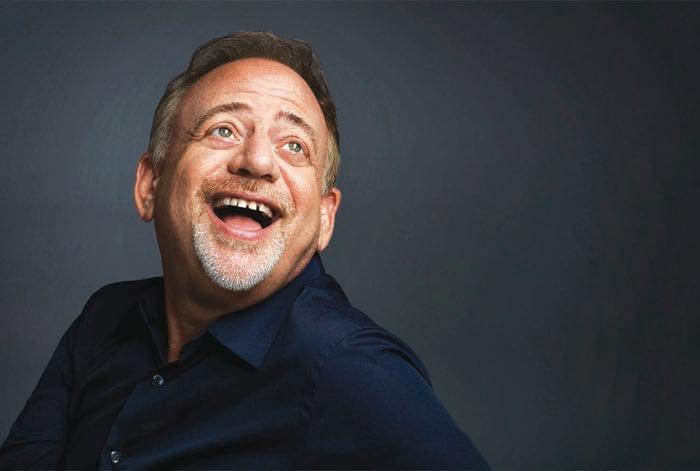
On the occasion of Never Mind the Happy’s official release, the Blade had the opportunity to chat with Shaiman about his decades-spanning career. He recalls the sexual freedom of his community theater days, the first time he heard someone gleefully yell profanities during a late screening of The Rocky Horror Picture Show, and why the late Rob Reiner was instrumental to both his career and his lasting marriage to Louis Mirabal. This interview has been edited and condensed.
BLADE: Naturally, a good place to start would be your book, “Never Mind the Happy.” What prompted you to want to tell the story of your life at this point in your career?
SHAIMAN: I had a couple of years where, if there was an anniversary of a movie or a

Broadway show I co-created, I’d write about it online. People were always saying to me, “Oh my God, you should write a book!” But I see them say that to everybody. Someone says, “Oh, today my kitten knocked over the tea kettle.” “You should write a book with these hysterical stories.” So I just took it with a grain of salt when people would say that to me. But then I was listening to Julia Louis-Dreyfus’ podcast, and Jane Fonda was on talking about her memoir — not that I’m comparing myself to a career like Jane Fonda’s — but she felt it was time to take a life review. That really stuck in my head. At the time, I was sulking or moping about something that had not gone as well as I wished. And I guess I kind of thought, “Let me look back at all these things that I have done.” Because I have done a lot. I’m just weeks short of my 50th year in show business, despite how youthful I look! I just sat down and started writing before anyone asked, as far as an actual publisher.
I started writing as a way to try to remind myself of the joyous, wonderful things that have happened, and for me not to always be so caught up on what didn’t go right. I’ve been telling some of these stories over the years, and it was really fun to sit down and not just be at a dinner party telling a story. There’s something about the written word and really figuring out the best way to tell the story and how to get across a certain person’s voice. I really enjoyed the writing. It was the editing that was the hard part!
BLADE: You recall experiences that made you fall in love with the world of theater and music, from the days you would skip class to go see a show or work in regional productions. What was it like returning to those early memories?
SHAIMAN: Wonderful. My few years of doing community theater included productions that were all kids, and many productions with adults, where I was this freaky little 12-year-old who could play show business piano beyond my years. It was just bizarre! Every time a director would introduce me to another cast of adults, they’d be like, “Are you kidding?” I’d go to the piano, and I would sightread the overture to Funny Girl, and everybody said, “Oh, OK!” Those were just joyous, wonderful years, making the kind of friends that are literally still my friends. You’re discovering musical theatre, you’re discovering new friends who have the same likes and dreams, and discovering sex. Oh my god! I lost my virginity at the opening night of Jesus Christ Superstar, so I’m all for community theater!
BLADE: What do you recall from your early experiences watching Broadway shows? Did that open everything up for you?
SHAIMAN: I don’t remember seeing Fiddler on the Roof when I was a kid, but I remember being really enthralled with this one woman’s picture in the souvenir folio — the smile on her face as she’s looking up in the pictures or looking to her father for approval. I always remember zooming in on her and being fascinated by this woman’s face: turns out it was Bette Midler. So my love for Bette Midler began even before I heard her solo records.
Pippin and The Wiz were the first Broadway musicals I saw as a young teenager who had started working in community theater and really wanted to be a part of it. I still remember Pippin with Ben Vereen and all those hands. At the time, I thought getting a seat in the front row was really cool — I’ve learned since that it only hurts your neck, but I remember sitting in the front row at The Wiz as Stephanie Mills sang Home. Oh my god, I can still see it right now. And then I saw Bette Midler in concert, finally, after idolizing her and being a crazed fan who did nothing but listen to her records, dreaming that someday I’d get to play for her. And it all came true even before I turned 18 years old. I just happened to be in the right place at the right time, and met one of her backup singers and became their musical director. I was brought to a Bette Midler rehearsal. I still hadn’t even turned 18, she heard me play and said, “Stick around.” And I’ve stuck around close to 55 years! She’s going to interview me in L.A. at the Academy Museum Would I have ever thought that Bette Midler would say yes to sitting with me, interviewing me about my life and career?
BLADE: That’s amazing. Has she had a chance to read the book yet?
SHAIMAN: She read it. We just talked yesterday, and she wants to ask the right questions at the event. And she even said to me, “Marc, I wasn’t even aware of all that you’ve done.” We’ve been great friends for all these years, but sometimes months or almost years go by where you’re not completely in touch.
Continues at washingtonblade.com.









COOKIES, the world’s most popular cannabis brand - has planted its flag on


Inspired by U Street’s rich history of musical innovation and the diversity of its residents.
Like music, cannabis transcends differences. It is one of the few things that bridge race, religion, politics, gender and sexuality.
Cookies DC is a celebration of what unites humanityA hub of culture, learning, healing and inspiration.
All products are lab tested, fully-legal, and locally sourced from licensed producers.







In DC, all cannabis is considered medicine, but no doctor’s visits are required.

VISIT OUR STORE OR GET FREE DELIVERY FOR A LIMITED TIME
By TINASHE CHINGARANDE
Center Aging Monthly Luncheon With Yoga will be at 12 p.m. at the DC Center for the LGBT Community. Email Mac at maca@thedccenter.org if you require ASL interpreter assistance, have any dietary restrictions, or questions about this event.
Spark Social will host “RuPaul’s Drag Race Watch Party S18 Watch Party” at 8 p.m.Drag Entertainers TrevHER and Grey provide hilarious commentary and make live predictions on who’s staying and who’s going home. Stick around after the show for a live drag performance. The watch party takes place on our heated outdoor patio and cozy indoor space. Attendance is free and more details are available on Eventbrite.
GoGay DC will host “First Friday LGBTQ+ Community Social” at 7 p.m. at Silver Diner Ballston. This is a chance to relax, make new friends, and enjoy happy hour specials at this classic retro venue. Attendance is free and more details are available on Eventbrite.
GoGay DC will host “LGBTQ+ Community Brunch” at 11 a.m. at Freddie’s Beach Bar & Restaurant. This fun weekly event brings the DMV area LGBTQ+ community, including allies, together for delicious food and conversation. Attendance is free and more details are available on Eventbrite.
LGBTQ People of Color will be at 7 p.m. on Zoom. This peer support group is an outlet for LGBTQ People of Color to come together and talk about anything affecting them in a space that strives to be safe and judgement free. There are all sorts of activities like watching movies, poetry events, storytelling, and just hanging out with others. For more information and events, visit thedccenter.org/poc or facebook.com/centerpoc.
DMV Gay Dog Moms will host “Puppy Love” at 1 p.m. at Wunder Garten. This is a Valentine’s pawty and market for dog lovers. Get gifts for your loved ones - both human & canine at this event. Attendance is free and more details are available on Eventbrite.
Center Aging: Monday Coffee Klatch will be at 10 a.m. on Zoom. This is a social hour for older LGBTQ+ adults. Guests are encouraged to bring a beverage of choice. For more information, contact Adam (adamheller@thedccenter.org).
Genderqueer DC will be at 7 p.m. on Zoom. This is a support group for people who identify outside of the gender binary, whether you’re bigender, agender, genderfluid, or just know that you’re not 100% cis. For more details, visit www.genderqueerdc.org or Facebook.
Tuesday, February 10
Coming Out Discussion Group will be at 7 p.m. on Zoom. This is a safe space to share experiences about coming out and discuss topics as it relates to doing so — by sharing struggles and victories the group allows those newly coming out and who have been out for a while to learn from others. For more details, visit the group’s Facebook.
Trans Discussion Group will be at 7 p.m. on Zoom. This is intended to provide an emotionally and physically safe space for trans people and those who may be questioning their gender identity or expression to join together in community and learn from one another. For more details, email info@thedccenter.org.
Job Club will be at 6 p.m. on Zoom upon request. This is a weekly job support program to help job entrants and seekers, including the long-term unemployed, improve self-confidence, motivation, resilience and productivity for effective job searches and networking — allowing participants to move away from being merely “applicants” toward being “candidates.” For more information, email centercareers@thedccenter.org or visit www.thedccenter. org/careers.
The DC Center’s Fresh Produce Program will be held all day at the DC Center for the LGBT Community. To be more fair with who is receiving boxes, the program is moving to a lottery system. People will be informed on Wednesday at 5:00 pm if they are picked to receive a produce box. No proof of residency or income is required. For more information, email supportdesk@thedccenter.org or call 202-682-2245.
Virtual Yoga Class will be at 7 p.m. on Zoom. This free weekly class is a combination of yoga, breathwork and meditation that allows LGBTQ+ community members to continue their healing journey with somatic and mindfulness practices. For more details, visit the DC Center’s website.
In honor of Black History Month, the DC LGBTQ+ Community Center will host a series of events uplifting the histories, artistry, and resilience of Black LGBTQ+ communities through dialogue, film, and intentional gathering.
The series begins with “Ballroom Culture: Rhythms of Resilience,” a panel discussion on Tuesday, Feb. 10, 2026 at 7 p.m. Artists, activists, and leaders from the ballroom community will explore ballroom’s historical, cultural, and political significance as a site of resistance, kinship, creative expression, and social justice within Black, Latinx, and LGBTQ+ communities.
On Friday, Feb. 13 at 12:30 p.m., the Center will host a screening of the groundbreaking documentary “Paris is Burning,” which chronicles New York City’s ballroom scene and house culture while examining themes of race, class, identity, and survival through the voices of legendary performers including Willi Ninja, Pepper LaBeija, and Dorian Corey.
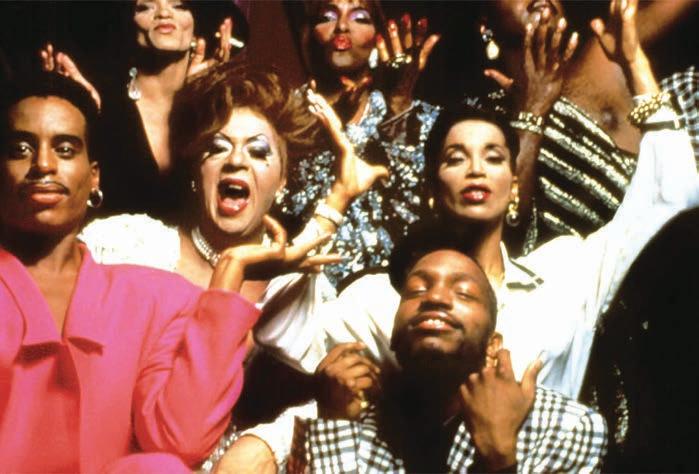
‘Paris is Burning’ is screening as part of Black History Month commemorations at the DC Center. (File photo courtesy of Reel Affirmations)
The month will conclude with “Soul Centered: A Black LGBTQ+ Gathering” on Saturday, Feb. 21, 2026 at 3:30 p.m. This free, RSVP-required event invites Black LGBTQ+ community members into a space of rest, connection, and reflection centered on love in all its forms. The gathering will feature a panel conversation with Black LGBTQ+ creatives, healers, and community members, followed by intentional speed connections and a closing social mixer.
For more details and to RSVP, visit the Center’s website.





OF


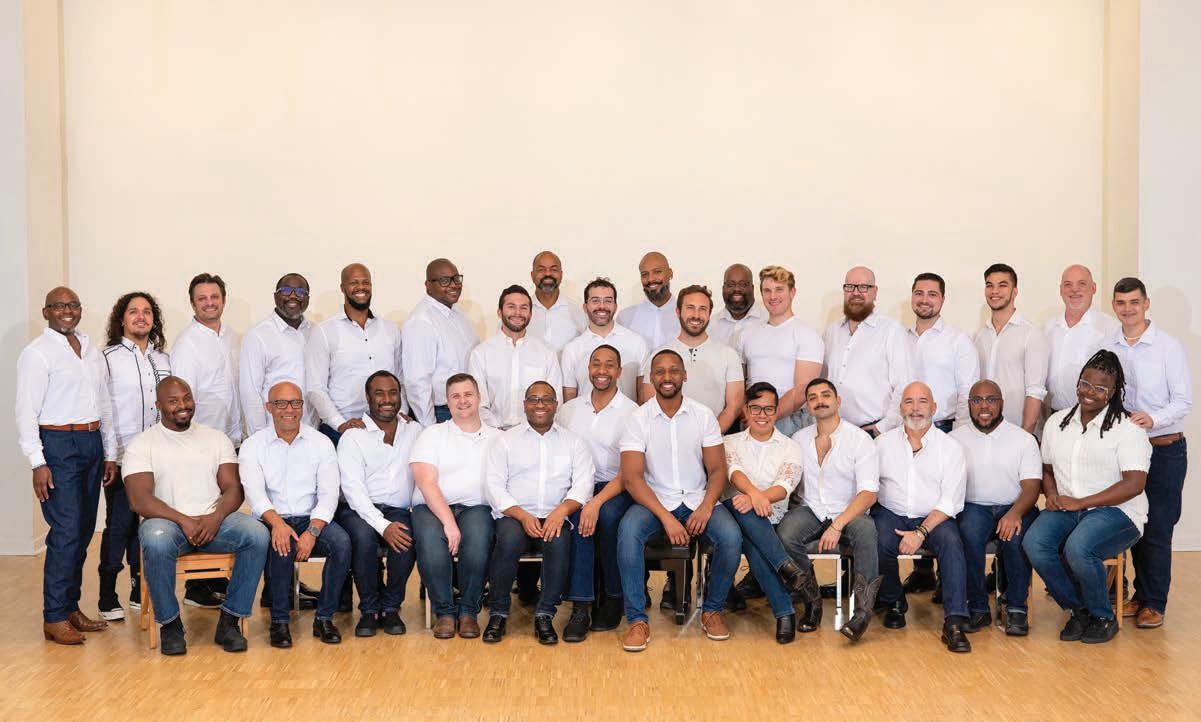









WITH SPECIAL GUESTS 17TH STREET DANCE

FEBRUARY 21 AT 5:00PM (ASL) THE HOWARD THEATRE 620 T STREET NW TICKETS & INFO AT GMCW.ORG




By PATRICK FOLLIARD
David Malloy’s “Octet” delves deep into the depths of digital addiction.
Featuring a person ensemble, this extraordinary a capella chamber musical explores the lives of recovering internet addicts whose lives have been devastated by digital dependency; sharing what’s happened and how things have changed.
Dressed in casual street clothes, the “Friends of Saul” trickle into a church all-purpose room, check their cell phones in a basket, put away the bingo tables, and arrange folding chairs into a circle. Some may stop by a side table offering cookies, tea, and coffee before taking a seat.
The show opens with “The Forest,” a haunting hymn harking back to the good old days of an analog existence before glowing screens, incessant pings and texts.
“The forest was beautiful/ My head was clean and clear/Alone without fear/ The forest was safe/ I danced like a beautiful fool / One time some time.”
Mimicking an actual step meeting, there’s a preamble. And then the honest sharing begins, complete with accounts of sober time and slips.
Eager to share, Jessica (Chelsea Williams) painfully recalls being cancelled after the video of her public meltdown went viral. Henry (Angelo Harrington II) is a gay gamer with a Candy Crush problem. Toby (Adri -
an Joyce) a nihilist who needs to stay off the internet sings “So anyway/ I’m doing good/ Mostly/ Limiting my time/ Mostly.”
The group’s unseen founder Saul is absent, per usual.
In his stead Paula, a welcoming woman played with quiet compassion by Tracy Lynn Olivera, leads. She and her husband no longer connect. They bring screens to bed. In a love-lost ballad, she explains: “We don’t sleep well/ My husband I/ Our circadian rhythms corrupted/ By the sallow blue glow of a screen/ Sucking souls and melatonin/ All of my dreams have been stolen.”
After too much time spent arguing with strangers on the internet, Marvin, a brainy young father played by David Toshiro Crane, encounters the voice of a God.
Ed (Jimmy Kieffer) deals with a porn addiction. Karly (Ana Marcu) avoids dating apps, a compulsion compared to her mother’s addiction to slot machines.
Malloy, who not only wrote the music but also the smart lyrics, book, and inventive vocal arrangements, brilliantly joins isolation with live harmony. It’s really something.
And helmed by David Muse, “Octet” is a precisely, quietly, yet powerfully staged production, featuring a topnotch cast who (when not taking their moment in
the spotlight) use their voices to make sounds and act as a sort of Greek chorus. Mostly on stage throughout all of the 100-minute one act, they demonstrate impressive stamina and concentration.
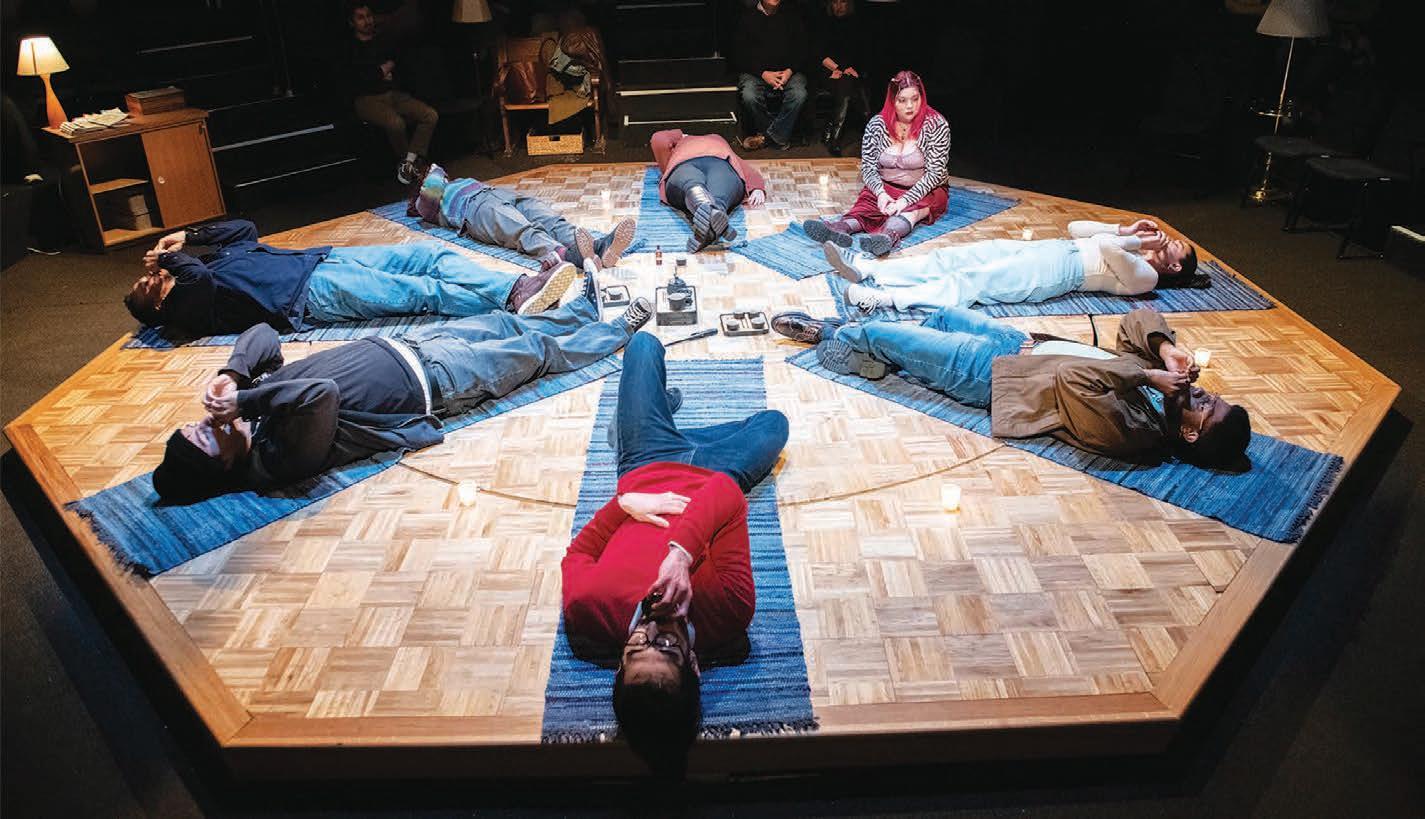
An immersive production, “Octet” invites audience members to feel a part of the meeting. Studio’s Shargai Theatre is configured, for the first, in the round. And like the characters, patrons must also unplug. Everyone is required to have their phones locked in a small pouch (that only ushers are able to open and close), so be prepared for a wee bit of separation anxiety.
At the end of the meeting, the group surrenders somnambulantly. They know they are powerless against internet addiction. But group newbie Velma (Amelia Aguilar) isn’t entirely convinced. She remembers the good tech times.
In a bittersweet moment, she shares of an online friendship with “a girl in Sainte Marie / Just like me.” Habits aren’t easily shaken.
Through Feb. 26 | Studio Theatre 1501 14th Street, N.W. | Tickets start at $55 Studiotheatre.org
























By JOHN PAUL KING
If we were forced to declare why “Grey Gardens” became a cult classic among gay men, it would be all the juicy quotes that have become part of the queer lexicon.
Celebrating the 50th anniversary of its theatrical release this month, the landmark documentary profiles two eccentrics: Edith Ewing Bouvier Beale and her daughter, Edith Bouvier Beale (known as “Big” and “Little” Edie, respectively), the aunt and cousin of former first lady Jaqueline Kennedy Onassis and socialite Lee Radziwell. Once moving within an elite circle of American aristocrats, they had fallen into poverty and were living in isolation at their run-down estate (the Grey Gardens of the title) in East Hampton, Long Island; they re-entered the public eye in 1972 after local authorities threatened eviction and demolition of their mansion over health code violations, prompting their famous relatives to swoop in and pay for the necessary repairs to avoid further family scandal.
At the time, Radziwell had enlisted filmmaking brothers David and Albert Maysles to take footage for a later-abandoned project of her own, bringing them along when she went to put in an appearance at the Grey Gardens clean-up efforts. It was their first encounter with the Beales; the second came two years later, when they returned with their cameras (but without Radziwell) and proceeded to make documentary history, turning the two Edies into unlikely cultural icons in the process.
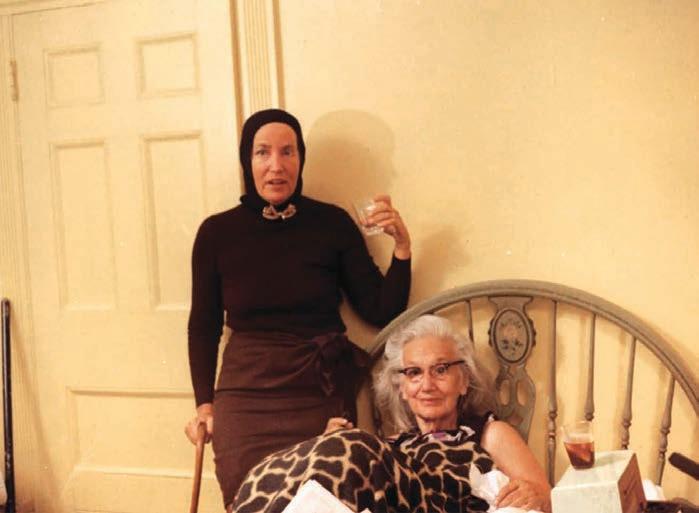
On paper, it reads like something painful: two embittered former socialites, a mother and daughter living among a legion of cats and raccoons in the literal ruins of their former life, where they dwell on old memories, rehash old conflicts, and take out their resentments on each other, attempting to keep up appearances while surviving on a diet that may or may not include cat food. Truthfully, it is sometimes difficult to watch, which is why it’s easier to approach from surface level, focusing on the “wacky” eccentricities and seeing the Beales as objects for ridicule.
Yet to do so is to miss the true brilliance of a movie that is irresistible, unforgettable, and fascinating to the point of being hypnotic, and that’s because of the Beales themselves, who are far too richly human to be dismissed on the basis of conventional judgments.
First is Little Edie, in her endless array of headscarves (to cover her hair loss from alopecia) and her ever-changing wardrobe of DIY “revolutionary costumes,” a one-time
model and might-have-been showgirl who is obviously thrilled at having an audience and rises giddily to the occasion like a pro. Flamboyant, candid, and smarter than we think, she’s also fearlessly vulnerable; she gives us access to an emotional landscape shaped by the heartbreaks of a past that’s gradually revealed as the movie goes on, and it’s her ability to pull herself together and come back fighting that wins us over. By the time she launches into her monologue about being a “S-T-A-U-N-C-H” woman, we have no doubt that it’s true.
Then there’s Big Edie, who comes across as an odd mix of imperious dowager and down-to-earth grandma. She gets her own chance to shine for the camera, especially in the scenes where she reminisces about her early days as a “successful” amateur vocalist, singing along to records of songs she used to perform as glimpses emerge of the beauty and talent she commanded in her prime. She’s more than capable of taking on her daughter in their endless squabbles, and savvy enough to score serious points in the conflict, like stirring up jealousy with her attentions to beefy young handyman Jerry – whom the younger Edie has dubbed “the Marble Faun” – when he comes around to share a feast of boiled corn-on-the-cob with them. “Jerry likes the way I do my corn,” she deadpans to the camera, even though we know it’s meant for Little Edie.
It’s not just that their eccentricities verge on camp; that’s certainly an undeniable part of the appeal, but it falls away quickly as you begin to recognize that even if these women are putting on a show for the camera, they’re still being completely themselves – and they are spectacular.
Yes, their verbal sparring is often shrill and palpably toxic – in particular, Big Edie has no qualms about belittling and shaming her daughter in an obviously calculated effort to undermine her self-esteem and discourage her from making good on her repeated threats to leave Grey Gardens. We know she is acting from fear of abandonment, but it’s cruel, all the same.
These are the moments that disturb us more than any of the dereliction we see in their physical existence; fed by nostalgia and forged in a deep codependence that neither wants to acknowledge, their dynamic reflects years of social isolation that has made them into living ghosts, going through the habitual motions of a long-lost life, ruminating on ancient resentments, and mulling endlessly over memories of the things that led them to their outcast state. As Little Edie says early on, “It’s very difficult to keep the line between the past and the present. Do you know what I mean?”
That pithy observation, spoken conspiratorially to the Maysles’ camera, sets the tone for the entirety of “Grey Gardens,” perhaps even suggesting an appropriate point of meditation through which to contemplate everything that follows. It’s a prime example of the quotability that has helped this odd little movie endure as a fixture in queer culture; for many LGBTQ people, both Edies – born headstrong, ambitious, and independent into a social strata that only wanted its women to be well-behaved – became touchstones of frustrated longing, of living out one’s own fabulousness in isolated secrecy. Add to that shared inner experience Little Edie’s knack for turning scraps into kitschy fashion (and the goofy-but-joyous flag dance she performs as a sort of climactic topper near the end), and it should be obvious why the Maysles Brothers’ little project still resonates with the community five decades later.
Indeed, watching it in today’s cultural climate, it strikes chords that resonate through an even wider spectrum, touching on feminist themes through these two “problematic” women who have been effectively banished for refusing to fit into a mold, and on the larger issue of social and economic inequality that keep them trapped, ultimately turning them against one other in their powerlessness.
With that in mind, it’s clear these women were never filmed to be objects of ridicule. They’re survivors in a world in which even their unimaginably wealthy relatives would rather look away than offer more than the bare minimum of help, and the resilience they show in the face of tremendous adversity makes them worthy of celebration, instead.
That’s why “Grey Gardens” still hits close to home, why it entertains despite its darkness, and why we remember it as something bittersweet but beautiful. By the end of it, we recognize that the two Edies could be any of us, which means they are ALL of us – and if they can face their challenges with that much “revolutionary” spirit, then maybe we can be “staunch” against our adversities, too.






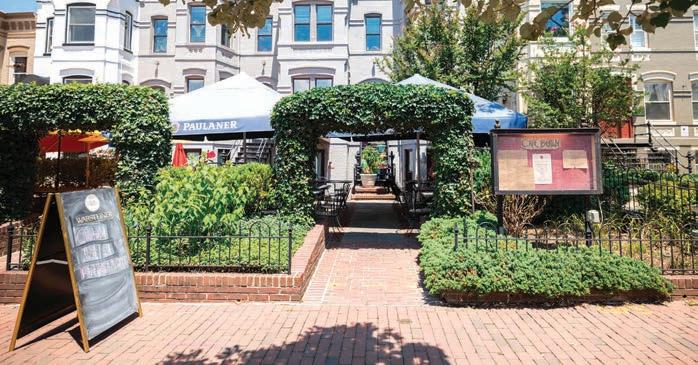
HH: 2-6PM WED-FRIDAY
2-10PM WED, THURSDAY AND SUNDAY
2-11PM FRIDAY AND SATURDAY









We’re an LGBTQ brokerage.



Stacey is the host of the popular vidCast and podcast, The Stacey Show. Available on YouTube and Apple, Spotify and wherever else you listen to your podcasts.










‘Queer
By TERRI SCHLICHENMEYER
Nobody likes you very much.
That’s how it seems sometimes, doesn’t it? Nobody wants to see you around, they don’t want to hear your voice, they can’t stand the thought of your existence and they’d really rather you just go away. It’s infuriating, and in the new book “The Queer Thing About Sin” by Harry Tanner, you’ll see how we got to this point.
When he was a teenager, Harry Tanner says that he thought he “was going to hell.”
For years, he’d been attracted to men and he prayed that it would stop. He asked for help from a lay minister who offered Tanner websites meant to repress his urges, but they weren’t the panacea Tanner hoped for. It wasn’t until he went to college that he found the answers he needed and “stopped fearing God’s retribution.”
Being gay wasn’t a sin. Not ever, but he “still wanted to know why Western culture believed it was for so long.”
Historically, many believe that older men were sexual “mentors” for teenage boys, but Tanner says that in ancient Greece and Rome, same-sex relationships were common between male partners of equal age and between differently-aged pairs, alike. Clarity comes by understanding relationships between husbands and wives then, and careful translation of the word “boy,” to show that age wasn’t a factor, but superiority and inferiority were.
In ancient Athens, queer love was considered to be “noble” but after the
Persians sacked Athens, sex between men instead became an acceptable act of aggression aimed at conquered enemies. Raping a male prisoner was encouraged but, “Gay men became symbols of a depraved lack of self-control and abstinence.”
Later Greeks believed that men could turn into women “if they weren’t sufficiently virile.” Biblical interpretations point to more conflict; Leviticus specifically bans queer sex but “the Sumerians actively encouraged it.” The Egyptians hated it, but “there are sporadic clues that same-sex partners lived together in ancient Egypt.”
Says Tanner, “all is not what it seems.”
So you say you’re not really into ancient history. If it’s not your thing, then “The Queer Thing About Sin” won’t be, either.
Just know that if you skip this book, you’re missing out on the kind of excitement you get from reading mythology, but what’s here is true, and a much wider view than mere folklore. Author Harry Tanner invites readers to go deep inside philosophy, religion, and ancient culture, but the information he brings is not dry. No, there are major battles brought to life here, vanquished enemies and death – but also love, acceptance, even encouragement that the citizens of yore in many societies embraced and enjoyed. Tanner explains carefully how religious credo tied in with homosexuality (or didn’t) and he brings readers up to speed through recent times.
While this is not a breezy vacation

read or a curl-up-with-a-blanket kind of book, “The Queer Thing About Sin” is absolutely worth spending time with. If you’re a thinking person and can give yourself a chance to ponder, you’ll like it very much.



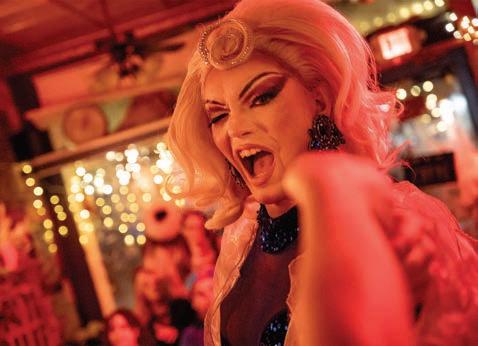
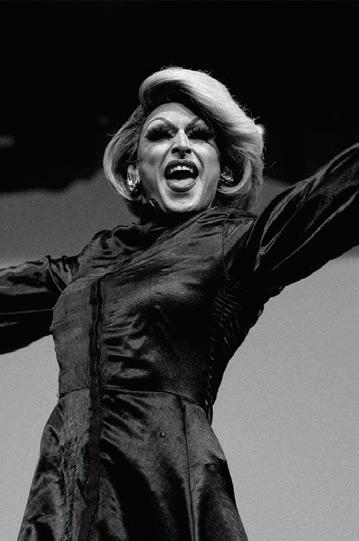
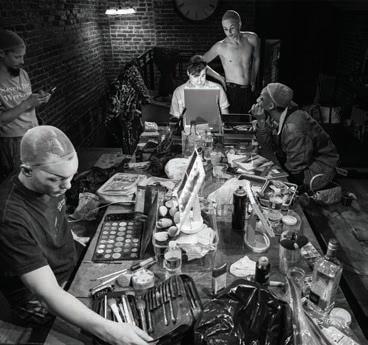
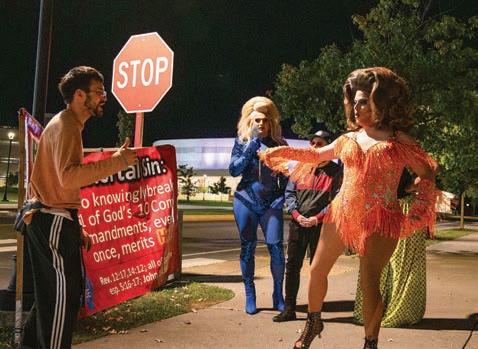
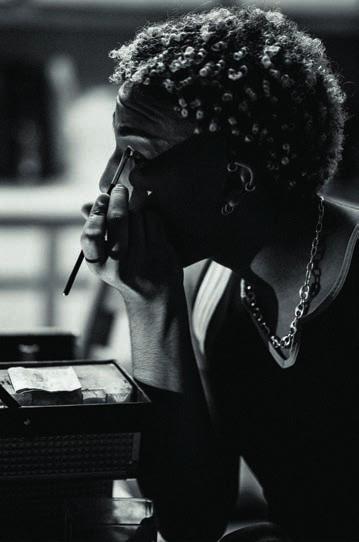
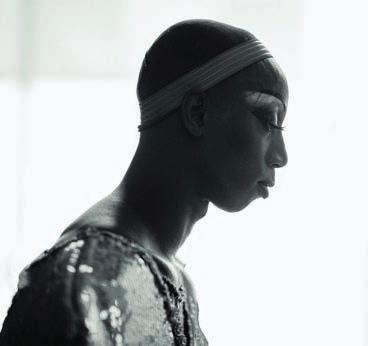
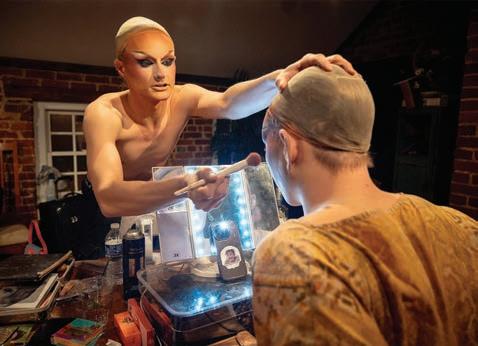
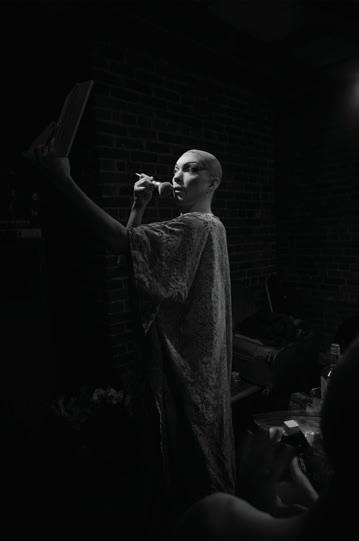
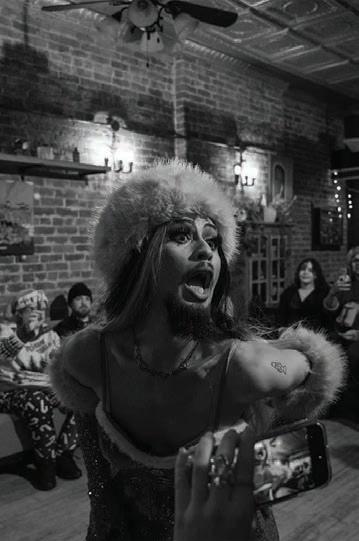
Performers face homophobia, find community
(Washington Blade photos by Landon Shackelford)
Drag artists perform for crowds in towns across Virginia. The Washington Blade follows Gerryatrick, Shenandoah, Climaxx, Emerald Envy among others over eight months as they perform at venues in the Virginia towns of Staunton, Harrisonburg and Fredericksburg. To see the full gallery, visit washingtonblade.com.








Kurt Elling
In the Brass Palace with the Strathmore Jazz Orchestra Fri, Feb 13
Tango After Dark Sun, Feb 22
RENT in Concert
Wed, Feb 25
Concert-style symphonic production with Broadway vocalists
An Evening With Yotam Ottolenghi Tue, March 3
Pilobolus
Other Worlds Collection Thu, March 5
Stand By Me: The Film and Its Stars
40 Years Later Sat, March 14
Strathmore & Washington Performing Arts Present Ravi Shankar Ensemble Thu, March 19
Emmet Cohen Presents: Miles and Coltrane at 100 Sat, March 21
The Okee Dokee Brothers Sun, March 22
Diana Krall
Tue, March 24
Ladysmith Black Mambazo
Thu, March 26
Meshell Ndegeocello
Fri, March 27
Angélique Kidjo
Thu, April 9
Ukulele Orchestra of Great Britain Sun, April 12
Strathmore & Live Nation Present Natalia Lafourcade Cancionera Tour
Tue & Wed, April 14 & 15
W. Kamau Bell Who’s With Me? Fri, April 17

Eliades Ochoa Sun, April 19
10 Anniv sary Bernard/Ebb Songwriting Awards
Fri, April 24
Just Announced! Jason Mraz
Tue, May 26
Solo acoustic hits and deep cuts






By SCOTT BLOOM
As 2026 begins, Washington, D.C.’s rental housing landscape continues to evolve in ways that matter to small landlords, tenants, and the communities they serve. At the center of many of these conversations is the Small Multifamily & Rental Owners Association (SMOA), a D.C.–based organization that advocates for small property owners and the preservation of the city’s naturally occurring affordable housing.
At their December “DC Housing Policy Summit,” city officials, housing researchers, lenders, attorneys, and housing providers gathered to discuss the policies and proposals shaping the future of rental housing in the District. The topics ranged from recent legislative changes to emerging ballot initiatives and understanding how today’s policy decisions will affect housing stability tomorrow.
If you are a landlord or a tenant, several developments now underway in D.C., are expected to influence how rental housing operates in the years ahead.
One of the most significant developments is the Rebalancing Expectations for
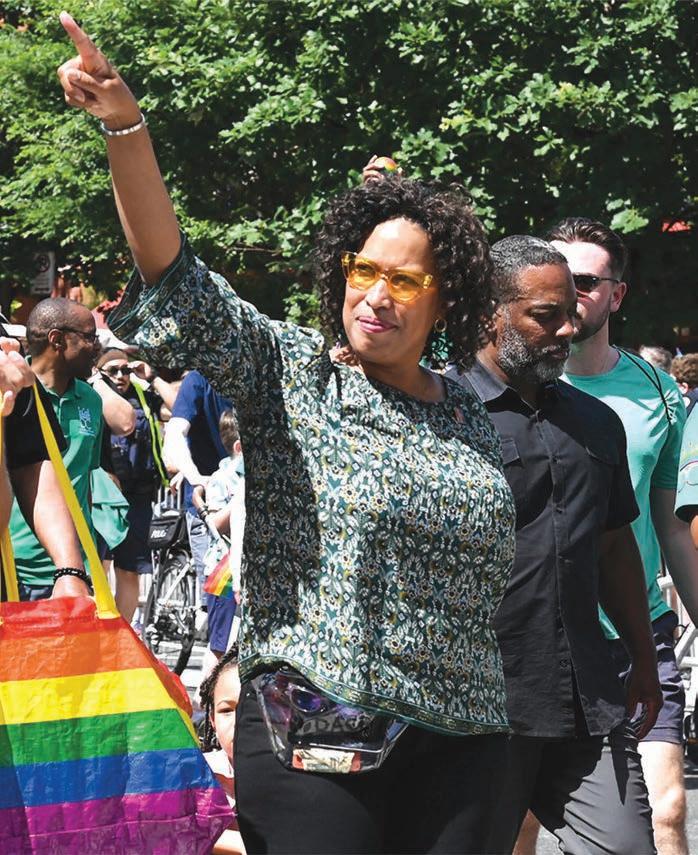
Neighbors, Tenants and Landlords (RENTAL) Act of 2025, a sweeping piece of legislation passed last fall and effective December 31, 2025, which updates a range of housing laws. This broad housing reform law will modernize housing regulations and address long-standing court backlogs, and in a practical manner, assist landlords with shortened notice and filing requirements for lawsuits. The Act introduces changes to eviction procedures, adjusts pre-filing notice timelines, and modifies certain tenant protections under previous legislation, the Tenant Opportunity to Purchase Act.
At the same time, the District has expanded its Rent Registry, to have a better overview of licensed rental units in the city with updated technology that tracks rental units subject to and exempt from rent control and other related housing information. Designed to improve transparency and enforcement, Rent Registry makes it easier for all parties to verify rent control status and compliance.
Looking ahead to the 2026 election cycle, a proposed ballot initiative for a twoyear rent freeze is generating significant conversation. If it qualifies for the ballot and is approved by voters, the measure would pause rent increases across the District for two years. While still in the proposal phase, it reflects the broader focus on tenant affordability that continues to shape housing policy debates.
Taken together, these changes underscore how closely policy and day-to-day operations are connected for small landlords. Staying informed about notice requirements, registration obligations, and evolving regulations isn’t just a legal necessity. It’s a key part of maintaining stable, compliant rental properties.
With discussions underway about rent stabilization, voucher policies, and potential rent freezes, long-term revenue projections will be influenced by regulatory shifts just as much as market conditions alone. Financial and strategic planning becomes even more important to protect your interests.
As the owner of a property management company here in the District, I’ve spent much of the past year thinking about how these changes translate from legislation into real-world operations.
The first priority has been updating our eviction and compliance workflows to align with the RENTAL Act of 2025. That means revising how delinquent rent cases are handled, adjusting notice procedures, and helping owners understand how revised timelines and court processes may affect the cost, timing, and strategy behind enforcement decisions.
Just as important, we’re shifting toward earlier, more proactive communication around compliance and regulatory risk. Rather than reacting after policies take effect, we’re working to flag potential exposure in advance, so owners can make informed decisions before small issues become costly problems.
Housing policy in Washington, D.C., has always reflected the city’s values from protecting tenants to preserving affordability in rapidly changing neighborhoods. As those policies continue to evolve, the challenge will be finding the right balance between stability for renters and sustainability for the small property owners who provide much of the city’s housing.
The conversations happening now at policy summits, in Council chambers, and across neighborhood communities will shape how rental housing is regulated. For landlords, tenants, and legislators alike, 2026 represents an opportunity to engage thoughtfully, to ask hard questions, and to create a future where compliance, fairness, and long-term stability go hand-in-hand.
is owner and senior property manager of Columbia Property Management.










































































9:30 Club, AHF(AIDS Healthcare Foundation), Arena Stage, Atlas Performing Arts, Awesomecon.com, Bastille, Big Gay Smiles, Bite the Fruit, Cafe Berlin, City Dogs, Jade Fitness, DACHA Beer Garden, DC Quit Now from Engage Strategies, GALA Hispanic Theatre, Gay Men’s Chorus of Washington, Heidelberg Pastry Shoppe, Integrity Homes/ Potomac Overlook, The Lee Ann Wilkinson Group, Nepenthe Gallery, Opal DC, Peter Crawford, Long & Foster, ProMD Health, Rufskin, Sadiya Clinic, Strathmore, Takoma Wellness, Zeiger Realty, Dignity NoVA, Dignity Washington, Gay Veterans, Live Nation, Olney Theatre, Greater Washington Community Foundation, A Cleaning Service, Robyn Zeiger, PhD., Sidney Binks and our classified advertisers.
Moving? Downsizing? One item to Whole Estate? Gold Jewelry, Sterling Silver, Quality Glass, Some Furniture, Etc. TheAtticLLC.com
Gary Roman: 301-520-0755

Residential & Commercial Cleaning, Reasonable Rates, Free Estimates, Routine, 1-Time, Move-In/Move-Out 202-486-6183
COUNSELING
FOR LGBTQ
People. Individual/Couples counseling with a volunteer peer counselor. GMCC, serving our community since 1973. 202-580-8861
gaymenscounseling.org No fees. Donation requested.
Local licensed company with over 25 years of experience. Specializing in bathrooms, kitchens & all interior/exterior repairs. Drywall, paint, electrical, wallpaper, roofing & siding. Trevor 703-303-8699
legal services. Catelyn represents LGBTQ clients in DC, MD & VA interested in adoption or ART matters. MODERN FAMILY FORMATION Law Offices, Slattery Law, LLC. 240-245-7765
Catelyn@ModernFamilyFormation.com
KASPER’S LIVERY SERVICE
Your Personal Uber/Limo Service

WHERE DO YOU WANT TO GO?
Proper DC License & Livery Insured. Gay & Veteran Owner/Operator. Since 1987. 202-554-2471
www.KasperLivery.com
GREAT SCOTT MOVING

Local & Long Distance. Get a Great Move at a Great Price call (301) 6992066
We’ve moved the Blade, Embassies & the Smithsonian’s piano collection! Let us move you!
House located in Historic District. Recently fully renovated. Two bedrooms/2 baths plus den & bonus light filled attic. Main level with 2 working fireplaces, original 1862 wood floors, modern upgraded fully equipped kitchen and rear patio w/half bath. Attention paid to details. Walking distance to Eastern Market or Potomac Ave Metro. Call your agent or Owner/ realtor to view. 1600 sq. ft. A gem!! $839,000
Joel N. Martin
RE/MAX Allegiance Call or Email: 202-498-1065 jn1martin@aol.com
NICE, GSWM, SILVER FOX, SEEKS
18-75 for friends, more?
Variety of interests - hiking, literature, cooking, music, etc!
RBhiker69@hotmail.com TALL,
ISO tall, good-looking, well-hung, Hispanic or Puerto Rican male ready to experience my hot, hungry mouth. Just relax and enjoy my service! Sincere responses, please text me. I will get back to you. Available 24 hrs a day. Call or text: 240-457-1292