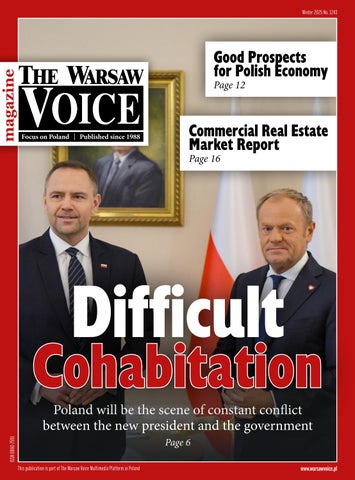
Difficult Cohabitation
Table of contents
POLITICS AND SOCIETY
ECONOMY
Preserving Heritage of French Haute Perfumerie
BUTIK
Musical Journey Back to Fascist Italy How We Wish To Be Seen When Art Meets New Technology Silent, Unseen But Remembered
If I Were a Lawyer... Lexus NX 350h Omotenashi
A Milestone in the Production of Vans of the Future Full Bodywork Success Safety All Year Round Changes in the Management Structure of
THE BUZZ | 26-33
French Chanson Phenomenon to Sing in Warsaw Operatic Take on Womanhood Boznańska, the Painter of Souls Sounds Carved in Stone
New Arms Factories Worth Over PLN 200 Million Electromobility Poland Returns to the Game Chopin Airport at the Limits of its Capacity Aucton for Offshore Wind Energy in a Month Korean Giant Opens Factory in Brzeg Africa Opens Its Doors to Polish Companies
Published by WV Marketing Sp. z o.o.
Editor-in-Chief
Andrzej Jonas, tel. (+48) 22 299-55-60
Managing & Online Services Editor Witold Żygulski, tel. (+48) 22 299-55-60
Moto Section Coordinator
Bartosz Grzybiński, tel. (+48) 22 299-55-60
The Wrocław Voice
Barbara Deręgowska, tel./fax. (+48) 71 783-61-29, mobile: 501 154 416
CEO
Juliusz Kłosowski, tel. (+48) 22 299-55-60
Accounting
Beata Robak, tel. (+48) 22 299-55-60
Magazine Layout Michał Lis
Office Manager
Anna Krawczyk, tel. (+48) 22 299-55-60
Address:
29 Jana Olbrachta St. Apt. 22, 01-102 Warsaw
Internet site
http://www.warsawvoice.pl e-mail: voice@warsawvoice.pl
Advertising Department
e-mail: advertising@warsawvoice.pl
Distribution & Subscription
Anna Krawczyk, tel. (+48) 22 299-55-60 e-mail: distribution@warsawvoice.pl
Address
29 Jana Olbrachta St. Apt. 22, 01-102 Warsaw, tel. (+48) 22 299-55-60
Cover photo: PAP/ITAR-TASS
CYPRUS

A Reliable International Business Centre
• Strategic location at the crossroad of Europe, Asia and Africa
• EU and Eurozone Member State
• Low cost of doing business for high-quality professional services
• Modern and transparent legal and regulatory framework
• Extensive network of Double Tax Treaties
• Attractive corporate tax environment
• Strong business support services
• Highly educated workforce
• High quality of life under secure living conditions

CYPRUS: A RESILIENT AND BUSINESS FRIENDLY ECONOMY
Over the past few years, Cyprus’ economy has experienced remarkable growth, largely due to the Government’s significant efforts to improve macroeconomic indicators – a strategy that has proven to be highly effective. According to the European Commission’s forecast, the nation’s economic growth is expected to remain strong in 2025 and 2026, fueled by continued dynamic domestic demand.
The latest annual report of the Cypriot Ministry of Finance stated that real GDP increased by 3.4% in 2024 compared to 2.6% in 2023 – a growth rate significantly higher than the Euro Area average of 0.9%. Τhis growth was driven
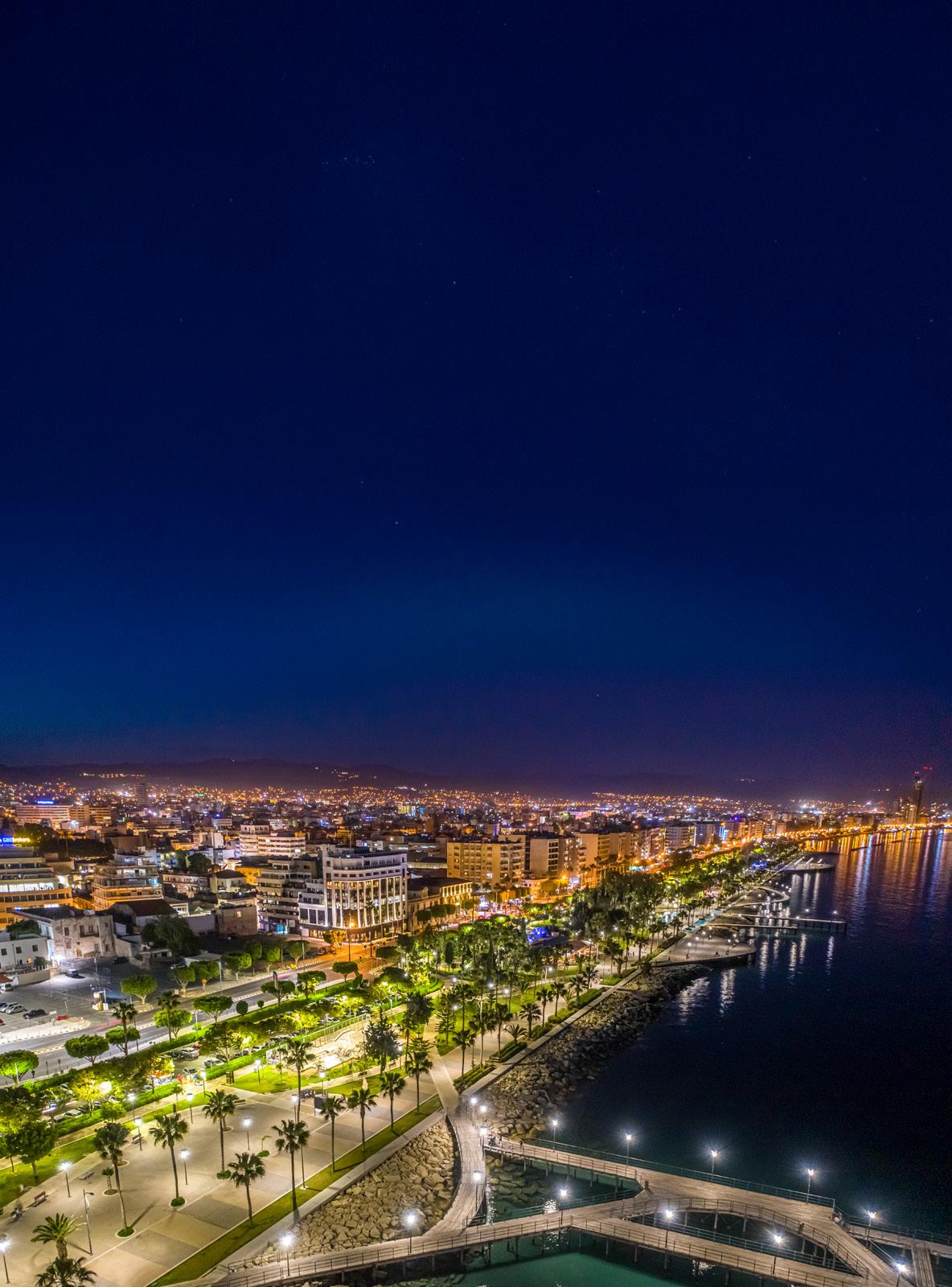
by private consumption, rising investment in housing and infrastructure, and an exceptionally robust tourist season. It is worth noting that three Credit Rating Agencies have recognized the Government’s positive performance, rating Cyprus in the “A” upper-medium-grade category for the first time in 13 years.
In recent years, Cyprus has also achieved a reduction in public debt, primarily due to strong economic growth and sound fiscal performance. The European Commission, in its latest macroeconomic forecast of May 2025, confirmed that the country’s public debt is on a steady downward trend, supported by continued fiscal surpluses.
Equally important, the diversification and strengthening of Cyprus’ economic base is evidenced by the sustained export of a wide range of services, including information and communication technology (ICT), shipping, trade, and professional and financial services.
In this context, the funds industry has also experienced remarkable growth, positioning Cyprus as one of the leading high-growth fund centres in Europe.
In its latest Article IV report, the International Monetary Fund (IMF) likewise acknowledged the resilience of the economy and the effectiveness of national policies in managing risks and opportunities. Cyprus’ economic resilience can be attributed to deliberate reforms, prudent policies, and effective collaboration between the public and private sectors. In this regard, the nation is in the process of transforming its economic model, with a focus on technology and an outward-looking approach.
‘’Our mission is clear: to ensure that Cyprus remains at the forefront of international business, innovation, and investment. In today’s dynamic global economy, it is crucial for our country to be competitive, resilient, and innovative. To this end, the Government is committed to establishing Cyprus as a top business destination with a strong focus on attracting foreign direct investment (FDI). Our broader strategy focuses on diversifying our economy while strategic investments drive the green and digital transitions,” stated George Papanastasiou, Minister of Energy, Commerce, and Industry, at CIBA’s Annual General Meeting on April 16th 2025.
The promotion of entrepreneurship, the improvement of the business environment, and the reduction of bureaucracy have been identified as key priorities of the Government and the Governance Programme of the President of the Republic of Cyprus. One of the institutions dedicated to these objectives is the Business Support Centre (BSC), which began operations in July 2025.
With an expanded mandate, the Centre evolved from the Business Facilitation Unit (BFU)—established in January
2022 as part of the Strategy for Attracting Investments and Talent. Operating under the auspices of the Ministry of Energy, Commerce and Industry, the BSC serves as the primary contact point for businesses already operating in Cyprus or seeking to expand their activities on the island.
The BSC offers a wide range of services, including processing applications from companies wishing to register in the Register of Companies with Foreign Interests, maintained by the Centre. Registered companies are eligible for various government incentives, including those related to the employment of third-country nationals.
Another key mechanism supporting foreign businesses in Cyprus is the Digital One-Stop Service (DOSS). DOSS acts as a comprehensive resource centre, offering a suite of services, particularly for the licensing of Renewable Energy Sources (RES) projects. DOSS provides detailed information and guidance on the necessary permits for implementing RES projects, as well as resources related to financing and lending opportunities.
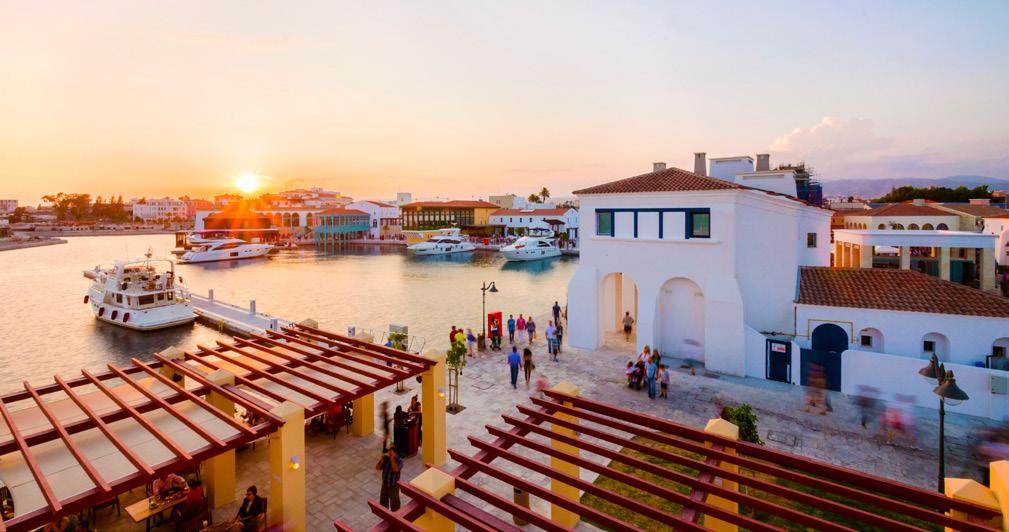
All the above, have been key factors in significantly enhancing Cyprus’ reputation as an attractive location for the development of business activities across various sectors. As a result, the island is steadily emerging as a leading hub for innovation, investment, and entrepreneurship in the wider region, strengthening its economy and securing long-term resilience in an ever-changing global landscape.
THE BSC SERVES AS THE PRIMARY CONTACT POINT FOR BUSINESSES ALREADY OPERATING IN CYPRUS OR SEEKING
TO EXPAND THEIR ACTIVITIES ON THE ISLAND
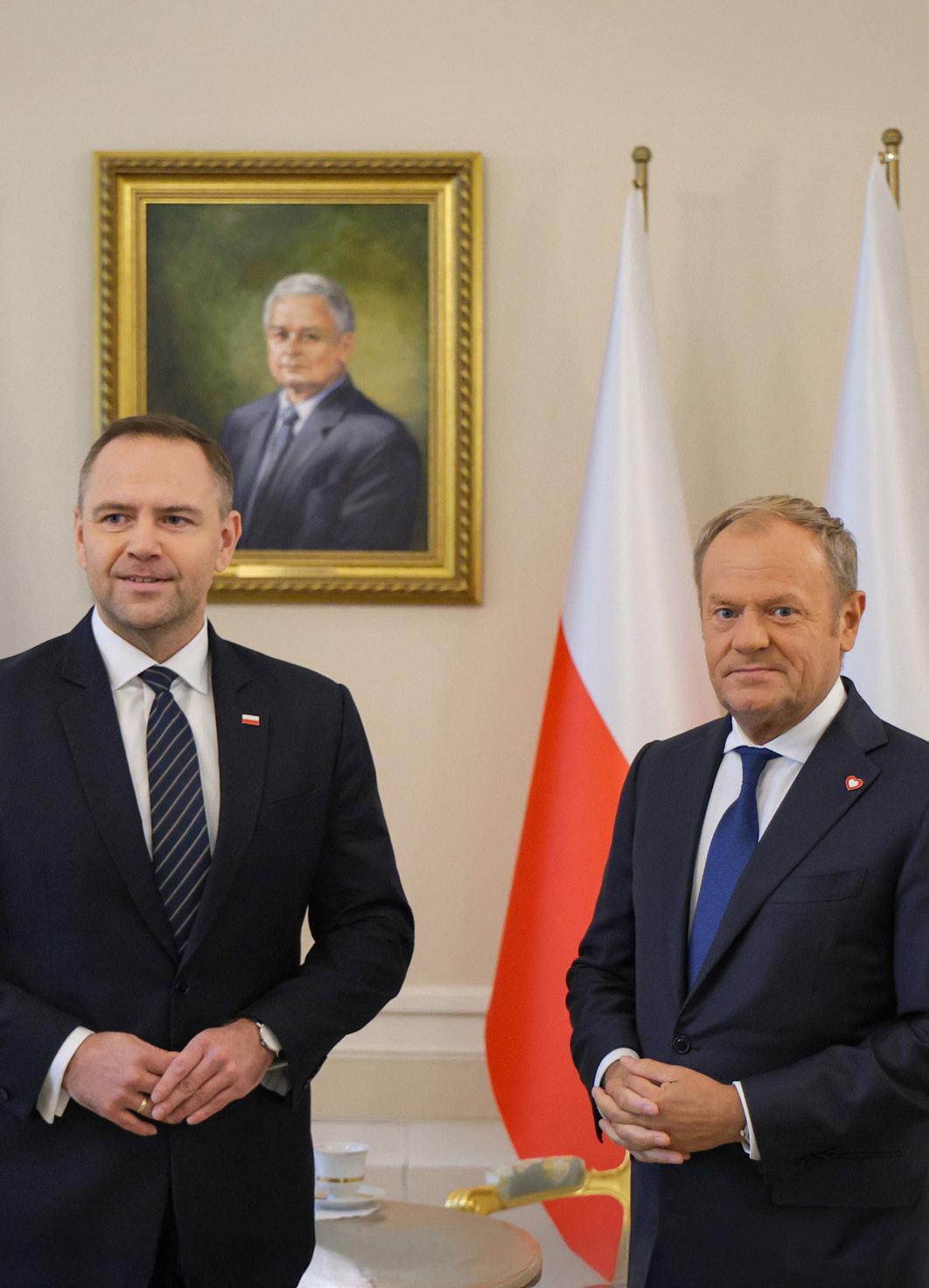
DIFFICULT COHABITATION
After just a few months of Karol Nawrocki’s presidency, it became clear that until the parliamentary elections in the fall of 2027, the Polish political scene would become an arena of ruthless struggle between the two most important centers of executive power.
The new president has vetoed 16 bills submitted by Donald Tusk’s cabinet so far. He has also blocked a number of promotions in the secret services and diplomacy, continues to refuse to sign a significant number of ambassadorial appointments, and openly contests the government’s foreign policy line.
Nawrocki’s blocking of government actions clearly signals that the president is seeking to change the system of power in Poland, according to Foreign Minister Radosław Sikorski.
In an interview with the public television news channel TVP Info, the minister refuted allegations of a lack of coordination in the government’s actions, criticizing Nawrocki for blocking decorations in the Internal Security Agency (ABW) and nominations for intelligence officers. “Decisions in favor of the Polish secret services are needed, and they are not being made,” he said, calling the president’s behavior “sabotage of the state,” as did Prime Minister Donald Tusk.

“At a time when there is a war going on beyond our borders, [the prime minister] has decided that the Commander-in-Chief of the Armed Forces should be deprived of the most important information about state security. The president’s representative was denied important information concerning state security during a meeting of the Special Services College. Four of my meetings with the heads of the special services were canceled. It was during these meetings that key issues for Poland’s security were to be discussed,“ Nawrocki said in a recording published on X. ”Prime Minister Tusk must understand that he is not a king, but the head of government, and that means he has a duty to cooperate with the president, who was elected by the Polish people,” he added.
“The heads of the services report to the prime minister, and it is the prime minister who makes the decisions,” Sikorski reminded.
“He would like to rule as if he had changed the system to a presidential one. In Poland, this cannot be done against the will of one of the major camps, because no camp in Poland has a constitutional majority, so by treating the government the way the president does, it will be difficult for him to convince us to vote for a presidential system,” he emphasized.
After Nawrocki said during an official visit to the Czech Republic, in a speech at Charles University, that “Poland proposes to abolish the position of President of the European Council,” Sikorski noted that “someone is leading the president into another trap.”
“According to the Constitution, the president represents Polish foreign policy, he does not impose it on the government,” he declared. He reminded that treaty changes are the prerogative of the government. He also criticized Nawrocki’s anti-EU statements on Independence Day. “It is claimed that Poland’s independence is threatened by the European Union,” he said.
“The president is not authorized to speak on behalf of the whole of Poland,” the minister warned.
Radosław Sikorski & Karol Nawrocki
During his speech at Charles University in Prague, the Polish president accused the European Union of dangerous centralization of power. In his lecture, he pointed out that “there are certain forces that are striving to create a more centralized European Union, using federalization as a camouflage to hide this process.”
Nawrocki announced that Poland is in favor of “restoring the presidency to the head of the executive branch of the member state currently holding the EU presidency, which means a return to the nature of the presidency before the Treaty of Lisbon. In this regard, Poland also proposes abolishing the position of President of the European Council.”
“The President of the Council must, as before, be the president, prime minister, or chancellor of his or her country, i.e., a politician with a democratic mandate and his or her own political base, rather than a bureaucrat dependent on the support of the EU’s major powers. While the rotating nature of this function gave each Member State periodic dominant influence over the functioning of the European Council, the current system ensures the constant dominance of the EU’s “central powers” and marginalizes the rest. The same applies to the EU Foreign Affairs Council, which is headed by an official dependent on the major powers, rather than the foreign minister of the country holding the presidency, who has a democratic mandate,” Nawrocki argued.
“I am a supporter of Poland in the European Union, but I believe that issues such as the political system, the justice system, and security are reserved exclusively for the Polish constitution, the Polish president, and the Polish government. The same should be true for every member state,” the president explained.
In his speech, Nawrocki also proposed “maintaining the principle of unanimity in those areas of EU decision-making where it currently applies,” “maintaining the principle of ‘one country, one commissioner’ in the composition of the European Commission,” “shaping the voting system in the EU Council in such a way as to offset the excessive advantage of large EU countries,” “basing the functioning of the EU on pragmatic principles - without ideological pressure - limiting the competences of EU institutions to selected non-ideological areas or challenges, such as economic development or demographic decline; thus limiting the areas of competence of European institutions to those where the chances of effectiveness are significant.”
“I understand my role as President of Poland not as someone who questions our presence in the European Union, but as a leader who, based on the countries of the
FROM THE VERY FIRST DAYS OF THE NEW PRESIDENT’S TERM IN OFFICE, THE DIRE PREDICTIONS ABOUT COOPERATION WITH THE MINISTRY OF FOREIGN AFFAIRS HAVE COME TRUE
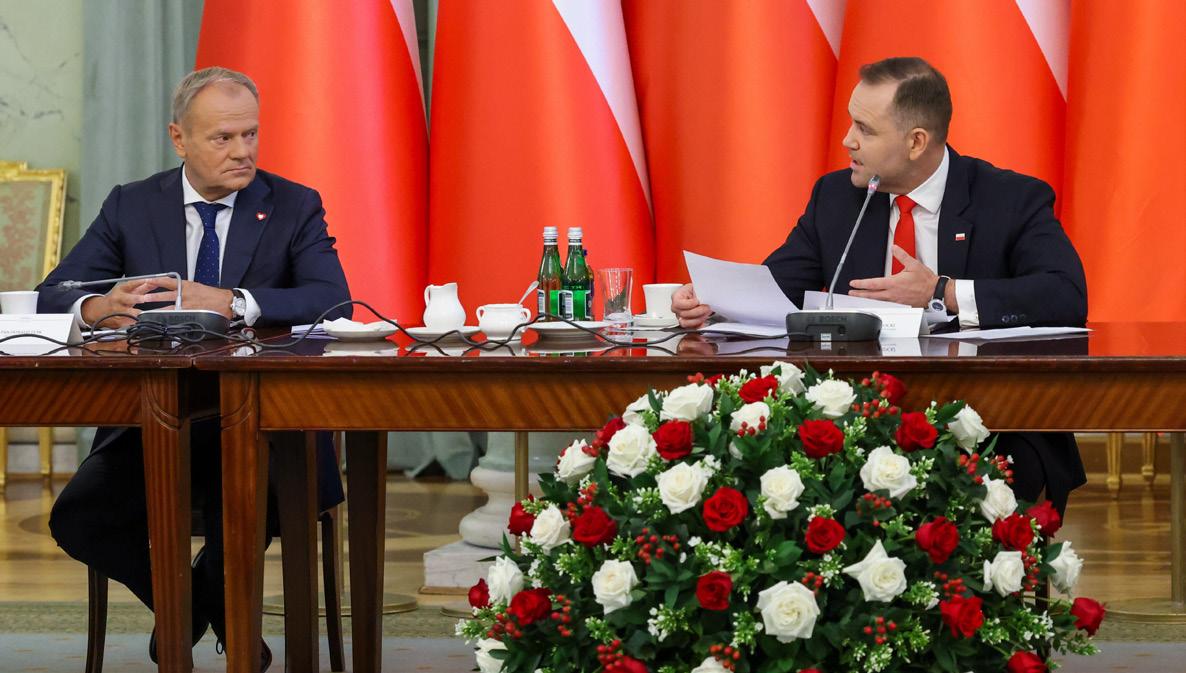
Donald Tusk & Karol Nawrocki

region, our sensitivity and emotions, will build a stronger Central Europe within the EU,” added Nawrocki.
“Thirty generations created a beautiful, wonderful Republic before it fell under the pressure of three partitioning powers. Thirty generations created this great work, which was called the Republic,” said the president during the Warsaw ceremony of Independence Day on November 11. “It took only one century for the Republic to fall under the force and pressure of three partitioning powers. But after those 30 generations, five generations of Poles came along, ready to fight for what was most important. Five generations of Poles ready for uprising and insurrection, for hard, positive work for a common home, which was to be the reborn Republic,” he continued. “Hence the beauty of November 11, 1918, because it was a great celebration for which so many generations and the fathers of our independence had worked. But the independence that came then was, on the one hand, a great joy, and on the other, a huge responsibility. Poland had to fight for its borders, it had to withstand the pressure of the Bolsheviks from the east.”
“What do we want to say today to those who, with their blood, effort, and work, brought us independence on November 11, when we see that some Polish politicians are ready to give away Polish freedom, independence, and sovereignty piece by piece to foreign institutions, tribunals, foreign agendas, and the EU?” asked the president.
From the very first days of the new president’s term in office, the dire predictions about cooperation with the Ministry of Foreign Affairs have come true. Like Andrzej Duda, Karol Nawrocki firmly refuses to sign nearly 40 ambassadorial nominations, with the result that the most important embassies are headed by officials with the rank of charge d’affaires. Nawrocki has publicly declared that he is open to discussions on this issue, but at the same time he has stated that he will never accept candidates such as Bogdan Klich [former Minister of Defense] for ambassador to Washington or Ryszard Schnepf [former Deputy Minister of Foreign Affairs, later ambassador to Spain] for ambassador to Rome. In recent days, he has also categorically refused to sign the nomination of Paweł Wroński [current spokesman for the Ministry of Foreign Affairs, long-time journalist] as ambassador to Sofia.
The only place where Karol Nawrocki and Radosław Sikorski, sitting next to each other, gave the impression of being unanimous was in the United Nations. However, a debate was taking place there on the war unleashed by the Russian Federation in Ukraine, and this is probably one of the few issues on which the two most important Polish centers of power tend to agree.
Another arena of conflict between the president and the government is the legal system. Nawrocki announced that
Karol Nawrocki
for the next five years, judges who question the status of other judges will not be appointed. Government spokesman Adam Szłapka said that this was an attempt to challenge the constitutional principles of judicial independence and the independence of the courts.
“Every judge nominated by the President of the Republic of Poland is a judge of the Republic of Poland. It is the president’s prerogative to nominate, but he may also refuse to do so. Today, I am exercising this right: I am refusing to appoint 46 judges,” the president declared. “This is no longer just a verbal signal, but a concrete decision. I will not appoint or promote those judges who question the constitutional and legal order of the Republic of Poland, those judges who listen to the evil whispers of the Minister of Justice,” he added.
Zbigniew Bogucki, head of the President’s Office, told the Dziennik Gazeta Prawna daily, adding that the direction of the changes proposed by the president will run counter to those proposed by the Ministry of Justice.
“I believe that the draft should move towards the democratic election of judges by the Sejm, rather than the election of judges by judges. We need to look at the procedure by which the Sejm would select members of the KRS from among judges, and the method of selecting candidates from the judicial community, including how many judges’ votes are needed for a candidate to be submitted to the Sejm. The proposals mentioned by Minister [of Justice Waldemar] Żurek are a continuation of the chaos of lawlessness and the segregation of judges into better and worse ones. The minister talks about the rule of law, but discriminates against judges appointed in accordance with the law. This is hypocrisy,” added Bogucki.
NAWROCKI ANNOUNCED THAT FOR THE NEXT FIVE YEARS, JUDGES WHO QUESTION THE STATUS OF OTHER JUDGES WILL NOT BE APPOINTED
Nawrocki emphasized that “the discussion about neo-judges and paleo-judges” is purely a journalistic debate, which has so far destroyed the Polish system. “The destruction of the constitutional and legal order today affects the lives of our citizens, ordinary people who cannot obtain a fair judgment. Several tragedies have occurred recently. A brutal murderer from Puszczykowo was not effectively convicted. Some judges questioned the status of others. Judges are not there to deal with status, but to pass judgments”, he said.
The government spokesman stated that the president’s speech was an attempt to usurp power. “Judges have the right to question the status of other judges in the form of a ruling, and there are rulings from both Polish and European courts to this effect. The judiciary in Poland must be independent of other authorities. Judges are independent, courts are independent, and any attempt to question this is simply an usurpation and an attempt to undermine the justice system in Poland and deepen the chaos that has been brought upon us by [former] Minister Zbigniew Ziobro, the previous parliamentary majority, and [former] President Andrzej Duda,” he added.
The new president is to submit his own draft bill on the National Council of the Judiciary (KRS) in January. Under his proposal, judges to the KRS would be elected by the Sejm. However, the manner in which they are elected by the lower house and the number of judges required to submit a candidacy to the Sejm would change. If the president’s proposal is rejected, Nawrocki will propose a referendum on the matter.
“In the near future, the president wants to appoint a Council for the Reform of the State System, whose task will be, among other things, to draft a bill concerning the KRS so that it can be presented in January next year at the latest,”
At the beginning of October, Żurek presented the long-awaited draft amendment to the Act on the National Council of the Judiciary. It provides that the members of the KRS will be elected by all judges, and not, as has been the
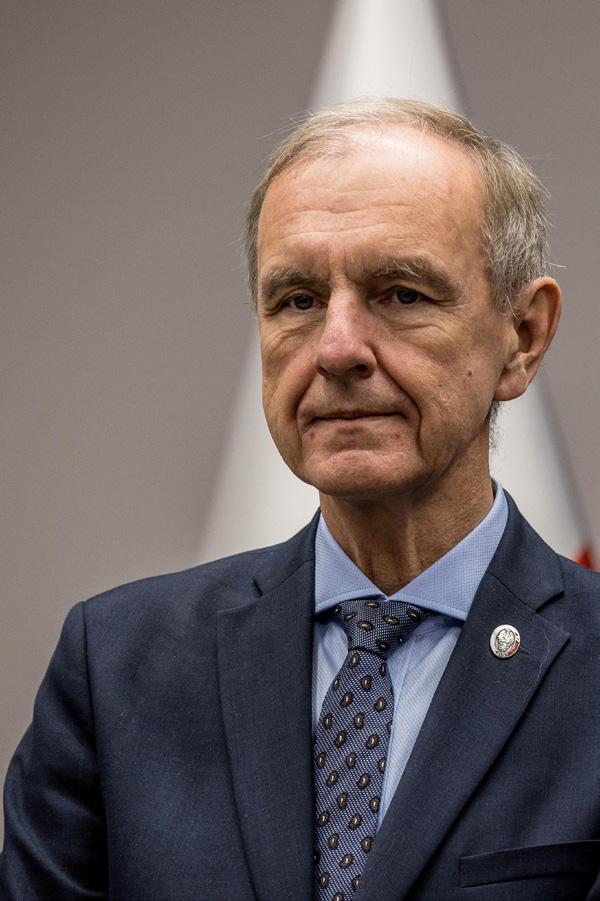
Donald Tusk
Bogdan Klich
Ryszard Schnepf

THE SEJM SENDS THE PRESIDENT MANY BILLS THAT ARE SIMPLY TOTALLY UNACCEPTABLE TO THE MORE CONSERVATIVE PART OF OUR SOCIETY, AND THAT IS WHY THE NATION ELECTED A PRESIDENT WITH MORE CONSERVATIVE VIEWS, SO THAT HE WOULD VETO THEM
case so far, by the Sejm. The bill also provides that judges promoted by the current Council will also be eligible to run for the Council, and those sitting on the KRS will be eligible for promotion to higher judicial positions.
The minister’s bill has raised objections among the judiciary itself. The changes that Żurek wants to introduce are also criticized by the Helsinki Foundation for Human Rights. The president’s entourage believes that the head of the Ministry of Justice is acting unconstitutionally and uses this argument to explain the president’s failure to sign the promotions of 46 judges.
Another daily sign of tension between the president and the government is the series of vetoes against bills that land on the head of state’s desk. Karol Nawrocki vetoed, among others, the bill on the crypto-asset market, the amendment to the Electoral Code and the amendment to the bill on the taxation of family foundations. “I want to make it clear that I exercise my veto power only when it is in the interest of citizens, the transparency of the law, and the stability of the state. It is the citizens who entrusted me with this preroga-
tive by electing me in a general election.”, he wrote on X. In the recording attached to the post, he emphasized that he had presented his own draft amendments three times along with the veto, “to show that the presidential veto is not a tool of destruction, but an element of responsible cooperation.”
Recently, Karol Nawrocki announced, also in a recording on the X that he had decided to veto the so-called chain law. It was intended to introduce a ban on keeping dogs on a leash. He announced that he would submit his own bill to the Sejm on this matter. The president emphasized that although the intention to protect animals is right and noble, in his opinion, the bill was poorly written.
“Instead of solving problems, it created new ones that could lead to a deterioration rather than an improvement in the situation of animals. The proposed standards for dog kennels were completely unrealistic. Kennels the size of city studio apartments are an absurdity that would hit farmers, breeders, and ordinary rural households,” he wrote, noting that the claim that the Polish countryside mistreats animals is a harmful stereotype. “That is why I am not signing a bill that stigmatizes the countryside and at the same time does not solve any real problem,” he added.
The president’s latest veto will probably be the first one that the Sejm will try to reject. “The chain law will be referred to the special committee on animal protection. The coalition has made a decision on this matter, and the veto will be put to a vote because we consider the president’s decision to be yet another decision that is completely incomprehensible,” said Sejm Speaker Włodzimierz Czarzasty.
While politicians from the ruling coalition are criticizing the presidential vetoes en masse, calling them outright attempts to obstruct and paralyze the state, politicians from the radical nationalist Confederation are justifying Nawrocki’s decisions.
“I believe that the president should veto more,” Krzysztof Bosak, Deputy Speaker of the Sejm, one of the leaders of the Confederation, said in an interview with Radio Plus. He argued that bad laws continue to come out of the Sejm, and the president only vetoes some of them. “This government is incapable of writing and creating anything useful,” he said. “The Sejm sends the president many bills that are simply totally unacceptable to the more conservative part of our society, and that is why the nation elected a president with more conservative views, so that he would veto them,” ne continued, adding that “people in government should accept that they do not have a democratic mandate giving them 100% power in the state.”
According to the 1997 Constitution of the Republic of Poland, the President of the Republic of Poland has the right to refuse to sign a bill passed by the Sejm. The Sejm may override the President’s veto by a qualified majority of threefifths of the votes in the presence of at least half of the statutory number of deputies. The right of veto does not apply to the budget bill and the bill amending the Constitution.
Nawrocki exercised this right 13 times during the first 100 days of his term. This is a lot compared to Andrzej Duda’s first term, during which he vetoed four bills in his first 100 days. Bronisław Komorowski, Lech Kaczyński, and Aleksander Kwaśniewski did not veto any bills during their first 100 days.
In total, Lech Wałęsa exercised his veto power 27 times, Aleksander Kwaśniewski 35 times during both terms, Lech Kaczyński 18 times, Bronisław Komorowski 4 times, and Andrzej Duda 21 times during both terms.
BAL C oroczny XVI
S towar z yszenia Greckich

Stowarz yszenie Greck ich Przedsiębiorców w Polsce
Zarząd Stowarzyszenia Greckich Przedsiębiorców w Polsce „HERMES”
ma przyjemność zaprosić Państwa na XVI COROCZNY BAL w sobotę 7 lutego 2026 roku o godzinie 19:30
w hotelu REGENT
(Belwederska 23, 00-761 Warszawa)

Sponsorzy:


Patron medialny :

Wejście: 399 zł / osobę cena obejmuje kolację, napoje alkoholowe, bezalkoholowe i muzykę grecką na żywo - piosenkarz Spiros Gianniotis
Rezerwacje pod adresem: biuro@hermes-gr.pl
GOOD PROSPECTS FOR POLISH ECONOMY
Poland will be among the EU countries with the highest economic growth in the next two years, but also with the highest deficit, according to the latest forecasts by the European Commission.
EU analysts also see Poland among the countries where ETS2 - the extended greenhouse gas emissions trading system - will have the greatest impact on inflation.
According to the EC, Ireland, Malta, and Cyprus will outperform Poland in terms of economic growth this year, but by 2026, only Malta will grow faster than the Polish economy. This year’s forecast for Poland has been slightly lowered compared to the predictions made a few months ago. The forecast for 2026 has been raised by 0.5 percentage points.
“The contribution of private consumption is expected to remain strong, but weaker than in the previous year, due to

a slowdown in disposable income growth. The positive contribution of investment is expected to increase significantly, reflecting higher absorption of EU funds, especially in the last year of the National Reconstruction Plan (KPO), and compensating for lower private consumption growth,” the EC said in a comment referring to the forecast for 2026.
The outlook for public finances is less optimistic. According to the EC, Poland will be the only EU country whose deficit will remain above 6% of GDP until 2027. This will result in an increase in public debt to 69% of GDP.
“The deficit is projected to fall to 6.3% of GDP in 2026. The government will implement new discretionary measures to increase revenues and support fiscal consolidation. These include a temporary increase in CIT for banks, increases in excise duty and VAT on certain beverages, and the introduction of a mandatory electronic invoicing system,” the EC assessed. “Fiscal policy is projected to remain expansionary in 2025 and 2026, supported by higher spending financed by the EU budget. In 2027, it is expected to become restrictive due to the end of the KPO, despite an increase in domestic defense spending,” the report said.
“Consolidation in 2026 is the result of a significant (above 0.5% of GDP) reduction in net current expenditure (similar to France, Austria, Malta, Finland, Slovakia, and Romania). On the other hand, the forecast for 2027 is the result of the EC’s no-policy change approach, i.e., the assumption of a continuation of the current policy of the government,” indicates the Ministry of Finance.
The EC’s predictions are mostly consistent with the forecasts of the government and the National Bank of Poland
(NBP). The biggest difference can be seen in the inflation forecast. In 2027, prices are expected to rise by 3.7% (the NBP predicts that inflation will be close to the central bank’s target of 2.5%). The main reason for this is the ETS2 system, which is to cover transport, among other things.
“However, the EC’s forecast does not take into account the recently announced postponement of the entry into force of the ETS2 system by one year, from 2027 to 2028,” notes the Ministry of Finance. NBP Governor Adam Glapiński recently said that the entry into force of the new greenhouse gas emissions trading system could increase inflation in Poland by as much as 2 percentage points.
Following GDP data for the third quarter - the best since 2022 - economists maintain that the economy will grow by 3.53.6% over the whole year. In 2026, growth may accelerate to 4%.
In the third quarter, the Polish economy grew by 3.7% year-on-year, according to the Central Statistical Office (GUS). In the previous quarter, the result was significantly lower, at 3.3%, and a year earlier, at 2.8%. This shows that the Polish economy is accelerating.This is the fastest GDP growth in three years; a better result was recorded in Q3 2022 (4.1%).
The GUS publication does not yet contain a detailed breakdown of the components that contributed to GDP growth in the third quarter. Nevertheless, analysts estimate that private consumption was the main driver of GDP growth in the last three months. “This scenario is indicated by previously published monthly data on retail sales and
ANALYSTS AT BANK PEKAO FORECAST THAT THE FULL-YEAR RESULT WILL BE EVEN BETTER, AT 3.6%
signs of solid activity in the service sectors,” economists at PKO BP bank wrote in a commentary.
Investments, mainly in industry and construction, have also had a positive impact on the economy in recent months. On the other hand, exports made a smaller, even negative, contribution to GDP growth this time around; this is due to the economic slowdown among major trading partners, such as Germany (which accounts for over a quarter of Polish foreign sales).
Analysts at Bank Pekao forecast that the full-year result will be even better, at 3.6%. In their opinion, the biggest problem facing the Polish economy at present is that the growth factors are only internal, while foreign demand - and consequently exports - are below potential. Consequently, although domestic demand still has room to grow (2026 promises to be a very good year for investment), the situation in Europe is crucial for the further acceleration of the Polish economy.
PLN 4 BILLION FOR INVESTMENTS
The Innovate Poland program, involving PFR Ventures, BGK, PZU, and capital funds, is expected to provide Poland with an investment boost for years to come.
The pillars of the project will be PFR Ventures, Bank Gospodarstwa Krajowego (BGK) and insurance giant PZU, which will provide the initial financing. We are talking about PLN 4 billion, with approximately 40% of this amount provided by the Polish Development Fund and the remainder by BGK, supported by the European Investment Fund. In practice, however, the amount of money is to be at least twice as large, as the idea is to mobilize institutional and private capital, including venture capital and private equity funds, pension funds, investment fund companies, and banks.
The project is to be modeled on the French Tibi plan. According to unofficial information, the size of the fund can be estimated at a minimum of PLN 8 billion.
At Innovate Poland, just as important as the capital itself is the creation of a platform for cooperation, knowledge and risk sharing, as well as learning for new investors. The state element is to provide security, trust, and guarantees, which may be an additional magnet.
THE AIM IS TO SOLVE THE PROBLEM OF INSUFFICIENT FINANCING FOR START-UPS AND TECHNOLOGY COMPANIES, ESPECIALLY IN THE LATER STAGES OF DEVELOPMENT
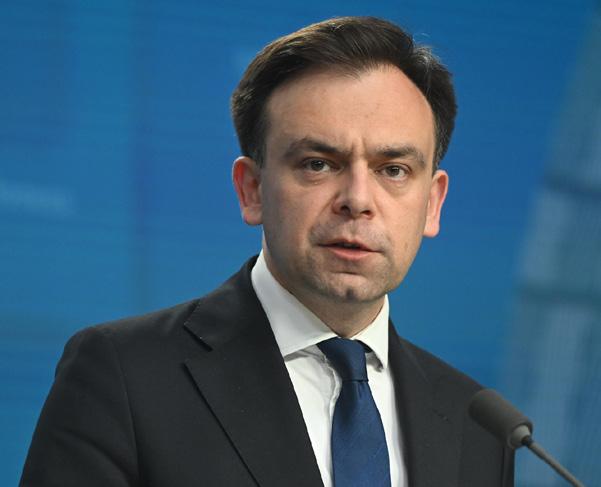
The author of the project is the Minister of Finance and Economy, Andrzej Domański. The team working on the plan makes no secret of the fact that it is modeled on a French government program that aims to increase funding for innovative technology companies by mobilizing capital from institutional investors, mainly private, but without involving large public subsidies. The French initiative, known as the Tibi plan (Philippe Tibi is a French economist and government advisor), was launched in 2019 and in its first years already raised several billion euros to finance start-ups and innovative technology companies. It is estimated that by 2026, technology companies will receive a total of over EUR 13 billion from this initiative (between 2020 and 2023, French start-ups already received EUR 6.4 billion in financing from investors covered by the program). The Minister of Finance and Economy is counting on a similar effect.
The origins of Tibi’s plan and Domański’s plan are similar. In both cases, the aim is to solve the problem of insufficient financing for start-ups and technology companies, especially in the later stages of development (series B and C), where challenges are growing and access to capital is more difficult.
These programs are designed to increase the involvement of large investors (e.g., pension funds, insurance companies, corporations) in the domestic innovation and deep tech sector by creating institutional, regulated funds with “state accreditation.”
Andrzej Domański
WARSAW HIGH IN EUROSTAT RANKING
The Warsaw Capital Region has the highest percentage of people involved in science and advanced technology in the European Union.
At the end of last year, 74.3% of employees in the Warsaw agglomeration were classified as part of the innovative HRST sector, i.e., science, research and development, and advanced R&D technologies, according to the latest Eurostat data. The Polish capital and its suburbs had the highest percentage of scientific and technological talent among EU regions. This also includes graduates of other fields who decided to pursue careers in science and technology-related industries after graduation.
According to Eurostat data, last year 126.2 million EU residents aged 15 to 74 were involved in the science and technology sector, accounting for 49.2% of the Community’s workforce. The largest number, 101.1 million people,
met the HRST education criterion, 80.5 million met the professional criterion (i.e., worked in professions related to this sector), and 55.4 million met both the educational and professional criteria.
As Eurostat points out, it is this third group - people with qualifications in science and technology and employed in related occupations - that constitutes the “core HRST.” This is a very valuable resource, as regions with a high share of core HRST in employment can expect a number of benefits, including higher productivity and higher wages.
The Warsaw agglomeration is also among the EU leaders in terms of the number of employees in the core HRST group. Last year, this figure stood at 0.8 million people.
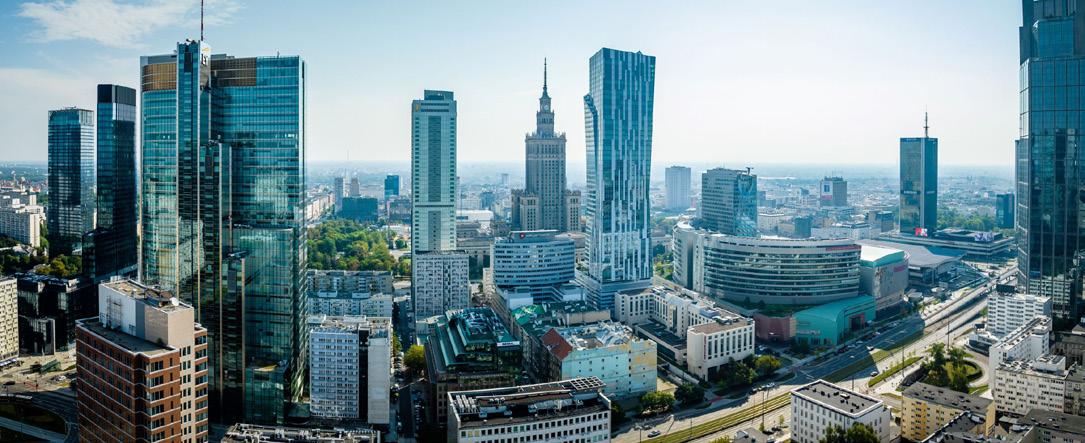
COMMERCIAL REAL ESTATE MARKET REPORT
In the first three quarters of 2025, the value of investment transactions on the commercial real estate market in Poland amounted to approximately EUR 2.4 billion, according to Savills Polska’s report “Investment Market in Poland, Q1–Q3 2025.”
Although this is 6% less than a year earlier, the number of transactions increased by the same percentage, confirming the continued activity of investors despite the more difficult economic environment.
The third quarter alone closed with a result close to EUR 800 million, similar to last year’s, which was partly due to the typical summer slowdown.
The result for the first three quarters is approximately EUR 1 billion lower than the ten-year average, but according to Savills’ analysis, the last quarter of the year traditionally sees the highest transaction activity. Approximately 35% of the annual volume is accounted for by the fourth quarter. If the market maintains its pace, the total investment volume in 2025 may exceed EUR 4 billion, although it will not reach last year’s level.
“We see that investors remain active, but they are very selective. In the current environment, asset quality and income stability are key. Transactions involving core and core-plus properties are still rare, while there is greater activity in the value-add segment, where investors are looking for opportunities to rebuild value through mod-
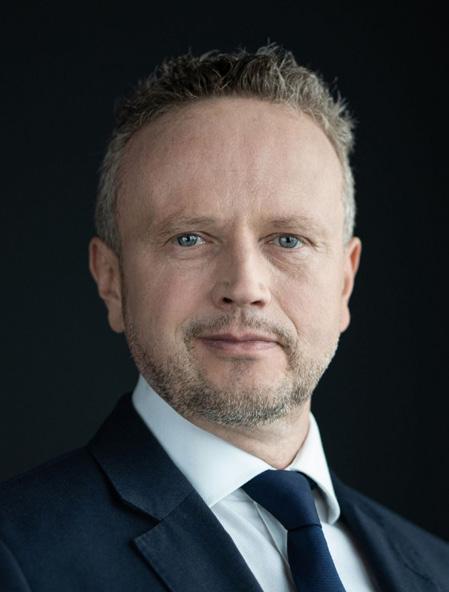
ernization, change of function or repositioning of properties,” commented Mark Richardson, Head of Investment, Savills.
From January to the end of September, the office sector maintained its leading position with a volume of around EUR 900 million (36 transactions), representing a year-on-
Mark Richardson
year decline of 11%. In the industrial and logistics sector, the value of transactions increased by 19% to EUR 873 million, with 18 transactions completed. The residential sector recorded the highest growth, increasing by as much as 71% to EUR 86.5 million. Such high growth should be linked to the rather small number of transactions recorded in this market. In turn, investors spent EUR 456 million on commercial projects, which represents a 29% year-on-year decline, but it was in this segment that the most transactions were concluded – 39 in total for the year.
Among the largest transactions of the year were the sale of the Eko-Okna production plants for EUR 253.5 million and the sale of the Mennica Legacy Tower office complex in Warsaw for EUR 180 million.
“The data from 2025 confirms the gradual stabilization of the investment market. Although the total volume remains below historical averages, the number of transactions is growing and activity is spreading across more and more sectors. This is a good sign, which can be interpreted as a return of confidence in the Polish market, with investors adjusting their strategies to the new financing cost environment,” said Wioleta Wojtczak, Head of Research, Savills.
Domestic investors, mainly private, remain one of the most active groups on the market. They accounted for onethird of the number of transactions and 23.8% of the total volume. Among the buyers were ME Invest, active in the
retail segment, and Syrena Real Estate, which purchased the Zaułek Piękna office building in Warsaw. Local governments and industry organizations are also increasingly involved in transactions. The share of investors from the CEE region and the Baltic states is estimated at around 7%, and American capital at 20%. Investors from Western Europe accounted for 18% of the volume.
In the third quarter of the year, capitalization rates remained stable across all sectors. Interest rate cuts in Europe have not yet led to a compression of rates, which are as follows: offices 6.00%, industrial and logistics 6.25%, retail 6.25%, PRS 5.50%, PBSA 6.00%.
The authors of the report point out that potential changes in rates will depend on investor activity in the prime real estate segment and on possible reference transactions that may redefine asset valuations.
DOMESTIC INVESTORS, MAINLY
PRIVATE,
REMAIN
ONE OF THE MOST ACTIVE GROUPS ON THE MARKET

Mennica Legacy Tower Complex
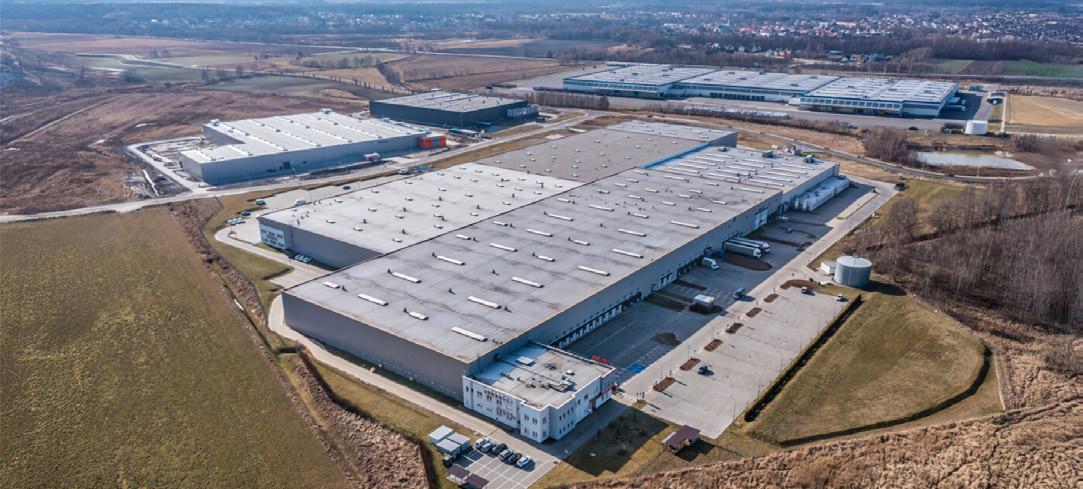
HILLWOOD POLSKA BUYS WAREHOUSES FOR EUR 100 MILLION
Hillwood Polska has purchased Industrial Park Bieruń and Industrial Park Tychy from Deka Immobilien, with a total area of over 153,000 sq. m. The value of the transaction is estimated at PLN 424 million.
According to Savills estimates, EUR 873 million was invested in logistics and industrial real estate in Poland during the first three quarters of 2025.
Industrial Park Bieruń has 56,000 sq. m. of leasable space, while Industrial Park Tychy has 97,000 sq. m. With the purchase of these two parks, Hillwood’s Polish portfolio will approach 2 million sq. m.
“A transaction of this scale is a clear confirmation of the strength of the Polish warehouse market, which remains one of the most attractive and dynamically developing real estate segments in Europe. At the same time, it strengthens our position in the region and confirms the direction set out in Hillwood’s strategy in Poland - the parallel development of development activities and value creation through selective
acquisitions,” commented Hubert Michalak, managing director of Hillwood Polska.
At the beginning of the year, the company purchased 43,000 sq. m. of warehouse space in Gdańsk and commissioned 54,000 sq. m. in Głuchów near Poznań. During the summer, construction began on the 58,000 sq. m. Hillwood S8 Warsaw South logistics park in the municipality of Żabia Wola.
During the first three quarters, 18 transactions were concluded in the logistics and industrial real estate sector in Poland, including five sale and leaseback transactions (sale with simultaneous lease of the property from the new owner), led by the sale of two factories by Eko-Okna to the American REIT Realty Income for over EUR 250 million. Only three portfolio transactions were recorded - demand and supply are seeking a happy medium in terms of price expectations.
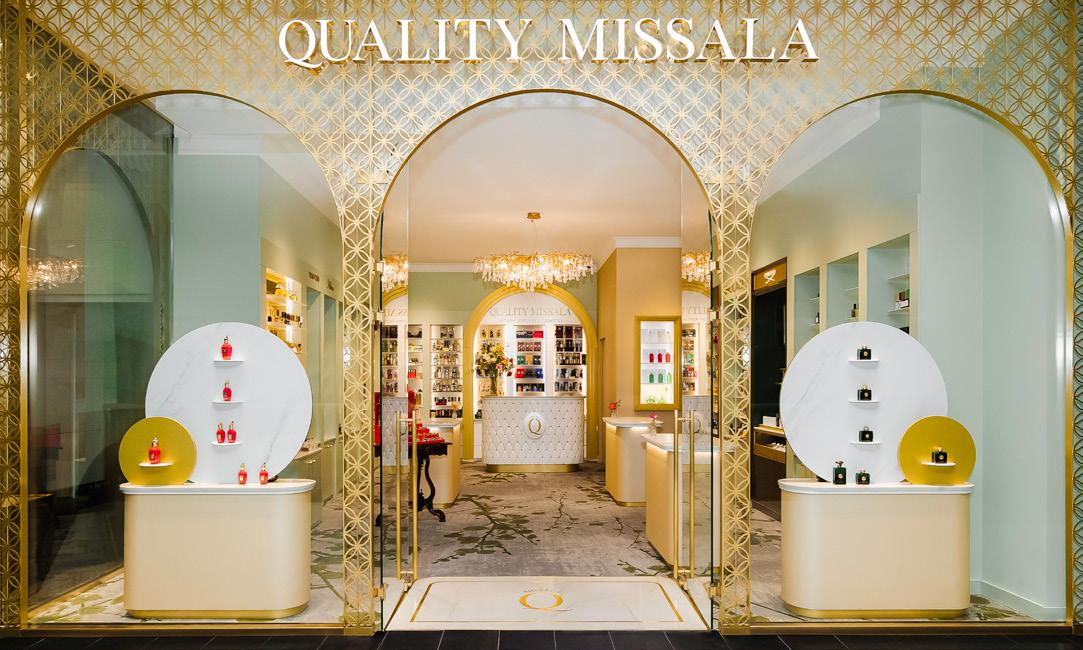
QUALITY MISSALA OPENS ANOTHER ELITE PERFUMERY IN WARSAW
One of the leading luxurious niche perfumeries in Poland and Europe, Quality Missala Perfumery, opened in November its sixth boutique in Warsaw. The new store is located on the first floor of the prestigious shopping complex Westfield Arkadia, among other luxury brand boutiques.
The décor, with its distinctive gold arabesque, echoes the elegant design of the other Quality Missala Perfumery housed in the Westfield Mokotów shopping complex.
The new space houses the most beautiful artistic and niche perfumes, the best skincare from leading global brands, and makeup in line with art and the latest trends. Among those high-end perfume brands are Amouage, Atelier des Ors, Clive Christian, Creed, Fragrance du Bois, Montale, Puredistance and Xerjoff.
The new Quality Missala Perfumery also offers exquisite skincare from the Japanese Menard and well-known
European brands including Bellefontaine and Natura Bissé, as well as luxury makeup from T. LeClerc, Alleven and Le Rouge Français.
Quality Missala is a family business founded in 1991 by Stanisława Missala, as a pioneer in offering exclusive, elite fragrances, skincare and make-up products in Poland. Over the years, the company, now run by the whole Missala family, has been constantly developing its elite portfolio. Today, Quality Missala offers more than 70 brands of artisan perfumes and skincare cosmetics along with superior service standards in its elegant and stylish boutiques in key Polish cities.
The newly opened perfumery is the eleventh Quality Missala boutique in Poland. Apart from Warsaw (Westfield Arkadia, Westfield Mokotów, Warsaw Presidential Hotel, Klif Fashion House, Mokotowska 40 and Bemowo Perfume House) it offers its exquisite products in Wrocław, Łódź, Gdańsk, Poznań and Opole.
BUTIK
Compiled by Marzena Robinson

1/ Elevating vanilla to a new dimension
Novae Vanilla, a new fragrance by Atelier des Ors explores the richness of Vanilla in all its facets offering a very unique interpretation of one of perfumery’s most beloved ingredients.
Its olfactory narrative draws upon the timeless symbolism of gold - the stars, the light, the eternal. The olfactory principle was inspired by the divine proportion of the golden number Φ (phi), resulting in a composition of extraordinary harmony – between darkness and light, matter and spirituality, softness and intensity.
The new fragrance celebrates a trio of rare Vanillas: elegant and ethereal Nature-

Print® Blue Vanilla, rich and carnal Bourbon Vanilla, and velvety, slightly woody Madagascar Vanilla.
The fragrance opens with a mineral, crystalline fresh accord enveloped by voluptuous Vanilla bean in a perfect balance with Mimosa, known as golden flower, adding its sunny, luminous sweetness. Gradually, Vanilla Absolute unfolds its creamy, balsamic side, Bourbon Vanilla settles in with warm, spicy nuances and Madagascar Vanilla completes the trio with a silky enveloping aura. The closing notes of Novae Vanilla are built on a base in which Amber Woods, and Musk provide sensuality and hold, leaving a warm and vibrant
trail that lingers on the skin.
Like all Atelier des Ors creations, Novae Vanilla is infused with 24-carat gold flakes, shimmering on the skin as the fragrance envelops the wearer. The fragrance’s sleek glass bottle is embossed with the brand’s signature seahorse emblem in liquid gold, which adds an extra glow to the gold-vanilla colour of the juice.
2/ Sensory stroll through Portobello Road Portobello Road is a new floral green fragrance in the Fleurs Bohèmes collection by Memo Paris, featuring a unique blend of notes that evoke a sense of the


urban rhythm with an artistic twist and floral vibrancy.
This crisp and sensual scent captures the poetic charm and mood of London’s most vibrant, colourful and eclectic street in full bloom, where the aromas of dewy flowers on market stalls mingle with the scent of rain evaporating from the city streets after a fresh downpour.
With the first spritz, the fragrance kicks off with a burst of sparkling Mandarin Orange, hints of Myrtle and Green Leaves. Then it gets more romantic with the note of a very fresh Rose intertwined with the herbaceous vibe of Clary Sage. This further sets on a contrasting raw base with a Rain accord, a creative inter-
pretation of damp asphalt, and the notes of Vetiver and Patchouli, evoking strolls through rain-kissed streets of the buzzing road market.
3/ An olfactory escape into nature
Nissaba is a Geneva-based perfume brand which creates fragrances inspired by specific world regions and uses natural ingredients sourced from those areas. The new Nissaba Les Alpes is the first extrait from the house, aimed to encapsulate crisp alpine air and mountain forests associated with the Swiss Alps. The fragrance is a refreshing blend of green, woody and herbal accords that highlights some rare native ingredients
from the region, shaped by altitude and purity. By evoking the essence of wild flora and untamed terrain, it offers a distinct olfactory journey to the raw beauty of the highlands.
In the top note, Les Alpes blends the fresh, aromatic scents of Pine needles, Fennel, Red Thyme and Rosemary capturing the essence of a brisk Alpine breeze. In the middle note, a vibrant alpine Juniper Berries essence entwines with Geranium, Cardamom, and a resinous Labdanum. In the base, the warmth of earthy and rich Hay Absolute is contrasted by aromatic facets of Balsam Fir, while a bouquet of fresh Woods adds intensity to this invigorating composition.

4/ Notorious XO: The elixir of charisma
Notorious XO by M. Micallef is the new bold fragrance which commands attention with every spritz. Designed as signature scent for individuals of genuine confidence, sophistication, natural elegance and allure, who never go unnoticed.
This gourmand scent blends rich, aromatic notes of Cognac and spices with the woody warmth of oak barrels. Crafted with the same exacting standards as an exceptional XO, it has a rich, deep and refined character, patiently shaped.
It opens with a burst of Pepper, aged Cognac, and subtle watery accords. The heart deepens with noble Leather, Tonka Bean and Oakmoss, warmed up by spicy


Cinnamon and Cardamom. The scent settles upon an addictive base of Praline, Vanilla, Amber, Sandalwood and Musk, leaving behind a lasting sensual impression.
5/ Chess-inspired fragrances for intellectuals
Luxury fragrance house Mind Games, which draws inspiration for its fragrances from the intricacies of chess, has expanded its acclaimed Perfumer Extraordinaire collection with the launch of two masterful new extrait de parfums: Queenside and Kingside. Both, named after chess moves, embody the duality of power and vulnerability, as well as strategy and instinct.
Queenside, a scent rooted in poise, intellect, and sensuality, radiates with
a graceful intensity. It is the epitome of being grounded in the beauty of the moment, the power of knowing you are exactly where you are supposed to be. It opens with luminous Pear and intense smoothness of Cassis Cream over Lychee Leaves, evolves through soft floral tones of Geranium, Lily of the Valley and Violet, and finishes with a grounding base of Oakmoss, Musk and warm Madagascar Patchouli.
Kingside, designed for those who lead with presence and grace, pays homage to quiet power and strategic precision. The scent unfolds with a bold interplay of vibrant Cardamom oil and zesty Grapefruit blended into a floral-spiced heart of Hazelnut Flower and Pink Peony Petals. An


unexpected note of Pistachio Gelato add smoothness and texture to the composition. The scent settles into a comforting, magnetic dry down of Tonka Bean and Peru Balsam, which lends depth with its resinous glow and complex aroma.
6/ A power-packed serum for skin renewal overnight Natura Bissé’s Essential Shock Intense Retinol Night Renewal Serum is a key step in your evening routine. This ultra-concentrated skincare solution, infused with an impressive cocktail of ingredients, provides unparalleled anti-ageing benefits, effectively firming and regenerating the skin overnight while providing deep hydration.
The formula not only contains Retinol but is enhanced with Bakuchiol to boost production of Collagen, Elastin, and Hyaluronic acid and help to reduce the appearance of wrinkles. Glycolic Acid offers an efficient exfoliation to smooth skin texture and restore luminosity, Matrixyl enhances skin flexibility and provides a visible lifting effect.
The serum is also ideal for those who want to fade the appearance of post-acne scars, dark spots and uneven pigmentation to reveal a renewed complexion.
7/ Conquering the night Elysium Noir by Roja Parfums is new bolder take on the iconic Elysium, offering a richer and more seductive scent
with a mysterious twist. Infused with the carnal impulse of velvety Leather and the addictive allure of Blackberry, it retains the freshness of its predecessor, while introducing a sensuality that balances refinement with raw power. Designed for the man who transitions smoothly from day into night, the fragrance embodies the power of darkness, masculinity and the radiance of timeless elegance.
The fragrance opens with fresh citrus and aromatic top notes, a luminous Bergamot, Lemon, Mandarin, Orange and Lavender. The bright opening serves as the perfect introduction to the compelling core of Blackberry accord, which adds sweetness to the contrasting base of Leather notes, Woods and Frankincense.
PRESERVING HERITAGE OF FRENCH HAUTE PARFUMERIE
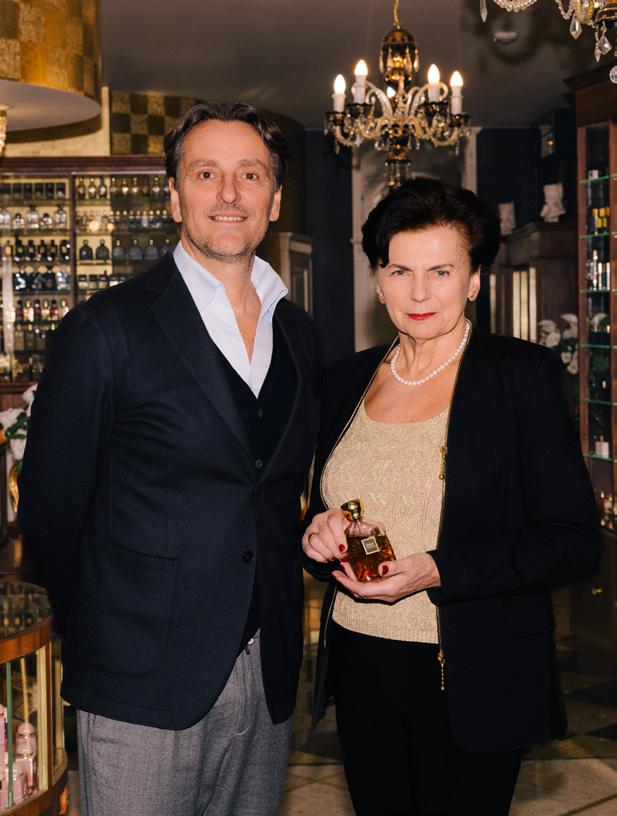
Jean Phillipe Clermont, Artistic Director of Atelier des Ors, French niche perfume house, came to Poland in late November to celebrate the brand’s tenth anniversary and to launch its newest fragrance – Novae Vanilla. The jubilee event was held at Warsaw’s perfumery owned by the Missala Family, one of Atelier des Ors’ first partners in Europe and, as Clermont put it, “very strong supporters of the brand’s artistic perfumes” when niche perfumery was yet not a worldwide trend. The Warsaw V oice took the opportunity to ask Clermont about his decade-long journey to success , his brand’s DNA and the new creation.
During your presentation at the event you said that you launched your brand with the aim of recreating the magnificence of Haute Parfumerie. Can you elaborate on this?
Haute perfumery has a long and rich history in France, dating back to centuries of fragrance traditions. As a French brand we have this strong heritage but when I started 10 years ago I had an impression that for decades after decades it had become very commercial. Using natural ingredients was not profitable any more so the perfume industry was shifting to synthetic ingredients. The brand creation was more minimalistic, something highly conceptual, something more about an eponym brand. Obviously, some people who started locally the niche revolution paved the way for us but I saw that one spot - French art de vivre - was still left void. So I decided to reinterpret French heritage in fragrance creation, bring back that lost magnificence of small French perfume houses from the 1930s and those very decadent crystal flacons when perfume was not commercial at all. I wanted to capture the best of the French tradition, art and culture, put the French know-how and craftsmanship into an elegant bottle and bring back elements of mystery and indulgence into fragrances.
So it is no coincidence that you have installed your business in Grasse, the birthplace of perfumery. Being a French brand it is very easy to claim and to take advantage of that prestigious heritage of the French art of perfumery. Yet, the question is: what can you do today, what is your commitment to pay back for this extraordinary legacy? I consider it my duty as a French brand to preserve and
transmit that heritage to the next generation. Therefore, with our audience growing over time, we moved to Villa Primerose, a magnificent neoclassical building from 1886 in Grasse, a region blessed with a unique microclimate and lands yielding some of the world’s most precious flowers. Luckily, about 10-15 years ago there was a comeback to natural ingredients, to replanting crops cultivated on the local fields from generation to generation. Now we are also part of a local business association, Grasse Expertise, to actively support these passionate farmers with various initiatives. Our establishment in Grasse testifies to our dedication to celebrating its unique ecosystem, preserving the exceptional local know-how associated with growing plants and making sure the history is not repeating itself.
But, Villa Primerose is even more, it is a lively space for inspiration, creation and exchange, where we network, where we bring our partners from all over the world so that they can meet with perfumers and farmers, visit the fields of mimosa, rose and jasmine, so that they can understand what it takes to make quality perfumes.
You also brought to the niche perfumery an idea of adding the 24-carat gold flakes to perfumes. Why did you decide to pair perfume and gold?
Gold, is very important in our brand’s DNA. Gold is of stellar origin, formed from the death of a star, the purest raw material you can find on earth. It is a signature of perfection, beauty and eternity. For me gold and perfume have the same origin, the first use, the representation of divinities. In many ancient religions priests burnt incense to communicate with God through scented smoke. That is in fact the etymology of
BEING A FRENCH BRAND
IT IS VERY EASY TO CLAIM AND TO TAKE ADVANTAGE OF THAT
PRESTIGIOUS HERITAGE OF THE FRENCH ART OF PERFUMERY
perfume, in Latin “per fumum” – through smoke. And gold, which shines forever, was important as a symbol of divinity to many ancient cultures. There is no alteration, no oxidation over time, and thus it is eternal. Gold is also used in our perfumes to highlight the craftmanship and artistic dimension of perfumery. Ancient dynasties used the process of hammering gold for long hours into extremely thin, lightweight sheets known as gold leaf. For me it is a symbol of craftsmanship, of what human beings do at their best, a quest for perfection. So our creations incorporate gold, this piece of eternity, just like timeless olfactive souvenirs. You smell something and all of a sudden all emotional memories feel alive again.
You are marking your jubilee with the launch of ‘new vanilla’, which you said “honours the brand’s past ten years and starts a new decade of artistry”. What is the significance of this ingredient to your brand?
When we started 10 years ago, out of the five perfumes we launched then Lune Féline, smoky, resinous, spicy and dark vanilla, became our best seller. And for the next eight years in a row it remained our most beloved classic, overtaken by Pink Me Up only two years ago, but still being a runner-up. The original baseline of Atelier des Ors was – art perfumery with poetry. And a poem that begins and ends with the same sentence is a form of circular - you are back to the beginning. We started with vanilla, we grew owing to vanilla, and it is a way to thank Lune Féline, to thank vanilla, for the past 10 years which offered so many emotions, travels and encounters.
The launch of Novae Vanilla closes the first decade and opens the new one in the same way, with the vanilla bean. It is a new beginning but we don’t forget the origins. But Novae Vanilla offers a very different olfactive profile. While animalic, balsamic and musky Lune (moon) with its darker facets was about the darkness of the night, the luminous Novae (supernova, a very bright star) is about the brightness of the day and a homage to stellar origin of gold. This one is cleaner, brighter, more uplifting and powdery. And I hope it’s going to be our compass for the next ten years.
The bottle of Novae Vanilla is absolutely stunning, especially with a prominent seahorse gold-embossed on the front. Yes it is the symbol, our founding emblem, the logo of the brand. It’s like a stamp of a craftsman and it adorns the top of the bottle cap for other fragrances. Seahorse comes from the ancient Greek word hippocampus, which in anatomy stands for the part of the brain responsible for bringing back memories, of especially colours and flavours. The seahorse is a hallmark for 24 carat gold in our special commemorative edition. It also adorns the bottles of our new limited edition of Lune Féline.
The rays on the back of the bottle symbolise the shininess of gold and are also reminiscent of Art Deco, one of the most creative periods in history, when Lalique and Baccarat used cut crystal. And by those embossed rays, which are like those you find on crystal glasses, we pay a tribute to this golden era.
Jean Phillipe Clermont and Stanislawa Missala, founder of the Quality Missala Perfumery
THE
French chanson phenomenon to sing in Warsaw
Isabelle Geffroy, known by the pseudonym Zaz, the charismatic French chanteuse, whose unique voice has captured millions of hearts worldwide, will perform songs from her upcoming album “Sains et Saufs” at Warsaw’s Torwar stage on February 2, 2026.
ItThe icon of the new generation of French chanson, who blends the styles nu jazz, soul and acoustic in her music, has been compared to the likes of Edith Piaf, Yves Montand and Ella Fitzgerald and her signature voice is celebrated all over the world.
She started out singing on the streets of Montmartre but her international career began with the release of her debut album ‘Zaz” in May 2010. The record topped the charts for nine weeks in France, Switzerland and Belgium and became double platinum. Zaz’s first single “Je veux” became a massive hit single in Europe, Hong-Kong, Japan, Russia and other places. She was awarded “Revelation Song” by the Academie Charles Cros, a French organisation of critics and music professionals, and named the French artist most played abroad in 2010.
Since then, the artist has won a multitude of awards, including French and German Grammys, the European Border Breaker Awards and has sold in excess of five million records internationally, with Gold status or higher in twelve countries.
She is currently, alongside Aya Nakamura, Imana and Barbara Pravi, the most streamed French-language artist.

BUZZ Operatic take on womanhood
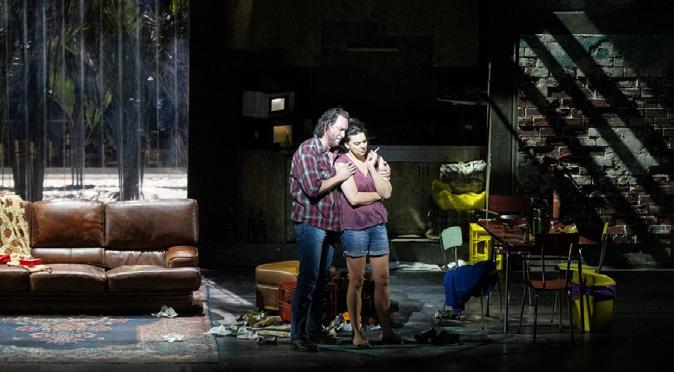
Richard Strauss’s opera, The Woman Without a Shadow (Die Frau ohne Schatten), is scheduled to premiere at The Teatr Wielki – Opera Narodowa in Warsaw on February 15, 2026. The production, directed by Mariusz Treliński, is a modern take on the fantastical tale, interpreting it as a psychological drama about womanhood and maternity.
TheWomanwithouta Shadow, first performed in Vienna, in 1919, is the fourth collaboration of Strauss and lyricist Hugon von Hofmannsthal. Despite abounding in ambiguous symbolism, the opera focuses on the most fundamental human experiences: love, loneliness, feeling unfulfilled, and longing.
The story follows a spirit princess, the Empress, who needs to obtain a human “shadow”, the ability to have children, within three days or her husband, the Emperor, will be turned to stone. She is tempted to steal the shadow from the happy wife of a dyer, but ultimately chooses compassion over selfishness, leading to a resolution where both couples find fulfilment.
The libretto combines tropes taken from Oriental fairytales and symbolic parables, alluding to certain motifs from Mozart’s The Magic Flute. What underlies the seemingly complicated narrative is a universal tale of an unhappy relationship and endeavours to save it. The story is told with sensual music based on contrasting elements: engrossing harmonies and stark dissonances,
momentous tutti sections and soft chamber passages, arias and large choruses.
Treliński, views the piece as a contemporary tale of a mentally exhausted woman, drawing inspiration from the films of Lars von Trier and Ingmar Bergman. The production is an interplay between symbolism and realism; a psychological drama and engrossing visual and musical experience.
Co-produced with the Lyon Opera, where it premiered on October 17, 2023 and received enthusiastic reviews from the French critics. They praised the extraordinary suggestiveness of the world conjured by Treliński to offer an insight into the female subconsciousness.
The performance will be sung in German with Polish, and English subtitles.
Boznańska, the painter of souls
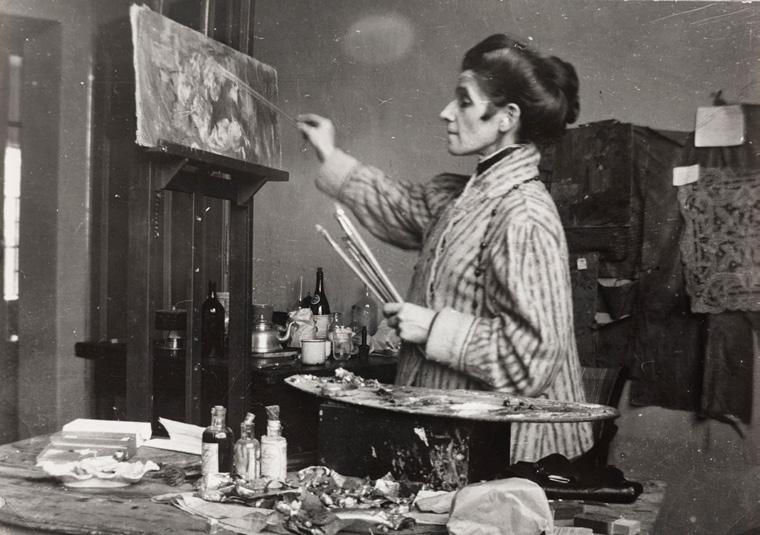
Lesser-known and rarely displayed works by Olga Boznańska, one of Poland’s most important painters, are on display at the Gallery of 19th-Century Art of the National Museum in Warsaw.
The exhibition was opened in late 2025, which marked the artist’s 160th anniversary of birth and 85th anniversary of death.
The museum has gathered thirty paintings and pastels in a specially arranged space. “The way they are presented – on grids stretched over metal frames – naturally evocative of art warehouses – highlights this special moment when hidden treasures come to light and can be enjoyed by the public,” said Agnieszka Lajus, the museum’s director.
The exhibition is dominated by Boznańska’s portaits and self-portaits juxtaposed with paintings that showed the artist through the eyes of her friends, including Wanda Chełmońska and Xawery Dunikowski.
“Among the portraits Boznańska painted are those of loved ones, friends, and even men with whom Boznańska shared close, yet platonic, bonds, those “amitié amoureuse,” as they were called,” said Renata Higersberger, the exhibition curator.
There are also portraits of children, and of people who simply commissioned works from the portrait studio the artist ran.
“Boznańska doesn’t paint the eyes, only the gaze, she doesn’t paint the mouth, but the smile or sob that distorts them, the spasm of cruelty, or the expression of a naive and sincere face. The painter possesses a wonderful gift for bringing out the spiritual, she can track down everywhere the anxious soul that hides, sensing it is being watched.,” wrote Max Goth in “Art et les Artistes” in 1913.
Boznańska is counted among the greatest woman artists in Europe. Born in Kraków to a Frenchwoman and a Pole,
she began her artistic education there in 1884, joining the Faculty of Arts of the Adrian Baraniecki Higher Courses for Women. The following year, she left for Munich, where she enrolled in Carl Kricheldorf’s private studio, also attending classes by Wilhelm Dürr. The active social life she led there concentrated around the studio of Polish painter Józef Brandt as well as those of German artists. By 1889, Boznańska had established her own atelier. In 1898, she became a member of the prestigious Society of Polish Artists “Sztuka”. Encouraged by these successes, she relocated to Paris in order to completely devote herself to the fine arts. At a time when women were not admitted to art schools, Boznańska honed the craft of painting to perfection, developed her owned style and made her mark on the exhibition circuit. While she gained widespread renown as a portrait
artist, she also enjoyed still life themes. Boznańska never painted en plein air as her entire life revolved around her studios. She spent her summers in Kraków, painting in her family home.
Boznańska’s ateliers have passed into legend. They hosted social gatherings of international guests and saw the creation of the characteristic, expressive psychological portraits which brought her worldwide fame. In Paris, the artist also pursued teaching: from 1908, she was an instructor at the private Académie de la Grande Chaumière, and gave painting revisions at her own studio. She exhibited her work regularly, participating in the Parisian Salon of the Société nationale des beaux-arts for 32 years. Three of Boznańska’s paintings that were purchased by the French government now belong to the collection of the Musée d’Orsay. OnviewthroughJuly52026.
Sounds carved in stone
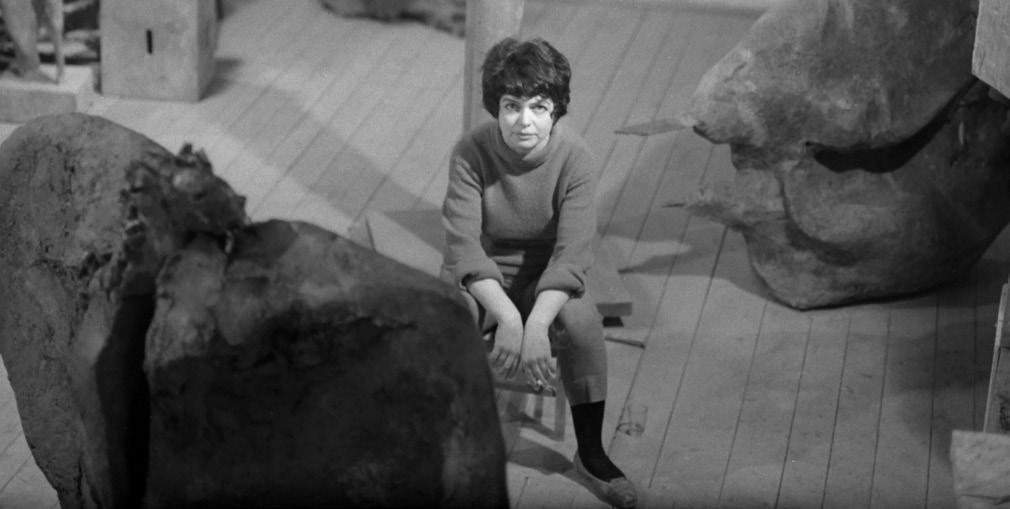
An exhibition entitled “The Voice(s)” Sculptures by Alina Szapocznikow, one of the most original 20th-century female sculptors, can be viewed at the Polin Museum of the History of Polish Jews in Warsaw.
In her work, Szapocznikow combined the experience of the Holocaust, fragility of the body and courage to experiment. On display is a set of her two works, both original in form: “Vowel” and “Consonant.” These sister sculptures, dating from 1962, reunite after many years. “Vowel” will remain in Poland permanently, joining the Polin Museum collection.
In “Vowel,” a sandstone block was shaped to resemble the philological definition of a vowel – in the form of the letter V –with the crevice filled by the artist with a bronze cast. “Consonant,” sculpted in the same year, in the shape of the letter U, completes this dialogue between stone and metal, nature and culture.
“We hear and pronounce sounds, and Szapocznikow tried to record them in stone,” said Renata Piątkowska, the exhibition’s curator.
Both works reveal how Szapocznikow observed the mutability of matter, making use of the stone’s cracks and edges, and how, through this exploration, she forged her own unique sculptural language.
Szapocznikow, a Holocaust survivor, studied in Prague and Paris after the War. From the early 1950s, she developed her artistic career in Poland and in France. Her art draws from personal experiences as well as from the audacity to experiment. She consistently expanded her sculptural medium by introducing new materials and new working methods, creating moving, intimate works with a rare power of expression.
Recent years have seen a resurgence of interest in her work. Her solo retrospective exhibition, “Sculpture Undone 1955-1972,” was a resounding success at leading art centres: the Wiels Centre for Contemporary Art in Brussels, the Hammer Museum in Los Angeles, and MoMA in New York. In 2012, London’s Tate Modern dedicated a series of film screenings and lectures to the artist. In recent years, her works have been acquired by leading museum collections worldwide: MoMA in New York, the Centre Pompidou in Paris, and Tate Modern in London.
The exhibition at POLIN Museum’s Legacy Gallery is accompanied by a selection of films about the artist. It offers a space to reflect on art, body and memory – on life in the aftermath of the Holocaust and on form which is capable of carrying this experience.
OnviewthroughMarch9,2026.
Musical journey back to fascist Italy
Mussolini’s Angels”, a new musical play on the Nova Stage of Warsaw’s Roma Musical Theatre, tells the story of the Leschan sisters, three Hungarian-Dutch-Jewish women who formed the vocal Trio Lescano in the 1930s. They started a spectacular career in Italy in 1935 and continued it during the height of fascism, despite their Jewish roots.
This grotesque musical, directed by Łukasz Czuj, is also a story of the consequences of artists’ fraternisation with the
authorities. While their compatriots and neighbours disappeared, deported to Nazi concentration camps, the Leschan sisters entertained the Duce himself with their singing. They even decide to join the party. The artists recounting their story on stage, explore the motivations behind this decision. Initially, they fraternised with the authorities simply because they wanted to sing. Over time, they began to believe that Mussolini’s sympathy will keep them safe when their compatriots fell victim to repression. After the war, the sisters attempted to cre-
ate a legend about their arrest and persecution by the fascist authorities.
Set to the rhythm of jazz and swing, played by a live band, “Trio Lescano” is a story about the unbridled desire for fame. It’s also a moving family drama and an adventure-filled story in which the Lescan sisters encounter key figures from Italian history during this era.
The cast includes Katarzyna Zielińska, who is also a producer of the show, Ewa Prus, Barbara Kurdej-Szatan, Monika Dryl, Marcin Przybylski and Mariusz Ostrowski.

How we wish to be seen
The Royal Castle in Warsaw hosts the exhibition “ Let Them See Us! Image, Attire, Body” which explores how, through clothing and appearance, people have expressed their identity, status, and emotions for centuries.
It presents clothing not only as a decorative or aesthetic element, but, above all, as a language full of meaning, symbols, and social codes.
The exhibition features around 250 diverse objects from different eras, spanning the 16th century to the present day. Among them are valuable works on loan from national and international museums, including the Louvre in Paris, the Museum of Art History in Vienna, and the Old Masters Picture Gallery in Dresden, as well as from private collections.
The exhibits include paintings by Marcello Bacciarelli and Bartłomiej Strobel, sculptures and porcelain figurines, historical costumes, Yves Saint Laurent haute couture outfits, and Thierry Mugler’s rainbow suits.
The starting point for the exhibition’s narrative is the Royal Castle’s collection. In subsequent sections, it explores the figures of the ruler, knight, hunter, Diana, Flora, philosopher, oriental costume, and female attractiveness, revealing the wealth of meanings contained in clothing over the centuries. Art, craftsmanship, and fashion come together as equal voices in the story.
Among the works presented are artefacts of inestimable value to Polish history, such as Stanisław August’s coronation mantle (1764) and Zygmunt August’s youth armour (1533). These are displayed alongside masterpieces by Old Masters such as Antoon van Dyck, Louis-Michel van Loo, and Alexandre-François Desportes.
The exhibition also offers a significant representation of works by renowned Polish artists of the 19th and 20th centuries, as
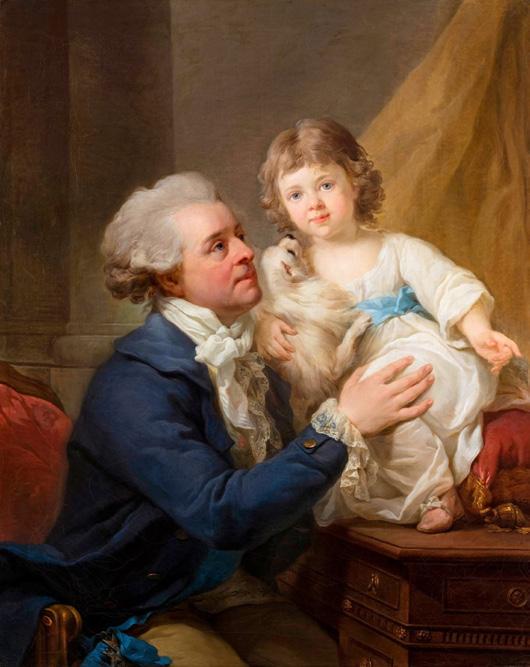
well as by contemporary young artists working in Poland. It provides a unique opportunity to see works by Zofia Kulik, Natalia LL (Natalia Lach-Lachowicz), Karol Radziszewski, Magdalena Abakanowicz, Edward Dwurnik, Agata Agatowska, Ewa Juszkiewicz, Teresa Pągowska, and Agnieszka Rożnowska all in one space.
The haute couture and prêt-à-porter creations and accessories by world-renowned designers and fashion houses from Adam Leja’s collection complement the exhibition’s narrative. The designs featured include those by Coco Chanel, Elsa Schiaparelli, Cristóbal Balenciaga, Christian Dior, Gianfranco Ferré, John Galliano, Alexander McQueen, Paco Rabanne, Daniel Roseberry, Yves Saint Laurent and Vivienne Westwood.
The exhibition also shows how individual motifs return after centuries, imbued with new, often diametrically opposed, meanings. One of them is the corset – once a tool of patriarchal oppression, today a symbol of female strength.
TheexhibitionwillbeopentovisitorsuntilFebruary8,2026.
When Art Meets New Technology
The Zachęta National Gallery of Art is showcasing an interactive installation by a recognised French artist Christelle Oyiri, also known as Crystallmess.
The project, titled “Ghost Rider,” is part of the “BMW Art Club. The Future is Art” programme, creating a framework for artistic experimentation where modern art meets technology and innovation.
Oyiri is a Paris-based visual artist, DJ, and music producer whose work has been featured in such prestigious institutions as the Tate Modern, Centre Pompidou, and Haus der Kunst. Her art combines electronic music, video, and futuristic sculpture, exploring the relationships between identity, technology, and collective memory.
The “Ghost Rider” installation is a continuation of works shown this summer at Tate Modern as part of the Infinities Commission series. The Warsaw instalment, curated by Michał Grzegorzek, is a performative experience combining sculpture, sound, video, and light. The project draws on DJing practices, digital aesthetics, and AI, and incorporates new technologies used to shape sculptural forms and compose music. In this multimedia installation, a techno-opera Oyiri evokes the pioneers of dance music, mostly Black artists from working-class backgrounds, whose experiments became the foundation of contemporary club culture. For the artist, they are like ghosts – simultaneously present and absent, spectres existing between the present and the past.
The project also incorporates a series of bronze sculptures, self-portraits in various stages of transformation, which the artist created in 2025 for the exhibition In a Perpetual Remix: Where Is My Own Song? at Tate Modern in London. The centrepiece of the

installation is a sculpture inspired by the form of a DJ console –an object created especially for the exhibition at Zachęta.
The venue for the project’s presentation is also significant –the Matejko Room, a historical and monumental space, filled with the “ghosts” of the institution’s history and the traditions of representation associated with its patron, a painter and creator of collective memory. “This creates a fascinating context for Oyiri’s intuition: instead of telling the story linearly, it allows it to disperse, vibrate, and reveal itself in sound and light. The Matejko Room thus becomes not only an exhibition space but also a medium,” said Grzegorzek.
The presence of viewers in the space is activated by light and sound, designed and implemented specifically for the installation. “Sensors installed throughout the exhibition space record visitors’ behaviour and transform them into sound impulses that influence the light choreography. Sound becomes a sculptural material, and its form – always open and shifting – is co-created by the audience,” Grzegorzek also said.
“It is the body, intertwined with technology, that acts as a transmitter of memory: visitors not only observe but also become active participants, reviving forgotten narratives. Voices, rhythms, and flashes of light emerge in response to their presence: walking, stopping, dancing,” he added.
Oyiri treats technology not as a tool, but as a medium of memory – a carrier of emotions, bodies, and communities. In this way, she constructs a reflection on how contemporary culture, immersed in digital rituals, can evoke and revive the past. Till February 1, 2026.
Silent,Unseen but Remembered
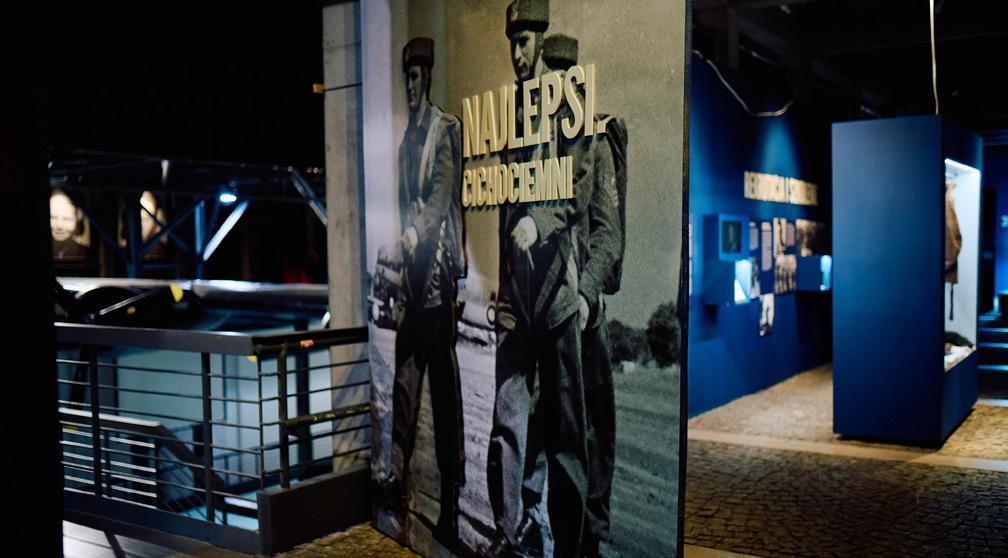
Anew exhibition at the Warsaw Rising Museum is dedicated to the “Cichociemni” (Silent and Unseen) paratroopers of the Poland’s underground Home Army and to the GROM Military Unit, which inherits their traditions and celebrates its 35th anniversary this year.
Cichociemni airborne troops were elite special forces trained to be dropped into occupied Poland from Great Britain during World War II.
The exhibition focuses on people’s fates, motivations, and the values that guide them, highlighting the elitism of their service .
“We tried to highlight what GROM and the Cichociemni have in common: professionalism, commitment, and dedication. We tried to bring the people to the forefront“, said Katarzyna Utracka from the Warsaw Rising Museum.
Visitors to the exhibition can listen to interviews with GROM soldiers, who talk about the gruelling recruitment process and extensive training, the dangerous life on missions, but also about friendship, brotherhood in arms, strength and honour, fear, and what the Cichociemni legacy means to them.
There are also training videos of both troops and the footage of the parachute jump of the Cichociemni veteran Aleksander Tarnawski “Upłaz,” with GROM soldiers, who was 94 years old at the time.
The exhibits include memorabilia of the Cichociemni, including training notes, equipment and fragments of a Halifax shot down over Norway, on which three commandos died en route to Poland.
On display are also items belonging to GROM soldiers, including weapons, uniforms, parachutes, complete diving, operator, and parachutist outfits. There are also memorabilia from their foreign missions in Haiti, the Balkans, the Persian Gulf, Afghanistan, Iraq, and Africa.
Animated maps of the transfer routes and landing sites of the Cichociemni in Poland, as well as training locations and GROM missions, complement the project.
Until June 30, 2026.
IF I WERE A LAWYER...
Lexus NX 350h Omotenashi
Story and photos by Bartosz Grzybiński
While browsing the internet recently, I came across an advertisement from a Lexus dealer for the NX model and a special offer for lawyers. Although I am not a lawyer, I decided to take a closer look at this model in a journalistic test.
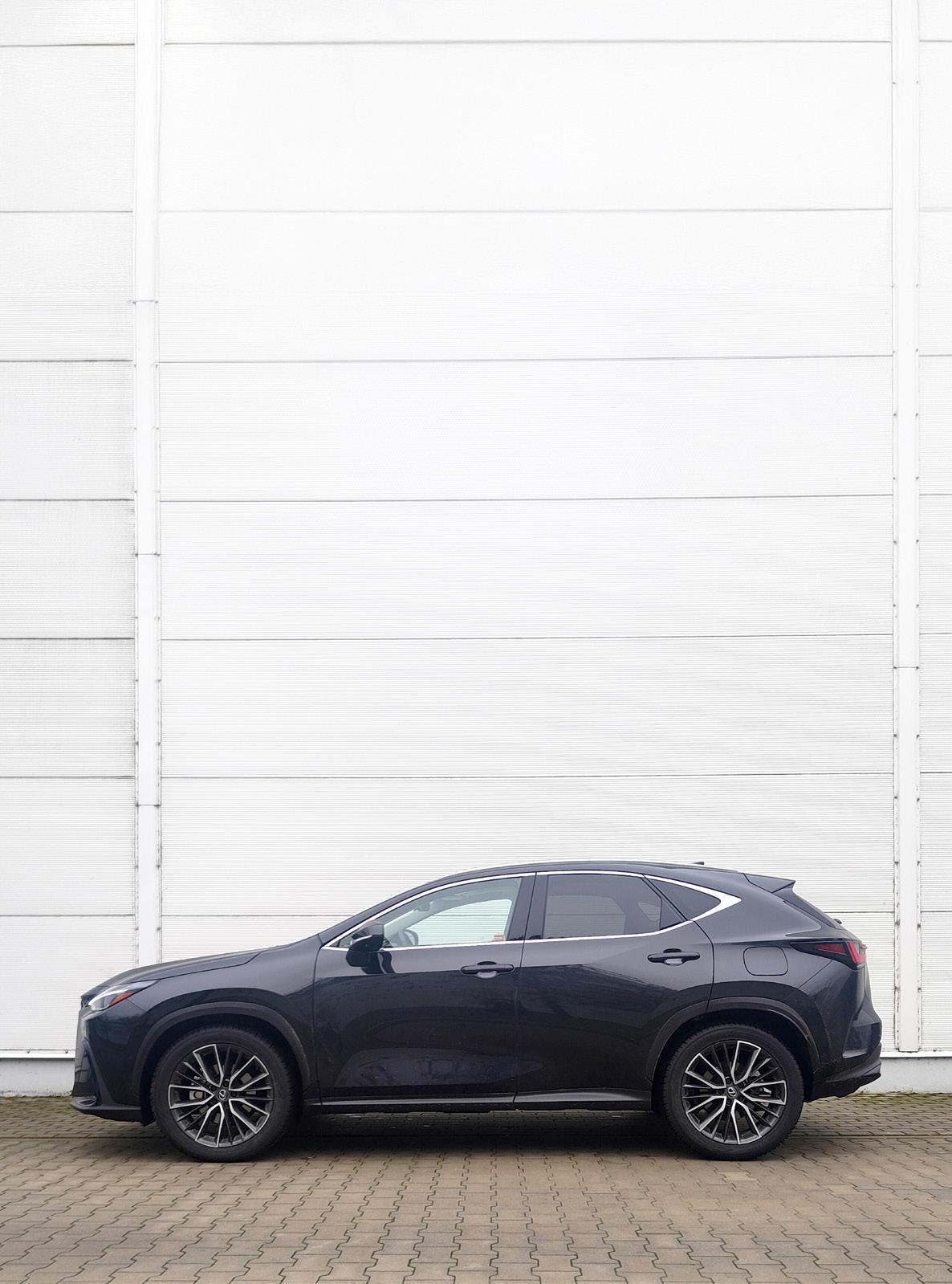
The NX is a mid-size (D) SUV that was launched in the spring of 2014. The second generation debuted in the summer of 2021, and the first units were delivered to customers at the beginning of the following year. On the Polish market, over two and a half thousand customers decided to purchase the car in a pre-sale system, ordering the new model “blind.” What was behind this success? Certainly, the good reputation of the previous generation, which was valued for its style, durability, high quality of workmanship, and advanced technological systems, but that’s not all, because the new generation offered much more.
The silhouette of the car, with a body length of 4.66 meters, is very dynamic. The front part features a large hourglass-shaped air intake to the radiator (grille). This is a characteristic and most recognizable stylistic element
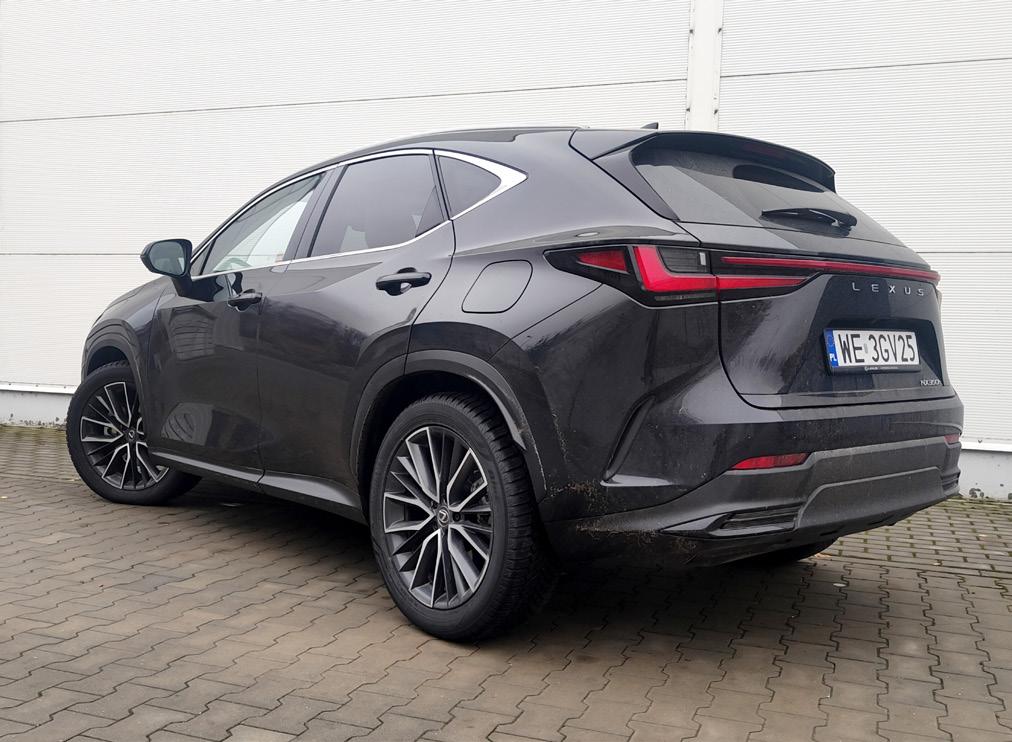
of the brand, as are the narrow and sharp LED headlights that extend deep into the fenders. The side line shows the compactness of the body. The blunt, almost vertical front and rear of the body contrasts with the sharp shapes of the headlights and the rear LED lights connected by a light strip. The rear of the NX looks particularly stunning at night. The slightly sloping roof and rising lower window line, emphasized by the chrome trim around the passenger compartment windows, add to the dynamic look. Even when stationary, this model, mounted on attractive 20inch aluminum wheels, looks as if it is in motion.
The passenger cabin is spacious and comfortably seats five adult passengers. They have a roomy 545-liter trunk
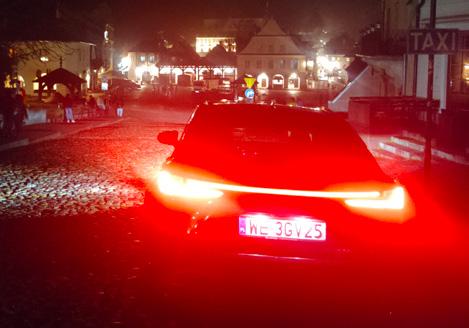
THE NX 350H MODEL USES A 2.5-LITER GASOLINE ENGINE WITH 190 HP AND TWO ELECTRIC MOTORS: ONE AT THE FRONT, ADDING TORQUE TO THE GASOLINE ENGINE, AND THE OTHER ON THE REAR AXLE
at their disposal (including the underfloor storage compartment). The interior of the Omotenashi, the most luxurious version presented here, has virtually all the features available on the market that affect the comfort and safety of passengers. Starting with natural leather upholstery, wood inlays, air conditioning with an air ionizer, heated and ventilated front seats and heated rear seats, a Mark Levinson audio system with 17 speakers, through all driver assistance safety systems such as lane assist, active cruise control, collision protection system with vehicle stop function, obstacle and pedestrian detection, and autonomous parking system with parking space memory function, not to mention the digital rearview mirror that shows what
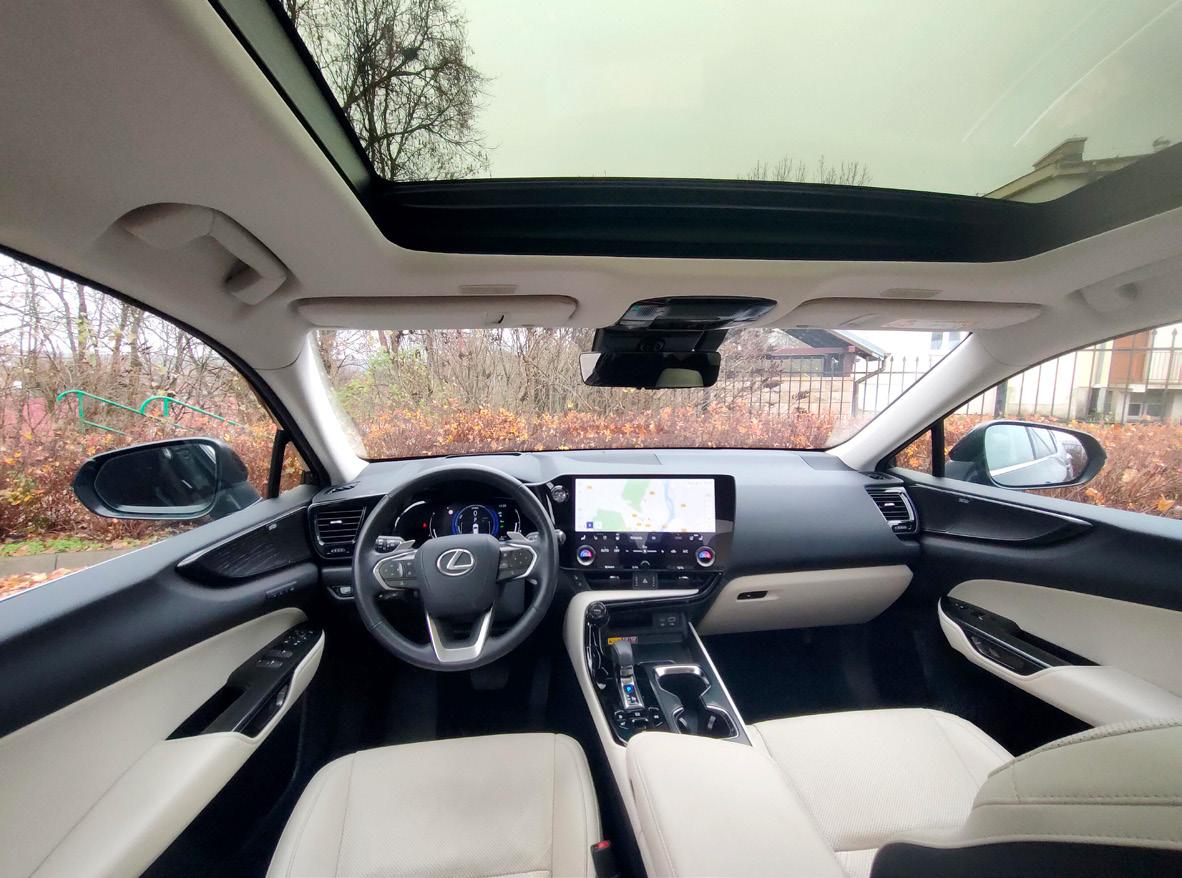
is happening behind the vehicle, a rearview camera with a 360-degree view around the car, parking sensors (also in transverse movement, i.e., when we are leaving a parking space without seeing other vehicles on the street, the sensors react to the movement of another vehicle and stop the car if necessary)
The dashboard is clear, and all indicators and switches are ergonomically arranged. Visibility from the driver’s seat is good. The heated and ventilated driver’s seat has multi-plane adjustment, but in my opinion, the seat is too short. The multifunctional, leather, heated steering wheel fits well in the hands. Below the steering wheel rim are paddles for manual gear shifting. In front of the driver is a 7-inch virtual cockpit and a head-up display showing selected data on the windshield. In the center of the dashboard is a large 14-inch touchscreen display that controls the on-board computer, audio, navigation, and air conditioning. The center console features a round knob for selecting the driving mode (Sport, Normal, Eco) and, below it, the gear lever for the automatic, continuously variable E-CVT transmission and the EV electric mode button.
Toyota, which owns the Lexus brand, is a pioneer and world leader in the use of hybrid drive systems, in which a combustion engine and an electric motor work together. The NX 350h model uses a 2.5-liter gasoline engine with 190 hp and two electric motors: one at the front, adding torque to the gasoline engine, and the other on the rear axle. The rear electric motor is designed to drive the rear axle. The computer-controlled E-FOUR intelligent all-wheel drive
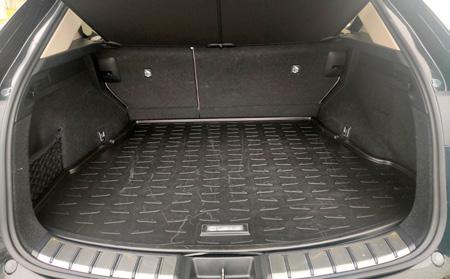
system can transfer up to 80 percent of the power to the rear axle as needed. The total power of the hybrid system is 239 hp. It provides acceleration to 100 km/h in 7.7 seconds and a top speed of 200 km/h (in electric mode, you can travel at speeds of up to 125 km/h). According to the manufacturer’s data, the average fuel consumption is 5.9 l/100 km. During test drives, it was almost two liters higher.
APART FROM THE NOT VERY COMFORTABLE DRIVING POSITION CAUSED BY THE SEAT BEING TOO SHORT AND POOR LATERAL SUPPORT, I WAS UNFORTUNATELY NOT CONVINCED BY THE E-CVT
AUTOMATIC TRANSMISSION
Undoubtedly, this is one of the most attractive SUVs available in the mid-range segment. For years, it has been successfully competing with European and other Far Eastern brands not only with its attractive styling, but also with its build quality, modern technical solutions, and very rich equipment. As for the driving experience, apart from the not very comfortable driving position caused by the seat being too short and poor lateral support, I was unfortunately not convinced by the E-CVT automatic transmission. I understand the manufacturer’s reasoning behind offering smooth operation, lower fuel consumption, low noise, and driving comfort (especially in urban conditions), but in practice, regardless of the driving mode, you have to be very careful when operating the accelerator pedal or paddles, because any more dynamic acceleration causes not only unpleasant noise, but also not very dynamic acceleration. The price of the car may also be a disadvantage for many. Even the basic version costs over PLN 200,000, and the model presented here, in the most luxurious Omotenashi version with a panoramic roof, costs almost PLN 356,000. Fortunately for some customers, such as lawyers, the car can be purchased as part of a special offer. In addition to a comfortable, ultra-modern and luxuriously equipped car, they will receive the prestige associated with owning this brand.
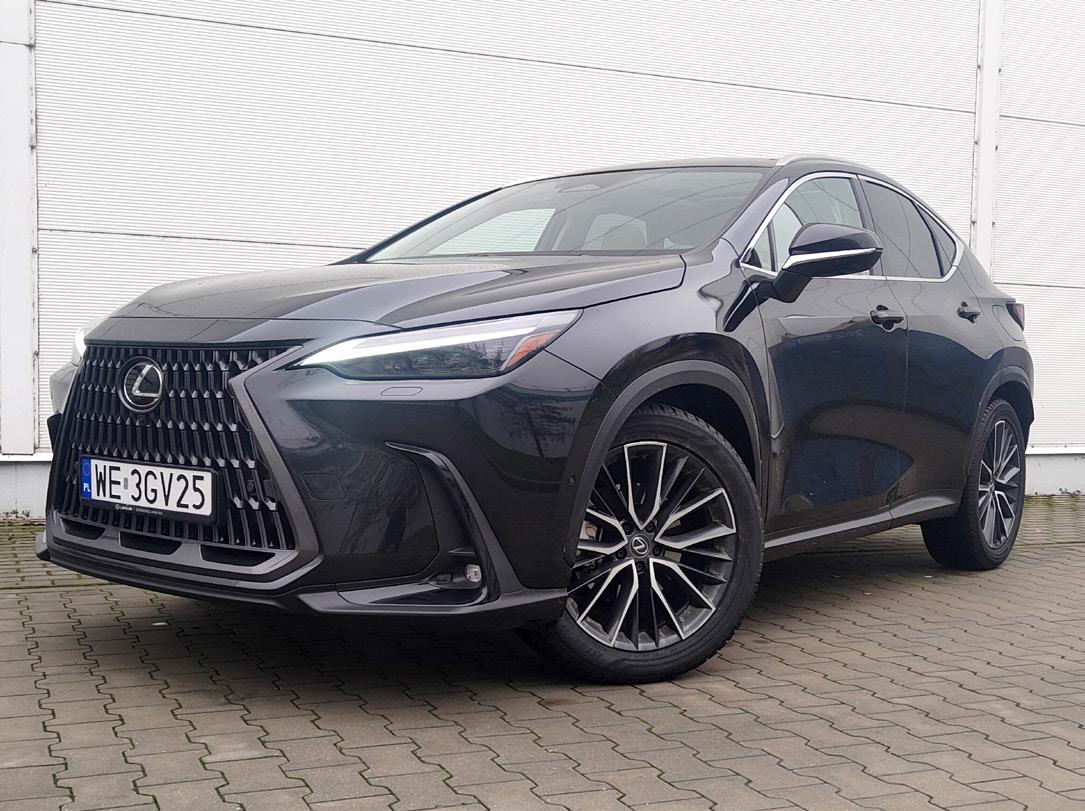
A MILESTONE IN THE PRODUCTION OF VANS OF THE FUTURE

The Mercedes-Benz factory in Jawor is entering another key stage of its transformation. Eleven months after the groundbreaking ceremony, the production halls of the new commercial vehicle factory are now in their raw state. The moment was celebrated with a traditional topping-out ceremony attended by representatives of Mercedes-Benz AG, the Ministry of Finance and Economy, the German ambassador, local authorities, business partners, and the Mercedes-Benz Manufacturing Poland team.
The factory being built in Jawor will become one of the most modern plants in the global Mercedes-Benz Vans network. All newly developed vehicles will be based on the Mer-
cedes-Benz Van Architecture, which allows for a clear distinction between private vans (MPVs) and commercial delivery vehicles.
“Poland particularly appreciates foreign investments that strengthen our economic ecosystem with highly advanced technologies. They generate approximately 4% of Poland’s GDP annually. Mercedes’ latest investment in our country is very good news, proving that Poland is a strategic investment location for the largest car manufacturers, among others. A factory for the latest generation of delivery vehicles is being built in Jawor, opening up new business opportunities for partners and cooperation between Mercedes and universities and voca-
tional schools. Poland is one of the European leaders in attracting investment in the area of innovative industry, which is extremely valuable in an era of impending deindustrialization in Europe,” said Andrzej Domański, Minister of Finance and Economy.
Mercedes-Benz Cars has been producing combustion engines in Jawor since 2019 and batteries since 2020. The plant will be gradually transformed and significantly expanded to meet the production requirements of future light commercial vehicles. Mercedes-Benz Cars and Vans are maximizing the synergies resulting from the continuation and transformation of the existing infrastructure and the high level of competence of the team. This allows for the effective use of the experience and resources of Mercedes-Benz Manufacturing Poland.
The factory already sets the standards for modern production. The planned expansion will raise this level even higher. The plant will continue to operate in a carbon-neutral manner and will generate some of its own electricity. The new halls – the body shop and paint shop –will be equipped with state-of-the-art technologies with a high degree of automation and efficiency.
The new equipment and processes will comply with the latest Mercedes-Benz production system standards and Industry 4.0 principles.
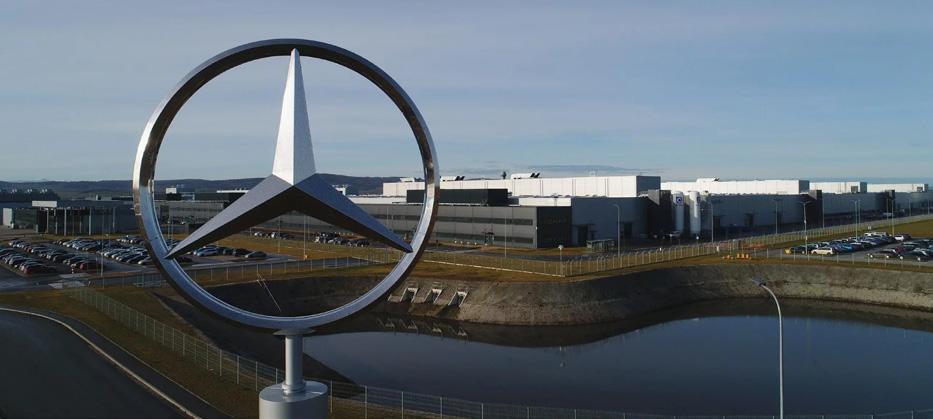
FULL BODYWORK SUCCESS
Renault has been the undisputed leader in the modified vehicle market in Poland for 16 years. Renault’s success is based on a universal offer, dedicated solutions for every industry, cooperation with 24 certified bodywork contractors, and a comprehensive Pro+ sales and service network.
Renault offers a wide range of factory-built vehicles and custom-built vehicles, which are developed by Renault’s engineering department and its certified partners while maintaining a high level of quality and reliability.
The offer includes, among others, bodies for the transport of goods: containers, isotherms, refrigerated bodies, boxes, tippers, parcel transport, passenger transport: up to 16 passengers, with the option of adaptation for the transport of people with disabilities, VIP transport, mobile services such as food trucks, shop vehicles, bodies for construction and technology: chassis for tippers, crew bodies, specialized transport: transport of horses, construction equipment, tools, or specialized vehicles: such as medical services,
medical transport, emergency vehicles, and others.
In Poland, Renault works with 24 certified bodywork companies, ensuring territorial coverage. To complement its range of bodywork, Renault also offers the Renault Pro+ label and certifies the best bodywork contractors in Europe, ensuring that they meet Renault’s quality standards.
Whether you need a construction, refrigerated, or cargo vehicle, Renault Pro+ centers can help you find the right vehicle and bodywork.
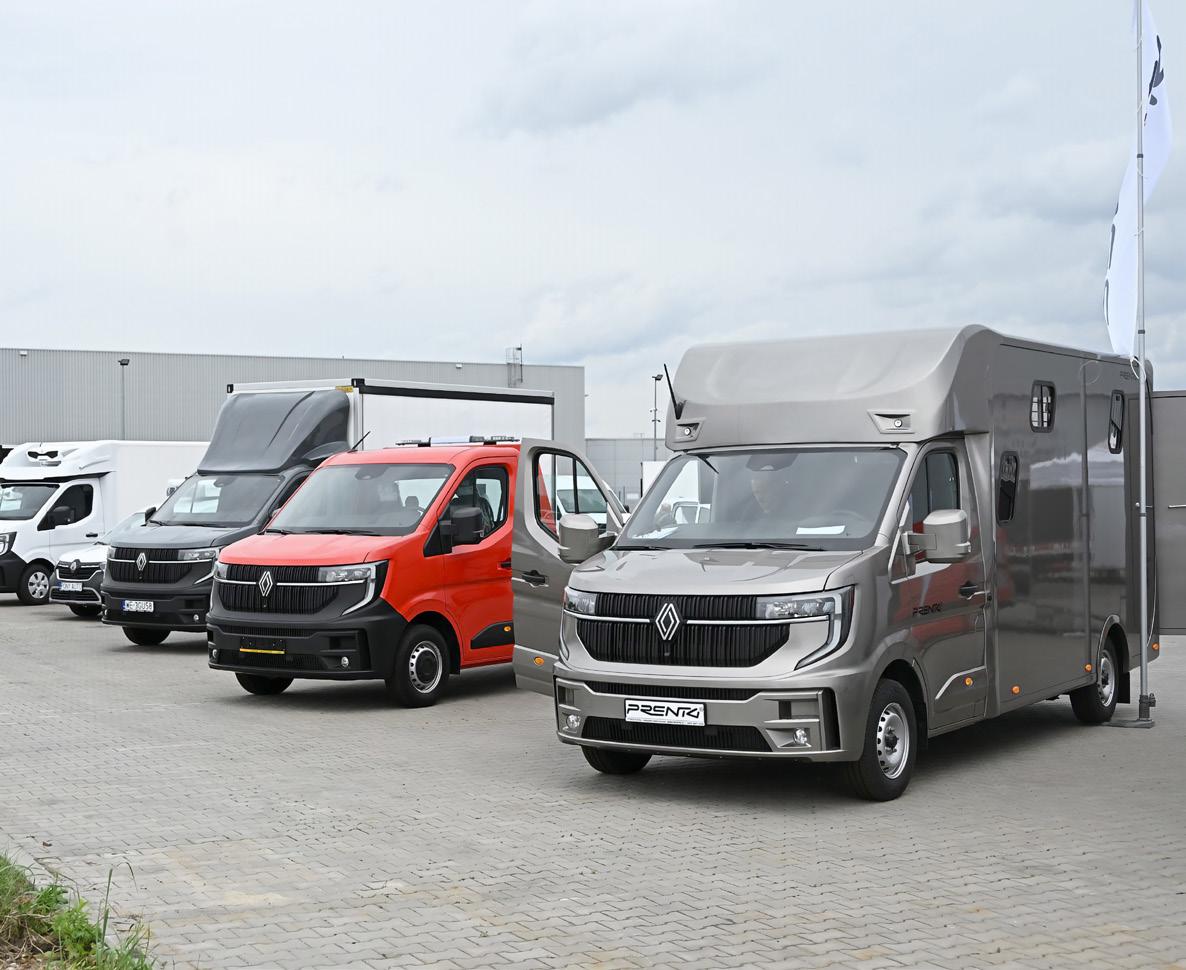
SAFETY ALL YEAR ROUND
The Continental AllSeasonContact 2 proves that all-season technology can combine the best features of summer and winter tires.
The AllSeasonContact 2 features a number of innovative solutions. The new tread compound guarantees shorter braking distances, which directly translates into road safety. The optimized tread pattern provides better grip in rain and snow, while reduced rolling resistance helps drivers save fuel and reduce CO₂ emissions. Thanks to these solutions, the AllSeasonContact 2 is a fully-fledged alternative for drivers who want to feel confident in all conditions.
Continental does not stop at technical innovations. The brand cares not only about road safety, but also about the comfort of decision-making. That is why it has introduced the “Continental Return” program, under which drivers can return purchased tires within 30 days – without giving a reason. If, after purchase, the tires do not meet expectations, simply fill out the online form and a Continental representative will pick up the tires on the agreed date. Importantly, the tires must be clean, undamaged, and have a tread depth of at least 6.5 mm. The promotion is valid throughout 2025 and covers the AllSeasonContact and
AllSeasonContact 2 models.
Continental Opony Polka offers a 7-year warranty from the date of purchase on tires for passenger cars and delivery vehicles. The extended warranty also covers passenger car tires from the Continental group, including Uniroyal, Barum, Semperit, and Viking.
Continental is a leading tire manufacturer and industry specialist. The company was founded in 1871 and achieved sales of EUR 39.7 billion in 2024. It currently employs approximately 95,000 people in 54 countries and has 20 production facilities and 16 development centers.
CHANGES IN THE MANAGEMENT STRUCTURE OF PORSCHE POLSKA
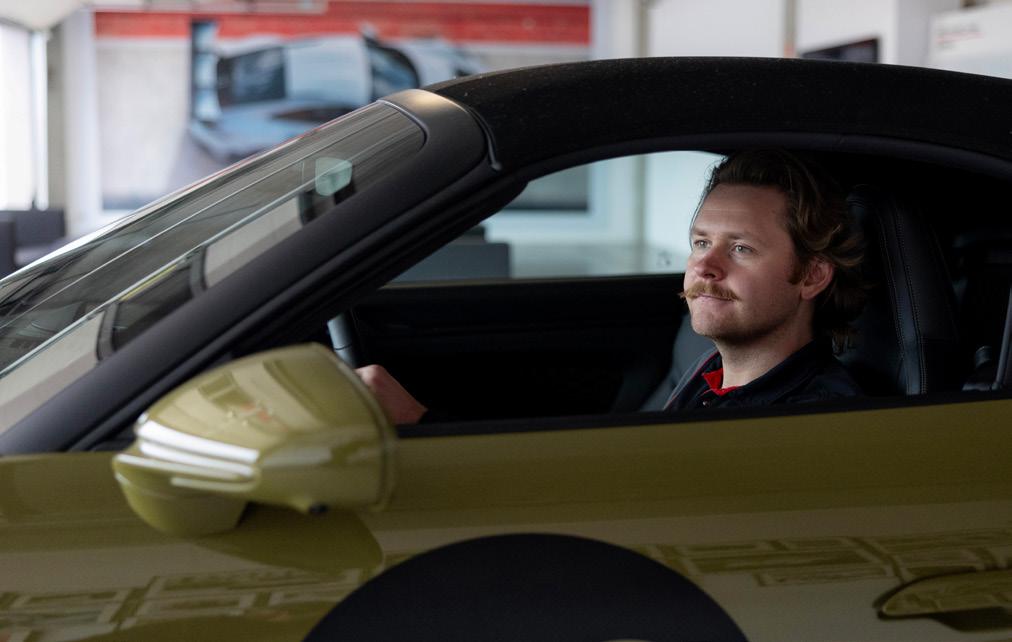
Porsche Polska Ltd. announces significant personnel changes in its management structure. Paweł Mazurek has taken on the position of Porsche Approved Manager, assuming responsibility for the strategic area of the Porsche certified used car program in Poland.
Mazurek, who previously served as communications and events manager in the marketing department at Porsche Polska, brings many years of experience in product, PR, and communications to his new role.
He has been working at Porsche Polska for nine years, during which time he was responsible for some of the brand’s most spectacular events, such as Porsche Experience, Porsche Parade, Cold waves by Porsche, Luftgekühlt, and Air|Water. His in-depth knowledge of the Porsche brand, resulting from many years of work in the organization, and his ability to build long-term business relationships provide a solid foundation for
the development of the Porsche Approved program in Poland.
The Porsche Approved program is a key element of the brand’s strategy in the used car segment. Each vehicle covered by the program undergoes a rigorous 111-point inspection carried out by certified Porsche technicians. Only original Porsche parts
are used in the preparation process, and buyers receive a minimum 12-month warranty and access to the Porsche Assistance program, which provides comprehensive 24/7 roadside assistance.
Mazurek’s appointment is part of a broader organizational transformation at Porsche in Poland. Since January 1, the brand has been operating as an independent subsidiary of Porsche AG, based in the prestigious VIBE office building in Warsaw at 7 Towarowa Street. Under the leadership of CEO Wojciech Grzegorski, Porsche Polska is consistently strengthening its position in the dynamically developing Polish premium market.
There are currently ten Porsche Centers and a Porsche Store in the center of Warsaw, offering a full range of sales and service options. The growth plan is to keep growing the dealer network and bring in new sales formats that meet changing customer needs.
Paweł Mazurek
G REAT
Compiled by Bartosz Grzybiński




1/ ZTE G5 Ultra
The ZTE G5 Ultra is a flagship 5G router that sets the highest standards for speed, stability, and versatility in wireless data transmission. It provides ultra-efficient Internet where other devices fail. It is the perfect solution for professionals, families, gamers, and anyone who values quality, stability, and lightning-fast access to the online world. The router offers speeds of up to 4.29 Gbps in 5G and support for triband Wi-Fi 7 with transmission speeds of up to 19 Gbps. Thanks to the proprietary ZTE Antenna AI system and powerful
antenna gain of up to 13 dBi, the device provides up to 25% faster transfer speeds in areas with weak signals. The router is equipped with 2.5G ports, TS-9 connectors, hybrid bonding of two Internet sources, and compatibility with the Easy Mesh system. Everything can be easily managed from the Smart Life app or connected via NFC, without entering passwords. www.zteshop.pl
2/ Mio MiVue 903W Pro
Mio MiVue 903W Pro is an advanced video recorder for drivers who expect the
highest quality recordings and reliable vehicle protection. The camera records in 2.5K QHD (1440P) resolution using Sony STARVIS 2 and Mio Night Vision Ultra technology, ensuring exceptional image clarity both day and night. The built-in parking mode power supply works without additional modules, is activated directly from the menu, and protects the vehicle’s battery while allowing you to record events while parked. The device also offers a GPS and Wi-Fi module, allowing you to save route and speed data and quickly transfer recordings to your smartphone.
GEAR
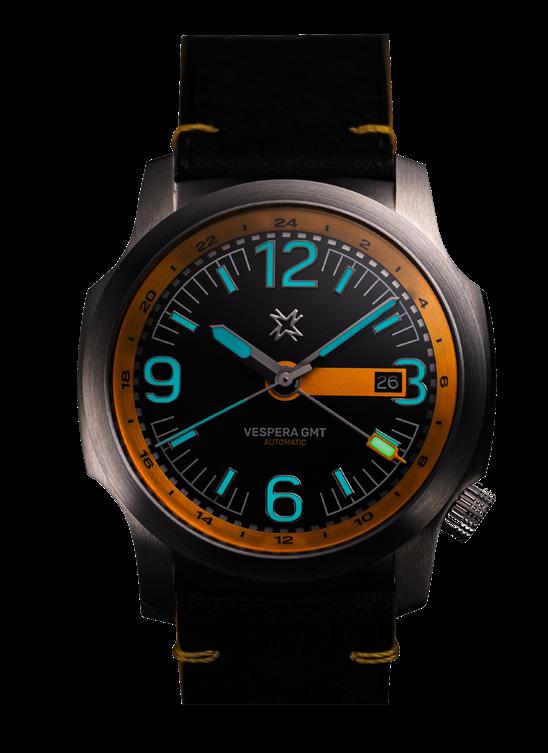
The SuperMP4 format guarantees easy reading and archiving of materials.
The MiVue 903W Pro has the same specifications as the dual version (903WD Pro), but does not include a rear camera in the set. The camera is covered by a 3-year manufacturer’s warranty. www.mio.com/pl_pl
3/ Nadir Vespera GMT
A watch from the young Polish brand Nadir - the Vespera GMT model is ready for any adventure. It will be the perfect companion whether you are exploring


mountain trails, navigating city streets, or wandering far beyond the map. The black dial with eye-catching yellow and orange elements and luminescent hands and hour markers is eye-catching, offering excellent readability and a unique look that combines sporty style and classic order. The GMT function allows you to control the time display both at your current location and at your home base. Available in several color versions, Nadir Vespera GMT watches are individually numbered, with 50 pieces of each variant. The watch has a hand-made Italian leather strap with
yellow-orange stitching that matches the colors of the watch face.
www.odczasudoczasu.pl
4/ Nubia Air
Nubia Air is an ultra-slim smartphone with a 6.78-inch 1.5K AMOLED display, a powerful 5000 mAh battery, a reinforced design with IP68, IP69, and IP69K certifications, and a 3-year warranty. This device combines a lightweight and slim form with impressive durability and a large battery.
www.zteshop.pl
NEW ARMS FACTORIES
WORTH OVER PLN 200 MILLION
Norwegian company Kongsberg wants to invest in industrial plants in Pomerania. This is to be part of the “Green Industrial District of Kashubia” project and herald Poland’s return to the Baltic Sea.
The plan is to potentially establish the production of medium-caliber turrets (MCT-30) and the integration of anti-drone systems, as well as the production of unmanned maritime vehicles. These capabilities are to be created in one or two plants, which will be located in the vicinity of Słupsk or the Tri-City. Their initial value is at least PLN 200 million, and ultimately, in subsequent stages, it is expected to reach as much as PLN 1 billion.
MCT-30 turrets can be installed on vehicles and used, among other things, to combat flying unmanned aerial vehicles. Kongsberg will most likely be one of the main suppliers of the anti-drone system, which is to be purchased in the near future by the Ministry of National Defense and the Armament Agency. After more than 20 Russian unmanned aerial vehicles invaded Polish airspace in September, the ministry began urgently searching for solutions.
The second important area of planned investments is Seawolf maritime drones. This is related to cooperation with partners from Ukraine and the possibility of Kongsberg obtaining special funding from Norway, which

is earmarked specifically for cooperation with Ukraine.
The Green Industrial District “Kashubia” is to be based on the maritime, defense, and energy industries in the Baltic Sea, which is to provide access to cheap energy from wind farms and, later, also from a nuclear power plant. “Kashubia” is the first of four industrial districts building a new strategic resilience system for Poland. Investors from the United States, among others, are already declaring their interest in energy, infrastructure, and military projects in this region,” announced Maciej Samsonowicz, advisor to Defense Minister Władysław Kosiniak-Kamysz.
The other three districts are “Vistula,” “Warta,” and “Galicia.” According to the concept developed by the Ministry of Defense, they are to form the economic and military backbone of Poland by 2035. “Vistula” is to be based, among other things, on systemic energy, chemicals, fertilizers, and logistics, “Warta” on nuclear energy and hydrogen technologies, and “Galicia” on the aviation industry.
In recent months, there has been a wave of investment in Polish arms factories. The Ministry of State Assets will subsidize the Polish Armaments Group (PGZ) with PLN 2.4 billion to build the capacity to produce 155 mm artillery ammunition. It will purchase the license from the British company BAE Systems. Bumar-Łabędy will receive approximately PLN 850 million to create the capacity to assemble and service South Korean K2 tanks; Hyundai Rotem is the foreign partner.
As part of the PGZ Narew consortium, agreements for co-financing in the amount of nearly PLN 3 billion have been signed. The main beneficiaries will also be PGZ companies, and the main partner will be the British company MBDA. In total, agreements for co-financing the state-owned arms industry are worth over PLN 6 billion.
The private WB Group, together with Hanwha Aerospace, want to use their own funds to jointly build a factory in Poland for the production of missiles for the K239 Chunmoo systems.
ELECTROMOBILITY POLAND RETURNS TO THE GAME
Electromobility Poland may receive PLN 4.5 billion from the National Reconstruction Plan (KPO) for an electro-mobility production and development hub.
Electromobility Poland was supposed to build a factory for Polish electric cars. After the failure of the Izera project, the company, which had been brought back from economic oblivion, found itself – alongside PowerUp Hydro Tech, which is to build a hydrogen generator factory – on the shortlist in a government competition as part of a support instrument for the low-carbon economy. The program supports industrial projects in two sectors: clean mobility and energy.
For the company, this is an opportunity to re-enter the electro-mobility market. EMP plans to implement a production and development hub that will rebuild the Polish automotive sector. The plans include the construction of a car factory, a research and development center, and the creation of a European automotive brand with its headquarters in Poland.
The new strategy involves the construction of a plant in Jaworzno, which in the first stage will enable the production of 150,000 cars per year, with the possibility of further expansion. EMP would like to build a strong brand recognizable on European markets, while maintaining its decision-making center and research and development facilities in the country. In addition, there will be investments in innovation and technology transfer to ensure the competitiveness of the Polish automotive industry on the global market, as well as the development of the electro-mobility ecosys-
tem by supporting domestic suppliers and building a value chain.
The new EMP project would be implemented as a joint venture, with one of the Asian automotive groups as a partner. In the case of the Izera project, cooperation with Geely, the owner of the Volvo brand, among others, was considered.
When initiating the Izera project, Mateusz Morawiecki, former prime minister in the Law and Justice (PiS) government, announced that there would be one million electric cars on Polish roads by 2025. Currently, there are just over 100,000.

CHOPIN AIRPORT AT THE LIMITS OF ITS CAPACITY
October was a record month for Warsaw Chopin Airport, with 2,176,531 passengers checked in.
For the first time in history, over 2 million passengers were checked in. The increase compared to last year was also high, at 14.7%. In total, 20,495,463 passengers were checked in during the first ten months.
The record day was Sunday, October 5. On that day, 79,867 people used the airport. The number of passenger operations was 16,704, and the number of all operations was 17,919.
“Today, we are strengthening connections from Warsaw, and we will transfer this model to the Central Transportation Port (CPK) on a larger scale. Our direction is long-term: a modern, resilient,
and passenger-friendly aviation system that sets the pace for development instead of just following it,” Marcin Danił, member of the management board of PPL S.A. for finance and trade, told the newspaper Życie Warszawy.
During the first ten months, 13,416,153 people traveled within the Schengen area. Non-Schengen destinations were chosen by 7,079,310 travelers. Currently, the maximum capacity of Chopin Airport is approximately 24 million passengers per year, which means that if October’s statistics are maintained, it will reach its maximum capacity by the end of the year.
The percentage of transit passengers in October was 23.5%. Between January and October this year, the market
share of traditional carriers fell by one percentage point to 59%. The share of charter carriers also fell by one percentage point. In contrast, low-cost carriers recorded an increase (compared to the same period in 2024) to 26%. In traditional traffic, passengers most often flew to London, Paris, Amsterdam, Brussels, and Copenhagen. In charter traffic, the most popular destinations were Antalya, Marsa Alam, Hurghada, Sharm el Sheikh, and Rhodes.
Cargo tonnage exceeded 12,000 for the third time this year, reaching 12,224 tons. Total cargo tonnage since the beginning of the year is 111,900 tons. The main carriers are LOT Polish Airlines (belly cargo), Qatar Airways (belly cargo and all cargo), and DHL (all cargo).
Investments in 9.9 GW of offshore wind energy could translate into PLN 15.5 billion in budget revenues and PLN 54.3 billion in added value for the Polish economy, according to estimates by the Polish Wind Energy Association.
On December 17, the first auction will be held as part of the second phase of support for offshore wind energy. The auction will select projects with a total capacity of 4 GW, which will receive support in the form of a contract for difference (CfD). This means that if the market price of energy falls below the level auctioned in the future, the state will pay the investor the difference. If the price of electricity is higher, the investor will return the surplus. The cheapest bids will win the auction. However, they cannot exceed the maximum prices specified in the regulation of the Minister of Climate and Environment – depending on the location, this will be from PLN 485.71 per MWh to PLN 512.32 per MWh. The December auction will be the first of four planned as part of the second phase of support – the next ones are scheduled for 2027 (also for 4 GW) and 2029 and 2031 (2 GW each).
For the auction to be successful, at least three projects must partici-
AUCTION FOR OFFSHORE WIND ENERGY IN A MONTH
pate. On November 18, Orlen Neptun announced that the Baltic East project had obtained an environmental decision for an offshore wind farm, which “brings the investment closer to participating in the first Polish offshore wind auction.” At the beginning of November, Polish Energy Group (PGE) announced that it had obtained an environmental decision for the Baltica 1 project. Polenergia was the first to obtain a decision for the Baltic 1 project in the spring, and in June it submitted an application for pre-qualification to participate in the auction.
“I believe that the December auction in Poland will break the deadlock in the European energy sector regarding investments in offshore wind farms and give a boost to this sector across Europe. I believe that this auction will be a huge success, we will attract new investments and we will implement new investment projects at a good price for Polish taxpayers and the Polish economy,” said Minister of Climate and Environment Paulina Hennig-Kloska during the Offshore Wind Poland 2025 conference.
Janusz Gajowiecki, president of the Polish Wind Energy Association, argued that the value of investments
in 9.9 GW offshore (i.e., 5.9 GW being developed as part of the so-called first phase of support projects and 4 GW selected during the December auction) will amount to PLN 260 billion. For 18 GW (i.e., the government’s plans for offshore by 2040), it will be PLN 474 billion, and for 33 GW (i.e., according to the PSEW, the potential of the Polish part of the Baltic Sea) – PLN 869 billion. The added value for the economy is expected to amount to PLN 54.3 billion for projects with a capacity of 9.9 GW, PLN 123 billion for 18 GW, and PLN 284 billion for 33 GW. The scale of revenue generated for the budget in taxes and fees is expected to amount to PLN 15.5 billion for the first 9.9 GW, PLN 29.1 billion for 18 GW, and PLN 55.3 billion for 33 GW. In recent weeks, discussions about offshore investments have usually been accompanied by the topic of their impact on Polish industry in terms of so-called local content. The share of Polish companies will be approximately 15-20% for the first 9.9 GW, 20-40% for 18 GW, and over 40% for 33 GW. According to the sectoral agreement, the so-called second phase offshore projects should have a Polish supply chain share of at least 45%.
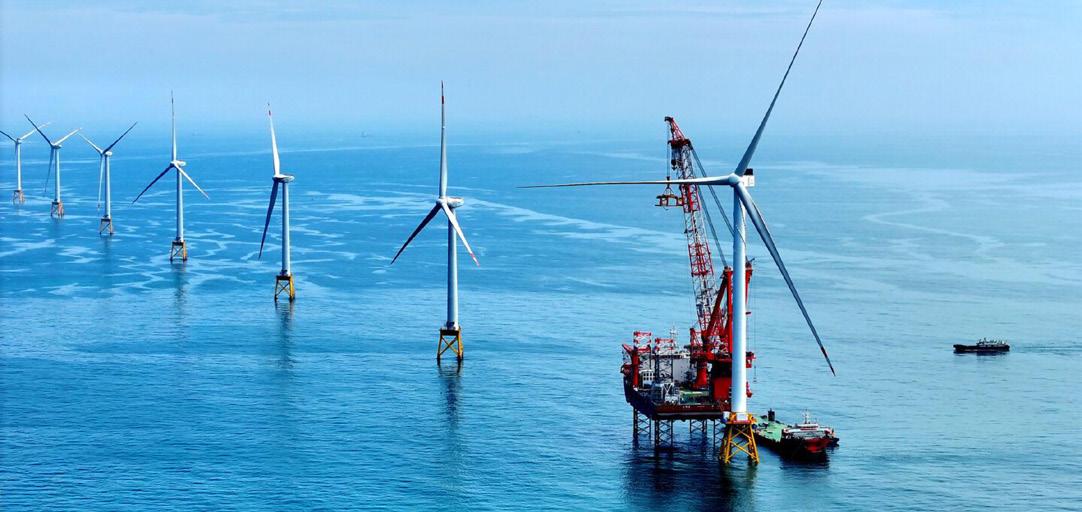
KOREAN GIANT OPENS FACTORY IN BRZEG
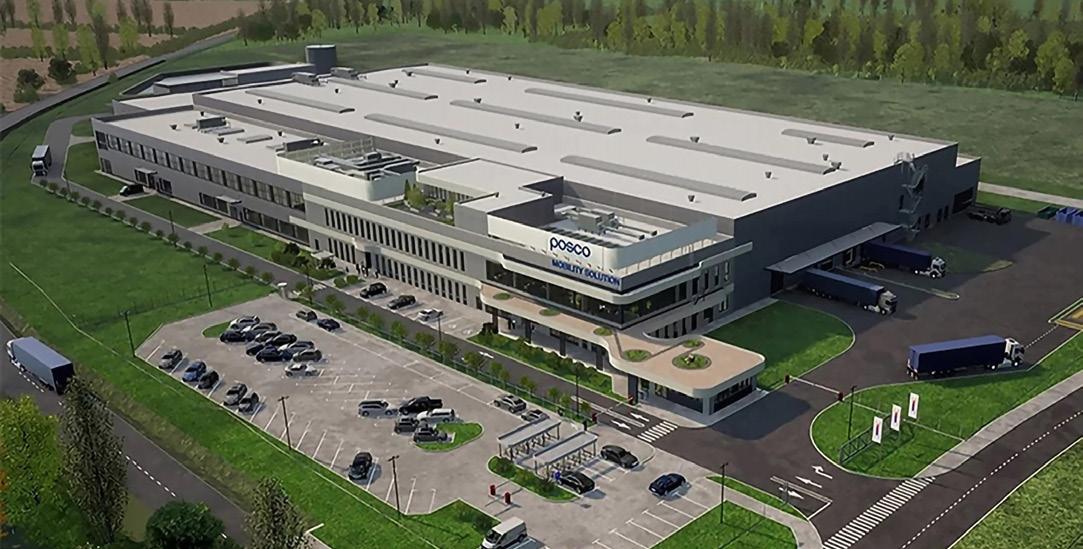
Poland is strengthening its position as one of the key players in the European supply chain for the electro-mobility industry. This is confirmed by the opening of a factory by South Korean company POSCO International, which specializes in the production of cores for electric motors.
The plant in Brzeg (Opole Province) is not only an investment worth nearly EUR 57 million, but also a signal that Poland has become a strategic point on the map of Europe’s automotive transformation. POSCO International, part of one of South Korea’s largest industrial groups, is implementing a plan to build a global production network covering Asia, North America, and Europe. The goal is to achieve a total production capacity of 7.5 million electric motor cores per year by 2030. After factories in Korea, India, and Mexico, Brzeg has become the European link in this network. The choice of Poland was not accidental. The company points to competitive operating costs, access to skilled technical staff, and a central location in the heart of the European Union. Poland, which already attracts the largest
Asian investments in the battery and EV components industry, offers a stable economic environment and developed industrial infrastructure.
Construction of the POSCO International Poland E-Mobility factory in Brzeg began in July 2024; and the facility was officially opened on October 1, 2025. The general contractor was Dekpol Budownictwo, which completed the complex with an area of over 25,000 sq. m. in 13 months. The plant was built on a 10-hectare plot in the Wałbrzych Special Economic Zone “Invest-Park.”
The interior was equipped with 13 overhead cranes with a lifting capacity of up to 25 tons, foundations for heavy machinery, and temperature- and humidity-controlled rooms. The first production lines are scheduled to start up in 2025, with full-scale production beginning in January 2026.
The initial production capacity of the factory is 260,000 cores per year, but by the end of the decade it is expected to increase to over 1.2 million units. This means that the plant in Brzeg will account for approximately 16% of POSCO’s global production. Employment will increase from an
initial 60 to nearly 200 people in 2030. Production is secured by contracts for years to come - POSCO already has orders for 35 million cores until 2033. The main customer will be Hyundai Motor Group (Hyundai and Kia), for which components for the new Kia EV4 and Hyundai Ioniq 3 electric models will be produced.
The cores produced in Brzeg will go directly to Hyundai and Kia’s European plants, eliminating the need to import them from Asia. This solution brings not only environmental but also economic benefits: shorter delivery times, greater logistical flexibility, and better quality control are key factors for electric car manufacturers in Europe. The new factory in Brzeg uses the proprietary EMFree technology developed by the POSCO Group. It involves bonding thin layers of electrical steel sheets instead of welding or stamping them, which reduces energy loss and noise in the electric motor. Combined with POSCO’s Hyper NO (non-oriented electrical steel) material, EMFree technology increases motor efficiency and translates into longer vehicle range.
AFRICA OPENS ITS DOORS TO POLISH COMPANIES

State-owned Bank BGK will allocate nearly PLN 4 billion to support the expansion of Polish companies that will participate in the construction of roads, railways, renewable energy investments, and medical and educational projects in Africa. This is an opportunity to strengthen their presence in one of the fastest-growing markets.
“We tailor our loans, guarantees, and letters of credit to the transaction,” said Arkadiusz Zabłoński, director of BGK’s Foreign Expansion and Trade Finance Department.
Support for Polish business in Africa will be provided in cooperation with the Export Credit Insurance Corporation (KUKE). The insurer’s involvement in the countries of the region already amounts to PLN 10 billion and is growing, and forecasts based on the needs and investment plans of African markets offer the opportunity for a 2-3-fold increase in the value of its portfolio in the next few years. “According to IMF forecasts, Africa has the most economies whose
growth in 2026 is expected to reach at least 6%. In addition, there is ongoing political and social stabilization and institutional reforms in many countries, increasing the long-term security of investments,” said Janusz Władyczak, head of KUKE.
One example is Tanzania, whose government was granted a USD 76.5 million loan by BGK in a consortium with five international banks to finance the construction of a railway line that is strategic for the country’s development. The total value of the loan granted by six banks to the Tanzanian Ministry of Finance exceeds USD 347 million, with BGK’s contribution from its own funds being the largest. The condition for BGK’s involvement in the transaction was the participation of Polish subcontractors and suppliers from the construction industry in the implementation of the order.
Last year, BGK provided financial support to the Angolan Ministry of Finance. It was allocated for the modernization of 250 km of roads in
the north-eastern part of the country, also with the participation of Polish subcontractors. In 2023, a long-term loan of EUR 23 million was granted to the Rwandan government for the purchase of a Polish milk cooling system. The Polish exporter that used the loan funds was Faspol, a Łódź-based company that designs and manufactures specialized tanks for the food and chemical industries, among others, and had previously supplied them to customers in Kenya, Tanzania, Ghana, and Senegal.
According to data from the Ministry of Development and Technology, in 2024 the value of Polish exports to Africa amounted to approximately EUR 2.9 billion. Polish companies can compete with their technological reputation in specialized engineering industries, a wide range of products with EU certificates valued in Africa (e.g., CE, HACCP, ISO), and the flexibility of SME sector offers, which can adapt to local needs faster than large corporations.