Queen of Green
Testing for radon Make sure this carcinogenic gas isn’t building up in your home IF YOU’RE LIKE ME, you probably try to minimize your family’s exposure to toxic chemicals by using paraben-free shampoo, living in a scent-free home, cleaning your tub with baking soda and gardening pesticide-free. Here’s another way to keep a healthy home: Test it for radon. Radon is a radioactive gas formed by the natural decay of uranium in soil and rock — which all our homes are built on. Radon can seep into buildings through foundation cracks, become trapped and accumulate. Without proper ventilation, concentrations in indoor air can reach dangerous levels. Radon is a known carcinogen — responsible for 16 per cent of all lung cancer deaths in Canada and the leading cause of lung cancer among nonsmokers. You can’t smell it, see it or taste it. Radon concentrations are known to be high in some parts of Canada (CAREX Canada’s online map illustrates Health Canada’s survey of radon levels in 14,000 Canadian homes. Click on your province and city.) But no areas of our country are “radon-free”. So, how can you measure radon in your home? Step one: Purchase a testing device. They can cost as little as thirty dollars. » Check your local hardware store » Purchase online from many Lung Associations across Canada or the Radiation Safety Institute » Contact a business specializing in radon testing Some stores sell only short-term radon detectors. Be sure to select a test device that measures concentrations over a period of at least 90 days. Step two: Set up your testing device. Indoor radon levels can vary hour to hour and day to day, so test for at least three
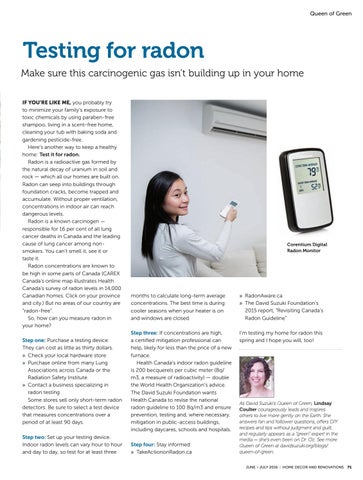
Corentium Digital Radon Monitor
months to calculate long-term average concentrations. The best time is during cooler seasons when your heater is on and windows are closed.
» RadonAware.ca » The David Suzuki Foundation’s 2015 report, “Revisiting Canada’s Radon Guideline”
Step three: If concentrations are high, a certified mitigation professional can help, likely for less than the price of a new furnace. Health Canada’s indoor radon guideline is 200 becquerels per cubic meter (Bq/ m3, a measure of radioactivity) — double the World Health Organization’s advice. The David Suzuki Foundation wants Health Canada to revise the national radon guideline to 100 Bq/m3 and ensure prevention, testing and, where necessary, mitigation in public-access buildings, including daycares, schools and hospitals.
I’m testing my home for radon this spring and I hope you will, too!
Step four: Stay informed: » TakeActiononRadon.ca
As David Suzuki’s Queen of Green, Lindsay Coulter courageously leads and inspires others to live more gently on the Earth. She answers fan and follower questions, offers DIY recipes and tips without judgment and guilt, and regularly appears as a “green” expert in the media — she’s even been on Dr. Oz. See more Queen of Green at davidsuzuki.org/blogs/ queen-of-green. JUNE - JULY 2016 | HOME DECOR AND RENOVATIONS 71