Campus costs
Into the Woods
House panel confronts ‘eye-popping’ school construction costs
To maintain songbird populations, forests need to be more resilient
Page 3
Page 12
January 25, 2024
Hinesburg looks to state for landfill fixes
POSTAL CUSTOMER
ECRWSSEDDM
Weekly news coverage for Charlotte and Hinesburg
thecitizenvt.com
Budget discussions heat up in Charlotte
Incoming!
LIBERTY DARR STAFF WRITER
Residents continue push for expanded water testing COREY MCDONALD STAFF WRITER
Hinesburg residents affected by the former town landfill, which has been leaching dangerous chemicals into groundwater since at least 2021, are now looking to the state to make the call on whether more testing should be conducted as their anxiety over potential health risks continue to mount. Property owners on Beecher Hill, North, and Forests Edge roads have, in letters and at public meetings, asked the town to expand its testing following a report by an environmental consultant, released earlier this month, that recommended several property owners discontinue testing their drinking water. Levels for various chemicals were detected below state thresholds at those homes. They have specifically pushed for an increase in the town’s FY2025 budget to fund a testing program similar to one that ended in 2009, when at least seven properties were tested annually by the state. Five more adjacent properties to the west would also be tested in addition to those properties, per the residents’ request. “If you had cancer and they went in to operate ... the surgeon is not going to just say, ‘I think I See LANDFILL on page 12
PRSRT STD U.S. POSTAGE PAID PERMIT #217 CONCORD, NH
PHOTO BY AL FREY
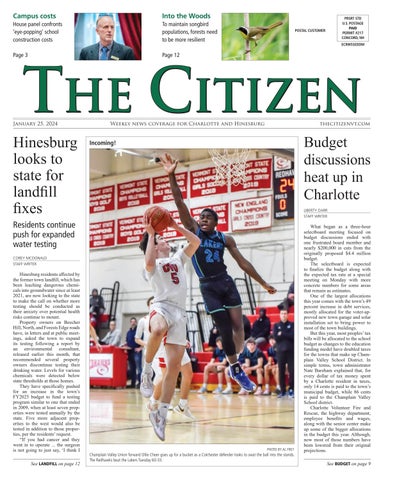
Champlain Valley Union forward Ollie Cheer goes up for a bucket as a Colchester defender looks to swat the ball into the stands. The Redhawks beat the Lakers Tuesday 60-33.
What began as a three-hour selectboard meeting focused on budget discussions ended with one frustrated board member and nearly $200,000 in cuts from the originally proposed $4.4 million budget. The selectboard is expected to finalize the budget along with the expected tax rate at a special meeting on Monday with more concrete numbers for some areas that remain as estimates. One of the largest allocations this year comes with the town’s 49 percent increase in debt services, mostly allocated for the voter-approved new town garage and solar installation set to bring power to most of the town buildings. But this year, most peoples’ tax bills will be allocated to the school budget as changes to the education funding model have doubled taxes for the towns that make up Champlain Valley School District. In simple terms, town administrator Nate Bareham explained that, for every dollar of tax money spent by a Charlotte resident in taxes, only 14 cents is paid to the town’s municipal budget, while 86 cents is paid to the Champlain Valley School district. Charlotte Volunteer Fire and Rescue, the highway department, employee benefits and wages, along with the senior center make up some of the bigger allocations in the budget this year. Although, now most of those numbers have been lowered from their original projections. See BUDGET on page 9
Page 2 • January 25, 2024 • The Citizen
Zoning chairman seeks election to town selectboard
The big cheese
LIBERTY DARR STAFF WRITER
Just three years later, Russell ran for selectboard and stayed for a decade and a half — 10 of those Charlie Russell is no stranger as chair. “Defeated in 2015, I turned to the innerworkings of Charlotte’s municipal world, and now he my energies to tax preparation, hopes to step back up to the plate working for H&R Block for seven for a two-year seat on the select- years,” he said. Aside from municipal work, board this year. Russell has played an integral Russell has an engineering degree part in the evolution of the Devel- which he put to work in Massaopment Review Board since it tran- chusetts for over a decade. Since sitioned from the Zoning Board of moving to Vermont in 1995 with Adjustments in 2021 and has held his wife and three children, he took the chair title for the last three the natural next step and became years. But as the board has contin- a farmer, which he says put his problem-solving ued to stabilize, skills to the ultihe now feels his “I believe it is time mate test. Spendexpertise could be ing late nights at used elsewhere as to use my strong the farm has also the town wades equipped him through a slew of analytical skills for the often-late big changes with nights spent at even more coming where they are most selectboard and down the pipereview board line. If the rules needed — on the meetings. allowed it, he said selectboard.” “My decihe’d be willing to sion to try for stay on the DRB until a replace— Charlie Russell the selectboard has to do with ment is appointed. Town Meeting Day 1996 was considering how I might best serve Russell’s first introduction to town the town,” he wrote. “Now that government, and by the follow- the DRB is well-established and ing year’s annual meeting, he was populated with thoughtful and already making change happen in hardworking members, I believe it town. He presented spreadsheets is time to use my strong analytical and graphs depicting historic over- skills where they are most needed spending by the highway depart- — on the selectboard, dealing ment as selectboard members at with budgets, capital planning and the time argued for more transpar- general business management.” He said his years of experience ency and fiscal responsibility in chairing the selectboard helped regard to the hefty budget. Discover of that is standthe up beauty a review board “To be clear, the road commisnatural looking results at Pêche! sioner at the time was not Hugh “well-prepared” and “conscious Lewis, Jr,” Russell said. “He has of our responsibility to be fair to COME SEE SARAH! SEE JASMINE! SEE KELLIE! those with rightsCOME at stake in the brought fiscal responsibility and allCOME development review process.” then some to the job.”
PHOTO BY HOLLY BROUGH
Jan.18 marked Shelburne Farms’ first day of cheesemaking in 2024. Lead cheesemaker Gus Slater-Dixon was tending to the 5,188 pounds of milk in the vat, transforming it into cheddar that will age for six months up to three years.
His focus throughout the years has been to maintain fairness — especially when is comes to approving permits — and to “ensure that the deliberations of the board are thoughtful, transparent and thorough.” Russell explained that the development review board and selectboard have worked relatively well together over the years, with one bump in the road happening last year when the selectboard approved an appeal for an application that the review board had previously denied. Since then, review board members of the have compounded a list of recommendations to the selectboard on their appeal process moving forward. “The recent issues between (planning and zoning) and the selectboard were specific to that one application and appeal,” Russell said. “We have all learned from the experience and I foresee working well together going forward.”
Discover the beauty of natural looking results at Pêche!
COMEthe SEE SARAH! SEE JASMINE! SEE KELLIE! Discover beauty ofCOME natural lookingCOME results at Peche!
To his mind, there are three big advantages to the town manager form of government. “Freeing up the selectboard to work on longer-term policy decisions, giving the town employees one rather than five bosses that could change somewhat every year, and allowing for younger Charlotters with full-time employment to serve on the selectboard with the reduced time commitment with a town manager taking care of the day to day duties.” He said the conversation also came about as Charlotte was deciding whether to transition to a town-run fire and rescue service. Although that discussion has been tabled until after Town Meeting Day, that would be just one more reason to consider a manager for town. “That’s sort of integral to it,” he said. “Because if you were to take over fire and rescue, that’s just one more big chunk of complication to running the town.”
It’s Our 7th Birthday! Saturday, February 3 10 a.m.-5 p.m.
Our expert providers, Sarah Dietschi, NP, Kellie Malaney, PA-C and Jasmine Fuller, LT specialize in laser treatements and injectables including laser hair JASMINE and vein removal, laser collagen stimulation, neuromodulators, fillers and biostimulators.
SARAH KELLIE Our expert providers, Sarah Dietschi, NP, Kellie Malaney, PA-C and Jasmine Fuller, LT specialize Ask us about our newest treatments with the AMAZING in • laser treatements • injectables • laser hair & vein removal • laser collagen stimulation Matrix Pro and Platelet Rich Fibrin! So many minimally • neuromodulators • fillers • biostimulators. Ask and us about newest treatments with the invasive treatments with natural gorgeousour results! AMAZING Matrix Pro and Platelet Rich Fibrin! Minimally invasive treatments with natural, Visit Pêche for a rejuvenating experience. gorgeous results!Find Visitus Pêche for a rejuvenating experience. at pechemedical.com or call 802-304-9570 to book! Find us at pechemedical.com or call 802-304-9570 to book!
Our expert providers, Sarah Dietschi, NP, Kellie Malaney, PA-C and Jasmine Fuller, LT specialize in laser treatements and injectables including laser hair and vein removal, laser collagen stimulation, 47neuromodulators, Maple Street • Burlingtonfi•llers pechemedical.com • @ pechemedical and biostimulators.
Ask us about our newest treatments with the AMAZING Matrix Pro and Platelet Rich Fibrin! So many minimally 3v-pechemedicalspa011724.indd 1
With some large decisions on the horizon for the selectboard, Russell said the most important aspects are responsible budgeting, capital planning, and “a thorough analysis of the possibility of regionalizing EMT delivery.” “Lane Morrison (a former selectboard member) and I worked on this in the year before I left the selectboard and I wish to continue that work knowing that it is more of an issue state and country-wide and there may be opportunities now that didn’t exist nine years ago,” he said. Russell has been vocal about his stance on the pending town manager versus town administrator debate in town and was even part of the group that spearheaded the petition for the change. He said his main reason to support the cause was with the retirement of former town administrator Dean Bloch, which he saw as a perfect opportunity to consider a conscious change in how the town is managed.
1/5/24 2:02 PM
Join the Party! Have Some Cake! Raffle Prizes!
STOREWIDE SALE! Shop local It matters 802-489-5571 • willowhousevt.com 11 Falls Road • Shelburne, VT
The Citizen • January 25, 2024 • Page 3
House panel confronts ‘eye popping’ costs of campus construction ETHAN WEINSTEIN VTDIGGER
On the first day of the 2024 legislative session, state education officials presented lawmakers with the latest estimates for Vermont’s school construction needs — a whopping $6.3 billion in the next 21 years. And that number, Agency of Education staff cautioned, is likely a significant underestimate. Rep. Peter Conlon, D-Cornwall, chair of the House Committee on Education, called the figure “eye popping.” He signaled that his committee would make addressing school construction needs a priority this session. The cost estimate came as part of a school facilities assessment ordered by the Legislature in 2021, which gathered baseline data on 384 school buildings in Vermont and translated the findings into cost projections for every district statewide. The Agency of Education expects to create a public dashboard with that data later this year. From fiscal years 2000-2008, the state provided more than $280 million in construction aid to schools, but amid the Great Recession it suspended state assistance for such projects. This year, lawmakers will consider how the state could revive some funding,
though Conlon made clear that footing the entire bill was out of the question. The discovery of toxic chemicals called polychlorinated biphenyls in some of Vermont’s schools has further complicated the state’s education infrastructure needs. The Legislature previously set aside $32 million to reimburse school districts for PCB mitigation and remediation, a sum many local administrators expect will be insufficient. With Gov. Phil Scott’s administration predicting an 18.5 percent rise in property taxes driven by a projected 12 percent increase in education spending, the cost of school construction could further strain local budgets. Bill Donohue, the Agency of Education’s facilities program manager, told lawmakers on Wednesday that he could spend two hours qualifying his estimate with potential “unknown costs” that could increase the $6.3 billion figure, which amounts to about $300 million annually for 21 years. “It could very well be $500 million a year,” he said. “It could be more.” Yet the agency predicted the cost of inaction would prove even higher. If schools across the state spent an inflation-adjusted $33 million annually on construction, rather than $300 million, the cost
PHOTO BY GLENN RUSSELL/VTDIGGER
Rep. Peter Conlon, D-Cornwall, seen at the Statehouse in Montpelier in January 2023.
of needed construction over the 21 years would increase by $7 billion, it estimated. “If we’re starting a construction program and we’re not funding it equal to the need out there, there’s going to be this snowball carryover effect,” Donohue said. A report from the school construction aid task force, a group responsible for examining Vermont’s school construction needs and possible funding structures, is expected to arrive by Feb. 1, laying out some recommendations on how to prioritize and pay for needed projects. “The taskforce report will provide guidance,” Conlon said, “but we’re going to have a lot of big decisions to make.”
GMTA, state seek funding sources Hinesburg concerned public transit funding is not equitable’ COREY MCDONALD STAFF WRITER
The Green Mountain Transit Authority and Vermont legislators are looking for alternative funding sources for the agency as towns like Hinesburg question whether the fee assessments for municipalities are fair. Hinesburg selectboard members claim there is an inequity in how certain municipalities pay for the service. The agency relies on funding from eight municipalities in Chittenden County — Burlington, South Burlington, Hinesburg, Shelburne, Williston, Essex, Winooski, and Milton — while other towns like Jericho and Underhill, for example, pay only minor contributions. “There simply needs to be a more equitable distribution of
what’s owed because it’s a heavy burden,” selectboard member Maggie Gordon said. Assessment fees range as high as $2 million for Burlington to Hinesburg’s $52,980 — a 3.9 percent increase from last fiscal year, officials said. GMTA general manager Clayton Clark agrees the methodology for assessments doesn’t make sense. GMTA is the only transit agency in the state considered a “municipality” and governed by a board of commissioners. The other six agencies are nonprofits. And while GMTA offers service throughout the state, municipalities that are considered “urban” are charged assessments while rural towns are donation-based, Clark said. “That’s an inequity even within our own service that doesn’t make
sense to me, that some of the people within our service areas have to pay the bill and other locations don’t,” Clark said. The Legislature is looking into this, and last week received a 2023 report that investigates more than a dozen different new potential revenue sources that GMTA, and all transit agencies in the state, could draw on. “There’s an understanding that it’s not fair and that public transit is going to run into some financial issues,”said Phil Pouech, Hinesburg’s state representative and a member of the House Committee on Transportation. One key piece of the report said municipalities that are paying right now are tapped out, Pouech See GMT on page 13
ESTABLISHED INDEPENDENT SENIOR COMMUNITY
Call today to plan for your future home at The Pines. Spacious 1- and 2-Bedroom Apartments Hair Salon • Massage Studio • Art Gallery Expanded Outdoor Patio and Grilling Area • Exercise Room Community Rooms • Mature Landscaping • Resident Garden Vibrant Social Atmosphere with Weekly Events and Activities LOCATED IN THE HEART OF SOUTH BURLINGTON
7 Aspen Drive, South Burlington, VT • 802. 865.1109
www. SummitPMG. com
2024 WINTER/SPRING REGISTRATION NOW OPEN! Cooking & Cuisine Fine Arts & Crafts Music Health & Wellness Yoga & Meditation Kids & Teens Fitness & Dance Fun & Games One Night Uniersity Home, Garden, DIY Languages & Literacy Photography & Computers
What? Community Education for All Ages! Where? CVU High School 369 CVU Road, Hinesburg, VT How? Register online at Access CVU When? February 1 - June 7 How? Register online at Access CVU
802-482-7194 / access@cvsdvt.org
Page 4 • January 25, 2024 • The Citizen
Hinesburg Police Blotter: Jan. 16-22 Jan. 20 at 12:45 p.m., officers assisted first responders with a medical emergency on Route 116. Jan. 20 at 6:00 p.m., an officer responded to a single-car crash on Charlotte Road. Jan. 21 at 1:45 p.m. a loose pup on North Road was turned in at the station and later returned to the owner. Jan. 21 at 1:57 p.m., officers responded to a 911 hang up on Cattail Lane. Jan. 22 at 11 a.m., officers assisted a resident with a civil issue stemming from a motor vehicle complaint. Jan. 22 at 12:45 p.m., police investigated suspicious activity on Route 116.
Total incidents: 46 Jan. 16 at 10:08 a.m., a fraud was reported and investigated. Jan. 16 at 4:15 p.m., an officer assisted State Police with a traffic crash in Charlotte. Jan. 17 at 7:42 a.m., police investigated suspicious activity on Route 116. Jan. 17 at 9:43 a.m., police investigated suspicious activity on Commerce Street . Jan. 18 at 12:30 p.m., officers responded to a two-car crash on Route 116. Jan. 18 at 3:50 p.m., an officer investigated a report of harassment. Jan. 18 at 9:08 p.m., a Hidden Pasture Road resident was issued court paperwork. Jan. 19 at 3:25 p.m., a stolen motor vehicle out of South Burlington was recovered on Baldwin Road.
Note: Charges filed by police are subject to review by the Chittenden County State’s Attorney Office and can be amended or dropped.
The Citizen Serving the community of Charlotte & Hinesburg A publication of Vermont Community Newspaper Group LLC thecitizenvt.com Advertising Wendy Ewing wendy@shelburnenews.com (802) 985-3091 x12
Billing inquiries Leslie Lafountain leslie@stowereporter.com (802) 253-2101
Advertising Director Judy Kearns judy@otherpapersbvt.com (802) 864-6670 x21
Advertising submission deadline: Friday at 5 p.m. advertising@thecitizenvt.com classifieds@thecitizenvt.com
News Editor Tommy Gardner
Editorial submission deadline: Friday at 5 p.m. news@thecitizenvt.com
Staff Writers Aaron Calvin Corey McDonald Liberty Darr
Calendar submission deadline: Friday at 12 p.m. news@thecitizenvt.com
Production Manager Stephanie Manning stephanie@shelburnenews.com
Contact: 1340 Williston Road South Burlington, VT 05403 (802) 985-3091
Editor/Publisher Gregory Popa gpopa@stowereporter.com
The Citizen is published weekly and mailed free to residents and businesses in Charlotte and Hinesburg and rack distributed at select high traffic locations. The Vermont Community Newspaper Group LLC assumes no responsibility for typographical errors in advertisements and reserves the right to refuse advertising and editorial copy.
ADVERTISING •
•
•
•
•
•
•
•
•
•
an idea that SELLS
CALL 802-985-3091
to place your ad today!
Man charged after stealing vehicle from car dealership COREY MCDONALD STAFF WRITER
An Upper Valley man was arrested and charged last week after stealing a car from a dealership and driving through Shelburne Road, striking multiple vehicles on the roadway before ditching the car in Charlotte. According to a report from the South Burlington police, employees at Goss Dodge on Shelburne Road were rearranging the vehicles in the lot when Shawn Carpenter, 46, Hartford, jumped into one of the vehicles and began to drive off. Carpenter struck multiple vehicles in the parking lot, police said, as he tried to elude employees of the dealership who were trying to stop him. He then started driving southbound on Shelburne Road, reportedly striking a slew of other vehicles in both South Burlington
and Shelburne. Officers from the Shelburne police department were called and located the vehicle on Lower Old Town Trail in Charlotte. The vehicle was later returned to its owner. Carpenter was found by Shelburne police and state troopers attempting to break into another vehicle. When confronted, Carpenter reportedly threatened the responding officers with a knife, police said in a press release. He is accused of aggravated operation of a motor vehicle without owner’s consent, grossly negligent operation, leaving the scene of an accident, and reckless endangerment, police said. While under custody, Carpenter was also found to have two active arrest warrants out of Washington and Windsor counties. This is not Carpenter’s first case of grand theft auto and, according to state police, he was also involved in a short police
chase with state troopers in early December. According to a Dec. 7 press release, Carpenter, who was listed as living in Braintree at the time, had been driving a stolen vehicle on Interstate 89, and when troopers attempted to stop him, but he continued southbound on the interstate at a high rate of speed. The state police had to use spike trips and other tire deflation devices around Exit 2 to stop Carpenter. Despite having flat tires, he continued driving before crashing into a guard rail. He was arrested at the scene, and at the time was accused of aggravated operation without consent of owner, gross negligent operation, eluding a police officer, and violation of conditions of release. Carpenter had been lodged at the Southern State Correctional Facility in Springfield before being released.
Ice fishing safety paramount with inconsistent conditions Ice conditions across Vermont are inconsistent due to warm and variable weather, and the Vermont Fish and Wildlife Department is urging anglers to put safety first if they venture out ice fishing. “Check the ice as you go, avoid areas where currents can create weaker ice, and if you are not sure the ice is safe find a different waterbody,” fisheries biologist Shawn Good said. “With good judgment ice fishing is a safe and fun way to get outside in winter. But that means making cautious, smart decisions and changing plans if conditions are not what you hoped for.” Ice conditions are currently variable across Vermont. At higher elevations and in the Northeast Kingdom many lakes and ponds have frozen over completely and have fishable ice. But in southern Vermont and the Champlain Valley, many lakes and ponds are not yet safe for ice fishing. “Three to four inches of clear black ice is the minimum for safe ice fishing,” Good said. “For the kind of gray or opaque ice we get after repeated freezing, thawing, and re-freezing we recommend anglers look for at least 6 inches of ice where they plan to fish.” Even on a single waterbody it
COURTESY PHOTO
Three to 4 inches of clear black ice, visible in this ice fishing drill hole below the top layer of snow, is the minimum recommended for safe ice fishing.
is important to know that ice thickness is not always uniform. Areas around pressure cracks or near stream or river inlets can be thinner and weaker than surrounding ice. The department says anglers should always carry a spud bar to test the ice as they go and should have a set of personal ice picks for self-rescue. Anglers should avoid fishing alone and should let someone know where they will be fishing and when they plan on returning home.
But despite poor or nonexistent early season ice conditions in some areas of Vermont, eager anglers can still find safe ice fishing opportunities this month. “While we wait for colder weather to freeze up waterbodies statewide, I recommend anglers focus on planning and getting their gear in top shape — or that they hit the road and explore the higher elevation waters or northern waters where there is already good ice,” Good said.
The Citizen • January 25, 2024 • Page 5
OPINION Fair share: Economic justice is a civil liberty issue Guest Perspective James Lyall The Fair Share for Vermont campaign is calling for Vermont’s wealthiest residents to pay their fair share in taxes so we can build a better state for all of us. As part of this campaign, the American Civil Liberties Union of Vermont and its partners are urging state legislators to ensure that those who can most afford it — the wealthiest 2 percent of Vermont residents — pay more in taxes to better support and address the needs of our communities. There are many reasons why we are proud to support this campaign, but they boil down to this: As an organization that works to remedy deeply entrenched sources of inequality, and to advance the rights and liberties of all people, economic justice
is central to our vision for a more just and equitable state, and a healthy, vibrant democracy. Today, because of extreme and growing wealth inequality, more and more of our neighbors are denied access to opportunity and to basic necessities. As a result, many are prevented from fully exercising their civil rights and civil liberties, participating in democracy, and experiencing true freedom and equality in society. As we have long recognized, wealth inequality also reinforces the many forms of systemic racism that we are working to dismantle each day. When Vermont invests in people in the here and now, it makes the state more sustainable and affordable for everyone in both the short- and long-term. When we prioritize real solutions like affordable housing, health care and education — all things that impact civil liberties, directly
Letters to the Editor State treasurer makes case of baby bonds To the Editor: Despite the opportunities in our states, we know our economies do not work for everyone. According to 2019 American Community Survey data from the U.S. Census Bureau, the top 20 percent of Vermont households had an average income of $200,816, while the bottom 20 percent averaged $15,054. These disparities are even more stark in Connecticut, one of the wealthiest states in the nation that also features one of the most significant wealth gaps. Currently in the United States, the top 10 percent of households hold about 69 percent of the nation’s wealth, while the bottom 50 percent own only about 2.5 percent. We recently proposed an idea in Vermont to address these challenges — baby bonds, an innovative policy to address intergenerational poverty, foster rural economic development and retain young people in Vermont. Under baby bonds, babies born into the most impoverished families in Vermont would have $3,200 set aside for them and invested by the Vermont Treasurer’s Office. These children could access their baby bond between ages 18 and 30, with the initial $3,200 investment projected to grow to $11,500 by age 18 and $24,500 by age 30. The funds could be used for four wealth-building activities: purchasing a home in Vermont; starting or investing in a business in Vermont; pursuing higher education or job training; or saving for retirement. Last year, Connecticut became the first state in the nation to implement a baby bonds program, highlighting the
importance of investing directly in people. Over the long-term, the policy will unlock economic opportunity for a generation of young adults and spark investment in local communities. Since the CT Baby Bonds program saw its first eligible babies born on July 1, 2023, we’ve also seen how baby bonds can serve as a powerful message of state government’s commitment to building a more equitable, prosperous future — one that includes economic participation for everyone. This session in the Vermont Legislature, baby bonds legislation is being led by Sen. Kesha Ram Hinsdale and Rep. Dan Noyes with over 80 co-sponsors, a broad coalition of support among Republicans, Progressives, Democrats and Independents. Baby bonds would support Vermonters’ economic resilience for generations to come and relieve pressure on our state budget over time. By investing in our state’s greatest resource — our children — we can support our communities and create a more resilient, fair, and productive Vermont economy for all. Mike Pieciak Vermont State Treasurer
Act 127 does not provide ‘equitable outcomes’ To the Editor: In 2004, the town of Killington overwhelmingly voted to pursue secession to New Hampshire. It was a time of great turmoil as Vermonters navigated the impact of Act 60. Although extreme, it was a reflection of the anger and frustration felt by residents pushed to the breaking point. See LETTERS on page 7
and indirectly, every day — the benefits to the state and its workers and families are transformative. State legislators have started to make investments for healthier, more resilient communities in housing, child care, harm reduction strategies and climate solutions. We applaud those efforts. At the same time, we know we must do far more to create a state budget that better addresses the needs of everyone who calls Vermont home. With more revenue from the state’s wealthiest residents, we can build a Vermont with affordable housing; where no child goes hungry; where everyone gets the health care they need; and where our environment and infrastructure can sustain a vibrant economy and a strong democracy. That’s why we look forward to working with legislators to advance this proposal
in the coming year. We recognize there are other paths forward to raise revenue from those who can most afford it, and we hope policymakers will explore all available options to prioritize Vermont workers, families and communities. When they do that, it’s important for state legislators to know that they will have the support of our members and partners in the Fair Share for Vermont campaign. They will also have the backing of the vast majority of their constituents. Voters overwhelmingly support proposals like Fair Share for Vermont, and those voters will be looking to their representatives for solutions this election year. James Lyall is executive director of the American Civil Liberties Union of Vermont.
Winter Coat &
Sweater
Sale
in Store &
Online www.jessboutique.com
Page 6 • January 25, 2024 • The Citizen
Longtime conservative voices ends 30 years of columns Guest Perspective John McClaughry With this column I am concluding my biweekly commentaries that stretch back to 1993 for the Ethan Allen Institute. Years ago, I learned that I had some marketable abilities in understanding issues, analyzing implications and explaining things clearly and I hoped persuasively. Accordingly, I embarked on a career that I half-jokingly referred to as “brain rental.” In 1988, after a tour in the Reagan campaign and White House, I was elected to the Vermont Senate, and reelected with 82 percent of the vote. But after those often frustrating four years, I concluded that maybe I could make a more valuable contribution by launching a nonpartisan think tank to promote “Ideas for Vermont’s Future” built upon the liberal principles of Vermont’s brilliant 1777 Constitution. In 1993, Anne Haugsrud Webb, John M. Mitchell and I launched the Ethan Allen Institute. Its mission was to influence public policy in Vermont by helping its people to better understand and put into practice the fundamentals of a free society: individual liberty, private property, competitive free enterprise, limited and frugal government, strong local communities, personal responsibility and expanded opportunity for human endeavor. Soon to follow was the INDOOR EVENT
ARTISANS & CRAFTS
first of my more than 800 biweekly commentaries, almost all on timely Vermont-related public issues. We planned to offer “Ideas for Vermont’s Future” in Ethan Allen Institute’s reports, conferences and publications. But as the years went by and little Vermont grew bluer and bluer, it became clear that even well-thought out and timely proposals in fiscal, legal, education, energy, health care and other issues aroused little interest within the progressive juggernaut determined to use its growing legislative majorities to reshape Vermont into the Perfect Little Blue State, no matter what the cost. Looking back through those columns, here were some of my favorite themes: • Fidelity to our Constitution: It is the indispensable agreement among the people about how we shall be governed, and which rights of the people must remain inviolate. • Accountability: Our Constitution declares that government, with its power to confiscate and coerce, must always remain accountable. For 30 years I have exposed and denounced politicians working to get what they want through intricate schemes too complicated for their citizens to comprehend. A disgraceful example is the Global Warming Solutions Act of 2020, passed over Gov. Scott’s veto, that empowered unaccountable bureaucrats to enact rules that no legislator would ever vote on. MUSIC & DANCING
KIDS FREE UNDER 6
7th Annual
WINTER Feb 3 & 4, 2024 Renaissance Faire
C H A M P L A I N VA L L E Y E X P O
Buy Tickets Online at: VTGatherings.com
That’s why I labelled it “the worst democracy-shredding legislation in the past 50 years,” and, quite likely, ever. • I also, unsuccessfully, promoted a Regulatory Accountability Act, which allowed one fifth of the House or Senate to put a proposed bureaucratic rule on the calendar for an up or down approval vote. Earlier, when I introduced that bill in the Senate, my colleagues, unwilling to risk going on the record if they could avoid it, bolted for the exits. • Single member districts: The worst curse of our election structure is the multi-member district, where candidates can improve their chances by avoiding any controversy on issues. • Fiscal integrity: We must pay bills as pledged, including promises to retirees, and resist every temptation to embark on spending today that obligates our children and grandchildren to pay for our largesse decades later.
• Property rights: Our Constitution is founded on cherished right of citizens to own, use and exchange property. Government can limit those rights and can take them away in the public interest but only by paying the owner just compensation. Otherwise, government becomes a regime of piracy and tyranny. • Freedom of political speech: Laws prohibiting libel, defamation, false labeling and rank pornography may be enforced, but not laws to circumscribe and silence political speech or punish “wrongthink.” • Subsidiarity: This means resisting centralization of power to actors increasingly remote from local communities, while recognizing that some public issues, such as criminal justice and air and water pollution, must be managed on larger scales. “The Vermont Papers: Recreating Democracy on a Local Scale,” the book Frank Bryan and
I wrote in 1989 sought to show how decentralization of power to some 40 autonomous shires would reverse the anti-democratic domination of the centralized state and bring a new flowering of citizen responsibility and community essential to preserving a free society. Last but far from least, a full-throated defense of what should always be Vermont’s paramount guiding star, liberty. Now, with this last of my commentaries, I take leave of the Ethan Allen Institute, and of my 30 years of biweekly efforts to defend and advance the principles that over the years have made our little state strong, proud and free. I hope and trust that others will now step up to continue that mission. Former representative and senator John McClaughry of Kirby co-founded the Ethan Allen Institute, where he has labored for the past 30 years.
Facing increases, legislators should fix education funding Guest Perspective Rep. Scott Beck The annual discussion over Vermont’s Education Fund and wringing of hands over education property tax rates is an unprecedented mess this year, and that’s being kind. The annual December tax letter projects that unless school districts back down from increasing their education spending by $207 million — around $60 million is normal — the average property tax bill will go up by 18.5 percent. Voters will make the final determination of how much school districts spend, they always do. Here is a laundry list of why there is such a large increase this year: universal school meals added $28 million; health care premiums went up by 16 percent; very high staffing ratios; inflation; student weighting changes; failure to fully implement special education reform from 2018; an increase in pension costs of $10 million; collective bargaining agreements; the retention of school positions being funded by one-time COVID-19 dollars; high capital construction costs; a cap on district rates that has encouraged spending; and consumption tax growth has returned to 2 percent. Then there is the confusion
of the common level of appraisal (CLA). Half of the districts benefit from the common level of appraisal, and half don’t. I’ve never spoken to anyone that knows which bucket they are in or why, or how it impacts their tax rate. Recent public comments indicate that the Legislature will address property tax rates. It is important to understand that the Legislature has only four blunt tools at its disposal: in the middle of school budget season, it could change the rules; a reserve fund could be tapped to provide one-time relief; spending could be cut from a non-education program and diverted to the state education fund; and non-property taxes could be increased to reduce property taxes. These are extraordinarily unpopular and dramatic ideas to consider. Of course, so is an 18.5 percent increase in property tax rates. Some of what is occurring is not particular to the education fund, but much of it is. The following changes would finally fix Act 60/68 and cause the fund to perform as it was supposed to, and in a way that Vermonters could understand while strengthening local control and accountability. Those changes would include: • More closely connecting a district’s tax rate to its spending as
proposed by the House in 2018. • Making pension costs be paid by employers, not as a line-item in the education fund, also proposed by the House in 2018. • Eliminating the common level of appraisal and instead move to the Massachusetts schedule of determining property value. • Reforming the property tax bill to a property tax payment with an income-based credit received at tax filing. This is how every New England state administers an income-based property tax credit. An estimated income-based credit could be applied for in advance. • Modifying or eliminating the Act 127 rate cap in fiscal year 2026. • Eliminating the excess spending threshold and penalty. This year’s mess is unprecedented, but Vermont would be foolish if it did not acknowledge that much of our problem is systemic. The Legislature should act decisively and provide Vermonters with an education funding system that is understandable, more closely connects a district’s spending decision with its tax rate without the use of penalties and divorces the local tax rate from unpredictable local property valuations changes. Rep. Scott Beck, Republican from St. Johnsbury, is on the House Committee on Ways & Means.
The Citizen • January 25, 2024 • Page 7
LETTERS continued from page 5 Within two years, Act 60 was revised and new revenues were identified to ease the unsustainable tax burden felt by families. It appears that twenty years later, we may be at a similar political crossroads. Vermonters will soon face unprecedented economic pressure and it is clear that the root cause is Act 127, the latest version of Act 60 and one of the most detrimental and dangerous pieces of legislation in recent history. This bill, signed in the spring of 2022, was intended to increase transparency and produce more “equitable” outcomes for students across the state. Although the intent is the right one, the reality is that this law decreases transparency and raises property taxes for Vermont residents to levels that will require many to make very difficult financial decisions. As superintendent of the Lamoille South Supervisory Union, I hold a unique perspective regarding the impact of education finance policy. Our supervisory union is composed of three unique towns: Elmore, Morristown, and Stowe. These three towns have been operating in a fiscally responsible way for many years and we have always strived to maintain a spending increase below the state average. We present our academic data on a regular basis and provide our taxpayers with a good return on their investment. What is our reward for this transparency and steadfast financial management? Based on current projections, Elmore residents can anticipate an average property tax increase of 29 percent for FY25. In Stowe, the average resident can plan for an increase of 24 percent and in Morrisville, residents can anticipate an 18 percent increase to their annual bill. Let there be no mistake that these increases are completely driven by Act 127, which has resulted in unprecedented statewide spending and a lower property yield. With a monumental upswing in state-negotiated health care costs and new state policy that removes even more local control, we have been put in a situation where property tax increases are untenable. This is not the Vermont way. Although we could offer many perspectives on how we got here, what is more prudent is a path forward. After countless conversations with colleagues, school boards, and legislators, I present these three strategies for reversing course: • Developing policies that prioritize Vermonters. The most pressing challenge we face is our lack of state revenue, decreasing enrollments, and rising costs. Short-term rentals and second homes owned by out-of-state residents need a separate tax rate. Why is the current (non-homestead) rate in the same category as local businesses? Why would local residents pay a higher tax increase than a second home owner? Legislators must create a new category for
out-of-state property owners and collect more revenue from those extracting money from our state. Short-term rentals have changed the game, and we need to change with it. If these tax increases result in owners selling their properties, so be it. It can only help our housing crisis. Imagine homes filled with teachers, firefighters, and little league coaches. These year-round residents not only contribute to their local communities; they also increase school enrollments. • Implement spending safeguards and increase transparency. Contrary to its claim, the new weighting model does not offer a transparent look at annual spending increases by town. Pupil weights, common level of appraisal, property yields and more all work to distance voters from their actual spending increase. A lack of timely statewide academic data also leads to an erosion of trust. How many of your neighbors (or legislators for that matter) can explain how their tax increase was calculated or how investments are connected to learning outcomes? Instead of complicated formulas that seek to confuse voters, state officials should be establishing safeguards for annual spending and providing clear annual reports on school performance. Massachusetts requires a voter override when property tax exceeds 2.5 percent. They also publish school report cards each fall that display current academic and social / emotional data in an easy-to-read format. These safeguards encourage efficiency and allow individual towns to have a strong say in what they are willing to pay in tax increases. The state also provides technical support, not just financial resources, to school systems that are underperforming. • Focus on health care. Everyone can agree on healthcare reform. The 16.4 percent increase in state-negotiated health care costs has imposed a significant hardship on local budgets. Instead of passing legislation that increases our tax rates, we must encourage our legislators to help us control costs. Health care is the perfect place to start. Vermont is a state with a long history of providing students with an excellent education. It is arguably our greatest asset and needs to be prioritized in the current legislative session. We need to stop claiming we are pursuing equity while simultaneously pushing our residents into poverty and losing our focus on student learning. The above are three realistic steps that can be taken this year. Do we really want to revisit a time in history when towns were asking to secede to New Hampshire? Please consider contacting your local legislators and advocating for our students and families. Ryan Heraty Superintendent, Lamoille South Supervisory Union
thecitizenvt.com
Get the News of Charlotte and Hinesburg 24/7
OPEN FOR BUSINESS?
New Hours? Retail Online Ordering/Curbside Pickup Take out/Delivery Let us help you reach Charlotte and Hinesburg customers in the next issue of The Citizen Email wendy@shelburnenews.com Call – 802-985-3091 Vermont Community Newspaper Group Your community partner “Moving forward, together”
VTCNG
Page 8 • January 25, 2024 • The Citizen
COMMUNITY Community Notes Supreme Court presents Sen. Leahy photo exhibit The Vermont Supreme Court Gallery opens its doors to the public for the first time since the July 2023 flood with an exhibition of photographs by former US Senator Patrick Leahy. “The Eye of Senator Patrick Leahy” is an extraordinary collection of photographs that showcases the unusual access and unique perspective enjoyed by Vermont’s beloved longtime senior senator, with images captured throughout his 48-year career at the center of the nation’s political spotlight. The exhibition will be on view from Feb. 1-March 29. Sen. Leahy and his wife Marcelle expect to attend an opening reception on Thursday, Feb. 1, from 4:30-7 p.m. The following evening there will be another reception as part of Montpelier’s Art Walk, also from 4:30-7 p.m. “As the son of a printer in Montpelier, I learned early about the power of the printed word and the printed image, and a lifelong interest in photography was born the first time I picked up a camera,” Leahy said. “Photographs can at once be both timely and timeless. They enhance our understanding beyond the ability of words alone.”
With Sen. Leahy documenting nearly five decades of events and personal interactions, both great and small, this exhibition intimately celebrates politicians, human rights leaders and artists that have inspired and influenced people across borders and oceans. The exhibition also highlights everyday people from around the world who have inspired the senator. His work has been published in newspapers and magazines, including Time, US News and World Report and other national and international news publications. Leahy represented Vermont in Congress from 1975-2023, establishing a record as Vermont’s longest-serving United States senator.
Girls on the Run Vermont seeks volunteer coaches Girls on the Run Vermont is a physical activity-based, positive youth development program that inspires students in grades 3-8 to be joyful, healthy, and confident. And it needs coaches. The ten-week program incorporates movement to empower participants to develop critical life skills, build confidence, cultivate positive connections with peers, manage their emotions,
COURTESY PHOTO
Former Sen. Patrick Leahy’s photography will be showcased in a new Supreme Court gallery exhibit.
and stand up for themselves and others. Volunteer coaches utilize a curriculum to engage teams of girls in fun, interactive lessons. The spring season begins the week of March 18. Teams meet twice a week for 90 minutes and the program culminates with all teams participating in one of two noncompetitive, celebratory 5K events in Essex and Manchester. Coaches do not need to be runners. Girls on the Run Vermont provides training so volunteers
have all of the tools needed to facilitate the season and to have a positive coaching experience. All volunteer coaches must complete a background check and high school students are welcome to volunteer as junior coaches. Chittenden County locations still in need of coaches are: Brewster-Pierce Memorial School, Browns River Middle School, C.P. Smith Elementary School, Chamberlin School, Champlain Elementary School, Charlotte Central School, Christ the King,
It’s Summer Summer Camp Camps Sign-Up 2024 GUIDE Time!
Enjoy Age Well meals at Charlotte Senior Center The Age Well meal pickup for Thursday, Jan. 25, is from 10 to 11 a.m. at the Charlotte Senior Center and features barbecue pork rib, home-fried potatoes, carrots, wheat biscuit, fruit crisp with cream and milk. You must pre-register by the prior Monday at 802-425-6345 or meals@charlotteseniorcentervt. org. The suggested donation is $5. Check the website for last-minute cancellations at bit.ly/3FfyLMb.
Promote your program in our Summer Camps guide for targeted exposure to a local audience of kids and parents as they make plans for the upcoming summer season. This advertising section is a go-to guide for summer camp and recreation seekers, making it the ideal place to outline your offerings and secure more early enrollments.
Used book sale comes to United Church
Publication Dates: February 8, March 7, April 4 Deadlines: February 1, February 29, March 28 Contact: Stowe Reporter/News & Citizen at 802-253-2101, Shelburne News/The Citizen at 802-985-3091 or The Other Paper at 802-864-6670 for information or to advertise your camp (ask about multi-paper, half-price color and Burlington Area Newspaper Group deals).
To learn more or reserve your space, talk to us today!
Burlington, Hiawatha School, Hinesburg Community School, Integrated Arts Academy at H.O. Wheeler, J.J. Flynn School, Jericho Elementary School, Malletts Bay School, Mater Christi School, Rick Marcotte Central School, Shelburne Community School, St. Francis Xavier, Summit Street School, Sustainability Academy at Lawrence Barnes, Thomas Fleming School, Westford Elementary School and Williston Central School. Visit www.gotrvt.org/coach for full details or email info@ girlsontherunvermont.org. Join us for a virtual Q&A session on Tuesday January 24th at 7 p.m.
A used book sale fundraiser for the Hinesburg Youth Project, a program sponsored by the United Church of Hinesburg aimed at providing youth from Hinesburg
STOWE REPORTER NEWS&CITIZEN
See COMMUNITY NOTES on page 9
The Citizen • January 25, 2024 • Page 9
Obituary
COMMUNITY NOTES continued from page 8
Ezra Raymond Pouech The family of Ezra Pouech ask that you join them to honor and celebrate the life of Ezra on Feb. 17 at the United Church of Hinesburg, located at 10570 VT-116 in Hinesburg, VT. The service starts at 11 a.m. and will be followed by a short reception at the Hinesburg Public House. There will be a second commemorative event this summer, with details to be announced at a later date. In lieu of flowers the family suggests a donation to either a GoFundMe for Ezra’s girlfriend and children who have been affected by this tragedy — gofundme.com/f/injured-pacifica-mother-her-children — or the Vermont Network Against Domestic Violence.
with experiences in service and social justice issues, will be held at the United Church Parish House on Saturday, Feb. 10, from 9 a.m.-noon. If you have gently used books in good condition that you would like to donate for the sale, please drop them off by Feb. 2. Contact the church at 802-482-3352 or by email at unitedchurch@gmavt.net with any questions.
Talk focuses on ‘blind merchant of Burlington’
Ezra Raymond Pouech
BUDGET continued from page 1 Charlotte Volunteer Fire and Rescue, who had originally proposed a budget over just over $1 million, was able to lower its budget slightly to $989,000 a two-percent increase over last year’s $965,806, with nearly 94 percent of that allocated for personnel. “There’s reserved money that was set aside a few years ago that still had some funding left in it,” said Bareham. “(Fire and Rescue) requested that a line item get reduced out of that fund. So it’s not a budget reduction per se, but we’re drawing funding from different accounts, so we don’t need to include that in the budget.” The expected $90,000 increase in the highway department fund had a similar highway reserve fund transfer that balanced the budget and remains now at no increase over last year. In addition to other minor reductions, the selectboard, under the guidance of board members Kelly Devine and Lewis Mudge, say they plan to cut nearly $30,000 from the previously anticipated $388,286.00 in employee benefits packages, a 10 percent increase over last year.
Town Meeting Day Almost entirely opposite from the feedback given to the selectboard last Town Meeting Day when the board opted for an Austalian ballot vote, residents have voiced strong reservations with the selectboard holding a floor vote on Saturday, March 2 — the last day of school vacation — as previously voted on in October. “Parents were concerned about their ability to participate,” said Devine, noting the transmission
of COVID is still a risky factor at play. Although there was debate from residents advocating for the historic value of the day, town clerk Mary Mead explained that voter turnout for an Australian Ballot vote in Charlotte is almost nine times more than it is for an in-person floor vote. “I really want to allow more people to weigh in on the budget,” said Devine. “As Mary said, you get about 900 people showing up as opposed to 100 at Town Meeting Day.” When it came time to vote to backtrack their original decision to hold an in-person town meeting, chair Jim Faulkner and Devine voted in favor of switching to Australian ballot, while Frank Tenney and Mudge voted in favor of keeping with the original plan. “We set a plan. It’s never going to accommodate everyone,” said Mudge.
Ambulance bond vote As the clock struck 10 p.m. and tensions turned personal, the selectboard had one final decision to make regarding the $365,000 bond vote for a new ambulance to replace the 10-year-old tanker. Devine stood alone in her opinion not to put the bond up for town meeting vote. Her bottom line reasoning: “We will have to raise taxpayer money in order to pay for it.” With the future of a town-run fire and rescue service still uncertain, she said the decision to make a ten-year commitment to an organization that the town still has to decide what to do with comes at the high cost of taxpayer money. “As far as I understand, we still
have to have some discussions about it. I fail to see why giving us more time would be so dire,” she said. But Fire and Rescue president John Snow made a rebuttal that the 30-month lead time to actually getting the vehicle would put payments out another two to three years, causing no affect on this year’s budget. The decision not to include the bond vote, he said, would be reckless. “I think for the selectboard to intermediate and refuse to take this before the taxpayers is irresponsible,” he said. “If you’re not going to support that, then you’re saying you want us to cut back on our services, and that’s fine, but you need to do that straight up in public session in front of the voters. We will gladly, not gladly I shouldn’t say that as a taxpayer and resident, but if we need to shut down fire and rescue, we will shut it down.” Sensing the opposing opinions from her fellow members, Devine said, “I could be standing alone here like I seem to be pretty often.” “Standing alone but in solidarity,” Mudge jokingly responded. While the straw vote was pulled with Tenney, Faulkner and Mudge in favor of putting the question to voters, Devine again piped in, “Just keep putting out money” she said, packing her things before a motion to adjourn was entertained. “I’m done, this is ridiculous,” she said to Mudge. “F--k it.” Faulkner asked whether she could make it to the special selectboard meeting next week. “Not sure if I can make it, I’ll see,” Devine said. “I’m sure you’ll be able to proceed without me.”
“Anne Connelly: The Blind Merchant of Burlington,” a talk by John Thomas, development director of the Vermont Association of the Blind and Visually Impaired, will take place on Sunday, Feb. 11, 2 p.m., at Burlington High School, 67 Cherry St., presented by the Chittenden County Historical Society. Thomas will tell the story of Anne Connelly (1889-1939), who came to Vermont as a blind adult and worked at the association who introduced trained guide dogs and white canes, ran her own business, and supported the blind community. Applications are also open for Chittenden County Historical Society annual research grants of up to $1,000. The deadline is June 1. Learn more at cchsvt.org. There is free parking at the city parking garage on Cherry Street. The program is free, and refreshments will be served.
School mentoring program seeks adult mentors The Connecting Youth Mentoring Program in the Champlain Valley School District, middle level, is looking for more adult community members to join its team of volunteer mentors for students in grades five to eight. If you’re considering becoming a mentor or want to learn more, email Kate Rooney, krooney@cvsdvt.org, (802) 425-6682, Charlotte Central School; or Livy Bulger, lbulger@cvsdvt.org, (802) 482-6248, Hinesburg Community School.
January programs at the senior center The Charlotte Senior Center, 212 Ferry Road, has several upcoming programs in January. More at charlotteseniorcentervt. org.
• January artist exhibit: Colorful representative and abstract paintings on panels and canvas by Theresa Petrow. • Restorative yoga for deep winter renewal, Friday, Jan. 26, 5:30-6:45 p.m. Warm up your body with slow, mindful movements followed by longer held restorative postures. Yoga props required. Prop list will be sent upon registration. With Heidi Kvasnak. Registration required. Cost is $15. • Winter spike hike, Wednesday, Jan. 31, 10:30 a.m.-12:30 p.m. Get outside and enjoy winter hiking. Weather permitting, the group will meet every other week through February. The outings will be about two hours on trails around Charlotte and neighboring towns. Bring your own spikes or snowshoes, depending on the weather, snacks and water. To register or indicate an interest in leading a winter hiking trip, contact Susan Hyde at susanfosterhyde@gmail.com. • Vermont Association for the Blind and Visually Impaired, Wednesday, Jan. 31, 1 p.m. If you or someone you love is experiencing vision loss, it is still possible to enjoy reading with some simple adaptations. Dan Norris, director of adult services at the Vermont Association for the Blind and Visually Impaired, shares the variety of large-print, digital and audio resources that are available to help you to access print. Registration suggested. Free.
Shelburne Age Well hosts February grab and go Age Well and St. Catherine’s of Siena Parish in Shelburne are teaming up to provide a meal to go for anyone 60 and older on Tuesday, Feb. 13 Meals will be available for pick up in the parking lot at 72 Church St. from 11 a.m. until noon and are available for anyone 60 or older. Suggested donation is $5. The menu is Swedish meatballs with sauce, rotini noodles, carrots, green beans, wheat roll, pineapple tidbits and milk. To order a meal contact Kathleen at agewellstcath@ gmail.com or 802-503-1107. Deadline to order is Wednesday, Feb. 7. If this is a firsttime order, provide your name, address, phone number and date of birth. Learn more at agewellvt. org.
Page 10 • January 25, 2024 • The Citizen
SPORTS Redhawk hoopsters hold court with winning week LAUREN READ CORRESPONDENT
Girls’ basketball Champlain Valley 70, Rice 32: The Champlain Valley girls’ basketball team outscored Rice 23-3 in the third quarter to pull away for a win on Friday. Zoey McNabb had 16 points to pace the Redhawks, who remain undefeated at 7-0. Samara Ashooh chipped in 10 points and seven rebounds, while Nev Parrish added nine points and four steals.
Boys’ hockey Burr and Burton 3, Champlain Valley 2: Champlain Valley surrendered two third period goals to drop a game to Burr and Burton on Saturday. Nic Menard scored two goals for the Redhawks, who had a 2-1 lead in the third period. Tommy Barnes made 22 saves. With the loss, CVU fell to 3-5-3. The loss comes after the Redhawks earned a win earlier in the week, beating Essex 5-1 on Wednesday.
PHOTOS BY AL FREY
CVU had its way with Colchester Tuesday, as the Redhawks beat the Lakers 60-33 to move to 10-2 this season. Above, Russell Willoughby puts in an easy two.
Menard and Travis Stroh each tallied twice in the win, while Zavier Barnes added a goal and an assist.
Boys’ basketball Champlain Valley 52, BFA-St. Albans 45: Champlain Valley held off a furious fourth quarter push from BFA-St. Albans to gain the win on Thursday in boys’ basketball. Tucker Tharpe led all scorers with 24 points and seven rebounds. Kyle Eaton (eight points) and Colby Morehouse (seven points) also scored for CVU. The Redhawks moved to 9-2 with the win.
Girls’ hockey Burr and Burton 3, Champlain Valley/Mount Mansfield 1: The Champlain Valley-Mount Mansfield girls’ hockey team fell to Burr and Burton on Saturday in Manchester. Cadence Tessier had a goal for the CougarHawks (2-8-1), while Clark Clark and Evie Mae Buford added the assists on the score. CVU-MMU also lost on Wednesday, falling to Essex 2-0.
The Citizen • January 25, 2024 • Page 11
ILLUSTRATION BY ADELAIDE MURPHY TYROL
Thundersnow: the winter time storm with the rock star nickname The Outside Story Colby Galliher It’s deep in winter, and a nor’easter is dumping snow outside. In between the howling winds you hear a boom. Maybe a heap of snow fell from the roof, you think, or a giant icicle crashed from the eaves. A few minutes later, another boom pounds through the blizzard’s gales. It’s closer this time, and it seems to resound from the sky. This booming may be a rare wintertime phenomenon: thundersnow. While most of us equate thunderstorms with hot, humid summer weather, they can also happen during the winter. Thundersnow is, simply, a type of thunderstorm where precipitation falls as snow rather than rain. The thunder and lightning of a thundersnow storm result from the same factors that cause rainy thunderstorms. Regardless of the season, lightning in any storm requires electrical charge separation, explained Peter Banacos, science and operations officer at the National Weather Service in Burlington. “Charge separation comes about when you have what is called a mixed-phase region within a cloud and strong vertical motions — think updrafts and downdrafts — in tall, cumulonimbus clouds,” Banacos said. “The mixed-phase would be a combination of rain droplets, graupel, and snow within a portion of the cloud.” The winds of a powerful winter storm smash those condensates together, he said, “stripping electrons and charging those particles positive or negative.” The storm cloud, now stratified into positive-
ly and negatively charged regions, may emit an electrical discharge in the form of lightning, which then generates a thunderclap. Thundersnow, unlike the thunderstorms typical of spring and summer in the Northeast, is uncommon. It owes its rarity to the general meteorological conditions of winter. “Air temperatures are colder, the sun angle is low, and moisture is more limited” in winter, Banacos noted. “Without that instability in the atmosphere, you don’t get the magnitude of vertical motion necessary to develop the charge separation within a cloud.” No charge separation means no lightning and no thundersnow. That’s why you’re most likely to experience thundersnow during the Northeast’s strongest storms. Only the meteorological chaos of a nor’easter — when gale force winds gust from the Northeast, often coupled with heavy precipitation — is powerful enough to introduce the necessary atmospheric instability for thundersnow when temperatures are cold enough for snow, rather than rain, to fall. Banacos said that the same instability favorable to thundersnow’s formation is associated with heavy snowfall rates of up to 2 inches per hour. But not every nor’easter or other powerful winter storm produces thundersnow. Very specific criteria must align for thundersnow to arise. Banacos estimates that thundersnow occurs in northern New England only once every year or two. He recalls two recent days when his office tracked thundersnow in Vermont: across the northern portions of the state on Nov. 15, 2019, and again on March 29, 2023. Even as a meteorologist,
he has only witnessed thundersnow firsthand twice in his life, in instances two decades apart. Thundersnow bears another characteristic that distinguishes it from warm-weather thunderstorms. Because thundersnow usually occurs during high-intensity snowstorms, falling snow often acts as an acoustic dampener. Rather than the distinct clap of summer thunder, which may be heard from miles away, thundersnow is more muffled; its boom is often only detectable within a mile or two of the storm’s eye. Despite thundersnow’s muffled acoustics, these winter events can be dangerous. Accounts collected by the Washington Post, for example, describe people being struck by lightning during thundersnow. One details thundersnow lightning blasting a hole in the side of a house in Rhode Island, while another describes one strike injuring several people at a bus stop in Illinois. Just like a nor’easter, thundersnow is most safely and prudently enjoyed from the refuge of your home. If you hear a thunderous boom while a nor’easter blows outside, take heed: you may bear witness to an exceedingly rare meteorological phenomenon. Colby Galliher is a writer who calls the woods, meadows, and rivers of New England home. To learn more about his work, visit colbygalliher.com. Illustration by Adelaide Murphy Tyrol. The Outside Story is assigned and edited by Northern Woodlands magazine and sponsored by the Wellborn Ecology Fund of the New Hampshire Charitable Foundation, nhcf.org.
Local businesses and restaurants need your support more than ever. Whether you visit stores, get delivery or shop online, keep your spending local and keep your community healthy. Newspapers are LOCAL. We are dedicated to keeping you informed, safe and connected and care about the issues that are important to ourand neighbors, our schools and our businesses. Local businesses restaurants need your support more than ever. Whether you visit stores, get delivery or shop online, keep your spending local and keep your community When you support your local newspaper, healthy.
you support your community.
Newspapers are LOCAL. We are dedicated to keeping you informed, safe and connected and care about the issues that are important to our neighbors, our schools and our businesses.
SUPPORT LOCAL
When you support yourNEWSPAPER local newspaper, SUPPORT YOUR you support your community.
SUBSCRIBE TODAY
SUPPORT LOCAL
SUPPORT YOUR NEWSPAPER Contact Wendy Ewing at SUBSCRIBE TODAY wendy@shelburnenews.com or 985-3091 America’s Newspapers is a national association supporting journalism and healthy newspapers in our local communities. Find out more at www.newspapers.org or follow us on Twitter @newspapersorg or on Facebook @americasnewspapers.
ADVERTISING •
•
•
•
•
•
•
•
•
•
America’s Newspapers is a national association supporting journalism and healthy newspapers in our local communities. Find out more at www.newspapers.org or follow us on Twitter @newspapersorg or on Facebook @americasnewspapers.
an idea that SELLS
CALL 802-985-3091
Page 12 • January 25, 2024 • The Citizen
LANDFILL continued from page 1
COURTESY PHOTO
A yellow-throated warbler lives up to its nickname.
Managing forests for birds requires resiliency Into the Woods Ethan Tapper What does it mean to manage forests for birds? While this may seem like a simple question, it’s actually almost impossible to answer. What we call birds includes everything from ducks and gulls to hawks and herons, from woodpeckers to hummingbirds, from turkeys to turkey vultures. Vermont is home to more than 80 species of breeding birds — one of the most diverse breeding bird populations in the United States. Birds are an immensely diverse group of animals with incredibly variable habitat requirements. For this article, let’s narrow our scope to songbirds. What we call songbirds, known by ornitholo-
gists as passerines, or “perching” birds includes birds as big as a raven and as small as a chickadee, as common as a robin and as uncommon as a golden-winged warbler. Our songbirds include both year-round occupants and neo-tropical migrants — birds that overwinter in the tropics and migrate to Vermont to breed in the summer. The first thing that songbirds need is food. Most songbirds are heavily dependent on insects and other arthropods, especially when feeding chicks in the spring and early summer. Our tens of thousands of species of native insects have complex relationships with many species of trees, shrubs and herbaceous plants, as well as being associated with forests of different ages and structural conditions. Managing for insects in the
woods means encouraging forests with tree species diversity and structural diversity, big, old trees, a gap-filled forest canopy, dead wood, dead-standing trees (“snags”), cavity trees and areas of young forest. Also key to promoting insect habitat, and thus songbird habitat, is controlling threats to forest diversity — especially non-native invasive plants and deer overpopulations. While insects are a staple of most songbirds’ diets throughout the year, another important food source is mast — seeds, nuts, fruits and berries. Neo-tropical songbirds will feed heavily on mast, especially soft mast like berries, as they prepare for migration, as will year-round occupants See INTO THE WOODS on page 16
Check Locally First Chances are what you need is available through local online ordering and curbside pickup or delivery. Our entire community is depending on your support.
VTCNG
WHY GO LOCAL?
Buying and shopping locally helps independent businesses, which in turn helps all of us shape our community’s distinct flavor, personality and character. We’re all in this together.
The Other Paper • Shelburne News • The Citizen • Stowe Reporter • News & Citizen
got it, yeah, that looks pretty good, I can’t see anything else’ and close you up,” Janet Francis, a resident and homeowner near the landfill, said at a selectboard meeting last week. “They are going to take tissue samples all around to determine if they really got it, especially when it’s invisible.” The town has thus far deferred to their environmental consultant, Stone Environmental, and have said they were going to follow the science before committing to a new testing program. A second opinion garnered from another company, KAS Consulting, offered the same recommendation. But during a selectboard meeting last week, town officials suggested that the onus on testing was ultimately up to the state. “Testing is under review by the state. It’s up to them to say yes or no with what the town’s consultant is saying, so I think it would be beneficial to take your case to (the state) and say, ‘We disagree,’” Hinesburg town manager Todd Odit said, addressing residents at the meeting. “Because the selectboard isn’t the decider— it is the state — the state has to accept that plan and the testing regiment.” What the state will decide is unclear. Under a permit issued by the Agency of Natural Resources, the town is required to conduct and pay for inspections of the landfill and specific properties and submit a report to the state. Since 2021, that has been conducted bi-annually. The state is then responsible for reviewing and approving that report. Dennis Fekert, a supervisor with the Agency’s waste management and prevention division, said they are reviewing the report now and hope to have a reply soon. “As part of the state review, we look at the current sampling regime and the results of that sampling to make decisions for going forward,” he said. The town could act on its own and test whatever they wanted, Odit said, but added, “The question is what standard would we use to determine who we’re going to test and how often?” What was thought to be a settled matter in 2021 has now turned into an expensive dilemma for the town. The landfill operated from 1972 until 1988 and received solid waste from Hinesburg and Richmond before it was closed and sealed off with a permanent chemical-resistant plastic sheet in 1992. Properties in the area were tested annually until 2009. It wasn’t until 2021, when a local company sought to build a solar array on the property that required a state permit, that officials discovered two nearby wells serving the town garage and a private resi-
dence on Forests Edge Road had high levels of methylene chloride and PFAS — both highly carcinogenic chemical compounds. A year and a half later, two more homes on Forests Edge and Beecher Hill roads tested for high levels of PFAS. The town has since paid thousands of dollars in testing and monitoring and has had to install four point-of-entry treatment systems to treat the contaminated residences and buildings. But since then, residents who haven’t had their water tested, or didn’t have detectable levels when they were tested, have been stuck wondering whether water that is deemed safe today will be drinkable a month from now. “This is a life-threatening health risk that needs immediate response, and the town needs to figure out how to fix this,” said Laura Wisniewski, a resident near the landfill. Hinesburg’s FY2025 municipal budget includes $30,000 in increased funding in case the town will need to install more POET systems, test more homes, or drill new monitoring wells. And earlier this month, the town was approved for a $60,000 grant from the state’s Revolving Loan Fund to explore what drinking water alternatives exist for nearby property owners. Residents, however, have asked for testing to be expanded beyond the consultant’s recommendation. Testing, they said, should include properties that were originally included in the 1990 closure plan, as well as “any property that is adjacent to a property that is found to exceed groundwater drinking standards, Francis said. “That will provide everybody ... an understanding of where is this perimeter, where are the clean margins,” she said. Town selectboard members have been hesitant to commit to going beyond their consultant’s recommendation. “To use your metaphor of a doctor, that’s what we’re relying on,” said Merrily Lovell, chair of the town’s selectboard. “We’re relying on the best doctors that we can.” Selectboard members have reassured residents that, should something come up “that is a health emergency, of course we’re going to find the money” for additional testing and remediation, Lovell said. “How will you know that, though?” asked Tim Parent, a resident living near the landfill. If the town is not testing residents’ water, Parent argued, “the only way we’re going to know there’s a problem is if someone gets sick, or we test.” See LANDFILL on page 13
The Citizen • January 25, 2024 • Page 13
GMT continued from page 3 said. Some of the areas the report looks at is vehicle registration fees — “Probably not going to happen because they were just raised,” Pouech said — an additional tax on rental cars, retail delivery fees, and even a per capita tax for all of Vermont’s population “because they all benefit, and they all need transportation.” The committee, Pouech said, would work hard “because it’s a definite need throughout the state of Vermont.” Hinesburg currently has one commuter line that runs through town, the 116 Commuter, which runs four round trips a day inbound and outbound. Last year, ridership on that line was just over 3,000 riders — a 72 percent increase from the previous year, Clark said. “To be frank, 3,000 for a route is one of the lower riderships that we have,” he said. “But I’m really happy to see that it had a significant increase over the previous year, and I hope that that will continue.” Since the pandemic, higher density “urban” routes have rebounded much faster than
commuter and link routes that go through rural areas or, for example, connect Montpelier or St. Albans to Burlington, Clark said. Despite this rebound, GMTA is still facing pressures, both financial and labor related. About one in three bus routes last year were covered by somebody who was working an overtime shift, making time-and-ahalf or double time. The agency’s contract allows them to force overtime to ensure services are operating. An adjustment to the starting wages has helped them bring on additional staff, Clark said, but labor pressures remain their biggest threat. “The lack of CDL drivers is something that in the future is probably one of our biggest threats when it comes to maintaining service,” Clark said. Last year, the transit authority announced it would be reinstating fares to brace for the loss of federal COVID-19 relief funds set to exhausted in fiscal years 2026 and 2027. Those fares will restart on March 6, although Hinesburg’s route will not have fares because it’s partly aided by Tri-Valley Transit.
“My top priority as the general manager is finding revenue replacement to replace the Covid relief funds,” Clark said during a Hinesburg selectboard meeting, “I want to ensure you that I’m not going to be looking to municipalities to be the main source for where that increase is going to happen because we already know that you all are going through many of the same cost pressures that we have.” Merrily Lovell, the chair of the town’s, said the town doesn’t have any issue with the service itself, “but our understanding is there are surrounding towns that don’t pay anything. We pay quite a steep price ... I think we feel generally that it’s not equitable if we’re paying and our neighbors are not paying.” Pouech cautioned that, while the Legislature is looking into alternative sources, it would not necessarily decrease what Hinesburg would be paying. “The hope is that it would reduce the demand on the municipalities that are members of GMTA and provide the additional funds that GMTA and the other public transit organizations need,” he said.
Champlain Valley School District Food Service Prep/Server Redhawk Café is seeking a full time, energetic individual to join the food service team. Work a school schedule, February and April School Break paid and paid personal time. Medical, Dental and Retirement plans!. Come work in a safe, structured environment where your efforts are appreciated. Detailed job description available upon request or at interview. Please request an application or apply at www.cvsdvt.org/jobs Questions, contact Leo LaForce, llaforce@cvsdvt.org or by calling 802-482-7172 CVSD is an equal opportunity employer and is committed to ensuring that all of our students achieve our mission - which means we are also committed to developing a faculty and staff that represents the inclusive, welcoming environment we seek to develop for students and families. We seek applicants with diverse experiences who share this commitment and strongly encourage Black, Indigenous, and People of Color (BIPOC), immigrants, women, and LGBTQ+ candidates to apply.
SHELBURNE
LANDFILL continued from page 12 The question for selectboard members, Odit said, is if they want to “be the deciders of what is tested and what is not.” If they do, Odit said, “what criteria are you going to establish so you can make decisions that aren’t arbitrary?” “It’s not something that can be figured out by just looking at a map,” selectboard member Maggie Gordon said. “For us to jump in and, it seems to me, make arbitrary guesses as to where to test, it’s like a bunch of people blindfolded playing pin the tail on the donkey, and that seems incredibly irresponsible to me. That is why we hire people who know what they’re doing, and we hire other people to check their work.” While some officials have shown a willingness to expand testing — Hinesburg Rep. Phil Pouech said the town should ask Stone to expand testing immediately, and selectboard member Paul Lamberson suggested that it “seems like people are playing by existing rules that feel like are coming up short” — the town has indicated it would wait until the state issues its report to decide whether to increase testing. Residents will also have to wait for the state’s recommendation. “Knowing what you know about the water up here in our neighborhood, would you drink the water at my house?” Francis asked the selectboard. “And would you buy my house?”
CHARLOTTE DEVELOPMENT REVIEW BOARD Will hold a public hearing at Town Hall, 159 Ferry Rd., Charlotte, VT on the following application during its regular meeting of Wednesday, February 14, 2024. 7:45 PM 24-005-BA Bunten-Galipeau – Boundary Adjustment at 488-436 Monkton Rd.
Human Resources Assistant $23-$26/hr., DOQ This is a full-time administrative position responsible for providing comprehensive and efficient human resource support and services to the Town of Shelburne employees.
For more information, contact the Planning & Zoning Office at 802.425.3533 ext. 208, or by email at: pza@townofcharlotte.com
The HR Assistant will be responsible for recruitment and onboarding, records management, benefits administration, HR reporting, training and development, and other HR related projects.
NEWSPAPER CARRIER
We are looking for a self-motivated problem solver who is resourceful and organized with excellent interpersonal and customer service skills. We are excited to shape this position to the skills and interest of the right person who will be energized by working in the public sector.
Interested in a gig that takes just four to five hours a week?
The Town of Shelburne offers competitive salaries and an excellent benefits package.
Deliver The Other Paper of South Burlington, Shelburne News and The Citizen to vendors around Chittenden County.
Visit www.shelburnevt.org/jobs to see full job description and employment application. To apply, submit application and resume to Susan Cannizzaro at scannizzaro@shelburnevt.org. Review of applications begins immediately.
Thursday afternoons and/or Friday mornings. Hourly wage plus mileage. Send a letter of interest to bryan@newsandcitizen.com or call (802) 253-2101.
The Town of Shelburne is an equal opportunity employer.
Page 14 • January 25, 2024 • The Citizen
Antiques
Acupuncture & Massage
Decluttering? Downsizing? We can help you discover, learn about and sell:
WATCHES • JEWELRY • COINS • SILVER • ARTWORK
Champlainwellness.com 802-989-9031 Empowering people to achieve their best health and wellbeing
Brian Bittner • 802-489-5210 • info@bittnerantiques.com Showroom at 2997 Shelburne Rd • Shelburne Open Wed-Fri, with walk-ins to sell every Thursday. www.bittnerantiques.com
Construction
Construction
802-343-2102
Free Estimates Design Assistance
davidcone23@comcast.net PO Box 5478, Burlington, VT 05402 www.builtbydc.com
Sports Cards
R ELIC
Bob & Jessica Trautwine
Cell/Txt: 802-233-1451 • Office: 802-497-1681 Hyperreliccards@gmail.com • hyperrelic.com Flooring
FLOORING
• Basement Waterproofing • Crawl Space Repair • Sump Pump Systems • Foundation Repair • Egress Windows
Custom Built Decks, Porches & Small Additions
David Cone Owner/Builder
Buying & Consigning Hyper Relic Sports Cards
Felipe Toro, LAc
527 Ferry Road - Charlotte, VT
YPE
R
ANTIQUES WANTED
Collectibles
H
Acupuncture
Flooring Inventory IN STOCK
HARDWOOD • LUXURY VINYL LAMINATES • CARPET • CARPET TILE TILE • FLOORING SUPPLIES 1111-855-DRY-TIME • www.northernbasements.com
96 Commerce Street | Williston | www.floortraderwilliston.com | (802) 204-1080
Knife Sharpening
Landscape / Lawncare
Insurance
The Holidays Are Coming
THE SHARPER BLADE Covering Your Life’s Journey Home • Auto • Motorcycle • Watercraft Business • Contractor 802-862-1600 • info@turnbaughinsurance.com 188 Allen Brook Lane • Suite 1 • Williston, VT 05495
Kitchen Knives Sharpened Fast Turnaround • Convenient Shelburne Drop Box at Village Wine and Coffee For more information contact Bill Lowell (802) 363-2447 • TheSharperBlade109@gmail.com
Metal
Painting
Full Line Steel Service Center
Serving all your metal needs for over two generations
35 Intervale Rd, Burlington
3.5 x 2 AD for Shelburne News & The Citizen
FAIR • DEPENDABLE • RELIABLE
24 Consecutive Weeks $18.00/week for both Free papers $432.00 Estimates
Call NOW for Interior Painting - Winter 2024 Schedule NOW for Spring Exterior Painting
We’ll even recycle your ferrous and non-ferrous metal
802.777.8771
Delivery available
Renovations
Sheds
Siding/Remodeling
Check out our large inventory in Wolcott. We will custom build, too!
Bath ~ Kitchen ~ Home Renovations
802.355.7148
jeff@aatileandcarpentry.com Serving the Shelburne area for 20+ years
TONY BRICE PAINTING, LLC
4/29/2019
Cutting, Punching, Drilling and Bending Services
802-864-0326 800-540-4692 www.qcsteel.com
Huge inventory of steel, aluminum and stainless in many shapes and sizes from sheets to tubing to angle iron
Painting
BEAGLE BUILDERS, LLC Remodeling & Additions
ALL TYPES OF SIDING Vinyl/Wood/Composite
Storage Sheds - Gazebos Garages - Woodsheds Horse Barns - Run Ins Kennels - Chicken Coops 2083 N Wolcott Rd, Wolcott, VT
(802) 888-7012
Windows & Doors • Decks & Porches
Kitchens & Bathrooms Sunrooms & Garages
Monkton, VT
beaglebuilders@gmavt.net
802-453-4340 CALL US! 802-355-0807
The Citizen • January 25, 2024 • Page 15
Horoscope January 25, 2024
ANSWERS FROM THIS ISSUE
Weekly Puzzles © 2024 King Features Synd., Inc.
Page 16 • January 25, 2024 • The Citizen
Optimism, Opportunity and Urgency: It’s Time to Work Together for Our Future As we begin a new year, and as I embark on my second year as CEO of the University of Vermont Health Network, I feel a sense of both optimism and urgency. Optimism, because I think we have an opportunity to make progress on the challenges we share in this region— if we work together. And urgency, because we need to act now to ensure we are best serving our patients and communities, today and into the future. I’ve done a lot of listening and learning, and that has shaped four fundamental “pillars” we’re focusing on for our health system: • We want to create an exceptional UVM Health Network experience for our patients and everyone who works for the health system. • We’re prioritizing education and research. Our academic health system is making a real difference across Vermont and in the North Country of New York. • Stewardship of our communities is about community health and building public trust and confidence in our health system. • We also need to achieve operational excellence and financial sustainability to fulfill our mission. That’s where we’re headed, but we face the same challenges that many people are dealing with in their daily life and work— things like inflation, labor costs, workforce shortages and a lack of housing and childcare. The landscape of providing health care services in a rural setting has shifted. And these challenges have made it much harder for our not-for-profit health system to make needed investments in our people and in the quality of the health care we provide. In our fiscal year that ended September 30, we fell short of our financial goal by $47 million. In our current fiscal year, we’re working to close a $75 million gap that resulted from a number of factors, including the decision by our Vermont regulator to significantly cut our budget. The fact is, if we hadn’t received one-time relief funds, we would have lost hundreds of millions of dollars since 2020. This is not sustainable. COURTESY PHOTO
So we’re engaged in a difficult balancing act: We’re working to improve patient access, while also operating more efficiently and creating new sources of revenue.
A black-capped chickadee likes to say its own name.
For example, we’re prioritizing access to surgical services at several hospitals, which addresses patient wait times. We’re improving efficiency for providers and patients—things like expanding eConsult services between physicians; launching self-scheduling for patients in MyChart; and additional measures to reduce the amount of time patients stay in the hospital unnecessarily.
continued from page 12
We’re also cutting costs: For example, we’ve reduced expenses by $20 million, including eliminating 130 open positions, in shared administrative services that support organizations throughout our health system. And we’re continuing to closely scrutinize all new hiring. Unfortunately, these kinds of cuts have an impact on our people and on our patient-care and patient-experience initiatives. If we choose to act collectively we can make real strides in overcoming our shared challenges. Here are some key areas where we need partnership: • Economic development and growth — We need more residents, more people in the workforce, more businesses. This can happen only through a coordinated, all-out effort that involves government and the private sector. We are ready to be a partner in this charge. • Housing— We’ve started to invest in housing for our workforce, but it’s a drop in the bucket compared to what’s needed in our region. We need more, better and smarter housing solutions. • Finances — The health care affordability crisis affects everyone, and it’s going to take a collective effort to change it. But we need more voices calling for meaningful health care reform; realistic reimbursement from Medicare and Medicaid; and a fair and consistent regulatory environment that helps us meet our mission. We all share a common interest in the vitality of our communities. We have everything to gain by working together, and we know what’s at stake: It’s the future of this region, and the quality of life for our children and grandchildren.
Sunil “Sunny” Eappen, MD, MBA, President and CEO, The University of Vermont Health Network
INTO THE WOODS as they prepare for winter. Birds that spent the summer north of us will also snack on soft mast in our forests as they stop-over in mid-migration, fueling up for another long night of flying south. Another important component of songbird habitat is breeding habitat. Just as different species of songbirds utilize different canopy layers — understory, midstory, overstory — for foraging, they also do so for nesting. A forest with a diverse, multi-layered canopy may have rose-breasted grosbeaks nesting in the overstory, red-eyed vireos nesting in the midstory, black-throated blue warblers nesting in the understory and hermit thrushes nesting on the ground. Managing for structural diversity is key to providing breeding habitat for all our songbirds. Other important and often under-appreciated habitats for songbirds are big old trees, snags, cavity trees and dead wood. Old trees feature complex bark and canopy structure, providing unique foraging habitat for many birds, especially bark-foragers like nuthatches. Both old trees and snags are important food sources for woodpeckers, which forage for the insects and insect larva that colonize rotten wood. As they forage, woodpeckers create the tree cavities that are nesting habitat for birds from owls to chickadees to wood ducks. As old trees, snags and cavity trees fall over, they create nesting and foraging habi-
tat for birds like winter wrens, drumming logs for grouse and seedbeds for future generations of trees. So, what does it mean to manage forests for birds? We can’t answer this question without also answering a larger question: How do we manage for healthy, diverse forests that are functional and vibrant and rich with habitat for all of our native species? All the habitat features mentioned here — species diversity, structural diversity, old trees, dead wood, snags and cavity trees — are key to improving habitat for all wildlife, and as we manage for them we simultaneously manage for forests that are resilient and adaptable in a changing climate, for old-growth characteristics, for water quality, for carbon and much more. One of the joys of managing forests for songbirds is how by doing so we also create and sustain so many other vital things. To learn more about managing forests for birds, check out Audubon Vermont’s “Foresters for the Birds” program. Ethan Tapper is the Chittenden County Forester for the Vermont Department of Forests, Parks and Recreation — and one of Vermont’s Audubon-endorsed foresters. See what he’s been up to, check out his YouTube channel, sign up for his eNews and read articles he’s written at linktr.ee/chittendencountyforester.