
Copyright
Omnino
Omnino is a peer-reviewed, scholarly research journal for the undergraduate students and academic community of Valdosta State University. Omnino publishes original research from VSU students in all disciplines, bringing student scholarship to a wider academic audience.
Undergraduates from every discipline are encouraged to submit their work; papers from upper level courses are suggested.
The word “Omnino” is Latin for “altogether.” Omnino stands for the journal’s main mission to bring together all disciplines of academia to form a well-rounded and comprehensive research journal.
ISSN: 2472-3223 (Print), 2472-3231 (Online)
Managing Editors
Sarah D. Burch
Jacquelynn Robinson
Student Editors
Jenna Arnold
Airionna S. Fordham
Karli Icard
Karsyn Long
Brittany McNulty
Ivionna Pettigrew
Lydia Williams
Margie Woodhurst Kersey
Graphic Designer
Katie Holton
Faculty Advisor
Dr. Anne Greenfield
Copyright © 2025 by Valdosta State University
COVID 19 and Mental Health: What are the Key Predictors of the Suicide Rate Before the Pandemic and Then in the Wake of the Pandemic Across the 50 States? 7
By Kaylor Stone
Faculty Mentor: Dr. James LaPlant, Department of Political Science
The Scope and Nature of White-Collar Crime in The United States: A Review of Cases from the FBI’s database on Fraud and Embezzlement 24
By Sabrina Maine
Faculty Mentor: Dr. Rudy Prine, Department of Criminal Justice
Una ventana a la realidad femenina en la literatura hispana / A Window to the Feminine Reality in Hispanic Literature 37
By Meghan Barnett
Faculty Mentor: Dr. Ericka Parra, Department of Modern and Classical Languages
The Beauty Behind Nature’s Masterpiece: The Medicinal Roles and Biogeography of Roses
By Judith-Selah Israel
Faculty Member: Dr. John G. Phillips, Department of Biology
From Brokenness to Wholeness: The Journey of Trauma and Healing
By Jacquelynn Robinson
Faculty Mentor: Dr. Ryan Wander, Department of English
Mitákuye Oyás’iŋ: An Analysis of Native North American Cosmologies and Western Science 65
By Cecilia Grace Kee
Faculty Mentor: Dr. Shelly Yankovskyy, Department of Anthropology
La reafirmación de la Reconquista: El porqué de la humanización de la “Rosa entre las Rosas” en las Cantigas de Santa María 80
By Lauren Mariah
Faculty Mentor: Dr. Grazyna Walczak, Department of Modern and Classical Languages
How to Play a Musical Instrument More Often: A Simple AB Design on Increasing Duration of Ukulele Playing 89
By Eldred B. Jones
Faculty Mentor: Dr. Deborah Briihl, Department of Psychological Science
COVID 19 and Mental Health: What
are the Key Predictors of the Suicide Rate Before the Pandemic and Then in the Wake of the Pandemic Across the 50 States?
By Kaylor Stone
Faculty Mentor: Dr. James LaPlant, Department of Political Science
Article Abstract:
The purpose of this quantitative study is to investigate the key factors contributing to the suicide rate before (2019) and during the wake of the COVID-19 pandemic (2021). This study explores the key predictors of the change in the suicide rate from 2019 to 2021. Nine independent variables were analyzed: population with a bachelor’s degree, population aged 25 to 64, Trump votes by state in 2020, state mental health agency expenditures per capita, percentage unemployed during the pandemic peak, crime rate, gun restrictions, population density, and region. Three dependent variables were studied: the 2019 suicide rate, the 2021 suicide rate, and the rate change. Correlation analysis, scatterplots, box plots, bivariate analysis, and multivariate regression analyses were conducted. Gun restrictions by state were the only statistically significant predictor of the change in suicide rates. Population density was found to be a statistically significant predictor of suicide rates in 2019 and 2021. The percentage of the vote for Trump by state was found to be significant for two of the three dependent variables: the suicide rate per 100,000 people in 2019 (pre-pandemic) and the suicide rate per 100,000 people in 2021 (post-pandemic). Contrary to the hypothesized relationship, state mental health spending per capita is positively associated with the suicide rate in 2019 and 2021. In relation to region, the west demonstrated the highest suicide rates with the lowest in the northeast.
Introduction
The COVID-19 virus originated in late 2019 and rapidly dispersed across the globe by early 2020. Governments worldwide instituted a range of strategies, such as social isolation and lockdowns, to halt the spread of the virus. People across the world braced themselves for a new world. Lockdowns and quarantine procedures caused social isolation, which worsened pre-existing mental health issues and heightened feelings of loneliness. The strain on mental health increased for some due to job loss and financial instability, resulting in a dual crisis of psychological and economic discomfort. The transition to remote learning and the subsequent closure of schools had a profound effect on the mental health of students, parents, and educators equally, as they grappled with the difficulties associated with adjusting to new forms of education. The pandemic has significantly impacted mental health as a result of various factors, such as isolation, uncertainty, fear of illness, economic strain, and routine disruptions. People suffered increased worry, sadness, and stress as they dealt with the pandemic’s hardships. The main question being asked is, what are the key predictors of the suicide rate before the pandemic and then in the wake of the pandemic across the 50 states? Across the nation, expenditures on mental health vary from state to state. Additionally, variations in education levels, population densities, and gun control policies between states may have an impact on mental health and the suicide rate. The nation’s crime rate also exhibits regional variation. Suicide rates before and after the pandemic may vary by region of the country and by the percentage of Trump votes in 2020.
The purpose of this quantitative study is to investigate the key factors of the suicide rate before and during the wake of the COVID-19 pandemic. Several studies have been conducted to explain the suicide rate prior to the pandemic and to explain some of the effects that the COVID-19 pandemic has had on people across the country. These studies will be explored in the first section of this study. The second section of this study will explore the data and methods of this study. The next section will examine the significant findings of this study. The final section of this study will explain the importance of the findings of this study and will offer guidance for studies to come.
Exploring the Possible Key Predictors of the Suicide Rate Before the Pandemic and in the Wake of the Pandemic
Kathy Katella (2021) notes that in March of 2020 the World Health Organization formally recognized COVID-19 as a pandemic. California became the first U.S. state to mandate a stay-at-home order. As the number of cases increased, hospitals experienced an overwhelming workload, leading to a widespread scarcity of personal protective equipment on a
national scale. Cases began to rapidly increase throughout the United States in April. The nation also began to experience the initial economic repercussions of the pandemic at this time, as an increasing number of states issued stay-at-home orders.
The United States labor market experienced an unprecedented period of volatility amid the COVID-19 pandemic. Employment decreased by 13.6 percent, or 20.5 million people, between March and April 2020; this is the largest one-month decline in employment since 1939. Not only was there a decline in employment, but there was also an increase in job separations. This increase reached an all-time peak of 16.3 million by March 2020, up from 5.7 million in February 2020. It took over a year for this to be reversed and return to pre-pandemic levels (US Bureau of Labor Statistics, 2022). The ongoing pandemic caused a spike in mental health issues in July, as evidenced by widespread job loss, parents balancing work from home and childcare duties, and young adults feeling frustrated by their lack of social opportunities and job isolation (Katella, 2021). Furthermore, economic downturns can lead to an increase in suicidal ideation (Sher, 2020). Mental health professionals began to worry about everyone, even people who were not in high-risk roles, like healthcare workers or people who had survived a serious case of COVID-19. According to data released by the U.S. Census Bureau in May, one-third of the American population reported exhibiting symptoms consistent with clinical anxiety or depression (Katella, 2020).
In the past, economic uncertainty has been associated with an increase in mental health disorders and suicide. Research has found correlations between increases in the unemployment rate and heightened rates of depression, substance use disorders, and suicide. Previous observational studies have found job insecurity and unemployment as significant risk factors for increased depressive disorders. Suicides increased in the United States throughout the Great Depression. Suicide rates peaked during periods of unemployment and recession, specifically in 1921, 1932, and 1938 (Sher, 2020).
Many began to realize, based on the earlier evidence, that the pandemic might affect several vulnerable communities in ways other than health problems. One of these vulnerable communities includes people with mental health issues prior to the pandemic. There have been widespread reports of elevated rates of anxiety, depression, and posttraumatic stress disorder since the outbreak of the COVID-19 pandemic. The implementation of COVID-19 stay-at-home orders has been linked to feelings of social isolation, which has been found to worsen mental health issues and contribute to fatal overdoses (Kohrt, 2022). A health alert network advisory was issued by the Centers for Disease Control and Prevention (CDC). The CDC recognized a substantial increase in drug overdose deaths across the United States. This influx started
in 2019, before the pandemic, and accelerated throughout the start of the COVID-19 pandemic. Preliminary data indicated that the number of fatalities attributed to drug overdoses exceeded 81,000 throughout the twelve months ending in May 2020. A concerning acceleration in the number of fatal drug overdoses was identified in the health alert, with the greatest increase occurring between March and May 2020, which can be attributed to the implementation of widespread COVID-19 pandemic mitigation measures. The most significant influence occurred with synthetic opioids, which accounted for a 38.4% surge in fatal overdoses during this time frame (Georgia Department of Public Health, 2023).
In the two decades before the pandemic (1999-2019), an estimated 800,000 fatalities were attributed to suicide, representing a 33 percent surge in the suicide rate throughout that period (Stone, Jones, Mack, 2021). Suicide rates were found to be lower in urban areas, and higher in older populations (Stone, Jones, Mack, 2021). Individuals aged 25 and older who hold a bachelor’s degree or higher have consistently demonstrated lower suicide rates, in contrast to those with only a high school diploma (Phillips and Hempstead, 2017). Employment opportunities are typically greater in urban areas than in rural areas. Likewise, this applies to education. Individuals with advanced degrees typically have greater employment opportunities compared to those with lower levels of education. It was also determined that the highest percentage of suicides involving firearms occurred in 2019 (Stone, Jones, Mack, 2021). Coincidentally, firearm purchases increased during the first year of the COVID-19 pandemic in the United States (Hicks, Vitro, Johnson, Sherman, Heitzeg, Durbin, & Verona, 2023). States with stricter gun restrictions and lower rates of gun ownership were linked to a decrease in firearm-related suicides in the United States among adults and juveniles (Paul and Coakley, 2023). Furthermore, beginning in the summer of 2020 and continuing through 2021, there was a significant surge in firearm-related violence throughout the country (Hicks, Vitro, Johnson, Sherman, Heitzeg, Durbin, & Verona, 2023). Levels of gun restrictions and violence may also be linked with levels of suicide among states. Finally, presidential elections can have an impact on suicide rates. It has been shown that suicide rates increase following polarizing elections, as was observed in the 2016 election of Donald Trump (Classen, 2010).
Data and Methods
The unit of analysis for this study are the fifty states. There are three dependent variables in this study: the suicide rate per 100,000 people in 2019, the suicide rate per 100,000 people in 2021, and the measure of change of the suicide rate between 2019 and 2021. The data for the 2019 and 2021 suicide rates can be found on the “Centers for Disease
Control and Prevention” website.
There are nine independent variables in this study that have been observed in order to evaluate their effect on the suicide rate before and after the pandemic throughout the fifty states. The percentage of the population with a bachelor’s degree and the percentage of the population aged 25 to 64 can be found on the “Annie E. Casey Foundation Data Center” website. The percentage of Trump votes in 2020 can be found on the “Cable News Network” (CNN) website. The amount of state mental health agency expenditures per capita can be found on the “American Addiction Center’s Rehab” website. The percentage of the population unemployed at the height of the pandemic can be found on the United States Bureau of Labor Statistics website. The crime rate per 100,000 people can be found on the “Statista” website. The level of gun restrictions by state can be found in the “SPSS Statistics Data Set” on States. The regions of the United States can be found on the “Centers for Disease Control and Prevention” website. The population density by state can be found on the “United States Census Bureau” website.
Table 1: Variables, Characteristics, and Sources
E. Casey Foundation Data Center
As stated earlier, the dependent variable is composed of three different measures: the suicide rate per 100,000 people in 2019 (prepandemic), the suicide rate per 100,000 people in 2021 (post-pandemic), and the change rate before (2019) and after (2021) the pandemic. The
suicide rate per 100,000 people in 2019 (pre-pandemic) ranges from 8.00 (New Jersey) to 29.30 (Wyoming), with a mean of 16.3980 and a standard deviation of 4.71989. The suicide rate per 100,000 people in 2021 (postpandemic) ranges from 7.10 (New Jersey) to 32.30 (Wyoming), with a mean of 16.9720 and 5.62933 and a standard deviation of 5.62933. The measure of change in the suicide rate before and after the pandemic ranges from -2.40 and 5.80 with a mean of .5740 and a standard deviation of 1.57140. There were twenty-one states whose suicide rate decreased between 2019 and 2021, and twenty-nine whose suicide rate increased between 2019 and 2021.
The percentage of Trump vote in 2020 ranged from 31 (Vermont) to 70 (Wyoming), with a mean of 50.08 and a standard deviation of 10.325. The amount of state mental health agency expenditures per capita ranged from 36.05 (Florida) to 362.75 (Maine), with a mean of 131.8748 and a standard deviation of 79.75154. The percentage of the population with a bachelor’s degree ranged from 14 (West Virginia) to 28 (Colorado), with a mean of 21.3000 and a standard deviation of 3.30275. The percentage of the population unemployed at the height of the pandemic ranges from 5.20 (Wyoming) to 30.60 (Nevada), with a mean of 13.6460 and a standard deviation of 4.28887. The crime rate per 100,000 people ranges from 1245.28 (New Hampshire) to 3620.15 (New Mexico), with a mean of 2320.4676 and a standard deviation of 631.46325. The population density ranges from 1.30 (Alaska) to 1263.00 (New Jersey), with a mean of 206.5080 and a standard deviation of 274.91651. The percentage of population age 25 to 64 ranges from 63.00 (Vermont) to 71.00 (Alaska) and has a mean of 66.2600 and a standard deviation of 1.79353. Gun restrictions were coded 1-3: (1) more restrictive, (2) moderately restrictive, and (3) less restrictive. Regions were coded 1-4: (1) northeast, (2) midwest, (3) south, and (4) west.
The hypotheses to be tested in this study are as follows:
H1: As the percentage of the vote for Trump increases, the suicide rate will increase.
H2: As the crime rate increases, so will the suicide rate.
H3: As gun restrictions increase, the suicide rate will decrease.
H4: As the amount of state mental health agency expenditures per capita increase, the suicide rate will decrease.
H5: As the percentage of population unemployed at the height of the pandemic increases, the suicide rate will increase.
H6: As the population density decreases, the suicide rate will increase.
H7: As the percentage of the population with a bachelor’s degree increases, the suicide rate will decrease.
H8: As the population percentage age 25 to 64 decreases, the suicide rate will increase.
Findings
After running a correlation analysis, six variables were statistically significant in relation to the 2019 suicide rate. The non-significant variables were the amount of state mental health agency expenditures per capita, and the percentage of the population aged 25 to 64. The significant variables were the percentage of Trump vote in 2020, the percentage of the population with a bachelor’s degree, the percentage of the population unemployed at the height of the pandemic, the crime rate per 100,000 people, the gun restrictions per state, and the population density by state. The Trump vote in 2020 was significant at p<.01 with a correlation coefficient of .529. The percentage of the population with a bachelor’s degree was significant at p<.05 with a correlation coefficient of -.289. The percentage of the population unemployed at the height of the pandemic was significant at p<.05 with a correlation coefficient of -.304. The crime rate per 100,000 people was significant at p<.01 with a correlation coefficient of .372. Gun restrictions were significant at p<.01 with a correlation coefficient of .563. Population density was significant at p<.01 with a correlation coefficient of -.681.
The correlation analysis of the 2021 suicide rate also had six statistically significant variables. The non-significant variables were the amount of state mental health agency expenditures per capita and the percentage of the population age 25 to 64. The significant variables were the percentage of Trump vote in 2020, the percentage of the population with a bachelor’s degree, the percentage of the population unemployed at the height of the pandemic, the crime rate per 100,000 people, the gun restrictions per state, and the population density by state. The percentage of Trump votes in 2020 was significant at p<.01 with a correlation coefficient of .544. The percentage of the population with a bachelor’s degree was significant at p<.05 with a correlation coefficient of -.317. The percentage of the population unemployed at the height of the pandemic was significant at p<.05 with a correlation coefficient of -.295. The crime rate was significant at p<.05 with a correlation coefficient of .347. The gun restrictions were significant at p<.01 with a correlation coefficient of .622. The population density was significant at p<.01 with a correlation coefficient of -.676.
The correlation analysis of the suicide change rate in 2019 and 2021, outlined in Table 2, had three statistically significant variables. The significant variables were the percentage of Trump votes in 2020, gun restrictions per state, and population density by state. All other variables were statistically non-significant. The percentage of Trump votes in 2020 was significant at p<.05 with a correlation coefficient of .361. Gun restrictions per state was significant at p<.01 with a correlation
coefficient of .535. Population density was significant at p<.01 with a correlation coefficient of -.375.
Table 2: Correlation Analysis
Independent Variables
Trump Vote in 2020
Amount of State Mental Health Agency
Rate per 100,000 People in 2019
Rate per 100,000 People in 2021
Measure between 2019 and 2021
of Population Age 25 to 64
per 100,000 People
N=50, *p<.05, **p<.01
Figure 1 is a bivariate regression analysis that reveals a positive
and statistically significant relationship between the percentage of the vote for Trump in 2020 and the suicide rate per 100,000 in 2021. An r-squared value of 0.296 indicates that the Trump vote in 2020 explains 29.6 percent variance in the dependent variable of the suicide rate per 100,000 people in 2021. The regression line is equal to y=2.12+0.3*x. The y-intercept explains that if there were no votes for Trump, the suicide rate would decrease by 2.12. The slope of the regression line explains that for every percentage point increase in the Trump vote, the suicide rate increases by 0.3.
Figure 1: Scatterplot of the Percent of Trump Vote in 2020 and the Suicide Rate in 2021
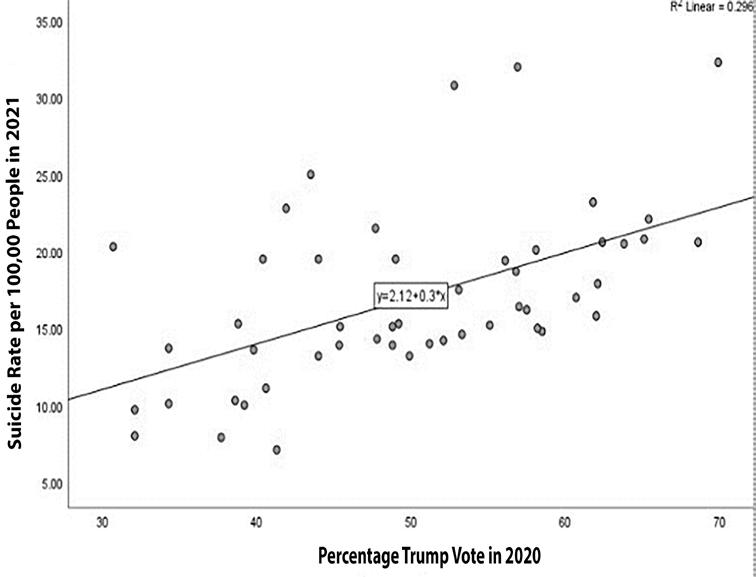
Figure 2 is a bivariate regression analysis that displays a positive relationship between the crime rate per 100,000 people and the suicide rate per 100,000 people in 2019. An r-squared value of 0.139 indicates that the crime rate per 100,000 people explains 13.9 percent variance in the dependent variable of the suicide rate per 100,000 people in 2019. The regression line is equal to y=9.94+2.78E-3*x. The y-intercept explains that if there were no crime, the suicide rate would decrease by 9.94. The slope of the regression line explains that for every point increase in the crime rate, the suicide rate increases .00278.
Figure 2: Scatterplot of the Crime Rate per 100,000 people and the Suicide Rate in 2019
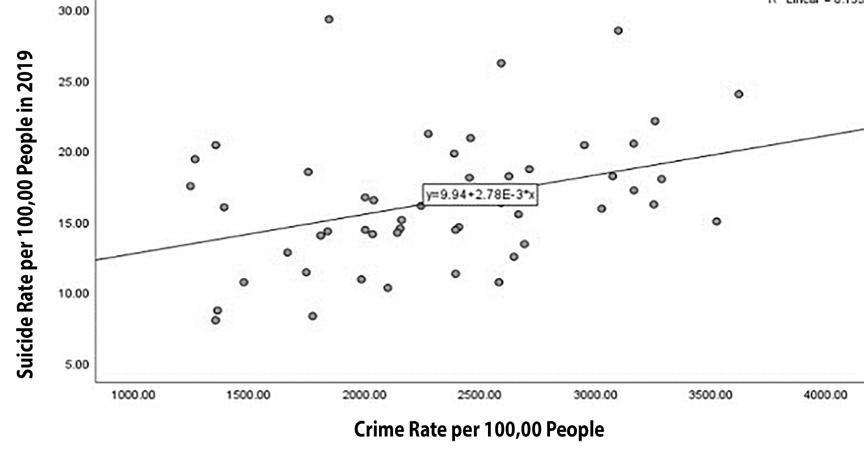
Figure 3 is a boxplot that shows the suicide rate in 2019 by region. The boxplot displays the median values of each region. The northeast has a median of 9, the midwest has a median of 12, the south has a median of 16, and the west has a median of 13. The west is the only region that has an outlier, and it is California, which had a suicide rate of 10.70. The highest suicide rate can be found in the western region. The lowest suicide rate can be found in the northeast. The midwest and the south had similar suicide rates.
Figure 3: Region and the 2019 Suicide Rate
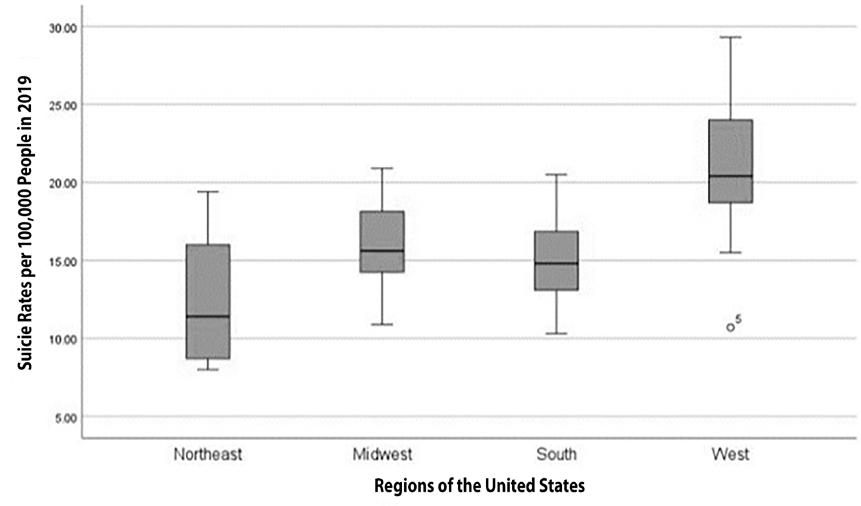
Figure 4 is a boxplot that shows the suicide rate in 2021 by region. The boxplot displays the median values of each region. The northeast has a median of 9, the midwest has a median of 12, the south has a median of 16, and the west has a median of 13. The west is the only region that has an outlier, and it is California, which had a suicide rate of 10.10. The highest suicide rate can be found in the western region. The lowest suicide rate can be found in the northeast. The midwest and the south had similar suicide rates.
Figure 4: Region and the 2021 Suicide Rate
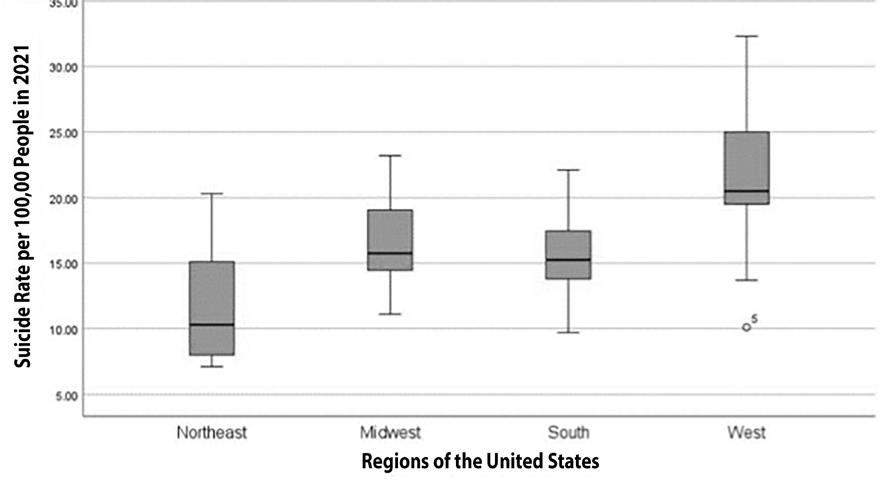
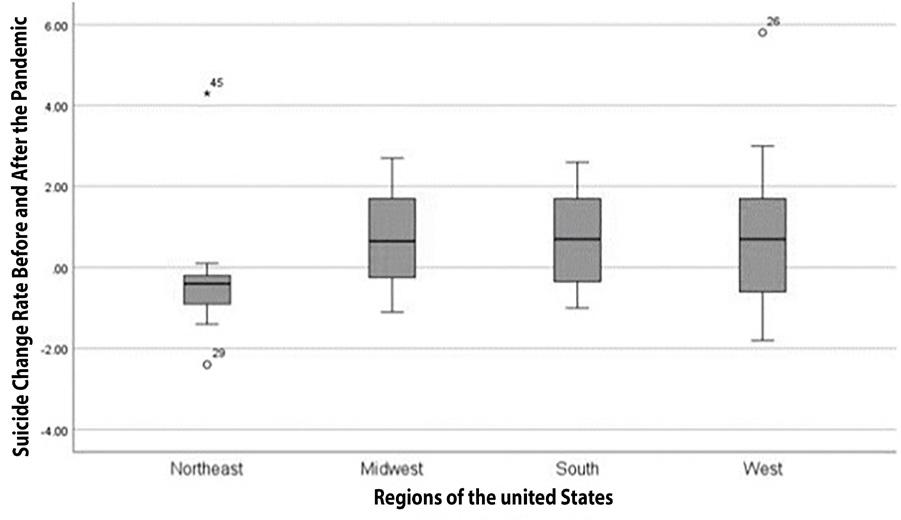
Figure 5 is a boxplot that shows the suicide change rate before and after the pandemic. The boxplot displays the median values of each region. The northeast has a median of 9, the midwest has a median of 12, the south has a median of 16, and the west has a median of 13. The northeast had two outliers, which were New Hampshire and
Vermont. New Hampshire had a change rate of -2.40, while Vermont had a change rate of 4.30. The west also had an outlier, which was Montana. Montana had a change rate of 5.80. The highest suicide change rate can be found in the west. The lowest suicide change rate can be found in the northeast. The midwest and the south had similar suicide change rates.
Figure 5: Region and the Suicide Change Rate
The multivariate regression analysis in Table 3 reveals that independent variables explain 64.3 percent of the variance in the 2019 suicide rate. The multivariate regression analysis also revealed that the crime rate, percentage of the population unemployed, percentage of the population with a bachelor’s degree, gun restrictions, and percentage of the population aged 25 to 64 were not statistically significant. The percentage Trump votes was significant at p<.05. The amount of state mental health agency expenditures per capita and population density was significant at p<.01. As population density decreases, the suicide rate increases. As the amount of state mental health agency expenditure per capita increases, the suicide rate also increases. As the percentage of Trump votes in 2020 increases, the suicide rate also increases.
Table 3: Multiple Regression Analysis 2019 (Pre-Pandemic)
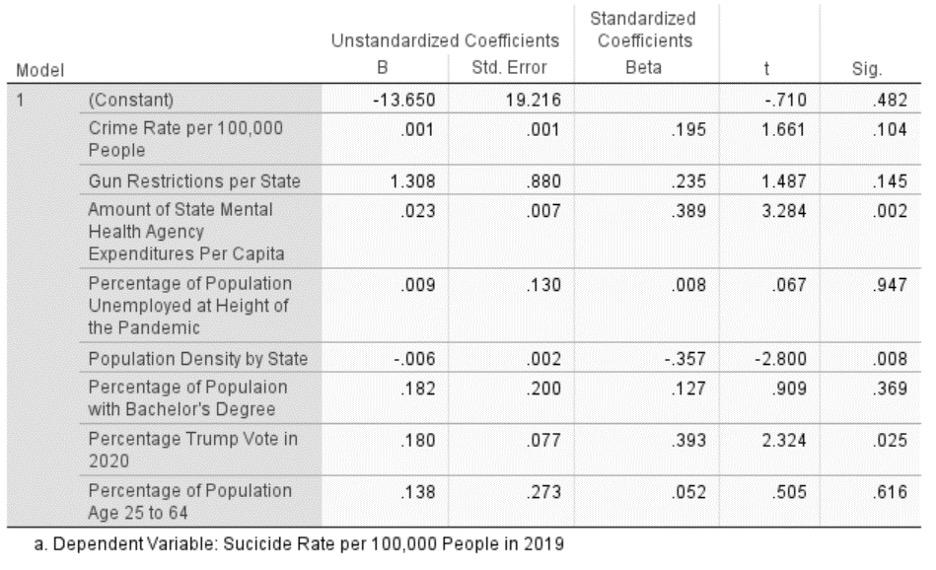
R-squared=.643 N=50 *p<.05, **p<.01
The multivariate regression analysis in Table 4 reveals that the
independent variables explain 67 percent of the variance in the 2021 suicide rate. The multivariate regression analysis also revealed that the crime rate, percentage of the population unemployed, percentage of the population with a bachelor’s degree, percentage of the population aged 25 to 64, and gun restrictions were not statistically significant. The Trump vote was significant at p<.05. The amount of state mental health agency expenditures per capita and population density was significant at p<.01. As population density decreases, the suicide rate increases. As the amount of state mental health agency expenditure per capita increases, the suicide rate increases. As the percentage of Trump votes in 2020 increases, the suicide rate increases.
Table 4: Multiple Regression Analysis 2021 (Post-Pandemic)
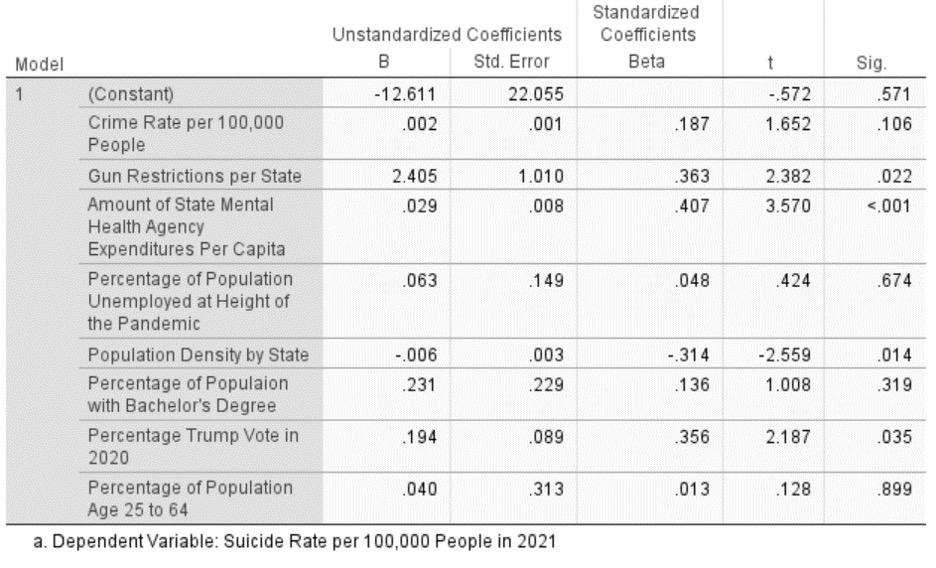
R-squared=.67 N=50 *p<.05, **p<.01
The multiple regression analysis in Table 5 reveals that the independent variables explain 37.4 percent of the variance in the suicide change rate before and after the pandemic. Table 5 revealed just one statistically significant variable. As states become less restrictive on guns, the change in the suicide rate increases.
Table 5: Multiple Regression Analysis of the Suicide Rate Change
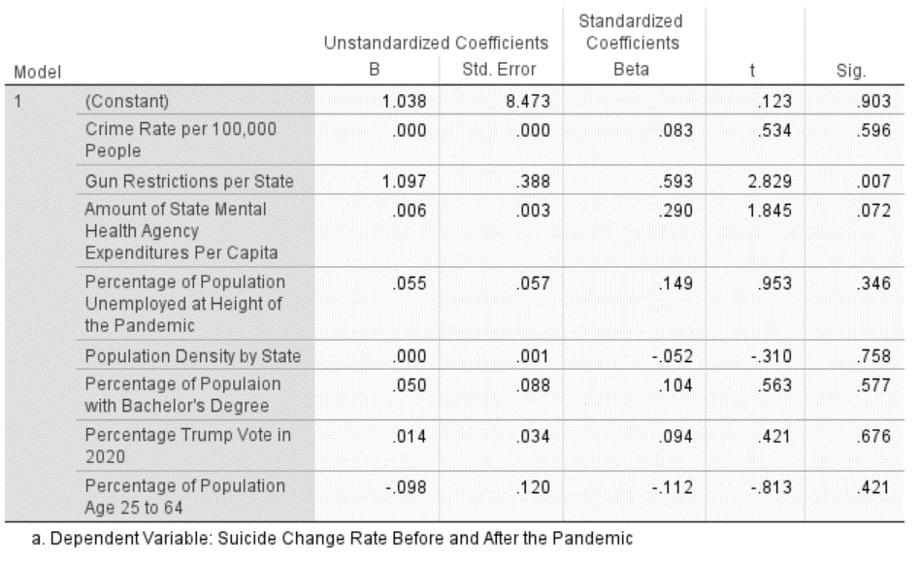
R-squared=.374 N=50 *p<.05, **p<.01
Conclusion
The results of this study found support for H3 (as the gun restrictions increase, the suicide rate will decrease) in relation to the change in the suicide rates from 2019 to 2021; and H6 (as the population density decreases, the suicide rate will increase) for the suicide rates in 2019 and 2021. A decrease in suicide rates was witnessed as states became more restrictive on gun laws, while an increase in suicide rates was witnessed as the population density decreased. Support for H1 (as the percentage of the vote for Trump increases, the suicide rate will increase) was found in the suicide rate of 2019 and 2020, but not for the change variable of the suicide rate.
This study rejects H4 (as the amount of state mental health agency expenditures per capita increase, the suicide rate will decrease) as the opposite was found. In both the 2019 and 2021 suicide rate, the opposite of the hypothesis was found. This was not as significant in the change variable of the suicide rate.
On the other hand, this study accepts the null hypothesis for H2 (as the crime rate increases, so will the suicide rate), H5 (as the percentage of population unemployed at the height of the pandemic increase, the suicide rate will increase), H7 (as the percentage of the population with a bachelor’s degree increases, the suicide rate will decrease), and H8 (as the population percentage age 25 to 64 decreases, the suicide rate will increase).
The boxplot findings on regions found interesting results for all dependent variables. The west demonstrated the highest median value for each dependent variable, while the northeast had the lowest median on each variable. California stood out in both 2019 and 2021 as a significant outlier for its region.
Significantly, support for H6 (as the population density decreases, the suicide rate will increase) was important for this study. As previously stated, suicide rates have historically been lower in urban areas than in rural areas. Support for H3 (as the gun restrictions increase, the suicide rate will decrease) relates to state policies and gun laws. The results of this study suggest that gun control regulations can reduce suicides rates based upon an analysis of those rates across the American states before and after the pandemic. Even though H1 (as the percentage of the vote for Trump increases, the suicide rate will increase) was not significant in the change variable, it still showed evidence of a relationship between state political culture and the suicide rate in 2019 and 2021. This is extremely intriguing because Republican support tends to be higher among residents of rural areas and in states with less restrictive gun laws. When looking at the results, this is significant since it shows a potential relationship between the variables that were statistically significant in this study.
In future studies, it would be more intriguing to take a qualitative approach and utilize survey research to measure people’s feelings and attitudes during the pandemic. Future research should look into other independent variables such as different age groups, income levels, race, levels of religiosity, rates of therapy visits, and more crime data. Additionally, I would propose that future researchers explore the change variables more extensively across states while incorporating new independent variables. Furthermore, it would be intriguing to investigate particular states such as Wyoming, which has the highest suicide rate in the United States, and California and New Jersey, which have the lowest rates of suicide.
References
American Addiction Centers Editorial Staff. (2023). Mental Health Spending By State Across the US. American Addiction Centers. Retrieved from https://rehabs.com/ explore/mental-health-spending-by-state-across-the-us/ Boor, Myron. “Effects of United States Presidential Elections on Suicide and Other Cases of Death.” American Sociological Review, vol. 46, no. 5, 1981, pp. 616–18. JSTOR, https://doi.org/10.2307/2094942. Accessed 24 June 2025.
CDC. (2023). Stats of the states. Retrieved from https://www.cdc.gov/nchs/pressroom/ stats_of_the_states.htm
Classen, Timothy J., and Richard A. Dunn. “The Politics of Hope and Despair: The Effect of Presidential Election Outcomes on Suicide Rates.” Social Science Quarterly, vol. 91, no. 3, 2010, pp. 593–612. JSTOR, http://www.jstor.org/stable/42956420.
CNN. (2020). Election Results. Retrieved from https://www.cnn.com/election/2020/ results/president
Georgia Department of Public Health. (2023). Understanding the Opioid Epidemic. Retrieved from https://dph.georgia.gov/document/document/cdc-han-00438pdf/ download
Hicks, Vitro, Johnson, Sherman, Heitzeg, Durbin, & Verona. (2023). Who bought a gun during the COVID-19 pandemic in the United States? National Institutes of Health. Retrieved from https://www.ncbi.nlm.nih.gov/pmc/articles/PMC10464976/
Katella, K. (2021). Our Pandemic Year—A COVID-19 Timeline. Yale Medicine. Retrieved from https://www.yalemedicine.org/news/covid-timeline
Katella, K. (2020). Taking Your ‘Mental Health’ Temperature During COVID-19. Yale Medicine. Retrieved from https://www.yalemedicine.org/news/mental-healthcovid-19
Kohrt, B. (2022). Impact of Social Isolation during the COVID-19 Pandemic on Mental Health, Substance Use, and Homelessness. National Institutes of Health. Retrieved from https://www.ncbi.nlm.nih.gov/pmc/articles/PMC9566547/
Paul, J., & Coakley, T. (2023). State Gun Regulations and Reduced Gun Ownership are Associated with Fewer Firearm-Related Suicides Among Both Juveniles and Adults in the USA. ScienceDirect. Retrieved from https://www.sciencedirect.com/science/ article/abs/pii/S0022346823000076
Phillips, J., & Hempstead, K. (2017). Differences in U.S. Suicide Rates by Educational Attainment, 2000-2014. PubMed. Retrieved from https://pubmed.ncbi.nlm.nih. gov/28756896/
Shaw, M., Dorling D., Davey Smith G. “Mortality and political climate: how suicide rates have risen during periods of Conservative government 1901-2000.” Journal of Epidemiology and Community Health (1979-) , Oct., 2002, Vol. 56, No. 10 (Oct., 2002), pp. 723-725 https://www.jstor.org/stable/25569811
Sher, L. (2020). The impact of the COVID-19 pandemic on suicide rates. QJM: An International Journal of Medicine. Retrieved from https://academic.oup.com/ qjmed/article/113/10/707/5857612
Statista. (2020). Crime rate in the United States in 2020, by state. Retrieved from https:// www.statista.com/statistics/301549/us-crimes-committed-state/
Stone, D., Jones, C., & Mack, K. (2021). Changes in Suicide Rates — United States, 2018–2019. National Institutes of Health. Retrieved from https://www.ncbi.nlm.nih. gov/pmc/articles/PMC8344989/
COVID
The Annie E. Casey Foundation. (2023). Data Center. Retrieved from https://datacenter. aecf.org/
U.S. Bureau of Labor Statistics. (2023). COVID-19 Economic Trends. Retrieved from https://data.bls.gov/apps/covid-dashboard/home.htm
U.S. Bureau of Labor Statistics. (2022). Labor Market Dynamics during the COVID-19 Pandemic. Retrieved from https://www.bls.gov/blog/2022/labor-market-dynamics-during-the-covid-19-pandemic.htm
U.S. Census Bureau. (2023). Population Density Data. Retrieved from https://www2. census.gov/programs-surveys/decennial/2020/data/apportionment/population-density-data-table.pdf
The Scope and Nature of White-Collar Crime in The United States: A Review of Cases from the FBI’s database
on Fraud and Embezzlement
By Sabrina Maine
Faculty Mentor: Dr. Rudy Prine, Department of Criminal Justice
Article Abstract:
This article explores the concept of white-collar crime, focusing on the emergence and evolution of fraud during the COVID-19 pandemic and the prevalent issue of embezzlement in business settings. White-collar crime, a term coined by Edwin Sutherland in 1939, refers to illegal activities carried out by individuals in positions of power and respectability, typically within the context of their employment. This study analyzes 14 distinct cases, split between COVID-19 relief fraud and embezzlement, highlighting the types of crimes committed, their impacts on businesses and the government, and the legal consequences faced by offenders. Key findings show that wire fraud and contract fraud were the most common forms of white-collar crime identified, often involving small business owners misusing government aid for personal gain. The analysis of embezzlement further emphasizes the role of high-ranking employees in perpetrating financial crimes within their organizations. The article concludes with recommendations for preventing such crimes in the future, including the need for stricter oversight on government relief funds and heightened vigilance in corporate financial management.
Introduction
The term “White-collar Crime” was coined in 1939 by Edwin Sutherland, who introduced the concept as, “crime committed by a person of respectability and high social status in the course of his occupation” (Payne, 2021, p. 2-3). He was calling attention to the fact that crime can be committed by the social elite, not just the lower classes. Today, we recognize a plethora of different types of white-collar crimes as the scope of the crime keeps evolving with technological advances in hacking, phishing, and malware attacks. There are three factors that are needed to qualify a crime as white-collar. First, the context of the crime must be related to one’s employment and the perpetrator should be from an elite social and economic status. Secondly, the person’s occupation must play a central role in the crime. For example, a murder in the workplace does not constitute a white-collar crime. Last, the occupation must be legitimate. Dealing drugs is an illegitimate business, so that example would not count as white-collar crime (Payne, 2021, p. 2-3). To summarize, the person committing the crime must have a legitimate job and they must use their job to break the law.
White-collar crime is seen as an “umbrella” term due to its many sub-groups. For example, both embezzlement and identity theft can be a white-collar crime if it is in the context of the workplace. However, it is hard to tell what counts as a white-collar crime; there is no database that strictly analyzes it. This article will provide a database using a few different cases to demonstrate what constitutes white-collar crimes, the various forms of white-collar crime, and give an accurate picture of the type and frequency of white-collar crime. Then it will discuss how we can learn from these cases, white-collar crime effects, and how we can implement ways to prevent white-collar crimes in the future.
This article began as an assignment from a professor who aimed for us to develop a database on white-collar crimes, which was the topic of the course. Using the FBI database, I discovered that the most frequently reported cases involved COVID-relief fraud and embezzlement. These cases highlighted the diverse range of individuals who engage in fraudulent activities. I chose to focus on these particular cases due to my interest in the topic and the varied profiles of white-collar criminals. The original intent was to include more cases, however, in order to meet the deadlines of the course, a decision was made to stop at 14. This allowed for a sufficient sample size to examine both the similarities and differences in the crimes committed, without overwhelming the scope of the research.
Case Summaries
Fraud via COVID-Relief Programs
Our first set of cases involve fraud related to COVID-19. This is
an important economic issue as noted by Amanda Stapleton, a faculty member of Science in Financial Crime at Utica University. Explaining how the pandemic has affected business fraud, she writes, “In a recent Association of Certified Fraud Examiners (ACFE) study, 77% of participants said that fraud has increased since the pandemic started and that they anticipate this tendency to continue” (Stapleton, 2022, p. iii). Since there was an increase in government aid (COVID-19 relief) to Small Business Association (SBA) programs like EDIL (Economic Injury Disaster Loans) and PPP (Paycheck Protection Program), they were abused and defrauded. An estimated total of $25 billion was expected to have been stolen from the government from these programs (Stapleton, 2022). Stapleton elaborates further, “The government assisted 62% of enterprises, comprising roughly $5.2 million in the Paycheck Protection Program (PPP) loans with a combined value of over $525 billion. Due to the unusually high number of recipients and the scant scrutiny of applications, fraudsters could take advantage of the system and get ‘free money’ for their benefit” (Stapleton, 2022, p. 3). In a time when small businesses needed help the most, a portion of them got greedy and took advantage of the system. The combination of easy accessibility to these loans and high number of recipients further shows why such a high amount of crime occurred and money stolen. To elaborate, here are seven examples of wire fraud and/or contract fraud via COVID relief funds to analyze the similarities and differences of the crimes.
Lancaster man sentenced for COVID relief fraud
Our first set of cases involves fraud related to COVID; this is an important issue as noted by the FBI’s website. Two brothers from Lancaster, NY committed bank and wire fraud by filing fraudulent loan applications to a COVID relief fund program. PPP was meant to forgive payroll debt for businesses that could not support their payroll costs post-COVID. Larry Jordan, according to court documents, submitted eight fraudulent PPP applications on behalf of companies he and his brother owned or controlled. These applications stated that the company 5 Stems Inc. (owned by Jordan) had 194 employees and over $200,000 in payroll. In reality, only nine employees were working there and had less than $54,000 in payroll deposited. Some of the money was used for the defendants’ own investments, as well as personal expenses and home improvements. Larry Jordan has been sentenced to 18 months in prison. His brother Curtis Jordan has been convicted and awaits sentencing.
Spokane Dermatologist Indicted for Using Approximately $1.5 Million in COVID-19 Relief Funds to Buy Arizona Home, Sports Cars, and Other Properties
In this case a dermatologist was caught fraudulently obtaining and
using approximately $1.5 million in COVID relief funds to purchase luxury sports cars, buy real estate, and pay off personal debt. When President Biden signed the CARES Act (Coronavirus Aid, Relief, and Economic Security) it provided several programs through which eligible small businesses could request and obtain relief funding intended to mitigate the economic impact of the pandemic for small and local businesses. William Philip Weschler abused the CARES Act when he used a loan from the act that was meant for legitimate business expenses rather than for his personal enrichment. He was indicted by a grand jury for these fraudulent charges.
Lehigh Acres Man Indicted for COVID Relief Fraud
The CARES Act supported an Economic Injury Disaster Loan (EIDL) that could be used to provide economic relief to small businesses postCOVID. This loan could be applied to any normal operating expenses like rent, payroll, utilities, etc. Thakur Sukhdeo faces a maximum penalty of 30 years for fraudulently collecting EIDL revenue for his personal enrichment. His company J.R. Handyman Pro’s LLC was registered to receive $414,000 from EIDL, but the payments went to a luxury car and truck in his name. His indictment led to many counts of wire fraud and illegal monetary transactions.
First Feeding Our Future Defendant Sentenced to 12 Years in Prison
A popular COVID support program called “Feeding Our Future” has reportedly been abused by Mohamed Ismail, the owner and operator of Empire Cuisine and Market LLC. His restaurant participated in creating false documents claiming that they had served a certain number of meals to in-need children and had used their restaurant’s resources to do so. The Feeding Our Future program, created due to the COVID-19 pandemic, would then reimburse the restaurant for serving meals to underserved children. Each of the rosters given to the program by Ismail were fabricated by using fake names. Judge Brasel of the US District court of Minnesota had this to say in court, “The taxpayers in Minnesota are rightfully outraged by the brazenness and the scope of [Ismail’s] crime. The evidence at trial was frankly breathtaking.” Overall, Ismail received $40 million in fraudulent Feeding Our Future funds. This will result in 144 months in prison and half a billion dollars in restitution.
Baltimore woman pleads guilty to COVID fraud
In Baltimore, Maryland, a woman named Nina Williams has pled guilty to wire fraud. Within her crimes she had falsified applications for both PPP COVID-relief loans and EIDL on behalf of Nimiche Inc. and Nimiche Interiors Inc. Both applications were accepted by
the PPP, and the businesses received just over half a million in loans. However, Williams pocketed every cent the government gave her for the businesses into personal-related expenses and not to the company’s payroll. She collaborated with a small team to submit more fraudulent PPP and EIDL loan applications to another bank. In total, she made at least $1.5 million from both loans. She faces a maximum penalty of 20 years in prison and $250,000 in restitution.
Businessman Pleads Guilty to Theft of Pandemic Relief Funds
Jesse Lelievre was the owner and manager of one of these small businesses who applied for the loan. This business was named “Paramount Plumbing & Heating LLC.” To obtain the loan, Lelievre met with the SBA and drafted an agreement to use the loans for the working capital of his business; this can include payroll, rent, utilities, etc. However, he directed funds he applied for into his personal accounts to buy items like a diamond ring and home decor. Due to this misappropriation of COVID-19 relief funds he will end up in prison. The sentence has not yet been announced; however, he has pleaded guilty. On May 17th, 2021, the Attorney General established the COVID-19 Fraud Enforcement Task Force in Massachusetts to enhance efforts to combat and prevent pandemic-related fraud such as this one.
Indianapolis Woman Sentenced to Prison for Submitting Fraudulent COVID-19 Relief Loan Applications
Not only are businesses using COVID-19 relief aid for their personal benefit, but people from the government are helping them do it, with a small fee, of course. Antranette Echols has recently been sentenced to prison for 12 months and a day due to her contributions to COVID-19 relief fraud. Echols worked for the SBA (Small Business Administration) and submitted falsified COVID-19 relief loans on behalf of the business borrowers and was given a fee in exchange for her work. She was ordered to pay $373,690 to several financial firms and the SBA, who were the victims of this fraud upon her conviction. Her sentence had not been given yet, but the highest sentence for wire fraud is anywhere from twenty to twenty-five years. Since she has used her legitimate job to commit an illegal act for personal gain, this qualifies as whitecollar crime.
Fraud embezzlement
Our other set of cases involves embezzled funds. Embezzlement is the act of stealing money from your company by using false financial reporting, lying about assets, and “cooking the books” (Payne, 2021). A research paper written by Ha-yeon Park (et al.) states that “60% of corporations filed for bankruptcy after suffering from embezzlement.” This means many companies are dying due to the rise of embezzlement
even among small businesses. There are many factors at play when discussing why embezzlement happens. A large portion of the fraudsters have a prominent position in their company (Park et al., 2017, p. 376). This is mainly because to get away with the false reporting, falsified checks and deposits, and “cooking the books” you must have access to those financial systems. Only those in higher positions have the opportunity to do such things and hide the evidence.
The fraud triangle is a model that explains the three parts of committing fraud: pressure, opportunity, and rationalization (Crumbley et al., 2021). To summarize, the process of committing fraud includes mental motivation to do so, an opportunity to cheat the system, and justifying the act to suppress guilt before they commit the crime. Other similar fraud models add ego as another main factor and according to research the majority of people who embezzle do use the money for personal gain (Crumbley et al., 2021). This model does a good job of explaining why embezzlement happens. Looking at the data, we can see the fraud triangle unfolding on a lot of the CEO/CFO/business owners and accountants who commit it. The correlation between high-position employees and the rate of embezzlement is furthered in the following seven case summaries.
Former CFO Sentenced to 41 Months in Prison for Embezzling $2 Million
Our second set of cases involves embezzling; this is an important issue as noted by the FBI’s website (2016). Between approximately January 2019 and January 2024, Richard Zellner, the former CFO of a minor company in St. Louis Missouri, had been using his employer’s bank accounts to pay off personal credit card debt. His expensive lifestyle added up quickly by purchasing vacations, travel tickets, gold, and precious metals, so that when the charges would go above $1000 on his credit cards, he would use his position to make his business pay for it. He would cover up his theft by creating fake work orders and bills on the company’s accounting records. Since he was the CFO, he had access to all of the financial statements and had the influence of his position to not get caught. Zellner had spent over $2,000,000 in fraudulent transactions through his business. He pleaded guilty in August 2024 to one count of wire fraud.
Former Chief Executive Officer of Chicago Hospital Added to Federal Indictment Alleging Corruption and Embezzlement
A Chief Executive Officer of Chicago hospitals has recently been alleged to have embezzled money from his hospital. According to the indictment, George Miller had been conspiring with other hospitals to steer vendor contracts to certain medical supply companies in exchange for cash from the vendor companies’ owner Sammer Suhail. Basically,
he was getting a kickback for recommending a certain vendor to smaller companies. Furthermore, the hospital had been issuing payments to those same vendor companies for goods and services that they knew were not being provided. As it turns out many of these vendor companies were created by Suhail and the deposits went directly into his pocket. Suhail had been indicted earlier the same year for embezzlement and money laundering on separate charges. However, Miller continued to work with them to receive his kickbacks for supporting Suhail’s fraud. Suhail paid Miller a share of $19 million in payments that he received from the hospital in return for Miller and Ahmed steering those contracts and business to him. Although there is no conviction yet, the evidence against him is considerable. Currently he is waiting for court.
Former Health Care Manager Sentenced to Prison for Embezzlement Scheme
In the health care field, it is of the utmost importance to focus on the quality of care for your patients; however, Emiliya Radford of Warner Robins, Georgia, decided that one thing was more important: money. She was an office manager of Smith Spinal Care Center (SSCC) and had the responsibility of issuing and signing all the bi-weekly checks, including her own. She had a side business of her own as well, Cyber Pinecone, a marketing company. Without the permission of her employers, she wrote and endorsed Cyber Pinecone for marketing work for around $200,000 and gave herself an unauthorized pay raise. She also used the company’s bank account to buy Apple products shipped directly to her house. The company filed for EIDL loans, the COVID-19 loans to small businesses, and a large portion of those funds ended up in Radford’s pocket. In the end, her embezzlement scheme cost the company $200,000 in losses and they had to shut down indefinitely. Radford will pay $298,000 in restitution and serve 66 months in prison.
Falmouth Woman Pleads Guilty to Embezzling More Than $1.3 Million
In the small town of Falmouth Massachusetts, a bookkeeper at a local flooring company pleaded guilty to embezzling one million dollars from her employer. She would write checks to herself from her employer’s bank account and would hide the evidence by not reporting any of the checks in the financial statements. By excluding the funds she embezzled from tax sheets there was a tax loss of $353,000. Due to her actions, she was indicted with wire fraud and filing false tax returns. She then pled guilty, facing up to 25 years in prison and half a million in fines on her sentence; however, the final sentence has not been reported yet.
Anderson Accountant Sentenced to Over Three Years in Federal Prison for Embezzling Nearly One Million Dollars from his Employer
A resident of Anderson, Indiana, Nathaniel Wills, was employed as an accountant and Director of Administration for a business located in the same state. Wills has pleaded guilty to embezzling from his employer. For six years he worked as an accountant for the firm and had been entrusted to perform business with the utmost ethics. However, using his position, he falsified many inventory logs, listed jobs as “unpaid” to earn double, and transferred money to himself from the company, hiding it in fake invoices. Through 120 transactions he stole just less than one billion dollars from Anderson, which resulted in substantial financial hardships for the company. He worked solo and used the money to pay for his gambling. He has been sentenced to 41 months in prison and ordered to pay $877,507 in restitution.
South
Carolina Woman Pleads Guilty To $1.7 Million Embezzlement Scheme
In this case, Ms. Kristen Turney pleaded guilty to embezzling more than $1.7 million via wire fraud. According to documents from the courthouse in Catawba, South Carolina, Turney defrauded her employer to attain the illegal funds. She had access and control over her company’s financial statements and would write checks to herself from them without authorization or approval. At least 1000 checks were written to her before she was caught. She then tried to cover up her accounting by making false entries into her company’s records and lied to her employers about the missing money. The money she wired herself was used for personal expenses like tuition, vacations, mortgage payments, and many shopping trips. Her sentence is not out but she faces up to 20 years for wire fraud and over a quarter of a million dollars in fines.
Former Takeda Employee Sentenced to Nearly Four Years in Prison for $2.5 Million Embezzlement Scheme
Priya Bhambi, a senior employee from Takeda Pharmaceutical Company Limited has recently been sentenced for her part in embezzling by her employer. Because she was a senior-level and highly compensated employee, she planned a complex financial fraud scheme to steal thousands more for her personal gain. To do this she created a fake consulting business called “Evoluzione,” incorporated it, and then submitted a statement of work to Takeda stating that “Evoluzione” had done a service for them worth $3.5 million. Then she sent payments for fake invoices made by herself and a co-conspirator. In total, $2.3 million was defrauded from Takeda into the personal hands of Bhambi
and her co-conspirator. This was not the first time Bhambi used sham companies to funnel extra money into her accounts; a previous scheme earned her $300,000 for consulting services never provided. The Acting United States Attorney Joshua Levy had this to say about Bhambi’s sentencing, “The sentence sends two strong messages—first, there are very serious consequences for executives who exploit their positions to line their own pockets and second, for companies who are victims of embezzlement, law enforcement stands ready to do whatever it can to recoup stolen funds and hold individuals accountable for fraud against their employers.” She was sentenced to 46 months in prison with a restitution bill of $2,585,480.
Analysis
Overall, I have covered 14 cases, seven covering COVID-19 relief fraud and the other seven covering embezzlements. In all of these cases, we can see that the fraudsters are using their legitimate jobs to break the law. Therefore, they constitute white-collar crime. The effects of the crimes caused millions of dollars to be stolen from companies and businesses. People have been fired or lost their jobs due to this crime, and the government has been taken advantage of—which can limit how much they will allow for future relief loans and increases in application regulations. According to Occupational Fraud 2024: A Report to the Nations, there are three types of occupational fraud (crime in the workplace) and they are asset misappropriation, corruption, and financial statement fraud. Throughout the COVID Relief fraud and embezzlement cases, we saw a lot of asset misappropriation which refers to the money that was meant to keep the business running but was funneled into the pockets of the employees. 89% of all fraud cases are asset misappropriation cases and they result in a medium rate of $120,000 per case (Warren, 2024). These crimes are similar due to their nature of fraud; however, they are different due to the method of stealing. The COVID-Relief cases received their money from defrauding the government while the embezzlers took it from their own company. The most common white-collar crime was by far wire fraud. Wire fraud was used to transfer funds from every embezzlement case and every small business to their personal accounts for their personal use. Contract fraud was also exceedingly high in the cases I analyzed because they had to forge documents to receive funding, which in turn caused charges for contract fraud. These crimes varied from small to massive scales.
Focusing on the COVID-19 relief case summaries, I have noticed a few trends. Of course, all of them were small businesses because the relief loans were targeted towards the SBA (Small Business Administration). To apply for relief loans, businesses were required to have the owner/manager sign off on it, so, as a result, everyone who
was guilty of fraud had to be the owner/manager or had to commit it with their knowledge (Stapleton, 2022). Almost all of the cases I read involved one person committing wire fraud to his/her account, and in all the cases I reported, the fraudster was the owner/manager. All the funds recorded went to payments for luxury items or personal payments, so this was outright corruption which is defined as “the use of political power or influence in exchange for illegal personal gain” (Payne, 2021). The influence that the owners/managers had on their businesses gave them the ability to corrupt it. There are many ways we can limit government relief loan fraud, but not while also allowing it to be easier for businesses to have access to money. You must pick one or the other. As mentioned before, certain task forces have been formed to monitor relief funds and prevent fraud. These work as both a preventative and detective measure towards white-collar crime.
Gender and/or race did not play much of a part when it comes to COVID-19 fraud, however, almost all of them had to be old enough to be the owner themselves so early 30s-late 50s was the average range. The total amount of money involved in these cases ranged from $200,000 to $40 million. The fines paid by the fraudster would only end up being a fraction of the money they stole, which makes sense because they could not possibly pay all of it back if the government took away all their stolen money and they no longer had a job. When someone was found guilty of a crime, the full time that they could have been sentenced to was never given; this is the same among many white-collar crimes of varying severity. Since white-collar crime is not seen as violent, the fraudster is usually only given 1-4 years instead of the full 20-25 years that the law allows.
Throughout the embezzlement cases I noticed two different trends. Either the embezzler was the CEO/CFO/manager, or the embezzler was the head accountant of the business. According to Ha-Yeon Park (et al), “Of 284 embezzlement cases that occurred between 2005 and 2012, the CEO is involved in 181 cases” (Park et al., 2017, p. 384). To get away with embezzlement you must have access to the money and hide the evidence (Park et al., 2017). Only those with a high enough position could do that, so they are more likely to embezzle than a low-level employee. When the operation is on a larger scale with a bigger business or company, I have found that more than one person would be involved in wire fraud (embezzlement). In contrast, if the business was on a smaller scale, then only one person would be in on the embezzlement. The number of victims varied depending on the company. However, these crimes affected whole corporations and did not target anyone individually. The lowest amount of money stolen from a company via embezzlement was $200,000 and the highest amount was around $19 million. The highest someone can be sentenced to for wire fraud is 20-25 years (depending on state), but the highest sentence given was
49 months (around 4 years). This is still a long time, however, if the crimes are as bad as the state says they are, then given the low sentences, deterrence from the crime is not going to work.
Deterrence theory is “based on the assumption that punishment can stop individuals from offending if it is certain, swift, and severe” (Payne, 2021). This theory should work greatly on white-collar criminals because these people are supposedly rational thinkers who are placed high in society with jobs, homes, and most of the time, families. If they know the punishment for their crime is going to certainly be over 20 years, the rate of crime would likely plummet. Furthermore, when the punishment does not match the crime, in this case punishment is far less than the crime, then it will not do a good job at preventing other people from doing the same thing.
When observing if justice was served in these cases, the criminals were given sufficient punishments for their crimes to an extent. However, the full sentence was never given in these cases, which could downplay the severity of being a white-collar criminal. Some people can rationalize stealing millions of dollars for less than 5 years in prison if it pays for their kids’ tuition and/or gets the family out of debt, but 20-25 years is almost unthinkable. The infamous case of company Enron, which includes major accounting fraud and embezzlement scams, the CEO, Jeffrey Skilling, was sentenced to 24 years following his conviction. This is a perfect example of general deterrence in white-collar crime. General deterrence is used to prevent everyone from committing a crime, while specific deterrence is used to prevent that particular person from committing the crime again. Since Skilling got away with so much and put millions in his pocket, he received a high sentence to be used as a deterrent for others who were doing the same. His case was a breakthrough in the white-collar crime field because it showed that even though these criminals have money, are high in society, and have connections, they can still be fully prosecuted. However, in less public cases, no one seems to be charged with such a high sentence. There are many arguments on whether white-collar crime should be punished up to the 20-year mark. Of course, it should mainly depend on how many people are affected by the crime and how much money is stolen. But many of these cases involved counts of fraud that, since the media did not have their eye on it, did not result in high punishments.
Conclusion
Even though white-collar crime is not a violent crime, it is one of the most dangerous overall. As the blockbuster movie The Big Short, which details the bank fraud of the 2008 recession put it: “When the unemployment rate increases by 1%—40,000 people die.” White collar crime has such a huge influence on society because of the amount of money that is taken. It destroys businesses, families, and as the
2008 recession proves, can lead to thousands of people becoming homeless. It is a crime that needs to be taken more seriously by people and prosecuted like they affected people’s lives not just lost money. “Preventing fraud from occurring in the first place is the most costeffective way to limit fraud losses” (Warren, 2024). Some of the most common ways to implement prevention is to ensure proper auditing is taking place within the company and that separation of duties occurs among those employees with control over the accounting access (Warren, 2024).
The fraud triangle could be used as an indicator for white-collar crime behavior; however, by itself, it cannot prevent white-collar crime, only aid in detecting it. In discussing how to improve the system we have to think about how different white-collar criminals are from traditional criminals and what would work better to cater to their rehabilitation. In a research journal by Dr. Vijaykumar Chowbe, he states the following about the future in fighting white-collar crime (WCC), “. . . despite the fact that most of the proceedings of the WCC have been initiated, executed, and criminal proceedings, the WCC needs a different and more stringent treatment and its affect and impact seriously on the social morality and economic fabric . . . it has been held that while considering bail involving socio-economic offenses, stringent parameters should be applied” (Chowbe, 2024, p. 19). Furthermore, embedding a culture of transparency and accountability among companies can be accomplished by being aware of the fraud triangle and characteristics needed to form a white-collar criminal, applying higher sentences to white-collar criminals for deterrence, and increasing government regulations will prevent white-collar crime from happening.
Citations
Chowbe, Vijaykumar Shrikrushna. (2024, March 16). Redefining the Fight Against White Collar Crime: A Moral and Value-Centric Perspective. Available at SSRN: https:// ssrn.com/abstract=4761381 or http://dx.doi.org/10.2139/ssrn.4761381
Crumbley, D. L., Fenton, E. D., Smith, G. S., & Heitger, L. E. (2021). Forensic and investigative accounting. Wolters Kluwer. FBI. (2016, May 3). News. FBI. https://www.fbi.gov/investigate/white-collar-crime/news McKay, A. (2015). The Big Short. Paramount Pictures. Payne, B. K. (2021). White-Collar Crime (3rd ed.). SAGE Publications, Inc. (US). https:// reader2.yuzu.com/books/9781071833926
Park, H., Lee, A., & Chun, S. (2017). Asset Embezzlement and CEO Characteristics. Google Scholar. http://kmr.kasba.or.kr/xml/25559/25559.pdf
Stapleton, A. (2022). The Financial Fraud Epidemic and How It Has Changed Business Fraud. Utica University ProQuest Dissertations & Theses.
Warren, J. (2024). Occupational fraud 2024: A report to the nations. Association of Certified Fraud Examiners. https://vsu.view.usg.edu/content/enforced1/3228983CO.510.ACCT3100.26514.20254/VSU_eDegree_Course_Content/Module%20 5/2024-Report-to-the-Nations.pdf?isCourseFile=true&ou=3228983
Una ventana a la realidad femenina en la literatura hispana / [A Window to the Feminine
By Meghan Barnett
Reality in Hispanic Literature]
Faculty Mentor: Dr. Ericka Parra, Department of Modern and Classical Languages
Resumen:
Los temas y opiniones sobre la identidad estudiados en la literatura Hispana reflejan las percepciones de la cultura y de la sociedad de cada época. La literatura hispana representa cómo su sociedad y el mundo valoran y experimentan los roles de las mujeres. La autora chilena Isabel Allende, en el cuento “Dos palabras” (1989) se inspira en un cuento chino sobre un guerrero convertido en político que es cautivado por una mujer y sus palabras, revelando cómo las mujeres son representadas a partir de la idealización que ellas experimentan. Entre otros autores y obras hispanas, el drama del chileno Sergio Vodanovic “El delantal blanco” (1956), el cuento del cubano José Martí “La muñeca negra” (1889) y el poema de la mexicana Rosario Castellanos “Kinsey Report” (1975) revelan las percepciones sociales sobre las mujeres en la sociedad a través de los personajes femeninos y los problemas que resultan de los constructos de género. Este ensayo, en español, analizará cómo se idealiza, envilece y cosifica a las mujeres a fin de invitar a los lectores a reflexionar sobre estas representaciones y contribuir al cambio de estas percepciones.
[English Translation: Article Abstract:
The themes and opinions that are present in Hispanic literature reflect the greater perceptions of the culture in which it is written and of society. In this manner, it can be seen that Hispanic literature reflects the perceptions of Hispanic society and the world regarding the value and roles of women. The Chilean author Isabel Allende in the short story “Dos palabras” (1989) tells a tall tale of a warrior turned politician who is captivated by a woman and her words, revealing one view on the role of women, the idealization that they experience. Other Hispanic authors and works, such as the Chilean Sergio Vodanovic drama El delantal blanco (1956), the Cuban José Martí short story “La muñeca negra” (1889) and the Mexican Rosario Castellanos poem “Kinsey report” (1972) reveal other perceptions of women in society and the problems that result from these perceptions. This essay in Spanish will discuss how the ways that women are romanticized, villainized, and objectified are found in the literature of Hispanic society and encourages the reader to participate in changing these perceptions
Barnett
Introducción
La literatura es una ventana. Con solo palabras, un autor puede ofrecer una perspectiva de la experiencia humana de una manera sin igual. Incluso un cuento que parece muy simple puede tener influencia social. Sin embargo, los autores que escriben con una misión o una razón específica tienen aún mayor poder. A través de las obras literarias: poemas, cuentos, novelas, y dramas, los autores transmiten sus perspectivas, sus verdades, y experiencias de vida. Pero sus relatos no terminan aquí: las personas habitan el mismo mundo y están conectadas por una experiencia compartida. De esta manera, expresan aspectos universales de la experiencia humana.
Las historias de una persona en un tiempo y un lugar determinados pueden interconectarse con alguien de otra época y otro lugar completamente distinto. El impacto y la importancia de la literatura no están limitados por su contexto histórico o geográfico; más bien, puede revelar la verdad de su pasado, presente, y futuro a la humanidad. Este es el poder de la literatura. Este poder tiene una relevancia especial respecto a la experiencia femenina. A lo largo de la historia, las mujeres han experimentado opresión, discriminación, y luchas que los hombres no han experimentado. Aunque la sociedad ha progresado, las mujeres siguen viendo reflejadas sus circunstancias en la literatura del pasado. Incluso en aquellas historias en que los autores no intentan apoyar ni cambiar las circunstancias contra la opresión hacia las mujeres, las representaciones de imágenes y personajes femeninos revelan su realidad. De manera intencional o no, la literatura ofrece un panorama de la condición femenina.
Este ensayo examina cómo la literatura hispana revela una tendencia persistente a idealizar, envilecer y cosificar a las mujeres.
A través del análisis del cuento “Dos palabras” de Isabel Allende, del drama El delantal blanco de Sergio Vodanovic, del cuento “La muñeca negra” de José Martí, y del poema “Kinsey Report” y su interconexión con los textos contemporáneos y experiencias reales, este trabajo busca fomentar una reflexión crítica que contribuya a una sociedad más equitativa y justa de la identidad femenina.
Dos palabras
En el cuento “Dos palabras”, escrito en 1989 por la chilena Isabel Allende (1942), narra la historia de Belisa, una mujer que aprende el poder de las palabras y las utiliza para salvarse de circunstancias adversas de la vida y de ser cautivada por un hombre. En la historia, las palabras de Belisa ayudan a un coronel a obtener un puesto en el gobierno y lo llevan a enamorarse de ella. Esta historia de amor muestra a una mujer empoderada, pero también idealizada. Con su habilidad y talento con el lenguaje, Belisa tiene el poder para hacer todo lo que
desea y, también, el cariño del coronel. Ella es representada como una figura dotada con habilidades sobrenaturales y como una amante: objeto de devoción.
Jorge Chavarro discute que, en este cuento, “H[h]ay dos fuentes del poder de Belisa: su belleza física [y el] poder derivado de su racionalidad en el dominio del discurso” (citado en Comfort 58). Con este comentario, el autor provee una perspectiva limitada del personaje de Belisa con características idealizadas más que de identidad completa y realista. Belisa se representa como una mujer idealizada por ser hermosa, inteligente, poderosa, sin espacio para defectos en su carácter porque la imagen de la mujer solo es definida por lo que la sociedad considera valioso. En realidad, la identidad de las mujeres es compleja, con virtudes, defectos y luchas. La idealización impone expectativas imposibles y crea una presión injusta.
¿De dónde viene la idealización? Un ejemplo de la idealización de la mujer sumisa a través del tiempo se encuentra en el cuento de hadas “La Cenicienta”, de los Hermanos Grimm. Según Micael M. Clarke, las palabras finales de la madre de la protagonista le indican que debe ser “piadosa y buena” (“pious and good”; mi trad.; 4). Estos rasgos son analizados como las virtudes más importantes para la madre. Y, Cenicienta los mantiene a pesar del abuso de su madrastra y sus hermanastras (4-5). Mientras la madrastra tiene éxito al mantener este carácter sumiso, la hijastra, al final, es tratada como un triunfo que debe recompensarse con un final feliz. Esta perspectiva resulta problemática para las mujeres por ser una idealización. La imagen de que la mujer ideal es sumisa, tierna y pasiva es una forma de idealización común que no debe reflejar la realidad de las mujeres y debe tener fin.
Desde una experiencia de la realidad, Heyder y Kortzak analizan las percepciones de las mujeres en el medio laboral y muestran cómo los estereotipos idealizados se manifiestan en la vida cotidiana. Las autoras argumentan que, “los estereotipos sobre las mujeres las describen como teniendo menos competencia y más calidez, y los rasgos que señalan la calidez son percibidos de la misma manera como femeninos” (S[s]tereotypes about women describe them as usually low(er) in competence and high(er) in warmth, and traits indicating warmth are correspondingly perceived as feminine, thus reflecting the close relationship between warmth and communion”; mi trad.; (Hyder y Kortzak 2).
Esta perspectiva demuestra que, incluso fuera de la literatura, las mujeres son o deben ser tiernas y cálidas, cualidades que se valoran como “femeninas”. Mientras las mujeres pueden tener estas cualidades, es común que ellas experimenten la vergüenza si son más fuertes y menos delicadas. La idealización limita el desarrollo auténtico de las mujeres y perpetúa la desigualdad. Las mujeres deben ser reconocidas y valoradas por su identidad y fortaleza verdadera en vez de una fantasía
social que les exige ser fáciles o agradables.
El delantal blanco
Por otro lado, las mujeres son envilecidas por la sociedad, según lo muestra la obra del teatro “El delantal blanco”, de Sergio Vodanovic (1926-2001), publicada en 1956. El drama representa cómo una mujer rica y su empleada doméstica deciden intercambiar sus roles. La trabajadora se cambia su ropa y su estilo de vida, mientras la señora usa el delantal blanco de la empleada (Vodanovic 23). En el drama se describe que la mujer rica no es una buena mujer sino una persona influenciada por su contexto social. Los lectores aprenden que la mujer rica fue forzada a una relación que no quería porque los hombres que controlaban su vida no ponían valor en su amor sino en la riqueza material y la clase social. Por lo tanto, utiliza su riqueza y sus modales para sentirse bien sobre sus circunstancias al decir: “¡Ah! Lo crees ¿eh? Pero es mentira. Hay algo que es más importante que la plata: la clase. Eso no se compra” (25). Se destaca que es pretenciosa, y que está atrapada. Aunque la actitud de la señora parece ser de villana, es una víctima del sistema patriarcal. Sus circunstancias son complejas porque ella solo es representada como envilecida mientras la trabajadora la engaña para tomar su lugar.
Carlos Gonzáles Hernández examina el reflejo de la opresión al que la mujer da continuidad en su hijo, “Con respecto al patriarcado, la señora exterioriza en la figura de su hijo pequeño, por cuanto lo inculca, constantemente, que tiene una personalidad dominante, y que, es una tradición familiar poseerla” (citado en Comfort 39). La mujer está acostumbrada a los hombres que tienen más fuerza y voluntad que ella. En el mundo de la mujer rica, los hombres hacen las reglas para las mujeres, y las mujeres deben obedecerlas. Esta perspectiva es muy importante para comprender las circunstancias de una mujer con dinero pero sin poder.
Con la mujer idealizada en los cuentos de hadas, la mujer que juega el papel de la villana es un personaje muy común. Hay ejemplos de las madrastras malas y las brujas que llenan estos cuentos simples y viejos, especialmente, cuando son comparados con los ejemplos de la presencia de los hombres malos. La Cenicienta también puede ejemplificar este tipo de mujer con su carácter limitado. Como presenta Micael M. Clarke, la madrastra de la Cenicienta es un personaje sin rasgos complejos (3-5). La madrastra es la enemiga de su hijastra; su odio sin fundamento sólo la lleva a imponerle trabajos sin valor y a utilizarla a su conveniencia (3-5). El personaje de la mujer villana tanto en los cuentos de hadas, como la madrastra villana son inexplicables. Estas imágenes solo muestran los rasgos negativos típicamente dados a las mujeres, como la envidia, la mezquindad, y la brujería. De este modo, las características débiles son típicamente usadas para los constructos de mujeres villanas en la vida real.
Sobre la tendencia de envilecer a las mujeres en la vida real, Jenny Johnston discute el caso de una mujer que experimentaba abuso sexual por su novio. La mujer lo llevó al tribunal para tener justicia (Johnston). El hombre expuso una narrativa que no era verdadera. La víctima, cuenta que él la presentaba como una villana, dudaba de su salud mental, y todavía preguntaba si estaba sufriendo de un trastorno de personalidad (Johnston). Aunque ella era la víctima del hombre, él trataba de culparla. Estas circunstancias han ocurrido casi en toda la historia; las mujeres experimentan abuso y la sociedad encuentra alguna forma de culpar a la víctima, señalándola como una villana.
La muñeca negra
En el cuento del escritor cubano José Martí (1853-1895) “La muñeca negra,” que fue publicado en 1889, provee un ejemplo de la cosificación de las mujeres que ha existido a través de la historia. En este cuento se relata el cumpleaños de una chica joven que ama a una muñeca vieja, y, aunque todos los adultos quieren que ella tenga una muñeca nueva, la chica solo quiere la muñeca vieja, la muñeca negra (Martí 5-9). La historia muestra la tendencia de la humanidad para usar a las personas, especialmente a las mujeres, desde niñas, y poner valor en ellas. Las mujeres, cuando son hermosas o serviciales, valen más para la sociedad, pero cuando crecen o se convierten en menos “valiosas” ya no son importantes. La elección de la niña desafía las perspectivas sociales. Las mujeres son tratadas como cosas que pueden ser elegidas o “tiradas” según los caprichos de la sociedad. Esther Poza Campos expresa que, “Si la muñeca nueva simbolizaba lo aparente y lo artificial, Leonor, la muñeca negra, es lo sencillo, lo humilde, lo significativo” (citada en Comfort 18). Esta cita subraya cómo las perspectivas sobre las mujeres a menudo son superficiales y no tratan a las mujeres como gente con pensamientos o sentimientos sino como objetos artificiales. Este ejemplo literario del siglo XIX se repite en experiencias reales aún en nuestros días. En su investigación sobre cosificación, Amanda Bockaj y Lucia F. O’Sullivan comparten que entre un grupo de personas entrevistados que admiten haber robado un beso, el 66% se identifica como masculino (3). Este estudio revela que la mayoría de los hombres que han hecho esta acción, y, aunque pueden ser muchas circunstancias de esta acción, hay una correlación distinta entre los hombres haciendo lo que quieren a las mujeres sin la consideración del deseo de las mujeres. Además, esta idea es global. El siguiente ejemplo muestra la cosificación en la experiencia de una mujer india. Hema GanapathyColeman relata que, “En India, su familia había estado tratando de arreglar un matrimonio para ella, pero porque ella había nacido bajo un signo astrológico desfavorable, la gente era indecisa de casar a sus hijos con ella” (“In India, her family had been trying to arrange a marriage for
her, but because she had been born under an unfavorable astrological sign, people were hesitant to have their sons marry her”; mi trad.; 2). Una vez más, las mujeres son tratadas como cosas buenas o malas para el beneficio del hijo de alguien. A la sociedad, no le importan las personalidades, las habilidades, o los caracteres de las mujeres: solo tienen valor como esposas. En la ficción y en la realidad las mujeres se representan sin agencia.
Kinsey Report
Por último, el poema “Kinsey Report”, publicado en 1972, de la escritora mexicana Rosario Castellanos (1925-1974) resume las luchas y experiencias de las mujeres y las perspectivas sociales que las han limitado históricamente. El título del poema hace alusión al informe de Alfred Charles Kinsey (1984-1956) sobre la investigación sexual humana. En este poema ejemplifica la idealización y la cosificación en el contexto del matrimonio. Con la idealización de las esposas, Castellanos explica la idea de que las mujeres, especialmente las esposas, deben someterse a los deseos de sus esposos, los hombres, diciendo, “Pero, siempre también, cedo. Por obediencia” (Castellanos 244). La voz poética se resigna a la sumisión.
En el siguiente verso, la doble moral de la sociedad demuestra que las mujeres son envilecidas: “Soltera, sí. Pero no virgen. Tuve un primo a los trece años” (Castellanos 244). Las mujeres a menudo cuando pierden la virginidad o alguien la toma reciben la culpa, son tratadas como “impuras.” Las mujeres son reducidas a sus cuerpos, son cosificadas como objetos sexuales. La voz poética menciona cómo hay expectativas de las mujeres casadas que deben “paga(r) el débito conyugal” (Castellanos 243). Este verso las reduce como objetos, especialmente objetos sexuales, frente a los ojos de la sociedad. El poema es una denuncia a la falta de humanización y agencia de las mujeres.
Conclusión
Los ejemplos literarios y las experiencias reales discutidas en este ensayo revelan la diversa y compleja representación de las mujeres en la literatura y en la sociedad. Desde la idealización de Belisa en “Dos palabras” hasta la cosificación de la mujer en “La muñeca negra” las representaciones literarias comprueban la perpetuación de estereotipos sociales. Sin embargo, el poema “Kinsey Report” también tiene un espacio para la denuncia de estas representaciones. Así, mientras hay aspectos culturales como el valor del matrimonio en India o el machísimo de la sociedad hispana que permiten que los hombres estén enojados y dominen sin consecuencia o perspectiva femenina, las verdades en las narrativas literarias reflejan las experiencias de la sociedad.
Los temas de las historias son universales y son experimentados
por la mayoría de las mujeres. Soy una mujer, y aunque no he experimentado personalmente la discriminación y las perspectivas limitadas y equivocadas sobre las mujeres, estas obras literarias me han afectado. Recuerdo cuando era joven y miraba las películas y la televisión. Las mujeres eran representadas de maneras limitadas como objetos sexuales o incapaces. Me preguntaba, ¿cuándo estos mensajes serían corregidos?, pero me di cuenta de que estos mensajes eran la realidad de las percepciones sobre las mujeres. Hay gente que solo ve a las mujeres de esta manera. Es una realidad triste y frustrante. Entre las perspectivas que la literatura provee y las historias de la vida real, es claro que las mujeres no son vistas o tratadas como iguales a los hombres. Las mujeres han sido idealizadas, envilecidas, y tratadas como cosas, y aún peor. Puede ser un mundo difícil para las mujeres solo porque nacieron en este género. Sin embargo, el mundo ha mejorado. Con autores, creadores, activistas, reformadores, y más que han luchado por la igualdad, se ha hecho un cambio. Las mujeres tienen más libertad. La discriminación tiene oposición. Las mujeres cuentan sus propias historias y se expresan personalidades, emociones, y experiencias importantes en la literatura de hoy. No solo tienen valor por lo que pueden ofrecer o hacer sino porque son humanos. No solo llenan un papel sino son personas completas. Todavía, se necesita más cambio. Así el mundo comprende la humanidad de las mujeres y continúa mejorando sus percepciones y libertades, pero, si miramos a través de la ventana de la literatura de hoy y la comparamos con la literatura del pasado, podemos ver mujeres que tienen importancia, mujeres que tienen voluntad, mujeres que son tratadas como humanos. La ventana literaria revela el progreso que se ha logrado y muestra un destello del progreso increíble que el futuro traerá para la experiencia femenina.
Obras Citadas
Allende, Isabel. “Dos palabras.” Cien Años de Identidad: Introducción a la literatura latinoamericana, editado por Kelly Comfort, Georgetown University Press, 2018, pp. 46- 51.
Bockaj, Amanda, and Lucia F. O’Sullivan. “Romanticizing the Stolen Kiss: Men’s and Women’s Reports of Nonconsensual Kisses and Perceptions of Impact on the Targets of Those Kisses.” Journal of Sex Research, vol. 60, no. 8, oct. 2023, pp. 1083–89, doi.org/10.1080/00224499.2022.2103070.
Castellanos, Rosario. “Kinsey Report.” Cien años de identidad: Introducción a la literatura latinoamericana, editado por Kelly Comfort, Georgetown University Press, 2018, pp. 243- 246.
Clarke, Micael M. “Brontë’s ‘Jane Eyre’ and the Grimms’ Cinderella.” Studies in English Literature, 1500-1900, vol. 40, no. 4, 2000, pp. 3-5. JSTOR, doi.org/10.2307/1556246.
Comfort, Kelly. Cien años de identidad: Introducción a la literatura latinoamericana, Georgetown University Press, 2018.
Ganapathy-Coleman, Hema. “Becoming ‘Authentic’ Indian Women: Displacement, Home, and Identity among Women of the Indian Diaspora in the USA.” Social Identities, vol. 29, no. 5, Sept. 2023, pp. 480–97, doi.org/10.1080/13504630.2024.2 324274.
Heyder, Anke, & Kortzak Olivia. “Backlash Against Women and Support for Men? On the Perception of Men and Women Researchers in Gender Stereotype-Inconsistent Domains.” Psychology of Women Quarterly, vol. 46, no. 3, 2024, doi. org/10.1177/03616843241236397.
Johnston, Jenny. “My Ex-Boyfriend Was Found Guilty of Rape. But at the Trial I Was Treated like the Villain... So I Launched a Case against His Vicious Lawyer - and WON.” Daily Mail, Apr. 2024, p. 33. www.dailymail.co.uk/femail/article-13320551/ My-ex-boyfriend-guilty-rape-trial-treated-like-villain-launched-case-againstvicious-lawyer-WON.html.
Martí, José. “La muñeca negra.” Cien años de identidad: Introducción a la literatura latinoamericana, editado por Kelly Comfort, Georgetown University Press, 2018, pp. 5-9.
Vodanovic, Sergio. “El delantal blanco.” Cien años de identidad: Introducción a la literatura latinoamerican.
The Beauty Behind Nature’s Masterpiece: The Medicinal Roles and Biogeography of Roses
By Judith-Selah Israel
Faculty Mentor: Dr. John G. Phillips, Department of Biology
Article Abstract:
Roses have a rich history of medicinal use and worldwide distribution, evolving alongside human migration over centuries. Factors including medicinal properties, biogeography, ecology, and evolution have contributed substantially to the prominence of roses we see today, highlighting their importance across diverse regions. With the advent of hybridization and domestication, they have spread globally, while also adapting to various climates and ecosystems. This article provides a review of primary research on how roses have been used for medical treatment, particularly for treating disorders and conditions such as pain, dysmenorrhea, diabetes, and gastrointestinal disorders, which is confirmed by its rich chemical composition. This article also explores the phylogeny and biogeography of the rose, which gives further insight on the origins of the species, as well as the genomic makeup of roses specified by each observable trait and its molecular development. Further research on the plant may reveal more precise knowledge on roses’ ability to treat diseases and disorders as well as contribute to healthcare and the widespread use of herbal plants.
Introduction
Roses have a global presence, with wild species found in temperate regions of North America, Europe, northwest Africa, and Asia, where they have adapted to diverse climates alongside human migration. Humans have cultivated roses for many purposes, including medicinal and ornamental, further increasing their expansion across the globe during modern history. Through the domestication and hybridization of roses, countless varieties of the species have emerged, and they have been cultivated for different ecosystems and a diverse range of climates (Bendahmane et al. 2013). The global distribution of roses through human activity has also impacted local biodiversity, as the many large-scale rose farms require vast swaths of land, leading to deforestation and habitat destruction in crucial locations (Jiang 2024).
“Roses are not only admired for their beauty but are also studied for their unique botanical and genetic features.” Domestic roses (Rosa spp.) produce rose hips, a berry-like fruit, renowned for its medicinal properties. Over time, the rose has evolved into a highly sought-after flower, with over 20 billion produced and 2.8 billion sold each year, as its genetic makeup is enhanced using Agrobacterium, a soil bacterium that facilitates gene transfer. Therefore, as new genes are transferred to the rose, new traits are produced. Some of the rose plants even obtain a mutation in the RhAG gene, which plays a crucial role in the physical formation and visuality of the flowers and results in the striking phenomenon of the double-flower phenotype (Aaserud 2013). As a class C gene, it is a specific gene needed for plant development, which controls the formation of stamens and carpels. It also regulates petal development, which creates the doubling flower phenotype effect, in which the number of rose petals is increased or doubled.1
Over the centuries, as humans have taken these flowers and created mass production of roses, they have selected those with more attractive appearances and used this to breed for specific traits, such as the doubleflower phenotype in cultivated lines of roses. As seen in the studies in this article, humans have significantly impacted rose evolution in the past few centuries. The following studies conducted experiments on roses and their related species to analyze the relationship between their ecology and medicinal use. This research highlights how the plant’s environmental interactions and role in biodiversity influence its chemical composition, thereby enhancing its therapeutic properties for human health.
1 See https://pmc.ncbi.nlm.nih.gov/articles/PMC3594942/figure/F3/ for images of a double flower phenotype in Rosa (Bendahmane et al.2013): (a) Simple flower Rosa gallica, (b) Longitudinal section of a R. gallica flower, (c) Double flower of R. gallica cv Cardinal de Richelieu, and (d) Longitudinal section of a double flower rose of R. gallica cv Cardinal de Richelieu.
Background
The rose is a well-known organism in the ecological community, with beautiful and fragrant varieties.2 One of its prominent roles is to fulfill the many desired medicinal uses. The plant consists of several structures that can be used for medical healing (Wang 2023). These structures include leaves, flowers, fruits, and bark, which must be processed and prepared for use. The treatment of roses can be used for various ailments, such as stomach aches, diarrhea, menoxenia (menstrual irregularities), diabetes mellitus, pain, and chronic inflammatory diseases.
To prepare the petals for appropriate internal consumption, they are placed in a sterilized jar with a cup of alcohol (vodka for internal use) and water. Once the mixture has been given a week to steep in a dark area before being filtered and steeped again, it can be safely consumed. The extract is then added to drinking water and taken 3–4 times daily for treatment.
In addition to the petals, rose hips are rich in vitamin C, holding thirty times more vitamin C than an orange. It also holds phenolic compounds, carotenoids, tocopherol, bioflavonoids, tannins, volatile oils, and pectin. Rose hips are relatively large compared to other structures of the rose plant and provide the human body with necessary natural antioxidants (Wang 2023). Within the human body, these antioxidants search for and collect the free radicals that live inside the body’s cells to prevent further damage from oxidation.
Roses have been valued for their medicinal properties across various civilizations throughout history. In the early Roman Empire, their astringent qualities were recognized and used to treat a range of ailments; rose petals were applied to conditions affecting the head, ears, mouth, gums, tonsils, stomach, rectum, and uterus (Başer 2017). The flowers were made into an oxycrate to stop fluxes in women and treat blood-spitting, while a liniment from the seeds was used for toothaches and as a diuretic. The fragrance of roses was also inhaled to clear the mind. In traditional Ayurvedic medicine in India, rose buds are highly regarded for their astringent, cardiac, and cephalic tonic properties. The petals are used to reduce uterine hemorrhage and are applied topically to treat mouth ulcers. In medieval Islamic civilizations, roses were distilled into rose water, believed to strengthen the brain, sharpen the senses, and boost vitality. It was also used to treat rapid heartbeats caused by anxiety (Başer 2017). Rose water was sometimes boiled, and inhaling the steam, especially when exposed to the head, was considered healing. This method was particularly effective for eye diseases, and the steam reportedly helped alleviate the effects of
2 See https://pubmed.ncbi.nlm.nih.gov/38169957/#&gid=article-figures&pid=fig-1-uid-0 for images of different types of Roses and their varieties (Wang 2023).
drunkenness and relieve headaches. Roses have held immense value throughout human history and are distributed widely throughout the Northern Hemisphere. The genus Rosa belongs to the large family of the Rosaceae (Bendahmane et al. 2013). They have been cultivated since antiquity, preceding 3000 BCE, in China, western Asia, and northern Africa. As self-induced protection, the rose produces thorny stems and expels a strong aroma, thus making wildlife reluctant to eat it. Although the modern rose is one of the main attractions in both natural and commercial ecosystems, its prestige and purposeful use support a high demand in many industries of today’s economy, with the U.S. cut-flower market alone importing nearly $1.9 billion in 2022, of which over $800 million were fresh-cut roses (Mayorga-Gomez et al. 2024).
Synthesis of Primary Papers
A 2016 study explored the use of rosa aromatherapy to relieve pain in women with primary dysmenorrhea. Dysmenorrhea is a heavy and painful menstrual cycle, often accompanied by fibroids, large clots, or even endometriosis, where the lining of the uterus grows on the outside of the uterus. Although various medications are available to treat this disorder, prolonged use may result in undesirable side effects, such as nausea, dyspepsia (indigestion), peptic ulcers, and diarrhea. This study encompassed one hundred patients, all of whom were diagnosed with primary dysmenorrhea, with ages varying from 19 to 30 years. The patients were divided into two groups, one being the control group, which was administered diclofenac sodium (75 mg/ IM) alone. In contrast, the test group received diclofenac sodium and aromatherapy using 2% rose essential oil. The group given the rose oil had more significant outcomes than those not receiving the treatment, suggesting that rosa aromatherapy was a beneficial treatment for women presenting with primary dysmenorrhea (Wang 2023).
A different paper authored by Dr. Ahmad Gholamhoseinian in 2008 discussed a study on the use of rose extracts to treat diabetes mellitus, manifested by hyperglycemia. They collected the herbal plants and prepared the methanolic and aqueous extracts from them. Glucosidase is an enzyme released during the process; it is commonly found in herbal plants and is safe for consumption. Once nearly 200 extractions were prepared, they were given to those presenting with diabetes and were 50% effective against the disease. Despite the outcome, as a new trial, it was still undergoing investigation to be approved as a source of treatment (Gholamhoseinian et al. 2008).
In a case study, Dr. N.R. Biswas of the Indira Gandhi Institute of Medical Sciences stated that he and his team tested the ophthalmic effects of herbal eye drops made from roses. A clinical trial consisted of patients suffering from various ophthalmic disorders such as
conjunctivitis, conjunctival xerosis (dry eye), acute dacryocystitis (tear duct infection), and many more. They were given an eye drop prepared with various herbs, including Rosa damascena. The herbs held antiinfective and anti-inflammatory properties, which alleviated pain and swelling while also working to kill infectious agents and prevent them from spreading to other areas of the body. This study was designed to elucidate the role of this treatment as an important medicinal approach for optical diseases. No patients presented any signs of rejection of the drops, no side effects were seen during the study, and all the patients tolerated the eye drops (Biswas et al. 2001).
Fougère-Danezan detailed a case study in which scientists discussed the phylogeny and biogeography of roses by presenting the phylogeny of the genus. This provided a broad perspective needed to determine the origins of the species from the genus Rosa. They then supplemented samples from Asia, Europe, and North America with a few herbarium samples and were able to sequence chloroplasts from relative variables in the genus. The chloroplast data allowed them to decide on the phylogenetic hypothesis. There were relationships with the nuclear-cytosolic glyceraldehyde 3-phosphate dehydrogenase (GAPDH) gene, giving rise to profound evidence of coherent evolution in the genus. Then, using currently known information on the Rosa genus, they inferred the biogeological history of roses. Once the results from the tests and method were concluded, it was found that genus Rosa typically evolved during the Eocene in Asia and western North America. Examining genetic exchanges between the areas and previously cited fossils of the genus confirmed that the rose species were present in those areas at some point (Fougère-Danezan et al. 2015).
Yet another study by Wei-Hua Cui described how he and his team investigated the complex and reticulate origin of edible roses in China, the petals and fruit of which have been selectively bred for millennia as a reliable source of food, vitamins, and minerals. Prior to the Eastern Han Dynasty, with frequent crossing and backcrossing with the flowers that harbored the Asian genotypes, what is known today as the modern rose began to shift significantly genetically between the backgrounds of Europe and Asia. Within the study, they were able to show the origins of roses in China, using a plastome phylogeny for 88 Rosa lines in combination with haplotype phasing of internal transcribed spacers, or ITSs (Bendahmane et al. 2013). The ITSs lie between the small and large subunits of the ribosomal RNA (rRNA) gene sequences and contain the fastest evolving region of the rRNA in many organisms, making them highly valuable for analyzing intraspecific variation in some taxa. The goal was to identify where in China the rose species had derived and investigate what species contributed to the origin of the species R. damascena. After precise identification, it was confirmed that sixteen edible cultivars gave rise to eight edible roses cultivated
in China, resulting in 26 related wild species and 39 genotypes. From the 88 Rosa lines, 34 species were found. Data analysis also confirmed that three wild progenitors were presented before R. × damascena. These included the ovule donor, R. moschata, and the potential pollen donors, R. gallica and R. fedtschenkoana (Cui et al. 2022).
In their 2013 study, Bendahmane et al. mentioned that the domestication of roses and their long history of complex hybridization were affected by the selection of characteristics humans chose to define the floral plant. In this study, the team of scientists reviewed and analyzed the developmental properties that gave rise to genetic and genomic changes in roses and used transcriptomic tools to detect recent advancements in floral traits. They found there was a later hybridization of the species of roses, as they substantially evolved throughout regions of China, Europe, and the Middle East, which created over 30,000 distinct species.3 The traits of the rose were highly molecularly engineered to display its prestigious attraction of quality. Rosa hybrida was one of the most complex rose species and played a significant role in the origination of the plant’s given traits. However, although many distinct species contributed to desirable traits (including but not limited to recurrent blooming, cold hardiness, and yellow flower color), the genome of these species antecedes the introgression of R. chinensis alleles. Therefore, the lack of allelic variation created difficulty in species variation due to the polypoid barrier. They used a molecular and genetic approach to find and decide the characteristic genes used in the rose plant to learn the genes associated with each trait present. Through biosynthesis, they analyzed the genes involved in the flowering of the rose and found that the cultivators during different budding seasons of the day enabled different expressions of the flower. Mutations present in the genome also enabled flowering. Through further identification, mutant analysis, molecular cloning, and other organ identification analytics were used to classify and name the roses based on organ and morphogenesis. They concluded the basis of the rose developmental process and observable traits using genetic and molecular tools (Bendahmane et al).
Finally, a 2008 article by Dr. Robert A. Raguso of Cornell University described the constitution of ecology and evolution of the floral scent in flowering plants and determined that there was a close connection between the communication of floral plants, their pollinators, and enemies, dictating the diversity of the floral aroma expelled from the plant. Evolutionarily, the floral scent of the plant changes based on the type of pollinators used for that plant. There are differences in the scent chemistry mediated between the species associated with diurnal and nocturnal pollinators, which release different amounts of
3 See https://pmc.ncbi.nlm.nih.gov/articles/PMC3594942/figure/F1/ for a schematic representation of major steps of modern rose genealogy across geographic regions (Bendahmane et al.2013).
phenylacetaldehyde and lilac aldehyde. Raguso found that in regions such as Europe, lilac aldehydes were produced abundantly, as they are incredibly attractive to the nocturnal pollinators, as opposed to the diurnal pollinators, which gravitate to both but tend more towards the phenylacetaldehyde. With a species-specified preference as such, this ultimately transitions evolutionarily to the taxonomic specialized plants. He then explained how sensory exploitation is used as signal evolution, where those receiving the scent, pollinators, begin to create an innate preference before the plant can even produce and evolve the signal. This signaling benefited the flowering plant and pollinator, where they received food or reproduced.
Analysis
These primary papers and experimental processes demonstrated the ability of scientists and researchers to access the characteristics and traits of the development of the rose plant. “Gholamhoseinian et al. (2008), Wang (2023), and Biswas et al. (2001) each detailed the settings of their respective studies, highlighting where roses were applied as a medicinal treatment. Although treating separate medical conditions, each team could analyze each patient’s symptoms and conditions and precisely prepare the roses according to their respective conditions. In contrast to the above papers, Fougère-Danezan et al. (2015) and Cui et al. (2022) analyzed the rose plant’s biogeography, with Fougère-Danezan et al. noting the phylogeny and biogeography of roses by presenting the phylogeny of the genus, which ultimately widened the perspective needed to decide the origins of the species from the genus Rosa. They then took samples from different specified regions of the world and supplemented them with herbarium samples to find the precise time and location in which these rose species emerged. The two could also show the rose’s origins in different countries, confirm genetic changes, and further name more new species. The 2013 study by Bendahmane examined the domestication of roses and their long history of complex hybridization. This study differed from the others as the scientists focused on a distinct perspective of the roses. The roses were complexly hybridized, presenting factors preventing species variation. In the last study presented here, Raguso (2008) conducted research on the constitution of ecology and the evolution of the floral scent in flowering plants. He found a close connection between the communication of floral plants, their pollinators, and enemies, dictating the diversity of the floral aroma expelled from the plant. He focused primarily on the floral scent of flowering plants and how this has changed over time based on the pollinators that the plant attracts. The above studies focused on medical treatment, evolution, and the history of roses.
Conclusion
Roses have emerged as a significant organism across various world regions, valued for their unique and diverse uses (Alioua 2023). Hybridization of the floral plant has, at times, been problematic for the scientists who seek an understanding of its traits. After scientists and researchers investigated, analyzed, and named each species, they were able to use the collected data to approve treatment methods and confirm the evolutionary development of roses, aided by fossil evidence showing the plant’s presence in Asia and North America. In additional studies, scientists found that the genomic makeup of roses specified each observable trait and its molecular development. Although they discovered the other plant species after using transcriptomic tools, a quantitative trait locus (QTL) mapping study and genome-wide association analyses (GWAS) are other genetic approaches that are more efficient in ensuring a better genomic assessment. Through research, scientists have discovered that the rose, amongst other species of Rosa, has different allelic variations. Though multiple factors are associated with the genetics of roses, scientists have proven, through case studies and experiments, that there are multiple tests and different approaches to analyze these factors. These studies have shown the importance of genetic testing of organisms to determine their origins and potential uses. The research of roses and other plants should be studied comprehensively to evaluate the possibility of alternative medical options for various diseases. Further research will provide future individuals with added scientific knowledge about their own diseases or disorders, as well as insights into the evolution of the plant itself, in order to advance health care and improve the quality of herbal plants.
References
Aaserud, T. (2013). Botany of desire: looking at the rose plant as a manmade tool of love. The Review: A Journal of Undergraduate student Research vol. 14: 1–3. firsherpub. sjf.edu/ur/voll4/iss1/3
Alioua, A., Pascal H. (2023). On the origin of cultivated roses: dna authentication of the bourbon rose founding pedigree. International Journal of Plant Biology 14(4):1117–1130. doi.org/10.3390/ijpb14040082
Ba ş er, K. (2017). Rose mentioned in the works of scientists of the medieval east and implications in modern science. Natural Product Communications, vol. 12, 8. doi:10.1177/1934578x1701200843
Bendahmane, M., Dubois A., Raymond O., Le Bris, M. (2013). Genetics and genomics of flower initiation and development in roses. Journal of Experimental Botany vol. 64,4: 847 57. doi:10.1093/jxb/ers387
Mayorga-Gomez, A., Campbell, J, Campbell, B. (2024). Consumer preferences for cut roses and the effect of the introduction of a new cultivar on the US market. HortScience, 60 (1), 126–132. doi.org/10.21273/HORTSCI18196-24
Biswas, N.R., Gupta, S., Das, G., Kumar, N., Mongre, P., Haldar, D., Beri, S. (2001). Evaluation of ophthacare eye drops—a herbal formulation in the management of various ophthalmic disorders. Phytotherapy Research: PTR vol. 15,7: 618-20. doi.org/10.1002/ptr.896
Cui, W., Du, X., Zhong, M., Fang, W., Suo, Z., Wang, D., Dong, X., Jiang, X., Hu, J. (2022). Complex and reticulate origin of edible roses (rosa, rosaceae) in china. Horticulture Research vol. 9: uhab051. doi:10.1093/hr/uhab051
Fougère-Danezan, M., Joly, S., Bruneau, A., Gao, X., Zhang, L. (2015). Phylogeny and biogeography of wild roses with specific attention to polyploids. Annals of Botany vol. 115,2: 275–91. doi:10.1093/aob/mcu245
Gholam Hosseinian, A., Hossein, F., Fariba, S., Aldini, M. (2008). The inhibitory effect of some iranian plants extracts on the alpha glucosidase. Iranian Journal of Basic Medical Sciences vol. 11(1 (37)), 1 9. Sid. sid.ir/paper/575892/en
Jiang, L. (2024). Advancements and prospects in china’s edible rose industry: breeding, cultivation, and processing. Environment Development Sustainability, doi. org/10.1007/s10668-024-05765-1
Raguso, R. 2008. Wake up and smell the roses: the ecology and evolution of floral scent.
Annual Review of Ecology, Evolution, and Systematics vol. 39, 2008, pp. 549–69.jstor. org/stable/30245176
Wang, H. 2023. Beneficial medicinal effects and material applications of rose. Heliyon vol. 10,1 e23530. doi:10.1016/j.heliyon.e23530
From Brokenness to Wholeness: The Journey of Trauma and Healing
By Jacquelynn Robinson
Faculty Mentor: Dr. Ryan Wander, Department of English
Article Abstract:
Using Freudian psychoanalytic theory, this article aims to unravel the intricate interplay of trauma, recovery, and resiliency in Kennedy Ryan’s Before I Let Go. The novel dives into an emotional and moving examination of unresolved grief and repression of emotion in a non-linear process of recovery that redefines intimacy and family bonds, and this article aims to unravel the psychological and relational dynamics of Yasmen and Josiah Wade. In terms of Freudian defense mechanisms, this analysis explores Josiah’s emotional disengagement and Yasmen’s self-deception; yet, the behavior of their daughter Deja demonstrates the intergenerational impact of trauma. The symbolic function of Grits, the family eatery, as a place of safety and avoidance, is highlighted in the research. This study shows how romance may be an engaging medium to examine complicated psychological experiences by situating Ryan’s story within the broader discourses of trauma studies and the romance genre. The article’s main contention is that, in the end, Before I Let Go rewrites the possibilities in romantic fiction, demonstrating the genre’s capacity to creatively and perceptively address the fundamental themes of loss, vulnerability, and resilience.
Introduction
Before I Let Go is an emotionally poignant contemporary romance, written by Kennedy Ryan, that digs deep into grief, healing, and second chances. The story follows Yasmen and Josiah Wade, who once had it all together but are now fighting to survive the consequences of an unimaginable event that devastated their marriage. Set against a backdrop of shared business and family, the novel powerfully and sensitively reveals the complexities of love and loss and the struggle to rebuild in the wake of trauma. Kennedy Ryan utilizes Freudian concepts of repression, the unconscious, and defense mechanisms to illustrate how unresolved grief and repressed emotions destabilize Yasmen and Josiah’s relationship.
Trauma and Repression in Before I Let Go
Trauma narratives can be defined as stories, in literary or psychic terms, based on the character who has undergone trauma and the emotional, psychic, and sometimes physical consequences of the said event. These narratives also often look at how the character deals with grief, loss, and pain, and how they move towards healing or adaptation. Laurie Vickroy writes that “Most trauma literature aims to create reader empathy by testifying to the human experience of pain and locating the defensive mechanisms by which we survive it” (179). Before I Let Go depicts emotional pain with so much honesty that a reader is allowed to relate to the struggle of the characters and sympathize with their humanity. It is one of those stories where one is allowed to observe how the characters cope, dodge, and finally face their pain, which generates a deep feeling of connectedness with their journey. This nonlinear process of healing that prevails in the story focuses on how characters take steps forward and fall back. The attempt here is to show that, yes, healing is very much nonlinear, and that it is okay to stumble. Therefore, readers can easily connect with what the characters go through in their journey and understand that such struggles form part of our shared humanity.
Before I Let Go and the Contemporary Romance Genre
Psychoanalytic scholarship often focuses on characters’ defenses— repression, denial, and projection—along with their attachment style as a way to discuss the ways in which trauma informs these psychic tactics and, in turn, permeates intersubjective relations. For example, a character’s early losses or emotional wounds may yield, in the context of the romance genre, a guarded or fearful attitude toward love. According to John Style, “Given trauma’s atemporal quality, Romance narrative can offer an anachronistic style of storytelling which allows it to be recounted or ‘acted out,’ in a mode that
readily accommodates intensification, dilation, contradiction and the presence of the spectral” (127). It Ends with Us by Colleen Hoover has become a very powerful example of how a romance narrative can use an anachronistic and layered storytelling style in service of detailing trauma’s persisting presence and emotional intensity. Hoover makes Lily’s storyline anachronistic by having her use journal entries detailing her relationship with Atlas, the love of her life. This keeps the narrative layered, flipping between her past and present relationships. This nonlinear approach allows readers to see how Lily’s formative experiences with love, support, and violence continue to shape her understanding of relationships and her tolerance for abusive behavior. The story is staged with a sequential, back-and-forth movement that echoes the way trauma whisks past moments into the present in a blaze of clarity. Drawing from psychoanalytic theory, this article elaborates on how characters would work out intimacy amidst unresolved traumas and grief. Relating again to Freud’s losses and repetition compulsion, I investigate how Yasmen’s and Josiah’s responses to the shared trauma shape their attempts at reconnection.
A Broader Psychological Perspective: PTSD, Attachment Theory, and Feminist Psychoanalysis
Yasmen suppresses the most deep-seated emotions, especially about her feelings of grief and pain due to the loss of her son, the collapse of her marriage, and at the same time, the pressure to move on without processing her trauma. This repression turns into a form of self-deceit: she had been lying to herself about her condition of being “okay” just to function and maintain some sense of control. As Yasmen narrates, “Dr. Abrams says honesty is medicine to the soul. I’ll have to ask her the remedy for a lie” (Ryan 355). In such a context, Yasmen mentions the necessity of “remedy for a lie,” insinuating that she realizes all these lies will eventually start to negatively affect her psychologically and emotionally. “Lie” here is a gloss for the hardiness she projects to conceal the overwhelming injury she has experienced and her vulnerable position. Dr. Abrams, Yasmen’s therapist, would echo the idea that honesty is the beginning to healing, and Yasmen is not being honest with herself as of yet. Pamela Thurschwell notes that “The ego preserves the self by telling it to hold back on its desires and negotiate with reality.” The repression of her emotions has caused a disconnection between her inner reality and how outwardly she presents herself, which represents the ego according to Freudian principles. Yasmen reflects that she needs a remedy for a lie, and her growing awareness shows that in order to heal, she has to confront buried feelings, what was repressed, and the truth of the grief. This becomes the turning point for her in the novel because slowly and surely, she starts recognizing the fact that actual healing necessitates
emotional honesty, to which she has been at variance for so long. Josiah channels this pain into emotional withdrawal and what borders on an obsessive orientation to work; his pain buries his own grief through avoiding conversations about their son and the end of their marriage as well as emotionally withdrawing from Yasmen. For Josiah, “As much as it hurt to lose Henry, as much as the pain sawed my insides, no tears ever fell…At first I convinced myself I was being strong for everyone else, but then I realized I couldn’t cry” (Ryan 165). In this quote, Josiah confesses to the deep hurt he felt due to the loss of his son Henry, yet all the same reveals himself to be one who has never really allowed himself to feel and express that hurt. It would eventually dawn on Josiah that he couldn’t cry, and that wasn’t just his conscious decision to make people think he was strong; rather, it was with the repression of his feelings. He is unable to cry because his mind, out of protection from the full weight of the trauma, has buried the overwhelming feelings of loss. As Freud would argue, Josiah’s ego suppresses these emotions so as not to overwhelm himself with sorrow. The hallmark of repression is constituted by the incongruity between inner pain and outer inscrutability. Josiah is torn between an inability to reconcile the internal world (private reality) with the external one (public display), as he feels grief and devastation inside, but the outside must be composed and stoic.
Deja, Yasmen and Josiah’s teenage daughter, struggles in several ways with repressed feelings: she becomes withdrawn, acts out to get attention, and loses the ability to express her pain. Her parents also notice the changes in her behavior, but it does take them a bit of time to realize just how profound her buried grief and emotional anguish are. In chapter one, Deja is being disrespectful to Yasmen, and Yasmen tells her that she and Josiah expect her to set a better example for her brother, Kassim. In response, Deja expresses how Josiah isn’t around much anymore. Of Deja we read, “Those eyes, before never far from sparkling with laughter, now seem too old for the rest of her face, and not just from seeing one more year pass, but from witnessing the dissolution of her parents’ marriage over the last few” (Ryan 12). Freud viewed this as the psychic apparatus getting painful experiences and relegating them to the unconscious when they were too overwhelming for the conscious mind, while they still exerted an influence regarding behavior and mood.
Deja’s old-seeming eyes hint at the load of those repressed memories and emotions. The laughter she once enjoyed is now replaced with a burden she cannot fully articulate or process. The “dissolution of her parents’ marriage” also reflects the Freudian concept of how family and its dynamics shape a child’s psyche. Paul R. Amato writes that “Children of divorced parents, as compared to children of continuously married parents, appear to be at greater risk for academic,
psychological, social, and self-concept adjustment concerns” (Amato, 2001). The breakdown of the parental unit often results in psychological stress; the feelings of abandonment, anxiety, or guilt rise, resulting in Deja’s emotional withdrawal and internalization of the trauma. This repression manifests in actions that denote unresolved pain, which she, like many survivors of trauma, does not consciously acknowledge but still expresses through her demeanor and actions.
Contrasting Paths to Healing: The Role of Foil Characters in Yasmen and Vashti’s Emotional Journeys
Foil characters are those who contrast with other characters— usually the protagonists—showcasing certain traits, qualities, or themes within the story. In literature, foil characters and Freudian concepts are combined delicately in an effort to present deep reflections upon human behavior and motivation throughout the psyche. While Yasmen’s emotional turmoil is strongly juxtaposed with the stability and openness of Vashti (Josiah’s girlfriend), serving as a foil in Yasmen’s struggles to cope with her grief and travel the path of healing, Vashti’s nurturing nature and ability to engage with others serve to bring into sharp focus the inner tumult of Yasmen and her defenses, such as emotional withdrawal: “Even though Vashti’s been here for about a year, we don’t know each other that well…” (Ryan 16). Vashti is portrayed as a woman who, in a due course of time, has managed to find her place both within the family and in the workplace, commanding love and respect of the customers and personnel alike. Such a juxtaposition underlines the fact that Yasmen strives but cannot open up and show her feelings to people; the barriers are spiritual. Yasmen’s unease over Josiah’s touch on Vashti’s shoulder discloses submerged jealousy and insecurity. However much she described that touch as “innocuous” and “platonic,” the “niggles” in her mind betrayed a deeper possessiveness and fear of being supplanted. This reveals that subconsciously, she toils at her emotional bonds with Josiah and actually fears losing him to someone who seems more capable of moving on.
Grits as a Symbol of Stability and Stagnation
In Before I Let Go, Grits, the family-owned restaurant, plays an important supporting role in the setting and within the emotional journeys of the characters. The restaurant is portrayed as warm, inviting, vibrant, and homey—a reflection of the love and careful touch of Josiah’s now-deceased Aunt Byrd. It has now become symbolic to Yasmen of an unconscious desire to have some control and normalcy within a place of utter chaos. Running this restaurant is her meaning, but it has become a distraction from emotional hurt. In this sense, her fixation on the restaurant diverts her from any more psychologically difficult reconciliations of her grief and the relationship she had with
Josiah. This constitutes a reflection of the unconscious ways in which the mind forces the individual to work or adhere to a routine. In this way, Grits is Yasmen’s haven, her armor; it keeps her hands and mind full to avoid deeper confrontations with her pain. The busy routine of the restaurant and her fierce dedication to its success become an avoidance of the unresolved grief and complex feelings she has toward Josiah. Yet, even as the restaurant is a beacon of stability and restoration of purpose, it also serves to hold Yasmen back in the process of working through her grief and moving forward. The duality in Grits’ function underlines how, amidst chaos, we may hold on to structures of familiarity for balance, even if unconscious delaying of healing is the cost. Grits is not just a restaurant in Before I Let Go; it is a clear view into Yasmen’s inner turmoil, her passage of growth and self-discovery mirrored subtly but powerfully.
Intertwined in the complication of their emotional history with each other, Kennedy Ryan charges the atmosphere of Before I Let Go thick with sexual tension between Yasmen and Josiah.
Throughout the novel, Ryan builds up the tension by focusing on their shared history: how well they know each other, their familiarity with each other’s bodies, and the deep longing they still feel, even if suppressed. This sexual tension can, perhaps, be used as a metaphor for the seesaw pull between aspects of the psyche—between their brute, unvarnished desires, the rational consideration of whether and how to reconcile, and the internalized pressures about what’s morally or emotionally right. Josiah narrates, “There’s no way I can fool myself that this erection has anything to do with my actual girlfriend, who has sent me two texts hinting that she’d like to spend the night. Nope. This is all Yasmen, dammit. I subtly shift in my pants, hoping to rush down the steps and to the car before she notices” (Ryan 87). Here, Josiah’s sexual desire for Yasmen is clearly a representation of the id, since his sexual desire manifests in his physical reaction, which is his erection. For Freud, the id functions according to the pleasure principle: it seeks an immediate discharge of desires. “The ‘id’, also known as the ‘unconscious’ or ‘subconscious’, is where all our primitive desires and urges come from: it is not accessible to conscious thought, but it affects all our acts. This ‘unconscious’ embodies the primal, instinctual drives towards gratification (for Freud, all these drives were essentially sexual…)” (Roberts 56). In this case, the attraction of Josiah to Yasmen is an instinctive and unconscious desire that he cannot help, although he has a girlfriend. The id keeps on driving his focus to be on Yasmen, and thus all thoughts of his girlfriend are bypassed by the id. The ego, in this case, tries to manage the situation by suppressing such desires and helping someone maintain a connection with reality. Josiah’s recognition of having a girlfriend and further trying to conceal his arousal demonstrate the ego’s mediating role between the id’s craving
for Yasmen and the practical realities of his life. The superego refers to internalized moral standards and expectations from society. In this case, the superego influences Josiah by identifying his relationship status and causing him to feel guilty. He tries to smother the nascent lust for Yasmen by trying to quit the scene in haste before she sees, which reveals the fact that the superego is at work, trying to apply an ethicalmoral restraint on fidelity and respect to the current relationship. Yasmen and Josiah’s son, Kassim, influenced by his own superego, shows empathy, sensitivity, and concern for his parents. He shows a sense of responsibility at the possible risk of emotional liability in his observant and mature approach to family matters. This development of the superego most likely results from observing his parents’ challenges, including their personal moral battles. Kassim’s superego-controlled actions reflect an attempt to follow family values and family harmony while he unconsciously tries to mediate or maintain balance. “‘I’m not sick or sad,’ Kassim says. ‘I’m not falling apart.’” The statement, spoken in complete innocence and void of any malice, lances through me for a moment. No, I was the only one who fell apart” (Ryan 85). Kassim is not speaking with malice, and he himself is not even aware of it; the innocent child has little understanding as yet of all their grief and what such trauma has done to the family. Yet Yasmen will hear in his words something that lays bare her own emotional weight. Moreover, the reason for his seeming control becomes an oblique and sad contrast to her being torn apart. Daniel K. Lapsley notes that “the superego is the ‘conscience’ of the personality, and it can retaliate against the imperfections of the ego by inducing guilt” (6). Yasmen’s guilt embodies the dissonance in the state of her emotions with the idealized version of herself that the superego demands. Kassim may be in pain for his loss, yet his outward demeanor, bereft of the guilt and sorrow experienced by Yasmen, makes all the more perpetuating the fact that she is the only one who has “fallen apart.”
Before I Let Go’s emotional complexities provide a glimpse into the larger issues and revelations related to trauma and recovery in modern stories. Essentially, the novel discusses the effects of unresolved sorrow and suppressed emotions on people, relationships, and family dynamics—a topic that frequently appears in trauma studies and psychoanalytic literature. Through the analysis of these dynamics, this analysis underlines how romance as a genre can offer deep reflections about resilience, reconciliation, and the nonlinear process of recovery. Yet, in so doing, it also faces critical questions: How can trauma be authentically represented without simplifying its complexity? How do personal and relational healing processes unfold when hindered by defense mechanisms and emotional avoidance? The goal of this research is to reveal the deeper layers of Kennedy Ryan’s storytelling while also adding to larger discussions on the relationship between
trauma and love by examining these issues and the solutions the book subtly suggests, such as the strength of honesty, vulnerability, and shared spaces of growth.
Romance as a literary genre is frequently criticized for being too idealistic or formulaic, which gives the impression that it lacks the nuance necessary to address weighty subjects like trauma. Kennedy Ryan’s Before I Let Go, on the other hand, eliminates this myth by fusing an honest depiction of loss and recovery with a passionate love story. The novel illustrates how romance stories can realistically examine the tremendous impact of trauma on people and their relationships through the journeys of Yasmen and Josiah. The novel therefore provides insight into how repressed, unresolved emotions threaten intimate relationships by applying psychoanalytic theories that include repression and defense mechanisms in response to unbearable experiences. This approach not only raises the emotional pitch of the narrative but also reconstitutes the romance genre as a site for empathy and introspection. In so doing, Ryan’s work calls on readers to reconsider their assumptions about romance, showing how it can navigate joy and pain with equal authenticity.
For people dealing with trauma, coping strategies are frequently survival aids, but they can also impede emotional development and recovery. Kennedy Ryan uses the divergent actions of Josiah and Yasmen in Before I Let Go to highlight the intricate relationship between coping mechanisms and unresolved pain. Even when her inner world falls apart, Yasmen’s self-deception and repression show up as an external display of tenacity and control. Josiah, however, avoids discussions that would compel him to face his feelings of loss and instead uses his anguish to fuel compulsive work habits and emotional disengagement. These behaviors are certainly aligning with Freudian mechanisms of defense, whereby the ego guards the self against overpowering emotions by burying them. According to Lapsley, “The ego masters external stimuli by becoming ‘aware,’ by storing up memories, by avoidance through flight, and by active adaptation” (Lapsley 6). However, Ryan’s story illustrates that these mechanisms can only be temporary and provide a wedge between characters and their own truths. Josiah and Yasmen’s conflicts also illustrate attachment theory, which states that early emotional experiences shape the way individuals regulate emotions and comfort themselves during distress. Their avoidance of vulnerability is a perfect example of an insecure attachment style where self-protection is more important than emotional connection. By depicting their struggles to move beyond avoidance, the story underlines the need for vulnerability and emotional honesty in healing, offering a pathway toward addressing and resolving the psychic toll of trauma.
Kennedy Ryan deftly and poignantly examines the delicate and
Jacquelynn Robinson
frequently turbulent process of reestablishing closeness following a significant loss in Before I Let Go. The wounds caused by their shared trauma and the barriers they have put up around themselves make it difficult for Yasmen and Josiah to get back together. It thus becomes a metaphor for the pull and tug of their emotional states, representing the raw desires of the id struggling against the rationality of the ego and the moral constraining of the superego. However much they may yearn for each other, their journey reinforces the belief that their true reconciliation must be founded upon more than physical connection: it needs vulnerability, forgiveness, and facing up to painful truths. Ryan’s depiction of their changing relationship emphasizes the value of making room for openness and development, showing that intimacy following loss is about building a new, deeper connection based on mutual healing and understanding rather than going back to how things were.
Modern romance books are able to transcend conventional limits through the merging of genres, producing narratives that are both conceptually and emotionally sophisticated. Kennedy Ryan subverts the idea that trauma literature is only used for humorous escape by skillfully incorporating aspects of the genre into the plot of a romance novel in Before I Let Go. By doing this, she establishes romance as a valid avenue for dealing with serious emotional and psychological problems. More than just a tale of rekindled love, the novel’s examination of sorrow, healing, and family dynamics enhances the romantic arc and serves as a tribute to resiliency and the complex reality of interpersonal relationships. This hybrid approach also extends the reach of romance to readers who may not typically engage with the genre, inviting them to consider the ways in which romance can be a meaningful storytelling device. Ryan’s work is exemplary in how the melding of romance and trauma narratives can produce stories that are not only compelling but also profoundly impactful.
Conclusion
Ultimately, Kennedy Ryan’s Before I Let Go skillfully weaves the emotional and psychological intricacies of tragedy, mourning, and recovery into a romantic story. This investigation demonstrates the deep and frequently imperceptible ways that unresolved grief can permeate personal psyches, family dynamics, and interpersonal relationships. The novel emphasizes the transformational power of emotional honesty and vulnerability as avenues for healing and reconciliation through the nonlinear journey of Yasmen and Josiah. The concepts of Freudian psychoanalysis offer a strong framework for comprehending the actions, protections, and emotional development of the characters. Josiah’s avoidance and obsession with his work demonstrate the psychological toll of unresolved suffering, while
Yasmen’s self-deception is a manifestation of her grief’s repression. The silent battle of their daughter Deja serves as more evidence of how trauma ripples through family structures, affecting each member in a different way. The characters’ erratic journey toward wholeness is reflected in Ryan’s nuanced portrayal, which shows that healing is not a straight line but rather a sequence of setbacks and recoveries. The way the id, ego, and superego interact throughout the story gives their internal problems more nuance. The universal conflict between unbridled emotions and social expectations is reflected in Yasmen and Josiah’s repressed impulses, logical considerations, and moral restraints. The fact that Grits, the family-run eatery, is included as a metaphor for both safety and avoidance highlights how people frequently rely on rituals to keep things under control when they are experiencing emotional turmoil. By tackling serious topics of loss and resiliency with authenticity and nuance, Before I Let Go goes beyond the expectations of romance. In addition to redefining the romance genre’s potential, Ryan also dispels the myth that these kinds of stories are simplistic. Her writing demonstrates how effectively love tales may be used to examine the relationships between trauma, love, and interpersonal relationships. In the end, Ryan’s book challenges readers to consider the bravery required to face suffering, the power of collective healing, and the resiliency of the human spirit. The tale of Yasmen and Josiah is not just one of renewed love; it is also proof of the strength of reconstruction, both on a personal and collective level. In this way, Before I Let Go turns into a ray of hope, showing that happiness, closeness, and wholeness may be found again even in the midst of brokenness.
Works Cited
Amato, Paul R. “Children of divorce in the 1990s: An update of the Amato and Keith (1991) meta-analysis.” Journal of Family Psychology, vol. 15, no. 3, pp. 355–370. https://doi.org/10.1037/0893-3200.15.3.355.
Lapsley, Daniel K., and Paul C. Stey. “Id, ego, and superego.” Encyclopedia of Human Behavior 2 (2011): 1-9.
Roberts, Adam. “Unconscious.” Fredric Jameson, Sept. 2000, pp. 56–57. EBSCOhost, research.ebsco.com/linkprocessor/plink?id=2627f9c1-214c-3813-b3c57eb2d6b635db.
Ryan, Kennedy. Before I Let Go. Forever, 2022.
Shumaker, David, and Charlotte Kelsey. “The Existential Impact of High-Conflict Divorce on Children.” Person-Centered & Experiential Psychotherapies, vol. 19, no. 1, Mar. 2020, pp. 22–37. EBSCOhost, https://doi.org/10.1080/14779757.2020.1717985.
Style, John. “Trauma and Romance in Contemporary British Literature.” Miscelánea: A Journal of English and American Studies, vol. 52, Dec. 2022. EBSCOhost, https:// doi.org/10.26754/ojs_misc/mj.20157210.
Thurschwell, Pamela. “Ego and Id.” Sigmund Freud (0415215218), Sept. 2000, p. 82. EBSCOhost, research.ebsco.com/linkprocessor/plink?id=60e63d4d-96a5-3f13a8e2-f5ca0936a63e.
Vickroy, Laurie. Reading Trauma Narratives: The Contemporary Novel and the Psychology of Oppression. University of Virginia Press, 2015. EBSCOhost, research. ebsco.com/linkprocessor/plink?id=a4e80040-88fd-3ed3-bcb9-1c589d7cf6a0.
Mitákuye Oyás’iŋ
: An Analysis of Native North American Cosmologies and Western Science
By Cecilia Grace Kee
Faculty Mentor: Dr. Shelly Yankovskyy, Department of Anthropology
Article Abstract:
Ethnoscience, or Traditional Ecological Knowledge (TEK), understands the importance, values, and credibility of traditional cultural narratives and practices of native peoples. “Mitákuye Oyás’iŋ,” is a Lakota saying meaning “we are all related,” and it not only reflects TEK, or ethnoscience, but also the Western science belief that all life on Earth shares a common ancestor. Many Native American cosmologies include a “Creator,” the recognition that plants and animals are related to humans and therefore should be treated as such. Native ethnoscience features principles of “reciprocity,” referring to a symbiotic relationship between humankind and the environment, and land stewardship, the principle of preserving the environment for the benefit of longevity. These TEK beliefs are often in opposition to the general perspective of Western beliefs that sees the natural world as being created for human use. Where and why do these differences originate? How do Native American origin stories align with Western theories of Native American migration and origin? The purpose of this research is to analyze the ways that Native North American ethnoscience or TEK and Western scientific ideas complement or diverge from one another and investigate how both ways of thinking can be synthesized for the benefit of the natural world.
Thesis and Defining the Foundational Schism
Traditional Ecological Knowledge (TEK), as defined by Gwyneira Isaac, et al., is “. . . a conceptual framework that highlights Indigenous knowledge (IK) systems” (Isaac et al. 1). In Native American Perspectives on Health and Traditional Ecological Knowledge, Isaac says that the term TEK arose in the 1980s “. . . as a means to raise awareness of the existence and value of Indigenous knowledge (IK) in conservation efforts and to ensure equity to its treatment, especially in the context of scientific theories and methods” (Isaac et al. 1). From the introduction of this article, there is a definable “Schism” forming between IK and Western science, based on differing foundational principles: scientific theory and empirical evidence vs. TEK and scientific spirit. Western science is founded on a principle of scientific methodology in the pursuit of empirical evidence; Indigenous traditional ecological knowledge (TEK) is founded on the three principles of reciprocity, interdependence, and land stewardship, and from this fundamental difference in scientific foundations we encounter a chasm of misunderstanding, something this article refers to as the “Schism” between the scientific practices of Indigenous peoples and Western scientists. The principles of TEK are focused on principles of spirit, because in indigenous science, spirit is science; a notion that is completely foreign, even perhaps antithetical, to Western science. Western science equates notions of a “spirit” with religion, and much of Western science has lost its aspects of spirituality in the pursuit of empirical evidence. This “metaphysical” aspect of TEK is “. . . that set of first principles we must possess in order to make sense of the world in which we live. In this sense, the Indian knowledge of the natural world, of the human world, and of whatever realities exist beyond our senses has a consistency that far surpasses anything devised by Western civilization” (Deloria, “Metaphysics” 2). The notion of a metaphysical aspect of science has been highly contested throughout history, lacking respectability in Western scientific circles as people drew immediate, surface-level conclusions. As Deloria says, “The best description of Indian metaphysics was the realization that the world, and all its possible experiences, constituted a social reality, a fabric of life in which everything had the possibility of intimate knowing relationships because, ultimately, everything was related” (“Metaphysics” 2). Western science favors the secular, while Indigenous science moves in the opposite direction, pursuing the idea of Spirit. This article seeks to understand the origins of the difference between Western science and Indigenous knowledge (IK) systems, and how these differences have informed the creation of indigenous TEK.
Much of the literature referenced in this article comes from two preeminent books by prominent Indigenous authors: God Is Red: A Native View of Religion (2003) by Vine Deloria Jr. and Native Science:
Natural Laws of Interdependence (2000) by Gregory Cajete. These books discuss Native American religions and Native American sciences respectively and were the source for much of the thought processes later espoused in this article. Additional sources come from articles on TEK and IK, as well as contemporary issues surrounding discourse between Western scientists and Indigenous peoples. The aim of this research is to understand how we can synthesize these different understandings of science for environmental purposes: the end goal is environmental conservation and preservation, for both Western science and Native science. However, this end goal cannot be reached without first understanding the fundamental, conceptual differences in these scientific schools of thought. We must first understand the Schism, before we can cross it.
The Basis of Scientific Thought in Religion, and the Secularization of Government for the Benefit of the Individual
We shall note…that the early developmental stages of most sciences have been characterized by continual competition between a number of distinct views of nature, each partially derived from, and all roughly compatible with, the dictates of scientific observation and method. What differentiated these various schools was not one or another failure of method–they were all “scientific”—but what we shall come to call their incommensurable ways of seeing the world and of practicing science in it. (Kuhn 4)
Before we can discuss science in any form, we must first establish the contemporary relationship between science and religion. Science and religion inform each other; a synchronous emergence of culture where cosmological beliefs come from human attempts to explain the origins of ourselves and the world; scientific practice seeks to explain cosmology and humanity’s place in the universe. Cultural beliefs help to inform scientific practices, religion informs culture, and science emerges synchronously with religion to complement cosmological belief. This is important when discussing TEK and Western science because the principles of TEK are based on an IK understanding of the land as a relation to humanity; religious thought in TEK is also scientific, a division from the secularization of Western religion and science. If we understand religion and science to be complements and religious science to inform culture, and therefore we understand culture to inform scientific principle, then the schism of understanding between the West and IK lies in the foundation of their scientific principles. As Kuhn (4) says in the very first chapter of Understanding Scientific Revolutions, there are many forms of science that span cultural boundaries and therefore create friction between schools of scientific thought because
of their “incommensurable ways of seeing the world and of practicing science in it.” Kuhn makes the argument that “History, if viewed as a repository for more than anecdote or chronology, could produce a decisive transformation in the image of science by which we are now possessed” (Kuhn 1). If we look at the history of science not as a stagnant force but as something adaptable to modern culture, we can change our views of scientific principles. Scientific methodology changes with each successive scientific revolution, but Kuhn makes the distinction that not every scientific revolution needs to be on a grand scale. We may think first of the Enlightenment-era scientific revolution as the opus of scientific revolutions, but Kuhn notes that the “revolutionary” aspects of these revolutions are not bound only to those which make their stamp on history, “It is, however, a fundamental thesis of this essay that they can also be retrieved from the study of many other episodes that were not so obviously revolutionary” (Kuhn 6). It should be apparent, then, that changes in scientific methodology should come from all corners of the scientific world, not only derived from those practices most dominant at the time. Especially when those ideologies that are most dominant arise from religions and cultures predicated on the principle that they are superior to others.
Vine Deloria Jr. discusses the relationship between religion and cultural beliefs extensively in his book God Is Red: A Native View of Religion, and he ties it back to the principle of what holds more “philosophical importance” within an ideology, place or time. Christianity, a major influence on Western culture and therefore an important influence to consider in the development of Western science, endorses a linear form of history, wherein humanity comprises a finite line extending in one direction from the Genesis creation story to death. Indigenous knowledge systems, the origin of TEK, argue that humanity is important relative to its place in the world; creation is a covenant formed between all parts of an environment.
The existence of humanity, it would seem, necessitates an origin story, whether that be the Genesis creation or the emergence of humanity from the dark bowels of the Earth. Cultures across the globe each have explanations for the origins of humanity; the necessity for science came from a very human desire to explain our place in the world–religion is, in that case, a scientific explanation. The two are complements, which means to understand the division between Western science and TEK, we must look to the cosmological origins of each culture. Christianity is linear, and humanity begins with the Genesis story and Adam. In contrast, IK appears more cyclical, shown in cosmological origins and the Chaos theory, to be discussed later on. Deloria uses the biblical figures of the first man, Adam, and Jesus of Nazareth to explain his idea of the “linear.” Adam creates the original sin, for which Jesus later dies on the cross, absolving humanity of sin. Finding a person
named Jesus who lived in Palestine thousands of years ago is probable, even possible, but finding a man named Adam living somewhere in Middle-Asia before written records is improbable, nigh impossible. Deloria argues that, without the existence of Adam, there is no need for the existence of Jesus; no original sin means no crucifixion; history becomes linear, comprising finite points on a timeline. If there was no Adam, then there was no crucifixion of Jesus, and then there is no Christianity; it becomes a fallacy. Furthermore, Christianity holds great sway with the idea that humans are eternally damned; science exists as a mechanism to prove God, but it also exists as a road to the end of life: Heaven, or eternal damnation in Hell.
The tumultuous relationship between Christianity and science eventually had a lasting break-up during the scientific revolution and Enlightenment movements of the eighteenth century, which resulted in a more permanent secularization of government. This came about not from any rejection of Christianity, but as a result of the emphasis placed on individual rights in a democracy. “The modern age is marked by the intentional separation of church and state” (Allan 4). In Allan’s book Explorations in Classical Sociological Theory, he discusses the break between religion and government as a result of Enlightenment thinking and new ideas of individual rights: a switch from a feudal system where power is distributed top-down to a democratic system where power is distributed bottom-up. Additionally, a non-secular government that is “. . . legitimated by religion cannot be questioned; to do so would be to question God. Thus, a theocracy (rule by God) is the polar opposite of a democracy (rule by the people)” (Allan 4). Movement by the people towards governance emphasizing the individual’s rights naturally means that the government must be able to be questioned. This can go further in the sense that Western government prioritizes the individual, versus the idea that TEK prioritizes a collective, “The quintessential form of government in modernity is the democratic nation-state, whose chief goal is to protect the freedom and sovereignty of the individual” (Allan 4).
Indigenous knowledge systems do not have a linear format, because the foundational principle of IK religion is the idea of “Spirit”; consequently, this is also a foundational division between Western science and TEK. The Schism identified earlier in this article is, in fact, Spirit. Because IK has an informed understanding of Spirit, there is an idea of all things being related found across IK systems. Spirit invokes an idea of “consciousness,” and consciousness as we understand it is the ultimate form of life. Western science ascribes consciousness and sentience to humanity; IK knows that every aspect of the world has a sentience, has a purpose, and as we are all equals in the sphere of the world, we have a cooperative relationship. To quote Ogden Nash, “God in his wisdom made the fly / and then forgot to tell us why.” In
IK systems the fly does not need to “tell us why” it was created; it is a living thing of equal value. Western science espoused the idea that some things have no valuable purpose and are therefore nuisances and unnecessary. IK tells us that everything living has purpose intrinsically, as a byproduct of being alive. Deloria sees humans as “cooperatives” to the “Great Spirit” because of this idea of intrinsic equality and value.
To return to the idea of place in IK, as opposed to time, the formation of IK religion is not linear but cyclical; and this idea of religion as a cycle is indeed in tune with the cyclical nature of the natural world itself. From these ideas of religion alone, we can already see the division of science. Further, the cyclical, or nonlinear, nature of IK leads us back to one of the three pillars of Native science (or, as identified by Gregory Cajete in Native Science: Natural Laws of Interdependence, one of three principles of creativity that form Native science), the Chaos theory. Chaos theory, as described by Cajete is “. . . the process through which everything in the universe becomes manifest and then returns to the chaos field” (16). Because time is a circle, chronological history loses its importance; history of place and land supersedes time, and Deloria comments on this when he references the lack of physical recordings of history within North American Native societies. Chaos theory and this concept of “moving creatively” within the wider ebb and flow of the universe informs the foundation of Native science and subsequently informs the great chasm of difference and misunderstanding between Native science and Western science.
The cyclical nature of Native religion is a prevalent commonality found across different tribal origins. For example, Deloria describes the origin story of the Hopi, where there are multiple worlds that have been destroyed; paralleling Navajo beliefs in a cycle of multiple worlds being destroyed. The Navajo also have the belief, shared by the Pawnees, Arikara, Pueblos, and Mandan, that humankind emerges from a dark place in the ground and upwards into the land of light (Deloria, “God is Red” 141). The land on which they emerge creates a sense of place; the relationship between humans and place informs the practices of TEK. This idea can be summed up as the idea of “emplacement.” Indigenous societies that “emerge” onto a place from the land treat the land as their “mother” or “Creator,” and this relationship is passed down through generations, strengthening the sense of emplacement over thousands and thousands of years and creating a deep connection between Indigenous inhabitants and the physical land itself. Indigenous societies become set in place, or emplaced, on their ancestral lands due to this relationship. Being from the Land: Memory, Self and the Power of Place in Indigenous Southern Chile by Piergiorgio Di Giminiani is a case study of Mapuche theories of emplacement, and while it is focused on Southern Chile, Di Giminiani uses a good explanation of TEK, “. . . a working definition of kimün as knowledge from nature
rather than of nature. Kimün is inherited from previous generations, the ‘ancient ones,’ as well as acquired through the direct observation of natural phenomena (Ñanculef).” TEK comes from experience and observation, as opposed to a rigid methodology. There is no need to adhere to a methodology or gather empirical evidence; rather, scientific belief is based on the observation of the natural relationships between aspects of the world.
Indigenous Philosophies of Land
Paul Guernsey’s article Indigenous Philosophies of Land and Their Importance for Anticolonial Camaraderie offers an extensive look at TEK, using an IK-centered thought position, despite the article being written “. . . from a settler perspective…” (2). In the beginning of the article, Guernsey remarks,
For Western philosophical research, which often fails to center the significance of land as a philosophical concept, understanding the sophisticated nature of Indigenous philosophies of land is pivotal for disrupting practices that further erase Indigenous nations, peoples, thinkers, and worldviews and approaching the possibility of “meaningful solidarities” and camaraderie in decolonizing action and resistance. (2)
Guernsey’s identification of the necessity and importance of “meaningful solidarity” is paramount to the purpose of this article: the necessity of a synthesis of different schools of scientific thought. Like Deloria, Guernsey expounds on the value of “space” as a philosophical and religious concept—space as something that lives and breathes and has an intent, as opposed to space as a purchasable piece of private property. Indeed, Western society, American society especially, places huge emphasis on the “inalienable right” of persons to have property. However, Guernsey states, “John Locke conjectured the moral basis of private property to be a natural right for the explicit purpose of colonizing the Americas” (254). The right of humankind to ownership over land does, when one breaks it down, seem falsely construed and antithetical to the principle of land itself. Most Indigenous American societies featured little to no conceptions of private property; the Spirit of the land was not to be owned. The land was an equal to man, a dependent, and a provider. Guernsey discusses this when he refers to Indigenous activist Winona LaDuke’s principles of kinship. IK considers the land to be a relative, the Earth to be a mother (a mother, Guernsey explains, not in the heteronormative Western way, but mothering as a social role not fixed to a biological state) and that “we owe them our existence. It is ethically problematic, therefore, to own or conquer one’s relative in a straightforward sense, especially if that relative is
one’s own mother. Therefore, a view of Earth as mother condemns the disruption of familial life by forced removals or diasporas” (Guernsey 264). Because of the incorporation of property as an individual right, Western science does not have this principle of kinship to the land; the relationship to land in Western science is opposite to what it is in TEK, and furthering that, TEK features active participation in the environment as a means to gather knowledge; Western science focuses on the scientific theory and the clinical nature of the scientific method. If the formula for TEK is reciprocity + interdependence + stewardship, then the formula for Western science must be secularization + scientific method + empirical evidence–but how religious is Western science in the modern day? Government may find origin in religious institutions, but religion has both informed Western science and caused the secularization of science. There is a loss of religious undertones in Western science, but there is no loss of Spirit in Native science. Native science seems to have almost grown its strength in the belief of Spirit. Thus, why such divisive changes? If we go back to the religious origins, we know that Christianity as an institution of religion has had a long historical lineage of superiority. Indeed, Christianity superimposes its beliefs over other religions and primitivizes them, which has led to a trend of Western cultural superiority, “The Lockean fallacy that Indigenous people ‘wasted’ the land because they did not maximize its production is false on multiple accounts” (Guernsey 256). Guernsey also discusses the idea of the “ecological Indian,” a strategy “. . . deployed to undermine Indigenous relationships to land, indicating that Indigenous people are simply a part of ‘nature,’ repeating the colonial disregard for Indigenous governance systems that establish political, moral, and spiritual protocols” (Gilio-Whitaker 256). Western science has continuously dismissed Native science and the notion of Spirit; in response, Indigenous peoples have held on stronger to these beliefs. TEK and IK have a history of longevity and practice that parallels, and even outlives, contemporary Western science. TEK and IK must have equitable treatment and be taken as seriously as Western science, even if the methodology of acquiring the science is different. Christianity (or the rigidity of religious governance– i.e., the idea of not questioning the government because to do so means questioning God, and vice versa) does not allow for discourse on the validity of God; Deloria makes note of a supernova believed to have occurred in 1054, a three-week period of clearly observable astronomical activity. There are carvings and paintings of the event in the southwestern U.S., made by Indigenous people to mark such an event for future generations, however, there are few to no records of the same event in Europe, where the “social science of history” was fairly advanced. Deloria says, “The reason that there are very few records in Europe is that everyone believed that the heavens were constant. Thus, people
did not really see what they were seeing” (Deloria, “God is Red” 134). Western theologian-scientists at the time chose to, or were forced not to, make note of this event because it contrasted with the religious belief of the heavens being a constant. TEK would celebrate such an event as a natural phenomenon, where Western theological science rejected it (in this case, Western science before the ideological split of the scientific revolution and the Enlightenment). We can see Indigenous records being more accurate and faithful to the natural process of the world than Western records, which failed to record an event in its entirety because of the need to adhere to rigid religion; and this event is certainly no outlier when it comes to the validity of Indigenous recordings and history. This has further driven a wedge into the Schism, and indeed, we see this across Native and Western relations as a whole.
Physical manifestations of the Schism are abundant and easily found, whether it be environmental or spiritual degradation. Bruce E. Johansen’s article, “The Inuit’s Struggle with Dioxins and Other Organic Pollutants,” discusses a case where agriculture and big business farming in the U.S. left massive amounts of pollutants in the Inuit’s waterways and subsequently, their food. Johansen classifies this as “. . . ground zero on the road to the environmental apocalypse: a place and a people who never asked for any of the travails that industrial societies to the south have brought to them.” The lack of Western consideration for the environment and humankind as interdependent factors is actively poisoning people: “The bodies of some Inuit on the northernmost islands of Nunavut, thousands of miles from sources of pollution, have the highest levels of PCBS ever found, except for victims of industrial accidents” (Johansen). The Inuit subsist on their traditional diet, consisting almost entirely of sea animals; they practice TEK, responsibly hunting and stewarding their resources as they have for thousands of years. Yet it took less than a century for Western science to undo and permanently damage thousands of years of work and knowledge. Patricia Cochran, director of the Alaska Native Science Commission, says, “This impacts not only our physical wellbeing but our emotional and spiritual lives as well” (Johansen). The Inuit’s traditional and sustainable way of life has been corroded away, their community left permanently damaged. It becomes impossible for them to practice TEK because Western science prevents the coexistence of different schools of thought; it only presents itself as allowing for this, “. . . industries that produce them have become experts at semigreen language that announces compliance while ducking speedy implements of new rules” (Johansen).
Western science often lacks an aspect of Spirit as a result of the secularization of science and religion. Western culture’s belief in the superiority of the individual has influenced the steadfast Western belief in the potency and superiority of science–a continuation of the
Grace Kee
culture of superiority established by Christianity, without the spiritual aspect. What Remains? Reconciling Repatriation, Aboriginal Culture, Representation and the Past by Katherine Lambert-Pennington provides a chronicle of how Western science misunderstands and often dismisses the Spirit, or in this case, the closely related principle of the “sacred.” Sacred spaces in Native science consist of natural formations, as well as places, animals, and natural aspects of the universe, but the sacred also constitutes the necessary practices to ensure the proper treatment of all things. Lambert-Pennington’s article describes a common conflict with Indigenous people: the reclamation of Indigenous remains held onto by anthropologists and museums seeking to study them. Here is a clear example of not only exploitation of Indigenous communities by Western scientists but also the interests of Western scientists superseding the interests of TEK; “. . . there are things that researchers can learn from the skeletal remains. Moreover, there are times when this science enhances Indigenous people’s interests. Consequently, repatriations require a shift in mindset. They do not simply represent a debate between science and human subjects about whether the remains should sit in storage until they become useful or should be reburied; many interests are involved” (Lambert-Pennington 319). The remains of these people are not properly taken care of; a violation of the sacred. However, there are some people within the Indigenous community who do not want these remains repatriated because they have lost the proper ceremony to take care of them; colonialism and imperialist policy have destroyed those aspects of TEK. Western government has made strides in the right direction regarding their treatment of the sacred, such as the Native American Graves Protection and Repatriation Act (NAGPRA). However this Act faced intense scrutiny by Western anthropologists, as Dongoske notes,
. . . many archaeologists and physical anthropologists lamented that the act and its mandate to consult with Native Americans about the treatment and disposition of human remains recovered from the archaeological sites would have dramatically negative effects on the science of archaeology and on paleodemographic, paleopathological, and paleogenetic research. (Dongoske)
The chief concern about NAGPRA was its possible negative effects on the field of archaeological and anthropological science surrounding Native Americans–concerns over the scientific value of these remains superseded the idea that these human remains had a personhood and were therefore sacred. The larger concern with NAGPRA among Indigenous activists was the muddled recognition of tribal lands; basically, how the remains of some tribes might be repatriated to a different tribe on the basis of land rights imposed by the colonialist
government. Scientists weren’t concerned with the rights of the tribes, just the threat they saw posed to their practice; they completely failed to acknowledge these remains as being anything outside of evidence. The very nature of Western science and scientific methodology seems to disavow the existence and use of spirit; spirit must remain as a separate system of belief.
Lambert-Pennington’s article, as well as Dongoske’s discussion on the impacts of NAGPRA, also represents the importance of understanding the nuance of a situation within historical contexts. While it is true that the prolonged study of Indigenous remains can further knowledge of Indigenous origins and cultures, it is improper and scientific imperialism to continue research against the wishes of the tribe or culture you are studying. The issues of personhood come into play, and what counts as personhood when discussing exploitation. Some may not consider what the anthropologists in the article above did to be exploitative, but if we operate off the knowledge that the Indigenous remains have a “personhood,” as they do in IK and TEK, then the anthropologist’s actions are definitively exploitative.
Environmentalism
The final purpose of this article is to provide reasoning and a framework for the necessity of a synthesis between Western science and TEK with regard to environmentalism. A culture’s ideas of environmentalism are characterized by the relationship a culture has to its environment via the previously established religion-science pipeline. Cajete refers to a “proper relationship” with the natural world, established through direct experience with the land (67), and this formation of a proper relationship with the natural world is needed for a unified front on environmentalism. The proper relationship Cajete refers to means that we must view the natural world as an extension of our own personhood, as opposed to a resource for human exploitation; “Accordingly, non-human beings have spiritual agency and personhood, and human beings must learn to relate to them rightly to participate in cosmological harmony” (Conarroe 46).
The main difference identified between Indigenous and Western ideas of environmentalism is the concept of preservation versus conservation. While these terms are often considered interchangeable, they acquire different meanings when examined within the contexts of Western and Native science. Because of Indigenous relationship to the natural world and Spirit, TEK employs a more “preservationist” standpoint in environmentalist pursuits; conversely, because of the lack of relationship to Spirit in Western culture, Western science employs the principle of “conservation.” TEK can inform contemporary environmental policy, as seen in the article “When A River Is A Person: From Ecuador to New Zealand, Nature Gets Its Day in Court”
Grace Kee
(Tanasescu), where rights of personhood are granted to rivers in New Zealand and Ecuador as a means of preservation. The article makes note of the role Indigenous people and activists play in environmental preservation and how often they are given or expected to take on the role of stewards; however, Indigenous people are not homogenous in belief, as the discussions of repatriation in Lambert-Pennington’s article show. Contemporary issues framed within historical contexts should inform environmental policy if we ever want to “save the planet,” which this author sincerely hopes all people want. However, there is no one culture, one society, or one school of thought that will fix everything absolutely. Take, for instance, the issue of overpopulation and agriculture. Big agribusiness, necessary for the food industry to support the planet’s population, is a notorious contributor to environmental degradation. However, we are not able to simply stop farming, preserving what we have; that would lead to a massive increase in global starvation, but we have also seen the damage big agribusiness does to communities such as the Inuit.
While the concept of “preservation vs. conservation” is ultimately a semantic issue, it can still inform our understanding of these sciences and more importantly, how we can synthesize these ways of thinking for a unified environmentalist front that will protect the planet and the land for all people. If we refer to Deloria’s idea of Indigenous people living in cooperation with the world, this is done because IK systems understand that human beings cannot exert an absolute level of control over the mechanisms of the universe. It is not for humans to decide how the world shall evolve and change; they must just do their due diligence in shepherding the change for the benefit of all things. In this sense, we can understand how TEK seeks to preserve the environment in its most natural form. In contrast, Western science constantly seeks to exert control over the mechanisms of the universe, especially when considering the culture of superiority created by Christianity and Western nationalism, hence why Western science seeks to conserve the environment as change continues and to catalog all living things. Change can only be brought about by human action for the purpose of conservation. Additionally, Western environmentalism operates from a “guilt consciousness,” where the sense of responsibility Western environmentalists feel has been forced upon them by their guilty consciences for the damage done by (primarily Western) humankind to the environment. Because of the guilt consciousness, we often see a political division surrounding Western environmentalism. Some people embrace the guilt; others reject it, leading to a politicization of what should be a non-political issue. The creation of a political agenda surrounding environmentalism detracts from the movement as a whole and obscures the bigger picture with petty dialogue on the flaws of the enemy’s agenda.
Colonialism sought to erase the complexity of Indigenous society, as Guernsey says “. . . indicating Indigenous people are simply a part of ‘nature,’ repeating the colonial disregard for Indigenous governance systems that establish political, moral, and spiritual protocols.” This was an intentional disregard, in order to elevate the superiority of Christianity as well as “primitivize” Indigenous people so that their theories and scientific practices could be discredited, and the environment could be actively degraded as a principle of Manifest Destiny, man’s right to private property, and the subjugation of the natural world under the pretense of achieving a greater understanding of the universe. The divisive nature of Western culture, Western nationalism, and the superiority culture of Christianity all create this problem; a synthesis of the worst kind, as it leads to often virulent division of people who are, after all, the same. This monopolization of ideals, a contemporary form of imperialism based in science, is the greatest roadblock to the true synthesis of TEK and Western science needed for the protection of the planet; and what are we, as a species, without our planet? We are dead.
Grace Kee
References
Allan, Kenneth, and Sarah Daynes. Explorations in Classical Sociological Theory: Seeing the Social World. Vol. Fourth edition. Los Angeles: SAGE Publications, Inc, 2017. https://search.ebscohost.com/login.aspx?direct=true&AuthType=shib&db=nleb k&AN=2685435&site=eds-live&scope=site&custid=val1
Cajete, Gregory. Native Science: Natural Laws of Interdependence. Edited by Leroy Little Bear. First edition. Clear Light Publishers, 2000. https://search.ebscohost. com/login.aspx?direct=true&AuthType=shib&db=cat06556a&AN=val.997949214 802962&site=eds-live&scope=site.
Conarroe, Gregory. “‘Even the Stones Will Cry Out’: Native American Cosmology, Theological Anthropology and the Mission of Creation.” Studies in World Christianity 30, no. 1 (March 2024): 44–61. doi:10.3366/swc.2024.0457 https://search. ebscohost.com/login.aspx?direct=true&AuthType=shib&db=edb&AN=17594451 2&site=eds-live&scope=site&custid=val1
Deloria, V. “Chapter 1: American Indian Metaphysics.” In Power & Place, 1–6. Fulcrum Publishing, 2001. https://search.ebscohost.com/login.aspx?direct=true&AuthTyp e=shib&db=lkh&AN=42847656&site=eds-live&scope=site&custid=val1
Deloria, Vine. God Is Red: A Native View of Religion: 30th Anniversary Edition / Vine Deloria, Jr. Fulcrum Pub., 2003. EBSCOhost, research.ebsco.com/linkprocessor/ plink?id=80d53c6f-b479-39f9-abec-6c9982c9678f.
Di Giminiani, Piergiorgio. “Being from the Land: Memory, Self and the Power of Place in Indigenous Southern Chile.” Ethnos: Journal of Anthropology 81, no. 5 (December 2016): 888–912. doi:10.1080/00141844.2015.1028566. https://search. ebscohost.com/login.aspx?direct=true&AuthType=shib&db=slh&AN=11817368 2&site=eds-live&scope=site&custid=val1
Dongoske, Kurt E. “The Native American Graves Protection and Repatriation Act: A New Beginning, Not the End, for Osteological Analysis--A Hopi Perspective.” American Indian Quarterly 20, no. 2 (April 1, 1996): 287–96. doi:10.2307/1185706. https://search.ebscohost.com/login.aspx?direct=true&AuthType=shib&db=edsjs r&AN=edsjsr.10.2307.1185706&site=eds-live&scope=site&custid=val1
Gilio-Whitaker, Dina. “The Problem with the Ecological Indian Stereotype.” PBS SoCal, 7 Feb. 2017, www.pbssocal.org/shows/tending-the-wild/the-problem-with-theecological-indian-stereotype
Guernsey, Paul. “Indigenous Philosophies of Land and Their Importance for Anticolonial Camaraderie.” American Indian Quarterly 47, no. 3 (Summer 2023): 251–87. https:// search.ebscohost.com/login.aspx?direct=true&AuthType=shib&db=slh&AN=174 809549&site=eds-live&scope=site&custid=val1
Isaac, Gwyneira, et al. “Native American Perspectives on Health and Traditional Ecological Knowledge.” Environmental Health Perspectives 126, no. 12 (December 2018): 1-125002–10. doi:10.1289/EHP1944. https://search.ebscohost. com/login.aspx?direct=true&AuthType=shib&db=rzh&AN=133821111&site=e ds-live&scope=site&custid=val1
Johansen, Bruce E. “The Inuit’s Struggle with Dioxins and Other Organic Pollutants.” American Indian Quarterly 26, no. 3 (Summer 2002): 479–90. doi:10.1353/ aiq.2003.0041. https://search.ebscohost.com/login.aspx?direct=true&AuthType= shib&db=slh&AN=14809631&site=eds-live&scope=site&custid=val1
Kuhn, Thomas S. The Structure of Scientific Revolutions. Third. 1962. Reprint, The University of Chicago Press, 1996.
Lambert-Pennington, Katherine. “What Remains? Reconciling Repatriation, Aboriginal Culture, Representation and the Past.” Oceania 77, no. 3 (November 1, 2007): 313–36. https://search.ebscohost.com/login.aspx?direct=true&AuthType=shib&db=edsjs r&AN=edsjsr.40495562&site=eds-live&scope=site&custid=val1
Ñanculef, Juan. 2003. La cosmovisio´n y la filosofı´a mapuche: Un enfoque del AzMapu y del Derecho Consuetudinario en la cultura Mapuche. Revista de Estudios Criminolo´-gicos y Penitenciarios, 6:38–57.
Nash, Ogden. The Fly. Oxford Essential Quotations, edited by Ratcliffe, Susan: Oxford University Press, 2018 https://www.oxfordreference.com/view/10.1093/ acref/9780191866692.001.0001/q-oro-ed6-00007774.
Tanasescu, Mihnea. “When a river is a person: from Ecuador to New Zealand, nature gets its day in court.” Open Rivers: Rethinking Water, Place & Community, no. 8. 2017 https://openrivers.lib.umn.edu/article/when-a-river-is-a-person-fromecuador-to-new-zealand-nature-gets-its-day-in-court/
La reafirmación de la Reconquista: El porqué de la humanización de la “Rosa entre las Rosas” en las Cantigas de Santa María
[English Translation: Reaffirmation of the Reconquista: The Reason for the Humanization of the “Rose among Roses” in the Cantigas de Santa María]
By Lauren Mariah
Faculty Mentor: Dr. Grazyna Walczak, Department of Modern and Classical Languages
Resumen:
La dama idealizada era el tema favorito de los trovadores de la Edad Media, pero Alfonso X amplió este foco con su colección de las Cantigas de Santa María al ubicar a la madre de Jesucristo como paradigma de esas damas. Con cuatrocientas veinte cantigas que vienen acompañadas de hermosas ilustraciones, esta obra es en gran ejemplo de poesía culta y rica, además de ser toda una hazaña que representa el presente y el futuro de la poesía española mientras reafirma la importancia de la Virgen María en el éxito de la Reconquista. El análisis de las cantigas revela una representación poco convencional de Santa María como una madre simpática, una amiga amable y guardiana impredecible de cada aspecto de la vida en Castilla. Esta representación de la Virgen ofrece una visión fascinante de la psicología y los valores sociales de España cristiana de la época. Asimismo, funciona como una herramienta política: las Cantigas transforman a Santa María de cuasi-diosa en una figura simultáneamente humana y divina quien apoya al rey Alfonso X, concediéndole el estatus de su trovador favorito, elegido entre sus feligreses.
[English Translation: Article Abstract:
The idealized lady was the favorite subject of medieval troubadours, but Alfonso X expanded this focus in his collection of the Cantigas de Santa María by including the mother of Jesus Christ as the epitome of these women. Containing four hundred and twenty songs which are accompanied by beautiful illuminations, this musical work is a wonderful example of rich and cultured poetry as well as a tour de force that represents the then present and future of Spanish poetry while reaffirming the importance of the Virgin Mary to the success of the Reconquista. An analysis of these cantigas reveals an unconventional depiction of Saint Mary as a sympathetic mother, a caring friend, and the unpredictable guardian of every aspect of life
in Castile. This depiction of the Virgin offers fascinating insights into the psychology and social values of medieval Spain. Furthermore, it functions as a political tool: the Cantigas transform Saint Mary from a quasi-goddess into a simultaneously human and divine figure who supports Alfonso X, conceding to him the status of her favored troubadour, chosen among her devout subjects.]
De una época bien conocida por su erudición y desarrollo de las humanidades, las Cantigas de Santa María es al mismo tiempo la culminación de la poesía de la Península Ibérica del Siglo XIII y una obra singular, casi única en su género. En las Cantigas, la riqueza de los siglos de la convivencia es canalizada en una forma que apoya a la fe cristiana, y en esta colección las cantigas de loor se mezclan con muchas narraciones impresionantes de los milagros que resultan de la intercesión y la atención de Santa María. Sin embargo, a pesar de su descripción de frecuentes milagros celestiales, la figura de la Virgen María en las Cantigas de Santa María se humaniza con sutileza que deriva aparentemente de la gloría del cielo y del imperio de Alfonso X. Aunque su humanización es a veces oculta y aparece solamente en la voz del narrador o la inferencia que se presenta, es esencial el carácter y el propósito de la obra que pintó un retrato de la Virgen muy útil a las exigencias de la población, y a las ambiciones políticas del rey cristiano, durante el periodo conocido como “la Reconquista.”1
Obviamente, el tema de Santa María parece ser bien definido por las creencias católicas. Como madre de Jesucristo, quién es a la vez Dios y el hijo de Dios, Santa María tiene un alto nivel de favor e influencia con su hijo que eran los premios que la gente esperaba ganar cuando la bendecían. Sin embargo, con su identidad doble como una mujer mundana y como un ser de influencia divina, Santa María ocupa un lugar difícil a definir en el conocimiento colectivo cristiano y esta dificultad es reflejada en su representación en las Cantigas. Una de las cantigas de loor expresa la situación muy bien cuando la llama la “Rosa entre las rosas ... mujer entre las mujeres,” que la establece como un ser humano sin parangón (Alfonso X CSM 10 líneas 1, 3). Fomentando su imagen humana, El Sabio disemina la idea que es posible para un hombre fiel, como él mismo, adorar a Santa María y ganar su favor de la manera más caballerosa. Es verdad que muchas representaciones de la Virgen María recalcan su casi divinidad y perfección, como muchas historias de sus milagros en esta obra indican. En ellas se dice que ella puede crear los milagros en la manera de una diosa, pero a razón de su humanidad, ella es frecuentemente considerada por la gente más accesible que su hijo. Aunque nadie tiene un hijo que es Dios, todo el mundo tiene una mamá, y la gente recurre a ella algunas veces en
1 La Reconquista (718 A.D. -1492 A.D.) indica los siglos cuando los visigodos cristianos luchaban para recobrar la Península Ibérica de los invasores árabes (Mujica 2).
preferencia a Dios como la ser más capaz a comprender, más dispuesta a perdonar, y una voz bien amada en la oreja de Jesucristo. Así que es esta segunda caracterización de Santa María que Alfonso alababa, mientras ilustraba su poder para servir sus propios propósitos. Para entender la importancia de esta obra y la humanización de Santa María durante este tiempo de la sociedad de España, es esencial tener en cuenta la obra misma y la situación de Alfonso X. Se puede decir que las Cantigas de Santa María representa la culminación de la poesía gallegoportuguesa, porque, según Joseph Snow, las Cantigas fueron creadas en las formas y la tradición de las cantigas gallegoportuguesas, todas en una obra (183-84). Por otro lado, es una obra singular a razón de que las Cantigas son las “únicas cantigas religiosas (con poquísimas excepciones)” (Snow 184). Con más de cuatrocientas cantigas religiosas, las Cantigas es una obra de devoción ostentosa en esta nueva variación de las cantigas tradicionales, y una obra no sorprendente de Alfonso El Sabio, quién, según Bárbara Mujica, “convirtió su Corte en un núcleo de actividad literaria” (14). Aunque nadie sabe por cierto cuántas de las cantigas fueron escritas por Alfonso mismo, John Keller explora las indicaciones que las Cantigas fueran la obra de Alfonso y sugiere que el estilo unificado de su composición apoya la idea (84-85). Por otro lado, Mujica sugiere de Alfonso “que su papel fue más bien el de mecenas” (14). De todas maneras, la identidad del autor o de los autores no cambia su importancia en la literatura de la Edad Media y la conveniencia de la imagen de la Virgen con los intereses políticos del rey Sabio que la promovía muy activamente.
Las Cantigas es muy importante en la literatura española, aunque puede parecer una rareza, porque, mientras Alfonso es bien conocido por su apoyo del desarrollo del idioma castellano, todas las cantigas fueron escritas en la lengua gallegoportuguesa. Este es el idioma de los trovadores y de la tierra de su niñez (Keller 80), y no sería extraño después de su historia en la poesía de la Península si Alfonso considerara este idioma como el más apropiado para las alabanzas, puesto que su prestigio seguro pudo dar más autoridad y una calidad duradera a esta interpretación de la Virgen. Sin embargo, veinticuatro de las Cantigas fueron escritas también como narrativas breves en el castellano (Keller 120), lo cual muestra el presagio de Alfonso sobre la dirección de la poesía española del futuro. No obstante, las raíces de estas cantigas son en formas diversas de la poesía de la Edad Media, que probablemente incluyen las jarchas, la poesía popular de la tradición oral, la liturgia, la poesía provenzal, y las poesías latinas (Snow 182). En este sentido, las Cantigas son una antología maravillosa de la poesía de la Edad Media. Es más, Snow cita a Dorothy Clotelle Clark para confirmar que las Cantigas incluye cada forma del verso empleado en la poesía castellana que fue escrita hasta al final del siglo XV, e indica que muchos académicos creen que la influencia de las Cantigas era
enorme (184). A la inversa, Manuel Ferreira defiende la idea de que las Cantigas fueron suprimidas con mucho cuidado por los enemigos de su autor después de su muerte. En consecuencia, no eran tocadas frecuentemente antes del siglo XIX o XX (300), y Ferreira indica que el estudio de los textos reaparece solamente tres siglos después de la muerte de su autor (299). Entonces, no parece posible, si Ferreira tiene razón, que las Cantigas tuvieron una influencia grande sobre la poesía que las seguía. Sin embargo, se puede considerar que esta obra es la hija legítima de su momento de la poesía de la Península Ibérica, porque capturó las formas del pasado y anticipó el futuro, y era el vehículo elegido por Alfonso X para expresar su devoción a la Virgen y difundir su imagen simpática al mundo.
Un ejemplo de esta imagen humanizada con delicadeza es evidente en la Cantiga X, donde el “yo” poético alaba a la Virgen María en la manera convencional del amor cortés. Al principio de su estribillo de adoración, en una traducción reciente al castellano, el narrador llama a María la “Rosa de beldad y de belleza, / flor de alegría y de placer” (Alfonso X CSM 10 líneas 5-6). Entre las cantigas analizadas aquí, la Cantiga X es el mejor ejemplo “de la tradición cortesana,” donde el narrador se declara “trovador de María” (Mujica 14). Cierto, esta rosa puede ser cualquier dama, pero la cantiga continua con la indicación que ella es aún más poderosa, porque es la “señora en sacar penas y dolores” (Alfonso X CSM 10 línea 8). Esta ambigüedad continua; sin duda el narrador usaría este lenguaje si ella fuera una dama en su torre a quién él adora con toda humildad, o si ella fuera Santa María. Es más, el narrador jura su devoción con la declaración que “si yo pudiera de alguna manera tener su amor, / al diablo doy los otros amores” (líneas 31-32). Esta representación atrevida de la familiaridad y el respeto de un admirador transforma a la Virgen María al terreno real e irreal de la señora idealizada e inaccesible. Por todas estas razones, esta cantiga sugiere que la devoción del narrador y del autor merece la atención y la lealtad de su objeto a cambio, y si el público puede imaginar que a ella le gusta la adulación, la hace a Santa María aún más humana. De acuerdo al código vigente en la Edad Media, los caballeros dedicaban sus campañas bélicas a una dama que los apoyaba con su amor y sus favores; Alfonso X luchaba en la Reconquista, cuando los líderes cristianos competían entre sus reinos divididos y era importante para él que sus súbditos identificaran sus guerras y sus ambiciones territoriales como emprendidas por la voluntad y la gloria de la Reina de Cielo. Sin duda, la gente de la época medieval aceptaba que la devoción pública y singular de un rey trovador era un homenaje apropiado aún para la madre de Dios.
En contraste, la Cantiga C es otra pieza de loor, pero muestra a la Virgen María como una ser casi divina. Aquí, la dama no queda en su torre, sino vive en el cielo de donde escucha este himno en la tierra.
Lauren Mariah
Durante esta cantiga, la “estrella matutina” no habla ni hace nada para mostrar su humanidad, pero el narrador destaca su bondad con su voz de dependencia (Alfonso X CSM 100 línea 2). Este “yo” poético expresa una confianza completa en su magnanimidad y cuando dice a Santa María, “Pues haces ver a los errados / que se perdieron por sus pecados … pero por ti son perdonados,” indica que su poder es grande, mientras sugiere que ella ocupa un papel como la guía con “la luz verdadera y sin igual / que Tú sola puedes darnos” (líneas 5-8, 19-20). Esta cantiga reafirma la idea que la gente de España de la Edad Media dependía del papel de Santa María como mediadora entre la divinidad y los humanos, porque su proximidad a Dios la establece en una posición donde puede ayudar a los humanos. Pero la Cantiga C implica la humanización de Santa María por la confianza del narrador, porque si no por su propia humanidad, no existiría una razón por qué ella tuviera un interés en la gente o fuera más accesible que Dios mismo. Por otro lado, la Cantiga LXXI presenta un milagro que muestra la humanidad de la Virgen María en una manera sencilla y suave. Narra la historia de “una monja de muy santa vida,” quien con sus rezos, “muy gran placer encontraba / en alabar constantemente a la Virgen” (Alfonso X CSM 71 líneas 9, 10-11). Santa María aparece una noche en el dormitorio de la monja y le dice “alégrate, pues, y charlemos un rato” (línea 37). Charlan como dos amigas, y María le enseña cómo decir la Avemaría en la manera que se disfruta más (líneas 47-80). Habla de su alegría de ser la madre de Jesucristo y de oír “de cómo Dios fue conmigo” (línea 58). No importa si la dinámica entre ellas es la de una mujer muy importante con una más humilde, la buena voluntad de ambas es muy evidente. Pero, cuando María habla de su experiencia, es en la manera de una muchacha que habla con otra. En este retrato, ella es presente, simpática gracias a su amabilidad, y cercanía al público. La monja es importante a la Virgen, entonces, el Rey quien reza con estas canciones también debe serlo. Está situación hace un contraste con la Cantiga X, porque la humanización de Santa María en la Cantiga LXXI es completa y no parece en la forma de perfección inaccesible de la amada al estilo del amor cortés.
Sin embargo, al principio, la Cantiga CXII parece mostrar la evidencia del carácter divino de Santa María, no de su humanidad. Es la historia de un milagro, cuando la Virgen María salva las vidas de una tripulación y también salva su nave y su carga. Desde luego, no habría tal acaecimiento posible sin la intervención divina, pero aquí el milagro ocurre debido a la intercesión de María, quién ruega a su hijo que salve la nave (CSM 112 líneas 43-46). Aunque Santa María es la patrona poderosa de Alfonso X, ella sigue las reglas y usa su influencia con su hijo de la misma manera que lo hacía casi cada mujer de la Edad Media, para quienes el poder generalmente venía de segunda mano de un hombre. También, como Nicholas Parmley
explica, la atención de Santa María a la condición de la nave y su cargo de trigo es un punto importante para analizar el mensaje de la cantiga (210). El estudioso afirma que “[l]ike King Alfonso, who intends to rule these waters and their ports, [Santa Maria] is again concerned for the wellbeing of merchants,” (“como el rey Alfonso, quien tiene la intención de gobernar sobre estas aguas y sus puertos, [Santa María] está otra vez preocupada por el bienestar de sus comerciantes”) que indica que ella presta su atención a los asuntos terrestres y otorga su favor al reino de Castilla (212). Quizás en un eco de su propia vida, Santa María conoce la importancia del trigo y la condición de la nave a la sobrevivencia de la gente, y lo salva todo. Su humanización es más completa a razón de que esta cantiga muestra las creencias sobre los asuntos políticos y del papel de las mujeres en la sociedad de la Edad Media, y Santa María sigue estas reglas. Con esta cantiga, Alfonso sugiere que la Madre de Jesucristo hablaría con su hijo para otorgarle la victoria.
En otra narración de un milagro, la Cantiga XCIV muestra a Santa María desde un punto de vista único, como la persona que “nos guarda de caer / y además nos encubre / cuando en el error caemos” (Alfonso X CSM 94 líneas 5-7). Aquí, la Virgen mira cuando una monja deja sus deberes, o, literalmente, sus llaves, en el altar y huye del convento con su amante. Aunque el poeta tuvo cuidado a describirla como “la Virgen de Buen Prestigio, / a la que nunca le gustaron las tonterías,” sin una palabra durante la cantiga, Santa María cuida de los deberes de la monja y oculta su ausencia de la comunidad (líneas 63-64). Cuando la monja se arrepiente y regresa, descubre la misericordia de la Virgen. Entonces, dice la verdad a las monjas por su propia voluntad, aunque Santa María nunca la traiciona y solamente espera su regreso, a la manera de una madre paciente. En una tradición donde el pecado debe ser siempre condenado, esta cantiga ofrece un retrato remarcable de la Virgen, porque no apoya el pecado, pero tampoco condena a la monja. Su reacción sin palabras sugiere una compasión por la debilidad de la monja—es como si la monja fuera otra amiga amada de Santa María, de manera semejante a la monja en la Cantiga LXXI. En efecto, la imagen de la Virgen como la madre simpática de la humanidad aparece entre estas líneas, aún sí ella es la mejor de todas y tiene poderes no terrestres. La colección en masa ofrece una imagen solamente más completa de la humanización de Santa María, porque ilustra su variabilidad. Mientras las Cantigas la alaban de múltiples maneras, como es evidente en estas cinco composiciones, se muestran también las reacciones diferentes de la Virgen a situaciones similares. Por ejemplo, mientras en la Cantiga XCIV, Santa María permite a la monja huir y no dice nada sobre su pecado, en la Cantiga LVIII, impide que otra monja salga con su amante. Y aunque se muestra indulgente cuando las monjas olvidan o están al punto de olvidar sus votos, en la Cantiga CXVII, castiga a una mujer que olvida su promesa que no
Lauren Mariah
trabajaría el domingo. No hay consistencia en perdonar el pecado intencionado de una mujer y castigar la culpa accidental de otra—aquí Santa María revela la contradicción del perdón en el alma humano, que no es consistente, pero da la merced más fácilmente a sus amigos o dependientes que a otras gentes.
En vista de todas estas pruebas de la humanización de la Virgen María, parece razonable preguntarse ¿cuál era el propósito del rey a elegir este retrato humanizado? Tanto Parmley, como Ferreira sugieren que las Cantigas era una obra propagandística. Por un lado, Parmley analiza algunas de las cantigas como “a visual and textual manifestation of Alfonso’s struggle for power over the Iberian Peninsula and Mediterranean Sea, and ultimately a propagandistic tool of imperial expansion” (“una manifestación visible y textual de la lucha de Alfonso por el poder sobre la Península Ibérica y el mar Mediterráneo, y en última instancia una herramienta propagandística de la expansión imperial”) (210). Mientras tanto, Keller explora la idea que algunas de las historias en las Cantigas son posiblemente autobiográficas de su autor (84 y 87), y que ofrecen la imagen del rey a su público. De acuerdo a esta idea, Ferreira escribe que “[t]he whole collection, as Elvira Fidalgo observes, demonstrates the king’s privileged connection with the Virgin,” (“la colección entera, como observa Elvira Fidalgo, muestra la conexión privilegiada del rey con la Virgen”) y sugiere que ello ocurre “both in its incorporation of as many songs as possible and in its inclusion of autobiographical narratives in which the Virgin acts to protect him or his family” (“tanto en su incorporación de tantas canciones como sea posible como en su inclusión de narraciones autobiográficas en las que la Virgen actúa para protegerlo a él o a su familia”) (333). Esta observación apoya la idea que la obra fue creada para ilustrar una narrativa sobre el Rey Sabio como el gran líder de España cristiana y el emperador del Sacro Imperio Romano-Germánico (Ferreira 334-335). En estas cantigas, Alfonso X se declara el caballero de Santa María, y aunque la evidencia sugiere que su devoción a la madre de Dios era de veras (Keller 80-81), su obra podía ser una estrategia astuta que tejió Alfonso en el alma de España de los visigodos del pasado, su presente, y el futuro. Es una obra que Alfonso creó para alabar a la Virgen y al mismo tiempo reforzar la identidad de los cristianos en España en frente de la ocupación árabe de Al Andaluz, así como para alabarse a sí mismo y adoctrinar a los cristianos para apoyarlo al adorar a la madre de Dios. Con el gran poder de la iglesia católica y la importancia de la unificación cristiana durante la Reconquista, sin duda El Sabio percibía el aliciente para crear una obra enorme que demuestra su intensa piedad para ganar públicamente el favor de Santa María y asegurar su renombre y su legado.
Esta obra ofrece una vista clara de las preocupaciones de Alfonso X y los cristianos durante la Reconquista, y también ilustra la imagen
coetánea de la Virgen—o la manera en que era necesario manipular esta imagen para dar esperanza y una visión nacional a la gente del Rey Sabio. Por su compasión, su enseñanza y su atención a los asuntos y a los seres humanos, Santa María se muestra humana también. La madre de Dios tiene influencia no solamente con su hijo, sino también entre los cristianos y la usa para asegurar su bienestar. Cuando que el mensaje político falló, y “the Learned King was defeated and disgraced and buried in Seville” (“el Rey Sabio fue derrotado y deshonorado y enterrado en Sevilla”) (Ferreira 340), quedó el valor artístico y el retrato sorprendente de una Santa María muy humana que duró durante los siglos. Hoy en día, la obra no es solamente importante como un hito en la literatura de la Península Ibérica y una señal profética de la poesía castellana después, sino que nos muestra un conocimiento no tan convencional de la Virgen María. Esta visión puede cambiar nuestra impresión actual de la Edad Media por su evidencia de una comprehensión del valor de la visión en la propaganda y su entendimiento profundo de su sociedad contemporánea y la psiquis humana de Santa María.
Bibliografía
Alfonso X, Rey de Castilla. “Traducción al castellano de las «Cantigas de Santa María» de Alfonso X el Sabio.” Traducción de Elvira Fidalgo Francisco. Biblioteca Virtual Miguel de Cervantes, 2022. PDF.
Ferreira, Manuel Pedro. “The Medieval Fate of the Cantigas de Santa Maria: Iberian Politics Meets Song.” Journal of the American Musicological Society, vol. 69, no. 2, 2016, páginas 295–353. JSTOR, www.jstor.org/stable/26417254.
Keller, John E. “The Cantigas de Santa Maria of Alfonso X el Sabio.” Pious Brief Narrative in Medieval Castilian and Galician Verse : From Berceo to Alfonso X. The University Press of Kentucky, 1978., páginas 80-126. EBSCOhost, search. ebscohost.com/login.aspx?direct=true&AuthType=shib&db=e000xna&AN=938 095&site=ehost-live&scope=site.
Mujica, Bárbara. Milenio: Mil años de literatura española. 2nd ed., John Wiley & Sons, 2002. pp. 2, 14-19.
Parmley, Nicholas M. “Alfonso X’s Imagined Mediterranean Empire: Shipwrecks, Storms, and Pirates in the Cantigas De Santa María.” Hispanic Review, vol. 85, no. 2, Spring 2017, páginas 199–221. EBSCOhost, https://doi-org.proxygsu-ecor. galileo.usg.edu/10.1353/hir.2017.0016.
Snow, Joseph T. “De la métrica y versificación de las Cantigas de Santa María de Alfonso X, El Sabio, y la de los Cancioneros.” Letras (0326-3363), no. 65/66, Jan. 2012, páginas 181–204. EBSCOhost, search.ebscohost.com/login.aspx?direct=true&db=edo&AN =86013810&site=eds-live&scope=site.
How to Play a Musical Instrument More Often: A Simple AB Design on Increasing Duration of Ukulele Playing
By Eldred B. Jones
Faculty Mentor: Dr. Deborah Briihl, Department of Psychological Science
Article Abstract:
The purpose of this experiment was to perform a simple-comparison (AB) design to examine and measure the effect a behavioral treatment program had on a target behavioral deficit. The deficit in question was that of playing a ukulele, and the treatment administered was Premack’s Principle of positive reinforcement. The Premack Principle states that a more desirable activity can be used to reinforce a less desirable activity (Premack, 1959). During the baseline period, the average playing time was 3.50 hours per week, and during the treatment period, the average playing time was 6.46 hours, which accounts for an 85% increase in ukulele playing time. The consequences of playing for this amount of time included a more developed sense of rhythm, better left-hand and right-hand coordination, calloused hands, and multiple new songs learned. The hypothesis regarding this experiment was whether or not Premack’s Principle of positive reinforcement could increase a behavior deficit, such as playing an instrument. The initial goal was to increase playing time by 100%, or double that of the baseline period. The implications of these findings could be generalized to any behavioral deficit that includes a musical instrument. While learning a new instrument takes time and discipline, applying a behavioral program will most likely have a net positive outcome.
Eldred B. Jones
Increasing the duration of any behavior could potentially be difficult, but increasing the activity of a behavior that is perceived as challenging could be much harder. To begin, learning a musical instrument in the traditional sense has slowly been replaced by individuals taking it upon themselves to learn instruments online. Sébastien et al. (2012) wrote that entire music sheet collections exist online for free. A plethora of free applications exist that help beginners to learn, such as Yousician, Guitar Tuna, Simply Guitar, and many more that only have a focus on one instrument. This indicates that the barrier of entry to learning an instrument is much less expensive in comparison to the market a few decades ago. Even though this is the case, there are still several variables at play that determine the success one has with continuous playing.
The environment someone is in is “instrumental” in whether or not someone continues playing their musical instrument of choice. For example, if a young person who attended high school noticed someone being mocked because of their curiosity about wanting to learn the piano, that child will most likely never decide to play based on vicarious punishment (Bandura 1965). Driscoll (2009) conducted a study in which he asked students who attended a musically-inclined school why they stopped playing instruments. The findings were that a majority of those students stopped playing when they started attending high school, which they attributed to a lack of funds, lack of time due to participation in other activities, too much schoolwork, and overall disinterest. Driscoll concluded that negative peer pressure was not found to be a significant factor in discontinuation, but the lack of peer support was. These findings indicate that without a positive social environment, the motivation to continue playing an instrument will decline. Reciprocal Determinism supports this notion by stating a positive environment can help to develop behaviors people exhibit in that environment, if they are supportive of said behaviors (Bandura, 1978). Despite these negative instances, there exists behavioral programs that could help increase the level of musical playing, at least at the individual level.
Simply placing the instrument in front of a person who is struggling to find the motivation to play can increase the likelihood that they will start practicing again. Montuclard et al. (2017) performed an experiment in which he placed an easily visible sign in a college dining hall that directed students to where they could purchase water. It was important that the sign was visible to all students in the dining hall. The findings were that students self-reported their consumption of water to a much higher degree after the introduction of the sign. This finding indicates that a visual cue can act as a reminder to do something they know should be done.
Another behavioral treatment that could apply well to increasing the playing time of an instrument is Premack’s Principle of positive reinforcement (Premack, 1959). Herrod et al. (2022) writes that the
Premack Principle states that any response, “A,” can reinforce any other response, “B,” if the independent rate of A is greater than the independent rate of B. This means that if you use an activity or behavior that someone wants to engage in as a reinforcement, the person is much more likely to engage in the behavior that is contingent on them being able to do what they want (engage in a low probability behavior, to be able to engage in a high probability behavior). An example of this would be wanting a child to do their homework more often. By allowing them to play video games upon the completion of their homework, the child is much more likely to do their homework.
The benefits of playing an instrument extend far beyond social currency, or appearing socially “cultured.” Playing musical instruments can promote neurogenerative capabilities. Fields (2020) suggested that if a person learns to play piano, the volume of existing myelin sheaths around a bare axon increase, which speeds information flow across brain networks. It has been found in laboratories that decreased myelin results in slower learning processes, while increased myelin reports the exact opposite. If this was not appetitive enough, Fields (2020) also points out that “it is common that musicians have thicker regions of the auditory cortex in their brains,” not from inheritance but by learning and mastering musical instruments. These findings indicate that by simply learning a new instrument and getting better at it, it is possible to develop a stronger and faster brain.
The hypothesis behind this experiment was to evaluate whether or not Premack’s Principle of positive reinforcement would be successful in increasing the duration of ukulele playing. Three weeks of data were recorded with the first week acting as a baseline period, and the latter two weeks acting as the treatment period.
Method
Three weeks of data collection occurred during the duration of this experiment with the aforementioned baseline and treatment periods taking place successively. The treatment administered was Premack’s Principle of positive reinforcement. This is the idea that if engaging in a low probability behavior was rewarded with the opportunity to engage in a high probability behavior, the degree of the low probability would increase.
Participant
The participation in this study was self-imposed, meaning that I was the sole participant in the study.
Setting
The setting in which the experiment took place was my home, specifically in the living room of my home.
Eldred B. Jones
Procedure
The procedure was that any time (with a minimum of 10 minutes) associated with ukulele playing was rewarded with the same amount of time watching preferable content on YouTube, Netflix, and other streaming services. In many cases to initiate playing, I placed the ukulele in the same position I put my laptop in when I get home. This way, the visual indication of the ukulele functioned as a cue to start playing. A pros and cons list was also created prior to performing the experiment (as demonstrated by fig. 2), including predictions for the experiment. Predictions consisted of decreased stress levels and higher self-esteem for short-term benefits, and hurt fingers and less time on other activities for short-term consequences.
Results
During the baseline period, the average playing time was 3.50 hours a week, and during the treatment period, the average playing time was 6.46 hours; this accounts for an 85% increase in ukulele playing time (as demonstrated in fig. 1). Approximately 10 to 15 new songs were learned in the three weeks of playing, as well as a better developed sense of rhythm, better left-hand and right-hand coordination during ukulele playing, and calloused hands. The more developed sense of rhythm was observed from week 1 to week 3. Timing of notes played became more efficient through subsequent sessions. The intervals in the treatment period for practicing ranged from 45 minutes to 60 minutes, which accounts for an increase from 10 to 40 minutes in the baseline period.
Discussion
The results supported the prediction that Premack’s principle of positive reinforcement could be effectively implemented in order to increase the duration of ukulele playing. As soon as the behavioral treatment was introduced within the experiment, duration increased and continued to stay at that rate. The results show similarity with how Herrod et al. (2022) described Premack’s Principle. Every minute spent playing the ukulele was rewarded with time spent engaging in favorable behaviors such as watching YouTube and television shows. It was intentional not to reward the low probability behavior with food as doing so could not be controlled. In 10 minutes, 10 potato chips could be eaten slowly, or 50 could be eaten quickly, and I wanted to measure duration with duration, not duration with intensity.
The observation of increased ukulele playing was consistent with reciprocal determination and the extension of social learning theory, vicarious punishment (Bandura 1978; Bandura 1965). Having peers encourage the behavior in some instances may have led to the increase in time playing as the weeks passed. Cases in which playing the ukulele
may have declined could have been attributed to recollections of negative peer outlooks on students within band classes.
I could not analyze the effects found by Fields (2020), who observed increased myelination production and development of a larger auditory cortex because I did not have access to the equipment needed for proper measurement. However, by becoming more proficient with the ukulele, I was able to learn the guitar and piano in a much more efficient manner. While initially learning the ukulele was exceedingly difficult, playing the guitar and piano became much easier as a result of my ukulele playing. This could be due to the fact that I became more familiar with playing chords and how they are supposed to sound, especially with the guitar, as they are both chordophone instruments (instruments with strings).
When Sébastien et al. (2012) wrote of the many online resources for learning a musical instrument, he was correct. My main resources for learning were websites and YouTube videos teaching specific songs, strumming patterns, and chords. Due to not having to pay for lessons, my growth at this time seemed exponential.
Placing the ukulele near where I dropped off my laptop when I got home was also found to be a noteworthy influence on my desire to play. The findings were consistent with the results of Montuclard et al. (2017), who placed a sign that directed students on where to obtain water. They found that students drank more water after the placement of this sign, which is what happened to me. Each time I came home and put my laptop up and saw my ukulele, my thoughts went to “If I play this for a while, I can watch another episode of that show I am watching!”
In conclusion, while this study may have suffered from an observer bias because I implemented the behavioral program on myself, the results may be generalizable to other people. My future plan is to instill an ABAB design on more participants who have a desire to play a musical instrument better and more often.
Eldred B. Jones
References
Bandura, A. (1965). Influence of Models’ Reinforcement Contingencies on The Acquisition of Imitative Responses. Journal of Personality and Social Psychology, 1(6), 589–595. https://doi.org/10.1037/h0022070
Bandura, A. (1978). The self system in reciprocal determinism. American Psychologist, 33(4), 344–358. https://doi.org/10.1037/0003-066X.33.4.344
Driscoll, J. (2009). “If I play my sax my parents are nice to me”: Opportunity and motivation in musical instrument and singing tuition. Music Education Research, 11(1), 37–55. https://doi.org/10.1080/14613800802547722
Fields, R. D. (2020). The Brain Learns in Unexpected Ways. Scientific American, 322(3), 74–79.
Herrod, J. L., Snyder, S. K., Hart, J. B., Frantz, S. J., & Ayres, K. M. (2023). Applications of the Premack Principle: A Review of Literature. Behavior modification, 47(1), 219–246. https://doi.org/10.1177/01454455221085249
Montuclard, A. L., Park-Mroch, J., O’Shea, A. M. J., Wansink, B., Irvin, J., & Laroche, H. H. (2017). College Cafeteria Signage Increases Water Intake but Water Position on the Soda Dispenser Encourages More Soda Consumption. Journal of Nutrition Education and Behavior, 49(9), 764–771. https://doi.org/10.1016/j.jneb.2017.05.361
Premack, D. (1959). Toward empirical behavior laws: I. Positive reinforcement. Psychological Review, 66(4), 219–233. https://doi.org/10.1037/h0040891
Sébastien, V., Ralambondrainy, H., Sébastien, O., & Conruyt, N. (2012). Score analyzer: Automatically determining scores difficulty level for instrumental e-learning. In Gouyon, Fabien. ISMIR 2012: Proceedings of the 13th International Society for Music Information Retrieval Conference. Published by: FEUP Edições, Porto, 2012; Published by: International Society for Music Information Retrieval (ISMIR), Porto, 2012. Pages: 571-576. FEUP Edições.
Figures
Figure 1.
of
(in minutes) of ukulele playing over the course of three weeks
Baseline and Treament Program for Playing The Ukulele (Target Behavior)
Note. Line indicates initiation of treatment program.
2.
Pros and Cons list associated with ukulele playing.
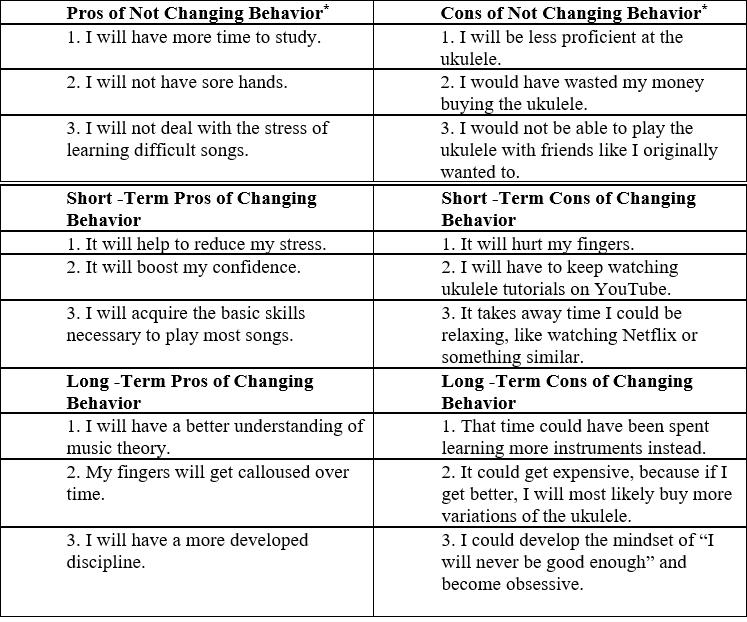
Figure
Call for Research Paper Submissions
Omnino is a peer-reviewed, scholarly research journal for the undergraduate students and academic community of Valdosta State University. Omnino publishes original research from VSU students in all disciplines, bringing student scholarship to a wider academic audience. Undergraduates from every discipline are encouraged to submit their work; papers from upper level courses are suggested.
Submission Guidelines:
In order to submit your work, please email the following items to omnino@valdosta.edu. The email must be sent from your student (@valdosta. edu) email account.
1. An electronic copy of the full paper, in .doc or .rtf format.
2. A 150 – 200 word abstract of the paper.
3. A completed, signed, and scanned “Faculty Checklist” (available online). Alternatively, the checklist may be delivered in print to the Omnino mailbox in West Hall 2109.
In order to submit, you must be an undergraduate student with original research which contributes knowledge and critical argument to your given field. Undergraduates who recently graduated from VSU have up to 1 year from graduation to submit their work. There are no disciplinary restrictions.
Deadline:
All materials must be submitted by January 19th, 2026 for consideration in volume 16. (Submissions received after this date will be considered for the next year’s volume.)
https://www.valdosta.edu/colleges/arts-sciences/english/student-resources/student-publications/omnino/