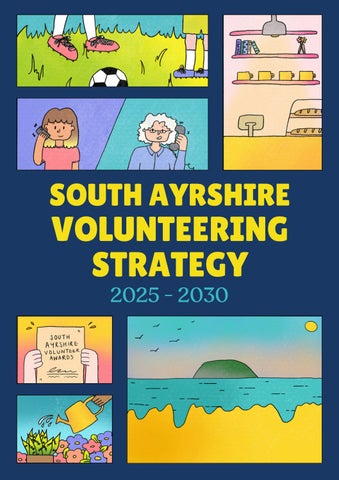
SOUTH AYRSHIRE VOLUNTEERING STRATEGY
2025 - 2030
PAGE 3
INTRODUCTION
PAGE 4
WHAT IS VOLUNTEERING?
PAGE 6
WHY DO WE NEED A STRATEGY?
PAGE 7
EXISTING POLICY AND GUIDANCE
PAGE 12
WHAT DOES THE DATA SAY?
PAGE 15
PAGE 17
BARRIERS TO VOLUNTEERING OUTCOMES AND BENEFITS
PAGE 18
PAGE 19
WHAT’S NEXT FOR SOUTH AYRSHIRE? ACTION PLAN
This is South Ayrshire’s volunteering strategy. This strategy has been developed by Voluntary Action South Ayrshire (VASA) in collaboration with a range of partners within and beyond the South Ayrshire Community Planning Partnership (CPP).
This includes: Volunteer-Involving Organisations
South Ayrshire Council
Active Schools South Ayrshire
Thriving Communities
In developing this strategy, we have reflected on existing volunteer recruitment and development practice throughout South Ayrshire, and considered this alongside local and national policy regarding volunteering.
South Ayrshire’s volunteers and Volunteer-Involving Organisations (VIOs) are outstanding in the work that they do and in their commitment to supporting and empowering our local communities.
By enacting this strategy, we will seek to ensure:
1. That volunteering is embedded in the work of all CPP partners.
2. That volunteering is purposeful for everyone involved.
3. That volunteering is inclusive of all individuals, and that any barriers to volunteering are met by Volunteer Involving Organisations, where possible.
4. That volunteers are celebrated for their exceptional contribution to supporting communities and individuals throughout South Ayrshire.
5. That Volunteer Involving Organisations (VIOs) are empowered.

The Scottish Government defines volunteering as follows;
“Volunteering is a choice. A choice to give time or energy, a choice undertaken of one’s own free will and a choice not motivated for financial gain or for a wage or salary ... the term volunteering is used to describe the wide range of ways in which people help out, get involved, volunteer and participate in their communities (both communities of interest and communities of place).” 1
People, groups and organisations across South Ayrshire benefit every day from the input and support of a huge army of volunteers of all ages, in a wide range of settings. People of all ages from across the lifespan decide to volunteer at different stages of their lives and for different reasons.







Voluntary Action South Ayrshire (VASA) have a key role in linking people who are thinking about volunteering with organisations offering volunteering opportunities. Every day VASA matches people with volunteering placements based on their individual interests and availability. In addition, a number of organisations and services independently promote their own volunteering opportunities and recruit for these roles.
Prestfest
Music Festival

Golfing Tournaments
The International Ayr Show
Festival of Flight
MANY VOLUNTEERS ARE INVOLVED IN A WIDE RANGE OF ROLES TO MAKE SURE THAT VARIOUS LARGE LOCAL EVENTS TAKE PLACE ACROSS SOUTH AYRSHIRE.
Local and Regional Highland Games Local Gala Days
Music on the Prom Girvan
From telephone befriending from home for 30 minutes each week to being a volunteer guide within a museum or heritage building, volunteering in a charity shop, volunteering in a theatre, becoming a volunteer Board member for a charity, offering a spectrum of support to people (and animals) in need, tackling environmental issues in outdoor settings and many other opportunities, even driving a steam engine!; individuals are helped to find a suitable volunteering placement. But none of this would be possible without the input and achievements of local organisations offering such a wide range of voluntary roles and opportunities.
The South Ayrshire Volunteering Strategy 2025–30 provides an overview of our multi-agency strategic direction for volunteering across South Ayrshire and includes an action plan for annual review and update.
Recent statistics suggest that volunteers contribute an estimated £20.3 million in social value to South Ayrshire’s local economy every year. This indicates just how crucial it is that South Ayrshire takes an ambitious and committed approach to improving volunteering for both individuals and VIOs. 2
The strategy document and action plan identifies what we all need to do to improve positive outcomes from volunteering for individuals, groups, organisations and partnerships across the public, private and third sector.
The South Ayrshire Volunteering Strategy 2025–30 is key to the ongoing development of best standards of inclusive, volunteering practice for all agencies, organisations, services and departments operating within South Ayrshire.
“Volunteering brings enormous benefits and enjoyment, not only to beneficiaries, but to communities, and to volunteers themselves. We know that – among other things – volunteering increases social and civil participation, empowers communities, and reduces loneliness and isolation. It can also improve mental and physical health, support the development of job and life skills, and foster a greater sense of belonging.” 3
Volunteering For All: Our National Framework
The National Framework was developed in 2018 by the Scottish Government jointly with partners from the volunteer and community sector, local government and NHS, with academics and social researchers, and with volunteers. 4
The objectives of the Framework cover ten years and include:
‘Defining the key outcomes desired for volunteering in Scotland over the next ten years’;
The National Framework specifies five ‘volunteering outcomes’, namely that:
1
2
Volunteering and participation is valued, supported, and enabled from the earliest possible age and throughout life.
Volunteering in all its forms is integrated and recognised in our lives through national and local policy.
3
4
There is an environment and culture which celebrates volunteers and volunteering and all of its benefits.
5
The places and spaces where we volunteer are developed, supported and sustained.
There are diverse, quality and inclusive opportunities for everyone to get involved and stay involved.
In 2022, the report ‘The Contribution of Volunteering to a Healthier and Happier Scotland Influencing Policy and Practice in Scotland’ was published by the Scottish Volunteering Forum. 5
The report identified the need to ‘...embed volunteering at the heart of national and local policy’ noting that ‘It is essential that national and local policies relevant to Scotland’s health and wellbeing agenda have considered the contribution of volunteering and that, where appropriate, this is reflected in published policies, strategies and frameworks...’
Here is one example of how Volunteering is incorporated within local policy; South Ayrshire Council had a statutory duty to produce a Community Learning and Development (CLD) Partnership Plan in 2024. 6
The CLD Partnership in South Ayrshire includes, South Ayrshire Council, Ayrshire College, Community Planning Partnership, Health and Social Care Partnership, Skills Development Scotland, Voluntary Action South Ayrshire and Department for Work and Pensions.
The current plan sets out the arrangements for Community Learning and Development Provision across South Ayrshire noting the five priorities including Youth Work, Mental Health and Wellbeing, Employability and Volunteering, Adult and Family Learning and Community Empowerment and Engagement.
Volunteering is very much recognised as a significant feature of local planning, benefiting the health and wellbeing of volunteers and the wider community.
VISION
A nation of volunteers strengthening Scotland’s communities


PURPOSE
People volunteer, early and throughout their lives
Volunteers feel safe, valued and heard, making a difference to themselves and others
Volunteers represent their communities
Strategy and Action Plan (2024)
The South Ayrshire Ageing Well Strategy and Action Plan was developed by South Ayrshire Health and Social Care Partnership and Voluntary Action South Ayrshire (VASA) in collaboration with South Ayrshire Community Planning Partnership.
South Ayrshire is one of Scotland’s first Age-Friendly Communities, a growing social movement led by the World Health Organisation. The strategy absolutely aims to celebrate the contributions that older people make to their communities - often the unsung childcare providers, informal carers and volunteers. The Ageing Well Action Plan states:
‘We will extend options for older people in relation to paid work and volunteering. We will promote the importance of volunteering and engaging in community activities.’ 8

The Youth Volunteering Innovation Project (Youth VIP) was formed as part of the development of ‘Volunteering for All’ by Project Scotland and Young Scot. This group of young volunteers, from a variety of backgrounds, have brought their stories and experience to bear to ensure these guidelines are authentic and reflective of the needs of the sector.
The Youth Volunteering Guidelines set out key recommendations on how VIOs can recruit, retain, and develop young volunteers:9
RECRUIT
Be clear
Be open
Be inclusive
Be relevant
RETAIN
Experience = participation
Recognise achievement
Be volunteer-ready
Build communities of support
DEVELOP
Meaningful representation
Shaping future opportunities
Support transition internally and externally

The Volunteer Charter supports the foundations for a good volunteer experience and gives individuals, groups and organisations the opportunity to express their support for the spirit of volunteering (while upholding the principles of good volunteer practice). 10
The Volunteer Charter sets out the ten key principles which help to underpin good relations within a volunteering environment. Any individual, group or organisation from any sector who either involve volunteers, or influence decisions on how volunteering is resourced or reflected in policy can pledge their support by becoming a Charter Champion. Pledges to uphold and promote the Volunteer Charter will have a real impact on the experiences of volunteers, volunteer practice and volunteering within Scotland. 11
Any volunteer activity is a freely made choice of the individual.
6 1 2 7 3 4 5
Volunteers should receive no financial reward for their time however out of pocket expenses should be covered.
Effective structures should be put in place to support, train and develop volunteers.
Volunteers and paid workers should be able to carry out their duties in safe, secure and healthy environments.
Volunteers should not carry out duties formally carried out by paid workers.
8 9 10
Volunteers should not be used instead of paid workers or undercut their pay and conditions of service.
Volunteers should not be used to reduce contract costs.
Volunteers should not be used to bypass minimum wage legislation.
Volunteers and paid workers should be given the opportunity to contribute to the development and monitoring of volunteering policies and procedures.
Volunteer roles should be designed and negotiated around the needs and interests of volunteers, involving organisations and wider stakeholders.

The Scottish Household Survey (2024) indicates that the formal adult volunteering rate across Scotland has increased from 18% to 25%.12
The picture for South Ayrshire is optimistic with a steady increase in volunteering opportunities over the past few years.
At any time, VASA are actively promoting around 200 volunteer roles across South Ayrshire. Often each of these roles offers a number of opportunities, for example an organisation may be looking for 5 or 10 volunteers for each volunteering role. This equates to an average of approx. 1400 volunteer opportunities at any time.
Voluntary Action South Ayrshire (VASA) supported approx. 380 organisations in one year to promote volunteering opportunities, by including an online and printed VASA newsletter, by listing nationally on Volunteer Scotland and by referring interested individuals to the respective organisations. 13
of adults in remote rural areas volunteered formally in 2023.
Volunteer participation is higher in rural areas than the national average, perhaps reflecting the increased reliance on volunteers to sustain rural communities specifically.
Approx. 27% of the population in South Ayrshire is classified as rural. 15
27%
However, volunteer participation has declined across Scotland in recent years, highlighting that the support of volunteers cannot be taken for granted.
How does South Ayrshire compare to Scotland overall?
2022
2023
In 2022, South Ayrshire had 1% more volunteers compared to Scotland overall (23% vs. 22%).
In 2023, volunteering saw a notable decrease
nationally, with 18% of people volunteering in both
South Ayrshire and Scotland as a whole.
In South Ayrshire, the likelihood of older people volunteering is higher than the Scottish average by 5 percentage points.
19% of over 60s reported volunteering in Scotland, whereas 24% of over 60s volunteered in South Ayrshire.
17% of 35-59 year olds in South Ayrshire have volunteered. This is 3% lower than the national average in Scotland of 20%.
Volunteering across Scotland has seen a decline for a range of reasons, however the prominent explanation continues to be the Cost of Living Crisis. People of working age are now less likely to have the time to volunteer, and fewer people are coming forward to volunteer. Additionally, while organisations are actively trying to address recruitment challenges, many face a lack of capacity as well as uncertainty over future service provision which makes this difficult.17
As shown on the following two pages, financial circumstance and age continue to be key influential factors in the likelihood of an individual becoming a volunteer both in South Ayrshire, and across Scotland.
The ‘Scottish Household Survey: Who contributes the most to Scottish Volunteering’ has shown that in Scotland you are more likely to volunteer if you are:
Living in a rural area
Aged 35-44
Earning £40k+
Employed or in education White Female Christian
Living in the least deprived areas of Scotland
Evidence from Volunteer Scotland (2025) shows us that the relationship between deprivation and volunteering is complex, and while the participation gap is closing there are actions to be taken to ensure that volunteering is a positive experience for people across all of Scotland’s communities. 19
Economic barriers to volunteering can include: Travel expenses, childcare costs, equipment costs, food and drink, and concerns about benefits and a person’s right to work.
Volunteers may face experiences of discrimination, such as being made to feel undervalued or unqualified in society. A lack of confidence is commonly experienced by people from marginalised groups. A lack of diversity within VIOs can lead to gaps in knowledge and experience resulting in stereotypes and discriminatory views.
Exterior factors: Parking areas, kerbs, steps, doors, access to public transport, etc.
Interior factors: Stairways, doors, toilets, washing facilities, lighting and ventilation, escalators, floor coverings, signs, etc.
THERE ARE A NUMBER OF ECONOMIC, PHYSICAL, SOCIAL AND CULTURAL BARRIERS TO VOLUNTEERING. 20
Research shows that volunteering can provide important benefits to volunteers. These enhanced health and wellbeing benefits increase positive outcomes: for the volunteers, for those they support, for communities, and for wider society. 21
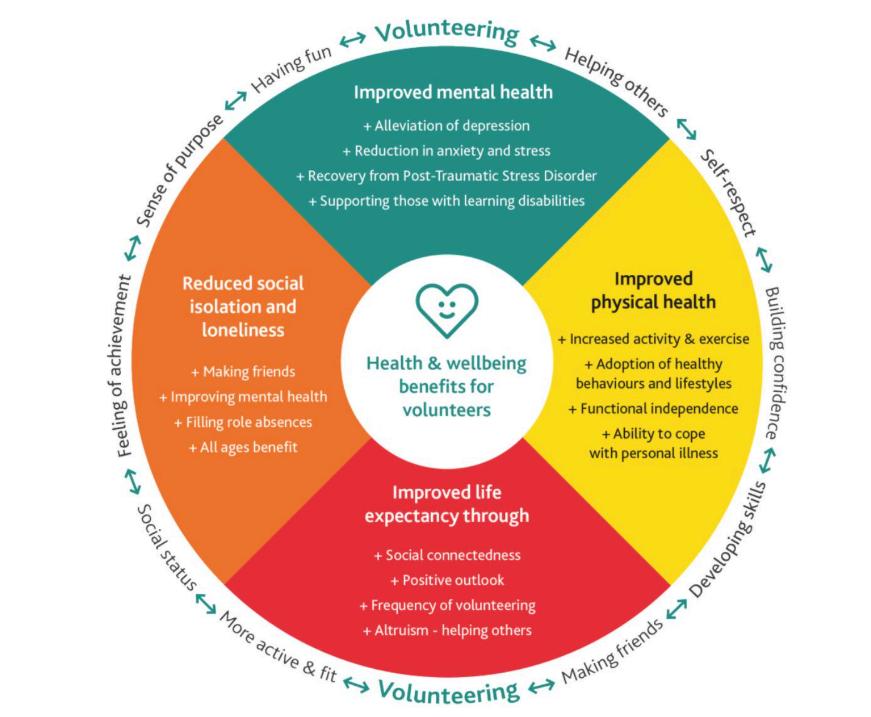
This highlights just how crucial it is that we take action for volunteering to become accessible for all so that the maximum possible number of organisations and individuals can access the benefits and advantages offered by volunteering.
The South Ayrshire Volunteering Strategy 2025 – 2030 actively incorporates key aims and objectives from national and local plans and strategies and includes a living Action Plan to ensure these are addressed.
Our Action Plan, which begins on the next page, is themed under the following goals:
Embedding Volunteering
Purposeful Volunteering
Inclusive Volunteering
Promoting Volunteering
Celebrating Volunteering
The Action Plan outlines what we will set out to do as a CPP in order to achieve each of these aims. Whilst the Action Plan is the collective responsibility of all CPP partners, key relevant organisations are identified throughout the document.