The Volante
THE STUDENTS’ VOICE SINCE 1887
W E D N E S D AY, F E B R U A R Y 1 3 , 2 0 1 9
VOLANTEONLINE.COM
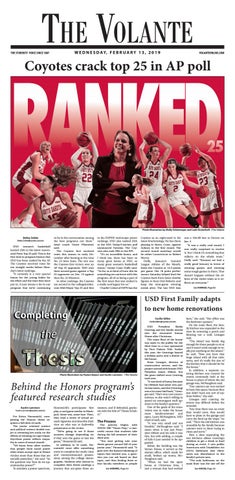
Coyotes crack top 25 in AP poll
Photo Illustration by Molly Schiermeyer and Leah Dusterhoft I The Volante
Bailey Zubke
Bailey.Zubke@coyotes.usd.edu
USD women’s basketball landed 25th in the latest Associated Press Top 25 poll. This is the first time in program history that USD has been ranked by the AP. The Coyotes received votes for ten straight weeks before Monday’s latest rankings. “It certainly is a very special honor for the young ladies for the effort and the time they have put in. It just means a lot to our program that we’re continuing
to be in the conversation among the best programs out there.” head coach Dawn Plitzuweit said. The Coyotes first received votes this season in early December after beating at the time No. 23 Iowa State. The win was the Coyotes first victory over an AP Top 25 opponent. USD won their second game against a Top 25 opponent on Dec. 15 against then No. 22 Missouri. In other rankings, the Coyotes are second in the collegeinsider. com Mid-Major Top 25 and first
in the ESPNW mid-major power rankings. USD also ranked 25th in the USA Today/Coaches poll announced Tuesday. The Coyotes also rank 39th in the RPI. “It’s an incredible honor, and I think too, there has been so many great teams at USD, so many great women’s basketball teams,” Junior Ciara Duffy said. “So for us to kind of have this be something we can leave with this program, all of us being a part of the first team that was ranked is a really cool legacy for us.” Charlie Creme of ESPN has the
Coyotes as an eight-seed in his latest bracketology. He has them playing in Storrs, Conn. against Auburn in the first round. The second round matchup would be either Connecticut or Robert Morris. Duffy, January’s Summit League Athlete of the Month, leads the Coyotes at 14.9 points per game. Her 18 point performance Saturday helped lead the Coyotes back from down double figures to beat Oral Roberts and keep the nine-game winning streak alive. The last USD loss
was a 104-99 loss to Denver on Jan. 3 “It was a really cool award, I was really surprised to receive it, but I think it’s something that reflects on the whole team,” Duffy said. “Because we had a really good January in terms of winning games and winning some tough games in there. That doesn’t happen without the efforts of the entire team so it reflects on everyone.” See RANKED, Page B2
USD First Family adapts to new home renovations Cecilia Gillen
Cecilia.Gillen@coyotes.usd.edu
Photo Illustration by Peyton Beyers and Austin Lammers I The Volante
Behind the Honors program’s featured research studies Austin Lammers
Austin.Lammers@coyotes.usd.edu
For Krista Honomichl, completing the Honors thesis requires a full deck of cards. The junior criminal science and political science double major is centering her study on the effects of winning on rape empathy—how power reflects empathy in cases of sexual assault. “We know from other studies that people from social power often times accept rape or blame victims more than those that are socially powerless,” she said. “So the question was ‘how do we operationalize power?’” To simulate a power spectrum,
Honomichl’s participants first play a card game similar to Blackjack. Some win, some lose. Then, they read a series of sexual assault vignettes and describe their view on who was at fault—the perpetrator or the victim. “We’re going to see if those answers change depending on if they won the game or lost the game,” Honomichl said. In addition to 52 cards, Honomichl must offer something more to complete her study: time and money–treasured possessions among the college demographic. Students who choose to complete their thesis undergo a journey that occupies three se-
mesters, and if defended, graduate with the title of “Thesis Scholar.”
The Process
The process begins with UHON 398 “Thesis Prep,” a onecredit course that students take during the fall semester of their third year. “You start getting into your thesis groove around fall of your junior year,” Honomichl said. “It goes over the basics—thinking of topics that interest you, a question you can ask based on that topic, and then finding three or four faculty members or people See HONORS, Page A3
USD President Shelia Gestring and her family moved into the renovated Inman House after Christmas. The main floor of the house was open to the public for the third time in a tour sponsored by First Dakota Title. Earlier this year, the Gestrings hosted a holiday party and a dinner at the house. Brian Limoges, director of construction service, said the project started with former USD President James Abbott, but the gears shifted once Gestring took over. “It was kind of funny because he (Abbott) had some very particular tastes, and she (Gestring) was a lot more laid back,” Limoges said. “She’s very cost conscientious, so she wasn’t willing to spend on extravagant stuff upstairs in the family’s quarters.” One of the goals of the renovation was to make the house more family-oriented and open, Laura McNaughton, USD chief of staff, said. “It was very small and not liveable,” McNaughton said. “I mean when it was just President Abbott and his wife it was fine, but with adding...a couple of kids it just needed to be upgraded. Before the building was the Inman House, it served as the alumni office, which made for small, broken up rooms, McNaughton said. “When we had the open house at Christmas time, I met a woman that had worked
here,” she said. “Her office was the bedroom upstairs.” On the main floor, the family kitchen was expanded to the west by removing a porch and blowing out a wall, Limoges said. “The island was barely big enough for three people to sit at and it wasn’t wide enough to really put anything on the island,” he said. “Now you have that huge island with all that cabinetry, and it’s really the size of the kitchen that it should be for the house.” In addition, a separate catering kitchen was created for events commonly held at the house in place of where the old garage was, McNaughton said. “Our caterers are very excited to have this space, because they just didn’t have any sort of options before,” she said. Limoges said catering for events was difficult before the remodel. “Any time there was an event they would cater, they would have to plate in the garage and carry the food up the steps,” he said. “Then the old kitchen was unusable by the family because caterers were in there trying to clean and serve.” Now a door separating the two kitchens allows Gestring’s children to get a drink or food during an event. A new public Americans with Disabilities Act (ADA) bathroom also eliminates any disturbance to the family’s private area. “The only bathroom on the main floor was the one off the See HOUSE, Page A3
News
A2 Wednesday, February 13, 2019
The Volante I volanteonline.com
FREE-THROW THROWDOWN
Molly Schiermeyer I The Volante
University President Sheila Gestring and David Herbster faced off in a free-throw competition during half-time at the women’s basketball game on Sunday.
City of Vermillion Police Blotter Highlights
2
1
DUIs
Feb. 3 Officers smelled an illegal drug coming from a house. A search warrant was obtained and drugs were found. Charges are pending. Feb. 3 Officers addressed a loud stereo coming from a house. A male was cited for the noise. Feb. 3 Officers stopped a car for speeding and cited the driver. Feb. 3 Officers responded to a two vehicle non-injury accident. One of the drivers was cited for
running a stop sign. Feb. 3 Officers saw a vehicle strike a parked car and then drive away. The car was stopped and the driver was arrested for DUI. Feb. 4 A local business reported several items stolen by two men who fled the area. Under investigation. Feb. 5 Caller reported the odor of marijuana in an apartment complex. Officers walked the public areas of the complex but did not
USD transitions to new program, schedules student registration Temiloluwa Adeyemi Temiloluwa.Adeyemi@coyotes.usd.edu
Starting in March 2019, a new platform called Banner will replace the current service of WebAdvisor. Banner, a self-service program, will allow students to access all of their information including class registration, financial aid and finances.
Implementation and Launching Process
The South Dakota Board of Regents approved the implementation of the new student information system in June 2017. Beth Freeburg, associate provost of academic affairs, said that the increased self-service functionality in the new program was the reason for the change. “This is a critical milestone for USD along with all other SDBOR schools,” she said. Freeburg said a statewide team has been working to ensure the successful launch in March. “It is all six schools within South Dakota Board of Regents that are doing this transformation,” Freeburg said. “A statewide team of people from various institutions is working to implement this new program.” Freeburg said there has been some struggle with the transition process. “We currently use Ellucian’s Colleague
Student Information System and that is connected to their selfservice product, that we refer to as WebAdvisor. As we move from Colleague to this new product, which is Banner, we will be using a new self-service model called Student Banner,” Freeburg said. The features and processing capabilities of Banner covers all of the school’s holdings, including finances, human resources, students, alumni development and financial aid. The Banner platform is not totally new to USD. Some of the university’s departments like the financial and human resources have been pioneers of the program. “Our financial system at the university, as well as our HR system, has used the Banner product,” Freeburg said. “We are actually just merging. Actually, that’s why the Board of Regents approved this move from Colleague to Student Banner, which was due to the desire to migrate so that we are fully using all of the same systems.” Freeburg said that creating efficiency by using one service system was the goal. Former registration rules will apply to this new program as well. Webadvisor will still be accessible to students for academic mapping purposes. “Our registration process works here that we get priority registration dates, so all of that will
1
vehicle injury accident
smell marijuana. Feb. 5 Caller requested a welfare check on an employee who had resigned her position without notice and was acting out-of-character. Officers located the individual who was alright. Feb. 5 Caller reported loud noise coming from a neighboring apartment. Officers checked the area but could not locate the noise. Feb. 5 A Vermillion Officer assisted a University
remain the same. It will just be a new product,” Freeburg said. “As we roll out this new product, students are still going to be able to open WebAdvisor for planning purposes and see what is offered for summer and fall. ” WebAdvisor will be phased out later in the year. Avery Sage, a first-year education major, wasn’t aware WebAdvisor was being replaced and said she thinks the change will be inconvenient to students. “We as students don’t really have any say over it, but it ends up affecting us directly,” Sage said. “I never really felt that WebAdvisor was ever hard to use, but if the changes being made make it more user-friendly then I think the inconvenience is worth it.” Debbie Agbeniyi, a junior nursing major, said she has no problem with the change. “I liked WebAdvisor because it was easy to navigate,” Agbeniyi said. “We do not know what the change is exactly, but if it is something that will benefit the students... then I think it is a good change.” Banner is scheduled to go into service for all students Monday, March 18.
>> Feb. 3 - 9
Officer with a subject who was suicidal. Feb. 5 An officer was writing a parking ticket and found the vehicle had four previous unpaid parking tickets. The vehicle was impounded. Feb. 6 Officers responded to a medical call of a patient lying on the ground unable to care for themself. Officers provided care until the ambulance arrived. Feb. 7 Officers assisted another agency with delivery of paperwork to
welfare check
an individual in Vermillion. Feb. 7 Caller reported a one vehicle injury accident. Officers responded and rendered assistance. The injured party was transported to the hospital with non-life threatening injuries. Feb. 8 Officers responded to a dispute between a mother and her adult daughter. Officers mediated the dispute. Feb. 8 Caller reported they believed someone was in another part of the
LIVE AT 5 P.M.
residence, who did not belong
there.
Officers
searched but found no one. Feb. 9 Officers responded to a two vehicle non-injury accident in a parking lot. Feb. 9 While
investigating
a theft, officers spoke with a male who tried to give them false identification. The male was arrested and the theft investigation continues.
TUNE IN THIS MONTH Tune in at noon for an interview with a representative for the women’s basketball team.
Watch Channel 21 for a story on regulations for greek life satellite houses.
WATCH ON YOUTUBE Watch the second episode on YouTube for an interview with Amber Hulse and Lara Boman.
COYOTEHistory 1906 USD starts a glee club.
The Volante Volume 144, No. 5 February 13, 2019 www.volantenline.com Al Neuharth Media Center 555 Dakota St. University of South Dakota Vermillion, SD 57069 Adviser Chuck Baldwin Mission statement The Volante covers issues relevant and interesting to USD students. Faculty, staff and community members are welcome readers, but the newspaper is written and presented for a diverse community of students from the students’ point of view. The paper should provide a variety of information, entertainment and educational opportunities for the readers. The Volante encourages everyone to write letters to the editor. The Volante wishes to be viewed by students as respectable, objective, accurate, fair and trustworthy. If you have comments, concerns or questions, please contact The Volante at 677-5494. The Volante is distributed Wednesdays during the academic year free of charge locally with the cost of $1 for each additional copy. One year subscription rates are $40, which solely covers the mailing costs. The Volante does not endorse, promote or encourage the purchase or sale of any production service advertised in this paper. Advertisements are the sole responsibility of the advertiser. The Volante disclaims all liability for any damage suffered as the result of any advertisement in this newspaper. The Volante reserves the right to refuse any advertising.
1947 Arctic explorer Vilhjalmur Stefansson speaks at USD.
Austin Lammers editor-in-chief Kelli Susemihl managing editor Logan Rahn advertising manager Lexi Kerzman news editor Devin Martin news presentation editor Cecilia Gillen assistant news editor Lauren Soulek verve editor Sara Cappiello verve presentation editor Ali Boysen assistant verve editor Bailey Zubke sports editor Morgan Matzen sports presentation editor Rachel Newville social media director Molly Schiermeyer photo editor Peyton Beyers assistant photo editor Tori Harwell opinion editor Nick Zeimet & Nikolas Wilson copy editors Leah Dusterhoft visual director
News
The Volante I volanteonline.com
Wednesday, February 13, 2019 A3
Heart health tips for National Heart Disease Month Lauren Soulek
Lauren.Soulek@coyotes.usd.edu
Heart disease is the leading cause of death for both men and women in America, according to the Center for Disease Control and Preventions. February is National Heart Disease Awareness Month, and Heather Kleeman, with Sanford Health, said it’s important for students to take preventative measures in their 20s and 30s to avoid getting heart disease later in life. “It’s great to get started thinking about that early on for prevention purposes later in life,” Kleeman said. “As we’re younger, we develop heart disease by what we do, eat, health, exercise and we can prevent a lot of that in the future when you hit your 40s, 50s, 60s in the prevention of strokes and heart attacks.”
Kleeman said the biggest thing she thinks college students can work on is their diet. “Fast food is not great for the heart, avoid saturated fats is probably the biggest one, so that’s going to be anything fried,” Kleeman said. “Try to incorporate more healthy vegetables into the diet, leafy green vegetables, kind of looking at the Mediterranean diet using healthy fats, olive oils, for cooking. Try to avoid excessive amounts of alcohol intake and smoking.” Curtis Krempges, a nurse at Sanford Heart Hospital, said the ideal age for someone to get a heart screening is anyone between 40 to 75. “That tends to be the range when you start to see plaque building,” Krempges said. “That doesn’t mean it can’t build sooner, it’s
HONORS From Page A1
outside of the university that would have some expertise in that field to help you along with that process.” 60-70 percent of students enter the Thesis Prep course unsure of what question they want to pursue, said Scott Breuninger, USD’s honors director. “I ask them to start big. I ask them, ‘what are you really interested in?’” he said. “Because the thesis can really be on any topic. We’ve had people in pre-med who do fine arts projects.” Following Thesis Prep, students can take 2-6 credits of UHON 498 “Honors Thesis” throughout their third and fourth years. “That’s when you’re working on your thesis. You’ve created your committee, that has at least two faculty members and then either one more faculty member or someone from outside the university, and you go forward with the project,” Breuninger said. “If it’s experiment based, you do your experiment, you collect your review info and put it all together.” Lastly, after the student completes their thesis and their committee reviews it, they must defend it in front of a panel. If defended, the thesis stands and is published.
just not as common, but it can happen in younger people.” Kleeman said people in their 20s and 30s don’t have a reason to check for heart disease unless they have a strong family history of it. “We do recommend a cholesterol screening in your 20s or 30s and that’s just for familial genetic things that could cause your cholesterol to be really high,” Kleeman said. “That’s things that you can’t prevent so it’s good to have that done once in your 20s or 30s. Other than that, unless you have strong genetic risk factors, not too many things to worry about besides your exercise. Getting thirty minutes five times a week to help with your heart.” As for heart health in general, Kleem said the biggest thing to watch for
Breuninger said in his six years of leading thesis courses, only one theses’ defense hadn’t held up to the panel. “The only cases we run into problems is when the student doesn’t stay in close contact with the faculty members and then try to rush everything at the end, so faculty members haven’t seen any of it before the defense,” he said.
The Investment
According to USD, a student eligible for in-state tuition pays $302 per credit hour. This means a finished thesis can cost between $906 and $2,114. However, most students don’t take more than two credits following Thesis Prep unless they want to “carve out” an allotment of time to work on their thesis during their senior year, Breuninger said. “A thesis is a pretty substantial undertaking, and I think it would certainly be worth five credits, but I think students, rightly so, don’t want to pay for extra credits,” he said. “It’s an opportunity for students to do what they want to while earning credits toward graduation. There is a cost, and that’s an important consideration, but it’s a cost that directly helps them.” In the case of junior medical biology student Ben Jacobs, Breuninger’s estimation stands true. Jacobs said he spends an average of five hours a week
Leah Dusterhoft I The Volante
is “typical chest pains.” “So if you’re exercising and you’re having difficul-
working on his thesis. “One hour is a meeting with someone on my committee and usually four hours doing literature review and other stuff. Since I am taking one credit of my thesis I am trying to treat it like a course,” he said. Jacobs’ thesis studies “the curriculum of the medical school and cultural competence in diversity.” For his thesis, Jacobs is sending surveys to students enrolled in USD’s medical program, asking how they’re being educated on treating diverse peoples, specifically Native Americans. He said the extra work it entails doesn’t weigh on him in his other studies. “I like biology, right? Because that’s my major. But if I was doing more biology research, it might be redundant to be learning in class and do a survey, but because I’m passionate about religion and diverse peoples, this gets me away from my schoolwork,” he said. “It’s about communication. I’m not learning about the mitochondria during my thesis, I’m going to be learning about how to work with diverse peoples, which I would argue is more important when you’re working with patients.” Jacobs said the cost was a concern, but never deterred him from completing his study. “It’s hard because of the financial aspect, but I’m so far in debt already, add another zero, I really
ties breathing or pressure or pain in your chest then that would be something
don’t care,” he said. “Overall, it’s worth it. That’s why I joined. I picked it up as a sophomore because I wanted to.” Honomichl, however, said she occasionally had second thoughts. “I will say I’ve had hesitations. I’ve considered dropping it before because of the extra time requirements and the money component,” she said. “However, at this point, with the aspirations of what I want to do after graduating–I want to go to law school and get a joint degree in policy–having a thesis that looks at a specific area I think will be beneficial for me applying for law school and grad school.” The thesis forces students to reflect on “how they work,” according to Breuninger. “There’s something about the process, and learning how to have self-discipline and learning how to motivate yourself and learning how to deal with ambiguity,” he said. “When they sit down, they can do literally anything, which is something you can’t do in any other class.” Breuninger said constructing a thesis allows students to get a taste of their profession’s work before their career begins; a valuable headstart in today’s competitive climate. “In today’s environment, whether you’re looking for jobs or trying to figure out what you want to do with your life if you’re standing still and not pushing
to go in and get checked out,” Kleeman said.
yourself, you’re falling behind. I feel the thesis provides a real opportunity for students to get a better sense of who they are and what they want to do.” Students may feel more comfortable paying for thesis courses if they knew where their money is going, Honomichl said. “I was talking to a friend that goes to South Dakota State and she’s also in the honors program. They don’t necessarily require a thesis but they require an independent study and a paper...so basically a thesis. I was talking to her about it, I was like ‘I can’t believe I have to pay upwards of $1,000 just to write this thesis, and she was like ‘I don’t really have a problem with it because it’s going to benefit the department.’” Honomichl said the honors program at SDSU allows students to take credits through any department, and in turn, those tuition dollars return to the department (South Dakota State’s Honors program did not respond to calls confirming this). “I think that’s something that I would like USD doing. Instead of it going to the honors program, granted they use that money to take us on trips and stuff, but I would much rather spend my money knowing that it’s going back to the deptartment that I’m working in. since they’ve provided so much for me, I’d really like that my money would go back to benefit them.”
Peyton Beyers I The Volante
Students can work on their thesis in the Honor’s Program lounge in Old Main.
HOUSE From Page A1
family kitchen and so everybody during an event had to go through the family kitchen to go to that bathroom,” Limoges said. There is also a new ADA ramp that goes straight into the house, instead of around the garage and onto the deck. The new garage is to the south of the house and now is a three-stall instead of a one-stall garage. The deck was extended, but the sunroom was removed in order to make room for a larger dining area. The first two rooms on the main floor had to be renovated alongside the South Dakota National Historical Society, Limoges said. Where a mural was hung in the ceiling of the entryway, there is now a
LED chandelier that still matches the historical time period. Other changes to the front part of the house include stainied hardwood to match the updated floors in the rest of the house and new white paint. The private family quarters upstairs was in need of bigger bedrooms and additional bathrooms and closets to suit a family, McNaughton said. “It was a lot of reconfiguring so that the front two bedrooms could have their own closets,” she said. “They built a bathroom where an office used to be and then built above where the catering kitchen is just so that there’s more space.” Limoges said the old bedrooms didn’t really count as useable bedrooms. “There was a bed, but there weren’t really any closets to put anything in,” he said. “So now you actually have three nice big bedrooms, plus you have that extra room over
the garage.” Now the house has three full bathrooms and two half baths. The room built over the garage serves as a family room, which Keith Gestring, Sheila Gestring’s husband, said was his favorite part of the renovation. “It’s just a nice gathering place for us to sit around as a family,” he said. Keith Gestring also said his children enjoy the better WiFi in town. As of now, there are no official plans for the property next door, also purchased by the USD Foundation, besides protecting it as a historical building, McNaughton said. “It will kind of marry with this house so that there can be some event space over there and you know whatever they need as well,” she said. “I presume they’ll do some apartments or something above, but I don’t think that there’s been any real fleshed out plans yet.”
Opinion
WEDNESDAY, FEBRUARY 13, 2019
THE VOLANTE
VOLANTEONLINE.COM/OPINION
It’s time Hollywood went totally gay
VOLANTE EDITORIAL
NICKOLAS ZEIMET is a senior majoring in media & journalism
Photo illustration by Peyton BeyersI The Volante
A USD student studies a practice United States citizenship test.
Editorial: We don’t know enough of our own history
We are, unfortunately, in a time in which most Americans would not be able to answer basic questions about their government. According to Annenberg Public Policy Center of the University of Pennsylvania, only about a quarter of Americans can name all three of the branches of government. The state of South Dakota is working to change this for its students. South Dakota House Bill 1087 proposes new requirements in South Dakota schools. The bill reads, “Beginning July 1, 2019, any student enrolling as a freshman in a baccalaureate degree program at a public institution of higher education under the control of the Board of Regents shall, as a condition of graduation, demonstrate the successful completion of three credits in the area of United States history and three credits in the area of United States government.” There are concerns, however, about where funding will come from to fund these changes. The new bill is asking that two of the already required general requirements for graduation become requirements for one U.S. government class, and one U.S. history class, meaning that, instead of adding six more credits required to graduate, the two new required classes would be worked into current graduation requirements.
According to the Bill, these credits may also be completed through the use of advanced placement tests, dual credits or a college level examination program. Currently, there is no policy or procedure to develop the mechanisms necessary to implement these educational changes and additions. Without providing funding, the state legislature puts the burden on the Board of Regents, universities and their students to fund these additions to educational requirements. House Bill 1087 also states that, “Beginning July 1, 2019, any student enrolling in a baccalaureate degree program at a public institution of a higher education under the Board of Regents shall, as a condition of graduation, correctly answer at least eighty-five percent of the questions on the civics test.” While some high school students seem to be upset about the new proposed requirements House Bill 1087 introduces, the motives behind the Bill don’t actually seem like a completely terrible idea. A survey, released Oct. 3, 2018 by the Woodrow Wilson National Fellowship Foundation with research firm Lincoln Park Strategies, shows that only a little over a third of Americans would have passed a basic multiple choice United States citizenship test, modeled after the one taken by immigrants in the process
of naturalization. The survey sampled 1,000 American adults. It showed that only 36 percent actually passed the test. We require immigrants to pass a test that not even half of us can pass. What is the sense in that? There is no reason that we shouldn’t be able to pass a test like this as well. Otherwise, we are living in a system that we simply don’t understand. Americans’ lack of knowledge about our own government is more than a little bit concerning. Our nation is suffering from a crisis in civic literacy. While we shouldn’t address these issues through legislation, but rather through school administrations, efforts aimed at addressing this educational deficiency are necessary. It’s challenging to be an effective citizen if you don’t know how the government works. As long as people have an inadequate understanding of how our political system works, civic engagement will remain poor. A truly functioning democratic society depends on its citizens to be informed. What we don’t know can hurt us, and continued ignorance will cause snowballing consequences. Whether a legislative bill is the right way to approach this issue is still questionable, it’s important for students and all American citizens to be aware of our history and our government.
The Volante THE STUDENTS’ VOICE SINCE 1887
EDITORIAL BOARD Austin Lammers, editor-in-chief
Tori Harwell, opinion editor
Kelli Susemihl, managing editor
Lauren Soulek, verve editor Bailey Zubke, sports editor
CONTACT US The Volante welcomes letters to the editor in regards to campus, local, state and national issues. Letters will be edited for clarity and length and will be printed as space allows. Please limit letters to 300 words or fewer. The Volante reserves the right to hold letters for publication in a later issue. Submissions must include the author’s name, address, telephone number, year in school and major or job title. Letters must be exclusively for The Volante. We will not publish anonymous letters. Send letters to: Al Neuharth Media Center 555 Dakota St. Vermillion, S.D. 57069 Fax to: 605.677.5105 Email to: volante@coyotes.usd.edu Via our website: volanteonline.com The deadline for letters is 5 p.m. the Friday prior to publication. Letters must be typed and fewer than 300 words.
In a recent interview with Gay Times, former “Kyle XY” star Matt Dallas spoke out about Hollywood producers encouraging him not to come out as gay because he “could not be successful if you were openly gay in the entertainment industry.” This is striking for a number of reasons. Queer characters are slowly becoming a staple on television and film–being a member of the LGBTQ community is no longer a storyline that writers shy away from because, in 2019, it’s overwhelmingly okay to be gay. With that in mind, it seems curious as to why it’s okay to play gay, but not actually be gay. All the time we see straight actors portraying gay characters–yet gay actors are not granted the opportunity to bring their own experience to these stories because being openly gay in Hollywood as well as successful are not mutually exclusive. If we want to live in an inclusive landscape, the importance of representation can’t be ignored. Allowing gay actors to bring gay stories to life is the best way to accurately portray the challenges of being a member of the LGBTQ community, as well as affording LGBTQ members the opportunity for a successful career. In the past, we’ve seen actors like Darren Criss or Eric McCormack bring stories of gay men to life. This representation–while positive in many regards–takes a chance to more genuinely tell the story of a gay character from someone who better understands these struggles. Peppermint, the first transgender woman with a major role in a Broadway musical, Head Over Heels, told Vice, “Right now, gay, trans and queer people need to participate in the telling of their own stories. Hollywood has a terrible history of
creating movies and making money off the experiences of marginalized people, without letting them have any input in the process. A lot of the time, Hollywood makes these stories about queer, trans and minority folks and they get it wrong. There’s offensive material, tragic storylines, one-dimensional, stereotypical characters with little depth.” The best way to tell a story about a marginalized group is to allow members of that group to tell their own stories. A level of understanding on what it actually means to be a member of a group that faces scrutiny the way the LGBTQ community does, brings sincerity to a character that may otherwise be missing from a straight actor portraying the role. This is not to say that straight actors shouldn’t be taking on these roles or that when given the opportunity they do a poor job. The point is that if Hollywood is willing to cash in on writing queer characters, the stigma behind being out in Hollywood needs to be eliminated. In the past, non-trans actors have portrayed trans characters, which again, is limiting opportunities for trans people to tell the stories that they have lived and can more accurately depict. With a record number of 4.5 percent of adults (which translates to a whopping 11 million people) identifying as LGBTQ in just the United States, there is certainly no reason why the opportunity to bring a story that is true to them to life is not being more readily offered. While bringing awareness to these issues is what is most important–representation in our media being the key to a more inclusive world–one cannot deny that taking representation to the next level by using actors who have had somewhat similar experiences to the characters they are portraying can only be beneficial, not only to the overall storytelling experience, but also by showing LGBTQ youth that being who they are can take them to the same places as straight and cisgender entertainers.
“
If we want to live in an inclusive landscape, the importance of representation can’t be ignored.
OVERHEARDS
Here you’ll find the weirdest, funniest and stupidest things we’ve heard during the week. Context is for suckers.
“Beta’s are in the B School but also hicks. They are business cowboys.” — Spruce Street
“Dildos scare me.” — Coyote Village
“I feel like my heart will never let me die.” — Arts & Sciences
“Every time I go downtown and don’t see the men’s basketball team is the worst day of my life .” — Carey’s
“They should start selling Four Lokos here.” — University Brew
Wednesday, February 13, 2019 A5 Opinion Limiting terms: Seek the people’s How meditation can approval change your life MARCUS
The Volante I volanteonline.com
DEVIN MARTIN is a junior majoring in media & journalism
Meditation. It sounds cheesy, doesn’t it? I thought the same thing until I tried it. Meditation can and does have a significant impact on your mental health for the better. It can also help with your anxiety, depression and stress, and it can change your perspective on your day-to-day life. I have to admit, as much as I am an optimistic person, I was always getting down in the dumps more often than I should have. I was beating myself up all the time and I was getting sucked into this vortex of negative thinking. I seemed to have no escape, until I started meditating. According to Psychology Today, Rebecca Gladding M.D., said that the practice of meditation is important and will cause your brain and thought process to change in the future. “I’m sure you’ve heard people extol the virtues of meditation. You may be skeptical of the claims that it helps with all aspects of life. But, the truth is, it does,” Gladding said. “Sitting every day, for at least 15-30 minutes, makes a huge difference in how you approach life, how personally you take things and how you interact with others. It enhances compassion, allows you to see things more clearly (including yourself) and
creates a sense of calm and centeredness that is indescribable. There really is no substitute.” I think the thought process of meditating can intimidate some, when in reality, that’s not its intention. It can feel nerve-wracking at first, and many people could be nervous because they feel like they can’t take time for themselves, or they feel like they have to get the meditation practice just right. Gladding says meditating every day changes the lateral prefrontal cortex and the medial prefrontal cortex. These are parts of the brain that allow you to look at things from a new perspective and feel a sense of balance. This can also be explained as overthinking about the future, your reflections and the thought process of living in the past. Simply put, without meditation, you are stuck on yourself, your thoughts and your emotions, and you go day-to-day ignoring the beautiful world around you. With meditation, you can clear your mind and appreciate the world around you. This is beneficial to your happiness and your relationships with others. But a lot of people don’t know where to start meditating and might feel stuck. I use an app on the App Store called Insight Timer, which I have been using for the past year. It’s beneficial because not only is it completely free, but you gain access to 15,000 meditations. What more can you ask for? There is also a timer
option and numerous courses available. For
starters, there is also a “Learn How to Meditate in Seven Days” course. I’ve taken the courses “How to Stop Overthinking” and “Coming Home to Yourself” which are all a ten-day process, and I have learned so much from them that I carry into my daily life. You could also become a premium member and for just $5 a month, you can gain access to all 10-day courses and the Daily Insight among others. But why am I talking about this app? Simply because from my experience, it’s lifechanging. I’m a happier person, I appreciate the wonderful lessons of good and bad that the universe offers and I just live surrendering myself to the universe and learning along the way. It’s all about perspective and how you think about things. You can choose to be happy and live a healthier life. But in order to do that, you have to take the steps to believe in yourself and take time for yourself. By doing so, you come home to yourself and soon you can appreciate all the life around you. Namaste.
IRELAND is a senior triple majoring in political science, criminal justice and philosphy
Is it time for term limits? The people should determine who represent them—not special interests, not political establishment elites and not the Supreme Court. South Dakota regularly sees legislation proposed calling for a convention of states under Article V of the United States Constitution. Such a convention would, in theory, allow delegates from the states to write and propose amendments to the U.S. Constitution. South Dakota, and other state legislatures, often tack on limits regarding what the convention can discuss—though whether these limits are enforceable is another question entirely. In 2017, South Dakota’s call for a state convention included the topic of term limits for members of Congress. Term limits would act as a check against incumbency and would allow for new blood to enter the veins of Congress. This is not the first attempt of a state limiting Congressional members to a select number of terms. In 1992, Arkansas passed a state constitutional amendment limiting its congressional candidates to three terms in the House of Representatives, or two terms in the Senate—though it allowed candidates to exceed these limits if they win
by write-in. The United States’ Supreme Court, in U.S. Term Limits, Inc. v. Thornton, found this amendment to be a violation of the U.S. Constitution, which expressly lists the qualifications necessary to be a member of the House or Senate. Since this ruling, term limits have been unconstitutional. This means unless the Court reverses its earlier ruling, an amendment to the U.S. Constitution is required to implement term limits on members of Congress. This steep requirement is not to say that term limits do not come with benefits. Term limits could increase the odds of new ideas being represented in Congress. Term limits would weaken the power of incumbency, instituting a more difficult method of getting elected once and incumbent reaches the term limit. Lobbyists would become less influential, because they would not be able to keep as many of their key members in office. They limit the power of seniority and increase the power of newly elected officials—though, this result is more of a benefit to American democracy as a whole, as many people still support their own members of Congress having seniority. Even with this list of benefits to term limits, they come at a cost. Leadership suffers if good leaders are forced to retire. Congresspeople take time to learn the processes of how Congress works, and forcing term limits on them will mean they have less time to create
policy. Further, during this learning period, new members of Congress will begin to rely more heavily on lobbyists. This reliance is due to lobbyists becoming the experts on policy crafting, not long-term senators and representatives. Even when considering these negative side-effects of term limits, Arkansas got it right when it sought to implement term limits. By allowing strong leaders to be re-elected through the write-in process, it enables good leadership to stay in office while forcing bad leaders to retire. The dissents in the Thornton more accurately described the effect of the Arkansas amendment by recognizing that it only dictates who can be printed on the ballot, not who can win the election. Further, by forcing the pathway to term limits to become one of constitutional remedy by amendment, it will likely reduce individual states’ rights to decide who is best to represent them. Many constitutional discussions about term limits revolve around amending the Constitution to have set term limits instead of making it so states can individually set term limits. Although the consequences of term limits have mixed effects, there is nothing wrong with forcing long-term members of Congress to earn the people’s continued support instead of relying solely on incumbency and money.
Are millennials as bad as everyone says they are? TORI HARWELL is a junior majoring in English
Often, especially in today’s political climate, it can be difficult for the older and younger generations to understand each other. Stories, experiences and pop culture that younger generations can connect with may seem alien and absurd to those who are older, and vice versa. It’s almost impossible to scroll through the internet without seeing an article or a Facebook listing the things that the millennial
generation have done to make this world a horrible place. Everyone likes to bash the millennials, even millennials themselves. We’re spoiled, entitled and hopelessly glued to our electronic devices. We demand trophies just for participating, can’t find jobs and live with our parents until we’re 30. It seems sometimes like nothing good can be said about this generation’s youth, but is the hate against millennials justified? Bruce Gibney makes an argument in his book “A Generation of Sociopaths: How the Baby Boomers Betrayed America” that the baby boomers have committed “generational
plunder” by ruining the nation’s economy, repeatedly cutting their own taxes, financing two wars with deficits, ignoring climate change and leaving future generations to clean up the messes they have created. There is so much back and forth about who is to blame all of our country’s issues that people continue to ignore all of the good things that millennials have to offer. According to the Pew Research Center, 33 percent of millennials ages 26 to 33 have at least a college degree—a higher percentage than any previous generation. There are also great movements that have been
strengthened by young people. A great interest and participation in the fight towards gender and racial equality, and the fight against normalized sexual assault and misconduct. Movements like #MeToo and Black Lives Matter would’ve been impossible without the participation of millennials. Millennials are a lot more educated than the older generations may believe. According to the Pew Research Center, millennials are the most educated generation in history; 27 percent of women and 21 percent of men have bachelor’s degrees, compared to just 7 percent of women and 12 percent of men from the
Baby Boomer generation. A study by Harris Group suggests that millennials are less materialistic than previous generations. The study found that 72 percent of millennials prefer to spend money on experiences than on material things. We’d rather have an interesting story under our belts than, well, a new belt. According to a study commissioned by Pact and conducted by OnePoll, millennials carry out more
“
good deeds than any older generation. While our generation may have some things to work on, I think it’s important to note that not everything we do has to be seen as a negative. It is very valuable for genuine, intergenerational communication to take place, because, without it, we all continue to make assumptions about and blame the other for today’s issues, without a basis in fact.
We’re spoiled, entitled and hopelessly glued to our devices.
Drawing has benefits for everyone JOE VITO MOUBRY is a junior majoring in studio art
From retaining more information in lectures to creative problemsolving skills, drawing and doodling have benefits for any student. Art majors at USD are required to take three separate drawing classes as part of their degree. But beyond these classes, art majors are constantly drawing. Art students, as well as many non-art majors, have a tendency to doodle in their notebooks during class, which can actually be a beneficial tactic for note taking.
According to a piece by Matt Davis on Big Think, doodling impacts how the brain processes information. The reason, according to Davis, is that it can help students pay attention during a boring lecture by helping to maintain a baseline stimuli when other stimuli are lacking. In fact, Davis cites a EurekAlert piece that stated how people who doodle during class or meetings are 29 percent more likely to remember information covered during this period. Another benefit of drawing is improved problem-solving skills, according to a post by Hessam Moussavi on LinkedIn. According to the post, drawing can help individuals realize
that there can be multiple solutions to a problem. In the literal sense, drawing allows art students to fully develop the artwork they are working on. For graphic design students at USD, they often sketch out several possible layouts for websites or logo ideas. For painting and printmaking majors, sketching and drawing allow these majors to develop what their final image might be. For engineering majors, drawing or sketching could possibly allow them to improve design for a project. For example, it could allow civic engineers the ability to work through designing a bridge or building. According to the same post on LinkedIn, drawing can increase the mobility
of one’s hands. This has to do with how different techniques for drawing and shading require different hand, wrist and even arm movement. In Michael Hook’s figure drawing class, he requires his students to draw while standing up because he believes that drawing involves using the whole body. For students who are hoping to pursue a career in medicine, specifically surgery, drawing can help them to start developing some of the necessary muscle memory for using a scalpel. This stems from how one may turn their wrist while drawing. Another benefit drawing offers is that it can help increase non-
verbal communications. Art therapy expert Cathy Machioldi was quoted in an article on Alive’s website that the visual arts have the advantage of being a method of nonverbal communication. In the field of art therapy, drawing is a way for people to share how they’re feeling. Strengthening one’s drawings abilities can
“
help to find new ways to get points across without using words. Regardless of why one decides to draw, drawing can be beneficial for any number of reasons. So pick up a pen or pencil and doodle a bit in your notebook during class, or go out and buy a sketchbook, and do some drawing for fun.
Art students, as well as non-art majors, have a tendency to doodle in their notebooks during class, which can actually be a beneficial tactic for note taking.
News
A6 Wednesday, February 13, 2019
The Volante I volanteonline.com
South Dakota legislature proposes mandatory passing of citizenship test Lexi Kerzman
Lexi.Kerzman@coyotes.usd.edu
The South Dakota House of Representatives currently has two bills in discussion that would require both high school and college students to take the United States Citizenship test prior to graduation. House Bill 1066 will require high school students to pass the civics test, while HB 1087 will not only require college students to pass the test but also complete six more credit hours of United States history courses. Currently, students are not required to take any history course in order to graduate from a South Dakota Board of Regents University. History classes can be taken in order to fill certain general education requirements, however. David Burrow, chair of the history department, said if HB 1087 does pass, the Board of Regents will have to figure out how they fit the new required courses into all university and student requirements. “As a historian, obviously I’m happy to have people take more history, but the challenge is we don’t know how that is going to fit into the 120 credit hours,” Burrow said. “If the state tells the Board of Regents, ‘now, you need to increase the required course hours from 120 to 126’ when the board went from 128 to 120 only
a few years ago, does this mean now that literally, every program in the state of South Dakota is going to have to eliminate two elective classes out of its course of study?” If passed, students will have to complete the civics test with a score of 80 percent or higher. They will, however, be allowed to take the test as many times as they need in order to earn this score. Burrow said one of the concerns with this bill is the lack of clarification on how the test will be administered. “There is no provision in the bill on who is going to administrate it,” he said. “The legislature also helpfully told us you aren’t going to get any funding for this, you just have to do it, so that’s delightful.” David Earnest, chair of the political science department, said the bill’s principle is “unobjectionable.” “Nobody’s going to object that we have to have citizens who are informed about how their government works,” Earnest said. “That’s just an unobjectionable principle. The only question is what’s the right way to do that.” Elizabeth Duncan, a first-year medical biology major, said she doesn’t see this bill passing because of complications with the required courses. “I don’t think it will
(pass), just because like I know a lot of the state colleges don’t require a lot of humanities classes. I think it’d be a good thing if they did, but it kind of is just difference in opinion for students,” she said. “For my major, obviously I don’t like history that much, not that it’s like bad or anything, it’s just kind of boring, but I mean obviously I think it’s a good thing to learn about government and learn about history. But I don’t see the benefit of it.” Katrina Callahan, a junior political science major, said she likes the idea of students taking more history classes. “I like the idea of it. I think that not enough kids know about how the government works and the history of the U.S., and I like the idea of the civics test because I think if we expect people coming into our country to pass the test, I think we should have to pass the test,” Callahan said. Burrow said passing the civics test is not the challenge, the challenge will be figuring out the logistical aspect of the bill. “The test in it of itself is not that complicated. From USD and the Board of Regents perspective, it’s just an unfunded mandate,” Burrow said. “They are telling us we have to have a mechanism for students taking this exam and we have to monitor and
Citizenship test requirements House Bill 1066, if passed will require high school students to pass the U.S. Citizenship test prior to graduation. House Bill 1087, if passed, will require college students to pass the U.S. Citizenship test prior to graduation. Students will also need to complete two courses related to U.S. history. According to the Education Commission of the States, eight states require students to pass a civics test to graduate from high school. Several others require students to take a civics test but don't tie passage to graduation. The states are...
Leah Dusterhoft I The Volante
tell you who is taking this exam, but you’re not giving us any resources to do this. We will have to have a mechanism to monitor
that for literally every student in the state of South Dakota. Over and above what you think of the value of having students take the
exam is, there is a giant logistical question of how that is going to be implemented.”
English as a New Language programs prepare future teachers Kelli Susemihl
Kelli.Susemihl@coyotes.usd.edu
The USD School of Education uses its English as a New Language (ENL) programs to prepare future teachers to work with students from a variety of cultures, even if they don’t speak their language. The department offers a minor, a graduate certificate and a masters specialization. English as a New Language is also a required class for all elementary education majors. Dyanis Popova, an assistant professor of curriculum and instruction, teaches many of the ENL education courses. She said their program focuses on equipping future educators to teach English learners in their classrooms. “Students are learning how to take their existing teaching or existing plans and adapt them to the needs of a student,” Popova said. “We also focus on using specific tools to adjust instruction, things like visuals and gestures so students can understand what they’re supposed to do without having to translate every single word, so making content more comprehensible and more accessible.” English learners make up 7.7
percent of students in South Dakota schools, according to the South Dakota Department of Education. Popova said the growth of English learners in South Dakota and across the nation has led to struggles with meeting their needs. “The odds are that if you have one or two English learners in your classroom, you’re still going to have to teach the same content to all of them. A lot of the time, English learners get sent to the back of the classroom with an iPad or crayons because a teacher is trying their best, but not necessarily sure as to how to communicate,” she said. “Our program sort of looks at the cultural background and how that impacts or influences a student’s learning… if a kid is worried about family members getting deported, or if a kid is worried about missing their friends or homesickness... all these little things can affect their attention span and how they retain information.” Popova said the program shows teachers how they can use different methods to assess students who are English learners. “In most cases, students have the content knowledge and are able to grasp the content, they just don’t have the vocabulary to demonstrate their understand-
ing in the way that we look at it,” she said. “So knowing if you’re asking a tenth grader to write a five paragraph essay, and they are a level one English learner, they aren’t going to have the vocabulary and the sentence structure to produce a five paragraph essay. But if they can show you they understand by drawing an image or labeling or producing short sentences, as long as they’re demonstrating that they’re understanding, they should be able to get credit for that.” Kaitlyn Danielson, a junior elementary education major whminoring in English as a New Language, said it is important to make sure that students are understanding what is being taught. “Being sure that your students are able to understand what you’re talking about, and pulling them aside to help better them, and to make sure that they’re understanding it,” Danielson said. “If they’re not understanding it, figure out another way to teach it, like maybe putting a worksheet in their home language or making home visits to understand their culture.” Chaelor Koolstra, a junior elementary education major with an English language learners (ELL) endorsement, said she is passionate about English learn-
Peyton Beyers I The Volante
Dyanis Popova, an assistant professor in the School of Education, instructs future teachers in an English Language Learners class.
ers because of her past experiences. “I volunteered at a local elementary, and I got put into the ELL room, and at first I was really nervous about it because I had no idea what it was about, and I thought you had to speak their language to understand them,” she said. “But it ended up being my favorite thing ever… I loved working with them and seeing their smiles when we would like to get each other, even though we didn’t speak the same language.” The ENL masters program focuses on cultural differences in the classroom, along with language barriers. “With the master’s program, we expand into not only English learners, but English learners as well as culturally and linguistically diverse persons who are not necessarily English learners,” Popova said. “You might have members of the Native American population who are bilingual at home... You may have students who are ethnic minorities or who have been minoritized who may have cultural differences.” Popova said these communication skills can make teachers more marketable when applying for jobs, and it can even increase pay in some states, although not in South Dakota.
“It does increase your marketability significantly, mainly because it tells schools and principals that are interviewing that you have an additional skill that would be really useful,” she said. “Especially if you are able to show that you’ve covered not only English learners but culture and how culture affects things. It gives you a little bit of marketability, and in some states, it would increase your pay.” Although the ENL programs are currently designed for teachers, their content can be applied to a variety of disciplines. “It translates to medical care, it translates to business, it translates to a bunch of different fields, because our world is diverse, and we do have global migration, and knowing how to navigate that is helpful to everyone,” Popova said. “It has amazing value, not only in terms of schooling but in terms of you being a global citizen and interacting with others.” Koolstra said communicating across linguistic barriers is an important skill for evryone to have. “I think anyone can use these skills that I learn because the United States is very diverse,” she said. “Understanding cultures and why people do things is very important, and I think that can help many ways in life.”
Peyton Beyers I The Volante
Future educators are offered the opportunity to learn skills that help them communicate across cultural and linguistic barriers.
Senate Bill 122 moves past committee, colleges concerned Lexi Kerzman
Lexi.Kerzman@coyotes.usd.edu
On Tuesday, the South Dakota Judiciary Committee voted to advance Senate Bill 122 to the Senate floor. SB 122 will “restrict the enactment of policies governing the possession of firearms at the public institution of higher education.” Essentially, if passed, this bill will forbid the Board
of Regents, South Dakota Board of Technical Education or any institution under their control, to adopt any rules or regulation related to firearms on college campuses. Higher education institutions will require by law to follow the limitations and regulations the state has for firearms on campuses. Sen. Stace Nelson, the bill sponsor, said he thinks students should have the
right to arm themselves while at school. “We’ve got students in the state of South Dakota that are concerned about their constitutional right to defend themselves,” Nelson said. “When looking at my constitutional duties as a state senator, in regards to this bill, it’s obvious that I have a duty and an obligation to support, defend, these law-abiding students’ rights to bear arms and defend themselves.”
According to KOTA TV, the Board of Regents and student officials opposed the measure. USD Student Government Association, passed an emergency Senate legislation at last week’s meeting, opposing SB 122. According to the resolution, students, faculty and administrators have reservations with firearms in a college setting, especially mixed with alcohol. “Alcohol plays a large
factor in the college experience, regardless of location, and firearms and alcohol should never coincide with one another,” according to the resolution. “Especially at an institution of learning that our students call home.” Currently, the Board of Regents policies prohibits firearms on campuses with little exceptions. SB is scheduled to be read on the Senate floor for later this month.
Senate Bill 122 • If enacted... Rulemakers of higher education cannot adopt a rule, regulation, policy or standard that limits the right of a person to carry a firearm within the institution.
Sports
Wednesday, February 13, 2019
THE VOLANTE
VOLANTEONLINE.COM/SPORTS
Inside a distance runner’s mind Q&A with Eldon Warner: Clearing head space for a race Rachel Newville
Rachel.Newville@coyotes.usd.edu
Running any sort of distance isn’t something that excites the general population. However, senior distance runner, Eldon Warner, has been doing it for years and sat down with The Volante to talk about his mental and physical preparation process. Rachel Newville: How do you prepare when you are getting ready to practice? Eldon Warner: Distance runners are usually a creature of habit. Coach makes it a point to not do anything different. We have a schedule; we have a certain warm-up we do. Usually, for the freshman, it’s kind of hard to tell like ‘oh what are we supposed to do today? But once you get into the habit you know that Monday, Wednesday, Fridays you are supposed to do this warm up and Tuesdays and Saturdays you are supposed to do this warm up and that kind of thing. So every single time we race we have roughly an hour of warm-up time, and we just go through the same routine that we do for a workout. So it just kind of gets us in that same mental space as we do before work out and whether or not you’re nervous or anything like that, that’s kind of a ‘you’ thing. I know with myself I just kind of like to walk off and talk to myself beforehand and talk to myself, like “it’s just a race. It’s not the end of the world if you do poorly,” but then again, of
course, you want to run very well. It’s kind of a thing beforehand where you tell yourself “you’ve done this a million times over and over in workouts. There is no difference why you shouldn’t be able to do it right now.” RN: How long have you been running? EW: I started running when I was in 7th grade, but I didn’t really start really training and competing until my senior year of high school. RN: Has your process stayed the same that whole time or has there been ebbs and flows in it? EW: I couldn’t even tell you what I did in 7th grade. In middle school, I would show up to the line in a pair of converse and a pair of basketball shorts and that was my thing. I don’t think I even warmed up. I would just show up to the line and race. Whereas nowadays I definitely have a routine on the day of racing. There are certain things that I will eat, certain things that I won’t eat. Especially before running, like even on a regular day I won’t eat anything spicy before I run, just cause it messes with my stomach or I won’t eat anything with too much grease. After the run, I’ll eat pretty much anything I am hungry for. I definitely did not have a routine until I reached about my junior or senior year of high school. See ELDON, Page B2
Molly Schiermeyer I The Volante
Senior Eldon Warner points to the sky as he finishes the 2018 Summit League Cross Country Championships in Omaha Neb. last October. Warner won the championship race.
Coyotes overcome sluggish start, beat Oral Roberts 75-64 Bailey Zubke
Bailey.Zubke@coyotes.usd.edu
USD women’s basketball finished Saturday’s game against Oral Roberts on a 24-5 run spanning the final six-and-a-half-minutes to take a 75-64 victory inside the Sanford Coyote Sports Center. Oral Roberts opened the game on a three-point barrage, hitting six of their first eight from behind the arc. Sophomore Maya Mayberry and redshirt-senior Lakota Beatty each made two 3-pointers in the first quarter. The Coyotes trailed by 15 points in the first quarter, but brought it within ten after the first. The second quarter was no different for the Golden Eagles, who hit 4-of-7 from three in the quarter. The Coyotes, after hitting 17.6 percent (3-of-17) of their shots in the first quarter, were an efficient 8-of-12 in the second. The Golden Eagles hit seven more 3-pointers than the Coyotes, but at halftime USD only trailed by seven. Chloe Lamb finished the half a perfect 5-of-5 from the field and tallied 13 points. Neither team shot well in the third quarter, and the Coyotes trimmed one point off the lead, making it a six-point game going into the fourth quarter. Junior Ciara Duffy scored two points in the first three quarters, but caught fire in the fourth. She scored 16 of the team’s 27 points in the quarter. Duffy finished with 18 points and nine rebounds and made five of the team’s seven converted baskets in the period. “I think it was teammates finding me openings, getting me the ball and just not wanting to lose to be honest. It was sort of just now or never at this point,” Duffy said. “I think we did a good job continually moving the ball, throughout the whole game to be honest, but shots just started to fall in the fourth quarter.” The Coyote defense was a major difference in the second half. The Golden Eagles were 3-of-13 from beyond the arc for the half, and 11.8% (2-of-17) shooting in the fourth quarter. Oral Roberts missed 15 of their last 16 shots. “I think just in everyone’s head, we just didn’t want it (Oral Robert’s three point success) to happen anymore. That’s kind of
the mind-set we had going in, we knew we had to change something or else the end result wouldn’t be something we wanted,” Lamb said. “At halftime, we just had to refocus and change some things and we see how that turned out.” Lamb finished the game with 17 points and junior Madison McKeever 14 to lead the Coyotes. Redshirt-sophomore Hannah Sjerven injured her ankle in the first quarter, but returned. Sjerven finished the game with seven points, five of which came from the charity stripe. The injury continued to bother Sjerven throughout the game, but she checked in with roughly three minutes to go. She played one offensive possession, was fouled, made both free-throws, and was subbed out after the second shot fell. Those two free throws tied then gave USD the lead at 63-62. Senior Allison Arens made her presence felt even though she only scored seven points. She led the team in rebounding with 10 boards and in assists with six. “Allison (Arens) just grabbed 10 rebounds, and that’s just amazing,
I think that’s just absolutely impressive,” head coach Dawn Plitzuweit said. “She has ten rebounds and six assists, and so many individual kids make a lot of things happen.” Plitzuweit also praised her players’ toughness and performance on the offensive and defensive side of the ball in a game that Duffy called a “gut check” win for the Coyotes. The Coyotes’ winning streak extends to nine games, and is currently over a month long. Oral Roberts is the second team to score over 60 points inside the SCSC this season, the first being South Dakota State on Jan 6. Saturday was also “Pink Day” inside the SCSC in honor of breast cancer awareness. Plitzuweit thanked Sanford Vermillion for sponsoring the game and the fans who bid on the pink jersey that raised money for local hospitals. The next game for the Coyotes is on the road at Western Illinois. The last meeting between the two teams was a 92-49 win for the Coyotes on Jan 26. The game is on Saturday, Feb. 16 at 4:30 p.m.
Peyton Beyers I The Volante
Redshirt-sophomore Hannah Sjerven has her ankle looked at during Saturday’s game. Sjerven later returned for the Coyotes.
Molly Schiermeyer I The Volante
Head coach Todd Lee questions a call during Sunday’s men’s basketball game. The Coyotes are 9-15 in his first season as head coach.
USD drops fourth straight game, falls to Oral Roberts Austin Lammers
Austin.Lammers@coyotes.usd.edu
Arms crossed in front of his bench, USD head coach Todd Lee watched Oral Roberts freshman forward Kevin Obanor take another game from the Coyotes. Obanor scored 24 points (8-12, 2-4 3pt) and 14 rebounds in an 86-72 win over USD in the Sanford Coyotes Sports Center Sunday afternoon. It was an encore to the 31-point performance against USD on Jan. 17. “One thing that’s been consistent all year long is that we have trouble guarding a post player,” Lee said after the game. “It’s a little bit unfair to have Trey Burch-Manning down there guarding a 6-foot-8, 230pound guy.” Something else that has been consistent for the Coyotes is defense (they lead the Summit League with 71.1 points allowed per game). But, following a 107-102 doubleovertime loss to Omaha Thursday, Saturday brought another lapse. ORU shot 56 percent from the field and 14-15 (93 percent) from the free throw line, outscoring USD 40-24 in the paint. “This is a very good offensive league. It’s the best 3-point shooting league in the country by far,” Lee said. “There are a lot of guys that can shoot the ball, and it seems like every team has a post player. What you end up doing is spending a lot of time guarding the post in different ways and it hurts the rest of your defense.”
“We couldn’t guard,” junior Triston Simpson said. “They have some big boys down there and they crashed the boards hard.” USD, who shot 44 percent, was led by Simpson’s 20 points (5-8, 3-4 3pt), nine rebounds and five assists. Sophomore Stanley Umude compiled 18 points (4-12, 1-2 3 pt) — he hit all nine of his free throws. Juniors Tyler Peterson and Cody Kelley each scored 10. The Coyotes have now lost four games in a row, three of those in front of home crowds. “I feel bad for our fans. We’ve dropped a couple our last few games at home,” Simpson said. “They deserve to see us come out there and compete and win. It’s frustrating. It really is.” ORU shot 55 percent during the first half, nearly 14 percent better than USD. However, every time ORU seemed to pull away, Simpson or Kelley hit a three to keep the game intact. USD shot 7-of-12 from 3-point range in the first half. It wasn’t enough for the lead, but the Coyotes went to the locker room trailing by five, 39-44.
ONLINE ONLY Photo Gallery with added photos from the game and exclusive interviews with the athletes and coaches.
volante online. com
Sports
B2 Wednesday, February 13, 2019
The Volante I volanteonline.com
John and Tommy Vining: Brotherhood on the golf course Bailey Zubke
Bailey.Zubke@coyotes.usd.edu
The Coyote men’s golf coach John Vining graduated from USD in 2013, and now his brother, senior Tommy Vining, is leading the team to a Summit League Championship. John Vining took the job as the head coach of the men’s team in the July 2018 after five seasons as an assistant to the men’s and women’s golf teams. Tommy Vining grew up competing with John, even with the seven-year age difference between the two. They played basketball, golf and football growing up together. John admits letting Tommy win when the two were really young, but Tommy eventually could beat John without the handicap. Tommy and John were born with golf in their blood. Their grandfather Tom Egan is in the South Dakota Golf Association Hall of Fame, and their aunt Jane Egan played on the LPGA Tour. The Vinings’ father played Division I golf at Texas Pan American. “I was brought into (golf) as a baby, with my family playing golf. He (John) definitely influenced me to play sports, basketball too,” Tommy Vining said. “So I definitely remember playing with him and learning from him, and I would say he definitely influenced me in playing golf.” Tommy went to the
ELDON From Page B1
RN: Do you see running competitively in the future after you graduate? EW: I plan on becoming somewhat of a hobby jogger. I will still compete. There will never be a point in my life where I don’t want to compete and run. I’ll do half marathons, marathons if I really want to, 5Ks, road races. But I do plan on slapping on a jersey every once and a while and running an unattached mile, say at the alumni meet or one of the meets nearby, just to see what kind of gears I have. If things end up going super well this year, at the end of the track season I might think on continuing the high intensity, high quality running that I’m doing in college. RN: What does your training look like week to week, and how does that vary depending on where you’re at in the season? EW: We have a roughly 20-28 week cycle for training. When you first
University of Minnesota before transferring to USD in 2016. He won the Summit League Newcomer of the Year for 2016-2017. Tommy is a two-time all-Summit first team selection. The 2018-2019 spring season started in South Carolina. Tommy Vining tied for seventh in the UNCG Martin Downs Collegiate that took place Sunday through Tuesday, Feb. 10-12. The team placed eighth, but saw major improvements from round one to rounds two and three. The winter season for USD includes a lot of preparation in the dome, which has positives and negatives. “The only negative (about practicing in the dome) is you can’t see the ball fly. Our springs are usually really good and that just alludes to us practicing the right things. It is nice to get away from playing so much because we have a full spring season, full summer and fall of playing,” Tommy Vining said. “It is nice to just practice in the Dome and not worry about traveling and competing. We have a practice green and everything so we can practice just about anything and it helps us be refreshed for the spring.” “The disadvantage is not being to practice on the natural grass surface, and obviously not getting to play rounds of golf. In terms of advantages, we have lots. We have the opportunity to hit full wedge shots, and start the cycle it’s all mileage and low intensity and we’re right now going through that transition phase. We ended cross country season and then that’s when our first cycle ended and started a new one. So ever since then, we should have been doing high mileage, low intensity. I keep at more mileage than I usually would do during competitive season. And as we go throughout the season we lower mileage and increase intensity. We’re just now starting to get to the point where we are starting to lower our mileage a little bit but definitely upping the intensity. RN: So after talking about preparation, what is going through your head when you’re at the line starting a race? What goes through your head as you’re running a race? EW: That’s a good question; it really depends where in the race I’m at or what kind of mental space I’m in. Usually, my brain kind of goes blank during the race. I don’t think about all too much during the race. Every once and a while I
working on fundamentals,” John Vining said. “My job is to make indoor practice interesting, exciting and competitive because things can get repetitive in the DakotaDome. I love indoor practice for us, it is our time to get better and not get wrapped up in how the ball is flying.” The brothers’ connection off the course has an impact on their relationship on the course and in practice. Tommy Vining knows that his brother challenges him because of their relationship, but John Vining doesn’t want to treat his younger brother different than any other member of the team. “He challenges me a lot because he knows me so well. I’m always trying to prove to him I can do what he asks me to do. He just challenges me to get better.” Tommy Vining said. “He might see things, or disagree with Coach, but he is very respectable and very coachable. Sometimes I have to make sure I am coaching him up and
making sure I’m not letting him just do his own thing,” John Vining said. “I just have to remember that and not take it for granted, and do my best to keep him moving in the right direction.” Tommy Vining said he doesn’t want to let a moment of his final semester here slip by. He is excited to play at new courses, but also to be in the classroom when he can knowing this is his final semester. “I’d say for result my hope is that we can win the Summit League championship. We have been really close the last couple years and we are eager to win that,” Tommy Vining said. “We have the same couple guys for the last few years for the most part and I know that we are eager and believe that we can win. Also to just enjoy the last semester here, playing the courses and having one last semester with my teammates.”
Aaron Packard I USD Athletics
Senior Tommy Vining (above) watches his shot in a previ-
ous meet. His brother, John Vining (left), is the head coach of the men’s golf team. This is John Vining’s first season as the head coach and Tommy Vining’s final season with USD. will come back in when I hear a split, but really I’m not really thinking about all too much. Just focused on keeping my body moving. I don’t really think about all too much until the last lap or two where my brain is going okay your lungs are burning, your legs are tired and I just try to keep that out of my brain and go “okay you have 400 meters left in the tank” until I get to the last 100 or so meters and then I’m just laying all the gas on the line and all I’m thinking is “what’s the fastest way from me to get from here to there.” RN: Is there anything else you want to add at all? EW: If you want to get into running, just keep consistent with yourself. One big problem I see with people trying to get into running is they are super on it for like a week and then after the week it becomes kind of a routine that people get bored with. But I just suggest that people stay with it and keep strong and it’ll pay off.
Molly Schiermeyer I The Volante
Senior Eldon Warner leads the pack at the Cross Country Summit League Championship in October 2018.
PLAYER OF THE PACK
DAVID HERBSTER USD ATHLETIC DIRECTOR
Submitted Photo I The Volante
Athletic Director David Herbster sat down with The Volante after the women’s basketball team received the news of being ranked in the latest Associated Press and USA Today/Coaches polls.
Photo Illustration by Leah Dusterhoft and Molly Schiermeyer I The Volante
RANKED From Page A1
USD is 22-3 on the season, and their 10-1 record in the conference has them tied for first in the Summit League with South Dakota State. South Dakota State was the last Summit League team to be ranked, who landed in the Top 25 during the 200809 season. Sophomore Chloe Lamb grew up in Onida, S.D. and says this is the best place to represent the state of South Dakota.
LAST WEEK IN
COYOTE
ATHLETICS
“I wanted to be able to represent my home state and be able to do that as best I could,” Lamb said. “This is the best place to do it, being in Vermillion at the University of South Dakota. It’s the best place to represent my home town, home state, and it’s been working out really well lately.” The Coyotes play three of their final five games inside the Sanford Coyote Sports Center. They have yet to lose this season inside the SCSC, and have allowed two opponents to score more than 60 points (South Dakota
FEBRUARY 6
WOMEN’S BASKETBALL vs. Omaha Coyotes beat Mavericks 78-33
Junior Taylor Frederick tallied 14 points and sophomore Chloe Lamb 13 points and seven rebounds.
State and Oral Roberts). The next game for USD is at Western Illinois Saturday, Feb 16. The last meeting between the two was a 92-49 win for the Coyotes. “With this group we are going to celebrate this, it’s something that should be and needs to be celebrated, but this isn’t going to prove anything for us,” Lamb said. “There is still a lot of to accomplish, so I don’t want to get hung up on this and I know with this group we won’t.”
FEBRUARY 7
MEN’S BASKETBALL vs. Omaha @ Sioux Falls Pentagon Coyotes fall to Mavericks 107102 in OT Triston Simpson and Stanley Umude each scored 24 points.
Austin Lammers: What was your first reaction when you heard the news? David Herbster: It’s about time. We see it differently because we get to see them week in and week out. I’ve seen the groups this team has beaten. I’ve seen how they’ve played, how they’ve come together, the quality and caliber of the team... Now that has been acknowledged and recognized nationally by being ranked in the AP Top 25. AL: What does this do for the entire athletic program at USD? DH: At various times, a lot of our teams have experienced great success and you work to embrace and celebrate those things, because
FEBRUARY 8 & 9
Track and Field @ Brookings, S.D. & Fayetteville Ark.
Megan Billington broke the 5,000 meter run record at the SDSU Classic. Kimmy Peterson won the women’s pole vault at the Tyson Invitational.
athletics is about wins and losses, and you’re (going to) have your great wins and your sometimes devastating losses... I think it’s great recognition for our women’s basketball team, the university, the state of South Dakota and for the Summit League. AL: In terms of your program, is this an expectation, a treat or a treat that was expected? DH: We always talk about ‘it’s not how you start, it’s how you finish.’ We still have six or seven games left, we still have a Summit League basketball tournament left, and we don’t really want to lose sight of that. If we can finish the season ranked, that’s a special accomplishment; only 25 teams out of 350 get that opportunity. This is recognition for the hard work that we’ve done up to this point... I’m proud. I’m excited. It’s a pretty special moment. To come at a week when you have the inauguration of a new president, it’s a fun, upbeat, vibrant time right now.
FEBRUARY 10
Free Throw Contest President Gestring vs. David Herbster
President Sheila Gestring beat Athletic Director David Herbster in a free throw contest during halftime of the men’s basketball game.
Verve
Wednesday, February 13, 2019
THE VOLANTE
VOLANTEONLINE.COM/VERVE
‘Latte Love’ raises money for United Way
Lauren Soulek
Lauren.Soulek@coyotes.usd.edu
Over 80 people crowded The Bean for Vermillion’s first latte art competition on Friday. Christobal Francisquez, a barista at The Bean and organizer of ‘Latte Love,’ said the competition was a “big deal” for the community. “Since The Bean just opened up in this new building, we kind of wanted to celebrate the grand opening and also kind of just bring the coffee community together,” Francisquez said. “This is kind of like a big city event, they’re very common in like the West Coast, East Coast, Minneapolis, Kansas, Chicago area. As far as the Midwest goes, the tri-state area, it’s very, very new within the past maybe three years.” Out of almost 30 competitors from around South Dakota and other states, three baristas took home prizes from the event. Jesus Iniguez from Stone Bru Coffee in Sioux City was the top finisher, Ashlynn Brunz from Coffea Roasterie in Sioux Falls took second
“
place and Ren Lang from Horizon Line Coffee in Des Moines, Iowa, took third place. Francisquez said their prizes ranged in a variety of things from a coffee scale, a coffee brewer, milk pitchers, shirts and coffee. Madalyn Houlden, a student from the University of NebraskaKearney, also competed Friday night. She said she likes latte art because it’s unique to each person. “You can’t really recreate anyone’s certain style and that’s my favorite thing,” Houlden said. “You can imitate it, but no one can ever make it the same.” Houlden said she was looking forward to meeting new people at the event. “Competing is all fun, and I’m a competitive person, but I love meeting new people,” Houlden said. “Networking, seeing where they’re from, what got them into coffee, because honestly we’re all here for coffee and that’s my favorite thing about it.” The night was for more than just appreciating latte art and
coffee, though. All of the entry fees of the competitors went to United Way of Vermillion to help build a community connection center. United Way Executive Director Kelsey Collier-Wise told attendees at the event that the new center would host the United Way offices, the Vermillion Food Pantry, the Welcome Table and the Salvation Army. The purpose of the center is to combine all of Vermillion’s services under one roof to help fight the poverty rate in the city. There was also a donation box for the cause set up during the event and a booth where attendees could get more information. All baristas had to pay $5 in order to compete, but the event was free to the public to watch. Madi Miller, a junior chemistry and secondary education major, said the event was good for Vermillion. “I like hearing the purpose behind it that they’re trying to raise money and raise awareness about the poverty level in Vermillion,” Miller said.
This is kind of like a big city event, they’re very common in like the West Coast, East Coast, Minneapolis, Chicago area. Christobal Francisquez, event organizer
Molly Schiermeyer I The Volante
Over 80 people were at The Bean Friday night for Vermillion’s first latte art competition.
‘Boeing-Boeing’ offers comedic love story Sam Johnson
Sam.V.Johnson@coyotes.usd.edu
Lauren Soulek I The Volante
Megan Weidner, director of ‘Boeing, Boeing,’ said she chose this play for her thesis project because she wanted a big comedy that was also family-friendly.
For their first show of the spring semester, the USD Theater Department is putting on a comedic love story that is requiring the actors to work on new dialects. Megan Weidner, the director of the play, said ‘Boeing-Boeing’ is unique compared to any other play the theater department has put on because it is a “straight farce comedy.” “It’s really high energy,” Weidner said. “There are seven doors, and there’s a lot of running around. It’s a comical chaos.” Weidner chose this play to direct as her thesis project for her master’s degree in Fine Arts. She said she wanted a big comedy that could also be family-friendly. “I would say that this ranks a little bit more on the PG-13 edge, but I really wanted to do something that was big and hilarious and required a lot of physicality and a lot of energy from the actors,” Weidner said. Weidner said the play is set in ‘60s Paris, and the main plot is centered around Bernard, an American living in Paris, who is engaged to three fiancés. His fiancés are all air stewardesses and the launch of the brand-new Boeing 747 airplane brings them all home at the same time. Jackson Whitaker, one of the actors, plays Bernard’s “naive” friend. “His friend Robert comes to visit him in Paris and is thrown
into this circle of lies where Bernard is trying to keep each of his fiancés away from each other so they don’t know that they exist,” Whitaker said. When Whitaker was preparing for this role, Weidner said they talked about him drawing inspiration from Josh Gad’s roles in Frozen and The Book of Mormon. “We talked about him a lot because he has that same kind of bumbly character,” Weidner said. Weidner said there are a lot of accents in this play. Whitaker has to do a Wisconsin accent for his role, two of the actors playing the fiancés have to do an Italian and German accent and the actor playing Bernard’s maid has to do a French accent. “Getting into this character’s dialect has been quite different from any character that I’ve done,” Whitaker said. Although the backdrops and sets were designed in the fall, Weidner said the cast and crew have spent the past five weeks rehearsing. Boeing-Boeing premieres on Feb. 14 and runs through the 17th at the Wayne Knutson Theatre inside the Fine Arts building. “It’s a love story and it opens on Valentine’s Day,” Weidner said. “Perfect date night or friend date night or you know, family date night, grandparent date night. It’s a really funny comedy that’s going to keep you laughing the whole evening.”
Verve
B4 Wednesday, February 13, 2019
USD couples reflect on their relationships Molly Sperlich
Molly.Sperlich@coyotes.usd.edu
Love is in the air this Valentine’s Day as two student couples reflect on their relationships.
Submitted Photo I The Volante
Courtney Stodola and Austin Simmons
Austin Simmons and Courtney Stodola are both redshirt juniors; they are majoring in physical education and business administration, respectively. Simmons plays for the USD football team, and Stodola is a soccer player. The couple have been dating for over two years and met at a party their freshman year. They agreed that dating another athlete is nice, but it can sometimes be hard to find time to spend together. “Obviously as an athlete, you are busy with your sport all the time, so that can make it tough sometimes,” Simmons said. However, they said it is nice to have someone who can relate to their busy
schedule. “We both get it,” Stodola said. “We both understand that we are going to be busy and we have stuff to do.” Since they are frequently busy with class and practice, they try and spend time together at night. “We normally just get the nights together, because we both have sports in the afternoon. So, we will just hang out and watch Netflix after dinner,” Stodola said. Working hard to excel as student-athletes, the two say it is fun to see each other accomplish their goals. “I like seeing how much he wants it and how much extra time he puts into it,” Stodola said. Stodola said even though it can be hard to find time together, dating an athlete is rewarding to see them succeed. “Watching them succeed because we see how hard each other work,” Stodola said. “It is fun to go to games and see that hard work pay off.” Simmons also appreciates his girlfriend’s strong work ethic. “She’s a go-getter and she goes and works hard and doesn’t slack off,” Simmons said. The couple also encourages each other to eat healthy and exercise. “Over breaks when we go home we will work out together and I have learned a lot from Austin about eating healthy and how that helps with athletics,” Stodola said.
a business minor. She has been dating Brandon Armstrong, a junior USD basketball player majoring in sport management with a minor in coaching, for a year and a half. Painter said the couple met through mutual friends. “I was friends with a lot of guys on the team and we started hanging out from that,” Painter said. “We just spent a lot of time together and starting hanging out and that’s when we kind of realized we liked each other.” Painter said she is the furthest thing from an athlete and sometimes it is hard dating a studentathlete. “During the season he is really busy,” Painter said. “He is always doing something between traveling or workouts.” The couple enjoys traveling with each other and have visited Texas, Kansas City, Minneapolis and the Black Hills.
PEOPLE OF THE PACK
KYRA LUNDE SOPHOMORE CHEMISTRY HARTFORD, SD Ali Boysen I The Volante
Ali Boysen: What do you do on Valentine’s AB: What are your thoughts on Valentine’s Day Day? as a holiday? Kyra Lunde: Nothing really. This year I’m planning on just hanging out in my room and studying because I have an exam the next morning. Even when I was in a relationship, we didn’t really do anything.
KL: I think it’s very commercialized. It shouldn’t be this one specific day that you treat your significant other or your friends or your family a different way because it’s Valentine’s Day. To me the small things matter. So I’m having a bad day- pick me up my favorite chocolate AB: Do you celebrate “Galentine’s” or or something like that. I think flowers are “Palentine’s” Day instead? ridiculously over-priced for Valentine’s Day, so get me flowers during a random time. I’m KL: No. I mean, me and my little sister talked going to be a lot more surprised by that than about doing chocolates for each other, but that on Valentine’s Day. was about it. We’d rather be able to go out to supper with each other than buy each other AB: So is this your first Valentine’s Day single or something. in a relationship? AB: So how do you celebrate the holiday KL: I’ve been single before on Valentine’s Day, usually? and I’ve been in a relationship for one year before, and we didn’t celebrate it because we KL: I just kind of hang out and do nothing. That were long distance. You can’t really do anything sounds so bad, but I don’t know. It’s mainly for because we were both busy with school and people who are in relationships. classes. We were both like, if you do other stuff for each other during the year why would you?
ONLINE ONLY Check out a story about Inkpa Mani, a senior art major, who focuses his artwork on Native American issues.
Nicole Painter and Brandon Armstrong
Nicole Painter is a junior dental hygiene major with
The Volante I volanteonline.com
Submitted Photo I The Volante
volante online. com
DISCOVER YOUR SUPERPOWER
New Donors EARN $250 for 5 donations! 676TV
BRING IN THIS COUPON FOR AN EXTRA
$10 BONUS!
Make EXTRA $$$ with our Specialty Programs!* Schedule an appointment at biotestplasma.com 1012 Princeton St • Vermillion, SD 57069 (605) 277-1434
New donors only. Not valid in conjunction with any other referral fees or bonuses.
We DO NOT pay by WEIGHT!
BiotestPlasmaCenterVermillion
@BPCVermillion
BECOME BECOME AA BIOTEST BIOTEST PLASMA PLASMA SUPERHERO! SUPERHERO! Copyright © 2018 Biotest Pharmaceuticals Corporation. All rights Reserved. *when applicable
676_SH_10x10_75_4cMA.indd 1
10/26/18 5:39 PM