The Volante W E D N E S D AY, F E B R U A R Y 1 , 2 0 1 7
THE STUDENTS’ VOICE SINCE 1887
VOLANTEONLINE.COM
Public library to loan mobile Wi-Fi hotspots to patrons Chance Mullinix
Chance.Mullinix@coyotes.usd.edu
be ruled unconstitutional.” Sen. Blake Curd of Sioux Falls is the lead plaintiff in the lawsuit against IM 22. Curd said he would deal with the legislature’s group request for a preliminary injunction. South Dakotans for Integrity (a pro-IM 22 group) filed a motion to intervene. Defending the law, Attorney General Marty Jackley said that even if IM 22 is approved, it may be challenged in court on constitutional grounds. As a result, Gov. Dennis Daugaard was to appoint the five-member ethics commission no later than Jan. 17. The appointment is stalled now because the measure by the committee has an emergency clause. This means, if passed, IM 22 could be repealed by the governor. Kronaizl went to Pierre for a protest of IM 22 with two USD alumni, Bene-
The Vermillion Public Library will offer mobile Wi-Fi hotspots available for checkout, beginning with a trial period in February. Susan Heggestad, the programming specialist for the library, said Verizon contacted the library about this program last summer. The trial will help the library and Verizon better understand how much of a demand there is for the devices, she said. There will only be two hotspots used during the trial, but that could increase to five or even 10, depending on their popularity. The library expects the program to be successful, as many Vermillion residents currently don’t have access to the Internet. The hotspots are 4G capable and use Verizon’s nationwide coverage. “It sounds like these devices can be really useful to people who might have Wi-Fi access, but maybe spotty access,” Heggestad said. “And of course our goal is to also assist people who can’t afford or aren’t savvy enough to get one otherwise.” The hotspots have been tested by the library staff. “Within city limits, outside city limits, we’re finding really great results. People are not experiencing a drop of a signal,” Heggestad said. “It’s really, really intuitive; it’s easy for them to use. No one is having compatibility issues with the devices. So we’re super excited.” Library director Daniel Burniston says he’s been hearing
See IM 22, Page A6
See WI-FI, Page A3
Conflict continues Submitted Photo I The Volante
Legislators and members of the public gathered in the capitol building in Pierre Jan. 26 to watch lawmakers vote to delay the
repeal of Initiated Measure 22, a law passed by voters in November to fight government corruption and promote transparency.
State debates controversial IM 22 Devin Martin
Devin.Martin@coyotes.usd.edu
S
outh Dakota lawmakers have been in the spotlight recently because of their hard-fought efforts to overturn a recently-passed measure, Initiated Measure 22, which supporters say is intended to make state government less vulnerable to bribery and more transparent. IM 22 was passed by voters in South Dakota last November with 180,634 votes in favor and 169,199 votes against. The bill took effect Nov. 16 and a group of Republican legislators are fighting for the repeal of IM 22. Doug Kronaizl, a spokesperson and field organizer of Represent South Dakota, a political organization in support of IM 22, said he wants to work with the opponents of the measure.
“I would rather see (legislators) work with IM 22 than against it,” Kronaizl said. “And the complete and total repeal of a law passed by the voters is totally unacceptable.” The measure is intended to establish publicly financed elections of candidates for statewide office and legislative seats, establish a state ethics commission and place limits on political spending for representatives in the state. There’s an argument by opponents of IM 22 that the initiated measure would be unconstitutional because it encompasses laws of more than one subject. “There has been no final declaration from a court. What they are referring to that Judge Mark Barnett said in his ruling (is that) a preliminary injunction back in the beginning of December (put) the law on hold,” Kronaizl said. “He said three specific portions of IM 22 would in the future
“
I never really liked it when Obama did executive orders. While I agree with Donald Trump’s, I don’t really feel comfortable with the executive order itself. Seth Randall, first-year & member of College Republicans
USD students react to Trump administration Volante Staff
Volante@coyotes.usd.edu
Donald Trump has been president for 13 days. In that time, he’s signed more than a dozen executive orders and memorandums. Some of those orders include a travel ban on several Middle Eastern countries, a green light on production of the Dakota Access Pipeline and the withdrawal of the United States from the Trans-Pacific Partnership trade deal. Many students have been discussing President Trump’s ‘travel ban.’ On Friday, Trump signed an executive order for a 90-day suspension of refugee resettlement and entry into the United States from several countries, including Syria, Libya, Iraq, Iran, Sudan, Yemen and Somalia. This order has prompted a campus forum on the execu-
tive order on immigration by the Center for Diversity and Community. The forum is scheduled to take place in the Muenster University Center Pit Lounge at 3 p.m. Thursday. Lamont Sellers, associate vice president for diversity, said there will be three attorneys at the forum to answer students’ questions. “They will answer questions and try to bring some clarity to what immigration really is and what this is shaping up to look like, even though this is a moving target and this is like trying to nail Jell-O to the wall,” Sellers said. “Nobody really knows what this executive order is or what it is really shaping up to be at this point.” Graduate student Carolina Pineda said she’s concerned about the order. “It’s overwhelming, all the See TRUMP, Page A3
Taylor Kidd I The Volante
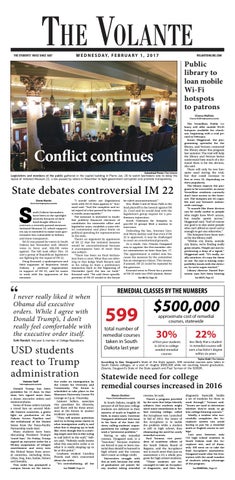
According to Gov. Daugaard’s State of the State speech, 599 remedial courses were taken in South Dakota colleges, at a cost of roughly $500,000 while not counting toward graduation. (Source, Daugaard’s State of the State speech and Paul Turman of the SDBOR.
Statewide need for college remedial courses increased in 2016 Mason Dockter
Mason.Dockter@coyotes.usd.edu
In South Dakota, roughly 30 percent of all first-year college students are deficient in their mastery of math or English or both, in many cases. Governor Daugaard addressed this issue in his State of the State Address, calling students’ unpreparedness for college coursework a “persistent problem.” Having to take remedial courses, Daugaard said, is a “lose-lose,” because students are forced to pay to learn material they should’ve learned in high school, and the courses don’t count as college credit. Universities struggle with this as well, because the odds of graduation are poorer for any student taking remedial
courses, he said. There’s a program provided by the state that helps identify subjects that students might need some remediation in before entering college, called the Accuplacer test. Launched in fall of 2013, the intent of the Accuplacer is to tackle the problem while a student is still in high school, thus eliminating the need for costly remedial courses. Paul Turman, vice president of academic affairs of the South Dakota Board of Regents, said the Accuplacer test is much more than just an assessment – it’s a whole program for high school students. “Those students are encouraged to take an Accuplacer diagnostic, and then that
diagnostic basically builds a set of modules for them to work through,” Turman said. “Scores are used to determine whether they’re ready to go into college-bearing courses.” Ideally, a student who successfully completes the Accuplacer system can avoid having to pay for a remedial math or English course in college. Last year, however, only 154 high school students in South Dakota took the Accuplacer test, and of those, only 100 went on to take the final Accuplacer assessment. Daugaard made clear his frustration with the small number of students taking advantage of the program. See REMEDIAL, Page A3
News
A2 Wednesday, February 1, 2017
The Volante I volanteonline.com
HIMALAYAN HAPPENINGS
Cheyenne Alexis I The Volante
Members of SDSU’s Nepalese Student Association performed a traditional dance at the MUC ballroom Sunday night. The event was organized by International Club President Prakriti Rajbhandari, who wanted unify all five countries that surround the Himalayas.
City of Vermillion Police Blotter Highlights >> Jan. 22 - 28
2 Jan. 22 Officers stopped a car for a broken tail light on High Street. Some passengers in the car were underage and had been drinking. They were cited. Jan. 22 A passenger of a car stopped for speeding was found to be drunk and in possession of an expired ID belonging to another person. Officers arrested and cited the passenger. Jan. 22 At a residence on E. Cherry Street, officers responded to a call reporting a resident burning yard
2
reports of fraud
waste illegally. The resident was informed of the law and told that the recycling center would be a better option for the waste. Jan. 22 Officers were called to a business on E Cherry Street for a welfare check on an individual who had made suicidal statements to her mother. The statements, the woman said, were made out of stress, and she had no intention of harming herself. Jan. 24 A caller reported receiving a phone call from someone who informed
1
DWI’s
him that he had won a lottery and a car. The unknown caller asked the man for his banking information in order to process a $300 “fee” to release the lottery winnings. The police department said the call, and any like it requesting funds, are fraudulent. Jan. 24 A caller reported several fraudulent checks had been written on her account. The incident is under investigation. Jan. 24 Police received a call about a man and woman arguing loudly by the side of the road.
An officer contacted both people but found that no crime was committed.
marijuana arrest
tion with the driver passed out at the wheel. When they arrived, officers found the driver was a man whose license was cancelled due to health issues. The vehicle was stopped, the driver was cited and the vehicle was impounded.
Jan. 25 A local restaurant reported that someone had dropped a bag of marijuana on the floor. Officers collected the marijuana and started an investigation.
Jan. 27 A caller reported a man in a convenience store had dropped a bag of marijuana on the floor. Officers contacted the man, who said he was holding the marijuana for a family member who had a job interview. The man was arrested for possession of marijuana.
Jan. 25 Officers were called to a dispute between two adult sisters living together. One sister, the lease holder, wanted the other removed because she wasn’t sober. Jan. 25 A caller reported a vehicle stopped at an intersec-
Jan. 27 An officer saw a vehicle being pushed by several young men. The officer turned to help provide traffic control. Several of the young men ran away from the vehicle, which was no longer stuck. The driver and four passengers were underage and drunk. The driver was arrested, and the passengers were cited. Jan. 28 After stopping a vehicle for improper lane travel, an officer found the driver was drunk. The driver was arrested for DWI.
GAF fund allocations discussed in-depth at SGA meeting Chance Mullinix
Chance.Mullinix@coyotes.usd.edu
By the time the SGA meeting was over Tuesday night, Senate Resolution 20 had seen discussion, but no progress. The resolution, which proposes how to allocate the new funds raised by the General Activity Fee (GAF), was tabled for next week’s meeting. Eighty-seven percent of the new GAF funds will be going to the athletic department. About 40 students came to SGA’s meeting to voice their opinions about the allocation. Kim Grieve, USD dean of students, gave a brief presentation at the meeting to explain the process of allocating GAF funds. David Herbster, USD athletic director, followed Grieve’s presentation and talked with students and senators, answering their questions and concerns about how the increase is going to be allocated. The crowd seemed to be divided evenly, with athletes supporting Resolution 20 and fine arts students and members of the Student Veterans Resource Center (SVRC)
The Volante
opposing the GAF allocations as it stands. The meeting lasted for more than two hours. SGA at-large Senator Diedra Gatzke questioned the advantages of being in Division-I versus Division-II. Citing a 2012 Sioux City Journal article in which Jeanette Hubert, USD’s athletic director for business and finance, claimed D-I schools need less funding than D-II schools, Gatzke questioned why USD doesn’t fit that pattern. “As the revenue goes up for being in Division-I, university funding should actually decrease,” Gatzke said. “I was just wondering why the decrease hasn’t occurred, if it was supposed to.” Herbster said he’s not sure the university funding will ever go down. “I look at (the athletics department) trying to be more self-sufficient,” he said. “When will we get to that point? I wish I had that answer for you right now.” One SVRC member expressed concern over being unable to use the athletic buildings when USD sports teams weren’t using them. Herbster
COYOTE History 1893 Chance Mullinix I The Volante
USD students discussed Senate Resolution 20, which allocates SGA money for
the 2018 fiscal year, during SGA’s Tuesday meeting. The resolution would give 87 percent of funds raised by GAF to the athletic department.
responded that the Wellness Center was open for him to exercise when he wanted to. Another student from the audience said he regretted voting for the GAF increase three years ago. He hoped the SGA could vote to overturn the GAF increase. Nathaniel Steinlicht, SGA president, warned
that overturning the GAF increase would cause SGA’s budget to shrink. This would result in cuts to student organizations’ budgets. SGA communications manager McKenzie Holton advised students to come to SGA meetings more often in order for their voices to be heard. “We would love to hear
Mission statement
Ally Krupinsky
editor-in-chief
The Volante covers issues relevant and interesting to USD students. Faculty, staff and community members
are welcome readers, but the newspaper is written and presented for a diverse community of students from
Volume 141, No. 15 February 1, 2017 www.volanteonline.com
the students’ point of view. The paper should provide a variety of information, entertainment and educational
Al Neuharth Media Center 555 Dakota St. University of South Dakota Vermillion, SD 57069
have comments, concerns or questions, please
HOW TO REACH US Editor-in-Chief 677-5494
opportunities for the readers. The Volante encourages everyone to write letters to the editor.
The Volante wishes to be viewed by students as respectable, objective, accurate, fair and trustworthy. If you
contact The Volante at 677-5494.
The Volante is distributed Wednesdays during the academic year free of charge locally with the cost of $1 for
Rachel Newville managing editor Heather Egbert advertising manager Siannah Martius digital editor Mason Dockter
each additional copy. One year subscription rates are $40, which solely covers the mailing costs.
news editor
Josie Flatgard news presentation editor
The Volante does not endorse, promote or encourage the purchase or sale of any production service advertised
in this paper. Advertisements are the sole responsibility of the advertiser. Adviser Chuck Baldwin
about these issues when they first start and before they reach critical mass,” she said. “SGA should not just be a student outlet when a budget is up.” In other SGA business, senators voted to approve Senate Bill 56, which changes SGA’s constitution and by-laws to be more inclusive and gender-neutral.
The Volante disclaims all liability for any damage suffered as the result of any
advertisement in this newspaper. The Volante reserves the right to refuse any advertising.
Chance Mullinix news assistant
Following the destruction of University Hall the past October, many believed attendance would drop. However, many returned and new faces showed up on campus.
2003 An a cappella group was formed called “Just Cuz.” Featuring four USD students, the group planned to take USD by storm and sing at USD sporting events.
Ryne Myers opinion editor Cheyenne Alexis verve editor Devin Martin verve presentation editor Morgan Matzen verve assistant Dustin VanHunnik sports editor Clay Conover sports presentation editor Taylor Kidd visual assistant
News
The Volante I volanteonline.com
WI-FI
From Page A1 complaints from customers for quite some time about the less-thanstellar Internet quality in town. “It’s something we’ve seen come up fairly regularly from patrons grumbling about their Internet connection,” Burniston said. “Either they can’t get connection or the one they have isn’t reliable, always disconnected, the signal’s not good enough.” Heggestad said there will be no limit to what patrons can use the devices for. “There isn’t any cap on the data and what people do while using the Wi-Fi is completely up to them,” she said.
REMEDIAL From Page A1
“Most students who needed this Accuplacer assessment didn’t take it,” Daugaard said in his speech. “And how do we know that? Because this past fall, just months ago, at our state universities, 599 remedial courses were required for new freshmen from South Dakota high schools. That’s 599 remedial courses, at about $1,000 each, totaling over half a million dollars in expense. Money our students paid, when the state has a free program, not being used.” Daugaard said state high schools have been too slow in adopting Accuplacer. Of 150 school districts in South Dakota, 108 didn’t offer Accuplacer to students, he said. While Daugaard said he’s hopeful that more school districts will start to use Accuplacer, Turman said the state is doing what it can to get students to take advantage of it. Despite the fact that the
Chance Mullinix I The Volante
The Verizon mobile hotspots that the Vermillion
Public Library will be offering to loan qualified patrons. Burniston said the library offers a number of programs that need an Internet connection, which the mobile hotspot program will enable patrons to enjoy. “Increasingly, the library itself is offering a lot of databases,” Burniston said. “We have the Inoverall percentage of students needing remedial courses has risen over the past year, Turman said he’s encouraged by the work being done by South Dakota’s Opportunity Scholarship program, which requires students to take a certain set of courses in high school. For students who do end up in remedial courses, however, the outlook is somewhat less bright than students who don’t take the courses. “If you are a student who comes in needing remedial, the first-year to second-year retention rates drop by almost 12 percent,” Turman said. Over the following six years, there’s a 22 percent higher chance a student will fail to complete a degree, Turman said. Math can be a troubling issue for incoming first-year students, Turman said, because South Dakota high schools only require three years of math, concluding their junior year. This means that many high schoolers don’t take any math classes during their senior year.
dieFlix movie streaming service, we just started trialing a one-play digital gaming service that has PC and Android apps, we’re trialing this year a universal class which is a system that offers nearly 600 different classes on different topics.” Without the hotspots,
Burniston says the computers at the library will always be occupied by patrons taking advantage of these services. “If people can’t get a connection to use these services, they have to come in to the library to do it and we have 12 computers, with two in the teen room,” he said. “So they fill up pretty fast after school and on weekends.” In order to participate in the program, an individual must be a VPL cardholder, be at least 18 years old, have a 6-month or older active library card in good standing and a valid ID. An individual must then fill out a VPL Hotspot Lending Agreement form, accepting responsibility if anything that happens to the device while in the person’s possession.
Wednesday, February 1, 2017 A3 During the trial period, an individual can checkout a hotspot for three days. Heggestad said if a device isn’t returned in time, its Internet capabilities will be shut off. After the trial period, the checkout time will be expanded to five or seven days, depending on the feedback the library gets. When someone returns the hotspot, they’ll be asked to fill out a survey, helping the library understand the public’s reasons for checking out the hotspot and how it performed. “We really need feedback and that’s also the purpose of this trial period,” Heggestad said. “We’ll be asking people to fill out a follow-up survey. That’s going to help us understand how it’s working for them as patrons and inform what we
“
stigma (on math),” Van Peursem said. “I mean, it’s totally OK to say, ‘I hate math, I stink at math,’ whereas in real life, you’re not going to go to a party and say, ‘You know, I stink at English, I stink at grammar, I hate reading, I can’t read.’ It’s kind of a shame to admit you can’t read, but it’s perfectly OK, and actually kudos to you, if you can’t do math. So I think there’s part of a social acceptance that doesn’t help us any.” Patricia DiMond, an instructor at USD who teaches remedial English courses, said students in her class have their strong suits, as well as areas where they need more practice.
“I have a variety of students coming in with a variety of skills,” DiMond said. “Some of them have never written a research paper, some of them have written multiple research papers but the last time they had anything to do with grammar was fourth grade, so their grammar and usage is all over the place.” DiMond added that not all high school educations are created equal in South Dakota – some students come from high schools that are understaffed, particularly in some reservation areas. “Sometimes it’s the institution, sometimes the teachers just do not have time to teach writing the
way they would like to, other times it’s the curriculum,” DiMond said. The purpose of placing a student in a remedial course, DiMond added, isn’t just to bridge a gap in subject matter – it’s also to help them transition to college courses in general. “Sometimes they’re not prepared for the demands that college makes of them,” DiMond said. “Part of this remedial course is helping them to be successful in college, by teaching them to read a syllabus, to use it as a calendar for what they have to do each day, to keep track of their work, to manage their time.” Some day, Turman hopes, the conversation of student readiness for college will be in the past, because more students will be ready for the transition. “We’ll keep looking for policy solutions so that at some point, USD is not in the business of doing remediation for its students at all,” Turman said.
TRUMP
icy changes. Shamly Mackey, a senior computer science major from Sri Lanka, said he found it interesting how quickly Trump started signing orders. “I just found it very interesting how as soon as he came, he just had so many orders like restarting the DAPL and the other pipeline,” he said. “Now the most recent development is the one with the bans... I do know a friend from Syria. I don’t know if she’s a citizen or if she’s here for school. I’m kind of worried about her.” Josh Andrews, a sophomore in College Democrats, isn’t supportive of Trump’s travel ban. “According to Trump, it is going to combat terrorism when it in no way is not,” Andrews said. “Because out of the sev-
en countries he chose, zero of them have lead to terrorism threats in the United States since 9/11.” Seth Randall, a firstyear student and member of College Republicans, said he supports Trump’s policies, but not the way he’s going about them. “I never really liked it when Obama did executive orders,” he said. “While I agree with Donald Trump’s, I don’t really feel comfortable with the executive order itself.” Sellers invites everyone to come to the forum on Thursday with questions and queries. “Come with an open mind,” Sellers said. “Come with your questions. Get information and that’s what it’s all about.”
We’ll keep looking for policy solutions so that at some point, USD is not in the business of doing remediation for its students at all .
Paul Turman, SDBOR vice president of academic affairs This “gap” year in math learning could be bridged by requiring South Dakota high school students to take a fourth year of math, Turman said, but such a requirement could take a long time to develop. While math isn’t required in each year of South Dakota high schools, English is. Turman cited this as a possible explanation for why English remediation rates are lower than math. Dan Van Peursem, chair of USD’s math department, said there may be a cultural reason behind the number of students that arrive at college unprepared for college-level math. “We put a big social
will do going forward.” Any lost, damaged or stolen hotspots will be billed to the person who checked out the device, Heggestad said. “The devices will cost $50 to replace,” she said. “The charging cords are more likely to disappear, and those will cost $6 to replace.” Looking at the success other libraries have had with the program, Burniston is optimistic about the program going forward. “The question isn’t if it’s going to be successful, it’s whether we’ll be able to keep up with demand,” he said. “Libraries have all these programs, but we only have so much money. We don’t get our budget raised, so we have to spread the money around.”
From Page A1
things and seeing Facebook and talking to my friends about it,” she said. “I’m worried that it might affect some of my friends and how it will affect my family too, because I’m from Mexico. I’m a citizen, but not all of my family is.” Sellers said the forum is open to all students to come and ask questions. “It is a concern for many of our students, even our students that don’t come from those affected countries. It is a concern because there is no telling what may come of this ban,” he said. USD students across campus have mixed feelings on Trump’s first pol-
Opinion WEDNESDAY, FEBRUARY 1, 2017
THE VOLANTE
VOLANTEONLINE.COM/OPINION
Whatever your opinion, bring on the ruckus JORDAN SMITH is a sophomore majoring in political science. Well, it happened. Donald Trump is now the 45th president of the United States. We now have one of the most unpopular presidents ever elected. He’s the second to lose the popular vote, and the first to have experience with neither government nor military. Of course, the almost 63,000,000 people who voted for him are thrilled he was able to pull out a win through the archaic Electoral College, and that’s fine. Trump won fair and square. That doesn’t mean I will take this sitting down. This past Saturday, I marched for Women’s Rights in Sioux Falls, and here in Vermillion. And I don’t think this will be my last. Of course I would love for progress to roll forward and alleviate me of a need to protest, but I have little reason to believe that. We now have a president who has mocked the disabled, denied climate change, settled a fraud lawsuit, shown a very demeaning attitude toward women and a state ready to again consider transgender bathroom legislation. Maybe I’ll be proven wrong, but a lot of issues I care about and that seem fairly popular with my generation are already under siege. For almost a decade, we saw some tremendous progress under the Obama administration, specifically in social and scientific progress. To be fair, President Trump has said that while he does intend to repeal the last administration’s signature Affordable Care Act, he at least wants to replace it with something. So, I’ll keep an open mind and wait to see what Trumpcare ends up looking like. On the other hand, not even 24-hours after they were sworn in, the Trump administration has removed the White House pages for civil rights, LGBTQ+ rights, women’s rights, voting rights, climate change and
VOLANTE EDITORIAL
“
Maybe I can’t get involved with every issue... but you can bet that I am going to make some noise.
immigration for a 404 error. Of course I don’t expect Obama’s policies to stay up, it’s a new administration, but if we were worried he didn’t have a plan before, this isn’t very reassuring. What do we do now? We do what our parents and grandparents did, we get active. Ever since the era of Civil Rights and the Vietnam War, students around the country have been important catalysts of change, and we as a gifted generation must not let that flame die out. This is a free speech campus, adorned with the Al Neuharth building proudly proclaiming our First Amendment. Our generation is blessed with better communication and organization technology than any before, and what do you know, there’s a reality TV personality in the White House. I think there’s fairly solid evidence for reality TV stars taking concerned with votes and #socialmedia. Reasonably, I need to get my marching boots on and get ready to leverage my privilege as a straight, white, Christian man for those without it. Maybe I can’t get involved with every issue I care about in the rural Midwest, but you can bet that I am going to make some noise. No matter what happens in the future, I will always stand ready to support anyone whose rights are threatened. As noted American poets Chuck D and Flava Flav once said, “We need to fight the powers that be.”
The Volante THE STUDENTS’ VOICE SINCE 1887
EDITORIAL BOARD Ally Krupinsky, Editor-in-Chief
Cheyenne Alexis, Verve Editor
Rachel Newville, Managing Editor
Dustin VanHunnik, Sports Editor
Ally Krupinsky I The Volante UPD officers are here to protect us. Their goal is not to stifle student fun.
UPD officers deserve praise, not apprehension Our university has an amazing department that’s here to protect us. UPD officers keep us safe,
of. This shouldn’t be the case. If you haven’t done anything
because they want to be here. If they do issue citations,
wrong, don’t act like you have.
it’s because they want to help
Instead, students should say
students, not hurt them.
and oftentimes are lenient
hello and give officers a smile.
regarding ticket writing, in
Their job is difficult enough
help, with at least two officers
accordance with USD’s policy.
as it is – let’s not add to it by
on duty at all times. They also
being hostile or wary. In fact,
have a safety feature on campus
Paulsen was featured in a recent
let’s be friendly to other faculty
– if it’s late and you don’t feel
Volante story (see B3). It’s nice
members on campus, too.
to have a UPD sergeant who
Without their hard work, USD
comfortable walking back to
likes the same “holiday” that we
wouldn’t be the same.
UPD sergeant Andrew
do, Dakota Days. While many
protect us. Their goal is not to
‘bad guys,’ sergeant Paulsen, as
stifle student fun.
doing their jobs. UPD’s ultimate goal is safety,
your dorm, they’ll walk with you. Students should be more
UPD officers are here to
students tend to see UPD as the well as the rest of UPD, are just
UPD is always around to
When we have people like sergeant Paulsen who are passionate about their jobs and
not getting students in trouble.
about USD students, we have a
Sure, there can be some
better atmosphere on campus.
unfortunate parking tickets
UPD’s primary mission is to
appreciative of the hard work they put in day after day, Friday night after Friday night. If anything happens and you need UPD’s assistance, be kind. They’re here to help you and make sure everything is okay. When you see an officer, don’t be alarmed or afraid, instead
and the occasional minor in
keep USD’s campus safe. They
possession citation, but those
enjoy interacting with students,
be compliant. If you are given
are actions that warrant a ticket.
even if students don’t always
directions or asked questions,
If you aren’t doing anything to
enjoy interacting with them.
follow and answer them.
get into trouble, you won’t get in
We, as students of a great
If these officers didn’t like college students, they could
university, are lucky to have
When some students see
very well go and work for the
UPD with us.
UPD on campus, they become
Vermillion Police Department
uneasy, and a little scared, even
or another station. Instead
respect you and all that you do
if they have nothing to be scared
they work on a college campus,
for us.
trouble. It’s that simple.
OVERHEARDS Here you’ll find the weirdest, funniest and stupidest things we’ve heard during the week. Context is for suckers.
“If you go to bed the same day you woke up, you’re a quitter.” — North Complex
So thank you, UPD. We
In The Know & In The Dark IN THE KNOW: Sigma Alpha Epsilon (SAE) members painted the lion in front of their house. IN THE DARK: Your fraternity colors don’t contain red. Should’ve painted it purple.
Ryne Myers, Opinion Editor
CONTACT US
“I had no speaking notes, so I just got up and yelled for an hour and a half.”
The Volante welcomes letters to the editor in regards to campus, local, state and national issues. Letters will be edited for clarity and length and will be printed as space allows. Please limit letters to 300 words or fewer. The Volante reserves the right to hold letters for publication in a later issue. Submissions must include the author’s name, address, telephone number, year in school and major or job title. Letters must be exclusively for The Volante. We will not publish anonymous letters.
— The Varsity
Send letters to: Letters, The Volante Al Neuharth Media Center 555 Dakota St. Vermillion, S.D. 57069 Fax to: 605.677.5105 E-mail to: volante@coyotes.usd.edu Via our web site: volanteonline.com
— North Complex
The deadline for letters is 5 p.m. the Friday prior to publication. Letters must be typed and fewer than 300 words.
“I think their overlords are prohibiting them from talking.” — Al Neuharth Media Center
“Can we get these shoes off the fridge?”
“I’m worried if I put money in it, I’ll get a razor blade out of it.” — The link
IN THE KNOW: It’s almost Valentine’s Day. IN THE DARK: Happy Unattached Drifter Christmas to the rest of us.
IN THE K NOW: It’s getting warmer outside! IN THE DARK: Don’t trust it, you’ll still fall on ice after 8 p.m.
IN THE K NOW: Spring break is approaching. IN THE DARK: Spring break is still a month away, hang in there!
Opinion Candidly Canada: Trump opinions, influence extends beyond U.S. borders
The Volante I volanteonline.com
ALLIE KNOFCZYNSKI is a junior majoring in media & journalism.
My study abroad excursion conveniently coincides with the inauguration of America’s new president. While the decision was unintentional, I can jokingly say that I decided to go to Canada to escape the changing administration. I still stand along the sidelines as a United States citizen, watching the torch of leadership passed from Obama to Trump. Hopefully the country doesn’t burn. While the event is American-oriented, this shift in power is crucial for every person, no matter their opinion, citizenship or ethnicity, to understand.
As Trump toted in his speech, our voices will define our American destiny. They also define our global destiny. With an everincreasingly globalized society, actions in one country reverberate in others. Especially for students leading the upcoming generation, people must make sure the ideas they share define a beneficial destiny for all. Despite little influence in the election itself, Canadian citizens still possess their own opinions regarding President Trump. After all, according to the Guardian, the Canadian immigration website crashed on election night as key battleground states glowed red. For Canadians, their government under Prime Minister Justin Trudeau is virtually a complete opposite from Trump’s proposed plans. The Washington Post went so far as to call Trudeau the “anti-Trump.” The two politicians do
have some similarities: Trudeau’s rise to power was described by opponents as inexperienced and solely based on family legacy. Each candidate won through expert branding and loyal voters, especially on social media platforms. However, that’s where their similarities end. Canada exudes a clear example of what it means to show tolerance and respect to every single person, championing concerns for human rights and the environment. Prime Minister Trudeau is focused on peace-making efforts with the United Nations and even fulfilling goals like welcoming 25,000 Syrian refugees into the country. The key points of political variance from this day forward are not just an American challenge, but a global one. Policy areas for Canada are at risk if key players like America aren’t on board. The Huffington Post adds that other nations like the United Kingdom, especially after Brexit,
have left citizens and administrators questioning the fundamental shift in values in an effort to find common ground. When it comes to trade, security and international relations, Canada and America have a crucial relationship at stake, one that is only as strong as its weakest link. Inside or outside American borders, the strict partisan divisions have become a determining factor in everyday interaction, but as long as a shared goal of cooperation and respect maintain top priority, we can stand together and fight for what is right. As citizens of our respective countries and the world, that is our responsibility, more important now more than ever. If you’re a USD student traveling abroad and would like to contribute to The Volante, please contact us at volante@coyotes.usd. edu.
Electoral College isn’t to blame for election DEREK CHANCELLOR is a master’s student obtaining an MPA. As ugly and undignified as the campaigns of the past election season were, we must now come together to advance our country’s best interests. A bigger picture is at stake: the current state and future trajectory of our nation and its collective people. This reality is much more important than partisan politics will ever be. We must always remember that we are one nation of many and we mustn’t dispose with the founding principles that have made this country so great in the first place. While we don’t always have to agree with one another, it’s absolutely imperative that each of us remembers the characteristics that already make this country the greatest in the history of the world. If we are to sustain the global prominence that we have so consistently bolstered, for the goodness of the world, as a beacon of freedom and prosperity for others to strive to exemplify, then we must frequently remind
“
A bigger picture is at stake: the current state and future trajectory of our nation and its collective people.
ourselves of our origin and the things that have gotten us this far. Take, for instance, the system in which we indirectly elect our president: the Electoral College. After the results of the election, instead of retrospectively regretting their decision to abstain, many individuals have proposed completely voiding the Electoral College system and altering our country to becoming a direct democracy. Yet this system has a defined purpose and was established for a number of relevant reasons. America was founded as and remains a constitutional republic, bounded by a founding document and steered by the people through a small elected body of representatives. Those who suddenly wish to alter the ingenious system we have in this country – a system which has proven relatively successful at electing
presidents for more than 200 years – are doing so out of rash animosity over the results of a single election. This sort of impulsive, hasty reaction is thoughtless and can fundamentally destroy a great nation. Many individuals believe that states in the Midwest carry too much weight in presidential elections. Conversely, residents of those states would laugh at such a claim. While California receives 55 electoral votes, South Dakota receives only three. But this is the way it was meant to be – based upon representative population. If a pure popular vote were enacted instead of the current Electoral College system, states like South Dakota would utterly pale in comparison to the few metropolitan areas of the country. In fact, according to the U.S. Census Bureau’s Population Estimates Program, the 2013 population of Los Angeles
County alone was roughly 12 times larger than the entire state of South Dakota. A pure popular vote for president would alter the very identity of our country through the policies that would begin to take priority. The agriculture and manufacturing industries are the nucleus of America’s identity. This country exists on a continent with some of the most abundant natural resources on the globe. So, if you’re unhappy with the results of this election cycle, become more involved in the process, get active, perhaps vote next election if you didn’t, but do not threaten to upend the system that has treated us all with relative prosperity, longevity and global prominence for the good of the world. Such a result would jeopardize more than is fathomable. Chancellor is a member of College Republicans.
Wednesday, February 1, 2017 A5
Chance Mullinix I The Volante SGA discussed increasing the GAF fee at their meeting on Jan. 31.
Guest column: Why GAF increase shouldn’t be approved JOSH ARENS is a senior at-large SGA sentor.
I admit, it is easy to get upset about the special treatment of athletes on this campus. While athletes eat for free, we are forced to buy exorbitantly priced meal plans. While athletes regularly travel on the university’s dime, not only do we struggle to receive funding from the university, but we also pay income tax on travel reimbursements. While athletes workout in the new, multimillion dollar Sanford Coyote Sports Center, we are not granted access despite many of the rooms being unused. And while athletes receive “full cost of attendance” scholarships, we are expected to pick up the tab for these ever-increasing athletic expenses via a $9/credit hour increase in GAF (an additional $145/semester for a student taking 15 credits). Although easy, blaming athletes is unfair and ineffective. If offered the benefits listed above, any student would take them without hesitation. More importantly, athletes do not craft university policy, the administration of President James Abbott does. Being angry with our fellow students does nothing but incite division when unity is needed to demand key policy changes from this administration. In 2006, Abbott announced the transition of athletic programs from NCAA Division II to Division I. Since then, his administration has taken steps at whatever costs necessary to prove this decision the right one. After hiring new coaches and staff, constructing new buildings, providing student athletes with “full cost of attendance” scholarships, and more, this administration bills the student body for this costly transformation. Administrators
claim the athletics department pays for itself, but this is a lie (or perhaps, an alternative fact). Nearly 61 percent of athletic revenues in 2014-15 were in the form of subsidies, i.e., student fees, school or state support. Without these subsidies, the university lost $8,917,987 on athletics. It is not hard to figure out why the administration — so bent on justifying its decision to transition — wants to increase student fees through GAF. At this point, you may think I am against the administration’s decision in 2006, but that is not the case. I strongly believe the University of South Dakota is a better institution today than it was a decade ago. However, I also believe the administration failed to include students in this conversation. Although they point to a vote in which the student body supported a GAF increase to support athletics two years ago, only 13 percent of students participated despite a massive campaign by the administration. Additionally, many students are unaware of GAF, let alone its allocation process, which has become so complex. It discourages student participation. Taken together, poor student participation and a convoluted allocation process give the administration the tools necessary to muscle through its priorities while deceptively claiming to have student support. As administrators attempt to foster a viable athletic department, they do so at our expense. In the process, they disenfranchise students and exacerbate divisions among the student body by creating the inequities we see between athletes and ourselves. While administrators usually have good intent, it is important that we, as the student body demand our rightful place in these conversations. If we do not speak up, who will? Note: A guest column by an SGA senator in favor of the GAF increase couldn’t be obtained in time for print.
Being ordinary means much more than meets the eye RYNE MYERS is a first-year majoring in media & journalism.
All my life I wanted to be something else. I have a first name that people can’t pronounce
easily, I’m taller than the average man and I have an annoying snort when I laugh. I have ordinary talents, but I like to think I’m good at ceramics and writing. Being ordinary, as I’ve come to find out, is pretty great. I love the look on people’s faces when I tell them that I don’t play basketball, volleyball or run track.
Growing up, my older sister was the one who excelled academically and in golf. I loved to be ordinary in high school, there was less to be picked on for. Just because I wasn’t the best academically and I was an awful golfer, doesn’t mean that I was happy about it. In high school, I got a job that I really excelled at – being a
personal assistant to kids with special needs. I finally found what I was extraordinary in. Sure, it wasn’t a sport, but to me, it might as well have been. My senior year of high school I graduated as a Missouri A+ Scholar. Finally, something to separate me from the pack – two years of paid community college. But I decided to take it a step further and come
here, to USD. I remember sitting in class and all the seniors were announcing what their plans were after high school. I stood up and proudly announced, “I will be attending the University of South Dakota in the fall.” I’m a kid from a town of 3,811 people. For someone to come this far for college is almost unheard of, though we did have one other girl from my high
school attend USD – volleyball player Bailey Lupardus. I am thankful that I am ordinary. I am thankful for my wacky name, being crazy tall and having that odd snort when I laugh. Being ordinary, I have learned, is the best thing that could ever happen to me. I am incredibly thankful to be ordinary.
Societal customs, priorities change – let’s roll with it NICK ZEIMET is a sophomore majoring in media & journalism.
I’m 20 and single. When my parents were 20, they were engaged to
be married in a few short months. It seems crazy to think that at one moment in time holy matrimony was something that would rank high on the list of a 20-year-old’s list of concerns, but it was. Most people I know are single – they aren’t necessarily thrilled at that fact – but they aren’t longing to be wrapped in white taffeta
or stuffed into a morning coat, either. My friends Emily and Isaac have been dating for almost five years. Both are 20. Now, following the logic our parents seemed to have followed back in the 80s, Emily ought to be looking through Modern Bride and picking out her bridesmaids dresses. But neither Emily nor Isaac are ready to
get married. When I asked Emily if she thought her and Isaac would get married, she answered yes. She added that she didn’t see it happening for a long time. She wanted to travel, to have a career, she wanted to live her life before she tied the knot. This isn’t to say that Emily doesn’t want to do these things with Isaac
by her side. But being married at 20, or in the near future, doesn’t rank high on either of their priority lists. They love each other and that’s what is important to both of them. How it was possible that we could be straying far from the paths of our parents as we are? We want to be so much more than just a
significant other. At some point we would like to have someone to be with,but we don’t mind if that doesn’t happen right away. There’s nothing wrong with doing things at our own pace. Society is changing in our favor, let’s embrace it.
A6 Wednesday, February 1, 2017
News
The Volante I volanteonline.com
Fewer USD law students passing the bar Clay Conover
Clay.Conover@coyotes.usd.edu
Only three weeks into spring semester, USD School of Law students are preparing for the bar exam. The law school has seen a relatively low passage rate of the bar exam passage in recent years. Historically, passage rates for the bar, the test lawyers are required to pass to practice law, have been as high as 95 percent at USD. The trend of students passing the bar changed in 2014. That year, the bar passage rate dropped to 75 percent, and it dropped even lower to 70 percent in 2015. Law school faculty are working as hard as they can to get passing rates back up, said Thomas Geu, the law school dean. “We purchase a seven-session bar prep program, specifically designed to be taken before you take the commercial bar prep course in the summer,” Geu said. “I asked the professors to take a look at their courses and compare them to the scope of the subjects and the different areas of the subjects (on the bar exam)... We’re really trying to help the students.” There are many reasons that students aren’t passing the bar, Geu said. One is because of a drop in law school applicants, which means many schools have had to loosen their standards for admittance, thereby accepting students who are more likely to struggle. USD did change their admission standards, but
Clay Conover I The Volante
Students attend a lecture by professor Christine Hutton in the USD School of Law
on Monday.
not enough to explain the drop, he added. Another explanation for the decreasing rates may have to do with the exam itself. “Nobody knows the exact reason why. Some people speculate it’s because the bar has become harder,” said Eric Young, assistant dean and director of the law library. “Some people say the individual states are grading the bar exam differently.” The bar exam is split into two sections, which can be passed individually. Students take a multiple choice portion the first day, which is standard among most states. The second day is spent on an essay portion, which is more specific to South Dakota. In South Dakota, unlike
most states, students can pass one section and fail the other. Students are required, however, to pass both sections of the test to practice law in the state. In bar exams done in some other states, if a student does poorly on one section of the test and does well on the other section, they may still pass.
Preparing for the bar
Most students take a bar exam preparation course in the summer before taking the test in July. Students usually take a week break after graduating and then start the intense course. “There are 24 topics on the bar. You’re not going to be able to take classes on every one of them,” said Eric Schlimgen, who graduated from USD’s law
Department of addiction studies has perfect pass rate Chance Mullinix
Chance.Mullinix@coyotes.usd.edu
USD’s addiction studies program, the only nationally-accredited program of its kind in the state, has perfect passing rates. Over the last two years, students in the program have had a pass rate of 100 percent. Nationally, the pass rate for addiction studies is 82 percent, said Frank Zavadil, the department chair. Addiction studies focuses on understanding and treating any type of addiction people face – including alcohol, ZAVADIL drug, sex, tobacco and gambling addictions. Zavadil said a huge part of the program’s success is the rigorous training students get, which they can apply to tests. “Our students, before they take the exam, usually have some actual experience working in the field,” he said. “They can actually see the application work and when they actually take the test, it asks application questions so they can apply that information.” Because of the havoc that is wreaked upon the lives of those suffering from addiction, Zavadil said the personal experiences people have helps students better understand addiction. “(Students) have that passion to work with others,” he said. “They know the trauma and experiences people go through with addiction. They are trying to be a source for those people who lost it.” Assistant professor John Korkow attributed the students’ early and frequent hands-on
experience to the high pass rate. “Our students have their first contact with the clients that are out there in their sophomore year,” Korkow said. Senior Montanna Huitema is majoring in addiction studies. She said in an email that she shadowed at the Glory House in Sioux Falls during her sophomore year. “Getting to sit in on a couple group classes made me realize that I was in the right major,” she said. “Job shadowing really shows you what you will be doing in the future, so I enjoyed it.” Many individuals facing addiction also have some form of mental illness. This requires students to understand both addiction and mental illnesses in order to better help patients, Korkow said. “At least half of the (addiction) clients co-occur with (mental illness),” Korkow said. Mental illness is a key component in many cases of addiction, said assistant professor Mary Merrigan. “Students come in because they have histories with that or histories in their family with it,” Merrigan said. Huitema said she has a personal connection to addiction. “My dad was in therapy for PTSD after two deployments in Iraq that caused him to have an addiction,” she said. Even if students don’t major in addiction studies, Merrigan says it’s important for people to understand addiction and the afflictions that come with it. “We want people to recognize when someone’s in trouble and get them the help they need,” she said. “That’s a huge part of why people might take our classes who aren’t major or minor.”
The path to recovery can be hard for some, but Merrigan says it’s a satisfying experience to help people overcome addiction. “It’s so rewarding to see someone in the throes of addiction and help them towards health again,” she said. Addiction studies isn’t as well-known on campus as faculty would like it to be. Korkow said a big reason more people aren’t aware of the program is the roots they have in 12-step programs, such as Alcoholics and Narcotics Anonymous. Because of the misconceptions surrounding addiction, some people don’t take it seriously. “We’re an academic, evidence-based, rigorous field of study,” Korkow said. “That’s why we have the pass rate. It’s so rigorous, it’s so intense. We teach the whole gamut of addiction. We teach mental health and addiction. There’s a misperception that we’re still in our roots. But they’re 70 years out of date.” Zavadil wants those who aren’t interested in an addiction studies major to consider taking a class in the program, as the classes can help people understand addiction. “Even if people aren’t interested in the degree of education, some of the classes are really helpful for people to take to have for their own future,” he said. “More than likely, they’re going to encounter someone with addiction problems or issues. And having that knowledge, at least they’ll understand that person better and won’t discriminate against them or be ignorant of what causes addiction. It’s not a moral thing, it’s a disease.”
school last spring, passing both sections of the exam. “I put the burden of bar prep on the student. You have to really stick to the study plan, and you have to buy the right study plan that will work for you. What I did was I took a week off, I moved, and then from then on I studied for the bar.” The online courses often involve six weeks of studying for eight hours a day, and can cost thousands of dollars. Faculty in the law school said the course is necessary to pass the bar. “Most students, I’d say all students, buy a commercial bar preparation course,” Young said. Failing the bar exam could mean having to take it again months later. Students who fail the exam
could lose jobs they’ve committed to. As a result, many find themselves out of a job with no way to pay off the debt they acquired in law school. “The exam is given every six months, in February and July,” Geu said. “I don’t know how you eat – there are some real consequences financially, but you can take the bar exam again, and most people do.” Because USD’s law school is the only law school in the state, the low bar passage rates have raised concern that an already starved rural South Dakota will be left even shorter of legal advice, Geu said. “Our mission is to populate the legal infrastructure of the state of South Dakota,” Geu said. “And in that regard, if we can’t get most of our students to be able to do that, we’re failing in our mission.” USD’s law school isn’t the only one experiencing low bar passage rates. Passing rates have been decreasing all across the country. In July of 2015, only 62 percent of students at the University of Montana passed the bar exam, according to the National Conference of Bar Examiners. In the state of California, only 47 percent passed in July of 2015, according to the NCBE. For this reason, Ashley Brost, a third-year law student, believes it’s wrong to compare USD’s bar passage rates with those of other schools. “We’re a unique state,” Brost said. “I think it’s
unfair to compare us to the rest of the country. I think we need to be looked at independently, especially after the bifurcated scoring.” Regardless of bar passage rates, Brost believes she’s well prepared to practice law. “We’ve (Brost and fellow third-year law school student Kiira Anderson) both done internships, after our first and second year,” she said. “We’ve always been able to meet the expectations of the people we’re working for.” Next week, the American Bar Association, which is in charge of accrediting law schools, will be voting on dramatic changes to the accreditation standards. The proposed Standard 316 would establish a cut off for bar passage rates. Schools who are unable to make the cut could lose their accreditation. Many in the legal profession are opposed to the change. Geu said Standard 316 may have a negative impact on USD’s law school, because it could potentially imperil the law school’s accreditation. Geu, however, didn’t sign a letter circulating among law schools opposing Standard 316. “It’s a very real conundrum. That, in part, flows from the bar exam and passage rates and causes for the passage rates to fall,” Geu said. “I worry about those that haven’t had the opportunity, for example, be able to study the LSAT.”
“
If it’s decided that parts of IM 22 are unconstitutional, then I think the legislators should do the necessary work to change parts of IM 22, but not totally repeal it. Brett Ries, first-year political science and criminal justice major
IM 22 From Page A1
dict Gombocz and Mark Winegar. Kronaizl also spoke with USD College Democrats about the need of contacting legislators. First-year student political science and criminal justice double major Brett Ries said because South Dakotans voted for IM 22, legislators should respect it. “The people of South Dakota voted that they want this measure to pass and be instated in our state law,” Ries said. “The legislators of our state are supposed to reflect the wants of their constituents, and by repealing this law, they would not be representing our wishes. Instead, they’d be protecting the lobbyists and themselves.” Ries said the repeal process is being hindered by some of the finer points within the law. “If they want to repeal IM 22, then they should at least remove the emergency clause attached to it so that the voters can request a referendum and decide if they are okay with the legislators repealing it,” Ries said. “What legislators are currently doing is not only going against the will of the people, but also preventing the people from having their voice heard through a vote.” It would be better, Ries said, for state lawmakers to work with the bill rather than repeal it entirely. “I think the legislators should not repeal IM 22. If it’s decided that parts of IM 22 are unconstitu-
tional, then I think the legislators should do the necessary work to change parts of IM 22, but not totally repeal it,” he said. There have been two bipartisan bills proposed in the past. One would establish a government accountability board and another would limit gifts from lobbyists to lawmakers. If IM 22 is repealed, then these bills include some of what IM 22 was intended for: to have more transparency in government. First-year business major Jaedon Foreman said he’s opposed to IM 22 because he doesn’t want taxpayers funding political campaigns. “I am against IM 22 because it will take about $9 per taxpayer to fund. IM 22 sets up a special fund, which is funded by money taken from the general fund, and has a cap of $12 million,” Foreman said. “Being that this money is coming out of the state’s general fund, this is $12 million that cannot go towards state infrastructure or schools.” Foreman also explained the work he did for the Defeat 22 Campaign. “We called people all around South Dakota letting them know the parts of the bill that we thought would be detrimental to South Dakotans,” Foreman said. This was also not the first time South Dakotans were able to engage directly through the initiated measure process, nor was it the first time South Dakotans were frustrated by inaction. In Nov. 2014, South Dakotans approved Measure 18. This measure
increased the minimum wage from $7.25 per hour to $8.50 per hour. However, Republicans in the legislature introduced Senate Bill 177, which exempted workers under age 18 from receiving the minimum wage. South Dakota voters then responded by voting ‘no’ to decrease the minimum wage for those under age 18 with 71.1 percent of the vote. The people had to vote again for whether or not to raise the minimum wage, and the voters had to state their opinion the second time for them to be heard correctly by their legislatures. The fact that initiatives sometimes reach this fate in South Dakota is troubling for some because South Dakota voters have to state their voices through voting on an initiated measure more than once. “It makes me worry about future initiatives,” Kronaizl said. The next step for IM 22 is the possible enactment of an emergency clause and there needs to be votes in opposition to stop the delay. If the repeal goes forward, Kronaizl said he has a plan. “If (the legislators) go forward with the repeal then (we) will keep a close eye on these replacement measures,” Kronaizl said. Ries has a word of advice for USD students who want their government to hear their concerns. “I think South Dakota voters should hold their legislators accountable,” Ries said.
Sports
WEDNESDAY, FEBRUARY 1
THE VOLANTE
VOLANTEONLINE.COM/SPORTS
@VOLANTESPORTS
Siannah Martius I The Volante Kylea Sheley, an athletic trainer for the women’s basketball team, works with fifth-year senior Caitlin Duffy’s injured ankle. Duffy is rehabilitating from the ankle injury that has kept her out all season. Duffy said Sheley has kept her motivated and has been a “shoulder to cry on.”
Athletic trainers dedicated to success Siannah Martius
Siannah.Martius@coyotes.usd.edu
While the crowds are cheering and athletes are giving their all during games, athletic trainers are always on the sidelines, carefully watching out for any injuries that might occur. Tyler Dopheide, an athletic trainer for the football team, and Kylea Sheley, an athletic trainer for the women’s basketball team, are two USD employees who exceed their job descriptions. These trainers aren’t only there for the injuries, but also to support their athletes.
The job
Many trainers become involved in the field because of their love for sports, which is ex-
Siannah Martius I The Volante Tyler Dopheide, an athletic trainer for the football team, works on junior physical education major Brandon Colpitts’ hamstring.
actly why Dopheide and Sheley decided to become trainers. Dopheide said he suffered a major injury as a high school
athlete, which sparked his interest in athletic training. After he went through the rehabilitation process, he decided that he
didn’t want to see any other athletes having similar experiences, which propmted him to consider a career in athletic training. Dopheide has been on the athletic training staff at USD since the 2014-15 season. He started as the assistant athletic trainer and has since moved to head football trainer. Sheley’s start in the field was a bit different from Dopheide’s. “I grew up in a small community where playing sports at the next level was never going to be an option for me, but I really had an enjoyment of helping other people, whether that be kind of coaching or mentoring people in the classroom,” she said. “I kind of always knew that I wanted to just help people, so I kind of combined the two loves and
found athletic training was going to be a good fit for me.” Sheley has been on the athletic training staff at USD since the summer of 2015. She works primarily with women’s basketball, but also works with football and softball athletes.
The work atmosphere
USD’s athletic trainers dedicate their time to student athletes. Sheley said that in a typical day of work, they see athletes that are ill and determine if they’re able to practice, tape athletes before practices and games, complete pre-practice and pregame treatments, post-practice and post-game treatments and See TRAIN, Page B2
Offseason conditioning ‘crucial’ Taylor Kidd
Taylor.Kidd@coyotes.usd.edu
Students and fans cheer on USD athletes in their prime: racing on the track, nailing threepointers or scoring a touchdown. Competition primarily makes up an athlete’s in-season, with some sports having up to three games in a single week. Competition season, regulated by the NCAA, allows up to 20 hours of practice a week. Even when competitions are over, practices continue all year for athletes, and offseason training can extend longer than inseason, depending on the sport. Currently, athletes in a fall sport are in the midst of their offseason training. Athletes are only allowed eight hours of offseason training per NCAA rules. Jevon Bowman, head strength and conditioning coach, has been working with USD athletes for the past eight seasons, and said the offseason is an important tool in training the football team. “Our number one goal is to bring them back, get them moving to our standard, regain the size and strength that we lost through season and turn all that stuff into power,” Bowman said. “We really work technique at the beginning and enforce the little things and progress that through the year.” For the football team, in-season training differs quite a bit from offseason. While in-season requires careful planning around competition days, Bowman said offseason is the time to “get after it.” The team lifts five days a week, completes a running workout twice a week and holds a team competition once a week. “... We’re working on different
Enosh Kattinapudi I The Volante
Sophomore guard Alison Arens drives to the basket for a layup during the game against Western Illinois Jan. 28. Taylor Kidd I The Volante
Freshman football player Dodi Makwinja lifts during the team’s offseason training on Jan. 30. skill sets, seeing some leadership, cooperation, cohesiveness and creative thinking on how to accomplish certain goals,” Bowman said. “The offseason is important for building team culture.” The football team’s offseason extends from November all the way through the summer, but the team will begin “spring ball” in March, and their allotted practice limit goes back up to 20 hours a week. Similar to football’s schedule, volleyball will continue their offseason training for about another month before beginning spring training. Leanne Williamson, the USD women’s head volleyball coach, says the team utilizes individual workouts before they pick up again in mid-February. “To start our offseason, we do a lot of individual workouts. We do two hours of volleyball a week
and about five hours of strength and conditioning,” Williamson said. “So they’re able to really put a lot of time and effort into those smaller details we work on to a point in the fall, but the fall is so much more about the team and making sure we’re ready as a whole.” The volleyball team will have four games this spring, but the focus isn’t necessarily on the win-loss record. “It’s a great learning opportunity,” Williamson said. “Everybody gets a chance to play so we don’t just have our six main starters, so everybody gets those experiences which is obviously very important for us going into our next season.” With volleyball kicking off right away in August, Williamson said the team-lead summer training will be beneficial. “Our players have made the See LIFT, Page B2
Women lose to Leathernecks Enosh Kattinapudi
Enosh.Kattinapudi@coyotes.usd.edu
The USD women’s basketball team (18-4, 7-2 Summit) hosted the Western Illinois Leathernecks (16-6, 6-3 Summit) on Saturday at the Sanford Coyote Sports Center. The Leathernecks offensive play was at its best during the first half as they accumulated 46 points while the Coyotes gathered just 31 points. Leathernecks junior guard Morgan Blumer scored 28 points, including 6 three-pointers to lead the scoring for both teams. Blumer’s fellow junior guard, Emily Clemens, contributed 24 points. The Coyotes came back strong in the second half but couldn’t pull off the victory. Sophomore guard Allison Arens’ hot shooting fetched 27 points for the team, while fellow sophomore guard Jaycee Bradley added another 13 points. “They are a great defensive
unit. They pressured us, caught us off guard a few times,” Arens said. While just the fourth loss of the season for the Coyotes came in a tough fashion, the team is looking forward to moving on to the next game. “We did not make good decisions in their zone,” Bradley said. “We will go back, learn from this game and continue to get better.” Coach Dawn Plitzuweit spoke about how the early play against the Leathernecks was a big reason why the comeback came up short. “Western Illinois is a really good team. Our transition defense was not very good tonight, and it helped them play more offensively from the start.” Looking forward to the upcoming games Plitzuweit said, “We will get better because of this game.” The Coyotes will play their next game in Denver on Feb. 2.
Sports
B2 Wednesday, February 1, 2017
The Volante I volanteonline.com
Back in business Rachel Newville
Rachel.Newville@coyotes.usd.edu
Coyote basketball’s sophomore forward, Tyler Hagedorn, is back in business after an early season ankle injury and improving more than ever, his coaches have said. Hagedorn suffered an ankle injury at the beginning of the season, and has worked his way back up to consistently playing regular minutes each game. Hagedorn said he rolled his ankle two days before the team’s first regular season game against Drake. A week later he was cleared to practice, but he later slipped on the ice and injured it more. It took more than a month for Hagedorn to recover, he said. Head coach Craig Smith said Hagedorn’s injury was a bad one. “Sometimes it’s a moderate one, just a mild sprain and this was a high ankle sprain,” Smith said. While Hagedorn sat on the sidelines, his coaches and teammates continued to encourage him. “We met a couple different times and we just kept telling him, ‘Tyler you gotta keep fighting, keep getting better. You’re clearly not yourself yet’,” Smith said. “...Give that kid a lot of credit, he’s hung in there and hung in there. You just never know when your number is going to be called and when his number was truly called, when he had some extended minutes was the IUPUI game, and he’s played fantastic ever since.” Hagedorn’s passion for basketball is one reason he was able to ‘hang in there’ through his injury. His drive is rooted in his family’s passion for the game, he said. Both of Hagedorn’s parents played college ball: his mom at Mount Marty College and his dad at Northeast Community College and Dana College. His sister, Breanna, played for Doane University and his brother, Matthew, plays for Norfolk High School. “(I’ve been playing) as long as I can remember,” Hagedorn said. “It’s just from day one playing basketball, so I’m really excited I’m playing at this level.”
The next man up
Hagedorn had over a month-long recovery for his left ankle injury. “I wasn’t completely focused in on the season... but I started practicing better, which is probably the big key. I wasn’t prac-
TRAIN From Page B1
keep an eye out for different tendencies with the athletes during practices and games. They’re constantly on the lookout for any injuries that might happen. “If we’re there and we can see the injury occur, we can better treat it,” Sheley said. “So it’s really crucial for us to be present for practices, conditioning activities, as well as games.” Sheley said she loves her job, but she especially enjoys getting to work with such great people. “This is my family here and our student athletes are really special. They’re very well-rounded individuals,” she said. “I mean, they’re wonderful athletes, but most of them are even better people, so I really enjoy actually just the social interaction of my job.” Brandon Colpitts, a junior physical education major and defensive back on USD’s football team, and Caitlin Duffy, a fifthyear history and criminal justice double major and point guard for the women’s basketball team, have both been treated for their injuries, and said they consider their trainers friends.
Enosh Kattinapudi I The Volante
Sophomore guard Matt Mooney pulls up for a shot in a game against Denver on Jan. 28.
USD beats Denver in thriller Enosh Kattinapudi
Enosh.Kattinapudi@coyotes.usd.edu
File Photo I The Volante
Sophomore forward Tyler Hagedorn attempts a free throw in a game at against Wwstern Illinois Jan. 25. ticing that great because my mind wasn’t there... so for me to get back on the court it was really tough,” he said. “But obviously with Tyler Flack getting injured and with my ankle starting to feel better and the hardship fell through. I really started to thrive in practice which carried over to the games.” Smith agreed that practicing well transitioned into playing well in games. “You can really help yourself by practicing well,” Smith said. “Because when you practice well, obviously you get the attention of your teammates. It’s not just the coaches, it’s your teammates as well, and when Tyler Flack went down his opportunity came.” Hagedorn said he believes the team’s ‘next man up’ mentality really helps them succeed. “We have some history of injuries, so it’s not our first and in the end it’s truly the next man up philosophy,” he said. “We’ve got 15 guys on the roster, two of them can’t play, so 13 guys, and then you know, one guy goes down and the next guy has to step up. So it’s truly that next man up philosophy.” Sophomore forward Dan Jech said Hagedorn’s teammates could see how hard he was working to recover. “When he was in practice he worked every day like he had never been injured in the first place and “(Sheley’s) not only great at her job, but she’s a great person, so it’s just awesome to work with her because I feel like I consider her a friend in a lot of ways too,” Duffy said. “I think that is so much more fun and helpful when you’re trying to do something to work with someone like that.” Dopheide said in his first year of being a USD graduate assistant, a basketball player tore his ACL (anterior cruciate ligament), and he had to walk that athlete through the whole rehabilitation process. “Fortunately, that athlete is still currently playing. He’s a professional basketball player overseas,” he said. “That was my first big injury, and it’s something that turned out really well and it’s a great story.” Colpitts said he thinks Dopheide does his job well. “(Dopheide) is always determined to get you back on the field and ready to go again,” he said. Duffy has had similar experiences with Sheley, she said. “I’ve dealt with a lot of injuries since I’ve been here, and especially with my ankle this season, she’s worked with me almost every single day — like rehabbing and stuff. But she’s been so much more
that’s what you want to see,” said Jech. Smith said he hasn’t seen a team this close in a while. “It doesn’t always happen like that. (With) these guys, we do have a lot of depth in our program,” he said. “I think this team is a tight team. They have great chemistry. They really get along well with each other off the floor and with the depth that we have – it’s kind of our mantra now, ‘the next man up,’ and the guys believe in each other.” Hagedorn’s goal for the rest of the season is to keep improving for the team. “These last eight games I am just going to focus on making every play I can to give our team our best chance to win the conference title at the end of the year,” he said. Smith says Hagedorn is ‘just scratching the surface’ of where he can go. “We have high expectations for Tyler. A big step for Tyler is just showing that consistency and showing that he can be productive and dependable every practice, every game. Where we know exactly what we’re going to get out of him every night,” Smith said. “He’s the total package, he’s a very talented player but he’s very respectful, he’s very intelligent, off the floor, on the floor. We’re sure excited to have in our program.” than that for me,” she said. “When I get down because I can’t play, she’s always there to lift me up and help me in more ways than one.” Colpitts said he thinks
The USD Coyotes (15-9, 6-3 Summit) took on the Denver Pioneers (13-9, 5-4 Summit) in Vermillion on Saturday as sophomore forward Tyler Flack made his return from a leg injury that held him out for seven games. Unlike previous games, the Coyotes were fluent with their offensive play early in the game, with Flack leading the charge. Sophomore guard Matt Mooney continued
LIFT From Page B1
decision to stay here over the summer as a group on their own over the last couple years,” Williamson said. “That allows us to really hit the ground running in the fall.” Like volleyball, soccer’s offseason also runs into the summer. Maddie Butterfield, a sophomore on the soccer team, says training over the summer is crucial. “We aren’t required to be here over the summer, but it’s becoming more common for people to be,” she said. “It just makes it easier because then you can train with other people.” Training during the offseason in summer will also help prepare the team for the “Gauntlet,” a fitness test every team member must pass. “The first day of preseason you come back and run the fitness test.” Butterfield said. “People throw
his success by totaling 27 points. Flack added 19 points for USD. The score was tied 16 times throughout the game. Mooney credits Flack for giving the Coyotes the necessary boost for a win. “Having Flack back definitely boosted our confidence,” Mooney said. “We were able to pull off another close game.” Head coach Craig Smith was pleased with the win over Pioneers. “It was a great win for the Coyotes,” he said. “The
Pioneers are a sound team and they defended us very well.” Smith also spoke of Flack’s comeback and his impact as a team leader. “It’s great to have Flack back with us. He was really sharp on offense, but was a little rusty on defense,” Smith said with a laugh. “It will be something to work on and bring back.” The Coyotes are now in second place in the Summit League and will play their next game in Omaha on Feb. 1.
“
Offseason is the time we like to get stronger, more explosive and better... Maddie Butterfield, sophomore soccer player
up, people pee their pants, people pass out… it’s the most team bonding we do because it’s so awful.” The test begins with a six and a half minute mile, followed by descending distances and intervals until reaching a 100m run. Although the team has practices year-round, Butterfield said the fitness test is the worst of it. Now, the team’s offseason consists of mainly weight training with a few hours of skill work. “In spring season, the lifting is heavier, it’s a little bit more intense, but it’s a little bit more free because you’re allowed to
make mistakes,” she said. “There’s less pressure, so it’s a really good time to improve and build up.” In addition to weight training, the team engages in skill work. “It’s pretty heavy in foot skills and really basic things,” Butterfield said. “Offseason is the time we like to get stronger, more explosive and better on the ball and as a team. So a lot of what we’re doing right now is team building and learning how to trust each other. The better you can connect with your teammates, the better you connect on the field.”
PLAYER OF THE PACK
highly of Dopheide. “As an athlete you never
JIM LITRENA
want to be injured, and you want to get back on the field as fast as possible, but you want to do it in a
Year: Junior
timely and respectful manner to that injury,” he said.
Major: Sociology
“I think he did a really good
Sport: Football
job and does a really good job of that so that when you are back, you’re actually healthy and not making dumb decisions and risking yourself more.” Duffy said she’s very appreciative of everything Sheley does for her. “She’s just been a shoulder to cry on and has kept me
motivated
and
in-
spired to want to get better,” she said. “Just always having a smile on her face as she’s working with me and keeping me excited to keep wanting to work hard and get better.”
Dustin VanHunnik: What was your favorite sport growing up? Jim Litrenta: I used to play both baseball and football as a kid, but just football here now. DV: Who was your favorite athlete growing up and why? JL: I would have to
“I used to play both baseball and football as a kid, but just football here now.” say Barry Sanders. He was so fun to watch. DV: How big of an impact do you think athletes have on kids today?
JL: I think they have a pretty big impact. They’re always on TV now and so many of them are huge role models to a lot of kids.
Verve
Wednesday, February 1, 2017
THE VOLANTE
VOLANTEONLINE.COM/VERVE
Ally Krupinsky I The Volante
Andrew Paulsen, UPD sergeant, has worked with with department since 2003.
Longtime officer, lifetime Coyote
UPD sergeant committed to university, campus safety Ally Krupinsky
Ally.Krupinsky@coyotes.usd.edu
The university police department is committed to student safety, a priority that’s evident in the work of Sergeant Andrew Paulsen. Paulsen has been monitoring USD’s halls, hazards and home-
coming festivities for more than 10 years. He started as a student worker in 2003. He became a security officer in 2004, was hired as a full-time police officer in 2007 and was promoted to sergeant last spring. His first experience with law enforcement was at USD, where
Ally Krupinsky I The Volante
UPD sergeant Andrew Paulsen locks the Vucurevich Childrens Center during a routine patrol.
he became fascinated by case law in his criminal justice classes. “Understanding case law lets you understand the nuance of law enforcement,” Paulsen said. “It’s not just what the law says, but it’s learning how to apply the law and understand what the law is meant to do and what courts have said is OK and not OK when you’re applying the law. That’s what really hooked me.” Paulsen also received his masters of public administration degree from USD a few years later. In addition to his role as sergeant, Paulsen has a range of other responsibilities, including use of force instructor, OC Spray instructor and field training officer. Though training new officers requires extra vigilance, Paulsen said he loves doing it. “Keep them safe, make sure they can do the job and keep the community safe — I’m there to teach them that,” he said. “But while I’m
teaching them that, they’re bringing an exuberance or an excitement to do this job that in my mind carries back over to the trainer. If you do enjoy working with new people, their zeal to do the job will gleam back over to you and it makes the job fun.” Paulsen’s long-term career goal is in law enforcement administration. If he’s not able to do that at USD, he’d like to find a position in another small town. “I want to work in an agency where you get to experience everything,” he said. “That’s one of the things that I’ve liked about UPD, I get to respond to any type of call.” Overall, Paulsen said he enjoys working in a college town. “I think the thing I like most about interacting with students is these are people who are happy to be here,” he said. “They chose to come here, they’re excited about being at USD, they’re proud to be at USD, they enjoy the idea of expe-
riencing new things and it’s good to interact with a community or a population base that does feel a sense of pride and desire to be here. And it makes my job easier by having to deal with that a lot of times.” Working with a population that changes all the time allows UPD officers to constantly meet and interact with new people, he added. “UPD isn’t a traditional police agency,” he said. “We work for a unique community, and that community changes every year.”
The army
Since starting at UPD as a student worker in 2003, Paulsen has been deployed three times: in 2005, 2009 and 2012. “The university has been nice enough to let me go overseas and serve my country at the same time,” he said. Paulsen will be leaving for his See UPD, Page B4
R-Pizza serves a slice of the Vermillion music scene Morgan Matzen
Morgan.Matzen@coyotes.usd.edu
The scent of oregano, sweat and beer filled the air at R-Pizza Jan.26 as the restaurant hosted its first show ever. A cover of $5 bought several hours of music and a complimentary slice of pizza. The show featured local acts such as Chump Party, Baby D, Vulgo and Allypantz. Allypantz is Ally King, co-owner of R-Pizza. She started off the night with an acoustic set, and her song “Hobo’s Lullaby” was a hit. Co-owner Brandon King said the event was a success. “It went really well and we had a good turnout,” Brandon King said. “We will probably do something like
this again.” Members of the band Chump Party once lived in town for school, and they were happy to come back. “Tony and I lived here for years, and it’s very exciting to be playing at R-Pizza,” said Paul Squyer, drummer for Chump Party. Chump Party is comprised of Johnny Berkness (guitar and vocals), Benjamin Swank (guitar), Tony Helland (bass) and Paul Squyer (drums). Squyer is also part of the electronic group CH6R6Z6RD, and he wrote a song about Vermillion not too long ago. Each member of Chump Party is a music scene staple. “We’ve all danced around each See MUSIC, Page B4
Cheyenne Alexis I The Volante
The African Student Association book drive brought in about 4,000 donated books.
ASA to have 4,000 books delivered to Tanzania to combat illiteracy Cheyenne Alexis
Cheyenne.Alexis@coyotes.usd.edu
Morgan Matzen I The Volante
Ally King, co-owner of R-Pizza, plays “Hobo’s Lullaby” on Jan. 26.
After two successful book drives, the African Student Association is ready to ship close to 4,000 books to Tanzania. Electing new members to ASA, graduate student and former ASA president Prosper Zongo said the executive members were looking to plan activities for the 2016-17 school year. ASA has 113 members, and Zongo said about 30 of them helped with the drive. They got the word out through social media and emails, he added. Boxes were placed around campus in November, and books were collected until the end of the semester. “We collected close to 4,000 books,” Zongo said. “The idea of Tanzania... was that we should send the books to a country on the continent that is an example. Right now, the new president (of Tanzania) is doing great work, is combating corruption, is fighting to improve education in the country. We thought there wouldn’t be any better place to help.”
Zongo said he found Books for Africa, an organization that would help deliver the books. ASA public relations officer Diamond Hall said the group wanted the drive to be unique. “(We wanted to) make a new tradition,” Hall said. “We learned about the literacy in Africa that’s needed, and that was our main target.” Zongo said he “gives a lot of credit” to ASA member Christina Bushinger for helping spread the word. She had a lot of friends donate books, which Zongo said influenced others to donate, too. “Anthropology Club... had so many books we didn’t know what to do with,” Bushinger said. “I thought this is a perfect opportunity to do something meaningful with them. I donated some books and from there it just snowballed.” Zongo said the donated books were “a mixture” of textbooks and novels. The books from ASA’s previous book drive, which started in May last year, were delivered to Kenya. See ASA, Page B4
“
We wanted to make a new tradition...We learned about the literacy rates in Africa that’s needed, and that was our main target. Diamond Hall, ASA public relations officer
Verve
B4 Wednesday, February 1, 2017
The Volante I volanteonline.com
MUSIC From Page B3
Emily Schrad I The Volante
Simple Habit allows users to decompress from the stress of school through 10 free sessions using the art of meditation.
However, the app is misleading and only offers two sessions for free.
Product review: Meditation app proves useless in reducing stress, misleading subscription Emily Schrad
Emily.Schrad@coyotes.usd.edu
All college students have to deal with stress. Whether it’s a class project, an upcoming test, making the team or simply going to class, stress doesn’t go away easily. Luckily, there are many ways to cope with the dayto-day stresses of life, and meditation is one. Simple Habit is the fiveminute meditation and mindfulness app for busy people. This app claims that with its help, it’s easy to begin a daily practice of meditation. At work, home or on commute, the user can meditate wherever they are. I was eager to try this out because, like anyone else, I have my fair share of stress.
UPD From Page B3
fourth deployment in about a month. In the army reserve for almost 14 years, Paulsen has reenlisted two times: once while he was in Afghanistan and again just a few months ago. “I love the military,” he said. “I love the lifestyle, I love getting to go do strange things that I wouldn’t do if I was just a civilian.” Paulsen said being in the military has given him a “broader perspective of the big picture.” He’s had plenty of unique experiences in Afghanistan, Kuwait and working as a prison guard for high-value detainees in Iraq, in particular. His next deployment will be in Cuba, where he’s looking forward to being near water, he said. While his deployments have certainly affected him in certain ways, Paulsen said he doesn’t believe he’s been affected more than any other veteran. There’s a lot he’s learned from the military that makes him a better UPD officer, he added. “It can be difficult at times when I come back
Who wouldn’t want to take a free opportunity to try and reduce it? First of all, the app is a little misleading in that it’s free to download. Once it’s installed, only two of the 10 sections are free, and the others cost a subscription fee. So, I tapped the “taking a break” tab, then the “stressed” tab. A woman with an Australian accent came on and gave me instructions to find a comfortable spot to sit and close my eyes. She then told me to breath in deeply and breath out slowly. She continued by saying we should take a moment to focus on the stressors in my life and then to slow down my breathing.
Next, I was instructed to do a relaxation technique. The woman told me to tense my entire body and take a deep breath and hold it. When releasing the breath, she also told me to release the tension. We continued to breathe and picture the tension melting away. Finally, we took one last, long inhalation and slow exhalation. And then the meditation was over. I continued to do this exercise throughout the week. I tried to do it at about the same time every night to be consistent. As the week went on, I found myself growing tired of having to do the same thing when I wanted to meditate. I knew what was going
and I’m coming from that environment where the rule says, and if you break the rule, guess what, you’re in trouble,” he said. “To adjust to, the university has a completely different mindset. Yes, the rule says this, and you did it, but I’m not handling it in the same way. So I’ve got to be able to put that experience away when it doesn’t apply.” Paulsen and his wife, Holly Paulsen, met in the military. They started dating after a year of knowing each other, and got married in the courthouse in Vermillion 15 months after that. Holly Paulsen has been out of the military since 2015 and now works at a graphic design firm in Sioux Falls. They live in Centerville, SD, and have two “fourlegged kids” — a German Shepherd mix and a Bichon Frise mix. They’re currently looking for a house in Vermillion, Paulsen said.
Paulsen finds something hands-on to do, whether it be making flower beds or furniture. “That physical activity clears my head,” he said. “That’s generally how I deal with it, is it’s find something I can do with my hands.” Jef Rice, UPD assistant director, has worked alongside Paulsen since starting at the department in 2011. Because it was Rice’s first experience with a university law enforcement agency, he said he relied on Paulsen for information regarding campus policies and procedures and how the overall community interacted. “I enjoy working with him in all aspects,” he said. When it came time to fill the position for a sergeant last year, Rice said Paulsen was one top candidate from the start. “He got promoted this last year to sergeant, and he’s done a very good job as a supervisor,” Rice said. “He understands the mission and what we’re trying to accomplish and how we’re interacting with the campus community and what our goal is — to provide a safe and secure campus.” In addition to having a good working relationship, Rice said Paulsen does a
An optimist
“In my personality profile, I’m essentially service-oriented and an optimist,” Paulsen said. “I’m all about how can I help the public and I look for the good in people.” If he’s ever feeling down,
to happen every time, and it got boring. Although I was supposed to feel less stressed from using this app, it just added another task onto my busy schedule and added stress. I think this app has good intentions, but as a broke college student, I can’t afford to buy all the amenities that go with the app, which limits what I could do. I think had I been able to try out the different features of the app, I would’ve been a lot more satisfied with it. Because I was limited to just the two options, it wasn’t something I’d recommend to someone who was looking for an easy, free way to start meditation.
other for a long time in musical acts,” Helland said. “We’ve been very tight, and the direction has been leaning toward putting out a record that catalogues some of the things that we’ve been working on over the past two years.” Some of the themes in Chump Party’s music are heavy and fast-paced. Squyer defined the genre as “pizza,” which fit the environment at R-Pizza. Berkness said the lyrics aren’t as important as the sound. “The songs have no meaning,” Berkness said. “They have more feeling than they have meaning. I usually (sing) some pretty nasty stuff. The lyrics reflect the theme.” R-Pizza employee and Vermillion native Dylan Daniels is Baby D, and she went on before Chump Party. Daniels was the driving force between bringing these local acts together. She’s lived in town for most of her life and grew up in the small but mighty music scene. “The people that work at R-Pizza are really cool and are big music supporters,” Daniels said. “A lot of them used to throw these really DIY punk shows in the basement of the Washington Street Arts Center when I was growing up here.” Daniels attributed her interest in music to having an all ages venue in town. “I think it’s awesome when you can get the middle and high schoolers involved,” Daniels said. There was a concern for space and sound at
the venue, but it was a good problem to have, Daniels said. “They’ve been talking about doing a show forever there, so I said we’ll just figure it out,” Daniels said. “Th’ Rattletrap has a PA system, so we borrowed that. They’re all pretty stoked to have this going on at the shop.” Baby D is Daniels’ alter ego and stage name that came about from her days as a member of Th’ Rattletrap, a band she started when she lived in Sioux Falls. She released the split EP titled “Th’ Rattletrap presents Baby D meets Pale Norse” with bandmate David Sahl. “We were planning on doing that anyway just because we wanted to explore songwriting on our own,” Daniels said. “We’re not disbanded, we’re on hiatus.” Daniels said the hiatus would make for good songwriting. “It’s good for me to figure out how to write,” Daniels said. “I tend to write kind of prettier things with more reverb and he’s got more of this aggressive guitar style.” Vulgo is Phil Thoendel, who displayed his looping pedal abilities before Baby D played. Vulgo also played bass as part of the backing band for Baby D. Sophomore music major Ian Reiland-Smith said he was happy to see Chump Party live. “The music scene is pretty sweet here,” Reiland-Smith said. “It’s good to be at a show at R-Pizza.”
Ally Krupinsky I The Volante
UPD sergeant Andrew Paulsen has been deployed three times while working for the department, and will be deployed to Cuba in about a month.
good job working with students and represents the department well. Rice estimated that the normal officer turnover at UPD is around three to four years, making Paulsen’s 14-year commitment unique. “He’s been very dedicated to the department and the university,” he said. Rice said he also relies on Paulsen for ensuring that all new officers are trained properly, adding that he continually gets positive feedback from those he trains. One of his trainees, UPD officer Juston Sangster, has worked in the department for close to three years. “He is very knowledgeable. Like super, super
knowledgeable — every detail of his job, of the community, what’s going on, going out,” he said. “So he was just a wealth of knowledge.” Sangster said Paulsen was approachable from the start, which made him feel welcome. He’s an “all-around good guy,” he added. Paulsen’s transition to sergeant went very smoothly, and he’s still very friendly, approachable and trustworthy, Sangster said. “Every one of us was proud of him for getting (the job),” he said. It’s a role Paulsen takes seriously, down to the tasks that may seem mundane to other people, he said. “Our supervisors are
expected to be field supervisors. That means I shouldn’t be tied to this desk,” he said. “The expectation for me is to be out there, be seen, be visible.” Paulsen’s passion and optimism about his work and the university are clearly palpable — even when discussing the 12-hour shifts UPD often covers during USD’s homecoming week. “D-Days is fun. I love D-Days,” he said. “We’re busy, and there’s nothing better than being busy.” Rice said that Paulsen’s attitude, commitment to USD and interactions with students all demonstrate his diligence. “He’s very dedicated,” he said. “He’s a Coyote.”
PEOPLE OF THE PACK Tommy Hansen & Justin Jones Years: Sophomore Major: Tyler — business administration Justin — health services administration
Morgan Matzen: Why did you choose each other as roommates? Tommy Hansen: I can deal with his (stuff), and he can deal with mine. We’ll be up until four in the morning. Justin Jones: We’re just social people, we like to talk and have a good time. MM: Do you have siblings? JJ: My older sister Carrie is 24 and my brother Austin is 17. My older brother, Derek, 29, is not the most
“I can deal with his (stuff), and he can deal with mine.”
hardworking person, but he’s super smart. He went to SDSU but ended up dropping out because he’s not that kind of person, but he worked hard and now he’s got a really wellpaying job at TORO. He’s really hardworking, but he doesn’t like to put forth the effort if he doesn’t see fit. My older sister, she went to
school and she is human resources at a nursing home as well, and she is kind of the one that talked me into being a healthcare administrator. She said that there’s not a lot of good ones, so if I can be good at it, then that would be good.
Cheyenne Alexis I The Volante
ASA Members celebrate their success of donating books to Tanzania on Jan. 28.
ASA From Page B3
The ASA book drive brought in around 4,000 donated books. “We were able to collect more than 2,500 books,” Zongo said. “Once we collected them, we all met again and wondered how we were going to manage to get these books to Africa.” Books for Africa told ASA they would be responsible for taking the books to Minneapolis to be delivered to Kenya. With the money ASA collected from African Night, they took the books in two vans to Minneapolis. The second drive doesn’t have a delivery date yet, Zongo said.
Zongo said ASA hopes to have these drives more frequently. “After the first successful book drive, we decided it was something we can do every semester,” Zongo said. Hall said the drive didn’t have a set goal. “We just hoped for the best,” Hall said. “We wanted, of course, to have more books than last year.” Bushinger said donating books “makes sense.” “Students who have books that they don’t need anymore and will never need again, they can put them towards something meaningful,” Bushinger said. Hall said the book drive was an important experience. “(I) always want to give
back to the community and give others opportunities that most people, like here in the U.S., take for granted,” Hall said. “It’s something very new to me. It’s always good to experience new opportunities and do new things.” Bushinger said she was glad to be part of the book drive. “You’re able to donate something meaningful,” Bushinger said. “A lot of people in the U.S. don’t necessarily know what it’s like to not have the resources that we have, such as physical books. Education is something that’s so important. It’s taken for granted in the U.S. It’s nice that ASA can make an effort towards giving people resources that they might otherwise not have.”