Puerto Rico and the Caribbean
www.theweeklyjournal.com
>Josian E. Bruno Gómez
Wednesday, October 21-27, 2020 - // no. 078
Hospitals at the COVID Front Lines P6 Massive Oil Spill Threatens the Caribbean Sea P7 Economic Impact of Culture and the Arts P8-9
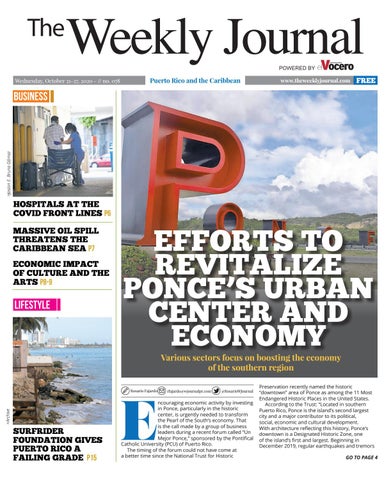
Efforts to Revitalize Ponce’s Urban Center and Economy Various sectors focus on boosting the economy of the southern region
E
>Archive
Rosario Fajardo
Surfrider Foundation Gives Puerto Rico a Failing Grade P15
rfajardo@wjournalpr.com
@RosarioWJournal
ncouraging economic activity by investing in Ponce, particularly in the historic center, is urgently needed to transform the Pearl of the South’s economy. That is the call made by a group of business leaders during a recent forum called “Un Mejor Ponce,” sponsored by the Pontifical Catholic University (PCU) of Puerto Rico. The timing of the forum could not have come at a better time since the National Trust for Historic
Preservation recently named the historic “downtown” area of Ponce as among the 11 Most Endangered Historic Places in the United States. According to the Trust: “Located in southern Puerto Rico, Ponce is the island’s second largest city and a major contributor to its political, social, economic and cultural development. With architecture reflecting this history, Ponce’s downtown is a Designated Historic Zone, one of the island’s first and largest. Beginning in December 2019, regular earthquakes and tremors GO TO PAGE 4
The Weekly Journal > Wednesday, October 21, 2020 > 2
3
/ Wednesday, October 21, 2020
a week in review BD Expands Operations in Puerto Rico
>Josian E. Bruno Gómez
>Courtesy
Becton, Dickinson and Company (BD), a multinational medical device company that operates as BD Caribe LTD in Puerto Rico, will expand its operations in the municipality of Juncos with a shared investment of roughly $23 million. BD will invest nearly $16 million for equipment, construction, job retention and job creation.
Treasury: FY 2020-2021 Collections Exceed Projections
Puerto Rico Treasury Secretary Francisco Parés Alicea reported that preliminary net income for the General Fund in July and August, the first two months of fiscal year 2020-2021, totaled more than $1.673 billion. Collections during the accumulated period to August exceeded the fiscal estimate by $190 million, or 12.8 percent.
Auto Industry Reports Year-Over-Year Growth in September
The United Group of Automobile Importers announced the results of new car sales in Puerto Rico for September 2020. The month ended with 8,427 units sold, compared to 7,546 units sold by the same month in 2019, representing an increase of 11.7 percent. However, there has been a 20.7 percent decline from overall sales throughout the year compared to 2019.
4
/ Wednesday, October 21, 2020
The Ponce Massacre Museum, damaged after the earthquakes >Josian E. Bruno Gómez
of resignation on the part of residents,” he said, adding that a sense of urgency is needed to save the Historic District of Ponce. As part of the study, students and professors identified buildings with historical and architectural value affected by Maria and the earthquakes, and prepared specific proposals for improvements. “Ten public buildings and 131 privately owned buildings were analyzed. Among the extensive list of historic buildings is the Casa Wiechers Villaronga, where the Ponceña Architecture Museum now operates; Armstrong Poventud Residence, headquarters of the Institute of Puerto Rican Culture; Ponce Cathedral and the Ponce Massacre Museum. “We also proposed how to mitigate them and what should be implemented. Construction methods and details were put forward to show the correct way to build [in preparation] for the severity of future events. We analyzed 15 structures with prototypical damage. Ponce Cathedral and the Ponce Massacre Museum, for example, are buildings that, for their historical value, must be rebuilt,” Badillo said. He added that proposals for new buildings were developed in harmony with the context of the Historic District. “More than 32 new buildings were proposed in available locations. We also presented improvements to some of the existing urban spaces and the inclusion of new spaces of shared experience, as well as urban landmarks and improvements to roads and accesses,” Badillo noted.
CONTINUED FROM PAGE 1 have caused extensive structural damage to Ponce’s historic architecture, compounding the damages caused by Hurricane Maria three years ago. Local and government organizations are working on a Recovery Plan for the Ponce Historic Zone but will need significant funding and support.” “It is at times like these,” said Paul Edmondson, president of the National Trust for Historic Preservation, “when cultural treasures mean the most. They remind us of what we have accomplished as a people during other periods of struggle, they mark the pathways we have traveled as a nation, and they remind us of who we can become if we work to realize the promise of our society… [H]istoric places have the power to reveal the possibilities of our future. These 11 places are all endangered, and all need our help to save them.” Many residents of Ponce couldn’t agree more. “The reconstruction and rehabilitation, designed and strategic, of the city is a matter of extreme urgency that we all have to do and that is why our school, as neighbors of the traditional center of Ponce, has taken a step forward providing this study “A Better Ponce is Possible,” explained the dean of the School of Architecture and Design of the PCU, architect Luis V. Badillo Lozano. “The prolongation, for an extended period of time, of a state of abandonment could give way to a spiraling fall in the life and activity of the urban center, accompanied by a possible attitude
The Ponce Cathedral, damaged after the earthquakes >Josian E. Bruno Gómez
/ Wednesday, October 21, 2020
5
Business Leaders Speak Out
Several entrepreneurs also spoke of the need to facilitate investment in Ponce. For Ponceño businessman Abel Misla Villalba, incentives to facilitate investment in historic centers is crucial. “It is very difficult, in a damaged economy, to set up a business and restore a historic building. This reality forces us, as a society and as allies of a government process, to create the conditions to facilitate investment. Without incentives, it will not be possible to rehabilitate these structures that are the country’s legacy,” he said, calling for a new incentives bill for historic areas. Misla owns The Fox Hotel in Ponce, as well as the Solace by the Sea, Hotel Meliá, Ponce Tribute and Aloft Hotel. For his part, the president-elect of the southern Chamber of Commerce, Salvador F. Rovira Rodríguez noted: “We have already identified people who are eager for this movement to move more firmly. Soon we will sit down to identify laws and investment, i.e. the mechanisms to bring more people to Ponce. What we want is for businesspeople in the area to look toward Ponce to invest in the urban area. We have to give Ponce the security that we are working. We have to make alliances and communicate it to the people.” Attorney César Hernández Colón said other efforts could be done to promote economic activity. For example, he said legislation could be put in place, such as that 75 percent of the materials needed for a project in Ponce must be purchased in Ponce or that 75 percent of the people who work in such a project must be from Ponce.
Eyes on the Port of Ponce and La Guancha Another area that is vital to the southern region’s economic activity is the Port of Ponce, which has been undergoing multiple reconstruction projects, thanks to FEMA funds. Specifically, over $1.2 million was assigned to the Ponce Port Authority for repairs to the crane
Design for La Guancha’s renovation >Inter News Service
The Port of Ponce >Archive
systems at Puerto de Las Américas. To date, more than $6.5 million has been approved for the Ponce Port Authority for emergency protective measures, architectural and engineering design costs and other permanent work to its facilities, according to FEMA. The Port Ponce is a key port for emergency management operations and after the hurricanes managed the entry of cargo and supplies needed to re-establish the distribution chain on the island, FEMA said. “Being an island, these piers serve as the main receiving point to obtain food and construction materials, among other goods. Roughly 306,211 tons of rice and flour were received by these ports last year, and a total of over $500 million in merchandise. In addition, all fuel for the Puerto Rico Electric Power Authority’s power generating plants and co-generating AES Puerto Rico plants
is received through our ports,” the federal agency said. The two main gubernatorial candidates, Charlie Delgado of the Popular Democratic Party and Pedro Pierluisi of the New Progressive Party, have vowed to continue developing the Port of Ponce by bringing in more cargo and container ships to the southern port. Another area of interest includes bringing in more cruisheships to Ponce, but this will likely be a long-term project, as the coronavirus pandemic has devastated the cruise industry. Reconstruction work at La Guancha, a boardwalk with restaurants, is scheduled to begin in 2021 with an investment of $10.6 million in FEMA funds. La Guancha, popular with locals and tourists alike, will be redone with a focus on resiliency against future storms. “We have already announced the beginning of various reconstruction projects in our communities and continue to work on rebuilding our priority projects such as La Guancha. This design is focused on promoting our on-site food and activity businesses. It sought to improve the aesthetic experience, the enjoyment of the marine landscape and access to the different amenities of the complex,” explained Ponce Mayor María Meléndez Altieri. “Now the kiosks are going to be organized in such a way that they can have a view of the sea and the tables will have umbrellas for protection from the sun and rain. The space will be much more flexible and attractive so that the ‘guancheros’ can plan special activities and bring live music. We’re going to improve the experience at our La Guancha,” the mayor said. According to federal officials, a total of 209 reconstruction projects are underway in Ponce, with an assignment of $38.3 million. These include $3 million to renovate the Teatro La Perla, with construction scheduled to begin in April 2021; at least $2.9 million in CDBG-DR Housing funds for infrastructure and economic development projects; and $3.35 million for reconstruction work on the Santiago Iglesias public housing project.
6
Hospitals in the Front Line Against COVD-19
The case of two hospitals in Puerto Rico
and Pediatric University Hospital. The Hurra hospital, as a public facility, already cared for patients regardless of whether they could pay, had insurance, or were documented. When COVID-19 appeared, the hospital was designated a support facility — one that would receive patients The Weekly Journal Staff in case other hospitals became saturated. But nearby diagnosis and treatment centers, which fter Hurricane Maria in Sept. don’t have the facilities to hospitalize patients, 2017, Puerto Rico’s Regional quickly began sending patients their way. Hospital of Bayamón, which Over the last seven months, Hurra’s isolation had been severely damaged, rooms have remained mostly full. struggled to In May, during a spike in cases, rebuild. Critical they even had to divert patients damages to to other hospitals. To treat the their infrastructure, caused by incoming flow of patients, the leaks and broken glass, had made hospital acquired new medical In the three their fourth floor a total loss. equipment for what had been, years since To this day, FEMA continues to before the pandemic, largely Hurricane Maria assess parts of the hospital, which unused isolation rooms, outfitting devastated Puerto is generally known as Hurra. them with ventilators and other Rico, Direct Relief When rebuilding began, Hurra’s equipment. For patients with has provided more leaders were focused on being renal disease, they added dialysis than $100 million in prepared for future storms, not stations to rooms. aid and funding to a pandemic. But when COVID-19 Even seven months into the the island, working hit, the hospital — one of three pandemic, treatment guides closely with the belonging to Puerto Rico’s change continuously, said Giselle pharmaceutical Department of Health — was Van Derdys, Hurra’s executive company AbbVie. braced for the blow. director. However, COVID-19 has While Direct Relief continues given them an opportunity to to protect front-line workers acquire equipment they didn’t during the global pandemic by have, allowing them to better care providing personal protective equipment (PPE) for patients. and other vital supplies, the organization remains Treating the disease has taken its toll, said focused on bolstering Puerto Rico’s health care Van Derdys. “The fear and uncertainty that this system, strengthening it for the long haul. As well pandemic generates is reflected in employees,” as improving infrastructure, the organization has especially since PPE was particularly hard to come provided essential medical equipment, including by in the early days of COVID-19. video laryngoscopes, portable X-ray machines, “Direct Relief … has helped us a lot … We ventilators and other equipment to the Hurra have been able to provide our employees and hospital, as well as Puerto Rico’s Trauma Center some patients with PPE,” said Van Derdys. Other
equipment, such as the hemodynamic monitors and blood gas analyzers have also allowed a quicker screening of a patient’s condition and provide a more accurate treatment, she added.
A
Trauma and COVID
In fact,
The Puerto Rico Trauma Center, part of Centro Médico in San Juan, is used to treating critical cases. On any given day, they see the victims of accidents, shootings and stabbings. They have been lucky thus far. The center withstood the onslaught of Hurricane Maria and the earthquakes that have rocked southwestern Puerto Rico are mercifully far away — although Dr. Pablo Rodríguez Ortiz, the director of the Trauma Center and a surgeon, worries that Centro Médico may not be able to withstand a bigger earthquake. But COVID-19 is another matter. “During the first months [of the pandemic], I felt proud to say that we didn’t have any cases,” said Rodríguez. He saw the trauma center as a way to judge the larger COVID-19 situation on the island. “By receiving people from all over [the island], we could have an idea of what was happening,” he explained. But while emergency rooms were seeing patients with exacerbated symptoms of the disease, such as difficulty breathing, the Trauma Center primarily dealt with physical injuries, not with severe COVID-19 cases. They quickly realized that, to keep their employees safe, they would have to test every patient who arrived. “Every patient is COVID positive until proven otherwise,” Rodríguez said. “Patients arrive with trauma and COVID. That means that the number of infections has increased” as asymptomatic patients show up with physical injuries. In the three years since Hurricane Maria devastated Puerto Rico, Direct Relief has provided more than $100 million in aid and funding to the island, working closely with the pharmaceutical company AbbVie.
>Josian E. Bruno Gómez
/ Wednesday, October 21, 2020
/ Wednesday, October 21, 2020
7
Listing Venezuelan Vessel Risks Massive Oil Spill in the Caribbean western coast of Venezuela. An oil spill in that area would therefore devastate the Caribbean’s delicate ecosystems. If no action is taken to prevent an oil spill, it would represent a greater environmental catastrophe than the Exxon Valdez oil spill of 1989, which spilled 260,000 barrels (10.8 million The Weekly Journal Staff gallons) of crude oil in Prince William Sound, Alaska. To date, the Exxon Valdez disaster is everal government entities and considered the worst oil spill in terms of its effects organizations warned that on the environment. Nabarima, a Venezuelan-flagged The Trinidad-based environmental group vessel, is at risk of spilling millions Fishermen and Friends of the Sea, which of gallons of oil in the Gulf of represents 50,000 people in the industry, has Paria in the Caribbean Sea, raising called for a national emergency, noting that the environmental concerns for the spill would crush fishermen’s livelihoods, as well region. as destroy millions of wildlife. In a video published According to Newsweek, by the group, Gary Aboud, its efforts are underway to unload corporate secretary, denounced the crude oil aboard as safely as government inaction, saying: possible. “What we found is frightening Since Aug. 13, the Commission … This requires a national of Environment, Natural emergency.” In the video, shared Resources and Climate Change on Facebook, the vessel is shown of the Venezuelan National tilted and barely held together by The Nabarima Assembly has warned about the a couple of anchors. is anchored in risk posed by the vessel, which “We strongly support the Gulf of Paria, has been abandoned since immediate actions to bring the located between the January 2019 after Petrosucre Nabarima up to international Caribbean island shut down production at the safety standards and avoid of Trinidad and the Corocoro oil field following U.S. possible environmental harm, western coast of sanctions by President Donald which could negatively impact Venezuela. An oil Trump. The Commission’s not only the Venezuelan spill in that area president, María G. Hernández people but also those in nearby would devastate the del Castillo, denounced that the countries. Pdvsa (Petróleos de Caribbean’s delicate risk of an oil spill has “increased Venezuela) has a responsibility ecosystems. alarmingly.” to take action to avoid an “The tanker Nabarima, which environmental disaster in is anchored in the Gulf of Paria, Venezuelan waters,” the U.S. is presumably loaded with 1.3 Embassy of Trinidad & Tobago million barrels of crude (54.6 million gallons), informed in a statement last Friday. as a result of the weight and tides, the ship is The threat of a devastating spill could perceived to be more inclined (listing) than what potentially reinvigorate environmental discussions was reported last August,” Hernández said in an about oil. Greenpeace, a renowned eco-conscious official missive. organization, has repeatedly advocated stopping The Gulf of Paria is an inland sea located the use of oil altogether, warning that “it’s not a between the Caribbean island of Trinidad and the question of if oil will spill, it is a question of when.”
Would represent greater leakage than the infamous Exxon oil spill
S
In fact,
The Nabarima vessel has been idle since January 2019, but 1.3 million barrels of crude oil remain onboard. >Fishermen and Friends of the Sea/Reuters
Moreover, Hernández affirmed that Venezuela’s Nicolás Maduro dictatorship is destroying the country’s natural spaces, with effects that could impact the whole world. “We already have enough with the destruction of the south of our land, our Amazon, with that badly named Mining Arc. Furthermore, all the disaster that PDVSA is generating in its refineries, spills from Morichal in Monagas, passing through Anzoátegui, Carabobo in El Palito, the spill on the gulf in the Cardón refinery, denounced in satellite images by Professor Eduardo Klein, which is still ongoing, and the constant spills on the Maracaibo Lake in Zulia. The dictatorship has made our iconic lake black, as its conscience, oil comes out even on the streets of Cabimas,” she said.
8
/ Wednesday, October 21, 2020 Wooden figurines made by Javier Vélez. Artists have joined voices calling for more funding and tax exemptions to mitigate the financial impact of COVID-19. >Carlos Rivera Giusti
Artists Present Proposals to Tackle Pandemic’s Impact Public efforts result in more funding for the culture and arts industry
T Giovanna Garofalo
ggarofalo@wjournalpr.com
@giopgarofalo
he Puerto Rico Museums Association, in collaboration with the Art & Culture Committee and the People’s Social Task Force (collectively, the Alliance), presented a report on the state of the island’s cultural sectors amid the COVID-19 pandemic. The report, responding to October 2020, contains general information on public hearings aimed at addressing the plight of these sectors, as well as insight from professionals in cultural fields, including challenges and proposals.
“The work agenda that we set includes short and long-term goals. Strengthening the cohesion of the cultural ecosystem to overcome its invisibility in the context of the pandemic, conceiving concrete proposals that enhance our integration into the State’s response strategies, and contributing to the social and economic recovery of Puerto Rico are some of them. “This is essential to overcome the multiple challenges we face, to be effective in promoting, educating, formulating and advocating in the establishment of cultural policies and raising funds that ensure the viability of the cultural ecosystem and a better quality of life for our artists, as a community that has to be recognized as a highly vulnerable,” said Marianne Ramírez Aponte, president of the Museums Association and facilitator for the collaborating entities.
Public Efforts
The report indicates that following multiple hearings with government officials, more money
was made available to individuals and entities in the cultural industry, and other proposals are under evaluation. In early October, the Economic Development and Commerce Department (DDEC by its Spanish acronym) announced that the Incentive for Creative Industries was allocated an additional $3 million under the Puerto Rico Incentives Code for self-employed professionals in this sector, available at www.RefuerzoEconomico.com. “Puerto Rico is going through a time of great challenges that affect various economic sectors, including the creative industries, where many entities and employees have not had the opportunity to work for more than six months. It is our duty to offer the aid that is within our reach to provide an economic reinforcement to this sector,” DDEC Secretary Manuel Laboy said. Meanwhile, the Alliance called to include nonprofit organizations in the Protection Project: Community and Social Impact Organizations, with a report that they presented to Gov. Wanda
/ Wednesday, October 21, 2020
9
Vázquez. Their findings revealed that the economic impact of COVID-19 on the third sector could reach up to $483 million. Including nonprofits in that initiative would reportedly represent more than $300 million that would benefit, among others, nonprofits dedicated to promoting and preserving artists and cultural entities and activities. At the federal level, through the American Alliance of Museums and the office of Resident Commissioner Jenniffer González, the local Alliance has called on the U.S. government to include Puerto Rico’s museum community in any upcoming economic stimulus package and design a specific stimulus for artists and cultural managers. The Alliance also aims to protect local artists’ workshops through a bill under the U.S. Department of Housing, provided that these spaces represent the artists’ housing, art and livelihoods.
Artists Present Proposals
Ramírez Aponte, who also serves as the executive director and curator in chief of the Contemporary Museum of Puerto Rico, called for the creation of a Cultural Task Force to permanently integrate museums in the island’s COVID-19 emergency plan and foster collaboration between these institutions and the government to design projects geared at offering artistic and educational services, as well as art therapy to “promote wellness and social cohesion.” For her part, Raquel Vázquez Varela, executive director of Teatro Público, issued a series of proposals to revitalize the Scenic Arts subsector. Some of these include an exemption of the Sales & Use Tax on ticket sales for performing arts presentations; free access to public spaces for scenic arts presentations until 2021; and a reduced rate for the use of facilities attached to the Institute of Puerto Rican Culture (ICP by its Spanish acronym) until December 2021. Vázquez Varela also advocated for an alliance between the P.R. Department of Education and WIPR (Channel 6) -the island’s public broadcast station- to hire artists to produce educational and cultural programming. Furthermore, she affirmed that Education must hire more art teachers and implement art and theater as required classes in all levels of school education. Visual artist Abdiel Segarra-Ríos observed that local artists who work independently or are new to the scene are at greater risk of unemployment and being removed from their workshops. He also criticized that artists are expected to have an entrepreneurial mindset, but “the professionalization spaces available for recent graduates who want to dedicate themselves to developing their own work are so rare that very few choose to dedicate themselves to it. “If, despite everything, they want to force us to behave as entrepreneurs, we need education curriculums to contemplate it and fair conditions to support us in the process of starting our own businesses. Many of the alternative spaces do not sell a piece until after the first two years of being founded. Legal and financial incentives are urgently needed to stimulate the creation of new patrons, so that giving is not a charitable act, but rather an opportunity to make a country,” SegarraRíos added.
Marianne Ramírez Aponte, president of the Puerto Rico Museums Association, called for the creation of a Cultural Task Force to communicate the needs of this industry in the local government. >Archive
We need agency models and development conditions that adjust to the needs of our sector. Abdiel Segarra-Ríos, visual artist
Other artists from a variety of backgrounds -including dance, print and conservation- agreed that the government must propitiate cultural appreciation and artistic development in the public school system, both to champion future artists and create job opportunities in teaching.
Call for Greater Funding
The government’s budget for Fiscal Year 20202021, approved by the Financial Oversight and Management Board, designates $33.16 million for the Institute of Puerto Rican Culture, the Musical Arts Corp. and the Puerto Rico Fine Arts Center Corp. Artists, however, asserted that the cultural industry needs more allocations paired with tax initiatives. “We need agency models and development conditions that adjust to the needs of our sector.
A vision that includes ways to pay taxes that are reinvested in the sector, financial tools that allow buying spaces and building autonomy,” SegarraRíos opined. The full snapshot of the present state of the cultural industry and its monetary needs is generally inaccessible. Lab Cultural, an online platform, gathers data from various sources to generate reports. Its most recent report, with information from 2017, revealed that back then, there were 1,590 establishments related to the industry, generating 16,513 jobs. The subsectors of manufacturing (print, architectonic carpentry and jewelry), retail, film and fine arts education generate annual average salaries lower than $30,000, with the latter offering the lowest average salary at $12,134. These are reportedly exacerbated by the current pandemic due to business closures and lockdowns, among other virus-related measures. As such, the report urges more government funding and measures to impact artists and entities that seek to promote and preserve Puerto Rican culture. “We invite the government, foundations, private companies and civil society to make a long-term commitment to culture. If anything has given him glory, hope, imagination and pride, it has been artists and their ecosystem. The time has come for strong and continuous support,” added Javier Hernández Acosta, director of Business Administration at Sacred Heart University.
10
/ Wednesday, October 21, 2020
Bayer Leads Campaign to Optimize Water Resources
Raises awareness of existing technology, automated systems and controlled spaces
B Giovanna Garofalo
ggarofalo@wjournalpr.com
@giopgarofalo
ayer Crop Science Puerto Rico, a subdivision of the German multinational pharmaceutical Bayer Corp., is raising awareness through social media about the benefits of automatic drip irrigation systems in agriculture. Through the “Gota a Gota” campaign, Bayer Crop Science is educating farmers and local communities about efficient uses of water in agriculture, particularly through automated mechanisms. According to the U.S. Geological Survey (USGS), about 71 percent of Earth’s surface is covered by water, of which roughly 96.5 percent are oceans. That is, less than 4 percent is composed freshwater, apt for human consumption, and according to the team at Bayer, about 70 percent of that supply is used to support agricultural sectors. Given that water is a limited resource and understanding the need to preserve ecological spaces amid the threat of climate change, the Puerto Rican agriculture and agricultural biotechnology industries have implemented a series of practices and technologies to use water with an efficiency rate of up to 99 percent. Juan Valle, Agronomy manager of Field Projects at Bayer Crop Science, told THE WEEKLY JOURNAL that the company’s focus is automatic irrigation systems, drip irrigation systems and variable frequency drives (VFDs). “Our focus is directed towards that area: automation, use of humidity sensors and VFDs, which are the pressure regulators in the pumps,” he said. VFDs allow farmers and agricultural workers to use only the amount of water they need. Thus, Valle explained that while drip irrigation allows for water use with 90 percent efficiency, automatic drip irrigation and VFDs would allow up to 99 percent efficient water use in agricultural sectors. This system was implemented in Bayer’s farms in 2019. Currently, nearly 40 percent of the company’s farms actually have automatic drip irrigation and VFDs, and they expect that number to increase to 65 percent or even 70 percent by the end of 2020. For these means, Valle revealed that
Bayer Crop Science Puerto Rico has been operating in the municipality of Juana Díaz for over 20 years. >Courtesy
the company plans to invest between $145,000 and $150,000.
Greenhouses, Shade Houses Optimize Resources
Valle underscored the advantages of greenhouses in agriculture, which are essentially closed spaces where farmers and agri-scientists can cultivate vegetables and crops in a controlled environment, thus allowing them to generate more produce in a smaller space than in an open field, using fewer resources. “The maximization of the spaces inside the greenhouses provides us with an efficiency capacity 70 percent greater than that we have in open fields. Naturally, if we are able to produce the same amount of cultivation in 70 percent less space, then the need for water is lower. So, these greenhouse structures, which have superadvanced technology, allow us to be extremely efficient with the use of natural resources, especially the use of water,” Valle explained, adding that implementing the use of greenhouses has been one of Bayer Crop Science’s “greatest achievements.” Moreover, shade houses, as the name suggests, are used to grow plants that require less sunlight, such as orchids or spinach. Valle stated that with these structures, moisture retention increases by 15 percent. In other words, plants need 15 percent less water.
Restricted Access to Water
Miguel Pereira, leader of Government Affairs at the company, clarified that companies and
individuals in farming actually respond to the Puerto Rico Electric Power Authority (Prepa) and the Department of Natural and Environmental Resources (DRNA by its Spanish initials) for their use of water, not to the P.R. Aqueduct and Sewer Authority (Prasa). With the exception of some aquifers, none of the freshwater sources serve residential or commercial Prasa connections. Instead, the irrigation canal system in Puerto Rico is administered by Prepa’s Irrigation Division and farmers need to pay a monthly rate. Meanwhile, the DRNA establishes an amount for franchises for the extraction of water from the wells located on the farms. “For many years, an image has been projected and there have been different groups that do not necessarily know about our industry that have alleged that the biotechnology industry in Puerto Rico has unrestricted and free access to water … and that is not correct,” Pereira affirmed. “In both cases, both Prepa and the DRNA, there are caps that you have for water consumption; you can’t consume more than what was approved in the franchise [by the DRNA] or what Prepa approved in your plan.” With these restrictions on top of an already limited resource, Valle and Pereira hope to encourage farmers and biotech experts to use automated systems and controlled farming spaces, which they claim would also help achieve food autonomy in Puerto Rico and reduce an overreliance on imported produce. For more information about “Gota a Gota,” visit Bayer Crop Science Puerto Rico’s Facebook page at https:// www.facebook.com/Bayer4CropsPR.
11
< The Weekly Journal > Wednesday, October 21, 2020
12
/ Wednesday, October 21, 2020
Rear Admiral Peter Brown
and EPA Associate Deputy Administrator Doug Benevento
T
Partnerships in Puerto Rico Bring Big Solutions to Small Communities
he devastation caused by Hurricanes Irma and Maria in 2017 exposed serious underlying problems with Puerto Rico’s electrical grid, transportation systems and clean water infrastructure. Since that time, President Donald Trump has prioritized revitalization efforts, marking a departure from simply repairing antiquated systems to actively helping fortify communities against current and future environmental challenges. During a recent visit to Puerto Rico, senior officials from the White House and the U.S. Environmental Protection Agency (EPA) witnessed firsthand the progress made as a result of coordinated federal action and collaboration with Puerto Rico and the private sector. Together, we are building resilience and sustainability into recovery efforts, and the progress
to date is truly remarkable. Many rural communities in Puerto Rico struggle to provide safe and reliable drinking water to their residents. Puerto Rico’s aweinspiring rainforests, mountains and beaches earned it the moniker “Isle of Enchantment.” However, the interior topography contains steep roads that are difficult to navigate, making access to water systems a challenge. Although residents of Puerto Rico primarily get their water from the government-owned Puerto Rico Aqueduct and Sewer Authority (Prasa), there are at least 240 community systems (serving almost 100,000 residents) that are not overseen by Prasa. These community systems have struggled to meet safe drinking water standards because each community has its own circumstances, and there isn’t a neat one-size-fits-all solution to address the challenges. During our visit to Caguas, we announced new aid through EPA’s
Circuit Rider program to send technical experts and support directly to small communities. The program empowers local decision-makers by providing training and consultation to local water systems and their operators. These experts, working with local communities, will develop a monitoring and compliance plan for the community systems to administer safe drinking water. Ultimately, our goal is to help these systems build capacity, meet existing needs and withstand future natural disasters. EPA laid the groundwork in 2018 by establishing the Water Coalition with other federal agencies, local governments and NGOs. Members of the Water Coalition pledged over $10 million of private investments through a Memorandum of Understanding with the EPA to make rural drinking water systems more resilient against power outages and provide technical assistance and build capacity. This collaboration has already resulted in
Ed Carey
Chief Sales Officer, Discover Puerto Rico
T
he tourism industry in Puerto Rico faces both an extraordinary challenge and significant opportunity in the coming months. When travel restrictions are lifted and the colder weather settles into our key markets, consumers will begin to search for the perfect tropical getaway. In fact, research confirms that many travelers eager to escape have already begun making winter travel plans. As the official destination marketing organization (DMO) of the island,
Travel Advisors Will Help Us Lead the Recovery Discover Puerto Rico has always made the safety and security of our residents and visitors a top priority. All paid media was placed on hold early in the pandemic to support the government’s proactive stance toward controlling the number of coronavirus infections. What has never stopped is our commitment to providing clear and accurate information to travel professionals worldwide. One example of this commitment is the work we have done to continually engage and educate travel advisors throughout the pandemic. It is well known that in times of crisis, many consumers will turn to
travel advisors for expert advice, and we want those advisors to be thinking of Puerto Rico. We are very proud of our partnership with the American Society of Travel Advisors (ASTA). What began as a brainstorming session with the Puerto Rico Chapter has led to significant global recognition. Puerto Rico was named ASTA’s 2020 North American Destination of the Year and enjoyed a prominent position at the recent ASTA Global Live Virtual Summit. The Puerto Rico team was the third most visited by participants at the summit and rated the No.
30 systems installing solar panels and backup battery storage. During the islandwide outage after earthquakes in January 2020, these systems were able to continue providing drinking water to their customers. These restorative projects are evidence of the EPA’s concerted efforts to maximize efficiencies and opportunities through public-private partnerships. Our partners include: the Federal Emergency Management Agency; COR3 — Recover, Reconstruction, Resiliency; the Puerto Rico Department of Health; the U.S. Department of Agriculture’s Rural Development; the U.S. Department of Housing and Urban Development; 11 nongovernmental organizations; and three academic institutions. The joint efforts in Puerto Rico are a prime example of how publicprivate partnerships can be used to implement site-specific solutions where dangers to human health and the environment persist. While each community has its own unique challenges, we have the knowledge and resources to help Puerto Rico recover and improve its infrastructure through resilient and sustainable methods. We recognize there is not a onesize-fits-all fix, and under President Donald Trump we are committed to rebuilding a cleaner, safer and more prosperous environment for future generations in Puerto Rico and across the United States. 1 destination with 91 percent of the 2,100 advisors who attended expressing interest in learning more about our current protocols. Our team has also been delivering presentations to chapter meetings in the North East, West and South East of the U.S. to maintain and nurture this awareness within the ASTA membership. We believe that travel advisors are true ambassadors and wonderful advocates for the island if given the right tools and information. Our Puerto Rico Travel Agent Expert program is an online educational course specifically designed to educate travel advisors on the experiences that await their clients in all regions of our island. Once the course is successfully completed, they become certified “experts” on selling the island and we stay in constant contact with educational and promotional opportunities.
13
/ Wednesday, October 21, 2020
Ángel and Christiane Botello >All photos courtesy of Hallee Patterson
Juan Botello
Galeria Botello, A Hidden Treasure
An Old San Juan ‘must see’ Hallee Patterson
V
“
isual surprise is natural in the Caribbean; it comes with the landscape, and faced with its beauty, the sigh of History dissolves.” — Derek Walcott, Saint Lucian poet and
playwright History takes on a new meaning when you have the opportunity to enter Old San Juan’s hidden treasure, Galeria Botello. The gallery has been located at 208 Calle Cristo for 60 years, but the building dates back 375 years. When you enter the premises, your eyes will be drawn to the large Botello sculpture. Juan Botello, the owner and son of the famous Spanish artist Ángel Botello, is always gracious and willing to share his father’s story and the creation of their gallery with visitors who stop by. Juan took me through the Botello Museo on the second floor of the gallery. The art in the museum is a collaboration of the three children and his mother. Christiane Botello, the wife of Ángel
Botello, is still living and working. She lovingly organized her husband’s legacy in chronological order. Ángel Botello was born in Galicia, Spain in 1913 and died in Puerto Rico in 1986. He worked in many artistic medias: oil paintings, drawing, printmaking, bronze sculptures, wood carving, photography and mosaics. He was named “The Caribbean Gauguin.” Beginning his career as an architect, he switched to art. He was trained in the school of impressionism in France. Playing with light is a big component of impressionism, so when he moved to the Dominican Republic, he discovered a different type of light and color. This is very apparent when you enter the museum and see the first paintings he did in France and Spain. His style is easy to recognize. The women have extended necks and flat heads. Juan told me that when Ángel was in Haiti, he noticed that many women carried baskets on their heads. Therefore, he emphasized this in his art and sculpture. He also used dark straight lines to help define his subjects in his paintings. Another feature representative of his style is the red dot that adorns woman and children. The voodoo religion would brand women and children on their cheeks with a red plant dye, which signifies beauty and purity. His art also expresses his humor. He loved his children and many of his oils are stories about
them. One large painting shows Juan’s brother feeling anxious about doing his homework. There are many niches in the museum that were designed by Ángel to showcase his many “santos,” or wooden statues of saints. He was not a churchgoer, but he felt the “santos” were an important expression of Puerto Rican art. At one time in Puerto Rico’s history, there were different religions taking hold. Missionaries were converting new believers to their faith and having them burn their old bibles and “santos.” Therefore, you may notice some of the “santos” are burned because Ángel rescued them from destruction. The frames of his paintings are artworks in themselves. He loved to work with wood. Therefore, he designed intricately cut wooden frames to enhance his paintings. Ángel learned about bronze sculptures when he met Lindsay Daen, another famous sculpture artist in Puerto Rico. Before meeting Daen, Ángel sculpted in cement, wood and clay. Ángel Botello’s life story is amazing! His sculptures and art are indelible. Juan Botello is giving and loving with the retelling of his father’s journey from Spain, France, the Dominican Republic, Cuba, Haiti and finally to Puerto Rico. Why Puerto Rico? Juan explained that the political climate in Haiti where Ángel lived was changing, and he was offered a teaching job in Puerto Rico. How lucky for us that he came here.
14
/ Wednesday, October 21, 2020
Navigating by Mango Trees,
Pink Houses in Rural Puerto Rico
Life in the Caribbean
AGUAS (AP) — Firefighters in this city near Puerto Rico’s capital cheered when they recently got updated maps that include rural neighborhoods, confessing they sometimes had to rely on taxi drivers for directions during emergencies. That’s because more than 300,000 homes on the island have no formal address. The absence of street names and numbers across the island has long been a problem for the U.S. territory, where Internet map services sometimes fail. Directions can involve a mango tree, or a bakery or a house of a certain color. It’s even a problem in urban areas, like one district of the capital, San Juan, where some people rely on a lifesize Bigfoot doll on a balcony as a reference point for directions to a hospital. It’s not unusual to hear something like: “Turn right at kilometer 58 and make a left after a large hole. If you go past the big breadfruit tree, you’ve gone too far.” Oso Blanco prison, nicknamed the Alcatraz of the Caribbean where hundreds of inmates were killed, is still used as a reference point even though crews demolished it long ago. So getting lost has long been an acceptable and occasional fun part of island life for some, but the coronavirus pandemic, a recent series of earthquakes and increasingly active hurricane seasons are prodding authorities to resolve the problem. Without an address, emergency responders cannot find people quickly or deliver basic supplies or medical care when up to 60 percent of homes in some municipalities lack one. “If you’re not on a map, you don’t exist,” said Raúl Ríos, a former manager at the U.S. Postal Service who now leads iCasaPR, a nonprofit group that aims to standardize addresses on the island. Puerto Rico’s 78 municipalities and dozens of government agencies still use separate databases that use different names for the same streets or list the same addresses in varying ways, such as 1013 or 10-13. “It’s like the Tower of Babel,” Ríos said. Four years ago, a young boy died in San Juan
>AP Photo/Carlos Giusti
C
The Associated Press
because it took an ambulance 15 minutes to find the apartment in a complex that did not have a standardized address, said Nazario Lugo, the president of Puerto Rico’s Association of Emergency Responders who was the city’s emergency management director at the time. And the mother could not go outside to flag down emergency responders because she was following CPR directions from the 911 operator, he said. The problem is so widespread the government even recommends that a home emergency plan include designating someone to go out to a main road to flag down emergency responders.
Efforts in Caguas
As in other cities, officials here in Caguas want to avoid such tragedies. Over the past decade, more than 100 roads have been named for the first time, but there are many more that need identities and it’s not always easy, said Carmen Díaz, auxiliary planning director. Street names have to be unique and they are limited to 28 characters, so to help neighborhoods come up with ideas Díaz bought books on Puerto Rican plants and animals, novels by famous local authors and even suggested the name of the song “Calma” by Puerto Rican pop singer Pedro Capó. Díaz said the practice of using landmarks to
give directions is not sustainable: “They’ve already changed the color of that pink house or cut down that tree.” It’s those types of directions that Caguas resident Luz Martínez used to rely on before her neighborhood got street names and house numbers. She even told visitors to ask for her wellknown neighbor “Nazario” if they got lost en route to her house. “It was very complicated,” she said. As president of La Unión community, Martínez held a vote on potential street names. Among the winners: José Díaz Dede, who ran an informal grocery delivery service, and Antonia Díaz, who campaigned to pave their streets. José Díaz Dede learned his name won while in a nursing home, but he died before he could see the sign go up. Antonia Díaz, who is 106, still lives on the street named for her. Not everyone, though, wants to be on a map. Ríos said some people resist because they have added a swimming pool or other feature to their home without permits. Others simply want to live off the grid. And many people have their official addresses listed as post office boxes — with clusters of rusting boxes dotting rural routes around the island — and don’t want to have to switch to a new address.
/ Wednesday, October 21, 2020
15
Puerto Rico Receives a ‘D’ Grade in Coastal Management Surfrider Foundation looked at coastal erosion, sea level rise and planned development
P Rosario Fajardo
rfajardo@wjournalpr.com
@RosarioWJournal
uerto Rico has received a near failing grade in the Surfrider Foundation’s “2020 State of the Beach Report.” The island received low marks in sediment management, coastal armoring, development and sea level rise. “This lush island is no stranger to climate change vulnerabilities, as environmental impacts such as Hurricane Maria have brought major setbacks to the region. Currently, these impacts are already taking their toll on the island, causing major issues such as conflicts over water rights. Transparent regulations are needed to mitigate coastal erosion and impacts from climate change. In addition, the territory would benefit from increased aid from the federal government,” said the 88-page report.
Surfrider’s findings include:
• Puerto Rico does not have a sand management plan, an inventory of sand resources, policies on beach nourishment standards or an effort to restore natural sediment flow to the coast. • Puerto Rico does not have any codified statewide/territory statutes that restrict the construction or repair of hard stabilization structures. After Hurricane Maria, emergency permits for additional armoring were readily available. Fortunately, Puerto Rico has made progress in promoting more proactive adaptation
>Courtesy of the Surfrider Foundation
methods. • On the surface, the territory has a good islandwide coastal development setback standard of 50 meters, or 2.5 times the building height, from the high tide line; however, waivers and exemptions make this policy ineffective. • Puerto Rico has also implemented strong programs to protect mangroves and coral reef ecosystems, which provide critical ecological benefits and help mitigate damage from coastal hazards. Codified policies to further protect these areas would be beneficial. The nonprofit Surfrider Foundation is dedicated to the protection and enjoyment of the world’s ocean, waves and beaches, for all people. The 2020 State of the Beach Report grades 31
U.S. states, and the U.S. territory of Puerto Rico, on their policies to protect our nation’s beaches from: coastal erosion, sea level rise, and poorly planned development. California was the only state to receive an “A” grade. The results reveal 74 percent of coastal states are doing a mediocre to poor job of managing our nation’s shorelines and preparing for future sea level rise. “From unprecedented fires, to extreme hurricanes, and increasing sea level rise, local communities are presently experiencing climate change impacts,” said Stefanie Sekich-Quinn, Coastal Preservation Manager at the Surfrider Foundation. “Scientists predict these impacts will continue to grow, especially for coastal communities. “Therefore, it is imperative that states and municipalities improve shoreline management practices by curtailing poorly planned development, planning for sea level rise, and investing in proactive, nature-based solutions. Our report recommendations aim to improve responses to coastal threats, thereby ensuring strong, resilient coastlines for the future generations,” she added. A new mapping effort conducted by the First Street Foundation shows that in the future, the U.S. will experience drastically more flooding than previously calculated by the Federal Emergency Management Agency (FEMA). According to Surfrider, the conclusions are daunting, and estimate that 14.6 million properties are at risk from a “100-year flood,” far more than the 8.7 million properties estimated by FEMA. The new mapping effort also uncovered that 70 percent more buildings in the U.S. are vulnerable to flood risk than previously thought, with most of the flooding impacting low-income neighborhoods.
Constant updates online 24/7. TheWeeklyJournal.com
Visit us for updated content on our 24/7 platform.
WeeklyJournal
The