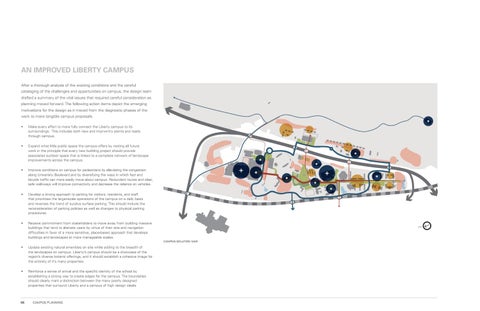
AN IMPROVED LIBERTY CAMPUS After a thorough analysis of the existing conditions and the careful cataloging of the challenges and opportunities on campus, the design team drafted a summary of the vital issues that required careful consideration as planning moved forward. The following action items depict the emerging motivations for the design as it moved from the diagnostic phases of the work to more tangible campus proposals. •
Make every effort to more fully connect the Liberty campus to its surroundings. This includes both new and imprwntry points and roads through campus.
•
Expand what little public space the campus offers by rooting all future work in the principle that every new building project should provide associated outdoor space that is linked to a complete network of landscape improvements across the campus.
•
Improve conditions on campus for pedestrians by alleviating the congestion along University Boulevard and by diversifying the ways in which foot and bicycle traffic can more easily move about campus. Redundant routes and clear, safe walkways will improve connectivity and decrease the reliance on vehicles.
•
Develop a strong approach to parking for visitors, residents, and staff that prioritizes the larger-scale operations of the campus on a daily basis and reverses the trend of surplus surface parking. This should include the reconsideration of parking policies as well as changes to physical parking procedures.
•
Receive commitment from stakeholders to move away from building massive buildings that tend to alienate users by virtue of their size and navigation difficulties in favor of a more sensitive, place-based approach that develops buildings and landscapes at more manageable scales. CAMPUS SOLUTION MAP
•
Update existing natural amenities on site while adding to the breadth of the landscapes on campus. Liberty’s campus should be a showcase of the region’s diverse botanic offerings, and it should establish a cohesive image for the entirety of it’s many properties.
•
Reinforce a sense of arrival and the specific identity of the school by establishing a strong way to create edges for the campus. The boundaries should clearly mark a distinction between the many poorly designed properties that surround Liberty and a campus of high design ideals.
56
CAMPUS PLANNING