
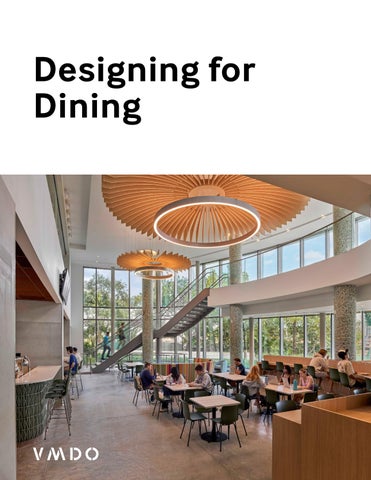
Designing for Dining

Page 1


Designing for Dining

Dining

Students are drawn to places that are full of visible life, where they can see themselves as part of a community. Dining options create socially rich destinations where students can gather together to participate in meals that strengthen their relationships with each other and their school. Sharing meals is fundamental to the student experience, featuring healthy options that celebrate food preparation and support well-being. Strategic flexibility can be achieved through multipurpose components that allow dining services to throttle service up during peak mealtimes and down again during off hours, allowing dining areas to double as spaces for entertainment, recreation, and study.

At VMDO, we design every space as a learning environment with opportunities for engagement, with generosity - often times transparency - and welcome that offer something to campus, and with multivalenceopen to many interpretations and meanings. We work with clients to deliver architecture that defines meaningful placemaking for the communities we serve.

Building with Experience

We have experience with designing campus hubs that integrate the latest trends in dining, hospitality, socializing, and technology. We maximize our project’s value, and therefore, bring revenue to the University. We strive to meet and exceed the needs of 21st century students with interiors, finishes, and technologies that are attractive, flexible, and collaborative. We realize the important role dining facilities play in student recruitment + retention and are continuously researching the latest and best trends in student life. Our ultimate hope is that our work will nourish student’s bodies, attract prospective students to join the university’s rich community of learners, and nurture engagement among your students.

University of Miami Centennial Village

Completed: 2024 (Ph. 2A), 2026 (Ph. 2B)

Size: 578,876 SF

Residential Dining: 640 Seats

Event Dining + Athletic Training Table: 160 Seats

Key Program Elements

5 Residential Colleges

Multi-use Event Space + Teaching Kitchen

Flexible Lounges + Study Areas

Faculty Apartments

William & Mary West Woods Village

Completed: 2025

Size: 315,000 SF

Residential Dining: 800 Seats

Key Program Elements

Living Learning Communities

Multi-use Event Space

Flexible Lounges + Study Areas

Learning Commons

Clemson University Core Campus Complex

Completed: 2016

Size: 285,000 SF

Residential + Retail Dining: 1,200 Seats

Key Program Elements

Honors College

Multi-use Event Space

Flexible Lounges + Study Areas

Faculty Apartments

GWU Thurston Hall Renovation

Completed: 2022

Size: 209,361 SF

Residential Dining: 225 seats

Key Program Elements

Multi-use Event Space

Flexible Lounges + Study Areas

Offices

Community Rooms

Faculty Apartments

Courtyard Dining

Liberty University Montview Student Union

Completed: 2016

Size: 158,056 SF

Residential Dining: 800 Seats

Key Program Elements

Multi-use Event Space

Flexible Lounges + Gathering

Learning Commons

Young Harris College Campus Center

Completed: 2014

Size: 125,000 SF

Residential + Retail Dining: 500 Seats

Key Program Elements

Multi-use Community Rooms

Flexible Lounges + Study Areas

Additonal projects include: The Virginia Theological Seminary Dining Renovation, Chatham Hall Student Dining Center, and the University of Richmond Wellness Center Dining Cafe.

Dining Trends + Opportunities

Technology Integration

Leverage technology through mobile ordering systems, automated kiosks, and potentially delivery robots to enhance the dining experience. These tech-driven innovations will provide convenience for students, reduce wait times, and streamline operations, allowing universities to cater to the fast-paced needs of students while improving operational efficiency.

Authentic Cuisine

Expand and diversify menu offerings by introducing more culturally authentic dishes that reflect the diverse backgrounds of a university’s student body. Providing students with a wider variety of global cuisines can help create a more inclusive and engaging dining environment, fostering a sense of community while enhancing the overall student experience.

Dietary Accommodations

Increase the availability of menu options that cater to dietary restrictions such as gluten-free, vegan, and plant-based diets. With a growing demand for specialized diets, We are positioning our universities as leader in inclusive dining by ensuring that all students have access to nutritious meals that meet their dietary needs and preferences. By integrating contemporary dining trends like all-you-care-to-eat (AYCE) and specialty menu programs (halal, vegetarian, allergen-free), we will elevate the dining experience to support diverse student dietary needs for them to thrive.

Flexible Kitchen Design

Design flexible kitchen spaces that can seamlessly accommodate both dine-in and take-out meals, allowing for hot and cold prep simultaneously. This adaptability ensures that the dining facilities remain efficient, catering to changing student preferences for convenience and flexibility, particularly with the rise in to-go and delivery dining trends.

Locally Sourced and Ethical Products

Ethically sourced food options. Partnerships with local farms and suppliers can provide more locally sourced, fresh ingredients. This not only promotes sustainability but also aligns with student demand for farm-to-table dining options, contributing to healthier eating habits and environmental stewardship.

Water and Waste Management

Implement water-efficient technologies such as low-flow faucets and aerators, alongside comprehensive waste management strategies like recycling, composting, and accurate demand forecasting. This will reduce water waste and optimize food portions to minimize food waste.

Energy-Efficient Equipment

Invest in energy-efficient kitchen equipment such as refrigerators, freezers, ovens, and ventilation systems. These upgrades will not only reduce energy costs but also make the dining operations more environmentally responsible and energy-conscious.

HVAC and Alternative Heating/Cooling

Integrate HVAC systems and alternative heating/cooling solutions that capture and reuse heat generated by kitchen equipment. These energy recovery systems will reduce the carbon footprint of dining operations and improve overall energy efficiency,

Montview Student Union

Distinct + Varied Dining

Creating a Natural Place to Socialize

Creative dining options and venues are key to campus success. Quality food and exceptional experiences will draw people into the building. Sharing food sustains the special bonds that form in a collegiate setting. A sense of openness and visibility will invite students to linger, engage in conversation, and build meaningful relationships.

A range of dining options that are combined and strategically overlap with other student life programs can create a buzzing sense of vitality. Our recent design and programming work at universities such as the University of Miami, WIlliam & Mary, George Washington University, Clemson University, Liberty University, and Young Harris College underscore the importance of a dynamic overlap of academic and student life spaces with dining. Multiple venues or service platforms offer students the range of choices that can personalize their dining experience–emphasizing an approach that is appealing, healthy, and seamlessly integrated into the life of a building.

Flexible and easy-to-use gathering spaces make a place and a way for faculty and students to continue the conversations started in the classroom. Likewise, supporting busy students with a variety of ‘grab-and-go’, take-out, or sit-down options can help transform a campus into a lively 24/7 community destination. Easy access to good food at all times is an essential part of getting the mix of uses right.

Providing a Variety of Healthy Dining Options

A variety of dining options demonstrably enlivens campus life – from casual, ready-made ‘grab-and-go’ to formal, specially prepared meals for events. Options that suit different personalities, eating needs, and payment options make all feel comfortable, welcome, and engaged in the life of the school. Skillful interior design can shape dining environments so that they may comfortably host a variety of personalities and experiences, allowing different needs at different times to find their place within the building. Color, texture, surface, and furnishings all create the varied moods of dining throughout the building–from calm and private for reading and study in a quiet café to the energy and openness of enjoying a meal with a large group of friends in a spacious dining room.

Dining facilities satisfy not only the basic need for food, but the deeper need for nourishment. A multi-venue servery offers students the range of choices that can personalize their dining experience, emphasizing a youthful approach that is appealing, fresh and healthy.

Similarly, bringing the finishing of food preparation out of the kitchen and into the open servery gives students a real sense of the freshness of their food, and provides an opportunity for interaction with food service staff, who can become familiar faces and friendly members of the daily dining experience.

Centennial Village Dining, University of Miami
Clemson Core Campus, Clemson University

Weaving the Vitality of Dining into the Life of the Building

Dining options are essential to a successful student center. Quality food draws people into the building. Sharing food sustains the special bond that can form as relationships begin in a collegiate setting. However, the thoughtful design and arrangement of dining spaces invites them to linger, to engage in conversation, and to become part of the activity.

A sense of openness and visibility is key. A range of dining options that are combined and strategically overlapped with other union program can create a buzzing sense of vitality. These programs can transform the environment into a lively campus with round-theclock student presence, on-campus extracurricular and weekend activities-all building an educational and cultural community.

Designing for Connections

By pulling in prominent campus pathways and by opening up to active, programmed outdoor spaces, a dining building can reach out to its surroundings, provide a clear center of gravity for campus activities, and carry forward the unique identity and individual character of the institution.

A careful approach to providing essential service access ensures that the building sits comfortably in its prominent location – right in the center of things – maintaining a seamless, pedestrian campus landscape while still gaining access to the loading docks and service drives needed to supply the building. A “see and be seen” factor permeates successful unions. Transparent opportunities for interaction can bring the best aspects of an institution to life and to light.

Integrating + Revealing Sustainable Design Strategies

Durability

Student dining is designed to attract students, faculty, staff and community members from the far reaches of a campus to enjoy its activities and resources. Thus, a successful dining center is inherently exposed to a high volume of traffic and use. Careful attention to the durability of the materials and finishes of a dining center building will go a long way towards saving maintenance investment over the life of the building.

Cleanability

A high volume of traffic also impacts the cleaning needs of a dining building. Finishes chosen to minimize the collection of dirt and debris, to avoid fingerprints and smudging, and to coordinate with a staff’s cleaning equipment and methods will maximize efficiency in cleaning efforts.

Indoor Air Quality

Attention to cleanliness will have an important impact on the indoor air quality of a student center. Similarly, the thoughtful choice of finishes and the careful attention to a building’s mechanical and ventilation systems will improve occupant health and well-being.

Education And Display

Increasingly, college and university students are concerned about the human impact on the natural environment. Pursuing and displaying sustainable design efforts can improve building performance and educate concerned students about a college or university’s efforts towards responsible building practices. Building displays can explain and celebrate efforts addressing the fundamental concerns of sustainable student center design.

Other Key Issues

Water Conservation, Energy Conservation, Food Service - Energy and Waste Management, Recycling and Waste Management, Durability, Indoor Environmental Quality

Daylighting, Views + Lighting

Generous windows and skylights bathe spaces in natural light and reinforce connections to the campus outside. Daylight harvesting sensors ensure the quality of natural light and moderate necessary artificial lighting levels accordingly. Energy-saving LED fixtures with wireless lighting controls that analyze and measure lighting use and wireless occupancy and vacancy sensors that automatically switch lights off in unoccupied rooms work to improve the overall campus environment by, reducing energy bills, and passing savings on to student programs.

Dining Services & Recycling

Sustainable dining strategies used by universities include the elimination of dining trays – which encourages healthy portions and significantly reduces the amount of food being thrown out. Liberty University dining services use an in-vessel composter to transform food waste into nutrients for their campus gardens. Crops that are grown in the garden, in turn, are donated to dining services and incorporated into food preparation.

Case Studies

Centennial Village University of Miami

Scope of Work

Featuring over 600,000 square feet of living-learning residential space on Lake Osceola, Centennial Village fulfills the vision for a visually stunning and programmatically complete first year residential community at the University of Miami. Attracting and engaging top students through an enhanced residential profile, Centennial Village enriches the first year experience through programming and architecture designed to foster academic, social, and community relationships as well as interaction with live-in faculty and reside nce life staff.

Part of an ambitious, multi-phased housing plan, Centennial Village is the largest project to date aimed at reinvigorating the residential experience for students on campus. Over the next decade, new on-campus housing will re-define what it means to live, learn, work, and meet at the University of Miami. Centennial Village complements an upper-class student village currently under construction and set to open in August 2020.

Creating a Signature First Year Experience

Centennial Village is being programmed to create a sense of community at multiple levels, starting with 1,725 beds of student housing and 640 Seats of dining. Centennial Village’s four Residential Colleges reach out to campus, building on the existing architectural context and connecting the campus together, while reinventing the entire south side of Lake Osceola as a new and dynamic center of student life.

The Residential Colleges are distinguishable as four buildings, offering a straightforward sense of orientation and identity for students that makes a lasting impression. Sited next to a new Canal Walk that connects residential, academic, dining, and pedestrian spaces along a shared waterfront, the four Residential Colleges, along with a renovated Eaton Residential College, create a village – a community of citizenship where learning is integral to life. As a village, building and landscape have equal importance and are brought together into one seamless, carefully considered environment that reframes the first year experi ence on campus.

Lake Osceola
Miami Beach
Downtown Miami
Centennial Village
Metrorail

DYNAMIC PROGRAMMING FOR STUDENT LIFE

Students crave places that are alive with activity. Ground floors consist entirely of generous public programs (and no student bedrooms); they are featuring learning, social, and dining centers. Interior and exterior rooms overlap as common ground for shared experiences — opening up these vibrant programs to the outside and enticing others to join.

Lake Front Dining Room

Supporting Student Health

Major health risk factors for today’s students include feeling social isolation and high levels of anxiety and stress. Architecture’s role in creating a sense of home is critical to supporting each student’s physical and mental health. The design of Centennial Village offers respite through physical and visual connections to nature and through the incorporation of natural materials and colors. The creation of an active pedestrian landscape that brings the outdoors in through views and daylighting increases student alertness levels, decreases absenteeism, and supports better sleep quality and opportunities for movement. Light amount and quality, acoustic design, and attention to temperature and humidity create the right conditions that make residents feel comfortable and at home. In particular, the design of Centennial Village provides significantly improved indoor air quality utilizing HVAC Load Reduction smart scrubber modules.

In addition to generous natural daylight, Centennial Village takes wellness-oriented artificial lighting to the next level, using tunable LEDs to match the color and brightness of the sun’s natural rhythms. Attuned to students’ circadian rhythms, white light is featured during the day (as our biological clocks expect), and warmer, softer lighting predominates in the evenings.

“VMDO was selected as the lead design architecture firm based upon a competition that involved a number of nationally known firms. Their design was selected on the merits of the architecture, its appropriateness to the site, and for me, as a student housing professional, their insight into how to create an effective living learning community for our students.”

College of William & Mary

Westwoods Dining Village

Shifting From Planning to Implementation

In 2022, William & Mary solicited a public-private partnership agreement (P3) for the design of a series of new housing projects and a dining hall on its Williamsburg campus.

VMDO and partners Balfour Beatty Campus Solutions, Balfour Beatty Construction, and Kjellstrom + Lee Construction developed an initial, yet comprehensive response to the solicitation—building on the Housing and Dining Master Plan. T he West Woods project vision re-shapes the existing campus edge into a new campus center.

The new West Woods dining hall celebrates its natural context by utilizing mass timber construction and by incorporating expansive glass to preserve the views of the woods to the east and of the new campus quad to the west. A series of dining areas, each with unique views, will provide different experiences - from vibrant and lively to small and private. The design provides for increased flexibility; not only to serve meals but to provide a campus-wide amenity that students can use enjoy in any number of ways at all hours of the day.

Campus Tranformation

VMDO’s design concept is intended to set a new standard for the student experience, giving students high-quality residential and dining spaces befitting the caliber of the William & Mary brand.

The design at West Woods is intended to create a sense of place that architecturally reflects W&M’s unique charater while breathing new life into its interpretation. It balances a sense of traditional campus planning and strong W&M campus traditions with a modern architecture reprsentative of W&M as a pioneer of developing leaders of tomorrow.

West Woods Dining Hall

The placement of the new 800-seat dining hall responds to student demand for dining close to the center of campus. A new pedestrian bridge will improve physical, as well as perceived, proximity to the heart of campus. The new dining hall is imagined to have a vibrant interior environment, characterized with transparent connections to the adjacent woods to the east, and a distinguished face to the new campus quad to the west. In the evening, the dining hall could serve as a soft lantern-like beacon for pathways through the West Woods.

Montview

Project Overview

The Montview Union is a gathering place for students, faculty, and student life professionals at the locus of the university community, where academic pursuits are complemented with cultural, social, and recreational services. Emblematic of the university and its mission, the Union makes a place where meaningful relationships can be nurtured. Locating the Union at the center of a new Campus Walk – which links the entire spectrum of campus life, from recreation to residential – ensures the Union’s success in serving as a beacon of campus activity.

Keystone of a Campus Transformation

In 2010, the University embarked upon an ambitious building campaign – guided by a new campus master plan – designed to dramatically recast the campus’ physical identity and envision a new physical core. A reinvigorated commitment to a student-centered landscape sparked the elimination of poorly-built metal buildings and haphazard parking lots and roadways to make way for a new Commons – a campus lawn space that organizes key academic and student life buildings around a Campus Walk. The keystone of the Commons is the Montview Union – which fronts the Campus Walk and energizes its full eastern edge with active student life programs and retail dining venues that spill out onto the building’s broad steps and into its arcades and elevated porches.

Campus Transformation

Montview Student Union

Academic Lawn

Landmark Tower

Science Hall

Falwell Library

Lake Liberty

Residential Commons

School of Music

Shifting Student Life to the Heart of Campus

The Montview Union is not a stand-alone structure. It is actually an addition to the largest academic building on campus, DeMoss Hall. The Union springs off the blank back wall of DeMoss, breaks down its scale, and creates an inviting and welcoming front that supports the new Commons and Campus Walk. Connecting the Union to the core academic building on campus transforms what once was an inwardly-focused “big box” into a dynamic center for academic and student life.

Previously, the University considered their vast student recreation center on the north end of campus as their default student center. It wasn’t until planning for the Montview Union came into focus that they recognized the importance of shifting campus life from the north end to this new “center of gravity,” in the words of the Provost. In recognizing that central shift, the University whole-heartedly embraced the student union concept: where it “is the gathering place of the college and serves as a unifying force that honors each individual and values diversity …[and] fosters a sense of community that cultivates enduring loyalty to the college.”

“The first time I walked in, I felt like I was on a college campus. I like the open layout of the building and how everybody has their own individual space but it’s also very communal. I love the big windows. It’s nice to be able to see outside. It’s not so dark and daunting like previous buildings on campus. It doesn’t feel like a serious, studious space … it’s more of a living room for students.”

University Student Interviewed during Opening Week

A Rich Mix of Uses

The Union is home to a variety of social, student life, and dining opportunities, customized to serve their unique culture. Student lounges, study spaces, and meeting rooms provide flexible places for studying and gathering. On the topmost floor, a multipurpose event room enjoys views of campus while, on lower floors, a bowling alley and technology-rich game areas encourage recreational fun. The Union is most populated during the early evening, when student leadership groups such as Student Government and Clubs + Orgs populate open work and gathering areas. Such components of the Union have prominent locations in the building and find useful expression on the exterior to draw students in and encourage them to participate.

Student Life Professionals are strategically integrated throughout the building to serve and support students. The Campus Services department is located near the building’s entrance and acts as a central information gathering hub. Departments such as the Center for Multicultural Enrichment and the Military Veterans Center help champion the Union’s mission through outreach and events that build an educational community out of diversity.

Floor Plans

Finishing

Military

Alumni

Roof

Loading

Student

3-Season

U-Foods Grill

Outdoor Dining

Dining Venue: Argo Tea

Dining Venue: Star Ginger

Dining Venue: Garbonzo’s

Dining Venue: Wood Fire Grill

Building Community with Food

The Union’s dining options create socially-rich destinations where students can gather together to participate in meals that strengthen their relationships with each other and with the University. Students can choose between six unique micro-restaurants, each offering its own distinctive atmosphere and celebrating healthy food. Thoughtful furniture, interior signage, and circulation strategies guide students in coming together to experience the ritual of meal-sharing.

Flexibility is achieved through multi-purpose components that allow dining services to throttle service up during peak meal times and down again during off-hours – allowing dining areas to double as places for entertainment, recreation, and study. The 3-Season Dining Room can be reserved for communal gathering and events featuring family-style dining. In good weather, large windows open to campus views and garden al fresco meals.

CHARLOTTESVILLE

200 East Market Street Charlottesville, VA 22902

WASHINGTON

2000 Pennsylvania Avenue NW Suite 7000 Washington, DC 20006

Turn static files into dynamic content formats.
Create a flipbook