The Visual Artists’ News Sheet
May – June 2012
35
How I Made
before the reality of blackouts, shortages, and radiation fear sank home. Back in Dublin and still feeling jishin-yoi (eathquake drunk) for a while, especially when heavy trucks rumbled past, the business of finding work, trying to make work, and organise a show somewhere, got underway. The series of images that I made after coming back drew on notebooks from Japan, but also from previous concepts that seemed to segue into the idea of the beautiful dead things. For a long time I had used pattern in my work, and curiosity about the mechanics of patterning had led me to the idea of redundancy. In different fields, the concept works in slightly different ways, but I was drawn to the basic idea that the repeated, superfluous elements of a pattern are redundant – insignificant in one sense, yet essential to the continuation of, or communication of, the pattern. For example, sensory perception depends upon redundancy, otherwise information would overwhelm the brain. In digital imaging, files can be compressed by losing psychovisually redundant data, eg large regions of similar pixel values. In biological terms, redundancy ensures survival: a surplus of organisms means greater chance of continuing reproduction in the face of death. The key, whether in neurology or systems theory, is the identification of what is redundant.
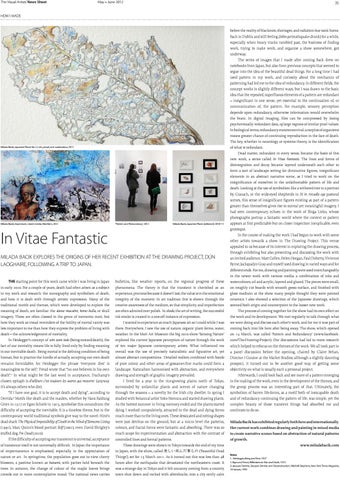
Milada Bacik, Japanese Plants No. 12, ink, pencil, and watercolour, 2011
Dead matter, redundant in every sense, became the basis of this new work, a series called In Vitae Fantastic. The lines and forms of disintegration and decay became layered underneath each other to form a sort of landscape setting for diminutive figures, insignificant elements in an abstract narrative scene, as I tried to work on the insignificance of ourselves in the unfathomable pattern of life and death. Looking at the use of symbolism like a withered tree in a portrait by Cranach, or the wide-eyed shepherds in Et in Arcadio ego pastoral scenes, this sense of insignificant figures existing as part of a pattern greater than themselves gives rise to surreal yet meaningful imagery. I had seen contemporary echoes in the work of Shiga Lieko, whose photographs portray a fantastic world where the context or pattern Milada Bacik, Insomnium, mixed media, 30x20cm, 2012
'Pattern and Redundancy', 2012
Milada Bacik, Japanese Plants (selected) 2010–11
appears at first predictable but on closer inspection inexplicable, even grotesque.
In Vitae Fantastic
In the course of making the work I had begun to work with some other artists towards a show in The Drawing Project. This venue appealed to us because of its interest in exploring the drawing process,
Milada bacik explores the origins of her recent exhibition at the drawing project, Dún Laoghaire, following a trip to japan.
through exhibiting but also presenting and discussing the work with an invited audience. Matt Cullen, Helen Horgan, Paul Doherty, Vivienne Byrne, Jackqualyn Gray and myself used drawing in varied ways and for different ends. For me, drawing and painting were used interchangeably in the newer work with various media: a combination of inks and
The starting point for this work came while I was living in Japan
bulletins, like weather reports, on the regional progress of these
watercolours, oil and acrylic, layered and glazed. The pieces were small,
in early 2010. For a couple of years, death had often arisen as a subject
phenomena. The theory is that the transient is cherished as an
on roughly cut boards with smooth gesso surface, and finished with
in my work and research: the iconography and symbolism of death,
experience, precious because it doesn’t last; the value is in the emotional
gloss medium: at the show many people thought they were painted
and how it is dealt with through artistic expression. Many of the
integrity of the moment. In art tradition this is shown through the
ceramics. I also showed a selection of the Japanese drawings, which
traditional motifs and themes, which were developed to explore the
creative awareness of the medium, so that simplicity and imperfection
seemed both origin and counterpoint to the looser new work.
meaning of death, are familiar: the danse macabre, homo bulla, or skull
are often admired over polish. In shodo, the art of writing, the successful
imagery. These are often classed in the genre of memento mori, but
ink stroke is created in a one-off instance of expression.
The process of coming together for the show had its own effect on the work and its development. We met regularly to talk through what
how they work as visual reminders of the futility of mortal vanity was
I wanted to experience as much Japanese art as I could while I was
we were doing and discuss each other’s work, and for me it was part of
less important to me than how they express the problem of living with
there. Everywhere, I saw the use of nature, organic plant forms, water,
coming back into life here after being away. The show, which opened
death – the acknowledgement of mortality.
weather. In the Mori Art Museum the big 2010 show ‘Sensing Nature’
on 14 March, was called ‘Pattern and Redundancy’ (www.facebook.
In Heidegger’s concept of sein zum tode (being-toward-death), the
explored the current Japanese perception of nature through the work
com/The-Drawing-Project). Our discussions had led to more research
fact of our mortality means life is fully lived only by finding meaning
of ten major Japanese contemporary artists. What influenced me
which helped to refocus on the themes of the work. We all took part in
in our inevitable death . Being mortal is the defining condition of being
overall was the use of precisely naturalistic and figurative art, yet
a panel discussion before the opening, chaired by Claire Behan,
human, but in practice the hurdle of actually accepting our own death
almost abstract compositions. Detailed realism combined with bands
Director / Curator at the Market Studios; although a slightly daunting
remains formidable; for Heidegger the phrase ‘everyone dies’ is meaningless to the self.1 Freud wrote that “no one believes in his own
of pure colour and other areas of gossamer-fine marks could form a
prospect, it turned out to be another good way of getting some
landscape. Naturalism harmonised with abstraction, and everywhere
objectivity on what is usually such a personal project.
death”.2 In what might be the last word in acceptance, Duchamp’s
drawing and strength of graphic imagery prevailed.
chosen epitaph is d’ailleurs c’est toujours les autres qui meurent (anyway it’s always others who die).
Afterwards, I could look back and see more of a pattern emerging
I lived for a year in the rice-growing plains north of Tokyo,
in the making of the work, even in the development of the themes, and
surrounded by unfamiliar plants and scenes of nature changing
the group process was an interesting part of that. Ultimately, the
“If I have one goal, it is to accept death and dying”, according to
through the seasons – a novelty for the Irish city dweller. In spring I
symbolism of barren life-forms, as a motif both of inescapable death
Derrida.3 Motifs like death and the maiden, whether by Hans Baldung Grien in 1517 or Egon Schiele in 1915, symbolise this conundrum: the
studied with botanical artist Yoko Nomura and started drawing plants.
and of redundancy continuing the pattern of life, was simple, yet the
As the hottest summer in living memory ended and the plants started
complex beauty of those transient things had absorbed me and
difficulty of accepting the inevitable. It is a timeless theme, but in the
dying I worked compulsively, attracted to the dead and dying forms
continues to do so.
contemporary world traditional symbols give way to the novel: Hirst’s
much more than to the living ones. These dessicated and rotting shapes
dead shark The Physical Impossibility of Death in the Mind of Someone Living
were just detritus on the ground, but at a micro level the patterns,
Milada Bacik has exhibited regularly both here and internationally.
(1991), Marc Quinn’s blood portrait Self (2001), even David Shrigley’s
colours, and fractal forms were fantastic and absorbing. There was so
Her current work combines drawing and painting in mixed media
stuffed dog I’m Dead (2010).
much scope for experimentation and abstraction with the contrast of
to create narrative scenes based on abstraction of natural patterns
controlled lines and formal patterns.
of growth.
If the difficulty of accepting our transience is universal, acceptance of transience itself is not universally difficult. In Japan the importance
These drawings were shown in Tokyo towards the end of my time
of impermanence is emphasised, especially in the appreciation of
in Japan, with the show, called 美しい死んだ事もの (‘Beautiful Dead
nature or art. In springtime, the population goes out to view cherry
Things’), set for 13 March 2011. As it turned out this was less than 48
blossom, a pastime known as hanami, with parties held beneath the
hours after the earthquake that devastated the northeastern coast. It
trees. In autumn, the change of colour of the maple leaves brings
was a strange day in Tokyo and it felt uncanny coming from a country
crowds out in more contemplative mood. The national news carries
town shut down and rocked with aftershocks, into a city eerily calm
www.miladabacik.com Notes 1. Heidegger, Being and Time, 1927 2. Sigmund Freud, Reflections on War and Death, 1915 3. Jacques Derrida, 'Jacques Derrida and Deconstruction', Mitchell Stephens, New York Times Magazine, 23 January 1994