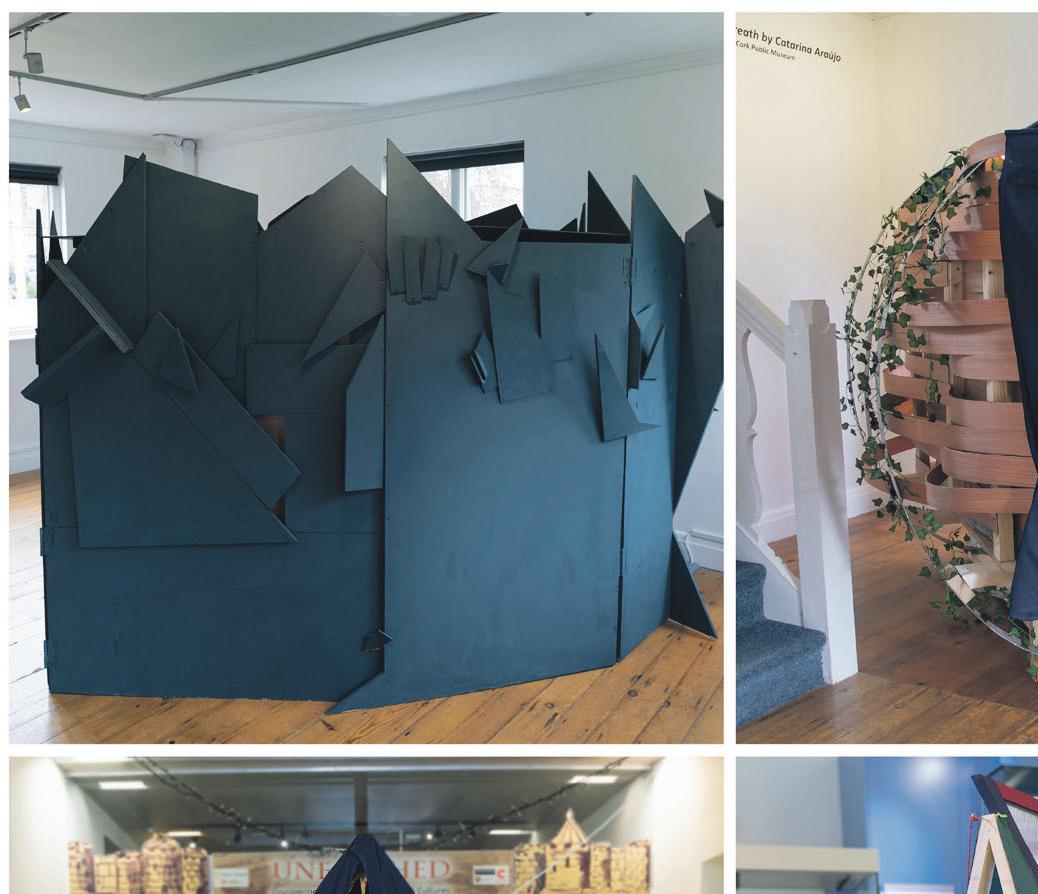
The Visual Artists' News Sheet – September October 2024
Lismore
Exhibitions across 2 locations:
Each now, is the tme, the space Leonor Antunes, Alexandre da Cunha, Rhea Dillon, Veronica Ryan
Curated by Habda Rashid 23 March27 October 2024
Lismore Castle ORIGINS Graduate Award Leslie Allen Spillane 722 September 2024 St Carthage Hall
The Visual Artists’ News Sheet
September – October 2024
On The Cover
Yuri Patison, dream sequence (working title for a work in progress), 2023-ongoing, generative and mutable game engine motion picture/play and score affected by local atmospheric conditions, duration variable, dimensions variable, looping; photograph by Ros Kavanagh, courtesy of the artist and Temple Bar Gallery + Studios.
First Pages
6. Roundup. Exhibitions and events from the past two months. 8. News. The latest developments in the arts sector.
Columns
9. The Composers in the Garden. Cornelius Browne traces the tender intersections of art, nature, music, and love. The Beauty of Castalia. Benjamin Stafford considers the work of KCAT Studio artist Brianna Hurley.
10. More Power to You. Logan Sisley on Irish artist Sarah Purser. Salmagundi. Jijo Sebastian outlines his collaborative film project co-commissioned by the Hugh Lane Gallery and Create.
11. Ecological Imperative for Creatives. Dr Cathy Fitzgerald reflects on bringing ecoliteracy to the creative sector. Functional Magic. For her latest column, Lian Bell reflects on walking as a dedicated physical practice of ritual and intention.
Exhibition Profile
12. Shortest Way Home. Joanne Laws reflects on the current offsite exhibitions by TBG+S at The Pumphouse in Dublin Port.
14. Androcles’ Key. Joanne Laws interviews Denis Farrell about his recent exhibition at Le Couvent de la Tourete in Lyon.
15. GROUND (100+one). Susan Connolly outlines her themes and approaches for a new body of painting.
In Focus: Postgraduate
16. Making Kin. Eden Munroe, MA in Fine Art at TUD Necessary Polarities. John Graham, MA ACW at NCAD
17. Experience of Engagement. James McLoughlin, MFA in Fine Art at Limerick School of Art and Design Reimagining Materials. Maia Shelby Hay, MA Art & Ecology at BCA
18. Dwelling Dystopia. Clara McSweeney, MA ARC at IADT Afterwards. Tracey McCoey, MFA in Fine Art at BSA
Critique
19. Richard Malone, Semantic Sketches, 2022-23, installation view.
20. Sinéad Smyth at Echo Echo Dance Theatre
21. ‘Sanctuary’ at Mermaid Arts Centre
22. Eimear King at South Tipperary Arts Centre
23. ‘NOW YOU SEE IT...’ at Crawford Art Gallery
24. Ulla von Brandenburg and ‘Behind the Curtain’ at VISUAL
Organisation Profile
27. Creative Momentum. Síle Penkert outlines the evolution of Garter Lane Arts Centre as it celebrates 40 years in operation.
28. QSS at 40. Irene Fitzgerald chronicles the evolution of Belfast’s Queen Street Studios over four decades.
Ecologies
30. When We Cease to Understand the World. Mary Flanagan reviews the group exhibition at Interface for GIAF.
Career Development
31. Let Them Paint Flowers. Jennifer Trouton and Sian Costello discuss their approaches to painting.
32. In Transit. Michael Hill interviews Ella Bertilsson about the pressures of maintaining an art practice.
Member Profile
33. Retrofuturism. Hazel O’Sullivan outlines the trajectory of her emerging art practice.
35. VAI News. Recent VAI award winners report on their activities.
36. VAI Lifelong Learning. Helpdesks, cafés, and webinars.
Editor: Joanne Laws
Production/Design: Thomas Pool
News/Opportunities: Thomas Pool, Mary McGrath
Proofreading: Paul Dunne
CEO/Director: Noel Kelly
Office Manager: Grazyna Rzanek
Advocacy & Advice: Oona Hyland
Advocacy & Advice NI: Brian Kielt
Membership & Projects: Mary McGrath
Services Design & Delivery: Emer Ferran
News Provision: Thomas Pool
Publications: Joanne Laws
Accounts: Grazyna Rzanek
Special Projects: Robert O‘Neill
Board of Directors:
Michael Corrigan (Chair), Michael Fitzpatrick, Richard Forrest, Paul Moore, Mary-Ruth Walsh, Cliodhna Ní Anluain (Secretary), Ben Readman, Gaby Smyth, Gina O’Kelly, Maeve Jennings, Deirdre O’Mahony.
The Visual Artists’ News Sheet: Visual Artists Ireland: Republic of Ireland Office
Visual Artists Ireland
First Floor
2 Curved Street
Temple Bar, Dublin 2
T: +353 (0)1 672 9488
E: info@visualartists.ie
W: visualartists.ie
Northern Ireland Office
Visual Artists Ireland
109 Royal Avenue
Belfast
BT1 1FF
T: +44 (0)28 958 70361
E: info@visualartists-ni.org
W: visualartists-ni.org
Page
TAKE A BREATH
Exploring the Politics of Breath 14 June 2024—17 March 2025
Admission Free Visit imma.ie
Ag Déanamh Iniúchadh ar Pholaitíocht na hAnála 14 Meitheamh 2024—17 Márta 2025
Paintings, drawings, and illustrated letters by Sir William Orpen, along with watercolours by his father Arthur, his mother Annie, his brother Richard, his daughter Diana, his niece Bea, and his cousin Tomas, were on display as part of ‘A Family Legacy’ at Farmleigh Gallery, from 15 March to 25 August. Often described as the greatest of all war artists, Orpen’s talent as a portraitist was also greatly appreciated by Edwardian society, and a modicum of that inimitable talent was also shared by his close family.
farmleigh.ie
Rua Red
‘Templates of Chance’ by Stéphanie Rollin and David Brognon was on display at Rua Red from 7 June to 31 August. Both artists live and work between Paris and Luxembourg and are described as ‘Explorers of the abyss’. Since 2006, the collaborative duo been observing those who exist on the fringes of society. Tey create modest monuments to people who have fallen by the wayside, where addiction and melancholy exist side by side. Teir work does not shout; it quietly unfolds.
ruared.ie
The LAB Superprojects in partnership with Forerunner, Te LAB Gallery, and the Liberties Training Centre, presented ‘Let’s Get the Hell Outta Here’, a group exhibition by participants in the Digital Media Art & Design (DMAD) course at Liberties Training Centre, which opened on Saturday 29 June and ran until Saturday 24 August 2024 at Te LAB Gallery in Dublin. ‘Let’s Get the Hell Outta Here’ is the result of a research project between DMAD and the artistic practice Forerunner, beginning in January 2023.
dublincityartsoffice.ie
MART Gallery
‘Milksop’ by Niamh Hannaford is currently showing at MART Gallery until 7 September. ‘Milksop’ is the residue of a collection of the artist’s thoughts, which cluster around time, usage, environment, complicity, and care. Mirroring the dominant extraction economy and the industrialisation of resources, she creates a temporal sculpture which requires cyclical maintenance and endures decay and loss. Tis exhibition explores the value of labour and ageing when liaising with the god of commerce.
mart.ie
The Complex Gallery
‘Underwave’ by Bettina Seitz delves into the rich history of human arrivals in Sligo and the North West, tracing the journey from the earliest Neolithic settlers to the diverse modern multicultural society. Tis project features sculptures by Bettina Seitz, which were temporarily installed within the tidal zones of Sligo Bay. Videographer Fionn Rogers flmed these sculptures underwater and edited them with sound design by Joe Hunt and Patrick Hallinan.
thecomplex.ie
TØN Gallery
‘INCANTATIONS’, a solo exhibition by Aisling Conroy, presents the artist’s new body of work. Conroy is a multidisciplinary artist using painting, print animation, who delves into the metaphysical realm, guided by the themes of sound, vibration and cymatics. Working with paint, print, installation, experimental flm, and sound, the artist invites audiences on a journey beyond the visible world, exploring the unseen forces that shape our reality. Te exhibition continues at TØN Gallery in Temple Bar until 21 September.
tondublin.com
Catalyst Arts
‘Mother of pearl’ is a series of events celebrating Catalyst Art’s 30th year – the pearl anniversary. Drawing on archival materials and collective memories of sharing, passing (through), collecting, and being, the gallery developed a programme of performances, exhibitions, events, and engagements to highlight Catalyst Art’s dedication, signifcance, and infuence to the visual arts on the island of Ireland. To celebrate and acknowledge this long-standing history, the programme ran throughout the month of August.
catalystarts.org.uk
Household
‘Form Follows Function’ was developed by Household Belfast as part of Te Living House programme of activities exploring the domestic as a radical site of production and imagining. Te presented artworks were all commissioned through UPHOLD. Te exhibition title was derived from the core principle of modernist design; that the shape of a building or object should primarily relate to its intended function or purpose. On display at La Roche House from 9 to 11 August.
belfastphotofestival.com
The MAC
Presented across two gallery spaces at Te MAC, ‘ Te Weight of Light’ brings together the practices of Conor McFeely and Pascale Steven – artists who live together and occasionally work together. Teir practices have been infuenced by their shared, and occasionally diferent, outlooks on art and living. In this presentation, works overlap at a conceptual level, with their focus being the discernment of meaning within the experience of loss and the potential for adaptive change resulting from life experience. Te exhibition continues until 20 October.
themaclive.com
Golden Thread Gallery
Golden Tread Gallery launched their new space on Queen Street in Belfast with ‘ Te End of Art is Peace’ – a solo exhibition by Scottish artist Graham Fagen, which continues in the frst-foor gallery until 21 September. Fagen works across mediums including video, installation, sculpture, photography, and text. He is interested in how history and culture are created, and how in turn this shapes and forms who we are or who we become. His themes look at Scotland and the transatlantic slave trade, war, plants, journeys, poetry and song. goldenthreadgallery.co.uk
Queen Street Studios
Curated by Olivier Cornet, the group exhibition ‘What do we want?’ at QSS is a response to the increasingly dangerous geopolitical situation in the world today. It features the work of four artists: Jill Gibbon, Eoin Mac Lochlainn, Tom Molloy and Gail Ritchie. Conceptually, the exhibition blends history, memory, reality and imagination. Te show forms an arc that connects early 20th-century conficts to the present day, wherein war is exposed as a commodity. On display from 8 August to 5 September.
queenstreetstudios.net
Vault Artist Studios
‘Try we must – Te impossible task of squaring the circle’ by John Baucher is a further examination of the sensitive subject of identity, emblems and commemoration in Northern Ireland, primarily utilising found, gifted, and retrieved fags, deconstructed and reconfgured. By utilising a process of isolation and simplifcation, the artist deconstructs, repurposes and reimagines these (mostly) discarded material signs of loyalty, questioning the notion of allegiance along with the nature and physicality of belief and remembrance. On display at Vault Artist Studios from 1 to 14 August. vaultartiststudios.com
Brognon Rollin, Templates of Chance, 2024; photograph by Juliete Rowland, courtesy of the artists and Rua Red.
John Baucher, ‘Try We Must: The Impossible Task of Squaring the Circle’, installation view; image courtesy of the artist and Vault Artist’s Studios.
Regional & International
126 Gallery
‘Domestic Bodies’ was a series of perfor- mative installations by Áine Phillips and collaborators exploring themes of home, shelter and sustenance in the context of domestic space. Te exhibition as a whole confronted the pleasures, discontents and struggles of habitation: fnding, keeping, and the meaning of home. Te exhibition ran from 7 to 25 August and comprised three distinct parts: ‘Embedded’, ‘Red Couch / Archeology’ and ‘Tender Morsels’.
126gallery.com
Grilse Gallery
‘Crosscurrents’ by Gerda Teljeur is on display at Grilse Gallery in Killorglin from 17 August to 22 September. Teljeur is a familiar fgure in contemporary Irish art having arrived from the Netherlands in 1967. Her large-scale, abstract ink drawings mix concentrated energy with a profound sense of the importance of each mark. Her work is deeply meditative, adhering uncompromisingly to an abstract form of expression yet conveying a sense of the connections between humanity, the earth and the spaces around us.
grilse.ie
Muine Bheag Arts
‘COMMUNE’ was a programme of live events that took place in the Muine Bheag Community Centre from 12 to 18 August. Te programme invited artists, community organisers, graduates-in-residence, gardeners, zine-makers, visitors and friends to contribute to an evolving and expanding programme. ‘COMMUNE’ took inspiration from self-organised communities and was based on values of collectivity, exchange and experimentation.
muinebheagarts.com
Artlink
Te Artlink 2024 Members Show, ‘Meitheal’, was presented at Artlink in Donegal from 3 August to 1 September. Meitheal is a powerful concept. It is an Irish word describing the tradition of neighbours coming together to help each other to harvest crops or save hay, and was a historically fundamental part of life, particularly in rural areas. Building a sense of solidarity and unity in the community, this ethos of collaboration is deeply rooted in Irish culture.
Hamilton Gallery
For Sligo’s Tread Softly Festival 2024, Hamilton Gallery hosted ‘Pause’ – cinematographer Peter Martin’s frst solo photographic exhibition. ‘Pause’ drew together a selection from fve years of Peter’s flm photography work, in an examination of the image and the inherent value that it holds. Among the presented works were photographs that variously use analogue formats including Motion Picture flm, Colour Transparency flm, and Medium Format flm. On display from 3 to 31 August.
hamiltongallery.ie
Sarah Walker Gallery
‘In Parallel’ was a pairing of Irish artists
Martin Gale and Charles Tyrrell, jointly curated by Fenton Projects and Sarah Walker Gallery,. With underlying themes of relationship and connection, the exhibition was undercut with a deep contrast in artistic styles. Since their revolutionary days together in NCAD in the early 1970s, Gale and Tyrrell have lived parallel artistic lives with mutual ties. Te two artists have maintained a strong interest in each other’s 50-year evolving art practices. ‘In Parallel’ ran from 13 July to 17 September. sarahwalkergallery.com
Custom House Studios + Gallery
‘InHouse’ was a group exhibition celebrating the diverse and fruitful creative discourse and exchange generated within its walls by the artists who practice at Custom House Studios + Gallery. Tis workspace artists’ exhibition for 2024 included the work of nine artists who have been resident in the studios (ground foor gallery) and works by 19 artists who have been working in the CHS+G print studio in 2024 (frst foor gallery). On display from 25 July to 25 August.
customhousestudios.ie
Lavit Gallery
Te Summer Exhibition at Lavit Gallery on Wandesford Quay in Cork is an annual group show featuring painting, print, photography, sculpture and craft at a variety of price points. Cork Arts Society (est. 1963), trading as Lavit Gallery, is dedicated to promoting an appreciation of art in Cork City through the provision of a gallery space in which artists can exhibit their artwork for public patronage. All exhibited works were available to view and purchase on the gallery website. On display from 11 July to 22 August. lavitgallery.com
The Linenhall Arts Centre
‘Split the Curlew and you’ll fnd the music’ by Paul Murnaghan ran from 19 July to 31 August. Murnaghan recieved the Bolay Residency Award 2023 and is a multidisciplinary artist whose projects explore spiritual, scientifc and psychological terrain. Content is gathered through experiments, public questions and utopian quests. In residency, he asked people “Where do you go?” Replies came as video, audio, email, and anonymous words, and informed this site-specifc exhibition exploring where we might fnd comfort in truthless times. thelinenhall.com
Galway International Arts Festival
In ‘Don’t Need No Country, Don’t Fly No Flag’, Bernadette Kiely presented new large-scale paintings and moving image concerned with the efects of fooding and decay on both the landscape and human lives. Tis has been an enduring theme in her practice for over 20 years, and now has even more urgency in our present time of environmental distress. Presented from 15 to 28 July for Galway International Arts Festival, the exhibition asked, can we envision ourselves as a unifed global community that can live in harmony with nature?
giaf.ie
MTU Gallery
Te annual EMERGE Exhibition and Awards ran from 2 to 28 August. Curated by Sarah Buckley, this year’s exhibition showcased the work of 23 artists. For 2024, in celebrating 15 years of Cork Craft and Design’s Cork Craft Month, the organisation once again reunited with their partners Benchspace, Friends of the Crawford, and MTU Arts Ofce to support and nurture emerging graduates from the fve art colleges in Cork city and county.
mtu.ie
Waterford Gallery of Art
2024 marks the one-hundredth year of the founding of the Friends of the National Collections of Ireland (FNCI) by renowned artist and long-term resident of Dungarvan, Sarah Purser. Te FNCI is the oldest arts charity in Ireland, established for the purpose of acquiring works of art and objects of historical interest and donating them to national and regional art galleries and museums throughout the country. Te exhibition ‘100 Years of the FNCI’ was on display at Waterford Art Gallery from n display from 14 February to 13 July. waterfordgalleryofart.com
artlink.ie
Betina Seitz, Underwave, 2020, film still; photograph by Fionn Rogers, courtesy of the artist and The Complex.
Koni Boros, Lookbook Neutral II 2023, mixed media on archival paper, 35 x 29cm; image courtesy of the artist and Lavit Gallery.
Gerda Teljeur, Red 2024, ink on paper, 32 x 25 cm; image courtesy of the artist and Grisle Gallery.
THE LATEST FROM THE ARTS SECTOR
ISCP Residency 2024
Temple Bar Gallery + Studios announced artist Sonia Shiel as the recipient of the International Studio & Curatorial Program (ISCP) Residency, New York.
Sonia Shiel will spend three months in residence at ISCP in Brooklyn, New York. This residency awards an artist with a high-quality studio; a travel, accommodation, and living stipend; in addition to studio visits and off-site trips to museums, galleries and other cultural organisations. It supports an artist at a pivotal point in their practice with significant experience on a programme designed to build international links through a growing network of artists and curators who are ISCP alumni.
Sonia Shiel’s paintings take the shape of terrain, portal, pageant,
ISCP Residency 2024 [Cont.]
Selected exhibitions include VISUAL Centre for Contemporary Art, Carlow (2023-24); Kunstverein Aughrim, Wicklow (2023); Void Gallery, Derry (2019); Te Glucksman, Cork (2018); Crawford Art Gallery, Cork (2017); Te Cable Factory, Helsinki (2016); and Kevin Kavanagh Gallery, Dublin (2024, 2021, 2019, 2017, 2015). Selected collaborative projects include Kunstverein Aughrim, Wicklow; Te School of Drama, UCD, Dublin; Te Art and Law Program at Fordham University in New York.
miniVAN | Steel, Stone, and Wood
In the latest edition of the miniVAN, Production Editor Tomas Pool interviews crafters and sculptors Sam Gleeson, Tina O’Connell and Sonia Caldwell about their practices and careers, their unique use of materials, and their passion for bringing life to their creations!
Te miniVAN is the online magazine published by Visual Artists Ireland. With uniquely commissioned content, Te miniVAN explores the visual arts with an accessible view of all aspects of careers and practice that make up our visual community.
To read these articles and more please visit: visualartistsireland.com/category/minivan
Funding for Small Scale Local Festivals
Te Minister for Tourism, Culture, Arts, Gaeltacht, Sports and Media announced a funding allocation of €69,945 for 16 events to support Small Scale Local Festivals and Summer Schools taking place around Ireland in 2024.
Te scheme is designed to assist local cultural events which may not be eligible under funding criteria for larger scale events, such as those supported by Fáilte Ireland, the Arts Council and similar bodies. Te closing date for applications was 1pm on 26 April 2024. Funding was allocated following a competitive applications process, with a maximum grant of €5,000 available.
AIB Portrait Prize
Te National Gallery of Ireland has revealed the shortlist for this year's AIB
puppet, and prop. In her exhibitions, ‘landscapes’ appear to possess a multi-dimensional capacity that stretches not only painting’s materiality, but also its temporal, liminal, and spatial qualities. In these otherworldly domains, humans, animals, plants and gods co-exist mechanically with phenomena – transposition, restoration, disembodiment, prediction and other metaphysical states. Influenced by art history, theatre, mythology and literary fiction, Shiel’s work explores our capacity for self-determination, and often creates dynamic opportunities for performance.
[Cont. below]
Portrait Prize. 26 artists, working across a variety of media, have made it through to the fnal stage of the competition.
• Harriet Casey (Meath), Are You Sitting Comfortably?, oil on canvas
• Shane Coughlan (Dublin), Róisín Dubh, photograph on photo rag paper
• David Creedon (Cork), Miss Evans in her Sweetshop, photograph
• Philip Tomas Crean (Dublin), 64, photograph
• Lorraine Dunne (Westmeath), Aoife on Dollymount, oil on canvas
• Amanda Dunsmore (Clare), Lydia, Dr Lydia Foy, 2022, flmed video portrait, silent, 18 mins
• Ellius Grace (Dublin), Shane MacGowan At Home, 2021, photograph
• David Hamilton (Armagh), Te Family Bowles and Te Fiscal Black Hole, acrylic on canvas
• Neil-Jack (Alphonsus) Hamilton (Donegal), Jennifer McShane, oil on canvas
• Gearóid Arthur Hayes (Limerick), Kwena Chokoe, oil on board
• Beverley Healy (Antrim), Sibling Travellers, mixed media (egg tempera, oil and acrylic) on panel
• Markela Iacovou (Dublin), 10.07.1980, photograph edited in photoshop and illustrator, digital printing on canvas and manual work with hagiography pigments and caustic liquid
• Robert Jackson (Dublin), Beth in Low Light, oil on roughened brass plate
• Joy Kavanagh (Cork), Self-subject; In bloom, acrylic on wooden boards
• Martin Maguire (Louth), GameBoy, oil on canvas
• Arann McCormack (Wicklow), I Never Promised You a Rose Garden, photograph
• Emily McGardle (Monaghan), Te Pox, coloured pencil and pen on paper
• Laurence J McMahon (Dublin), Mary Lou McDonald President of Sinn Féin, photograph
• Conor O’Connell (Roscommon), Ómra, oil on copper panel
• Darragh O’Connell (Wexford), John and Fionnán, oil on canvas
• Mick O’Dea (Clare), Fergus Martin, oil on canvas
• Cara Rose (Dublin), Ailbhe and Michelle, coloured pencil on mounted paper
• Kevin Sharkey (Dublin), Robyn, photograph
• Robert Stothard (Leitrim), Carl in the Box Room, photograph
• Michael Wann (Sligo), Camille, charcoal on paper
Te gallery’s annual AIB Portrait Prize exhibition features the shortlist of works chosen from hundreds of entries each year. Running in tandem, the AIB Young Portrait Prize is an inclusive art competition for young people of all abilities which aims to support creativity, originality and self-expression. Te AIB Portrait Prize and AIB Young Portrait Prize run from 9 November 2024 to 9 March 2025 in the Portrait Gallery. Te winners will be announced at a ceremony held in the Gallery on 27 November 2024.
Golden Thread Gallery Re-opened Te former Gas Corporation Showroom and Craftworld building at 23-29 Queen Street, Belfast, has been renovated and restored to bespoke specifcations to become Golden Tread Gallery’s new city-centre home. Set across two foors, the new venue includes two large galleries, a projection room, a Community Participation and Engagement Hub, and Northern Ireland’s frst visual art library and archive. Entry to the gallery is free.
Co-Directors Peter Richards and Sarah McAvera and the GTG team are pleased to welcome visitors back to the gallery. Peter Richards says: “We’re excited to collaborate with you to actively cultivate the rich histories of art in Belfast, fostering its power to inspire and empower our communities for generations to come.”
Te new gallery is an accessible venue with step-free street access, lift to the frst
foor, a wheelchair-accessible ground-foor bathroom, sensory guide to exhibitions and large-print versions of all gallery texts available. Our library and archive room on the ground foor ofers wheelchair accessible workspaces, adjustable seating, magnifcation aids for people with vision impairment and reading aids for people with dyslexia.
Culture Ireland Grant Deadlines 2025 Culture Ireland is publishing its grant deadlines for 2025. Tere will be four grant rounds in 2025 covering all windows of activity throughout the year. Based on feedback, they are also extending the activity timeline for each round. Applicants are advised to check whether their project is eligible prior to submission. For more information and to apply visit cultureireland.ie/funding/regular-grant
Shared Island Creative Youth
Music Generation, Macnas, Fighting Words, Narrative 4, Extern Northern Ireland, and Tallaght Community Arts awarded funding for Shared Island Creative Youth Partnerships.
• €1,070,112 awarded for creative initiatives for children and young people living throughout the island of Ireland as part of the Shared Island dimension of the Creative Ireland programme.
• From Dublin to Belfast, Antrim to Galway and beyond, projects are designed to create connections, promote understanding, and build meaningful friendships.
• Six diverse projects awarded funding to bring young people together.
• Projects include mythical story exchanges, creation of original parades, residential musical hothousing projects, story-telling and interactive theatre performances.
On Monday 29 July, Taoiseach, Simon Harris TD, and Minister for Tourism, Culture, Arts, Gaeltacht, Sport and Media, Catherine Martin TD, announced the awarding of funding to six successful Creative Youth on a Shared Island projects as part of the Shared Island dimension to the Creative Ireland Programme 2023-27.
Sonia Shiel, ‘Medusa In Pieces’, 2023-24, installation view, Visual Centre of Contemporary Art, Carlow; photograph by Ros Kavanagh, courtesy of Temple Bar Gallery+Studios.
Plein Air
The Composers in the Garden
CORNELIUS BROWNE TRACES THE TENDER INTERSECTIONS OF ART, NATURE, MUSIC, AND LOVE.
“BRING MUSIC” WERE the frst words I heard from my wife’s lips. A stranger, Paula appeared on my doorstep one night in 1987 with her best friend, who I knew vaguely, to invite me to a Halloween party. Smog cloaked the Dublin streets; the bitter air stank. I ran back upstairs and grabbed a handful of cassettes.
Te seeds that grew into my series of paintings, A Garden a Stone’s Trow from the Sea, had already been sown when curator Catherine Marshall contacted me. Te invitation to show them as part of September’s Cashel Arts Festival, however, spread sunlight over their growth. As she recovers from cancer, Paula has been healing the overgrown felds amid which we live with sympathetic gardening. She works with the wild, her passion being pollinators. Insects are starved by neatness, our mania for gentrifcation and order hastening their decline. Paula has created a wildlife haven, a heaven of birdsong. It is a sanctum, also, to her painter husband. Melodies of colour fow from Paula’s begrimed fngers, timed to detonate months ahead, a leafy orchestration covering the year with fading beauty and fresh blossoms.
Among my reasons for only painting outdoors lies a need to hear, as well as see, the landscape. Some of my paintings are not much larger than fower heads. I have always been drawn to the challenge of condensing as much feeling as I can into the smallest possible space. Catherine and I quickly realised that this made them ideal for Cashel. Te unorthodox venue, in the Chapter House of the Church of Ireland Cathedral, ofers none of the roomy blankness associated with contemporary art. Catherine’s photographs of bookcases and vitrines, which might be used in lieu of walls, caught under my sunhat like an old tune.
One of my pleasures, listening to music, is tracing the journey of a single note in, let’s say, a Bach fugue. Painting her garden, my eyes often follow the journey of one of Paula’s pollinators. A bee buzzes past Anton Bruckner, born 200 years ago this year, on
4 September 1824. His short sacred choral works, the beautiful motets, have always struck me as small devotional gardens. An evening moth guides Nicola LeFanu through the trees. Her Sextet: Fasach – A Wild Garden, frst performed at the Hugh Lane Gallery in 1997, and inspired by the composer’s favourite wild places along the western coastline of Ireland, frequently lends texture to my paintings. A butterfy rests upon the shoulder of Claude Debussy, near the willow from which Paula has suspended a watering can. My painting hopes to borrow notes from the opening fute solo of Prélude à l’après-midi d’un faune (189294), where Debussy set to music the poem by Mallarmé, the fute “watering the grove with melodies.”
In late May, on the edge of her garden, mid-conversation, Paula collapsed. She had sufered a ruptured brain aneurysm, a subarachnoid haemorrhage. “I’m dying,” she gasped into the grass pressing her lips. Te next day I was in Dublin with our two children, as their mother underwent surgery. Dusk falling on the Grand Canal, I decided to show Cornelia and Lucian the window of the basement fat where Paula and I had lived for a decade. Peering from the pavement, after our sleepless night and long journey, we barely registered the door opening, or the man asking if he could help us. My garbled explanation led to an invitation inside to meet the man’s wife and revisit the past.
Our shabby home was unrecognisable under layers of gentrifcation. Only the concrete backyard, now bare, retained Paula’s presence. Tis tiny space she had crammed with so many plants in terracotta pots that it took an entire lorry to move them to Donegal. Across 20 winters the terracotta crumbled, freeing captives to spread luxuriously. Painting Paula’s garden, I am among the leaves and blooms of our shared youth. Into my life she has brought such music.
Cornelius Browne is an artist based in County Donegal.
Work
in Focus: KCAT Artists
The Beauty of Castalia
BENJAMIN STAFFORD CONSIDERS THE WORK OF KCAT STUDIO ARTIST BRIANNA HURLEY.
THE PLANET OF Castalia resembles our own in ways both reassuring and disconcerting. Its atmosphere is hospitable to humans, who live there in a city comparable in size to New York. Tis city has many impressive public buildings and squares, reminiscent of the architecture of Madrid and Moorish Spain. However, the humans of Castalia are colonisers, having imprisoned or expelled the indigenous population to the far reaches of the planet and built an enormous wall encircling the capital.
Castalia is the creation of the artist and writer Brianna Hurley, a member of KCAT studios in Callan, County Kilkenny. A character called Brianna is also the protagonist in Te Story of Castalia (KCAT, 2022). Te book, and the related body of narrative paintings, record the fght against the domination and imprisonment of the indigenous people of Castalia, and the eventual peaceful coexistence that is brought to the planet, to which Brianna (the character) is essential.
It is evident there are multiple Briannas in the story of Castalia. Tere is the artist, who has created a world rich in texture and detail, featuring enormous trees drooping with green and white foliage, sphinx-like creatures that are ridden through the sky, and incredible tornados on the horizon.
Tere is Brianna the human character who, after going to retrieve her basketball ‘accidently’ thrown over the border wall, fnds herself in the hinterlands of the planet. And there is Brianna who receives a new, indigenous body, after taking part in mysterious ritual and becoming a member of the tribe of Castalia. She inhabits diferent forms and shapeshifts between roles and cultures with ease. Crucially, in Te Story of Castalia, when one body dies, the protagonist simply wakes up in her other form, and the story continues.
Tis doubling and tripling of versions of the artist contributes to a blending of narra-
tives and overlapping of worlds in Brianna’s practice. In conversation the frst time we met, Brianna mentioned some of her great passions: basketball, Madrid, tornados. Tese all feature in the world-building of Castalia, but also inspire standalone series of works, and in some cases relate back to Brianna’s lived experience (the basketball and Madrid, not the tornados). In this way, we might understand Brianna’s practice to be a case of the cliché of ‘life imitating art’, but also a complex and rich version of self-portraiture.
By depicting her passions in her work, she not only shows a version of herself, but a version of the world. We might consider this version as one where, as per the story of Castalia, after some struggle, some misunderstanding and some change, a better, more equitable world is possible. Tose who have been fortunate enough to spend time in or work with KCAT studios know that in some places, a version of this world already exists, where artists and their work are given space to thrive and develop away from an insistence on categorisation or commercialisation.
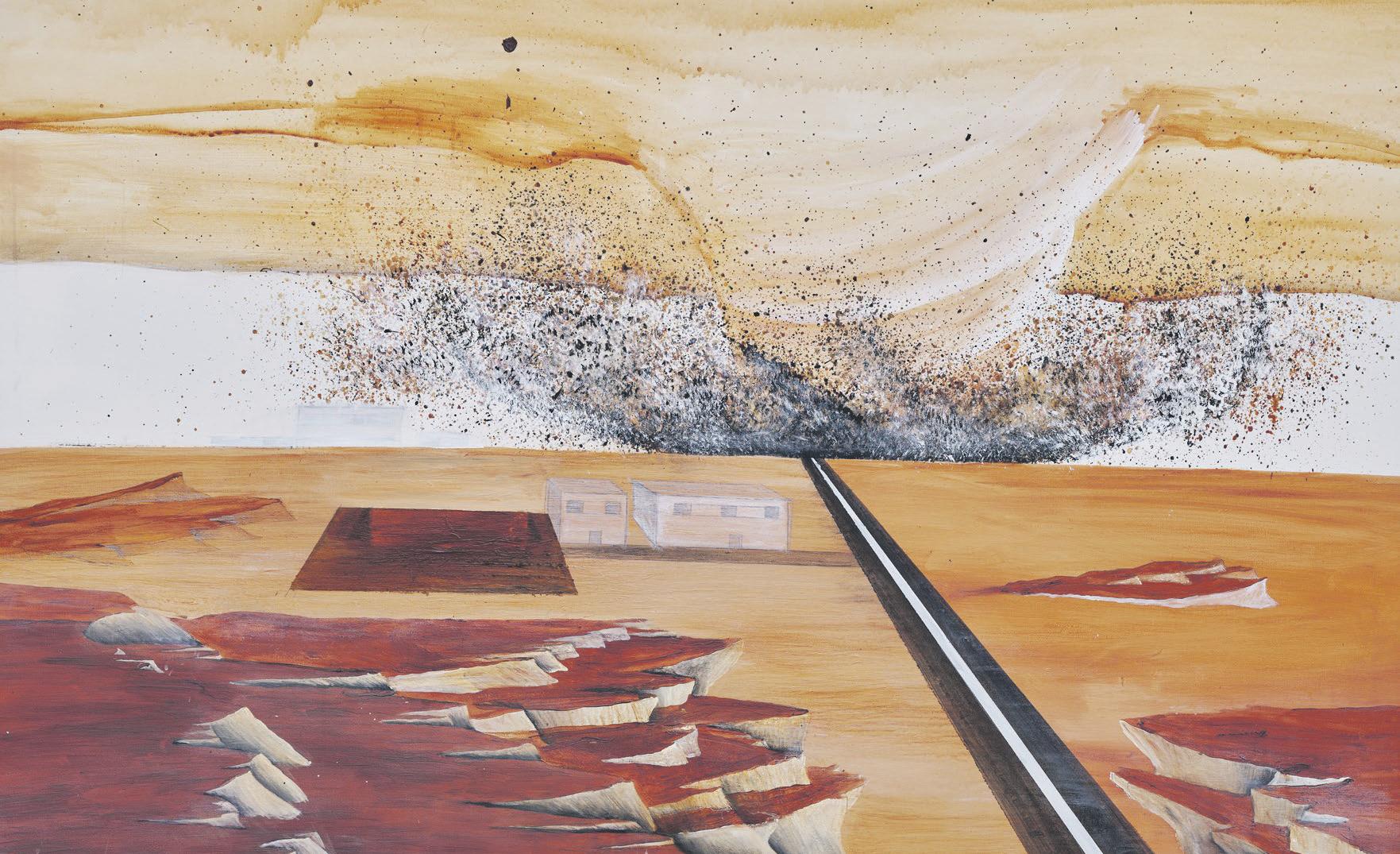
Hurley’s most wide-ranging series of works outside of Castalia are of tornados in landscapes both real and fctional. Many of the works show an elevated perspective, looking down on a small fgure dwarfed by an enormous cyclone of wind, rain and fying debris. Tey capture the fact that tornados are things of great power, intensity, beauty, and danger. However, in one key respect they are diferent – in the paintings the tornados are frozen in time, not tearing through a landscape. Tey allow us to pause and look, and to see both the beauty and strangeness of this world, and of others.
Benjamin Stafford is Visual Arts Curator at VISUAL Carlow. visualcarlow.ie
Cornelius Browne, Afternoon Watering Can, 2024, oil on board [detail]; photograph by Paula Corcoran, courtesy of the artist.
Brianna Hurley, Untitled 2019, acrylic and pencil on canvas, 100 x 150 cm; photograph by Ros Kavanagh, courtesy of the artist and VISUAL.
Irish Art History: Forgoten Figures
More Power to You
LOGAN SISLEY CHRONICLES THE LIFE AND LEGACY OF IRISH ARTIST SARAH PURSER.
SARAH PURSER (1848–1943) was not only an accomplished portrait painter but also an energetic campaigner for the visual arts throughout her long life. She enabled opportunities to make, exhibit, sell, and see art in Dublin. Patriotic and cosmopolitan, she championed younger artists and modern art movements during a period of dramatic change.
Purser was born in Kingstown (Dún Laoghaire) in 1848 and grew up in Dungarvan, County Waterford. While she enjoyed a comfortable upbringing, circumstances changed when her father’s business collapsed in 1873. She moved with her mother to Dublin and pursued a career as a painter. In 1878, she travelled to Paris to study at the Académie Julian. A fellow student, Marie Bashkirtsef, wrote: “Everything about her, even to the quarter in which she dwells, is artistic.”1
Returning to Dublin, Purser built a successful career as a portrait painter. Such was her success in securing portrait commissions that she later quipped that she “went through the British aristocracy like the measles.”2 (Te Irish Builder and Engineer trade journal called her “easily the wittiest woman in Ireland.”3)
Her sitters included members of the Gore-Booth family, John Kells Ingram, Maud Gonne, and W.B. Yeats. She also produced sensitive studies of unidentifed (largely female) sitters, and a smaller number of genre scenes and landscapes. She frst exhibited at the Royal Hibernian Academy in 1872. In 1924, Purser was the frst woman elected to full RHA membership.
Alongside her own practice, she was tenaciously supportive of other artists. In 1886, she cofounded the Dublin Art Club and was on the organising committee of the groundbreaking ‘Loan Exhibition of Modern Pictures’ in 1899, which brought works by Manet, Degas, Whistler and others to Dublin.
Frustrated by the lack of acclaim in Ireland for Nathaniel Hone and John Butler Yeats, Purser organised an exhibition of their work in 1901. Te exhibition inspired Hugh Lane to establish a gallery of modern art. Purser was supportive of Lane’s broader aims – “more power to you,” she wrote4 – and soon became a staunch supporter of what is now Hugh Lane Gallery. She identifed and successfully campaigned for Charlemont House to become the gallery’s permanent home.
Purser championed the revival of stained glass in Ireland and founded An Túr Gloine (Te Tower of Glass) in 1903. She funded the workshop’s construction and was the driving force behind its success. Notably the studio included a signifcant number of women: Catherine (Kitty) O’Brien, Beatrice Elvery, Ethel Rhind, Wilhelmina Geddes and Evie Hone, alongside Alfred Ernest Child and Michael Healy. Purser
maintained an active role in the management of An Túr Gloine until she was 93.
Purser used her fnancial resources –gained from portrait commissions and from canny stock market investments – to buy other artist’s works. Her impressive collection of modern art included works by Berthe Morisot, Maurice de Vlaminck, Paul Signac, Louise Catherine Breslau, Jack Butler Yeats and Mary Swanzy, that adorned the walls of Mespil House, which she rented with her brother, John Mallet Purser, from 1909. In 1932, she mounted an exhibition of Swanzy’s work there.
Mespil House, and before that her studio on Harcourt Terrace, were the settings for Purser’s celebrated monthly salons, which provided opportunities for artists, writers and others to explore ideas. Attendees included George Bernard Shaw, George Moore, Douglas Hyde, Mainie Jellett, and Mary Swanzy.
Purser also saw the need to better support Irish public collections, founding the Friends of the National Collections of Ireland (FNCI) in 1924. At times the FNCI’s donations sparked controversy – such as Christ and the Soldier (1930) by Georges Rouault or Reclining Figure No. 2 (1953) by Henry Moore – fostering debate about the place of modern art in Ireland.
Under Purser’s guidance, the FNCI campaigned for the return to Dublin of the 39 pictures of the Sir Hugh Lane Bequest, then held at the National Gallery in London but now shared with Hugh Lane Gallery. Celebrating its centenary this year, the FNCI is one of Purser’s most enduring legacies. Another is the Purser-Grifth Scholarship in the History of European Painting at TCD and UCD, which Purser endowed in 1934 with her cousin, Sir John Purser Grifth.
Purser held one solo show in her lifetime, ‘Pictures Old and New’ in 1923, and another retrospective was held at Hugh Lane Gallery in 1974. More recently, there has been renewed interest in Purser and her legacy. Te National Gallery of Ireland (NGI) – on whose Board she served from 1914 to 1943 – mounted ‘Sarah Purser: Private Worlds’ in 2023, while ‘An Túr Gloine: Artists and the Collective’ continues at the NGI until 12 January 2025.
Logan Sisley is Acting Head of Collections at Hugh Lane Gallery, where ‘More Power to You’ continues until 5 January 2025.
hughlane.ie
1 Te Journal of Marie Bashkirtsef, trans. A.D. Hall and G.B. Heckell (Chicago, 1890) p.610.
2 Quoted in John O’Grady, Te Life and Work of Sarah Purser (Dublin: Four Courts Press, 1996), pp. 64-5.
3 ‘Topical Touches,’ Te Irish Builder and Engineer, 14 September 1929.
4 Sarah Purser to Hugh Lane, c. 1906, [NLI. MS. 27,759].
Socially Engaged Practice
Salmagundi
JIJO SEBASTIAN OUTLINES HIS COLLABORATIVE FILM PROJECT CO - COMMISSIONED BY HUGH LANE GALLERY AND CREATE.
ABOUT 16 YEARS ago, I met with a group of fellow Indians in suburban Dublin who were unemployed spouses of nurses. I proposed that we could use our free time to make a flm. Infuenced by low-budget flmmaking methods and motivated by an activist flmmaker from back home, John Abraham, we started from scratch. We learned everything by ourselves from free sources on the internet, bought essential equipment, organised ourselves into a flm collective and started flming. We produced a 25-minute-long short flm in which most of us played ourselves. It was premiered at Rua Red in Tallaght to an invited audience and distributed online.
In the subsequent years, I made several flms employing the same methodology. Utilising participatory and collaborative methods of community flmmaking, socially engaged art, and amateur cinema, I have developed a unique practice which borrows from and identifes with many flmmaking movements including Tird Cinema, Intercultural, Ethno, Dogma 95, Imperfect Cinema, and Docufction.
In 2015, I received the Arts Council’s Artist in the Community Scheme Project Realisation Award, managed by Create, the national development agency for collaborative arts. Tis was my frst funding to make a collaborative short flm; however, I had already made fve short flms and one two-hour tele-flm with no budget, working with the Indian Keralite community in Ireland. Since then, I have been the recipient of the Arts Council’s very frst Next Generation Award bursary in 2016 and the Arts Participation Bursary in 2020.
Without any art or flm school training, I have unintentionally followed the thematic tradition of ethnic flmmakers in Europe. Te projects often deal with immigrant identity and belonging by connecting the personal to the cultural. My flms are generally docufctions, serving as repositories of personal memory while production-wise they disrupt industry norms and become a site of dissent.
In my later funded flms, which were more collaborative in nature, I have experimented with diferent engagement methods and levels of collaboration, from online story building to improvising without a script. In my current project, Salmagundi, as part of a creative approach to sustainable community building, I have moved to a facilitative role, making the project almost completely community led.
Salmagundi is a transcultural collaborative flm project, co-commissioned by Hugh Lane Gallery and Create in 2023. Te main objectives of the project are to produce a collaborative feature length flm and build a transcultural community that will continue beyond the project. Acknowledging collaborative art and community building necessitates a step away from the industrial protocols of flmmaking; informal, compassionate, communal bonding was established early on. Ethical representation, collective agency, empowerment, self-advocacy and co-ownership of the flm are prospective outcomes.
At the moment, we are a community of over 50 members from at least 16 diferent nationalities and ethnic groups, including Irish Travellers, with a committee, website, social media accounts and funding applications in place for future projects. Salmagundi is in the fnal stages of flming, with a planned installation in Hugh Lane Gallery in October 2024. Te script, direction and most of the production jobs are being done by the community members and I work mostly as a camera person and editor. Te intention in the coming months is for the group to be well established and to determine its future focus and projects without necessarily needing me to play a leading role as the artist.
Jijo Sebastian is a collaborative filmmaker with more than ten years of experience in participatory, collaborative and transcultural filmmaking in community-based contexts. jijospalatty.com
DR CATHY FITZGERALD REFLECTS ON THE IMPORTANCE OF BRINGING ECOLITERACY TO THE CREATIVE SECTOR.
WHEN EARTH GIFTS us life, becoming ecoliterate isn’t just an option – it’s a responsibility. Integrating ecological literacy into our creative practices is part of a cultural shift that challenges norms embedded in education and creative felds, where non-human ecologies are often seen as mere resources for human beneft.
Ecoliteracy begins with embracing a holistic worldview that counters fragmented, life-limiting understandings of our place on Earth. Moreover, it ofers rewarding ways to re-enchant our creativity to address social injustice and environmental degradation. As ecological crises worsen, it is heartening to see a recent rise in interest, even as ecoliteracy learning supports remain rare. Ultimately, ecoliteracy is a lifelong journey of seeking greater wisdom, compassion, and beauty, as we chart wiser directions for our creativity.
Ecological science, evolving since the 19th century, shows that humans are one species among many, with our survival linked to the wellbeing of other species and their habitats. Tis understanding of interdependence, though recent in science, has been deeply understood in Indigenous and other wisdom traditions. It challenges the dominant cultural norms of human exceptionalism – a key reason why ecological insights have been slow to gain traction, and which are further hampered by recent anti-science sentiment.
Systems researchers like Donella Meadows and sustainability education organisations like Earth Charter International know that changing mindsets and adopting compassionate ecological values are essential for guiding our actions. In modern industrial societies, we are raised in a human-centric, individualistic mindset, reinforced through language, education, media, the arts, and politics. Like a fsh unaware of the water it swims in, we are often blind to the humanfrst mindset that governs everyday life. Consumerism and economic progress are prioritised, alienating us from the impact our creativity has on the web of life.
In the creative feld, I honour the courage of US art critic Suzi Gablik, who, inspired by ecological cultural historian Tomas Berry, wrote about ‘the ecological imperative’ for the arts in the early 1990s. She observed that a growing number of creatives were becoming aware of the Earth crisis – 1992 was the year of the frst UN Earth Summit in Rio – and were abandoning their studios to clean rivers and work with communities to heal their environments. Tese creatives were at the forefront of a paradigm shift, recognising the urgent need to align their work with ecological principles. Te publication of the frst textbook from the international EcoArt Network, EcoArt in Action (New Village Press, 2022), signals the growing relevance of this area.
During my contemporary art education in Ireland, I found little mention of this necessary shift, aside from the writings of my tutor and later PhD supervisor, Dr Paul O’Brien, who also explored art and ecology in the 1990s. With environmental and social issues worsening, my doctoral research sought to clarify the power of durational creative practices that foster community building and regenerative actions. Tis work culminated in my art-forestry PhD, Te Ecological Turn (NCAD, 2018).
Tough I had never taught before, after my PhD, I felt compelled to ofer learning pathways to other creatives and developed the modest yet popular online learning platform, Haumea Ecoversity. Collaborating with philosopher Dr Nikos Patedakis, we understand the challenge of becoming ecoliterate. Before we can deeply change our practices, we need new ecological thinking and language, integrated environmental and social values to impart an integrated worldview to practitioners .
Ecoliteracy demands a rethinking of how we teach, create, and live –an ecological philosophy. As distinguished sustainability educators like Sam Crowell observe, ecological insights require whole-of-society and whole-of-institution educational change. Given the limitations of current art education, which is part of a human-centric model and is largely under-resourced, independent endeavours may be nimbler in embracing and delivering holistic ecoliteracy for creatives. I also know this approach must incorporate ecological understandings developed in some wisdom traditions and Indigenous knowledge. Contemplative practices and ecological values, foundational to fostering an ecological, compassionate mindset, are essential for creative education, if we are to guide our creatives to serve what Berry calls ‘the community of life.’
Embracing ecoliteracy is essential for creatives who wish to remain relevant and impactful in today’s world. Having supported over 360 creatives from all creative felds in ecoliteracy pathways, I now feel part of a new community of eco-creative practice. Many of our past learning participants have been involved with IMMA’s Earth Rising Festival and Creative Ireland’s Climate Action Awards. I’m honoured to be surrounded by other eco-creative learning leaders, including creative educators and post-graduate researchers. Already, I sense our creative lives are more meaningful, life-afrming, and regenerative – and there’s no doubt we are much more motivated, and even unexpectedly joyful, when we come together to empower our creativity to help heal the fractures in our world.
Dr Cathy Fitzgerald is an eco-social creative, ecoliteracy advocate, and accredited Earth Charter educator. HaumeaEcoversity.com
Functional Magic
FOR HER LATEST COLUMN, LIAN BELL REFLECTS ON WALKING AS A DEDICATED PHYSICAL PRACTICE OF RITUAL AND INTENTION.
I APPRECIATE THE functional magic of a walk. Using walking within a creative practice, and as an ultra-ephemeral, experiential form of object-free art in itself, appeals to me. Te simplicity holds deeper resonances. Lurking on the Walking Artists Network mailing list for many years, the sporadic emails have ofered me glimpses into a world of artists and academics, mainly UK-based, who incorporate walking in their practice. While I fnd reading about walks a little unsatisfying, I am taken with these experiences that evade materiality, are experiential, subjective, somatic, and, often, collective.
In 2019, I installed a large labyrinth in the courtyard of the Centre Culturel Irlandais in Paris. Made with steel rebar and red and white hazard tape, Work Walk nodded to the invisible work that happens in and around that building. Generations of artists pacing the streets of the 5th arrondissement, whittling ideas. Te work that looks like nothing. Labyrinths have been used in European folk traditions for millennia as meditative devices for contemplation, even aids to magic. Tere are seafarers who walked labyrinth-patterned paths before setting out on a voyage, as a protective charm. As I say, I’m drawn to the functional magic of a walk.
Later that same year, I spent a month at an artists’ residency in rural Finland called Arteles. On day two, we handed in our phones and the internet was turned of. By day three, we had a piece of paper on the kitchen wall to write lists of things to look up when we got our phones back. By about day fve, we forgot about the paper. Some night, half-way through the month, sitting in the light of a frepit, I looked around the faces of my new colleagues and thought: I haven’t had this feeling for years. A brain flled with only my thoughts, and the company of people who are entirely present.
In Paris, I led a silent walk for the frst time. A group of artists and academics followed me on a looped path through the city, with no other intention but to walk together. One told me that he never walks anywhere without purpose, without aiming for somewhere. He also found it exceptionally hard not to check his phone. Others were stimulated by how their perceptions altered.
Since then, I have devised walking situations to ofer participants access to other states of mind, and other ways of nourishing connections between people. A month isn’t feasible yet. For the next two hours we will have our phones of, and we will walk together in silence. I bring people through parks, woods, and city streets; often places unfamiliar to me, and maybe unfamiliar to them. Since Paris, I’ve been asked to lead walks in Cork, Bray, Galway, Ofaly, Sligo, Drogheda, and Belfast.
Te simple ofer is a structure for refection. Te deeper experience includes how
quietly performative the group becomes. In our collective silence we are a benign, perplexing sight for those that pass us. I ofer prompts to the group to nudge new thinking, but whatever happens inside your head is for you, I tell them. You think diferently when you walk. You see diferently. We are newly aware of our gait and musculature. We might get strange looks, and that’s ok. It might feel unsettling for us to walk like this, and that’s ok too.
To complete the experience, I bring everyone to a pub or ofer a picnic. A moment to unfold from the quiet. No requirement to share what you’ve been turning over in your mind; just a chance to re-enter the world. Each time, I notice how we strangers have been knit together by moving in quiet unison.
I also walk alone. Tere’s a rich cultural imaginary of creative walking associated with (primarily male) thinkers and artists –from Charles Baudelaire and Guy Debord to Richard Long and Iain Sinclair. Men who walk solo. Even now, there is often a question over a woman walking alone. In city streets, the location and time of day infuence my choice to walk, whether I like it or not. On long journeys alone along rural paths, I have been asked: “But are you not afraid?”
Each month, I walk a long, circular route around Dublin city. It has evolved into a regular job I do; a spell, a civic observance. Te practice started nearly two years ago at a time when I felt powerless about the condition of the city. I consider whether an act of walking with intention can impact upon a place. Can an energetic body – my body –by walking a path repeatedly over time, stir something? Can ritualised walking in itself be a civic service? Where does the edge of my being blend into the city?
Tis year, Axis Ballymun has commissioned me as part of the project ‘Art Made By Walking’. Four of us – myself, Shanna May Breen, Veronica Dyas, and project initiator Maeve Stone – are spending time separately working through walking. We will share the results collectively in an exhibition at Axis this winter. Tis functionally magical act of repeatedly encircling the city is where I am beginning. I whittle these incomplete thoughts as I walk. Phone of Lian Bell is an artist and arts manager based in Dublin. lianbell.com
Shortest Way Home
CLEARLY BUILDING ON the momentum, scale and ambition of Ireland at Venice in 2022,1 the curatorial team at Temple Bar Gallery + Studios has partnered with Dublin Port Company to present ‘Longest Way Round, Shortest Way Home’ – a pioneering ofsite project in the context of a working port. Te title draws on James Joyce’s Ulysses (Shakespeare and Company, 1922), specifcally a quote from the novel’s protagonist, Leopold Bloom: “So it returns. Tink you’re escaping and run into yourself. Longest way round is the shortest way home.”2
Travelling by boat for the press preview on 2 July was a novel and embedded way to experience the city from the river. We set of from Temple Bar along the quays, through the towering Financial District and sprawling Docklands, with the Liberty Hall ‘CEASEFIRE NOW’ banner as backdrop. Tis journey served to highlight the seaward expansion of the once compact, pre-suburban Dublin, chronicled in Ulysses. Cranes and shipping containers ushered our arrival into Dublin Port – the site of transit and the convergence of logistics on a global scale.
TBG+S is presenting solo exhibitions by Yuri Pattison and Liliane Puthod in Te Pumphouse on Alexandra Road until 27 October. Tough aesthetically and materially distinct, these site-specifc works share several points of convergence – and some unexpected synchronicities – not least in relation to the perceived ghost status of mechanical systems in the digital age.
Installed in the disused Pumphouse No. 2 – among the 1950s machinery that once controlled the fow of water to the graving docks, where old boats were repaired or dismantled – Pattison’s work expertly harnesses digital technology, while also alluding to its precarity. Mounted on the wall inside the entrance, clock speed (the no more) conceptualises relations between time and labour
in
JOANNE LAWS REFLECTS ON THE CURRENT EXHIBITIONS AT DUBLIN PORT.
[L-R] Liliane Puthod, Beep Beep 2024, installation view; Yuri Patison, dream sequence (working title for a work in progress) 2023–ongoing. Generative and mutable game engine motion picture/play and score affected by local atmospheric conditions. Duration variable, dimensions variable, looping; photographs by Ros Kavanagh, courtesy the artists and Temple Bar Gallery + Studios.
the workplace. A looping sequence of clockfaces morph into images produced by a now obsolete Artifcial Intelligence generation tool. Although cutting-edge a few years ago, this software proved unstable and diffcult to scale, apply to new domains, or train on small datasets; it would collapse without carefully selected hyperparameters. For me, this artwork highlights a dichotomy between the tangible labour of the mechanical age (memorialised in the dials, levels, gears, and pumps of obsolete machinery) and the disembodied, virtual nature of work in an era of digital acceleration.
Te main element is a video installation, Dream Sequence, presented on a cinematic scale via a large LED screen. Rendered using gaming software, the video follows the course of an imagined river (based on a conglomeration of real rivers) from its source in a remote forest, through post-industrial landscapes, towards a harbour and ocean sunset. Te work channels the symbolic qualities of water as a carrier of history and folklore, as well as data – in this instance, drawn from monitors in Dublin Port that record atmospheric changes such as water quality, temperature, air pollution, and light levels. Tis live environmental data is then processed to infuence aspects of the installation, perpetually connecting it to external realities. It also informs the fuctuating water levels of a model landscape – its miniature buildings periodically submerged – as well as the composition of a live musical score, being delivered by an automated player piano.
Tis instrumental soundscape ofers points of connection with Puthod’s installation, Beep Beep, which, during my visit, emitted French melancholic music, interspersed with radio static. Echoing a Joycean-style epic journey to a place once recognised as home, the artist travelled across her native France to bring her late father’s car to Dublin. Tis iconic Renault 4 from the 1960s required year-long restoration by specialist mechanics to become roadworthy, and its subsequent 900km road trip was live-streamed via Twitch. Upon arrival by ferry into Dublin Port, the car became the main component of Puthod’s installation within two conjoined shipping containers. Encountering the vintage car in this context, one feels nostalgic for a time when things were made by hand, or skilfully repaired with diligence and care.
Tough touched by the work’s tender backstory, I was not prepared for the emotional impact of entering the space. Passing through a threshold of industrial PVC strip curtains, the smell of oil and bitumen transported me to my own late father’s shed. Tere, he could be found among DIY detritus – paint tins, epoxy resin, buckets of creosote, varnish, turps, and other pungent liquids. Hands almost permanently stained with oil, he was happiest dismantling mechanisms, spilling forth sprockets and springs, or lubricating engine parts to keep them running beyond their time. He is gone eight years now, and the signs of his enduring presence around me have slowly begun to fade.
If the vehicle’s journey is ongoing, as suggested by its loaded roof-rack, then the handmade and found objects populating this cenotaph may well be votive oferings –small relics and mementos expressing dedication to the deceased that will aid their journey into the afterlife. Further illuminating this passage are a series of neon works that emanate a blueish glow. For me, they conjure the atmospheric ghost lights of Irish folklore, said to be encountered on marshland by lone travellers at night. Tese cartoonish light drawings variously depict a puf of air escaping from a back tyre, or a speech bubble exclaiming “No Pressure!” On the radiator grille, we fnd a single neon teardrop.
Te impulse to journey through familiar landscapes can be overwhelming when we lose someone. Tere, we hope to fnd evidence of their existence that will somehow hold past, present, and future together in energetic confuence. Te artist’s journey of reclamation resonates with me for these reasons. In constructing this temporary repository, she has created a kind of multi-dimensional portal – an in-between space, where fathers can always be found, mending broken things.
Ambitious artistic projects such as these form part
of Dublin Port Company’s broader plan to create a heritage zone at Te Pumphouse. It is one of three cultural venues that make up the ‘Distributed Museum’ – a concept featuring in the Port-City Integration programme, aimed at increasing public access and awareness of maritime heritage. Dublin Port is clearly a space of potential, particularly when one considers the cultural regeneration of docklands in other cities, including London, Liverpool, and Glasgow. I recently attended the launch of Edinburgh Art Festival in Leith – once an industrial port for shipbuilding and manufacturing that fell into dereliction in the 1980s. Four decades later, the area has been rezoned for residential, cultural, and commercial purposes, attracting a younger and more afuent demographic in its latest phase of regeneration.
Visible just beyond Pumphouse No. 2 are the grain silos of the former Odlums Flour Mills – the site of Te Arts Council’s proposed new artist campus, comprising 50 artist workspaces. Such infrastructure is badly needed in the city, particularly if these studios
can be subsidised, or include a residential strand that would help counteract the exodus of artists, due to spiralling housing costs. In my opinion, direct investment in commissioning and production is also urgently required. As superbly demonstrated by ‘Longest Way Round, Shortest Way Home’, given sufcient supports, the sector can capably deliver biennial-quality projects to augment and sustain the professional practices of artists.
‘Longest Way Round, Shortest Way Home’ continues until 27 October. The Pumphouse is well sign-posted, and is located a ten-minute walk from The Point Luas stop. For details, visit: templebargallery.com
1 Te TBG+S Curatorial Team, Clíodhna Shafrey and Michael Hill, curated Niamh O’Malley’s exhibition, ‘Gather’, for her representation of Ireland at the 59th Venice Biennale in 2022.
2 James Joyce, Ulysses, with introduction by Declan Kiberd (London: Penguin Books, 1992) p.492.
Liliane Puthod, Beep Beep 2024, installation view; photograph by Ros Kavanagh, courtesy the artist and Temple Bar Gallery + Studios.
Androcles’ Key
JOANNE LAWS INTERVIEWS DENIS FARRELL ABOUT HIS SHOW AT LE CORBUSIER’S LE COUVENT DE LA TOURETTE IN LYON.
Joanne Laws: Your solo exhibition, ‘Androcles’ Key’, was recently presented in Le Couvent Sainte-Marie de La Tourette. What can you tell us about this iconic building?
Denis Farrell: Le Couvent de La Tourette was built for the Dominican Order and completed in 1960. Te priory was designed by Le Corbusier and was the architect’s fnal building. It is located on a hillside outside Lyon, and is a UNESCO World Heritage Site. It’s an active monastery –there are about 20 monks there at present. Silence is a priority for the order, so we had to be cognisant and respectful of that, when installing the work and living there. However, this tranquillity adds to the intensity of the place.
We lived in monk’s cells during our stay, which are obviously sparse rooms, containing only a bed, table, and balcony with views over the surrounding landscape. Tere are a lot of Ukrainian and Palestinian refugees currently living in another building nearby. Te monastery is a cast cement brutalist building; some of the interior features were also pre-cast and brought to site, which was unusual. It’s very solemn and spiritual, which is incredible for a building made from raw concrete, and designed by a man who wasn’t at all religious. Lots of architects visit the site, often as part of a tour that includes Eileen Gray’s Modernist villa, located on a clif top in the French Riviera.
JL: How did this exhibition come about?
DF: We came here last year to check whether the place would be suitable to host our Lodestar School of Art annual residency and studio intensive this summer. We were met by the abbot of the monastery, who had previously organised exhibitions by artists such as Anselm Kiefer in 2019, Anish Kapoor, as part of the Lyon Biennale in 2015, and Guiseppe Penone in 2012 and 2022. I said it would be wonderful if I could have an exhibition here, and he said I could, as long as it was during the period of the Lodestar residency. He was fnishing his tenure at the monastery and didn’t know whether the practice of staging temporary exhibitions would continue after his departure.
JL: Can you outline the process of selecting and installing your paintings in this setting?
DF: Te exhibition was curated with care and excellence by Kate McSharry, who did a fantastic job. Kate also gave the exhibition its title, which draws on my longstanding interest in Greek mythology. My work was installed throughout the whole building, apart from the church. I didn’t create new work for the show, although I did bring some pieces that were very new. I brought two separate sets of work, including a series of small paintings that I had previously rejected myself. I made them between 2002 and 2004 at the start of the inch grid
process I was developing around that time. Tey had been in storage and I didn’t know their aesthetic value as paintings – they clearly needed that time. Upon visiting the monastery, I felt they would work very well in this context.
In addition, there are six works on paper from a series of drawings I made last year, titled ‘Horus’, that contain a central confguration, which I began to extend out in cruciform shape. My desire was not that these works would become emblematic of the cross, but that they would nevertheless be ‘cross-like’ in an abstract sense. I also installed two paintings from 2009 in the chapitre (chapter house / meeting room) which contains the most profound and frighteningly beautiful cross I have ever seen. I was very happy and quite moved by how the two quiet paintings worked in this space.
JL: Are you interested in the art historical legacy of abstract painting appearing in chapels and places of worship?
DF: Deep down, it’s something I’ve always been very interested in, ever since I saw some quite modern tapestries in the old gothic cathedral in Monaghan as a boy, and wished that I had made them! Naturally I loved the Rothko room in the Tate, when I frst saw it in the early 80s during an art college trip to London. Tere’s also the Rothko Chapel in Texas, the Matisse Chapel in Vence, France, and many other examples.
JL: I also noticed that the Lodestar School of Art generally holds residencies in convents and other places of retreat and refection.
DF: Yes, we fnd that those kinds of places give one space to think in a more profound way because they function as sanctuaries away from normal life. Tat’s why it works so well for our students – we can focus free from distractions, while fnding comradery among the group as well as discovery of the self, which is wonderful to experience and also to observe in others.
JL: Can you discuss any other upcoming projects?
DF: I intend to get back into the studio, where I’m working on a new series of medium-sized paintings.
Denis Farrell’s solo exhibition, ‘Androcles’ Key’, was presented in Le Couvent Sainte-Marie de La Tourete from 22 July to 3 August. The exhibition was curated by Kate McSharry and funded by Culture Ireland. denisfarrell.ie
Denis Farrell, Lepanto 2009, oil on canvas; photograph by Francis Augusto, courtesy of the artist.
Denis Farrell, The Holy League 2009, oil on canvas; photograph by Francis Augusto, courtesy of the artist.
[L-R]: Denis Farrell, Lepanto Study, 2023, oil on canvas; Denis Farrell, Ordinary Time, 2004, oil on linen; photograph by Francis Augusto, courtesy of the artist.
GROUND (100+one)
SUSAN CONNOLLY OUTLINES HER THEMES AND APPROACHES FOR A FORTHCOMING SHOW AT F.E. MCWILLIAM GALLERY.
MY PAINTING PRACTICE comes from a conceptual way of thinking about image making, using the medium and its histories as the primary source within the development of my projects. Having established a hybrid practice, whereby I create paintings that slip between categories and genres, my work has become known for my processes of applying paint to surfaces, before removing it through delicate cutting.
‘GROUND (100 + one)’, my solo exhibition of newly commissioned work, will open at the F.E. McWilliam Gallery in late September and will showcase a slight departure from previous ways of working. Tis new series continues my long interest in how painting and its surfaces can become traces of their own histories and activity.
Te title, ‘GROUND (100 + one)’, came to me very early on in the unfolding of this work, and allowed me to think about what may be deemed specifc to painting. With the pursuit of pushing paint around a canvas surface still raising many questions, the physical canvas itself became of interest. Curator Anthony Huberman defnes painting as “always already art. As soon as we see one, we know what to do and recognise it as art… Even the un-primed stretched canvas for sale in Walmart is a signifer of art, before any marks are made on its surface…”1
Te word ‘ground’ – and specifcally thinking about the possibilities of canvas as a signifer, a surface and an object – opened
up many research avenues to play with in the studio. Te project has explored ideas as diverse as Colour versus Shape,2 Early Modernism and Abstraction in Ireland,3 and the Patterns and Decorations movement of the 1970s.4
Importantly, this work allowed me to think about abstract painting in an Irish context, which is something I had never really done. Trough early conversations with curator and art historian Dr Riann Coulter, I became aware of the complexity and controversy surrounding the introduction of abstraction in Ireland during the early 1920s by artist Mainie Jellett.
Of course, I knew of Jellett’s now celebrated painting Decoration (1923) as one of two childhood memories of school trips to the National Gallery of Ireland (the other one is the green and circular room in which Jack. B. Yeats paintings were displayed, funnily, not the paintings themselves).
Embarrassingly, I knew very little about just how exceptional this trailblazing young Irish woman was. How having spent time in Paris in the early 1920s, Jellet along with fellow Irish artist, Evie Hone, and celebrated French cubist, Albert Gleizes, developed a theory for painting called Translation / Rotation, which became their life’s work. When frst shown in Ireland in 1923, Decoration was poorly received both by the establishment and the public, so much so that Te Irish Times condemned Jellett for producing “freak” pictures that “presented
an insoluble puzzle”!5
It somehow seemed ftting, then, that 100 years later, I would choose, like lots of other Irish artists, to again poke around at the meanings and histories of this painting, as a way of considering what it might mean to make abstract painting today. What I have found is that Decoration still represents a curious puzzle of sorts but the ‘insoluble’ and troublesome element for me is now that word: decoration. As noted by artist Jef Perrone in Artforum in 1976, “‘decorative’ is about as pejorative a description as ‘literary’ or ‘theatrical’”6 Te term is often thrown about in art crits to belittle or cheapen through its association with craft or handiwork – it is hardly a title beftting a serious painting!
I began ‘GROUND (100 + one)’ by burrowing into the visual elements of Decoration through a methodology of collage. I did this frst by 100 A5 reproductions of the painting as a way of deconstructing every possible visual element to understand not just its construction, but how shape and colour could prevail over image or subject. I became intrigued by Jellett’s forms, wondering how they might convey meaning in areas as diverse as architecture, design or the world at large.
Ultimately, the hundred new paintings I have completed for ‘GROUND (100 + one)’ aim to celebrate the importance of Jellett’s Decoration within the understanding, acceptance and celebration of abstraction in
Ireland. Tis project aspires to undercut any simplistic readings of painting as pictorial content, not reducible to simply imagery. Tis exhibition seeks to act as a landing pad, where references and stylistic tropes converge from diverse territories and periods, afrming how painting holds and unfolds time through its own unique language.
Susan Connolly is an artist and lecturer based between Belfast and Waterford. Her solo exhibition, ‘GROUND (100 + one)’, runs at F.E McWilliam Gallery from 21 September to 2 November 2024. susanconnolly.com
1 Anthony Huberman, ‘Laura Owen: Ten Paintings’, CCA Wattis Institute, accessed May 2024.
2 Amy Sillman, ‘Further Notes on Shape’, in Charlotte Houette, François Lancien-Guiberteau and Benjamin Torel (eds.), Faux Pas: Selected Writings and Drawings (Paris: After 8 Books, 2023) pp.77-94.
3 Riann Coulter, ‘Translating Modernism: Mainie Jellett, Ireland and the Search for a Modernist Language’, Apollo, 164, 2006, pp.56-62.
4 Jef Perrone, ‘Approaching the Decorative,’ in Artforum, December 1976.
5 Coulter, p.5.
6 Perrone, p.1.
[L-R]: Susan Connolly, 100 + one, 2023, collage on canvas 30.5x23cm; Mainie Jellet preparatory sketch 1929, gouache on paper; Susan Connolly, 100 + one 2023, collage on card; photograph taken by the artist at The National Gallery of Ireland Print and Paper Archive, August 2023.
In Focus : Postgraduate
Making Kin
EDEN MUNROE DISCUSSES CURRENT RESEARCH EMERGING FROM THE MA IN FINE ART COURSE AT TU DUBLIN.
I COMPLETED A BA in Fine Art at TU Dublin in 2022. I spent close to two years of that degree in isolation during the Covid-19 pandemic, struggling to make work on an overheating laptop, at a cramped desk, in a shared bedroom. I wasn’t a bad artist – I was just a lonely one. Tankfully, the tail end of my undergrad was back in a large studio space and workshop, and most importantly, back amongst my peers. Making work alone is painfully difcult, and following the conclusion of my degree, I didn’t feel ready to be thrust into the art world in isolation. I craved more time within a supportive space, weaving a safety net of friends, mentors, and collaborators, and thus found myself applying for an MA while invigilating my degree show.
Almost two years on, nearing the end of the MA in Fine Art at TU Dublin, I have been comforted by the kin I have made here, and equally by what I have unearthed and learned through my artistic practice. Te Artists Research Group (ARG) became a locus during the MA for rich, generous discussion and debate which functioned in a looser manner to the structured studio crits we partook in across the semester. ARG visited exhibitions across the country, and we engaged in discussions around the presented work and supplementary texts. We spoke to curators and artists involved in the shows, as well as invited speakers, like artists Jesse Jones and Alice Rekab, who generously ofered up their time to have discussions around their practices. Amongst the MA cohort, there are shared and overlapping research concerns, with ideas and debates fowing across and between us. Books are excitedly passed around, links shared, talks and exhibitions visited with friends on your arm. Tere’s a lot of generosity and empathy within and without the walls of our studios.
Te research I’ve personally engaged in throughout the MA exists at a crossroads
between queer archaeology and meaning making. Amid my research, I came into contact with a prehistoric stone head in the stores of the National Museum of Archaeology. I felt this head might be lonely, sitting in a crypt for 60 years, so I struck up a conversation. Tis stone head and our exchange features in a flm work I am developing, in which the enigmatic head becomes a queer tool for sense-making. Te head, referred to in the flm as 1962:11, utilises speculative fctioning, storytelling, and time-travel, to search for meaning and understanding. Within this work, 1962:11 learns about queer theory, and proceeds to collapse binaries across space and time, garnering new meanings.
Tis flm will feature in our graduate exhibition, ‘waystation’, curated by Mark O’Gorman, which opens in Te Complex on 26 October. A waystation is an intermediate stopping place; a moment to pause on a journey. Our ‘waystation’ is an imagined rest-stop for our work before we emerge into the world, while implicating archival and ‘storeroom’ conventions as means for display. Te other artists showcasing work in ‘waystation’, whom I have had the privilege to work alongside, include Kat Lalor, whose performative flm engages with queer intelligibility through drag and fction. Aideen Farrell’s installations feature gathered and made material, concerned with extraction, ruin, precarity, and display, while Ger O’Brien will be showing a flm unravelling ideas of the posthuman and deep ecology. Finally, Claire O’Hagan’s paintings in the exhibition are concerned with queer eco-feminism, the body, biopolitics, and intersections with sexual subjectivity.
Eden Munroe is a Dublin-based queer visual artist and researcher. @edenmunroe.va
Necessary Polarities
JOHN GRAHAM OUTLINES HIS EXPERIENCES IN ART IN THE CONTEMPORARY WORLD MASTERS PROGRAMME AT NCAD.
AS A WAY of engaging with ‘Art in the Contemporary World’, the MA at NCAD is suited to both theory nerds and more practical types. Founded and co-directed by Francis Halsall and Declan Long, the programme is part of the School of Visual Culture – whose director, David Crowley, led a brilliant writing module called ‘I See a Voice’ – and as such, is not solely concerned with contemporary art, but with wider concepts of the visual. And even this determination is too limited, since literature, cinema and music are as readily discussed as visual art and culture.
If ‘art’ is wide, ‘contemporary’ is also broadly understood, since our current moment is inevitably linked to the past. In a class on Afro-Futurism, even the designation ‘world’ came into question, with writers and musicians like Octavia Butler and Sun Ra nodding towards more cosmic realms. Returning to earth with Judith Wilkinson, we looked at Samuel Beckett’s infuence on contemporary artists like Bruce Nauman and Stan Douglas. We also looked at his impeccable sense of style, and how his sartorial choices are part of his enduring appeal. In core modules on ‘Key Teories’ and ‘Contemporary Art Practices’, led by Francis and Declan respectively, names like Julia Kristeva and Jean-François Lyotard were bandied about, but so too David Bowie and Godzilla.
Tis broad approach is also refected in student diversity. As well as artists and writers, our class included at least two musicians (a drummer and a harpist), an archivist, an interior designer and a mental health nurse. Te emphasis is on ‘practice’, whatever form that takes. Te course requires that you work together, and in the frst semester we made States of Alteration, a publication examining ideas of the postmodern – that nebulous condition refecting many of our own uncertainties. With reading and writing to the fore, I became interested in the physicality of language and did some typesetting with Jamie Murphy. Holding the brass composing stick in my left hand, its heft increasing with the addition of each lead character, the weight of words was not only metaphorical. While clearly laid out in the syllabus, headline terms like ‘Situations’ made little sense to me. I understood the course
in terms of individual modules. Nathan O’Donnell and Jennie Taylor guided us through ‘Archival Art Practices’, using the National Gallery and its extensive archives as a physical location and model. Sarah Pierce’s ‘Scene of the Myth’ at IMMA provided another base, her ‘Paraeducation Department’ a location for considering ‘Radical Pedagogies’ within the space of the exhibition itself. Modules on ‘Critical Race Teory’ and ‘Socially Engaged Art’ broadened perspectives but being an old fart – most of the class were half my age – the use of personal pronouns gave me some trouble. Even adding ‘He/Him’ to my email address seemed odd. Focused on feminist and gender theory, with Carol Ballantine we considered ideas of diference through writings by Sara Ahmed and Nira Yuval-Davis. Audre Lorde was also inspiring. “Diference,” Lorde reminds us, “must be not merely tolerated, but seen as a fund of necessary polarities between which our creativity can spark like a dialectic.”1
After many years teaching fne art at undergraduate level, I was happy to be a student again. As a part-time student, I did the course over two years. Full-time students complete the course in a single year. Te MA is theory based, while the MFA is a combined theory/practice pathway (see ncad.ie). Among equals, you learn to talk and to listen, and to take nobody’s position for granted. Sometimes, assignments felt disconnected from the wider experience of learning. Te richness of personal interactions, which the course facilitates and encourages, is not easily incorporated into academic processes. My thesis, an awkward marriage of reading, writing and studio practice, is due by the end of September. Te summer is ruined.
John Graham is a Dublin-based artist and writer. His solo exhibition, ‘Familiar Things’, will open at Highlanes Gallery, Drogheda, on 9 November.
1 Audre Lorde, ‘ Te Master’s Tools Will Never Dismantle the Master’s House’, paper frst delivered at Te Personal and the Political Panel, Second Sex Conference, New York University Institute for the Humanities, 29 October 1979, republished in Audre Lorde, Sister Outsider: Essays and Speeches (Berkeley: Crossing Press, 2007) p74.
Eden Munroe, encounter with a prehistoric stone head, National Museum of Archaeology Archive; image courtesy of the artist.
Typecase cabinets, Distillers Press, NCAD; photograph by John Graham.
Experience of Engagement
JAMES MCLOUGHLIN OUTLINES HIS EXPERIENCES OF THE MA IN FINE ART AT LSAD.
AS A PRINTMAKER, Limerick School of Art and Design was an obvious choice for me to pursue an MA, because the college has a great reputation for print. One of Ireland’s leading print studios, Limerick Printmakers, is located near the Clare Street Campus, and I ended up completing a residency there as part of the MA programme. Te goals of the MA in Fine Art are to support and develop the practice of artists in navigating the professional networks of the art world, which is exactly what I was looking for from a postgraduate course.
Based in Louth, I was not only apprehensive about the demands of an MA but also the prospect of studying on the other side of the country. However, the staf and students at LSAD were supportive and welcoming and made the transition so much easier. We were fortunate to have a workshop early in the course with the internationally renowned performance artist, Nigel Rolfe. Te attendees were a mix of students, from second year to fourth, and a number from the MA. Tis was an immersive and afecting experience for everyone involved but also introduced and connected the master’s students to colleagues in undergraduate years.
Te course runs over twelve months from October to September and is arranged over fve modules, with a practice-based studio project making up the largest accreditation. Te critical and theoretical modules permeate throughout our work, which I have found invaluable. It has been challenging but the tutors have been supportive and generous with their time. For the coming academic year, TUS will also ofer an MFA at LSAD – the only technological university to ofer this accreditation in Ireland.1
A diverse mix of fellow students of diferent ages and backgrounds has been critically engaging. My work has centered around the clash of human and non-human, focusing on the long and imbalanced relationship we have had with the once ubiquitous eel. Te work of fellow student Michelle
Hickey explores a diminishing breed of Galway sheep, with its wool revealing the blunt economics that afect native breeds in rural communities. Tis research also opens the discussion on resource empathy and what we chose to value as a culture. With a background in nursing, Deborah Birmingham takes a deeply personal investigation around bodily fuids that fow into the emotional experiences of holding on and letting go.
Eva Byrne is a printmaker and illustrator whose work examines the conviction and long incarceration of a teenager in West Memphis, Arkansas, based largely on his clothing choices in a case of judicial and societal prejudice. Her examination of ‘frock-consciousness’ and how we choose to present ourselves to the world is a complex and nuanced subject. Chiming with current anxieties surrounding the Irish rental market, multi-disciplinary artist, Adela Passas, takes a voyage of discovery through the unique home she rents as a student, culminating in several sculptural installations and video pieces.
Getting the most from the MA course has been the experience of engagement. Tere is an energy in LSAD that I have found inspiring, from the exhibitions taking place in the hallways and foyer to the visiting lecturer programme. As Nigel Rolfe said: “I don’t know what they are doing at LSAD, but they are doing something right.”
Originally from Dublin, James McLoughlin lived in London for many years before relocating to Louth in 2015. The MA in Fine Art Graduate Exhibition runs from 4 to 11 September at LSAD, with the Main Event taking place on 11 September from 4 to 7pm. tus.ie
1 Te Technological University of the Shannon (TUS) is an Irish university with over 15000 students on seven campuses across four counties in Ireland.
Reimagining Materials
MAIA SHELBY HAY OUTLINES THE MA IN ART AND ECOLOGY AT BURREN COLLEGE OF ART.
THE FIRST TIME I set foot in the Burren was in the summer of 2018. At 19 years old, I’d never left home – never left the United States, let alone cross the Atlantic Ocean. Yet, somehow in that moment, I knew this was a place I would one day call home.
In 2023, I began the MA in Art and Ecology Programme at Burren College of Art in Ballyvaughan, County Clare. As a frst-generation student, pursuing a postgraduate degree was beyond my expectations, yet the unique focus of the course made it my sole application. Te comprehensive 12-month programme is divided into three semesters, and ofers a blend of research methods, professional development, ecology and sustainability studies, and theory-based modules. Te studio spaces are a dream with gigantic walls and space for the imagination to run wild.
It’s in the unique environment of the Burren that students are given the space and tools to investigate how social and earth ecologies coexist across collaborative and community-based initiatives. I currently help facilitate workshops within the Ballyvaughan Art Class every Tuesday, a volunteer-driven initiative fostering community connections between Ukrainians and locals. It is in these spaces that I have been able to expand upon my research examining the restrictions and accessibility concerns of socially and community-engaged practices. We aim to develop new approaches that harness recycled materials and innovative methods to promote alternative forms of creation.
Dr Eileen Hutton developed the MA in Art & Ecology programme, and has ensured that critical thinking and experimental processes are central. Te faculty and staf go above and beyond in supporting its students; each week, we receive guided one-to-one tutorials. Te visiting lecture series also deserves special mention, as it has connected me with researchers, artists, and other practitioners in the feld from across the world, whom I would not have discovered on my own.
Among the many standout visiting lecturers was Yana Dimitrova, an artist and PhD researcher based between Brussels and Brooklyn. Her work consists of painting and community murals that explore visual strategies for storytelling, weaving links between stories of love, solidarity, and often grief. Another is Alannah Robins, founder and director of Interface, a notfor-proft residency organisation in Inagh, Connemara. Alannah is also a visual artist who regularly participates in and curates both solo and collaborative projects.
Troughout the semester, we meet with specialists in various felds, providing a deeper understanding of the interdisciplinary approach of our MA programme. Te BurrenBeo Trust initiative stands out, during which we planted 480 native trees on the BCA campus as part of a national efort to reintroduce species like the Burren Pine. We also participated in ‘Winterage’ – a tradition whereby Burren farmers herd their cattle onto pastures in the limestone uplands to graze during winter. Tis event allowed us to engage local farmers and community members in conversations on how to best support these special places and their custodians during challenging times.
Te last semester is organised as a self-directed residency over the summer months, as MA students work towards a fnal exhibition in the BCA main gallery. Our graduate showcase, ‘Process, Presence, Place’, opened on 15 August and continues until 6 September, presenting the work of three students. My work experiments with alternative processes and waste, reimagining materials, and emphasising the significance of natural pigments and the stories they tell, creating a dialogue between the viewer and the environment.
Maia Shelby Hay is a current student on the MA in Art & Ecology programme at Burren College of Art. maiashelbyhay.com @hay_its_maia
[L-R]: James McLoughlin, Crossing Bodies 2024, screenprint, acrylic paint, enamel paint, resin, aluminium; Farmer (detail), 2023, screenprint, acrylic paint, soil, resin, gold metal leaf, aluminum; images courtesy of the artist.
Maia Shelby Hay, Over the Wall, 2024, mural; image courtesy of the artist.
Dwelling Dystopia
CLARA MCSWEENEY REPORTS ON THE MA IN ART AND RESEARCH COLLABORATION AT IADT.
GROWING UP IN Cork, I did not venture to Dublin regularly – only on occasion. However, I remember one visit vividly, when we went to see ‘What We Call Love: From Surrealism to Now’ at the Irish Museum of Modern Art, in preparation for the Leaving Cert in 2016. It was an exhibition unlike any I had seen, with a concrete theme and contemporary works that left a lasting impression on me. Following on from secondary school, I ventured outside the Corkonian bubble to study at Limerick School of Art and Design.
Since graduating from LSAD with a BA in Fine Art in 2020, I have dabbled in curation alongside my practice as an artist and discovered an area I was eager to pursue. In 2023 I was awarded the ARC-LAB Curatorial Scholarship, which is ofered by the Institute of Art Design + Technology (IADT) in partnership with the Dublin City Arts Ofce. Te ARC LAB Scholarship comprises two parts: I am a full-time student on the MA in Art and Research Collaboration (ARC) at IADT; and I also work part-time in the Dublin City Arts Ofce and Te LAB Gallery, gaining practical experience in programming and curating exhibitions.
I started the MA in ARC programme in September 2023 with ten other incredibly talented artists and curators, who are each exploring a range of diferent research projects. For instance, Luke Brabazon is developing a nineteenth-century railway cottage into a community art and music space called Growing Space, while Emma Hurson is constructing a physical archive of queerness in contemporary Ireland.
When I began studying on ARC, I was particularly interested in unused vacant spaces as potential venues for artist intervention. I wanted to create a broader awareness of empty spaces and, indeed, of other topical issues like the housing crisis, recycling, and eco-awareness. Te ARC programme is structured as three-semester blocks over 18 months. In the frst semester, we researched our projects while also com-
pleting a mock funding application and an academic essay. Weekly tutorials from our lecturers Maeve Connolly, Sinéad Hogan, David Beattie, and Maria McKinney, as well as visits from artists like Alan James Burns and visual arts adviser Seán O’Sullivan, guided us through these processes.
In the second semester, we moved into the production phase, testing, experimenting and ending with a presentation at the Irish Museum of Modern Art Studio Spaces. I worked with artist Bríd Murphy that semester to publicly project her video work, Semi-Detected (2024) onto the windowpane of 6 Seville Place. From that semester I realised my key interests were the peculiarities of certain vacant spaces and the potential dystopian future of our current housing crisis, with writing, sound, and curation as the mediums to explore these topics. During the fnal semester, which runs from September 2024 to January 2025, we are working towards a public exhibition of our research at Te LAB Gallery, which will open on 11 December. I plan to present a series of short stories exploring anomalies and future scenarios surrounding vacancy from the building’s perspective. Additionally, I am curating a group show at Te LAB Gallery from 13 March to 24 April 2025, focusing on the speculative future of dwellings in Ireland, in the context of the housing crisis.
Refecting on the past few months of living, working, and studying in Dublin, I feel I am much closer to understanding the kind of curator I aspire to be. I must say, I am thoroughly enjoying immersing myself in this city. From working at the LAB Gallery and pursuing my MA to participating in the 1815 Football Club, Dublin is truly becoming my home.
Clara McSweeney is a visual artist and curator from County Cork. She is the recipient of the 2023 ARC-LAB Curatorial Scholarship. claramcsweeneyart.com
Afterwards
TRACY MCCOEY OUTLINES HER EXPERIENCES OF THE MFA IN FINE ART AT BELFAST SCHOOL OF ART.
I STARTED MY MFA at Belfast School of Art, Ulster University, when Ireland was seven months into the grip of the COVID-19 pandemic. My access to the print workshop, where I had planned to spend most of my time, was limited to one afternoon a week, due to public health restrictions. Tis was problematic, since print is a discipline in which a full week’s work can often yield unsatisfactory results – though, naturally these are important learning experiences. I decided to change my course from full to part-time, and it was the best decision I made.
Tis gave me two extra years of workshop access and critical feedback. However, the main drawback of opting for part-time study was losing my studio space in the MFA area. Tis was not a minor consideration because the group dynamic in the studios is pivotal to the learning process and the development of working relationships. I worked around it by fnding corners in the print workshop and later in the ceramic studio.
Te teaching team of Mary McIntyre and Dan Shipsides, with Duncan Ross overseeing the ‘Refective Writing’ modules, provide a nurturing environment in which to develop a rounded art practice. All are working artists and ofered practical guidance in the ‘Professional Practice’ module, which I was able to utilise. I was delighted to receive several Graduate Awards during the MFA showcase in June, which ofered solo exhibitions at CCA Derry and Platform Arts (dates to be determined), as well a solo show at ArtisAnn Gallery for NI Science Festival in February 2025.
Te course is structured around a series of critical feedback sessions in which students ofer observations about the displayed work of their fellow students. Dan and Mary also ofer feedback and contextual references for further research. Te group crits allow an understanding of the continuity and development of other students on the course. Such sources of discussion were transformative to my practice.
I started the MFA course as a confrmed printmaker, and over time I was nudged out of my comfort zone. Taking advantage of the skill, generosity and depth of knowledge of the technical staf, I ventured into areas that I had never considered. As a process-led discipline, printmaking appealed to my background in science education, and my work, which explores marine environmental issues resulting from human activity. I started with a narrative about Horseshoe Crabs and their importance to the pharmaceutical industry – their copperbased blue blood is worth roughly £15,000/ litre because it is an essential component to test vaccines and replacement joints for bacterial contamination. Teir larvae are also part of an ancient relationship with a migratory bird that fuels up on it during their 14,000 km journey. Trough research and experimentation, I began to layer personal history, concepts of value, sustainability, balance, and capitalism into the work. I made a breakthrough in 2023 when Dan encouraged me to make copper coins using the imagery from my prints. I started with printmaking by deeply etching steel, and then embossing copper discs in the jewellery department. Based on this new area of work, in my fnal year, I had the courage to create an installation, ‘Afterwards’ (2024), for my graduate exhibition. Te exhibition culminated in a mini-Victorian-style museum of faux artefacts gathered after a projected climate catastrophe. Te piece references Native American culture, direct democracy, new calendar eras, ecological imbalance, museum culture, assignment of value, and personal history. Due to space, ‘Afterwards’ was edited back; however, I plan to expand the piece for my solo exhibitions in Belfast and Derry in the coming year.
Originally from New York, Tracy McCoey is a printmaker, biologist, and teacher currently based in Northern Ireland.
Bríd Murphy, Semi-Detached, 2024, 1080p video projected onto glass pane, Seville Place; photograph by Maria McSweeney, courtesy of the artist.
Tracy McCoey, ‘Afterwards’ installation view, Belfast School of Art, June 2024; photograph courtesy the artist
The Visual Artists’ News Sheet
Critique
Edition
75: September – October 2024
Richard Malone, Semantic Sketches, 2022-23, installation view, ‘Behind the Curtain’; photograph by Ros Kavanagh, courtesy of the artist and VISUAL.
Critique
Sinéad Smyth ‘Land-shape Dreaming’
Echo Echo Dance Theatre, Derry-Londonderry 25 May – 15 August 2024
ON THE INISHOWEN Peninsula in Donegal, there is a coastal path connecting the towns of Moville and Greencastle. Te ‘Shore Walk’ presents a saline, sensory experience, at times only a matter of centimetres from the windswept drama of the Atlantic. Te peninsula sits on the western edge of Lough Foyle, sovereignty over which remains in dispute between Ireland and the UK to this day.
Tis is where I locate myself, within the environments depicted by Sinéad Smyth in a new body of paintings, shown in her recent solo exhibition ‘Landshape Dreaming’. Tese paintings are inspired by the landscapes of Inishowen, with colour palettes of churning skies and waters, arranged on the walls of a small, triangular antechamber of the Echo Echo Dance Studios. Tis in-between space, dotted with exits and entrances to studios and greenrooms, seems appropriate. A landscape – a real landscape – is similarly framed in our minds as a meta-space containing places with names defned by shared psychogeographic relationships.
Some of the paintings evoke a sense of portraiture, vertically orientated and focused on subjects described with impasto gestures, such as A Temple For Trees or Moonlight Falling and Fairy Torn. Most canvases are unimposing in scale, including a few postcard-sized images. Tey are mounted centrally in of-white boxframes with cream mountboards, suggestive of domesticity and decoration; nearly half have little red dot stickers, denoting that they are already earmarked for new owners. In Te Company Of Foxgloves is an outlier, with its horizontal canvas mounted vertically of-centre towards the top of the frame, allowing the sky to loom large above.
Te exhibition is foregrounded by a sort of autobiographical mythology. Smyth attempts to describe a personal sensory experience of Inishowen, writing: “ Tese are places I’ve spent time alone, gathering ivy, building huts and dams in small streams, crying to myself or laughing out loud.” Tere is a conceptual tension here between the presentation of artworks as deeply personal, yet framed and ready for sale – aesthetically contained in a way at odds with the awe-inspiring scale of their subject matter.
Cloudscape I, II & III (all 2024) are not landscapes, or even skyscapes, but depict a series of cloud formations that occupy the entire canvas. Tese clouds are so unmoored from points of reference as to become almost abstracted. At the bottom of each cloud are vertical drippings of paint that suggest rain disgorging onto some unseen surface below. Conversely, in another painting, Tis Island, rainfall is described with vertical brushstrokes, emphasising the purposeful hand of the artist rather than the viscous properties of the medium.
Te distant view of rainclouds is a common sight here on the Moville Shore Walk. Stand here long enough, in any season, and you’ll see processions of rain showers pass over the clifs of Binevenagh Mountain, across the water in County Derry. Tis perspective draws attention not just to the showers, but to the intervals between them.
We have developed a lexicon for understanding the environment in ways that confrm the biases of our perspectives. Te Gaeilge word, Aiteall, refers to a spell of fne weather between rain showers, which betrays a conception of rain as a phenomenon that begins and ends. And yet, the shadowy rhythm of rainfall over Binevenagh speaks to a more protean agency, neither beginning nor ending, but constantly changing.
Kevin Burns is an artist and writer based in Derry.
Sinéad Smyth, [Top]: Island 2024, oil on canvas, [Botom]: Sand dunes and mirrored skies 2024, oil on canvas; photographs by Des Kemmy, courtesy of the artist and Echo Echo.
‘Sanctuary: Glendarragh Studios – 25 Years’ Mermaid Arts Centre
6 July – 3 August 2024
THE GLENDARRAGH STUDIOS complex is located in a tranquil setting a few minutes’ drive from Newtownmountkennedy in County Wicklow. Founded in 1999 in response to a shortage of artist spaces, its initial four purpose-built studios were constructed with the support of LEADER (European funding for rural development). Another four were added in 2002, all with double glazing, central heating, hot and cold water, plenty of light, rural views and access to kilns, power tools, print equipment, and a communal space.
Over the intervening years a diverse roster of practitioners, including painters, sculptors, weavers, glass artists and ceramicists, has passed through its doors. A screening of still images in the aptly named exhibition, ‘Sanctuary: Glendarragh Studios – 25 Years’ at Mermaid Arts Centre, shows members working alone, collaborating on projects, sharing cook-ups, interacting with resident chickens and pigs, and plucking vegetables from the land.
To celebrate the quarter-century anniversary, the unusual step has been taken of conjuring the studio atmosphere within a minimalist gallery space. By transposing and making visible the kinds of research, experimentation, sources of inspiration and spontaneous juxtapositions that underpin creative practice, it ofers rare insights into how the works that art venues usually show come about. Te exhibition also imparts an important message about the value of studios, which continue to be in short supply around the country.
Te gallery has been informally partitioned into discrete spaces, using plants, furniture, easels, crates, ad-hoc wooden dividers, and even a wheelbarrow spilling over with weeds. In places cluttered, in others streamlined, these refect and at times overlap the diferent practices of the 15 featured artists, each introduced through short bios and photographs. Such interweaving hints of the mutual benefts that can come from opportunities for social interaction.
Te frst display centres around an etching press on a movable trolley, with print paraphernalia and impressions of leaves scattered across its surfaces. It is fanked on one side by a sprawling cactus, driedup paint tubes, and a metal bin, and on the other by a double-glazed window unit. Used as a palette for mixing paints, this signals a transition to the work of Paul Douglas, whose landscapes and seascapes are variously shown wall-hung, leaning against the skirting board, or resting on a foor-standing easel. Similar presentations by painters Fergal Flanagan and Brenda Malley are distributed around the gallery, among works in other mediums.
Nearby, a shelving unit is laden with jars of specimens collected by food grower and forager Jenny Dungan, along with bronze and ceramic sculptures, a bird’s nest, a small painting of a cat, and other cherished items. It borders a stretch of wall and foor replete with materials and works belonging to Yanny Petters, David Eager Maher, and James Hayes. Petters and Erica Devine, whose framed plaster casts are presented in an adjoining room, are both botanical artists. Eager Maher works across painting and
drawing, Hayes through print, drawing and sculpture, including public art commissions.
A tiny feather balances delicately on the upper edge of an Eager Maher oil-on-panel, to which various wooden profles adhere –possibly alluding to the options considered for the painted frame that became integral to the composition. Hayes’ corner, in turn, houses animal-shaped plaster moulds, a metal-casting furnace, upright metal rods (as source material), a desk with shelves displaying work, and a painted kitchen chair, softened by a pile of cushions.
It is not surprising, given Glendarragh’s setting, to fnd most exhibitors referencing nature. Golden Fleece Special Award 2023 recipient, Cathy Burke, uses drawing to “investigate landscape and botanical forms,” developing and deconstructing ideas to create stoneware ceramics, fnished using textured and volatile glazes. A table displays glass containers, dried plants and glazed and unglazed pieces, a sense of place further evoked by the small dog bed and comfy armchair, next to which are stacks of inspirational reading. Dancing shadows, cast by a clothesline strung with cut-out paper templates, animate the wall behind. In exploring the recreated ambience of these Wicklow-based studios, visitors can also engage with the work of Chloe Dowds, Fiona Cofey, Jean Clyne, Simon Lazewski, Heather Muir, and Helen McNulty. Many among the cohort are contributing to the second important facet of this celebratory event – a rolling programme of talks, demonstrations and workshops that help to bring their practices alive, immersing participants in activities that will hopefully continue at Glendarragh for at least another 25 years, and beyond.
Campbell is a visual arts writer, art historian and artist. susancampbellartwork.com
Susan
Installation view, ‘Sanctuary: 25 Years of Glendarragh Studios’; photograph by Simon Lazewski, courtesy of Glendarragh Studios and Mermaid Arts Centre.
Fergal Flanagan, Diego the Rooster, 2024, OSB timber and paint, dimensions variable; photograph by Simon Lazewski, courtesy of Glendarragh Studios and Mermaid Arts Centre.
Critique
Eimear King, ‘Idir Talamh agus Spéir’
South Tipperary Arts Centre
29 June – 2 August 2024
PHOTOGRAPHY, ACCORDING TO Susan Sontag, rather than being an art form, is like language – “a medium in which works of art (among other things) are made.”1 In the contemporary digital world, there are billions of us skilled in this language, with the wherewithal to distribute a vision of our shared reality. However, in this image saturated context, what has any photographer got to ofer that has not already been said?
Eimear King’s response is not to try to “show something novel.”2 She is not afraid to celebrate the things that have always drawn artists – trees, seascapes, sunsets, rooks taking fight, a twisting road. Within this framework of the familiar, she opens a window onto a world that, though nominally black and white, is imbued with warmth through the use of well-judged hints and washes of colour. Tis is enhanced by curator Helena Tobin’s understated presentation, which lovingly matches King’s vision. Simply framed and beautifully printed, the delicately ragged edges whisper of peeling bark and rippling tides.
On frst sight, an unremarkable headland on a dull day, Sea-Dream (2021), is distinguished by the all-over nature of its detail, from foreground to horizon: repeating curved swatches of marram grass, grainy sand, and stark trees under a delicately toned sky. Te tilted horizon, coming from a precise hand, hints at a world less than solid. Te same tilt in Headland (2021), animates the black promontory, underscored as it is by the silvery estuaries etched in sand that stream after the ebb tide.
King’s skies – painterly, windswept, lowering, cradled by the rounded dark edge of a scope, or bisected by a wire from which black crows launch – are backdrop and signifer. Clouds are ghosts of long-gone trees, just as puddles on a mountain road tear holes in any thought of solidity.
Her wide gaze, combined with a laserlike focus on detail and photogenic subject matter, is striking. Sea pinks, usually so pretty, in West Coast Cooler (2020) are leached of their blush; stalks as ragged as old bone cast shadows upon the lichen splotched rock, onto which their bobbly
heads fade and die. Beyond, under the eternal sky, the sea is washed with the lightest touch of deep blue.
Te artist’s precision and application of warmth transforms even the blandest vista. In Islander (2021), three scattered boats are stranded by the tide, an arrangement that must attract passing tourists. Here, their decay is exposed in the full glare of the sun. In contrast, Over the Hill leans on form more than detail. A mountain road curves up into a dusky sky, carrying us away into the night.
Encountering King’s work for the frst time in the shadow of her untimely passing, it’s easy to assume that a perceived “undertow of melancholy” is a projection.3 However, the shade was ever there. Earlier work deliberately avoided any focus on subject – a non-descript hedgerow, a scrubby feld – as if perpetually searching for something beyond. Te picturesque holds no fear, and any melancholy is ofset by wonder.
In ‘Idir Talamh agus Spéir’, knuckled tree roots reach down into the depths, powerfully sucking life, as delicate branches scratch the low clouds. An elm explodes like a frework, faring white in a black sky. In felds trees stand their ground with a surety that has made peace with the passing of things, anchored in stubble, whispering to the passing clouds that mark the distance to the horizon.
Eimear King’s wise, generous gaze speaks a “language understood in all parts of the world, and bridging all nations and cultures, it links the family of man.”4 Rather than separating us from reality, as Sontag dourly fretted, King speaks of crossing boundaries set by time and space. If there is nothing new under the sun, we may still walk among the stars.
Clare Scot is an artist based in Waterford.
1 Susan Sontag, On Photography, Electronic Edition (New York: Rosetta Books, 2005 [1973]) p116.
[Top]: Eimear King, Lone Tree, digital print on Hahnemuhle Photo Rag; [Botom] Eimear King, ‘Idir Talamh agus Spéir’, installation view, June 2024; images courtesy of South Tipperary Arts Centre.
‘NOW YOU SEE IT...’
Crawford Art Gallery
20 July – 15 September 2024
CRAWFORD ART GALLERY will be closed for two years for refurbishment from mid-September onward. Te current exhibition, ‘NOW YOU SEE IT...’ (20 July – 15 September), is the result of a public survey to discover the artworks from the collection that audiences like and will miss during the gallery closure. Tis collaborative curatorial approach has produced intriguing results. Two foors of the museum and the stairwell accommodate the selected works, which span three centuries, framed by Emily Dickinson’s poem, Forever – is Composed of Nows
From the paintings and sculptures presented in the Long Room, we can get a sense of how cultural myths are built. Seán Keating’s epic oil painting, Men of the South (1921-22) dominates the north wall. Tis is a work that glorifes warlike machismo. Femininity is also described in this space: Leo Whelan’s oil painting Te Kitchen Window (1926) shows a woman polishing silver, an allegory surely for the restoration of national treasure during the Irish Civil War (1922-27). Yet it also afrms the woman’s place in a supportive role within the domestic realm, and not as an equal.
Trath Scoile, Cnoc Foile, Tir Conaill (c.1946) painted by Muriel Brandt, depicts small children in a dreary classroom in Gweedore in the Donegal Gaeltacht. At that time, Ireland was rehabilitating the Irish language and mythology. Nationalism was politically endorsed in the 1920s, but do we licence that sentiment now?
Harry Aaron Kernof ’s Te Forty Foot, Sandycove (1940) shows men bathing, while Patrick Hennessy’s Self Portrait and Cat (1978) illustrates how the homoerotic male gaze was encoded in paintings, at a time when homosexuality was still illegal in Ireland; yet these works found their way into the national collection. What cannot be spoken of can be wrought in paint.
Te walls of the Upper Gallery have been painted purple, creating a futuristic energy. Machines Of Learning (1938) by Alicia Boyle cautions against the error of social complacency in the year Hitler annexed the Sudetenland. Across the room, Stephen Brandes’s pen on vinyl drawing, Der Aangstlustbaum (2005) or ‘ Te Fearlust tree’, is a puzzle whose title neatly summarises our modern neoliberal reality. Tom Climent’s monumental geometrical landscape, Eden (2019), fnds echoes in abstraction, subject, and colour palette across other works around the room. It particularly resonates with Ronnie Hughes’s Columns (2022) that in turn resembles data stacks – hidden geopolitical realities layered in tottering columns. Interpreted as the ‘Holy Trinity’ or the holy family when it was frst exhibited, Mainie Jellett’s luminous oil on canvas, Abstract Composition (c.1935), may now be perceived as a multi-gendered being, its meaning transcending time and artistic intention.
Te Modern Gallery walls are pink and black, with four women portrayed: Dragana Jurišić ’s photograph of Irish poet, Paula Meehan; Amanda Coogan’s intriguing giclee print, Mary Magdalene Te Wren (2021); Gerald Festus Kelly’s oil painting, Sasha Kropotkin (c.1912), depicting Alex-
andra Petrovna Kropotkin – a Russian princess and writer, responsible for translating Leo Tolstoy’s War and Peace and Fyodor Dostoyevsky’s Crime and Punishment; and John Lavery’s Te Widow (1921), a portrait of Muriel Murphy MacSwiney whose husband Terence MacSwiney died on hunger strike in Brixton Prison, bringing international attention to the Irish Republican campaign.
Of the six male portraits, three are painted by Louis Le Brocquy, depicting Irish literary icons Joyce, Yeats and Beckett. Tere is also an immense photograph of proud Corkman, Roy Keane, by Murdo MacLeod from 2002, and an oil painting of Irish playwright Lennox Robinson by Margaret Clarke from 1926.
In the adjoining room, a trestle table holds Eclipse (2015), an erasure installation by Kathy Prendergast. Matt black globes of varying sizes cover the trestle table. Te work implies the erasure of knowledge based on myth, revealing the precarity of our current reality. An enchanting work in black acrylic and gold leaf by Patrick Scott, Meditation Painting 33 (c. 2006), advocates contemplation. Can art be a corrective to fake news, polarised debate, and other negatives trending now? Is the gallery a safe place to unite opposing voices? If so, this is what will be sorely missed, when Crawford closes for its two-year renovation.
Jennifer Redmond is a visual artist and educator based in Cork.
Ulla von Brandenburg ‘Under Water Ball’ VISUAL Carlow
6 June – 25 August 2024
THERE WAS A children’s workshop in progress at VISUAL, when I visited German artist Ulla von Brandenburg’s ‘Under Water Ball’, so the soundscape was punctuated with laughter and tiny feet running across the gallery foor, which seemed appropriate, as this exhibition was immense and brimming with joy.
Vast colourful assemblages formed huge fabric shapes, hanging aloft in the massive space. Te installation began with a foor to ceiling purple triangle, whose lifted skirts welcomed me into the space. I followed the line of a massive yellow semi-circle, and a huge red pentagon foating upwards. Five enormous multicoloured tapestries hung ceiling to foor. Tese pieces created boundaries and routes for most visitors to navigate around (the small, shoeless, laughing visitors chose to run straight through the fabric walls instead). I had the impression that these spaces were scenic and could be hoisted up or down, like theatrical backdrops.
Tese ‘scenes’ were activated by white, sculptural ‘props’ – a long rope, an aerial hoop, a giant ball, and oars – each adding to a pre-performance atmosphere and charging the air with potential. Six neatly arranged benches demarked the space for a flm screening, with the characters projected life-size. Flitting between German, French and English, the flm was projected directly onto a large canvas backdrop, which looked like the sail of a ship. We saw a stage set with the same bench seating, creating a mirror efect. Troughout the flm, the camera panned from front of stage to backstage and out again, like the tide. We moved from front of house to the greenroom before returning, taking in the empty benches, the pre-performance rehearsals, the performance build up, and the performance itself.
I was reminded of Luigi Pirandello’s experimental play, Six Characters in Search of an Author (1921), as I watched six actors sitting around a table, conversing abstractly about their relationship to their characters, with phrases such as: “I never go out without my character on,” and “I prefer to act with nothing on.” Lounging about, trimming their wigs with shears, trying on sea costumes, and practising their dance moves, there was an element of wonderful absurdity. Teir conversations slid between the superfcial and the serious, from their make-up preferences to their living arrangements. We also watched puppet versions of these actors sing in
German about opportunities and resources for creative practitioners.
Te drama continued under the sea, as the actors sang in French about their solidarity, making love, and bubbles. Te sea itself may have been the seventh character, permeating the flm in waves, surfacing through the theatrical backdrop, as well as in the soundscape and many scripted allusions. Te show expertly expanded refections on stagecraft and the performativity of the exhibition space, with a self-awareness treading a line between the poignant and the absurd.
Te accompanying group show, ‘Behind the Curtain’, was the annual open-call exhibition, hosted by VISUAL as part of Carlow Arts Festival, with 18 artists presenting works that smartly expanded some of Von Brandenburg’s concepts. Playing with notions of scenography, Andreas Kindler von Knobloch’s In A Contrary Place (2024), presented a large modular sculpture of sliding screens, which partitioned the space to create diferent views and pathways. Wexford artist, Richard Malone, folds and drapes fabric to produce forms reminiscent of outstretched arms and bent bodies. From the corner of my eye, it seems as if these textile sculptures are swaying; though this could be infuenced by Malone’s video, Knights, in which various characters, wearing similar garments, dance and jiggle.
Liam O Callaghan’s Another Day With Song (2005) teased by shutting of the video whenever I got too close, a very small screen (featuring a woman dancing alone) further limiting my proximity to the work. Kathy Tynan’s Brilliant Disguise (After Te Reverse of a Framed Painting by Cornelis Norbertus Gijsbrechts, 1670) (2024) has been painted to resemble the back of a canvas, creating a trompe-l’oeil. In a similar vein, Siobhan McDonald’s Silent Witnessing (2016) shows the reverse side of a tapestry lined with dust shadows, framing the space where now-absent butterfies were once pinned in place.
Kerry-based artist Julie Lovett discussed her professional and creative dilemmas in the must-see Success Strategy (2022) – a comic take on the tightrope an artist walks between her (sometimes obscure) practice and fawning to popular trends. Rachel Fallon’s Te Assumption (2018) comprises a knitted ladder, extending upwards out of sight. Te title references Middle
Age European paintings of Madonna and Child that surprisingly depict the Virgin Mary knitting. While the ladder traditionally symbolises biblical connections between heaven and earth, in this handcrafted form, it may act as a metaphor for housing access, or a perceived lack of career progression after motherhood.
On refection, this very strong double exhibition at VISUAL left me considering my position as viewer within the exhibition space – navigating behind the scenes, caught in conceptual currents, and submerged in the disconcerting everydayness of the deeply absurd.
Ella de Búrca is an Irish visual artist and lecturer at SETU Wexford College of Art. elladeburca.com
[Top]: Ulla von Brandenburg, ‘Under Water Ball’, installation view; [Botom]: ‘Behind the Curtain’, installation view; photographs by Ros Kavanagh, courtesy of the artists and VISUAL.
Top Left: Anja Buchheister, Possible Ending, 2013, C-Print / pigment print cutout 350 x 220 x 120, installation view; photograph by Ros Kavanagh, courtesy of the artist and VISUAL. Top Right: Liam O Callaghan, Another Day With Song
2005, mixed-media installation; photograph by Ros Kavanagh, courtesy of the artist and VISUAL. Botom Left: Ulla von Brandenburg, ‘Under Water Ball’, installation view; photograph by Ros Kavanagh, courtesy of the artist and VISUAL.
Botom Right: Rachel Fallon, The Assumption, 2018, knited ladder; Andreas Von Knobloch, In A Contrary Place, 2024, modular sculpture of sliding screens, photograph by Ros Kavanagh, courtesy of the artists and VISUAL.
Fingal Artist Mentoring Initiative 2024/2025
Fingal County Council Arts Ofce is seeking applications from Fingal artists for its new year-long Artist Mentoring Initiative 2024/2025 led by Sharon Murphy, artist, curator and mentor.
The Fingal Artist Mentoring Initiative ofers a programme of one-to-one, individually tailored artist development sessions taking place from October 2024 to October 2025.
Six artists from visual arts, dance and theatre will be selected through a two-stage process. The artists can be at any stage of their career cycle and will demonstrate a clear commitment to refection, dialogue and development.
The initiative aims to provide a nurturing and empowering environment for participating artists to grow, thrive, and sustain their creative practices through a structured and holistic mentoring approach.
To be eligible to apply, applicants must have been born, have studied, or currently reside in the Fingal administrative area.
Closing date for receipt of applications: Friday, 27th September 2024 at 4.00pm
For further information and to apply, please visit: w fngalarts.ie or email artsofce@fngal.ie
AUTUMN 2024 VISUAL ARTS PROGRAMME
TIMELINES, GROWTH AND CATASTROPHE
CURATED BY FRANCES CROWE
Muriel Becket, Tish Canniffe, Frances Crowe, Pascale De Coninck, Lorna Donlon, Terry Dunne, Catherine Ryan, and Heather Underwood
Admission Free Exhibition Opens on September 20th Culture Night | 6pm
Gallery Talk, Tour and Panel Discussion Saturday September 21st | 11am HIVERNAL –GROUP EXHIBITION
CURATED BY EAMONN MAXWELL
Featuring artists living in Roscommon and its bordering counties –Galway, Leitrim, Longford, Mayo, Offaly, Sligo and Westmeath
Exhibitions Opens November 1st | 6pm
Artist Café with Eamonn Maxwell on Saturday November 2nd | 11am
Please visit:
roscommonartscentre.ie for more information and bookings
Roscommon Arts Centre Circular Road Roscommon F42YX61 +353 (0)90 66 25 824 artscentre@roscommoncoco.ie
Creative Momentum
SÍLE PENKERT OUTLINES THE EVOLUTION OF GARTER LANE ARTS CENTRE AS IT CELEBRATES 40 YEARS IN OPERATION.
OFFICIALLY OPENED AT No. 5 O’Connell Street in Waterford by actor Niall Tóibín in 1984, Garter Lane Arts Centre has been a consistent lynchpin in the region’s cultural and arts infrastructure ever since. Spanning two Georgian buildings in the heart of Waterford City, the centre is renowned as a base for creative activity across many artistic disciplines. Our Studio building currently houses ten visual art studios, a project space, a sprung-foor dance studio, and a children’s workshop; while our Teatre building ofers a rehearsal space, a fully operational theatre with state-of-the-art cinema, including a 4K digital projector, and two gallery spaces.
Tis wasn’t always the case; when originally opened, the arts centre occupied a series of large rooms in a disused townhouse, widely believed to be a former residence of the prominent Quaker Merchant, Samuel Barker. Te building was once the city library and even served as a bank. Now, having undergone a major refurbishment project, funded by the Department of Tourism, Culture, Arts, Gaeltacht, Sport and Media and Waterford City and County Council, the newly renamed Garter Lane Studios building was ofcially opened by Minister for Nature, Heritage & Electoral Reform, Malcolm Noonan TD, on Friday 3 May 2024.
Te centre’s second building – containing the theatre, gallery and outdoor courtyard spaces – is long synonymous with arts presentation in the city and region, so much so that many people are unaware that the centre operates two fully programmed buildings. One is a space geared toward creative practice, learning, and professional development, while the other showcases the fruits of creative endeavour.
Te centre is managed by a voluntary Board of Directors and a small team, currently comprising three fulltime employees and 23 CE Scheme participants. Te centre’s funding and income streams are varied and require consistent management. Tis includes funding from the Arts Council of Ireland, Waterford City and County Council, and the Department of Social Protection; generated income from ticket sales, related products, and rental of spaces; as well as donations, sponsorship, and our Friends Scheme.
Te arts in Waterford made a signifcant leap with the advent of a local movement in the late 1970s and early 80s, known as Arts for All. A groundswell of public appreciation of the arts bubbled into a powerful call to action, in which local artists and creators aspired to access more opportunities to make impactful art that would be accessible for everyone to enjoy and participate in. Te opinion among local arts circles in Waterford was that the arts were indeed for all. Waterford in the early 1980s could be a challenging place to dream big, but this powerful energy changed the societal outlook.
Arts for All coincided with the impact
of the government ratifying the Arts Act (1973), which made the Arts Council responsible for initiating schemes in regional and rural locations, and the shared purchase of spaces with the sole purpose of housing groups and creators of ‘fne arts’. ‘Decentralisation’ was a buzz word being used by the, then, relatively young Arts Council. Tis collision of local momentum and governmental will brought Garter Lane Arts Centre into being, as it did for many other arts organisations nationwide. When opened, Garter Lane Arts Centre was the largest in the country and was one of only seven arts centres nationally. From this bedrock, our national arts infrastructure was utterly changed for the better.
Many well-known and treasured groups, organisations, and individuals have engaged with Garter Lane Arts Centre over the years. We have housed Citóg, Red Kettle Teatre Company, Spraoi, Waterford Youth Arts, and many others. Garter Lane Studios is now the home of A Little Room Teatre Development Centre, housing new emergent theatre talent (alittleroomtdc. com). Once a month, its studio is inhabited by practising visual artists and the centre has been a base for prolifc Waterford artists such as Rachel Ní Bhraonáin, Deirdre Dwyer, and Kathi Burke. It is also the home of Little Red Kettle Children’s Teatre Company and is the base for the impressive Traces Dance Ensemble.
Both Garter Lane venues are undoubtedly multidisciplinary, and the potential of these spaces is being further unlocked as the centre expands. We are currently working with Janice Hough (Assistant Curator: Residency & Artists’ Programmes at IMMA) in the drafting of a new Gallery/ Studios Strategy Document. As a member of SEVN (South East Venues Network), Garter Lane Arts Centre is a key stakeholder in the ongoing growth and strengthening of the cultural sector in the southeast.
Síle Penkert is Director of Garter Lane Arts Centre garterlane.ie
Garter Lane birthday celebrations in the Studios building; photograph by Jo McCluskey, courtesy of Garter Lane.
‘The Tapestry Room’ exhibition by Garter Lane Studio Artist, illustrator and author Kathi Burke; photograph by DGM Photographic, courtesy of the artist and Garter Lane.
Serena Caulfield, ‘Con\verge’, installation view, Garter Lane Arts Centre, July 2023; photograph by DGM Photographic, courtesy of the artist and Garter Lane.
IN MAY 1981, the Art & Research Exchange (ARE) in Belfast, founded in 1978 by Christopher Coppock and Anne Carlisle (who also established CIRCA art magazine), invited the artistic community in Northern Ireland to discuss forming an artist’s collective.1 At this time, there was no studio provision or art suppliers in Belfast, no real gallery accessibility for non-established artists, and little support for graduates. Over a hundred artists responded to the invitation, leading to the formation of the Artists’ Collective of Northern Ireland.
QSS at 40
IRENE FITZGERALD CHRONICLES THE EVOLUTION OF BELFAST’S QUEEN STREET STUDIOS OVER FOUR DECADES.
It was the outcome of conversations within the collective, that focussed people’s attention on the need for artist workspaces, and a small group of individuals committed themselves to signing a lease. Damien Coyle spearheaded the search for premises, and in 1984, studios on the fourth foor of a former printer’s building on Queen Street were opened, funded by a grant from the Arts Council of Northern Ireland (ACNI).
Today, Queen Street Studios (QSS) operates on Bloomfeld Avenue in East Belfast, maintaining its original name. We provide 47 self-contained studios, ranging from 147 to 744 sq. ft., with excellent natural light, double-glazed windows, and electric heating.2 An annual bursary ofers free studio provision for a Belfast School of Art graduate. Additionally, a limited amount of storage space is available to rent, and we have a communal workshop and equipment for member’s use.
QSS also manages two gallery spaces, primarily showcasing early and mid-career artists who are generally selected via open calls or through partnerships. Over the last year we hosted 22 exhibitions but have pared back to 13 shows this year to better align with our stafng capacity. Currently, Gallery 01 features Eimear Nic Roibeaird’s solo show, ‘Seek the Fair Land/ Tabhair ar ais an Oíche
John Mathers and Terry McAlister at Queen Street Studios in 1994; image courtesy of QSS.
Aréir,’ while Gallery 02 has a group show, ‘What do we Want?’ curated by Olivier Cornet, which addresses geopolitical themes and includes works by Jill Gibbon, Eoin Mac Lochlainn, Tom Molloy, and QSS artist Gail Ritchie. Both exhibitions continue until 5 September.
Notably, on 26 September, QSS will launch its 40th Birthday Programme with ‘We are QSS at 40,’ a largescale exhibition curated by Eamonn Maxwell that will run until 12 December. Tis show is not meant to act as celebration of the past 40 years of QSS but seeks to acknowledge the many great artists who have helped create the organisation and to highlight the huge talent that exists in the current membership. Maxwell notes: “It’s going to be an eclectic show with an unusual hang, but that makes it really exciting for me as a curator. Being from County Antrim, it’s nice to be working with artists who live and work near where I hail from. Spending time in QSS over the last few months, meeting the artists and considering the exhibition spaces, has been deeply rewarding.” Te exhibition will feature participatory events, including Open Studios (26 October), artist talks, workshops, school visits, and professional development opportunities. An archival display will document the evolution of QSS over four decades, to include photographs, posters, historical material and more.
QSS is governed by a voluntary Board of Directors, supported by two part-time employees (Board Secretary and Membership & Development Ofcer) and a freelance digital media consultant. Te board meets every six weeks and includes four studio artists and four external members with expertise in management, law, and fnance. We use Arts & Business NI’s Board Match Programme for recruiting non-member trustees, and artists can nominate studio members to the board. Tis governance structure ensures that QSS remains artist-led while benefting from diverse professional insights and experiences.
Troughout 2024/25, our operations will be funded by ACNI’s Annual Funding Programme (£32,014) and BCC’s Cultural Multi Annual Grant (2024-2026, £10,000 per annum). Tese funding streams will help cover our core operational costs. Despite these supports, securing funds for non-ticketed venues like QSS remains challenging. Te introduction of Belfast City Council’s Artist Studios Organisational Grant in 2022 was signifcant and has since helped us to deliver studio-specifc projects and to diversify our funding sources. For example, our 40th Birthday Programme is kindly supported by BCC’s Arts & Heritage award and the Esmé Mitchell Trust.
Although we have been around for 40 years, uncertainty of tenure persists. Te owners of our current premises have recently applied to redevelop the site into apartments and although a short-term lease extension might be possible (our current lease expires on 31 March 2025), relocation is inevitable. Tis issue is widespread; Jane Morrow’s PhD thesis highlighted the precarious nature of studio tenancies in Belfast, with all of the 17 organisations she consulted having tenancy agreements of fewer than three years in 2019.3 By 2022, two studio groups had closed. A recent review found that only one organisation had secured a lease of any great length, and many were operating on monthto-month rolling contracts. Tis instability hampers future planning and incurs signifcant relocation costs, which are particular burdens for our sector.
Yet, afordable studio provision is vital for retaining NI’s artistic talent and supporting the wider visual arts sector. Notably, 86% of our members have previously studied at Belfast School of Art. During 2023-2024, 62% of our studio-holders exhibited across the city (excluding QSS galleries) and 34% showcased their work in other galleries in Northern Ireland, providing numerous opportunities for cultural engagement. Moreover, 18% of QSS artists contributed to third-level arts education in Belfast.
At present, we are developing a three-year strategic plan, dependent on securing a stable, suitable location. Amid our landlord’s redevelopment plans, our priority is to lease a building that meets our needs, aiming
for a permanent home in the long-term. We will also focus on enhancing staf capacity to better support our artists to reach their full potential. Refecting on the work of the Artists Collective of Northern Ireland and the establishment of CIRCA Art Magazine, editor Michaële Cutaya wrote in 2016: “ Te needs of artists, it seems, are not so diferent from the 1980s: they are still underfunded, struggling for workspaces, and yearning for sustained critical engagement with their work.”4 Tese words resonate today. However, we hope that by our 50th birthday, we will have a diferent story to tell: one of stability, growth, and continued support for the vibrant artistic community in Belfast.
Irene Fitzgerald is Board Secretary at Queen Street Studios (QSS) in Belfast. queenstreetstudios.net
Notes:
1
2 Current QSS artists: Alana Barton, Mollie Browne, Reuben Brown, Gerard Carson, Majella Clancy, Pauline Clancy, Niamh Clarke, Hannah Clegg, Daniel Coleman, Susan Connolly, Amanda Coogan, Mary Cosgrove, Jonathan Conlon, Ian Cumberland, Alacoque Davey, Catherine Davison, Gerry Devlin, Craig Donald, Dan Ferguson, Joy Gerrard, Kathryn Graham, Angela Hackett, Karl Hagan, David Haughey, Ashley B Holmes, Frédéric Huska, Sharon Kelly, Gemma Kirkpatrick, Rachel Lawell, Naomi Litvack, Clement McAleer, Terry McAllister, Mark McGreevy, Meadhbh McIlgorm, Sinead McKeever, Michelle McKeown, Sharon McKeown, Grace McMurray, Tim Millen, Kate O’Neill, Darcy Patterson, Jane Rainey, Claire Ritchie, Gail Ritchie, Yasmine Robinson, Duncan Ross, Anushiya Sundaralingam, Vasiliki Stasinaki, Jennifer Trouton, and Kwok Tsui. Associate/subletting artists: Rebecca Dawson, Clare French, Amy Higgins and Charlie Scott).
3 Jane Morrow, ‘Precarious people, places, and practices: Mapping, mediating, and challenging the instability of artists’ studios in Belfast (2018 - 2022)’, PhD Tesis (unpublished), University of Ulster, 2022. 4 Michaële Cutaya, ‘Is CIRCA an Artists’ Magazine? Part I’, CIRCA Art Magazine, 2016 (circaartmagazine.net)
Christopher Coppock ‘A.R.E. – Acronyms, Community Arts and Stif Little Fingers’, Vacuum, No. 11 (Belfast: Factotum, 2003)
‘Strange Brew,’ new members group show, installation view, QSS Gallery, June 2023; image courtesy of the artists and QSS.
QSS Studio 37, Alana Barton; photograph courtesy of the artist and QSS.
Original QSS building on Queen Street in Belfast; photgraph courtesy of QSS.
When We Cease to Understand the World
MARY FLANAGAN REVIEWS THE GROUP EXHIBITION AT INTERFACE IN CONNEMARA FOR GALWAY INTERNATIONAL ARTS FESTIVAL 2024.
‘WHEN WE CEASE to Understand the World’ is an exhortation to refect on environmental renewal and the possibility of a deeper connection with the natural environment. Curated by Marysia Więckiewicz-Carroll and produced by Alannah Robins as part of the visual art programme for Galway International Arts Festival, this group show at Interface exemplifes the broad ranging and often hybrid practice of eco-art.
Te exhibition brings together works by artists Clodagh Emoe, Kate Fahey, Jo Killalea, Clare Langan, Sarah Ellen Lundy, Kathryn Maguire, and Vanya Lambrecht-Ward, who share a preoccupation with ecology and biodiversity, and a profound relationship with landscape. All of the participating artists have an existing relationship with Interface through membership and shared ideals. Indeed, the ethos of Interface is central to the exhibition, providing not merely a venue but also an overarching coherence.
Located in the magnifcent, remote Inagh Valley in Connemara, Interface emerged from “the ruins of capitalism,”1 as anthropologist Anna Lowenhaupt Tsing would have it, to become a nurturing community for creativity and for interdisciplinary collaboration. Originally established in the 1980s as a salmon hatchery, it is now a self-declared “hatchery of ideas.” Set up by Alannah Robins in 2017, Interface brings artists together “to engage with a unique environment and to be inspired by the ecological and scientifc research that is taking place.”2
Interface is both a physical and intellectual space for the cross-fertilisation of ideas from a range of disciplines, including creative arts, geology, archaeology and eco-science. Robins’s vision is dynamic and open. Local and international linkages have been fostered in a spirit of co-operation and knowledge building. Interface has transformed what was once a hostile imposition on the natural environment into a place of regeneration and
restoration. Tis includes active engagement with the surroundings through reclamation work on the lake shore and the planting of native trees among the Sitka spruce.
Many of the artworks in the exhibition demonstrate how the natural world requires the interplay of many diferent elements, both animate and inanimate. Interspecies entanglements can be seen in Sarah Ellen Lundy’s sculpture, Géag – the Irish word for ‘limb’ – which assembles bird feet and tree branches to intriguing efect. Another work by Lundy is a foor-based installation made from organic and non-organic materials, refecting elements of the surrounding landscape.
Several of the artworks draw attention to the microscopic and the granular, thus elucidating wider environmental issues. In many instances, the artists give agency to the non-human, and in the spirit of Bruno Latour, “fatten the hierarchy” among elements of the material world.3 For example, in Caisearbhán (2024) Clodagh Emoe has created an enormous image of the common dandelion fower by enlarging the trace of its leaves onto biodegradable paper. Te image becomes a signifer of nature’s munifcence and power.
Vanya Lambrecht-Ward, in her research-based work, Invited Entropy (2024), explores mycology and how fungi enhance an understanding of the world and its interconnections – a theme also found in Jo Killalea’s meditative series, Peatlands. Inspired by her local landscape, the imagery and motifs featured in Killalea’s oil paintings serve to link climate change, land use and famine, while conveying the political urgency of actions needed to protect fragile ecosystems and, ultimately, the planet.
Te concept of ‘grounding’ is explored in Kate Fahey’s installation of sculpted metal and electromagnetic sound, Neutral to Earth (2024). Te artwork references inter-species responses to the earth’s natural
charge. Te aerials or receptors, made from moulded marble dust, have a certain mobility, and, at a glance, might be shark fns. Clare Langan’s flm, Te Rewilding (2022), invokes, among other things, the symbolism and mythology of certain animals, including the wolf, the crow, and the owl. Her work extends the promise of cohabitation within the natural world.
“We are lithic bodies performing rocks” is a quote from Kathryn Maguire’s text-based work. An exploration of geology and its relationship with human activity is a central feature of her work, which involves text, sculpture, video and installation. Tis is examined in microscopic detail in her hyper-enlarged prints of clay and metal pollution – based on samples taken from the riverbed strata of the Tames River – displayed on loosely suspended fabric banners, allowing for a subtle degree of motion.
Tere is a conscious symmetry between the ethos of Interface and the concerns that are manifest in the presented artworks. From a curatorial point of view, Marysia Więckiewicz-Carroll stresses the importance of context and intention in this exhibition. Tis purposeful correlation between artists, curator, landscape, and site enhances the depth and scope of this marvellous exhibition, which is far greater than the sum of its parts.
Mary Flanagan is a County Roscommon-based art writer.
1 Anna Lowenhaupt Tsing, Te Mushroom at the End of the World (New Jersey: Princeton University Press, 2015).
2 Alannah Robins (Ed.), From Dream to Dream: Where Science Meets Art (Letterfrack: Artisan House, 2019).
3 Bruno Latour, Facing Gaia: Eight Lectures on the New Climatic Regime (Cambridge: Polity Press, 2017).
Interface, aerial view, Inagh, Connemara; photograph by Emilija Jefremova, courtesy of Interface.
Clodagh Emoe, Caisearbhán 2023, monumental print, 377 x 674 cm; photograph by Aoife Herriot, courtesy of the artist and Interface.
Let Them Paint Flowers
JENNIFER TROUTON AND SIAN COSTELLO DISCUSS THEIR APPROACHES TO PAINTING AND THEIR RESPECTIVE EXHIBITIONS AT ORMSTON HOUSE.
Jennifer Trouton: My painting practice is informed by my interest in the historical devaluing of female artists and the genres which they, through lack of access, were forced to accept. Many years ago, I read a quote by founding member of the Royal Academy of Arts, Sir Joshua Reynolds: “Let men busy themselves with all that has to do with great art… let women occupy themselves with... the painting of fowers.”1 Tis propelled me towards female painters like Vanessa Bell, Angelica Kaufman, and Rachel Ruysch. Tis in turn led to my making of coded contemporary still life paintings that narrate the history of women’s lived experiences through the objects and spaces that bore witness to their lives. I believe our practices have feminist concerns at their core, but where I explore spaces and objects, you explore the female form, reframing its role in art history.
Sian Costello: I love how your use of the still life refects simultaneously on both the absence and the ever-presence of women throughout art history and contemporary society. I frequently use paintings from the Baroque and Rococo periods as reference material and am fascinated by the role of the artist’s model as a widely uncredited collaborator in the creation of these acclaimed and infuential works of art. I see this as an extension of the wider trivialisation of feminine labour. In my paintings, I use my own body as model to reassess the physical work involved in maintaining a pose, and inverting the established power dynamic between artist, model, and viewer.
JT: I spend months, even years, researching and developing my imagery before approaching a canvas. For me, beginning the painting feels like a fnal step, as most
of the decision-making has already been done. But I look at your work and get a real sense of energy and playfulness, which makes me think that the physical act of painting is much closer to the start of your creative process. Your brushstrokes suggest a more intuitive approach.
SC: I am always trying to paint from the gut. I’m usually unsure of how the painting is going to look at the end, but rather, I enjoy the process of fguring out how to respond to each new mark laid down. I build my paintings in layers, from a pastel under drawing on raw canvas, through to the gesso, and then the oil paint has to be strategically placed on the more primed areas. It’s my way of holding on to that impulse to paint through every stage of the making, but it can also result in a heap of frustration and lost time. Sometimes I wish I had a more reliable process, but in all honesty, I think I’d start breaking away from it as soon as I’d have it established!
JT: Titles are something we both agree are important in the presentation of our work. I fnd untitled works frustrating and even disappointing. For me, titles are the frst signpost in reading an image. I think of my paintings as maps and the titles are clues to be decoded. I spend a lot of time considering them. Sometimes they come at the beginning, the middle, or the end of the process, but they are never rushed or an afterthought.
SC: I’ve come to use titles as a way of signalling something abstract in my imagery. I like to use the sounds of the words like another brushstroke, a layer that engages the viewer’s tongue and triggers a memory, transporting them to somewhere other than in front of my painting. All the bet-
ter if the efect is humorous; for example, my 2023 painting series, ‘Le Gubbeen’, was based on Jean-Honoré Fragonard’s late-Rococo painting, La Gimblette (1770). Tere is something very funny and indelicate about cheese.
JT: How do you feel about the role of beauty in your work? I often refer to my work as aesthetically pleasing, but rarely beautiful. I struggle with beauty as it is too often linked to femininity and so not seen as a serious artistic concern. Referring to something as beautiful can potentially diminish its strength and reduce it to a decorative craft, which the feminist in me abhors. I deliberately create attractive still life paintings and employ colour palettes that evoke a sense of nostalgia. Tis is to draw in my audience before asking them to also consider the uncomfortable realities contained within. Te punch is contained within the beauty.
SC: Te subject matter that I deal with directly engages with the pursuit of beauty in the history of fgurative art. I’m interested in who benefts from the construction of beauty, and what happens when society turns on what it once held in esteemed ‘good taste’. I’m particularly pleased with a painting when I feel it’s teetering on the edge of something beautiful and something disgusting, like the sheen on a glossy head of hair, which upon closer inspection, appears greasy and unwashed.
JT: As an artist in my 50s, I’m keenly aware that my education and early career were electronically diferent from yours. I was unburdened by the wealth of information, imagery and opportunities that today’s superfast internet brings. And I’m not sure
if I would have found my own style or voice in the context of all that external noise. As a Gen Z artist, how has the internet and social media impacted on your practice, for good or bad?
SC: I graduated at the beginning of the pandemic and so felt particularly vulnerable to the pressures of pleasing an audience and establishing a consistent brand early on. Tat being said, social media has been very kind to me, and opened up opportunities that I would never have been able to access without major art world connections in big cities. Tings feel more democratic now, but I know it’s important to stay connected to real-world communities. I think that is key to maintaining any kind of longevity in the arts after college.
Jennifer Trouton is an artist based in Queen Street Studios in Belfast. Her forthcoming exhibition, ‘In Plain Sight’, will run at The RHA from 5 September to 5 October 2024. jennifertrouton.com
Sian Costello is an artist who works from James Street Artists’ Studios in Limerick. Her recent solo exhibition, ‘Hot Child’, was presented at Ormston House from 26 July to 31 August 2024. @siancostelloart
1 Norman Bryson, Looking At the Overlooked: Four Essays on Still Life Painting (London: Reaktion Books, 1990)
Sian Costello, ‘Hot Child’, installation view, Ormston House, July 2024; photograph by Louis Haugh, courtesy of the artist and Ormston House.
Jennifer Trouton, Last Supper 2023, and Original Sin, 2023, installation view; image courtesy of the artist and Ormston House.
In Transit
MICHAEL HILL INTERVIEWS ELLA BERTILSSON ABOUT THE PRESSURES OF MAINTAINING AN ART PRACTICE.
MH: I have been amazed at your unstoppable energy and creativity during your recent run of work. Seeing you develop three solo exhibitions between December 2023 and March 2024 felt like a series of portals into your dreamworld had simultaneously opened across Ireland. How did you manage to work on these projects all at once?
EB: I knew that it was going to be challenging to manage working on these three shows. Since they overlapped, I had to make new and diferent work for each exhibition. For months, I put my life on hold and adapted to a 12 to 14-hour working day, focusing mainly on editing video work and planning installations. Tere was only a matter of days between the installation of each show, and my life became a logistical web, bouncing between Leitrim, Mayo, Dublin, Wicklow, and Kilkenny. Te car became increasingly flled with toothbrushes, old banana peels, empty yoghurt pots, dirty cutlery, and clothes.
MH: How did you keep your spirits up during this time?
EB: It was important to do things I truly enjoy when tired, like writing, drawing and painting, so I could be playful and take a more intuitive approach, then it would feel like a reward even though it was still work. I also took many short walks during the day, which gave me bursts of energy and a sense of relief. It’s hard to keep your spirits up all the time though, and when the show in Te LAB was de-installed, I felt pretty down and tired. I think working so concentratedly on something for an extended period really means that you exist in a parallel universe. Until the moment the work becomes public, that world exists within yourself. Te openings are like bringing that inner world to its funeral and burying it, so I guess there is always a bit of grief afterwards that needs to be resolved.
MH: On top of all of this, you’ve moved studios several times during the past year. I visited you while you
were on residency in IMMA as part of the Museum of Everyone programme; you’ve come to the end of your tenure at Rua Red, and have since moved into TBG+S. Does this kind of uprootedness impact the work you make, either conceptually or materially?
EB: Yes, a bit of both. I constructed a storage space to use as a backdrop for flming, live performances, and later as a site-specifc sculptural installation for Te Dock. Te idea came from a feeling of being in transit at that time, and a desire to expand on and reconnect new work with a previously made storage space installation, which was part of my 2015 NCAD MFA show. Building the new storage space was a conceptual and practical decision, as it allowed me to fll it with items from home and the studio. Te artworks for my exhibition in Ballina Arts Centre were all made to ft in the boot of the car, which meant I could move and keep working in multiple locations.
Tematically, the metaphor of rivers ran through all my recent work. I looked at the river as a sort of moving energy, a perpetual fow between the places where the exhibitions were located. As a child, I lived next to the Ume River in Sweden, so rivers feel very present in my mind and have come to represent time, life and movement. Tere is also symbolism surrounding the salmon that embodies my ideas about cyclicality, migration, homecoming, and sensitivity.
Materially, I am drawn to second-hand items with a sense of personal history, stories and emotional attachment. I like materials that might not seem precious but hold a lot of meaning, and when put together, have the ability to contribute to a larger, perhaps fragmented, narrative.
MH: Were some of these ideas about storage, precarity, and impermanence formed through your experience of moving from peripheral northern Sweden to Dublin, and getting to grips with a diferent culture?
EB: Yes, these ideas do feed from being a renter, moving country, and also from my upbringing. Tere
was always a sense of impermanence in my life from a young age. My brother and I moved between our parents so we either packed or unpacked bags every fortnight. My mum, especially, moved around a lot, so cardboard boxes were very much part of the furniture. I have been renting a storage space in Sweden ever since I came to Ireland (which is nuts!). Te stuf from my old fat is like a time capsule from that period of my life. When back in Sweden, I spend a lot of time organising and looking through childhood things. Tat space represents home for me, so I am holding onto it. Sometimes, I think my fascination for collecting objects comes from trying to reconcile the connections between my old and new lives.
MH: Did it take you long to integrate into the visual art community here in Ireland?
EB: I worked in restaurants for twenty years, so, until quite recently, I felt more part of that world. I am lucky that the people I frst became friends with here were artists working in flm, photography and fashion. Trough them, I got encouragement and help to apply to NCAD in 2005. I completed a BA in Fine Art Print, went travelling, studied Literature and Creative Writing in Sweden, then came back to Ireland and started an MFA at NCAD. Working in a long-term studio in Rua Red, receiving my frst Arts Council bursary, and making a solo exhibition at Te Complex, all helped to stabilise my practice. During my Project Studio year, I am really looking forward to integrating into the community of artists at TBG+S.
Ella Bertilsson is a Swedish visual artist based in Dublin. She is recipient of the TBG+S Project Studio (2024-25).
ellabertilsson.net
Michael Hill is Programme Curator at TBG+S. templebargallery.com
Ella Bertilsson, ‘LIFE POND’, installation view, Ballina Arts Centre, January 2024; photograph by Michael Gannon, courtesy the artist and Ballina Arts Centre.
Ella Bertilsson, ‘Endlessnessnessness’, installation view, The LAB Gallery, February 2024; photograph by Louis Haugh, courtesy of the artist and The LAB Gallery.
Retrofuturism
HAZEL O’SULLIVAN OUTLINES THE TRAJECTORY OF HER EMERGING ART PRACTICE.
I BEGAN MY artistic studies with a BA in Fine Art at NCAD (2017-21) and an Erasmus year in Münster, Germany. My time in Germany was a catalyst for my current artistic approach and transformed my mode of painting from fgurative to architectural. When I returned to Ireland to complete my fnal year at NCAD, it was amid the pandemic and I put all my time and energy into prepping for my degree show, albeit with no public opening. I made a series of reductive paintings on plywood with wood stains and oils that would later expand into a series for my frst ever solo show, ‘Inner-City’ at Te Wilton Gallery in Glasthule, Dublin, with the sale of artworks fnancing my subsequent MA at Chelsea College of Arts (2021-23).
My decision to study at Chelsea was driven by an ambition to expand painting into sculpture, and to chance my arm as an artist in London. I explored new materials and ideas while meeting an incredible cohort of people, including artists Phillip Rutter, Phillip Rhys Olney, and Elliott Roy, who would later form my community and family in London. I was ofered the opportunity to undertake my frst artist residency at PADA Studios in Lisbon, and soon after was awarded a residency with Hypha Studios back in London, where I transformed my paintings into wall-based sculptures. Tese few months of exposure and experimentation were pivotal moments of development in my career, helping to defne my current line of enquiry and my growing awareness of Irish identity within a global context.
I received the Solstice Visual Art Award at the end of 2022, culminating in a solo exhibition ‘Harvest Gold’ in 2023, where I presented a series of wall-based sculptures which were fully immersed in my retrofuturistic enquiry, exploring the efects of neoliberalism and commercialism on cultural memory. My attempt to make seemingly Irish artefacts with domestic fur-
nishings and site-specifc colours would somewhat fail – my outcomes appeared more like Americana with an atomic twist. I was undertaking a residency at Good Eye Projects in London at this time, and participated in numerous group shows across Ireland and the UK. Tis included a two-person exhibition ‘Cladding’ with Charys Wilson in October 2023 at Catalyst Arts, Belfast, where I made my frst free-standing sculptures. My solo exhibition, ‘RETROFUTURE’ at Te LAB Gallery in May featured a selection of these recent works. My latest residency at Acrylicize in East London in early 2024 culminated in two large paintings on canvas, Sídhe and Geis, which were selected for the prestigious New Contemporaries 2024, taking place across Plymouth at KARST, Mirror and Te Levinsky Gallery, and at the ICA in London. Tese paintings explore ancient themes, from Irish mythology to Te Book of Kells, and expand the aesthetic values of retrofuturism in my work as a tool to imagine both ancient and future narratives. My current goal is to visualise these dual strands by exploring archetypal images relating to the broader context of global decolonisation, while interrogating the characteristics that defne cultural identity.
I’ve since been awarded the Arts Council of Ireland Agility Award 2024. Tis will fund my frst independent studio space, where I can fnally commit to a prolonged period of research and experimentation, enabling my ambitions as a multi-disciplinary artist. I’ve proposed to strengthen the presence of institutional critique in my practice by challenging the collection of Irish artefacts stored in British museums, and by rewriting certain narratives with a fabricated, retrofuturistic flter.
Hazel O’Sullivan is an Irish artist currently based in London. hazelosullivan.co.uk
[Top Right]: Hazel O’Sullivan, Geis, 2024, ‘New Contemporaries’, installation view; photograph by Isabella Scot, courtesy of the artist. [Top Left]: Hazel O’Sullivan, Sídhe 2024, ‘New Contemporaries’, installation view; photograph by Isabella Scot, courtesy of the artist. [Botom]: Hazel O’Sullivan, Topia (Operator), 2024, ‘Retrofuture’, installation view, The LAB Gallery; photograph by Louis Haugh, courtesy of the artist.
Peace Work
MARIELLE MACLEMAN OUTLINES RECENT AND FORTHCOMING PROJECTS.
THE DIALOGUE BETWEEN site research and material exploration is a cornerstone of my practice that has become even more pronounced, since moving to the west of Ireland in 2011. I combine found or context-specifc media with craft techniques and references, to interrogate their potential to produce meaning. Tis often manifests through themes of collective action, commemoration, or conservation, calling attention to how care is enacted or undermined in the human drive to create, collect, and understand.
My working methods are underpinned by dissection and reassembly. Rigour and order characterise my approach to things in a state of fux. In early works, this played out in drawings which reimagined lost gardens through the rubber-stamping of historic accounts in 3mm text; and in site-specifc installations which applied narrative décor and ornamental fyposting to derelict buildings of cultural importance. Increasingly, the materials I use are themselves on the brink of transformation: weaving scavenged sales merchandising in a vacant shop; sorting beach glass for terrazzo tiles; rendering botanical studies from campfre charcoal; making posters with the frst cut of grass from a new public park; or patchworking reconstituted tumble dryer lint. Right now, inspired by the remnants of clear fell, I am reconfguring Lodgepole
pine needles as a doormat, composing a colour gradient that might fade before an opportunity to exhibit.
Tis unwavering commitment to process and a curiosity for uncertainties owes much to my arts and health practice – responding to people adjusting to corporeal change and the shifting parameters of healthcare environments where I had limited control. Tis work was also catalyst for my frst forays in natural dyeing over a decade ago. Retracing the routes of bedside conversations in a bid to establish trust, a fash of marker-stained feece, fapping wildly on Connemara wire, was the genesis for using textiles to transmute the colours of site.
Te grounds of the same hospital are now a source of material for an unfolding body of work on Ireland’s trees. Exploiting the fugitive nature of dyes gleaned from barks, ivy, and invasive species, I recently used the windows and experimental format of my LEER Residency at Leitrim Sculpture Centre and Spring Preview at Kunstverein Aughrim to draw with daylight, masking silk with shapes cut from conservation Tyvek. Te faded fabric is currently being pieced together for my forthcoming solo show at Butler Gallery, alongside paper I am making with woodchips salvaged from a blanket health and safety response to Ash dieback disease. Where previous works largely involved the solitary foraging of
remnants in the wake of storms or human activity, future projects will see the scaling up of material concerns, using inoculated twigs from Teagasc polytunnels and invasive cherry laurel, collected by scientists and landscapers in the course of their work.
Other collaborations include Home Industries, a group of needleworkers established with Kunstverein Aughrim as an homage to historic communities of traditional craft and socialist labour, following my 2023 residency with the Center for Research of Fashion and Clothing (CIMO) in Zagreb. Embroidering Irish linen with the threads of unpicked Croatian souvenir tablecloths, their stitches memorialise shadows cast on the State Archives and wildfowers which lined my route to Hrelić fea market.
Considering ideas of authenticity and value in cultural and industrial heritage, other works resulting from the residency use papermaking processes to reform the pulped remnants of garment production and white lab coats of museum conservation. Culminating in a solo exhibition at Zagreb Ethnographic Museum, my work for CIMO’s ‘Briefng on Soft Arts’ programme extends to a collaboration with Zabok-based Regeneracija, which is tufting my design for a rug using surplus yarn from past projects, whilst I use the respective wool dust shorn in fnishing to make wall-
based work.
To coincide, Kunstverein Aughrim is launching an edition of my Scattered Acquisitions bomber jacket, and a subsequent patch collaboration with Alex Synge of Te First 47 will celebrate the collective spirit of Home Industries: peace work, not piecework.
My solo exhibition, ‘We are collecting today, for tomorrow’, runs from 1 to 10 October at Zagreb Ethnographic Museum. ‘ Te Visitors’ will show at Butler Gallery from 14 December 2024 to 9 February 2025, with associated projects supported by an Arts Council Bursary Award, a Galway City Council Creative Practitioner Bursary, and a Galway Arts Centre and Galway Culture Company Artist Bursary Award.
Marielle MacLeman is an artist based in Galway. mariellemacleman.com
[Both images]: Marielle MacLeman, Experiment with light II (Work in Progress), 2024, woodland dyes (oak, birch, ivy, cherry laurel, laurel, rhododendron, bracken) oak gall, iron, copper, starch, silk, Tyvek, installed at Leitrim Sculpture Centre as part of the LEER Residency Exhibition, ‘OPENINGS (Ends.)’, July 2024; photograph by Louis Haugh, courtesy of the artist.
Terroir et Non-Lieux
VAI/CCI AWARD WINNER RUDI - LEE MCCARTHY DISCUSSES HIS RECENT MONTH - LONG RESIDENCY IN CCI PARIS.
PARIS, THE CITY of Light, has an intoxicating allure. My residency there in early summer promised romance, creativity, and a life well-lived within a feeting moment steeped in culture and history. As I walked through cobblestone streets, trudging along my suitcase flled with videography equipment and drawing supplies, the wind whispered with its sense of adventure. With every opportunity comes the tantalising chase for greatness. I arrived on the doorstep of Centre Culturel Irlandais on my 24th birthday at 10pm.
As an artist, I had spent my time in college, and the two years following my graduation, researching culinary arts (theory and practice) while simultaneously sustaining myself fnancially as a chef. I spent my fnal year cooking steak frites, cassoulet and ratatouille in the village of Kells, where I would tell my mentor stories of Hemingway, the émigrés, and why I have Georges Méliès’s iconic moon from Le Voyage dans la Lune tattooed on my left hand. In return, I was told stories about the French chef and culinary writer, Auguste Escofer, and Anthony Bourdain’s Parts Unknown, specifcally the episodes about France.
Te project I was researching stemmed from my culinary experiences and my obsession with Parisian history. Te core concept focused on the theory of terroir, often used for wine and later repurposed for food by chefs like Alain Passard. Terroir is the soul of the land, an alchemy of earth, climate, and tradition woven together to bring the essence of place into the tastes that sculpt a well-crafted meal. My ambition was to redefne this theory to expand its concept to the human condition, and to investigate how one might consider it, when designing public spaces.
I consumed architectural philosophy and design, delving into Hausmann, Le Corbusier and Charles Fourier, and trying to understand the minds that wanted to change the human experience through the urban landscape. Te promise of adventure inhabiting the streets of Paris would
call me away from my books to explore this urban landscape made of Napoleonic architecture intertwined with fora. It was on one of these days that I stumbled into a bookshop where the aroma of shared knowledge stained each sun-kissed page of second-hand books. Among all the words I couldn’t understand, something stood out to me: Non-Lieux, Introduction à une anthropologie de la surmodernité (Verso, 1995) by Marc Augé.
Non-Lieux theorises how urban spaces have become non-places, where human actors are anonymous individuals who do not interact with their surroundings in any intimate sense. While staring at the weeds that were reclaiming the streets, I felt as if Augé’s theory could expand to these resilient plants, as though the spaces they inhabited were non-lieux.
Heavily inspired, I took to painting as a way of generating tangible artefacts and capturing the perspective of plants in nonlieux. I started defning rental apartments as non-places – temporary dwellings close to companies that facilitate our labour. I took on an observant role, analysing and capturing a series of spaces that I would pass through or by on my daily adventures.
I began stalking the chair in Jardin du Luxembourg each morning at 10am to illustrate a narrative of how human experience is feeting in urban green spaces. Tis project is currently unfnished and has sparked a new direction as I am writing, developing work, and exploring my ideas creatively. As part of my MA at NCAD, I intend to take this research further, focusing on social action with the hopes of creatively challenging how we think of urban spaces in keeping with the concept of terroir as a reaction to non-lieux
Rudi-Lee McCarthy was recipient of the VAI/CCI Residency Award 2023/24.
@ rudilee.mccarthy
Spatial Definition
VAI
EXPERIMENT! AWARD - WINNER NOEL HENSEY REPORTS ON THE FABRICATION OF A NEW BODY OF SCULPTURAL WORKS.
I APPLIED FOR the VAI Experiment! Award to take time out of family obligations as carer for my mother, and to concentrate on my art practice. Using the award, I was able to take a dedicated period of time to focus on the sculptural element of my work. Te reason I wanted to undertake a sculpture residency is that I haven’t been in a workshop since leaving college in 2010, and as a result, have predominately made ‘readymade’ sculptures, or sculptures produced by outsourcing to various fabricators.
I undertook a self-directed residency over a fve week period at Wilkins Art in Carrigaline, County Cork. I also paid a visit to the National Sculpture Factory (NSF) in Cork. Wilkins Art is run by Mick Wilkins, a full-time professional artist and master craftsman. Mick is a graduate of Crawford College of Art and Design, who has exhibited extensively in Ireland and has work in private international collections. Public commissions make up the main body of his work in recent years.
Wilkins Art is a large complex outside Carrigaline that houses both Mick’s studio and the studios of other artists. It’s predominately a sculpture workshop with large-scale stone and metalwork facilitates, although there are also muralists and glass and furniture makers on site. During the residency I experimented with materials, such as silicon, laminating resin and bronze and learnt processes, such as mould-making and bronze-casting. I used this knowledge to make more permanent versions of ‘readymade’ sculptures I had created in the past, as well as making a new series of sculptures.
I worked on three diferent series of sculptures with Mick and his assistant Aleksandra Kowalcyzk. Te frst is a work entitled Spatial De fnition (2024), which is based on a readymade sculpture I made in 2011. It consists of a two-litre milk carton upon which various levels of content have been demarcated (like one might fnd if living with a possessive fatmate) and is
concerned with the absurdity of trying to defne space. Using silicon to make a mould of the original carton, we then made a wax mould which was placed in a burn-out kiln to create a bronze cast. We made two bronze casts of the work; one was given a high-polished fnish and the other was spray-painted white to look like a standard plastic carton.
Te second work we made was a series of cast bronzes entitled ‘Fresh’ No.4 (Toilet Cleaner Cap Buddha) (2024). Te work consists of a toilet cleaner bottle cap that resembles a meditating Buddha and is concerned with fnding deeper secondary meanings in everyday, mundane objects. Te fnal work I made at Wilkins Art was inspired by a news article I saw last year in which an American man was selling a piece of toast, with the image of Jesus Christ burned into it, on eBay for a large sum of money. We made a series of resin casts of toast that I will paint the image of Jesus Christ onto.
Te outcome of VAI’s Experiment! Award is that I learnt a lot about new materials and processes through working with Mick and Aleksandra. I ran out of superlatives to describe how good Mick was to work with – sometimes I would have semi-religious experiences watching him work! Also, as a conceptual artist, you spend a lot of time thinking. Undertaking physical work brought me more into the present moment, which is something I found profound and would like to incorporate more into my practice. I have proposed this new body of work, made through the support of the Experiment! Award, to the RHA Ashford Gallery exhibition programme 2025. Te exhibition, entitled ‘ Te Sacred in the Mundane’ is concerned with how the present moment, albeit it sometimes mundane, is the gateway to some of our most potent lived experiences.
Noel Hensey is an artist who lives and works in County Kildare.
noelhensey.com
@nhensey
Noel Hensey, [L] Spatial Definition, 2024, high-polished cast bronze, 12.5 x 8.5 x 24cm, [R] Fresh’ No.4 (Toilet Cleaner Cap Buddha) 2024, cast bronze, 3 x 3 x 4.5cm; photographs by Michael Donnelly, courtesy of the artist.
Rudi-Lee McCarthy, pages from Paris sketchbook, June 2024; image courtesy of the artist.
Date: Tuesday 29 October Time: 2pm – 4:30pm Places: 5
Cost: Free
Information and Bookings
ROI Information and Bookings
To register a place or to find information on any of our upcoming Professional Development events in the Republic of Ireland, visit: visualartists. ie/professional-development
Fees
NI Information and Bookings
To contact the NI Helpdesk or to inquire about upcoming Professional Development events in Northern Ireland, visit: visualartists.ie/ni-portal/ help-desk-advice
VAI members receive preferential discount of 50% on fees for all VAI training and professional development events.
7th Sept - 18th Oct
SMELLING THE RAIN
Anna Macleod & Katherine Sankey
26th Oct - 30th Nov
CROSSING GROUND
Rory Prout
Nelson Street, Clonmel southtippartscentre.ie
We
We
If
LAURA NÍ FHLAIBHÍN
Edge of Range
Wexford Arts Centre 27 August - 3 October 2024
Opening: Saturday 24 August, 2pm
“Cocconing: Catch a Breath” - Catarina Araújo and Mental Health Professionals community group Image credits: Seán Daly An AIC Scheme funded project (2022)
Applications are open for the Artist in the Community Scheme Awards 2024 (Round Two); funding for collaborative artists and communities to research, develop and create exceptional art together. Closing Date: 30th September 2024.
Read more about info sessions, supports and how to apply: www.create-ireland.ie
ELS DIETVORST
Curated by: Catherine Bowe and Karla Sánchez Zepeda
Wexford Arts Centre & Wexford County Council 15.10.24 - 13.12.24
Commissioned by Wexford Arts Centre. ADRIFT is supported by the Arts Council’s Touring of Work Scheme. Image credit: Crystal Fortune Cookies, 2020, film still. wexfordartscentre.ie | 053 9123764 | catherine@wexfordarscentre.ie
Curated by Catherine Bowe
Image: Cecil Hurst, Cottonweed Plant, 1901. Published in Memoirs and Proceedings of the Manchester Literary & Philosophical Society (Manchester Memoirs) 46(1): 1-8 (1901).
Wexford Arts Centre | +353 (0)53 9123764 | wexfordartscentre.ie