6 COLUMN
Emily Mark Fitzgerald
The Visual Artists’ News Sheet
May – June 2013
Roundup artworks
awkward beauty
from
significant
artists
they all came down...
working in very different economies
The Feedback Loop
and locations. Initiated by the Goethe Institut Paris, the exhibition was part of
‘We are all makers now,’ proclaim the technology pundits, as digital technology, interconnectedness and the instantaneity of the internet offer unprecedented possibilities for re-mixing and reinterpreting cultural material. User-generated content, crowdsourcing and social networking are now naturalised concepts for the ‘digital native’ generation, for whom boundaries between public and personal space are less defined than ever before. In such a context, the older notion of a ‘cultural democracy’ – which has for many decades defined efforts to strengthen the bond between civil society and cultural production – may seem outdated. However the central aspiration of a cultural democracy is to re-balance cultural provision and consumption by equalising access to and participation in the arts. Few would argue that these goals have been fully achieved but, in any event, as the nature of participation has altered, so too has its language. Core tenets of citizenship, access and empowerment are now joined by entrepreneurship, experientiality and collectivity. One doesn’t have to look far to see evidence of these principles in Irish cultural activity. From DIY pop-up initiatives to creative projects financed by FundIt campaigns, participatory aesthetics now dominate many forms of practice. Community and public art projects have perhaps been ahead of this curve, as dialogism has formed part of their practice for decades – Deirdre O’Mahony’s 2008 X-PO collaborative project, transforming a rural post office in Clare, is but one example (documented at www.x-po.ie). Likewise, collectivity is at the heart of much of contemporary theatre-making, not simply in terms of secondary audience engagement, but from fundamental conception. Fishamble’s recent Tiny Plays for Ireland (I and II, 2012 – 13) selected 50 plays out of 1,700 public submissions, performed in two stagings of 25 4-minute mini-plays. Performed in the round, they presented a kaleidoscopic view of contemporary Ireland – a theatre experience that was exhilarating, multi-vocal and unpredictable. Irish museums and collecting institutions have proved more resistant in adapting to new digital opportunities and shifts in power relationships between knowledge encounter and curation. There are honourable exceptions: the National Library of Ireland has developed perhaps the most visible presence on social media of all the National Cultural Institutions, with an active and well managed Twitter account and regular postings of images from its collection on Facebook, soliciting public knowledge and identifications of unknown images or features (in addition to its collection digitisation initiatives). The outcomes of the DECIPHER project (Digital Environment for Cultural Interfaces; Promoting Heritage, Education and Research) – a collaboration between DIT, IMMA and the NGI – are still emerging, but their prototype ‘Storyscope’ draws upon semantic web technology in ways utterly novel for Irish cultural institutions. How and why should cultural organisations adapt to rapidly evolving cultures of encounter and expectation? In early 2013, the Victoria & Albert Museum in London presented the findings of a visitor survey conducted in 2012 on the subject of mobile technology and visitor experience (‘Understanding the Mobile V&A Visitor’). The study found 60% of their public visitors had used smartphones to access information about the collection and / or taken photographs of their visit. With use of traditional audioguides decreasing sharply (especially amongst younger audiences) one of the report’s key recommendations was to think creatively about how such use patterns might be built upon by museums as a means of deepening engagement – or in their own words, ‘leverage these existing behaviours to meet the Museum’s mission’. Such information suggests we should design encounters centred on visitor needs and behaviours, using technology as tool rather than endpoint, and develop interpretative and engagement strategies based on the public’s desire to individuate their experience. These findings won’t surprise anyone working in marketing in the commercial sector, where personalisation of services and customer experience is now an embedded practice. However, for cultural institutions accustomed to the role of gatekeeper and custodian of cultural knowledge, the challenge of the networked visitor often runs counter to institutional culture and structures. In Ireland, the short-term response has sometimes produced apps and one-off applications that may capitalise on available project funding, but essentially do little to shift organisational approaches to public engagement. These short-lived apps are but the modern equivalent of the CD-ROM and other early forms of 1990s ‘multimedia’ now gathering dust in storerooms across the country. The free download ‘History of Ireland in 100 Objects’ app (sponsored by the RIA, National Museum, and the Irish Times) has proved popular and a clever marketing tool in the year of The Gathering and Ireland’s Presidency of the European Union, but whether the principles of open access and haptic experience it conveys will translate to other aspects of the NMI’s engagement strategy remain to be seen. As Dr Ross Parry (Director of Museum Studies at University of Leicester) has argued, the outlook and approach of contemporary museums should be situated (aware of the online and physical channels they occupy), semantic (adaptive and responsive to external influences), social (participatory and user-focused) and sensory (bridging the digital and tactile).1 Such distinctions can be easily mapped to other artforms as well, and despite the financial crunch faced across the board, the challenge that remains is philosophical rather than resource-dependent. Note 1. Ross Parry, keynote address at Digital Strategies for Heritage (DISH) Conference, December 2009 (www.dish2009.nl)
Culture
Connects
Programme
of
Ireland’s Presidency of the Council of the European Union. www.nationalsculpturefactory.com
handjob Alan Phelan’s exhibition, ‘Handjob’, ran at the Oonagh Young Gallery, Dublin (14 Mar – 26 Apr). The press release
Ayelet Lalor, Lost in Thought, 2013
stated, “The show, in keeping with much
From 7 Mar – 6 Apr, the South Tipperary
of Phelan’s practice, provides a structure
Arts Centre hosted ‘Awkward Beauty’,
for a myriad of random connections – in
described as “a mixed media exhibition
this instance ‘hands’. The concept has
of figurative sculpture and drawings" by
been further opened out to several other
Dublin-based sculptor Ayelet Lalor.
artists whose recent work has involved
www.ayeletlalor.com
this prestidigitatorial subject. The springboard for the project is an online
thresholds
archive of hand imagery, which Phelan
Group exhibition ‘Thresholds’ ran at
has accumulated over the past year.”
Belfast Exposed (15 Mar – 26 Apr). The
www.alanphelan.com
press release states that, “Thresholds explores the relationship between truth,
Colin Matthes, Personal Continuous Evacuation Dwelling
The group show ‘They all came down from the mountain when they heard the good news’ ran at Monster Truck Gallery, Dublin (Mar 29 – May 4), and was devised in collaboration with the Wexford Arts Centre and the residency programme at Cow House Studios, Wexford. The artists involved were Colin Matthes, Lois Patino, Marc Horowitz and Susie Tarnowicz. The press release noted: “This exhibition explores the disjunction between their
text work ii
observations and representations of
fiction and fantasy within documentary
environment, and how this separation
photography”. Curated by Ciara Hikey,
alters perceptions of our landscape,
artists exhibiting included Maja Daniels,
private and public space, customs,
Stephen Gill, Sophie Ristelhueber, Luke
traditions and habits.”
Stephenson, Peter Watkins and Tereza
www.monstertruck.ie
Zelenkova. www.belfastexposed.org
raphael hynes From 3 Mar – 20 Apr, Droichead Arts
sensory overload
Centre displayed the still life paintings of Raphael Hynes. The press release describes Hynes’s use of “simple Shane Cullen, Fragmens sur les Institutions Républicaines IV
As part of their Spring Exhibition Programme, Luan Gallery, Athlone held ‘Fragmens
sur
les
Institutions
Républicaines IV, 1993 – 1997’ (7 Mar – 28 Apr). This exhibition showcased the
mathematical ratios to place the objects within the picture…. The paintings are built up slowly with small measured units. This method and these ratios are used in an attempt to give the still life objects some emotional weight”. www.droichead.com
second instalment of Shane Cullen’s text work, as part of IMMA’s National Programme.
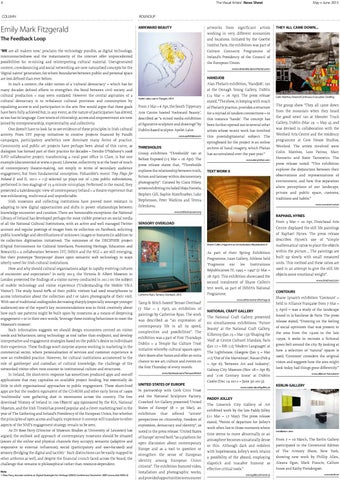
Catherine Ryan, 'Sensory Overload', 2013
www.athloneartandheritage.ie
Tamp & Stitch hosted ‘Sensor Overload’ (7 Mar – 3 Apr), an exhibition of paintings by Catherine Ryan. The work was described as “an expression of contemporary life in all its speed, complexities and possibilities”. The exhibition was a part of First Thursdays Dublin – a Temple Bar Culture Trust initiative whereby cultural spaces open their doors after hours and offer an extra chance to see art, culture and events on the first Thursday of every month. www.facebook.com/TampandStitch
national craft gallery The National Craft Gallery presented six simultaneous exhibitions: ‘Future Beauty’ at the National Craft Gallery, Kilkenny (Jan 25 – Mar 13); ‘Shaping the Void’ at Centre Culturel Irlandais, Paris (Jan 17 – Feb 22); ‘Modern Languages’ at The Lighthouse, Glasgow (Jan 5 – Mar 21); ‘Out of the Marvelous’, Navan (Feb 9 – Apr 6); ‘Between Art and Industry’, Galway City Museum (Nov 28 – Apr 8);
www.nationalcraftgallery.ie
In partnership with Cork Civic Trust and the National Sculpture Factory, Crawford Art Gallery presented ‘United States of Europe’ (8 – 30 Mar), an exhibition
that
offered
“artists’
perspectives on citizenship, freedom of expression, democracy and identity”, as noted in the press release. ‘United States of Europe’ served both “as a platform for open discussion about contemporary Europe and as a tool to question or strengthen the sense of European identity
among
European
Union
citizens”. The exhibition featured video, installation and photographic works, and provided opportunities to encounter
Shane Lynam’s exhibition ‘Contours’ – held in Alliance Française from 7 Mar – 5 April – was a study of the landscape found in la banlieue de Paris. The press release stated, “Drawing on the feeling of social optimism that was present in the area from the 1920s to the late 1950s, it seeks to recreate a fictional green belt around the city. By looking at how a selection of ‘natural’ spaces is used, ‘Contours’ considers the original vision and suggests how the area might look today had things gone differently.” www.alliance-francaise.ie
and ‘21st Century Icons’ at Dublin Castle (Dec 19 2012 – June 30 2013).
united states of europe
contours
kerlin gallery
paddy jolley The Limerick City Gallery of Art exhibited work by the late Paddy Jolley (21 Mar – 17 May). The press release stated, “Points of departure for Jolley’s work often lies in those moments where time seems to move abnormally or an
Installation view
atmosphere becomes unnaturally dense
From 7 – 10 March, The Kerlin Gallery
or thin. Although dark and redolent
participated in the Centennial Edition
with hopelessness, Jolley’s work retains
of The Armory Show, New York,
a possibility of the absurd, employing
showing new work by Phillip Allen,
slapstick and macabre humour as
Aleana Egan, Mark Francis, Callum
effective critical tools.”
Innes and Kathy Prendergast. wwwgallery.limerick.ie
www.kerlin.ie