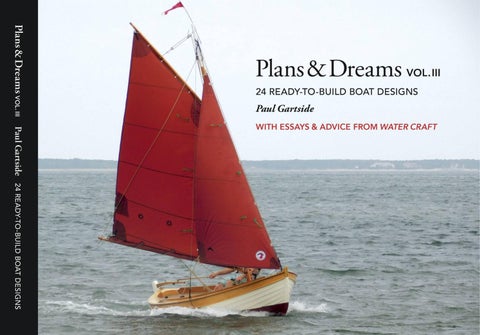
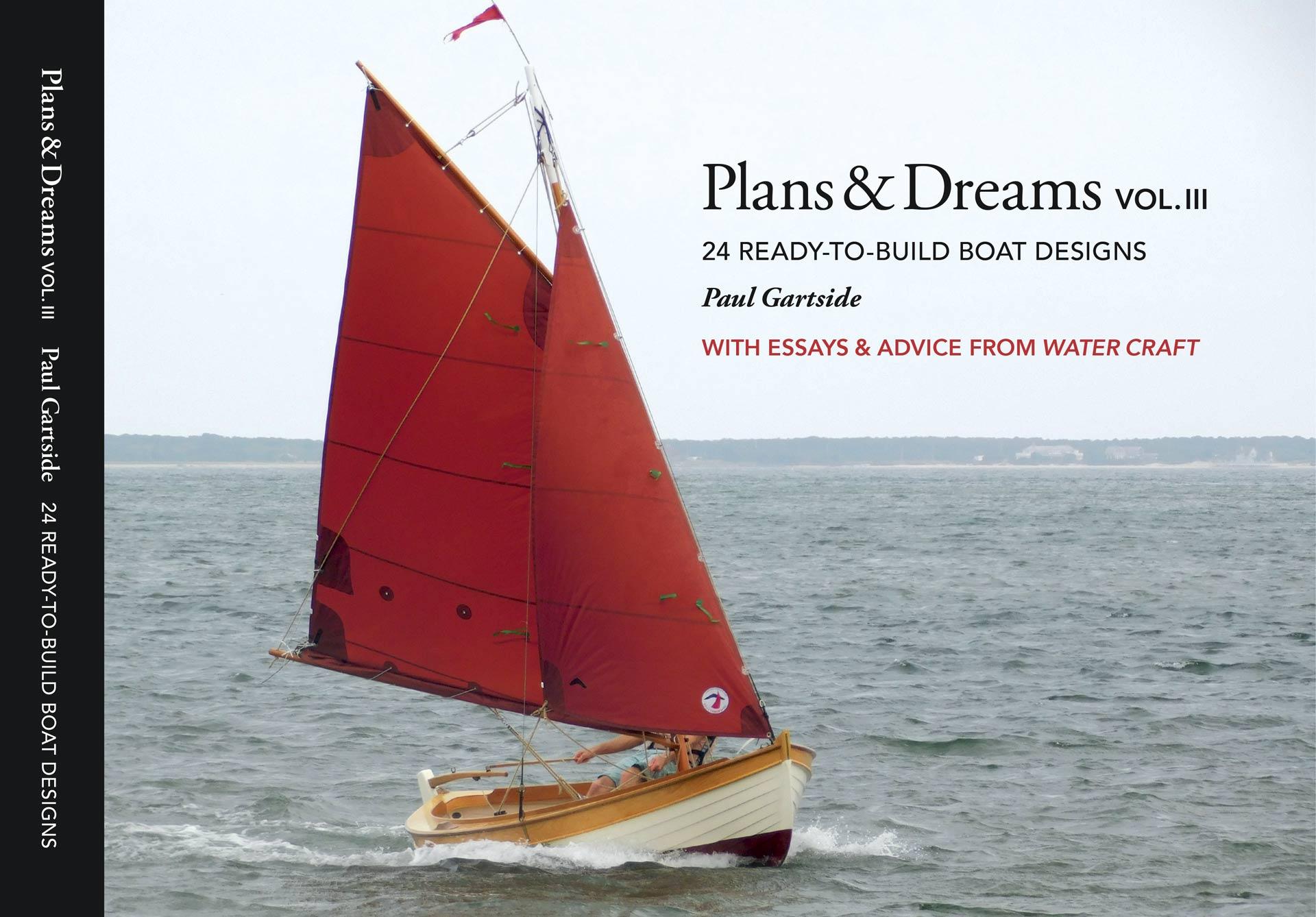
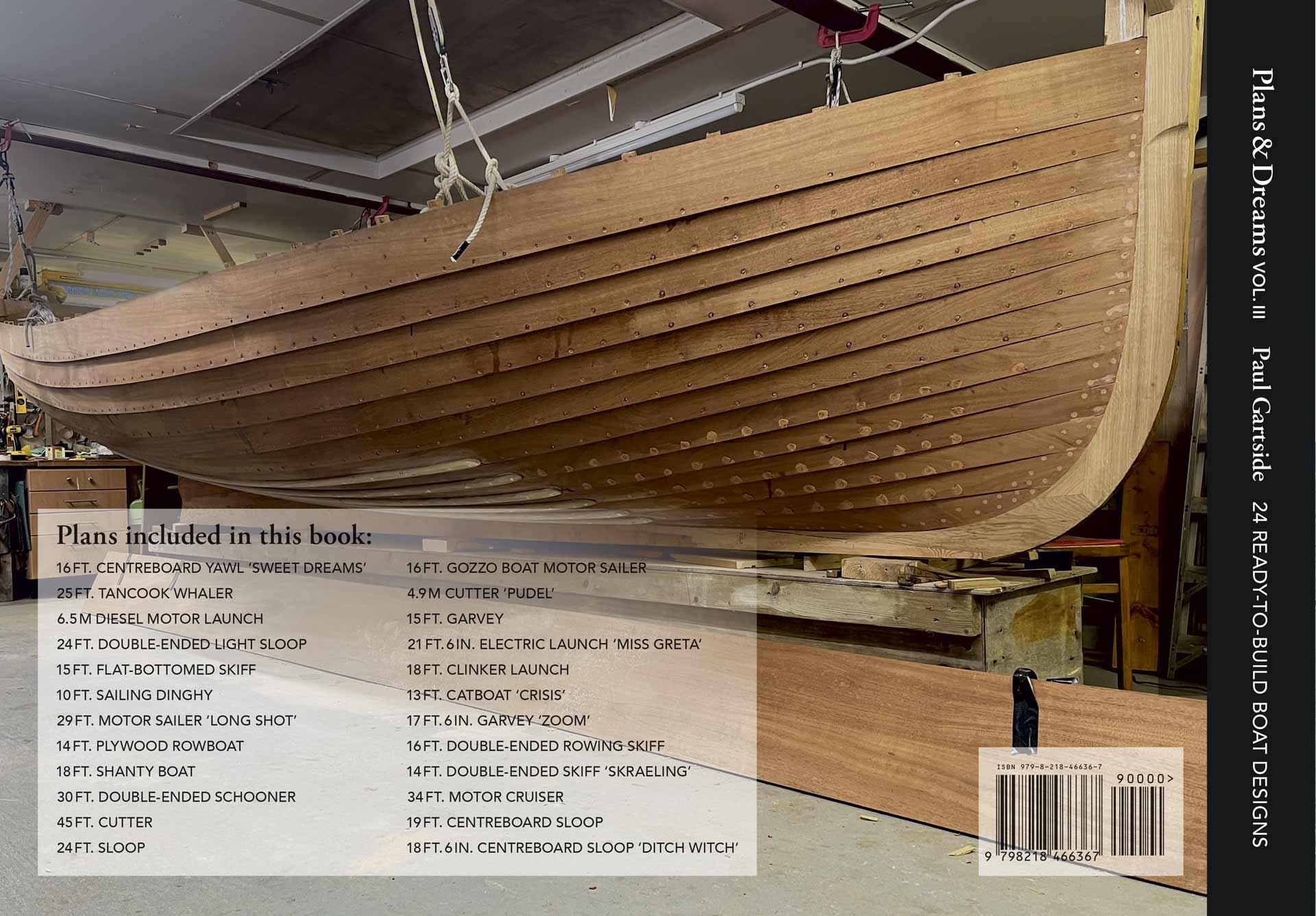
Plans & dreams. Vol. 3, 24 ready-to-build boat designs / by Paul Gartside ; with essays and advice from Water Craft. -- 1st edition.
192 pages 9 in. x 11.875 in.
1. Boats and boating--Design and construction. 2. Boatbuilding-Amateurs’ manuals. I. Title. II. Title: Plans and dreams. Vol. 3, 24 ready-to-build boat designs. III. Title: 24 ready-to-build boat designs. IV. Title: Twenty-four ready-to-build boat designs. V. Title: Water craft.
VM321.G37 2024 623.82’02 QB114-600149
All rights reserved. Except for use in review, no part of this book may be reproduced or used in any form, electronic or mechanical, including photocopying, without written permission from the publisher. Permission requests should be addressed to the publisher at the address below: Paul Gartside
29 Malone Street, East Hampton, NY 11937 USA www.gartsideboats.com
Book design and layout by Rami Schandall / Visual Creative. Edited by Stuart Ross.
Printed in Canada by Friesens Corporation. All chapters have appeared in Water Craft magazine. First edition: October 2024.
Chapter 1. 16 ft. Centreboard Yawl Sweet Dreams
#226A With a description and photos of light, edge-glued carvel planking.
Chapter 2. 25 ft. Tancook Whaler 14
#227 A close look at an interesting historic model from Nova Scotia and a eulogy to the work of marine historian Howard I. Chapelle
Chapter 3. A Small Diesel Motor Launch 22
#228 A practical 6.50 m cabin launch of simple strip construction. A discussion of the difficulty of obtaining good boat lumber.
Chapter 4. 24 ft. Light Sloop
#229 Double-ended light sloop, with thoughts on the necessity of sustaining enthusiasm and stamina through large projects.
Chapter 5. 15 ft. Long Island Clamming Skiff
#230 Flat-bottomed skiff, with notes on the delights of simple traditional construction techniques and the visual power of even the simplest boats.
Chapter 6. A Miniature Pirate Lugger 44 #231 10 ft. sailing dinghy, designed with and for a young designer/builder.
Chapter 7. A Dream of Escape, 29 ft. Motor Sailer Long Shot 51 #232 An interesting request results in a unique vessel with more than a nod to Slocum’s ‘Spray.’
Chapter 8. 14 ft. Plywood Rowboat 60
#233 Inquiries from two islands on opposite sides of the planet provide inspiration for the design of an efficient rowboat, a plywood peapod.
Chapter 9. An Imaginary Voyage, 18 ft. Shanty Boat 65
#234 A request for a simple shanty boat for use on sheltered water leads to a voyage of the imagination through the heart of America.
Chapter 10. 30 ft. Double-Ended Schooner 72
#235 Tancook schooner, with thoughts on wood boat construction in the tropics and the proper sizing and installation of propeller shafts and bearings.
Chapter 11. 45 ft. Cutter 79
#236 A reworking of a much-loved earlier design, with thoughts on the trials and triumphs to be found in larger projects
Chapter 12. 24 ft. Sloop, a Practical Cruiser 88 #237 Includes thoughts on single-handing and self-steering of long-keeled boats.
Chapter 13. Unusual Motor Sailer, 16 ft. Gozzo Boat 96 #238 An unusual small motor sailer based on the beach boats of Greece and Italy.
Chapter 14. 4.9 m Cutter Pudel 104 #239 A small cutter, first developed as a stock boat in 1978, encapsulates the appeal of the miniature yacht. Reimagined here for traditional carvel on bent frame construction.
Chapter 15. 15 ft. Garvey
113 #240 Simple and practical, a small workboat for all manner of uses on and around the waterfront.
Chapter 16. Miss Greta 117 #241 21 ft. 6 in. electric launch, with notes on the necessity of moving away from the use of fossil fuels in boats and the benefits and challenges of electric power.
Chapter 17. 18 ft. Clinker Launch
125 #243 A fine husky launch of traditional construction and diesel power. Contains a detailed building sequence and tips for quality clinker work.
Chapter 18. 13 ft. Catboat Crisis
133 #246 An easy-to-build, plywood catboat, small enough to be put together in the garage from readily available material
Chapter 19. 17 ft. 6 in. Garvey Zoom
140 #247 A larger version of the 15-foot garvey in Chapter 15, detailed for double-skin glued construction with the option of clinker topsides. An easy boat to build and enjoy
Chapter 20. Bud Baker’s 16 ft. Double-Ended Rowing Skiff
146 #242 When in doubt, build a double-ended rowboat. Designed and built in 2020, this is a good all-round model that can be used with one or two rowers.
Chapter 21. 14 ft. Double-Ended Skiff Skraeling
153 #260 A smart, fast daysailer, with musings on the enduring legacy of the Norse aesthetic in the field of boat design.
Chapter 22. A Motorboat for the Adventurous
161 #245 34 ft. motor cruiser, a capable long-distance motorboat of simple construction, with thoughts on the importance of maintaining an understanding relationship with one’s engine.
Chapter 23. 19 ft. Centreboard Sloop
169 #257 One of the sweetest daysailers in our series, with musings on the enduring appeal of the double-ended model .
Chapter 24. Ditch Witch
178 #225 18 ft. 6 in. centreboard sloop, in which we revisit the very first plan drawn especially for Water Craft readers in 2008 to ponder again the delights of minimalist cruising.
18 ft. Clinker Launch
Length Overall
Length Water Line
18 ft. (5.50 m)
17 ft. 4 in. (5.27 m) Beam
6 ft. 8 in. (2.03 m)
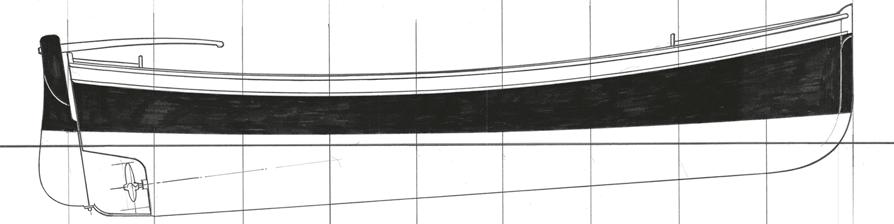
Plans & Dreams, Volume I, Chapter 16, contains plans for an 18-foot Gentleman’s Launch drawn for John Milnes, retired submariner and enthusiastic builder of small boats. I thought it just the ticket for both customer and brief, but alas it missed the mark and so far as I know has yet to be built. It’s a funny thing how personal the images of the boats we carry around in our heads are, and how often close just doesn’t do it. However, John has decided to give me a second chance at it, so here goes, with hopes that this time the fuse gets lit.
This is a simple boat and a very practical one too, ideal for work or pleasure use, a good spec project, the kind of boat that will always find a willing buyer. I’ve drawn it for traditional construction—clinker planking on bent oak frames. John is contemplating glued plywood lapstrake, which I think would be a pity. While in some ways a practical choice for the home builder, it is not nearly as much fun as real boatbuilding and to my mind doesn’t match the character of a boat that has waterfront workboat written all over it. With that diesel engine thumping away merrily, the more heavy-duty structure just feels better to me. So let’s set up the steam box, immerse ourselves in the joys of real boatbuilding and hope we can bring John along with us.
We’ve covered clinker building in some detail in these columns in the past, but we can look at some aspects specific to this boat. The
drawings are heavily detailed (maybe overly so, but the tricks and dodges they illustrate should help smooth the way for the first-time builder). We are using an upside-down set-up: frames bent first, followed by the planking. This is the reverse of the more common British practice of plank first, frame second. But there are advantages to this approach, especially for the builder, who avoids stooping and bending.
A careful full-size lofting is the first step; then, with body sections established, we will make the appropriate deductions to arrive at the shape of moulds. Since we will be bending frames first before planking, we must subtract from the outside of plank line the thickness of plank plus frame plus temporary fore-and-aft ribbands, for a total deduction of 115/16". See sheet 3 for that detail. The deduction will be constant on all moulds, though in theory we should take a little more fore and aft of amidships as the plank angle changes. A constant deduction gets us close enough. The moulds are extended to the building base, where a cross pall is fitted for an easy set-up.
Next we will make up and assemble the components of the centreline—keel, stem, shaft log and horn timber. Stem, knee and fore deadwood will be air-dried oak bolted up with nice tight joints wellbedded. Once the rabbet is cut and the stem shaped per the detail on sheet 2, stopwaters will be fitted on all through joints. For the keel, log
and horn timber, I’ve shown Douglas fir. That is determined by the stern tube arrangement. I’m using a glass/epoxy tube that will be fully bonded into the shaft log. For that we need wood with good gluing characteristics. Fir would be my choice, but there are other options. If a bronze tube is used, we could use an all-oak centreline, the time-honoured material. In that case, we need to bore for the stern tube—pilot hole first, reamed out later, with the boring bar to clear the outside diameter of the tube. I prefer an inert glass tube bonded in with thickened epoxy that becomes part of the structure—it’s simple to make and will be there long after all else has turned to dust (designer and builder included).
With the backbone assembled, it can be lowered gently into the mould notches, pulling everything into its rightful place and solidifying the building jig. The permanent stringers go in before framing and serve as part of the bending jig—so much easier than fitting
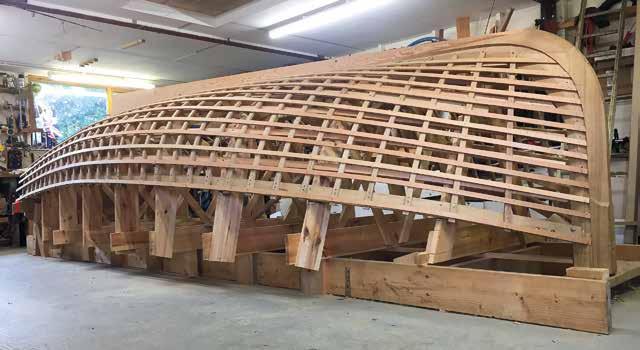
First-class workmanship in John Milnes’s spotless workshop. Note the details of the set-up: frames bent outside the ribbands with heels boxed into the stem. Lining out battens for the planking have just been placed. Battens are the same width as the plank land.
Photo credit: John Milnes.
them later. Both bilge stringers and gunwales will require steaming, and note too that the gunwale will have to be sawn to shape. The full deck line will give it a pronounced S curve that can’t be overcome by steaming alone. We’ll take a spiling and cut it out just like a piece of planking. Try to avoid short grain at the forward end, and if it has to be scarfed, keep the joint well aft so it doesn’t have to go in the steam box—it’s the forward half we need to limber up.
Temporary ribbands go on next, filling the gaps between stringers and keel. Note the jogged fids used to secure these to stem rabbet and transom. It’s worth going over the jig with a batten at this stage and knocking off any high spots before bending the frames—put a slight round in the back of the bilge stringer so there are no hard spots. The ribband next to the keel will have its corner removed so the frames fair through nicely onto the apron. All these little dodges make for a stress-free bending day.
so it lands properly on the lap of the previous plank. That way, the measurements taken and marked on it will be accurate. Sometimes a plank will spring when it is cut—wood is like that. If I find that happening, I will cut them a little oversize for extra wiggle room and adjust as they go on the boat.
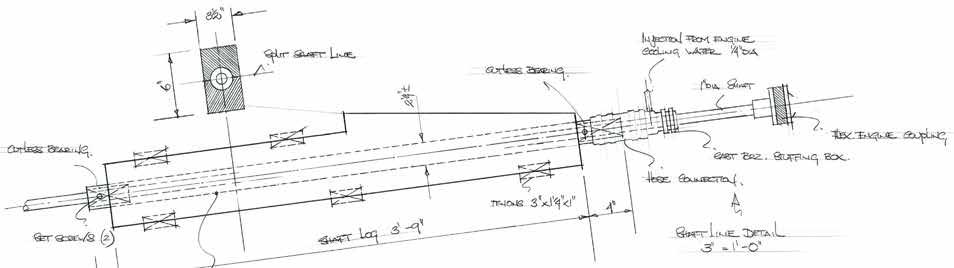
A couple of thoughts on the shaft line and engine installation. To provide adequate support for the 1" diameter shaft, there is a waterlubricated bearing at both ends of the tube, the inner fed by a bleed from the engine-cooling water. The engine coupling is close enough to the inboard end of the tube that I’d like to see a flexible coupling fitted. I don’t often do that, but the geometry of this one dictates it— I would be concerned otherwise about wear in the forward bearing. This should not be seen as a substitute for careful alignment. Line up with the feeler gauges in the normal way, then part the couplings and install the flexible connection. Proper shaft support and precise alignment are the best insurance against drivetrain issues.
A bearing at either end of the tube makes life easy for the builder, as we can run a dummy shaft in there to give us the line of the beds; no need to fool around with a stretched string. The beds are notched down into the heavy floor timbers, which must be fully fitted to the planking, and they must bear solidly on the frames. Both those operations require careful fitting. Taking the floors first, make a light
pattern out of thin stuff fitted over the plank laps. Bandsaw the floor with some extra height and do a test fit. It will be miles off because no account has been taken of the bevel (not so much a fit—more of a seizure, as dear old Frank Andrew would say), but don’t worry. Brush a little wet paint on the planking, drop the floor down again, lift it out and, with a sharp chisel and spokeshave, remove the paint marks. Repeat and repeat for a half-hour or so and you can’t help but get a perfect fit eventually. It’s hard on the knees in the bottom of the boat, but just go slow—we are not trying to make this pay. The beds are notched into the floors both ways and bear on the frames. Use the same method to achieve good fits there. Again, leave them high and cut down once fitted. Beds can be glued and lagged into the floors, or for small installations like this, I like to pin them with big oak dowels like a trunnel fastening. That way there is no concern about hitting a bed bolt with the engine feet bolts. (Been there? Me too.)
This promises to be a most enjoyable project. It is all boatbuilding, with very little of the tedious fitting-out work that comes with larger projects. The richness of traditional construction is the main appeal. From the sourcing of material and the relationships forged with local sawmills and their colourful inhabitants, to the smell of the fresh-cut timber, fragrances that reach back through generations of boatbuilders, to the smoke and hiss of the steam box—it’s all an intoxicating magic.
Detail from sheet 2: shaft line and engine installation.
19 ft. Centreboard Sloop
Length on Deck
Length Waterline
Beam
19 ft. 0 in. (5.8 m)
16 ft. 10 in. (5.13 m)
7 ft. 4 in. (2.22 m)
Somewhere back in the late Middle Ages, when this series began, we published the plans for a 16-foot double-ended sloop, design #165. It was the first of a string of small centreboard double-enders we have featured in the years since. For reasons not entirely clear to me, this general model remains by far the most popular of any of the types we have explored. The simple power of symmetry, I suspect, overcoming rational argument. For we give up a lot when we sharpen both ends of a hull, especially in small boats. Right away we lose a chunk of righting moment and hence sail-carrying power—a transom stern is much more effective in this regard, and offers planing potential in strong winds. It is also harder to arrange for auxiliary power in a doubleender. A small electric outboard mounted on a removable bracket over the side is probably the best solution for covering distance; otherwise, a pair of sweeps or the Chinese solution, the long cranked yuloh, worked in a pivot offset to one side of the rudder.
But if we know anything about the science of boat design, it’s that it is not a science at all, but rather a conversation with some entirely different part of the brain, a luxuriant place of daydreams and distractions where rational argument is often an unwelcome intruder. Perhaps that’s why books on design theory are often so unsatisfying. Sure, we know the numbers are important—in any kind of competitive environment, essential—but surely there is more to it than that?
Draft (Centreboard Down)
Sail Area
Ballast
4 ft. 3 in. (1.3 m)
190 sq. ft. (17.66 sq m)
600 lb. (273 kg)
A hundred and fifty years ago, Walt Whitman described that feeling of disappointment perfectly in his poem “When I Heard the Learn’d Astronomer.” I still remember the recognition and relief I felt when I came across that one. But we are wandering again.
A nice example of plan #165 is Skorri , built by Rob Denny in Saanichton, British Columbia. Rob added a cuddy not shown on the original drawings that seems to suit her well and attracted the attention of Eddie Breeden, confirmed double-ender man who boats on Mobjack Bay on the Chesapeake. Eddie’s thoughts went to a larger version with cockpit space for four and a similar cuddy to keep gear dry and make sleeping aboard a little less spartan. That brief forms the basis for this chapter’s plan.
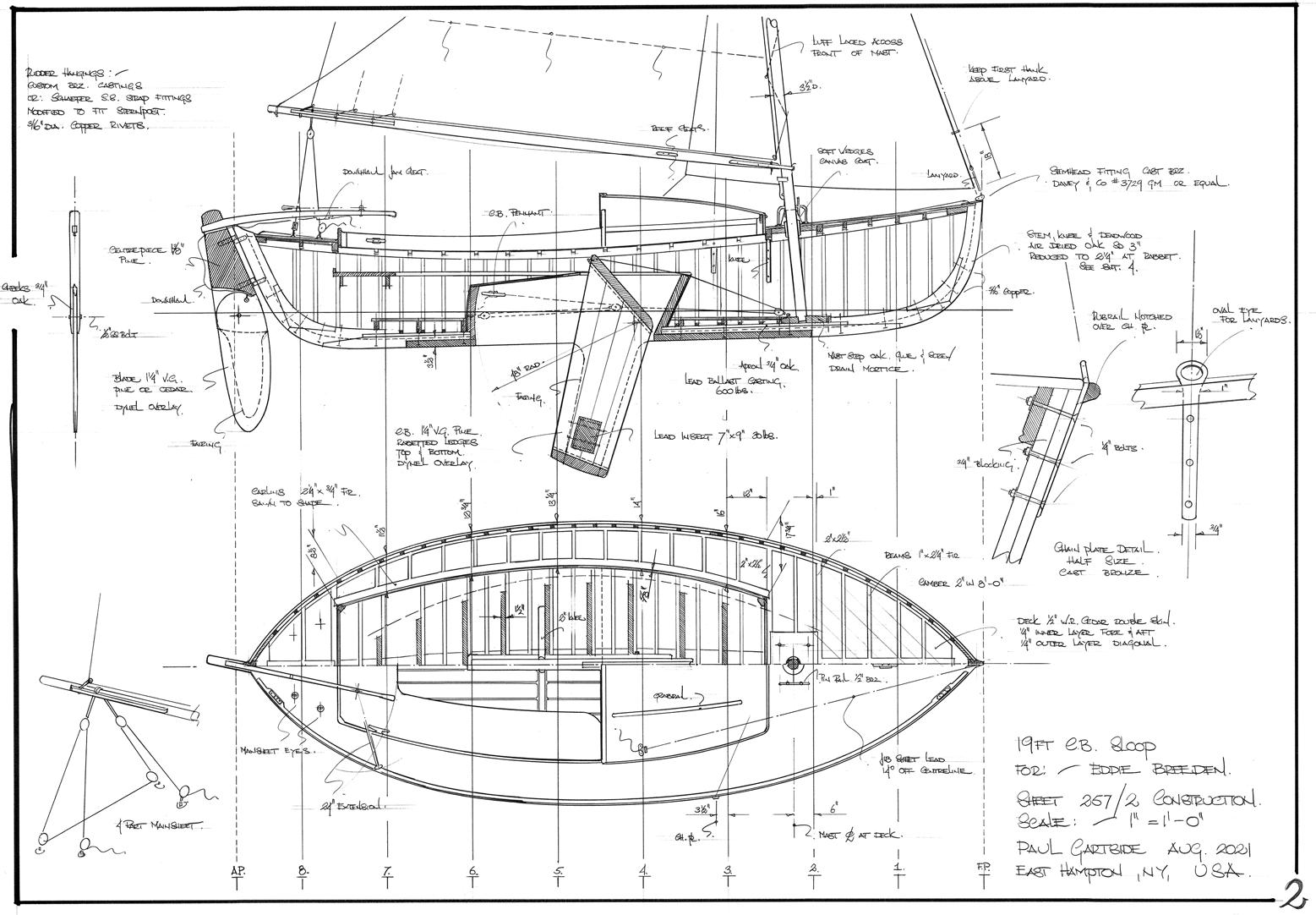
Skorri , at 16 feet, is at the upper end of the size range for an unballasted boat, particularly single-handed, and I was a little disconcerted to see Rob had omitted the tiller extension I would have deemed indispensable for hiking out. For Eddie’s boat there is no question some fixed ballast is required. Just how much is something of a judgment call, but the 600 lb. shown on the drawings feels about right and should power her up nicely. Proper disposal of crew weight will still be very important, and early reefing is recommended when single-handing.
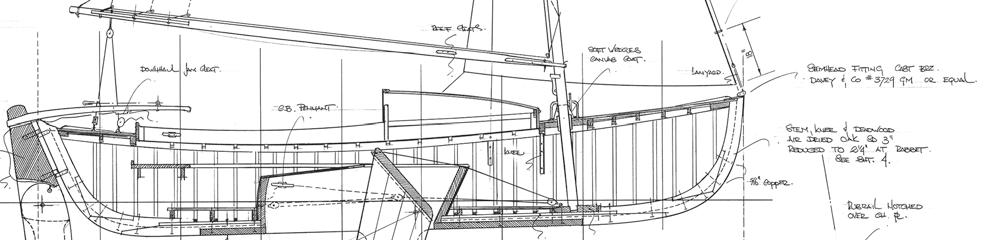
The construction drawings show simple carvel on bent frames, the most pleasant way to build if good planking material is available. Here in the US, the cedars, western red or Alaskan yellow, would be the best choices. I would use a standard caulking seam two-thirds of the plank thickness deep and gently set a single thread of cotton topped with seam compound. Another approach that works well with softwood species is the rolled seam described in Plans & Dreams, Volume I, Chapter 2. For those seeking the elusive (and overrated) dry bilge, a fully glued option is also given on sheet 3. I am not sure where Eddie stands on epoxy use, but this double-skin method uses the least amount of it for a tight, stable hull.
I’ve shown the stem and sternpost in some detail and had a good time doing it. Assembling and shaping up a proper rabbeted stem in air-dried oak is one of the most enjoyable parts of the boatbuilding process, and even on paper is good fun to work through. In glued construction we often plank up over an inner stem, plane off and fit the outer stem as a separate piece. Practical, perhaps, but not nearly as much fun or as fragrant.
The rigging is as simple as it gets: a hollow mast to make stepping easier, a solid boom and gaff with hardwood jaws. Standing rigging will be 3/16" diameter, with a 7" x 9" wire set-up and lanyards rather than rigging screws. The soft eyes at the masthead and the thimble eyes at the lower end will look best hand-spliced, served and varnished. Don’t forget to parcel under the serving with cloth-based electrical tape—which I am happy to report we can still get here in New York. Who said America is in decline?
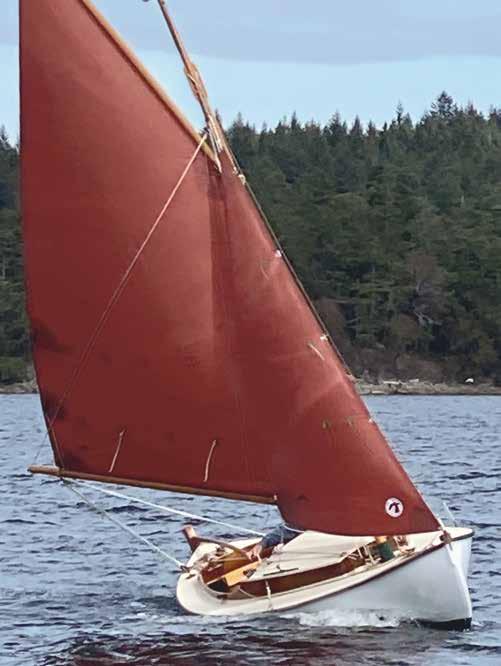
Rob Denny of Brentwood, British Columbia, built his 16-foot ‘Skorri’ to design #165 featured in Chapter 8 of ‘Plans & Dreams, Volume I.’ Rob added the neat cuddy, and it was this photo that served as inspiration for the 19-foot boat in this chapter. Photo credit: Nighean Anderson.