Visitors’ Site Guide
Other inhabitants of leaf litter include the carnivorous Glass Snail (Oxychilus draparnaudi) , distinguishable by a relatively large, diaphanous and smooth brown shell, and its smaller and less common relative (Oxychilus hydatinus). The small, glossy, Yellow-Bodied Snail (Ferussacia folliculum) is found in high population densities in the same locations and also in open areas, if enough rock cover is present.
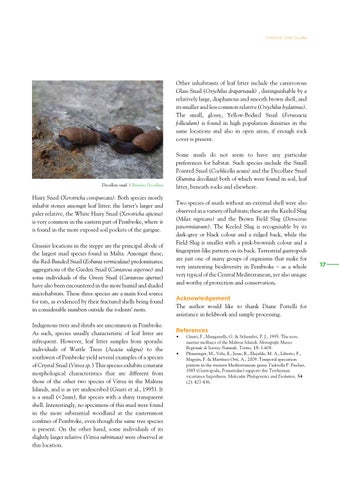
Decollote snail | Rumino Decollata
Hairy Snail (Xerotricha conspurcata). Both species mostly inhabit stones amongst leaf litter; the latter’s larger and paler relative, the White Hairy Snail (Xerotricha apicina) is very common in the eastern part of Pembroke, where it is found in the more exposed soil pockets of the garigue. Grassier locations in the steppe are the principal abode of the largest snail species found in Malta. Amongst these, the Red-Banded Snail (Eobania vermiculata) predominates; aggregations of the Garden Snail (Cantareus aspersus) and some individuals of the Green Snail (Cantareus apertus) have also been encountered in the more humid and shaded microhabitats. These three species are a main food source for rats, as evidenced by their fractured shells being found in considerable numbers outside the rodents’ nests. Indigenous trees and shrubs are uncommon in Pembroke. As such, species usually characteristic of leaf litter are infrequent. However, leaf litter samples from sporadic individuals of Wattle Trees (Acacia saligna) to the southwest of Pembroke yield several examples of a species of Crystal Snail (Vitrea sp.) This species exhibits constant morphological characteristics that are different from those of the other two species of Vitrea in the Maltese Islands, and is as yet undescribed (Giusti et al., 1995). It is a small (<2mm), flat species with a shiny transparent shell. Interestingly, no specimens of this snail were found in the more substantial woodland at the easternmost confines of Pembroke, even though the same tree species is present. On the other hand, some individuals of its slightly larger relative (Vitrea subrimata) were observed at this location.
Some snails do not seem to have any particular preferences for habitat. Such species include the Small Pointed Snail (Cochlicella acuta) and the Decollate Snail (Rumina decollata) both of which were found in soil, leaf litter, beneath rocks and elsewhere. Two species of snails without an external shell were also observed in a variety of habitats; these are the Keeled Slug (Milax nigricans) and the Brown Field Slug (Deroceras panormitanum). The Keeled Slug is recognisable by its dark-grey or black colour and a ridged back, while the Field Slug is smaller with a pink-brownish colour and a fingerprint-like pattern on its back. Terrestrial gastropods are just one of many groups of organisms that make for very interesting biodiversity in Pembroke – as a whole very typical of the Central Mediterranean, yet also unique and worthy of protection and conservation. Acknowledgement The author would like to thank Diane Portelli for assistance in fieldwork and sample processing. References sª
sª
Giusti, F., Manganelli, G. & Schembri, P. J., 1995. The nonmarine molluscs of the Maltese Islands. Monografie Museo Regionale di Scienze Naturali, Torino, 15: 1-608. Pfenninger, M., Véla, E., Jesse, R., Elejalde, M. A., Liberto, F., Magnin, F. & Martínez-Ortí, A., 2009. Temporal speciation pattern in the western Mediterranean genus Tudorella P. Fischer, 1885 (Gastropoda, Pomatiidae) supports the Tyrrhenian vicariance hypothesis. Molecular Phylogenetics and Evolution, 54 (2): 427-436.
17