ROT-DSI 2013:Layout 1 04/10/13 11:35 AM Page 2
WHY INS SINDHURAKSHAK EPISODE WON’T HURT INDO-RUSSIAN TIES
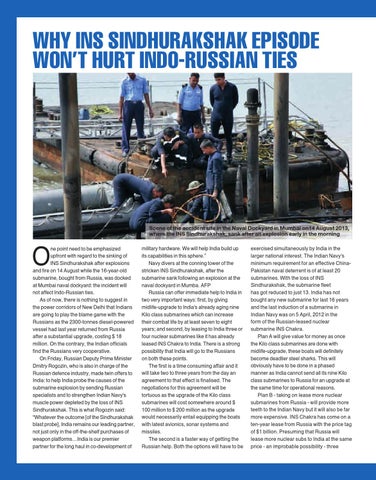
Scene of the accident site in the Naval Dockyard in Mumbai on14 August 2013, where the INS Sindhurakshak, sank after an explosion early in the morning
O
ne point need to be emphasized upfront with regard to the sinking of INS Sindhurakshak after explosions and fire on 14 August while the 16-year-old submarine, bought from Russia, was docked at Mumbai naval dockyard: the incident will not affect Indo-Russian ties. As of now, there is nothing to suggest in the power corridors of New Delhi that Indians are going to play the blame game with the Russians as the 2300-tonnes diesel-powered vessel had last year returned from Russia after a substantial upgrade, costing $ 18 million. On the contrary, the Indian officials find the Russians very cooperative. On Friday, Russian Deputy Prime Minister Dmitry Rogozin, who is also in charge of the Russian defence industry, made twin offers to India: to help India probe the causes of the submarine explosion by sending Russian specialists and to strengthen Indian Navy's muscle power depleted by the loss of INS Sindhurakshak. This is what Rogozin said: “Whatever the outcome [of the Sindhurakshak blast probe], India remains our leading partner, not just only in the off-the-shelf purchases of weapon platforms…India is our premier partner for the long haul in co-development of
military hardware. We will help India build up its capabilities in this sphere.” Navy divers at the conning tower of the stricken INS Sindhurakshak, after the submarine sank following an explosion at the naval dockyard in Mumba. AFP Russia can offer immediate help to India in two very important ways: first, by giving midlife-upgrade to India's already aging nine Kilo class submarines which can increase their combat life by at least seven to eight years; and second, by leasing to India three or four nuclear submarines like it has already leased INS Chakra to India. There is a strong possibility that India will go to the Russians on both these points. The first is a time consuming affair and it will take two to three years from the day an agreement to that effect is finalised. The negotiations for this agreement will be tortuous as the upgrade of the Kilo class submarines will cost somewhere around $ 100 million to $ 200 million as the upgrade would necessarily entail equipping the boats with latest avionics, sonar systems and missiles. The second is a faster way of getting the Russian help. Both the options will have to be
exercised simultaneously by India in the larger national interest. The Indian Navy's minimum requirement for an effective ChinaPakistan naval deterrent is of at least 20 submarines. With the loss of INS Sindhurakshak, the submarine fleet has got reduced to just 13. India has not bought any new submarine for last 16 years and the last induction of a submarine in Indian Navy was on 5 April, 2012 in the form of the Russian-leased nuclear submarine INS Chakra. Plan A will give value for money as once the Kilo class submarines are done with midlife-upgrade, these boats will definitely become deadlier steel sharks. This will obviously have to be done in a phased manner as India cannot send all its nine Kilo class submarines to Russia for an upgrade at the same time for operational reasons. Plan B - taking on lease more nuclear submarines from Russia - will provide more teeth to the Indian Navy but it will also be far more expensive. INS Chakra has come on a ten-year lease from Russia with the price tag of $1 billion. Presuming that Russia will lease more nuclear subs to India at the same price - an improbable possibility - three
nuclear submarines' lease would be costing over $ 3 billion. If the Indian Navy has to look ahead it has to completely phase out all diesel-electric submarines in the next decade. It is an era of nuclear submarines and the Indian Navy must be already sensitized to the huge strategic and operational advantages of nuclear submarines over diesel-electric ones, like the Sindhurakshak was. A nuclear submarine allows a navy to remain under water for months on and gives a much more superior stealth advantage. Both the above-mentioned options as well as the sinking of INS Sindhurakshak will dominate three top-level Indo-Russian bilateral engagements in the next two months first a pull aside meeting between Prime Minister Manmohan Singh and Russian President Vladimir Putin on the sidelines of the G 20 summit at St Petersburg (5-6, September), then the Indo-Russian Inter Governmental Commission - Military and Technical Cooperation (IRIGC-MTC) meeting to be held between the two sides' defence ministers in Moscow in October, and shortly later in the same month the 14th annual sumit between India and Russia in Moscow. This writer understands that next month's meeting between Singh and Putin will be for less than one hour and since the two leaders will be conversing with each other with the help of interpreters the meeting will be effectively for just about half an hour. However, even in this short duration, the INS Sindhurakshak will definitely come up for discussion and the two leaders may also have a brief look at the possible roadmap for near term Indo-Russian collaboration in this context and leave the matter to be clinched for the next two meetings.
INS SINDHURAKSHAK: SHAKEN, NAVY MAY OPT FOR EMERGENCY PURCHASE OF SUBS
W
ith the loss of INS Sindhurakshak, the navy is considering “emergency acquisition”, which will cost the government up to Rs 3000 crore. The navy’s underwater capabilities have taken a hit after explosions and fire sank the Kilo class submarine. At present the navy has nine Kilo class conventional submarines, but only five of them are in operation. Of the nine, two have gone for mid-life refit, two are under repair maintenance. INS Sindhukirti is in Hindustan Shipyards Limited in Vishakhapatnam. A top naval source told dna that navy’s reducing underwater capability has raised alarm. “After losing our frontline submarine, we are seriously working on the option to go for emergency acquisition to gain underwater strength,” an officer said. The navy may put up a proposal before the ministry of defence for clearance for emergency acquisition. Taking a
submarine on lease from Russia could also be an option. If the navy goes for an emergency acquisition, it would not require to follow regular procedure for acquisition like issuing a Request for Proposal (RFP) and selection of lowest bidder after competitive bidding. INS Sindhurakshak had arrived on April 29 this year from Russia after a Rs.815 crore mid-life upgrade, which included installation of radars and missiles. Naval sources said salvaging of the submarine is a remote possibility though at some point of time navy would be taking services of professionals to salvage the boat. Meanwhile, countries like Russia and US have come forward to offer assistance in rescue and salvage operation. “At present, rescue and salvage operations are going on together. The Board of Inquiry (BOI) can start only after we are able to extract the ship from the sea,” an officer said. —Courtesy: DNA
Safety violations likely cause of Sindhurakshak accident, says Russia Violation of safety regulations could be the most likely cause of the explosions on submarine Sindhurakshak because of which it sank, Russian Deputy Prime Minister Dmitry Rogozin has said. Rogozin, who was quoted by Russia's official news agency Itar Tass, has said India had raised no questions over the technical aspects of the submarine built and recently overhauled by Russia. Quoting experts, he told the news agency that the violation of safety regulations was the most probable cause of the accident on Wednesday.
Indian Chief of Naval Staff Admiral DK Joshi briefing Defence Minister AK Antony about the sinking of INS Sindhurakshak submarine following an explosion in Mumbai on Wednesday, 14 August 2013
—Courtesy: Firstpost
DSI Marketing Promotion