S P
e o
w
a e
r
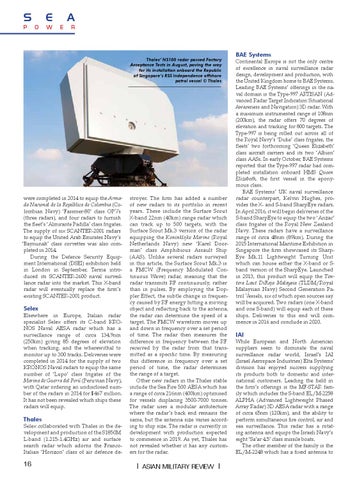
Thales’ NS100 radar passed Factory Acceptance Tests in August, paving the way for its installation onboard the Republic of Singapore’s RSS Independence offshore patrol vessel © Thales
were completed in 2014 to equip the Armada Nacional de la República de Colombia (Colombian Navy) ‘Fassmer-80’ class OPVs (three radars), and four radars to furnish the fleet’s ‘Almirante Padilla’ class frigates. The supply of six SCANTER-2001 radars to equip the United Arab Emirates Navy’s ‘Baynunah’ class corvettes was also completed in 2014. During the Defence Security Equipment International (DSEI) exhibition held in London in September, Terma introduced its SCANTER-2600 naval surveillance radar into the market. This X-band radar will eventually replace the firm’s existing SCANTER-2001 product.
Selex Elsewhere in Europe, Italian radar specialist Selex offers its C-band KRONOS Naval AESA radar which has a surveillance range of circa 134.9nm (250km) giving 85 degrees of elevation when tracking, and the wherewithal to monitor up to 300 tracks. Deliveries were completed in 2014 for the supply of two KRONOS Naval radars to equip the same number of ‘Lupo’ class frigates of the Marina de Guerra del Perú (Peruvian Navy), with Qatar ordering an undisclosed number of the radars in 2014 for $467 million. It has not been revealed which ships these radars will equip.
Thales Selex collaborated with Thales in the development and production of the S1850M L-band (1.215-1.4GHz) air and surface search radar which adorns the FrancoItalian ‘Horizon’ class of air defence de-
16
stroyer. The firm has added a number of new radars to its portfolio in recent years. These include the Surface Scout X-band 22nm (40km) range radar which can track up to 500 targets, with the Surface Scout Mk.3 version of the radar equipping the Koninklijke Marine (Royal Netherlands Navy) new ‘Karel Doorman’ class Amphibious Assault Ship (AAS). Unlike several radars surveyed in this article, the Surface Scout Mk.3 is a FMCW (Frequency Modulated Continuous Wave) radar, meaning that the radar transmits RF continuously, rather than in pulses. By employing the Doppler Effect, the subtle change in frequency caused by RF energy hitting a moving object and reflecting back to the antenna, the radar can determine the speed of a target. The FMCW waveform moves up and down in frequency over a set period of time. The radar then measures the difference in frequency between the RF received by the radar from that transmitted as a specific time. By measuring this difference in frequency over a set period of time, the radar determines the range of a target. Other new radars in the Thales stable include the Sea Fire 500 AESA which has a range of circa 216nm (400km) optimised for vessels displacing 3500-7000 tonnes. The radar uses a modular architecture where the radar’s back end remains the same, but the antenna size varies according to ship size. The radar is currently in development with production expected to commence in 2019. As yet, Thales has not revealed whether it has any customers for the radar.
| Asian Military Review |
BAE Systems Continental Europe is not the only centre of excellence in naval surveillance radar design, development and production, with the United Kingdom home to BAE Systems. Leading BAE Systems’ offerings in the naval domain is the Type-997 ARTISAN (Advanced Radar Target Indication Situational Awareness and Navigation) 3D radar. With a maximum instrumented range of 108nm (200km), the radar offers 70 degrees of elevation and tracking for 800 targets. The Type-997 is being rolled out across all of the Royal Navy’s ‘Duke’ class frigates, the fleets’ two forthcoming ‘Queen Elizabeth’ class aircraft carriers and its two ‘Albion’ class AASs. In early October, BAE Systems reported that the Type-997 radar had completed installation onboard HMS Queen Elizabeth, the first vessel in the eponymous class. BAE Systems’ UK naval surveillance radar counterpart, Kelvin Hughes, provides the X- and S-band SharpEye radars. In April 2016, it will begin deliveries of the S-band SharpEye to equip the two ‘Anzac’ class frigates of the Royal New Zealand Navy. These radars have a surveillance range of circa 48nm (89km). During the 2015 International Maritime Exhibition in Singapore the firm showcased its SharpEye Mk.11 Lightweight Turning Unit which can house either the X-band or Sband version of the SharpEye. Launched in 2013, this product will equip the Tentera Laut DiRaja Malaysia (TLDM/Royal Malaysian Navy) Second Generation Patrol Vessels, six of which open sources say will be acquired. Two radars (one X-band and one S-band) will equip each of these ships. Deliveries to this end will commence in 2016 and conclude in 2020.
IAI While European and North American suppliers seem to dominate the naval surveillance radar world, Israel’s IAI (Israel Aerospace Industries) Elta Systems’ division has enjoyed success supplying its products both to domestic and international customers. Leading the field in the firm’s offerings is the MF-STAR family which includes the S-band EL/M-2258 ALPHA (Advanced Lightweight Phased Array Radar) 3D AESA radar with a range of circa 65nm (120km), and the ability to perform simultaneous fire control, air and sea surveillance. This radar has a rotating antenna and equips the Israeli Navy’s eight ‘Sa’ar 4.5’ class missile boats. The other member of the family is the EL/M-2248 which has a fixed antenna to