a i r P O W E R
China's IEP
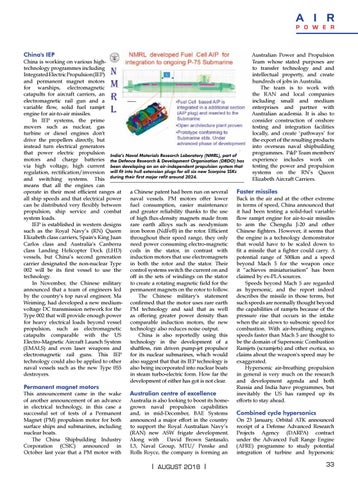
Australian Power and Propulsion Team whose stated purposes are China is working on various highto transfer technology and and technology programmes including intellectual property, and create Integrated Electric Propulsion (IEP) hundreds of jobs in Australia. and permanent magnet motors The team is to work with for warships, electromagnetic the RAN and local companies catapults for aircraft carriers, an including small and medium electromagnetic rail gun and a enterprises and partner with variable flow, solid fuel ramjet Australian academia. It is also to engine for air-to-air missiles. consider construction of onshore In IEP systems, the prime testing and integration facilities movers such as nuclear, gas locally, and create ‘pathways’ for turbine or diesel engines don't the export of the resulting products drive the propellers directly, but into overseas naval shipbuilding instead turn electrical generators programmes. P&P Team members' that power electric propulsion India’s Naval Materials Research Laboratory (NMRL), part of experience includes work on motors and charge batteries the Defence Research & Development Organisation (DRDO) has testing the power and propulsion via high voltage, high current been developing an an air-independent propulsion system that systems on the RN’s Queen regulation, rectification/inversion will fit into hull extension plugs for all six new Scorpine SSKs Elizabeth Aircraft Carriers. and switching systems. This during their first major refit around 2024. means that all the engines can operate in their most efficient ranges at a Chinese patent had been run on several Faster missiles all ship speeds and that electrical power naval vessels. PM motors offer lower Back in the air and at the other extreme can be distributed very flexibly between fuel consumption, easier maintenance in terms of speed, China announced that propulsion, ship service and combat and greater reliability thanks to the use it had been testing a solid-fuel variablesystem loads. of high flux-density magnets made from flow ramjet engine for air-to-air missiles IEP is established in western designs rare earth alloys such as neodymium to arm the Chengdu J-20 and other such as the Royal Navy’s (RN) Queen iron boron (NdFeB) in the rotor. Efficient Chinese fighters. However, it seems that Elizabeth class carriers, Spain's King Juan throughout their speed range, they only the engine is a technology demonstrator Carlos class and Australia's Canberra need power consuming electro-magnetic that would have to be scaled down to class Landing Helicopter Dock (LHD) coils in the stator, in contrast with fit a missile that a fighter could carry. A vessels, but China’s second generation induction motors that use electromagnets potential range of 300km and a speed carrier designated the non-nuclear Type in both the rotor and the stator. Their beyond Mach 5 for the weapon once 002 will be its first vessel to use the control systems switch the current on and it “achieves miniaturisation” has been technology. off in the sets of windings on the stator claimed by ex-PLA sources. In November, the Chinese military to create a rotating magnetic field for the Speeds beyond Mach 5 are regarded announced that a team of engineers led permanent magnets on the rotor to follow. as hypersonic, and the report indeed by the country's top naval engineer, Ma The Chinese military's statement describes the missile in those terms, but Weiming, had developed a new medium- confirmed that the motor uses rare earth such speeds are normally thought beyond voltage DC transmission network for the PM technology and said that as well the capabilities of ramjets because of the Type 002 that will provide enough power as offering greater power density than pressure rise that occurs in the intake for heavy electrical loads beyond vessel comparable induction motors, the new when the air slows to subsonic speed for propulsion, such as electromagnetic technology also reduces noise output. combustion. With air-breathing engines, catapults comparable with the US China is also reportedly using this speeds faster than Mach 5 are thought to Electro-Magnetic Aircraft Launch System technology in the development of a be the domain of Supersonic Combustion (EMALS) and even laser weapons and shaftless, rim driven pump-jet propulsor Ramjets (scramjets) and other exotica, so electromagnetic rail guns. This IEP for its nuclear submarines, which would claims about the weapon's speed may be technology could also be applied to other also suggest that that its IEP technology is exaggerated. naval vessels such as the new Type 055 also being incorporated into nuclear boats Hypersonic air-breathing propulsion destroyers. in steam turbo-electric form. How far the in general is very much on the research development of either has got is not clear. and development agenda and both Russia and India have programmes, but Permanent magnet motors inevitably the US has ramped up its This announcement came in the wake Australian centre of excellence of another announcement of an advance Australia is also looking to boost its home- efforts to stay ahead. in electrical technology, in this case a grown naval propulsion capabilities successful set of tests of a Permanent and, in mid-December, BAE Systems Combined cycle hypersonics Magnet (PM) propulsion motor for both announced a major effort in the country On 23 January, Orbital ATK announced surface ships and submarines, including to support the Royal Australian Navy’s receipt of a Defense Advanced Research nuclear boats. (RAN) new ASW frigate development. Projects Agency (DARPA) contract The China Shipbuilding Industry Along with David Brown Santasalo, under the Advanced Full Range Engine Corporation (CSIC) announced in L3, Naval Group, MTU/ Penske and (AFRE) programme to study potential October last year that a PM motor with Rolls Royce, the company is forming an integration of turbine and hypersonic
| august 2018 |
33