r e g i o n a l D i r e c t o r y
■ Fielded Capabilities Skycam UAV Kahu: The Kahu has been designed as a high performance, aerodynamically efficient mini-UAV that is equipped with an autopilot system designed by the New Zealand Defence Technology Agency. It is presently operated by the New Zealand Army and can carry a range of high performance still, motion video and forward-looking infrared (FLIR) sensors, with a flight endurance of two hours and a range of 25km. INDIA India has been involved in UAV development for over two decades, with research and development (R&D) organisations such as the Aeronautical Development Establishment (ADE), Bharat Electronics Limited (BEL), Defence Research and Development Organisation (DRDO), Hindustan Aeronautics Limited (HAL), National Aerospace Laboratories (NAL), developing UAVs with ISR, targeting, and weapon guidance capabilities for a number of years. The country has a growing UAV requirement for its military, paramilitary, border security forces, and commercial organisations across the platform size spectrum. Indigenous efforts have thus far resulted in a number of deployable mini- to tactical-class UAVs, although local industry has been struggling to develop larger platforms in the MALE and HALE class. However, collaboration with foreign developers such as Israel’s IAI as well as technology research institutes – which are also involved in R&D or part-manufacture of more advanced platforms – could finally provide the necessary breakthroughs in the development of larger multi-role UAVs. ■ Fielded Capabilities IAI Heron 1/2: The Indian Air Force (IAF) is known to operate at least 20 Heron MALE UAVs for long endurance ISR mission, with the first examples delivered in 2001. Meanwhile, the Indian Army signed a $218 million contract in February 2013 for additional Heron UAVs that were delivered from early 2014 to equip its artillery regiments situated along the disputed SinoIndian border. The army earlier acquired 16 Heron UAVs in 2009. The Indian Navy (IN) is believed to operate at least 12 Heron UAVs, with a number of these located at its Porbandar facility on the west coast to monitor the waters off Karachi. However, a Heron UAV crashed soon after take-off in March 2018. Taken together, the total number of these air vehicles in Indian military service likely exceeds 50 units. IAI Searcher Mk II: All three services of the Indian armed forces have also been operators of the tactical-class Searcher II UAV since 2001. The MkII variant features extended-span wings and
18
an AR 682 rotary engine that provide improved flight endurance over the earlier model. It is also configurable for tactical surveillance and communications relay and can carry multiple payloads simultaneously. IAI Harop/Harpy: Although not specifically a UAV, the IAF has procured at least 10 units of the Harop loitering munition under a $100 million deal in 2009, which were operational by 2013 to provide an all-in-one search, observe, track, and attack capability against fleeting targets of opportunity. The IAF also operates a number of the Harpy anti-radar attack munitions. ■ Under Development/Consideration/Trials IAI Heron TP/TP-XP: In September 2015 India's Minister of Defence approved a US$400 million purchase of 10 Heron Turboprop (TP) MALE UAVs, with deliveries within 12-18 months of contract signing. However, these air vehicles have IAI
for aerial ISR UAVs in its Future Land Operating Concept 2035 paper, which outlines potential challenges for its armed forces in the next decade and beyond. A similar desire had also been highlighted by the NZDF in its latest 2016 Defence White Paper, which has proposed $14 billion (NZ$20 billion) out to around 2030 to enhance the capabilities of its various services, although both documents do not offer any specific timelines or preferred systems. The Royal New Zealand Navy (RNZN) has also indicated an interest to field a maritime UAV aboard its Otago-class OPVs, which would greatly benefit from an organic high-speed surveillance capability for their extended maritime and economic exclusive zone (EEZ) patrols. However, no formal requirement has been raised to date.
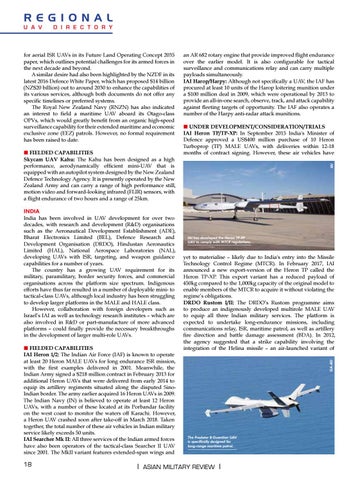
IAI has developed the Heron TP-XP UAV to comply with MTCR regulations.
yet to materialise – likely due to India's entry into the Missile Technology Control Regime (MTCR). In February 2017, IAI announced a new export-version of the Heron TP called the Heron TP-XP. This export variant has a reduced payload of 450kg compared to the 1,000kg capacity of the original model to enable members of the MTCR to acquire it without violating the regime’s obligations. DRDO Rustom I/II: The DRDO’s Rustom programme aims to produce an indigenously developed multirole MALE UAV to equip all three Indian military services. The platform is expected to undertake long-endurance missions, including communications relay, ISR, maritime patrol, as well as artillery fire direction and battle damage assessment (BDA). In 2012, the agency suggested that a strike capability involving the integration of the Helina missile – an air-launched variant of GA-ASI
U A V
The Predator B Guardian UAV is specifically designed for long-range maritime patrol.
| Asian Military Review |