Vinyl Tap Fall 2025

Page 1


APPALACHIA
JEFF

by Mia Ryan

cover photos by Thelma Kestner, Brooklyn Perkins
photos

Madeleine & Amelia

Album Reviews

Horror in the Ba llroom When He Sa ys, “ I’m Going To Do It ” 5 9 16 22 29 33

Appa la chia , the Nuanced South, and Colter Wa ll’s Perspective

The Music of Cha rles Manson

Highwa y to Hell: The Devil in Rock and Roll

photo by Mia Ryan, art
Tiba

Nourished by Time

The Passionate Ones

Before typing “Nourished by Time” into Google, be prepared to hear about the cultish “meditation group experiences” and Marxist ideologies of Marcus Brown, the identity behind the Guided by Voices-inspired moniker. With an online presence as eclectic, surprising, and often humorous as his, it is no surprise that his new record carries the same creative spirit. The Passionate Ones is laced with punchy vocals that soar from Brown’s throat over instrumentals of the avant-garde, reinventing artpop and post-punk with a leftist wit that bites through his lyricism. The feat shines most in the album’s highlight “BABY BABY,” in which Brown ruthlessly says that “If you can bomb Palestine, you can bomb Mondawmin,” with the latter being a neighborhood in his old stomping ground of Maryland. In The Passionate Ones, Nourished by Time cuts a berry with a chainsaw, as it is a manifesto for boldness in an era of conservatism.

- Sophia Carroll '27, 3.5/5

Addison

Addison Rae

In her debut album, Addison Rae invites us into her glitzy world of fun, fashion, and fame. This album is contagious–once you’ve heard it, it stays with you. It’s not about ignoring the hard times, but dancing through them and still enjoying your life, knowing there’s light at the end. This album soars sonically, especially on standout songs like “Aquamarine” and “Headphones On.” Although the lyrics are fun and upbeat, they do not lack depth, many songs are a reflection on how fame has changed her ( “Fame is a Gun” and “Money is Every thing”). Clearly inspired by other pop icons like Britney Spears, Addison has a clear idea of what her audience wants to hear. This album captures the fun and fear of being in your early 20s, and I can’t wait to see where she goes from here. Addison, I’ve got my headphones on.

- Ella Bender '26, 4.5/5

Bleeds

Wednesday

Wednesday’s sixth studio album is steeped in stories of heartbreak and vulnerability, taking a relationship that was once jammed between the public and the personal and letting it bleed out. Bleeds is a lyrical masterpiece, haunted by sounds of grungy riffs and dreamy slide guitars. Making sense of her breakup with bandmate MJ Lenderman, Karly Hartzman writes “feels like I’m almost good enough / to know you,” in a ballad of broken promises and disappointments. Bleeds feels the purest of Wednesday’s discography, building intricate sounds through an addicting collection of narrative-heavy indie-rock. Wednesday’s Bleeds tells a tale of love and heartbreak, both coexisting in the streets of Asheville, North Carolina and on the paths of Williamsburg, Virgin-

ia. Wednesday has found its way into my heart–I hope its found a way into your earbuds as well!

- Rose Field '26,

4.5/5

Bloodless Samia

On her third studio album, indie singer-songwriter Samia explores existentialism in a folk-pop setting. Samia departs from her usual electronic production and opts for a summery acoustic feel. She blends poetic lyricism with gut-punch bluntness; on her quiet reflection “Proof,” she notes that “to be loved like a child’s toy or cigarette / is to die a funny feeling in a chest.” Yet, her chorus repeats, “you don’t know me, bitch.” Samia trades in metaphors; she compares the mutilation of cows to self-discovery on her lead single “Bovine Excision,” depicts herself as a thirsty mosquito on the campfre song “Fair Game,” and documents the magnetic feeling of friendship on a propulsive rock track “North Poles.” Bloodless closes with the unconventional, beat-switching “Pants,” where Samia asks, “Who was I when I bought these pants? / They’re non-refundable / Now I’m questioning everything I am.” Bloodless is more experimental, introspective, and candid than its predecessors and shines with self-certainty.

- Amelia Johnson '26, 4.5/5

Willoughby Tucker, I'll

Always Love You

As winter’s cold decay seeps into our hearts and homes, you’ll need a soundtrack to warm the soul. Ambience, shoegaze, dreampop, indie twang, slowcore: no matter what rich melody you crave, you’ll fnd it on this much-celebrated prelude to Preacher’s Daughter. Hayden Silas Anhedönia builds a reflective, heartbreaking narrative as she follows her protagonist, Ethel Cain, through her frst love and loss after an abusive childhood. If you’re curious about dipping your toes in the Ethel Cain cistern, begin with the frst four tracks on this album. “Janie” opens the project much like the gentle hum of tv static.

“Nettles” captures

questionable choice. The visuals of The Cosmic Selector are what bind the album to Lord Huron’s brand, bringing the retro energy to the constant theme of solitude. For some albums, the lyrics draw you in. For others, it’s the production and melody. The Cosmic Selector Vol. 1 has both, and is all the more fascinating for it.

- Caroline Pirsch '28, 4/5

Malcolm Todd (still) Malcom Todd

Lana Del Rey’s melancholia with Waxahatchee’s twang and grit. For lovers of layered instrumentals, “Willoughby’s Theme” feels like surrendering to the vulnerability of love itself.

- Amelia Goetz '26, 5/5

The Cosmic Selector Vol. 1

Lord Huron

It’s been over three years since Steve Lacy released his record-breaking, major-label debut Gemini Rights and set new precedents for the R&B genre. Listeners in search of the next great alternative R&B artist had to look no further than emerging artist Malcolm Todd, humorously assigned the nickname “white Steve Lacy” across the internet. The 22 year old breakout star released his self-titled studio album on April 4th of this year, with the deluxe, Malcolm Todd (still), and four additional bonus tracks releasing on August 8th. Standout single “Chest Pain (I Love)” climbed the charts thanks to its virality on TikTok, but give the album one listen through and it becomes undeniable that every track, notably “Florence” and “Attention”, are worth adding to your library.

If you’re searching for new chill study tracks or a groovy new fall album, Malcolm Todd has (still) got what you need.

- Robin Perdue '28, 4/5

Tsunami Sea Spiritbox Review

Where their previous albums such as Strange Trails had a cohesive sound, Lord Huron’s The Cosmic Selector sticks to a twangy sound and varies only when it hits the most effectively. “Is There Anybody Out There” is reminiscent of tracks off an earlier album. With a dreamier sound, it should feel out of place, but it somehow fts. Singles “Nothing I Need” and “Bag of Bones” are other standouts, featuring Western sounds and visuals that make the album remarkable. “Who Laughs Last” is the only song that feels nonsensical, a Kristen Stewart feature being a

Following the release of their acclaimed 2021 debut Eternal Blue, the Canadian metalcore quartet Spiritbox returns with Tsunami Sea, a sophomore album that lives up to expectations. Sonically, it’s marked by sweeping contrast which demonstrates the band’s impressive range, including frontwoman Courtney LaPlante’s transition from harsh vocals to a dreamy, shoegaze-inspired chorus on opener “Fata Morgana.” The juxtaposition of the crushing force of “No Loss, No Love” with the synths of “Crystal Roses”—along with oceanic textures throughout—enhance the album’s emotional turbulence. Spiritbox further illustrates this in a lyrical sense, highlighting the combination of both beauty and isolation found in their home of Vancouver Island, through the metaphor of “A Haven With Two Faces.” Tsunami Sea appeals to fans of both heavy and melodic elements, tying together a variety of influences without sacrifcing its cohesion, and solidifying Spiritbox as one of the most compelling bands in modern heavy music.

- Elizabeth Thompson '29, 4.5/5

Fancy That

Short-form content is taking over, something that PinkPantheress capitalizes on. While often criticized for having songs that are too short, the length of each song lends itself to her style of quick and punchy music, a quality that becomes very clear on this mixtape. And what she lacks in duration, she makes up for in depth. On this 20-minute mixtape, PinkPantheress showcases her aptitude for production as she solidifes a truly unique sound through her audio and effects alone. On one of the mixtape’s more popular songs, “Tonight,” she effortlessly blends samples from Panic! at the Disco with the revving of an engine and camera flashes, transporting listeners to a flirty world of infatuation with an undertone of longing. While some songs may feel a bit repetitive, Fancy That still retains freshness, with unique production that supports and builds with her voice instead of hiding it; PinkPantheress has truly solidifed and clarifed her niche in the music world.

- Ben Giles '28, 4.5/5

Get Serene Lampland

Get Serene is the latest album by the indie New-York based band Lampland. Channeling Elliott Smith and the 90s indie scene, Get Serene is like a warm hug at the end of a long day or the candle you light in your room on a fall afternoon. Unlike most of the indie music I’ve been trying to get into, Get Serene’s lyrics remain strong throughout, and ultimately, the song-writing is the compelling aspect of the album. My favorite song off the album is “Cold Comfort”, with “Miracles on Ice” and “My Mystique” also being standout tracks. If you are looking for your next indie-folk-ish comfort band, consider checking out Lampland. Personally, I can’t wait to see what they release next.

- Ilias Papageorgiou '27, 4/5

Getting Killed Geese

“There’s a bomb in my car!” With the album Getting Killed, the upcoming indie rock band Geese releases another phenomenal album in their series of breakout hits. This album tones down the depressing themes of Cameron Winter’s solo album Heavy Metal, but retains equal lyrical prowess while forming intricate masterpieces of indie rock. The album is more experimental sounding than their previous works, so this might throw off new listeners. But in my opinion, this experimentation allows for musical complexity that slowly reveals itself as you continue to relisten to the album. Personally, this caused me to adore the rich production and deeply personal lyricism of the tracks “Islands of Men,” “Au Pays Du

Cocaine,” and “Long Island City Here I Come.” However, there are so many more parts of the album to fall in love with, and Getting Killed is a masterpiece that everybody should hear!

- Andrew Timberlake '29, 5/5

hickey

hickey, Royel Otis’ sophomore album, brings a fun and spunky addition to their discography. The album conveys a wide range of emotions through a hazy and synthflled soundtrack. Their strong guitar riffs and dissonant vocals power the sweet-sounding album. hickey has received a lot of mixed reviews, some arguing it was too similar to their previous releases, while others say it was a strong addition to the indie-pop canon with many standout songs. Some songs that I’ve kept returning to were “moody,” “who’s your boyfriend,” “car,” and “say something.” Most songs deal with themes of missing people, insecurities, toxic relationships, and endings, but the upbeat drums and danceable beats mask their grief. The juxtaposition between the upbeat melodies and the self-doubting lyrics make this album really interesting. With each listen I’ve picked out a new meaning or lyric that hits harder, growing my love for this album.

- Juliana Nelson '28, 4.5/5

Man's Best Friend

Sabrina Carpenter

Where does one begin with Man’s Best Friend? This writer was ecstatic when the album announcement was released on June 11th, 2025. This writer even fercely maintained that the controversial album cover did not, in fact, set back feminism by ffty years. However, when this writer rose the morning of August 29th and excitedly began to stream the twelve glittering new songs, she was quite disappointed. While Man’s Best Friend is assuredly infused with a sugary “pop sauce,” that may be its only redeeming quality. Sabrina continued her trademark innuendos from Short n’ Sweet in “House Tour” and “When Did You Get Hot?,” and I can admit they had me giggling ever so slightly. But I was expecting more than just clever insinuations and a catchy beat. We know Sabrina can go deeper, as evidenced by “Lie to Girls” and “decode,” so where was that intimacy on this record?

- Laya Garza '28, 3/5

Pain to Power

Maruja’s long-awaited frst full-length album lives up to everything their fans have hoped for as Pain to Power utilizes their chaotic post-punk sound to its fullest. Maruja stands out as one of the most interesting modern rock bands. Their saxophonist, Joe Caroll, leads the group in tandem with Harry Wilkinson’s bellowing raw vocals.

Though, even as Maruja demonstrates their musical mastery over tension and release, the group defnes themselves best by their lyrics. Contrasting their tumultuous sound, this record emphasizes the importance of love. While Harry expresses his anger with corrupt politicians and the greedy rich, his greatest frustration truly lies in the world’s lack of compassion. He begs the audience to embody love, and he attempts to inspire us by igniting a fre of compassion and empathy. To do this, Maruja leads by example, singing songs rejecting fear and hate, proving that pain can lead to strength – to power.

- Ethan MacLaren '29, 4/5

Private Music Deftones

It is safe to say the August 2025 release of Deftones’ Private Music lives up to expectations. Opening with “My Mind Is a Mountain,” listeners are surrounded by a wall of heavy drums and impassioned guitar, complemented by distorted, haunting vocals. Songs like “Infnite Source” and “Souvenir” remodel repetition as desirable rather than dull, highlighting the beauty of addictive guitar riffs. The stand-out song is undoubtedly “I Think About You All the Time,” a mellow arrangement of hushed vocals and soothing instrumentals. Closing out the album with waves of ethereal echoes, “Departing the Body” is a melody that lives up to its otherworldly title. The band manages to continue to unearth concoctions of commotion and melancholy, experimenting with electronic noise and expansive lyricism. While it may lack some of the powerful energy that former albums achieved, this album redeems itself with an expertly crafted production that situates sorrow and turmoil within a sea of atmospheric sound.

- Amalia Lewis '28, 4/5 Labyrinthine

Faetooth

Magic is in the air as Faetooth makes their return to the doom metal scene with their sophomore album, Labyrinthine. This haunting collection opens with “Iron Gate,” a track that makes you feel as if you have wandered into the belly of a beast with no way out. You can’t help but be mesmerized by the vocals of both Ari May and Jenna Garcia as they lure you into the fog of Faetooth’s ethereal and gutwrenching sound. “It Washes Over” and “White Noise” are my personal favorites from this LP. These songs encapsulate exactly what Faetooth is: a trio of faeries who curse those who desecrate their sacred terrain. Drummer Rah Kanan is a powerhouse on every ballad, terrifying the listener with every rhythmic beat. As a project, Labyrinthine is a surrealistic masterpiece that will leave you feeling spellbound and anxious for more.

- Isa McMillan '28, 4.5/5

Snipe Hunter

Tyler Childers

Tyler Childers has signifcantly changed his sound with Snipe Hunter. It’s much more experimental; it has the foundations of country, but it has different genre elements. It’s a mixture of pop, indie, and maybe even a splash of funk? If you’ve listened to any of his other albums, the listening experience is shocking–maybe even a little jarring. Although with this different sound comes very energetic songs, there are only a couple that I’d willingly search out: “Oneida” and “Bitin’ List.” Very few songs are memorable, and they all sound very similar, making it hard to differentiate between them. He did rerecord “Nose to the Grindstone,” which was a nice revisit, but OurVinyl sessions sounds more raw and genuine, which I fnd myself more drawn towards. Overall, while Tyler Childers has shifted to a more experimental sound, it seems a bit disconnected from his previous albums, or even what the country genre should sound like.

- Thelma Kestner '29, 3/5

Ego Death At A Bachelorette

Party

Hayley Williams

In the wake of a series of nontraditional rollout techniques and asking her Instagram followers to create an order for her 17 new singles, Ego Death At A Bachelorette Party became Hayley Williams’ frst independently-released album. Blending pop-punk sounds, more subdued synths, and an exceptional voice, Williams is absolutely shining. “Ice In My OJ” opens the record with the proclamation, “I’m in a band!” expressing frustrations with both her former 10-album Atlantic agreement and the scrutiny dealt with as the face of Paramore. The content also focuses on shifting band dynamics and mental health struggles. She beautifully reflects on her relationship with Paramore bandmate Taylor York in songs like “Love Me Different,” while the title track and “True Believer” point to the hypocrisy, racism, and religious culture of Nashville (where she has been based for much of her life). “Parachute” sees Williams at her angriest–pleading for love, she heartily closes out this honest and raw pinnacle of her work.

- Mimi Chapman '28, 5/5

Colter Wall’s debut album, Imaginary Appalachia, released on June 2nd, 2015, introduces a distinctive sound in the Southern Gothic genre, specifcally in the way it derives infuence from the hollers of Appalachia. In the beginning of 2025, my frst listen to this album matched the grey trees on the mountains outside my library’s window and my general lookout on life during that time: moody, mysterious, and haunted by the past Appalachian sound. This is the exact feeling this album transmits among all seven songs. With every song he sings, his voice sends chills down your spine. Then, hypnotized by the instrumentals and his rustic voice, you’re left haunted by the aftermath of each track.

Although only 22 minutes long, each song has its own unique sound, incorporating a beautiful mixture of Southern Gothic and elements of Appalachia. “Sleeping on the Blacktop,” the opening track, immerses the listener into an ominous, typical small town hiding a sinister secret within its roots. When I listened to it for the frst time, I thought of my own miniscule, sinister town. It sets the tone for the album; you expect more mystery, and you want to listen to more. It’s like fnding abandoned property, its mystique and ambiguity luring you in to explore the land.

“Sleeping on the Blacktop” perfectly transitions to “Johnny Boy’s Bones” featuring The Dead South, an upbeat ballad about a con-

federate soldier’s family wanting his body back in Tennessee after being killed in the civil war. This song in particular dips into Southern culture, specifcally depicting the death of a soldier in gray, and the despair that’s come with this tragedy. This is one of the defning songs which categorizes this album as Southern Gothic. Even though the instrumental makes it seem like an energetic track inspired by folk ballads, it explores a “darker” element of the life cycle.

“Caroline,” featuring Belle Plaine, transitions from upbeat balladry to a melancholic sweep. It is very comforting, yet unsettling. “The grave and the garden won’t be satisfed / Until your name’s next to mine:” they each reassure one another they won’t be complete until their lover joins them down below. In my numerous listens of this album over the winter, this song always redirected my attention to the album, beckoning me to slow down and truly listen.

“Living on the Sand” is probably my favorite song of of this album, as Wall interchanges from directing the lyrics to himself to the listener. Both perspectives are very raw, one of the various aspects that makes this song my favorite. It pulls at something inside of you, almost as if Colter Wall gives advice you know you should take. He also expresses vulnerability: “I’ve been living on the sand / Don’t take much to guide my hand.” He acknowledges he can be easily guided to make regrettable decisions.

Following that is a slightly more upbeat yet just as woeful track: “Ballad of a Law Abiding So -

phisticate.” After a town fnds out that the narrator has killed a boy, they want him dead. However, the narrator doesn’t regret his decision of committing this act of murder: “It was worth it / To see that boy / Cut from the knees.” Wall takes a situation that has happened numerous times and fabricates an Appalachian style ballad, allowing him to retell this story through an individualistic mechanism. The sound strikes me as the most ballad-inspired, and is by far the most Appalachian inspired song on this album. Whether it’s my frst or most recent listen, I instantly feel connected to the sound and lyrics, in which I fnd a deep sense of comfort.

“Nothin’” is haunting in its instrumentation and its lyrics. Wall focuses on how he wants nothing materialistic, but instead, seeks traces of solitude, sor row, and death. This song is a ghost that follows you around everywhere you go, hiding in the corners of every room, only appearing in the most vulnerable of times. Refecting on the cycle of life and telling his mother he doesn’t want anything when she passes, he sings: “And if you see my friends / Tell ‘em I’m fne / Not using nothin,’ implying that he isn’t on drugs. A criminally underrated Colter Wall song, it adds a certain mystique to the complexity of this album.

The last, and possibly the most classically “Southern Gothic” (lyrically speaking) song of the album, is “The Devil Wears a Suit and Tie.” The narrator recalls his past interactions with the Devil, how he’s taught him a “few turns to make all the girls dance.” However, he admits to the Reverend his foolishness in order to cleanse himself from this substantial sin. This follows a very typical pattern of the Southern Gothic genre of fnding shame in a ‘sin,’ and then attempting to fnd redemption, usually through a priest or reverend. This is also his most distinctive song; it’s been used in numerous movies. Hell, I discovered it through one of my friends. Although Colter Wall has switched his genre to mostly a Western style of music, his Southern Gothic past does ultimately defne his music and how he’s recognized.

What is considered Southern Gothic? Usually when defning this term, it’s in relation to anything that discusses the American South and its ominous shadows—racism, poverty, violence, grotesque themes, and a blend of realistic and supernatural phenomenons. Works of literature, flm, and music have been given this label. Literature such as The Life You Save Might Be Your Own by Flannery O’Connor, The Sound and the Fury by William Faulkner, and To Kill a Mockingbird by Harper Lee are some examples. In the music industry, numerous artists have either found infuence in the Southern Gothic scene, or their whole discography is steeped in the genre itself.

Early Colter Wall has another album similar to his debut, his sophomore self-titled album. However, this album is more straightforward in its explicit dark and violent lyrical themes as compared to his debut. Whether he’s

against himself in “Motorcycle,” or against his lover in “Kate Mccannon,” the writing style of a majority of these songs have Southern Gothic leanings. Another artist that creates a combination of Southern Gothic and Country is none other than the Man in Black himself: Johnny Cash. I would even argue he’s a foundational artist of this particular genre. His songs that explore themes of redemption and sorrow inspire how Southern Gothic music is presented today.

A more modern and recognizable artist is Ethel Cain. She explores her own experience with her life in the South, such as her album Preacher’s Daughter, where she refects on her trauma with the Southern Baptist church. You see her everywhere: plastered on old photographs of abandoned churches, ghastly white fgures in dark woods, or eerie Appalachian or rural towns, often labeled as “omg Ethel Cain core!!!!!” Social media has treated like she is the genesis of this when in reality, it’s been many folks’ experiences for decades, including myself.

Where I come from is in the heart of Appalachia. It’s also very southern (hence, Southwest Virginia) which comes with a myriad of themes that the genre refects, but also boasts its own unique Appalachian traditions. Music is highly sacred and individualistic in this area, including mixtures of folk ballad-like lyrics, indigenous sound, plus mixtures of Scottish (highly infuential), Irish, and German tradition. This genre of music may also be known as bluegrass rather than the unanimous “country” genre. Well-known artists, such as the Carter Family or Hobart Smith, have defned the Appalachian style of music over the past century.

The style of this music is everchanging; some stick to their roots, while others branch out into unique sounds of this genre. I personally know many folks of varying age groups (though most are around my age) who perform a combination of the traditional Appalachia sound and experimentation with diferent, varied sounds. I think with the internet, the Appalachian sound is slowly but surely becoming more experimental, which will create even more traditions in the coming years.

For example, Clover-Lynn, an artist from Franklin County, Virginia, is an artist who combines the traditional sound of Appalachia with a banjo, using ballad-inspired lyrics to connect with the Southern Gothic themes that lay in the mountains themselves. She also performs with her band, the Laurel Hell Ramblers. Clover-Lynn also represents the Appalachian transgender community. Through her music, people can fnd someone who’s proud to be themselves in a conservative area, along with someone who’s embraced being Appalachian. The sound she produces is diferent from the tradition

as it has familiarity, but it’s still unsettling. The music itself projects the hidden truths of what lies in the dark corners of these neverending forests. It reminds me of driving through upper Southwest Virginia where ruins of former schools stand rotting—formerly full of students, small “mom and pop” businesses that once thrived, and trailers which are almost unlivable, the people who reside in them don’t know anywhere else to live. Overall, Clover-Lynn’s music is a fabulous mixture of both genres of Southern Gothic and Appalachian—not only in sound, but in lyrical content, too. With her burgeoning talent and Wall’s undeniable infuence on Southern Gothic, both artists illustrate their individual perspectives, and build onto this everchanging genre of music.

art by Sophie Grard

The Music of

Cult-created media has always fascinated me—from eerie recruitment videos to surreal websites, I’ve always taken a morbid interest in macabre pieces of art. Because of this curiosity, I’ve recently developed an interest in the musical career of the infamous Charles Manson. For those unaware of him, Manson led the Manson Family Cult from 1967 until his imprisonment in 1970, and forced an extremist sect of contemporaneous hippie values upon his followers. Manson’s cult was thoroughly entangled with immense psychedelic drug usage, and he orchestrated his cult to tragically murder at least nine victims for miscellaneous reasons. owever, anson’s horrifc actions were also accompanied by a strange and tragic career in the music industry, which poses the question: “Was Charles Manson a good musician?”

Manson’s musical journey started on his childhood home’s piano when he was incredibly young. He learned to play country and church songs by ear and was considered a prodigy for his talents. However, his tumultuous childhood led him to get arrested and sent to juvenile prison as a late teenager, halting his musical development. At 24, Manson was granted fve years’ parole, but was resentenced for another ten years at the age of for charges related to involvement in prostitution of minors and check forgery. However, this second imprisonment at McNeil Island Prison revitalized Manson’s musical passion. There, Manson learned guitar from his fellow inmates and received the contact of producer ary tromberg, which would be anson’s frst potential opportunity to break into the music world.

Once he was released early from prison in 1967, the then 33-year-old Manson cultivated a following within the hippie scene of San Francisco before heading south to Los Angeles to promote his music. There, Manson contacted Stromberg to book a recording session at Gold Star Studio in hopes of getting signed. While these recordings failed to land Manson a record label, they eventually played a signifcant role in anson’s life. fter this, the anson Family ult migrated east of Los Angeles to live in Topanga Canyon, California, where Manson met with local musicians to form the band The Solar System. However, the band quickly disbanded after a particularly unpopular local performance with a setlist that featured mostly Manson songs. As a result, he continued as a solo artist for the rest of his musical career, though often including ensemble elements from members of the Manson Family.

After failing to achieve rock-and-roll stardom, Charles Manson continued to write songs and expand his cult until his next musical opportunity in 1968. As two

upcoming label, Brother Records. Therefore, Dennis o ered anson a recording session in rain ilson’s home studio, and promised to show the demos to

spell “Lie” (because the charges were a “lie”). Obviously, the album was a commercial op, and the court sentenced Manson to death–a sentence later turned into life in prison on legal technicalities.

Undoubtedly, Manson’s occult atrocities heavily interfered and prevented his music career from taking o . owever, we now return to the uestion posed at the beginning of this article. If it weren’t for his corrupt lifestyle, was Charles Manson a good enough musician to deserve a record deal? I fear the proof is in the pudding – that is, his only album, Lie.

Lie primarily follows a singer/songwriter structure, as all tracks focus on Charles Manson’s vocals and his acoustic guitar with few percussive elements and/or background vocals. While the album generally follows traditional ‘60s folk stylization, it contains strange

stylings is in its absurdist and experimental instrumentation. This is the frst track on the album to contain more than Manson himself, as a cacophony of percussive instruments and voices boldly outlines anson and his guitar. hile it is di cult to distinguish the origin of these extraneous noises, you can clearly hear percussive instruments and stomping, roughly in time with Manson. Additionally, some members of The Family sing background vocals alongside him, while others chatter throughout the track. Sometimes the background noise is so loud that you can barely hear him, yet everything feels intentional. Though it may hurt your head to listen to, this is defnitely the most sonically distinct and interesting track on the album.

A few tracks later, we venture from Manson’s most instrumentally eerie track to his most lyrically

“Now they’ show you their castles / and diamonds for all to see / But they’ll never show you that peace of mind / ‘Cause they don’t know how to be free.” However, the subsequent bridge is the creepiest part of the album, because it connects normal hippie ideology to Manson’s perverted and extreme version of the ideology: “Now burn all your bridges / leave your old life behind / you can do what you want to do / because you’re strong in the mind.” This verse in the song is Manson explicitly telling people to cut ties with their past in order to join his cult, and it is nauseatingly terrifying. n the tracklist, this is defnitely the song I least enjoyed listening to, purely because of its unsettling nature. I do not recommend this song to curious readers!

However, despite the complexity of these previous songs, most tracks on the album don’t contain as much explicit depth. Many songs on this album are only quick snapshots into Manson’s life, so here are some brief notes on the remaining tracks. “Garbage Dump” is essentially about The Manson Family eating tons of food out of the trash, which fnd hilarious to imagine. “Don’t Do Anything Illegal” is an interesting libertarian anti-authority track, but it’s also incredibly comedic in retrospect because Manson is almost solely known for doing illegal things. The un- each- oys-ifed version of “Cease to Exist” is quite interesting; it vaguely overlaps with “Never Learn Not to Love” while somehow remaining completely distinct. However, this song also struggles with bland lyricism and instrumentation similar to “ ook at our ame irl.” nd fnally, “ ig Iron Door” is an interesting view into Manson’s prison experience. But honestly, I enjoy this song because Manson threateningly exclaiming “CLANG BANG CLANG!” over and over is almost ludicrous in its absurdity.

So, as much as I love weird and surrealist art, my answer to the question “Was Charles Manson a good musician?” would probably have to be no. Aside from the creepy, occult messaging scattered throughout the album, Manson’s music feels extremely generic in context of his folk musician contemporaries. Lie feels blatantly rushed to completion, and Manson being in prison while it was fnali ed clearly restricted his creative freedom. The mixing on this album is so muddy that it is headache-inducing at times, and most tracks feel at least somewhat unfnished. For e ample, the song “Slick City” doesn’t really have a resolution: it simply cuts out for an ending. ince this album was fnished without Manson really being part of the process, it feels closer to a posthumous release than a ready-to-go album. It’s arguable that the album would be better if Manson were free to work without restrictions, but I honestly think that a “more fnished” version of this album would likely be worse. The most complete songs on this album are “Cease to Exist” and “Look at Your Game Girl,” and those songs struggle to overcome the pitfalls of the folk genre. Most of the enjoyment I got from this album came from its chaotic and unfnished nature, so I think a completed version of Lie would certainly not be good enough to make Manson famous for his music. However, there are people that truly enjoy Manson’s musical talents. Manson’s music clearly won over a Beach Boy, and I don’t think I could ever do that. However, Dennis Wilson did end up dying due to a depression caused by Manson Murders, so technically, I’ve never killed a Beach Boy either! In the end, I suggest that you listen to this album with your newfound knowledge of Charles Manson’s life. It could be a strange creepy experience with friends, or an enlightening experience on the dangers of cult living. owever this album a ects you, know that my fve listening experiences are plenty for a single lifetime.

art by Tiba Alnaqshabandi
photo by Illias Papageorgiou, Candence Candelaria
by Emily Garloff, Catie Swansiger

Highway to Hell: the devil in rock and roll

Sinister Beginnings:

As the story goes, there was once an aspiring musician traveling along the Mississippi Delta. A notorious womanizer and a lazy, abysmal guitar player, the man longed for musical talent. Late one night, he met the Devil at the crossroads of Route 49 and 61 and sold his soul for the ability to play extraordinary music.

That man was a brilliant blues musician by the name of Robert Johnson, who, as far as we know, did not sell his soul to the Devil. What he did do was forever change the Blues and eventually rock ‘n’ roll.

It’s not hard to see where the rumors came from. Johnson was a mediocre guitarist (though not as bad as many stories suggest) before a year of traveling and musical training transformed him into a wonder of musical talent. Some of his most iconic songs include “Crossroads Blues,” “Hellhound on my Trail,” and “Me and the Devil Blues.”

Robert Johnson’s death only solidified the rumors. At just 27, he died young under mysterious circumstances, leading some to believe he was poisoned by the husband of one of his mistresses. Johnson is also often cited as the first member of the “27 Club,” a list of famous musicians who all coincidentally died at 27 years old, including Jim Morrison, Janis Joplin, Jimi Hendrix, Kurt Cobain, and Amy Winehouse.

Listening to Johnson’s work is a wild experience. Underneath the eerie crackle of the early 20th-century recording is the birth of a distinctive sound: one that would later blossom into modern rock ‘n’ roll. Before rock itself even formed from blues singers of Johnson’s time, early country, and gospel music onlookers would forever associate the genre with the Devil.

The 60s: Racism, Pseudoscience, And John Lennon:

In 1966, John Lennon made an ill-timed comment on Christianity. “Christianity will go,” he said, “It will vanish and shrink. I needn’t argue about that; I’m right and I will be proved right. We’re more popular than Jesus now; I don’t know which will go first — rock and roll or Christianity.” Lennon did not mean for this to be a slight on Christianity, only a comment on the changing times. This comment might have been clarified and forgotten, but this was the ‘60s, and, to put it mildly, a socially turbulent time. A drastically changing culture, rising progressive movements, and Cold War paranoia caused some church leaders to fear this new generation, and Rock music along with it. Progressives, atheists, and communists were often conflated in the eyes of the church. In this environment, a conceivably anti-Christian comment coming from a Rock icon did not go over smoothly.

While Lennon’s statement was brushed off in the UK, it sparked outrage in the American Bible belt. Southern radio stations banned the Beatles. Some DJs smashed Beatles records live on air. A station in Reno, evada, aired an anti-Beatles editorial every hour. In Birmingham, Alabama, DJ Tommy Charles led a “Ban the Beatles” campaign on WA (“Wacky Radio”), inviting listeners to send Beatles records and merchandise to be destroyed by an industrial tree shredder known as the “Beatle- rinder.”

In Texas, a public burning of Beatles records was organized by radio station KLU . Ironically, the following day, the station’s transmission tower was struck by lightning, destroying broadcasting e uipment and rendering the news director unconscious.

More disturbingly, South Carolina’s rand Dragon of the Ku Klux Klan nailed Beatles albums to a cross and set it aflame.

Rock’s deep roots in the African American community, coupled with widespread fear of the Civil Rights Movement, made it a convenient satanic scapegoat. Several books were published linking rock to the Devil. Chief among these authors was David oebel, a conservative churchman from klahoma who published both Communism, Hypnotism and the Beatles and Rhythm, Riots and Revolution: An Analysis of the Communist Use of Music.

oebel claimed Rock originated in “the heart of Africa,” where it was used in rituals meant to incite warriors to murderous frenzies. According his racist pseudoscience, Rock’s loud volume, rhythm, and “broken meter” could hypnotize American youth, encourage interracial marriage, and lead them to godless communism.

The 70’s: The Holy Redemption Of Rock:

In the late ‘60s and early ‘70s, psychedelic Rock once again reshaped youth culture. Drugs like LSD were now undeniably tied to the genre and the Hippie counterculture exploded in popularity. Between the publication of two of oebel’s anti-Rock books was the Monterey Pop festival in 1967, and the iconic Woodstock in 1969, complete with its trademark tie-dye,

drug use, and free love.

Also in ‘67 was the release of The Rolling Stones’ 6th album, ominously named “Their Satanic Majesties Re uest.”

Around this time came the emergence of a new group: the Jesus People, a counterculture movement that linked the youth to Christianity, especially through contemporary music. Rebranding Jesus as a long-haired, peace-loving hippy, the movement wasn’t fully embraced by the mainstream church. Despite their more modern sensibilities, the music of this group incorporated folk into rock ‘n’ roll, softening its trademark edges and making the sound less rhythmic and more melodic.

In the early ’70s, young Christians’ interest in Rock surged despite church resistance. Larry orman’s solo LP, Upon This Rock, blended contemporary rock with Christian themes and became wildly popular. In March 1970, one of the first Christian music festivals, billed as a “faith festival,” was held.

Christian spirituality eventually began to infiltrate mainstream Rock. The Beatles released “Within ou, Without ou.” Simon and arfunkel proclaimed that “Jesus loves you more than you will know” in “Ms. Robinson.” The Jesus people were infiltrating primarily secular bands.

As time went on, the church could no longer deny Rock’s staying power. This divide between older establishment Christians and the emerging Jesus people was bridged by an unlikely candidate: popular evangelist Billy raham. Although still critical of Jesus people, raham’s book The Jesus Generation, published in 1971, praised the new generation for their energy and spiritual vigor.

However, this new Christian Rock was only accepted if it was sanitized and whitewashed. In many cases, this meant the exclusion of the African Americans and the erasure of Rock’s black influences. ne of the few black Christian Rock artists in the early 1970s, Andra Crouch, was

often faced with discrimination, both in his performances and from radio stations who refused to play his songs.

Then came “Jesus Christ Superstar,” yet another controversial union between Christianity and Rock. The Rock opera is steeped in modern music and based on the life and death of Jesus Christ, depicting him as a moral and revolutionary thinker without granting him divine powers. While some saw the opera as a great way to bring young people to Jesus, others called it blasphemy.

Still at it, David oebel described the opera as “blasphemous, sacrilegious, irreverent, profane, desecrating, apostate, and anti-Christian.”

The 80s: The Satanic Panic

The satanic panic, immortalized in modern pop culture, was a widespread moral panic that peaked in the 19 0s. The era spawned outrage, paranoia, and conspiracy.

The ‘ 0s saw both the illumination of the horrific rates of child abuse and women joining the workforce in the greatest numbers since World War II; this combination created massive anxiety around the safety of children. A scapegoat came in the form of a largely fictionalised, child-abusing, goat sacrificing, baby-killing satanic cult.

“Six six six, the number of the beast Hell and fire was spawned to be released”

(Iron Maiden, 19 2)

“Be strong and laugh and shout, shout, shout Shout at the Devil ” (M tley Cr e, 19 )

With lyrics like these, metal bands did little to soothe the worries of parents and churchgoers who were already on high alert.

ne avid critic of heavy metal was American radio and television evangelist Bob Larson. In the ‘ 0s and ‘90s, Larson claimed the dangerous beat of rock ‘n’ roll came directly from “heathen tribal and voodoo rites,” which would (you guessed it ) corrupt the souls and hearts of America’s youth. Dr. James Dobson, called “the nation’s most influential

leader” by The ew ork Times in 200 , lumped heavy metal in with perceived evils such as AIDS, pornography, premarital sex, evolution, and the “objectives of the gay rights movement.”

ne of the biggest conspiracies of this era was backmasking: the belief that subliminal satanic messages were hidden in records played backward. According to this theory, Led eppelin’s “Stairway to Heaven” had hidden within it the words “ h, Satan, move in our voices,” which could only be heard when the record was played backwards. The theory gained large media attention, leading many to destroy their records in fear of subliminal messages. In California, a law was even proposed to label records with subliminal messages.

The outrage came to a head in 19 , with the formation of the Parents Music Resource Council (PMRC).

Co-founded by Tipper ore, the second lady of then ice President Al ore, the PMRC targeted heavy metal as a corrupting force.

They compiled the “ ilthy 1 ” a list of what they thought of as the worst songs the ‘ 0s had to offer, featuring tracks from Judas Priest, AC DC, Def Leppard, Twisted Sister, and Black Sabbath. The group proposed a labeling system: “ ” for occult, “ ” for violence, and so forth.

n September 19th, 19 , the Senate’s Committee on Commerce held a hearing. Artists like rank appa, John Denver, and Dee Snider testified.

Snider, lead singer of Twisted Sister, was eager to put on a show. Arriving in cut-off denim, snakeskin boots, and a gigantic hairdo, he defied expectations with an articulate defense. He professed his Christian faith, his drug alcohol free lifestyle, and laid out his objections to the labeling system.

The way Snider saw it, the interpretation of lyrics by the PMRC was unfair and amounted to “little more than character assassination,” pointing out that “Under the Blade,” a song Tipper ore claimed was about sadomasochism and bondage, was actually about a bandmate’s throat surgery. “The only sadomasochism, bondage, and rape in this song is in the mind of Ms. ore,” he said. While the PMRC did not get their preferred warning system, they succeeded in introducing the now iconic Parental Advisory: xplicit Content sticker. If anything, the crusade against heavy metal increased its appeal, uniting a rebellious youth and elevating the fame and mysti ue of the genre. The satanic panic is now seen as an absurd overreaction, and the generation that once smuggled Metallica albums into their home now play them behind white picket fences of their own. Today, rock ‘n’ roll, punk, and metal are considered staples of American culture. To varying degrees of outrage, the Devil continues to be depicted in modern music. However, as time goes on, the figure himself is taken less and less seriously by mainstream society. It’s easy to poke fun at witch hunts of the past, but culture wars are alive and well. We have new figures cloaked in black, new hidden dangers around every corner, and new scapegoats on the chopping block. Social movements come and go, and art along with them. Something will always be shaking the foundations of American life, whether it be the Civil Rights Movement or a heavy baseline. But one day, the anti-American work of Satan could be playing in your dad’s garage.

Horror in Ballroomthe

Why do the most beautiful songs sound the scariest when nobody’s left to dance to them?

During the early part of the twentieth century, dance bands and singers signifed a kind of sophistication that now carries a look of uneasiness. Even songs that were flled with romance, refnement, and social immediacy now feel ghostly: familiar for the moment yet remote, inviting yet unnerving. Stanley Kubrick and David Lynch are some of the flmmakers who do an excellent job at this without ruining the art they tried to create by making it corny. Some of my favorite musicians: The Caretaker, Burial, and Boards of Canada, recognize this shift—beauty and joy cycle toward a haunted quality when repetition, preser vation, or remembrance are long. The past, once vivid and present, collapses into an echo that

art by Erin Shannon

lingers, simultaneously intimate and elusive.

The intent of ballroom music composed with strings, subdued brass, and smooth vocals was to fll large rooms with laughter, dancing, and shared joy. Ballroom music began in the salons of Europe and dance halls in America during the 1910s and 1920s. Elegantly dressed dancers in those spaces dominated in waltzes, foxtrots, and tangos. While they provided great entertainment, these spaces served an additional purpose as social spaces, in which displays of manners, class, and gender were played out. Dance was the evidence of coordinated, sequential social communication: gestures of partners were echoed, steps were synchronized, and physical arrangements emphasized social order. Women in beautifully designed gowns and men outftted in formal clothing moved together in unison, sharing a rhythm both physically and emotionally. This clarity of music, orchestrations, and swing rhythms encouraged dance participation while also contributing to that social vitality bubbling to the surface during the time observed.

Some notable examples of early ballroom music are Paul Whiteman’s orchestral arrangements, which delivered jazz-inspired sophistication to the ballroom, and RCA Victor’s recordings of Art Hickman, whose foxtrot-oriented rhythms were developed through the American foxtrot craze. Songs such as “Whispering” (1920) and “Fascinating Rhythm” (1924) were not just musical expressions, but also expressions of social currency, performing cultural ideals of grace, refnement, and modernity. They were composed with melodies to blend the freedom of swing music, with restraint ofered by polite society music: a soundscape that was equally participatory and aspirational. Furthermore, the state of recording technology then, with 78 rpm, early microphones, and acoustic amplifcations, all contributed to a distinctive sound character. The midrange frequencies were compressed, adding grainer textures, treble and bass defned notes, and some natural reverb, which made each note both intimate and distant at the same time.

Now, after decades, those same characteristics heighten discomfort. A ballroom song played today bears the ghost of missing-ness; an instrument still smiles, but no one is left with emotions to respond. Strangeness emerges from the disjunction between prior function and contemporary meaning. The harmonic ambiguity, the slight sway of rhythm, the soft timbres that once invited the body into motion now linger with an ache for wistful deepness. The foxtrot now swings stify, or– he waltz glides precisely, but, like a foxtrot, now seemingly occurs in memory rather than in motion. Meanwhile, the skipped mishaps that emerge in early recordings add to the

spectral aspect of music, whether that be a hiss of the needle, the pitch-perfectness of the sound, or the mechanical quality to reproduce sound create a frail yet open sound that is both close and distant.

David Lynch applies a related logic in Eraserhead, in which every aspect of the aural aspect of the movie is dominated by hums, drones, and mechanical sounds. However, organ music occasionally rises above the surface. The Lady in the Radiator is positioned among the scrambled images of the narrative, doing what she can to sing her loop of a lullaby: “In heaven, everything is fne,” over the industrial hum. Tenderness becomes frightening; a simple melody, isolated and out of place, creates discomfort. This is something that contemporary electronic artists went on to expand upon; that is, the manipulation of decay, repetition, and texture to make music that unearths memory and loss. Burial, the London producer who emerged with his 2007 album Untrue, defnes this, building his compositions through fragments: chopped R&B vocals, the pops of a vinyl record, and even distant buzz from city streets. His music does not reference ballroom music, but it conjures a voice or two distinct warm human actions that linger when there is nothing left in the cold underground of urban nights. Voices echo nearby, but are mufed or drifting out of focus; percussion fdgets around irregularly, trying to feel out rhythm, and moments mark rhythms through stuttering, suggesting repetition without complete re-assertion of the repeating phrasings. The music is nostalgia in motion: vague, blurry, movement, quick, and then erased, simultaneously claiming memory while pointing to its feetingness.

Country,” melodic joy is almost achieved, yet with a slight warble, memory is exposed as fragile and reconstructive.

The Caretaker engages, instead, in the act of re-visiting physical spaces from the past, generally through early recordings of ballrooms or dance halls. The Caretaker’s albums, like Everywhere at the End of Time, overlay an element of decay on old recordings, attempting to create a simultaneous experience of time turning and memory fading. Where Boards of Canada has digitally simulated decay, The Caretaker highlights physical rot and, with vinyl crackle, hiss, and dead space, suggests spaces that were once occupied, evoking specters of dance foors, laughter, and social energies. Burial’s urban hauntings capture a third space: contemporary cities that are now inhabited with traces of humanity, loneliness, and hints of conversations. Collectively, these artists investigate absence as it manifests in the blight of memory, modes of memory, and loneliness in the urban landscape.

Technical components in these recordings are essential. Early ballroom recordings often isolated the midrange, while the bass and treble were somewhat detached from it. The combination of compression and natural reverb of the hall shapes the sound—it feels limited but also expansive, very intimate with a hint of haunting. When The Caretaker adds layers of crackle and decomposition, or when Boards of Canada applies just a slight degree of detuning, their technical manipulation accentuates this feel of memory stretching and fading. Even with Burial’s chopping of urban sample, the feel of compression and distance still very much eludes to this hauntology.

Boards of Canada extends this idea to the haunting perception of the past indirectly, rather than the past itself. Their music replicates a memory of a memory; a washed-out, hazy echo. Music Has the Right to Children (1998) and Geogaddi (2002) create textures with a slow decay using digital simulations of tape hiss, warped pitch, and analog bleed. Nostalgia is deployed within anxiety, as the once-familiar becomes unfamiliar. Whereas The Caretaker and Burial haunt places or experiences, Boards of Canada haunt memory (and therefore time, as time does not erase the past but rather distorts it). In the songs “Roygbiv” or “In a Beautiful Place Out in the

This concern with sound as a medium for carrying memory links Kubrick, Lynch, The Caretaker, Burial, and Boards of Canada. Ballroom music easily registers within this continuum. Its formalities, optimism, and historical distance can become something of a haunting exercise when the audience’s aural backdrop is entirely removed, as it would be at a ballroom. Harmonies that once inspired movement now plead not to be forgotten, while rhythmic patterns, swing, and instrumental timbres generate longing. These pieces are as vulnerable as they are expansive, intimate, and removed. They signify an undeniably haunting presence, without digital ma-

nipulation, and that is their appeal.

For decades, artists have revisited these textures: warmth, crackle, decay. The Caretaker’s hauntings reside in the 1930s, Burial haunts mysterious London nights, and Boards of Canada exists in an aesthetic VHS timbre rooted far back in the 1980s. Nostalgia becomes discomfort, repetition becomes decay, and permanence becomes haunting. They still, in the case of vaporwave accoutrements, TikTok edits, and online “haunted” playlists, encounter the familiar and estranged through digital engagement, instilling the tension of immediacy. Loops, glitches, and fades echo the faw of memory—while the past can be repeated, it will never be fully recoverable.

The Shining concludes with Jack Torrance in a 1921 photo, trapped in the hotel’s unending past. The joyful, unending dance hall music completes the deception: the party never truly stopped; it simply remembered itself. In the same way, the albums featured in The Caretaker’s discography, of course, don’t end; they just stop. The dance continues, but it is not attended. What we sense in ballroom music, and in artists who embody that, is not death, but persistence. Sounds don’t die; they cycle, with a worn quality despite absolutely being unbroken in a sense. Each playback has a read-out, pale echo of what happened. The needle leaves the record, the hiss passes, the ghosts keep dancing. Even as people fade away, all of the echo and trace of their ex-

istence subtly follows their sounds away from themselves: persistent, ghostly, eternal.

In this sense, haunted music embodies both a memorial and a warning: while memory may not be fully recoverable, there is something uncanny about the past when it is attempted to be preserved. Early ballroom music, which is

precise, warm, and elegant, becomes the raw material that contemporary artists use to relate decay, nostalgia, and absence. The melodies that once beckoned people to the dance foor leave space for contemplation; the very recording and playback techniques that were once taken for granted as a limitation contributed to the aesthetics of haunting. We are drawn into these echoing spaces as listeners, performing and watching at the same time, conscious that the dance will continue forever but still means nothing, and that the music is preserved but contemporary.

In this way, we can see the inevitable interest in the “haunted” aspects of music. Whether it is in the decayed tapes of The Caretaker, the nocturnal urban scenes of Burial, or the hazy and fltered childhood memories of Boards of Canada, the past maintains its presence. Early ballroom music, for instance, existed not as a reverie of leisure, but as a deep and collective experience; it is the meditation on the persistence of sound, the impermanence of a memory, and the residual traces of past lives. The haunted did not disrupt life, but pointed to the same; the past is always there as it continues to dance quietly in the present, right there in the crackle, in the hiss, and the distorted echo of a melody that may have once been shared.

When a man decides his life is worthless, what does he do next? Does he seek professional help or support? No– he is too far gone for that. Instead, he might indulge in alcohol, swallow handfuls of pills, and simply wait to die. Dan Barrett, half of the Have a Nice Life rock duo, found himself lost on this path after being trapped in the dark hell of depression; he washed down gel-cap painkillers with bottles of beer and waited by a secluded river for the toxic effects to fnish him of. Though he hoped for a quiet and seamless death, his body thrashed in agony, resisting the poisons corroding his systems. Luckily, Barrett survived the attempt, but the hopelessness that pushed him to suicide in the frst place continued to ache. To process these emotions, Barrett channeled his depression into the only way that makes sense for a revered musician as himself: writing an album–Giles Corey.

Dan Barrett is best known for his work in Have a Nice Life, particularly with Deathconsciousness, which often gets cited as the magnum opus of his career. This record captured somber misery through sounds ranging from hypnotic droning to noisy guitars so bent and distorted that they pry open the caverns of our souls we usually keep locked up. While Giles Corey retains the darkness found in Barrett’s previous work, he also explores a new, stripped-back musical direction throughout the record, birthing a folk-infuenced and deeply personal sister to Deathconsciousness. He did not just write general lyrics of sadness, but rather he transcribed the inner voices

that urged him to end his own life. Because of these lyrics, Giles Corey can feel too personal at times. His frightening vulnerability makes the album incredibly difcult to return to. Even as I write this article, listening to Giles Corey on repeat has started to weigh on my mental well-being, as Barrett’s own suicidal thoughts seep into the listener’s psyche. Nevertheless, Barrett showcases his mastery at producing unsettling soundscapes on this project, and with the mix of an eerily produced atmosphere and his uncomfortably intimate lyrics, Giles Corey amounts to nothing less than psychological horror.

The opening track of this record epitomizes fear: “The Haunting Presence.” It opens with an old, worn, and out of tune piano with Barrett’s layered vocals entering like a ghostly choir echoing through a dark chamber. The lead voice features Barrett crying out images of death and self-loathing, straying from the resonant nature of the backing choir but conveying desperation and sufering. Ambience flls the empty spaces as we hear wind drifting through trees (though, on a closer listen, we fnd it is not wind at all, but displaced whispers rustling through branches). The track’s two minute outro demonstrates how the album can feel personal as we hear Barrett smashing dissonant keys on his piano and yelling curses into an empty dark room. It is questionable if this even qualifes as music anymore; it could easily be the audio recordings of a distressed mental breakdown. If so, should we even be listening anymore? Do our moral compasses have a direction when it comes to the audio of a man on the edge of suicide?

Before we can resolve our moral dilemma, the album takes a sharp turn with the next two tracks, ofering much needed calmness after the opening be-

hemoth. These next songs stray from the horror element of the previous track, and instead give us delicate prettiness. “Blackest Bile” reveals the album’s folk infuences as an acoustic guitar with dead strings and Barrett’s choir accompany his earnest lead voice. This track also clarifes our setting, as we are no longer trapped in a dark chamber but now wandering in a dark forest. Though instead of worrying about the strange whispers hiding in the branches, we get to enjoy a breath of the night’s fresh air. “Grave Filled with Books” opens with a chord that almost fts a modern indie rock song, though the entrance of Barrett’s signature ghostly-choir quickly dispels any sense of modernity. Despite these two tracks ofering relief through their calming sounds, the lyrics read like depressive entries from Barrett’s personal journal. “Blackest Bile” features the line,

I open up my heart

And let it all in

And it kills as my love

And hope for everyone.

Clearly, this is a far cry from anything hopeful. “Grave Filled with Books” is similarly bleak as he speaks about a broken romance and says, “I’m not the only one / That you’ve never loved.”

Continuing with the darkness and returning to the unsettling sound of the album, “Empty Churches” samples an eerie spoken word recording from The Ghost Orchid: An Introduction to EVP, a 2008 British flm essay. The recording tells the story of unknown voices emerging from radio transmissions which many believe to be paranormal activity. Here, we notice Barrett starting to philosophize about the afterlife, and though it is impossible to know what happens after death, the track’s disturbing production and a jarring dissonant organ does not suggest a very bright outcome.

Halfway through our dark journey, we reach the excruciating climax of Barrett’s depression. He dispels all the fog that obscured our travels through cold chambers and dark forests, and he grabs our faces, reels our eyes towards a gaping hole in his skull, and forces us to witness his agonized thoughts. The track “I’m Going to Do It” petrifes the listener as Barrett removes all subtly– there is no question about what it is. Barrett makes this clear with the unmistakable opening line of the song: “I’m going to kill myself.” At this moment, we must refect on whether we even wish to continue listening. One may think Barrett is simply capturing a classic argument that “art should comfort the disturbed and disturb the comfortable,” but does anyone really beneft from such hopelessness? If we do choose to continue this track, we will fnd no redemption, no uplifting wing nor cheerful bridge. In fact, its production that mimics screams from hell only grow louder and louder until Barrett’s suicidal thoughts infltrate our own minds. So really, it is not too far-fetched

to ask: Why should we listen to this?

As we trudge into the second half of the record, drained from a tsunami of despair, we want to give up. But right as we’re about to abandon this musical journey, Barrett saves us by introducing grand, expansive sounds that incite new feelings of triumph and pride. On this B-Side, our previous question is answered: we should listen because, once we reach the very bottom of despair, we realize we are still alive and can suddenly fnd hope everywhere. “Spectral Bride” and “Buried Above Ground” use blaring brass horns that make us feel victorious— not because Barrett is fnally cured of depression, but because he has discovered that he still has fght left in him. If the majority of the album portrays him losing an intimate wrestling match with his suicidal thoughts, “Buried Above Ground” features Barrett prying free from a chokehold and squaring back up to fnish the match. “Spectral Bride,” though somber, feels delicate and joyous as a bright piano bounces throughout the track, inciting a slight grin in our mouths. For the frst time during the entire album, we feel true happiness. The philosophizing of the afterlife in “Empty Churches” is also resolved when Barrett says the line, “I’ll be your Spectral Bride.” This implies that even in death, his love will persist and remain triumphant against his depression. Even the bleaker tracks on the B-Side help us feel at ease. “No One is Ever Going to Want Me” might begin like we’re being stalked through the woods, but it slowly crescendos into a fearless ride through the night. “Sleeping Heart” strays from the grandness of the second half, but captures the folk infuences with a lazily picked acoustic and Barrett’s earnest vocals; If Barrett was sufering in a dark forest alone, this track depicts him discovering a patch of blue moonlight where he can rest and have a soft cry in.

Before listening to this record, the answer to our question at the beginning of this article was terribly frightening. Giles Corey even seemed to agree with our original conclusion as we witnessed the horror of Barrett’s cries in “The Haunting Presence” and his tortured proclamations in “I’m Going to Do It.” But as we pushed through the despair and darkness, we reached a hopeful conclusion. In the second half of this record, Barrett insists on our ability to triumph as we fnd ourselves bouncing along to the piano in “Spectral Bride” and feeling victorious under the prideful horns of “Buried Above Ground.” We entered this album in horror, refecting on suicide and philosophizing about the afterlife. But now, as we depart, though still feeling somewhat unsettled, Barrett has given us the courage to reject the darkness.

By Natalie Jacob
Art by Tiba Alnaqshabandi

Horror media doesn’t always have to lean into stereotypical conventions like copious gore and jumpscares. Specifcally, there are countless video game environments that are simply uncanny and weird, also making them veritably spooky. Pulling from things like dreams, being in public, daily tasks, obsession, and small spaces, what really adds to the chilling discomfort of these themes are the soundtracks of these games. There is some phenomenally eerie music that seems to echo across empty planes of the subconscious. More mainstream games, like Team Silent’s Silent Hill series (1999-present) with soundtracks by Akira Yamaoka are great examples of pieces of a similar tact. Even so, the experimental sound design demonstrated in the following indie games are more than worthy of attention.

To exemplify this genre, I would choose the 2004 role-playing game Yume Nikki. While advertised as an adventure game, the objective ultimately remains unclear. The world of Yume Nikki features few elements of reality as the main character, Madotsuki, explores the dark, surrealist world of her rampant dreams. With little guidance the player discovers nonsensical landscapes and encounters cryptic entities with vague intentions.

Similarly, in indie studio Omocat’s Omori, there is also a journey through the dreamspace. However, unlike Madotsuki, the protagonist Sunny must explore the dichotomy of escape: The dream, and the reality. The 2020 game was also released as an RPG and was heavily inspired by Yume Nikki. However, it creates a more polished, overarching storyline of grief and debilitating escapism. While uncovering Sunny’s traumatic past of lingering tragedy, the player meets plenty of absurd characters and visits the liminal corners of the mind that serve as a progressively thinning veil of the real world.

Throughout both of these puzzle piece “narratives,” there are many tracks that are quintessential to the tangible suspense of waiting for something to happen. Yume Nikki features a range of interesting soundscapes, but “Neon Passage,” composed by the developer Kikiyama, is a perfectly hypnotic, pulsating track that draws you into the timelessness of a scene

suspended in space. Omori’s “A Place by a Lake,” composed by Pedro Silva, has a tune that washes over you sneakily and high-pitched after the anticipatory pull of lake waves. Faintly in the background, an innocent string of recurring notes beckons to a repressed memory.

The gritty vival horror game by Akuma Kira that breathes a new terror into claustrophobia and other classic cerebral thrills. After a stormy walk ends with the main character’s service dog washed down a storm drain, the player navi gates them through the sewers and encounters hellish apparitions of their fears, old and new. “Celestial Drowsi ness” sonifes the antic ipation of danger with the magnetic thrum of a vast emptiness. Com posed by collaborator Jarren Crist, this track includes higher electron ic notes that yawn over a droning ambiance, seeming ly without order.

Within the realm of visu al novels, the 2017 game

Doki Literature Club Salvato has landed itself in the hall of fame. Disguised as a poetry-focused dating simulator, its darkness slaps you in the face as it transforms into a psychological horror that extensively breaks the fourth wall, destroying the player’s foundation for reality. The four main girls avoidantly appeal themselves to the player as they reach through the screen, each with respectively horrifc magnetism. As the soundtrack features some lighthearted pieces and innocent ballads, it also has a sound that is

lilting and eternal. “Sayo-Nara” by studio director and composer Dan Salvato has the quality of a broken music box, playing into the once girlish environment and demonstrating the change from innocent to omnipotent.

Another notable psychological Milk Outside a Bag of Milk

. This is the second game in the 2021 series by developer and composer Nikita Kryukov about the protagonist “Girl,” depicting her struggle with mental illness that interferes with daily tasks and proves isolating. The player takes on the role of her internal voice through an abstract distortion of choices. The almost climactic track, “Concrete Circle,” features swelling vibrations and dark guitar chords—it is a sinister movement of sound that is arranged like a demonic choir of inhuman voices echoing down a tunnel of heightening dread.

SCP-3008 is a 2019 Roblox survival game by uglyburger0, who also composed the soundtrack. Set in an infnite IKEA-inspired retail store with a backrooms-like quality, the player must build a shelter with miscellaneous furniture until the lights go out. In the dark you must avoid the hostile entities, SCP-3008, which are faceless employees of various statures and speeds. For a Roblox game to not use copyright-free music from Youtube is already a wonder in itself. However, the soundtrack is also jazzy and productive by day, and liminal and chilling when the

lights turn out. “Severe Acrophobia,” is a binaural and foreboding track, with pauses that build suspense as electronic, introspective notes reverberate through the mind.

While most of these games have nostalgic aspects such as younger protagonists and retro, pixelated graphics, I believe they appeal to a crowd that appreciates the relatable creepiness of simple fears rather than other horror gimmicks. The surrealism in these games is captured through humanoid sounds and unsettling frequencies, like the breathing in Lost in Vivo’s “Forbidden Tuna”. Most tracks are largely composed of short loops and reverb of droning noises (like in “Just Monika.” from Doki Doki), and the abstract begins with our questioning of reality. Of course, there are the exemplar compositions of minor key instrumentals that pluck well-tuned at our hippocampus for a misplaced nostalgia, like in Omori’s “Orchard.” All of these aspects rely on conventions of both the familiar and the uncanniness that can be conjured by one’s own psyche. Things that are not so far from real but are still as hair-raising as the fctional might be something to keep you up at night. Traversing worlds of phobias and mental obstacles, the unknown and the worst-case, these topics are somehow presented as both pixels and shapes, once comfortable and almost intimate. The mystical interacts with the nostalgic. There is something very close to home about the eeriness of the music—a tangible atmosphere where something is just a little off. Maybe the elements that are feared represent different issues, or maybe they don’t. There is a ftting sense of ambiguity in the messages. The suspense of nothing is eclipsed by the fullness of silence, all enveloped as a pause that begs a question. I believe less is more when it comes to creepiness.

All Flowers In Time:

Will we ever be satisfed with the unknown?

“I hear your words and I know your pain

With your head in your hands and her kiss on the lips of another

Your eyes to the ground and the world spinning round forever

Asleep in the sand with the ocean washing over.”

- Final lines of “Dream Brother” by Jef Buckley

In August 1994, Jef Buckley re leased his critically-acclaimed album, Grace, with “Dream Brother” as the closing track. Two years and nine months later, following a 6-day search, Buckley’s body was found near the Wolf River in Tennessee, washed ashore after an accidental drowning.

ly foreshadows his death.

The tragedy resulted in rumors of drug abuse and suicide, with many people, including fans, framing Buckley as the typical tragic rock star. Autopsy reports showed that Buckley had only one beer in his system and multi ple eyewitnesses who saw the tugboat that created the wake that pulled him under; yet, people remained skeptical and looked for hid den messages in his music as proof of some deeper meaning be hind the accident. In 1997, almost one year after his death, Drunk was released, containing the beginnings of what Buckley had recorded for his sophomore album, My Sweetheart the Drunk. Many of the songs are very haunting, and one song in particular, “Nightmares By The Sea,” has especially intrigued fans, as many consider it direct-

While Jef Buckley’s legacy soon became corrupted with conspiracy theories and over-analyzation of his demise, the overshadowing of his character was unfortunately nothing new for Buckley’s career. Jef Buckley was the son of Tim Buckley, a 1960s folk singer-songwriter who abandoned Jef’s mother while she was pregnant. In 1991, as a memorial for Tim Buckley’s tragic heroin overdose in 1975, Jef would sing at a tribute for his father as his frst ever public performance. He sang Tim Buckley covers, including “I Never Asked to Be Your Mountain,” a song about abandoning Jef, forever solidifying his connection to his biological father. While Tim had only met Jef once or twice, labels and music venues were excited to promote Jef as the “next Tim Buckley.”

“I know they were just sitting there with bated breath just waiting for the next Tim Buckley to come up and pick up where his father left of. I hated it I couldn’t stand it.

“What do you think you inherited from

“People who remember my father. Next

- Jef Buckley, in an interview in the mid-90s

In 1994, Buckley would release his revolutionary debut album Grace. Musical legends like David Bowie hailed it “best album ever made,” and it achieved massive success internationally, especially in England, France and New Zealand. However, despite this critical acclaim, the

Art by Malaya Garza

album failed to make its mark in the US. Grace released at a time when grunge rock was dominating the mainstream, and it failed to deliver what American listeners wanted at the time. Buckley bears a fashy golden jacket on the album cover, while his haunting and oftentimes feminine-like vocals shine on both slow ballads and heavier rock songs. In an era of Kurt Cobain, the album was destined to be alienated from mainstream acclaim. He received little airtime, as radios were hesitant to platform his sound on any genre-specifc stations at the time. Even with his fame abroad, he would usually be asked to perform his cover of “Hallelujah” instead of his original material. The album’s overall mixed response led Buckley to go into considerable debt to his record label.

Following Buckley’s unexpected death, his record label attempted to cash in on his notoriety and recuperate his debt. Eventually, everything –outtakes and demos sessions to radio show recordings – would be released, oftentimes with the addition of tacky, uninspired instrumentals to “polish” the songs. Even Grace has been re-released on streaming platforms with a former outtake, Forget Her, which Buckley originally refrained from releasing. Buckley, unfortunately, is not alone in this practice. Many artists, in giving up their music rights – either by dying or contrac tually – become mere products of their labels. To many, Nirvana has become nothing more than a logo on a T-shirt.

rtney and Ringo Starr using an AI software to isolate and clean up John Lennon’s vocals from the 1970s to complete a song – an endeavor that won a 2025 Grammy.

“The recordings we have are Jef’s true remains. We should treat them as we would prepare his body for burial–no makeup, no Armani suit, leave the green glitter toenail polish on, and don’t cut or comb his hair.”

- Liner Notes by Mary Guibert, Buckley’s Mom, on the 2016 Jef Buckley Compilation album, You and I.

This phenomenon spans generations and genres, impacting artists like Prince, Michael Jackson, and Mac Miller, whose posthumous releases have often drawn criticism for lack ing the original vision or consent of the artist. Record labels routinely scavenge through vaults for any unfnished or unreleased material, sometimes splicing together disparate scraps or bringing in outside producers to reshape rough demos into marketable tracks, regardless of the art ist’s intent or artistic stan dards. AI has even begun to creep into this musical appropriation, with Paul McCa

A new HBO documentary released this year, It’s Never Over, Jef Buckley, attempts to return power back to Buckley, but ultimately fuels the very narrative about his life that he sought to destroy. While the movie includes testimonials from his closest friends and family alongside archival interviews of Jef himself, signifcant aspects of his story are omitted to push the overarching narrative that the documentary attempts to tell. The documentary fuels the connection between Buckley and his father, the mystifcation of his last days in Tennessee before his death,

and the caricature of Buckley as a tortured and tormented artist.

“I don’t want people to think of me as a name or a face or a body or anything. Just the music, ‘cause when I’m dead that’s the only thing that’ll be around.”

- Jef Buckley in an interview in the mid-90s

A notable omission from the documentary was Buckley’s romantic relationship with Cocteau Twins’s lead singer Elizabeth Fraser, a development that, and something many people over time have forgotten about. Shortly after his death, a demo that the duo worked on together had leaked online.

“Why do people have to hear everything… it’s unfnished … I don’t want it [All Flowers In Time Bend Towards The Sun] to be heard.”

- Elizabeth Fraser in an 2009 interview

The song is a beautiful duet about vulnerability, longing, and intimacy. Flowers eventually bend toward the sun in the same way that hope and love will eventually lead to something just as warm and secure. The song has become a fan favorite within the Jef Buckley community, with many fans disregarding Fraser’s wishes by listening to it regardless. Is the purpose of making music not for it to be heard, to be played?

As beautiful as the song is, the method in which it was released underscores how, time and time again, artistry is pushed aside for the insatiable hunger of the music industry. I had listened to the song without knowing its history, but have elected to stop listening to it after reading Fraser’s interview. While I am not encouraging readers to go against Fraser’s wishes, I will admit that the demo is one of the most captivating, ethereal songs I have

ever heard, truly embodying the close relationship between two of the greatest musicians of all time.

“All fowers in time bend towards the sun

You may say that there is no one for you

But here is one, here is one.”

Jef Buckley’s legacy refects our collective inability to be satisfed with the unknown. His death, like his art, invites mystery; however, rather than accepting it, we dissect, speculate, and consume until nothing sacred remains. Buckley’s legacy has been shaped as much by what people read between the lines as by what he chose to leave unsaid. His true artistic vision has been buried beneath the noise of obsession and exploitation, yet perhaps that tension is inevitable: art, once shared, no longer belongs entirely to its creator. As listeners, we crave understanding, but genuine artistry often resists it. Maybe satisfaction lies not in uncovering every hidden meaning or lost recording, but in learning to sit with the silence — to honor what we were never meant to hold.

photo by Mia Ryan
art by Natalie Jacob

IKNOW A WOMANWHO CANSPEAK TO SATAN

The sound of depravity exists, and I am certain I have heard it. ow, depravity does not always suggest needless provocation, nor does it always suggest proximity to some terrible perversion (the theological definition of depravity reads as the “innate corruption of human nature, due to original sin”). In Diamanda alas’ debut album Litanies Of Satan, she horrifically laments depravity in the infernal realm. If you are really, truly damned to a lifetime in Hell, is there any plea you wouldn’t make Any wail you could not conjure Any limb you would not sever, even if just for momentary relief

To the very best of my knowledge, I have never been to Hell. It was a concept I had only really thought about in abstraction from childhood, though Hindu epics like the Mahabarth certainly differed from modern Christian conceptions of hell, depicting it as a purgatorial realm that was only temporary—a place where disgraced souls were purified of sins before being reborn. I guess I get off easy, I’d thought.

However, after my first listen to Litanies Of Satan (19 2) this summer, I can say with confidence that I know someone who has visited the afterlife. Diamanda alas, a reek avant-garde vocalist born in 19 , has dedicated her discography to scaling the guts of Hell, mental illness, human savagery, and puppeteering Death as we know him. ften described as a “mourner for the world s victims,” she has not only positioned herself as somewhat of a martyr, but also that of a master provocateur. In 1990, she performed her piece “Plague Mass” blood-laden and topless in protest of the Catholic Church s religious condemnation towards AIDS victims the live recordings of which would later constitute her album Plague Mass

When I first came across Litanies Of Satan, I at first disregarded the critical response as melodramatic. While most lavished praise on alas’s dedication to exploring the capabilities of the human voice, I was skeptical at some of the user reviews. Some reported they’d needed to turn the record off in a fear-induced stupor, and many even claimed that they’d even thrown up. Some were not as graphic: they gave frantic but simple warnings, almost as if they were instructed to write it as uickly as possible. Do not listen to this record. It has been three days, and I cannot sleep. f course, it was only necessary for me to test all this out for myself. I just reasoned that music fans just have a tendency to describe albums in awful theatrics ( bviously, I am guilty of this.) Though I still kept a paper bag by my side for good measure.

THE LITANY ITSELF (TITLE TRACK)

It is like one thousand flies you cannot escape from, this sound -this pounding wall of insanity. Through frenzied, intelligible scats, alas performs vocalizations that not only interrogate but almost knife typical conceptions of what the voice as an instrument can do. scillating between chastising and pleading, alas chants lines of the Charles Bauldaire poem “Les Litanies Des Satan” of his collection Fleurs Du Mal over these vocalizations. (Bauladaire was a rench poet and essayist born in 1 21, and in what is arguably one of his most celebrated pieces, he inverts an old Christian litany to praise Satan as a protector of tortured souls.)

“ Satan, prends piti de ma longue mis re.” Satan, take pity on my long misery All together, it is uite difficult to listen to. To endure. I find myself getting frustrated at my own limitations as a writer — how can I really give justice to what I am hearing here, when it feels so unhuman, so unknown to me This performance is so auditorily experiential, and as much time as we take trying to find the perfect words to capture a song, there is no simplifying this record. To listen to this is to feel like you are next in line to the slaughter, and that your fate, as truly terrible as it might be, is real and imminent. As the song unravels, her long moans are armed with barb and trill that seem fit to sever the uvula; punctuated by coughs of duress, it is agonizing, this force. It feels almost as if she is being exorcised, like there is a flayed, skinned woman that has birthed from her mouth. It is in its sheer luridness I almost take off my headphones. However, a presence unknown wills me to stay.

THE RECORDING & STEAK KNIVES

I often like to imagine the creation of this record. The title track was recorded in a adir Studios in ngland, and Track 2 (“Wild Women With Steak-Knives (The Homicidal Love Song or Solo Screen),” which we will discuss further) was recorded in an unknown studio in San rancisco. In this record, alas almost acts as a spiritual, infernal-pundit giving Satan a name. With her sudden, frenzied upticks in modulation, the curl of a lascivious smile you can nearly hear, it is hard to imagine a producer in the room. It is hard to imagine anyone near a fifty foot radius of the creation of this music. It is hard to imagine a human making this. It feels like a strikingly isolated, tortured effort. I sometimes like to imagine what she did after a recording session. Did the decrepit streets of an ‘ 0s London make her feel ill as she traveled home, that pounding, ruinous rain not so unlike the intensity of the session prior She has revealed she was once awake for 24 hours while recording. I wonder what she began hearing; inebriated by that sick, wide-eyed fever of delirium, what did she see that was not truly there r, even worse, what did she see that was alas has likened the recording of Litanies of Satan to a “ripping of the flesh.” Did she have any refuge, any escape during the process that acted as a suture

Anyway, all my musing gives way to discussion of the second track. That idea of refuge: what does that mean in context of this record The second track gives way to sounds that are a bit more campy, but never outwardly satirical or truly comical. In “Wild Women ” while you still wonder how she’s able to make

any of these sounds, she toys with maniacality here a bit more than she does doom. As she gasps for breath while nearly screeching, it is not only shockingly guttural, but also another reminder of how much she pushed the limits of her body to make this record. And, if nothing else, for the most pretentious of avant-guardians to say: I understand this wall of sound better than you do. However, I don’t think there is a point of painstakingly analyzing a method to alas’ intensity. ou simply must experience it.

As she scats about “looking for a killer ..” and that she’s “not talking about meatballs,” but “talking about steak, steak, steak, steak, steak,” you’re left to wonder: what is really so different between a promise and a threat

“Wild women with veins slashed and wombs spread, Singing songs of the death instinct, In voices yet unheard, Praising nothing but the promise of death on earth.”

( alas, “Wild Women With Steak Knives (The Homicidal Love Song or Solo Screen)”)

The idea of Satan as a figure as a heroic, fallen figure doomed to exile (he’s consistently noted in the original poem and in this record as the “prince of exile”), is not new. It is Miltonian in nature, this idea of Satan as a tortured hero afflicted by his own bravado and perhaps even charm. However, alas’s work mutates this idea: it distorts it and steeps it in torturous chirrups and

photo by Mia Ryan

chortles in a way that is nearly deafening. It is reflective of both the complexities of the female voice as an instrument but also somehow a love letter to the rotten, the wasted, the oppressed, and those who are pulled between Hell, purgatory, and the space between the two. However, in this tug of war; there are no winners. There is not even a survivor.

photos by mia ryan
photos by Mia Ryan, Cadence Candelaria
art by Tiba Alnaqshabandi
Amelia Goetz 26
Co-Editor in Chief
Madeleine Babcock 26
Co-Editor in Chief
Ben Giles 28 Art Editor
Victoria Fekete 28 Media, Marketing, Merch
Tiba Alnaqshabandi 28 Design Editor
Brooklyn Perkins 26 Photo Editor
Rose Field 26 Media, Marketing, Merch
Illias Papageorgiou 27 Web Editor
Sophia Carroll 27 Copy Editor
Srinidhi Lakshminarayana 27 Copy Editor
Evelyn Parsonage 27 Social Chair
photos by Brooklyn Perkins, Cadence Candelareia

VINYL TAP SURVIVES. THE NIGHT

Turn static files into dynamic content formats.
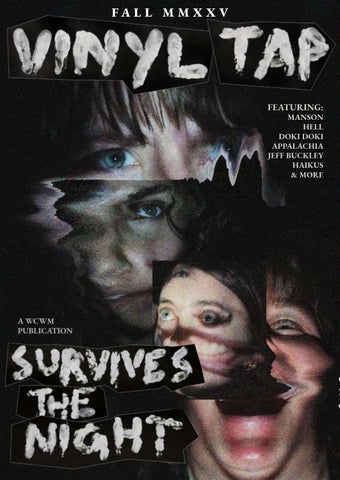
Create a flipbook
Issuu converts static files into: digital portfolios, online yearbooks, online catalogs, digital photo albums and more. Sign up and create your flipbook.
Vinyl Tap Fall 2025 by Vinyl Tap Magazine - Issuu