autumnedition 2015
financiallyspeaking | autumnedition 2015
financiallyspeaking Brought to you by your Financial Planner Infinity Private Wealth, an Authorised Representative of Lonsdale Financial Group Limited
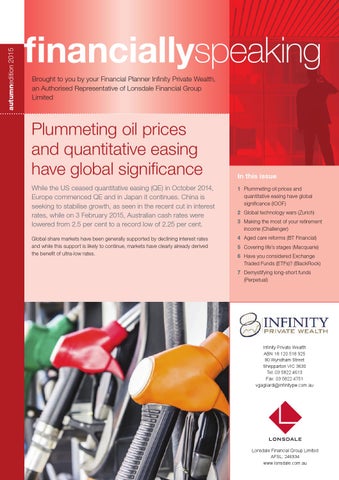
Plummeting oil prices and quantitative easing have global significance
In this issue
While the US ceased quantitative easing (QE) in October 2014, Europe commenced QE and in Japan it continues. China is seeking to stabilise growth, as seen in the recent cut in interest rates, while on 3 February 2015, Australian cash rates were lowered from 2.5 per cent to a record low of 2.25 per cent.
1 Plummeting oil prices and quantitative easing have global significance (IOOF)
Global share markets have been generally supported by declining interest rates and while this support is likely to continue, markets have clearly already derived the benefit of ultra-low rates.
4 Aged care reforms (BT Financial)
2 Global technology wars (Zurich) 3 Making the most of your retirement income (Challenger)
5 Covering life’s stages (Macquarie) 6 Have you considered Exchange Traded Funds (ETFs)? (BlackRock) 7 Demystifying long-short funds (Perpetual)
Infinity Private Wealth ABN 18 120 518 925 80 Wyndham Street Shepparton VIC 3630 Tel: 03 5822 4613 Fax: 03 5822 4751 vgagliardi@infinitypw.com.au
Lonsdale Financial Group Limited AFSL: 246934 www.lonsdale.com.au
1
Oil
Europe
Australia
Weak oil prices could have geopolitical consequences. For consumers in oil importing nations such as the US, China and India, current prices are cash flow positive as less is paid at the fuel pump. However, for oil exporters including Russia, the consequences are significantly negative. Lower prices, coupled with sanctions, are placing strain on the Russian banking sector to the extent that a debt default is possible if current prices are maintained in the longer term. Given its reliance on oil, Venezuela could default on its debt as early as March.
European GDP growth has been anaemic, however the introduction of QE is expected to benefit in the medium term and low inflation remains a near term concern. As Germany is the economic export engine of Europe, they will likely experience some relief from the weaker Euro. While QE is a positive step, political risks in countries such as Greece are likely to remain elevated.
The outlook for Australia is more challenges given falling commodity prices. The price of iron ore (our largest export) averaged around $US90 in 2014 but towards the end of December was trading at around $US70 – the lowest since 2009. Price weakness is also impacting the federal budget. In fact, the government recently slashed its price forecast for iron ore in 2015 by a third – from $US94 in September to $US63 a tonne in January. Unemployment was at 6.1 per cent in December and the Reserve Bank of Australia (RBA) is concerned that the unemployment rate may rise more than previously expected. This is a contributing factor to the RBA reducing interest rates to a record low of 2.25 per cent.
The Russian Ruble plunged in 2014 reflecting the challenging economic environment and, in 2015, there will continue to be major risks in the Russian financial system if current oil prices are sustained.
US The US is enjoying sound economic growth, a share market trading at record levels and low long-term interest rates (all at the same time). This doesn’t appear sustainable, even though the Federal Reserve has flagged higher rates, leaving the bond market susceptible and share markets possibly challenged. US corporate earnings growth revisions have recently been scaled back, hence the expanding price earnings ratio. US shares are trading on a forward multiple of 16, which is above historical averages. At these levels, the market is factoring in strong earnings growth due largely to the strength of the US economy. This year may well be a case of a strong US economy already being priced in.
To date, European Central Bank (ECB) actions have failed to lift growth as banks have been reluctant to lend. With negative interest rates in Europe, banks are increasingly likely to lend however this will take time.
China While there is no doubt the economy is slowing, the Chinese share market staged a significant rally in the latter half of 2014 from the undervalued levels earlier in the year. The China rally is one that has been influenced by recent Chinese policy initiatives. Official interest rates were unexpectedly cut during the quarter and the government has now allowed foreigners to purchase mainland China shares. Further, with house prices having weakened in China, there may be new funds directed toward non housing related growth assets in China and abroad.
All these factors have been major contributors to the decline in the Australian dollar. While a weak dollar should make Australia more competitive, especially in relation to exports, this will not make up for lower commodity prices which means the dollar is likely to experience further weakness. Source: IOOF
Although China is expected to be a beneficiary of lower oil prices, the end of the residential construction boom is being felt across the economy. As a result, and in anticipation of the slowing growth rate, China’s official borrowing rates were reduced in November 2014.
Speak to your financial planner to discuss your investment options for 2015.
2
financiallyspeaking | autumnedition 2015
Global technology wars Every day, we are bombarded with news about incredible breakthroughs in the technology sphere. What was once a long way into the future, maybe in a different world, is coming closer and at a faster pace. Self-driving cars, drones with shopping parcels, big data and 3D printing are just a few of the recent innovations to grace our lives. Start-ups that were in their infancy less than a generation ago, now bestride the global economy, battling each other for supremacy. The market value of the ’big 4’ – Google, Amazon, Facebook and Apple – alone totals well over $1 trillion and employs around a quarter of a million people, more than Ford or GM individually, and generating far higher profit per employee. But it is not just about these headline grabbing firms. As technological advances permeate, we’re seeing a world where companies that are able to obtain an information edge are increasingly moving ahead of their rivals. Sometimes, the speed of change and technological advances not only give these companies an edge but create binary outcomes – creative destruction at warp speed.
For Australian investors, this does raise more than a few issues. In 1992 the big four banks were valued at between 5.0 per cent or 6.0 per cent of GDP. Today, they now trade at a collective valuation of around 25 per cent of GDP. That is a tremendous expression of faith in the value and sustainability of profits in the face of change. Whilst the fully franked bank dividend is a beloved icon, especially amongst the DIY investor set, so was the Holden. The banks are at the vanguard of the franking frenzy. Barclays recently reported that about 36 per cent of household assets are tied up in our national banking system, a record high. High dividend payers like Woolworths, Wesfarmers and Telstra aren’t far behind in the heart and mind of the SMSF trustee. But, if China’s financial wobbles aren’t enough to give domestically entranced investors pause, they need also to consider the big new shift towards digital wallets and ’P2P‘ (person to person) financial services.
Apple recently signed a deal with the major credit card providers for their new Apple Pay system, potentially cutting the big financial services firms off from their clients. Richard Goyder, CEO of Wesfarmers, has said he doesn’t worry about Woolworths so much anymore as he does Amazon. Global high-tech business, especially those based in the US, are penetrating deep into the heart of formerly impregnable business models around the world and delivering bumper profits to its shareholders with their smart phones, e-commerce platforms and ecosystems. As the Australian dollar stubbornly holds onto levels well above where it should be, this may be a great time for investors to think globally. Source: Zurich Global Thematic Fund
Speak to your financial planner for more information on investments.
3
Making the most of your retirement income Retirement is a life-changing event. After you stop working, you can find yourself with time to do the things you may not have been able to do before, like travelling, volunteering or spending more time with family and friends. As you adjust to this new lifestyle, you’ll also need to think differently about your finances. In retirement, your priority typically changes from saving, in preparation for when you leave the workforce, to carefully spending those hard-earned savings. It’s likely that your initial focus will be to find a way to replace your salary or wage with cash flow from other sources. The composition of your retirement income requires careful planning. Your retirement income may come from more than one source.
Age pension The age pension is an income support payment offered by the Government to older Australians who meet the relevant eligibility criteria. With maximum payments of $22,211.80 per annum for a single pensioner and $33,488.00 per annum for pensioner couples (current for the period 20 September 2014 – 19 March 2015), the age pension probably won’t be enough to afford most people a modest post-work lifestyle of basic activities, let alone a comfortable lifestyle. To afford even a modest lifestyle in retirement, many people will need to supplement the age pension with other income. This could come from an annuity, an account-based pension or other investments.
4
An annuity (from within or outside super) An annuity is a simple, secure financial product that guarantees a series of payments, for a fixed term or for life, in return for an upfront investment. The earnings rate is fixed at the outset, and this applies for the length of the annuity, regardless of share market movements or interest rate fluctuations. Capital can be returned at the end of the agreed term or gradually during the term of the annuity as part of the regular payments.
An account-based pension (from your super) An account-based pension is an investment account which gives you the ability to choose from a range of investments with the level of income you wish to draw subject to the minimum annual withdrawal amounts set by the Government. Account-based pensions are usually market linked. This means that the capital value is linked to the performance of the underlying investments, which can impact the level and duration of your savings and the income produced.
Other investments These are just some of the types of investments that can sit within your super fund (personal or self-managed superannuation fund) or outside superannuation.
Q
Term deposits are fixed term, fixed interest savings accounts. Terms generally range from one month to five years.
Q
Shares generally pay income in the form of dividends. You can invest in shares directly or via some managed funds (or account-based pensions).
Q
An investment property is real estate which has been purchased with the intention of earning a return on the investment, either through rent, the future resale of the property, or both.
Income from various sources can be ‘layered’ to meet your income requirements. This can be set up so that more secure income, such as from the age pension or an annuity, can cover your essential costs of living, while your income from other sources can fund your discretionary spending. This approach can also allow your more growth-oriented assets to remain invested, giving them time to grow. Since each person is different, there is no single retirement income solution. More than one investment strategy and product may be required so it’s important to discuss your options with your financial planner. After all, it can make all the difference to your financial success in retirement. Source: Challenger
financiallyspeaking | autumnedition 2015
Aged care reforms Aged care in Australia has recently gone through some key reforms. We look at what the main changes are and why it’s more important than ever to plan ahead for care of loved ones. Our ageing population
Key areas of reform
Putting a plan in place
On 1 July 2014, the Government launched a whole raft of changes to aged care as well as a new websitewww.myagedcare.gov.au – to help explain them.
The changes and impacts of the reforms are complex but can be summarised as follows:
So, what does this mean for you and your family? Before they get less independent, it’s essential to find out what older loved ones want to happen and how much will that cost.
These reforms were part of a response to a growing, elderly, Australian population. According to ageing research done by the Arc Centre of Excellence in Population Ageing Research (CEPAR), “Australians aged 85 plus are projected to increase from two per cent of the population to anywhere between three and nine per cent by 2050”.
Q
The distinction between low care and high care have been removed.
Q
Entry fees for residential care are now calculated as a fully refundable lump sum (with no retention amount) and residents have 28 days after moving in to decide whether to pay a lump sum, periodic interest payments or a combination of both.
Getting advice
Bonds continue to be guaranteed by the Government.
Source: BT Financial
Q
Q
Plus, as we live longer, there’s a higher chance we may suffer illness in our old age. “Currently one fifth of people aged 65 and over say they need care and lifetime risk estimates suggest that half of men and two thirds of women aged 65 will need formal aged care in their remaining lifetime,” says the CEPAR report1.
The cost The cost to care for someone in a residential facility can be as high as $79,683 per year2 and these costs are heavily subsidised by the Government, which spends over $15 billion a year on aged care. A rapidly expanding elderly population ultimately means an increasingly expensive financial burden on the government. The aged care reforms are a way of mitigating some of these ballooning costs.
Q
The income-tested daily care fee has changed to a means-tested care fee using both assets and income testing. These fees are capped at the current level of $25,349 (indexed) per year and $60,838 (indexed) over a lifetime3. This fee continues to be in addition to the basic daily care fee (which is set at 85 per cent of the basic single age pension).
Choices around aged care can also mean selling houses and changing retirement income structures and a whole range of other financial considerations. 1 CEPAR Research Brief 2014/1 Aged care in Australia: Part I – Policy, demand and funding, page 3 2 $79,683= $17,210 (annualised basic daily care fee) + $25,349 (annualised means tested care fee) + $37,124 (annualised maximum daily accommodation payment, based on a RAD of $550,000 and an interest rate of 6.75%). Figures current at 1 January 2015. 3 As at 1 January 2015
Residential care facilities now have greater ability to offer extra-service packages for an additional fee. These packages can be made available to all residents and residents can choose to opt-in or opt-out of these services.
Talk to your financial planner who can help you navigate the maze of aged care. 5
Covering life’s stages At different stages of life you may want to adjust your personal insurance needs to protect your lifestyle and your financial security. Life insurance is more than just a lump sum payment to your family upon your death. Under the umbrella of life insurance, there are a number of insurance policies that have been designed to protect you and your family, regardless of your stage in life. Some financial institutions offer an insurance package that may include life insurance, income protection, total and permanent disability insurance, trauma insurance and business insurance. Packages are tailored to suit various ages and financial needs. Each type of policy covers different risks. Below are some examples of typical life insurance policies and their purpose. Make sure you always check the detail of your policy to find out what you are covered for and discuss it with your financial adviser.
Life insurance Life insurance helps protect you and your family against the financial consequences of death or terminal illness, with a tax-free lump sum.
Income protection Income protection helps protect you against the financial consequences of a temporary or permanent loss of income due to illness or injury, with regular payments of up to 80 per cent of your current income.
Trauma insurance
Young families
Trauma insurance helps protect you against the financial consequences of a major illness, with a lump sum to assist with major expenses and maintaining your family’s lifestyle while you recover.
This is the time when you and your family may be stretched financially, from school fees to the cost of your first home. Your family may also be relying on a single income. It’s important to think about what would happen if the family breadwinner became ill or injured and was unable to work.
Total and permanent disability insurance Total and permanent disability insurance helps protect you against the financial consequences of being total and permanently disabled and unable to ever work again.
Business insurance Business insurance helps protect your business against the financial consequences of a business owner or key employee becoming injured or dying. It provides money to cover lost revenue, and business expenses, and allows for a smooth change in business ownership. Another way to think about what type of life insurance may be appropriate for you is to think about your stage of life.
Young and independent When you’re young, you are more likely to enjoy leisure activities that involve a high level of risk, such as snowboarding or rock climbing. At the same time, at the start of your career you are less likely to have assets to draw on if you are temporarily unable to work because of an illness.
Maturing families Cost pressures may ease as you get older but won’t disappear completely. Also, while you may be approaching your peak earning years, you may still have to fund your children’s education. Protecting your health and income may be especially important to you during this life stage.
Approaching retirement As you approach retirement, you may have paid off your home loan and built up other assets, such as superannuation. However, you still need a safety net for you and your family. If you or your partner suffers a serious illness or dies, insurance may help you avoid the risk of having to sell your home and other assets. Source: Macquarie Life
Speak to your financial planner to discuss your life insurance options. 6
financiallyspeaking | autumnedition 2015
Have you considered exchange traded funds? While you may have purchased shares on the ASX, have you considered purchasing an exchange traded fund (ETF)? ETFs are managed funds that can be bought and sold in the same way as listed shares. They blend the benefits of both managed funds and shares.
Managed fund
+
These types of investments have been around for more than two decades and are increasingly becoming a larger component of the overall investment universe. By buying just one ETF, you can own a whole portfolio of international and/or local securities, providing a diversified exposure to an entire asset class in an efficient, simple and low-cost manner. Essentially, the ETF is a structure designed to track a specific index by packaging up securities and making them available on the stock exchange as a single stock. ETFs reduce complexity as they provide diversification though one trade on the ASX. An ETF also offers the benefit of liquidity; you can buy and sell units in the investment on the ASX during normal trading hours whether through your investment adviser, a broker or online. Like shares, pricing is daily and there is no minimum investment amount.
Share
One key advantage of ETFs is that they can provide access to markets that were otherwise hard to access for individual investors. For example, in the bond market, the minimum investment size for some bonds is up to $500,000 and the market is not always very liquid. There are 11 fixed income ETFs listed on the ASX that provide access to these markets, with no minimum investment level and daily pricing so you can trade through the normal trading day. The simplicity and ease of use of ETFs has led to them being used in a number of ways by Australian investors. Whilst they have been used to target specific exposures or play out particular investment themes, they have also been used as building blocks in portfolio construction.
=
ETF
They offer an efficient way to build a portfolio of Australian shares or to build an entire portfolio because they provide diversification across asset classes and international markets. Some investors have taken a blended approach and combined them with actively managed funds in their portfolios. In Australia and overseas, investor adoption of ETFs has grown strongly. Over the past 20 years, exchange traded products (of which ETFs are the largest part) have grown into a $2.8 trillion investment industry globally. In Australia, the industry grew by 50 per cent and represented just over $15 billion in funds under management by the end of 2014, with 104 products listed on the ASX. Source: BlackRock
ETFs can provide exposures to stocks in individual countries, (eg Australian, US, Japanese or Chinese shares), asset classes (eg bonds, commodities, shares) or sectors (eg healthcare, consumer staples or telecommunications) or broad global investment themes (Europe, Asia or emerging markets).
To find out more about exchange traded funds, speak to your financial planner. 7
Demystifying long-short funds Alpha is the output of a fund manager’s stock picking skills. It’s the ability to add value above the market return. The combination of a long/short fund gives investors a way to profit from the bad news, as well as the good. These opportunities are particularly valuable in volatile or sideways trading markets. Effectively, it adds another tool in an investor’s kit bag to generate returns but also manage risk.
Key benefits of shorting Shorting allows investors to profit from declining share prices. Not only can this boost portfolio returns, it can also provide diversification from the traditional ‘long only’ portfolio. Being able to short stocks increases an investment manager’s opportunity set. If a ‘long’ investor finds a share to be unattractive, their options are to either sell the share if they own it or not buy it. If a ‘short’ investor finds a share they expect to fall in price, they can short the share. If their assumptions are correct and the share falls in price, they can actively generate a return.
Seven misconceptions about shorting
2. Shorting played a part in the global financial crisis Prior to the global financial crisis (GFC), there were a lot of companies with over-stretched balance sheets and these were exposed during the GFC. Shorting did not create the downward pressure on these shares during the GFC. However, because the extraordinary circumstances of the GFC, it can be argued that it compounded the pressures already at play.
3. Shorting = positive returns While shorting provides the opportunity to profit in both rising and falling markets, not all short positions generate a positive return.
Shorting a share is no more sinister than selling a share for less than you paid for it. Assuming a company has a reasonably strong balance sheet, even if its share price fell to zero, it would still be worth the value of its balance sheet. All shorting does is expose weak companies.
6. Shorting involves unlimited downside risk It is true that, when opening a short position, the theoretical risk is limitless because the price of the share could increase forever.
7. Shorting doesn’t work The positive long-term performance of market indices leads many to believe that shorting does not work. The aim of short-selling is to profit from shorter-term factors, such as negative news or earnings downgrades, and can be used as to compliment a long portfolio that benefits from share price gains over the long term.
4. Shorting is not transparent Source: Perpetual
All short selling transactions and positions are declared to the Australian Securities Exchange at the end of each trading day and are available to all market participants.
5. Shorting is not ethical
If you would like to find out more about long-short funds, talk to your financial planner.
Some view shorting a company as tantamount to wanting it to fail. This is not the case.
While shorting strategies have the potential to generate returns in both up and down markets, there are a number of myths about shorting that have stopped many investors from using these strategies within their portfolios
1. Shorting can make a company go bankrupt
In fact, shorting can be a benefit to the overall market because it adds liquidity and can improve trading efficiency
Lonsdale Financial Group Limited ABN: 76 006 637 225 AFSL: 246934 Level 6, 161 Collins Street Melbourne VIC 3000
Infinity Private Wealth ABN 18 120 518 925 80 Wyndham Street Shepparton VIC 3630 Tel: 03 5822 4613 Fax: 03 5822 4751 vgagliardi@infinitypw.com.au
Disclaimer: The information contained in this document is based on information believed to be accurate and reliable at the time of publication. Any illustrations of past performance do not imply similar performance in the future. To the extent permissible by law, neither we nor any of our related entities, employees, or directors gives any representation or warranty as to the reliability, accuracy or completeness of the information; or accepts any responsibility for any person acting, or refraining from acting,on the basis of information contained in this newsletter. This information is of a general nature only. It is not intended as personal advice or as an investment recommendation, and does not take into account the particular investment objectives, financial situation and needs of a particular investor. Before making an investment decision you should read the product disclosure statement of any financial product referred to in this newsletter and speak with your financial planner to assess whether the advice is appropriate to your particular investment objectives, financial situation and needs.
8
WMA-15576
The benefits of a combined long/short fund: increasing the opportunity for alpha