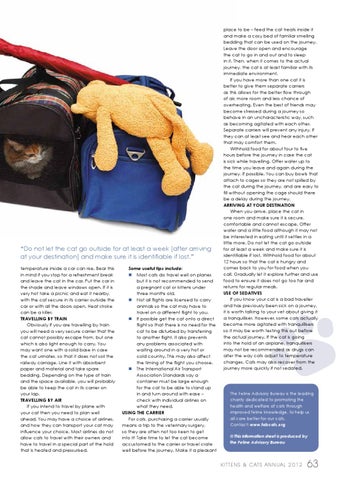
“Do not let the cat go outside for at least a week [after arriving at your destination] and make sure it is identifiable if lost.” temperature inside a car can rise. Bear this in mind if you stop for a refreshment break and leave the cat in the car. Put the car in the shade and leave windows open. If it is very hot take a picnic and eat it nearby, with the cat secure in its carrier outside the car or with all the doors open. Heat stroke can be a killer. Travelling by Train Obviously if you are travelling by train you will need a very secure carrier that the cat cannot possibly escape from, but one which is also light enough to carry. You may want one with a solid base in case the cat urinates, so that it does not soil the railway carriage. Line it with absorbent paper and material and take spare bedding. Depending on the type of train and the space available, you will probably be able to keep the cat in its carrier on your lap. Travelling by air If you intend to travel by plane with your cat then you need to plan well ahead. You may have a choice of airlines, and how they can transport your cat may influence your choice. Most airlines do not allow cats to travel with their owners and have to travel in a special part of the hold that is heated and pressurised.
Some useful tips include: n Most cats do travel well on planes but it is not recommended to send a pregnant cat or kittens under three months old. n Not all flights are licensed to carry animals so the cat may have to travel on a different flight to you. n If possible get the cat onto a direct flight so that there is no need for the cat to be disturbed by transferring to another flight. It also prevents any problems associated with waiting around in a very hot or cold country. This may also affect the timing of the flight you choose. n The International Air Transport Association Standards say a container must be large enough for the cat to be able to stand up in and turn around with ease – check with individual airlines on what they need. Using The carrier For cats, purchasing a carrier usually means a trip to the veterinary surgery, so they are often not too keen to get into it! Take time to let the cat become accustomed to the carrier or travel crate well before the journey. Make it a pleasant
place to be – feed the cat treats inside it and make a cosy bed of familiar smelling bedding that can be used on the journey. Leave the door open and encourage the cat to go in and out and to sleep in it. Then, when it comes to the actual journey, the cat is at least familiar with its immediate environment. If you have more than one cat it is better to give them separate carriers as this allows for the better flow through of air, more room and less chance of overheating. Even the best of friends may become stressed during a journey so behave in an uncharacteristic way, such as becoming agitated with each other. Separate carriers will prevent any injury. If they can at least see and hear each other that may comfort them. Withhold food for about four to five hours before the journey in case the cat is sick while travelling. Offer water up to the time you leave and again during the journey, if possible. You can buy bowls that attach to cages so they are not spilled by the cat during the journey, and are easy to fill without opening the cage should there be a delay during the journey. arriving aT yoUr desTinaTion When you arrive, place the cat in one room and make sure it is secure, comfortable and cannot escape. Offer water and a little food although it may not be interested in eating until it settles in a little more. Do not let the cat go outside for at least a week and make sure it is identifiable if lost. Withhold food for about 12 hours so that the cat is hungry and comes back to you for food when you call. Gradually let it explore further and use food to ensure it does not go too far and returns for regular meals. Use of sedaTives If you know your cat is a bad traveller and has previously been sick on a journey, it is worth talking to your vet about giving it a tranquilliser. However, some cats actually become more agitated with tranquillisers so it may be worth testing this out before the actual journey. If the cat is going into the hold of an airplane, tranquillisers may not be recommended as drugs can alter the way cats adjust to temperature changes. Cats may also recover from the journey more quickly if not sedated.
The Feline Advisory Bureau is the leading charity dedicated to promoting the health and welfare of cats through improved feline knowledge, to help us all care better for our cats. Contact: www.fabcats.org © This information sheet is produced by the Feline Advisory Bureau
k i t t e n s & c at s a n n u a l 2 0 1 2
63