Thomas Hancock, Donna Eads, Christine Ward, Rob Fuller, Clayton Calloway, Amy Bradshaw, Randi Fuller, Ashley Centers, Cliff and Ilene Bandringa, Rob Krieger, Anita DeLelles, Judi Moreo, Nathan Hughes, Karen L. Monsen, Debbie Gendron, Rook Reilley, Jean Watkins, Terri Fitzsimmons, Bruce "BT" Bugland, Elisa Eames, Amy Davis, Vernon Robison, David Cordero
ADVERTISING SALES Kathy Lee
ADVERTISING EMAIL ads@ViewOnMagazine.com
SUPPORT STAFF Bert Kubica Cheryl Whitehead
DISTRIBUTION ViewOn Magazine Staff
PUBLISHED BY ViewOn Magazine, Inc. Office (702) 346-8439 Fax (702) 346-4955
GENERAL INQUIRIES ads@ViewOnMagazine.com info@ViewOnMagazine.com
Letter from the Editor
Dear Readers,
This is your year! Now that the rush of the holidays is over, it’s time to stop avoiding goals and face them head-on. I mean really stare your hopes and intentions in the face—maintain eye contact so they know you mean business. Make solid plans for what you’ve been longing to do but have been too busy or afraid to try. Use the SMART goal acronym: Specific, Measurable, Achievable, Relevant, and Time-bound. Create a reasonably detailed plan with a timeline to break goals into manageable chunks. This year, we can do it! And ViewOn can help.
This year, find inspiration. Our Motivation article is a good place to start. It reminds us to find meaning in the everyday by focusing on what is around us right now. Allow yourself to feel so you can learn from and change negative emotions. Practice gratitude. Seek connection by giving others your full attention. Find the beauty in your flaws, and see the joy right in front of you.
This year, take charge of your well-being. For better heart health, Mesa View Regional Medical Center offers expanded cardiology services. Our Fitness article suggests winter gardening in our desert climate as a way to increase fitness, health, and overall wellness. As you cultivate plants, cultivate joy and peace within yourself.
This year, reclaim your home. Reorganize and beautify your surroundings and your life with new cabinets, drawers, and other storage solutions. Our Kitchen Encounters article will point you in the right direction. And to increase flow, comfort, and serenity while indulging your senses, explore the ancient Chinese art of Feng Shui in our Design article.
This year, take control of your finances. In our Finance article, Nathan Hughes discusses missed opportunities, blind spots, and reflecting on desired short and long-term outcomes. Now is a good time to review your situation with a financial planner.
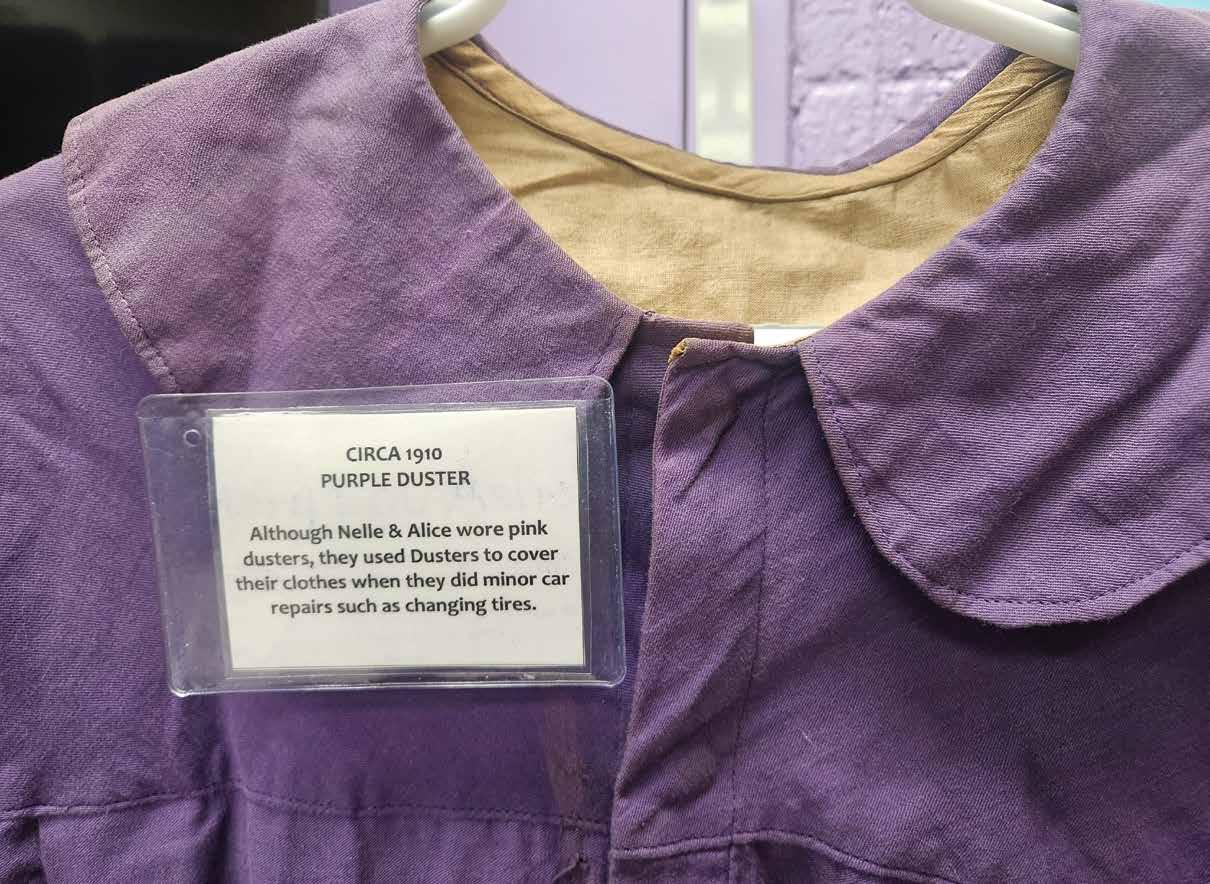
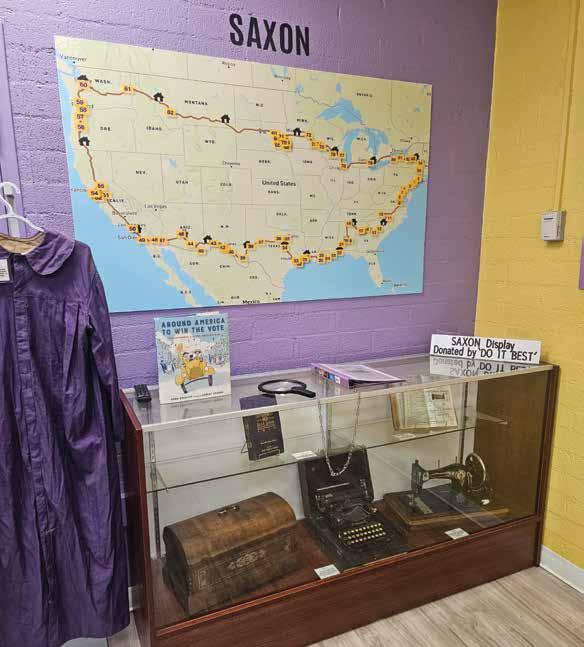
This year, chase away winter blues by getting out more. Learn about suffrage, aviation, and other contributions at the Mesquite Women’s History Museum, opening in January. Also in January, CasaBlanca Resort & Casino will host its Mesquite Motor Mania and Hot Air Balloon Festival. In February, enjoy genuine cowboy poetry at the Mesquite Western Roundup, and the Bryce Canyon Winter Festival arrives just in time for Valentine’s Day.
This year, try new things. Discover and fall in love with Mesquite’s charming Cinnamon Café, or catch the brand new play at the Center for the Arts at Kayenta. Consider investing in the future by donating to the Mesquite Community Education Foundation. And as always, please patronize our wonderful advertisers. They make this and every issue possible.
My dear readers, this year really can be our year. It all starts with believing in ourselves enough to chase our dreams.
Editor in Chief
Frequent
contributors
Anita DeLelles, LMT, is a certified Equine and Small Animal Acupressure Practitioner with accreditation from Tallgrass Animal Acupressure Institute. Her studies included two consecutive summers in Bath, England, as well as coursework in Colorado and California and a BFA from UNLV. Anita is certified in small animal massage from the Northwest School of Animal Massage as well as in human massage. In 2014, Anita and husband Ron opened WOOF! Wellness Center and launched their website www.ShopMeoow.com.
David Cordero is the Communications and Marketing Director for the City of St. George. A southern Utah resident since 2006, David has extensive experience in writing, public
relations, marketing, and public speaking. He has also served in a variety of volunteer capacities over the years, including Utah Honor Flight, American Legion Post 90, religious education, and as a coach for his son's athletic teams. Email him at david.cordero@sgcity.org.
Nathan Hughes is a proud native of Mesquite, Nevada. With a deep-rooted passion for community service, he has dedicated his efforts to making a positive impact, particularly among the youth and teaching financial literacy. He is looking forward to working with members of the community. Nathan is president and advisor of Hughes Strategic Group, LLC DBA Pilot Wealth Strategies. Contact Nathan at (208) 490-5400.
Rob Krieger is a 20-plus-year member of the PGA of America and is originally from Cleveland, Ohio. He came to the area as the Director of Golf at Conestoga and now owns his own golf instruction business in St. George called Red Rock Golf Instruction, which is based at Southgate Golf Course Driving Range. He has been writing for ViewOn Magazine since 2010. He is also a Utah PGA Player Development Award Winner. For help with your game, please visit www.stgeorgegolflessons.com or email him at rob@sgugolf.com.
Ron is a registered Investment Advisor Representative and has been serving Mesquite and the surrounding areas since 2007. Originally from Wisconsin, Ron grew up in Mesquite and served four years in the U.S. Marine Corps and earned his BA in Business Administration. After returning home, he joined his father at Financial Concepts, where he values building lasting relationships through a holistic approach to financial planning.
Ashley Centers is the former general manager of Anytime Fitness Mesquite, and her passion for fitness runs deep. She fell in love with competitive powerlifting as a preteen. She set many state records and national qualifying totals during her lifting career prior to her competitive retirement while attending college. Ashley is now an ISSA Elite Level Trainer, Certified Fitness Nutritionist, and Corrective Exercise Specialist and trains for Strongwoman competitions. She is an inactive board member for the Mesquite Senior Games and is excited to remain a contributor for ViewOn Magazine and to write about her passion for health and fitness!
Judi Moreo is one of the most recognized personal growth trainers and coaches in the world. She is the author of 11 books, including two international bestsellers, You Are MoreThan Enough and ConquertheBrain Drain. A self-made success, Judi started her first business with $2,000 and a lot of chutzpah. Judi learned to succeed step-by-step over many years and now has a worldwide following of clients who are enjoying outstanding success as a result of her guidance. You can reach Judi at judimoreo@yahoo.com or by calling (702) 609-2075.
Karen L. Monsen is a freelance writer who lives in St. George, Utah. She covers outdoor topics, nature, science, research, and human impacts. She taught French and social studies in public schools, served as a technical training coordinator, and designed and delivered business and technical writing seminars for corporate clients.
Randi Fuller is a psychology-based design strategist and founder of The Science of Sanctuaries, an approach developed through her work as owner of Mesquite Tile & Flooring. She combines sciencebacked design principles with artistry and real-world expertise to help homeowners and businesses create spaces that foster well-being, functionality, and beauty. Randi advocates for environments that prioritize safety, aesthetics, and emotional well-being, making thoughtful, evidence-based design accessible to both small businesses and homeowners. Call (702) 346-7225 to speak with Randi, or visit the showroom at 521 W. Mesquite Blvd. in Mesquite, Nevada. You can also visit their website at www.MesquiteTile.com.
Cliff and Ilene Bandringa are authors and the creators of BackRoadsWest.com. They have been traveling and photographing the world for more than 20 years, with a motto of finding the lesserknown, off-the-beaten-path places and then sharing their experiences with others. They do this via their blog, the virtual tour guides they've written, lots of YouTube videos, magazine articles, and a sister website of highquality and stock images. You can find all of these at www.BackRoadsWest.com.
Donna Eads and her husband moved to Mesquite in 2010 from Palm Desert, California, and she loves the small-town atmosphere. Her writing experience extends from high school and college newspapers to professional manuals as a critical care nurse. Her passion for tennis is evident in her frequent articles for ViewOn Magazine.
Kaylee Pickering is the comunications specialist for the Iron County tourism office, Visit Cedar City · Brian Head. Born and raised in Cedar City, she loves sharing the incredible recreation and arts opportunities around her with potential visitors @visitcedarcity. A mother of two young boys, she and her husband spend weekends showing them new trails, finding dirt to play in, and exploring southern Utah.
Message from
the Mayor
Iwish you and yours a joyful and prosperous new year as we welcome another beautiful winter season in Brian Head.
Although noted for its majestic beauty, Brian Head Town is also defined by its four distinctive seasons that offer both residents and tourists opportunities to enjoy what the town has to offer. My favorite, autumn, is always alive, bursting with its brilliant colors that seem to last forever. It has now transitioned into the glory of winter, which brings a new ski season. The whiteness of the snow flurries covers everything.
Chasing a girl, I first came to Brian Head in 1979, and I fell in love with her and the town. Of course, I still have her today, and we still reside in Brian Head. It has changed over the years, but the winters instill in us that wild feeling of stepping outside in the mornings when the crisp air is exhilarating. The sound of your boots crunching on the snow interrupts the dead silence after a snowstorm. The snow seems to muffle all the other sounds around you. You are alone with nature.
Our mountains are known for their high-elevation weather patterns that are unlike anywhere else in southern Utah. Raging blizzards still stir that conflict inside of me: man against nature. Being outside in a blizzard is something everyone needs to experience.
Brian Head is at a unique crossroads with the new ownership of the Brian Head Resort and the upcoming new ski community of Aspen Meadows. It’s very rare to have a wonderful place such as Brian Head Town. It is also wonderful to have a developer with a vision for its newly adopted mountain home and a resort owner who is focused. They are working together to move in the same direction.
These efforts are the road into our future, which will bring many exciting things to Brian Head. The vision of Aspen Meadows, together with Brian Head Resort and Brian Head Town, is in complete alignment with our town goals: keep the authentic aspects of the town untouched while preparing for its future.
We are really making some great improvements here in town. A couple of new items would be our Bristlecone Park area with a pond, the new playground equipment, and, of course, “Brian, the Bear,” our paved trail system throughout the town. And let’s not forget our other exciting trails. One of my favorites is our Manzanita Trail. I can just walk across the street and get on the main trail and head out with my two dogs. Also, recently completed is the Aspen Meadows loop, dedicated to recreational hiking and biking use by residents and visitors. It’s about a 10-mile loop, and it is a beautiful trail to hike.
As winter settles in, we hope you, your family, and your friends make it up to visit Brian Head Town and Brian Head Resort this season to enjoy our many activities.
As always, I hope to see you out on the trail.
Clayton Calloway
Brian Head Town Mayor
Why I Love Mesquite
Imoved from Washington, D.C. to Mesquite in the fall of 2013, taking to heart Horace Greeley’s advice at the end of the Civil War: “Washington’s no place to live. The rents are high, the food’s bad, the dust disgusting, and the morals deplorable. Go West, young man, go West and grow up with the country.”
Serving over 80% of my long Air Force career in Washington, I was lost in the Pentagon’s maze, ensnarled in commuter traffic, and working 12-plus-hour days. The worst yet, I lost close friends on 9/11. I was desperate to leave. Only then did Horace’s words touch my heart: “Go West!”
My first stop was Mesquite on a golf trip with my brother. I was so elated that this small town had everything D.C. didn’t have that I happily moved here, never looking back in my rear view mirror! Mesquite’s clearly my dream come true!
- Thomas Hancock
Perspective
by Judi Moreo
Every January, the same mantra echoes through social media feeds and self-help shelves: “new year, new you.”
It’s meant to inspire, but it often sounds like a polite accusation—as if last year’s version of you wasn’t quite enough. Maybe it’s time we flipped that script.
What if the “new you” isn’t about reinvention at all, but revelation? Not adding more but seeing differently? The truth is your life can change overnight without you changing a single thing—if your view changes. It’s astonishing what happens when we shift our perspective rather than our personality.
Think of it this way: stand at the top of a mountain, and the world looks vast and infinite. Drop into the valley and suddenly the same world feels intimate, detailed, and full of hidden life. Nothing in the landscape has changed—only the view. The same applies to us. We spend so much time “fixing” ourselves when all we really need to do is tilt the lens.
Rethinking “Improvement”
We’ve been taught to chase constant self-improvement—be thinner, brighter, more prosperous, calmer—as though we’re never quite finished. That’s a hamster wheel disguised as
progress. What if the “new you” isn’t a project but a point of view? What if you don’t need to fix yourself, but see yourself through kinder eyes?
Take a hard look at your so-called “flaws.” Are they actually weaknesses, or are they traits that need better context? The perfectionist becomes the detail-driven leader. The daydreamer becomes the visionary. The worrier becomes the strategist who plans for every outcome. When the angle shifts, the story changes—and so does the hero.
Decluttering the Mental Closet
We often declutter our closets in January—out with the old sweaters, in with the new resolutions. When was the last time you cleaned out your mental wardrobe? We keep beliefs that don’t fit anymore. “I’m too old to start that.” “That’s not my personality.” “People like me don’t do things like that.” These are the ill-fitting cloaks of the mind, and they’ve been out of style for years.
Try this: for one week, every time you catch yourself saying, “I can’t,” replace it with “What if I could?” You don’t have to believe it immediately—let the question hang in the air. That simple shift cracks open a window you didn’t know was locked.
Is the New Makeover
Seeing Through Curiosity, Not Judgment
Children are masters of perspective. They approach the world with unfiltered curiosity. They touch, taste, question, and invent. Somewhere along the way, we trade that curiosity for judgment. We stop asking, “Why not?” and start declaring, “That’s how it is.”
To gain a new view, try returning to childlike curiosity—but with adult courage. Ask ridiculous questions again. Explore your own city as if you were a tourist. Take a route you’ve never driven, talk to a stranger, try a hobby that makes you feel like a beginner. The new you doesn’t arrive with a list of improvements. It shows up when curiosity replaces control.
Reframing Success
A new view also means redefining what success looks like. Maybe this is the year you stop chasing big wins and start noticing the smaller ones: the morning you woke up at peace, the project you finished instead of perfecting, the friend who called because you make them laugh. These aren’t minor moments—they’re the mosaic tiles of a fulfilled life.
In photography, the “golden hour” happens when the light hits right. It’s not a new landscape; it’s a new way of seeing the same one. Success is like that. It’s not always about doing more—it’s about noticing when the light changes.
Your 2026 Resolution: Wonder
Forget the resolutions that make you feel like a failure by February. Try setting one intentional goal: to see differently. Approach your familiar life with unfamiliar eyes. The job you’ve grown tired of, the home you’ve stopped noticing, the mirror you glance in critically—all of them look new when you look through wonder instead of weariness.
This year, don’t become someone else. Become more you— the version that sees possibility instead of repetition, beauty instead of burden, and meaning in the mundane. When your view changes, your life doesn’t need to.
The “new you” has been here all along. You only needed a new way of looking to see it.V
Judi Moreo is an award-winning author, speaker, and coach. She is a passionate storyteller and has written 29 books. Her recent Chronicles of a Divided Land won the 2025 International Impact Award for best historical fiction. If you have a book inside you waiting to be written, Judi can help you bring your vision to life. (702) 609-2075
The Enduring Spirit of Brian Head
A Legacy of Nature, Resilience,
Community, and Vision
by Terri Fitzsimmons
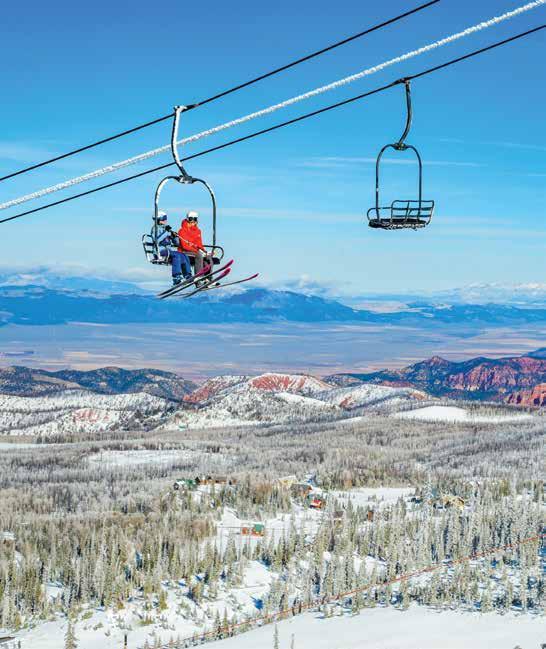
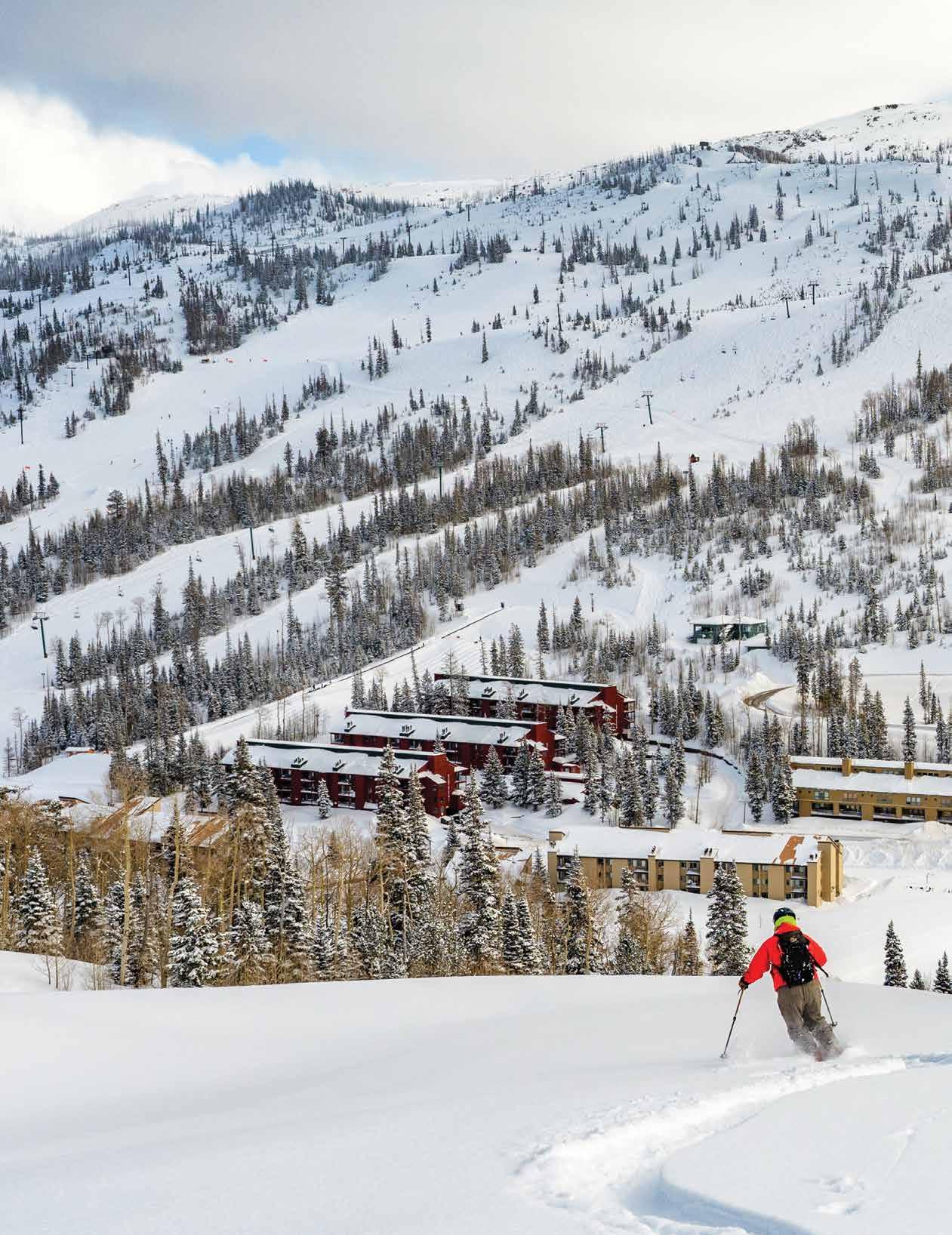
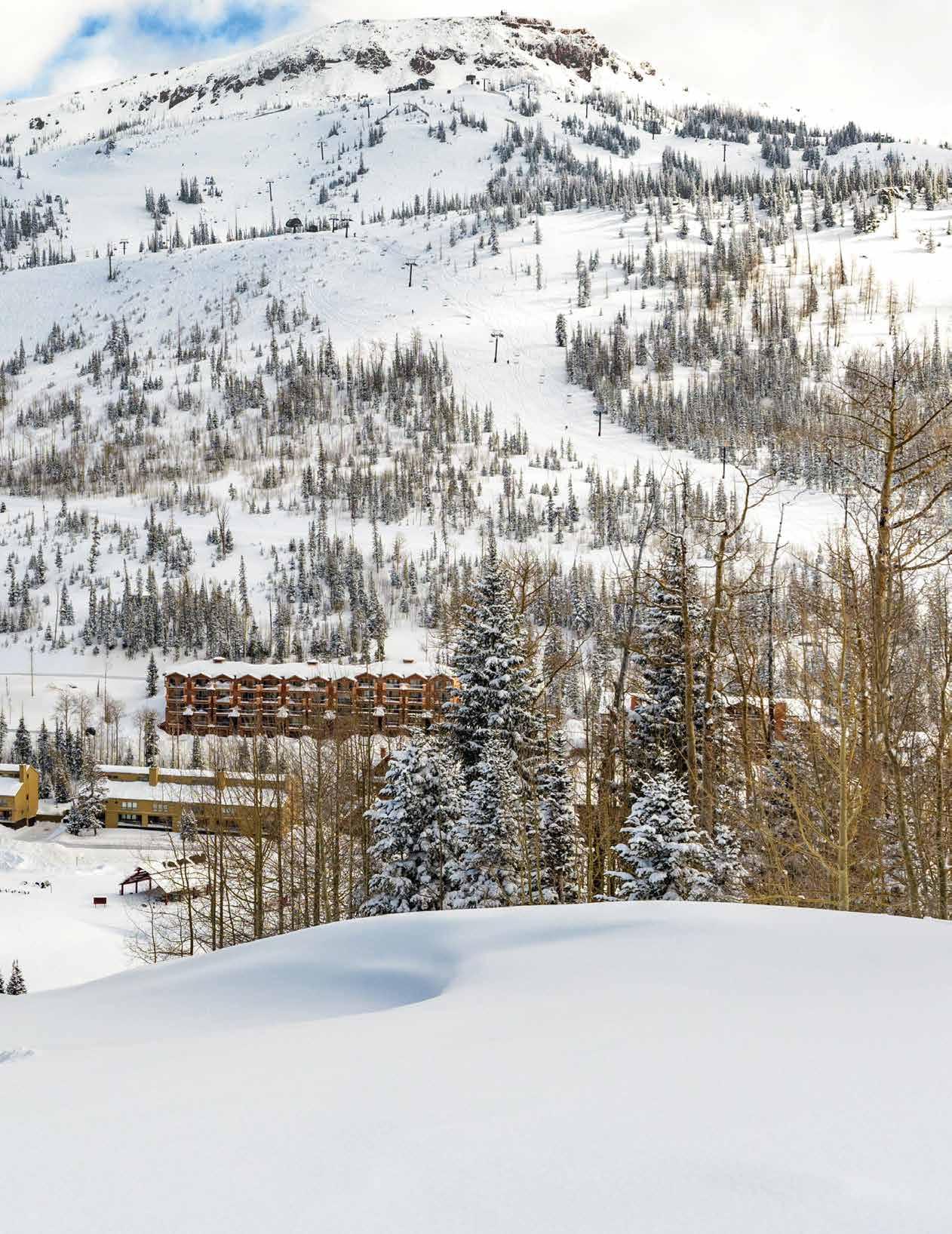
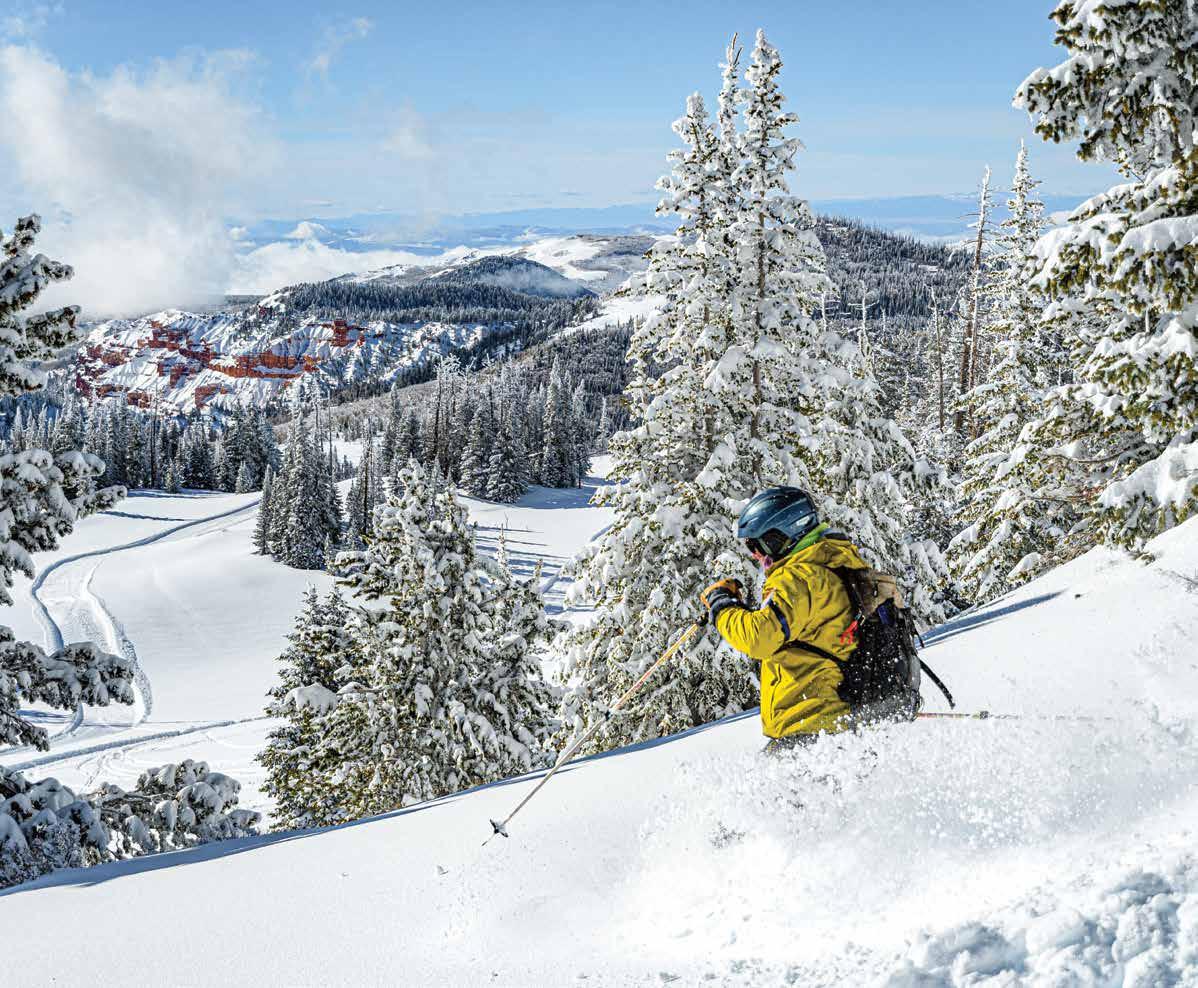
Surrounded by breathtaking scenery, Brian Head Ski Resort is one of Utah’s hidden gems. This past year marked the 50th anniversary of Brian Head Town. At 9,600 feet, it is the highest resort town in Utah. Once skiers take the Giant Steps Express Chair Lift to the summit, they ascend to 10,970 feet.
The view from Brian Head Peak is indeed staggering. In the distance, skiers can clearly see the massive, naturally carved horseshoe-shaped amphitheater of Cedar Breaks. This "Circle of Painted Cliffs," with its multicolored rock formations of red and white striped hoodoos (tall, skinny stone spires that form a "forest" of rock, wind, and ice), draws many tourists throughout the seasons.
This magical mountain community is home to residents who, over the years, have overcome adversity, shared successes, and continue to work together to keep the magic flowing. Those who live in Brian Head full-time have a variety of occupations, ranging from carpentry and running small businesses to ski resort operations, work-at-home professions, and snowplowing.
But it is their individual stories that show their resilience and camaraderie; they show why Brian Head is such a magical place and are a reminder of how special Brian Head is. At present, approximately 150 registered voters reside here. Three of them grew up together, going to school on the same bus, and now, as adults, they are business owners and competitors,
all the while remaining good friends! A favorite story from the past is the life of Mrs. Bentley, who drove the old school bus, an old four-wheel drive Suburban.
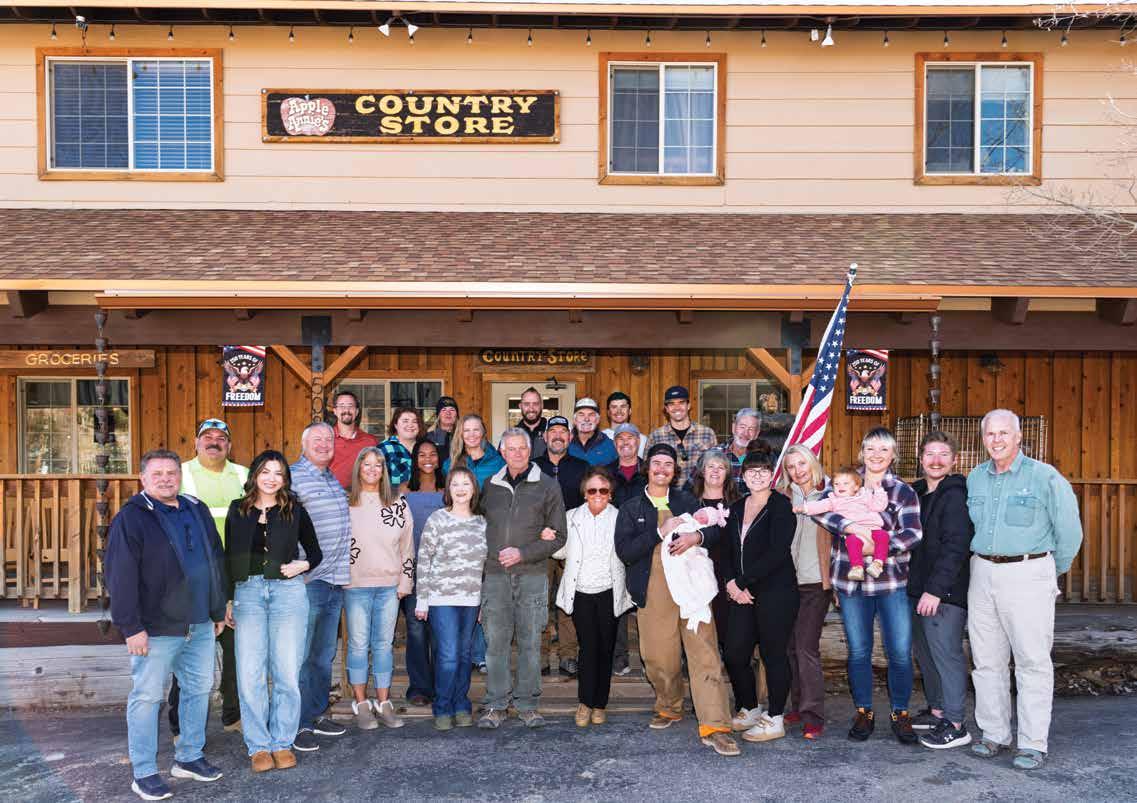
Shelly Calloway was one of the students who rode that bus. Now, Shelly owns Apple Annie’s Country Store. “My husband, the mayor, who is now serving his third term, loves to tell the story of how he chased a woman in Brian Head and finally caught her!” Shelly says. Apple Annie’s Country Store has a deck where a deer has been visiting for over 11 years. “Thunder lives in the neighborhood and goes wherever he feels like it,” Shelly adds. The general store was originally in the mall, but in 2009, it relocated to its present location.
Another noted local is Amanda Hunter, employed as the code enforcement officer for Brian Head Town. She holds numerous responsibilities that benefit the residents. Amanda was born in Brian Head and brings to her job personal knowledge of the town’s history, along with her passion, which is reflected in her dedication.
A. Flint Decker, president of Aspen Meadows and one of Brian Head’s newest second homeowners, along with his wife, Gail Decker, states that the entire town is appreciative of Amanda. Residents acknowledge her enthusiasm for what she does, especially her decision to work in her hometown, where she is a helpful guide for the town’s newest residents.
One of the very first full-time residents of Brian Head was Georg Hartlmaier. Arriving in December 1964, Georg, an avid ski racer and coach in Germany and Austria, made the decision to come to Brian Head as the resort's first mountain manager and ski school director. His wife, Stefanie, arrived in January
1965 with their oldest son, Georg. They lived in Cedar City while their home in Brian Head was being built, which they moved into in December 1965.
With no electricity or water, Georg recruited Stefanie’s brother from Germany to help in August. “For weeks, we had to use the outhouse,” Stefanie recalls. During this time, Robbie was born, the first baby born in Brian Head. With no money in their pockets, they came to a new country and became successful. They soon opened Georg’s Ski Shop.
In the beginning, their resources were limited, but they were still generous. One day, Georg came running into the ski shop, imploring Stefanie to make sandwiches for their customers. The couple raised three children in Brian Head, and Robbie now co-manages the ski shop with his older brother, Georg.
Stefanie also enjoyed a close friendship with another family, Bill Thompson and his wife, Gail, who moved to Brian Head in 1968. Georg and Bill would take turns driving their children, Bobbie and Georg, and others to and from all the local school events in Parowan, Utah.
“Brian Head is my paradise!” Stefanie exclaims. “I moved here and never moved anywhere else!” Her two sons are always with her, and now, 91, she has been honored with the first planned ski lift in Aspen Meadows to be named after her: Stefanie’s Lift. She resides above the ski shop.
Another special person whose experiences enrich the history of Brian Head Town is Steve Lutz, a musician and newspaper reporter who first moved to Brian Head in 1974 to escape Denver. “Like many people in Brian Head,” he says, “I chose not to be somewhere else!”
Left to right: Georg Hartlmaier, Shelly Calloway, Chip Deutschlander, Robby Hartlmaier
One evening, while Lutz was performing at a local bar, all the patrons exited the building—across the street was a building ablaze. All the townspeople stood in the streets watching it burn. Lutz was aghast to learn there was no fire department or provisions for public safety. There were only eight telephones in the entire town.
One Christmas, when the water pipe froze, the entire town was without water for a number of days. Porta-potties were visible everywhere. Multiple efforts were made to rectify the situation, but one such effort resulted in 300,000 gallons of water from a fire hydrant gushing into the condominium basements. It took several days to pump the water out. The residents tried everything, including making coal burners, to warm the water. Finally, they reached out to the state fire marshal, who had no idea what to do, so they then contacted the Utah National Guard. With the help of all the townspeople, especially Lutz, the problem was rectified.
The perseverance of the residents to build a thriving community paid off. Because of their efforts, on March 12, 1975, Brian Head Town became incorporated.
What else makes this town so unique? One feature of this quaint town is a general store with an eight-foot-long counter and three registers situated at different intervals: one for general store purchases, another for liquor, and the third for the post office. The store is a hallmark of small-town values in America if there ever was one.
Front Row: Greg Sant, Chris Leigh, Ciera Claridge, Chip Deutschlander, Heather Deutschlander, Shelly Calloway, Clayton Calloway, Stefanie Hartlmaier, Trace Whitelaw and daughter, Diana Calloway, Brittany Feller, Tatiana Hartlmaier, Alena Eberle and daughter, Mike Eberle, A. Flint Decker. Middle Row: Taizha Robinson, Kelly Marshall, Robby Hartlmaier, Georg Hartlmaier, Doug Deutschlander. Back Row: Bret Howser, Chelsie Bess, Kim Oldroyd, Tristan Oldroyd, Tom Pettigrew, Cody Hartlmaier, Jaxon Haderly.
Brian Head Resort was recently named one of the
top ten best places
to buy a mountain vacation home in the United States.
The original owners of Brian Head Resort had a vision for this town. As the land and ski area have been passed down to the new owners and adjoining land owners— Mountain Capital Partners and Aspen Meadows—the future dream has remained the same. The aim is for an expanded ski resort to serve skiers and riders from southern California to the Wasatch Back and beyond while keeping the town’s authenticity, maintaining its special place in the hearts of its residents, and fostering their love for where they call home.
Aspen Meadows, arriving in Brian Head just five years ago, is humbled by the warm welcome of these truly wonderful and resilient people. Their stories span over fifty years, reflecting their love for this pristine place. With the full support of the Brian Head community, Aspen Meadows is incorporating their values and beliefs into the project’s 30-year, multi-decade, masterplanned resort expansion.
“One of our earliest buyers and founders of Aspen Meadows couldn’t have said it better, that to his family, the entire plan of the Aspen Meadows new ski community represents the magic of balance between respecting local community values, nature, and mountain recreation,” says Decker.
Aspen Meadows also aligns its plans with the dreams of the community—to have future generations of families teaching their children to ski, and first and foremost, to continue the legacy. Once completed, it will be the seventh-largest ski resort in the state. Based on the shared vision of the town, the resort,
and Aspen Meadows, this plan will significantly contribute to and transform Brian Head Town and the Brian Head Resort.
As the Brian Head town manager, Bret Howser is excited to say, “Brian Head will be the next great western resort.” And as the general manager of the Brian Head Resort, Tom Pettigrew loves to share his thoughts with new skiers and riders visiting the ski and summer resort for the first time: “Brian Head is unlike any other place on earth.” These shared beliefs and values are what drive Brian Head forward today.V
For inquiries about Aspen Meadows, please contact A. Flint Decker of the Gardner Plumb LC Development Group at (435) 901-2500 or visit www.aspenmeadowsclub.com. For inquiries about Brian Head Town, please contact the town offices at (435) 677-2029 or visit www.brianheadtown.utah.gov.
For inquiries about Brian Head Resort, please contact the resort at (435) 677-2035 or visit www.brianhead.com.
The Power of Perspective:
Seeing Your Wealth Differently
by Nathan Hughes, AAMS®
What
if your financial plan isn’t as complete as you think?
A new year is the perfect time to find out.
Most people assume their financial strategy is solid. They’ve checked the boxes: savings, investments, insurance. But life changes quickly—careers shift, families grow, markets fluctuate. What worked yesterday may not fit tomorrow. What is missing?
Have you ever looked through a foggy window? You can see shapes, but not the details. That’s how many people view their finances—until they change perspective.
When you look at your finances from a new angle, you often uncover opportunities you didn’t know existed. And sometimes, those opportunities can make a significant difference.
Why Perspective Matters
Think of your financial plan like a map. If the terrain changes but the map doesn’t, you could end up lost. A new year is a natural checkpoint—a chance to compare your map to the reality of your life and goals.
As author Marcel Proust once said, “The real voyage of discovery consists not in seeking new landscapes, but in having new eyes.” When you look at your finances with “new eyes,” you often uncover opportunities you didn’t know existed— whether it’s optimizing taxes, updating estate plans, or adjusting for inflation. A fresh perspective isn’t about starting over; it’s about seeing what’s already there in a clearer way.
Common Blind Spots
Here are a few areas where people often miss opportunities:
· Tax Strategies: Are you taking advantage of deductions or charitable giving options?
· Estate Planning: Are your wills and beneficiary designations up to date?
· Risk Management: Do you have insurance gaps or too much exposure in certain investments?
· Inflation Impact: Are you underestimating future costs for retirement or healthcare?
These blind spots may cost you time, money, and peace of mind. The good news? They’re easy to fix—once you see them.
A Real Example
I recently worked with a couple who thought their plan was perfect. After a review, we discovered outdated beneficiary designations and missed tax-saving opportunities. With a few adjustments, they not only improved their financial security but also created a strategy for charitable giving that aligned with their values. All it took was a fresh perspective.
Start the Year with Clarity
A financial review is the first step toward a clearer view. Together, we can identify gaps, adjust your plan, and make sure your wealth strategy aligns with your goals for the year ahead.V
Ready for a new perspective?
Nathan Hughes, AAMS®, is president and advisor of Hughes Strategic Group, LLC DBA Pilot Wealth Strategies. He is a proud native of Mesquite, Nevada. Contact Nathan at (208) 490-5400 or info@pilotwealthstrategies.com.
Investment advisory services are offered through Hughes Strategic Group, LLC d/b/a Pilot Wealth Strategies, a registered investment advisor. This material is for informational purposes only and should not be construed as investment advice. Past performance is not indicative of future results. All investing involves risk, including the potential loss of principal. Analogies and examples are provided for illustrative purposes only. Financial outcomes vary widely and cannot be assured. While diversifying income sources may offer benefits, no investment strategy can guarantee income or eliminate financial risk.
Gears Up for a Year of Excitement
In 2026, CasaBlanca Resort & Casino in Mesquite is setting the stage for a year filled with high-energy entertainment, unforgettable events, and an impressive lineup of new offerings. From signature annual celebrations to elevated dining and refreshed resort experiences, CasaBlanca continues to build on its reputation as Mesquite’s premier destination for fun and relaxation.
“We are proud to welcome back some of Mesquite’s most popular events once again and look forward to sharing the thrill with our community and visitors to the area,” says Christian Adderson, Assistant General Manager at CasaBlanca.
Mesquite Motor Mania Returns
January roars into gear with the return of Mesquite Motor Mania, one of the region’s most beloved automotive events. From January 16–18, CasaBlanca welcomes car lovers of all ages to a weekend of chrome, horsepower, and action.
The weekend features the Classic Car Show & Shine, plus exhibitors, vendors, and a parts corral, where enthusiasts can browse car accessories and hard-
to-find components. Admission is free, making it easy for families and fans to explore at their own pace.
Crowd favorites are back, including the Roaring Engines Competition, Nostalgia Thunder Fire-Ups, Open Headers Cruise, Slow Drags, and Burn-Outs. For those who prefer a little strategy with their stroll, the Poker Trivia Walk will take place across participating Mesquite properties.
Attendees are invited to vote for their favorite cars, with more than 260 awards—including Crowd Pleasers and People’s Choice—to be presented. Event hours run Friday and Saturday from 8 a.m. to 6 p.m., and Sunday from 8 a.m. to 2 p.m. The celebration culminates with an awards ceremony at 2 p.m. on Sunday in the CasaBlanca Grand Ballroom.
A Sky-High Spectacle:
The Hot Air Balloon Festival
One week later, CasaBlanca shifts from roaring engines to soaring skies as the annual Hot Air Balloon Festival lifts off January 23–25. This visually stunning event draws spectators from across the region to witness dozens of colorful balloons rise over the Mesquite landscape.
Each morning begins with a balloon launch at approximately 7:30 a.m. in the Oasis Resort parking lot across from CasaBlanca. These launches are free and open to all ages, offering a serene and unforgettable start to the day. On Friday and Saturday evenings, the excitement continues with the Night Glow Candlestick Show in the CasaBlanca southwest parking lot, where balloon pilots fire their burners in sync to create a mesmerizing illuminated display beneath the marquee sign.
Saturday brings additional festivities. After the morning launch, guests 21 and over can enjoy a complimentary champagne tasting in the CasaBlanca Showroom from 4 to 6 p.m.—a perfect prelude to another enchanting Night Glow at 6 p.m. The festival wraps up Sunday morning with a final balloon launch at 7:30 a.m., weather permitting.
Whether you’re seeking weekend fun or you are simply someone who appreciates a one-of-a-kind spectacle, the Hot Air Balloon Festival is an event you’ll want to return to year after year.
New Year, New Eats:
CasaBlanca Resort & Casino Makes Mesquite a Dining Destination with its New Food Hall, Streatwalk
Something new is cooking in Mesquite, Nevada, and it’s changing the way visitors experience this desert getaway just north of Las Vegas.
CasaBlanca Resort & Casino, part of the Mesquite Entertainment family, is continuing its propertywide transformation with StreatWalk, a dynamic new food hall opening in early 2026. The addition marks another major step in the resort’s multimillion-dollar renovation, which is designed to modernize its spaces while keeping the easygoing warmth that has always defined the Mesquite experience.
StreatWalk will bring together a mix of wellknown and emerging quick-service brands, offering guests plenty of ways to grab a great meal without sacrificing quality or flavor. The lineup features Pei Wei, serving its bold wok-fired Asian dishes; Shaquille O’Neal’s Big Chicken, known for its crispy southern-style sandwiches; Fresh Brothers Pizza from southern California; and Chicago’s Krafted Burger Bar + Tap, whose globally inspired burgers have earned a loyal
following for creative pairings like Korean barbecue, Mediterranean lamb, and truffle aioli.
Einstein Bros. Bagels will join the mix for breakfast and coffee, while over at Virgin River Casino & Lodge, a brand-new Burger King will round out Mesquite Entertainment’s growing roster of convenient dining options.
More than a collection of eateries, StreatWalk is designed as a true gathering place. The openconcept layout encourages people to wander, sample, and stay awhile. It’s the kind of space where families can unwind after the pool, golfers can grab a bite between rounds, or travelers can stretch their legs and enjoy a quick meal on the drive between Las Vegas and Utah.
The food hall also represents a pivotal moment in CasaBlanca’s ongoing reinvention. Over the past year, the resort has undergone a comprehensive refresh that modernizes nearly every corner of the property while preserving the warmth and personality that longtime guests love.
Guest rooms now feature a sleek, contemporary design, the gaming areas have been expanded and updated, and the showroom boasts enhanced seating and upgraded sound systems to elevate both comfort and acoustics. Katherine’s Steakhouse, the resort’s nationally acclaimed fine-dining venue, has also been reimagined with a sophisticated new bar and lounge where guests can enjoy craft cocktails and live music before dinner.
The culinary evolution has been equally ambitious. Two new concepts launched earlier this year—Ritas & Fajitas, a vibrant Mexican kitchen and tequila bar, and Jersey Joe’s Diner, a nostalgic throwback to classic East Coast comfort food—have brought new energy to the property. Together with the upcoming StreatWalk hall, they offer guests a dining experience that ranges from laid-back and familiar to elevated and indulgent.
For Mesquite Entertainment, these updates go far beyond aesthetics. The company’s vision is to position Mesquite as a destination that stands on its own, a place where road-trippers and locals alike can relax, explore, and enjoy exceptional dining and high-quality entertainment without the crowds or high prices of larger cities. By pairing nationally recognized brands with distinctive new concepts, CasaBlanca Resort & Casino delivers the kind of variety and quality once reserved for major resort markets.
For travelers eager to experience Mesquite’s evolving hospitality scene, CasaBlanca Resort & Casino and Virgin River Casino & Lodge now offer an array of upgraded amenities, refreshed dining experiences, and expanded entertainment options that make the destination a mustvisit in the year ahead.V
For the latest updates on StreatWalk and other offerings at CasaBlanca Resort & Casino and Virgin River Casino & Lodge, visit playmesquite.com.
Mesquite Entertainment is the premier hospitality and entertainment company in Mesquite, Nevada, which is home to CasaBlanca Resort & Casino, Virgin River Casino & Lodge, and two championship golf courses. The company continues to elevate guest experiences with modernized amenities, new dining options—including the upcoming StreatWalk food hall—and refreshed entertainment spaces. For more information, visit www.playmesquite.com or connect on social media @casablancanv and @virginrivernv.
Photos Courtesy of Mesquite Entertainment
Mesa View Regional Hospital Adds Cardiologist and Expands
Heart Care
Locally
by Rob Fuller
This year, Mesa View Regional Hospital is expanding access to specialized heart care right here in the community, so patients no longer need to travel long distances for treatment. With a growing population and increasing need for heart care, the hospital is strengthening its Cardiac Services program to better support patients close to home.
Welcoming Cardiologist Shayef Gabasha, M.D.
To support this growth, Dr. Shayef Gabasha, a board-certified cardiologist, is now a member of the medical staff at Mesa View Regional Hospital. He is currently accepting new patients at Mesa View Medical Group’s cardiology clinic, located at 1301 Bertha Howe Avenue, Suite 7, in Mesquite. To schedule an appointment, call (702) 345-4373 or visit MesaViewMedical.com/cardiologyservices.
Dr. Gabasha has extensive experience in diagnosing and treating coronary artery disease, heart rhythm disorders, and congestive heart failure. His arrival enables more patients to receive procedure-based care in Mesquite, such as cardiac catheterization and coronary evaluations.
“We are pleased to welcome experienced cardiologist Dr. Gabasha to the medical staff as we continue expanding access to care locally,” says Kelly Adams, CEO of Mesa View Regional Hospital.
Building on a Strong Foundation of Cardiac Care
The hospital’s cardiac expansion began in early 2025 with the launch of the Cardiac Rehabilitation Program—the first program of its kind in Mesquite. Before the launch, patients recovering from heart attacks, open-heart surgery, or stent procedures were required to travel out of the region multiple times a week for therapy.
Today, patients in Mesquite can participate locally in a structured program that includes monitored exercise, nutrition counseling, medication guidance, and lifestyle coaching. The program is led by Madeline Richey, FNP-C, alongside Rhett Farrer, MBA, PT, and a supervising physical therapist.
This program has already made a meaningful difference for patients. The results are clinically proven. According to the American Heart Association, cardiac rehabilitation programs can reduce the risk of future heart events by up to 35% and improve long-term survival rates.
Improving Access to Specialized Cardiology Services
Heart disease remains the leading cause of death among adults in the United States. For many families in Mesquite, traveling to Las Vegas or St. George has been a barrier to timely treatment. From initial evaluation through recovery, patients can now stay close to home.
In addition to cardiac rehabilitation, expanded cardiac services include:
· Diagnostic cardiac testing
· Management of chronic heart disease
· Evaluation for chest pain and shortness of breath
· Loop recorder implantation
· Transesophageal echocardiography
· Defibrillator and pacemaker interrogation
· Coronary artery disease management
· Medication management and risk-reduction planning
A Vision for High-Quality, Local Care
Mesa View Regional Hospital’s cardiac investments support a larger goal: building a strong, locally based healthcare system that delivers expanded service availability and quality outcomes.
Ongoing quality and safety efforts include:
· Expanded diagnostic imaging and cardiac testing
· 24/7 emergency care for urgent cardiac events
· A hospital-wide focus on infection prevention and patient safety
· Physician-led care coordination to support long-term heart health
“By growing our cardiac service line and welcoming specialists to the medical staff, we are investing in the future of local health care,” adds Adams.
The 22nd Annual Mesquite Community Heart Walk
Mesa View’s commitment to heart health extends beyond hospital walls with its annual Heart Walk, which encourages neighbors to stay active and prioritize heart health. The 22nd Annual Heart Walk will take place on Friday, February 11, 2026, at the Mesquite Recreation Center, 100 Old Mill Road. Registration begins at 8 a.m.
Participants will enjoy a 3.4-mile walk ending at Mesa View Regional Hospital, where heart-healthy snacks, educational materials, meet-and-greet opportunities with providers, and a Valentine’s Day surprise will be available. The event is free and open to all ages.V
For questions, contact the City of Mesquite Recreation Center at (702) 346-8732 or Mesa View Regional Hospital at (702) 346-8040.
Mesa View Regional Hospital is a 25-bed critical access acute care medical facility located in Mesquite, Nevada. Mesa View provides a range of inpatient and outpatient hospital services, including acute care, intensive care, emergency, surgery, orthopedics, swing-bed, pulmonary, wound care, infusion therapy, laboratory, and diagnostic imaging. For more information, visit MesaViewHospital.com.
sowing seeds for Healthy Resilience
by Ashley Centers
Hello again, readers, and thanks for joining us for another awesome edition of ViewOn Magazine. I hope your holidays were filled with lots of love, family, friends, joy, and laughter! This year, I would like to focus on building resilience and healthy hobbies. In this edition, I’m going to focus on gardening.
In our own home, my mom and I are making steps to adopt healthier hobbies by container gardening and using a small plot at the Mesquite Heritage Garden. We intend to know more about the food we put into our bodies, and the result will also be more physical activity and hopefully better output from eating much cleaner foods.
I think many of us have started to realize that food simply doesn’t taste like real food anymore. And with so many preservatives, chemicals, and pesticides used in our food production, it's really no wonder.
So we are personally making some small steps toward hopefully growing all of our own produce at home or in our own plot someday. Maybe someday we will even be blessed with enough land to grow for our community as well.
A huge plus for us here in Mesquite is, of course, that we have over 300 days of sunshine per year, which means multiple growing seasons.
Let’s think about a few of the ways gardening can help make us healthier and more resilient.
1. Food Security - The sad fact is that some have it and some don’t. Living in a zone where you could grow for three cycles or more with things like succession plantings could be the difference between survival and starvation during times of food insecurity. This is especially true when many others are facing food security issues.
2. Sharing of Resources - When you become a grower, you can share your abundance or trade these vital resources if you lack certain things.
3. Making a desert space green again - Most of us would say the desert is uniquely beautiful, but many would also say it’s too brown here. I say if that’s the case, then make your little corner of the world a little more green by growing some citrus trees or other fruits or veggies! We can also increase biodiversity in our ecosystem with more food production!
4. Physical activity - While a traditional garden may not physically work for everyone, there are many options for container gardens, raised beds, etc., which require less bending and stooping for those of us with physical limitations. But we can still grow and get vital physical activity from gardening.
5. Connection - Many people find connection through gardening. Making new friends, learning new growing techniques, hearing great stories, trading seeds and plants, helping each other with plantings or plot work—these are all great connectors and often span multiple generations and many backgrounds. Spending this time together really brings a deep sense of connection to your community.
6. Creativity - Gardening truly can bring out your most creative side. When you start down the gardening path and discover which plants you love, what type of layout you would like, what types of seeds you want, and what foods you love to eat, it can bring out your creativity. You decide how you want to plant, where you want to plant, what you want to build, recipes you’d like to try, if you would like to preserve with freeze drying or canning, and so many other neat and fun things. And maybe that all sounds a little like work to you, but to me, that sounds like creative resilience in very uncertain times.
I’m sure you’re asking, Ashley, how does this all tie in to health and fitness?
Let me ask you this…Do you think eating more organic veggies is a healthy thing? Do you think eating fewer processed foods and chemicals is a healthy thing? Do you think having to lift and move things around the garden is a healthy thing? How about the mental health benefits of knowing you can provide food for yourself no matter what? Does being in the sunshine make you feel better? How about working with your hands?
Plainly and simply, sometimes we make health, fitness, and wellness too much about being in the gym. We forget that the food we fuel our bodies with is just as important for the work we do with those bodies. And oftentimes, we forget to address the mental aspects of wellness.
Over the years, I’ve learned something very important. I work my body so my body works for me, but I also need my mind to be sharp and connected to the world around me. Working out is only one small part of that very big overall picture when it comes to wellness.
Things like feeling secure are important to health and wellness. Things like feeling connected to a community are important to health and wellness. Intentional movement is important to health and wellness. What we eat is supremely important to health and wellness. How we live in our surroundings is also important to our health and wellness, and even our personal hobbies can be used as a means to promote better overall health and wellness.
So gardening is just one more small thing we can do to connect the many dots of our health, wellness, and happiness.
If you’d like to use a plot of your own, check out the Mesquite Heritage Garden. Or if you’d like to find some very cool information about the agricultural history of the Virgin Valley, check out the Virgin Valley History Museum. If you’re in a community outside of Mesquite, consider joining or starting a community garden or gardening club. Or build out that raised garden you’ve had on your Pinterest board for ages!
Until next time, readers, I hope you find motivation and a path to resilience in all that you enjoy doing, and that you take it to heart that even your hobbies have an impact on living your best life!
Your friend in fitness, Ashley Centers
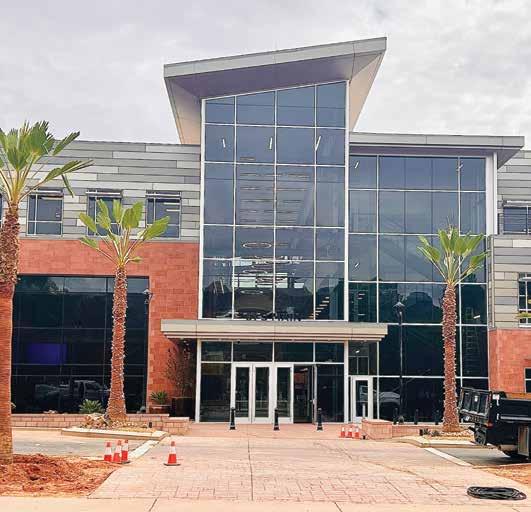
To Serve our Growing City City of St. George to officially open City Hall at Town Square on January 17, 2026
by David Cordero
Back in 1980, when St. George dedicated its City Hall, Jimmy Carter was in the White House, the “Miracle on Ice” had America buzzing, and Pac-Man had just chomped into arcades. Our city counted about 11,350 residents and roughly 100 full-time employees to keep services running.
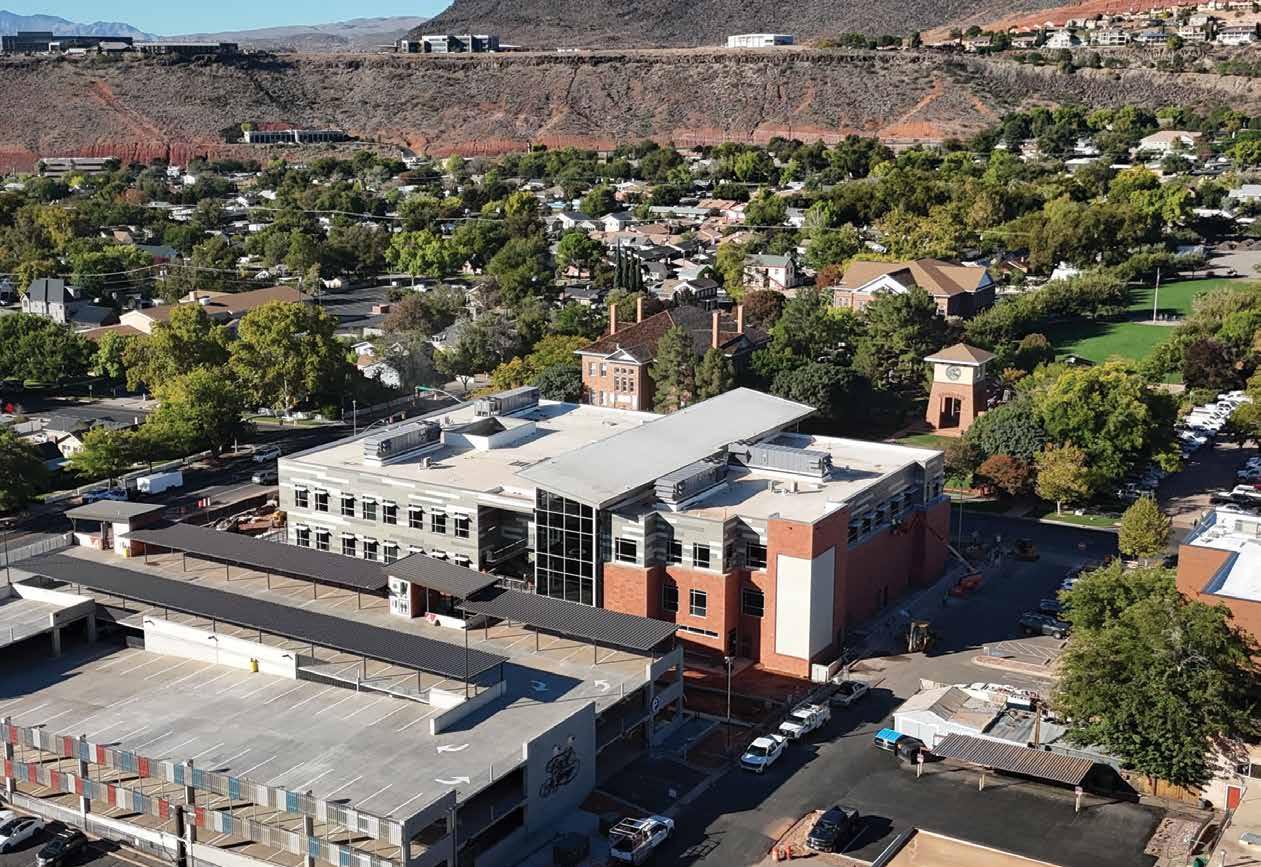
Supported by a professional team of 800-plus full-time city employees, more than 100,000 people call St. George home today. Times have changed—and so has the scale of public service. The newly built City Hall at Town Square, located at 61 South Main Street, was built to accommodate a growing St. George.
“City Hall belongs to the community,” says St. George City Manager John Willis. “As our population has grown, so has the need for spaces that are open, efficient, and welcoming. This building is designed to make it easier to get things done—from paying a bill to speaking at a public meeting.”
The new City Hall is built for service, access, and community.
The features include:
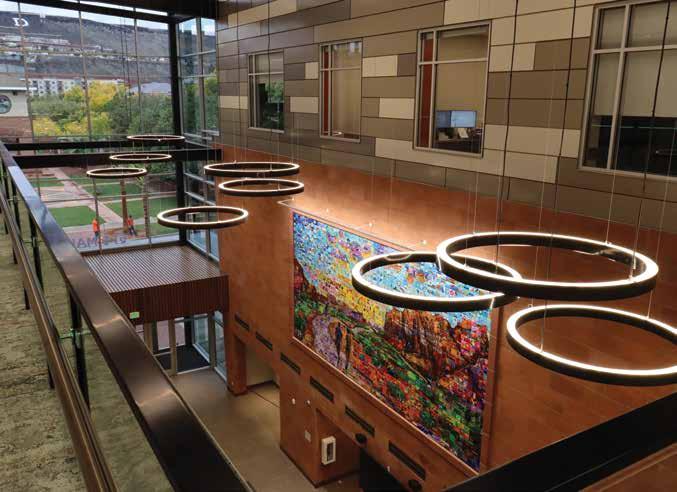
Larger council chambers: Seating doubles from 150 to 300 with flexible conversion to a community room, training center, or space for public forums.
Civic room: A ground-level, 4,350-square -foot civic hall was designed for exhibitions, art installations, and city-hosted events.
Connected atrium: A covered walkway links the new parking structure with easy access to Historic Town Square, the St. George Tabernacle, the Dixie Academy building, and nearby businesses.
Easier parking: A new structure with 290 stalls roughly triples the spaces at the current City Hall and is open seven days a week.
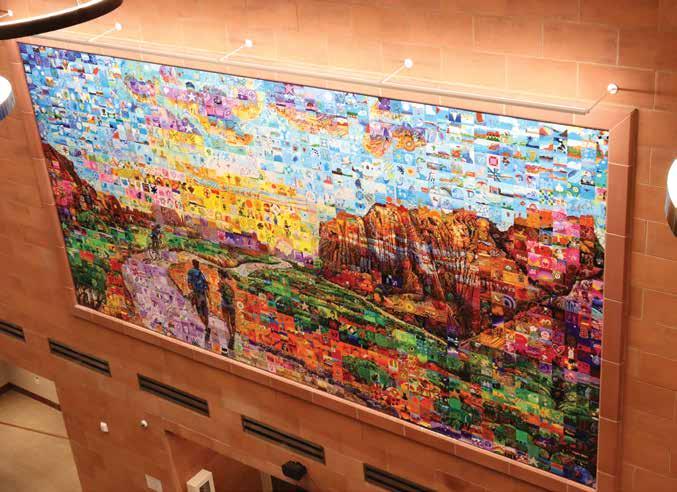
Public mural: A mosaic mural features the contributions of hundreds of residents.
Outdoor plaza on 100 South: An extension of Town Square is for events or a sunny spot to pause between errands.
“The design intentionally ties City Hall to Historic Town Square, strengthening St. George’s cultural heart,” says Marc Mortensen, Operations Director for the City of St. George. “High efficiency, transparency, and usability guided every decision. From natural light to intuitive wayfinding, the goal is a clean, safe, and friendly environment where residents feel invited.”
The St. George Police Department will repurpose the old City Hall building for training and office space, augmenting their headquarters at 265 North 200 East. This improves public safety capacity without constructing a separate facility.
“This project reflects who we are: a city that grows, adapts, and invests in places where people connect with their government— and each other,” Willis adds.V
Grand Opening — Save the Date
Saturday, January 17, 2026, at 11 a.m.
City Hall Grand Opening Celebration at Historic Town Square and the new plaza south of City Hall Heritage Day Celebration comes “down the hill” with root beer floats, live music, games, and family-friendly activities. It will take place immediately after the grand opening program has concluded.
More details can be found at sgcityutah.gov.
Project timeline and cost:
Construction completion: December 2025
Grand Opening Celebration: January 17, 2026
Total project cost: $51.5 million
Approximately $20 million was financed through sales tax and municipal building authority bonds.
Approximately $25 million was used from the city’s capital projects fund and enterprise funds.
A Dream From the Heart: Mesquite’s Cinnamon Café
by Elisa Eames
Jackie Buffington, Mesquite resident and owner of Cinnamon Café, has always loved restaurants and other gathering spaces. Born in Mexico, she and her family moved to Mesquite years ago for a new start. “We fell in love with the small-town charm, the friendly community, and the beautiful desert views,” Buffington says.
Though she has a degree in international business, the majority of her hands-on experience came from years working in the food and hospitality industries. “I’ve taken various management courses, but my greatest lessons have come from running my own business and connecting directly with customers,” she remarks.
Buffington had dreamed of opening her own Café for years, envisioning a cozy, home-like space where patrons could enjoy great coffee and fresh homemade food. “I noticed there was an opportunity in Mesquite for a café that combined homemade quality with warm service, so I decided to take the leap,” she explains. And so Cinnamon Café was born.
She soon discovered firsthand that starting a business demands a substantial amount of effort, perseverance, and faith. For Buffington, everything was personal. The location had to be just right, and the menu needed to provide comfort while displaying creativity. She managed many of the details herself, such as choosing the decor and training her team.
As with any new endeavor, challenges were inevitable, especially since Buffington is a Mesquite transplant. She struggled to get on her feet, not only in a new town but in a new country, and to establish a dependable customer base. “I overcame it by staying consistent—always focusing on quality, kindness, and community,” she reveals. “Word of mouth and local support have been key to our success.”
Though there are other eateries in the area, Cinnamon Café’s unmistakable heart stands out. The unique menu offers American classics, like pancakes, burgers, and French toast, with flavorful international twists. Each item is carefully made with only fresh, quality ingredients and served with noticeable warmth and cheer. “It’s something you don’t find everywhere. Customers often tell us it feels like home when they walk in,” Buffington says modestly.
Cinnamon Café is proud to mark its third year in the Mesquite area and has quickly become a fixture within the community. Organizations, neighbors, and visitors all gather there regularly, and the business is also active in community events. Daily specials, seasonal menus, community breakfasts, and Sundays with live music keep customers on their toes. “We’re always planning something new to keep things exciting for our guests,” Buffington says. The restaurant also loves supporting local causes and working with other local businesses or the Chamber of Commerce. Every year, the café continues to grow and evolve along with its customers.
The aspects of her job that Buffington loves the most include welcoming customers starting their days with her and her team, watching people smile as they enjoy their food, and seeing customers celebrate birthdays. She is proud of how far she and her team have come and the storms they’ve weathered. Apart from facilitating and forging relationships through food, her biggest joy is spending time with her sevenyear-old.
“Every cup of coffee and every meal we serve comes from the heart. We’re grateful for [customer] support and for allowing us to be part of their daily lives… and the community that believed in us,” she says reverently. “Cinnamon Café is more than a business—it’s a labor of love. We’re here to make Mesquite a little warmer, one cup of coffee at a time.”V
Cinnamon Café is located at 555 Highland Drive in Mesquite, Nevada, and is open daily from 7 a.m. to 3 p.m. and from 7 a.m. to 8 p.m. on Fridays. Reach them at (702) 346-3038, and find them on Facebook and Instagram.
New Year... New Strategy:
The “Easiest Chipping Ever” Method
by Rob Krieger, PGA
Kicking off 2026 with a fresh approach to golf could make this your best year yet. Chipping is often challenging for many players, so changing tactics or mindsets can help. Here are common chipping challenges and simple solutions for improvement.
1) Many people struggle to distinguish between chipping and pitching. Chipping sends the ball slightly airborne before it rolls farther, and the clubhead does not get above your knees during the stroke. Pitching keeps the ball in the air longer with less roll. As soon as you start taking the club back above your knees to hip height or to a three-quarter backswing, that is pitching—more air and less roll.
2)
For chipping, use a putting stroke—keeping the clubhead below your knees without wrist hinge—and let the angled clubface lift the ball. You are simply swinging a putter with a ramp on it. Swing level through the grass, striking the ball as well as brushing the grass in front of the ball; this allows the ball to rise up along the clubface, pop up a little bit, and then run. There’s no need to hit down—just make a smooth, level stroke, and let the club’s design do the work.
3)
Some players have been advised to accelerate through the ball, as they tend to slow down the clubhead
through impact, which causes poor contact and unsatisfactory results. Instead, use a pendulum motion with consistent pace and distance during both the backswing and follow-through— keeping both sides equal in power, speed, and length.
4) A frequent challenge in chipping is distance control. The tendency is to select clubs with excessive loft, such as sand wedges, lob wedges, or clubs with 54, 56, 58, 60, and 64 degrees of loft. While these are highly effective for pitch shots because they achieve greater height and less roll using backspin to control, for chip shots, they can be difficult to use. It is hard to determine how much backspin you are adding to your shot as you check up on one shot and then roll out on another. Yes, these clubs can be used, but it is more challenging for the average player.
For consistent chipping results, it is preferable to choose clubs that have less loft, such as pitching wedges, 9, 8, or 7-irons. They promote lower ball flight and increased roll towards the target, enable a more controllable stroke with less elevation, and allow for more roll out. Additionally, many golfers have found success using hybrids and 7-woods for chipping, as these clubs naturally impart topspin and facilitate a smoother roll through any grass height with less effort and backswing required.
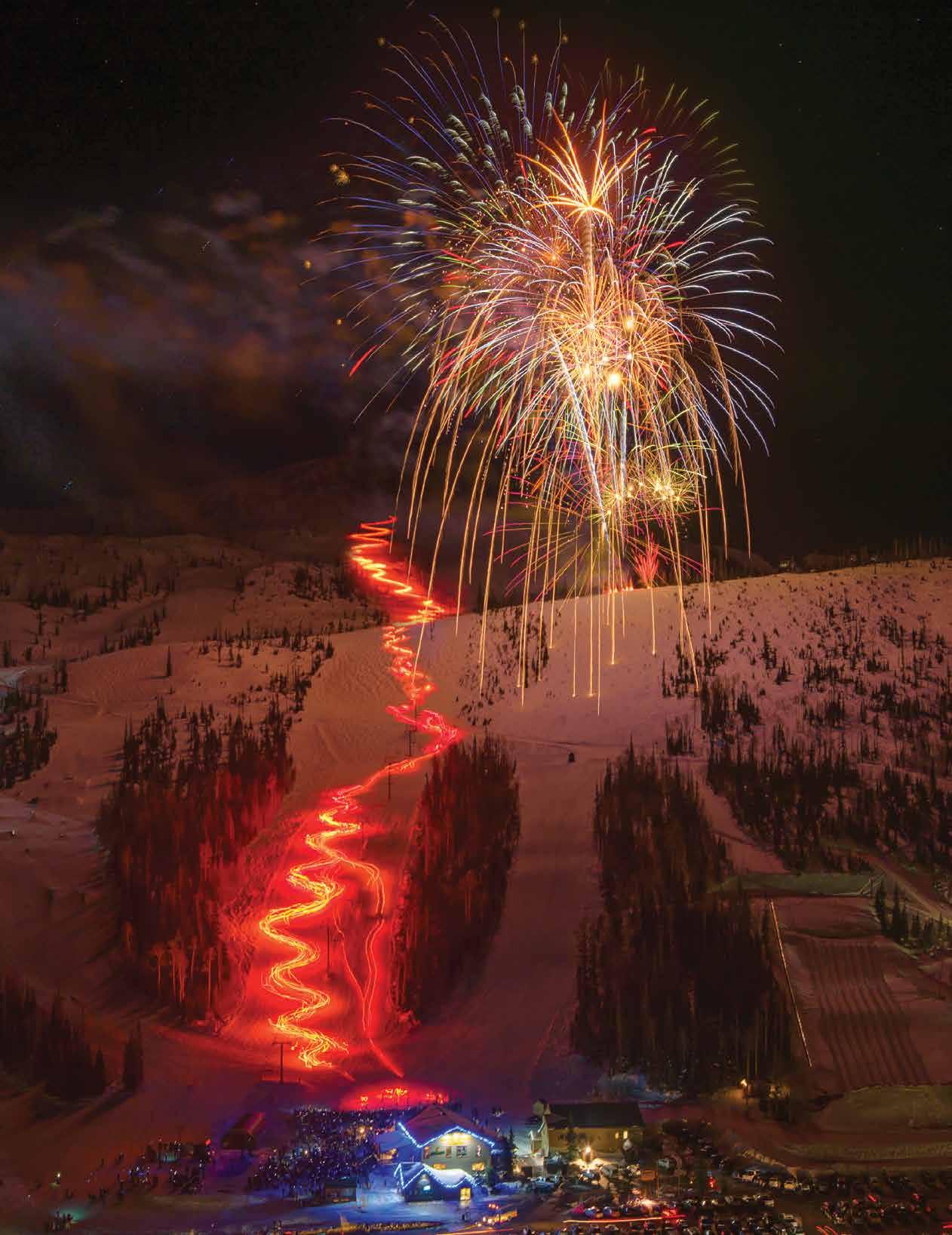
Brian Head Ice Holiday Lights | Photo credit: Visit Cedar City
“Easiest Chipping Ever” Method
1)
Start with a putter, using your regular golf grip. Yes, I know it has a different handle than your other clubs, but please bear with me.
You should always at least consider using your putter from off the green because it has one of the lowest risk, highest success percentages for a golf shot. It may not be the best option, but you should consider it 100% of the time.
2)
Position your feet together with your heels touching. A slight knee flex will help.
3) Place the golf ball in the middle of your feet.
4) Keep both your left and right arms straight. No bending of the elbows.
5)
Take the club back low and level to the ground— below your knees in your backstroke—using just your shoulders and limiting your lower body motion. No hitting down at the ball. Just go through the ball with level motion.
6)
Using a pendulum motion, bring the club smoothly back to the ball, allowing it to brush through the grass and propel the ball along the ground while maintaining control over both distance and clubface alignment. Ensure your backswing and follow-through are of equal length and pace. This technique promotes optimal acceleration throughout the stroke, avoiding both an increase and a decrease in power that could disrupt distance consistency.
7)
After rolling several balls with the putter, try a PW, using the same putting motion and a level swing brushing through the grass. If done correctly, the ball has to go in the air because of the ramp and loft of the club head.
8)
Once successful, try the same motion with an 8-iron and then a hybrid. The ball will still get up in the air, but will have less air time and more roll. A shorter stroke with the same tempo will suffice. Remember, it is still a putter with a ramp. Use your putting stroke.
9) You can modify this by placing more weight on your front foot to eliminate weight shift. You can also experiment with having your hands slightly in front of the ball.
10)Finally, relax your grip pressure and allow the stroke to have some rhythm and smooth tempo, just like putting.
Put your feet together—left and right arms straight—and use a level stroke like putting, not hitting down or up, just through the ball with the same distance back and through like a pendulum.
Winter Festivals l Bryce Canyon
by Karen L. Monsen
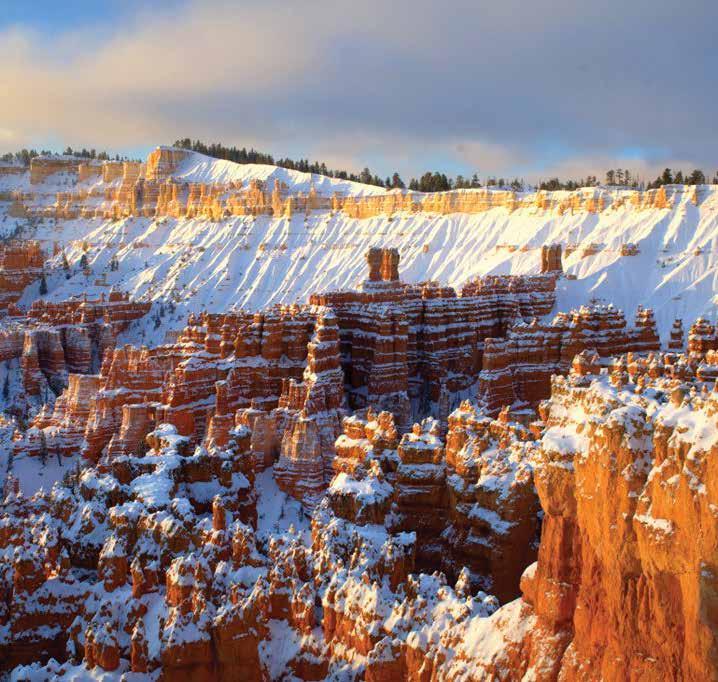
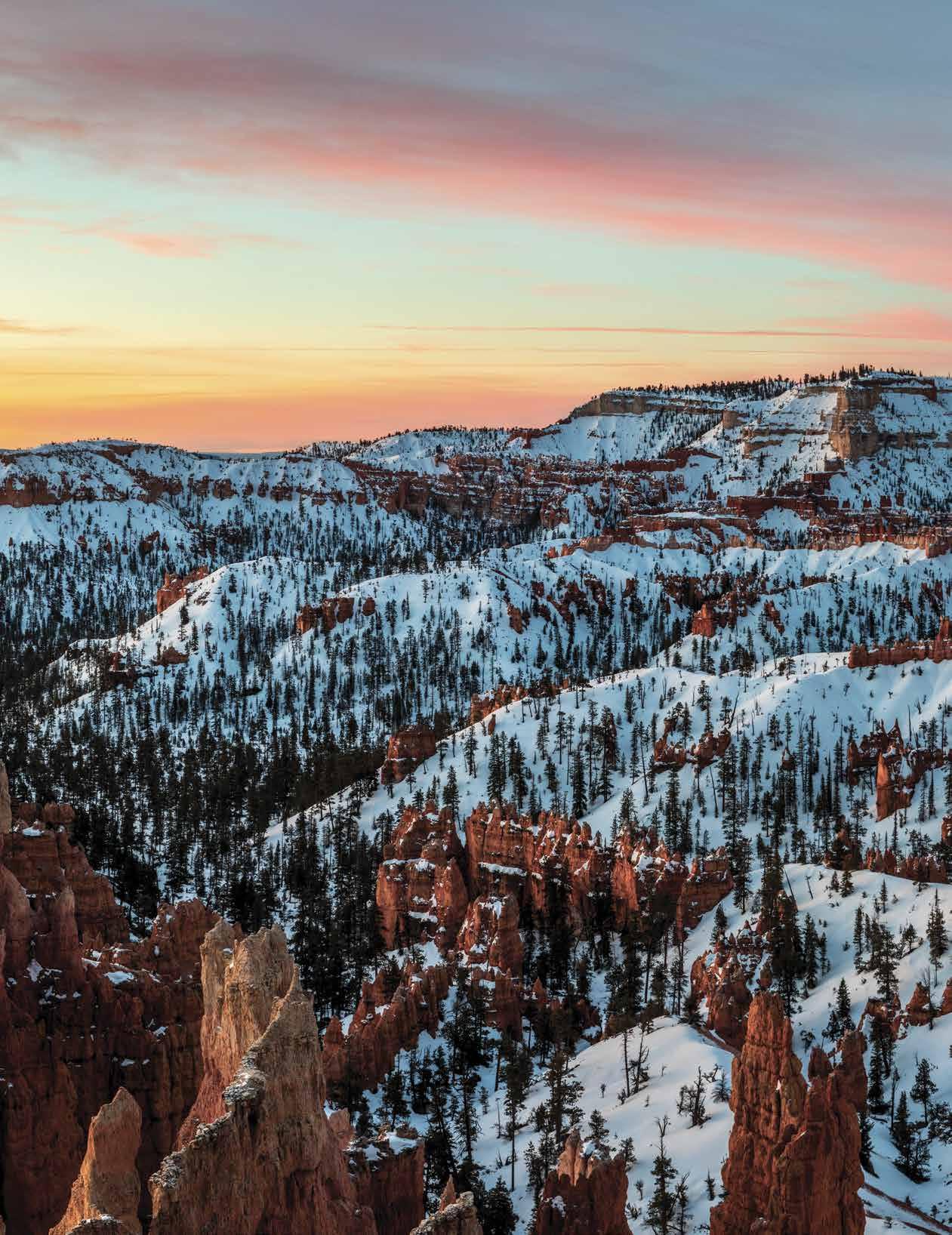
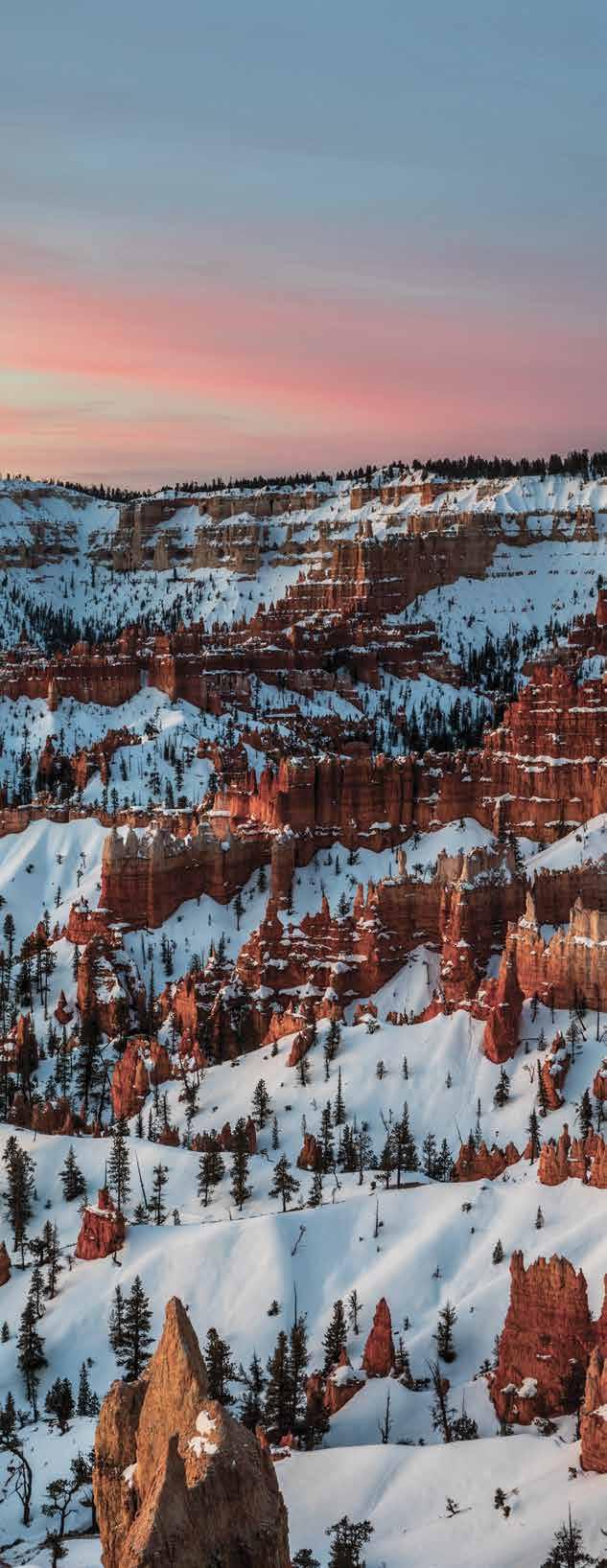
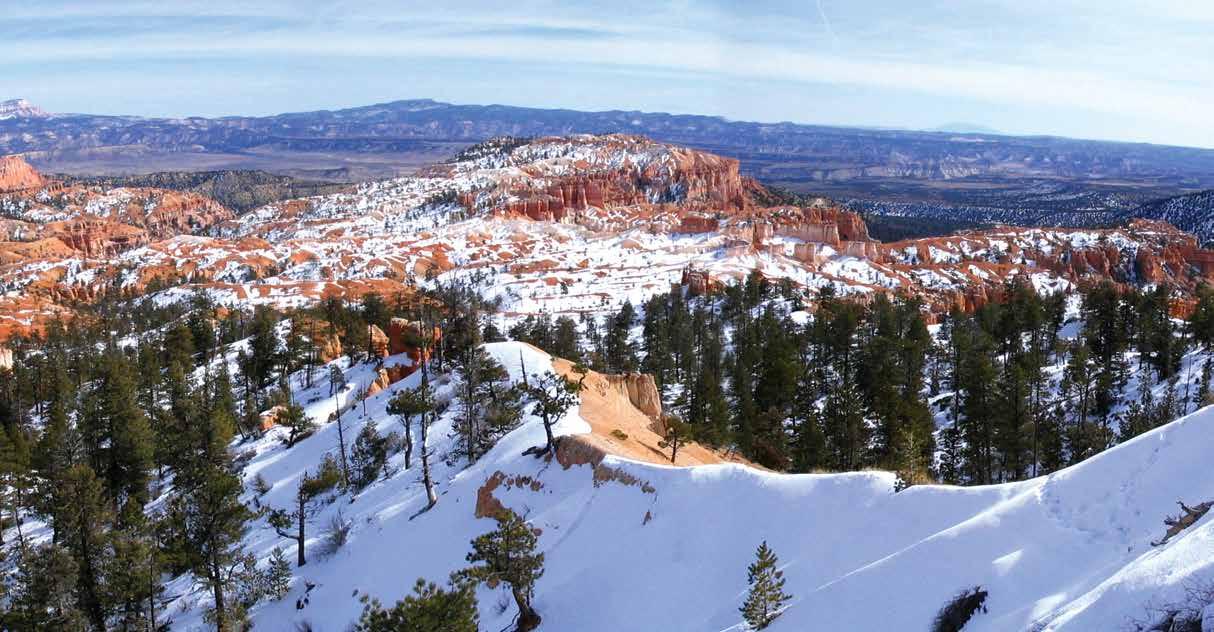
Even though winter festivals are adapting to a warmer climate, the National Park Service promotional material still describes winter in Bryce Canyon National Park as red rocks and pink cliffs topped with white frosting. On a blue-sky day after a snowfall, winter in Bryce includes vistas as far as one can see.
Southern Utah Winter Festivals
Not all winter festivals involve snow. In southern Utah, St. George hosts its Winter 4x4 Jamboree on January 14-17, 2026 (https://winter4x4jamboree.com/events.cfm). Rock-crawling will replace snow skiing.
Kanab, Utah, holds its Balloons and Tunes Roundup on February 20-22, 2026 (https://www.visitsouthernutah.com/ balloons-and-tunes-roundup/). A vendor fair and live bands will ensure visitors are entertained even when the weather does not permit launching hot-air balloons.
However, as they search for a reliably colder location, the annual Midway, Utah, Ice Castles attraction has been canceled for the 2025–2026 season due to warm weather.
The Effects of Warming
Even as far north as Alaska, the famous 1,000-mile dogsled race from Anchorage to Nome, called the Iditarod, was rerouted in 2025 due to insufficient snow. After a ceremonial start in Anchorage, the actual race started 200 miles north in Fairbanks. Three of the four times the race has moved farther north have been in the past decade, leading some to call it the I-Did-A-Detour race.
Warming temperatures have forced ski resorts to rely on manufactured snow. Notably, the 2022 Beijing Winter Olympics was the first to use 100% manufactured snow.
According to The Park Record, the online Park City and Wasatch Back News site, ski resorts in northern Utah have been adjusting to warmer weather and lower snowfalls for years. Artificial snowmaking began in Deer Valley in 2003 using snow guns powered by compressed air to spray fine water droplets that freeze into snow pellets. Deer Valley Resort recently added 2,100 low-energy snowmaking guns with the capacity to cover more than 2,900 acres and almost 100 trails set to open in winter 2025.
Energy and water-efficient snow guns are keeping the slopes open regardless of what nature provides. Farther south in the Tushar Mountains near Beaver, Utah, Eagle Point Ski Resort
began snowmaking in 2017 to maintain consistent quality skiing conditions. According to the National Oceanic and Atmospheric Administration, Utah’s freezing season is 37 days shorter than it was in the 1930s, and state temperatures have warmed over 2.5° Fahrenheit since the early 1900s, making summer conditions equal to those experienced during the Dust Bowl days.
Consequently, Brian Head Ski Resort, 12 miles east of Cedar City, has used snowmaking since the 1990s. With man-made assistance, the 2024–2025 ski season boasted 181 skiable days—the longest in Brian Head’s history.
Bryce Winter Panorama | Photo credit: Ron Carter
Bryce Canyon National Park
Unlike ski resorts, Bryce Canyon National Park relies on nature for snow. Proclaimed a national monument in 1923 and congressionally designated a national park in 1928, Bryce is the highest and coolest of Utah’s national parks, with top elevations ranging from 8,000 to 9,000 feet above sea level.
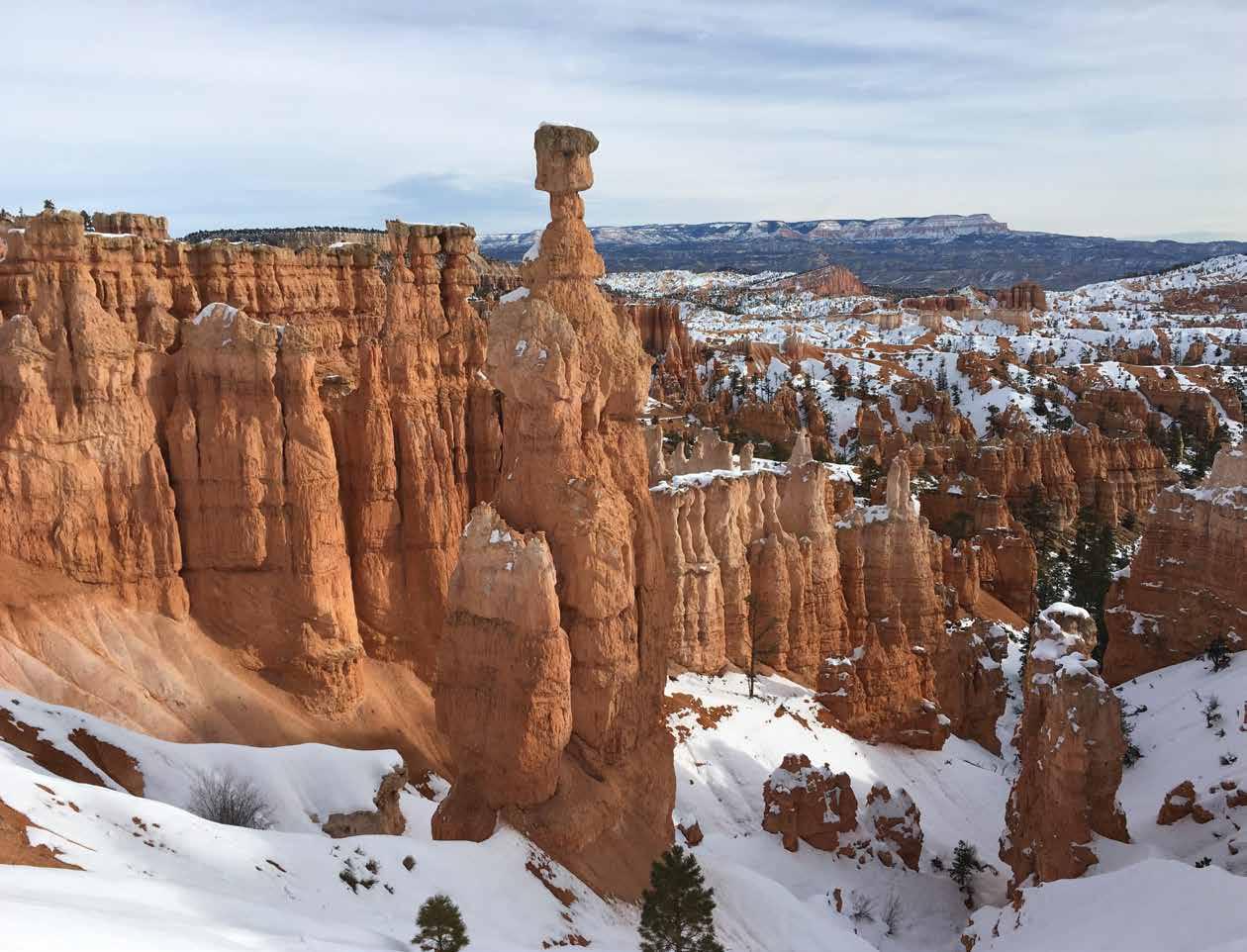
Bryce is known for the largest collection of hoodoos in the world, and its freeze-thaw differential erosion sculpted its Claron Formation into pinnacles, fins, alcoves, bridges, windows, and spires. A harder capstone atop a pinnacle of mudstone, siltstone, and sandstone eroded into the iconic hoodoo called Thor’s Hammer.
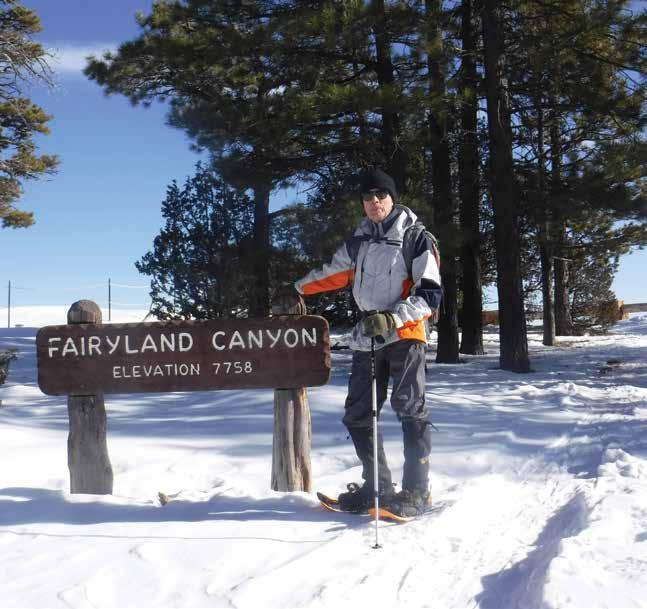
Strange patterns and shapes result when varying amounts of calcium carbonate, which is present in all rocks, dissolve or erode in slightly acidic water or snow. Upon close inspection, hoodoos reveal layers that jut out while others are indented as the calcium carbonate cementation dissolves or resists erosion. A dusting of white snow on the oddly-shaped structures makes the Fairyland Loop Trail truly magical.
Fairyland Canyon | Photo credit: Karen L Monsen
Thor's Hammer Photo credit: Leslie Glenn
Since 1984, Ruby’s Inn has celebrated the colder months with the Bryce Canyon Winter Festival (https://www.rubysinn.com/bryce-canyon-winterfestival/). The 2026 festival runs February 14, 15, and 16.
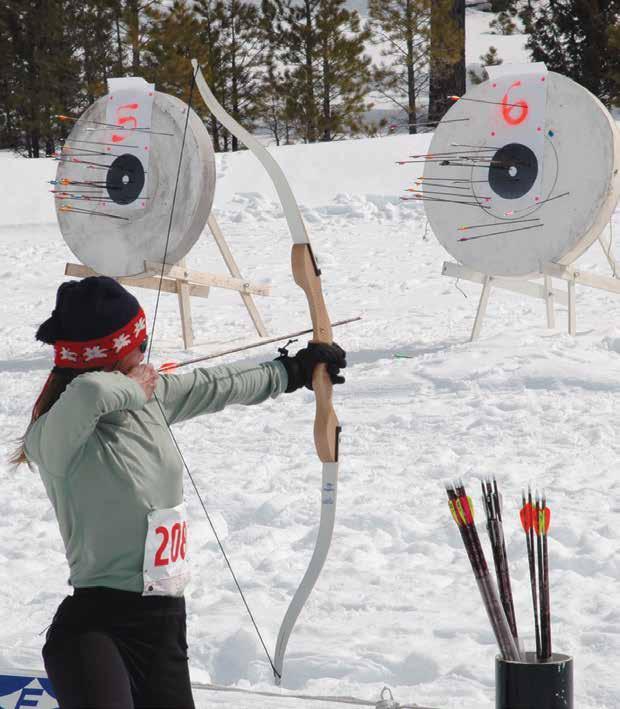
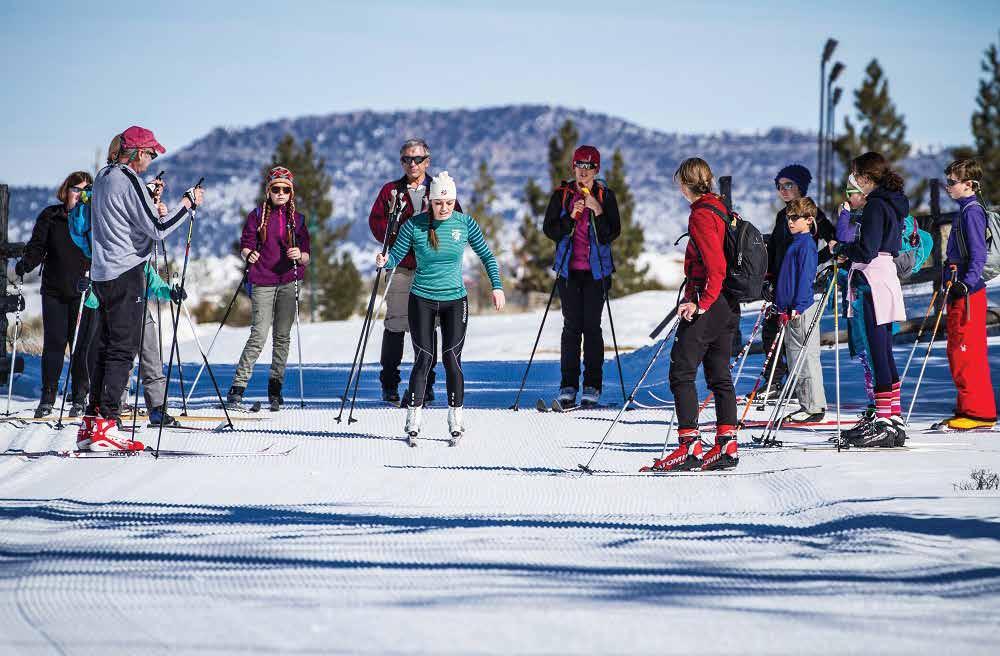
The first festivals were single-day events with a 10k cross-country ski race. Later festivals expanded into full weekend celebrations over the President’s Day holiday with snowshoe races, snow sculpture competitions, ice skating, and an archery biathlon with snow skiing or walking if snow is absent.
There’s something for everyone. Indoor activities include kayaks in the pool, playing with clay, watercolor painting, arts and crafts, nutrition and fitness, astronomy, and photography. Archery classes offer basic skills and target practice. Ruby’s Inn administrator Deanna Moore states, “A few years ago, we expanded our archery program to include any interested participant, not just those competing in the biathlon.”
Archery Biathlon | Photo credit: Ruby's Inn
Bryce Canyon Winter Fest 2016 | Photo credit: Ruby's Inn
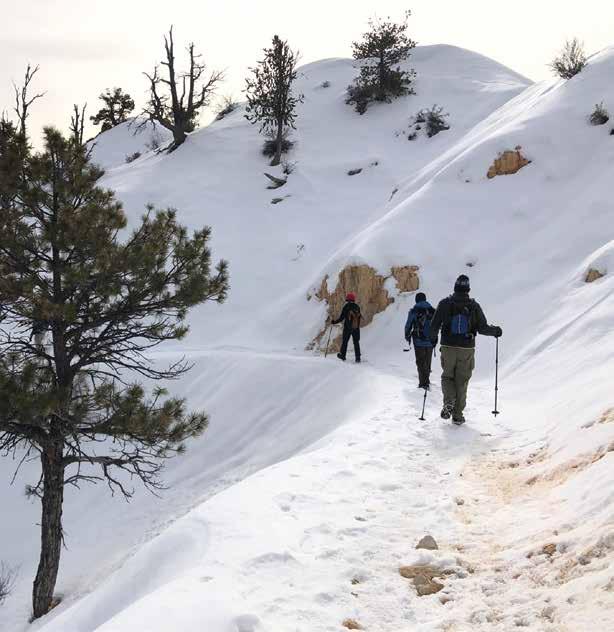
Ruby’s Inn works closely with Bryce Canyon to also offer Sunset Point ranger talks, hoodoo geology, junior ranger programs, Bryce Canyon history presentations, and snowshoe hikes.
Snow or shine, the festival has endless options for winter fun outdoors or indoors. The only time the festival has been canceled was in 2002 during the Salt Lake City Winter Olympics because festival instructors were volunteering for Olympic events.
Moore notes, “There is something incredibly special about the Winter Festival at Ruby’s Inn—it truly feels like a family reunion. Many of our instructors have been returning for over 30 years, and their continued presence brings a personal, familiar touch. It’s like seeing a family member every year, and guests feel that warmth and connection right away.”
While nature will always control the weather, winter festival planners adjust to warming temperatures by changing locations and altering activities. The fun is in the festival—with or without snow.V
Snowshoeing Below Rim | Photo credit: Linda Wohlgemuth
Tourism Grant Mesquite Hits Home Run with
by Amy Bradshaw
Mesquite is stepping into the spotlight as one of two communities chosen to share in Travel Nevada’s $1 million 3D (Destination Development Design) Project grant—an initiative to accelerate long-range tourism growth in rural Nevada.
The Mesquite Opportunities Regional Fund led the application, uniting a broad coalition of community partners. The steering committee includes representatives from the City of Mesquite; Eureka Casino Resort; Mesquite Entertainment; Holiday Inn Resort; Mesquite Senior Games; the Southern Nevada Pickleball Association; the Chamber of Commerce; Virgin Valley Artists Association; Sun City Mesquite; and several citizens-at-large. Their unified vision helped elevate Mesquite’s proposal above that of other applicants.
A Winning Game Plan for Mesquite’s Future
Mesquite’s tourism plan centers on three goals designed to guide the city’s development over the coming years.
1. Sports and Events: Playing to Win
Mesquite aims to establish itself as Nevada’s top year-round family sports and events destination. The plan calls for expanding athletic facilities, hosting more tournaments, and encouraging longer stays. By aligning regional event calendars and supporting local businesses, Mesquite hopes to cement its place as a key hub in the Southwest’s family sports and recreation circuit.
2. A Downtown Designed to Connect Downtown Mesquite will be reimagined as a lively visitor
hub that blends small-town charm with opportunities for exploration. Plans include improving public spaces and signage, revitalizing the visitor center, and promoting walkability in the arts and historic district.
3. Building a Stronger Tourism Identity
At the heart of Mesquite’s vision is collaboration. The city plans to foster a network of local partners supported by microgrants and shared resources to highlight authentic regional experiences.
Together, these initiatives form a championship playbook for a vibrant, inclusive, and sustainable destination—one that rallies community spirit and scores big by welcoming the world.
Travel Nevada Partnership and Planning
These goals resonated with Travel Nevada, and as part of the 3D grant process, they assigned a team of professional travel consultants to work directly with the steering committee and community. The consultants visited Mesquite to gain firsthand insight and craft a comprehensive tourism strategy tailored to the city’s strengths and long-term vision.
The Tourism Asset Inventory Tour
To understand Mesquite’s tourism potential, consultants began with a detailed asset inventory tour. They explored key facilities and attractions—including all eight ballfields, the Fine Arts Center, and local pottery, glass, and framing studios. The tour also covered the Sports and Events Complex, museums, community theatre, recreation center, parks, OHV staging areas, pickleball courts, the unused visitor center, and even a visit to Bunkerville to explore the Vegas Camel Safari.
Consultants also experienced Mesquite’s extensive trail network, eight golf courses, a proposed venue for a reservoir, and the airport. Their goal was to assess both current strengths and future opportunities for development.
Community Voices
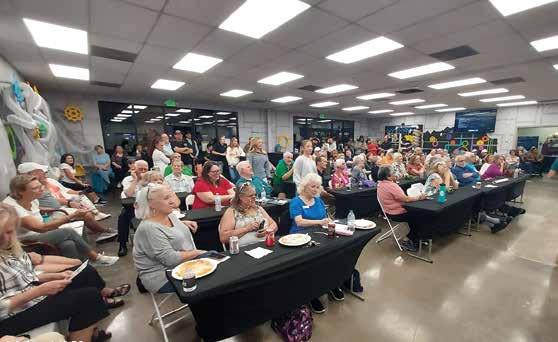
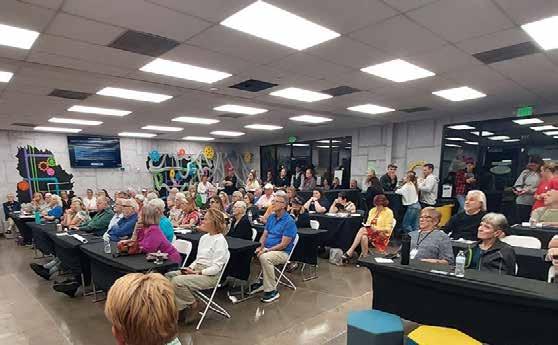
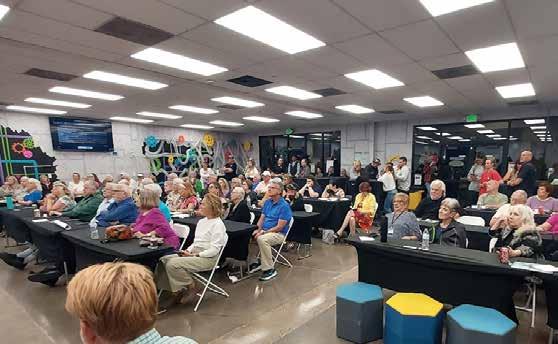
On November 6, Travel Nevada’s consultants hosted the first of two community listening sessions at the Mesquite STEAM Center—and the turnout exceeded expectations. About 140 residents attended to share ideas, concerns, and hopes for the city’s future as a tourism hub. Instant feedback was gathered through QR-code surveys, capturing community input in real time. The energy was overwhelmingly positive, setting a strong tone for the planning process.
The following day, consultants met with the steering committee for deeper discussions about local tourism assets, growth opportunities, and infrastructure needs. The next community listening session is scheduled for Wednesday, February 25, giving residents another chance to shape the final plan.
What Happens Next
After the second session and final planning meetings, Travel Nevada will deliver a recommended tourism blueprint for review. Once finalized, the agency will determine how the $1 million grant will be divided between the two selected communities—Mesquite and Goldfield.
For Mesquite, this process represents far more than funding. It marks an exciting turning point—a chance to build consensus, expand economic opportunities, and envision a future where the city becomes a dynamic destination for families, athletes, and culture-seekers.V
To learn more about the Travel Nevada 3D (Destination Development Design) program, visit www.travelnevada. biz/3D. Questions or comments may be emailed to the steering committee at mesquitenvtourism@gmail.com. Follow facebook.com/mesquitenvtourism for updates on the February 25 community session.
Local Restaurant Spices Up Mesquite’s First Friday
by Terri Fitzsimmons | Photo Credits: Terri Fitzsimmons
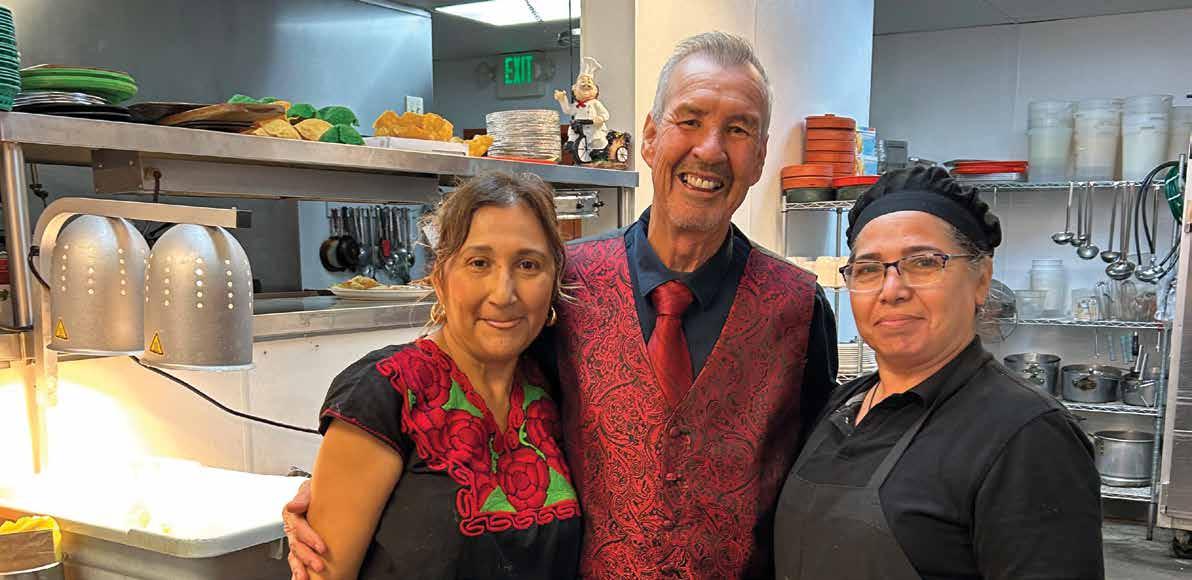
The Mesquite Public Arts Commission’s First Friday Family Art Walk, a monthly celebration of local culture, music, and art, got a tasty culinary boost in November. Local favorite La Fonda Mexican Restaurant, famous for its homemade quality, donated samples of its famous chips and salsa.
The art walk, held at the Mesquite Fine Arts Center and the Jimmie Hughes Campus, attracts locals who visit various booths while enjoying live music and supporting the town's creative spirit. The first event was held in October of 2025, and residents stepped up to the stage to showcase their talents during open mic time.
November’s event was made even more special as the residents enjoyed homemade chips and salsa. Each resident received a 5% discount at the restaurant. Ninety coupons were distributed, and Jean Watkins, director of the Women’s History and Culture Center, donated the extra food to the Mesquite Symphony, who were rehearsing and unable to attend.
The residents all agreed that having the samples was pure genius. “Everybody loves La Fonda’s salsa,” one of the volunteers
said while passing out small containers of red salsa and handfuls of tasty, warm chips. Attendees were seen visiting the booths with containers of the samples in their hands.
La Fonda's contribution demonstrates local business support. The restaurant, which has been a staple in the community for years, uses family recipes dating back to the 1970s. Their homemade salsa and chips are legendary in Mesquite. The owners were more than happy to share with the attendees at the First Friday Event. Because of the success of their contributions, Jean Watkins will be reaching out to more restaurants for upcoming events.
Sergio Becerra, owner of La Fonda, and his team are known for putting their "heart and soul" into their cooking, a philosophy that extends to their community involvement. By contributing to a major public event like the art walk, they invested directly in the town’s quality of life.V
Mesquite’s First Friday Events will continue. We are looking at more businesses to participate. Find information on dates, times, and locations at MesquiteNV.gov/events.
Summer work at can lead to good things
by Vernon Robison
The Overton Power District 5 internship and temp worker programs are more than just summer work opportunities for local youth. In many cases, they have been the beginning of a beautiful friendship between the district and valued, long-term employees.
OPD5 is currently accepting applications for both its internship and its summer temp programs. Applications can be submitted online at opd5.com/about/job-opportunities/.
Internships are open to local high school graduates now enrolled in college or technical school programs in accounting, business, engineering, construction, or a related field. Internship terms run a maximum of 10 weeks and are paid positions.
Summer temp positions are open to local high school students, ages 16–19, as an opportunity to work for OPD5 during summer break.
“We initially view these opportunities as a way for OPD5 to invest back into the community we serve, through developing our youth,” says OPD5 CEO/General Manager MeLisa Garcia. “But it has also been an investment in our future as a district, since some of our best employees have gotten their start here as interns and summer temps. Everybody wins!”
One example of this is Scott Robison, who now works as an OPD5 staking engineer. Robison spent the summers of 2009 and 2010 working at OPD5 while going to college at Southern Utah University. He was studying business at the time, and he had no idea that he would eventually make his career at OPD5.
“One of the linemen kept teasing me that I would come back and work here eventually,” Robison recalls. “But I said, ‘I’m never coming back here. I’m getting a business degree. I’m not even looking at power stuff.’”
Robison graduated from SUU and got married shortly after that second summer. Then he launched into a career. Nearly ten years later, he noticed an opportunity in the OPD5 engineering department and decided to apply.
“When I interviewed, the management team all remembered me from when I interned,” he says. “I absolutely believe that the reason I got this position was because of my experience in that summer help program. I never thought I’d come back, but I’m so glad that I did. I’ve loved this job and the people I’ve worked with.”
After working two summers as an intern, Scott Robison started a career in business, but he came back to OPD5 ten years later and now works as a staking engineer.
A somewhat less circuitous route was taken by OPD5 lineman Mike Abbott. Abbott served in an internship for the district in the summer of 2019, which led directly to him being hired to the line crew.
Shortly after graduating from Moapa Valley High School, Abbott set his professional sights on becoming an electrical lineman. He even completed a rigorous pre-apprenticeship program at Northwestern Lineman College in Meridian, Idaho.
But he never expected that he would be able to return to his hometown in such a position. “I never thought that I would get on at OPD5 because everyone said it is pretty hard to get on here,” Abbott says.
After completing lineman school, Abbott came home for the summer while seeking positions across the country. While
here, he saw some information about a summer internship at OPD5. With encouragement from an OPD5 employee that he knew, he applied and was hired as an intern.
“They told me up front that I shouldn’t get my hopes up, that it probably wasn’t going to lead to a job because they weren’t hiring,” he says. “But I figured it would be good experience while I was applying elsewhere.”
Abbott spent most of the 10-week internship working with the line crew, doing the job of a groundman. The experience was valuable in confirming to him that being a lineman was indeed what he wanted.
By the end of that experience, Abbott had found a position on a line crew at another utility in Texas. He prepared himself for the big move.
“I was packing to move there and take that job,” he remarks. “Then I got a call from [OPD5] asking if I’d be interested in sticking around. I said, ‘Yeah, of course!’ I wanted to stay home.”
Abbott ended up serving another internship for the rest of that year while management obtained official authorization from the OPD5 board to add his position. This was done, and he started as a full-time employee in January of 2020.
“Looking back now, I couldn’t picture it going any other way,” he says. “I am doing what I wanted to do with a great crew. OPD5 is an awesome company that treats its employees well. And I get to live in this valley that I love. It is really the best I could hope for!”V
Application details can be found on our website at: https:// www.opd5.com/about/job-opportunities/. Applications are also available for pickup at either OPD5 office during business hours, Monday through Friday, 8 a.m.– 5 p.m. (closed for lunch from 12 p.m. – 1 p.m.). Any additional questions may be sent to HR@OPD5.com.
OPD5 lineman
Mike Abbott is in his element working at the top of a power pole. He got his career started six years ago as a summer intern at the district.
A New Play at Kayenta for the New Year
by Rook Reilley, Photo Credits: Alan Holben Photography
This February, Kayenta Arts is excited to present a workshop production of The Caregiver’s Guide, a new play by Los Angeles-based playwright Jami Brandli.
The Caregiver’s Guide is a poignant comedy about love, family, and the messiness of caring for one another. When a stand-up comedian returns home and reveals he’s inherited the early-onset Alzheimer’s gene from his late mother, his two sisters are forced to face their own fears about the future, their health, and how to care for someone who doesn’t want to be cared for.
With humor, heart, and a touch of the supernatural, this play explores how one family leans on laughter, memory, and love to make it through life’s hardest turns. Uplifting, funny, and deeply human, The Caregiver’s Guide promises to move and entertain audiences.
Peek Behind the Curtain
The Caregiver’s Guide will be helmed by director Rob Goodman, who brings a remarkable depth of experience.
With more than 60 theatrical productions to his name—including 25 world premieres— Goodman has built a distinguished career championing new work. He is also the founder of Milwaukee's First Stage, a professional theatre for young audiences that is known as one of the nation’s premier theaters for younger patrons. His leadership and creative insight make him the ideal person to move The Caregiver’s Guide from a staged reading to a more robust workshop production.
An accomplished and award-winning Los Angeles-based writer, playwright Jami Brandli returns to Kayenta Arts for the second year in a row to develop a work from the Kayenta New Play Lab. Her work, The Magician’s Sister, was produced at Kayenta in January of 2025 following a staged reading the previous year. Her continued collaboration with Kayenta highlights the strong creative partnership between playwright and play lab—a relationship that once again brings an exciting new theater to life for our audiences.
Rob Goodman
Jami Brandli
A Closer Look at the Kayenta New Play Lab:
The Kayenta New Play Lab has quickly become one of the most vital and exciting pieces of the center’s programming. Designed as an incubator for bold new voices, the lab provides local and national playwrights a rare opportunity to workshop, refine, and test-drive their scripts in a professional, collaborative environment.
Each year, a dedicated panel of directors, dramaturgs, actors, and theater professionals selects a slate of new works to present as live readings. These readings are not only a chance for playwrights to hear their words in front of an audience but also a crucial step in the development process. Feedback from the community, performers, and creative team helps shape the next iteration of each script and whether it ultimately heads toward full production, further workshops, or other developmental pathways.
For audiences, the play lab offers a front-row seat to the creation of new theater—a chance to witness stories in their earliest stages and be part of the artistic evolution. For artists, it provides a space where risk-taking is encouraged and new ideas can flourish.
The Caregiver’s Guide opens February 19, 2026. We hope you’ll join us at the theater to experience something new.V
For more information, call (435) 674-2787, or visit www.KayentaArts.org. You can also email at boxoffice@kayentaarts.com.
Follow us on social media to stay updated on our events! Instagram: @cfakayenta | Facebook: Center for the Arts at Kayenta We are located at 881 Coyote Gulch Court in Ivins, Utah.
view on DESIGN
The Science of Feng Shui: HOW A 3,500-YEAR-OLD PRACTICE CAN BREATHE
NEW LIFE INTO YOUR HOME
by Randi Fuller
Have you ever noticed how often we use home and design metaphors to describe how we feel? We say we’ve “hit a wall” when we’re stuck or feel “backed into a corner” when choices are limited. As Feng Shui expert Karen Rauch Carter explains, “How we discuss our lives is often very easily described with words that correspond directly to our environment.”
It’s no coincidence. Our environments profoundly influence how we think, behave, and heal. This is where the ancient practice of Feng Shui meets modern design psychology, a synergy that forms the core of my work as a psychology-based design strategist at Mesquite Tile and Flooring.
Feng Shui (pronounced “fung shway”) is a 3,500-year-old Chinese practice focused on creating balance by arranging your environment to support the flow of qi, or life energy. Strip away the mysticism, and it becomes a powerfully practical design strategy. It’s about how energy—from light and air to layout and color—feels in a space.
Think of your home not just as a place you live in but as a place that lives with you. With ancient wisdom and modern insight, you can breathe new energy into your space and your daily life.
Let’s explore how Feng Shui’s principles align with evidence-based design for a fresh, grounded “view” this year.
1. Flow & Movement: SPACES THAT MOVE WITH YOU
The principle of flow is central to this ancient practice and emphasizes the smooth movement of energy by removing blocked pathways. In design psychology, uncluttered circulation zones reduce cognitive load, which frees our brains from navigating obstacles so we can truly relax. Research links visual and spatial simplicity to improved mental well-being.
Design Tip: Keep main pathways (entry, living room, kitchen) clear and open to support both physical movement and mental clarity.
2. Visual Calm: DECLUTTER, SIMPLIFY, HARMONIZE
Here, the goal is to achieve harmony of elements by avoiding visual chaos. Modern science strongly agrees: cluttered rooms measurably increase stress hormones like cortisol. A study in the Design Sciences Journal found that spaces incorporating Feng Shui and nature-inspired principles scored higher for “psychological comfort.”
Design Tip: Embrace biophilic design. Introduce nature-inspired elements like a vase of greenery, a painting of a forest, or a palette of soothing blues and greens. You don’t need a living wall; even symbolic representations of nature can calm the mind.
3. Light & Material:
A HOME THAT SUPPORTS YOUR SENSES
This wisdom teaches that our environment is reflected in our internal state. A key biological fact underpins this: as the eye ages, the lens yellows, altering how we see color and light. This is why testing materials in your actual space is so important.
Design Tip: Host a “Sample Slumber Party.” Live with tile, paint, and fabric samples in your home. Observe them in morning, midday, and evening light to ensure your choices feel soothing, not straining, to the eye. Pair this with warmwhite bulbs (2700K–3000K) for a harmonious glow.
4. Body-Friendly Design:
EFFORTLESS LIVING
At its heart, this philosophy champions design that supports well-being at every stage of life. Evidence-based design studies confirm this; one randomized trial found rooms arranged according to these principles lowered anxiety by increasing “pleasantness.”
Design Tip: Integrate anti-fatigue mats in kitchens, choose soft-close drawers, and ensure transitions between flooring are smooth. These are subtle, luxurious-feeling upgrades that support your body without looking clinical.
5. Elemental Balance:
THE TEXTURE OF COMFORT
The system’s use of five elements (earth, wood, metal, water, and fire) is a method for creating balance. The underlying principle is sound: a mix of natural textures promotes optimal comfort and grounds the senses.
Design Tip: Incorporate wood and stone, use soft metallic accents like brass, and avoid overly cold or shiny surfaces that can feel harsh. The goal is a layered, tactile experience.
This ancient art speaks in metaphors, like a mountain for support or water for flow. But from a psychological perspective, these represent universal needs: stability, movement, and renewal.
This year, as you seek a new view, don’t just focus on style. Focus on support. Feng Shui isn’t about superstition. It’s about creating a space that reflects who you are now and encourages who you’re becoming.
Ask yourself:
Does this space calm me or overwhelm me? Is there room to breathe?
Do I feel supported here?
If your home answers “yes,” you’re already practicing the science and spirit of Feng Shui. This year, carry that intention forward. Look at your home not for what it is, but for what
it could be: a true sanctuary, a source of energy, and a foundation for your best life. New year. New view. Fresh energy.
Let your home exhale—and breathe new life into you.V
Randi Fuller is a psychology-based design strategist and the founder of The Science of Sanctuaries, a division of Mesquite Tile & Flooring. As owner of Mesquite Tile & Flooring and with a passion for evidence-based design, Randi explores how psychology shapes our experience of space—helping homeowners and businesses create environments that foster well-being, functionality, and beauty. Her approach blends research-backed insights with real-world design expertise, proving that any space can be a sanctuary.
Find Randi on social media @thescienceofsanctuaries and @mesquitetile. Visit www.mesquitetile.com for more information. Mesquite Tile and Flooring is located at 521 W. Mesquite Blvd. Ste. A in Mesquite, Nevada. Call (702) 346-7225 for any questions you may have.
2026 Mesquite Western Roundup
by Bruce “BT” Bugland
It’s hard to believe that 2026 is upon us. There have certainly been a lot of changes in the past 12 months, and as many of us know, change is sometimes hard to accept.
Well, here’s some great news. One thing that hasn’t changed is America's love of cowboy poetry and the Mesquite Western Poets' dedication to preserving it!
History says that back in the 1800s, cowboys would think up stories during those long days on the trail. Sometimes they’d use the beat of their horses' hooves or the creaking of saddle leather to set a rhythm to their stories. At night, they’d sit around the campfire, spinning tales and telling those rhyming stories, which became known as “cowboy poetry.”
The Mesquite Western Poets began in 2006 as a project sponsored by the Virgin Valley Artists Association. Their first
show was called the Mesquite Cowboy Hootenanny, which premiered in 2007. In 2011, the show became known as the Mesquite Western Roundup and was sponsored by the Mesquite Arts Council. The Mesquite Western Poets group has included poets from Nevada, Utah, Arizona, Wyoming, North Dakota, and California.
This year's shows are scheduled for February 20 at 7 p.m. and February 21 at 1 p.m. and 7 p.m. All will be held at the Mesquite Community Theater at 150 North Yucca Street.
Prior to our cowboy poetry, we’ll have some great pre-show entertainment introduced by our emcee, Jeff Hoyt. Plus, our featured musical group will be Many Strings and Company (Tony and Carol Messerly), who performed with the poets in 2024. They were named 2018 Western Duo of the Year by the Academy of Western Artists, and we guarantee they’ll have you smilin’ and toe tappin’ in no time!
The cowboy poet lineup this year will be a great one. Farrel Bott, a cowboy from Utah who winters in Mesquite, will be there and is always a favorite. Russ Westwood, an awardwinning poet from Utah who now lives in Mesquite, has cowboy poetry in his blood. Kathy Smith has a long family history of ranching in northern Arizona, and she draws upon her heritage to present some great poetry. Steve Campbell grew up in Idaho and now resides in Mesquite. Cattle and horses have always been a part of his life, and he uses real-life experiences in his poetry. Rounding out the group is Bruce “BT” Bugland from Hurricane, Utah. Originally from back east, BT settled out west in his early 20s. When not writing his own poetry, he’s involved in cowboy action shooting and western event photography.V
Tickets are $20 per person and can be purchased at www. mctnv.com or at the Mesquite Community Theater box office one hour before each show.
For additional information, please visit www.mesquitewesternpoets.com.
Mesquite Community Education Foundation: “Investing in Our Own”
by Amy Davis | Photos contributed by Sherry Hartline
Every May at Virgin Valley High School, bright young seniors walk across the graduation stage to receive a diploma from the school’s principal. These young adults can’t help but smile from ear to ear as they realize that all their years of hard work and study have brought them to this final moment. With untethered optimism, they hold dreams of their future in their hearts.
Many of them are ready to take their next steps—college, trade school, or specialized training—but financial barriers stand in the way, threatening their dreams and dimming their hope.
That’s where MCEF and our community (a.k.a. YOU) can make a difference.
The Mesquite Community Education Foundation (MCEF) isn’t a national fund or a distant organization thousands of miles away. It was created by locals in Mesquite with local
VVHS kids in mind. MCEF is a volunteer organization. No one takes a paycheck, so every single dollar raised goes directly to VVHS students—kids who grew up playing on our fields, swimming at the rec center pool, playing in our parks, walking in our parades, and working part-time jobs after school.
Year after year, MCEF aims to bridge the gap between opportunity and despair. When we give, we’re not just writing a check. We’re saying, “We believe in you. We’re proud of you. We’re standing behind you as you take your next step.”
We support our kids, our community, and have one goal: accessibility to higher education.
MCEF was founded in 2017 by Darlene Nelson, a woman who believed deeply in supporting Mesquite’s own. Darlene wanted to donate to kids in her community, but when she learned her scholarship donation would disappear into a
McKadie Cowley and Andrew Cox, both $2,500 recipients, Sherry Hartline (MCEF board member), and Oliver West, $5,000 recipient
district-wide fund, she knew that wasn’t what she wanted. She wanted her gift to make a direct impact here—to go straight to a Virgin Valley High School senior with big dreams and real needs. So instead of settling, Darlene did what trailblazers do: she created a new way forward, and MCEF was born.
The people in Mesquite rallied around the newly created organization. Since 2017, our generous community has helped MCEF raise $200,000 for VVHS graduates. Last year’s Spring Fling Fundraising Event generated $5,500. Total donations approached $42,000 and will go directly toward scholarships. Approximately 108 students from VVHS have been the recipients of scholarships from these funds.
The 2025 recipient of $5,000, Oliver West, says, “It really means a lot to be chosen for this scholarship. I am very grateful to the people of MCEF and their generosity to me and the community. I am currently abroad serving a mission for The Church of Jesus Christ of Latter-day Saints in Paraguay, Asuncion, until October of 2027. When I return, I will attend BYU-Idaho to further my education.”
McKadie Cowley, a 2025 winner of one of the two $2,500 scholarships, says, “Thank you so much for selecting me to receive this amazing scholarship. I cannot express how much this opportunity means to me and how honored and grateful I am to be one of the few selected. This alleviates so many of my worries! My dream has always been to open my own restaurant, and these funds are making my dreams seem more attainable! I can confidently promise that this scholarship will not go to waste.”
Oliver West, MCEF $5,000 Scholarship recipient
In 2024, Marcos Moreno Cervantes was awarded a $5,000 scholarship from MCEF. Marcos is a neuroscience major at the University of Nevada in Reno. He says, “Thanks to the generosity of the MCEF, I have been able to concentrate on my education rather than needing to work. This has given me the time and the freedom to apply for, gain acceptance, and focus on the Pack Research Experience Program and obtain a first-generation one-to-one coaching program in Trio STEM Scholars!”
How do we continue making dreams come true? This is where you, dear community member, come in. We cannot do this without you.
We need you because when one of our students succeeds, our whole town shines brighter. These kids are our people and our future. If you want your money to make a difference in the world, this is the organization that can help make that happen.
Our goal this year is to raise $30,000. This would provide 23 scholarships (one for $5,000, two for $2,500, and 20 for $1,000).
It sounds cliché, but no donation is too small. Even the smallest amounts add up to a powerful message—that this community stands together for its children and we are here to be partners in their success. $5. $50. $1,000. It doesn’t take much to change the course of a life.
Help us bridge financial gaps. Help us bring hope. Help us keep our legacy of care and generosity alive. Your donation can lift our young people and give them the chance to achieve their dreams.
Together, we all rise.V
Join us by donating today to MCEF and help a VVHS student take their next step toward success. Questions may be directed to our email: mcefscholarships@gmail.com.
Donations may be mailed to MCEF, PO Box 2784 Mesquite, NV 89024 or visit www.mesquitecefscholarships.org to donate.
The Mother Road Turns 100:
by Christine Ward
In 2026, U.S. Route 66—the legendary "Main Street of America"—will celebrate its centennial, marking 100 years since its official designation. More than just a highway, Route 66 is a ribbon of asphalt woven into the fabric of the American story, a symbol of freedom, migration, and the quintessential road trip. From its vital role in the nation’s growth to its near-obliteration by the interstate system, the Mother Road has persevered, and the upcoming centennial promises a spectacular, year-long revival of its enduring spirit.
The Birth of an American Icon Route 66 was officially designated on November 11, 1926, as part of the new U.S. Interstate System. It was designed to connect small towns and rural communities to this national system, which provided a main highway for travelers to reach the country's newly developing agrarian economies. Route 66 covered 2,448 miles and traversed eight states: Illinois, Missouri, Kansas, Oklahoma, Texas, New Mexico, Arizona, and California. The road earned the nickname “Main Street of America” because traveling it brought people directly through the downtown areas of so many communities.
John Steinbeck’s novel, The Grapes of Wrath, was published in 1939, and it immortalized Route 66 as the “Mother Road.” The novel told the story of Dust Bowl families fleeing the impoverished plains on their way to discover the promises of southern California.
As economic conditions improved for most of the country after World War II and into the 1950s, Route 66 provided a way for millions of families to plan and enjoy road trip vacations, visiting the many “mom and pop” businesses that sprang up to cater to ever-increasing visitors. All along Route 66 from Chicago to Santa Monica, businesses offered necessary services and enjoyable side stops, including motels, diners, gas stations, and quirky roadside attractions. Route 66 was truly the perfect “road to adventure,” attracting millions of visitors during the burgeoning car culture of the era.
The Interstate Bypass and the Price of Progress In 1956, the Federal Aid Highway Act was passed, and this led to the creation of the Interstate Highway System, which was intended to provide efficiency and speed along the country’s highways. While this new system created more efficient car travel across the country, it also bypassed many of the communities that had been focused on and had served so many travelers along Route 66.
Construction for Interstate 40 began in the mid-1950s and ended in 1984 when the Arizona section was completed. During that time, several towns and communities along the original Route 66 experienced significant drops in visitors. The last stretch of Route 66 was officially bypassed by I-40 around Williams, Arizona, on June 27, 1985, and resulted in devastating losses for many towns in northern Arizona. Williams was the last town to be bypassed by Interstate 40.
The people of the affected communities refused to accept the loss of travelers and instead began to promote businesses along the former Route 66, working to get the road designated as a national scenic byway and recognized as Historic Route 66. Angel Delgadillo, a local barber in Seligman, Arizona, became a legend and hero as he worked tirelessly for the Historic Route 66 designation.
Pixar’s 2006 movie, Cars, takes place in fictional Radiator Springs, a town inspired by real-life events in several Arizona towns, including Williams, Peach Springs, Seligman, Oatman, Holbrook, and others.
Route 66 Centennial Celebration
The U.S. Route 66 Centennial Commission was established by Congress in 2020 and was tasked with researching and recommending activities to honor the road on its 100th anniversary this year. Numerous events and activities will take place all along Historic Route 66 to commemorate the amazing highway that played such a large role in the lives and businesses of our nation. Many of the events will take place in the northern Arizona towns of Kingman, Oatman, Seligman, Flagstaff, and Williams.
Route 66 to the Grand Canyon National Park
Although the Grand Canyon is not on Route 66, it is just one hour from Williams, which is heavily involved in the Route 66 Centennial. Williams is considered “The Gateway to the Grand Canyon” because it offers easy access to the national park whether visitors drive themselves or ride on the Grand Canyon Railway, which provides daily service from Williams to the Grand Canyon National Park South Rim.
Visit the website to learn more about:
· Route 66 centennial events in northern Arizona
· The history of Route 66 in northern Arizona
· The Route 66 boarding pass that offers discounts and special offers for Grand Canyon and northern Arizona tours, dining, lodging, and more.
· TripAdvisor and Google Reviews for northern Arizona and Grand Canyon tours, lodging, dining, and more.V
For more information, scan the code to visit www.gc-route66.com.
Let Kitchen Encounters Help You Get Organized in the New Year
by Debbie Gendron
As we turn the calendar and set fresh goals for the year ahead, there’s no better time to bring that “new year, new you” energy into your home. While fitness and finances often take center stage, there’s one area that quietly affects your daily peace of mind—organization.
From the garage and laundry room to the pantry and closets, every corner of your home can benefit from thoughtful cabinetry and clever storage solutions. With the right approach, you can transform cluttered spaces into calm, functional areas that make every day run more smoothly.
1. The Closet: Streamlined Style Every Morning Closets are where organization meets inspiration. Your daily routine starts and ends here. The right closet system transforms a closet from crowded chaos into a personal boutique.
Mix hanging rods, open adjustable shelving, and drawers to create a balance between display and storage. Use double hanging sections for shirts and pants, and reserve fulllength areas for dresses and coats. Velvet-lined drawers for accessories or jewelry elevate both form and function. If you have enough space, include a center island with drawers or pull-out wire baskets.
2. The Laundry Room: Efficiency Meets Elegance Laundry rooms are often compact, yet they handle some of the hardest tasks in the home. A well-designed layout can make laundry day less of a chore and more of a pleasure.
Choose custom upper and lower cabinets to conceal detergents, cleaning products, and supplies. Include a pull-out hamper to sort clothes and reduce clutter on the floor. Floating
shelves or open cubbies above the washer and dryer create easy access for everyday essentials.
Drawers and durable moisture-resistant finishes stand up to humidity while maintaining a polished look. Consider adding a built-in hanging rod, a folding countertop, or a fold-down ironing board.
3. The Pantry: Your Culinary Command Center
A beautifully organized pantry doesn’t just look great; it saves time, reduces waste, and makes cooking more enjoyable. Whether you have a walk-in space or a compact cabinet pantry, structure is key.
Incorporate pull-out drawers and adjustable shelving to maximize every inch of space. Deep drawers can store bulky items like flour containers and small appliances, while shallow drawers keep snacks and spices easy to reach. Clear containers, wire baskets, and consistent labeling help maintain order.
4. The Garage: From Chaos to Functionality
The garage often becomes the household catch-all for tools, sports gear, holiday decor, and everything in between. The secret to reclaiming it lies in storage cabinets and dedicated zones.
Install heavy-duty wall-mounted cabinets and ceiling storage racks to free up valuable floor space. Adjustable shelving inside allows you to store everything from car care supplies to power tools in an organized fashion. For frequently used items, consider open shelving or clear bins with labels.
Add a workbench with built-in drawers to keep hand tools accessible but neatly tucked away. Pegboards above the bench can hold small items like wrenches and scissors—a professional look that’s both practical and stylish.
Design Trends for 2026: Clean Lines, Smart Function
This year’s home organization trends emphasize versatility and sustainability. Homeowners are seeking cabinetry that adapts to their evolving needs—modular components, eco-friendly finishes, and concealed storage that keeps spaces visually calm.
Color palettes lean toward soft neutrals, warm wood tones, and matte finishes, offering a timeless backdrop for any design style. And technology is quietly stepping in—think soft-close mechanisms, integrated lighting, and smart storage accessories that help you stay effortlessly organized.
Start Fresh with Custom Solutions
As you plan your projects for the new year, remember that a well-organized home isn’t just about storage; it’s about creating harmony. Custom storage solutions allow you to tailor every detail to your lifestyle, from the depth of a drawer to the finish on a cabinet door.
By investing in smart, personalized organization systems for your garage, laundry, pantry, and closets, you’re not just clearing space; you’re creating room for what truly matters in the new year ahead.
Ready to transform your home?
Start the new year with beautiful, functional cabinetry designed just for you. Whether you’re looking to reclaim your garage, streamline your pantry, or reinvent your closet, our design experts can help turn your storage goals into reality. Call us today for a free in-home estimate.V
Kitchen Encounters is located at 521 W. Mesquite Blvd., Ste B. For more information, please call (702) 346-2076.
A NEW MUSEUM FOR MESQUITE!
by Jean Watkins and Terri Fitzsimmons
The Women’s History and Culture Center is proud to announce the opening of Mesquite’s newest museum, The Women’s History Museum. Take a journey through a history of narratives about resilient women who challenged conventional historical perspectives. Showcasing suffrage leaders to unsung innovators, every exhibit is a testament to the diverse roles women have played in human progress.
With both permanent and rotating exhibits, this museum is a source of inspiration and a reminder that progress is built on the tireless efforts of those who came before us and continues to be shaped by women today!
Upon entering the museum, you will be given a selfguided tour map to observe, read, and learn at your leisure. Permanent exhibits include Nevada’s Historical Suffrage Markers, our Founder’s Corner, a SAXON exhibit, and a Nevada Suffrage Timeline. In our Founder’s Corner, you will get to know Mesquite resident Jean Watkins, who has founded four local non-profit organizations: The Ms. Senior
Mesquite Pageant, The Mesquite Showgirls, The Women’s History and Culture Center, and the new Women’s History Museum.
Our SAXON exhibit immerses you in the four-month automobile trip that Nell Richardson and Alice Burke took in 1916 to build support for women’s voting rights. You will watch a seven-minute video with actual footage, see historical artifacts they took on the trip, and read genuine news articles chronicling their journey around the United States. You will also learn how the Women’s History and Culture Center commemorates this event with an annual SAXON contest. Some of the contest entries are on display.
Our Nevada Suffrage Wall highlights the major players and events in the Nevada Suffrage movement before and after women got the right to vote. The Nevada Historical Marker exhibit features six locations you can visit in Nevada that highlight people and events in the 1800s and early 1900s that led to the passage of women’s voting rights.
Our “rotating exhibits” change out either quarterly or biannually. They are currently showcasing “First Ladies and Their Causes,” which highlights sixteen amazing wives of U.S. presidents and the initiatives they implemented while their husbands served as president to better the lives of ordinary people across our country. We also have “Women in Aviation” that acknowledges the many contributions women around the world have made in the many facets of aviation.
We are excited to offer this fascinating and educational look at how women have made an impact in their communities, states, and country. We look forward to welcoming you to Mesquite’s Women’s History Museum!V
The Women’s History Museum is staffed and open to the public starting in January of 2026 on Tuesdays and Thursdays from 11 a.m. to 1 p.m. and 4 p.m. to 6 p.m. We are located in the Women’s Suffrage Plaza at 225 N. Willow Street in Room 18 in Mesquite, Nevada. To arrange a private tour or group visit, please email whccmesquitenv@gmail.com. There is no charge to visit the museum, but donations are appreciated and help us to add new exhibits.
Smoky Mountain Road Trip Loop
by Cliff & Ilene Bandringa, www.BackRoadsWest.com
This month, we’re going to take you on a rather adventurous dirt road trip through some amazingly colorful and absolutely stunning Utah scenery. Our road trip is a loop that will take the average driver the whole day to complete. It starts and ends in the small town of Big Water, Utah, near Lake Powell, about 16 miles from Page, Arizona.
Much of our trip explores the inside of the Grand StaircaseEscalante National Monument, with some of it passing through Glen Canyon National Recreation Area. The roundtrip distance is about 54 miles. The trip should be taken in an SUV with adequate ground clearance; four-wheel drive is not necessary. Every time we’ve enjoyed this trip, those 54 miles were on well-groomed roads.
However, because they’re all dirt roads, Mother Nature can change the conditions in an instant with one vicious downpour. That’s why it’s always a good idea to check in with
the national monument visitor center in Big Water. Not only can you inquire about the conditions of the roads, but you’ll also learn a little more about where you’re going.
The road we’ll be taking is called Smoky Mountain Road, and it’s also known as BLM Road 300. It stretches from Big Water all the way to the town of Escalante—77 miles total. On this trip, we’re only going to experience the first third of that stretch. We’ve traveled most of this road to Escalante, but the section described in this article is by far the most scenic.
Our trip starts where Highway 89 meets Ethan Allen Road, which is across from the visitor center. Head north for a couple of blocks, and look for the signs to Smoky Mountain Road and Escalante leading to the right. The pavement soon ends, and the road begins skirting the mighty cliffs of the Kaiparowits Plateau. We will continue to skirt these cliffs for the next 12 miles.
After these 12 miles, we come to a fork in the road. Smoky Mountain Road bears to the right, which is the road we’ll use to return to this very spot on our way back. For now, we’re going to bear left onto Smoky Hollow Road. This road slowly climbs up to the top of the Kaiparowits Plateau through a winding canyon called Smoky Hollow. The terrain will close in around you and become a lot more colorful.
As we travel up the layers of the plateau, we’ll begin to see some jet-black sedimentary layers that seem to be of a different material than the surrounding layers. These are coal seams. It was these seams that caused a stir in the 1970s when mining companies wanted to extract the coal for energy production. This interest was one of the main motivations for creating the Grand Staircase-Escalante National Monument— to save the plateau from extensive mining. Another reason was to preserve the abundance of dinosaur fossils that were being discovered inside the plateau at about the same
time. Now, many discoveries are being made in the field of Cretaceous-era paleontology, and the demand for coal has all but disappeared.
Soon, we find ourselves at the top of the plateau, where Smoky Hollow Road creates a T with Smoky Mountain Road (the road we started on in Big Water). We’ll turn right. This marks the halfway point through our trip. Once on top of this plateau, we’ll have good views of faraway places, such as Powell Point near Bryce Canyon, 40 miles to the northwest, and the rounded Navajo Mountain, 35 miles to the east.
After driving on the plateau for about four miles, we’ll take a small side trip to the left on Road 332. After heading northeast for about a mile, we’ll discover why this is called Smoky Mountain. This area has little vegetation. Look for smoke rising out of the ground. Remember those coal seams? Well, this smoke is coming from an underground coal fire.
The cliffs of the Kaiparowits Plateau
Geologists believe that these fires were started by lightning, perhaps over a hundred years ago. Do you remember seeing the coal seams as we climbed up Smoky Hollow Road? Did you notice their elevation about three-quarters of the way up? That’s how far down this fire is—a few hundred feet deep. We’ll see those coal seams again on the way down. It’s also interesting to note that the state of Utah spent a few million dollars trying unsuccessfully to extinguish these fires.
Continuing south on Smoky Mountain Road, we’ll soon arrive at the Smoky Mountain Overlook. From this vantage point, the sweeping, panoramic view of the rugged terrain that we’ll soon descend into—and the Lake Powell region stretching beyond—is simply breathtaking. After the overlook, our
road begins descending what’s known as the Kelly Grade. For many travelers, this is the highlight of the entire loop. In our opinion, if there were a road that dropped into the Grand Canyon itself, it would look a lot like this—steep, dramatic, and absolutely unforgettable.
Just like the ascent through Smoky Hollow, descending the Kelly Grade is an intensely colorful experience. That’s thanks to the John Henry Member of the Straight Cliffs Formation—a geological layer known for its vivid colors and rugged textures. This colorful landscape is a welcome surprise.
After our descent through the Kelly Grade concludes, Smoky Mountain Road returns us to where we veered left onto Smoky Hollow Road many hours ago. We’ll continue heading south, then west, on Smoky Mountain Road, retracing our route back to Big Water. On the way back, if you have some extra time, you might want to check out some fancy rock formations in Wiregrass Canyon.
There’s more to see on this road trip than can fit in this article, and you’ll want to see the visually stunning scenery, so we invite you to check out our virtual video tour on YouTube. Search for “Smoky Mountain Loop Road Trip” by BackRoadsWest. Visit our travel blog at www.BackRoadsWest.com/ blog and search for “Smoky Mountain” to get more information and view an interactive map of the trip.
Cheers and Happy Exploring!V
Smoky Mountain Road approaching Kelly Grade
A coal seam
Smoke on Smoky Mountain
It turns out you CAN teach an old dog new tricks…
by Anita DeLelles, LMT
Why does my dog need training? It seems obvious, but we hear this question a lot. The short answer is simple. Training creates a bond, friendship, and mutual understanding between the dog and his guardian, leading to a lifelong, healthy relationship. When you have this harmony, it reduces stress for both of you, eliminating small aggravations that can grow into an unmanageable nuisance! Too often, our help is only requested after bad habits have been formed and are making a dog difficult to manage. It’s basically a communication problem, and the good news is it can be fixed! But starting early with good quality training is the ideal plan.
Studies show that having a well-trained, happy dog that is relaxed and responsive means more pleasure from dog ownership. As a result, training strengthens the dog-human bond and establishes a close, enjoyable relationship. And there’s the added perk of impressing your friends with a dog that loves to show off its perfect manners!
Manage Behavior
Positive reinforcement training teaches basic commands through a reward-based training technique. Shock collars, choke collars, and other punishment-based techniques utilize fear and break down a dog’s emotional well-being.
This actually weakens the bond with your pet. Good training enables you to manage and enjoy your dog at home and in public. With good manners, your dog can become a part of the family, knowing how to greet someone politely at the door, coming back when called, and walking safely under control on a leash without pulling. These are skills that develop with clear, calm communication between owner and dog.
Build Social Skills
Socialization is one of the most important skills a dog should master early in their puppyhood. Learning how to respond to other dogs—what is acceptable and not acceptable in dog language—is an essential life lesson both owners and dogs need to understand. Social skills will allow your dog to cope and behave well during everyday occasions, such as encountering other dogs during walks, veterinary visits, boarding, and in playgroups. Knowing how to read when your dog signals stress, discomfort, and anxiety will allow you to manage situations that arise and avoid confrontations. After a puppy’s second set of vaccines, he will be ready to join a guided puppy social class. In these classes, puppies will be introduced to new sounds, other puppies, people, distractions, and smells. A trainer will introduce these new experiences in a positive and rewarding environment. With older or adopted dogs or your current family dog, it is never too late to retrain and manage your dog’s response to external situations. You can actually teach old dogs new tricks! Doggie daycare or dog parks are NOT places where dogs can safely learn to socialize, and one bad experience with another dog and/or owner can have life-long repercussions.
Attend Group Training Classes
Training classes are fun for both you and your dog. The exercises taught are stimulating and engaging. Even if your dog has perfect manners, training classes are available at all levels to teach new skills and reinforce current skills. WOOF! Wellness Center & Training Academy offers classes such as Puppy Socials, Basic and Advanced Obedience, Recall & Place Training, and even a Tricks class. Group and one-on-one options are offered. Their Loose Leash training class ends in an interactive group hike through a scenic local state park. The opportunity to consult your trainer while on a hike with real-time obstacles is invaluable. This can also help address your own training difficulties.
If your goal is to prepare your dog to be a service dog (trained to do specific tasks for you) or a therapy dog (one that visits nursing homes or hospitals), it all begins with basic obedience training and learning real-life skills. Dogs with advanced training can get their AKC Canine Good Citizen certificates and so much more.
Whether your dog is old, young, or somewhere in-between, it is never too late to refresh skills, learn new ones, or just hang out with other dogs and like-minded pet owners in a training environment.V
For more information on health and training for your pet, visit woofcenter.com. Call or stop by WOOF! Wellness Center & Training Academy in Santa Clara. (435) 275-4536. Anita DeLelles, LMT
TENNIS TNT -tips-n-tricks-
by Donna Eads
It is summer “down under,” so the first Grand Slam Event of the year starts in Melbourne, Australia. The Australian Open has become the most popular and well-attended tennis event in the southern hemisphere over the last 30 years. Being so far away made it a struggle in the beginning due to only a few of the top ten players being able to make the trip, but in 1993, the Australian Open upgraded with three roof-covered stadium courts in Melbourne Park and many more improvements. The event leaders have not had to look back, and it is now a super Grand Slam event.
Watch the open starting on Monday, January 12, to Sunday, February 1, with the men’s singles final at the Rod Laver Arena. The pros play at an advanced level, and we can learn from watching their performances.
The first thing is to look at their footwork. They usually take 10 to 15 steps before striking a ball, whereas the club player takes only half that amount. For proper footwork for a volley, think of a cross-over step to the left for a forehand and one to the right for a backhand. Of course, if you are left-handed, just reverse the feet. When you time your cross-over step with your volley, it makes your volley stronger and makes the ball go deeper into the court.
Watch how pros keep their eyes on the ball and how they keep their heads still until they hit. Any head movement
affects the stroke by changing the racquet face and timing. Maintaining eye contact plus no head movement is a must.
Speaking of head movement, one of the best examples of the importance of keeping your head still was during an indoor match with Steffi Graf while she was serving. There was a camera directly above the serve line that videotaped the fact that Steffi’s head and eyes stayed up until the serve was hit. This is true for both the serve and an overhead shot.
In doubles, teamwork is also a huge part of the game. Knowing where your partner is on the court is part of winning any point. For example, when a lob is hit over your partner at the net after you serve, you must cross to cover that lob, and your partner must switch to cover the other side of the court. As a team, your partner should look back to see how much trouble you are having as you try to hit a good shot. This is one of the few times the player should look back. If it is a weak shot, your partner should move back because your team is on defense. Again, work as a team and move like you are linked together by a rope.
Finally, do you want to hit a sharp out wide angle? The trick is to turn your back toward your target. If you are aiming at your opponent’s alley, your back is turned toward that alley. And remember to use your cross-over step to make it a strong penetrating volley.V
Embracing the
by Judi Moreo
The phrase “embrace the moment” sounds simple enough, but in practice, it’s one of life’s hardest lessons. We live in an age of constant distraction—phones buzzing, thoughts racing, calendars overflowing—and yet, true joy rarely hides in the chaos of what’s next. It hides in what’s now.
To embrace the moment is to inhabit your life fully. It’s about showing up—mind, body, and spirit—for the only thing that’s actually real: this second. The past is a memory, the future a guess. The present is a gift, cliché as that may sound, but clichés endure because they’re true.
The Art of Presence
Most people are physically present but mentally elsewhere. We replay old arguments, rehearse imaginary futures, or scroll through someone else’s highlight reel while our own life unfolds unnoticed. The irony is that we chase happiness through anticipation or reflection—dreaming of what’s ahead or mourning what’s gone—while the joy we’re seeking is quietly sitting beside us, waiting for us to notice it.
Presence takes practice. It’s a discipline, not a personality trait. It doesn’t mean ignoring the past or the future; it means not living in them. The mind loves to time-travel; the soul prefers to stay home.
Try this: stop for sixty seconds and look around. Notice the colors, the textures, the sounds that usually blur into background noise. The world is alive with details that reward attention—the rhythm of your own breath, the play of light on a wall, the way a breeze feels against your skin. These are the moments that tether us to reality.
The Cost of Distraction
When we fail to live in the moment, we don’t only lose time— we lose depth. Rushing through life creates the illusion of accomplishment but leaves us empty. You can tick every box on your to-do list and still feel unfulfilled if you never pause long enough to actually feel alive.
Technology, for all its brilliance, has made this even trickier. Notifications are the modern equivalent of mosquitoes—tiny interruptions that keep us buzzing but never satisfied. Every ding and ping pulls us away from where we are and into where we’re not.
To embrace the moment means setting boundaries for distractions. It might mean silencing your phone for an hour, eating without a screen, or taking a walk without earbuds. These small acts of rebellion reclaim your attention from a world that profits from your distraction.
The Beauty of the Ordinary
Embracing the moment doesn’t always mean seeking excitement. In fact, it often means the opposite—finding beauty in the ordinary. The smell of coffee in the morning. The sound of laughter echoing down a hallway. The satisfaction of performing a small task well.
We’ve been trained to equate happiness with grand achievements—promotions, vacations, awards—but lasting contentment lives in simpler spaces. You don’t have to chase sunsets on distant beaches to feel wonder; you can find it in your own backyard if you’re paying attention.
The poet, Mary Oliver, wrote, “To pay attention, this is our endless and proper work.” That’s what embracing the moment
Moment
is: the work of paying attention—to others, to ourselves, and to the fleeting beauty of existence.
When Life Isn’t Easy
It’s one thing to embrace the moment when life is good; it’s another when life is painful. Yet even in difficulty, presence is a refuge. When you stop running from your emotions and allow yourself to experience them entirely—without judgment or resistance—you begin to transform them.
Grief, fear, anger, uncertainty—these are not enemies. They are visitors carrying messages. To embrace them is to learn from them. Pain, when faced directly, becomes information. When avoided, it becomes suffering.
So rather than asking, “How do I get past this?”, try asking, “What is this moment trying to teach me?” You’ll often find that clarity, strength, and compassion grow in the same soil as discomfort.
Practice, Not Perfection
No one lives perfectly in the moment—not even the monks who’ve dedicated their lives to it. The human mind is restless by design. The goal isn’t to banish thought or control every second; it’s to keep returning to awareness whenever you drift away.
It’s like steering a boat on a windy day. The wind will push you off course, but with gentle correction, you can find your way back. Every time you notice you’ve become lost in thought but you’re able to bring your attention back to now, you strengthen your ability to live consciously.
One powerful technique is gratitude. When you take time to appreciate what’s here—right now—you automatically
anchor yourself in the present. Gratitude transforms moments of routine into moments of meaning. The act of noticing what’s good doesn’t change your circumstances; it changes your state of mind.
The Ripple Effect
Living in the moment isn’t selfish—it’s generous. When you are fully present, you give others your undivided attention, which is one of the rarest gifts you can offer. Conversations become richer, relationships deepen, and you start to experience connection rather than mere interaction.
The truth is, embracing the moment ripples outward. It makes you calmer, more grounded, more open. You start to see life not as something happening to you, but as something happening for you—and with you.
Living Awake
We spend much of life asleep with our eyes open, drifting through routines, missing the miracle of being alive. To embrace the moment is to wake up—to realize that this is it. It’s not rehearsal, not preparation—life is happening now, in all its messy, beautiful imperfection.
So, breathe deeply. Feel your feet on the ground. Look someone in the eye when they speak. Taste your food. Listen to the music of your own laughter.
This moment will never come again, but it’s enough. It’s more than enough. It’s everything.V
Judi Moreo is an award-winning author, speaker, and coach. She is also an editor and a publisher and has written 29 books. If you have a story inside you waiting to be told, Judi can help you. Reach her at (702) 609-2075.