12
|
MAY 2026
THE RIVER VIEW
Q&A with
JOHN SAVAGE S
ummer camp has long been a part of the experience of growing up in our corner of the world. We spoke with Camp Centennial Director John Savage about the value of the camp experience for young people. Camp Centennial draws campers from across our region and, sometimes, beyond.
Q: What does a typical week at camp look like? There are of course different age groups and different programs, but the fundamental idea is simple – the kids are spending their day outside. The activities range from campfires and canoeing to rock climbing to outdoor cooking, singing, field games, and forest games – all those things that you think of when you close your eyes and picture a summer camp. One of the philosophies that we discuss with staff during training is that all of those things that we spend time learning and doing, like canoe paddle strokes, are not the goal. They are the conduit through which we teach valuable things like curiosity, and fostering independence, and what independence looks like for a five year old who is coming to day camp for the first time, and how that differs from what independence looks like for our leadership campers who are fifteen
and sixteen. It looks different again for our counsellors. But, this whole program focuses on values, going back to Owen Fraser (editor’s note – Owen Fraser was a teacher at Harrison Trimble High School and long-time advocate of outdoor activity) when he established these programs. Society is figuring out how to teach and encourage young people without causing harm; camps provide this amazing space where a seventeen year old can be given a leadership opportunity to succeed.
Q: How does that work for counsellors and campers alike? There is a sense in which camps have not changed much in fifty or one hundred years. We see an appreciation for that consistency of tradition. We have never had cell phones for the kids, or access to technology; there is a growing appreciation for the simpli-
city in which you can approach a day, for the value of play. We are in a day and age where that is appreciated emotionally but it is also beginning to be appreciated academically as we come to understand the value of the types of experiences young people have at camp. Some of those old expressions, like “it takes a village to raise a child,” remind us of how people come together to make this experience. We try to set things up so that, for example, if that day campers are excited about turtles, the counsellor’s response will be “let’s go look at turtles,” more than, “today we have to go look at turtles.” Campers come back pumped about seeing turtles and counsellors embody that moment.
have lost. We just try to create the environment that fosters them. You just need to live it, to embody it.
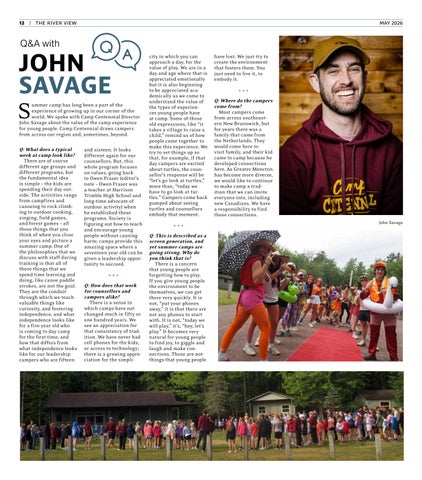
Q: Where do the campers come from? Most campers come from across southeastern New Brunswick, but for years there was a family that came from the Netherlands. They would come here to visit family, and their kid came to camp because he developed connections here. As Greater Moncton has become more diverse, we would like to continue to make camp a tradition that we can invite everyone into, including new Canadians. We have a responsibility to find those connections. John Savage
Q: This is described as a screen generation, and yet summer camps are going strong. Why do you think that is? There is a concern that young people are forgetting how to play. If you give young people the environment to be themselves, we can get there very quickly. It is not, “put your phones away,” it is that there are not any phones to start with. It is not, “today we will play,” it’s, “hey, let’s play.” It becomes very natural for young people to find joy, to giggle and laugh and make connections. Those are not things that young people