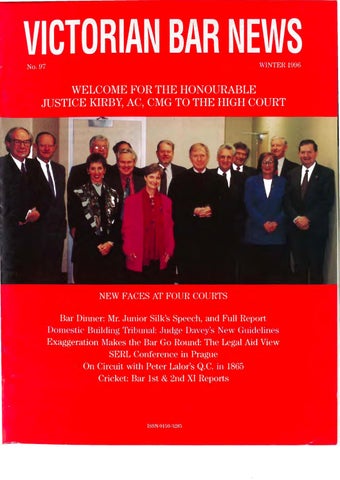
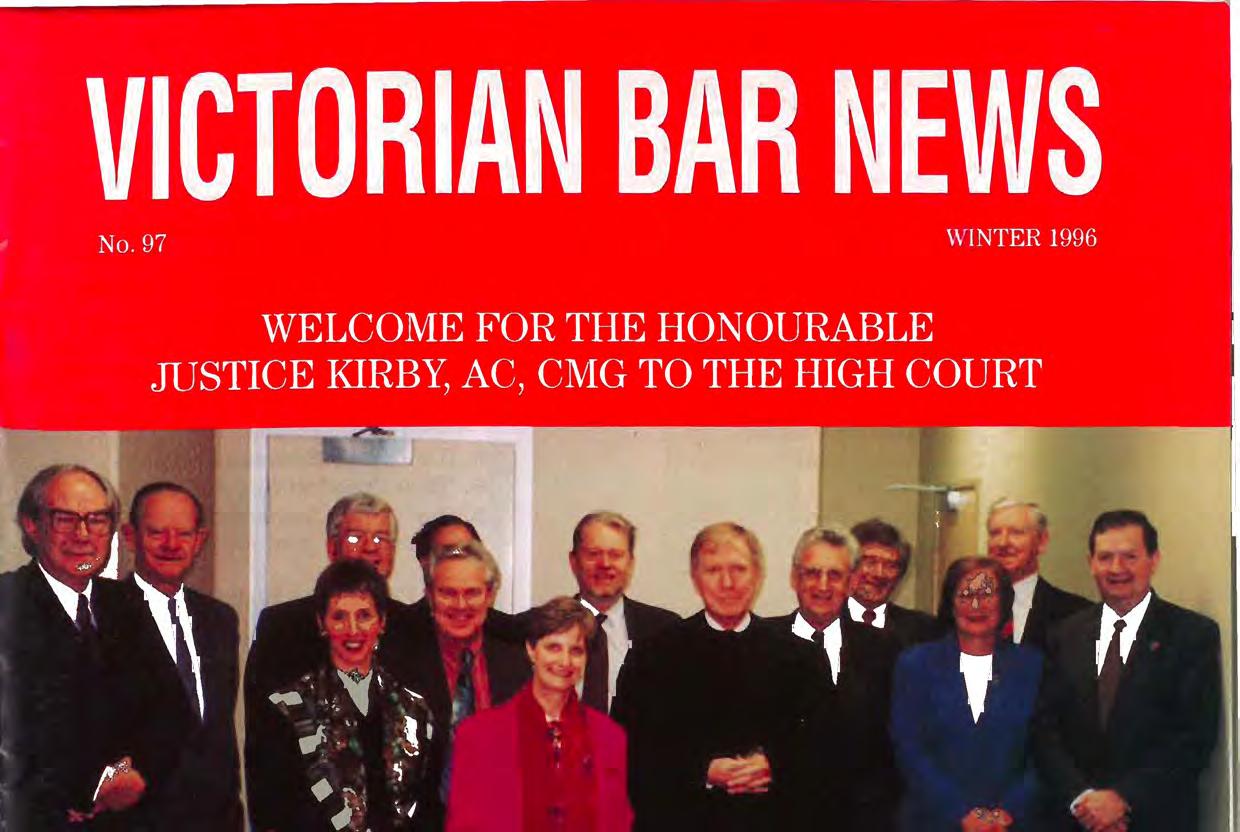
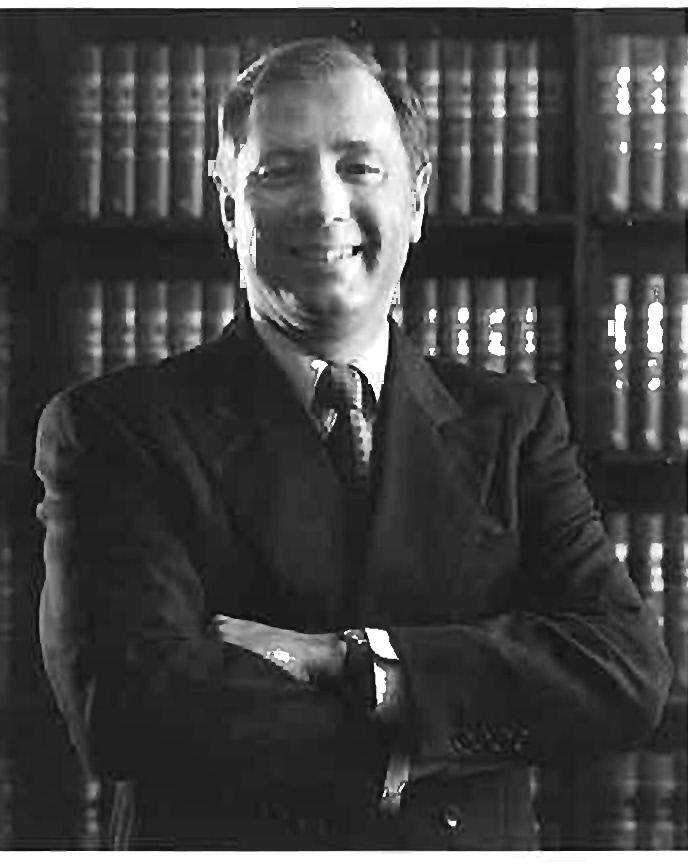
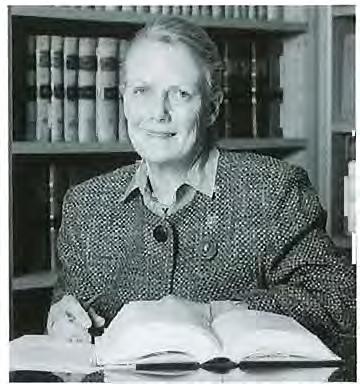
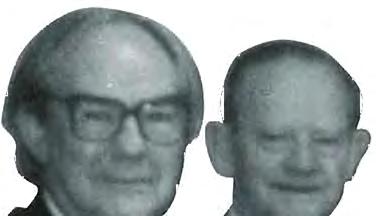
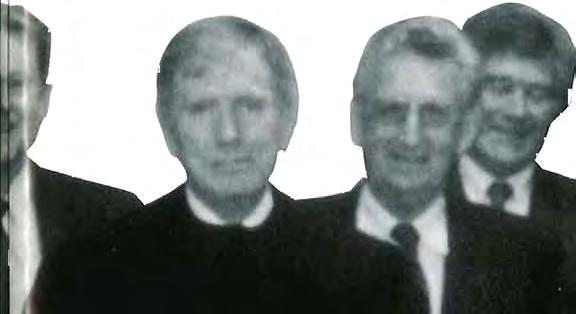
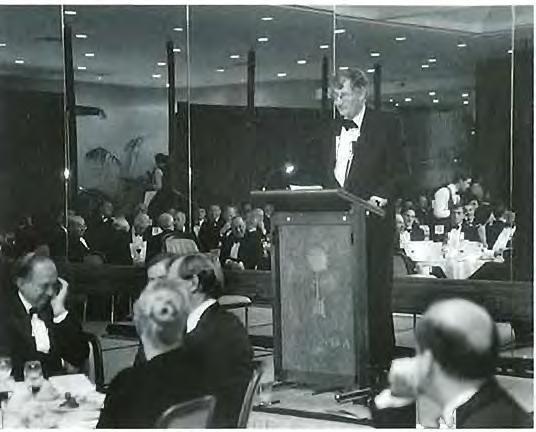
The Bar Council Chairman, John Middleton Q.c., weLcomed the Hon Justic e Kirby to hisfirst sitting as a Justice of the High Court in MeLbourne. His weLcome and that ofMr Woods of the Law Institute of Victoria, and his Honour's
[SSN01 50·3285
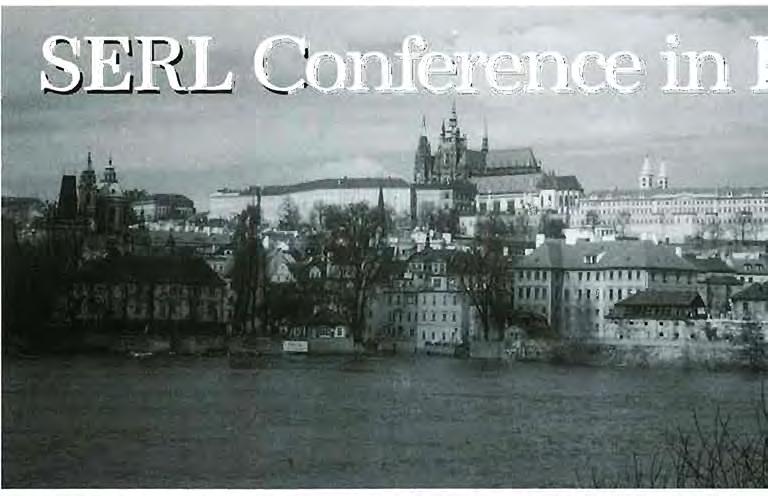
SERL Conference in Prague
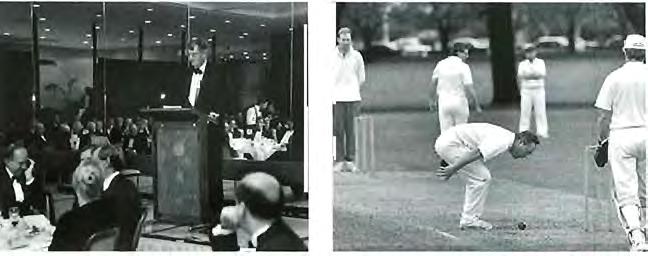
Junior SiLk's speech to the 1996 Bar Dinner
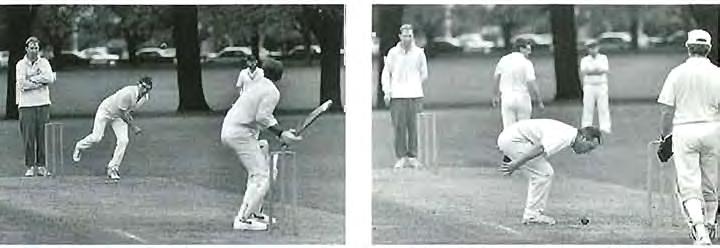
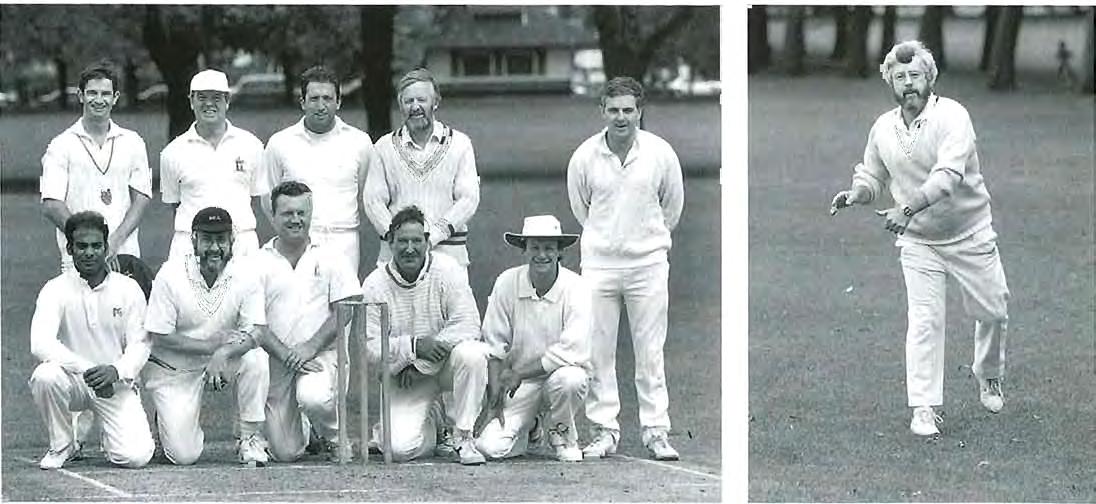
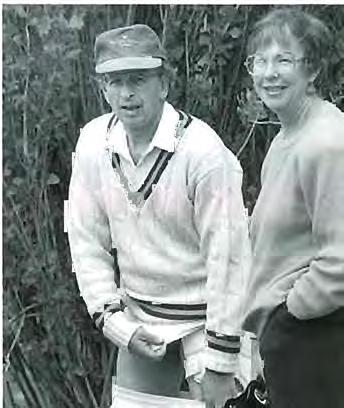
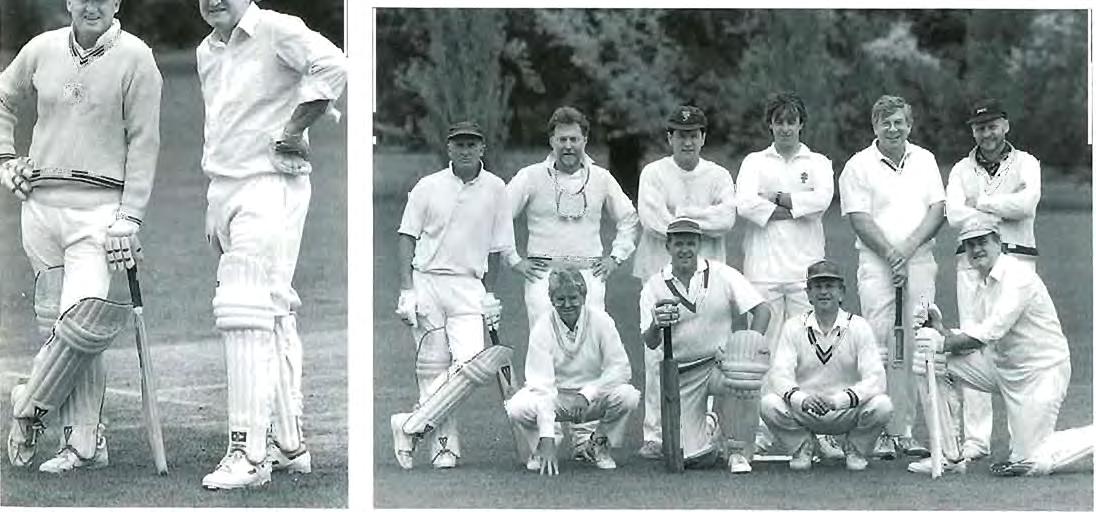
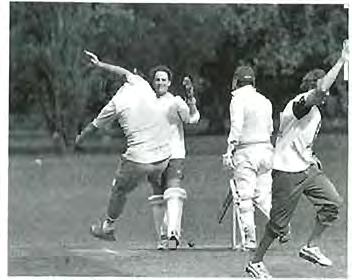
One of the Better Dinners Bar 1st and 2nd XI cricket
VICTORIAN BAR COUNCIL for the year 1995/96
Clerks:
G *Middleton Q.C., J.E. (Chairman)
B *Young Q.C., N.J. (Vice-Chairman)
F *Uren Q.C., A.G. (Vice-Chairman)
R *Redlich Q.C., RF.
D Bongiorno Q.C., B D.
A Macaw Q.C., RC.
H Keenan Q.C., J.P.
G *Burnside Q.C., J.w.K.
H *Rush Q.C., J.T.
G *Curtain Q.C., D.E. (Horwrary Treasurer)
W *Ray, W.R
G McMillan, C.F.
F Colbran, M.J.
D Beach, D.F.R (Assistant Honorary Treasurer)
D McIntosh, A.J.
A Tsalanidis , J.
A Richards, J.E.
S Elliott, J .D.
F Bryant, D.
G Hollingworth, E.J.
G McLeod, F.M.
A Moloney, G.J. (Honorary Secretary)
Ethics Committee
F Zichy-Woinarski Q C., W B (Chairman)
D Lyons Q.C., J.F.
F Guest Q C., P.M.
H Wright Q.C., H.McM
A Macaw Q.C., RC.
H Rush Q C., J.T.
S Magee Q.C., E.N.
R Kenny, S.C.
A Crennan, M.J.
W Stoikovska, R
A Pagone, G.T.
D Davies, J.
G McInnes, RJ.
H Williams, K.M. (Secretary)
S Storey, F.J (Assistant Secretary)
* Executive Committee
VICTORIAN BAR NEWS
Editors
Gerard Nash Q.C. and Paul Elliott
Editorial Board
David Bennett Q.C.
Julian Burnside Q.C
Graeme Thompson
Editorial Consultant
David Wilken
Chairmen of Standing Committees of the Bar Council
Academic and Continuing Legal Education Committee
L Forsyth Q.C., N.H.M.
Applications Review Committee
R Redlich Q.C., RF.
Bar Constitution Committee
D Barnard Q.C., J.E.
Bar Staff Committee
G Middleton Q.C., J.E.
Child Care Facilities Committee
R O'Brien, F.r.
Counsel Committee
F Uren Q.C., A.G.
Equality Before the Law Committee
G Lewitan Q.C , RA.
Ethics Committee
F Zichy-Woinarski Q.C., W.B .
Indonesian Legal Aid Committee
D Fajgenbaum Q.C., J.I
Law Reform Committee
M Moshinsky Q.C., N.A.
Legal Resources Committee
W Jessup Q.C., C N
Past Practising Chairmen's Committee
D Francis Q.C., C.H
Professional Indemnity Insurance Committee
D Gillard Q.C., E.W.
Readers' Practice Course Committee
G Burnside Q.C., J W K.
Victorian Bar Dispute Resolution Committee
S Martin Q.C., W.J.
Editorial Committee
Peter Lithgow (Book Reviews)
Richard Brear (Editorial Assistant)
Carolyn Sparke
Mal Park
Michael Silver (Photography)
Published by the Victorian Bar Council, Owen Dixon Chambers, 205 William Street, Melbourne 3000
Opinions expressed are not necessarily those of the Bar Council or the Bar.
Printed by The Craftsman Press Pty Ltd, Burwood, Victoria
This publication may be cited as (1996) 97 Vic B.N.
An Issue of Nostalgia
THIS issue is an issue of nostalgia. It is over 100 years since the Victorian legislature enacted legislation with the intention of abolishing th e separate Bar. That legislation failed in its purpose. In fact, the Bar as we know it in Victoria may owe its very origins to that legislation.
AMALGAMATION
Prior to 1891, in Victoria an applicant for admission to practise either studied and passed the examinations prescribed for admission as a barrister or studied and passed the examinations prescribed for admission as an attorney (or solicitor). After admission he could not switch from one branch to the other.
The earliest Australian bid to amalgamate the two branches of the profession took place in 1846 when 8r. Brewster, a barrister who, as representative of the District of Port Phillip, was a member of the Legislative Council of New South Wales, introduced into the New South Wales Legislative Council a Bill to amalgamate the professions of barrister and solicitor. That Bill was referred to a select committee which reported against amalgamation.
In 1875 a Private Members Bill to effect amalgamation was introduced into the Victorian Legislative Assembly Purves who spoke against the Bill said: "I see a distinct advantage to be gained by this Bill. It will, for example, enable a man who has failed in one profession to fail in another also".
In September 1884 the Legislative Council had before it a Bill to amalgamate the two branches of the profession. It was not, however, until 1891 that the Bill to amalgamate the two branches of the profession became law as the Legal Profession Practice Act 189l.
THE BAR
In his history ofthe Bar, A Multitude of Counsellors, Sir Arthur Deane says: "The word 'Bar' is derived from the bar or rail which formally separated members and officers of the court from all others in court. Initially it appears to have meant all persons admitted as barristers and in fact practising as barristers and so practising exclusively. The term was used to describe all such men. It could not refer to any association or society or organisation because there was none until 1900 apart from two very brief periods when a
short lived organisation did exist In 1900, however, an organisation known as 'the Bar' was established and thereafter, again by general usage, the Bar meant, and meant only,
those who signed the roll inaugurated in that year".
The first recorded meeting of the Bar was on 20 October 1871. It was convened
July
by the Attorney-General for the purpose of considering amalgamation of the two branches of the legal profession. The proposal was to enable a barrister to practise as an attorney (solicitor) and an attorney to practise as a barrister but the Attorney-General indicated that "if members of the profession decided to remain as barristers they would be bound to adhere to strict etiquette" (Deane 87).
The second recorded meeting of the Bar took place in July 1884 to receive the report of a committee appointed by the barristers to consider the relations between the Bar and the solicitors and the Bar and the public.
The Bar accepted the report and adopted the Bar Regulations 1884. Meetings of the Bar were held on 10 July, 20 November, 4 December and 8 December 1884 and, it seems, a Bar Committee was formed. How long that committee or the Bar Regulations 1884 persisted is unclear.
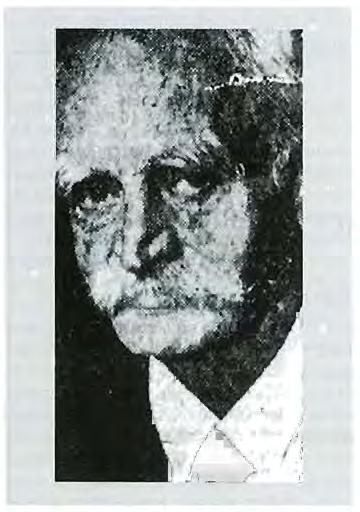
In 1891, after the Act came into force, the members of the Bar, i.e. a number of those practising exclusively as barristers, formed an association. According to the Argus of 30 January 1892 there were 49 barristers who were members of the association and 28 who were not. At a meeting of the association on 4 February 1892 it was resolved that the association be abolished. It seems that there was no formal association of the Bar until the Committee of the Bar was established on 21 September 1900. One ofthe original signatories to the Bar Roll who remained on the practising list for sixty years, Samuel King Hotchin, features in this issue (page 38).
THE BAR AND COMPETITION
Today there is fresh legislation before Parliament not ostensibly designed to abolish the separate Bar, but in the name of that new economic God, "Competition", to abolish many of the practices of the Bar. There have, in the past, been some practices which, whatever their historical justification, tended in more modern days to have a "feather bedding" effect. The Bar Council has over the last decade abolished all such practices. There appears to be little that could be described as "feather bedding" left.
The Bar felt the impact of Mr. Keating's "recession that we had to have" later than most. But when it bit, it bit deeply. By economic necessity we have indulged over the last two or three years in extremes of competition on price, service and quality.
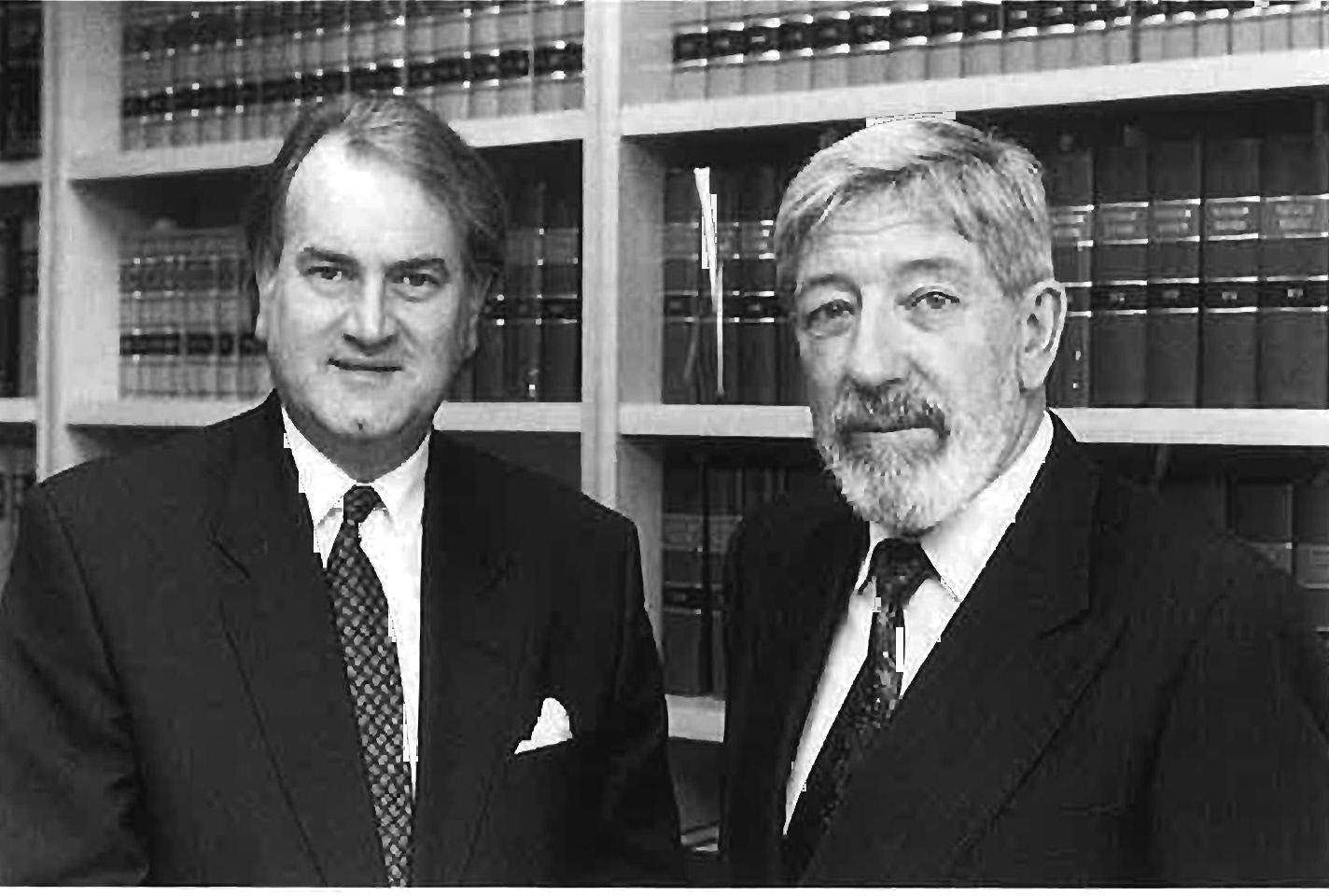
Many have left the Bar, of choice or of economic necessity. But the Bar is still almost ten times the size that it was when people such as Charles Francis and Brian Thompson joined it in 1948. The Bar which they joined was quite a different institution in many ways from that which was formed in 1900, or that which this year's Mr. Junior Silk, Kim Hargrave joined in 1980, or that which the new readers have joined this year.
Irrespective of the size of the Bar, however, the spirit of camaraderie, of cooperation and of fighting hard for the client's interest - and of putting the client's interest before one's own - has remained constant.
BAR NEWS IS TWENTY-FIVE
When the first issue of Bar News came out at Easter 1971 (Easter Sunday that year was on 11 April) Bill Kaye was Chairman of the Bar Council. The number of Counsel on the Practising List was 453; the limit of the jurisdiction of the County Court was $4,000 ($8,000 in respect of motor vehicle accidents).
The format (of Bar News then) was very like that of In Briejtoday. Bar News has changed considerably since then. In some ways it performs a different function from that which the original Bar News performed and much of that earlier function has been taken over by In Brief. We believe, however, that it provides a "public face" for the Bar which is of importance and which will be of increasing importance in maintaining the unity of the Bar when the new legislation comes in.
FLASHBACK
In 1871, when the Attorney-General was considering amalgamation, there appears to have been concern that Silks were poaching the practice of juniors. A Mr. Holmes complained that "Senior men, such as Fellows and Ireland, were doing work which in England would be left to juniors. The etiquette of the Bar was being openly violated In Melbourne juniors could get nothing to do, and many of them went to the country where they could not obtain many briefs from attorneys and found it necessary to deal direct with the clients. He said that in five months in the country he had earned £250 whereas in five years in Melbourne he had not made £50. He did not favour a full amalgamation but thought members of the profession should decide which branch to follow" (Dean 878).
The reference to "Ireland" is a reference to a man whom Dean describes as "the greatest advocate of his day". Ireland and Michie were the first Queen's Counsel appointed in the Colony of Victoria.
Dean (78) says that Ireland "earned enormous fees, but was a free spender and a hard liver. Money to him was something to spend and not to save His independence of mind made him a difficult man to control by any rules or regulations".
The letter from Ireland to his wife printed in this issue (page 34) was written while he was on circuit in 1865, two years after he took Silk. Manifestly, he was not inhibited by any "two counsel" rule. In fact he seems to have been generally uninhibited.
Following a dispute with the Attorney-General on the question of precedence between him, as the senior member of the Bar, and the Minister of Justice, who was an attorney, he wrote to the Argus a letter which included the following paragraph:
"I'd prefer therefore in future to see all my clients in all cases directly, and without the intervention of any attorney, and to transact all kinds of legal business that the law allows me to take and that the exigencies of my clients may require".
In a matrimonial case the jury found him to have been "unduly familiar" in his conduct in relation to Mrs. Molesworth, the wife of Mr. Justice Molesworth.
WE WERE WRONG (TWICE)
The Editors apologise to Paul Coghlan of Her Majesty's Counsel whose photo appears in the Autumn issue of Bar News but whose vital statistics were omitted. The Editors are at a loss to know how this happened but they take full responsibility.
We also apologise to all eleven Queen's Counsel whose names appear on page 34 of the Autumn issue for the somewhat aberrant description of them contained on the cover of that issue.
OMISSIONS
We regret that, for logistical reasons, no farewell to the Honourable Mr. Justice Crockett, His honour Judge Fricke or Mr. Pappas CM is contained in this issue. The Editors will rectify these omissions in the Spring issue. We apologise for the delay.
The Editors
6
Thanks From Barry Stone's Family
The Editors
Further to the obituary published in the Autumn edition of the Victorian Bar News, the family of the late Barry Stone would like to thank the many people associated with Barry throughout his nearly 20 years at Owen Dixon Chambers for their overwhelming kindness and support.
Our special thanks go to his Honour Judge Kellam for the detailed and thoughtful obituary, for which we were very proud.
Thanking everyone once again. Lois, Adam, Trent and Tarsha Stone.
No Sense of Time
Dear Sirs,
IN the course of chasing up a point I came across the following summary of an argument of counsel and judicial interj ection reflecting upon the values and practices of a bygone age:
JOHN PENNY CUICK and JOHN ARNOLD for the Applicants:
"The trustees here were entitled to bring this application and to obtain counsel's opinion in view of what went wrong on the two previous occasions. The trustees had to look to experienced counsel of standing and paid no more than the market rate for what they obtained. The taxing master refers to the amount of time spent on applications, etc."
DANCKWERTS J: That is nonsense, because fees should be delivered with the brief. Counsel cannot be paid according to time.
Re Grimtholpe dec'd [1958] 1 Ch. 615 at 620.
Sic transit gloria mundi!
Yours sincerely, Rodney Garratt
Crockett J.'s LL.D., honoris causa
Dear Sirs,
I wish to advise that on the 27th March, 1996 Mr. Justice William Crockett was awarded the degree of Doctor of Laws, honoris causa from Monash University.
I enclose for your information a copy of the citation given in support of the award. I also draw to your attention the fact that a portrait of His Honour has been hung in the 13th Court of the Supreme Court.
Yours faithfully, Louise M. Crockett
PRESENTATION OF THE HONOURABLE MR. JUSTICE WILLIAM CHARLES CROCKETT, AO FOR THE DEGREE OF DOCTOR OF LAWS honoris causa
Mr. Deputy Chancellor
WILLIAM CHARLES CROCKETT
William Charles Crockett was born in Mildura, on 16th April 1924. Educated at Geelong College and The University of Melbourne, he qualified for the degree of Master of Laws in 1945, also earning the Supreme Court Judges' Prize.
Following service in the Royal Australian Naval Reserve in 1945 and 1946, he was admitted to practise as a barrister and solicitor on 1st February 1948 and promptly signed the Roll of Counsel. Flourishing early as an influential advocate at the common law Bar, he was appointed one of Her Majesty's counsel in October 1962 - an established leader at the age of 38. His formidable capability, in wide demand throughout the country, was not confined to appearances in courts of law: he appeared prominently in Royal Commissions and inquiries - in several concerning marine and aircraft disasters - and himself conducted an extended investigation under the Companies Act into the affairs of a failed group of companies.
In December 1969 his Honour was a natural choice for appointment to the Supreme Court following the death of Sir John Barry. The following 26 years demonstrated how natural and felicitous an appointment it was, for this was a period of superlative service tendered by Mr. Justice Crockett to the Supreme Court and, through it, to the Victorian community. He developed into a consummate judge. It was perhaps his capacity for "instinctive synthesis" - an expression he himself introduced to the law in 1974that will bring him lasting legal celebrity. His erudition combined most happily with common sense, both in trial and appellate work.
His Honour's contributions as a judge were not made only in court. For many years he was chairman of the Supreme
Court Rules Committee, notably during the busy period of revision which led to the General Rules of Procedure in Civil Proceedings 1986.
Following the retirement of Sir John Starke in 1985, Mr. Justice Crockett became Senior Puisne Judge of the Supreme Court and in 1986 he was appointed an Officer of the Order of Australia. He has on several occasions served as Acting Chief Justice and as deputy for the Governor.
In the early years of the Faculty of Law of this University his Honour was one of its consultants and delivered lectures on practical aspects of the law of evidence. He has also presided at student mooting competitions. During the last decade he has acted as assessor for the Visitor of this University and others, a capacity little known or noted, in which he unostentatiously served the cause of tertiary education in the State.
Mr. Deputy Chancellor, it gives me great pleasure to present to you for the award of the degree of Doctor of Laws honoris causa of Monash University, William Charles Crockett.
R.J. Pargetter Acting Vice-Chancellor
Lawyering Is A Dangerous Profession
THEFayeds were also strapped by numerous Lonrho lawsuits challenging their ownership. Imagine the surprise, then, when in October 1993, Tiny Rowland decided to end the feud.
Absolutely no one could have anticipated it. The news was so startling to those in the trenches who had slung the mud and to the attorneys who had been putting on the writs for nine years that a 41-year-old lawyer, whose whole career had been made on keeping track of all the suits for Lonrho, suddenly dropped dead of heart failure.
Orth, ''Holy War at Harrods", 421 Vanity Fair, 28 at 43, September 1995.
A Number of Important Projects on the Go
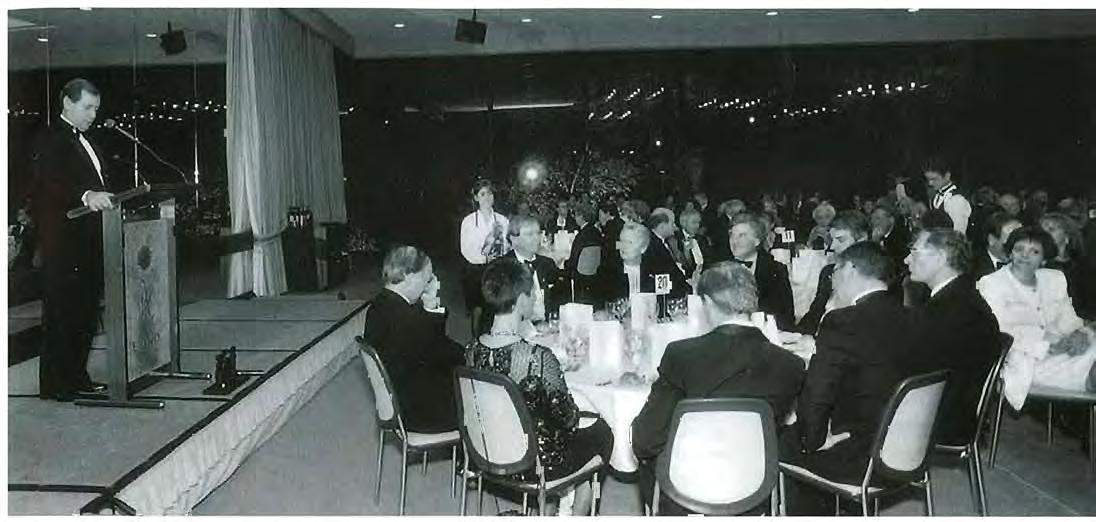
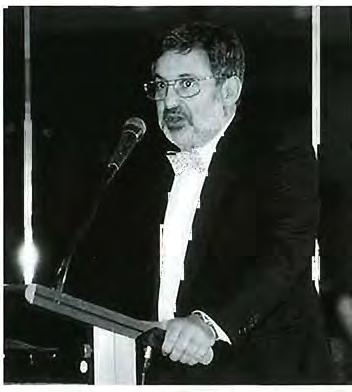
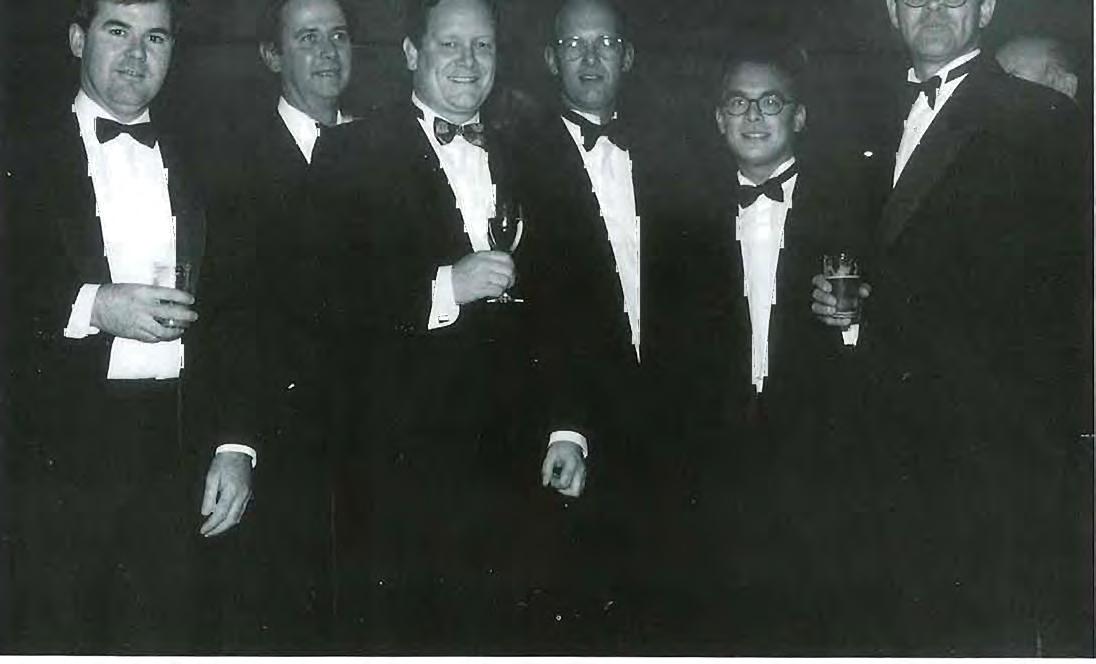
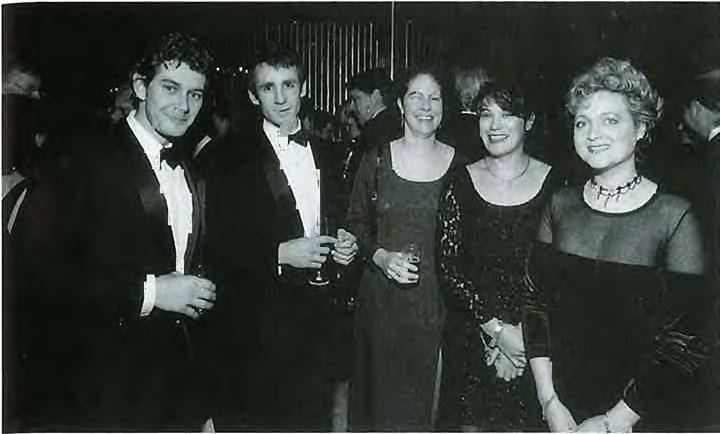
THANK you to all me mbers who attend e d the Bar dinn er on 1 June this year. The general reaction was that it was a particularly friendly and relaxed night with one less speech and a little more "schmoozing" time . Congratulations to Kim Hargrave Q C who feted 20 honoured guests in r e cord time and to Geoff Colman Q.C. who was feted for his own record of 45 years in practice at the Victorian Bar.
LEGAL PRACTICE LEGISLATION
There are a number of important projects being undertaken by the Bar Council at this time. Over the past month or so the Chairman and Vice-Chairmen have had discussions with representatives of the Victorian Government to discuss and fmalise the drafting of the legislation reforming and changing the regulation of legal practice in Victoria We now expect that the legislation will be introduced into Parliament in this Autumn session, and then all members will have th e opportunity to become familiar with the proposed changes and will then need to work towards their implementation. The Bar Council proposes to make a series of presentations to the members of the Victorian Bar, generally informing them of the proposed changes and the consequential
8
alterations needed to be ma de to the Bar structure, its rules and proc e dures. This will probably take place some time in July or August. The proposed changes will also involve the r e structuring of Barristers ' Chambers Limited, a matter which the directors of Barristers' Chambers Limited have been considering for some time and which the Bar Council is to address at a special meeting
BAR LIBRARY
Another important matter is the question ofthe Bar library and th e introduction of computerised library facilities. A new library committee has been established and the Bar Coun c il has now authorised that committe e to arrange for prospective consultants to make recommendations to the Bar Council and to put up options for an internal Bar-wide system . It will be necessary to extensively surve y members to determin e their various u se s and needs, and then for a careful analysis to made as to the costs of installing various computer options. Already discussions have taken place with the University of Melbourne, Monash University and the Supr eme Court library, along with two clerks who already offer modem access to CD-ROMs, for the purpose of considering all available options.
LAW AID TO BE ESTABLISHED
Anoth er rec e nt developm e nt has been the agreement in principle between the Law Institute of Victoria, the Victorian Bar Council and the Department of Justice for the establishm ent of Law Aid Law Aid is proposed as a civil litigation assistance scheme t o be established and managed by the Victorian legal profession r epresented jointly by the Law Institute of Victoria and the Victorian Bar Council A key element of the scheme will be the voluntary assistance provided through Law Aid to assisted litigants by members of the legal profession. The scheme is intended to extend the availability of civil litigation assistance to those people assessed as having worthy cases at law but who could not otherwise afford to go to court.
The three guiding principles for the establishment of Law Aid are :
The Bar Council proposes to make a series of presentations to the members of the Victorian Bar in July or August.
• the establishment and the operation of the scheme is the responsibility of the private le gal profession r epresented by the Law Institute of Victoria and the Victorian Bar Council;
• the Governme nt's involvem e nt in the scheme is clearly defined and limited to providing capital funding and ongoing monitoring to ensure th e scheme's accountability;
• the scheme needs to be financially viable and s e lf-sustaining In managing Law Aid, the trustees of the scheme will need to deve lop a set of criteria for case selection further to merit and means test considerations . These criteria should be directly informed by the n e ed to make 'Law Aid financially viable and self-sustaining
REFURBISHMENT OF FOUR COURTS CHAMBERS
Another exciting development is the refurbishme nt of Four Courts Chambers . The refurbishment is anticipated to commence shortly and this will hopefully increase the interest in members of our Bar taking accommodation in Four Courts Chambers. The Bar Council itself will meet the cost s of refurbishing Level 2 and Level 3 of Four Courts Chambers , these levels to be used for our Readers' Course and an improved mediation centre.
LIAISON WITH LAW COUNCIL
There have also been a number of major projects undertaken by the Law Council of Australia with which the Victorian Bar Council has been involved. The Law Council's Blueprint for the Structure of the Legal Profession was released in July 1994 . The essence of that Blueprint was to facilitate the mobility of legal practitioners between jurisdictions. A report is
now being prepared with an outline of a scheme of legislation for the implementation of a travelling practising certificate regime. Within the concept of a national legal services regime, a number of subtopics have been considered including model core rules of professional conduct and practice, model practising certificate rules, protocol on the operation of disciplinary processes, and model disciplinary processes. As part of the national legal services market there has been an endorsement of the recommendation of the Hilmer Review Committee that the competitive conduct rules of the Trade Practices Act 1974 should have universal coverage, including application to the professions. From 21 July 1996 the Trade Practices Act 1974 will extend to the legal profession. The Victorian Government so far has indicated that it will be seeking a Section 51 (1) exemption in relation to the Victorian Bar's "sole practitioner rule", which is and is seen to be pro-competitive.
This position is reflected in the Victorian draft Legal Practice Proposals Bill which contains provisions exempting the sole practice rules of the Victorian Bar from the Trade Practices Act 1974 and the Competition Code.
Another Law Council project has been the participation in a working group on advertising guidelines for lawy e rs. The Commonwealth Government announced in the Justice Statement that "in conjunction with the freeing up of advertising, the Federal Bureau of Consumer Mfairs, working with the Trade Practices Commission, consumer groups and the legal profession, will develop guidelines for the profession on the advertising of legal services". While opposing the need for the working group, the Law Council agreed to participate in the working group Draft guidelines have been finalised and are soon to be considered at th e meeting of the standing committee of AttorneysGeneral.
BUSY MONTHS AHEAD
The next few months are going to be very busy, and the changes to the Bar structure and our new regulatory regime will undoubtedly put a great deal of pressure on our administrative staff. Apart from their having to become familiar with the legislative changes and the restructuring, they will have to deal with greater reporting requirements and will need to be working closely with the three new regulatory bodies - the Legal Practice Board, the Ombudsman and the Legal Profession Tribunal. Many of our members are working on the Bar Council and through specific committees to make the transition as painless as possible and to put into place the required structure and rules to comply within the new regime I again express my sincere gratitude to all those people who contribute in this and other ways, in a completely honorary capacity, and in support of our independent Bar
Introducing PEN CI1Y
a unique shopping experience for barristers, within walking distance of your chambers
Pen City is a new pen and gift store conveniently located close to all barristers chambers, offering outstanding international pen brands - including Mont Blanc, Waterman, Parker, Cross, Sheaffer, Caran d'Ache, Montegrappa, and others . Pen City is conveniently locatedjust down the hill from all barristers
THE ART OF WRITING
chambers, at 250 Elizabeth Street, adjacent to the corner of Little Bourke Street.
Pen City offers exceptional professional service. Opened in November, 1995, it is owned by John Di Blasi and Terry Jones, two highly qualified career pen specialists, with a combined experience of over 30 years local and international pen marketing and service.
Come down and visit Pen City's spacious, friendly, and relaxing environment, with its gold and green decor, red cherry timber display cases, and desks where you can sit down and try your hand with all the famous makes John and Terry will serve you personally, and help you select the right writing instrument for your writing style
As well as the leading international pen brands, Pen City offers: antique pens - largest range in Melbourne leather business folios and desk accessories from Mont Blanc, Artex, Hazel, and Caran d'Ache.
pen repair and spare parts service for new and old pens. (The trusty Parker 51, Vacumatic, or Sheaffer PFM need not stay in your top drawer unused.)
calligraphy pens, nibs, and inks.
collectors lim.ited editions, including Mont Blanc 's flamboyant Oscar Wilde model, at $1,265, and the Cross 150th Anniversary Set at $2,250.
Filofax organisers and refills - the largest range 111 Melbourne.
Sharp electronic organisers tax and duty free purchases on most items free delivery within the Melbourne CBD.
THE PEN PROFESSIONALS
Shop 42, 250 Elizabeth Street, Melbourne, Vic 3000 Gust north or Little Bourke Street) Telephone 9663 4499, Facsimile 9663 4433
Autlwrised Mont Blanc dea/us
Involving the Community in Law Reform Process
IN this column, I will discuss the proposed sentencing review, and briefly note some of the reforms passed by Parliament in the Autumn session.
SENTENCING REVIEWS
It is obviously important that members of the community have confidence in the sentences imposed by the Courts There is a real danger that the community will cease to respect the law if the criminal justice system fails to take into account and reflect the community's generally accepted standards of what is fair and reasonable. We may find that victims will be reluctant to fully cooperate with the police and prosecutors, or that criticisms of the Courts by the media will increase, possibly adding to the perception that the criminal justice system is not working satisfactorily. Parliament may also be seen as failing in its duty to ensure that appropriate penalties are set by relevant leg islation
A primary objective underpinning the government's reforms to the criminal justice system is to improve community confidence in its operation This objective has, in part , been achieved by the reforms in 1993 to the Sentencing Act 1991. The Sentencing (Amendment) Act 1993 increased the penalties for serious sexual and violent offenders by one-third, introduced indefinite sentences for those offenders who commit serious crimes and 10
who pose a serious danger to the community, and, in some circumstances, the reforms permit sentences to be served cumulatively rather than concurrently. The impetus for thes e reforms came primarily from extensive discussions held with community and victim support groups who opined that some of the sentencing options contained in the Sentencing Act 1991 were not sufficiently commensurate with the gravity of the crime.
Already, the sentencing reforms enacted in 1993 have had some impact on sentencing pract ices. One indefinite sentence has already b ee n imposed, and a second application for such a sentence is presently before th e Courts. While it may take some time to analyse recent sentencing statistics, it appears from recent decisions, at both first instance and on appeal, that offenders convicted of serious sexual and violent c rime will serve more time in prison as a result of these reforms.
Notwithstanding thes e changes to the Sentencing Act 1991, however, media attention in Victoria r e mains focused on perceived public dissatisfaction with sentences handed down by our Courts in specific cases. The Department of Justice also regularly r ece ives correspondence from members of the community expressing concern at some decisions of the Courts and seeking advice on how they can obtain the imposition of greater sentences for certain offenders. Such concern needs to be carefully assessed in order to ascertain to what extent it is representative of the views of the general community.
It was therefore announced in March of this year that a wid e-ranging review of existing sentencing options will take place, involving extensive community consultation. It is anticipat e d that this review will be carried out by the Victorian Community Council Against Violence, with the assistance of the Department of Justice, and that it will be conducted over a period of 12 months.
Media and other comment in Victoria regarding this proposed sentencing review has been, predictably, misinformed. Some of this comment has, to date, queried the legitimacy of the government seeking
views on the adequacy of sentencing from the general community.
Closer community involvement in law reform processes is an important factor in improving the relevance of legislation made by Parliament in an effort to ensure that the law serves the public. Whil e the specific details of the proposed sente ncing revi ew are currently being finalised , the consultative process will enable the government to ascertain the community's views about existing sentencing options. Consultation will not be restricted to certain representative groups but, rather, involve as many people from the Victorian community as possible, in both rural and metropolitan areas.
Th e issues which the government would like to address in this consultation may include:
• the types and levels of sentences appropriat e to various offences. For example, do the maximum penalties set by Parliament adequately reflect the gravity of a particular offence? Are the maximum penalties appropriately ranked in accordance with their relative seriousness?
• the factors which should, or should not, be taken into account by Courts when sentencing an offender, and
• what is the relative importance of these factors and what weight should be given to them?
At the same time as this consultation is being conducted, Mr . Richard Read, Crown Prosecutor, will act as an independent consultant for the purpose of conducting a review of technical difficulties arising out of the operation of the Sentencing Act 1991. Mr Read will consult with judges, magistrates, criminal barristers and other relevant members of the legal profession over the next few months to consider and make recommendations on a number of problems with the Act, including the application of section 10 in light of Boucher's case. This decision has resulted in an arbitrary and unsatisfactory operation of the provision. It is anticipated that Mr Read will submit his recommendations by November 1996.
It is hoped that the information obtained from both the proposed consulta-
tive process and the technical review will enable the government to make an assessment of the strengths and weaknesses in the sentencing system as it is currently operating, with a view to formulating policy about any changes which may need to be made. Any legislative reforms resulting from these reviews are anticipated to be made sometime in 1997.
CHILD PORNOGRAPHY
The Miscellaneous Acts (Omnibus Amendments) Bill amends the Crimes Act 1958 in a number of ways to strengthen the law regarding child pornography. First, police will be given greater powers to search for child pornography. Second, section 60B of the Crimes Act 1958, which creates the offence of prohibiting persons with prior convictions for sexual and certain other offences from loitering in or near schools and other places frequented by children, is amended by extending this offence to persons with prior
convictions for producing child pornography, or procuring a minor for child pornography. Third, Courts are given the power to order that child pornography seized by the police be forfeited to the Crown.
SENTENCING ACT 1991
The Miscellaneous Acts (Omnibus Amendments) Bill also amends the definition of "sexual offence" in the Sentencing Act 1991. This definition will now include the offence of committing an indecent act with a child under the age of 16 years, as defined by the Crimes Act 1958, without the need for aggravating circumstances. Previously, the offence of committing such an indecent act was a "sexual offence" only where accompanied by violence or degrading behaviour towards the victim, or where the principal offender is aided and abetted by another person. The amendment removes the need to prove these circumstances. Offenders who fall
within this amended definition of "sexual offence" may now also be subject to the sentencing regime imposed by the Sentencing (Amendment) Act 1993, which I have already discussed.
Jan Wade, M.P.
Attorney-General
Family War
THE press reports the marriage between Michael Jackson and Lisa Marie Presley is on the rocks. This would make Jackson the first celebrity to be divorced for spending too much time with the kids.
US TV personality Dennis Miller on "Dennis Miller Live".
Welcome for the Honourable Justice Kirby, AC, CMG to the High Court
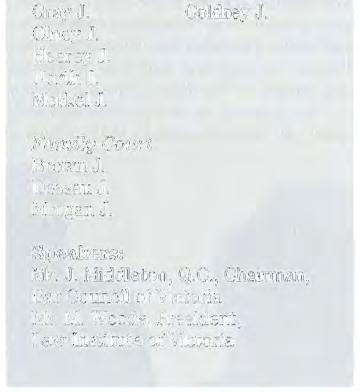
Heerey J . North J. (hidden)
Black C.J. Northrop J. DessauJ. Coldrey J. Brown J.
TRANSCRIPT oj
Proceedings at a special sitting in Melbourne, to welcome the Honourable Justice Kirby, AC, CMG to the High Court oj Australia.
Speakers: Mr. J. Middleton, Q.C., Chairman, Bar Council of Victoria
Mr. M. Woods, President, Law Institute of Victoria
KIRBY J: Mr Middleton?
MR MIDDLETON: If the Court pleases, I appear with some trepidation today on behalf of the Victorian Bar, to welcome your Honour to your first sitting in Melbourne as a Justice of the High Court of Australia. I say trepidation, as your Honour has already, at your swearing in to the Court in
February, expressed rather scathing views of speeches of welcome to new judges, describing "the flattery, portentous words and only occasional wise counsel at these · jubilees of the profession" and being hopeful that "none of these utterances can ever be remembered once the ceremony is over".
May I assure your Honour that this trembling speech maker at least has remembered your Honour's utterances on that occasion. I will engage in no flattery, although a little inadvertent adoration may creep in. I will avoid portentous words at
MerkelJ Bmoking J.A.
GrayJ Ki?"by J
OlneyJ. MorganJ. Phillips C.J:
all cost, although a little harmless prediction or two might be made, I hope, with safety. And I will offer no wise counsel, other than to trust that your Honour may find those counsel here who appear before you today in their applications to be wise, and if not wise, at least very brief.
Your Honour's speech made at your swearing in was destined to be remembered in other respects, having produced a certain lack of comity amongst constitutional lawyers, some of whom were alarmed, others of whom were relaxed, but all of whom who were interviewed at length as to what your Honour meant. It was a prototype High Court judgment if ever there was.
Your Honour is very welcome indeed to Melbourne. In your new capacity as a Justice of the High Court of Australia, in your long-standing capacity and experience in respect of jurists, but also as a man who has shown unswervable dedication to th e concept and practice of justice in this country and to human rights wherever they have been infringed Your Who's Who entry describes your recreational activity as "work", and indeed your extrajudicial achievements of themselves represent a significant body of work.
Your Honour, it is hoped, will find your new position relatively relaxing. Apparently you have shown an increasing tendency to "lighten up" in recent years, even switching from Mahler, as your composer of choice, to Bach, because Mahler was too depressing. Although, to paraphrase John Mortimer - the music of Mahler, lik e that of Wagner, is not as bad as it sounds. Personally I would recommend a Tina Arena CD after a long day in court.
On behalf of the Victorian Bar, I wish your Honour a long and satisfying career on the High Court of Australia and assure you of a very warm welcome whenever you are in Melbourne. If the Court pleases.
KIRBY J: Thank you, Mr Middleton. Mr Woods?
MR WOODS: May it please the Court.
I am delighted to appear today on behalf of the Law Institute of Victoria, and the State's solicitors, to formally welcome your Honour to the Bench of Australia's highest court.
For the reasons that were outlined by my learned friend, I am reminded of Macbeth as he contemplated the murder of Duncan: "twere well if it were done quickly" in deciding how much to say.
This brief has been made easier by the fact that several have spoken before me, not only here this morning but of course in 14
Canberra at your Honour's welcome in February, at which your Honour's achievements on the Australian Law Reform Commission and the Supreme Court of New South Wales were well outlined.
I have to say, your Honour, that you were the subject of some discussion and conversation at the New Zealand Law Society Confer e nce last week Your Honour's appointment, which as I indicated was the subject of some comment, was so in the context of the New Zealand Attorney-General's determination to abolish appeals to Privy Council. All agreed that, whether or not that would be a successful move , would be determined by who was appointed to the High Court of New Zealand if it ultimately became the final Court of Appeal.
During the course of a cup oftea after a discussion about the New Zealand Bill of Rights, I was informed by a district court judge in that country that appeals to the Privy Council should be abolished and that he was confident that there would be some excellent appointments to the High Court of New Zealand, "such as that Kirby fellow you have got in Australia". I have to tell your Honour, however, that at l.30 in the morning after the Bar dinner there was another expression of opinion by yet another New Zealand district court judge who said that "God forbid the Attorney-General should abolish appeals to the Privy Council because we might get someone like that
bloody Kirby in Australia". So the view of the New Zealand profession on your Honour's appointment, I can say, is at least evenhanded.
It was in Melbourne that I was first invited to accept judicial appointment. I remember the circumstances vividly.
Your Honour's knowledge of the law, notwithstanding the view of that lone Kiwi judge, and respect for its traditions are well known, as is your commitment to judicial creativity founded on those traditions. In a recent intervie w published in the Law Institute Journal, your Honour said that the common law had perioclic bursts of creativity as it adapted itself to changes in society, and that it was in the middle of such a burst now. Faced with the challeng e s of new technologies, especially in the fields of communication and biology, new and still changing social values and a world in which traditional notions of national sovereignty are becoming redundant, such judicial creativity will be more important that ever.
In your Honour, the High Court has gained a legal mind ideally suited with respect to finding solutions to the problems, and to articulating the answers arrived at clearly and intelligibly. 1. am obliged to my learned friend for setting th e scene for this story about your Honour's capacity for hard work and this was likewise one which was related in New Zealand . The Chief Justice Sir Gerard Brennan once decided to playa practical joke on your Honour and he rang your chambers on Christmas Day, intending to leave a message berating your Honour for not being at work. His Honour was startled, indeed, when your Honour answered the telephone and demanded to know what he wanted.
Your Honour has observed that before the links between the Australian and British legal systems were formally severed, the duty of an Australian lawyer was to get into the mind of the judges sitting on the Privy Council. These days, of course, the duty of Australian lawyers is to discern the law as it is decided by the High Court. I suspect I can speak for the whole of the profession when I say that this profession has the utmost faith and confidence that your Honour will make an immense contri-
bution to the body of law which we in Australia are now making for ourselves.
On behalf of the solicitors of this State, I likewise welcome your Honour to Melbourne and assure you of our cooperation and support.
If your Honour pleases KIRBY J: Thank you very much, Mr Woods.
Mr. Middleton, Mr. Woods, Chjef Justice Black, Chief Justice Phillips, your Honours, members ofthe legal profession of Victoria, ladies and gentleman.
In Jesting Pilate, that marvellous collection of the speeches, essays and other contributions of the quintessential Victorian practitioner and judge, Sir Owen Dixon, three speeches on occasions such as this are recorded. One of them is the speech on Chief Justice Dixon's first sitting in Melbourne as Chief Justice of the High Court of Australia in May 1952. Another is on his first sitting as Chief Justice in Perth in September of that year. The third is the speech on his last sitting in Melbourne as Chief Justice in 1964, when Sir Robert Menzies spoke at the Bar table to farewell a great Chief Justice.
In his address in 1952, on his first sitting in Melbourne as Chief Justice, Sir Owen Dixon said this:
"It is probably too long ago to remember exactly why I left the Bar for the Bench. I was then at the age of 42 and I probably regarded that as approaching the sere and yellow, although at this vantage point I regard it as extremely youthful for a judge."
In his farewell address, he said: "There is, I would like to say, a great tendency in anyone of my age, and with my great length of service, to indulge in retrospect and I am going to do a little, not much. Retrospect is not very interesting to the young - their life is in prospect - but retrospect does amuse and interest the old, and I have joined those ranks."
Having in recent weeks now faced three occasions of this kind, and having been reminded thrice of my earlier service, I feel a kindred sympathy for Sir Owen Dixon's words. I certainly feel that I have joined the ranks of the old. On occasions such as this, my mind goes back to times when as a young legal practitioner in this building, I worked busily at the practice of the law. This is the building in which, in the Commonwealth Industrial Court and in the Australian Conciliation and Arbitration Commission, I did much work. I must say that the decor seems to have changed a little since those days, not wholly for the better.
It was in Melbourne that I was first invited to accept judicial appointment. I remember the circumstances vividly. It happened in this building. I was invited by Sir John Moore, the President of the Arbitration Commission, to come and see him. He then asked me whether I would respond with favour to an invitation to join the Arbitration Commission as a presidential member. The prospect of then sitting with Sir John Moore, who was a great judge, and with other judges of that tribunal, including Justice Mary Gaudron, who was a deputy president, filled me with awe, pleasure, inspiration. I was 35 years of age. I walked out into the streets of Melbourne. I walked down Collins Street in the sunshine, as I vividly remember. I went to Henry Bucks where I immediately purchased an extremely expensive hat, thinking that that was the sort ofthing that a person of my age - or any age - about to enter upon what was equivalent to a federal judicial office, should do. Needless to say, when I took the hat to Sydney and subsequently to industrial inspections, it was soon consigned to a safe memorial. It was rarely used.
At first, I was treated, shall I say, with a degree of caution by the Victorian profession back in those days, in 1975.
My last case as a barrister was in Melbourne. Indeed, it was in this building. It was in this very court room. I was briefed by Bernard Gaynor, who was a solicitor on the industrial side. He was a paragon of solicitors for he was loyal to his counsel and always very quick to pay their accounts. That last case involved the SECV. Mr Gaynor had cobbled together a group of unions --from the extreme right-wing remnant of the old days of the Democratic Labor Party, to a union of the other persuasion whose chief officer was Mr Halfpenny. As a result of my heroic labours in this building, the lights went on again in Victoria. I hope that you remember with gratitude these things. I trust that, in the years to come, I may occasionally cast the light of the law in Victoria as well.
Shortly afterwards I was appointed to the Law Reform Commission. It was not a case that I had been appointed to the Arbitration Commission in order to give me the
judicial title for that office. The second position followed unexpectedly, and by accident. A majority of the foundation commissioners were from Victoria: Gareth Evans, then a young law lecturer but later to be a distinguished federal Minister; Professor Alex Castles, who taught law in Adelaide but derived from Melbourne; John Cain, then lately the President of the Law Institute of Victoria - he was soon to become the Premier of this State. There was also Professor Gordon Hawkins from Sydney and a young and up-and-coming and most promising silk from Brisbane, Mr F.G. Brennan, Q.C. These were the members of the Commission. My work in law reform often brought me to Melbourne. I laboured closely, over a decade, with leading Victorian judges and with members of the Victorian legal profession.
At first, I was treated, shall I say, with a degree of caution by the Victorian profession back in those days, in 1975. Not, I have to say, by the leaders of the profession. I will never forget the warm welcome that I was given by Sir Oliver Gillard, who was then the Chairman of the Chief Justice's Law Reform Committee. He invited me to Melbourne to speak on the subject "Law Reform - Why?" He organised a large meeting for that purpose. My speech is recorded in the 1976 Australian Law Journal. Sir Oliver, as a fine judge, respected office. He welcomed me as the holder of an office. So did Justice Clifford Menhennitt, a wonderful spirit of the law and a judge of great distinction whose opinions are always read with advantage. Sir Murray McInerney, whom I got to know very well. I remember, vividly, sitting with him in Shepparton, and his telling me of the capital cases in which, as a barrister, he had appeared in his youth. It is awful and moving to think of the pressures that are on counsel today. But the pressures that were then imposed on young counsel in capital cases are difficult even to imagine. The Honourable Tom Smith, who was the distinguished Victorian Law Reform Commissioner; Sir George Lush, with whom I shared University links; Sir John Starke, who shared with me an interest in libraries. There were many others. I count them as mentors. I learned from them all.
And then in the Australian Law Reform Commission we had many distinguished lawyers from Victoria. Sir Zelman Cowen, before his appointment as Governor-General; Brian Shaw, Q.C.; John Karkar, Q.C.; Tim Smith, later to become a Justice of the Supreme Court of Victoria; Kevin O'Connor, who is now the Privacy Commissioner; Professor David Kelly, who
taught me so much, now practising in this city; and Mr George Brouwer, the first Secretary and Director of Research and later head of Department of Premier and Cabinet. Victorian judges and legal practitioners contributed disproportionately to the vital work of institutional law reform.
Courtesy to clients and to each other has always, in my experience, been a hallmark of the Victorian profession.
My appointment to the Federal Court in 1983 gave me an occasion to sit again in Melbourne, as I was reminded last night by Justice Callaway who appeared as counsel before me. I sat with Sir Reginald Smithers, a great judge and a great humanist, who taught me much. And with Justice Charles Sweeney and Justice Raymond Northrop, whom I am happy to see is with me again on this occasion. I sat across the road in what was the old High Court building. I walked around the chambers there. I tried to imbibe the spirits, the great spirits of the past. How many of those spirits were Victorian practitioners : O'Connor, Isaacs, Higgins, Duffy, Latham , Dixon, the earlier Starke, Fullagar, Menzies, Stephen, Aickin. Some of the greatest justices of the High Court of Australia fashioned their skills in the legal profession of Victoria and in Victoria's courts
In the New South Wales Court of Appeal after 1984 we had the great benefit from time to time of appearances of counsel from Victoria - some of whom I see here today. Regularly, I appointed associates who came from Victoria, including my current associate eMr Nicholas James) who was appointed when I was President of the Court of Appeal of New South Wales. Tenderly, he urged me not to get killed in Cambodia in January when I went on my last mission as Special Representative of the Secretary-General of the United Nations for Human Rights I like to think that that was a gentle concern for my fate. But I am inclined to the view that it was rather so that he could return to Melbourne today and be in his own city with the High Court of Australia
Yesterday, after I had completed the reading of the application books that are to come before us later this day, when we will 16
have so much pleasure dealing with the special leave applications, and formed a view, ever so tentative, about the fate of those applications, I picked up a book by the Dean of Law at Yale University, Professor Anthony Kronman The book is called The Lost Lawyer - Failing Ideals of the Legal Profession Yale is now probably the greatest Law School in the United States. A book reflecting on our profession by its Dean of Law is something we should take closely to our hearts Much that happens in the United States repeats itself here, in Australia, a decade or so later.
Professor Kronman's thesis is that our profession, in the United States, has lost its way. Attorneys are the members of the mega firms. Their lives are ruled by time charging and loss of interest in law reform and pro bono work They have lost the idealism of the legal practitioners of the past. Advocates have lost the spirit of honesty that so motivated advocates in the past. Under the pressure of severe time limits, they can often not now get into the mind of the judge for persuasion. But Kronman's chief criticism is reserved for the judges who, he says, are now all too often, at least in appellate courts,· mere editors - editors of the works being written by their clerks Very rare are the judges, he says, in the appellate courts in the United States, who still prepare all of their own opinions The result is that the appellate courts are clerk driven. They have lost what he calls their "horse sense" and the wisdom - as well as the perception of principle and inclination to brevity and self-confidence - that comes with an experienced legal practitioner and judge. These are warnings to us, I believe. We must, of course, adapt to change, includ-
ing as a response to the great pressures on our courts. But we must hold fast to the good. That is the obligation of our profession and the challenge now before itincluding the judges.
In taking my oath in Canberra I said that I believed that the claim to nobility of our profession rested ultimately in its quest for justice - justice according to law, but justice As I reflected on Kronman's book, I came to the view which I wish to share with you on this occasion. Our profession's claim to nobility also rests upon our honesty with each other, on our idealism and optimism about the cause of justice, on our integrity as professionals and on our courtesy to clients and to each other. Courtesy to clients and to each other has always, in my experience, been a hallmark of the Victorian profession. I learned much from the Victorian profeSSion in that regard. I hope I will be acquitted of any offence on that score when I lay down this obligation in years to come. I hope that all of us will avoid the gloomy criticisms and predictions of Professor Kronman.
I express thanks to you, Mr Middleton, for your words; and you, Mr Woods, for your words. I express thanks to all the distinguished judges who have accompani e d me on this journey today, and all of you who are present, not all of whom are here for the special leave applications that will now follow Your presence, I realise, is not just a compliment to me But to the Federal Supreme Court of our country which cherishes its relationship with the Australian legal profession. Not least in Melbourne. Not least in Victoria.
The Court will now adjourn in order to be reconstituted.
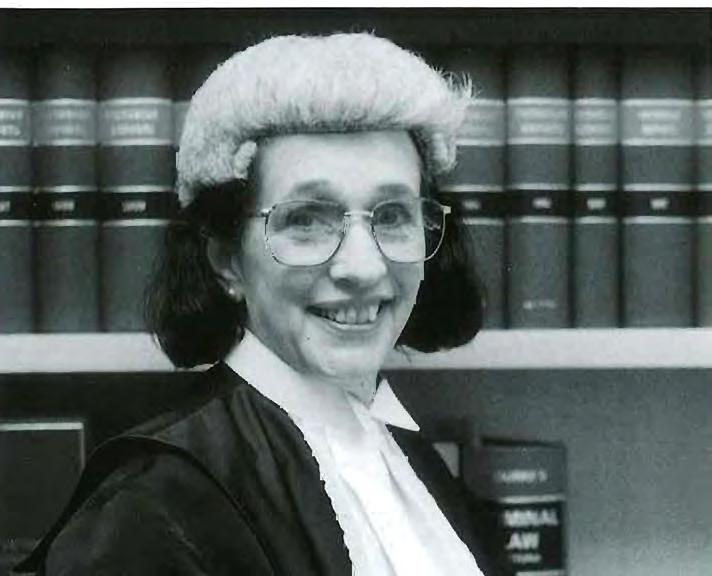
Justice Balmford
ROSEMARY Balmford (ne e Norris) was featured on the cover of Bar N ews (what see ms) a very short time ago when she was appoint e d to the County Court of Victoria. She th e n said that she was happy there and that her colleagu e s were "supportive". Now she has abandoned them and gone on to higher things
We do not propose to r e ite rate what was said of Judg e Balmford in the Spring 1993 issue of Bar News. Her experience and her academic prowess were there canvassed in de tail. Suffice it to say that she is probably the only MBA on the Supr e me Court, certainly th e only former President of th e Legal Wome n' s Association of Victoria, and most probably the only member of the Nursing Mothers' Association of Australia.
Her Honour has come t o th e Supreme Court by a somewhat non-traditional route. She has practised as a solicitor but not as a barrister; she has b e en an independent lectur er at Melbourne Law School; she was the foundation Executive Director of the Leo Cussen In stitute; she has been a memb e r of th e Equal Opportunity Board (Vic.) and was for t e n years a Senior Member of the (Commonwealth) Administrative Appeals Tribunal. She has ; written in th e ar e a of administrative law, conveyancing, legal education and wildlife law.
Of particul ar significance was her role as a memb e r of the Plannin g Committee . for the Australian National Confe rence on : Legal Education run by th e Law Council in Sydney in 1976. She was then Executive Director of the Leo Cuss en Institute which was at that time seen as the leader in postgraduate practical training in :' Australia.
One has to ask whether the young Rosemary Norris was very much "daddy's girl" Certainly she has emulated her , father in many things though (regrettably) she fail e d to follow in his footsteps at the Bar. He obtained the Supr e me Court Prize from the University of Melbourne in 1923. She obtained it in 1954 He was appointed to the County Court in 1955. She was appointed in 1993. He was "e levated" from the County Court to th e Supreme Court in 1968. She was "elevated" from the County Court to the Supreme Court in 1996 . Justice Balmford -we assume that ' now that the re is a non-male member of
the Supreme Court the styl e of address used in the Fed eral Court and High Court will percolat e into the Supr e me Courtis a keen bird watcher and has published two books and a number of articles on the subject.
Her first book, Learning About A ustralian Birds, was published by Collins in 1980; the second, The Beginners Chronicle to Australian Birds, by Penguin in 1990 . We have not checked to analyse whether observations made by her of her
colleagues whil e on the Federal AAT influenced the content of the Penguin book. It would be only a short step perhaps to a volume entitled "The Beginners Guide to Australian Advocates" or "Learning About Judicial Idiosyncras ie s"
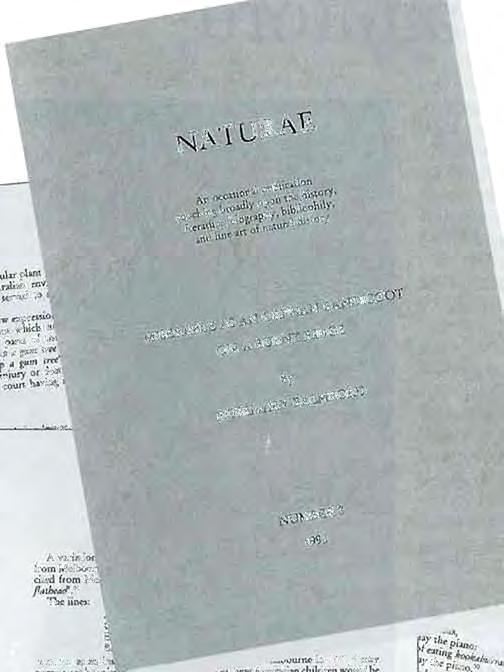
Her Honour has also published a fascinating article dealing with the relationship between Austr alian natural history and Australian Language which is entitled "Miserable As an Orphan Bandicoot on A Burnt Ridge".
Members of the Supreme Court who, 17
Justice Balmjord
when writing a judgment, find themselves lacking an appropriate authentic Australian expression to provide colour and imagery to their judgments may find reference to this article or to her Honour of considerable assistance. How many readers know that the use "cockatoo", as a description of a lookout posted by those engaged in an illegal activity, goes back to 18
1827, or that the word of "cocky" to describe a small farmer appears to derive from the use "cockatoo" to describe farmers brought from Sydney to settle at Port Fairy on the Victorian coast. How many readers have been known "to wombat"? It is to be hoped that her Honour's reported judgments will be replete with these and like Australian expressions. We
look forward to the day when she describes a litigant (or counsel) before her as a "wallaby" or a "boudoir bandicoot". We congratulate Justice Balmford on being the fIrst woman to join the Supreme Court Club. We wish her well and express the hope that she will not for long be the sole female member of that Bench.
or Qoi)I be I'tkft t AWlnliM 4h w6wd 'be .-""
Merry. he,
Judge Gebhardt
IT is common enoug h nowadays for one-time university rs, tutors or professors to be made partners in law firms, to practise at the Bar, to take silk or to even be appointed to the Bench. But an appointment to the County Court of a onetime public school headmaster, Harvard graduate, published poet and possibly the most senior articled clerk to have adorned Melbourne's footpaths? Never! Wrong. Enter his Honour Judge Gebhardt.
The popularity of his Honour's appointment was demonstrated by the capacity crowd of well wishers from the legal profession and public who gathered in court eight on 17 May at his Honour's welcome. The Solicitor-General, Douglas Graham Q.C., the Chairman of the Bar, John Middleton Q.C., the Chief Magistrate, Michael Adams Q.C., along with more silk than one finds at Diamaru, and other members of the profession attended to acknowledge his Honour's appointment.
His Honour commenced to practise law as a relative latecomer after having graduated from the University of Melbourne somewhat earlier. Among his Honour's fellow students and friends at the time were Jim Merralls (now J.D. Merralls Q.C.) Clive Tadgell (now Tadgell J.A.), John Phillips (now J.D. Phillips J.A.), Stephen Charles (now Charles J A.), Neil Forsyth (now N.H.M. Forsyth Q.C.) and many others who rank at the senior end of the legal hierarchy. His Honour graduated in law but pursued a career in education after a stint at Harvard . At a remarkably tender age his Honour was appointed to senior education posts at Milton Academy in Massachusetts, at All Saints, Bathurst, Geelong Grammar and later as Principal of Geelong College. There, his Honour's new age way of thinking saw a reduction in emphasis in sports and an increase in an emphasis on academic pursuits. The enlightenment of his Honour's new age way of thinking took the Geelong establishment a little by surprise.
After some years as headmaster of Geelong College and while a mere callow youth of age 49, his Honour decided to move to Melbourne and actually practise law. His Honour was articled to Brian Flynn of Flynn Murone & Co in Coburg. While serving articles, his Honour developed a keen knowledge of the Upfield line train timetable, the hours of the Stamps Office and the Titles Office and his Hon-
our acquired a first name basis friendship with the Registrar of Probates. Upon his Honour making daily visits to that office, he was frequently greeted with words "And what have you stuffed up today?"
At the conclusion of the 12-month period of articles, in March 1987 his Honour commenced to read at the Bar with John Kaufman, now J.v. Kaufman Q.C., on the lith floor of Owen Dixon Chambers West. Being "educated" by Curtain Q C., Kellam Q.C (now one of His Honour's brothers), Scanlon, Manly, Gobbo and Cook, his Honour learned certain of the finer points of life at the Bar the likes of which most new readers do not learn, and if they do it is certainly not from text books Lunching and pleading, sometimes simultaneously, were skills to which his Honour brought consummate ability.
His Honour quickly developed a flourishing practice at the Bar, mainly in administrative law and in crime. Among his Honour's milestone cases was the litigation rollercoaster Meeking v. Mills (1990) 169 CLR 214 If the Bar could only genetically engineer clones to be made of the litigant in that case. It involved a person driving with more than the prescribed concentration of alcohol in his blood. When first before the Magistrate and at the close of the crown case, his Honour submitted that it was an abuse of the process of the court that his Honour's client was charged under a particular section of the Road Safety Act. Rather than dismissing the charge, and over objection from both sides of the bar table, the Magistrate amended the information so that Mills found himself charged under an
His Honour Judge Gebhardt
Welcomes
altogether different proVISIon. Spouting righteous indignation, his Honour challenged the propriety of the Magistrate's amendment by review to the Supreme Court. Crockett J. held that the charge should have been dismissed rather than amended. The Crown appealed. The Full Court disagreed and ordered the Magistrate to hear the charge under the amended section. His Honour was outraged and sought special leave of the High Court. The High Court granted special leave but in a 3-2 split on the hearing of the appeal Mills failed. The matter was then remitted to the Magistrate, who heard the charge and convicted Mills. Leaving aside the splendour of the vista of almost every court in the Australian curial hierarchy, of particular significance is the fact that Gordon Lewis, then the instructing solicitor on the other
side, now is one of his Honour's brothers on the Court.
His Honour frequently succumbed to the lure of the camaraderie and other attractions of the tenth floor of Owen Dixon Chambers East. There, his Honour took wine and wise guidance from Dowling Q.C., Winneke Q.C., McPhee Q.C. and others. When the Attorney-General's offer of the appointment to the County Court arrived, Brian Flynn advised his Honour to accept.
His Honour's finesse in the world of poetry is unbounded. His Honour has published two books of poetry, one entitled Killing the Old Fool and the other Secretary to Praise. Not since the Chief Justice's stories of Ned Kelly has there been a more prodigious judicial writer in the Arts.
Whatever spare time his Honour has is
dedicated to his wife Christina, son Nicolas, daughters Sophie and Anna and to family matters. Family business frequently takes his Honour to Mt. Gambier where the Gebhardt name is firmly entrenched. A little known family fact is that his Honour is the descendant of Judge Drake Brockman a pioneer of the conciliation and arbitration court. His Honour also sat for a time on the Social Securities Appeal Tribunal. Every now and then his Honour has time to watch the blue and white Kangaroos in action.
His Honour's past form in passing out detentions will undoubtedly stand his Honour in good stead when administering custodial sentences.
The Bar wishes his Honour a long and distinguished career on the Bench.
Chief Magistrate Adams
ON 7 May, 1996 the AttorneyGeneral Mrs Wade announced the appointment of Michael Anthony Adams Q.C. as Victoria's Chief Magistrate.
His Worship was born and grew up in Castlemaine, Victoria and is the youngest of five sons born to Ann and Jack Adams. He was educated at St. Gabriel's College and Castle maine High School and came to Melbourne in 1967 and took employment with the Crown Solicitor's Office, Criminal Law Branch whilst he studied law at Royal Melbourne Institute of Technology. His abilities were soon recognised by Sir Esler Barber, the Chairman of the Legal Education Committee, and he was later appointed a tutor. His Worship continued as a tutor between 1973 and 1983 when the course was closed down. He was awarded the Supreme Court Judges' Prize for the best student in 1972.
After service in the Crown Solicitor's Office he was promoted to the position of Legal Officer in the Parliamentary Counsel's Chambers under the direct supervision ofthe late Mr. John Finemore Q.C., Chief Parliamentary Counsel, under whom he honed his considerable drafting abilities. He remained there until June 1973 when he was seconded as Legal Assistant to the then Attorney-General, Mr. Wilcox.
At the end of 1973 his Worship was' appointed Associate to Sir Alistair Adam Chief Magistrate Adams
with whom a strong friendship developed. Sir Alistair observed his Worship's practice at the Bar with particular interest and would be richly proud of this appointment.
In December 1974 his Worship came to the Bar and read with Bill Ormiston, now Mr. Justice Ormiston.
His Worship's practice at the Bar covered most areas of the law. In the early years of course the broad practice of the Magistrates' Court, appeals to the County Court and criminal trials. Within a few years he developed a specialised practice in commercial and taxation law before moving into the area he most enjoyed, Equity (particularly Part IV applications) and administrative law. Between 1989 and 1992 his Worship acted on behalf of the Attorney-General in four applications relating to the custody of Gary David. This matter was most time consuming and particularly difficult, requiring considerable patience which needed to be matched with high legal skills in dealing with novel legislation with far-reaching ramifications.
In November 1992 his Worship was appointed one of Her Majesty's Counsel. Fortunately, his late brother Maurice was present in Chambers when the announcement was made and was clearly delighted to be able to share his Worship's personal satisfaction.
In 1994 he was appointed a part-time member of the Guardianship and Administration Board remaining so until his appOintment as Chief Magistrate.
Justin O'Bryan read with his Worship, and in the tradition of Master and Pupil, each taught the other and more importantly remain close friends.
His Worship was a tireless worker for the Victorian Bar. He served on the Bar Council from 1977-83 and 1988-89. Following the appointment of J.D. Phillips Q.C. to the Supreme Court, his Worship was appointed Bar Librarian; an appointment he held for the balance of his time at the Bar. He was a member of the Bar Staff Committee for many years and in July 1991 prepared a total re-draft of Council Rules in the form of the Constitution of the Bar. The Bar Council later appointed a Committee, including his Worship, to consider and report upon this draft which was later to become the basis of the Bar's Constitution
The Essoign Club owes much to his Worship's tireless and unstinting efforts. He was a moving force together with Berkeley Q.C., Walsh Q.C. and Michael McInerney in the establishment of the Essoign Club and was a director since its inception in March 1981 and Chairman between April 1990 and April 1994. In the infancy of the Essoign Club his Worship arranged for various artists to exhibit their works at the Club and thereby helped to foster relations between the Bar and members of the arts community. In recognition of his service, his Worship was made a Life Member of the Essoign Club in 1995.
Members of the Bar would be hard-
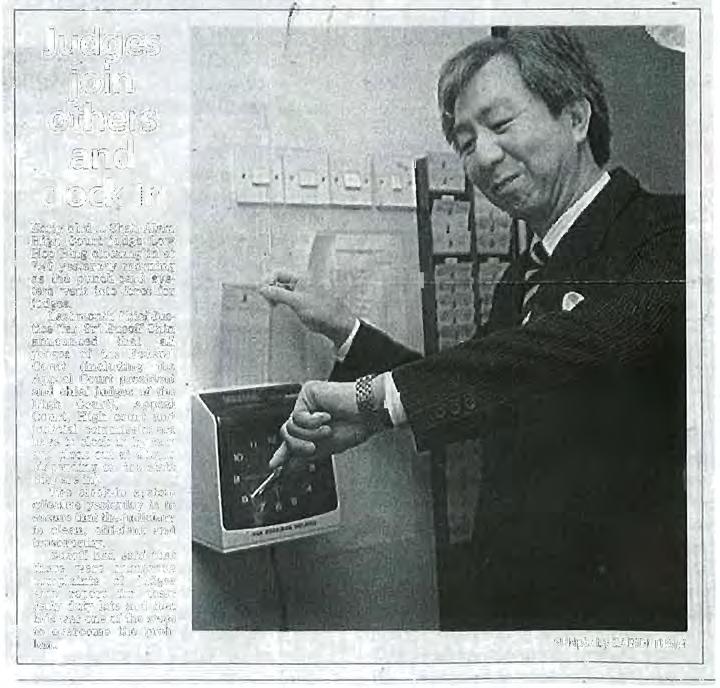
Clocking Counsel Off
CAROLYN Sparke reports the following:
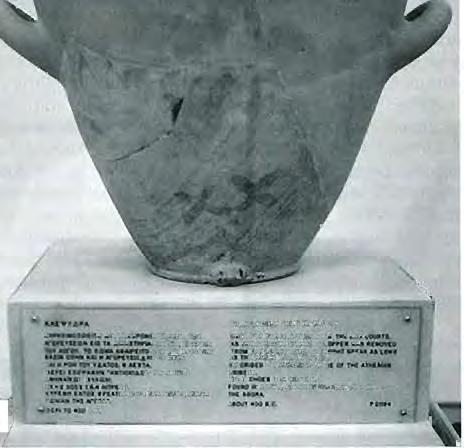
"Another 'intrepid explorer' member of Counsel, Jim Samargis spent some time in Europe last year. In a Greek museum he found the following useful device.
The description of the item is given as follows: "KLEPSYDRA = WATER CLOCK
Used for timing speeches in the law courts.
As the speaker began a stopper was removed from the lower hole. He might speak as long as the water ran: six minutes.
Inscribed: 'of Antiocis' (one of the Athenian tribes) found in a well at the south-west corner of the Agora.
About 400 BC."
A thought to strike terror into the hearts of many an advocate.
pressed to nominate an identity at the Bar as well known and respected as his Worship. This is partly due to the fact that no other member of Counsel in recent memory wore "Snoopy" watches, walked wooden ducks on sticks; and housed a Pianola and three Kelpie dogs (fortunately in succession, not concurrently) in Chambers. The last Kelpie, Lizzie, was reputedly kept to guard his Worship's secretary, Miss Christopherson . However, a little time ago Lizzie bailed up a priest who was clad in industrial clothing awaiting a return of His Worship's colleague, Mr. Brendan Murphy. His Worship consoled Lizzie by informing her that just because the priest was dressed in black it didn't mean that he was the Devil. The grateful priest, although relieved, exclaimed that although he was yet to face court, the worst was surely over.
Last year his Worship married Jan Brook and has an extended family of two step-daughters and four grandchildren. At the time, those of us who know his Worship wondered how he could possibly accommodate family life into his busy schedule.
The task of leading and administering this State's most populous court of 94 magistrates and over 1,000 administrative personnel has been entrusted to a most able, respected and compassionate man, The Bar warmly applauds his appointment and extends to His Worship, and his family, its sincere best wishes and congratulations.
Phillip Slade
First and Foremost an Activist
"Phillip stood for and protected the w eak est, he protected the most d ef enc eless and he stoodfor them in th eir h our of n ee d and if that meant that he had to get up i n the middle of the night to go and get someone out of trouble, he would."
Robert Richter Q.C.
PHILLIP Slade joined our Bar in 1987. He read with Lillian Lieder and practised as a respected advocate ofthe criminal bar.
Phil studied law at Monash La w School some 27 years ago. By all accounts, he made an extraordinary mark on the place, chall e nging it, as he did, with its first true expression of 1970s radicalism. On e of his clo s e friends, Neil Rees, has painted a striking picture of the Phillip Slade of thos e days:
"His daily garb, torn and ripped j e ans (b efore they became fashionable), purple T-shirt, Levi jacket and in one pocket a packet of Drum, and in the other pocket a packet of Kent for when th e r e was insufficient time to h ave a 1'011your-own Long brown hair, and a long brown beard
He was a raging fire Some people stood back from him because there were a few spark s Tho s e of us who loved him I think stood close and took in the warmth and the light. He was p as sionate, he was committed, he was dogged, h e was intense, he was provocative and he was utterly and completely outrageous."
He pursued in political philosophy alongside his law studies. His political philosopher at the time was Herbert Marcuse. However, Phil was first and foremost an activist. He was in a hurry to do things. He could not be content with study alone.
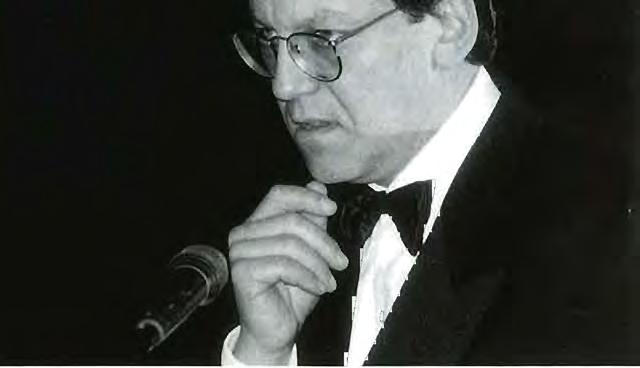
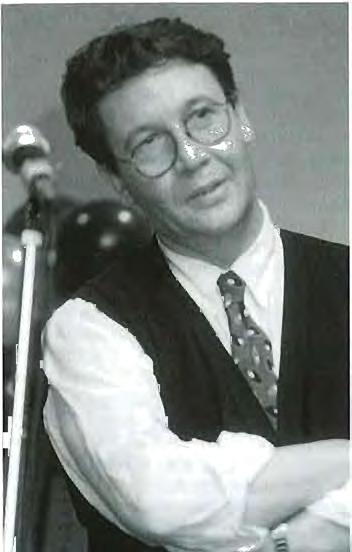
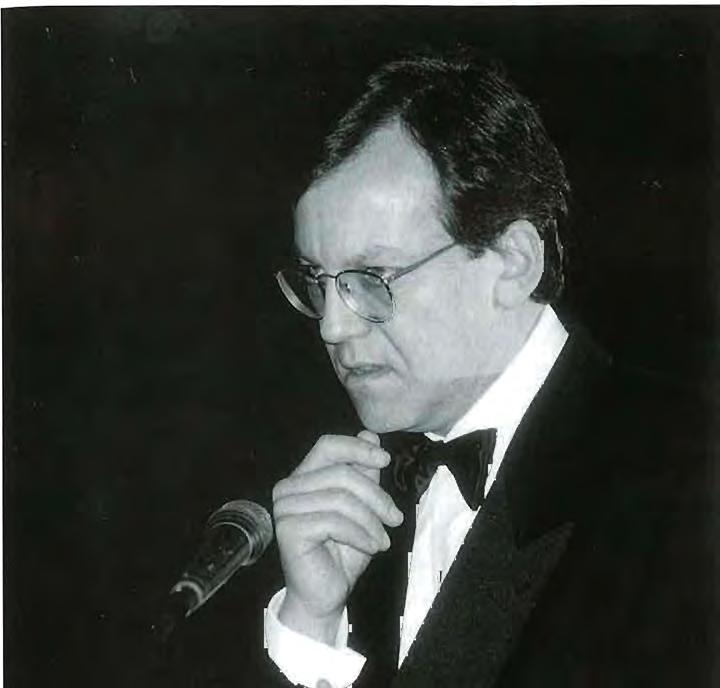
Phil forged the driving spirit behind the Springvale Legal Service. The Service started in 1973 and is still successfully operating 23 years later. Indeed it has become the largest legal aid service of its type in Australia. It owes its existence to Phil. He is remembered there each yeara student member is awarded the annual Slade Trophy for work performed at the Service . The photograph captures Phil in a classic stance behind the microphone at the 21st birthday party of the Springvale Legal Service in 1994.
Following law school, Phil did his arti-
cles with an old communist called Cedric Ralph. He was admitted to practise in 1975, and worked for a short time at becoming a family lawyer.
Phil then turned his energies to the Aboriginal Legal Service, where he joined an extraordinary band of people - Greg Lyons, Chris Lorham, Mick Dodson, Mick Noah and particularly Molly Dyer, who was to have a profound influence on his life. During those years, Phil devoted himself to the Aboriginal people. He became their friend and helper -a charismatic and powerful advocate of their cause.
Exhausted by his work for the Aboriginal Legal Service he went on to set up his own legal practice where he was joined by people such as Lyn Chuck, Les Webb, Denny Meadows, Neil Clelland, Tony Parsons and others He practised in his own name, then as Slade and Webb, and [mally as Slades. These were good and productive years. As Robert Richter described the practice:
"Slad e s specialised in the notion that they were there not just to wrap pieces of paper in pink ribbon for barristers to go and stand up in court. Th ey were solicitor advo cates par excellence. Everyone who worked with Phil and for Phil knew that they had to put themselves behind their convictions, they had to put themselves behind their re t ainer and they had to go and fight for their cli ent becaus e that was the way things were done by Phil and th e band of people he had around him
If you happ e ned to be a barrister that he was briefmg from time to time, he wouldn't let you go to court unless he was satisfied th §lt he had persuaded you that your client was right and that you would do the right thing by your client. "
In the course of his practice as an advocate solicitor, he developed close working relationships with a number of magistrates, particularly at the Prahran and St Kilda courts, where he regularly appeared to represent his clients. In those courts he was respected as an advocate who was more than a paid mouthpiece. His pleas were forceful and compelling. This had its source in his unquestionable sincerity and his ability to convey a deep understanding of his clients Phil's talent was able to secure a more productive life for many of those who entrusted their plight to him.
Phillip's drive and compassion extended his work into spheres beyond the law. In the 1970s he was confronted with the crying needs of an inadequate drug rehabilitation system in Victoria Phil could not let this rest. He worked tirelessly to help establish a new drug rehabilitation centre under the auspices of an association which bears the name - the "Windana Society". The name was Phil's inspiration. "Windana" is an Aboriginal word meaning "walking to the road of choice". Through the work of the Society, many young drug users have indeed been given a "choice" to set out on a new life
Phil became the secretary and the president of the Windana Soci ety . It went on to establish a drug treatment and community centre in St. Kilda and a therapeutic community at Pakenham It has now become one of the most comprehensive drug treatment centres in Australia
Phillip Slade joined Muir's (now Meldrum's) list in 1987. His time in practice has seen his passion and intense
Phillip Slade
curiosity become focused upon crafting the tools of the practising barrister. He appreciated that, with a more profound technical knowledge, he would be in a position to exert greater influence in advancing the interests of his clients. The fires of his youth were tamed and controlled. He became a fine criminal barrister, and at 44 years, was poised on the brink of an outstanding career at the Bar.
The stream of Isaacs Chambers neighbours who were constantly at his door seeking his advice and insight, bears witness to the high standing Phil achieved in the eyes of his fellow practitioners.
It would be fitting to conclude with a piece searched out by Neil Rees from the writings of Robert Ingersoll, a 19th century American lawyer and humanist who spoke these words at his brother's graveside 100 years ago:
"This brave and tender man in every storm of life was oak and rock. But in the sunshine he was wine and flower. He was the friend of all heroic souls, he sided with the weak and with a willing hand gave arms. He was a worshipper of liberty and a friend of the oppressed. He
believed that happiness was the only good and reason the only torch, justice the only worship, humanity the only religion and love the only priest. He added to the sum of human joy and were everyone to whom he did some loving
service to bring a blossom to his grave, he would sleep tonight beneath a wilderness of flowers."
Peter Vickery
Berlin: A Chance to Win a Dictation System
THE International Bar Association, of which the Law Council of Australia is a member, is holding its twenty-sixth biennial conference in Berlin, Germany, from 20-25 October.
By requesting a copy of the 72-page Berlin Preliminary Program, lawyers in Australia will be automatically entered into a prize draw for one of six IBM VoiceType dictation systems, which come with a 25,000-word vocabulary for legal dictation designed for corporate and private practice lawyers.
The Berlin conference will feature a Plenary Session on "Freedom of Expres-
sion - Privacy versus Freedom of the Press" and separate working programs covering a plethora of topics on business law, general practice, energy and natural resources law and many other areas. There will also be a special program for guests.
Requests for the Preliminary Program must arrive at the IBA in London by 1 September to qualify for entry in the draw.
Contact the International Bar Association, 271 Regent Street, London WlR 7PA ; England. Fax: +44 (0)171 409 0456. Phone: +44 (0)171 629 1206.
The University of Melbourne Law School has an exciting, flexible and innovative program of graduate courses in law. Practitioners and allied professionals are involved with academics in planning and teaching of the courses to meet the evolving needs of law in the community.
Subjects are available on a continuing education basis (assessment being optional), in addition to the masters program and specialist graduate diplomas.
INTENSIVE TEACHING:
Subjects taught intensively over 1-2 weeks are ideally suited for members of the Bar.
SPECIALIST AREAS
Asian Law
Corporations & Securities Law
Dispute Resolution & judicial Administration
Finance Law
Government Law
Health & Medical Law
Insurance Law
Intellectual Property Law
International Law
Labour Relations Law
Media, Communications & Information
Technology Law
Natural Resources Law
COURSEWORK DEGREES
Graduate Diplomas
LLM by Coursework
LLM by Coursework & Minor Thesis
M.Tax by Coursework
RESEARCH DEGREES
LLM by Major Thesis
Doctor of juridical Science (SjD)
Doctor of Philosophy (PhD)
MID YEAR ENTRY AVAILABLE
Further information:
Research & Graduate Studies Office, Faculty of Law, The University of Melbourne, Parkville, Vic. 3052, Tel: (03) 9344 6190, Fax: (03) 9347 9129.
Judge Davey's New Guidelines
THE Domestic Bullding Tribunal is establish e d under th e Domestic Build i ng Contracts and Tribunal Act 1995 (Vic). The functions of the Tribunal are set out under Section 52 of that Act and include hearing and determining domestic building disputes; disputes concerning insurance claims concerning domestic building work and insurers decisions on those claims; and hearing and determining matters referred to it under the House Contracts Guarantee Act 1987. A "domestic building dispute" is defined in Section 54 and includes any dispute or claim arising between a building owner and a builder or sub-contractor or architect in relation to a domestic building contract. For this purpose (Section 54(2» a dispute or claim includes any dispute or claim in negligence, nuisance or trespass but does not include any dispute or claim related to a personal injury.
The Registry of the Tribunal is located at 55 King Street, Melbourne (7th Floor). The Chairperson of the Tribunal is his Honour, Judge Davey of the County Court.
Under the Act (Section 114) the Chairperson may issue practice notes concerning the practices and procedures to be followed by the Tribunal and those appearing before the Tribunal.
In exercise of this power Judge Davey has issued Case Management Guidelines on 18 June 1996. They are set out in what follows
It is important to note, however, that such Guidelines are not intended to limit the discretion of the Tribunal in any individual case.
DOMESTIC BUILDING TRIBUNAL
PRACTICE DIRECTION CASE MANAGEMENT GUIDELINES (THESE PRACTICE DIRECTIONS REPLACE THE PRACTICE DIRECTIONS DATED 15TH MAY 1996)
1. APPLICATION AND INTERPRETATION
Scope
1.1 These Guidelines apply to all proceedings that are commenced in the Domestic Building Tribunal.
Time
1.2 The times specified in the Schedules to these Guidelines should be
treated as indicative only and may vary depending upon the circumstances of each application.
2. DEFINITIONS
2.1 In these Guidelines "Act" means Domestic Building Contracts and Tribunal Act 1995; "application" has the meaning given to it in Section 69 of the Act; "Case Management Conference" means the first pre-trial hearing that takes place after the issuing of an application; "Dispute Schedule" is the schedule which must accompany each application or cross application; "prescribed fee" means the fee set out in the Act or regulations; "proceeding" means a claim or cross claim which has been commenced by an application in this Tribunal; "small claim proceeding" has the meaning set out in Guideline 10.1; "track" means the system of case management; "Tribunal" means the Domestic Building Tribunal.
Status
2.2 The purpose of these Guidelines is to assist parties and their advisors as to the procedures generally adopted by the Tribunal but are not intended to limit the discretion of the Tribunal.
3. COMMENCEMENT OF A PROCEEDING
3.1 To commence a proceeding a party must file two (2) copies of an application using the form provided by the Tribunal and by paying to the Registrar the prescribed fee.
3.2 A respondent to an application who desires to make a cross claim must file two (2) copies of a cross application using the form provided by the Tribunal and by paying to the Registrar the prescribed fee.
3.3 Subject to the directions of the Chairperson, the Registrar may refer an application to mediation prior to the Tribunal conducting a Case Management Conference or
may classify an application as a small claim proceeding.
4. CASE MANAGEMENT CONFERENCE
How convened
4
1 The Tribunal may convene a Case Management Conference either before or immediately after the mediation. -
4.2 The Tribunal may direct that the parties attend the conference personally.
Purpose of the Case Management Conference
4.3 At the conference the Tribunal may:
(a) Identify the issues, and note those that are contested and those that are not contested; (b) require the parties or any of them to complete a Dispute Schedule;
(c) explore methods to resolve the contested issues; (d) if possible, secure the parties' agreement on a specific schedule of events in the proceeding or failing agreement give appropriate directions; (e) make orders for interlocutory relief;
(f) convene a hearing; and (g) review and, if necessary, amend the timetable for the proceeding.
4.4 A party who seeks an order under sub-guideline 4.2 may apply to the Tribunal at any pre-hearing conference for such an order.
4.5 On an application under subguideline 7.5(b) the Tribunal shall have regard to the matters set out in Schedule 1.
Attendance of Parties
4.6 Parties are expected to attend the Case Management Conference.
4.7 Should a party, for good reason, be unable to attend a Case Management Conference such party, or some person on behalf of each party, must advise the Registrar immediately so that, if possible arrangements may be made for such party or for each person on behalf of such party to participate in the Case Management Conference by telephone.
5. TIMETABLE
5.1 The Tribunal shall at the Case Management Conference when specifying a timetable for the preparation of an application for hearing have regard to the times specified in Schedule 2 for the relevant track, but notwithstanding those times a Member will remain entitled to exercise his or her discretion when determining the appropriate timetable for a proceeding.
5.2 A Solicitor acting for a party shall give a copy of the timetable forthwith to his or her client or clients.
6. FAILURE TO COMPLY WITH TIMETABLE
Power
of Tribunal
6.1 Where a party fails to comply with an order of the Tribunal, the Tribunal may convene a directions hearing before the Chairperson or a Member at which it may:
(a) amend the timetable and order the party to comply with the amended timetable;
(b) if the party is the applicant dismiss the party's application or if the party has filed a cross application dismiss the cross application;
(c) order the party or the party's solicitor to pay costs, including solicitor and client costs fixed and payable forthwith;
(d) require any order as to costs to be complied with before continuing the proceeding; and
(e) make any other order that is just.
Late Filings Accepted Conditionally
6.2 The Registrar shall accept a document for filing after the expiry of a time specified by order of the Tribunal, but shall mark it as fIled late.
7. CASE MANAGEMENT AND PRE HEARING DIRECTIONS
Direction
Hearings
7.1 The Tribunal shall deal with all matters that arise in the proceeding before the commencement of the hearing, including all applications, directions and pre-hearing conferences, except where these Guidelines provide otherwise.
7.2 An application may be referred to mediation by the Tribunal immediately after a Case Management Conference.
Informal Application Procedure
7.3 An application may be made to the Tribunal by a party to a proceeding at any time prior to the hearing for a pre-hearing conference and such application may be made: (a) with or without supporting material; (b) by attendance, conference call, telephone call or telephone transmission, or in writing at a hearing set by the Tribunal for hearing the application.
Tribunal May Convene
7.4 The Tribunal may, on its own initiative, require a hearing or a pre-hearing conference to deal with any matter arising in connection with case management, including a failure to comply with these Guidelines.
Power Generally
7.5 The powers of the Tribunal at a pre-hearing conference include the following powers: (a) to extend or abridge a time specified by these Guidelines; (b) to transfer a proceeding from one track to another; (c) to adjourn a pre-trial hearing; (d) to make orders, impose terms and give directions as necessary to carry out the purpose of these Guidelines.
7.6 The Tribunal member who presided at the Case Management Conference may preside at the hearing of the proceeding only if all parties consent.
8. DEFAULT PROCEDURE
Registrar to Note Default
Automatically
8.1 Where a respondent fails to file a copy of the completed Dispute Schedule within the time directed by the Tribunal, the Registrar shall, ten days after the expiry of the time for such completion and filing automatically and without further notice to the respondent, note the respondent in default and serve notice on the applicant that the respondent has been in default.
Applicant May Note Default
8.2 Sub-guideline 8.1 does not prevent the applicant from noting a respondent in default if the respondent does not serve and file the completed Dispute Schedule within the time allowed for filing.
More May Note Default
8.3 Where there is more than one respondent, the ten days referred to in sub-guideline 8.1 runs from the expiry of the latest time for filing any Dispute Schedule containing any counterclaim by a party to the proceeding.
9. ASSIGNMENT OF RELATED PROCEEDINGS TO CASE MANAGEMENT
Hearing Certain Proceedings Together
9.1 The Tribunal may order that a proceeding which concerns the same or a sufficiently related subject matter to another proceeding: (a) be heard together with that other proceeding; (b) be heard at the same time as or immediately before or after that other proceeding.
Service of Case Management Documents
9.2 Where an order is made by the Tribunal under sub-guideline 9.1(a) or 9.1(b) the Registrar shall forthwith give to every party to the other proceeding who is not also a party to the original proceeding, the directions orders made at the Case Management Conference and any orders varying those directions.
10. SMALL CLAIM PROCEEDINGS
Deimitions
10.1 A small claim proceeding is a proceeding:
(a) where the amount specified in the application as the amount claimed or as the cost of rectification or completion of the works is less than $5,001; or
(b) where the amount specified in the application as the amount claimed or as the cost of rectification or completion ofthe works is more than $5,000 but less than $10,001; and
(c) which is accepted by the Registrar as a small claim proceeding.
Procedure
10.2 In the event of the applicant seeking to have a claim treated as a small claim proceeding the applicant shall in addition to filing two copies of an application
file at the office of th e Registrar, also file :
(a) an affidavit (in accordance with the form in Schedule 3) (i) verifying the claim or claims made in the Dispute Schedule ; and (ii) stating that the proceeding is not expected to take more than one hearing day
(b) the building contract, plans and specification or copies thereof and two copies of any expert's report upon which the applicant intends to rely.
10.3 The Registrar upon accepting an application as a small claim proceeding shall :
(a) appoint a date for the mediation of the proceeding and for the h e aring of the proceeding;
(b) serve on the respondent a copy of the application with the verifying affidavit and a c opy of any expert's report filed by the applicant together with a notice setting out the time and pl a ce of the mediation and th e time and place of the hearing and should the mediation be unsuccessful;
(c) give a notice to the applicant of the time and place of th e mediation and the hearing.
10.4 The mediation of a small claim proceeding shall tak e place over a period not exceeding one hour and thirty minutes including the time taken by the mediator to complete a report in accordance with Section 74(1)(a) However should the mediator form the opinion that fmal resolution of the issues or settlement of the substantial issues in dispute is likely to occur within a further period of not more than thirty minutes the mediator may extend the period over which the mediation shall take place to a total period of two hours
10.5 If a mediation is unsuccessful the hearing of the proceeding shall take place before a member of the Tribunal immediately upon the conclusion of the mediation.
10 6 In the event of the respondent seeking to challenge the classification of an application under
Guidelin e 10.l(b) as a small claim proceeding he or she must object in writing to the Tribunal within 14 days of being served with the application of the Applicant( s).
10.7 Und er Guideline 10.6 the respond e nt 's challenge to the classification of a proceeding as a small claim proceeding may be mad e only on the basis that:
(a) th e r e spondent has a cross claim in excess of $5,000 and/or
(b) the evidence proposed to be called by the respondent will result in the hearing taking more than one hearing day.
10 8 The respondent's application to challenge the classification of the application must be supported by an affidavit (in accordance with the form in Schedule 4) verifying the ground(s) of objection
10 9 Should the Tribunal reclassify an application as a standard proceeding the mediation will still take place at the time and place fixed by the Registrar but will not be subject to a time limitation and in the event of th e mediation being unsuccessful, the application will be referred to a case management conferen ce
11 DIRECTIONS
Need for Directions
11.1 From time to time should a need arise for directions or for further directions in a proce e ding a party may make application to the Tribunal.
Procedure
11.2 A party seeking directions or further dir e ctions in a proceeding: (a) shall request the Registrar to set a date and time for the hearing of such application; (b) shall make application in accordance with the form in Schedule 5 duly completed; (c) shall(i) lodge the completed application form at the office of the Registrar; (ii) give a copy of the completed application form to each other party in the proceedings; (iii) inform each other party in the proceeding (not later than 48 hours be-
fore the hearing of the application) of the date and time set by the Registrar under Guideline 11.2(a).
12. STOP ORDERS
Generally
12 1 A party making application for an order under Section 64 of the Act must file two (2) copi es of the application and must pay to the Registrar the prescribed fee.
Procedure
12.2 A party making application under Guideline 12.1 shall make such application in accordance with th e form in Schedule 5 duly complet e d.
13. COMMENCEMENT OF GUIDELINES
13.1 These Guidelines come into effect on the date of the publication of this practice direction
SCHEDULE 1
CRITERIA FOR SELECTING THE APPROPRIATE TRACK
Domestic Building Disputes
Fast Track (Short Hearing)
The witnesses are not expected to exceed four and it is anticipated that the hearing will take, not more than two hearing days
The issues of fact or law are not anticipated to be complex
The number of parties are not anticipat e d to be more than two.
The amount of money in dispute.
Standard Track
The witnesses are not expected to require rrwre than three days oj h earing.
The time required for proper discovery and preparation for hearing is anticipated to require the standard time intervals.
The issues of fact or law are not anticipated to be exceptionally complex.
The amount of money in dispute.
Complex Track (Long Hearing)
The witnesses are expected to require rrwre than three days oj hearing.
The number of parties or prospective parties are anticipated to be more than two.
The amount of money in dispute
The time required for proper discovery and preparation for hearing is anticipated to require time intervals of more than that
provided on the Standard Track. The amount of case management intervention by the Tribunal that the action is
likely to require is anticipated to be more than that provided on the Standard Track.
SCHEDULE 2 INDICATNE TIMES
Activity Fast Track Period Standard Track Period
Time between filing of the application and receipt of mediator's report
Time between mediator's report and case management conference
Time between the case management conference and:
* the filing of witness statements and exhibits, and
* the discovery and inspection of documents
between filing of witness statements and exhibits and
filing the application and
* The indicative preparation times for the complex track may vary substantially depending on the complexity of the proceeding.
SCHEDULE 3 FORM OF AFFIDAVIT FOR APPLICANT(S)
Domestic Building Tribunal
NO:
Applicant(s) Respondent( s) AFFIDAVlT
I, [specify whom] of , make oath and say that:
(1) I am the a150ve named Applicant [Or, I am one of the above named Applicants and make this affidavit on behalf of all of them.]
(2) The claim/claims [Delete as necessary] made in the Dispute Schedule by me/by the Applicants [Delete as necessary] are true and correct.
(3) The above proceeding is not expected to take more than one hearing day.
SWORN BY
SCHEDULE 5
FORM FOR APPLICATIONS FOR DIRECTIONS/STOP ORDERS
Domestic Building Tribunal
NO:
Applicant(s) Respondent(s)
To: [Identify other party or parties] Application is to be made by [specifY whom] to the Domestic Building Tribunal on the day of 1996, at am/pm for the following direction/directions/stop order/stop orders [Delete as necessary].
l. 2.
Dated day of 1996 Signed DATED 18TH DAY OF JUNE 1996 /jJ( 1JUDGE
CHAIRPERSON: DOMESTIC BUILDING TRIBUNAL
SCHEDULE 4
FORM OF AFFIDAVIT FOR RESPONDENTS (S)
Domestic Building Tribunal
NO:
Applicant(s) Respondent(s)
(1) I am the above named Respondent [Or, I am one of the above named Respondents and make this affidavit on behalf of all of them.]
(2) IIWe [Delete as necessary] object to the classification of the above proceeding as a small claim proceeding on the grounds that a cross claim for an amount in excess of $5,000 is to be brought.
AND/OR
(3) IIWe [Delete as necessary] object to the classification of the above proceeding as a small claim proceeding on the ground that the evidence IIWe [Delete as necessary] propose to call at the hearing of the above proceeding will result in such hearing taking more than one hearing day.
SWORN BY at Before me
Judge's Annual Dinner "T
HE persons confined in the Melbourne gaol will be regaled on Monday next at the expense of his Honour, the Resident Judge. Orders have been issued to supply each man with a plentiful dinner of "plum pudding and roast beef' together with a pint of Mitchell's ale, to toast the generous giver's health. This practice has hitherto been adopted by all our judges, and the miserable inmates of the gaol are quite pleased with the liberality of his Honour on the present occasion."
The Argus, 22 December 1848
Peter Chadwick, who contributed this short piece, suggests that "the tradition has lapsed somewhat of recent times. Your readers may agree that the revival of the tradition is long overdue".
Exaggeration Makes the Bar Go Round: The Legal Aid View
By Robert Cornall, Managing Director, Victoria Legal Aid
THE legal p rofession is very adept at overselling a good argument, the anonymous au of your uthpiece column shows (Bar News, Autumn 1996). Mouthpiece has had a lot of fun at Legal Aid's expense (and makes some valid points) but he or she goes too far. Your correspondent's remarks must be placed in their proper perspective.
COMPLAINTS ABOUT THE SYSTEM
Mouthpiece cites a long list of frustrations with the justice system to support complaints about Legal Aid. A little clear thinking would illustrate the fallacy of this line of argument but, in case any of your readers were persuaded to a different view, I note Legal Aid is not responsible for:
• the 4.30 flick pass by a barrister colleague who has just received a better offer;
• late delivery of a brief by a panicking private solicitor;
• not being reached in a busy list; or
• for a combination of reasons, a barrister having difficulty marking his or her card for the next day.
It is also hard to see how gratuitous insults (asserting legal aid clients spend their "time out on bail knocking off a few more soft targets") advance Mouthpiece's contentions.
COMPLAINTS ABOUT PRIVATE PRACTITIONERS
Similarly, while Legal Aid foots the bill, it is not responsible for the proper conduct of files referred to private practitioners. I reject as irrelevant complaints about private solicitors who don't supply barristers with adequate details or proper instructions - that is a matter to be taken up with them. In the same category are assertions that a private solicitor didn't make it clear it was a legal aid brief or that funds believed to be in the trust account have, by the time the barrister's account is rendered, mysteriously evaporated.
GET THE RECORD STRAIGHT
The Mouthpiece article is headed "Beating your head against a brick wallthe Legal Aid Commission experience". Let's get the record straight. The Legal Aid Commission of Victoria ceased to exist on 14 December 1995. Victoria Legal Aid was established at that time as a new statutory corporation to take over all of the old Commission's activities.
Current accounts are processed within thirty days of being approved for payment but there is still, I accept, far too great a delay.
The Government's purpose in this change was to ensure that Legal Aid does things better and the new organisation intends to do so.
Important changes include:
• the replacement of the former eleven member Commission (largely representing sectional interests) with a small Board of five directors chaired by Geoff Masel of Phillips Fox. Other directors are Sue Crennan Q.C., John King (chairman of the Australian Legal Assistance Board), Norman Reaburn (Deputy Secretary, Attorney-General's Department, Canberra) and myself. The Board's statutory obligations are to manage VLA so it delivers effective, efficient and economical legal aid services to the Victorian public
• the recent appointment of senior managers for the new organisation. Their responsibility is to introduce the changes the Board wishes to make. Some significant improvements are already proposed for the process of granting legal aid to applicants and in improving VLA's accoul1ting procedures.
ACCEPT CRITICISMS
Despite the views attributed by Mouthpiece to "the powers that be at the Commission", I acknowledge our accounting procedures need substantial improvement. A great deal of work is presently being done to payor resolve all outstanding barrister's accounts over two years old. The efforts of today's staff to rectify the shortcomings of yesterday have resulted in accounts in this category dropping by more than $70,000 in the last two months. That does not mean VLA has actually paid $70,000 in outstanding accounts. It means that outstanding accounts totalling that amount have either been paid or resolved (by the account being withdrawn if it was not properly rendered).
Current accounts are processed within thirty days of being approved for payment but there is still, I accept, far too great a delay between the date on which VLA receives an account and the date on which it is certified for payment by our fmance division.
FILE NUMBER IS THE KEY
Legal Aid has made more than 170,000 grants of aid over the last five years: A significant number of those grants involve multiple briefs to barristers. This volume alone presents significant accounting challenges.
So does similarity in client names. For example, VLA has about 340 "Smiths", more than 300 "Thompsons" and 270 "Nguyens" registered in its client database. An address does not necessarily help. Many legal aid clients do not own their own home and frequently change residence.
The only way through this morass of detail is to identify each client matter by its own individual number.
CLERKS' ACCOUNTING
Having accepted those criticisms on VLA's behalf, the standard of the Bar's accounting cannot go unremarked. VLA
gripes with barrister accounting include:
• lack of sufficient detail to explain an accow1t ;
• rendering accounts for the 20 per c e nt legal aid discount after the 80 per cent fee has been paid;
• re-rendering accounts previously rejected by Legal Aid because, for example, the engagement of the barrister's services had neve r been authorised by this organis ation. In thos e circumstances, the barrister ought to take up th e matter with his or her instructor, not send further accounts to Legal Aid.
One other point needs to be made . I understand the Commission agreed some years ago at the Bar's request to pay all barristers' fees direct rather than through the assigned solicitor in the usual way As a result, VLA is required to pay brief fees in matters where it has ( only limited knowledge (in many cases) of the services the barrister provided and, consequently, the appropriateness of the fee charged. This system is fraught with procedural difficulties which require review.
METHOD OF SERVICE DELIVERY
If Mouthpiece has difficulty with private practitioners, why does he or she assume that VLA is any different? Th e problem is that VLA deals with a panel of up to 1,500 law firms c omprising mor e than 7,000 solicitors and the whole of th e Victorian Bar. It would be fair to say not all of them are the full bottle on VLA's requirements for handling legally aided matters This is not an efficient way to manage a business distributing more than $52 million worth of private practition e r legal aid services a year (in 1995/96).
The private sector provides some inte resting examples. One major Australian bank recently reduced its panel of private law firms from 30 or so firms to six or seven. The belief was (and I don't doubt it has been proved correct) that a smaller panel is easier to control, performs better and provides efficiencies in service (brought on by repetition and volume). These advantages lead to reduced costs. Legal Aid could derive similar benefits if it structured its work through the private profession on the same basis . VLA recognises the need to refine its panel of legal aid service providers and has written to the Attorney-General seeking unequivocal legislative backing for that initiative . Our objective is to ensure Victoria Legal Aid meets its statutory obligation to provide effective, efficient and 30
economical legal aid for the Victorian community
CONCLUSION
The present cooperative working relationship which exists between VLA staff and the barristers' clerks h a s enabled u s
Judicial Clock Watching
THE Malaysian newspaper The Sun of 2 February 1996 contains the following new item:
"Last month Chief Justice Tan Sri Eusoff Chin announced that all judges of the Federal Court (including the Appeal Court President and Chief Judges of the High Court), Appeal Court, High Court and Judicial Commission e rs have to clock in by 8.00 a.m. and clock out at 4.15 p.m. (depending on the state they were in) The clock-in system effective yesterday is
to make the significant reductions in long outstanding accounts referred to in this article. The other improvements I have outlined will build on that good work. I am confident th e Bar will not be able to level any of Mouthpiece's justified criticisms at Victoria Legal Aid in 12 months' time.
to ensure that the judiciary is clean, efficient and trustworthy.
"Eusoff had said that there were numerous complaints of judges who repDrt for their daily duty late and that this was one of the steps to overcome the problem."
The Editors understand that the phrase "depending on the state they are in" is a geographical rather than psychological expression.
""'''''1 I I
Prague Castle from the old town
IN March t hi s yea the IBA's Section on E and ItesoW'ces Law (SERL) held biennIal conference in Prague.
The conference took place just before Easter, about three weeks into the Euro c pean spring. But the temperature was wintry and there was snow on the hillsides - and snow falling in the city.
We flew to Vienna with Air Lauda. The service was superb. The food the best airline food either my wife or I have ever tasted and the timetable such - especially flying east on the way back - as to minimise the effect of jet lag. The crew also have the civilised habit of letting you sleep through a meal rather than tapping you on the shoulder to see if you want something to eat. On the way back I slept straight through one meal and two movies.
The conference was held at the Intercontinental Hotel, a large oblong building with all the charm and architectural merit of Owen Dixon Chambers East. But the foyer was larger and the ceilings on the ground floor higher; the lifts plusher. In the context of the old city of Prague it was (and is) an architectural abomination. On the other hand the service was willing and courteous and helpful. The meals were pleasant and the rooms comfortable.
The Intercontinental is located almost on the river, on the edge of the old town, about 200 yards (or should I say 180 metres) from the old Jewish quarter and 400 yards from the old town square.
On the organising committee for the conference was Prince Ludowicz, whose
family had for some centuries owned the castle erected on the site of the original wooden castle where good King Wenceslas was born. One of the highlights of the conference was a visit to his family castle located at the junction of the Moldau and the Elbe, and now restored to him by the Czech government.
When the castle was taken over by the previous government it had housed some highly significant art treasures; and, of course, it had contained furniture of
ancient vintage and imponderable value. Remarkably, when the State returned the castle to the family, it also returned or agreed to return the art treasures and the furniture, all of which was apparently catalogued and traceable. Most of the art works and most of the furniture has been traced and returned to the family. One beautiful desk was in fact recovered from the office of the Czech equivalent of the permanent head of the Prime Minister's Department.
The conference was held at the Intercontinental Hotel, a large oblong building with all the charm and architectural merit of Owen Dixon Chambers East.
Apparently the determination to restore ancestral homes and confiscated assets and treasW'es is a genuine one. No one gave us any indication of what such restoration is costing the State or how that cost is to be met.
The old town of Prague is like a time capsule. Somehow everything stopped over a century ago. It is not just "worth visiting". In some ways it is a place that it is essential to visit. There is a feel and an atmosphere that one does not find in the larger cities of Europe. In Prague one can really revisit the 19th century.
Street in the old town
The old city seems to have been preserved untouched from the middle of the 19th century. The streets are narrow and, although the architecture is largely 18th and 19th century, much of it goes back much, much further. In some ways it is reminiscent of one of the hill cities of Northern Italy
The public buildings are built on a grand scale and beautifully ornamented inside and out. Unfortunately the streets are so narrow that it is difficult to obtain photos of some of the buildings. I am told
It is not unfair to say that during the conference all the Australian wine drinkers were converted to beer.
Street in the old town
lEA visitors in the Street oj the Alchemists
Entrance to Prague Castle
Old town square
there is now on the market a throwaway camera with an ultra wide lens. I recommend that any visitor to Prague take such a camera with him or her
I be lieve it would be almost impossible to see Prague properly if. it were really crowded with tourists. Do not go there in July, August or September! Even on a cold March day the streets wer e busy
The old town square features stalls from which can be purchased Czech manufactures such as lace-work, pottery and, above all, marionettes of various shapes, sizes and manifestations. All are by Australian prices ludicrously cheap
If you are happy to lunch in the square on a glass of glauwein and a Czech sausage with mustard on a slice of rye bread, it Will cost you $2.00. In that form the Czech wine is potable, but is otherwise undrinkable. It is not unfair to say that during the conference all the Australian wine drinkers were converted to beer. The local beer is pleasant and light.
On the opposite bank of the river from the old town is Prague Castle. The castle is in fact a small town of itself, which takes half a day to explore at full pace with a relatively long-striding guide. Do not try to explore the castle
John Matthies & Co
416 Collins Street. Melbourne. Vic. 3000
Financial Consultants and Advisors
without a guide. The castle needs explanations and history. Few Czechs appear to speak English - this was one great advantage of the Intercontinental all of whose staff did speak fluent English -
and French is equally unknown Russian may be spoken but the only foreign language (which I recognised) with any significant currency was German.
In suburbia, and even in those parts of the city outside the old town, th e architecture is depressing . The flats or apartments built during the communist regime are of a quality such as might have been erected by the Victorian Housing Commission on a bad day if the Housing Commission had used its worst architect and had been totally indifferent to the quality of the construction.
The Metro is clean and fast and the service is frequent. But there is nowhere to sit while waiting at the stations. Tickets on the metro costs 6 crowns (30 cents) for anyone journey, whatever its length. Tickets can only be obtained from a vending machine which does not give change. The machine is honest but neither flexible nor coop e rative. There was no obvious place to obtain change and I had nothing smaller than a 10 crown coin. When I put the coin into the machine it refused to give me a ticket. But it returned my 10 crowns. Ultimately I discovered that if I put 30 crowns into the machine it would give me five tickets.
Gerard Nash
FIRST MORTGAGE FINANCE
Residential and Commercial Lending, 1-3 years.
Interest only fixed for term.
No ongoing fees or charges.
Repayment options.
Business loans secured by Residential and Commercial Property.
Telephone:9600 1200. Facsimile: 9600 0771
John Matthies
Gillian Baker
Cold morning in the old town
On Circuit with Peter Lalor's Q.C. in 1865
SIR Arth ur Deane records that ing of the Bar convened by the At torney-General October Mr. Holmes complained that senior men, su c h as Fe ows aneL eland, were doing work which in England would be left to juniors. The etiquette of the Bar was being openly violated".
The complaint appears to be based on the proposition that the Silks were "poaching" work which was properly that of juniors.
The material set out below (unearthed for Bar News by Norman O'Bryan) indicates that in the 1860s there was relatively easy money to be earned by Silks (without juniors) on circuit - the main labour being the physical effort of getting from Melbourne to the circuit town.
The following is a letter written by Mr. R.D. Ireland, the first Queen's Counsel appointed in Victoria. Ireland is perhaps most famous for his work in defending Peter Lalor and other Eureka Stockade "traitors" - many without fee. All of those trials resulted in acquittals for the accused.
The letter, presumably to his wife, gives an account of his trek from Melbourne on circuit in 1865 to meet Judge Cope at Wood's Point. As it happened, the party became the first to cross the Black Spur by buggy, and Mrs. Colgan the first lady to travel to Wood's Point. What is today an afternoon's drive in the countryside near Melbourne, was then an arduous four-day pioneering expedition.
The letter was much later published in The Evening Star on Saturday, 1 October, 1893.
An Adventurous Journey in Victoria Takes the First Buggy
to Wood's Point.
Power's Commercial Hotel Wood's Point, Victoria March 22nd, 1865
Here I am after a most adventurous voyage -I may more properly call it than journey - having traversed more water than dry land since my departure from Melbourne, taking into account even the many mountains which I have crossed.
Friday, 17th inst. 3 o'clock p.m.
We left Melbourne in a buggy with a pair of horses. Jemmy (driving) and Colgan in front, Mrs. Colgan and myself behind. We reached Lilydale that evening at eight (a distance of twenty-five miles) got plenty of tea, without sugar, beef steak, and eggs, also good beds in which we slept soundly, part of the road having been very bad. No adventure worth mentioning.
Saturday, 18th
Started at six in the morning. Made our way through very wet and heavy country along a track which took us to Healesville, a township consisting of four or five shanties in the course of being erected -a 34
detestable hole in which nothing to drink was to be had but gin and nothing to eat but damper. Having refreshed the horses with some very bad water, we pushed along a very bad road and for several miles towards Watt River.
At last got upon a new line being made by the Government, which consisted of a sort of yellowish sludge about 3 feet deep, but which contrasted most agreeably with the nasty sidelings covered with black sludge over which we had been travelling for some hours.
This Watt River was the paradise of our desires, Colgan declaring that it abounded in black fish, which we were to have for breakfast (for with his sanguine Hibernian temperament, he insisted that we should reach the place by nine o'clock in the morning and in vain wanted to start without breakfast).
Having travelled some miles in the Government yellow mud, we came to a deep drain cut right across the road, in which were engaged about a dozen men making a culvert. There was nothing for it but to take the horses out, and carry Mrs. Colgan and the buggy right over the cut, and lead the horses round by the bush track. The men joined carefully in this and the job (including the despatch of a bottle of brandy) was complete in ten minutes. Thence we proceeded along the Government line
(everyone we met telling us that Watt River was just two miles and a half from us) until at length, after some hours of further travel, it was announced by a man with a swag on his back that Watt River was just five miles and a half from us.
We then pushed on vigorously, but upon coming to a new bridge (being made by the Government) at the end of the line, we found that it had not been opened for passengers, and, to our mortification, we were compelled to return "by the way by which we came" along the yellow mud line, until we found an old track through the bush, which led to "Jefferson's", a wayside inn on the Watt River and which we did not reach until four o'clock in the evening.
The letter, presumably to his wife, gives an account of his trek from Melbourne on circuit in 1865 to meet Judge Cope at Wood's Point.
Upon our arrival we found that there was no black fish and were glad to dine, in company with two bullock drivers, on rancid ham and what I feel certain was pleuro-pneumonious beef served up in the form of steaks. The landlady told us she was sorry she had no accommodation to offer unless we would sit up at the stove all night in the kitchen and at the same time informed us that it was wholly impracticable to cross that night the mountain called the Black Spur at the foot of which we then were. The distance we had travelled from Lilydale to Watt River was stated to be twenty-four miles.
About five o'clock, started to ascend the Black Spur in hopes of reaching Fisher Creek same night. A distance of seven miles.
The ascent was something indescribable. The hill is nearly perpendicular for four miles, with large stones scattered upon the track, which is along its entire length -a terrible sideling upon which the two wheels on the upper side of the buggy could barely touch, the equilibrium being sustained by my lying crosswise in
the vehicle with my feet towards the valley below and my head towards the mountain This arrangement was supplemented by taking in a terrier called Boxer as a makeweight. Mrs. Colgan, myself and Boxer being thus converted to move able ballast, and shifted according to circumstances, we proceeded upon our journey along the track as it is called.
some hours, I perceived a man coming towards me. Neither of us could see the other but we exchanged salutations and I described to him how I was circumstanced, and advised him not to advance. He, howev er, did not take my advice and accordingly floundered up to his middle and I do not know where he went.
Jerruny wanted to walk down the mountain and to fetch some provisions to take us over the night; but this I would not permit. Having resolved to bush it, Jerruny went in search of water, which he found most to his liking in a hole in the middle of the road. We then collected some faggots and having h e aped them in some artistic fashion (understood by Jem only) we soon
This track I may here mention, is a sideling canal filled to a depth of feet with black mud and water, with occasional (concealed) boulders.
When about half way up, the buggy was on such an incline that I was obliged to get out and march along the canal up to my knees in mud, while Jerruny pushed on with the buggy.
At about nine o'clock it became pitch dark and I had nothing for it but to flounder along until I found the mud so deep that I was obliged to feel about for some firm spot to stand upon till morning which I did after two heavy falls. There I stood resting on a pole about sixteen feet long which I had picked up and which is a great assistance under such circumstances.
After remaining in that position for
We learned
that Smith
(inspector
of police) and Judge Cope had been at the creek, and had desired the men to look out for us, as we were
in danger of being bushed.
After ten o'clock I caught sight of a lantern and soon heard Jerruny's voice, he had got bushed, the buggy having been very nearly upset - this was on the very top of the mountain I proceeded to the place where I found Colgan and his wife sitting under a tree.
had an old fallen gum tree in full blaze, and it continued on fire all night.
Having muffled Mrs. Colgan and stored her away in the buggy, the next operation was to pull off my boots and stockings which was done after some difficulty . We then had a hot drink having boiled the water in a "billy". Jerruny, Colgan and myself then lay down before a roaring fire, covered with shawls, coats and fern leaves, and slept on soundly till four o'clock in the morning We then prepared to descend the mountain to Fisher Creek - a distance of three miles. But it was found impossible to restore the boots and stockings to my feet; and as to my sitting in the buggy while going down, it was impossible, the sideling down being worse than that going up.
Just as the horses (I never saw their match) were being put to, up came Cope (the judge), who had been bushed, mounted on a mule. He recognised me standing with my back to the fire, with the tails of my coat tucked up, in my bare feet . After he had partaken of some brandy and mud (for such was the water) he departed, and the buggy soon followed Having tucked up my trousers and grasped my pole, off I set barefooted. I walked abol,lt two miles and three quarters, up to my knees in mud, until at last I saw a mounted traveller at a little distance. I was in such a ridiculous plight that I hid myself partially behind a tree but the bare muddy legs (the very things I wanted to conceal) being exposed. The horse shied and the man commenced roaring out "What the devil is that!" I was at last forced to make my appearance when the man seemed utterly bewildered.
After some explanations, which I don't think were satisfactory, I arrived at the creek, strange to say, without a blister or scratch on my feet. There I got my trousers washed and dried while we had breakfast. I put on dry stockings and a pair of carpet slippers (as I had not a second pair of boots).
Sunday morning 19th inst.
Mounted the buggy and started from Fisher Creek at eight o'clock. Colgan, sanguine as usual, promised us splendid sherry at a placed called "Steavenson's", twelve miles off. He also promised us fresh horses if n e cessary, and said he knew the landlord, who bought all his liquors at the Albion, Melbourne. After much struggling, we arrived at Steavenson's; but alas! we found Colgan at fault again. It was not the right Steavenson and there was no sherry; but we had the satisfaction to find Cope stuck up there, the horse which he had engaged to carry him on having been taken off before his arrival to look for the mail bags which had been lost the night before.
Dined all together and Cope having got a horse, we started for Mt. Arnaud Creek, said to be eight miles; commenced to ascend a spur of a mountain; proceeded from one spur to another; following a track just cut, and wide enough to contain one vehicle. We then wound round, creeping in gradually ascending circles until we got to the summit of Mount Arnaud itself. During the ascent, and when upon the top, the scenery was magnificent - nothing to be seen but mountain towering over mountain . and the intermediate valleys filled with white clouds which for a long time we believed to be water.
36
On the way up we got water gushing from a rock, the like of which I fancied I had never before tasted. At this point (the summit) we were told that the creek below was about three miles off. On we went, dipping from spur to spur and winding along a sideling track, but not of a very precipitous nature, till I really thought we were approaching the bottom of the world -a place the existence of which had never occurred to me before. At last it suddenly grew pitch dark, and we could not see the horses heads. I got out and took a lantern, with which I walked in my carpet slippers and white cotton stockings before the horses, lighting them along I knew not whither.
Owing to adiournment of Court, people (including witnesses from afar) all drunk.
All along the track, which formed one continuous descent, were gum trees, perfectly white, some 200 ft high with beautiful fern trees and their dark foliage interspersed While passing down this winding way, none off us could dispel the illusion that we saw the ruins of ancient buildings - old shady walks, painted windows and qroken columns all around us. The tall white gums, the sombre spreading ferns, and the light of the candle produced this most bewildering effect to such an extent that we became puzzled as to what sort of region we were really in. All the time (as indeed throughout the entire journey) Jemmy showed the greatest presence of mind and most complete knowledge of the bush and of driving through it.
Suddenly, all at once we came upon an encampment of bullock drays and glad we were to meet them. On enquiry, however, we found that although they must be only a short distance from the township, the men knew nothing of it. They had been eight days coming from Steavenson, a distance of six miles, and had not reached the creek. While at this point, we heard a shot which we took for a signal. We responded with a cooey, and presently seven or eight men appeared with lighted lanterns. We learned that Smith (inspector of police) and Judge Cope had been at the creek, and had desired the men to look out for us, as we were in danger of
being bushed The workmen employed on the bridge kindly turned out accordingly and came to the rescue . The horses at this time were nearly jaded. Here it was that the splinter bar broke, and that Jemmy with his tomahawk cut a branch from a gum tree and made a new one.
At this stage of the journey I was told that we were within a mile and a quarter of the creek. As there was no use in my standing still while the repairs were going on, and as I did not expect to mount the buggy again, I took off my slippers and stockings and started with my pole barefooted for the creek accompanied by a man with a lantern. The man was surprised how I could walk so fast with my bare feet, and told me that he had once tried it but could not go twenty yards although he used to walk long journeys. The only explanation I could offer was that whereas he was an Englishman, I was from Ireland, where the people were born without shoes or stockings; and this seemed satisfactory to his Saxon mind
Loud cheers and blazing torches announced the approach of the carriage, and at this point, after walking upwards of a mile, I was informed we were within a mile and a half from the creek; got into the buggy and arrived safely at eleven o'clock, having been four hours in the dark descending from the mountain. Treated the men to whisky, got supper and went to bed. Jemmy and I slept in a pantry on the ground floor.
Monday 20th inst.
Started at half past nine. Having breakfasted - Jemmy disgusted at the lateness of the hour - crossed the corduroy bridge (a very dangerous place), Colgan having hired a Chinaman's horse for three pounds to assist in pulling the buggy.
Detestable road, mud, rocks, sidelings, water holes all along to Phillips's, distant nine miles from the point of starting. Met by a woman who asked if I was Mr. Ireland. She told me Judge Cope had desired her to tell me he would adjourn the court until my arrival. Took me privately into the kitchen and treated me to a nobbler, at the same time muttering something about all making a fresh start. I think I once defended her on a charge of robbery at Melbourne She was very civil and I said nothing. Dined on capital roast beef. Put John Chinaman in harness, where he jibbed and would not move an inch. Colgan paid a man five shillings for spite to ride the horse six miles further to given John a tramp. Proceeded until we reached Travellers'Rest.
Two Swedes keep this shanty; told us road to "The Springs" was eight miles as smooth as a floor; gave horses a drink and took one ourselves (Mrs. Colgan always accepted); proceeded, and shortly found ourselves at a frightful sideling track; met a dray and had difficulty getting past, road so narrow; man with dray told us road before us so frightful that we could not possibly get on that night; described it as covered with stumps. Pushed on; sudden darkness; did not know what to do; horses fagged but willing; Jemmy persevered, saying that he could see the track; drayman proved a liar; track quite clear of all impediments; occasional abrupt descents in dark; candles lighted; could only see the wheels; drove through long rows oftall fern trees for hours.
At length, after almost despairing, emerged from the forest and saw lights at "The Springs". Great rejoicing; supper; bed Cope and Smith had given notice of our approach, but expressed a belief that we would never succeed in arriving with the buggy.
Tuesday morning, 21st inst.
Colgan and I started on fresh horses for Woods Point, rode across mountains; scenery superb; got down to walk some places so steep; found we could not do it; remounted; Colgan's horse down on his knees; my mare, Lucy, quite sure; gave
her her head and she picked her way admirably. Met mail coach on top of mountain upset; six women and three children (one a baby) all sprawling; no one hurt.
Mrs. Colgan and Jemmy were to start an hour after we did; great fright for fear of their meeting coach on the mountain track 2,000 feet above the plain and so narrow - no turning room and no passing. Arrived at boundary of township of Wood's Point; magnificent view. Little white wooden town on rising rocky mound, encircled by amphitheatre of lofty mountains crowned by immense gum trees and showing indications of auriferous quartz-beds in all directions. Met a wild horse led by a packer; guide made us get aside, which was difficult to do, mountain so steep; reached town safely.
Put up at Biurer's hotel where everything is as good as Melbourne. Cope, P. Smith and myself have a nice front room, and everything as good as we could wish. Great excitement about the buggy; bets that it would never get through. Horses sent out night before by Judge Cope to meet us lost in the bush.
Four o'clock
Buggy with Jem and Mrs. Colgan seen coming down from Matlock height; horses actually sitting down; called out to see them. Just entered the town when buggy
turned right over; Jem thrown out several yards; Mrs. Colgan held on inside; neither of them hurt; nothing broken.
Owing to adjournment of Court, people (including witnesses from afar) all drunk. Great congratulations; first buggy and first lady that came to Wood's Point in oneMrs. Colgan. Wrote this letter on a mountain 4,000 ft above the level of the sea in a valley several hundred feet below summit of surrounding mountains. Only case I came up on settled while drunk yesterday Four retainers in Court of Mines - ten guineas each; fee in one case one hundred guineas; fifty guineas in each of the other three; refused case in County Court.
Climate here magnificent; scenery alpine; everything in keeping; horses with bells attached in all directions; no walking at all; no vehicles; pianos, billiard tables, bags of sugar, chests of tea, and furniture of all kinds carried on horses' back. Country here as different from what I had before seen - as Switzerland is from England or Ireland; five feet of snow here last week; tops of mountains now covered with snow Looking out window cannot see any road by which I could have got in here or by which I can get out.
I hope to leave in a few days for Melbourne but I do not know yet by what route.
Love to the children, R.D I.
MAKES SHOPPING A PLEASURE
Frits Menswear Consultancy
An innovative way to shop
This service is designed for gentlemen who usually do not like shopping, or do not have time to go from shop to shop.
After discussing your needs, Frits Trijbetz (formerly rf Georges), will do all the shopping for you and bring an appropriate selection to your office or home.
Suits, shirts, casual wear, etc.
It will save you time and take the hassle out of shopping.
Daytime/Evening/Weekend
Please phone Frits Trijbetz 9578 4174
92-Year-Old Bar Member
Insisted on Paying His Dues
Samuel King Hotchin
ON 25 August 1856, William Henry Hotchin of Horncastle in Lincolnshire sailed on the Una from Live rpool bound for Melbourn e. In 1855 Elizabeth King arrived in Australia from Barnstaple in Devon. Elizabeth married William and bore him four children.
William had a bookshop and stationers in Sturt Street, Ballarat until some time in the 1880s when th e family moved to Melbourne. They lived in Carlton William operated a book shop in Errol Street , North Melbourne.
One of their children, Samuel King Hotchin who was born in Ballarat on 11 May 1867, became one of the initial signatories to th e Victorian Bar's Roll of Counsel.
After the family moved to Melbourne, Sam became an Articled Clerk with Madden & Butl er, attending lectures at the University of Melbourne in the evening. He used to walk from Carlton to the city, come back for the evening meal and then return in the evening to attend lectures . Although th e re was a horse bus up Lygon Street, Sam's first salary of 15 shillings a
Samuel Hotchin, admitted to
Bar
LEFT:
week did not cater for the use of public transport. 960.
Sam was awarded the Supreme Court prize in April 1894 and was admitted to practise as a barrister and solicitor in November of that year. He practised as a barrister. On 21 September 1900 he signed the Roll of Counsel. He is number 24 on that Roll. All those who signed before him also signed on that date. He remained on the practising list of the Victorian Bar from that day until his death on 7 February 1960.
He was from 1901 a law reporter for the Argus Law Reports and, on the death of G.B. Vasey in 1934, he (at the age of 67) became Editor of the Argus Law Reports
He was a member of the "Committee of Council of the Victorian Bar" (now the Bar Council) for a period during the Second World War.
At the age of 92 he requested that his name be transferred to the list of non-practising counsel but the Bar Council requested that he withdraw his application.
In January 1959 (at the age of 92) he requested that his name be transferred to the list of non-practising counsel but the Bar Council requested that he withdraw his application saying, in a letter signed by J. MeL Young, the then Honorary Secretary, that "it is the desire of the Council that in recognition of your long service to the Bar your name be retained on the practising list without payment of annual subscription"
Sam refused the offer in that form but accepted the offer that his name remain on the practising list on the basis that he pay the annual subscription appropriate to barristers on the non-practising list.
Consummate workmanhip, uncompromising selection of materials, and loving attention to detail are what elevate the Mont Blanc Leather Accessories above all others.
VALUE: $120.00
What you have to do to win Reader's are invited to:
D provide a caption for this photograph ••••••• -+
D provide a short (and apocryphal) explanation as to the circumstances in which the words appeared on the building.
The three most amusing explanations and captions will be published in Spring issue of Bar News.
The entrant who provides what the Editors believe to be the most entertaining caption and explanation will receive a Mont Blanc Ballpoint Pen and Leather Notebook, supplied by Pen City, with a combined retail value of $365.00.
No member of the Board or Committee of Bar News and no relative of a Committee or Board member is eligible for the prize.
D Entries to Gerry Nash Q.C., c/- Clerk Spurr, Owen Dixon Chambers West, by 30 August, 1996
This Mont Blanc Meisterstuck Ballpoint Pen displays all the masterful craftsmanship, classic design, andfinest materials characteristic of Mont Blanc
Mr. Junior Silk's Speech to the 1996 Bar Dinner at Leonda
MR. Chairman, honoured guests, members of the Bar.
When I received the invitation to this dinner I immediately noticed two things. First, that the honoured guests were extremely diverse and interesting people. Secondly, almost one-third of the judicial appointments were women. A healthy percentage and hopefully the trend will continue.
Since receiving the initial list, numbers have steadily grown and 20 honoured guests were invited. In the , interests of brevity, I searched in vain for a unifying link between our honoured guests Given their diversity, I quickly gave up the task as hopeless. I then thought that it might be possible to group certain honoured guests together but found that task too risky.
In the end, I decided that the achievements of each honoured guest were special and deserved to be mentioned individually . Given their achievements, I could speak for hours but time does not permit and I am compelled to brevity.
THE RIGHT HONOURABLE SIR NINIAN STEPHEN, K.G.,
A.K., G.C.M.G., C.G.V.O., K.B.E., K.St.J.
Sir Ninian Stephen, some time High Court Justice and then Governor-General of Australia, was appointed a Knight of the Order of the Garter in May 1994. Since that time, Sir Ninian has been unable to attend Bar Dinners due to his busy schedule as a member of the War Crimes Tribunal. For this reason, he is not with us this evening.
With the possible exception of Sir Robert Menzies, Sir Ninian is the most decorated member of our Bar, past or present. His numerous outstanding achievements have been the subject of many speeches, welcomes and farewells.
As you can imagine, Sir Ninian's late mother was extremely proud of her son. Like all mothers, however, she was constantly concerned about the welfare of her children. When Sir Ninian retired as Governor-General, his mother was in her 90s and a resident of the Glenferrie Nursing Home. She went missing one day and a search was arranged. Eventually, she was found in a Glenferrie Road shop and asked
what she was doing. Her immediate response was: "My son is out of a job and I am looking for employment for him!" It seems that some mothers will never let go!
The Bar wishes Sir Ninian well in the continuation of his distinguished career.
THE HONOURABLE SIR JAMES GOBBO,A.C.
On 10 November 1995, Sir James Gobbo was sworn in as Victoria's Lieutenant Governor. Sir James has been a frequent honoured guest at Bar Dinners. This is the direct result of an outstanding career in the law and public life .
With the possible exception of Sir Robert Menzies, Sir Ninian is the most decorated member of our Bar, past or present.
You were also an outstanding scholar and sportsman. You were the 1952 Rhodes Scholar for Victoria and continued your rowing career for Oxford. You became the President of the Oxford University Boat Club and in that capacity presided over one of the most unusual occurrences in sporting history. This story involves the semi-finals ofthe Fours which were rowed on the Saturday before the finals on the Sunday. The first semi-final was decided without incident and the victorious college went straight through to the final on the Sunday. The second semi-final between Magdalen College and New College was then rowed and resulted in a dead heat. As President, you directed that the semi-final be rowed again at the end ofthe day's proceedings. Once again, the semi-fmal was a dead heat. As President, you directed that the semi-final be rowed on the Sunday morning, before the fmal in the afternoon. On the Sunday morning, there was again a dead heat. By this time, the winners of the first semi-fmal were rubbing their hands with glee, anticipating a yet further row-off between the second semi-fmalists.
In an early display of judicial wisdom, you came up with the following solution so
as to ensure that the afternoon final would be a contest. You directed that the captains of the respective semi-fmalists toss a coin to see who would row in the final, and that the crew which won the toss would row as representing both crews. The captain of New College won the toss and the New College Four rowed in the fmal and was successful. The commemorative photograph of the winning "Four" depicts eight rowers under the caption "Winner of the Coxless Fours - Magdalen College and New College equal" and in parenthesis "(New College actually rowed)".
Sir James, on behalf of the Bar, we wish you well in the pursuit of your outstanding contribution to public life.
THE HONOURABLE DARYL WILLIAMS, A.M., Q.C., M.P.
Daryl Williams was appointed as the new Federal Attorney-General and Justice Minister upon the election of the Howard government. Your appointment has been enthusiastically welcomed by the legal profession It is refreshing to have an Attorney-General who speaks supportively of the legal profession and in particular the Bar.
As a member of the Western Australian Bar, you may not be known to many members ofthis Bar. I am delighted to say that, until your election to Parliament in 1993, you were a "real" lawyer with wide experience oflegal practice, law reform and legal politics. You took silk in 1982 and have been President of the Law Society of Western Australia, Chairman of WA Law Reform Commission, and President of the Law Council of Australia.
Your commitment to excellence is such that in your matriculation year you obtained High Distinctions in each of your seven subjects . Your maths result was only 99 per cent - you asked for a remark.
The Bar welcomes your appointment and hopes that the fickle winds of political life will continue to blow favourably in your direction
THE HONOURABLE .mSTICE MICHAEL KIRBY, A.C.,
C.M.G.
Justice Michael Kirby was appointed a Justice of the High Court of Australia on 6
February 1996. Your Honour is no shrinking violet . Your reputation as a "man of the people" and Australia's best known judicial officer was not, however, predicted by fellow High Court Justice Michael McHugh. At the time you first achieved judicial status as a Deputy President of the Australian Conciliation and Arbitration Commission in 1975, you were McHugh's junior in a case. You walked into McHugh's chambers in an excited state to inform him of your appointment. No doubt you were expecting words of congratulations from McHugh. You were surely taken aback when McHugh looked up from his papers and said:
"You're an idiot. You will never be heard of again!"
It is not often that Justice McHugh is
guilty of such profound error.
Your Honour's fame is not limited to legal circles. You were at one time a candidate for a list of the 25 most eligible bachelors in Australia . As events transpired, you were not included in the final list which was published. Later, you granted an interview to Woman's Day magazine and described your reaction to these events as follows: "When I heard that I was on the list I was quite angry. Later, I heard I had been dropped from the list. At that, I was furious."
Your Honour's high profile status led to your appointment as President of the New South Wales Court of Appeal. The rest is history and does not need repetition to an audience such as this. The Bar wishes your Honour well on the High Court and
looks forward to observing the direction which that Court might take as a result of your appointment.
THE HONOURABLE MR. JUSTICE STEPHEN CHARLES
Your Honour was appointed a Judge of the new Court of Appeal on its establishment. That was only right and proper because you were a driving force behind the establishment of that Court: a paradigm case of creating one's own opportunities in life!
Your passion for overseas travel at the expense of deep-pocket clients is legendary. Indeed, the lack of fully paid travel opportunities was generally seen as a bar to your accepting any appointment except, perhaps, on the International Court of Justice.
The masseuse's first question was: uDo you like it rough or smooth?" You replied: UI like it rough"or words to that effect.
In the course of overseas travel, you have developed an adventurous outlook on life. You are renowned for insisting upon the most exotic locations for your accommodations, attempting the hottest and spiciest of foods and engaging in all manner of cultural pursuits whilst travelling. On a particularly rigorous trip to Korea, you were accompanied by Peter Hayes and Ian Sutherland (both then juniors). There was a notice in the hotel advertising the services of the hotel masseuse. Both Hayes and Sutherland were stressed and interested, but reluctant to act. You overheard them discussing the matter and quickly volunteered to go first. Consecutive appointments were made with the masseuse and all three arrived to provide moral support for the others in case it was needed. Hayes and Sutherland waited outside the massage room and were alarmed by screams of pain interspersed with the a guttural female cry "King Kong, King Kong". Eventually, a shaken, flushed and rather rubbery Charles emerged with the following story. The masseuse's frrst question was: "Do you like it rough or smooth?" You replied: "I like it rough"- or words to that effect. Rough apparently involved the masseuse jumping up and down on your back yelling "King Kong, King Kong".
Mr. Junior Silk, Kim Hargrave Q.c.
Both Hayes and Sutherland cancelled their appointments.
Finally, your Honour's crowning achievement in the law cannot pass unnoticed on an occasion such as this. You were leading counsel in the Gianarelli case, for which we are all indebted.
The Bar welcomes your Honour's appointment and wishes you well in your new home based practice.
THE HONOURABLE MR. JUSTICE FRANK CALLAWAY
His Honour Mr. Justice Frank Callaway is not with us tonight. He was appointed a Judge of the inaugural Court of Appeal in June last year. He is renowned for meticulous preparation for every task which he undertakes. Nothing is ever left to chance.
His Honour's knowledge and love of the classics is well known. As a bachelor, however, he has little understanding of the needs, desires and interests of children . This has not deterred a number of his friends from asking him to be godfather to their children. He has accepted the position on a number of occasions and, although he takes his godfather role seriously, he has not given it his usual thorough application. One godchild was appalled to find that the 13th birthday present from His Honour was an illustrated copy of the New Testament in ancient Greek.
We wish his Honour well and look forward to reading one classical judgment after the other.
THE HONOURABLE JUSTICE ROSEMARYBALMFORD
Earlier this year, Justice Rosemary Balmford was appointed the first female Judge of the Supreme Court. A long overdue appointment and one which was won wholly on merit. Prior to your appointment, you were a County Court Judge. You were well bred for each Of your judicial offices. Your late father, Sir John Norris, was also both a County Court Judge and later a Supreme Court Justice.
Your Honour's list of achievements and appointments is too voluminous to recite in full this evening. Suffice it to say that your legal career also includes such highlights as winning the Supreme Court prize in a close tussle with Sir Daryl Dawson.
Outside the law, your Honour has somehow found time to obtain a Master of Business Administration from Melbourne University and to become a mother and grandmother. Your grandson William is an avid fan. When William was in daycare, his best friend Bevan was apparently very upe 42
set about the fact that the family house and been burgled. "Never mind," said William, "The police will catch him and my gran will put him in jail."
Your Honour was legendary as a lecturer in conveyancing at the University of Melbourne. Apart from wearing a vast array of fashionable hats during lectures, you were also famous for lecturing at length as to the benefits ofthe caveat procedure. Indeed, as a solicitor, you were renowned for the tactical practice of, as you described it, "slamming on a caveat" whenever the need arose - irrespective of the entitlement to do so. This form of solicitors injunction proved very effective. Anyone wishing to remove a caveat would do well to ensure that your Honour is not sitting in the Practice Court at the time.
Your Honour's historic appointment is welcomed by us all. The Bar wishes you well.
THE HONOURABLE JUSTICE ROSS SUNDBERG
Justice Ross Sundberg was appointed to the Federal Court in July last year. The appointment was warmly welcomed by all in the legal profession and particularly by me. Your Honour's chambers (with a sunny northern outlook over the dome of the Supreme Court) had long been coveted by me. Your Honour's appointment gave me the opportunity to obtain those chambers as my own - in the very same month that Barristers Chambers was able to negotiate a very favourable rent reduction.
It is appropriate to pause here and, on behalf of the whole of the Bar, say thank you to the directors of Barristers Chambers Limited for their outstanding voluntary efforts in renegotiating the commercial terms ofthe leases for Owen Dixon Chambers West and Latham Chambers. Those renegotiations have ensured the continuation of the collegiate chambers system as we know it and, in particular, the ability for junior barristers to obtain benefit from the experience of more senior counsel in adjacent chambers. All barristers have the opportunity to obtain chambers without committing themselves to long-term leases. Congratulations and well done from all of us.
Back to Mr. Justice Sundberg. Your Honour's outstanding achievements as a scholar and contribution to the Commonwealth Law Reports are well known. You were dux of your school, first class honours student at university, Bachelor of Common Law (Oxford) and the Vinerian Scholar for that achievement. In your let-
ter to Jim Merralls Q.C. accepting the offer to report for the Commonwealth Law Reports, you commented that the then recent High Court decision in Beaudesert Shire Council v. Smith was in your view not only wrong but "quite extraordinary" and the subject of much amazement at Oxford. Earlier this year, one of your last tasks as a law reporter for the Commonwealth Law Reports was to write a headnote for Northern Territory of Australia v. Mengel which concluded: "Beaudesert Shire Council v. Smith overruled. "
III like wood and leather.
Do you know that those Commonwealth ca'rs have velour seats? I iust don't know what I'll do. 1I
Your Honour's passion for expensive motor vehicles is well known. Rolls Royces and 7 Series BMW's have now given way, however, to the Commonwealth car. On the day your appointment was announced, I asked you whether you would use the Commonwealth car available to you or would continue to drive yourself, on a rotation basis, in your Rolls and BMW. Your response:
"I like wood and leather. Do you know that those Commonwealth cars have velour seats? I just don't know what I'll do."
You have since been seen driving a silver Ford whilst wearing dark glasses. It seems that wood and leather have been replaced by plastic and velour. Your Honour's judgments are, of course, of the polished walnut and buffed leather variety.
We wish your Honour well and trust you will not be too embarrassed by your new automotive transport.
THE HONOURABLE JUSTICE SHANE MARSHALL
Justice Shane Marshall was appointed to the Federal Court in July last year at the tender age of 38. All going well, your Honour is not due to retire until 2025.
You are a quiet family man with few vices. Your passions, apart from your family and the law, are the Collingwood Football Club and horse racing.
Your Honour's organisational skills are phenomenal. You are the master of the electronic diary and, as a barrister, kept a comprehensive and up-to-date index of cases and references in the industrial area
which achieved notoriety under the name: "The Marshall Index". Your organisational skills were such that, prior to conferences for the purposes of advice, it was commonplace for your Honour to prepare a written advice and to hand that advice over at the end of the conference! It is to be hoped that counsel appearing before you will not be treated like clients and that you will not adopt· the practice of delivering written reasons for judgment immediately upon the conclusion of oral argument.
We wish your Honour well along the long and winding road to the year 2025.
THE HONOURABLE JUSTICE
ANTHONY NORTH
Justice Anthony North was appointed to the Federal Court in October last year. It has been difficult to find any evidence of your Honour's behaviour which is not thoroughly reputable, sensible and conservative. You do not drink, smoke or gamble. As a barrister, you never went out for a long lunch. You read with Jeff Lowenstein and adopted his chronic neatness. You drive your old Rolls Royce very slowly.
Your Honour does, however, have one vice. You are a "chocoholic". One of your more famous cases was your appearance as junior to David Ashley, now Mr. Justice Ashley, in the Mudginberry litigation in Sydney. The case was long running and you and Ashley stayed at a Rushcutters Bay boutique hotel for the duration of the case. Each afternoon after Court you would walk back to Rushcutters Bay. There was a choice of two routes. One past the Danish Deluxe Icecream Parlour, the other past the Norgenvaas Icecream Parlour. You chose which route was taken each day, depending on which brand of double chocolate icecream you wished to slurp on your walk back to the hotel. The case was a heavy one and there was no time for experimentation with different restaurants. Each night you and Ashley dined in the dining room of your hotel. Each night, five nights a week for some six or seven months, you ate one small entree and two desserts for dinner. Both desserts were comprised of chocolate and little else.
Your Honour's practice at the Bar was focused on industrial relations. As a Judge, you will have to diversify. Perhaps
you might try and diversify your culinary tastes also!
We wish your Honour well.
THE HONOURABLE JUSTICE RON MERKEL
Justice Ron Merkel was appointed to the Federal Court in February this year. As a result of success at the Bar, and a high profile status as a civil libertarian, your Honour became an extremely newsworthy person. The bright lights of television cameras were not shunned but embraced, interviews were granted as a matter of course. Many of your juniors tell stories of important conferences being interrupted whilst you were made up and gave a television interview in either your own chambers or, more usually, in Castans' chambers whilst the conference continued in your absence.
Your Honour has good reason to be both fashion conscious and knowledgeable. As a young man, you worked in the fashion industry in Flinders Lane designing ladies dresses. As a high-flying Q.C. and multi-media personality, you have always dressed inunaculately and expensively.
It is surprising, therefore, that as a university student, you seemed to have no idea as to how to dress on the first date. You invited a potential girlfriend to join you for dinner at a fine restaurant where a jacket without a tie might just be acceptable on a slow night. You made no enquiries as to the standard of dress required and arrived to collect your date for the big occasion directly after playing football for Ajax. You were dressed in aT-shirt, football shorts, football socks and no shoes. Presumably, your Honour had taken the trouble to shower after the game. Thus attired you escorted your date to the restaurant. To her dismay you were admitted. She thus had to endure the sniggering and staring of other patrons for the whole evening The first date was the last.
The Bar applauds your Honour's appointment and wishes you well.
THE HONOURABLE JUSTICE LINDA DESSAU
Justice Linda Dessau was appointed to the Family Court in June 1995, having previously been a Magistrate. Unless your Honour retires or accepts another appointment, you are sentenced to being a Family Court justice until 2023.
The Bar Dinner holds a special place in your life. You met your husband Tony Howard Q.C . at the 1980 dinner and attended the 1985 Bar Dinner approximately 9'h months pregnant. During the speeches, you commenced labour. Stoically, you remained seated until the end of the speeches before applauding and dashing out to the hospital. Your first child was born at 4am the following morning. Good things come in threes and you are now an honoured guest.
After your marriage, your Honour and your husband Tony Howard travelled to Hong Kong and worked as Crown Prosecutors in the office of the Director of Public Prosecutions. There was a travelling watch salesman who would regularly visit that office. You were taken by the large range of obviously counterfeit prestige watches. You decided to buy in bulkwatches of different shapes, sizes, colours and ornamentation were purchased to adorn your whole wardrobe. At about $20 a watch, you were able to purchase one or more watches to match each outfit. You availed yourself of the salesman's wares so regularly that you affectionately came to call the salesman "Rolex Wong".
Your Honour was appalled to have placed on your desk one day a brief to prosecute Rolex Wong for his counterfeit-
44
ing activities. Obviously you could not conduct the prosecution and so you picked up the brief and hawked it around the DPP's office. At each desk, an embarrassed prosecutor would push up his or her sleeve and display a Rolex Wong special. In frustration, you went to see the DPP himself to ask what you should do with the case. The DPP smiled, pushed back his sleeve and said: "I do not think we should prosecute this one .. . do you?"
Your Honour has a wonderful sense of humour. You told many amusing stories at your welcome. Time pennits that I recount only one
The Bar Dinner holds a special place in your life. You met your husband Tony Howard Q.C. at the 1980 dinner and attended the 1985 Bar Dinner approximately 9% months pregnant.
Whilst still a Magistrate, you were hearing a family law application regarding maintenance. The applicant wife was being cross-examined about an alleged affair that she was having with a man whom it was said was helping to support her. When it became absolutely clear to her that she had no alternative but to admit that this was true, she looked at your Honour plaintively and said: "Well, your worship, I was so sad and lonely, I would have done anything for a little infection."
The Bar wishes your Honour well in the next phase of your judicial career.
THE HONOURABLE JUSTICE
SUSAN MORGAN
Justice Susan Morgan was appointed to the Family Court in July 1995 She is not with us tonight.
Immediately upon graduating from the University of Melbourne, her Honour was invited by Sir Zelman Cowan, then Dean of the Law Faculty, to work as his research assistant -a promising start to a distinguished academic career. She continued work in an academic capacity and became a senior lecturer in law. In 1984, she came to the Bar. Because she came to the Bar so late, she was placed in the position of having to learn the ropes from those who were previously her students. As she put
it, she taught them the law and they taught her how to put it into practice.
Soon after her Honour's appointment to the Family Court she attended a judicial training program in the Northern Territory for the purpose of teaching judges about, and how to deal with, indigenous people. An unplanned part of the program took the women judges to a secret women's site, whereupon the group of female judges were all requested to jump fully clothed into a water hole and then sit around in the sun as their clothes dried on them. Her Honour's own comment about this event was that it was surely the first wet T-shirt competition for female judges.
The Bar wishes her Honour well in the continuation of her legal education.
THE HONOURABLE
MRS. R. MARGARET LUSINK A.M.
On Australia Day this year, The Honourable Margaret Lusink was made a Member of the Order of Australia (General Division) for service to the law as a Justice of the Family Court and service to the community
Like Justice Balmford, you were well bred for judicial office. In fact, you are the only daughter of a Victorian female barrister to ever practice at the Bar, let alone to become a Judge! You are the daughter of Joan Rosenove Q.C., the first woman barrister to achieve success in Victoria. The tradition continues. Your son is John Larkins Q.C.
You were a solicitor practising in family law before coming to the Bar. Your career at the Bar was truly explosive. Within six months, You were appointed a Justice of the Family Court of Australia.
Your achievements go far beyond that of a Family Court Justice. After retirement from the bench, you were one of the founding professors of law at Bond University, served on the Parole Board with distinction and you are currently Chairman of an Appeal Tribunal established under the Commonwealth Health Insurance Act. Tribunal members are required by statute to be retired Federal Judges. When your Honour was telephoned and offered this appointment, you asked the government representative with some apparent degree of amazement. "But do you know how old I am?" The representative responded: "Yes of course. The Act stipulates that you have to be old."
The Bar extends you its congratulations on your latest honour.
HIS HONOUR JUDGE BARRY DOVE
Judge Barry Dove was appointed to the
Chairman, John Middleton Q. c., welcomes guests
County Court in June last year. Your Honour has a passion for fine wines and horseracing.
Your name gave rise to the rather inappropriate nickname "Bird of Peace". You are, however, prone to become involved in the odd joust with authority and, in such circumstances, to refuse to go peacefully.
Whilst you were still at the Bar, you accompanied your friend Judge Nixon to the Caulfield races. You enjoyed the afternoon and no doubt consumed some fine champagnes and wines. With this in mind, you had planned to take the tram home. Judge Nixon had been recently appointed and was rather proud of his "gold pass" which enabled him to travel free on all Victorian public transport. Rather worse for wear, the two of you boarded the tram. The conductor refused to accept Nixon's gold pass. You took up the cudgels as advocate for his cause and argued vigorously with the conductor but with spectacular lack of success. The tram was stopped and the driver enlisted to assist the conductor to physically remove both you and Judge Nixon from the tram. It was a long walk home.
We wish your Honour well on the Bench and better luck with your gold pass.
HER HONOUR JUDGE MARILYN HARBISON
Judge Marilyn Harbison was appointed to the County Court in February this year.
Prior to your appointment, your Honour was a successful solicitor practising family law under your professional name Marilyn Head.
When your appointment, under your married name, was announced many people did not have a clue who this phantom Judge was. Indeed, such was the uncertainty that a Judge of the Family Court sent you a note of congratulations which read:
"Dear Marilyn,
If you are in fact Marilyn Head and therefore a friend of mine, my warmest congratulations on your appointment as a Judge. If you are not Marilyn Head but are someone else, perhaps I should in any event offer my congratulations to you. And so, whoever you are, the best of luck on the bench."
The new professional name has been no handicap. Your Honour has already established a new and enviable reputation as a courteous, fair, efficient and competent Judge.
We wish your Honour well.
GREGORY H. GARDE A.M., R.F.D., Q.C.
On Australia Day this year, Greg Garde Q.C. was recognised as a Member of the Order of Australia (Military Division) for exceptional service to the army reserve. Garde is a Brigadier in the army reserve.
Many years ago you appeared before a
Marine Board of Enquiry and cross-examined a Master whose ship had most unfortunately run aground just inside the heads at Queenscliff. There was much speculation that the Master had been drinking, and under vigorous cross-examination he eventually conceded to taking a small amount of alcohol on the night in question. When pressed by you as to how much constituted the "small amount" the Master estimated that it would have been only "a glass and a half'.
On the basis of this evidence you labelled the unfortunate Master, and he was thereafter known by all and sundry in the seafaring industry, as "Cadbury's".
Congratulations to Garde on his welldeserved award.
MICHAEL ADAMS, CHIEF MAGISTRATE
Michael Adams was appointed Victoria's new Chief Magistrate on 7 May 1996. When I asked one of his closest friends to describe his interests, she replied: "Michael loves early music, counter-tenors, horseriding, cooking, jokes, poetry, literature, modern dance, dogs, children, gardening and, above all, his many friends. He has transformed loyalty to his mates into an extraordinary art form." As enviable a description as any friend could wish for.
You were one of the best known personalities at the Bar. This was no doubt the
result of some likeable eccentricities which have become folklore. You are the only sighted barrister to have brought his dog to chambers every day. You are the only barrister to have appeared in the High Court wearing a plastic Mickey Mouse watch on each wrist Indeed, the Mickey Mouse watch became a regular part of your Court attire and you would delight at the end of each day in pulling back your cuff, thrusting forward the watch and saying "Mickey asks if this is a convenient time your Honour?"
You are the only sighted barrister to have brought his dog to chambers every day.
The Mickey tradition has now been immortalised in gold. Upon your appointment, some close friends presented you with a gold Lacroix watch with a Mickey Mouse engraving. The accompanying card read: "Just to ensure that Mickey lives on the magisterial wrist."
Until your appointment, you defied ambition and tradition and remained a resident of Four Courts Chambers. Not only did this enable you to keep your dog in chambers (those chambers being especially fit for habitation by the canine community) but enabled you to continue to enjoy the collegiate atmosphere engendered by the junior bar.
We congratulate your Worship on your appointment. You can be assured that the profession does not regard it as "Mickey Mouse".
HIS HONOUR JUDGE GEBHARDT
Judge Sheamus Peter Gebhardt was appointed to the County Court in May and is the most recent appointment.
Your Honour obtained a law degree from the University of Melbourne in 1959. You did not proceed to do articles but, instead, took up a career in education. You were successful and became the headmaster of Geelong College. When you retired from your headmastership, then aged about 50, you decided to commence articles in 1986. Afterwards, you wrote an article for the Law Institute Journal describing your experiences as a mature aged articled clerk, entitled "The Law, Leather and Lunches". Your passion for the good lunch is a constant theme of all information which has been volunteered in respect of your legal career.
After finishing your articles, you wished to become a Supreme Court Judge's Associate. You applied to be the Associate to Justice Ken Marks. At your interview, you enquired as to whether the Judge was a regular "luncher". You received a negative response. As a result, you immediately withdrew your application. and instead applied to sign the Bar Roll.
We wish your Honour well and hope your judicial duties include time for the odd lunch.
THE HONOURABLE MR. JUSTICE JOHN WINNEKE
Mr. Justice John Winneke was appointed last year as the President of the inaugural Court of Appeal. Your Honour is yet another honoured guest who was bred for judicial stardom. Your late father Sir Henry Winneke was Chief Justice of the Supreme Court.
Your Honour is universally regarded as a "fair dinkim good bloke". A rugged premiership footballer, a courageous advocate in all jurisdictions and a man with a tendency for strong language, Jack Winneke eschews pretension in all its forms.
Your Honour acted for Lindy Chamberlain at one time. Husband Michael Chamberlain described your Honour as having the appearance of a "benevolent ferret".
Although very senior at the Bar and able to choose large and luxurious chambers with a commanding view, you chose to remain on the 10th floor of Owen Dixon Chambers East until you were appointed President. For a considerable period of time, you occupied room 1026 which had
little to commend it. In particular, it possessed the distinctly unenviable view of the northern brick wall of the adjacent Telecom building. Enter Alan Bond at a time when he was still spectacularly successful and insisted upon opulence in all of his surroundings, be they accommodations, boats, planes, trains or automobiles. Bond looked carefully at the rather tatty client's chair, before removing some stray papers and taking his seat. The conference got under way. Even at that time, you noticed that Bond had difficulty in maintaining concentration upon the issues at hand. (Perhaps this was a precursor of the later temporary mental failings used by Bond in connection with his bankruptcy ) Eventually, having spent some time rather disdainfully looking around your chambers, Bond blurted out: "I don't think much of your view Jack" to which you immediately responded: "You're not here to look out of the Ling window Alan."
Now to your Honour's sporting career. I will not repeat the often repeated, but baseless and scandalous, allegations concerning the time when you induced one Laurie Mithen of the Melbourne Football Club to take a nap on the MCG during a game against Hawthorn. If some 80,000 spectators did not see it, the alleged offence must not have occurred.
After three years and 50 matches with Hawthorn, you retired at the end of the 1962 season. This coincided with your first year at the Bar. From that time you were continuously involved in football administration until your appointment as President ofthe Court of Appeal. You had then been a long-standing AFL commissioner, a position which you had to resign upon accepting your appointment as President of the Court of Appeal. On learning of this, one AFL commissioner said to you, with apparent seriousness, that he could not understand why anyone would give up such a prestigious position as an AFL commissioner to become a public servant!
Your Honour has a well-deserved reputation as a great raconteur and afterdinner speaker. Your Honour is to reply to this speech and no doubt those listening are all hoping that I will sit down and let you entertain them. The Bar celebrates your Honour's appointment and wishes you a long and rewarding term as President of the Court of Appeal.
Members of the Bar, I would ask that you now charge your glasses for the toast to our honoured guests. OUR HONOURED GUESTS.
David Bennett Q. C , Chairman NSW Bar
One of the Better Bar Dinners
W:HAT can be said about the Bar Dinner that hasn't been said before? Well, lots. At least lots were said at the dinner itself. The list of honoured guests was the biggest of all times - twenty (XX). Poor old Mr. Junior Silk, Kim Hargrave had to say something meaningful and a little witty about guests ranging from the Federal Attorney-General, and Mr. Justice Kirby to Justices Marshall and North and finally, Michael Adams Q.C., C.M. Can the tradition of mentioning everyone continue? Can the Bar afford to pay for. all these folk? Is $95.00 for a nosh-up at Leonda too much?
One very alert table started a competition to liven things up. How long would Mr. Junior Silk speak to cover 20 guests? Everyone chipped in for a prize of $50 and wrote down his/her estimate. Congratulations to Katherine Bourke for winning the prize by correctly guessing that Kim spoke for 42 minutes. Most thought it was much longer than that!
John Middleton Q.C. (as he now is) suggested that the competition be extended next year to cover the whole room, the prize being a free subscription to the Bar. Honourable Treasurer, David Curtain Q.C., O.x., X.O., believes it is a good way of fund raising for the Bar. He said the concept could spread to chook raffles, tombolas, bingo and a spinning wheel. This would all help to pay for the Bar News Vice Chairmen Graeme Uren Q.C.
and Neil Young Q.C , both posed the formation of a sub committee to co-ordinate next year's entertainment. A Constitution and Memorandum of Articles is presently being drawn. It was proposed that Mr. Junior's speech not be read out but handed out on a floppy disk, to be screened through the Faris Internet system with a bouncing ball Large lap tops with a suitable table top operator will be situated on each table. Ross Ray is co-ordinator.
A female present at the dinner suggested that there should also be a cleavage contest at next year's dinner. However, such a sexist suggestion was roundly disapproved by the male genders
on her table. A reliable legal source has stated that there are now more male members of the Women's Barristers Association than the other gender. This may well explain such a conservative approach to possible frivolity.
A good thing about the dinner was that there were more people present. A bad thing was that there were more black dresses. Some things never change. At least Betty King Q.C. brightened things up with a delightful leopard skin/ocelot creation.
Of the notables present, Justice Kirby stated that he was coming to terms with living in his new flat in Canberra This was his first attendance at a Victorian Bar Dinner and he was very relieved that he did not have to make a speech.
It was good to see that Justice Philip Cummins had recovered from his rib and back injury suffered in a recent fall. Evidently his Honour had attended at a rehearsal of his daughter's school play. Being concerned for the safety of the children he placed himself upon the stage so as to make sure that none of the girls slipped or fell. Unfortunately his Honour failed to have equal regard for his own safety and fell into the auditorium suffering nasty injuries. Reliable sources have it that his Honour was later observed hosting a dinner party from his bed which had been drawn next to the dinner table to accommodate his injuries. We trust that
Elizabeth Wentworth, Ian Stewart and John Billings
Mr. Justice Batt, Sir James Gobbo and Jacqueline Horan
Mr. Justice Ashley, Attorney-General D.R. Williams Q. C, Annabelle Bennett S .C. and Felicity Hampel
Sara Hinchey, Rodney Garrat, Nicholas Frenkel and Gary Fitzgerald
Mr. Justice Winneke P.
Richard McGarvie, Richard Cook, Josh Wilson, Jeremy Gobbo, David McAndrew and Richard Manly
his Honour has not suffered any lasting incapacity under the table of maims.
The food was a major improvement on recent years. The fillet of sea perch was very acceptable. However the tournedos of beef were a stand out. It appeared that each tournedo had been seared in the char grilled fashion. How Leonda managed to char grill so many steaks for so many people was indeed a feat of culinary organisation.
The finale of the speeches was that of President Winneke. After Chairman Middleton had proposed the toast to the Queen in his usual fashion, the President provided an amusing and down to earth
speech . Some of which perhaps cannot be printed because it was "in club".
After the speeches had ceased there was a great deal of walking about in the room Many tables were visited, much wine was exchanged. Towards the end of the evening, which always comes on rather quickly, there was the usual frantic rush to secure the last glass of cognac or port, or take hold of a half empty bottle of red or white so that a conversation could be prolonged.
At the end some rushed off to places unknown. The most known places were Jak's Bar and Silvers. Jak's Bar provided conversation, sometimes not of a polite nature and Silvers provided noise and music not of a polite nature. Some did not get home until the morning, others maybe didn't get home at all. It should be noted that this was one of the better Bar Dinners.
John Koowarta Reconciliation Law Scholarship Trust Fund
YOU CAN HELP
LAW Cotmcil Presid e nt, Michael Phelps has urged lawyers to contribute to a Trust Fund set up to encourage and assist indigenous Australians to study law
The John Koowarta Reconciliation Law Scholarship Trust Ftmd was established in 1994 with Cormnonwealth Government see d funding of $200,000 and is now valued at $300,000. With the Law Cotmcil acting as trustee, it provides scholarships each year to indigenous Australians who are currently studying, or intending to study, law The scholarships recognise academic achievement and commitment to the process of reconciliation between indigenous and non-indigenous people.
Terri Janke, a final year law student at the University of New South Wales , was awarded the inaugural scholarship in 1995. It is likely that two scholarships will be awarded in 1996.
The scholarships honour the memory of John Koowarta, a traditional custodian of part of the Archer River region of Cape York Peninsula He fought a long, courageous battle with the Queensland Government when it refused to allow the Aboriginal Land Fund to purchas e his people's land . His 1982 High Court victory
remains an inspiration to many Aboriginal and Torres Strait Islander people. John Koowarta died in 1991, without seeing his Archer River land returnE;!d to its traditional custodians.
How to contribute: Lawyers in all states and territories exce pt Queensland, should send contributions to Law Cotmcil of Australia Holdings Limited , PO Box 1989 , Canberra ACT 2601, indicating that the payment is a donation to the Fund. Queensland lawyers can lodge donations in the "Law Council of Australia Holdings Limited as ·Trustee for the John Koowarta Queensland Trust Fund" account (BSB 034 002, account number 191 686) With Westpac at 250 Queen Street, Brisbane. Contributors are asked to advise the Deputy Secretary General, Law Council of Australia, PO Box 1989, Canberra ACT 2601 that a deposit has been made into the Westpac account, as this is the only way th e trustee will know who has made the donation.
Donations are not tax deductible. For more information contact Barrie Virtue at the Law Council on 06 247 3788.
$12,000 BUSINESS LAW FELLOWSHIP
A Fellowship valued at up to $12,000 is being offered by the Business Law Section
of the Law Council.
The Fellowship will assist th e successful applicant to tmdertake a formal postgraduate course of study in Australia or overseas. The course of study would probably, but not necesssarily, be in law and must be of relevance to the Business Law Section
Charles Binks, Business Law Section Chairman, said the Fellowship was designed to encourage Australian lawyers and law students to further their e ducation in business law
"The Business Law Section hopes this Fellowship will encourage lawyers to tmdertake postgraduate study with a view to d e veloping their technical and research skills in the business law field," Mr. Binks said.
"The Fellowship will recognise and reward the financial and personal commitment associated with postgraduate study."
Law students, those who have graduated with a law degree within the past three years, or members of the Business Law Section (for at least two years), are entitled to apply.
Application forms and further information on the terms of the Fellowship are available from Carol O'Sullivan, phone 06 2488317.
The Medico-Legal Joint Standing Committee
THE Me mbers of this Standing Committe e are drawn from the AMA, the Victorian Bar and the Law Institute of Victoria. The Bar representatives are Kendall Q.C., Curtain Q.C. and Miss F.J. Story.
The objectives of the Joint Standing Committee are as follows:
1. To encourage cooperation between members of the medical and legal pro-
fessions to ensure that the professional standards and requirements of both professions are respected.
2. To assist in the dissemination of information to members of those professions about matters relevant to those standards and requirements.
3 To assist in the resolution of differences between members of both professions, in relation to medico-legal matters,
engaged in or on behalf of their clients or patients.
4 To make recormnendations, where appropriate, concerning rules of court, guidelines and protocol relevant to medico-legal matters.
In the event that any member of the Bar wishes to bring a matter to the attention of this Standing Committee, he or she should contact one of the Bar's representatives.
Bizarre Book Titles
THE scholarship of millions maybe unearthed in the great public libraries. Many (perhaps most) books are bound for oblivion Some few among them, however, have been given titles which guarantee them notice, if not acclaim. The following examples are genuine titles of books which were published with a serious purpose, and which can still be found in large (or undiscerning) libraries:
PROFESSIONAL ENTHUSIASTS
The Unconscious Significance oj Hair (G.C Berg 1951)
Truncheons : Their Romance and Reality (Erland Fenn Clark 1935)
The Inheritance oj Hairy Ear Rims (Reginald Ruggles Gates and P.N. Bhaduri)
A Toddler's Guide to the Rubber Industry (D. Lowe 1947)
Selective Bibliography oj the Literature oj Lubrication (Nathan van Patten and Grace S. Lewis 1926)
The Biochemist's Song Book (Harold Baum 1982)
Arresting Disclosures. A Report on the Strange Findings in Undergarments Washed with Soap and Water, and Popularly Supposed to be Clean, Fresh and Wholesome (John A. Bolton 1924)
A New General Theory oj the Teeth oj Wheels (Edward Sang 1852)
The Joy oj Chickens (Dennis Nolan 1981)
Enjoy Your Chameleon (Earl Schneider)
The Romance oj Proctology (Charles Elton Blanchard 1938)
Cluthe's Advice to the Ruptured (Charles Cluthe, 7lst Edition 1915)
The Joy oj Cataloguing (Sanford Berman 1981)
Handbook on Hanging (Charles St Lawrence Duff 1928).
Duff was an English barrister who died in 1966. His book suggests that trials for capital offences be held in the Albert Hall and Wembley Stadium, with revenue from the sale of film rights to help reduce income tax The book includes sections titled "Hanging as a Fine Art" and "The Sheer Beauty of Hanging"
The next is not inherently funny, but it might have been better without the dedication:
Venereal Disease and its Prevention (F.R. Leblanc, 1920, "To my wife this book is affectionately dedicated")
MISCELLANEOUS LUNATICS:
How to Avoid Intercourse with your Urifriendly Car Mechanic (Harold M. Landy 1977)
Memorable Balls (James Laver 1954)
Marmaduke Baglehole (Amgrim Berserk - pseudonym of Oloff von Dalin)
Son oj a Biscuit Eater (Ellsworth Prouty Conkle 1958)
Handbuch Der Massage (Anton Bum 1907)
Motorcyclingjor Beginners (Geoff Carless 1980)
Anatomy oj the Brain (William W. Looney 1932)
Land Speed Record. A Compete History oj the Record Breaking Cars jrom 39 to 600+ M.PH. (Cyril Posthumus 1971)
Why People Move (UNESCO 1981)
The Social History oj the Machine Gun (John Ellis 1975)
Manhole Covers oj Los Angeles (Melnick 1974)
Who's Who in Cocker Spaniels (M.F.R. Mangrum 1944)
How to Abandon Ship (Richards and Banigan 1942)
Proceedings oj the Second International Workshop on Nude Mice (University of Tokyo Press 1978)
The Roman ce oj Leprosy (E Mackerchar 1949)
Grow Your Own Hair (Ron McLaren 1947)
How to Pick Up Women in Discos (Don Diebel 1981)
How to Boil Water in a Paper Bag (Anonymous 1891)
How to Eat a Peanut (Anonymous 1900) Practical Taxidermy and Home Decoration (Joseph H. Batty 1880) Teach Yourself Alcoholism (Meier Glatt 1975)
Living Without Eating (Herbert Thurston 1931)
How to Cook Husbands (Elizabeth Strong Worthington 1899) Roots (Naomi Ellington Jacob 1931) Groping (Naomi Ellington Jacob 1933)
The Rubaiyat oj a Scotch Terrier (Sewel Ell Collins 1926)
I Was a Kamikaze (Ryuji Nagatsuka 1973)
Most authors do not have the brainless impulse to write a book with an appalling title. But some of them bring to the enterprise a name which is bound to attract attention to their literary efforts, even if it does not ensure commercial or academic acclaim. Some examples (and bear in mind, these are the true names of published authors): Arsen Diklic; Achilles Fang; A Farto; Stanka Fuckar; Manfred Lurker; Professor A. Moron; Ruth Rice Puffer; Morten Thing; Walter Womble. Julian Burnside
Choosing Your Law School
And You Thought Melbourne Was Snooty About Monash Revisited
"WHEN 1 went to take the lawschools admissions test, 1 went with a friend of mine from Wellesley," she recalls. "We had to go into Harvard to take the test, and we were in a huge room, and there were very few women there, and we sat at these d e sks waiting for the proctors or whoever to come and all the young men around us started to harass us. They started to say, 'What do you think you're doing? If you get into law school, you're going to take my position You've no right to do this. Why don't you go home and get married?'" She sits up very straight. "1 got into Harvard and 1 got into Yale, and actually 1 went to a cocktail reception at the Harvard Law School with a young man who was, I think, a second-year Harvard law student. And he introduced me to one of the legendary Harvard Law professors by saying, 'Professor So-and-So, this is Hillary Rodham. She's trying to decide between us and our nearest competitor' And this man, with his three-piece suit and his bow tie, looked at me and said, 'First of all, we have no nearest competitor, and, secondly, we don't need any more women'. And that's how 1 decided to go to Yale."
Gates, "A Reporter at large: Hating Hillary", 72(2) New Yorker 116 at 126, 26 February, 1996.
Verbatim
Memory Lost in Sands
Supreme Court of Victoria
The Queen v. Elliott and Others
Coram: Vincent J
17 April 1996
Woinarski Q.C.: Perhaps if I can just take your Honour briefly to this so your Honour does see where the situation is, because I must say when this was mentioned yesterday I was very troubled by it, but I couldn't quite remember what had happened.
His Honour: I can assure you I was untroubled by any recollection at all, Mr. Woinarski.
Mr. Woinarski: It wasn't until I had a chance to do some research yesterday and last night. It's just that my memory had got lost in the shifting sands, your Honour. Mr. Hammond: You mean that your mind is a desert.
Mr. Woinarski: I was referring to your argument, like the shifting sands of the Sahara Desert, Mr. Hammond.
Bringing Up Upbringing
County Court of Victoria
Coram: Judge Kelly
R v. Austin and McClelland 27 March 1996
Mr. Michael Tinney prosecuting Mr. G. Thomas for Austin Mr. P. Casey for McClelland
His Honour: Yes, Mr. Tinney.
Mr. Tinney: Your Honour, before I resume my submissions, I was deep into the involuntariness issue. None of us have seen fit to rise each morning and direct your Honour's attention to the various errors that exist in the transcript of these proceedings. It would obviously take ...
His Honour: If there was an error in the transcript that was likely to affect my understanding of it, then I would be obliged if somebody would draw my attention to it. But, if it is the usual mess of bits and pieces of missing grammar and the odd punctuation mark and people whose spelling stopped at primary level, then I would not bother about it.
Mr. Tinney: Yes. Normally that would be the case, your Honour, and has been.
There is one matter that perhaps fits into a slightly different category, upon my review of the transcript and I seek to raise it with your Honour now. Obviously your Honour made some comments earlier in the proceedings, "to be robust Mr. Prosecutor". In the course of the transcript of the cross-examination of McClelland at p.543, I'm recorded as adopting this approach in cross-examination. "But Jesus, you weren't making admissions were you?" Now
Mr. Casey: I'm sure I heard it, your Honour. I'm sure I heard it.
Mr. Tinney: However robust I may have been encouraged to be, and however exasperated, at that stage of the voir dire, that certainly was not an exchange that
His Honour: The term would be quite contrary to all your upbringing to use profanity in a court of law.
Questions Questioned
County Court of Victoria
Coram: Judge Mullaley
14 March 1995
Jury trial in the course of which Collins for the defendant has expressed concern at the judge's questioning of the accused.
His Honour: So that at that point I ask him two questions? Now, let's have no doubt about it Mr. Collins, I had the ability in former days to ask a question or two, did I not? The smile on your face indicates the answer to that. Nobody doubted that I was blessed with certain forensic skills.
Mr. Collins: Your Honour I wasn't being disrespectful.
His Honour: No, but what I am wanting to point out to you, and point to any Court of Criminal Appeal, I deliberately did not persist in a line of questioning that I could have there, and would have in other circumstances.
Skinning Cats and Dogs
Liquor Licensing Commission
Coram: Commissioners Horsfall, Angell and Puls
Mr. Hennessy: (after announcing his appearance for the Skinny Dog Hotel) You might draw some interesting parallels with
Commissioner Puls: There are more ways to skin a cat than to lodge a representation Mr. Hennessy.
Mr. Bourke: (appearing for the Applicant) You can skin a dOg I suppose.
Corridor Cheque-in
Supreme Court of Victoria Coram: Harper J
Lowe Enterprises Pty. Ltd. v. Wickham
Mr. G. Hardy for plaintiffs
Mrs. S. Crennan Q.C. and Mr. G. Lucas for first and second defendants
Mr. G. Gleeson for third defendant
Mr. Hardy: (examination in chief) Did Mr. Aird say anything about that to you at that stage? ... Yes, Mr. Aird said, it's too squashed in this corridor, I didn't realise you had so many people in the corridor, we have to go to another room.
His Honour: It sounds very like the Supreme Court.
Mrs. Crennan: Especially Court 7A, if I may say.
His Honour: It was this court I had in mind particularly.
Mr. Hardy: In the corridor, did you say anything to Mr. Wickham? Yes, I said "here's your beautiful cheque, Jim".
His Honour: That doesn't sound like Court 7A.
Name and Address
Supreme Court of Victoria
Coram: O'Bryan J 20 February 1996
Ecles Nominees Pty. Ltd. v. Commissioner of Business Franchises
Brian Reginald Shipman, examined by Mr. O'Callaghan: Mr. Shipman is your full name Brian Reginald Shipman?
Correct.
What are you typically known as far as your Christian name is concerned?
As my Christian name?
Yes
I don't have a Christian name.
I am very sorry. I apologise, Mr. Shipman. What is the first name usually given to you? ...
I am known as Ben or Brian.
Mr. Shipman, you live at 37 Leveson Street, North Melbourne?
No, I don't live there, I use 37 Leveson Street for all of my transactions.
Bar Retains Philip Opas Perpetual Trophy
Vic. Bar v. Mallesons Stephen Jaques - 1st XI 31 March 1996
THE annual fixture against Mallesons Stephen Jaques was snuck in on the last day of the cricket season. Despite heavy rain before the game the pitch at Fawkner Park, South Yarra was playable but with sufficient deviation to encourage all the bowlers to make use of an upright seam.
With the end of daylight saving, each innings was fixed at 30 overs. Batting first MSJ was limited to 9/111, with Nick Pane having the bowling figures of 2 for 10 off 5 overs. Chris Connor and Tony Radford, bowling their spinners, were also economical, each collecting 2 wickets. Tony Southall kept wicket with his usual aplomb, making 2 fine stumpings as well as a catch behind.
Faced with a target of just under 4 runs an over, the Bar began the chase with unaccustomed confidence. However, we were soon reduced to 5 for 44 due to some "happy hookers" mistiming rising deliveries, and opener David Neal (14) being unfortunately run out.
Luckily, the two veterans Connor and Bill Gillard Q.C. were able to turn the innings around, both players reaching 32 before being compulsorily retired. Together Gillard and John Tebbutt saw the Bar safely past our opponent's score, deservedly retaining the Philip Opas Perpetual Trophy. The Bar finished at 8/144, with Andrew Donald 11 not out.
The Bar 1st Eleven (Gillard was late)
Andrew Donald bowls
"Silly mid-off'
Neville Kenyonjinds the ball ,
The Bar's "ring in" does his stuff
Captain Connor in throwing mode
Beer and Sandwiches Highlights of Bar's Day
Bar 2nd XI v. M.S.J. 2nd XI (With Excursus to Dull the Pain)
IT is said that no aspect of human endeavour has been the subject of more books than cricket. Not politics, religion, war, sex, childbirth, relationships, not e ven "self-improvement".
Arguably, the best book on cricket was written by a West Indian Marxist , the late C.L.R. James. Beyond a Boundary was first published in London in 196 3 and was so ld in the countries where you would expect to find a cricket- loving audience. Then, in 1983 an American edition was published, in of all place , the U S.A. American soc iology and political science academics of a "liberal inclination" were fascinated by James' ability to relate the ethics and values of the gam e he loved to the psychic boundaries of nationalism in that region of former British co loni es
called the West Indi es. It may be assumed that, apart from su ch academics and their students, New York taxi drivers, who mainly come from cricket-playing countries, also read it in sufficient quantities to make its publication a financial success. It is still being printed.
James believ ed that, by exce lling at the game introduced by the co lonial power, the colonials gained a self-esteem which would eventually free them of the psychological shackles of co loniali sm.
James was infected, not only by the naive idealism of Marxism, but also by those of the British sporting traditions of loyalty, fair play and decency.
Notwithstanding this rather charming naivete, he was politically astute enough to pose in his preface the question: "What do they know of cricket who only cricket know?" The book discusses the ideas and facts on which h e r e li ed to postulate, at least, one possible answer.
James clearly believed that cricket
David Myers and Paul Elliott before opening on a soft track
The Bar 2nd Elev en
Captain Shatin sharing past glories
played a seminal role in the furtherance of the human condition It was in this context that he argued his central thesis that, beyond the boundary of the game, the master and the colonial·returned to their separate lives and the latter had to use the experiences gained inside the boundary to correct th e inequalities outside it
From the Bar's point of view the best thing that can be said about the game on 30 March 1996 in which M.S.J. (152) beat the Bar 2nd XI (82) was that, unlike in James' colonial world, the brotherhood of the gam e extended beyond the boundaries of th e fi e ld on which it was played The beer and sandwiches, which the teams shared after the game, were delicious. In fact they provided the highlights ofthe day for the Bar.
Only Habersberger Q.C. and Adrian Ryan (both with bat and ball), Paul Elliott (who open e d the Bar's innings and fought
hard to survive), John Lee (behind the stumps) and David Myers (with the ball) came near to rising to the challenge offered by M S.J.
M.S.J's part-time bowler-cum-parttime wicket kee per, Peter Fogarty (who never stopped talking), was clearly the man of the match
Needless to say, the Phil Opas Trophy for 2nd XI games remains with M.S.J.
Next y e ar, if the Bar's 2nd XI loses again to M S.J., I will discuss the epic history of West Indian crick et written by the former Prim e Minister of J amaica, Michael Manley. I hope that offers some inspiration to the Bar 2nd XI to win the next game against M.8.J.
McCLOUD §HOE§!:B.
Reta il ers and Manufacturers of Men's f Dgh Quality Footwear 120 Queen Street, Melbourne 3000 Australia Phone: (03) 9670 3386 Fax: (03) 9602 5512
Personalised service, qualified men shoes jitters, Australian Jamily company
McCloud Shoes are retailers and manufacturers of a wide range of business and casual footwear, catering to the needs of the footwear conscious male .
We pride ourselves in our product knowledge and professional approach to the men's footwear industry. So when considering your
/
footwear apparel, think of McCloud Shoes.
McClouds offer to the discerning male exclusive local manufacturers and world famous brand names that include Grenson, Church, Lloyd, Loake, Sioux, Rockport and Salamander
Tony Neal gives Mallesons causejor glee
Michael Shatin Q.C.
Commercial Equity Fiduciary Relationships
by John Glover Butterworths 1995
pp. i-xxxi, 1-358 including index RRP $95.00
JOHN Glover is a Senior Lecturer of Law, Monash University. He had been a practising member of the Victorian Bar having read in the chambers of A.J Myers Q.C before embarking on an academic career
The book examines fiduciary relationship in three parts: firstly, Relationships of Trust, secondly, the Fiduciary Relation of Influence and thirdly, Fiduciary Relations and Confidential Information.
In examining the Relationship of Trust, Glover discusses the theories that led to the development of the modern law The author quotes from the decision of Frankfurter J . in Securities and Exchange Commission v. Chenery Corporation 318 U S. 80 (1943):
"To say that a man is a fiduciary only begins the analysis; it gives direction to further enquiry. To whom is he a fiduciary? What obligations do es he owe as a fiduciary? In what respect has he failed to discharge those obligations? And what of the consequences of his deviation from duty?"
It is within that framework that the author has examined the Relationships of Trust.
In determining the existence of fiduciary relationship the author finds four characteristics: undertaking, entrusted property, reliance and power, and observes that there may be more as the law is not beyond expansion. Each of his characteristics are analysed in detail and he discusses for example, the relationships between managers and agents of syndicated loans , distributors and suppliers, brokers and client, business promoters and prospective investors and joint ventures. Included is an insightful analysis of the relevant cases in determining whether or not such a relationship exists.
Of particular importance to practitioners is the author's discussion of the breach of fiduciary duty. He discusses the profit and conflict rules and embarks upon two case studies namely, that of the fiduciary duties of company directors and of solicitors. The latter involves the constant problem facing solicitors who represent clients on both sides of a transaction. As the author correctly states, what often highlights such a conflict will be the pro-
tection of confidential information and the difficulty of ensuring that confidential information is not used to assist the other client. His discussion on breach of duty includes defences to fiduciary claim which include consent, ratification, an account and exclusion clauses. A separate chapter considers the remedies against third parties.
In a separate chapter Glover analyses the remedies against fiduciaries such as injunctions, constructive trusts, the recovery of property that is appropriated and the disgorgements of fiduciary gains.
It is a well-written and researched study of the topic. I consider that this book is essential for proper understanding of what is an important aspect of commercial relationships and to attain a proper appreciation as to when a fiduciary relationship between parties exists and the consequences of such a relationship.
John V. Kaufman
Australian
Constitutional Law and Theory: Commentary and Materials
by Blackshield, Williams & Fitzgerald
The Federation Press 1996 pp. i-xxxvii, 1-999, Appendix containing the Constitution, Statute oj Westminster 1931 and Australia Act 1986, 1000--1026, Index 10271033
AUSTRALlAN Constitutional Law and Theory: Commentary and Materials is a substantial collection of materials drawn from a wide variety of sources. True to its title, the materials deal with both constitutional law and the theory und e rpinning the law. It is perhaps not accidental that the law is stated as at II November 1995, the anniversary of a date itself important in Australia's constitutional and political history.
The text is divided up into nine substantive parts with each part containing chapters that in turn are broken down into specific topics Part I and II are the Introduction to Constitutionalism and Historical and Legal Foundations of Australian Constitutional Law. Part II includes a chapter on Indigenous Peoples and the Question of Sovereignty and includes an exposition of the law leading to and flowing from the Mabo decision.
Part III deals with The Federal Framework and includes a significant number of extracts from academic and political writings on the nature of the Australian federation The three arms of government are specifically dealt with in Part IV The Legislature, Part VII The Judiciary and Part VIII The Executive.
Part VI, Human Rights and the Constitution, contains chapters on express freedoms (right to vote, trial by jury, freedom of religion, rights of out of State residents), Section 92 of the Constitution (freedom of trade) and the acquisition of property on just terms. Section 92 is also the subject of a discrete chapter under Part V Restrictions on Power. In addition to the chapter on express freedoms there
is a chapter devoted to implied freedoms, a topic recently the subject of much development by the High Court
The full text of the Constitution is available to readers in an Appendix to the work.
Each chapter within each part contains discrete sub-parts where there are collected extracts of cases, articles and legislation etc. together with appropriate text to link the extracts. The sources of materials are quite eclectic. Some of the extracted material is not widely available, for instance an extract of an interview with Sir Garfield Barwick on Cole v Whiifield, an extract of an article by R.T.E. Latham commenting on the Engineers Case and various materials dealing with the battle for supremacy between Parliament and the judiciary in 19th century Britain. The authors are to be commended on their selection of materials. Further, the authors' text provides exposition, linkage and appropriate commentary between the extracts from the primary source materials and the text's detail adds significantly to the use and understanding of the extracted source materials. At the end of each chapter a list of Further References enables an interested reader to further pursue a line of enquiry raised by the materials.
Many of the chapters provide a chronology of the shifting fashions and doctrines of Constitutional Law. For instance, the headings within the chapter on Freedom of Interstate Trade (Section 92) in Part VI include sequentially The Rise of the Isaacs View, the Dixon View, the Barwick View and then two sections dealing with Cole v. Whiifield and its aftermath.
This is a most worthwhile book, particularly so in the 1990s where the wider community is being asked to consider constitutional issues such as "Australia as a republic" and the increased public awareness of the role of the High Court in shaping and applying the law and the Constitution . The authors have surpassed their stated objective set out in the Preface that:
" this book deals with the major issues, it seeks to provide materials and commentary needed to understand the doctrines and theories behind [Constitutional] law "
This book should have a wider audience than just legal students and lawyers. The book has the potential to be informative and a catalyst for its readers to develop a wider understanding of Australia's Constitution, and the alternatives and 58
possibilities that lie ahead for Constitutional development and change.
P.W. Lithgow
Principles of Remedies
by W. Covell & K. Lupton
Butterworths 1995 pp. i-xxxix, 1-270, Index 271-280
PRINCIPLES oj Remedies by Covell & Lupton is a practical guide to the main remedies available in common law jurisdictions, namely, damages, restitution, equitable remedies and statutory remedies.
The common law remedy of damages is broken down into two chapters, one dealing with damages in tort, the other in contract. The principles relevant to the assessment of damages in tort and contract are in general comprehensively dealt with. It is, however, unfortunate that certain aspects of the law of damages receive scant attention For instance, the effect of contributory negligence on damages in tort is dealt with in two pages, the right to nominal damages for breach of contract in one sentence and the question of when agreed damages in a contract will be set aside as a penalty or upheld as a genuine pre-estimate of loss does not appear to be dealt with at all. (See generally Boucaut Bay Co . Ltd v. Commonwealth (1927) 40 CLR 98; lAC (Leasing) Ltd v. Humphrey (1972) 126 CLR 131 and O'Dea v. All States Leasing System (WA) Pty Ltd (1983) 152 CLR 359.)
In the chapter on Restitution the authors note:
"While it may appear that Australian law is developing towards the recognition of a general right to restitution based upon the principle of unjust enrichment, it is submitted that Pavey & Matthews Pty Ltd v. Paul (1987) 162 CLR 221, and the line of High Court authorities which follow it, have yet to recognise such an independent cause of action."
As there is not yet a general right of restitution based upon the principle of unjust enrichment (see for instance P.M McDermott "Unjust Enrichment per se does not constitute a cause of action" (1995) 69 ALJ 774) the authors deal with restitution according to traditional forms of action but subject to the caveat that the law is no longer bound by these forms of action.
Equitable Remedies take up approximately half the work and the chapters
dealing with interlocutory injunctions, Mareva injunctions and Anton Piller Orders provide the reader with both an overview of the development of these remedies and a concise statement of the principles applicable.
The final part of the work deals with Statutory Remedies, and the authors confine themselves to remedies under the Contracts R eview Act 1980 CNSW) and the Trade Practices Act 1974 CCth). There is, of course, no equivalent legislation of the Contracts Review Act found in any Australian jurisdiction outside of New South Wales While the chapter dealing with remedies under the Trade Practices Act will be helpful to practitioners in many jurisdictions, this part is perhaps the least helpful section in a general sense as there is a diverse number and nature of statutory remedies available in each jurisdiction arising under local legislation designed to meet a myriad number of situations which the authors cannot be expected to cover except in a general way.
The Table of Contents refers to chapter headings only. At the beginning of each chapter th ere is a comprehensive breakdown of the contents of each chapter and reference to paragraph numbers within the chapter. It is unfortunate that this comprehensive guide to the contents of each chapter is not found in the Table of Contents. The Index is adequate and for ease of use refers the user to the specific paragraph or paragraphs dealing with the matter identified in the Index The work is comprehensively footnoted and by and large appropriate Australian authorities appear to have been preferred. For this the authors ar!'! to be commended.
This is a practical work sure to find a place on lawyers shelves It will be particularly useful to New South Wales practitioners, however this is not to demean its usefulness to lawyers Australia wide.
P W. Lithgow
Principles Of European Community Law Commentary And Materials
by Simon Bronitt, Fiona Burns and David Kinley
The Law Book Company, 1995 pp. v-lxi, 1-587
Consumer Protection Law (4th edn)
by John Goldring, Laurence Maher and Jill McReough
The Federation Press, 1993 pp. v-xxxviii, 1-458
Understanding Business Law
by Brendan Pentony, Stephen Graw, Jann Lennard and David Parker
Butterworths, 1995 pp.v-xxv, 1-547
THESE three titles are just a small sample of the numerous work s which are published annually by Australia' s le a ding legal publishers and which a re sp e cifically aimed at the stude nt m a rk e t. As i s oft e n the case, however, casebook s and oth e r student-oriented publi cations can b e of particular relevance and assistanc e to l egal practitioners in th e ir eve ryd ay practices.
Th e three works I have select ed have all b e en written by university lecturers who t e ac h in the fields in which they have writt e n All three works are of very high standard in t e rms of legal content and styl e of writing and none of th e m can be faulted for th e ir presentation.
Th e Law Book Company has in r ece nt years published a number of impr e ssive casebooks. Its new offering, Prin ciple s of Europ ean Community Law, is no exc e ption. What makes this particul a r publication special is that it is th e first major Australian casebook which d eals specifically with the European Union and the institutions and laws of the European Community
I had a sneak preview of this work during a postgraduate course at Monash last autumn, when my lecturer Matt Ha rve y was fortunate enough to be provided with draft copies of the text. It was these drafts which formed the basic reading for each lectur e in our course on European Integration. Furthermore, these drafts enabled us students to have a solid basis on which to und e rstand the workings of the European Union and its laws and institutions from a non-European perspective.
Unfortunately, there are not many Australian universities which do offer legal courses on the European Union in general or on its legal and judicial systems. The University of Melbourne, for instance,
which offered over 70 postgraduate law subjects in 1995, did not run any subject concerning the European Union, and I understand that it will not do so in 1996 either. This is a r e al pity because we now have a very fine Australian casebook to work from when studying an entity which is not only intellectually fascinating and of interest from a comparative law perspective, but which of its nature cannot be ignored. The European Union constitutes, after all , the biggest fr e e trading bloc in the world. At present it comprises 15 nations, some of which a re amongst the most powerful trading nations in the world. It therefore has undeniabl e relevance to Australia's governm e nt and businesses in its legal, economic and political context.
The lack of availability of university courses on the European Union does not, however, mean that PrinCiples of European Community Law cannot be used by students studying other fields of the law This casebook may still be very useful in relation to, for e xample , the University of Melbourne's courses on Trad e Marks and Unfair Competition, Inte rnational Trade Law, Competition Law and Intellectual Property and International Environment Law, as well as European studies subjects in the department of Arts.
Unlike European Community law, business law is taught in many Australian universities and other educational institutions. There are also a large s election of texts to choose from so this new work, Understanding Busi ne ss Law, must compete with the nume rous othe r business law textbooks available to students and academics. This is a difficult task when many lecturers have alr ea dy s elected their favourite works as th e b a sic t e xtbook for their particular course . Professor Paul Latimer, for exampl e, pres crib e s his own book as the basic t e xt in Monash University's business law courses.
One feature of this book which should appeal to students who do business law by correspondence (which, for example, is offered by Deakin University) is that it is accompanied by a very useful tutorial disk. Furthermore, throughout this work there are numerous cas e e xamples which are sure to assist students in comprehending the often difficult principles of our laws.
Unlike Understanding Business Law and Principles of European Community Law, Consumer Protection Law is a well-established text which is used in many law schools. What is interesting in the case of this work is that shortly following the release of its fourth edition,
Butte rworths published the rival text Trad e Practices and Consumer Prot ection Cases and Materials by Monash University's Mark Davison and John Duns. Since then Consumer Protection Law has lost it s status as the unique Australian casebook in this field of the law, but at least consum e r protection students can now benefit from having two comprehensive and well-written texts to choose from Anna Ziaras
McPherson: The Law Of Company Liquidation (Student edn)
By James O'Donovan
The Law Book Company, 1994 pp. v-xlix, 1-250.
Price: $35.00 (soft cover)
PROFESSOR O'Donovan ' s McPher son : Th e Law of Company Liquidation (Stud ent Edition) is a condensed and simplified version of the authors The Law of Company Liquidation, which is an established textbook for commercial lawye rs and other profe ssionals involved in the winding up of companies.
It may be that some practitioners are alr eady familiar with this student edition. This is be cause it has previously been publish e d by the Law Book Company in its legal en cyclopaedia The Laws of Australia (The text of The Law of Company Liquidation (Student Edition) appear e d a s commentary in The Laws of Australi a volume on Business Organisations.) In fact, the cross-references which can b e found scattered throughout O'Donovan's student edition refe r to the The Laws of Australia
This re-publication in a cheaper, soft cover format is primarily designed for tertiary students of law, business or commerc e , and as such cannot be faulted Legal practitioners who are unfamiliar with the processes of the voluntary and compulsory winding up of companies might derive some assistance from the student edition for its simpler use oflanguage, the numerous definitions, the clearly setout commentary and footnotes, and the chronological treatment of company liquidations In all other respects , however, it is preferable for commercial lawyers to invest in, or resort to, the unmodified version of this work, The Law oj Company Liquidation.
Anna Ziaras
Land Law (3rd edn)
by Peter Butt LBC Information Services 1996
pp. i-x, Table of Contents xi-xxi, Table of Cases xxiii-cix, Table of Statutes cxi-cxxxiv, 1-919, Index 921-970
THE first edition of Land Law was pubished in 1980. As a m e asure ofthis work's acceptance, it is now in its 3rd edition and the first two editions have run to a total of 11 impressions. The 3rd Edition brings the law up-to-date as at 1 January 1996.
The significant addition in the 3rd Edition is a chapter devoted to native title (chapter 25). This chapter includes text concentrating on the High Court's decision in Mabo together with discu s sion of certain native title legislation (Native Titl e Act 1993 (Cth), the Nativ e Title Act 1994 (NSW) and the earlier Aboriginal Land Rights Act 1983 (NSW)). However, with recent political developments particularly the various changes of government together with ongoing native title litigation it may not be long until Professor Butt will be required to bring out a 4th Edition just to document developments in relation to native title qu e stions .
Fortunate ly the bulk of Professor Butts text will not suffer a similar fate. The text seeks to put the modern law of land tenure into historical perspective from feudalism through the r e ception of the English law of real property and conveyancing into colonial Australian law and thereafter th e adoption of the Torrens system of title registration in Australia.
Other incidents arising from land ownership such as co-ownership (chapter 14) , leases (chapter 15), easements (chapter 16), covenants (chapter 17), strata title (chapter 21) and possessory title (chapter 22) are also subject to comprehensive exposition. The text, however, does not cover matters such as planning and environmental law although the law in these areas does impact upon land ownership and usage.
Although the general thrust ofthe work is applicable Australia wide, the concentration and exposition of the law is generally specific to the law as it exists in New South Wales. For instance, the treatment of the recent Victorian case of Classic Heights Pty Ltd v. Black Hole Enterprises Pty Ltd (1994) V Conv R 54506 is somewhat cursory, particularly in light of the repercussions for owners of equitable interests in land which rely upon
60
instruments which are unregisterable The author deals with the possible repercussions of this decision by r eferring the reader via a footnote to various articles. It is unfortunate that there is not more reference to and comparison b e tween New South Wale s legislation and the legislation in other Australian jurisdictions. The provision of appropriate comparative tables would enable the reader to cross-reference to equivalent statutory provision in the other Australian states. Equally the concentration of the text is upon New South Wales cases although in-the more general areas of analysis there is a wide-ranging source of case references . Ne vertheless, the 3rd Edition of this work which is fast becoming a standard text in the area will be well receive d by students , legal historians and practitioners particularly in New South Wal e s but also Australia wide.
P.W.
Lithgow
Technique In Litigation (4th edn)
by Eric Morris, revised and updated by H. Daniels Juta & Co Ltd 1993
pp i-xxxv, 1-346
BARRISTERS speak of books on advocacy as parents do of books on parenting: either the advice they contain is commonsense and put into practice on an everyday basis; or it is based on considerations so far removed from reality that such books contain nothing which could be of the slightest practical assistance. Taken at fa ce value, this would indicate that the prospects for sales of advocacy books are limited In spite of such disclaimers, however, they are resorted to in the hope of finding something which will at last prevent the recurrence of a recent disaster if not improve one's overall performance The same appears true of parenting books
So what will we fmd if we resort to Technique in Litigation? The author first examines technique and the role of the litigation practitioner, then proceeds through the stages of civil litigation (common only) with particular emphasis on the trial. Separate chapters are devoted to The Opening Address, Technique in the Conduct of Cases, The Leading of Witnesses, Cross-Examination , Re-Examination (2 pages) and The Argument Further chapters deal with Applications, Criminal Cases and Appeals.
Yet a number of features distinguish this book from the commonplace . The first is its approach : application, system and preparation. Chapter 2, A Personal Approach to Technique, often reads as rather didactic and platitudinous, aft e r the manner of Polonius But as in Polonius' speech, there is much there is worth taking note of, whether it relat e s to law or human nature. This is characteristic of the work as a whole: practical and realistic advice is given in each chapter. Particular mention should be made of Chapter 5 : Advice. on Evidence and Chapter 7: Preparation for Trial. These chapters give a very clear description of the steps which need to be taken by counsel to ensure that all legal and factual issues are cover e d in putting his or her client's case before the court. An excellent example of skilful and successful handling of a common forensic difficulty is given on pages 138-141: the situation where a plaintiff must call th e defendant as a witness to establish negligence owing to the absence, or negative perspectives of other witnesse s.
A numb e r of difficulties with this work must be noted. Its tone has already been mentioned and may be found irritating by some. Although it deals with English cases, c ases from Australia and other relevant jurisdictions are not mentioned One would expect, for example, Gianare lli v Wraith (1988) 165 CLR 543 to be mentioned in chapter 3 and Tuckiar v. R (1934) 52 CLR 335 in chapter 9. This failure to deal with Australian cases has been critically mentioned by Mr Justice Kirby (1992) 15 UNSWLJ 462 at 462-5 and D.M. Maclean, the Australian Law Journal Book Review Editor (1995) 69 ALI 1013. South African Rules of Court are mentioned by number and their content not outlined, although the context is of assistance in determining that content. Finally, one has to master the civil law procedural terminology to obtain full value from this book. This may incidentally broaden one's legal horizons
Even with these defects, this book leaves the reader with the clear impression of the conscientious master, who realises that his or her role is to lay the possibilities in litigation before the pupil and to give him or her guidance towards making the judgments which will be conducive to the skilful and effective presentation of the case. This passing on of collective experience is of the essence of professional education. That it can be done so effectively in a book is noteworthy indeed .
Clifton Baker
Concise Evidence Law
by P.J. Blazey-Ayoub, W.J. Conomos and J .1. Doris
The Federation Press, 1996 pp. i-xxvi, 1.:..262
CONCISE
Evidence Law is a small handbook admittedly conceived as a book to assist students. It provides case law annotations to the Evid ence Act 1995 (Cth) and cross-referencing to the Evidence Act 1995 (New South Wales). It covers those statutes which effectively codify the law of evidence in th e two jurisdictions concerned.
Other than the book's references to the Commonwealth Evidence Act the book is of limited use to Victorian practitioners The absence of judicial pronouncements concerning the interpretation of the Commonwealth Evidence Act have led the authors of this book to unwisely attempt to interpret the clear English provisions of the legislation Extensive and simplistic explanations of evidentiary rules are set out for its student audience
I found the book useful as a quick and easy reference to more recent High Court decisions relating to the laws of evidence. Large extracts of relevant judgments are provided for easy reference in th e context of the two statutes conside red. This concise text is worth considering for use as a quick reference in the Federal Courts.
S R. Horan
Rutley's Australian Wills Precedents (5th edn)
by Charles Rowland and Gary Tasmitt
Butterworths, 1994
pp. i-xxiv, 1-376
Price: $57.00 (soft cover)
Pleading Precedents (5th edn)
by H.M.G. Britts
The Law Book Company Limited, 1994
pp. v-xvii, 1-359
BOOKS on legal precedents are always popular with solicitors and barristers. New editions of two established works, which practitioners may be familiar with, were released in late 1994.
Hutley's Australian Wills Precedents is an excellent drafting aid for legal practitioners, be they expert draftspersons or novices. This fifth edition, which was prepared by Charles Rowland and Gary Tasmitt, contains 34 chapters with over 100 precedents to assist in the preparation of wills or specific clauses in wills
What makes this work appealing is that it is not simply a compilation of wills precedents. The added bonus, especially for the inexperienced solicitor, is that each chapter in Australian Wills Precedents contains very helpful and often detailed commentary, as well as practical instructions and advice, on how to approach the drafting of particular clauses in a will. There is also a wealth of explanatory notes on what can happen in certain situations, for instance when a beneficiary dies before the testator. The numerous capital gains tax implications which are now associated with wills are also highlighted, and there is advice on how to avoid family provision. Even the situation of a testamentary clause which directs that a testator's pet be put down is covered in Rowland and Tasmitt's book.
I do not hesitate in suggesting that this fifth edition of Hutley's Australian Wills Precedents would fit quite nicely in the libraries of practitioners who may be asked to draft the odd will.
Britts' Pleading Precedents, also into its fifth edition, is a popular text amongst New South Wales lawyers. It is not intended for the Victorian market, apart from the situation of local practitioners being required to prepare claims or defences in New South Wales proceedings. Indeed, this work should not be relied upon in preparing pleadings in Victorian courts as it contains many precedents which are different in both form and style from those the Victorian practitioner will be familiar with. Many precedents are also specifically concerned with New South Wales legislation.
That having been said, this book does contain very good precedents, and some, like those in relation to motor vehicle accidents, could be of assistance in preparing claims in Magistrates' Court proceedings. The particulars of negligence, which feature in the precedents and in the appendices, could also be referred to in preparing Victorian pleadings.
In all, Pleading Precedents contains 282 precedents for claims, defences and cross-claims in many diverse areas of the law, including contractual disputes , torts, conspiracy and family law. Also included in this work are selected forms from the
District Court Act 1973 (NSW), the Supreme Court Act 1970 (NSW), and commentary in relation to New South Wales proceedings.
Anna Ziaras
Concise Corporations Law
by Julie Cassidy
The Federation Press, 1995 pp. i-xxxvi, 1-344 Price: $35.00 (soft cover)
THE Federation Press has published a number of "concise" text books, two of the more recent ones being Robert Watts' Concise Legal Research (second edition, 1995) and Concise Evidence Law (1996). These works are appealing for their reasonable price (most, if not all, retail at $35 00) , their clear presentation and easy-to-use format, and the excellent summaries they provide of key legal principles and statutory provisions.
Julie Cassidy's book, Concise Corporations Law, is among the best. In just 340 pages she manages to achieve a simple, yet superbly thorough, summary of the legislative framework and the key common law principles which govern Australia's complex corporations law. Leading judicial decisions are identified and highlighted , in each case with brief summaries of the facts and ratios and, in some instances, with what the text refers to as "leading statements" by judges. Principles of law are set out in a particularly clear fashion, and always by reference to the relevant statutory provisions, and headings and point form are liberally used throughout the book to assist the reader.
Although this publication is ideally suited for law and commerce students, practitioners should find Concise Corporations Law to be of substantial benefit when researching unfamiliar areas of Australia's corporations law. This work offers lawyers who wish to identify and apply general principles of company law, or to ascertain what leading cases have held, a highly desirable, timesaving alternative to the volumes of looseleaf services and dense text books that are currently available.
I do not hesitate in recommending Cassidy's Concise Corporations Law.
Anna Ziaras
The Immigration Kit (4th edn)
by Jane Goddard and Arthi Patel
The Federation Press, 1995
pp. i-xvi, 1-533
Price: $60.00 (soft cover)
THE Immigra tion Kit is a superb reference source for persons who are researching or applying Australia's immigration laws Lawy ers should find it appealing for its clear pres entation and layout , and for its simple but comprehensive coverage of the law
This is th e fourth eclition of a work that had previously been published in the form of a looseleaf service. The rational e behind now producing this work as a book was primarily finan cial, as the authors state that it was difficult and costly to update the loos e leaf service.
In one important re spect it is unfortunat e that The Immigration Kit is no longer available in loo se leaf form because immigration law is of its natur e a volatile area of the law. Legislative amendments and changes to the Government' s migration policies are extr eme ly common and often quite raclical, as was the case with the MigrationReformAct 1992 (Cth) and the Migrati on Regulations 1994. This expo ses any text book which seek s to be a practical guide to Australia's immigration law (as this one does) to the risk of be coming outdated in rapid time.
In spite of this obvious shortcoming, Th e Immigration Kit is still a good investm ent for those who practice in this area of th e law. As with many Federation Press publications, this book is reasonably priced for a legal work. Furthermore, the Immigration Advice and Rights Centre in Sydney (for whom the authors work) does offer advice by telephone, as well as producing a bimonthly newsletter which highlights legislative changes.
AnnaZiaras
Books For Sale
Victorian Reports 1861-1995; The Argus Law Reports 1895-1959 (incomplete); Australian Argus Law Reports 1960--1970; Australian Law Reports Volume 1 to Volume 132; The Australian Law Journal Volume 1 to 1995; The Australian Digest (3rd edn) complete to date.
2. 1S-21 August 1996: Australian Bar Association Confe rence. Contact Conferenc e Secretariat. Tel. (07) 3236 2477.
3. The Australian Institute of Criminology will hold the foll owing confere nces:
(a) 2 September 1996: Sydney. Australian Institute of Criminology Conference on Prevent ing PropertyCrime.
(b) October 1996: Adelaide. AustraJian Institute of Criminology Conference on Family Violence.
(c) February 1997: Canb erra Second National Outlook Symposium on Crime in Australia.
(d) April 1997: Perth. Paedophilia. Australian Institute of Criminology
In respect of all of these contact Conference Administration, Australian Institute of Criminology. TeL (06) 260 9200.
4. 4-8 September 1996: Sydney. Australian Professional Legal Education Council International Conference. Contact the Organising Committee, Apl ec International Conference Tel. (02) 9657000.
Statistically Dead
On 13 June 1996 Bongiorno Management Services forwarded to selected barristers a letter which enclo se d "charts compiled by the Norwich Group, based upon figur es provided by the Institute of Actuaries of Australia. The alarming results stress the importance of maintaining a complete trauma and term insurance programme".
5. 4-8 September 1996: Madrid. International Association of Lawyer s 40th Congress under the Presidency of His Majesty th e King of Spain, Juan Carlos 1.
(a) 20 September 1996: Montreal, Canada Fifth Capital Markets Forum Seminar.
(b) 22 September 1996: Columbo, Sri Lanka. Human Rights Seminar. (c) 17-19 October 1996: Berlin Human Rights Conference. (d) 20-25 October 1996: Berlin IBA 26th Biennial Confer enc e.
(e) 25 November 1996: Singapore. Financial Law Seminar.
(f) 26 December 1996: Greec e. IBAI CCBE Conference.
In respect of all these conferences contact International Bar Association, 2 Harewood Place, Hanover Square, London .
6. 2-22 September 1996: Wellington, New Zealand, 15th AIJA Annual Conference. Contact AIJA Secretariat. TeL (03) 93476600. Fax (03) 93472980.
7. 30 October-l November 1996: Singapore. Conferences on International Law. Contact The Conference Secretariat, I-AIR DMC Pte. Ltd., Singapore. Tel: (65) 336 8855. Fax (65) 3363613.
Footnoted to one of the charts is the following: "At the age of 40 if you were to suffer a critical illness, or die, you would have a 72.76 per cent chance that it would be critical illness."
This graph shows the relative ratio of death to critical iUness over the 40 to 65 group