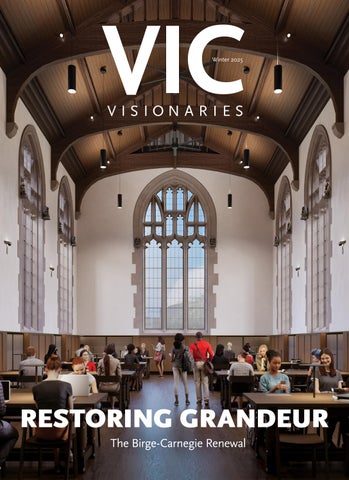
RESTORING GRANDEUR
The Birge-Carnegie Renewal
A Historic Space Reborn as Goldring Reading Room
By Leslie Shepherd
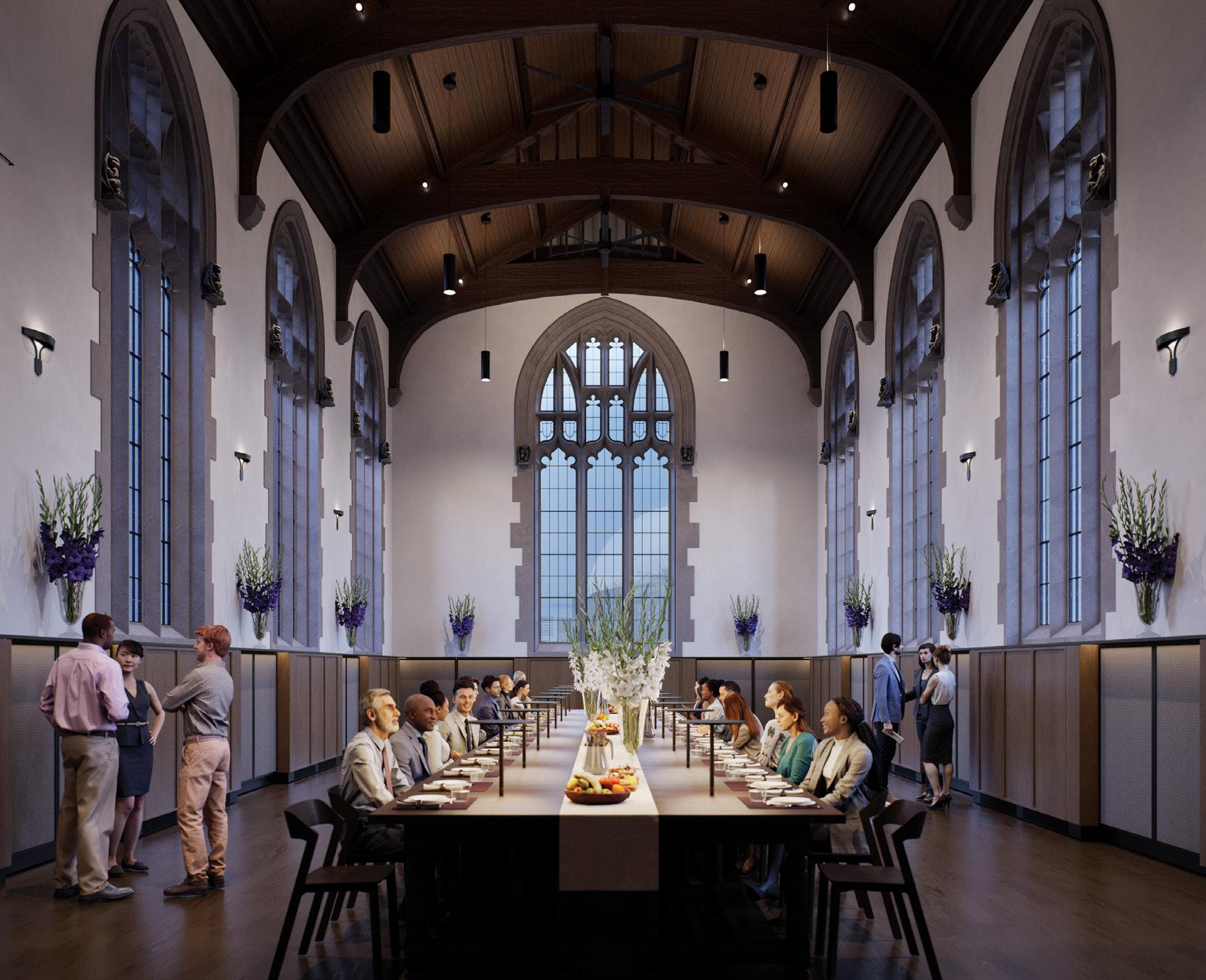
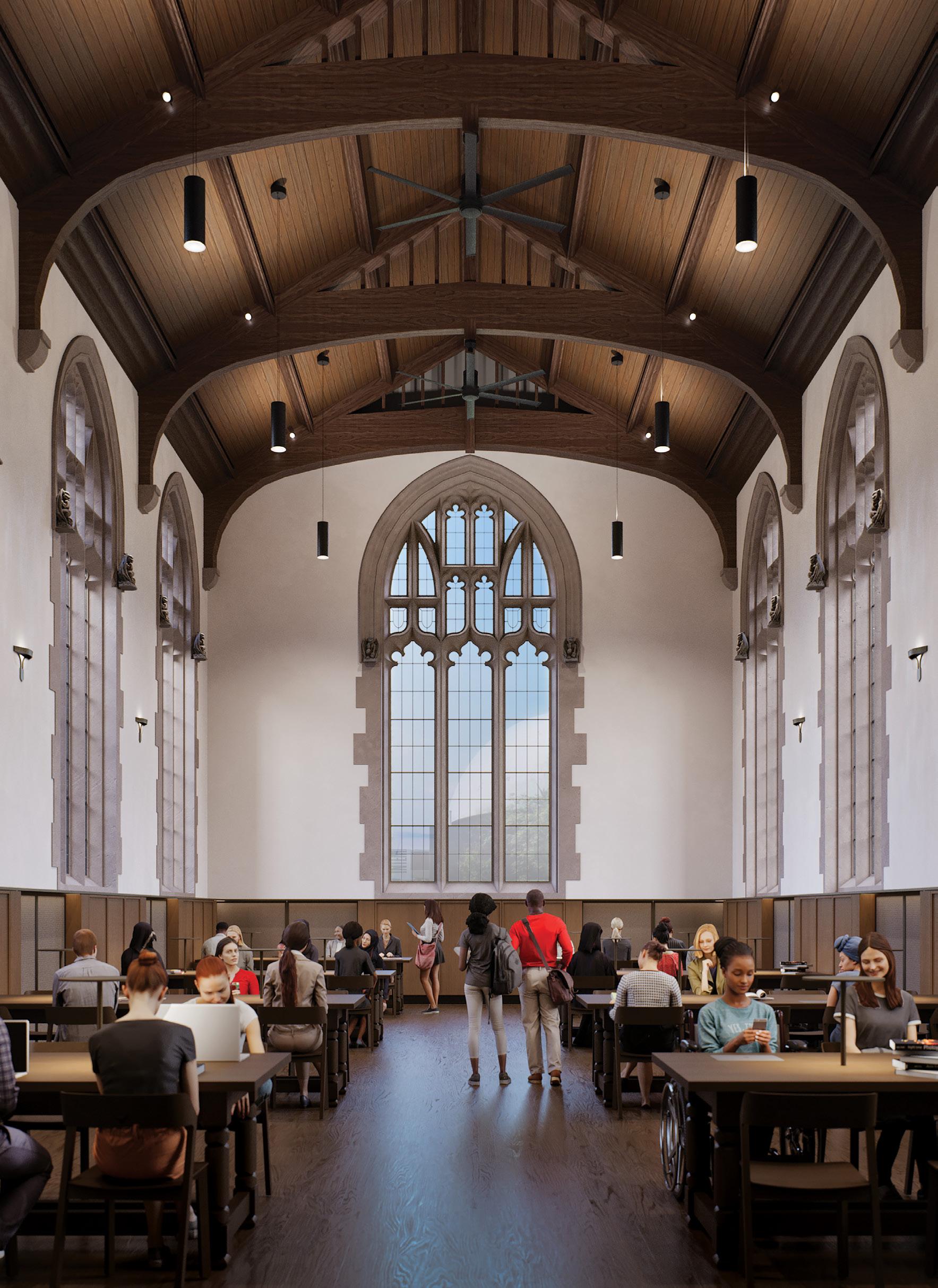
Construction crews are hard at work inside the Birge-Carnegie Building, where the Goldring Reading Room is taking shape as one of Victoria University’s most distinctive spaces. This transformation is made possible by a $1.5-million gift from Judy Goldring Vic 8T8 and her brother Blake Goldring Vic 8T1, whose generosity ensures the room will serve students and scholars for decades to come.
“This is about creating a space that matters,” said Mayes Rihani, associate director for major capital project management and planning. “The Goldring Reading Room will be a destination for quiet study, collaboration and events, a space that feels both historic and contemporary.”
Birge-Carnegie served as Victoria College’s library from 1910 until 1961, when the E.J. Pratt Library was completed. Since then, the building has been underutilized, with a large part of the main floor and the basement used as storage for archival material belonging to the United Church of Canada and
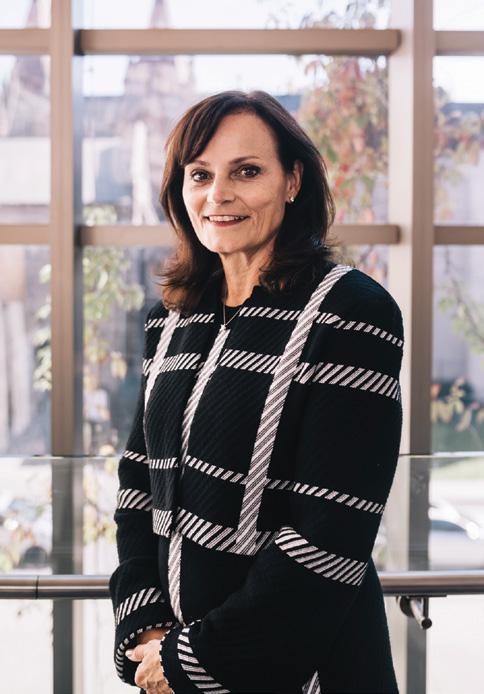
Judy Goldring
Photo: Will Dang
Architectural renderings courtesy of Brook McIlroy
Victoria University. The renovation will add more study and gathering spaces for students, as well as a new classroom and offices that will better meet the university’s operational needs.
The Goldring Reading Room work is well into its restoration phase. Two-storey Gothic windows, long obscured by interior storm panels, are being repaired and sealed for energy efficiency. Removing the storm windows has restored the clarity of natural light, dramatically changing the feel of the room. Many windows will retain their original glass, a detail that speaks to the care taken to preserve heritage features.
Inside, the design balances tradition with innovation. The original tables have been refurbished for modern use, complemented by new wood flooring in tones that echo the historic palette. Classic library lamps will provide focused lighting, while heating, cooling and power are discreetly integrated into custom wainscoting that wraps the room. This approach preserves the architectural character while meeting contemporary needs for comfort and connectivity.
Flexibility is another priority. The Goldring Reading Room’s furniture can be reconfigured in many ways, including for events. A mezzanine overlooking the space will offer staff a soft-furnished lounge—a retreat for informal work or breaks.
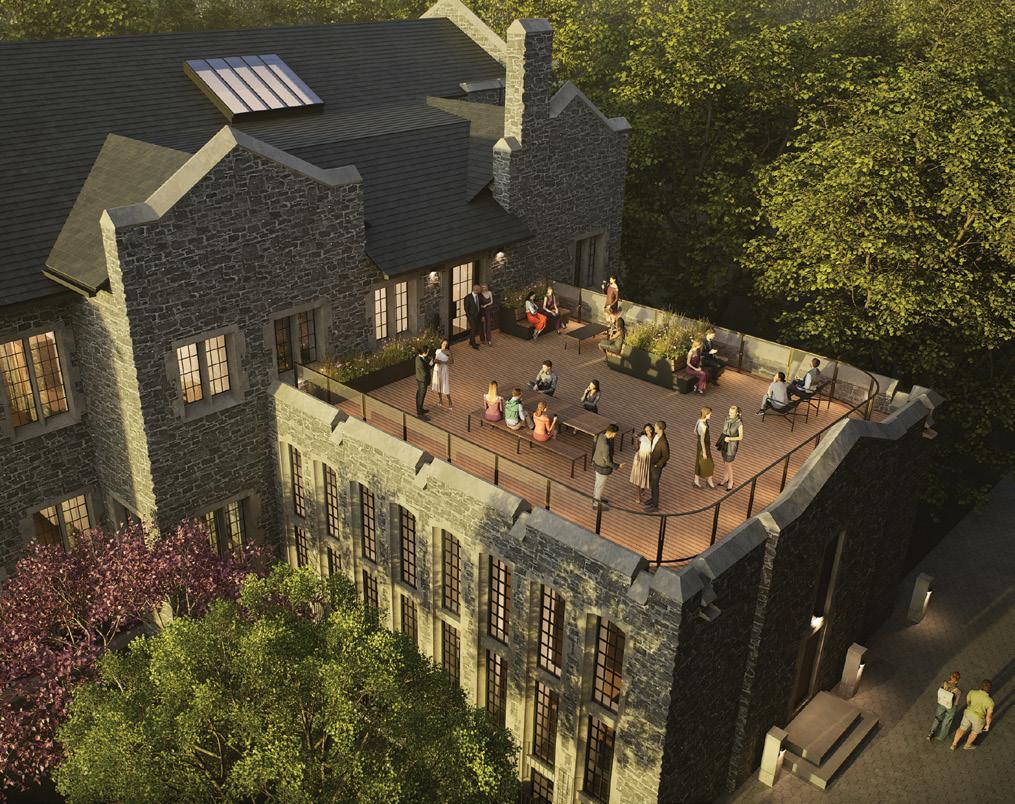
The new rooftop terrace in the revitalized Birge-Carnegie building will be called the Temerty Terrace, reflecting a generous contribution toward building the new space by distinguished philanthropist James C. Temerty. One of the most recognized names in Canadian philanthropy, Temerty previously made one of the largest gifts in Canadian history to U of T’s Temerty Faculty of Medicine. The Temerty name on this new Vic U space is a reflection of the family’s transformative generosity. Located atop the former archives, the Temerty Terrace will become a favourite outdoor setting for daily use, quiet breaks, classes and special events. “The Temerty family’s extraordinary philanthropy helps our city to create spaces where people can gather, learn and thrive,” said President Rhonda McEwen. “We are truly grateful for the Temerty family’s support for Victoria University’s future.”

See the Future of Birge-Carnegie
Scan this code or click here to experience a stunning video that brings the architects’ renderings to life. Victoria University’s Communications and Marketing team used AI as a creative tool to visualize the revitalized Birge-Carnegie Building—a space blending heritage architecture with modern functionality, natural light, and inclusive design. We hope you enjoy this glimpse into the future. It’s going to be absolutely beautiful!
Emmanuel College Receives Second Major Gift for Muslim Student Scholarships
By Leslie Shepherd
When Sajjad Ebrahim was talking to Emmanuel College about new ways he could support its students, one opportunity stood out. The college’s Master of Psychospiritual Studies program, with its focus on counselling, chaplaincy and spiritual care, trains graduates for roles urgently needed in the community.
Ebrahim, CEO of Lark Investments, responded with a $100,000 gift to establish the Sajjad Ebrahim Awards of Excellence. The new scholarships will provide financial support to Muslim students in the MPS program, Muslim focus.
“The psychospiritual approach is quite unique,” Ebrahim said. “It prepares graduates to counsel the faithbased community in a much better manner.”
Ebrahim has a long history with Emmanuel College. He donated the area for the ablutions in the college’s Muslim prayer room, which opened in 2012 through a collaboration between Emmanuel and members of Toronto’s Muslim community. Emmanuel’s Acting Principal Pamela McCarroll says students say the quality of the ablutions facilities, as well as the Muslim prayer room, make them feel a deep sense of belonging and welcome at the college.
Ebrahim was also involved in the Canadian Dawn Foundation’s earlier contribution that helped establish the Muslim focus of what is now the Master of Psychospiritual Studies program. That program includes an option for a Certificate in Spiritual Care and Psychotherapy, recognized by the College of Registered Psychotherapists of Ontario.
Graduates go on to work in counselling, psychotherapy, chaplaincy and spiritual care, fields that combine professional training with a deep understanding of spiritual well-being.
Ebrahim said he also wanted to help students with financial need to pursue these studies.
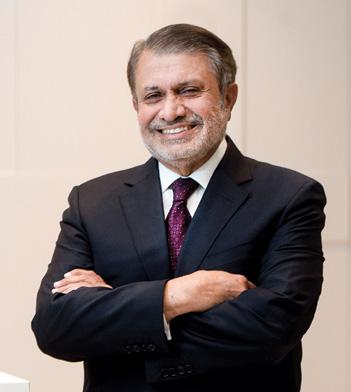
“We want people who cannot afford tuition not to be deprived of these opportunities,” he said. “The program also gives students an opportunity for employment very quickly and we need them in the community.”
Ebrahim’s latest gift follows a $100,000 donation from the Islamic Shia Ithna-Asheri Jamaat of Toronto last year, led by his fellow Jaffari Community Centre member and chair, Rizwan Khalfan Vic 9T5. Khalfan also serves on Victoria University’s campaign cabinet. Both donations were established as expendable awards, meaning the funds are distributed over a set period rather than held in perpetuity as an endowment.
“These generous awards of excellence respond to a deep need for financial support geared toward Muslim students,” McCarroll said. “They enable students to have more time to focus on their studies and to complete their degree programs sooner so that they can move into their professions of providing care and counselling to those in need.”

The new Sajjad Ebrahim Awards of Excellence will provide financial support to Muslim students in Emmanuel College’s Master of Psychospiritual Studies program, Muslim focus.
Photo: Neil Gaikwad
Photo: Courtesy of Sajjad Ebrahim
Sajjad Ebrahim
An Estimated $5-Million Gift
How One Donor’s Legacy Will Help Shape Victoria’s Future
By Leslie Shepherd
Alongtime donor who chose to remain anonymous has bequeathed an estimated $5 million to Victoria University, one of the largest donations in its history.
Her request was that her gift support the library she loved, possibly by funding an acquisition, adding to a special collection or another opportunity that might otherwise be out of reach.
“This donor exemplifies the power of planned giving,” said Louise Yearwood, executive director of Alumni Affairs & Advancement. She was a longtime friend of Victoria University who made a number of substantial gifts over her lifetime. Years ago, she quietly arranged a legacy gift in her will. Upon her death, an extraordinary gift far beyond what she gave during her lifetime is in the process of being realized for Victoria University.
“She was a quintessential legacy donor,” said Yearwood. “It’s a significant gift. She recognized that she could have a major impact on the library through a planned gift.”
Yearwood said the gift was particularly special “because it gives the library the ability to use it in the best possible way.”
Gifts like this one offer rare flexibility. The Victoria University Libraries can save the income generated from the bequest over several years, allowing it to accumulate and be used strategically, for example, to acquire rare materials or invest in special initiatives.
Chief Librarian Amy Furness welcomed the gift.
“The Vic U libraries continue to evolve to meet the needs of the students and the university community, so the specific needs for funding will change over time,” she said. “A gift like this is full of possibility for the future, whether that means having the capacity to purchase exceptional items for the special collections or developing our facilities for exhibiting and teaching from those materials.”
Legacy giving played a major role in Vic U’s fundraising success last year and cumulatively.
This bequest to the library was a significant factor in AA&A raising $14.3 million in the 2024-25 fiscal year, well over its target of $6.9 million. Planned giving accounts for a significant amount of all funds raised since such records were kept, and Yearwood said that speaks to the loyalty of Victoria University alumni.
“We have incredibly loyal alumni and we have a long history and pedigree,” said Sharon Gregory, Vic U’s associate director, gift planning. “You need all of these things to run a really successful gift planning program.”
If you are considering a legacy gift, please contact Sharon Gregory, Associate Director, Gift Planning, at 416-813-4050 or sharon.gregory@utoronto.ca
Suggested wording for your will: I give and bequeath to the Board of Regents of Victoria University, Toronto, Ontario, the sum of $ or % or shares of my estate.
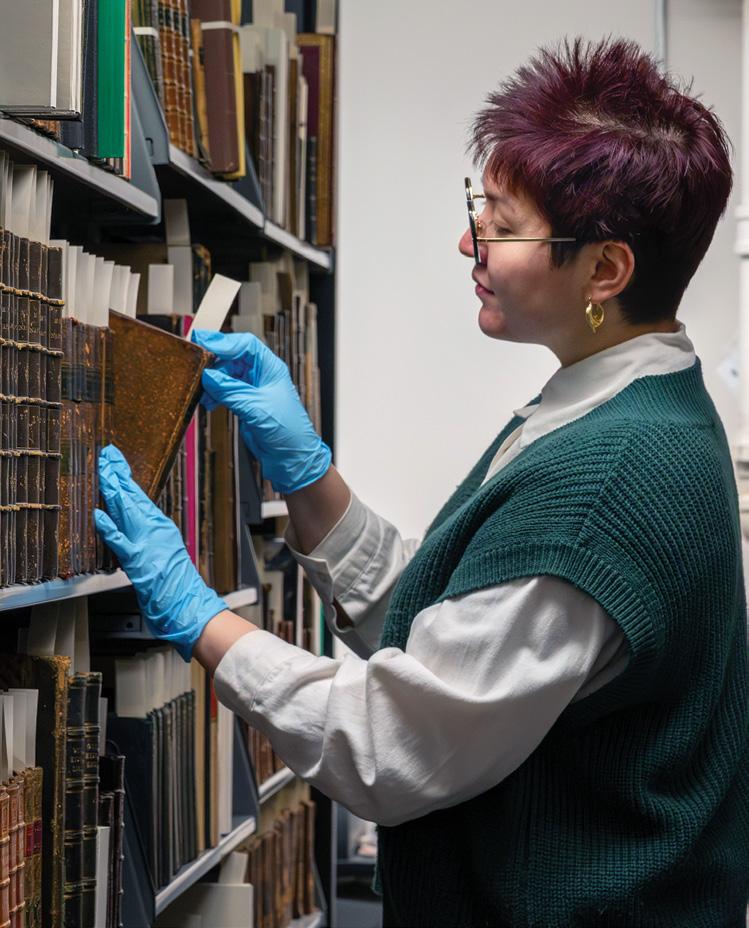
Legacy gifts can be used for many things, including acquisitions. Special Collections Archivist Bailey Chui is shown here in the E.J. Pratt Library Special Collections area.
Photo: Neil Gaikwad
Passing the Spark Three Alumni Invest in Creativity at Victoria University
By Leslie Shepherd
Creativity often begins with exposure—a poem published at age 12, a fine arts class that sparked a lifetime passion for art, a father’s handcrafted cabinets. For Sheelagh Whittaker Vic 7T0, Ed Truant Vic 9T1 and Susan Armitage Vic 6T4, early encounters with creativity helped shape not only their imaginations but also the paths their lives would take.
Now these three alumni have made generous gifts to Victoria University’s new Centre for Creativity to ensure that future students will have opportunities to explore, imagine and create.
The Centre for Creativity, which launched in May 2024, is a new initiative at Victoria University designed to foster cross-disciplinary collaboration. It hosts programming and events that bring together artists, thinkers and developers from different fields to share work, compare ideas and create together. It’s a space where students can
engage with creativity not just as a skill, but as a way of thinking—expansive, experimental and essential.
“Students need time, resources and encouragement to develop creative projects just as they do in other fields,” said Professor Adam Sol, launch director for the centre.
“These gifts will help inspire them to dig deeper, go farther and pursue their creative work with ambition and confidence.”
Whittaker lived across the street in postwar Edmonton from June Fritch, the editor of the Alberta Poetry Yearbook, a woman who nourished her soul by encouraging her to write poetry, and her body by feeding her lunch while her mother was ill. Her poem The Joy of Creation was published when she was 12. That early recognition that creativity brings joy sparked a lifelong love of writing, thinking and creating for the woman who would become the first female CEO of a Toronto Stock Exchange-listed company.
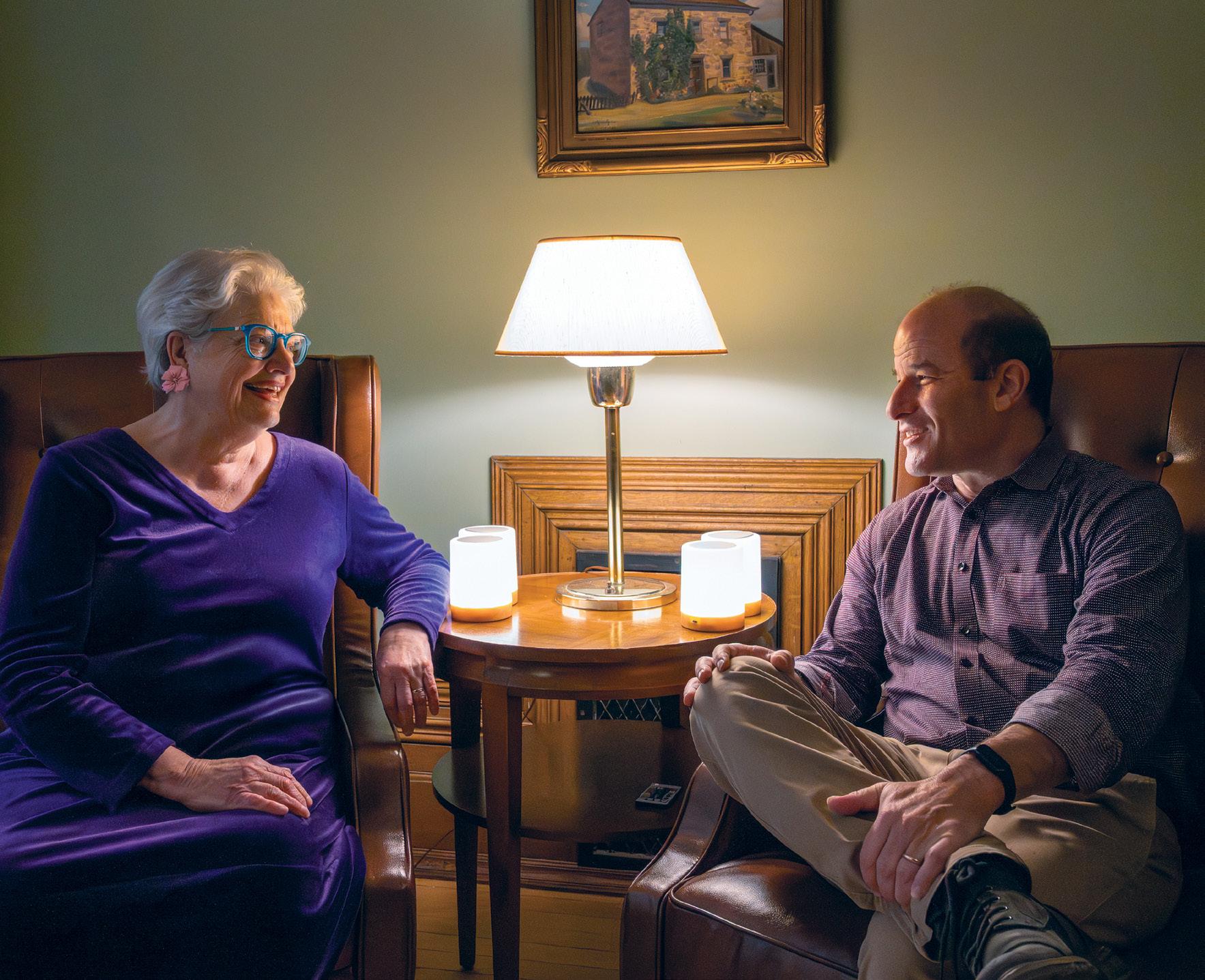
Donor Sheelagh Whittaker Vic 7T0 talks to Professor Adam Sol, founding director of the Centre for Creativity, about his plans for its future.
Photo:
Neil Gaikwad
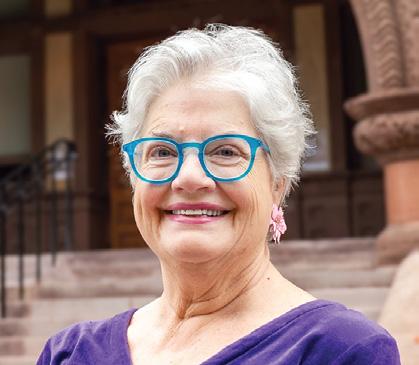

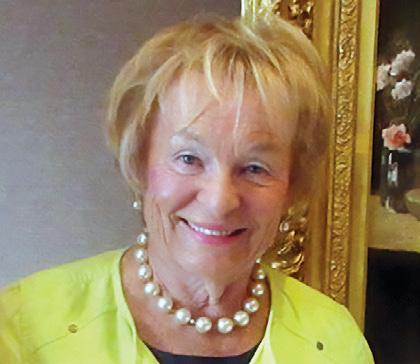
Whittaker has made a donation to establish The Sheelagh Whittaker Centre for Creativity Undergraduate Fellowship Award, supporting students in any discipline who demonstrate creative promise.
She said she was motivated to make the donation after attending her 55th Vic reunion last spring (along with a friend celebrating her 75th reunion) and connecting with so many other Vic alumni. In addition, she has a granddaughter about to graduate from high school who she hopes will consider Vic U.
“I was thinking and feeling a lot about my days at Vic and pride in other Vic grads,” she said. “When I heard the whole notion of a Centre for Creativity, I was beguiled. It’s trite to say it’s thinking out of the box, but it is. You think you are a graphic artist, but what about graphic art set to music?
She said she hoped the fellowship she has established will enable students to access the resources they need, from essential equipment to dedicated time for their work, while also providing the motivational lift that recognition brings.
“I just like supporting creativity,” she said. “We need joy and creativity brings joy.”
Ed Truant’s appreciation for creativity also began at home. His father, who immigrated to Canada as a teenager, taught himself custom cabinetmaking after a decade in carpentry. His brother Ray Truant Vic 8T8, a microbiologist and professor at McMaster University, is also an artist in many mediums.
Truant’s own career in finance, as the founder and CEO of Slingshot Capital, has shown him how creative thinking can unlock new opportunities and how important it is to foster that mindset in a world increasingly shaped by automation.
His gift will establish The Truant Centre for Creativity Undergraduate Fellowship Award. He said he hoped the fellowship would allow students to pursue their creative interests more fully—whether in the arts, sciences or social sciences—and help them push boundaries in their chosen fields.
“We rely too much on technology that allows us to replicate what we have created so far,” he said. “Pure creativity requires real intelligence versus artificial intelligence, which so far is a bit of wash, rinse and repeat. It’s important to keep fostering real creativity, which is how we will make real breakthroughs.”
Armitage discovered her creative interests during her time at Vic U in the 1960s, when she took a fine arts course focused on Renaissance art and architecture. That sparked a lifelong interest in visual culture that she still draws on when she travels.
Her gift has established The Murray and Susan Armitage Foundation Fund for the Centre for Creativity, honouring both her connection to Vic U and the memory of her late husband, Murray Armitage Vic 6T2, who shared her belief in the importance of education and the arts. The fund will support the centre’s leadership and programming, helping shape its vision and reach.
The Armitages are longtime donors to Vic U. In 2019, they created The Susan and Murray Armitage Scholarship, awarded to first-year students who achieve academic excellence.
“This will be a place for some young artists to get started and who knows what they will do?” Susan Armitage said of her gift to the Centre for Creativity. “It’s a great antidote to our troubled times. Whether it’s books or painting or sculpture, it takes you away from the everyday and into something you love.”
Ed Truant Vic 9T1
Susan Armitage Vic 6T4
Sheelagh Whittaker Vic 7T0
Photo: Neil Gaikwad
Photo: Courtesy of Ed Truant
Photo: Courtesy of Susan Armitage
Happy Charter Day, Vic U!
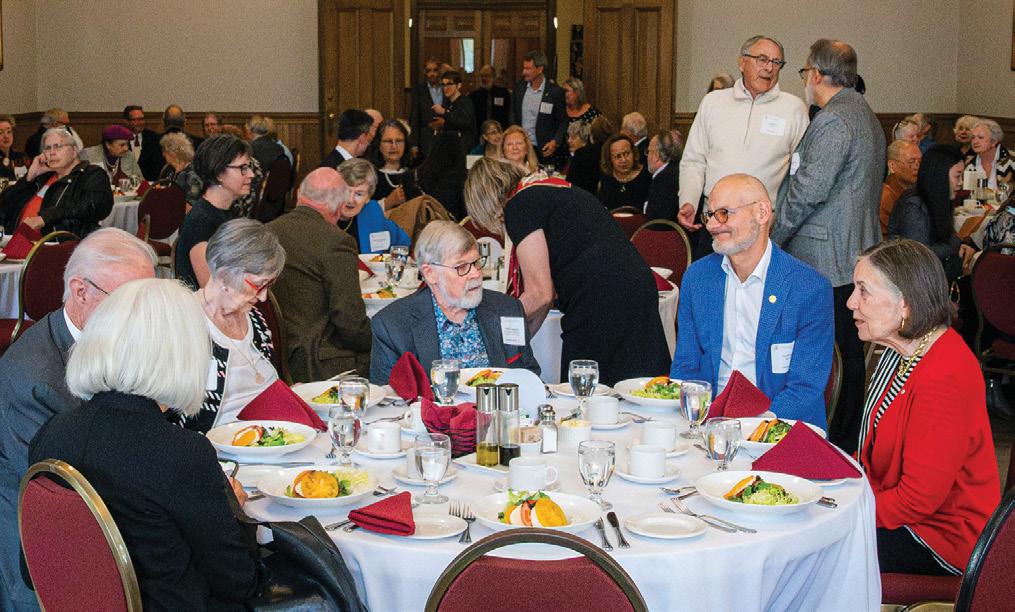
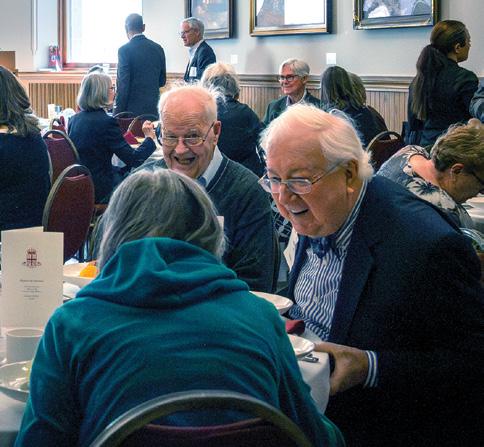
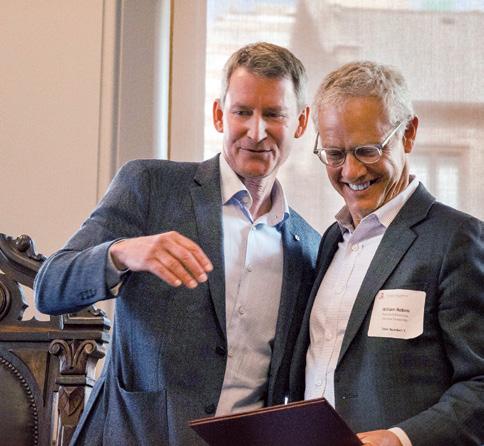
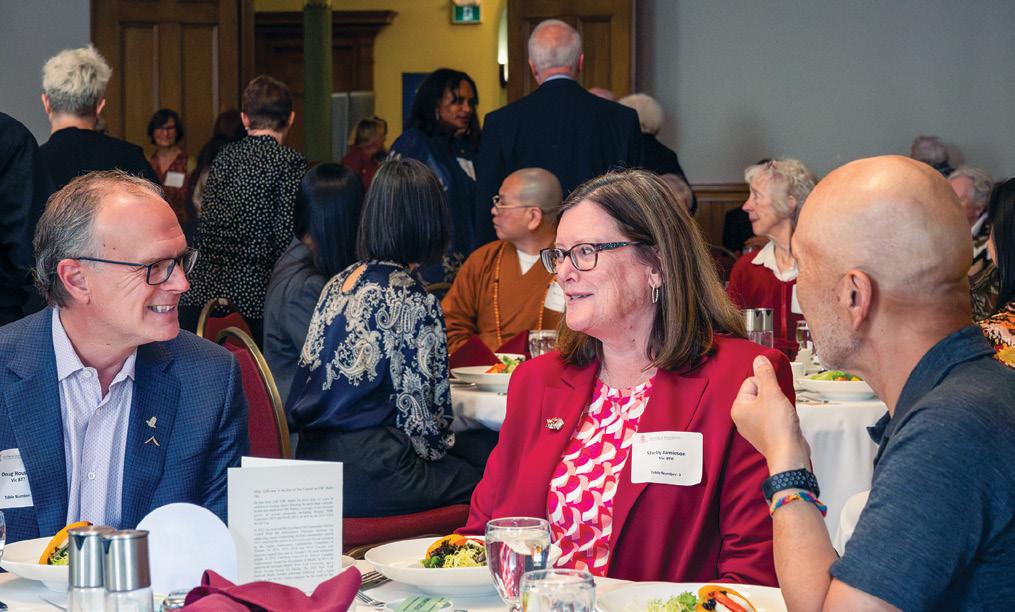
Victoria University celebrated 189 years of history and community at its Chancellor’s Council Luncheon and Donor-Student Awards Reception on Oct. 15. These two events marked the anniversary of the Royal Charter, granted to Victoria University on Oct. 12, 1836, by King William IV. Members of the Vic community, including donors, alumni, student award recipients and friends, gathered in Old Vic to honour nearly two centuries of scholarship and spirit.
At the Chancellor’s Council Luncheon, Vic U President Emeritus William Robins was inducted as a permanent member of the Chancellor’s Council in recognition of his service to the Vic community and for his philanthropy. Toward the conclusion of the luncheon, CBC Radio host Matt Galloway joined Chancellor Nick Saul for a conversation on leadership and legacy.
Photos by Neil Gaikwad


President Emeritus Will Robins Honoured for Service to Vic U
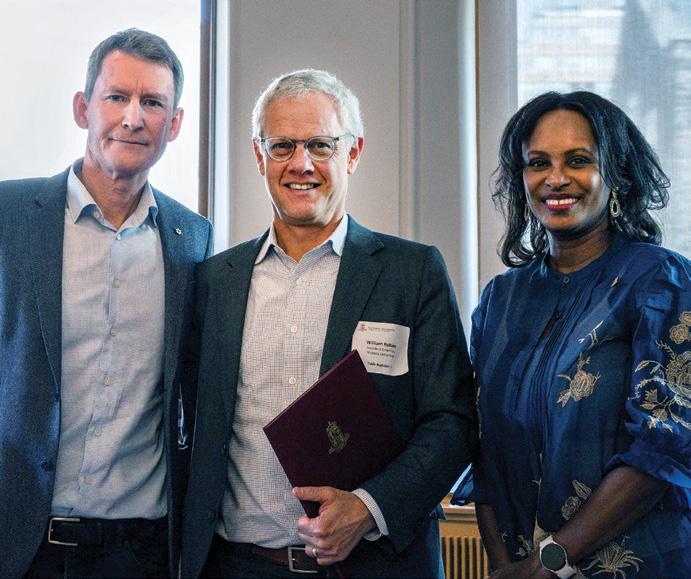
Victoria University President Emeritus William Robins was inducted as a member of the Chancellor’s Council at the Chancellor’s Council Luncheon on Oct. 15, recognizing his exceptional service to the Vic U community and his philanthropy.
Robins, a longtime fellow at Victoria College and associate professor of English and Medieval Studies
at U of T, donated annually when he was a faculty member. He established two awards at Vic U along with his wife, Anne Christie, to support student success and academic excellence.
Robins was Victoria University’s 13th president from 2015 to 2022. At the end of his term, the Robins Access Awards Program was established to honour his work, including his strong advocacy for programs supporting equity, diversity and inclusion for all Victoria University students.
The RAAP is made up of a series of Opportunity Awards, which are given to Victoria College students on the basis of financial need with preference to students from underrepresented or at-risk groups.
“It is deeply meaningful to me to see greater access to our unique undergraduate student experience,” said Robins.
At the luncheon, Chancellor Nick Saul praised Robins for leading the development of the current Strategic Framework and for championing accessibility to education.
“His steadfast leadership every day during the pandemic was “extremely important to the wellbeing of this university,” Saul said.
Nick Saul, William Robins and Rhonda McEwen
Victoria University Chancellor Nick Saul Vic 9T0 turned the tables on CBC Radio host Matt Galloway in a conversation on leadership and legacy, asking about journalism as a public good, the power of storytelling and what it takes to stay calm before a big interview.
Chancellor Nick Saul Vic 9T0 received a special gift of Victoria University Chardonnay, made by Hinterland Winery, which was founded by Vic alumna Vicki Samaras Vic 9T8. This marked Saul’s final lunch as chancellor before his term expires in 2026.
Together, We’re Defying Gravity Victoria University’s Campaign Surpasses $50 Million
Thanks to the remarkable generosity of alumni, friends, and community partners, Victoria University’s Defy Gravity campaign has reached an exciting milestone—raising more than $52 million, or 65 per cent of its ambitious $80 million goal.
This success reflects our community’s shared commitment to making Vic U a leader in broad-based, inclusive education. Every gift, no matter the size, contributes to the vibrant, accessible and forward-looking university experience we’re building together.
Launched in 2019, Vic U’s Defy Gravity campaign is transforming the university by supporting scholarships and awards, research, innovative academic programs and renewed campus spaces that foster creativity and connection.
Among the campaign’s many achievements is the redevelopment of the historic Birge-Carnegie building—a project that blends heritage preservation with modern, flexible learning and community spaces.
Jennifer Ankrett, Vic U’s bursar and CAO, said the restoration and accentuation of the heritage features of the building are key elements of the project and speak to continued beauty and functionality. Almost every space in the building will be able to be used for multiple purposes, including work, teaching, studying, relaxing or events.
Campaign contributions have also made possible the Indigenous Healing Garden, created in consultation with Indigenous advisers. Fully accessible and designed to welcome all, the garden features sacred medicinal plants, vegetables, and wildflowers—transforming a once-grassy area into a space of reflection, healing, and learning.
The success of this campaign lies in the generosity of both longstanding and new supporters. Our community has shown that when we come together, we truly can defy gravity!
Mary Heinmaa Director of Philanthropy
Note from Louise Yearwood, Executive
Director
of Alumni Affairs & Advancement
“On her retirement, I wish to thank Mary Heinmaa, Vic U’s director of philanthropy, for her many contributions during her eight-year tenure with the university as both a leader of the Alumni Affairs & Advancement team and as a donor. As Defy Gravity: The Campaign for Victoria University moves closer to its $80 million goal, we celebrate the profound impact of donor support which strengthens programs and spaces and provides opportunities that will empower generations of students to come.” We also celebrate the achievements and extraordinary leadership of our president, Rhonda McEwen, as well as the members of our campaign cabinet and our staff.
THANK YOU!
Defy Gravity: The Campaign for Victoria University
Campaign Update: Jan. 2, 2019, to Oct. 31, 2025
$19M Student Experience
$16.8M Programs and Research
$6.2M Infrastruc ture
$4.2M Facult y Support
$5.6M Planned Giving Intentions
$51.8M Total Amount Raised
$80M Campaign Goal
Realized and Pledged Donations
Gift Plan Intentions
Total Amount Raised by Gift Type
We extend our heartfelt gratitude to all members of the Vic U community for supporting Defy Gravity: The Campaign for Victoria University. Your generosity and dedication have driven our efforts forward and helped turn vision into reality.
Honorary Chair
Wendy Cecil Vic 7T1, chancellor emerita
Honorary Members
Nick Saul Vic 9T0, chancellor
Carole Taylor Vic 6T7, chancellor emerita
Campaign Co-Chairs
Sonia Baxendale Vic 8T4
David Wilson Vic 6T8
Committee Members
Sophia Chan-Combrink Vic 9T6
Maureen Kempston Darkes Vic 7T0
John Grant Vic 8T3
Paul Gooch, president emeritus
Doug Houston Vic 8T7
Brian Johnston Vic 8T1
Rizwan Khalfan Vic 9T5
Rhonda N. McEwen, president and vice-chancellor
Sandy McIntyre Vic 7T4
Jane Pepino Vic 6T7
Pauline Thompson Vic 6T3

Meet the newest member of the committee: Maureen Kempston Darkes was GM Canada’s first woman president and served as president and general manager from 1994-2001. Now retired, Kempston Darkes continues to serve on the General Motors Advisory Board and works on several corporate boards. A trailblazer and an advocate for women in leadership, Kempston Darkes received the Order of Canada in 1999 and was inducted into the Canadian Business Hall of Fame in 2022.
Thank you to Judy Goldring Vic 8T8, Co-Chair of the Campaign Cabinet, for her time and service.
A Community United How Victoria College Honoured a Beloved Professor’s Legacy
By Samantha Chater
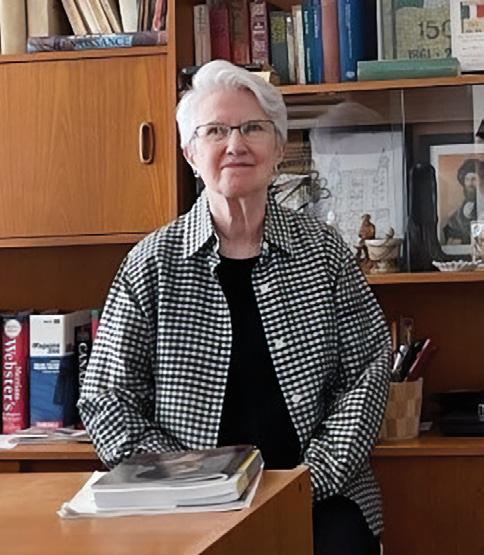
What began as a simple idea—a memorial bench in the Quad to honour a beloved professor—quickly became a testament to the deep connections Olga Zorzi Pugliese forged over nearly five decades at Victoria College. Within months, friends, colleagues and community members raised $10,000, turning a gesture of remembrance into a symbol of enduring gratitude.
Three organizers emerged from different corners of her life. Luisa Giacometti had worked with Pugliese on a project acknowledging Italian mosaicists at the Royal Ontario Museum. Paola Breda knew her through the Italian Fallen Workers Memorial Wall Project. Professor Konrad Eisenbichler had been her colleague at Vic since the 1970s. “It was such a large amount of money,” Giacometti said. “I thought it would take years. But no, within a few months, we had raised $10,000. It was amazing.”
Giacometti met Pugliese only in 2023, yet felt compelled to act, a testament to Pugliese’s impact.
The speed with which the monies were raised reflected Pugliese’s generosity to students, colleagues and her community, which had created lasting bonds spanning decades and continents. Donations arrived from across Canada, Italy and beyond, Giacometti said.
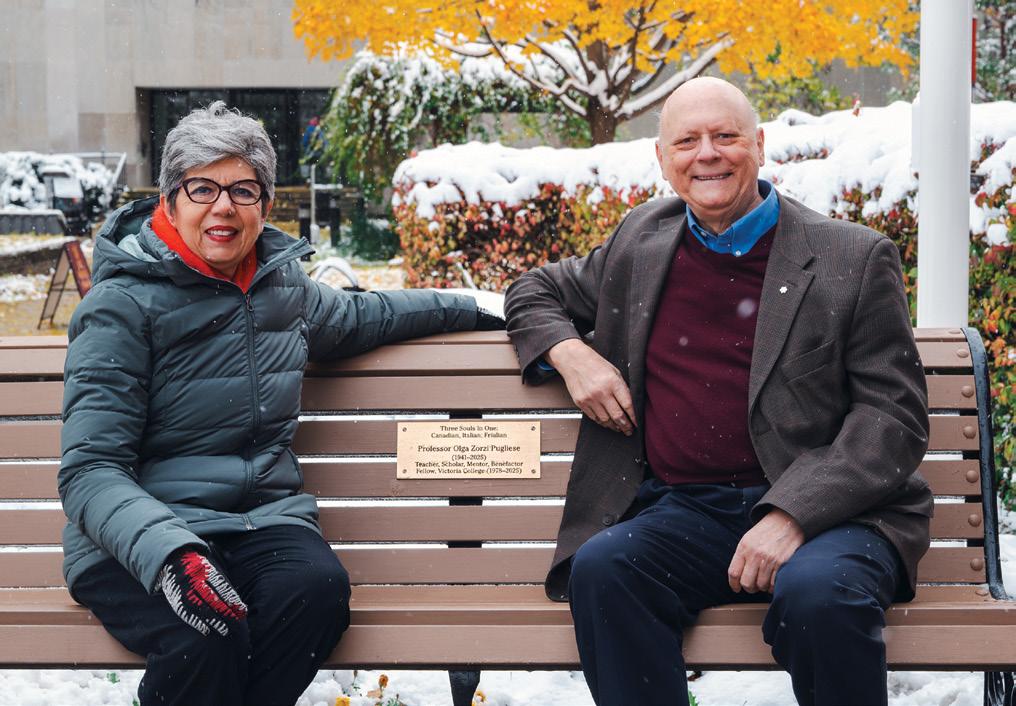
A scholarship in her name at Vic already existed, the Olga and Guido Pugliese Scholarship for Study in Italy established by the Puglieses themselves. However, the group wanted something more visible. Eisenbichler suggested a bench on the Vic U campus where Pugliese had built her career, serving as director of the Centre for Reformation and Renaissance Studies and championing the Renaissance Studies program.
Eisenbichler chose the location carefully: an intersection in the Quad where students and faculty pass between buildings. The bench sits beside one honouring Brian Merrilees, a close friend of Pugliese’s.
“They were really good friends and now they are keeping each other company,” Eisenbichler said.
For Eisenbichler, the memorial held deep personal meaning. Pugliese had supported his career, encouraging him to pursue early tenure and backing his promotion to full professor. He calls her his “academic mother.”
“What she did for me, she did in other ways for so many other people,” Eisenbichler said. “So, she was very much not only collegial, but supportive.”
The memorial bench was unveiled in a ceremony on Sept. 28 that drew more than 100 people, more than double the expected number. Family, former students, colleagues and members of Toronto’s Italian community gathered to honour a scholar whose influence extended across borders and generations.
Olga Zorzi Pugliese
Luisa Giacometti (left) and Professor Konrad Eisenbichler sit on the memorial bench honouring Professor Olga Zorzi Pugliese.
Photo: Neil Gaikwad
Photo: Department of Italian Studies, University of Toronto