
Teaching and Learning Playbook

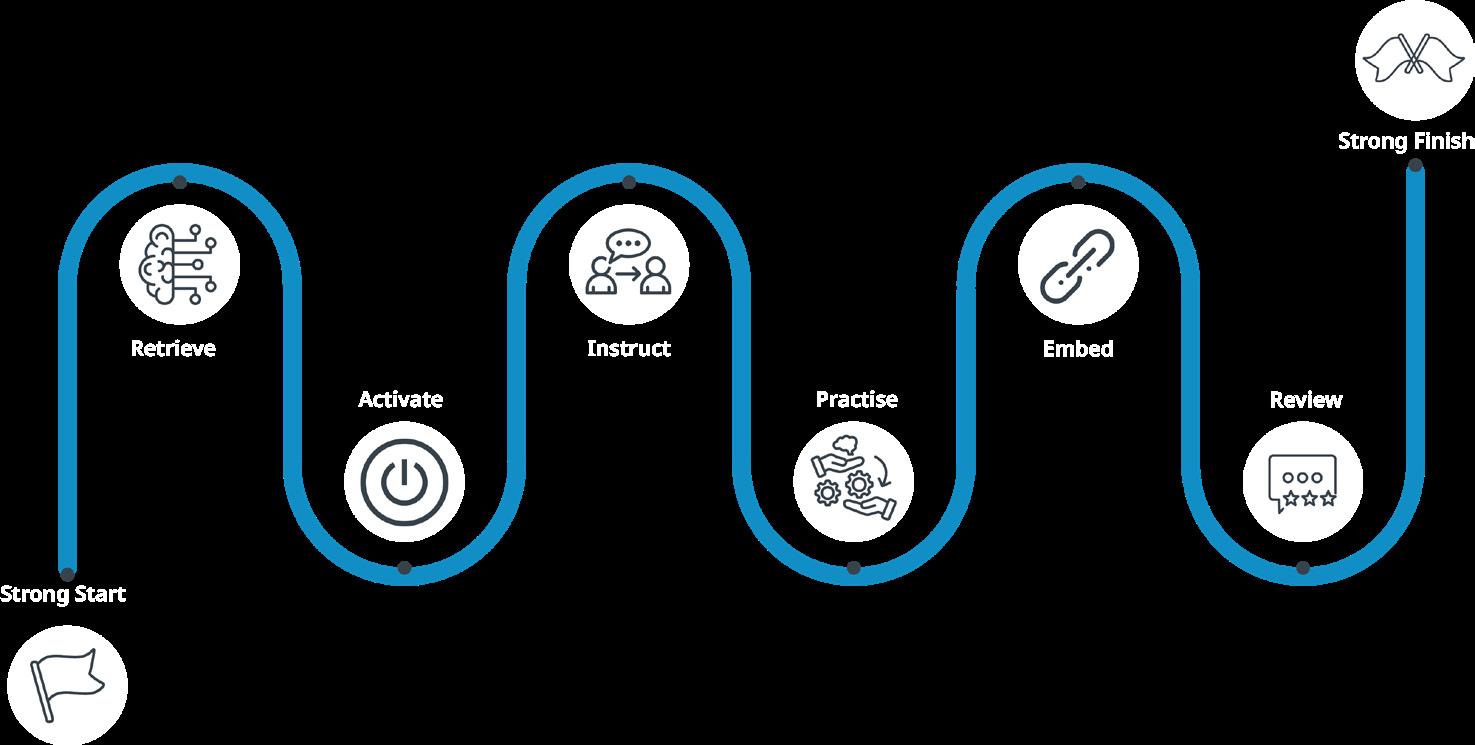

Lesson Planning and Preparation
Stage 1: Technique 1 - Content Knowledge
Clear Content knowledge is essential for effective teaching. When teachers have a deep understanding of the material they are teaching, they can deliver lessons more confidently, answer pupil questions effectively, and make the subject matter engaging.
Stage 1: Technique 2 - Learning Intentions
What
The Learning intention is a measurable statement which articulates what you expect all pupils to achieve by the end of the lesson. The Learning intention should be communicated clearly using economy of language and referred to throughout the lesson. Pupils’ understanding of this intention should be assessed.
How How
• Prepare thoroughly Before the lesson, review the content in-depth. Understand the key concepts, definitions, and principles and how learning links to previous and future learning. Script key definitions and be clear about the output you are looking for in discussion activities.
• Organise the content Organise the lesson in a logical flow, starting from foundational concepts and building up to more complex ideas. Identify any likely misconceptions and pre-empt these.
• Use visual aids Diagrams, charts, graphs, and other visual aids can clarify complex ideas. Visual aids make abstract concepts more concrete and can enhance retention.
• Be prepared to adjust your teaching If a particular explanation or method isn’t resonating with pupils, be ready to adjust. Use different teaching strategies, such as breaking down the concept into smaller steps, using analogies, or utilising multimedia.
• Reflect and improve After the lesson, take time to reflect on what went well and what didn’t. Consider whether the pupils grasped the key content and if there were areas where misconceptions persisted, prepare for how to address them in a future lesson.
Orion Adapting for All:
• Identify and preteach Key terms and script crisp and clear definitions.
• Ensure visual supports and other methods of dual coding are repeated to highlight key knowledge components and retrieve knowledge.
• Using knowledge of the curriculum and specification, state what pupils are expected to achieve by the end of the lesson.
• Consider how the Exit ticket (Stage 1, Technique 4) will assess this intention.
• Think about the end point of a learning sequence and plan backwards from that end point. Ensure that lessons are designed to enable pupils to know and remember more every lesson and over time.
• At Primary we may phrase the Learning intention as a learning question.
Orion Adapting for All:
• Consider producing a visual timetable or task list to support pupils to access the Learning intention.
• Increase intentional checks for understanding with key pupils.
Stage 1: Technique 3 - Curriculum – Big Idea, Key Terms
What
Big Ideas: The Big ideas within a curriculum plan refers to the central, overarching concepts or themes that guide the learning process. Big ideas provide a framework for understanding the key knowledge, skills, and values pupils are expected to develop. The Big ideas help to create connections across different topics and ensure that learning is meaningful and coherent.
Key Terms: Key terms are the important vocabulary words and phrases that are central to understanding the subject content. These terms help pupils grasp essential concepts and ideas within a specific topic or unit.
How Orion Adapting for All:
Big Ideas:
• Be clear on what your ‘Big ideas’ are.
• Break the ‘Big idea’ down into smaller, manageable sub-concepts - this should be pre-planned.
• Refer to ‘Big ideas’ often to ensure pupils are making clear links in their learning.
Key Terms:
• Pre-plan and script definitions for Key terms.
• Use economy of language to create crisp, clear explanations of Key terms.
• Do not allow pupils to define Key terms in their own words as this could result in incorrect definitions and misconceptions.
• Introduce and explain Key terms at the beginning of each lesson.
• Reinforce meanings of Key terms throughout the lesson (in context).
• Encourage pupils to use the Key terms actively in their discussions and writing.
• Incorporate reviews/Exit tickets on Key terms.
• Consider producing a personalised mind map which contextualises the learning and identifies the concepts and themes.
• Pre teach Key terms and revisit them regularly through the lesson in different ways e.g. oral, written or visual.
• Create a glossary of Key terms that pupils can refer back to regularly.
Stage 1: Technique 4 - Exit Tickets
What
An Exit ticket is a short formative assessment of (e.g. one to three short questions) planned prior to the lesson, which focuses on reviewing whether pupils have achieved the Learning intention (Stage 1, Technique 2) through mastery of the knowledge components.
Exit tickets inform lesson planning for future learning.
Orion Adapting for All: How
• Create an Exit ticket routine and share this with your class.
• Create a standardised format so that pupils know what to expect.
• Exit tickets typically take place at the end of a lesson (before pupils start to leave the classroom) and should take no longer than 5 minutes to complete.
• Pupils should complete the Exit ticket independently and should not need to refer to their work.
• Exit tickets should have a clear purpose, so questions should be focused on a key point from the Learning intention.
• Review the data collected from the Exit tickets to decide whether in the next lesson you can move on or whether you need to re-teach some sections of the lesson or plan smaller intervention groups.
• Share the Exit tickets during the lesson, not just at the end, so pupils know what they are aiming towards.
• Ensure you build in adequate thinking time for pupils to complete the Exit ticket in a calm and considered way (a timer could support here) and be aware of how upcoming transitions may be distracting for pupils at the end of the lesson.
• Ensure the Exit ticket informs identification of knowledge gaps for specific pupils and future planning.
Stage 1: Technique 5 - Hinge Questions
Hinge questions are planned questions written prior to the lesson with the goal of assessing all pupils’ understanding and thinking, at a specific point of the lesson, in relation to the Learning intention(s). The responses to the Hinge question guide the teacher as to what the next stage of the lesson should be – whether to recap or move on.
Stage 1: Technique 6 - Script the Exemplar
What
Orion Adapting for All: What
Script the exemplar is when a teacher drafts an ideal response to a question they are posing or asking pupils to answer. This includes Key terms and ideas they expect their pupils to produce. It is most important to do this for the highest leverage, intention-aligned questions or tasks that would indicate pupil mastery for the lesson. It is not possible to Script the exemplar unless a teacher knows the content and steps of the lesson well.
How How
• Hinge questions will typically be asked during the Instruct (‘I do’) or Practise (‘We do’) part of the lesson.
• Create a Hinge question routine and share it with the class e.g. decide if pupils will answer on white boards, fingers or with number fans - you should be able to easily observe every pupil’s answer.
• Plan a question that elicits a quick response from the whole class and does not interrupt the flow of the lesson.
• A Hinge question is usually most effective when it is a closed question, giving pupils options to choose from- one being the correct answer and the others exposing a potential misconception that a pupil might have at that stage in the lesson. By choosing
these answer options carefully, you will be able to find out exactly who has understood the concept and, for those who haven’t, identify what their misconceptions are.
Orion Adapting for All:
• Ensure the Key terms that pupils should use to answer the Hinge questions are explicitly displayed or accessible to the pupils.
• Provide adequate time to ensure all pupils can access and respond to Hinge questions independently.
• Plan how you will rephrase the question if needed and provide multiple choice options to check understanding.
• Identify the highest leverage, intentionaligned questions you are going to ask pupils to answer.
• Write an exemplar response which you can use as a model to pupils and that addresses all aspects of the question.
• Complete your exemplar on the same format the pupils will be using.
• Include Key terms and sentence stems you would want to see from pupils.
• Use your model to check the pupils’ response against the model and identify quick corrections for pupils during Intentional monitoring: live feedback (Stage 1, Technique 9).
• Ensure models are shared with pupils and use colours (e.g. highlighting) to draw their attention to specific points.
• Annotate the exemplars using a visualiser to show pupils the intention behind what you have written.
• Consider chunking your exemplar to make each element accessible to the pupils and reduce cognitive overload.
Stage 1: Technique 7 - Planning for Error
Planning for errors increases the likelihood that you will recognise and respond to misconceptions and reduces the ‘surprise’ and ‘inconvenience’ of it. Making a habit of noting the two or three specific errors you think pupils are most likely to make and planning what you will do if they occur, allows you to include tools for a potential reteach in your lesson resources in advance.
Stage 1: Technique 8 - Checking for Understanding (CFU)
What
Orion Adapting for All: What
Checking for understanding is intentionally gathering information from pupil participation regarding their learning and progress – be this verbal, written or practical contribution - and then acting on this to ensure comprehension.
How How
• Plan likely errors or misconceptions by considering what pupils are most likely to get wrong or misunderstand.
• Choose errors that are most intentionaligned and limit the errors you anticipate to two or three.
• Script these anticipated errors directly onto or beside your scripted exemplar. It is useful to do this in a different colour to be visible and clear.
• Plan the quick and precise feedback you will give in response to the errors you have planned.
• Plan how to respond to anticipated errors or misconceptions by also planning ‘back pocket’ questions you will ask pupils or the prompts you will give if they make mistake.
• Ensure errors and misconceptions are clearly detailed and labelled on your own exemplar so that you can quickly identify them in pupil’s work and respond to them during Intentional monitoring (Stage 1, Technique 9).
Orion Adapting for All:
• Recognise that misconceptions can look different for different pupils and the output may look different, without lowering your expectations.
• Consider using manipulatives to make concepts less abstract.
• Use inclusive language to normalise error.
• Determine how pupils will demonstrate mastery of the desired outcome. Plan to use different techniques for CFU such as questioning, Intentional monitoring, Show me’, etc.
• Plan for systematic checks throughout the lesson. Craft your questions if it is going to be a ‘Cold call’ or set pupils up for success before commencing independent practice so you can hunt for specific errors.
• Routinely check pupils’ work throughout the lesson to determine whether they are learning what is being taught.
• Provide both individual and group feedback in the moment to address gaps quickly.
• Adapt teaching in response to gaps identified so that misconceptions are addressed.
• Use a range of different means of participation and ways of responding and be willing to adjust this based on the pupils’ needs.
• Recognise that some pupils need to be prepared to be ‘cold called’ to support engagement from all.
Stage
Intentional monitoring is where the teacher moves around the classroom in a deliberate and pre-planned way to give live feedback to pupils. Whilst circulating, the teacher is able to notice misconceptions and intervene where appropriate. This could include a teacher making notes in a mark book to refer to later which will help inform planning for future lessons.
Stage 1: Technique 10 - Stamp It
What
Orion Adapting for All: What
Stamp it is a clear and direct explanation of key content in the lesson. It focuses on delivering the essential information in a clear, concise manner, especially after discussions or challenging moments where pupils may need additional clarity.
How How
• Using a seating plan and knowledge of class context (including underresourced pupils, pupils with SEND, reading ages, prior attainment of pupils), plan a circulation route.
• Always visit any underachieving underresourced pupils or pupils with SEND first.
• Tell the pupils what you are circulating to see using ‘I am circulating now to check for…’. For example, ‘I am circulating now to check for units on answers’.
• Give rapid feedback to pupils spending less than 10 seconds with each pupil providing lightning quick corrections, for example - ‘there is a missing unit here’.
• If a common error is noticed while circulating, pause the pupils and
address the error to the whole of the class, ensuring you have everyone’s full attention.
• If a misconception is noticed while circulating, pause the pupils and re-teach the content to address the misconception.
• Feedback provided to pupils should be actionable. For example, ‘check your spelling of this word’.
• Whole class feedback during Intentional monitoring should be motivational. For example, ‘I am excited to see people are rounding their answers’.
• Make a note in a mark book of key information that needs to be revisited in another lesson.
Orion Adapting for All:
• Recognise the changing needs of pupils when planning your circulation route dependent on topic, subject etc.
• Be strategic about who you visit and in what order.
• Anticipate the common misconceptions that may arise for pupils.
• Highlight the most important concepts and knowledge for pupils.
• Emphasise the key ideas and subject-specific terms that should be remembered from the lesson.
• Summarise the content efficiently, using minimal and effective language.
• Do not allow pupils to create their own versions of the key knowledge.
• Prepare an exemplar for independent tasks and be ready to demonstrate it in real time.
• Consistently refer back to the Learning intentions throughout the lesson.
• Increase the frequency of stamping the most important knowledge.
• Use accessible language and Key terms to stamp the most important knowledge.
Stage 1: Technique 11 - Do Now
A Do now activity is an opportunity to ask pupils to recall key knowledge which will be important for the upcoming lesson. This will be the activity which greets pupils when they arrive and acts as a settling activity to set the tone for the lesson.
Stage 1: Technique 12 - Retrieval of Knowledge
What
Retrieval of knowledge supports pupils to remember previously taught content to ensure pupils are able to know and remember more. Retrieval is more effective when there has been a delay since the content was originally taught when pupils might be starting to forget that content.
Retrieval of knowledge often takes place during the Do now (Stage 1, Technique 11) but may also be required in the main section of the lesson.
How How
• Do now questions should be accessible for all pupils.
• All pupils are expected to engage in the Do now activity.
• Knowledge being recalled by pupils in the Do now should link to the content of the lesson being taught.
• The Do now activity will be displayed on the board or handed to pupils as they enter the classroom.
• A 5-minute timer is used to keep pace of the Do now.
• During this 5-minute activity, the register is completed if required.
Orion Adapting for All:
• Understand the importance of early success for all pupils and the Do now is an important opportunity for this.
• Utilise the time to build positive relationships with all pupils.
• Keep the routine for the Do now consistent so all pupils know what to expect.
• Ensure knowledge to be retrieved is broken down into manageable chunks.
• Retrieval of knowledge should happen throughout the lesson.
• Display information to be retrieved in the same way it was displayed when initially taught.
• Retrieval practice may happen through low stakes quizzes, brain dumps (when a pupil writes down everything that can remember on a topic without referring to their notes), multiple choice questions, flashcards and verbal question and answer - the format should be varied to support long term memory retention.
• Retrieval practice should be spread over time to improve long term memory retention. Spacing out practices forces the brain to work harder to recall information which strengthens memory retention.
• Keep it low stakes - it is a learning tool rather than a high pressure test.
• Give feedback - accompanying retrieval practice with timely and constructive feedback helps maximise the benefits and significantly enhances learning outcomes by ensuring that pupils learn from their errors.
Orion Adapting for All:
• Provide adequate processing time and use visual cues (e.g. from the previous lesson) to prompt memory.
• Use a range of ways to demonstrate retrieval (e.g. mini whiteboards, multiple choice, verbal etc.).

Stage 2
Strong Culture
Stage 2: Technique 1 - Threshold
What
Threshold refers to meeting pupils at the door and setting or reinforcing positive expectations before they even enter the classroom. This is one of the most important moments for building positive culture. It gives you the opportunity to greet each pupil by name. It’s a moment when you can establish a personal connection with pupils through a brief individual check-in.
Stage 2: Technique 2 - Clear Instructions: Strong Voice
What
We use a strong voice to affirm authority through intentional verbal and non-verbal habits, especially at moments when we need control. It is the change in the volume and tone of your voice to emphasise, highlight, show enthusiasm, and hold pupils’ attention.
How How
Have a Do now activity (Stage 1, Technique 11) ready for pupils to engage with on entering the classroom.
• Be at the door ready to greet pupils before they enter the classroom.
• Engage with pupils as they come in by greeting them by name and setting up a positive atmosphere before the lesson begins.
• Use this moment to calmly correct any behaviour or incorrect uniform and set expectations before the pupils enter the classroom.
• At your door, monitor both the pupils in the classroom (completing their Do now activity) and those entering, establishing a calm learning environment.
Orion Adapting for All:
• Understand that this is a pivotal moment for some pupils, especially if it involves a transition so keep the interactions positive and personalised.
• Provide an opportunity for a fresh start where needed.
• Keep the layout and routine consistent and predictable.
• Shift Your Register - A register is a teacher’s overall tone communicated by their affect – their voice, body language and facial expressions. Shift your register from casual to formal when asking pupils to follow through with your direction.
• Quiet Presence - When you want pupils to listen and follow through on a direction, especially when emotions might be running high, strive to exude quiet presence. Drop your pitch and speak more slowly and quietly in order to signal that you are in control of your own emotions.
• Self-Interrupt - Stop speaking in the middle of a word or sentence to convey to pupils that you will not talk over them. The noticeable break makes the explanation (‘I have stopped talking because not everyone is listening, and right now you must listen’) unnecessary.
A brief pause and an effort to proceed again is often all that’s required.
• Time and Place - this is the skill of not engaging in a new topic until you have achieved a resolution on the one you’ve suggested. Sometimes the things pupils would rather discuss are frivolous. Sometimes they are legitimate but the time and place for them is rarely when you have just asked them to do something else or when you are trying to attend to the needs of 30 pupils.
• Economy of Language – Demonstrating economy of language shows that you are prepared and know your purpose in speaking. When you need your directions followed, use words that best focus pupils on what is most important, and no more. Avoid initiating distractions and using excess words. Be clear and crisp.
Orion Adapting for All:
• Be aware of pupil individual needs and break instructions now so pupils know what they need to do now and next.
• Provide visual cues as appropriate.
Stage 2: Technique 3 - Clear Instructions: Economy of Language
What
Fewer words are stronger than more. Demonstrating economy of language shows that you are prepared and know your purpose in speaking. Economy of language is the reduction of the unnecessary cognitive load by ensuring we script explanations to be as lean as possible by taking out any redundant words or examples to make it easier for pupils to pay attention to the core ideas being conveyed.
Stage 2: Technique 4 - Warm/Strict
What
Warm/strict is treating pupils with care and kindness while holding them to account for the highest standards. It is about learning to be caring, funny, warm, concerned, and nurturing—but also strict, by the book, relentless, and sometimes uncompromising with pupils. A Warm/strict approach requires teachers to be committed to the long-term growth of pupils and all exceptions to expectations are based on this assumption.
How How
• Be concise: Make every word count in the explanation. Get rid of any unnecessary words to focus the explanation on the key points.
• Simplify: Choose clear and familiar vocabulary to explain complex subjectspecific terms.
• Repeat: Repeat crucial ideas and terms, preferably using different examples, giving pupils several chances to grasp them.
• Vary pace: Vary the pace of what you are saying, speeding up to signal excitement, but slowing down to indicate the most important sections to remember.
Orion Adapting for All:
• Ensure the visual processing impact of your slides as well as your verbal instructions and visuals reflect what is written in books.
• Ensure font is of an appropriate size and colour, spacing of 1.5 and Key terms are emboldened.
• Keep visual displays limited to avoid cognitive overload.
• Use a warm tone when communicating with pupils.
• Use open body language when communicating with pupils.
• Speak slower and quieter.
• Centre the conversation around the pupil such as ‘Sophie, I noticed you were…’.
• Explain the ‘why’ behind your expectations such as ‘it is important we are not late to lessons because…’.
• Have clear expectations of pupils.
• Use phrases to allow the pupil to feel heard such as ‘I understand you are frustrated but…’.
• Hold pupils to account for not meeting those expectations.
• Use pronouns like ‘us’ and ‘we’.
• Say ‘please’ and ‘thank you’ to establish mutual respect.
Orion Adapting for All:
• Know your pupils well and how to support the best response from them.
• Use public praise and private correction.
Stage 2: Technique 5 - Teacher Radar
What
Use Teacher radar to subtly remind pupils that you are looking to check that they are all on task. Using Teacher radar will also enable you to prevent unproductive behaviour by developing your ability to see it when it happens so that you can act swiftly to get pupils back on task. This technique is the precursor to Expecting 100% (Stage 2, Technique 6)
How
• Scan the classroom regularly – make this a habit.
• Ensure you scan the entire room, especially following key directions.
• Look consistently and intentionally.
• Consider your position in the room: standing in the corner will enable you to effectively scan the whole room; when working with a pupil or a group of pupils avoid having your back to the class.
• Be seen looking - make sure pupils can see that you are looking at them and you have noticed what is happening.
• Not looking for a follow-through after we give a direction can suggest that we do not care whether all pupils follow the direction, doing the reverse –showing that we care that they follow-through what we have asked – is actually a strong incentive for most pupils.
Orion Adapting for All:
• Ensure you have the information required on all individual pupils to be able to position them in a place that will best support them.
• Adopt flexible grouping to get the best response from all pupils.
• Recognise the positives consistently and with clarity.
• Be aware of any pupils with physical or sensory needs e.g. pupils with hearing impairment who may need to be able to see your face to lip read.
Stage 2: Technique 6 - Expecting 100%
What
Expect that 100% of pupils are with you for teaching and learning, 100% of the time, 100% of the way. Great teachers generally step in to address distractions earlier than other teachers, allowing interventions to be almost unseen. The principle is catch it early and intervene without breaking the flow of the lesson.
How
• Be seen looking, using the techniques for Teacher radar. Remember to followthrough after giving an instruction and catch any unproductive behaviour early.
• Make your instructions observable e.g. ‘Books open in front of you’ rather than ‘Books out’.
• Narrate the positive (Stage 2, Technique 8) of at least two pupils who are doing it right.
• Use the Least invasive interventions (Stage 2, Technique 9) to get any pupils, who are not following the instructions, back on track.
• Be calm and composed throughout.
Orion Adapting for All:
• Be explicit about what you want to see from all pupils.
• Recognise the positives consistently and with clarity.
• Utilise non-verbal strategies to get 100% engagement.
Stage 2: Technique 7 - No Opt Out
No opt out is a strategy which ensures that any sequence beginning with a pupil unable to answer a question ends with that pupil giving the right answer. This adds pupil accountability and increases the participation ratio. It also ensures that your cold calling technique is delivered as effectively as possible.
Stage 2: Technique 8 - Narrate the Positive
What
What How
How Orion
• Create a culture of participation
⚪ Set the expectation that every pupil will answer questions, whether they know the answer or not. Let pupils know that struggling with a question is part of the learning process, and they will receive support if needed.
• Start with open-ended questions
⚪ Ask questions that allow pupils to think critically and give thoughtful answers. For example, instead of asking a yes/no question, ask, ‘What do you think happens next in this story?’ or ‘Can you explain why that answer makes sense?’
• Give wait time
⚪ After asking a question, give pupils time to think.
• Acknowledge and provide support
⚪ If a pupil gives an incorrect answer, provide support and guide them toward the correct response. You might say, ‘That’s not quite right, but you’re close. Let’s think about it together.’
• Use think-alouds
⚪ Help pupils by thinking aloud. For example, ‘I think the answer is X, because…’ Walk through the problem or question step by step to show the reasoning behind the correct answer.
• Provide scaffolding
⚪ If a pupil is stuck, provide hints, prompts, or partial answers that will help them arrive at the correct response. The goal is to keep them engaged, not let them off the hook.
• Follow-up questions
⚪ After providing support or assistance, circle back to the pupil who initially struggled. Ask them to give the correct answer or to complete the task.
Adapting for All:
• Rephrase questions and prompts when needed and use accessible language.
• Give pupils adequate processing time to be able to formulate their responses.
Narrate the positive involves the teacher actively acknowledging and verbalising the positive behaviours in the classroom and the efforts of the pupils. This moves beyond mere praise; it focuses on providing specific, real-time feedback that recognises and reinforces positive actions and choices.
• Tell the pupils who is doing the right thing to build momentum. Using narration as a tool to motivate group behaviour. This works well in key transition moments, when pupils are deciding whether to work to meet expectations (for example, taking seats and starting the Do now): ‘Excellent –we have [Name], [Name] and [Name] who have nearly finished Q1.’
• Praise what you hear or see to reinforce learning, using specific feedback. This helps to encourage both the praised pupil to cement the skill (and those listening to give it a go): ‘[Name] has used the word ‘…’ in their opening.’
• Use it as a tool to motivate group behaviour as pupils are deciding whether to work to meet expectations, not to correct individual pupils: ‘Well done to all those on the front row who have pens down and eyes on me’.
• Narrate the behaviours that are worth validation; avoid praising mediocrity or bare-minimum standards.
Orion Adapting for All:
• Use clear language to be precise and explicit about what the pupil has done well.
• Link back to the Learning intention so pupils can see how their behaviour is supporting their learning.
Stage 2: Technique 9 - Least Invasive Intervention
What
Least invasive intervention refers to behaviour management strategies that allow you to correct pupils’ behaviour quickly and without disrupting the flow of others’ learning.
How
• Use non-verbal intervention such as moving closely towards the pupil not on task and lightly tapping or putting your hand on their desk, for example.
• Adopt a positive group correction. For example: ‘Well done to the second row who are now all working quietly on their task.’ This will be enough for most pupils to correct their own behaviour.
• Use anonymous individual correction. For example: ‘One more person still needs to put their pen down.
• Use private individual correction by going up to the pupil in question when the rest of the class is on task and have a quiet word with the pupil.
• Use private individual precise praise when circulating the room and checking pupil work.
Orion Adapting for All:
• Know your pupils well and how to support the best response from them.
• Be precise in your praise so pupils can see how their behaviour supports their learning.
• Apply personalised strategies where appropriate.
Stage 2: Technique 10 - Do It Again
What
Do it again is a directive that instructs pupils to immediately repeat a task that did not meet the expected standard. This directive is used when pupils fail to complete a task that has already been explained and demonstrated to them.
How
• Explain and clearly model the activity.
• Expect the activity to be carried out to a high standard and a 100% of pupils to do it.
• When an activity is being executed, be seen looking - Teacher radar
• If pupils do not meet expectations, ask pupil/s to ‘Do it again’ with the following steps:
⚪ Stop the pupil.
⚪ State the gap and remind pupils of expectations.
⚪ Use a Warm/strict approach
⚪ Do it again.
Orion Adapting for All:
• Ensure there is appropriate scaffolding (e.g. visual or a model) as required.
• Provide adequate processing time to ensure the best response from all pupils.
• Praise effort as well as outcome.
• Slow down instructions, use a calm tone and non-verbal actions to support.
• Check pupils understand the language you are using to explain the task and provide a model.
Stage 2: Technique 11 - Whole Class Reset
What
A Whole class reset is essentially rebooting a classroom routine that has lost its effectiveness. It’s a way to reinforce the necessary behaviour expectations and get the class back on track. The goal is to restore a positive, focused environment where learning can thrive.
Stage 2: Technique 12 - Culture of Error
What
A Culture of error in the classroom is an environment where mistakes are seen as a natural part of the learning process and are encouraged to be shared and discussed. It builds resilience in pupils who then accept that they may not get to the perfect answer first time, as well as creates a safe learning environment in each classroom.
How How
• Expect routines to be carried out to a high standard and 100% of pupils to do it.
• When a routine is being executed, be seen looking - Teacher radar (Stage 2, Technique 5).
• If you spot that a routine is not right, proceed to a Whole class reset by using the following steps:
⚪ Stop the class.
⚪ Wait for 100% of focus.
⚪ Restate rationale.
⚪ Model what you want to see.
⚪ If needed include accountability and state consequences.
⚪ Be positive – use the language of good, better, best. ⚪ Narrate what pupils are doing right.
Orion Adapting for All:
⚪ Remember the power of ‘Thank you’. Thank the pupils for getting it right when they do.
• Refer back to visuals (e.g. VAR posters) to support pupils in understanding your expectations.
• Use of economy of language and explain the why behind the expectations.
• Ensure pupils understand the language used to explain the reset.
• Ensure every time a new person speaks, you use the prompt Track the speaker and model how you want pupils to do this e.g. turning their body to face the person speaking.
• Expect error: ‘I suspect there’s going to be some disagreement here.’
• Withhold the answer: Get pupils to explain their rationale before giving the answer. Often, pupils will identify their own errors, or common misconceptions are picked up. ‘I see several pupils picked answer choice X and that several others picked answer choice Y. How can I defend my answer whether I picked X or Y?’
• Praise risk-taking: By praising pupils who attempt the more challenging tasks, you encourage others to do the same and not be afraid of making mistakes. ‘I love the fact that this is a hard question and that I see so many brave hands in the air. Thank you for taking a risk.’
Orion Adapting for All:
• Praise the engagement and process as well as the outcome achieved.
• Support reflection by taking the positives from any mistakes made and framing them positively.
What
A technique that has all pupils listening attentively to the person speaking at that moment in the lesson. This may be the teacher or a peer who is contributing to the class discussion. It helps our pupils recognise the key moments in a lesson when they should be fully engaging with and giving attention. Furthermore, it also provides moments for pupils to build on what has been said or ask questions.
How
• Look interested and stay engaged. Be silent and adopt attentive body language.
• Show speakers that you are listening to what is being said by following with your eyes.
• Respond to the speaker’s comments building onto what they have said or questioning respectfully.
Orion Adapting for All:
• Understanding that different pupils may find eye contact more challenging and adapt expectations accordingly.
• Offer pupils alternative ways to Track the speaker e.g. using body language if appropriate.


Academic Rigour
Stage 3: Technique 1 - Show Call
Show call uses pupil work to display to the class to help support pupils in meeting the expectations of the task. Teachers select pupil work which demonstrates a key piece of learning which allows other pupils to fix common errors or pupils could be given the opportunity to offer peer feedback.
Stage 3: Technique 2 - Everybody Writes
What
Everybody writes encourages every pupil to engage in independent practice and promotes the individual reflection of the pupil. As a precursor to discussion, pupils are asked to write down their thoughts and ideas, which allows them to organise their perspective on the topic being learned.
• Consider the reason for using Show call. It should be to either praise and exemplify excellent work, demonstrate a common error or increase accountability for the quality of work being produced to motivate pupils.
• Use either one or multiple pupils’ work and display this so all pupils are able to see it, such as under a visualiser, or as a photograph. If using mini whiteboards, you could take and display the pupil’s board to the class.
• Ensure the climate of the room is positive and that a Culture of error (Stage 2, Technique 12) has been built into the lesson.
• Be clear about why this pupil work has been selected.
• Be specific about what pupils are expected to do following the reveal of pupils’ work.
Orion Adapting for All:
• Know your pupils – quietly ask for permission to share their work first before projecting on the visualiser.
• When identifying a common error, explain what the error is and be explicit about how pupils should address this.
How
• Encourage pupils to provide evidence or examples in their writing, explaining their ideas and exploring different viewpoints and perspectives. This deepens their understanding and helps develop their critical thinking.
• Move around and monitor pupils as they write, making a note of exemplars for Show call (Stage 3, Technique 1) and intervene to address any misconceptions. If you notice a common misconception, address this to the whole class.
• You may follow-up Everybody Writes with Turn and talk (Stage 3: Technique 4b) to build confidence and deepen understanding. Pupils can use their writing as a foundation for discussion and build on their ideas by sharing and taking ideas from their peers.
• To launch discourse, Cold call (Stage 3, Technique 4b) targeted pupils based on what you noticed during the writing and Turn and talk.
• During discussion, provide feedback and ask probing questions. Address any misconceptions that arise. Encourage pupils to contribute and share their ideas.
• Following discussion, you may provide a further opportunity for pupils to write in order to expand on their ideas.
Orion Adapting for All:
• Provide scaffolds and models to support all pupils to achieve the same ambitious outcomes.
• Provide sentence starters and verbal prompts and opportunities to process and think before starting.
• Use pre-write tasks e.g. Turn and talk, group discussion or mind map to plan their writing.
Stage 3: Technique 3 - Format Matters
Format matters helps teachers facilitate rich, high quality pupil talk, establishing and upholding the expectation that pupils should consistently communicate in a format that is clear and complete: in full sentences that are grammatically correct, audible and in an appropriate register.
Stage 3: Technique 4a - Means of Participation (Taking Hands, Cold Call)
What
Means of participation involves using specific participation techniques to gather real-time insights into pupil comprehension to assess learning and progress.
• Encourage pupils to use full sentences and standard forms of grammar when answering, both in verbal and written responses.
• Remind pupils of the expectations before they start (e.g. ‘Who can tell me in a complete sentence what the setting of the story is?’).
• Respond to lapses efficiently and in a tone that is supportive and nonjudgmental, correcting errors swiftly using Do it again (Stage 2, Technique 10).
• Ask pupils to speak clearly and audibly. When this doesn’t happen, teachers will ask pupils to repeat their answers adjusting tone and/or volume.
• Explicitly teach Tier 2 vocabulary and create opportunities for pupils to practise.
• Exemplify the standard by modelling appropriate language during teacher instruction.
Orion Adapting for All:
• Provide a model, speaking clearly and with precision.
• Provide opportunities to construct the sentence orally before transposition (writing it down).
How
• Taking hands: On the teacher’s request, pupils raise their hands to answer questions, ensuring everyone has a chance to contribute. This might be used at the beginning of a topic to find out what pupils already know, to boost motivation, to increase thinking ratio or to stretch and challenge.
A Cold call sequence can be connected to draw out responses from a range of pupils e.g. ‘How many wives did Henry VIII have Jack (6), Great, give me one Sarah, (Anne Boleyn), Fantastic and what happened to Anne Boleyn, James).’
The main objectives with Cold call are to ensure all pupils have a voice, create a culture of engaged accountability, to check what pupils have understood and keep the pace of the lesson moving.
• Cold call: The teacher poses a question, pauses, scans and selects a pupil to answer, ensuring all pupils are prepared to contribute. This allows the teacher to be selective and to check the understanding of every pupil in the room at any time. Be sure to pose the question first before selecting the pupil so pupils do not lose focus/opt out and to provide appropriate wait/thinking time. Cold call should be positive, predictable, universal, and intentional.
Orion Adapting for All:
• Keep routines consistent and expectations clear.
• Provide a model to support success including models of how to participate.
• Slow down the pace and repeat key discussion outcomes frequently to support pupils to meet high expectations.
Stage 3: Technique 4b - Means of Participation (Turn and Talk, Show Me, Call and Response)
Means of participation involves using specific participation techniques to gather real-time insights into pupil comprehension to assess learning and progress.
Stage 3: Technique 5 - Habits of Discussion (Agree, Build, Challenge)
What
Agree, build, challenge (ABC) is a teaching technique used to encourage enhanced discussion and thinking when conducting question and answer sessions. It can either be teacher-led, pupil-led, or a combination of teacher and pupil-led. The teacher should use ABC questioning to encourage pupils to ‘Agree’ with other pupil views, ‘Build’ upon each other’s ideas and ‘Challenge’ each other’s opinions.
• Turn and talk: Pupils turn to a partner to discuss their thoughts or answers for a brief timed moment, fostering peer interaction and deeper understanding, as the teacher monitors discussions, choosing valuable points to start class discussion with. Turn and talk questions/discussion prompts should not be closed or one-word answers. This technique can increase reluctant pupils’ willingness to speak in larger groups. In an effective Turn and talk, teachers bring pupils back to a full group just as the discussion peaks, before the conversation has dried up so there is more still to be said.
• Show me: This involves pupils showing the teacher visual evidence of their participation and understanding. This could involve using mini-whiteboards, or a show of hands/fingers each representing an answer to a multiplechoice question. It is important that pupils show their answers in unison and in a format that the teacher can check at a glance.
• Call and response: The teacher says a phrase or question, and pupils respond in unison to answer the question or to repeat the phrase, reinforcing key concepts, helping encode the key information in memory and maintaining engagement.
Orion Adapting for All:
• Keep routines consistent and expectations clear.
• Provide a model to support success including models of how to participate.
• Slow down the pace and repeat key discussion outcomes frequently to support pupils to meet high expectations.
How
Agree
• When conducting a question and answer session in your lesson, ask pupils if they ‘agree’ with each other’s answers, views and opinions.
• If a pupil says they agree with another pupil, ask them to explain or provide a justification as to why they agree. This enables pupils to develop a consensus around a particular topic or point of view.
Build
• During a question and answer session, ask pupils to build upon another pupils’ answer. This can be achieved in two ways:
⚪ By further enhancing or elaborating upon an existing response provided by another pupil.
⚪ By adding additional related information and ideas to develop the wider understanding of the topic.
Challenge
• Ask pupils if they would like to challenge each other’s responses and views.
• This should be done in a positive and constructive way to make sure challenge produces a beneficial outcome.
• Pupils should be asked to explain and justify why they disagree.
Orion Adapting for All:
• Ensure language is accessible to all and Key terms are displayed to support pupils in responding.
• Provide discussion sentence starters as a prompt.
• Be flexible in presentation of response.
Stretch it requires a teacher to take correct answers and ask pupils to add depth or nuance to their answers, be it in verbal or written responses. Stretch it shows that right answers alone are not the end of the learning process but, instead, they act as a doorway to further challenge. Stretch it builds a powerful culture of self-confidence and curiosity for all learners.
Stage 3: Technique 7 - Right is Right
What
There is a risk of calling something ‘right’ when the answer is not fully correct. Pupils may stop striving for accuracy when they hear ‘right’ or ‘good.’ ‘Right is right’ means accepting only fully correct answers, not partial ones, and in doing so we foster high expectations and academic rigour.
• Make a habit of asking follow-up questions in response to successful answers. Simply using ‘how’ and ‘why’ can help probe the pupil develop their mastery of the subject content.
• Vary questioning, ensuring that you ask a diversity of types of questions and followup questions, to develop critical thinking.
• Ask for evidence or an even a better word where pupil responses could be richer.
• Ask pupils to integrate a new skill, a related skill or even apply the same skill (or idea) in a new setting to stretch thinking.
• Use back-channelling like ‘say more’, ‘keep going’ and ‘develop’, or non-verbal cues (such as a rolling hand gesture and a nod) to encourage further exploration.
• Use connectives like ‘because...’ or ‘and, so…’ to further tease out additional thinking and development in pupils’ responses.
• Encourage pupils to add further ideas to their writing (additional working out or even sentences) when circulating or live feedback.
• Build a culture around those interactions that causes pupils to embrace, and even welcome, the notion that learning is never done.
Orion Adapting for All:
• Be aware of Pupil Passports and their ability but keep expectations high.
• Scaffold Stretch it questions to enable success e.g. provide a talking frame to show how to strengthen and frame responses.
How
• Model precision: demonstrate how to give correct, detailed answers using exact and clear language.
• Don’t settle for close enough: if a pupil’s answer is nearly correct, guide them toward the right answer. This involves improving answer format, or the application of specific subject terminology.
• Use hints or prompts: if a pupil struggles, offer hints or guiding questions to help them reach the correct answer.
• Clarify incorrect responses: explain why an answer is incorrect and help pupils identify the right one, creating Culture of error.
• Restate the correct response: after a pupil gives the correct answer, repeat it to ensure clarity for all pupils.
• Check understanding and ask for clarification: ask other pupils to explain how they arrived at the correct answer, requesting further details, e.g., ‘Can you explain that more clearly?’ Ask other pupils to repeat correct answers and demonstrate their own understanding.
Orion Adapting for All:
• Know the Pupil Passport and be aware of the barriers to learning to inform reasonable adjustments while maintaining high expectations.
• Build a Culture of error to enable you to gently correct pupils and use positive framing.
• Preteach Key terms and ensure regular checks for understanding.

Stage 4: Teaching and Learning Reading Strategies: Technique 1 -
Prepare ‘Ability Appropriate’ Texts
To effectively adapt our teaching for our pupils with reading ages significantly below their chronological age, we must ensure texts have been tweaked so these pupils can access the classroom material. Teachers can then use this to scaffold their understanding and make the content more accessible for these pupils.
Stage 4: Teaching and Learning Reading Strategies: Technique 2 -
and
Line
What
The Track and line technique is a simple but powerful method for guiding your eyes through text more efficiently. It involves using a physical or visual guide—often a ruler, index card, or simply your finger—to keep your focus on each line as you read.
• Identify key complexities in the original text: Highlight long sentences, advanced vocabulary, and abstract concepts that may impede weaker readers’ comprehension.
• Craft a precise AI prompt for simplification: Instruct the AI to ‘rewrite this passage using short sentences (8–10 words max), simple vocabulary and define any necessary terms in parentheses.’
• Review the AI’s output for retention of meaning: Check that the simplified version still conveys essential information and that no critical details have been removed.
• Iteratively refine with targeted adjustments: If the text remains too dense, ask the AI to further shorten sentences, replace specific words with more common synonyms, or break complex ideas into bulleted lists.
Orion Adapting for All:
• Check the Pupil Passport for information on reading ages and how to support.
• Add scaffolding supports as needed: Use AI to generate a brief glossary of Key terms, true/false comprehension questions, or a one-sentence summary to accompany the simplified passage.
• Use visuals or manipulatives to support understanding Key terms.
• Choose your tracker - A thin ruler, a sturdy bookmark, or simply your index finger.
• Position the guide - Place the top edge of the ruler (or the tip of your finger) just below the first line of text on the page, so that only the current line is visible above it.
• Set a comfortable pace - Start moving the guide from left to right at a pace that feels slightly faster than your normal silent-reading speed. If you’re new to it, begin carefully—don’t push so fast that you lose comprehension. The idea is to find a sweet spot where your eyes follow the guide without feeling rushed.
• Slide down line by line - As soon as you reach the end of a line, quickly but smoothly shift the guide down to the beginning of the next line. Repeat this ‘slide across, then drop down’ motion until you finish the paragraph or page.
• Maintain rhythm - Aim for a steady ‘sweep’ motion rather than pausing in the middle of each line. Over time, this rhythmic movement conditions your eyes to anticipate the next word or phrase more naturally.
Orion Adapting for All:
• Coloured word readers can support some pupils, e.g. those with dyslexia.
• Be aware of any pupils who may require enlarged text.
Stage 4: Teaching and Learning Reading Strategies: Technique 3
What
Whilst using the check and line strategy, pupils circle when they encounter an unfamiliar word, then they make an inference-based guess about its meaning using phonics knowledge, context clues and prior knowledge. They may want to look at words around the unknown word and try to work out what it means.
- Self-abridgement and Word Guessing How
• Read a section and circle unfamiliar words: As you encounter a challenging passage, mark words you don’t know and use context clues to infer their meaning (look at surrounding sentences, prior knowledge, word parts).
• Identify the main idea of each sentence or paragraph: Ask yourself, ‘What is this part really saying?’ and underline or jot down a brief phrase that captures the core point.
• Remove non-essential details and examples: In your own draft, omit lengthy explanations, anecdotes, or redundant phrases that don’t change the central meaning.
• Check for coherence and accuracy: Read your abridged version aloud to ensure it flows logically, conveys the original intent, and that your inferred definitions fit correctly.
Orion Adapting for All:
• Use a highlighter to highlight unfamiliar words.
• Paraphrase using simpler language without losing the core meaning of the text: Rewrite each underlined mainidea phrase as a short sentence, replacing any complex vocabulary with more common words or terms you’ve inferred.
Stage 4: Teaching and Learning Reading Strategies: Technique 4Explicit Teaching
of Vocabulary
What
Explicit vocabulary teaching involves choosing important academic and subject-specific words, giving simple definitions and examples, and using visuals and pronunciation practice to build understanding. Breaking words into prefixes, suffixes, and roots helps pupils decode new terms. Engaging pupils with activities like sentence writing, word maps, and games reinforces each word. Finally, repeated exposure in reading, discussion, and writing, along with quick checks (e.g., quizzes), ensures words move into long-term memory.
Orion Adapting for All: How
Using the Frayer Model to teach vocabulary:
• Choose a target word: Select an academic or subject‐specific term that is essential for upcoming lessons.
• Draw the four quadrants: Create a graphic organizer with four sections labeled: Definition, Characteristics (or ‘Facts/Features’), Examples, and Non‐Examples.
• Fill in each quadrant collaboratively:
• Definition: Have pupils write a concise, pupil‐friendly meaning.
• Characteristics: List key attributes or ‘must‐have’ features of the word.
• Examples: Brainstorm real‐world instances or sentences illustrating correct usage.
• Non‐examples: Identify words or situations that are often confused with the target word, clarifying what it is not.
• Discuss and refine: Share answers as a class, correcting misconceptions and adding details.
• Revisit and reinforce: Display the completed Frayer Model during subsequent activities (reading, speaking, writing) so pupils encounter the word in context.
• Use visuals or manipulatives to support pupils.
• Create a word bank that pupils can refer back to regularly with important terms.
Stage 4: In-class Reading Strategies: Technique 1 and 2 - Choral Reading and Echo Reading
Choral Reading: The whole class or a group reads aloud together in unison, following a shared text. Everyone ‘controls the game’ by participating simultaneously.
Echo Reading:A teacher-led model where the teacher reads a phrase at natural pace, pupils echo it back—fostering imitation of fluent prosody (rhythmic pattern).
Stage 4: In-class Reading Strategies: Technique 3 - Control the Game (‘Popcorn’ Reading)
What
What How
How
Choral Reading
• Select a manageable chunk—1–2 paragraphs with some phonetic/ vocabulary challenge.
• Pre-teach tricky words or expressions.
• Teacher reads first line/phrase clearly; pupils echo, then read together.
• Model variations in tone, stress, and pacing.
• Gradually introduce phrasing (‘chunking’) for fluency.
• Reflect briefly afterward with questions like: ‘Which line sounded most fluent?’.
Echo Reading
• Choose lines with expressive language.
• Model lively expression, intonation, and phrasing.
• Pupils immediately repeat what you said.
• Occasionally ask, ‘Who had the best echo?’
• After several iterations, have pupils read next phrases independently.
Orion Adapting for All:
• Be aware of reading ages from the Pupil Passport and most recent data.
• Be aware of specific needs you need to adapt for.
A controlled ‘one-at-a-time’ reading where teacher picks the reader, length, and order unpredictably—building accountability and focus.
• Prime the culture so any pupil could read aloud.
• Pre-read tricky spots together using Echo or Choral reading.
• Randomly choose readers and lengths of turns.
• Ask a pupil to summarise what was just read to ensure engagement.
• Switch modes if attention dips.
Orion Adapting for All:
• Be aware of reading ages from the Pupil Passport and most recent data.
• Be aware of specific needs you need to adapt for.
Stage
4:
In-class Reading Strategies: Technique
4 - Paired and Guided Reading
Stage 4: Developing Strategic Readers: Technique 1-4 - 3,2,1 / Section Summaries / Six-Word Summaries / Accountable Talk and Reading Routines
What What
Pupils work in pairs—often with one stronger reader—to read aloud, clarify meaning, and reflect on key ideas, improving decoding and comprehension.
‘3,2,1’: A summarisation tool prompting pupils to reflect and synthesise key ideas after reading.
Section Summaries: A scaffolded approach to comprehension through bullet-point summarising.
Six-Word Summaries: A technique to distil meaning and central themes into six carefully chosen words.
Accountable Talk and Reading Routines: Structured, high-quality discussions to promote analytical thinking and understanding of texts.
Orion Adapting for All: How
• Pair a fluent reader with a struggling one.
• Preview vocabulary and context together.
• Read aloud in turns or using echo format.
• Use text-dependent questions for discussion.
• Reflect with a summary from the weaker reader.
• Use non verbal signals/ movement to support pupils.
• Use visuals/manipulatives to support pupils who would benefit.
• Be aware of reading ages from the Pupil Passport and most recent data.
• Be aware of specific needs that impact reading ability and fluency.
How
3,2,1
After reading a text, ask pupils to record:
• 3 things to consider, connect, or remember.
• 2 key vocabulary items.
• 1 big idea or main takeaway.
Use as a Do now or Exit ticket to encourage active thinking.
Section Summaries
• Pupils write three key bullet points summarising a section of reading.
• End with a sentence starter: ‘I need to remember…’
• Use as a note-taking activity or after silent reading.
Six-Word Summaries
• After reading a text or passage, pupils create a six-word summary.
• Encourage selection of impactful nouns and verbs.
• Share and compare in pairs or groups to deepen understanding.
Accountable Talk and Reading Routines
• Embed talk routines (e.g., sentence stems, turn-taking rules).
• Model and scaffold discourse: ‘I agree/ disagree because…’ or ‘The author suggests…’
• Make these routines regular and visible in class culture.
Orion Adapting for All:
• Be aware of reading ages from the Pupil Passport and most recent data.
• Be aware of specific needs you need to adapt for.
Stage 4: Developing Strategic Readers: Technique 5-8 - Explain Yourself, The Big Question, Study Group, GASE
What
Explain Yourself: Promotes metacognitive awareness by encouraging pupils to articulate their thinking behind an answer.
The Big Question: A thematic or conceptual question designed to guide reading and connect ideas.
Study Group: Collaborative reading strategy where each pupil becomes an ‘expert’ on a section.
GASE: A structured framework to support deeper textual engagement.
How
Explain Yourself
• Use structured prompts such as ‘I thought this because…’ or ‘I noticed…’
• Include in paired reading or text analysis discussions.
The Big Question
• Pose a compelling, overarching question before reading (e.g., ‘How much do humans contribute to climate change?’).
• Encourage pupils to gather evidence from the text to address it.
• Use as the basis for class discussion or a written response.
Study Group
• Assign different sections of a text to pupils.
• They read, summarise, and then present their section to the group.
• Use with longer texts or for revision of complex topics (e.g., manifestos, case studies).
GASE
Guide pupils through four steps:
1. Gist – What is the text about?
2. Analysis – How is it structured/language used?
3. Synthesis – How does it link to other knowledge?
4. Elaboration – What is the impact or significance?
Stage 4: Writing for Reading: Technique 1-3 - List, Group, Label; Going Global, Expert Checklists
What
List, Group, Label: A vocabulary and concept organisation strategy that encourages pupils to sort and categorise ideas from a text, aiding comprehension and retention.
Going Global: Encourages pupils to connect the content of a text to broader global contexts and real-world relevance, deepening understanding and promoting critical thinking.
Expert Checklists: A structured way for pupils to extract and organise key subject-specific knowledge from reading into a reference format for future use.
How
Orion Adapting for All:
• Be aware of reading ages from the Pupil Passport and most recent data.
• Be aware of specific needs you need to adapt for.
List, Group, Label
• After reading, pupils list as many relevant words, concepts, or ideas from the text as possible.
• They then group the items into logical subcategories (e.g., processes, themes, character traits).
• Finally, pupils label each group with an appropriate heading that summarises the connection.
• Use this before extended writing or as a review activity to consolidate learning.
Going Global
• After reading, prompt pupils to identify global issues or contexts related to the text.
• E.g., ‘How does this scientific concept apply to global health?’
• Encourage them to write short responses or discussion notes connecting subject content to topics such as climate change, inequality, or political systems.
• Works well with subject-specific texts (e.g., science articles, historical case studies, political speeches).
Expert Checklists
• After reading, pupils create a checklist or timeline of essential content (e.g., events, processes, key facts).
• For example, in science, this might be a **step-by-step in history, a sequence of causes and effects.
• These checklists can be used for revision, peer teaching, or self-assessment.
Orion Adapting for All:
• Be aware of reading ages from the Pupil Passport and most recent data.
• Be aware of specific needs that impact writing ability and transcription.
Stage 4: Writing for Reading: Technique 4 and 5 - Writing Frames and Scaffolding Writing, Redrafting using Metacognition
What
Writing frames and Scaffolding writing: Structured templates or organizers (e.g., paragraph frames) plus graduated supports (sentence starters, outlines, checklists) that guide pupils through composing text by highlighting key elements—audience, purpose, structure, vocabulary—while reducing cognitive load.
Redrafting using metacognition: A process of self-monitoring and evaluation during revision, using metacognitive prompts to plan, assess, and refine one’s own writing—focusing on clarity of ideas, structure, and language precision.
Stage 4: Oracy Strategies for Promoting Literacy: Technique 1 and 2Share with Sentence Stems, Echo Reading with Partner Discussion
What
Share with Sentence Stems: A quick strategy where pupils think about a question, discuss it with a partner, then share with the class. Helps pupils verbalise understanding of a text.
Echo Reading with Partner Discussion: Pupils repeat after the teacher (or peer model), then discuss meaning or word choices briefly. Pupils give short verbal summaries of what they’ve just read, encouraging retrieval and oral fluency.
How Orion Adapting for All:
Writing Frames and Scaffolding Writing
• Choose or adapt a frame that maps out the essential parts (intro, details, conclusion).
• Model its use, co-construct a draft with pupils, then release responsibility by providing less structure.
• Gather feedback on which scaffold elements were most helpful and refine future frames.
Redrafting Using Metacognition
• Choose or adapt a frame that maps out the essential parts (intro, details, conclusion).
• Model its use, co-construct a draft with pupils, then release responsibility by providing less structure.
• Gather feedback on which scaffold elements were most helpful and refine future frames.
• Be aware of reading ages from the Pupil Passport and most recent data.
• Be aware of specific needs that impact writing ability and transcription.
How
Share with Sentence Stems
• After reading a paragraph or section, ask a focused question: ‘Why do you think the character acted this way?’
• Pupils silently think for 30 seconds.
• Pair: Share thoughts with a partner using a sentence starter like:
• ‘I think ___ because ___.’
• Share: Invite pairs to feedback to the class.
• Works well in 3–5 minute bursts during any reading task.
Echo Reading with Partner Discussion
• Read a sentence or phrase aloud with expression.
• Pupils echo it back in unison or individually.
• Ask, ‘What do you notice about that sentence?’ or ‘Why do you think the author chose that word?’
• Pairs briefly discuss and share interpretations.
Orion Adapting for All:
• Be aware of reading ages from the Pupil Passport and most recent data.
• Be aware of specific needs you need to adapt for.
Stage 4: Oracy Strategies for Promoting Literacy: Technique 3-5 -
One-Minute Oral Summaries, Literature Circles, Reciprocal Teaching
One-Minute Oral Summaries: Pupils give short verbal summaries of what they’ve just read, encouraging retrieval and oral fluency.
Literature Circles: Small pupil-led discussion groups, each pupil takes a role (e.g. summariser, questioner). Encourages ownership, accountability, and deeper comprehension.
Reciprocal Teaching: Collaborative reading using 4 simple steps: Predict, Clarify, Question, Summarise. Ideal for scaffolding comprehension in small groups.
Stage 4: Oracy Strategies for Promoting Literacy: Technique 6Directed Listening and Thinking Activity (DLTA)
What
A scaffolded read-aloud strategy that develops comprehension through prediction, active listening, and structured discussion. DLTA is especially effective for weaker readers or younger pupils, as it models comprehension skills and promotes engagement with the text in manageable steps.
How
Orion Adapting for All: How
1. Select a Rich Text
One-Minute Oral Summaries
• After reading a paragraph or page, set a timer for 1 minute.
• Pupils explain the key points to a partner without notes.
• Encourage phrases like ‘The main idea is…’ or ‘This part was about…’
• Can be used before answering exam questionsany reading task.
Literature Circles
• Pre-assign simple roles with brief job cards.
• Give each pupil a short section of the text to prepare (5 mins prep).
• Run 10–15 min group discussions.
• Rotate roles weekly. Use sentence starters for scaffolding (e.g. ‘I think this part is important because…’).
Reciprocal Teaching
• Split the class into reading groups of 4. Assign each role.
• Teacher models the process first with a short text.
• Each pupil leads their step with one paragraph.
• Rotate roles each session. Use visual cue cards or a mini whiteboard with sentence frames.
• Be aware of reading ages from the Pupil Passport and most recent data.
• Be aware of specific needs you need to adapt for.
• Choose a short story, article, or excerpt that includes strong narrative or thematic elements.
• Ensure it’s slightly above pupils’ independent reading level to stretch listening skills.
2. Set a Purpose for Reading
• Activate prior knowledge: ask questions like ‘What do you know about…?’
• Pose a big question or prediction prompt (e.g., ‘What do you think might happen in this story?’).
3. Read in Chunks
• Read the text aloud in short, logical sections.
• After each section, pause and guide discussion:
• ‘What’s happened so far?’
• ‘What do you think will happen next?’
• ‘Why do you think the character did that?’
4. Encourage Predictions and Clarifications
• Pupils discuss their predictions in pairs or groups using sentence stems (e.g., ‘I predict… because…’).
• Clarify vocabulary or confusing sections together.
5. Post-Reading Reflection
• Revisit the original prediction: Were they right? What changed?
• Ask summarising questions or set a short writing task
Orion Adapting for All:
• Be aware of reading ages from the Pupil Passport and most recent data.
• Be aware of specific needs that may impact how pupils engage with oracy and reading tasks. Remember that regular exposure to oracy and discourse can be as valuable as directly engaging with it.
@orion_education
@OrionEduc
@orionedu.org.uk
@orionedu
Orion Education Website: orionedu.org.uk
Scan for exemplification videos