CHOICES For Fifty Plus




CHOICESFor Fifty Plus
The publisher makes no representations concerning any product or service advertised in this publication. CHOICES For Fifty Plus and JuliensJournal.com serve only as a medium for sellers to reach potential buyers and do not warrant the accuracy of any advertisement. CHOICES For Fifty Plus makes every effort to eliminate typographical errors and assumes no responsibility for misspelling names. All editorial items submitted are subject to editing and alteration at the sole discretion of the publisher. Design and format of the magazine and website are protected by the copyright laws of the United States of America. Reproduction of this publication in whole or in part is prohibited without specific written permission of the publisher. For Advertising Inquiries, Feature Article Submissions and Billing Inquiries Contact Robin Nichols at 563.557.7571 or Robin@JuliensJournal.com.
THE FINE PRINT
CHOICES For Fifty Plus is published every other month by RTN Publishing, Inc. in Asbury, IA. Mailing address: 6170 Forest Hills Drive, Asbury, IA 52002-9349. Telephone 563.557.7571. Website: www.juliensjournal.com. Return Policy: Magazines are mailed standard class and should be received within 15 days of the mailing date. Returns should be sent to RTN Publishing, 6170 Forest Hills Drive, Asbury, IA 52002-9349. You must provide your name, address, and mailing label
OLDER AND BOLDER IS GOING
Article & photos by Tracey Rush
John Kloser grew up during the Great Depression and remembers scrimping and saving for his first guitar. To this day, John remembers walking into Renier’s Music at age 23 and buying his first guitar, a Gibson, along with a Mel Bay beginning guitar book.
As soon as Kloser taught himself to play that guitar, friends came over and joined him for jam sessions, including George Mootz, who played
the accordion. As more friends joined them over the years, in the 1990s they formed a band they called “Older and Bolder,” which still performs to this day. Their mission has always been to “bring joy, build community, and share the love of music.”
Maury Niemer was another one of the original band members. He started out singing with the group, then at age 70 taught himself to play guitar. Pat Niemer said of his dad, “He was really into performing with the group. At family gatherings he would brag about how many
gigs they’d have in a year. Several years it was well over 100 performances. It’s part of what kept him young and active for so many years. “ Maury played until he was 96 years old.
The first performance of Older and Bolder was at a family picnic, and not long after Luther Manor invited them to play for their residents. That started their long history of performing at senior centers and residences as well as other occasions. They also tailgated at Iowa football games, performing in the parking lot before the games.
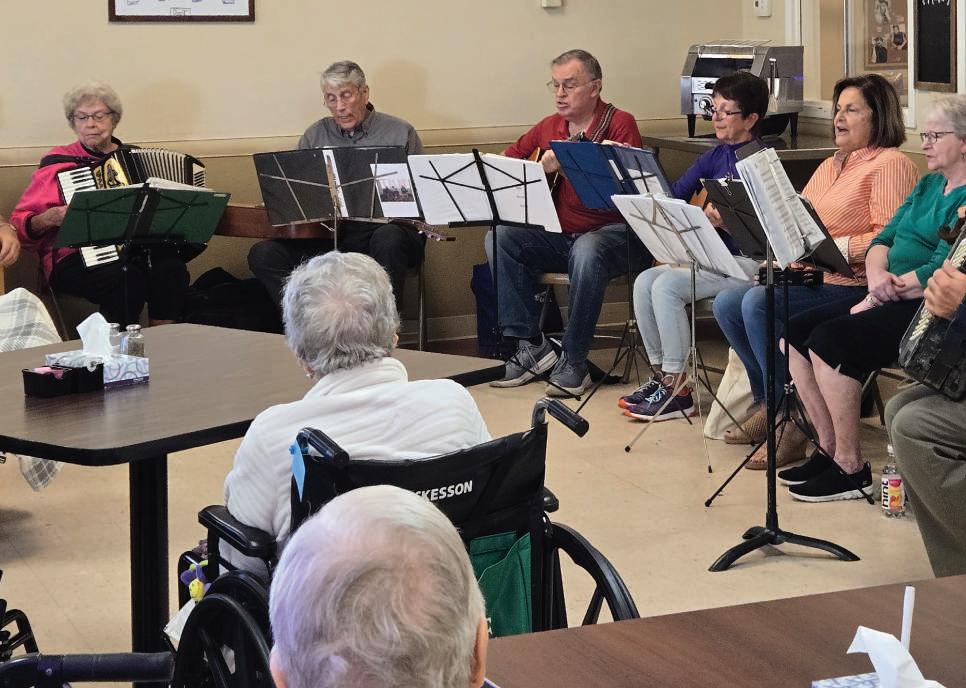
Pictured left to right: Jan Fagan, Don Schroeder, John Mauss, Carol Blum, Lola Coble, Carol Oberfoell, Karen McCarthy, and Jerry Stangl
GOING LONGER AND STRONGER
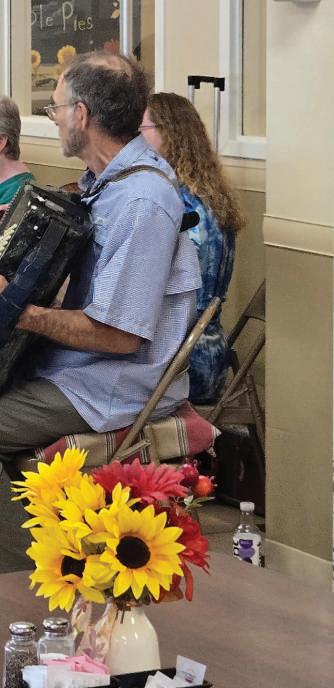
Years later, Older and Bolder has evolved but they still perform around the area at senior centers, parties, and other events. Several of the musicians have been with the group for many years, like Jerry Stangl who has been playing accordion with the group on and off for about 25 years.
“I enjoy playing these good old songs that are pretty, and people can sing along,” says Stangl. “At times it’s hectic playing three or four times a week, but so many times the people tell us they look forward to us coming every

Jan Fagan is one of two accordion players in Older and Boulder.
month and the songs bring back so many memories. That makes it worthwhile for me, and I really enjoy playing with the group.”
A recent sing-along held at Ennoble Nursing and Rehabilitation consisted of two accordion players, three guitarists, one violinist, one percussionist, and vocalists, along with a roomful of residents in full voice. The audience sang along on tunes like Red River Valley, Peg O’ My Heart, Redwing, My Wild Irish Rose, and the like. One of their favorites seemed to be You Are My Sunshine.
Just before his 96th birthday this past summer, John Kloser, now a resident of Sunset Park Place in Dubuque, was honored with a Lifetime Achievement Award “in recognition of a life dedicated to the love of music, the joy of community, and the spirit of giving.” Older and Bolder performed at the awards
ceremony, and Life Engagement Coordinator Shelly Gessner presented Kloser with a certificate, a trophy of a guitar player, and a “Guitar Dude” t-shirt that Kloser wears with pride.
What makes Older and Bolder so popular? According to Gessner, “Their performance is nostalgic, professional, and takes us all on a walk down Memory Lane.” She says the residents love every minute of their shows and beg for more. “The music lets the words fall out of our mouths. They not only meet their goal of bringing joy through music but go above and beyond.”

Tracey Rush is a local music teacher, composer, conductor, and Master Gardener, and is adjusting to life with a retired husband. ❖
Comments on this article can be sent to comments@juliensjournal.com.
Karen McCarthy on violin and Jerry Stangl on accordion.

When It’s Time to Stop Driving
by Nancy Fett and Taylor Hummer
People experiencing dementia brave a multitude of transitions as their symptoms progress. A significant struggle for many is giving up the ability to drive a car.
Some people may have no problem and willingly give up the keys, knowing their own limitations and trusting their family and friends to help them know when it is time. Others, even though they may be having new issues like increased confusion with pedals, directions, rules of the road, etc. are fiercely protective of their independence and control and argue that they are “fine,” and no one is going to tell them they cannot drive.
As family and friends, we must balance respect for their inde -
pendence with the need to keep them and others safe. Having conversations early, before driving becomes unsafe, can make the transition smoother. With early conversations, it can be easier to discuss more calmly and rationally. They can agree to certain behaviors that might indicate that driving is no longer safe. You could even create a list or a contract signed by all involved to document the agreed upon decision.
Having the Tough Conversation
The tone for a tough conversation about driving will determine the reaction and outcome of your loved one. It’s important to consider the following when planning for this conversation: Invite your loved one into the conversation early
Planting the seeds early and involving your loved one into the initial conversation is important. This frames the discussion as preparation, not restriction or judgement. An example of this could be discussing the signs that may suggest it is time to make adjustments on the road.
Validate feelings
It is important to validate your loved one’s feelings when beginning the conversation and throughout. Remember, you can still be direct while showing compassion for your loved one’s safety.
Reframe the conversation with a trusted authority
The reality is that sometimes people accept decisions more readily when it comes from a professional with some authority. You may say, “Your doctor is concerned for your safety on the road,” or “Your eye doctor mentioned that your vision makes it harder to see in the dark. They strongly recommend not driving at night.” Caregiver’s may also refer to the DMV, insurance company, occupational therapist, and more.
Reduce power struggles
Dementia often reduces a person’s ability to recognize safety risks. Using “we” language instead of “you” when having the conversation will promote collaboration. Reducing power struggles may also include using third parties as a neutral. Remember, emotions run high for all parties involved when it
involves one’s independence. You may try all these steps and still not be successful the first time. When discussions turn into arguments, step back and revisit it at another time.
In addition, driving may not be an all or nothing situation. We can start by limiting our loved ones’ driving to familiar locations, or only in mild weather, or without distractions such as the radio. They can also be engaged in the driving process as a passenger, providing navigation and helping the driver when possible.
Strategies to Manage Refusal
If your loved one should not be behind the wheel any longer and is refusing to give up their keys, you can request help from your doctor. Ask the physician





to write a “no driving” order, which can be used to remind the person. This method may also redirect blame from the caregiver.
• Out of sight; out of mind can work for those struggling with dementia. If they do not see their car, they may forget about it. If they ask, you can say it is in the shop for repairs. Selling the car, if not needed, saves on insurance and the worry they will find keys and wander off. If you can park the car at a family member or friend’s house while trying to sell it, all the better.
• Disabling the car so that it will not start or giving them keys that do not work can help satisfy the need to carry keys.
• Finding family members or a service that will pick them up

such as DuRide, Uber, or other transportation can provide that independence and freedom they crave when they want to go somewhere.
ID’S for Non-Drivers
Once your loved one no longer drives, they may need a different form of identification for situations such as traveling on planes, entering certain federal buildings, and voting. This may be a State ID, a REAL State ID (with the star) or a Voter ID card.
To apply for a REAL State ID (required for air travel), you must show proof of identity. This can be your old drivers license with Real ID, a valid passport, or certified birth certificate. You will also need to bring a document with your current name

Tri-State Crem a t ion Center, Inc.
• Assistance with the cemetery, military, florist, caterer, and monument company
• Uniquely personal obituary composition
• Urn, register book, and memorial envelopes are included in our package
and social security number as well as two pieces of mail for proof of residency like a utility bill or other document with your current name and physical address. If you switch from an Iowa REAL Drivers License to a REAL State ID, you will still need to provide documentation. The Department of Transportation also requires an appointment to be made at iowadot.gov.
If you do not anticipate needing an ID but you are a registered voter and want to make sure you can vote in elections, you can apply at your County Auditor’s office for a VOTER ID. If you are not a registered voter, when you register you will automatically receive a VOTER ID in the mail. You can apply in person at the County Auditor’s office or use an official Iowa Voter Registration form and send it to your county election office. This card is only necessary if you do not have a driver’s license or state ID.


Additional help and support for caregivers is available at the Caregiver Resource Center at Stonehill Communities by calling 563-690-9679. ❖
Nancy Fett is a Social Work Professor at Loras College on sabbatical. She is working with Stonehill’s GUIDE Dementia program and the Caregiver Resource Center this year.
Taylor Hummer is a social worker and Certified Dementia Connection Specialist with over two years of experience at Stonehill Communities. Her focus is on supporting and enhancing the quality of life for older adults. She can be reached at thummer@stonehilldbq.com.
THE JENGA EFFECT: HOW TO PROTECT YOUR NEST EGG

by Keith Leverentz
We like to play Jenga as a family and if you’ve ever played it, you know how nerve-wracking it can be to pull out the wrong block. For a few rounds, everything feels steady — until one risky move sends the entire tower tumbling down.
Retirement can feel much the same way. For years, everything seems to balance nicely: your income, investments, and lifestyle all supporting one another. But one ill-timed withdrawal — and you may end up paying more in taxes than necessary because your plan wasn’t coordinated efficiently Many people enter retirement with confidence, especially if they’ve worked with an advisor during their accumulation
years. They’ve spent decades saving, investing, and watching the markets — but at this stage, it’s not only about growth. It’s about keeping more of what you’ve earned through smarter coordination of taxes, income, and investment strategy.
That’s where many plans fall short. Traditional advice says, “Keep your portfolio balanced,” or “Stay the course.” But retirement requires a different strategy — one that coordinates not just investments, but also income sources, tax planning, healthcare, and legacy goals. Without that panoramic view,
even a well-built portfolio can start to wobble under the weight of taxes, market downturns, and unpredictable expenses.
SO HOW DO YOU KEEP YOUR TOWER STANDING TALL?
First, reduce the tax drag on your income. Many retirees pay more than they need to because accounts and withdrawals aren’t coordinated. Integrating tax strategy with your income plan, including how Social Security is taxed and which accounts you draw from first— can help ensure your savings support your goals for years to come.
Second, plan your withdrawals with purpose. A smart distribution plan coordinates income from multiple sources—Social Security, investments, and possibly old 401(k)s—so you’re not pulling too heavily from one area when markets are down. Think of it like balancing the weight of your Jenga tower: the key is knowing which piece to move and when.
Third, create a steady foundation for your income. The key to peace of mind is knowing your essential expenses are covered—no matter what the markets decide to do. This might include strategies to align Social Security, pension
benefits, or other dependable income sources to support your lifestyle in any market environment. Even small adjustments in how you coordinate income and expenses can make a big difference in how long your savings last.
The truth is that retirement success isn’t about guessing the market or hoping your tower never shakes. It’s about having a panoramic view — understanding how income, taxes,

investments, healthcare, and legacy all work together to create long-term balance. When every piece of your financial life fits together with intention, you can stop worrying about the next move — and start enjoying the game.❖
Keith Leverentz is a National Social Security Advisor® (a private credential for professionals trained in Social Security planning) and founder of The Life Group. You can visit their website at TheLifeGroupLLC. com.

The Importance of Self-Care During Bereavement: Nurturing Yourself Through Loss

Grief is an overwhelming experience, a profound journey that drains your physical, emotional, and mental reserves. In the midst of loss, the idea of tending to your own needs can feel selfish or impossible, but self-care is not a luxury; it is a critical necessity for navigating bereavement. Prioritizing yourself helps replenish the energy grief depletes, allowing you to process your feelings without complete burnout.
Your body and mind are under immense stress, so tending to basic physical needs is paramount. Aim for adequate rest, even if it’s just short naps, and
try to maintain a healthy diet. When your appetite wanes, focus on nutrient-dense snacks and stay hydrated. Gentle movement, such as a short walk or light stretching, can also release tension.
Beyond the physical, nurture your emotional and mental wellbeing. This is a time to be kind to yourself. Practice mindfulness or meditation to anchor yourself in the present moment or simply take five minutes to breathe deeply when you feel overwhelmed. Critically, allow yourself moments of joy or distraction without guilt. Watching
a comforting movie, reading a book, or spending time with a supportive friend offers a vital break. These moments don’t diminish your love or your loss; they simply replenish your ability to face the next day.
Recognize that grief is exhausting, and consciously implementing these self-care practices is the most powerful way to sustain yourself through the long, difficult process of healing.
This Bereavement Tip was Brought to you by Behr’s Funeral Home. Visit their website at Behrfuneralhome.com.
Our Family Serving Yours
Since 1936
When preplanning your funeral Behr Funeral Home can be a trusted source of information.
We can help you understand the different funeral


Nancy Conlon
How to Make the Most of Medicare’s Wellness Benefits
by Stefan Johnson
For many older Americans, Medicare provides more than health insurance, it is a path to improved health and overall wellness. Preventive services can be strong tools for a healthy life. Medicare Part B provides several preventive services to help beneficiaries to feel their best and find potential issues before the issues become major problems. And most of those services are available at no extra cost to the Medicare patient.
Yes, Medicare offers many essential wellness and preventive services at no cost to you, as
long as your provider accepts assignment. These benefits are a cornerstone of Part B (Medical Insurance), focusing on preventing illness and detecting health conditions early.
YOUR ANNUAL WELLNESS VISITS
Medicare covers two types of wellness visits, both with a $0 copayment:
“Welcome to Medicare” Visit (Initial Preventive Physical Exam - IPPE): This one-time benefit is available during the first 12 months you have Medicare Part B. You will review your health history, get baseline measurements (height, weight, blood pressure, etc.),
and discuss needed preventive screenings. It is not a routine physical exam.
“Wellness” Visit (Annual Wellness Visit - AWV): After your first 12 months in Part B, this visit is available annually. A key element of your preventive care, this meeting is to develop or update a personalized plan to help prevent physical problems. Typically included is a Health Risk Assessment , a medical and family history review, routine measurements, a cognitive assessment, and a screening schedule. It is not a physical exam.
When you schedule your IPPE


or AWV, it is important to make sure with the doctor’s office that you are scheduling that IPPE or AWV and not some other procedure. Otherwise, you could end up getting billed for something you did not intend to get billed for. Also, make sure that your health care provider accepts Medicare assignment. Most providers do, but it is important just to make sure.
NO-COST SCREENINGS AND SHOTS
Medicare Part B also covers several screenings and vaccinations with no out-of-pocket costs. These are vital services for the early detection of, and protection against, common diseases. This includes:
Cancer screenings like mammograms, pap tests, pelvic exams, colonoscopy, and prostate screenings.

Cardiovascular screenings for cholesterol, lipids, and triglycerides
Immunizations such as flu, pneumococcal, and COVID-19 shots and boosters
Other screenings like diabetes, glaucoma, and bone mass IN
ADDITION…
It might surprise some to know that Medicare even offers counseling services. This includes counseling to avoid alcohol misuse, to stop smoking, and even to help people to lose weight.
These no-cost benefits can empower Medicare beneficiaries to take care of their health, focus on prevention, and have a wonderful quality of life! ❖
Stefan Johnson helps people choose Medicare Advantage, Supplement, Cost, and Prescription Drug plans. He is licensed in Iowa, Wisconsin, Illinois, and Minnesota and represents several companies providing Medicare-related products. He can be reached at 563-581-9341 or sj@retiringease.com.
Comments on this article can be sent to comments@juliensjournal.com.
A GUIDE TO CHOOSING A RETIREMENT COMMUNITY
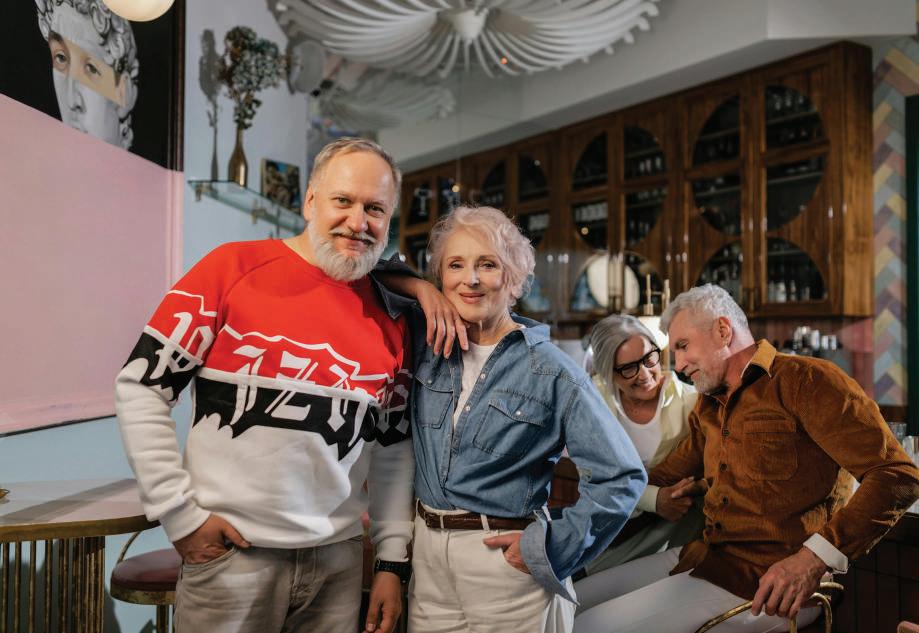
Retirement is a new chapter—a chance to pursue passions, build new friendships, and enjoy a life free from the burdens of home maintenance. For many, a retirement community offers the perfect setting for this next phase. But with so many options available, how do you find the one that’s right for you? It’s about more than just a place to live; it’s about finding a home that supports your lifestyle, health, and happiness.
Here’s a guide to what you should consider when looking for a retirement community, designed for those who are ready to make a smart and fulfilling move.
1. Understanding Your Options: It’s Not One-Size-Fits-All
The term “retirement community” is a broad one. Your first step is to determine what type of community best fits your current and future needs.
Active Adult Communities
(55+): These are essentially agerestricted neighborhoods, perfect for healthy and independent seniors who want to downsize and enjoy a maintenance-free lifestyle. They often feature amenities like clubhouses, golf courses, pools, and organized social events, but do not provide meals or personal care services.
Independent Living: Similar to active adult communities, independent living facilities offer housing for self-sufficient seniors. The key difference is
the range of services typically included in the monthly fee, such as housekeeping, transportation, and daily meals. You’ll have access to a vibrant social calendar and amenities, with the added convenience of having daily tasks taken care of.
Continuing Care Retirement Communities (CCRCs): This is a great choice for those who want a long-term plan. CCRCs offer multiple levels of care on a single campus, from independent living apartments and cottages to assisted living and skilled nursing facilities. This allows you to “age in place,” meaning you can transition to higher levels of care as your needs change without having to move to a new location.
Assisted Living: For seniors who require help with daily activities like bathing, dressing, or medication management, but don’t need round-the-clock medical care, assisted living provides the necessary support while encouraging independence.
2. Location, Location, Location
The old real estate mantra applies here, too. The community’s location will define your daily life. Consider these questions: Proximity to Loved Ones: Do you want to be close to family and friends? Easy access for visits can make all the difference in your social life and peace of mind.
Access to Services: Is the community conveniently locat-
ed near your preferred doctors, hospitals, shopping centers, and cultural attractions?
Climate: Are you ready to embrace a new climate or prefer to stay where you are? Think about how the weather will impact your hobbies and daily activities throughout the year.
3. A Look Inside: The Amenities and Social Life
A community is only as good as the life it enables you to live. Take a close look at the social and recreational offerings.
Activities and Clubs: Ask for a sample activity calendar. Are there options that align with your interests, whether it’s gardening, painting, book clubs, fitness classes, or card games? Do residents lead any of the clubs?
The term “retirement community” is a broad one. Your first step is to determine what type of community best fits your current and future needs.
Wellness Programs: Look for a community that supports your physical and mental well-being. This can include fitness centers, swimming pools, walking paths, and wellness classes.
Dining: If meals are provided, ask about the dining options. Is there a variety of healthy and delicious food? Can you try a meal during your tour to get a feel for the quality?

DISCOVER LIVING



4. Evaluating Healthcare Services
Even if you’re in perfect health today, it’s wise to plan for the future.
On-Site Care: Does the community have a medical professional on staff or a doctor who visits regularly? What is the procedure for medical emergencies?
Continuum of Care: If you’re considering an independent living or active adult community, what happens if your health needs change? Do they have a relationship with a nearby assisted living or skilled nursing facility? This is where a CCRC can offer a significant advantage.
Staff-to-Resident Ratio: This is an important indicator of the quality of care. The higher the


Independent
3
On-site therapy
Scheduled transportation
Maintenance-free living
Daily
Housekeeping & laundry service
2700 Matthew John Dr Dubuque, IA 52002 563-690-1900

ratio, the more personalized attention residents receive.
5. The Financial Picture: Understanding the Costs
The financial aspect can be complex, so it’s crucial to ask the right questions and read the fine print.
Monthly Fees vs. Entrance Fees:
Many communities require an upfront entrance fee, which can be substantial, in addition to a monthly fee. Find out if the entrance fee is refundable and under what conditions.
What’s Included: Clarify what the monthly fee covers. Does it include utilities, housekeeping, meals, transportation, and access to all amenities? What services are considered extra and have a separate cost?
Future Costs: If you are at a CCRC, ask how the costs change as your care needs increase. Some contracts have a predictable pricing model, while others are “fee-for-service,” meaning you pay as your needs arise.
Your Next Steps
Choosing a retirement community is a big decision, and it’s one that should be made with careful consideration. The best way to get a real sense of a community is to visit in person.

Even if you’re in perfect health today, it’s wise to plan for the future.
Take a tour, speak to the staff, and, most importantly, talk to the residents. Ask them what they love about living there and what they wish were different. Their insights will be your most valuable resource in finding the perfect place to start your next great adventure. ❖
YOUR RETIREMENT SHOULDN’T BE A GAME OF JENGA.
One wrong move—like pulling income in the wrong order—can collapse everything you've built.
Most retirees don’t realize how dangerous Sequence of Return Risk can be until it’s too late.
At The Life Group, we help you build a retirement plan with true stability—so you don’t leave your future to chance.
Let’s protect your retirement before the first block falls.

(563) 587-7840 www.thelifegroupllc.com


How to Translate Insight into Behavior
by Dr. Richard Houston
Nearly all adults have encountered the advice that active lifestyle habits, aka exercise, is good for their health. At the same time, only one in four adults meet the recommended standard for physical activity – 150 minutes per week. In this case, knowledge does not translate into behavior for 75% of the population.
NYU3
with NIH (National Institutes of Health) published an updated analysis of data concluding that American adults confront a 42% risk of contracting dementia after age 55. This represents a sobering conclusion for everyone that is fortunate enough to count birthdays into their 60’s, 70’s, 80’s and beyond.
The Alzheimer’s Association has recently published results of the Pointer study. Their conclusion is that 45% of dementia cases can be prevented. Unlike the NYU research, this conclu-
sion is not breaking news. The San Francisco VA Hospital made the same statement ten years ago.
Yes – mature adults face a substantive risk of cognitive deterioration and yes, we could tilt the odds in our personal favor by adopting lifestyle habits that promote healthy outcomes.
If people knew of the dementia risk and their personal ability to tilt the odds in their favor, would they be more likely to change their behavior? This knowledge would probably make a difference for some.

However, we operate with flawed thinking. For starters, humans function with short term myopia which is a strong tendency to focus on short term outcomes and dismiss or discount long term realities.
Consider Gloucester Massachusetts fishermen and women. As “catch” technology improved, they captured more and more bounty from the renowned Georges Banks fishery until the fish stocks were so diminished to require government restrictions on their catch.
Central Valley farmers in California have drained underground aquifers for irrigation to the extent that actual land upon which buildings are constructed is collapsing because the underground reservoirs are depleted.











Short term myopia makes long term risks evaporate. And this holds true for our health. Many people in their 50’s and 60’s feel fine and decide there is no need to change their behavior. When cognitive deterioration sets in, they wish they had done more to promote the health of their brain.
Physical activity is one piece of the solution. Challenging our learning capacity in later life represents another priority. Research published in the journal ‘Neurology’ noted that people with a routine job with little mental stimulation during your 30s, 40s, 50s and 60s have a 66% higher risk of mild cognitive impairment and a 37% greater risk of dementia after the age of 70.
The lesson for older adults should be clear. Maintaining the ‘same old, same old’ mental habits is dangerous for your cognitive health. Adults need to challenge their learning capacity as they age to keep their memory and brain functioning in optimal condition.
America’s first psychologist, William James, stated that “habit is the enormous flywheel of society.” If you want to keep your brain working successfully, you may need to change your habits.
In our next column, I will address techniques for implementing behavior change.
Dr. Richard Houston is an active and curious ‘senior’ who strives to get outdoors for a brisk
walk daily. He is a graduate of Brown University and earned advanced degrees at Clark University. He was licensed by the Massachusetts Board of Psychology in the early 1980’s. Check out his web site at Senior-Psych.com where readers can find tutorials and his contact information. ❖
For over 42 years, Hospice of Dubuque has helped persons with serious illness live as fully and comfortably as possible.
Call 563.582.1220 or visit hospiceofdubuque.org to learn more. Our strength is caring, our

How to Hire a Caregiver for In-Home Help
by Jim Miller
Finding a good in-home caregiver for an elderly parent is not always easy. How can you find one that’s reliable and trustworthy, as well as someone your parent likes and is comfortable with? Here are some tips that can help.
KNOW THEIR NEEDS
Before you start the task of looking for an in-home caregiver, your first step is to determine the level of care your parent needs.
For example, if they only need help with daily living tasks like shopping, cooking, doing laundry, bathing or dressing, a “homemaker” or “personal care
aide” will do. But if they need health care services, there are “home health aides” that may do all the things a homemaker does, plus they also have training in administering medications, changing wound dressings and other medically related duties. Home health aides often work under a nurse’s supervision.

Once you settle on a level of care, you then need to decide how many hours of assistance they will need. For example, do they need someone to come in just a few mornings a week to cook, clean, run errands or perhaps help them with a bath? Or do they need more continuous care that requires daily visits?
After you determine their needs, there are two ways in which you can go about hiring someone. Either through an agency, or you can hire someone directly on your own.



HIRING THROUGH AN AGENCY
Hiring a personal care or home health aide through an agency is the safest and easiest option, but it’s more expensive. Costs typically run anywhere between $15 and $30 an hour depending on where you live and the qualification of the aide. How it works is you pay the agency, and they handle everything including an assessment of your parents’ needs, assigning appropriately trained and prescreened staff to care for them, and finding a fill-in on days their aide cannot come.
Some of the drawbacks, however, are that you may not have much input into the selection of
the caregiver, and the caregivers may change or alternate, which can cause a disruption.
To find a home care agency in your area use search engines like Google or Bing and type in “home health care” or “nonmedical home care” followed by the city and state your parent lives in. You can also use Medicare’s search tool at Medicare. gov/care-compare – click on “home health services.” Most home health agencies offer some form of non-medical home care services too.
You also need to know that original Medicare does not cover in-home caregiving services unless your parent is receiving doctor ordered skilled nursing or therapy services at home too. But, if your parent is in a certain Medicare Advantage plan, or is low-income and qualifies for Medicaid, they may be eligible for some coverage.
HIRING DIRECTLY
Hiring an independent caregiver on your own is the other
Advertising INDEX
option, and it’s less expensive. Costs typically range between $12 and $25 per hour. Hiring directly also gives you more control over who you hire so you can choose someone who you feel is right for your parent.
But be aware that if you do hire someone on your own, you become the employer so there’s no agency support to fall back on if a problem occurs or if the aide doesn’t show up. You’re also responsible for paying payroll taxes and any worker-related injuries that may happen. If you choose this option, make sure you check the aide’s references thoroughly and do a criminal background check at companies like eNannySource.com.
To find someone use an eldercare matching service like Care. com or CareLinx.com, which both provide basic background checks. ❖
Jim Miller is a syndicated columnist that offers advice for Boomers and Seniors.
Business Card Directory