Home construction expected to begin on Glaser parcel
BY JASON STARR Observer staff
The Williston Selectboard accepted 48 acres of land into town ownership Tuesday, fulfilling the promise of the Glaser Specific Plan and paving the way for construction of 107 homes off Mountain View Road.
Jack and Cait Glaser initiated a seldom used subdivision process in 2020 for their 95-acre parcel at the corner of Mountain View and Old Stage roads. The “specific plan” process rewrote the town’s land use regulations for the parcel, creating an accelerated construction schedule for the homes in exchange for the 48-acre land donation to the
town.
“Land is just so precious, and I think it will be a great resource for the town to have into the future,” Jack Glaser said. “Hundreds of years from now, I think people will think ‘wow, it’s really great that we have this land available to walk on and look at wildlife and maybe do sports,’ — or whatever happens in the future. It will be a great asset for Williston.”
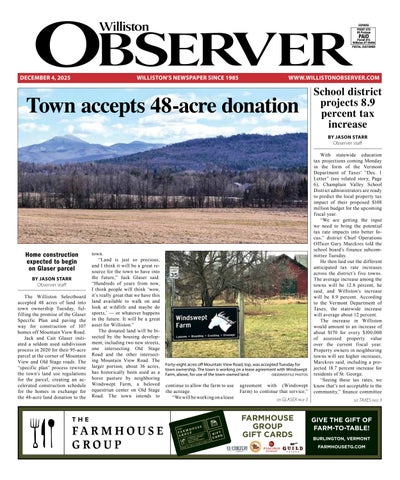
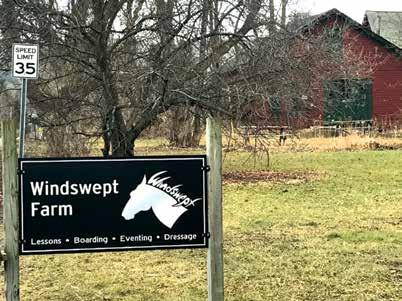
The donated land will be bisected by the housing development, including two new streets, one intersecting Old Stage Road and the other intersecting Mountain View Road. The larger portion, about 36 acres, has historically been used as a horse pasture by neighboring Windswept Farm, a beloved equestrian center on Old Stage Road. The town intends to
School district projects 8.9 percent tax increase
BY JASON STARR Observer staff
With statewide education tax projections coming Monday in the form of the Vermont Department of Taxes’ “Dec. 1 Letter” (see related story, Page 6), Champlain Valley School District administrators are ready to predict the local property tax impact of their proposed $108 million budget for the upcoming fiscal year.
“We are getting the input we need to bring the potential tax rate impacts into better focus,” district Chief Operations Officer Gary Marckres told the school board’s finance subcommittee Tuesday.
He then laid out the different anticipated tax rate increases across the district’s five towns. The average increase among the towns will be 12.8 percent, he said, and Williston’s increase will be 8.9 percent. According to the Vermont Department of Taxes, the statewide increase will average about 12 percent.
The increase in Williston would amount to an increase of about $170 for every $100,000 of assessed property value over the current fiscal year. Property owners in neighboring towns will see higher increases, Marckres said, including a projected 18.7 percent increase for residents of St. George.
continue to allow the farm to use the acreage.
“We will be working on a lease agreement with (Windswept Farm) to continue that service,”
“Seeing these tax rates, we know that’s not acceptable to the community,” finance committee
see TAXES page 3
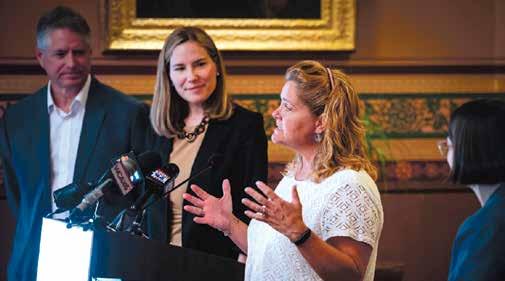
Forty-eight acres off Mountain View Road, top, was accepted Tuesday for town ownership. The town is working on a lease agreement with Windswept Farm, above, for use of the town-owned land.
Reading responders
Members of the Williston Fire Department visit Sensations in Learning during Thanksgiving week to read Thanksgiving-themed stories to the preschool students there.
COMMUNITY CALENDAR
EMAIL EVENT LISTINGS TO EDITOR@WILLISTONOBSERVER.COM
SATURDAY, DEC. 6
Around Town
Recycling Center breaks ground
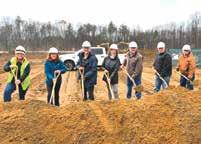
The Chittenden Solid Waste District broke ground Nov. 15 on construction of its new recycling center on Redmond Road. The $38 million project will replace the district’s existing recycling center off Industrial Avenue, significantly increasing recycling capacity in the county.
Town bills due by end of month
The Williston Public Works Department reminds residents
that quarterly water/sewer/stormwater bills have been mailed, and payment is due to the town by Dec. 31. Contact the department at (802) 878-1239 for more information.
VTrans seeks road construction feedback
The Vermont Agency of Transportation is surveying residents about the construction project at the intersection of Industrial Avenue, Mountain View Road and Route 2A. The survey will inform the agency’s work as the project relaunches in the spring.
Construction began in March and concluded for the season in November. Construction has included road widening, drainage improvements, curb and sidewalk installation and traffic signal upgrades.
Visit https://www.surveymonkey.com/r/K3TKZKV to participate in the online survey.
Feeding 1,300
Faculty at the Williston campus of Vermont State University volunteer with the Farmhouse Group restaurants to prepare 1,300 meals for donation to local food shelves in celebration of Thanksgiving. Pictured last Wednesday are Barb Flathers, Laurent Bruneau, Paul Yoon and Ross Lieblappen and his two children.
OBSERVER COURTESY PHOTO
Richmond Holiday Market. Crafts, lunch, book sale, live music, and food and toy donation opportunities. 9 a.m.-3 p.m. Richmond Congregational Church. For more information, email spochop@uvm.edu or call (802) 318-5360.
SUNDAY, DEC. 7
Williston Community Tree Lighting. Christmas carols, cookies and hot cocoa as the town Christmas tree is alight for the season. Donations of hats, mittens, gloves and socks accepted for the food shelf. 4:30-5:30 p.m. Village Green.
MONDAY DEC. 8 Senate Committee on Education hearing. Give feedback to legislators about statewide education policy. 2:30-4:30 p.m. CVU High School.
TUESDAY, DEC. 9
Williston Development Review Board meeting. 7 p.m. Town Hall. Agenda at www.town.williston.vt.us.
Champlain Valley School Board meeting. 6 p.m. CVU High School. Agenda at www.cvsdvt.org.
THURSDAY, DEC. 11
Jonathan Milne Senior Holiday Luncheon. Williston Central School choir performance and holiday meal, sponsored by the WillistonRichmond Rotary Club. 11 a.m. RSVP by Dec. 6 by calling (802) 489-8159.
OBSERVER COURTESY PHOTO
Glaser
continued from page 1
Town Manager Erik Wells said.
The smaller portion of the donated land comprises 11 acres along Mountain View Road. It was preserved primarily to protect easterly views of the Green Mountains, but may also become home to a town park.
“The town could look into developing that (with) some small amenities — a path along the road, and maybe a small parking lot,” Wells said.
The Development Review Board approved home
Taxes
chair Dave Connery said, echoing the thoughts of statewide political leaders (see Letters to the Editor, Page 9)
The school district’s $108 million budget proposal carries an increase in spending over the current year of about $5.1 million due primarily to a 5.5 percent increase in teacher salaries and
construction plans earlier this year, and last week, a state Act 250 land use permit was issued, according to Wells. With the selectboard’s acceptance of the land donation, Glaser expects ground to break in the coming months on home construction.
He has partnered with Sheppard Custom Homes of Essex on the development.
“He’s ready to go,” Glaser said about Sheppard Custom Homes President Tom Sheppard. “He’s hoping to have homes available in the fall of 2026.”
Under the Specific Plan, up to 18 homes can be built each year over six years — a pace
a 5 percent increase in support staff salaries that the board and teachers union agreed to in their current employment contract.
The differences in tax impact among CVSD towns is due to the state’s Common Level of Appraisal (CLA) — a ratio given to each town that accounts for the difference in the value at which properties are assessed and their actual market value.
The school board intends to
that bypasses the town’s typical “growth management” regulations. Twelve of the homes will be deed-restricted as perpetually affordable.
“Our vision was to make the land something that the community would be really proud to have,” Glaser said, “and really serve the community far into the future, way beyond our lifetimes. That includes having the horse farm continue to operate as long as possible and having responsible housing and growth for the community. We need more housing, so I think this accomplishes that.”
continue refining the budget during meetings in December and January before finalizing a proposal to put to voters at Town Meeting Day in March. The budget picture is also subject to change after the New Year based on potential action from the Legislature. Last year, the Legislature added about $100 million into the state education fund to reduce the education tax burden on property owners.
Sign-up opens for town Holiday Decorating Contest
The Williston Recreation and Parks Department encourages homeowners and business owners to register for the annual Holiday Decorating Contest.
Show off your festive outdoor lighting and holiday displays for drive-by viewing and online judging by members of the community. Compete for prizes from Adams Farm Market, Healthy Living Market, Williston Coffee Shop, Williston Meat & Fish and the Williston Observer.
Register by Dec. 14 at www.willistonrec.org or by calling the department at (802) 876-1160. Judging will take place Dec. 18-21 from 5:30-7 p.m. A map and online voting link will be available starting Dec. 18.
A past residential winner of Williston’s Holiday Decorating Contest.
criminal court grapples with court backlog and recidivist defendants
BY CHARLOTTE OLIVER AND
ALAN J. KEAYS VTDigger
A defendant appeared in court on a Wednesday morning in Burlington in an oversized crewneck with her hands cuffed in front of her. Judge Martin Maley said she was already looking healthier after spending time in jail since her last court date.
The defendant’s case, involving theft charges, was one of four scheduled that day in Chittenden County’s new community accountability court. The initiative Gov. Phil Scott started in October aims to address the backlog of court cases by directing resources to cases involving defendants who have five or more pending cases against them.
The special court was part of Scott’s “short term action plan” to help address public safety challenges in Burlington. In his October announcement, Scott touted the court’s mission to not only move through cases quickly but also to better connect defendants with social services.
Cases are prosecuted by Zach Weight, who was appointed by Scott, and are heard by Maley, who was named by the chief Superior Court judge.
On a recent day in court, two employees of Vermont’s Agency of Human Services sat with Hope Love, program manager of Therapeutic Works, a mental health services organization. The three often whispered, then pulled the defense lawyer aside to discuss treatment options for defendants.
During court proceedings, Maley spoke from the bench about trying to help defendants gain stability before looking for accountability from people who have racked up multiple offenses. In one case,
a defendant facing several retail theft charges pleaded guilty to four of the misdemeanors in exchange for 120 days to 18 months in jail. The defendant told the judge the charges came as he has battled substance use disorder and relapsed after being clean for five years.
Before his sentence was imposed, the man apologized for his actions.
“Appreciate hearing that,” Maley said to him, adding, “Hopefully, you’ll find yourself in a place where you’re clean and sober, and I expect you’ll do well.”
As of Nov. 20, 18 defendants in the court had their cases resolved, according to Chief Superior Judge Thomas Zonay. Because those people had many legal cases against them, the court has resolved 152 cases. Also, 87 defendants had cases in the docket yet to be resolved, Zonay said.
The court’s pilot period is projected to run through February, according to Tim Lueders-Dumont, executive director of the Department of State’s Attorneys and Sheriffs.
Maley began a recent court hearing with a question for the defense: “What’s happened since we were here last?”
The defendant has been stabilized in prison, she’s on medication and reading books, said her attorney, Harley Brown.
He proposed a sentence that would allow her to be released under the supervision of the Department of Corrections.
Maley said that Brown’s proposed sentence might make Maley “swallow hard and wonder why,” about the light sentence. The new court affords the lawyers and judge “the luxury of spending more time with folks and having these conversations,” Maley said.
Weight said in court that prosecuting this particular case is complicated: the defendant is facing multiple charges for alleged thefts from vehicles. In some of those cases, the victims drove in from out of state and Weight can’t even get the defendant on the phone, let alone to appear in court, he said.
The defendant has struggled with housing. She’s been trying to get a hotel room, but they’re hard to find, Brown said.
“I mean, prison is not the answer to homelessness, I get that,” Maley said. But Maley said he was concerned about releasing the defendant into the community without any housing or support, especially when she seems to be getting healthier in jail.
Both parties discussed the possibility of letting the defendant go to Oregon, where she has family she asked to be with. But see HOMELESSNESS page 5
Homelessness
continued from page 4
Maley said he doesn’t like the idea of passing off the case for other states to deal with.
Weight said that a lot of defendants on the court docket have to leave the county or state to get the services they need. Many have gone to New Hampshire to get into a sober living program, he said.
Weight said that while the defendant has many cases against her for a range of crimes, he didn’t want to propose a sentence out of line with what other defendants around the state are receiving for similar crimes.
“I don’t want to come in here with a sledgehammer and punish people exponentially worse because they ended up in front of Your Honor,” Weight said.
On another day, 14 cases were scheduled to be heard by the court. In many of those cases, the defendant had a warrant out for their arrest and did not appear in court. It’s unusual for a court to review those cases, Maley said, but he wanted to make sure they weren’t forgotten about.
Not all cases were straightforward. In one, Weight believed that a defendant was
recently arrested in Florida. Both parties discussed with Maley how it might not be worth it to spend the state resources and money to transport someone back to Vermont if they were only facing minor charges.
In another case, a man facing two charges of aggravated assault appeared to be heading to trial on at least one charge and the next available trial dates weren’t until the end of January. If a resolution to the cases was reached short of a trial, Maley told the parties, he would get them back in sooner.
When both parties weighed how to resolve the case of the defendant with the theft charges, Weight said, “I have tried to take the approach of being creative in resolving these cases.”
Both sides weighed the pros and cons of different arrangements that might let her out into the community. However, they wanted to make sure the defendant had stable housing so she could continue to make progress.
The judge agreed to a request from Weight to set the matter for another hearing.
That would buy everyone some time, the prosecutor told Maley, to “put a plan together so that she’s not released to a tent on the street.”
Superior Court Judge Martin Maley listens to an argument at Chittenden County Community Accountability Court in Burlington on Friday, Nov. 21.
PHOTO BY GLENN RUSSELL/VTDIGGER
State estimates average 12% education tax increase
BY ETHAN WEINSTEIN VTDigger
Vermonters could see a nearly 12 percent property tax increase in 2026, according to early estimates from the state.
The news arrived Monday in the form of the “Dec. 1 letter,” an annual Tax Department projection that represents the first public-facing estimate of the average expected education property tax rates. The estimate relies on data from the state Agency of Education and local school districts, which are already engaged in their budget-making processes, and is produced in collaboration with the Vermont Legislative Joint Fiscal Office.
“The rate of increase that we’re talking about is simply unacceptable and certainly defines unaffordability,” Bill Shouldice, Vermont’s tax commissioner, said in a media briefing on Monday.
Education property taxes have risen more than 40 percent in the last five years, according to the Tax Department, even while student enrollment in Vermont has dropped.
Education property taxes have risen more than 40 percent in the last five years … even while student enrollment in Vermont has dropped.
About half of the projected 11.9 percent average increase is due to anticipated increases in school district spending in the 2026-2027 school year, according to the Tax Department. The other half of the increase comes from not having the onetime allocation of roughly $100 million used last year to lower tax rates, a common practice in recent years adopted by the Legislature and governor.
Property taxes rose on average by about 1 percent in 2025, though increases varied in towns and districts across the state. The
modest increase resulted from lawmakers offsetting a 5.5 percent increase in school spending using one-time buy-down funds, a decision that makes this year’s increase appear higher.
Rising property taxes — and the cost of public education — have been the driving force in Montpelier politics over the last two years. In the 2024 legislative session, property taxes were projected to rise by an average of more than 18 percent, leading voters to reject a historic proportion of school budgets. Reductions in spending and offsetting funds lowered the tax increase to less than 14 percent, but that spike fueled a wave of Republican House and Senate victories last November.
Last legislative session, in response to rising education property taxes, lawmakers passed Act 73, setting in motion generational change to how education is paid for and governed in Vermont. But the bill depends on lawmakers approving new, consolidated school district maps this upcoming session. That requirement hit a speed bump last month, when the group tasked with proposing maps chose to endorse voluntary — rather than mandatory — district consolidation.
Gov. Phil Scott labeled the task force’s recommendation a failure. Education
Secretary Zoie Saunders added further criticism on Monday, arguing the state needs to act now to prevent an endless cycle of property tax increases and cuts to school budgets.
“Rising property taxes have not prevented staffing cuts and school closures. Rising property taxes have not facilitated equitable opportunities for students in every community across Vermont, and rising property taxes have not moved the needle on improving educational quality,” Saunders said at the briefing. “Instead, we are contending with two enormous challenges: property taxes that families cannot afford and an education system that local communities cannot sustain.”
The 11.9 percent estimate was formulated using preliminary school budgets from about two-thirds of districts, according to the Tax Department. In years past, the Dec. 1 estimate has been higher than the ultimate average tax bill, as lawmakers have used new taxes and one-time money to bring down rates. School districts may also lower their budgets before votes on Town Meeting Day.
Officials said Monday it was too soon to say whether Scott and his team would recommend budgeting money to buy down property tax rates this year.
Feds sue secretary of state for failing to turn over voter data
BY ETHAN WEINSTEIN VTDigger
The Trump administration has taken Vermont’s secretary of state to court, asking a federal judge to force the state to turn over information on registered voters.
Filed on Monday in Vermont’s U.S. District Court, the lawsuit argues Secretary of State Sarah Copeland Hanzas violated federal election law when she refused to share registered voters’ addresses, drivers license numbers and the last four digits of their social security numbers, among other information.
Vermont officials have yet to respond to the suit in court.
Back in August, Copeland Hanzas announced she wouldn’t comply with the Trump administration’s request, arguing Vermont law “specifically prohibits” the state and municipal governments from sharing voters’ personal details with the federal government for certain uses. That includes, per the law, handing over voters’ information so federal agencies can compare it to “personally identifying information contained in other federal or state databases.”
At that time, a number of other states had received similar requests from the Trump administration for voter information. Some states shared the information, while others, including Maine, declined the request. The federal government has since sued some of those states that declined the demand.
In the lawsuit, attorneys in the voting section of the U.S. Department of Justice’s Civil Rights Division suggested their inquiry is meant to ensure Vermont’s registered voter list is accurate. The federal attorneys requested that a judge order Copeland Hanzas to comply with the request to turn over voter information.
A spokesperson for the Secretary of State’s Office said on Tuesday that they weren’t familiar with the details of the lawsuit and declined to comment.
“We have not yet been served with this lawsuit but we look forward to defending Secretary Copeland Hanzas in this case,” Amelia Vath, a spokesperson for the Vermont Attorney General’s Office, which represents Copeland Hanzas in the case, said in a statement.
Judge denies injunction to stop return-to-office order
State workers are expected to return to in-person work this week
BY ERIN PETENKO VTDigger
A Superior Court judge ruled Saturday that he would not grant an injunction of the state’s return-to-office policy, paving the way for the state to enforce its Dec. 1 deadline for employees to begin in-person work.
The Vermont State Employees’ Association had filed the lawsuit last month to challenge Gov. Phil Scott’s decision to order almost all state employees back to in-person work three days a week.
In court last Wednesday, the union’s attorney argued that the policy would cause irreparable harm to certain employees forced to relocate or change their child care arrangements, among other impacts. That irreparable harm, Alfred Gordon O’Connell said, gives the court the right to intervene.
But in the ruling, Washington County Superior Court Judge Daniel Richardson sided with the state’s argument that employees have sufficient relief available through the state’s exemption process, in which employees can request temporary or long-term exemptions for their personal circumstances.
Of the 3,000 employees newly expected to come into the office, 425 have requested exemptions, according to the state’s
PHOTO BY GLENN RUSSELL/VTDIGGER
data cited in the decision. Only 25 exemptions have been granted, while the rest are pending.
“On the present record, the Court would be speculating as to the scope, nature, and even severity of the harm if it went forward to grant relief in this case,” Richardson wrote.
“This is not to say that there are not State employees who will be affected by this policy,” he continued. “Nor is it to minimize the hardships or concerns of those individuals, but it is to recognize that there are several processes in play, presently, that render a decision at this time from this Court inappropriate.”
The union has also filed complaints with the Vermont Labor Relations Board, which has scheduled an investigatory conference to determine whether the case should move forward, O’Connell said at the hearing.
Secretary of State Sarah Copeland-Hanzas at the Statehouse in Montpelier.
FILE PHOTO BY GLENN RUSSELL/VTDIGGER
State employees enter the state office complex in Waterbury in October.
Thanksgiving and the ethics of expansive wealth
BY BILL SCHUBART
My family’s always favored Thanksgiving over the celestial holidays like Christmas and Easter that feed a bloom of consumption. At Thanksgiving, families and friends simply gather to express gratitude, share food and tell stories. It’s an earthbound holiday.
There are exceptions. France’s Bernard Arnault (estimated net worth: $184 billion) recently was quoted saying “As long as I’m not the richest man in the world, I won’t really be happy.”
Haves and have-nots have lived side-by-side throughout much of humankind’s 300,000year history, although the concept of cumulative wealth as measured in currency — as opposed to food, fuel and shelter — is only some 5,000 years old.
The question we’re asking here is how does the person of excessive wealth react when he or she sees a fellow human being struggling to stay alive for
lack of food or shelter? Does their intellect come to their defense and suggest to them that the person they see has chosen their own fate by being idle instead of working? Does their head eclipse their heart, absolve them of human emotion, and allow them to simply walk on by?
In exploring the morality of massive wealth, expanding poverty and mass starvation, we will differentiate between “sympathy,” “empathy,” and “action.” “Sympathy” is observing and feeling sorry for someone’s adversity. “Empathy” is understanding it intellectually and experiencing it emotionally. “Action” is doing something about it in the moment and committing to changing the conditions that perpetuate it.
I remember when I first took my young children to stay with a cousin in New York City. I could afford neither a hotel nor taxis so we walked a lot. Even in the East 70s, there were street people begging for handouts, and I simply “walked on by.” My
Community Newspaper Since 1985
P.O. Box 1401, Williston, VT 05495 | 802-489-5499
ADVERTISING
Rick Cote, Associate Publisher rick@willistonobserver.com 802-373-2136
EDITOR
Jason Starr editor@willistonobserver.com
PRODUCTION & DESIGN
Jan Kenney
jan@willistonobserver.com
PUBLISHER
Susan T. Cote susan@willistonobserver.com
BILLING INQUIRIES
Michael McCaffrey office@willistonobserver.com
ADVERTISING
Friday at 5 p.m. for the next Thursday issue rick@willistonobserver.com, 802-373-2136
CLASSIFIED
SUBMISSIONS & LETTERS Deadline is Monday noon for Thursday issue. News/ story tips are welcomed. Letters to the Editor should be 300 words or fewer and include your name, address and a daytime phone number so that we can verify the letter’s author.
A livable wage for a working couple in Burlington with two children (is)
$40.48 per hour — six times the federal minimum wage and almost three times Vermont’s current minimum wage of $14.01.
children scolded me for my lack of caring. I wanted to explain that some of the beggars were smoking cigarettes or asked for money to satisfy addictions. But instead, I went to a bank, bought a roll of quarters and gave them each a handful to distribute as
they saw fit. They gave everyone who asked a quarter.
Later, when I lived briefly in New York City working in the music business, I took a different tack. When asked for money to buy food, I said, “Come along and I’ll buy you some food.” More often than not, I got an angry response. On the rare occasion where a street person responded, I would take them to the nearest Blarney Stone, where I could then buy them a steam-table hot meal for $2.99.
Throughout history, humankind has experienced cycles of deep and broad poverty alongside vast accumulations of wealth and power, eventually followed by societal efforts to reform the egregious range of wealth disparities.
The French Revolution at the end of the 18th century sought to put an end to the absolute power of King Louis XIV, and
to his coterie of aristocrats. “The Estate System” largely exempted French aristocrats from taxation and put most of the tax burden on the Third Estate … commoners and laborers.
At the turn of the last century, President Theodore Roosevelt introduced the “Square Deal” and the “Sherman Antitrust Act” in a regulatory effort to break up trusts and monopolies and reduce the wealth of the “Robber Barons.” Twenty-five years later, his distant cousin, President Franklin D. Roosevelt, initiated “The New Deal” to specifically protect the interests of an emerging middle-class of American workers and suppress the immense disparity of wealth. This historical cycle of allowing the concentration of massive wealth and widespread poverty to co-exist and then
Hi, I'm thinking about selling in the next year. Is it way too early to talk? I don't want to waste your time.
Never! I'd
Oh, I don't want to obligate myself to anything, though. I'm just curious right now.
No problem at all. Seriously, it's my job and pleasure to keep you informed. There's no cost or obligation—ever.
Think of it as a "market checkup" so you know where you stand. When's a good time for a quick call?
I'm
Polli Properties
see SCHUBART page 10
LETTERS TO THE EDITOR
Reaction to the ‘December 1’ school tax letter released Monday by the Department of Taxes
We have a spending problem
On Monday, the Vermont Tax Department released its annual forecast on the 2026 property tax implications of Vermont’s PreK–12 education system.
According to the report, the statewide average property tax increase is projected to be 11.9 percent. School districts are expected to increase education spending by $115 million, with per-pupil spending increasing by nearly $1,000 — a 6.8 percent jump. These increases are more than double inflation, economic growth, wage growth and the growth of Vermont’s General and Transportation funds, both of which are dealing with higher health insurance premiums.
Even more troubling is the longterm trend: Education property taxes have risen 41 percent over the past five years. This is not acceptable.
It’s important to emphasize that this projection is not a foregone conclusion. School districts still have the opportunity to revise and reduce their budgets. Additionally, the Legislature could allocate General Fund dollars to help offset property tax increases. However, those same dollars are also needed to support critical services Vermonters depend on — including public safety, food insecurity assistance, healthcare, housing and homeless assistance, and other necessary social programs.
Republicans are deeply concerned that, despite nearly the highest per-pupil education spending in the nation, Vermonters are seeing diminishing returns: declining reading and math scores, deteriorating school infrastructure, low post-secondary enrollment, a rising dropout rate, and the highest staffing ratio in the country — 3.4 to 1.
Senate and House Republicans are committed to controlling education costs and reforming Vermont’s education system into one that delivers real value and outcomes we can be proud of. The Foundation Formula in Act 73 was a step in the right direction. We are ready to work with the Scott Administration and Democrats who recognize the serious nature of the challenge and are committed to meaningful reform.
What we cannot support are proposals that ask for even more taxes from already overburdened taxpayers. Vermont doesn’t have a
revenue problem; we have a spending problem.
Sen. Scott Beck, Senate Republican Leader, and Rep. Pattie McCoy, House Republican Leader
An unsustainable pattern
Each year, as required by law, the Tax Commissioner releases an estimate of the coming year’s property tax rates in what’s known as the ‘December 1 letter.’ This year’s projection pegs the average property tax bill increase at 11.9 percent. We’ve seen this movie again and again over the last handful of years. This pattern absolutely cannot continue.
Last session, the governor and Legislature worked together to pass a framework for transforming our education financing system. It was not easy; too many opposed any approach but the status quo. But as this year’s letter makes clear, we can’t just feed more and more taxpayer dollars into an unreliable and volatile system.
The truth is that Act 73’s success depends on even harder work being accomplished this session. I am committed to continuing this mission — in collaboration with the governor, the House and my colleagues in the Senate — to advance reforms that will foster an equitable education system for all of Vermont’s children at a price that’s affordable, predictable and stable for Vermont’s families.
But we will need Vermonters’ support to make it happen.
Sen. Phil Baruth (D/P-Chittenden Central) Senate president
Totally unacceptable
The Department of Taxes has released its annual forecast of the education property tax rate, which once again shows, without intervention from Montpelier and/or school boards reducing spending growth, Vermonters will face an average 12 percent increase next year.
It should come as no surprise that I find this totally unacceptable, as I’ve been ringing the alarm — and proposing meaningful reforms — for years.
Last year, Vermonters went to the polls and made it very clear how they feel about property taxes increasing over 40 percent in the
last five years alone, while student enrollment, performance and opportunities decrease. That’s why we presented a thoughtful plan to the Legislature last session that addressed the changes needed, so the system works better for our kids, teachers and taxpayers.
But to achieve the outcomes we’ve all agreed are important, the Legislature must follow through on the commitments made in Act 73. This legislation charts a new, more affordable, and higher quality course. When implemented, it will reduce unnecessary and duplicative overhead and bureaucracy to ensure more of every dollar actually reaches our kids.
In order to move forward with the much-needed transformation — including a fairer and more sustainable funding system — this session, legislators must approve a new, modern, equitable governance structure that reflects the fact that we are now educating 20 percent fewer K-12 students than we were 20 years ago, and provides greater opportunity for all students. If we follow through, we can provide new, and higher quality standards for all of our kids.
I’m ready to follow through on these objectives, despite the efforts of those who are determined to
preserve a failing system that promises more of the same: declining test scores at ever increasing costs.
The choice before lawmakers in 2026 is clear: show courage by working together to keep moving forward with our bipartisan transformation plan or explain to Vermonters why yet another double-digit tax increase is acceptable, and why we’ll continue to see them well into the future if we abandon our efforts.
Gov. Phil Scott Montpelier
Inaction not an option
The continued growth in our property taxes is unsustainable and unaffordable for Vermonters across the state, and is forcing school districts to make difficult cuts that are impacting our students. Last year, we passed comprehensive legislation to transform our education system and Monday’s property tax projection is a reminder why this critical effort must continue. There are more tough conversations and difficult decisions ahead, and we must keep Vermont’s kids at the center.
Act 73 has spurred many discussions since it was enacted last spring, and Vermonters have been engaged in helping to chart the path
forward for our education system. As is the case with most legislation, there are a wide range of opinions on the direction we should take moving forward. It’s important for all of us to remember that the challenges before us are decades in the making, and we will continue to see double digit property tax projections and loss of educational opportunities for kids if we do nothing. This coming legislative session, we can make real, meaningful change to provide better educational opportunities for our kids. Taking no action is not an option.
The education system is the largest taxpayer funded system we have in Vermont, supporting kids and families in every community. There is no one single policy change that will fix the problem before us. Legislation we passed last year, including health care reform initiatives, are already making a difference in lowering costs. But it will take a variety of changes to make a difference.
We must be united in our mission to make sure that our public schools have the resources they need to support all of our kids, at a price that Vermonters can afford.
Rep. Jill Krowinski (D. Burlington) Speaker of the House
Schubart
initiating efforts to reduce the wealth disparity to salvage a middle class of workers and reduce the inhuman impacts of poverty is ongoing today as we watch another record-breaking upswing of wealth accumulation and plutocratic power, a steep projected increase in U.S. poverty, and the shrinking of the working middle class.
Since 1983, the number of billionaires in the U.S. has grown from 15 to over 800. Ariano Campo-Flores of the Wall Street Journal recently reported that the top .01 percent of U.S. households held assets worth $23 trillion this year while
the bottom 50 percent held about a quarter of that at $4.2 trillion.
Elon Musk made headlines with his successful demand for a 10year compensation package of one trillion dollars paid out at $100 billion a year.
Humankind generally understands the ethical questions around extreme wealth in the context of the world’s religions.
In Christianity, the King James Bible quotes Timothy 6:10, “For the love of money is the root of all evil: which while some coveted after, they have erred from the faith, and pierced themselves through with many sorrows.”
Likewise, the Dhammapada (Buddhism), Qur’an (Islam), Bhagavad Gita (Hinduism), and Tanakh (Judaism) all proscribe
BTV Winter Market
extreme wealth.
But things are never simple. Religion has been used by adherents to justify their extreme wealth and religious institutions themselves have amassed huge wealth.
What are the government tools available to us to counter these vast disparities of wealth? The concept of a wealth tax has resurfaced and is again under debate, even as the billionaire class of plutocrats exert their political power to prevent or elude such a tax.
In her 1885 novel “Mrs. Dymond,” Anne Isabella Thackeray Ritchie wrote: “If you give a man a fish, he is hungry again in an hour. If you teach him to catch a fish you do him a good turn …” But if you then create a socio-economic environment where one can work and thrive by supporting unionization, a progressive income tax as we had in the Eisenhower era, or a tax on extreme assets,
that fisherman might become a commercial fisherman or a fishmonger, and earn a livable wage.
A recent book by Chuck Collins, entitled “Burned by Billionaires,” details chapter-by-chapter with supporting data how billionaire plutocrats are destroying the environment, shifting taxes away from themselves to the middle class, diminishing affordable housing, expanding racial division, profiting from an unaffordable healthcare system, and eroding democracy.
We must elect leaders who will amend labor laws to encourage union organization, initiate changes in corporate governance to give workers more of a stake in their own employment and nullify Citizens United to return voice and power to average citizens themselves instead of plutocratic billionaires. We must be willing to pay taxes when they support the common good, invest in affordable public
housing and raise the unconscionable federal minimum wage from $7.25 per hour ($15,000 per year). The MIT Livable Wage Calculator sets a livable wage for a working couple in Burlington with two children at $40.48 per hour — six times the federal minimum wage and almost three times Vermont’s current minimum wage of $14.01.
Although I foreswore my childhood Catholic faith when I was 18, I maintained a deep relationship with the priest under whom I served as an altar boy as a child in Morrisville. As an adult, I would regularly invite him out for lunch, and we remained dear friends until he died at 85. I’d pick him up at his retirement home and take him to lunch, where we’d return to one of our many conversational threads. On our next-to-last visit, I asked him a question I’d been struggling with for much
of my life.
“At what point does the accumulation of wealth change from an ethical imperative to earn one’s living, support one’s family and community, and be a positive economic force in society to a mortal sin of greed and excess?”
An enigmatic smile lit up his face as he thought about my question. I continued, “Is it $10 million, $100 million, $1 billion. Can it be expressed in a number?”
In his soft voice, he finally replied: “An extravagance of wealth must be measured against human pain and one’s capacity to alleviate it with one’s own resources. Everyone must answer that question honestly for themselves. There is no number.”
“When does love become jealousy? When does faith become self-serving orthodoxy? When does a war of defense shift to one of aggression?” he continued.
I had my answer. He blessed our meal and we returned quietly to our food.
Bill Schubart of Hinesburg is a writer, retired businessman and former chair of the Vermont Journalism Trust, the parent organization for VTDigger.
Pride Center gets $350K to revive operations
The organization had planned to close due to financial constraints
BY ALAN J. KEAYS VTDigger
The Pride Center of Vermont, which announced in October it was closing its doors, has received a $350,000 anonymous donation that will help it reopen.
In announcing the financial contribution, the organization stated that the donation will not mean an immediate reviving of the group’s operations, but instead will allow it “breathing room” to develop and implement a sustainable path moving forward.
The Burlington-based organization’s board of directors revealed news of the “transformation gift” in a statement last week.
“This is a pivotal moment to reimagine the Pride Center of Vermont’s future: a necessary reset to confront long-standing structural challenges, repair internal systems, and rebuild trust after years of operating in crisis mode,” the board said in the statement.
“Instead of rushing to restore the status quo,” the statement added, “we are intentionally taking this moment to design a
“Instead of rushing to restore the status quo, we are intentionally taking this moment to design a stronger, healthier and more community-rooted organization.”
Pride Center of Vermont Board of Directors
stronger, healthier and more community-rooted organization.”
The Pride Center, one of the state’s largest organizations supporting the LGBTQ+ community, announced in October it was shutting down after 26 years, citing a lack of state and federal funding. At the time, the organization said the closure was not intended to be permanent, as the board was working to raise the roughly $350,000 it needed to resume operations.
Some community organizations have helped provide some of the support and programming the Pride Center had done in the
past, such as its SafeSpace Anti-Violence Program support hotline, which continues operation at the Vermont Network.
Following news of the $350,000 anonymous donation, the Pride Center of Vermont stated it will work to address debt, invest in a comprehensive community needs assessment and develop “a strategic plan that reflects a clear vision and timeline” for when it will reopen.
“This work will take time,” the organization’s board said in its statement. “Once the new strategic framework and budget are finalized, we will announce a clear plan and timeline for reopening. In the meantime, we are committed to keeping our community informed through regular updates.”
Connor Daley, a member of the Pride Center’s board, said Friday that the financial gift came through a donor-advised fund, a type of a charitable savings account that allows for giving over time while also providing certain tax advantages and anonymity protections.
In this case, Daley said, the organization does not know the donor’s identity.
Now, Daley said, the work will begin on developing a strategy to reopen by working with stakeholders and community members to determine what kind of support and programming the organization should provide.
Tips for a successful bird feeding season
Winter bird feeding is a great way to observe and learn about our year-round bird residents — such as black capped chickadees, nuthatches and blue jays — as well as birds that visit Vermont in the winter, including evening and pine grosbeaks and red polls.
According to Vermont Fish and Wildlife bird project leader Jillian Kilborn, limited food resources to our north due to the autumn drought will pull more birds into Vermont this winter in search of cone seeds and berries.
She offers these bird feeding tips.
— Make your own feeding mixture to maximize the number of species visiting your yard. Black oil sunflower seed is a favorite of many birds, but when mixed with “thistle” (or “nyjer”) or cracked corn you will be sure to attract a wide variety of species. Don’t forget the suet to attract woodpeckers and chickadees.
— Mix up the type of feeders you use. Hopper feeders are great for large birds like blue jays, while tube feeders are best for smaller birds. Elevated tray feeders will attract birds that usually feed on the ground, including juncos and larger bodied winter visitors such as evening grosbeaks.
— Place your feeders near natural habitat, or even add a habitat for birds to hide. A
Christmas tree is a great addition to a snowbank next to your feeder to provide quick cover.
— Keep your feeders clean. Only put out enough food for a day, and wash feeders every couple of weeks in a 10 percent bleach solution and let dry to prevent the spread of bacteria and disease.
— Feeding can expose birds to hazards they might otherwise avoid. The risks of predation are higher close to people, especially from domestic cats — the leading cause of bird deaths in North America. Keep cats inside and take feeders down if predators become frequent visitors. Also, it is recommended to place feeders within 3 feet of windows or greater than 30 feet from windows. This has been shown to minimize high speed window strikes.
active in your community. Bears that learn to associate food with a house, even only once, will continue to return, potentially leading to property damage and dangerous encounters with people. Also, it is illegal to feed bears in Vermont.
— Once you’ve started feeding birds, keep your feeders stocked. Although wild birds are not entirely dependent on bird feeders, they can become accustomed to this easy food source. If you wish to stop feeding during winter months, gradually taper off the amount of food you provide rather than stopping abruptly, giving the birds a chance to find other food sources. This is especially important when food is scarce in late winter or during periods of extreme weather.
— Immediately remove feeders if there are reports of HPAI (Avian Influenza) or even a bacterial infection outbreak. Concentrating birds at a feeder only contributes to the spread of diseases. If you find a dead bird, visit the Avian Influenza Wildlife Health Bulletin on the Vermont Fish and Wildlife website for more information on when to report, and what to do.
— Report your observations. While watching your bird feeders, you can participate in one or more bird monitoring projects. Look up the Great Backyard Bird Count and Project Feeder Watch. They collect important information for understanding bird populations.
— Don’t feed birds when bears are active. Most bears are in dens from Dec. 1 to April 1, but some will delay hibernation or re-emerge to feed during periods of warmer weather. Remove bird feeders immediately if you see signs of bears or know a bear is
— As winter sets in, find a comfortable spot inside where you can watch the birds visiting your feeders. Figure out what birds they are, observe how they interact with each other, and see what they prefer to eat. It’s an easy way to learn more about the lives of the birds around us.
PHOTO BY JOHN HALL
Thinking of gifting holiday plants?
Considerations when matching plant and recipient
BY DEBORAH J. BENOIT
Special to the Observer
During the hectic holidays, an eye-catching display of plants may seem like the perfect gift solution, particularly at the last minute. But is it?
Is the intended recipient a plant lover? Will they welcome the gift, or will it be something they’ll feel obligated to water (when they remember) and feel guilty when it dies? Maybe the best choice is a “disposable” plant — one that’s part of the holiday décor then gone. Millions of poinsettias are sold during the holidays. Most don’t survive through January, but they’re enjoyed while they last.
Many people would likely welcome a plant as a gift, but before adding one to your cart, ask yourself some questions.
Would they know how to care for it? Someone with a busy schedule may not have time to deal with a plant requiring frequent attention but might appreciate one that’s easy to care for. Whatever their level of experience with plants, including a card with information about the plant and its care will not only be helpful but
also appreciated. Consider whether there will be adequate light and space to accommodate your gift. How big and how fast will it grow? While an African violet won’t require much space and can do fine in the bright, indirect light of a northern window, a jade plant can eventually grow to over 3 feet high and requires at least four hours of direct sunlight daily. Bigger and more expensive is not always better. A smaller plant that fits the available space is often a better choice than a large plant that demands a place of its own.
Does the recipient have other plants? Perhaps they’ve avoided owning plants due to concerns about nibbling pets or curious children. It’s wise to know if a plant is toxic. Even plants not considered poisonous can cause stomach upset, so a hanging plant that will be out of reach or an enclosed terrarium may be a good choice.
When in doubt, consider asking the recipient what plant they’d like. While your gift won’t be a surprise, there’s no doubt it will be welcomed.
One last consideration: How will you care for the plant between its purchase and when you gift it?
To deliver it in as good a condition as when it left the store, be sure it’s adequately protected
from cold during transport from the store to your home and then from your home to its recipient. Icy drafts can damage foliage or shock a plant into dropping leaves or buds.
Be sure to package it with care. An open gift bag may not offer enough protection against cold temperatures, particularly if the plant you’re giving has its roots in a tropical climate. Be sure it’s completely covered, and don’t leave even a covered plant in your vehicle for an extended period. You’ll want your gift not only to arrive in pristine condition, but to stay that way without the aftereffects of a brush with freezing temperatures.
While at your home, if there’s foil covering the pot, remove it at least temporarily to allow excess water to drain. Water as needed and provide adequate light until it’s time for the plant to move to its new home.
Giving the right plant to the right person can be a great option for the holidays and will be a reminder of the gift giver that the recipient can enjoy for years to come.
Deborah Benoit is a UVM Extension Master Gardener who volunteers as a garden columnist and participates in Bennington County Extension Master Gardener Chapter activities.
Houseplants can make thoughtful holiday gifts when matched to the recipient’s space and lifestyle.
PHOTO BY DEBRA HELEBA
A new wave of agritech is revolutionizing small farms
BY KATE KAMPNER Community News Service
For eleven years, Brian Kussel woke up at 2 a.m. to tend to the facilities that keep maple syrup flowing around-the-clock on his Rutland farm. But this year, that’s all changed.
With Farmblox, an app-based automation system that detects farm equipment issues and productivity, now all Kussel has to do is check his phone to ensure his operation is running smoothly. Although he still has to wake up early, he can now tend to his production from the comfort of his bed.
Farmblox is one of a growing number of agrotechnology companies that promise to streamline farm work and boost efficiency. These innovations vary from farm to farm. Some operations use sensors to manage water use, while other farms survey crop coverage with drones.
In 2024, the global agritech market was valued at about $24 billion, and it is projected to reach $49 billion by 2030, according to ResearchandMarkets.com.
Farmers in Vermont are taking advantage of these innovations to ease labor shortages and resist the impacts of climate change.
Kussel said installing Farmblox has greatly improved his quality of life — from more sleep to higher production. He installed the system last January after receiving a development grant from the Vermont Agency
of Agriculture, Food and Markets.
The system sends him alerts if syrup lines leak, animals damage machinery or sap lines freeze.
In the past, his five-person crew spent four days a week surveying his maple tapping system for damages. Now, he said, the crew only has to manually check the tubing for about three days of the entire season.
“It’s labor savings,” said Kussel. “It’s the peace of mind.”
TOOLS FOR FARMERS
Farmblox started off as an indoor-growing company, but found the cost of production too high. That changed when the company’s founders visited a maple farm in Vermont that used a remote monitor system, said Will Brigham, a senior sales engineer for the company,
Following that trip, the founders realized they had the technology to make their own, improved solution. Brigham himself is a maple producer in Vermont and uses the technology for his operations.
The system works via wireless devices scattered throughout a farm. They gather data, such as fertilizer tank levels, equipment temperature and soil moisture levels. The collected information gets sent back to a main monitor.
Farmers also can attach the monitoring devices to farm equipment such as tanks, vacuums and pressure sensors and receive notifications when there’s a problem.
Farmblox is now used on 70 farms in 10 states. The company’s
goal is to make their technology usable for any crop. A sensor for sap level can also be used to monitor water tanks in orchards, for example.
Farmblox can also monitor carbon sequestration levels — the storing of carbon dioxide in soil — indicating soil health and showing amounts of carbon saved on a farm.
“We aren’t here to tell farmers how to do things,” Brigham said. “We’re here to give them a platform and tools to allow them to build the system that they want, that is useful to them.”
GETTING THE WORD OUT
This influx in technology can be overwhelming for the predominantly older workforce in farming, Brigham said. One Vermont group is trying to help with the introduction.
The Agritech Institute for Small Farms, a Montpelier nonprofit, provides financial, technical and monitoring support for farmers who implement new technology. Agritech tools can enable small farms to be a part of longterm climate solutions, said institute co-founder, Dan Smith.
“The idea is to promote agritech tools to assist their financial and operation sustainability,” he said.
Smith understands firsthand how challenging operating a small-scale farm can be. He has owned and managed a beef farm in East Montpelier for the past 20 years.
“You don’t have hired labor, so you’re dependent on yourself,” he said, “So, you look for agritech tools that will make your job easier.”
The organization has partnered with eight Vermont farms to test a virtual fencing system called Nofence, and has plans to do additional trials over the next two years.
Nofence was founded in Norway by goat farmer Oscar Hovde, who struggled to fence in his herd in the country’s mountainous topography.
Hovde created a virtual fence using a combination of highpitched ringing audio as well as electric pulses to contain his
herd. He put collars on his goats and trained them to associate the sounds and pulses with the fence.
The company went fully commercial in the U.S. in early 2025 and is now used by over 400 farmers, including 15 in Vermont.
NO MORE WALKING THE FENCE LINE
Matt Vermeersch, a salesperson for the company, said the technology has been beneficial for managing his own herd of cattle. Prior to using Nofence, Vermeersch relied on an electric fence, which required hours of management.
With a full-time job and a family to care for, he didn’t have time to worry about the fence line. Now, he doesn’t have to.
Nofence offers an easier way to start rotational grazing — moving livestock between pastures to regrow grazed areas, which builds climate resilience.
Vermeersch found the fencing allowed him to quickly adapt to weather changes and kept his cattle comfortable.
“In the past, I wasn’t really able to adapt to different things rapidly,” he said. “You’re spending all this time doing a low-value activity.”
Now with technology like NoFence and Farmblox, farmers say they can focus on higher priorities.
Community News Service is a University of Vermont journalism internship.
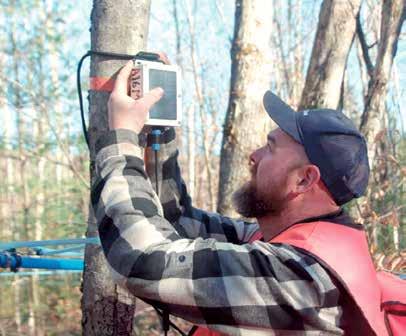
A farmer looks at a Farmblox monitor on a Vermont maple farm.
FARMBLOX COURTESY PHOTO
Community gathers at CVU’s Turkey Trot
BY SARAH BOKELBERG Community News Service
Upbeat music played, and runners of all ages chatted, dropped off food donations and stretched in preparation for the fourth annual CVU Turkey Trot in Hinesburg on Saturday. Spirits were high despite the chilly weather, with participants clad in hats, sneakers and even a turkey onesie.
The event, which was organized by the CVU Student Council and the Hinesburg Recreation Department, raised $446 for the CVU scholarship fund. This fund helps students at the high school afford certain student events, such as prom tickets. The Turkey Trot also featured a food drive, with a total of 144 collected food items being donated to the Hinesburg Food Shelf.
The fastest time of the day went to Gage Geeslin, who completed the course in 21 minutes and 7 seconds.
Student involvement was unmistakable at the 5-kilometer race around the high school. Student Council members collected food donations, helped direct runners
through the course and kept morale high, cheering for racers by name and playing lively music.
For the students, volunteering at fundraisers like the Turkey Trot isn’t a chore.
“It’s a really good way to start off (Thanksgiving) break and get the community together,” said Graciela Sanchez, a senior at CVU and member of Student Council.
Miranda Stewart, another senior at CVU, helped out with the Turkey Trot for the first time last year after joining Student Council and returned to volunteer this year.
“I love the way that the community rallies together to collect all this food,” Stewart said.
Emma Main, also a CVU senior and volunteer, emphasized the importance of being involved in the school community through Student Council.
“It’s one of our biggest fundraisers of the year, so it’s just a fun time to see the community and get involved,” Main said.
Jennifer McCuin, the Hinesburg Recreation Department coordinator, has helped organize the race
since 2021, when students came to her with the idea for the first CVU Turkey Trot. McCuin was immediately on board.
“I enjoy supporting student initiatives, and supporting anything that benefits our community,” she said.
The atmosphere at the finish line was cheerful and encouraging. Runners stayed long after their own race ended to cheer on friends, family and strangers still completing the course.
Local businesses, including Folino’s Pizza, Hinesburg Public House and the Flying Pig Bookstore donated prizes for the top runners. Participants also took part in a raffle with the opportunity to win other local goods.
This year’s Trot had 49 participants, with runners ranging in age from 5 to 75.
McCuin believes the race is becoming a tradition for some families, and hopes to increase engagement for next year, with more youngsters, newcomers and maybe another turkey or two.
If you missed out on the Turkey
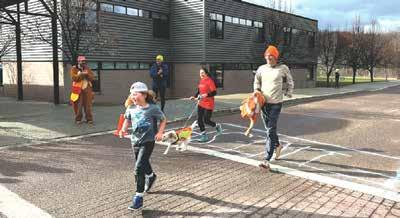
Runners crossing the finish line at the Turkey Trot. Joining the fun, a runner, wearing a turkey costume crosses the finish line.
Trot this year, be on the lookout for next year’s race — and don’t forget your turkey outfit.
Via Community News Service, a University of Vermont journalism internship, on assignment for the Hinesburg Record.
PHOTOS BY SARAH BOKELBERG
A curtain call for ‘Mill Girls’ — and its director
Harrigan’s last production at Saint Mike’s revisits stories of New England’s mill workers
BY IZZY SENIOR Community News Service
“Mill Girls,” a play by Peter Harrigan, returned to Saint Michael’s College in early November, almost 10 years since it first premiered.
The Mainstage Theatre Production lands close to home for another reason: It is inspired by the rich history of the young women who worked in mills across New England, especially in Winooski, Vt., and Lowell, Mass.
The restaging of the play carries significance for Harrigan — playwright, director and Saint Michael’s theatre professor —as it marks his final production with the school before his retirement.
Originally from New Hampshire, Harrigan grew up living throughout New England. He graduated from Saint Michael’s College in 1983, where he studied theater and English.
“My parents, luckily, supported me and drove me to different opportunities to be involved in theater, in workshops, or actually in plays,” Harrigan said. “It was always sort of a secret passion of mine … not something that I pictured would become a career.”
Harrigan wrote “Mill Girls” while on a sabbatical in 2016. He
was inspired by the Champlain Mills in Winooski and searched for reliable primary source material to develop a play. However, he found that most historical documents regarding female mill workers came from Lowell.
Harrigan used letters he found, written by mill girls, as well as essays and poems originally published in “The Lowell Offering” — a monthly periodical from 1840 to 1845 — to craft the story. Eventually, he collaborated with composer Tom Cleary to write the music for the show.
“One of (‘Mill Girls’) real uniquenesses and strengths is that it does have characters, but the group, the entire cast, is more important than any one character,” said Cleary.
“Mill Girls” follows a group of girls in Lowell, as they experience life working in the cotton mills. It describes their working conditions, housing conditions and the implications of unequal power between overseers and workers.
Most of the girls had left their homes and traveled to Lowell to provide for their families.
“These women were really ahead of their time in terms of who they were and what they were asking for,” Harrigan said.
The show doesn’t focus on one main character. Instead, it touches on the unique stories of 11 women.
The show was first produced in the fall of 2017 and ran for a few performances at St. Michael’s.
The original piece attracted large
audiences, growing into something of a local phenomenon, Harrigan said.
According to Harrigan, the original 2017 production got an enormous amount of publicity from Vermont Public Radio, the Burlington Free Press and Seven Days.
“Around here, for whatever reason, if you’re doing ‘Hello, Dolly!’, nobody notices,” Harrigan said. “People are very interested in things that are social, political and historical, and this was all of those things.”
Three years later, Harrigan and Cleary decided to put on “Mill Girls” again with a new group of actors. However, the pandemic got in the way, and they ended up producing a virtual version of the show instead.
Cleary said they “found their way through the dark” of turning a stage production into a virtual production. They focused on adding new songs to the show to provide more entertainment and context.
One of the songs they added in 2020 was “Flower Picking Day,”
which Cleary had written as a solo piece for a student to learn remotely during the pandemic.
But in this year’s production, “Flower Picking Day” became a group number, emphasizing the collective nature of the show.
That change is just one of many Harrigan and Cleary made for the most recent production. They streamlined the show, trimming songs and scenes to create more time for rehearsal.
“We’re still kind of in that post-pandemic, ‘maybe I’d
The cast of “Mill Girls” performs at Saint Michael’s College in November.
PHOTO BY ANDY DUBACK
see MILL GIRLS page 22
Library hours:
• Monday and Wednesday: 10 a.m.-8 p.m.
• Tuesday, Thursday, Friday: 10 a.m.-6 p.m.
• Saturday: 10 a.m.- 3 p.m. Visit www.damlvt.org to apply for a library card and register for programs. Need help? Call 878-4918 or email daml@damlvt.org.
YOUTH PROGRAMS
Children in fourth grade and younger must be supervised by
someone over 16 years of age.
SATURDAY STORYTIME
Saturday, Dec. 6, 10:30-11 a.m.
Start your weekend off with Cindy’s storytime.
STORYTIME
Tuesdays, Dec. 9 and 16. Drop in for stories, songs and fun.
AFTER SCHOOL MOVIE
Wednesday, Dec. 10, 2-3:30 p.m. PG. Travel from the North Pole to New York City in this holiday classic.
MUSIC AND PLAYTIME
Thursdays, Dec. 11 and 18, 10:30-11:30 a.m. Enjoy preschool music and stay to play.
LEGO TIME
Thursday, Dec. 11, 3-4 p.m.
Build something exciting with the library’s LEGO collection.
TEEN CRAFTERNOON: JEWELRY, KEYCHAINS & PINS
Monday, Dec. 15, 5-6 p.m. Ages
Hildegard M. (Hafner) Devino
Hildegard M. (Hafner) Devino, 100, passed away peacefully at home Nov. 21, 2025.
She was born in Ingolstadt, Germany Sept. 10, 1925, daughter of the late Quirin and Bertha (Schindler) Hafner.
She was married to Russell F Devino July 28, 1948 in St. Moritz Church in Germany and came to America in November 1948 aboard the USS General William O’Darby to New York. From there she arrived in Burlington, VT on Thanksgiving Day 1948 and became a citizen of the United States in 1953.
Hildegard’s hobbies included beekeeping, knitting, gardening, baking Christmas cookies and shopping. She enjoyed traveling
12-18. Have fun making beaded jewelry and keychains, as well as using the button-maker to design your own pins.
BABY TIME
Wednesday, Dec. 17, 10:3011 a.m. Ages 0-18 months. Drop in for gentle bonding and socializing activities.
AFTER SCHOOL CRAFT
Wednesday, Dec. 17, 2-3 p.m. Upcycle mason jar lids into festive wreath ornaments!
MULTI-AGE PROGRAMS
READ TO A DOG (LOLA)
Thursday, Dec. 18, 3:304:30 p.m. Sign up for a 10 minute session to read to, or hang out with, Lola the Therapy Dog.
ADULT PROGRAMS
For online programs or to join a book club, email daml@damlvt.org.
OBITUARIES
to Germany to visit her family and going to Disney World, day trips shopping and exhibiting her honey at the Vermont Farm Show where she won many blue ribbons. She also attended the Big E where she represented Vermont.
Mom belonged to the Grange, the Richmond Seniors and went to many Senior Meals where she made many friends.
Mom had a witty sense of humor and was always ready for a good laugh.
The family would like to thank Judy, Nina and Ezra from the University of Vermont Home, Health and Hospice for the wonderful care provided. She looked forward to the loving care provided.
NEW TEA CLUB FOR DECEMBER
Japanese ceremonial matcha will be available starting Dec. 1, while supplies last.
ADULT MEDITATION (ONLINE)
Fridays, Dec. 5 and 12, 1212:30 p.m. Join our guided meditation to relax and recenter.
MAH-JONGG
Fridays, Dec. 5 and 12, 1-3 p.m. All skill levels welcome.
LET’S TALK ABOUT IT
Saturday, Dec. 6, 12-1 p.m. This new group is for those who would like to discuss current events and can’t make it during the week.
CURRENT EVENTS
Wednesday, Dec. 10, 10:30 a.m.12 p.m. Drop in for conversations with community members.
LIFE STORIES WE LOVE TO TELL (ONLINE)
Wednesday, Dec. 10, 2-3:30 p.m. Share your life stories with the group using a guided
prompt.
FRENCH CONVERSATION FOR ALL
Saturday, Dec. 13, 10:4511:45 a.m. Join a native French speaker in an informal conversation group. All abilities welcome. COOK THE BOOK
Tuesday and Wednesday, Dec. 16-17. Copy a recipe from “Chewy Gooey Crispy Crunchy” by Alice Medrich, or choose one of your favorite recipes. Drop off a copy of your recipe and two dozen individually wrapped cookies on Tuesday, and pick up your gift box of assorted treats on Wednesday. Drop off Tuesday between 12-5 p.m. and pick up Wednesday between 10 a.m. and 6 p.m.
SPANISH CONVERSATION (ONLINE)
Wednesday, Dec. 17, 5-6 p.m. Join us to brush up on your Spanish language skills.
Pallbearers are her grandchildren Emily Blow, Dylan Devino, Jenna Devino, Fred Devino, Jared LeDuc, Jeremie Gauthier, Kristen Fitzgerald and Amy Caswell O’Clair.
Hildegard is survived by her seven children and their spouses Erwin Devino of Lake Wales, Florida; Sieglinde LaBelle and her husband Clement of Burlington; Alfred Devino of South Hero; Herbert Devino and Jane Gauthier of Milton; Heide Blow and her husband Gerald; Hilde Caswell and husband Alan of Richmond; Rebecca Knight and husband Monte of Huntington; several grandchildren and great grandchildren.
Hildegard also leaves behind
her beloved companion Dolly who has found a home within the family. She was predeceased by her husband Russell Devino on July 16, 2006.
Visiting hours were Dec. 1, at A. W. Rich Funeral Home - Essex Chapel. A Mass of Christian Burial was celebrated on Dec. 2, 2025 at Our Lady of the Holy Rosary Church in Richmond.
Burial will be in spring at the convenience of the family in the family lot in Westford Plains Cemetery.
Memorial contributions in Hildegard’s memory may be made to Our Lady of the Holy Rosary Church, P.O. Box 243, Richmond, VT 05477.
Safe Holidays to You
Christmas, Hanukkah and Kwanzaa are joyous winter holidays when we celebrate with family and friends. Make sure your family enjoys the holiday season by staying safe. The Mini Page offers some tips for safety during these fun times.
• Check your Christmas lights for exposed or frayed wires. Also look for loose connections or broken sockets. Replace any lights that aren’t in good condition.
Mini Fact:
In 2023, about 154,700 kids in the U.S. were treated in emergency rooms for toyrelated injuries.
Next Week: A White House holiday
Cold weather safety
If you are out in the cold too long, you could get frostbite. When this happens, ice crystals form in the skin.
Symptoms of frostbite are pain in the fingers, toes, nose, cheeks or ears. You might also have blistered skin that is glossy and hard to the touch. If this happens, the adult looking after you should:
• call a doctor;
• take you indoors;
• have you wiggle the affected body parts to increase blood supply to that area;
• immerse your frozen part in warm, not hot, water. Also, avoid getting warm with high heat from fireplaces or stoves. Don’t rub or break blisters.
Dress warmly
If you do plan to be outside playing or helping with chores, take care to keep warm. Dress in thin layers, including:
• Remember to blow out candles and keep matches away from young children. Candles should be at least 12 inches away from anything that can burn. Even better, use battery-powered candles.
• Make sure to keep a screen in front of the fireplace, even if your home has a gasfueled fire.
• Water your Christmas tree regularly. Dry tree needles can be a fire hazard.
• Put ornaments that are breakable or have small parts at the top of the tree, where little kids can’t reach them.
• Some of the beautiful plants of the season are poisonous to humans and pets. Keep these out of reach: mistletoe berry, holly berry and Jerusalem cherry plants.
• Keep batteries away from babies and toddlers, especially the little “button” types.
• If a bike or skateboard is on your gift list, make sure you also ask for a helmet to wear while riding.
• Turn off Christmas lights when you leave the house or go to bed.
• With a lot more cooking and baking going on, and more people in the kitchen, be extra careful around hot stoves and open oven doors.
• Keep your Christmas tree in a sturdy stand that won’t tip over.
• Ask an adult before you try a drink. Some adult drinks are not safe for kids.
• long johns
• one or two shirts
• pants
• sweater
• coat
• scarf
On the Web:
• bit.ly/1PmJLsi
• bit.ly/1MUldqd
• bit.ly/3W2l4Za
At the library:
Try ’n’
Find
Words that remind us of holiday safety are hidden in this puzzle. Some words are hidden backward or diagonally, and some letters are used twice. See if you can find:
Mini Jokes
• “Safety and Merry Christmas: Learning Safety Through the Joy of Christmas and New Year” by Sunphich Phimoolchat
Sara: When does Santa finish delivering toys to all the kids? Sidney: Just in the St. Nick of time!
Birds across the globe have independently evolved nearly identical warning cries to alert others of invasive Eco Note
Founded by Betty Debnam
of the season are poisonous to humans and pets. Keep these out of reach: mistletoe berry, holly berry and Jerusalem cherry plants.
Try ’n’ Find
Words that remind us of holiday safety are hidden in this puzzle. Some words are hidden backward or diagonally, and some letters are used twice. See if you can find:
Sara: When does Santa finish delivering toys to all the kids? Sidney: Just in the St. Nick of time!
Eco Note
Birds across the globe have independently evolved nearly identical warning cries to alert others of invasive threats, according to a study published in Nature Ecology and Evolution. Researchers from Cornell University and Spain’s Doñana Biological Station found that more than 20 bird species across four continents share a “whining” call used to identify parasitic birds — species such as cuckoos that secretly lay their eggs in other birds’ nests, leaving the hosts to raise their young.
For later:
Talk to your family about escape plans in case of a fire in your home.
Teachers: Follow and interact with The Mini Page on Facebook!
By Jim Miller
SAVVY SENIOR
Prepare your online accounts before you die
Dear Savvy Senior, I recently had an estate plan drafted, including a will, power of attorney and advance directive, but I’m not sure what to do about all my online accounts — email, banking and social media. What can I do to make sure my family can access what they
need and protect my digital information after I’m gone.
Almost 80
Dear Almost,
In addition to creating an estate plan, you should also make a “digital will” that lists all your online accounts and login information. This will help your loved ones access your electronic devices and online accounts more easily so they can manage your electronic affairs, according to your wishes, after you’re gone.
Montana State University offers a “Digital Assets Inventory Worksheet” (see Montana.edu/estateplanning/digitalsssetsworksheet.pdf) to help you get started. Or consider purchasing a “password book” on Amazon for just a few dollars. This will let you record and organize your online account information alphabetically. Here are a few other tips to help you prepare your digital life for your survivors.
Apple: If you’re an iPhone, iPad or Mac user, you should nominate a “legacy contact” who can access your Apple account’s data after you die. This is a secure way to give trusted people access to photos, files and messages. To set it up, you’ll need an Apple device with a fairly recent operating system. iPhones and iPads need iOS or iPadOS 15.2, and MacBooks need macOS Monterey 12.1.
For iPhones, go to settings, tap Sign-in & Security and then Legacy Contact. You can name one or more people, and they don’t need an Apple ID or device.
You’ll have to share an access key with your contact. It can be a digital version sent electronically, or you can print a copy or save it as a screenshot or PDF.
Take note that there are some types of files you won’t be able to pass on, including digital rights-protected music, movies and passwords stored in Apple’s password manager. Legacy contacts can only access a deceased user’s account for three years before Apple deletes the account.
Google: Google takes a different approach with its Inactive Account Manager (see Support. google.com/accounts/answer/3036546), which allows you to share your data with someone if Google notices that you’ve stopped using your account.
When setting it up, you need to decide how long Google should wait — from three to 18 months — before considering your account inactive. Once that time is up, Google can notify up to 10 people.
You can choose what types of data they can access, including emails, photos, calendar entries and YouTube videos.
There’s also an option to automatically delete your account after three months of inactivity,
so your contacts will have to download any data before that deadline.
Facebook and Instagram: If you’re on Facebook or Instagram, both of which are owned by the parent company Meta, you can have your accounts either memorialized or deleted after you die if the companies get a valid request from a family member or friend. Meta also strongly recommends Facebook users add a legacy contact to look after your memorial accounts. Legacy contacts can do things like respond to new friend requests and update pinned posts, but they can’t read private messages or remove or alter previous posts. You can only choose one person, who also must have a Facebook account.
Passwords: If you use a password manager — a service that creates, saves and manages passwords for all your online accounts — see if it has an emergency access feature. Some services, like Keeper, Bitwarden and NordPass, allow users to nominate one or more trusted contacts who can access your passwords in case of an emergency or death.
Send your questions or comments to questions@ savvysenior.org, or to Savvy Senior, P.O. Box 5443, Norman, OK 73070.
TODAY’S HISTORY:
• In 1639, Jeremiah Horrocks observed the first recorded transit of Venus, which occurs when Venus passes directly between the sun and the Earth.
• In 1881, the first edition of the Los Angeles Times was published.
• In 1945, the Senate formally approved United States participation in the United Nations by a vote of 65-7.
• In 1991, Pan American World Airways (commonly known as Pan Am) went bankrupt and ceased operations.
• In 1992, President George H.W. Bush ordered 28,000 U.S. troops to Somalia.
TODAY’S FACT:
• The United States embassy in Mogadishu, Somalia, evacuated in January 1991 due to increasing violence in the Somali civil war. It was reestablished in October 2019.
Mill Girls
continued from page 16
rather stay home’ kind of mode,” Harrigan said. “So being able to coax people out of the house, having a more compact experience for them, an hour and a half, no intermission, that’s appealing to me as an audience member.”
Set centuries ago, “Mill Girls” explores themes that remain relevant today, including gender inequality and workers’ rights.
“A lot of people come up to me afterwards nodding their heads and saying, ‘Yeah, a lot of that stuff is still a thing,’” Harrigan said.
Students involved with the show have also been able to resonate with the themes.
“Having that takeaway of how impactful shows can be when they are using words from underrepresented voices, as well as directly addressing the audience, was something that I wasn’t necessarily expecting,” said Amanda Lyons, a Saint Michael’s student and the show’s lead electrician.
As he approaches retirement, Harrigan looks forward to leaning into his hobbies and spending time with his dog, Ginger. Harrigan said he hopes to find ways to stay involved in local theater initiatives.
From a student perspective, Lyons discussed how, in Harrigan’s class, she was able to learn about the process of creating new work by watching clips from Harrigan’s past productions.
“We had a whole class discussing how it evolved and why he made some of the choices to cut down certain parts or why he and Tom added in some new songs and things like that, of how fluid writing can be,” Lyons said.
Harrigan’s 34 years in the theatre department are marked by his directing contributions, including multiple productions of “Mill Girls” and his consistent emphasis on supporting performers while refining their work.
“Peter is pretty special for the way that he is so positive,” Cleary said. “You have to be critical when you’re a director, but you have to balance supporting what’s good and patiently work on the things you want to change. He makes everybody shine.”
Via Community News Service, a University of Vermont journalism internship, on assignment for the Winooski News.
CLASSIFIEDS
LEGAL
TOWN OF WILLISTON DEVELOPMENT REVIEW BOARD AGENDA
Tuesday, December 9, 2025 – 7:00 PM
Town Hall Beckett/Maguire Meeting Room (7900 Williston Road, use rear entrance) or Zoom Webinar ID 813 6162 7981 on www.zoom.us/join
DP 19-11.1 Adams Real Properties
LLC request pre-application review to amend Lot 1 from a daycare facility to a 9 dwelling unit development at 35 Caroline Court in the Residential Zoning District (RZD).
Project details and site plans are available on the website, town.williston.
vt.us, under “Public Records and Documents”, then “Agendas & Minutes”, and “Development Review Board”. Contact Planning & Zoning Office for more information: 802-878-6704 or email planning@willistonvt.org.
LEGAL
Attention
Town of St. George Property Owners
The Town of St. George, Vermont, has started the Townwide Reappraisal Process for the 2026 Grand List. All properties in St. George will be visited by spring 2026 for assessment purposes. If you would like an appointment, please email the Assessor at assessor@ stgeorgevt.com. Additional information is available at www.stgeorgevt.com/ reappraisal.
To place a classified ad, email rick@willistonobserver.com or call 373-2136
Deadline for classifieds is Monday.
WE’RE HIRING!
The City of South Burlington’s Department of Public Works seeks dedicated staff for these open positions:
• Plant Operator
• Public Services Specialist
• Stormwater Maintenance
• Stormwater Superintendent
• Highway Maintenance
• Highway Mechanic
BENEFITS: Health, dental, and vision
insurance, paid time off, and more!
LEARN MORE AND APPLY NOW ONLINE »
The City of South Burlington is an Equal Opportunity Employer.
Executive Director Vermont Journalism Coalition (part-time)
The Vermont Journalism Coalition is seeking its first executive director.
Founded in June 2025, the nonprofit coalition represents more than 40 newspapers, television stations, radio stations, and digital news organizations across the state. It seeks to support and sustain its member news outlets and advocate for the principles of journalism.
The executive director will be charged with building the coalition into a robust institution that provides educational, public policy, business, legal and logistical support to its members. The ED should be equally comfortable communicating with members and allies, testifying at the Vermont Statehouse, administering a nonprofit and securing financial support. Most importantly, the ED should bring an energetic, entrepreneurial and self-directed approach to fighting for Vermont journalism and those who produce it.
Supervision: The ED will report to the Vermont Journalism Coalition’s nine-member board of directors, though they should be comfortable working independently to achieve the board’s goals.
Qualifications: The ideal candidate will have deep knowledge of Vermont and significant experience in at least one (and preferably more) of the following fields: journalism, nonprofit administration, advocacy.
Workplace: This is a remote position, but the ED should be prepared to spend time in Montpelier, particularly during the January-May legislative session, and to travel elsewhere in Vermont, as needed.
Hours and compensation: This position is currently envisioned as 20 hours a week, paying $40,000-$45,000 a year, though this could evolve over time. The position could work well for somebody engaged in freelance journalism or other contract work.
Start date: Early January 2026.
How to apply: Please send a resume and a cover letter explaining your interest in this work to contact@vermontjournalism.com. The position will remain open until filled, but the hiring committee will begin reviewing applications Wednesday, Dec. 10, 2025.
zen center yard sale
zen center yard sale
RABIES BAIT
continued from page 2
The week-long bait drop is a cooperative effort between Vermont and the U.S. Department of Agriculture Wildlife Services to stop the spread of the potentially fatal disease.
Rabies is a deadly viral disease of the brain that infects mammals. It is most often seen in raccoons, skunks, foxes, and bats, but unvaccinated pets and livestock can also get rabies. The virus is spread through the bite of an infected animal or contact with its
RABIES BAIT
continued from page 2
saliva. If left untreated, rabies is almost always fatal in humans and animals. However, treatment with the rabies vaccine is nearly 100 percent effective when given soon after a person is bitten by a rabid animal.
The week-long bait drop is a cooperative effort between Vermont and the U.S. Department of Agriculture Wildlife Services to stop the spread of the potentially fatal disease.
So far this year, 23 animals in Vermont have tested positive for rabies, and 14 of those have been raccoons.
SHELBURNE DAY
saliva. If left untreated, rabies is almost always fatal in humans and animals. However, treatment with the rabies vaccine is nearly 100 percent effective when given soon after a person is bitten by a rabid animal.
So far this year, 23 animals in Vermont have tested positive for rabies, and 14 of those have been raccoons.
Rabies is a deadly viral disease of the brain that infects mammals. It is most often seen in raccoons, skunks, foxes, and bats, but unvaccinated pets and livestock can also get rabies. The virus is spread through the bite of an infected animal or contact with its
According to wildlife officials, rabid animals often show a change in their normal behavior, but you cannot tell whether an animal has rabies simply by looking at it. People should not touch or pick up wild animals or strays – even baby animals.
continued from page 4 face Towards burne-Hinesburg head the Golf depending land.
Shelburne Historical Society will have a display and president Dorothea Penar will lead a cemetery tour at 1 p.m. Food vendors round out the event with everything from coffee and lemonade to burgers and creemees. Kids will enjoy meeting animals from Shelburne Farms, craft projects, and
According to wildlife officials, rabid animals often show a change in their normal behavior, but you cannot tell whether an animal has rabies simply by looking at it. People should not touch or pick up wild animals or strays – even baby animals.