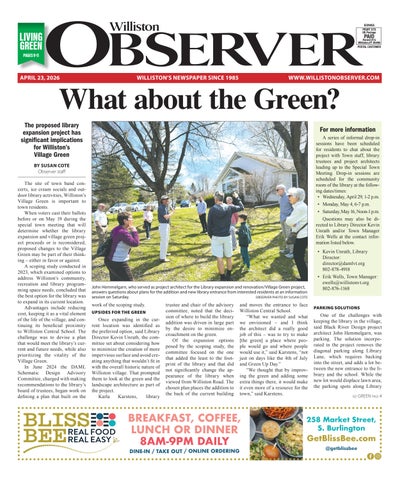
The proposed library expansion project has significant implications for Williston’s Village Green
BY SUSAN COTE Observer staff
The site of town band concerts, ice cream socials and outdoor library activities, Williston’s Village Green is important to town residents.
When voters cast their ballots before or on May 19 during the special town meeting that will determine whether the library expansion and village green project proceeds or is reconsidered, proposed changes to the Village Green may be part of their thinking – either in favor or against.
A scoping study conducted in 2023, which examined options to address Williston’s community, recreation and library programming space needs, concluded that the best option for the library was to expand in its current location.
Advantages include reducing cost, keeping it as a vital element of the life of the village, and continuing its beneficial proximity to Williston Central School. The challenge was to devise a plan that would meet the library’s current and future needs, while also prioritizing the vitality of the Village Green.
In June 2024 the DAML Schematic Design Advisory Committee, charged with making recommendations to the library’s board of trustees, began work on defining a plan that built on the
work of the scoping study.
UPSIDES FOR THE GREEN
Once expanding in the current location was identified as the preferred option, said Library Director Kevin Unrath, the committee set about considering how to minimize the creation of more impervious surface and avoid creating anything that wouldn’t fit in with the overall historic nature of Williston village. That prompted them to look at the green and the landscape architecture as part of the project.
Karla Karstens, library
trustee and chair of the advisory committee, noted that the decision of where to build the library addition was driven in large part by the desire to minimize encroachment on the green.
Of the expansion options posed by the scoping study, the committee focused on the one that added the least to the footprint of the library and that did not significantly change the appearance of the library when viewed from Williston Road. The chosen plan places the addition to the back of the current building
and moves the entrance to face Williston Central School.
“What we wanted and what we envisioned – and I think the architect did a really good job of this – was to try to make [the green] a place where people would go and where people would use it,” said Karstens, “not just on days like the 4th of July and Green Up Day.”
“We thought that by improving the green and adding some extra things there, it would make it even more of a resource for the town,” said Karstens.
For more information
A series of informal drop-in sessions have been scheduled for residents to chat about the project with Town staff, library trustees and project architects leading up to the Special Town Meeting. Drop-in sessions are scheduled for the community room of the library at the following dates/times:
• Wednesday, April 29, 1-2 p.m.
• Monday, May 4, 6-7 p.m.
• Saturday, May 16, Noon-1 p.m. Questions may also be directed to Library Director Kevin Unrath and/or Town Manager Erik Wells at the contact information listed below.
• Kevin Unrath, Library Director: director@damlvt.org 802-878-4918
• Erik Wells, Town Manager: ewells@willistonvt.org 802-876-1168
PARKING SOLUTIONS
One of the challenges with keeping the library in the village, said Black River Design project architect John Hemmelgarn, was parking. The solution incorporated in the project removes the diagonal parking along Library Lane, which requires backing into the street, and adds a lot between the new entrance to the library and the school. While the new lot would displace lawn area, the parking spots along Library
John Hemmelgarn, who served as project architect for the Library expansion and renovation/Village Green project, answers questions about plans for the addition and new library entrance from interested residents at an information session on Saturday.
OBSERVER PHOTO BY SUSAN COTE
Joseph Ribkoff
Eileen Fisher
Emerson Fry
Lilla P
Citizens of Humanity
Hutch
Gilner Farrar
Williston Town Band 2026 Concert Schedule
• Saturday, May 2, 11 a.m.-noon –Williston Green Fair
• Wednesday, June 24, 6:30 p.m. – at bandstand behind library
• Friday, July 3, 6:30 p.m. – Ice Cream Social
• Saturday, July 4, 10 a.m.
– Independence Day Parade, Williston Rd.
• Wednesday, July 15, 6:30 p.m. – at bandstand behind library
• Wednesday, July 29, 6:30 p.m. – at bandstand behind library
• Wednesday, Aug. 12, 6:30 p.m. – at bandstand behind library
EMAIL EVENT LISTINGS TO EDITOR@WILLISTONOBSERVER.COM
TUESDAY, APRIL 28
Floral design workshop. Burlington Garden Club. 1 p.m. Faith United Methodist Church, South Burlington. bgcvt.org.
Williston Development Review Board meeting. 7 p.m. Town Hall. Agenda at www. town.williston.vt.us.
THURSDAY, APRIL 30
Williston-Richmond Rotary Club breakfast meeting. Speaker: Ang Dawa Sherpa, Himalayan mountain guide. 7 a.m. Williston Federated Church. RSVP to rotaryclubofwillistonvt@ gmail.com.
SATURDAY, MAY 2
Williston Green Fair. Green Up Day and Energy Fair. 9 a.m.-12 p.m. Village Green.
TUESDAY, MAY 5
Williston Selectboard meeting. 7 p.m. Town Hall. Agenda at www.town.williston. vt.us.
Williston Planning Commission meeting. 7 p.m. Town Hall Annex. Agenda at www.town.williston.vt.us.
In print & online: We’re your neighbors, committed to keeping you informed on what’s going on in Williston.
Around Town
Community food drive scheduled for May 9
The Williston Federated Church will host a community-wide food and hygiene drive to benefit the Williston Community Food Shelf on Saturday, May 9 from 9-11 a.m. in the church parking lot at 44 N. Williston Rd.
In addition to basic food items there is a need for feminine hygiene items. If you can’t make it on the day of the drive, donations can be left on the table near the entrance to Fellowship Hall.
Help shape Recreation & Parks master plan
Williston’s Recreation & Parks invites residents to provide input to the development of the
department’s new plans by completing the Master Plan Survey.
This is an opportunity to share thoughts, suggestions and comments for a comprehensive plan for the future of the department. The survey will be available until May 10 at this link: https:// survey.alchemer.com/s3/8790052/ Community-Priorities.
First Strides running group seeking members
First Strides Vermont is a program for women who are beginning or returning to running and/or walking based on mentoring, peer support and lifestyle habits. The group gathers every Wednesday from 5:45-6:45 p.m. at Williston Central School for a run/walk workout followed by an interactive informational session on topics such as nutrition, injury prevention, basic strength training, motivation, breath work and shoes and apparel.
The program lasts 12 weeks: May 6 through July 22. Registration and more information can be found at
firststridesvermont.com.
Quilt show set for this weekend
“Star Struck” is the theme of this year’s Champlain Valley Quilt Guild Quilt Show taking place at the Holy Family Church Parish Center in Essex Junction April 24-26. Event hours are Friday and Saturday, 9 a.m.-5 p.m. and Sunday, noon-4 p.m. Admission is $8 with children under 12 free.
Volunteers needed for Catamount trail work Sundays
Get your hands dirty and feel good about it at Catamount Outdoor Family Center. Volunteers are needed to help get trails in top shape for summer adventures on the following Sundays from 10 a.m.-noon: April 26, May 3 and May10.
Sign up at https:// catamountoutdoor.org/events/ trail-work-sundays-withandy-2/2026-04-19/.
Lane would in be replaced in part with trees and other plantings and outdoor seating areas. A small auxiliary lot near the schoolhouse would aid accessibility to that building and to that side of the green.
LOSING AND GAINING TREES
Several trees on the green are slated to be removed in the plan, though most of the trees along Williston Road and those between the library and Central School Drive would be retained. A large poplar not far from the current entrance would be removed. In its place, three street trees are envisioned along that portion of Library Lane.
The largest number of trees to removed would be behind the current library to accommodate the addition and the new parking lot. Many of these trees are silver maples. The most notable loss would be the removal of a tall Norway spruce, planted in memory of Herb Painter, founder of the Town Band. Ideas for an alternate way to honor Painter are being discussed, said Unrath.
With new trees planned throughout the property, the number is expected to increase from 39 to 42 trees.
OPPORTUNITIES FOR IMPROVEMENT
Among concerns about the green to address are drainage is sues and accessibility.
The part of the green that lies between the library and the old schoolhouse often is wet and has standing water. By regrading the green, the goal would be to direct that water away from the center part of the green and into water retention areas that are part of the plan.
A CIRCULATING PATH
In place of the straight path that cuts across the green from Williston Road toward the school, the new plan includes a looped path allowing for travel through out the green. The path connects to a walkway to the new library entrance, making it possible for someone to approach the library from the direction of the green over a hard surface.
“The committee thought that would make a space that would be more accessible to our aging population and other people with accessibility needs,” said Unrath. “Grass can be hard for folks who have mobility constraints to walk on.”
A schematic of the proposed library addition and renovations to the green shows the looped path on the green, the position of the new performance platform, along with existing and new trees. Plans now are to keep the bandstand in its current location. IMAGE
OF
IMPACTS ON THE TOWN BAND
Recognizing that the Williston Town Band would be affected by the plans, early in the library design advisory committee’s work
they invited Kathy Schaw, president of the Williston Town Band, to discuss the needs of the group. Built in 1976 and repaired in 2019, the bandstand on the green served as the regular performance space for the town band until 2022. That’s when band membership grew sufficiently large that the group could no longer squeeze into the space.
Since then, Schaw explained, the band has played from the grass in front of the bandstand. Some challenges related to this arrangement are chairs and music stands sinking into sometimes soft, wet ground.
With that in mind, a 50-foot diameter performance platform was incorporated into the design of the green. Keeping it as far as possible from the noise of busy Williston Road, it is positioned between the bandstand, which will remain in place, and the schoolhouse. The space would also serve other outdoor activities, such as performances by the Lyric Theatre.
A storage solution for the band
remains to be addressed. Chairs and stands – 40 of each – are stored beneath the floor of the bandstand during the summer and must be lifted through a trap door and carried down the stairs to the lawn, then returned at the end of each performance. Items that cannot be stored under the bandstand, such as percussion equipment, an audio system and sheet music, must be transported to and from the site. While ideally the group would have use of a modern band shell offering overhead protection from the elements, lighting and permanent storage space, said Schaw,
LOOKFORUS
continued from page 4
they are grateful for the planned performance patio, which is large enough to accommodate all the musicians and offer a firm surface for chairs and stands.
She also noted the benefit that restrooms in the library addition would be accessible, even when the library is closed.
While nothing has been determined, Schaw said that there has been discussion of either a storage shed or trailer to be located somewhere on the grounds of the green to provide easier access to the band’s equipment.
If the project proceeds, Schaw said that she has been invited to be a regular part of the group that will finalize the plan details before construction begins.
HISTORICAL CONSIDERATIONS
Another group whose interests are closely tied to the status of the library and village green is the Williston Historical Society. Aron Merrill, president of the group, served as an official member of the Schematic Design Advisory Committee.
While his concerns are mainly focused on the interior of the library, where hoped for improvements include much needed expansion of event space, he is comfortable with the plans for the green. Merrill noted that the historic Stovepipe Corner Schoolhouse remains in its current spot, as does the Thomas Chittenden statue and the recently installed Lafayette historic marker.
“It felt good to be part of the design committee. ... I thought it was a really good process,” said Merrill. CHANGES OVER THE YEARS
The Dorothy Alling Memorial Library was completed in 1959 and dedicated in
1960. The land on which it sits, which came to be the site of the Village Green, is part of a 78-acre parcel that also encompasses Williston Central School and Village Community Park.
The bandstand was added to the green in 1976.
In 1988 the historic one-room Stovepipe Corner Schoolhouse was acquired by the town and moved from its original location on the corner of Mountain View Road and North Williston Road to a spot on the green and then renovated by the Williston Historical Society.
When the second expansion of the library was built in 1998, adding space for what is now the children’s collection and the Community Room, the town acquired an adjacent 0.6acre land parcel with the idea of expanding the green to the west of the library. According to Library Trustee Barbara Mieder, who was also a trustee at that time, this helped address public concerns about the expanded library’s larger footprint.
The year 1998 also saw the unveiling on the green of the monument to Thomas Chittenden, early Williston resident and first governor of Vermont.
Several years later, in 2007, a building on the acquired parcel, which formerly housed the Williston post office, was demolished and Central School Drive was moved west, allowing for the vision of the enlarged green to be realized.
The bond reconsideration vote taking place on May 19 may determine whether further changes to the Williston Village Green will happen anytime soon.
Williston’s Town Band performs from the grass in front of the bandstand.
PHOTO BY DANIEL MCCULLUM
Serving our community since 1985
willistonobserver.com
P.O. Box 1401, Williston, VT 05495 802-489-5499
ADVERTISING
Adam Geffken, Account Manager adam@willistonobserver.com 802-338-1655
Rick Cote, Associate Publisher rick@willistonobserver.com 802-373-2136
EDITOR
Jason Starr editor@willistonobserver.com
PRODUCTION & DESIGN
Jan Kenney jan@willistonobserver.com
PUBLISHER
Susan T. Cote susan@willistonobserver.com
BILLING INQUIRIES
Michael McCaffrey office@willistonobserver.com
ADVERTISING SPACE DEADLINE
Friday at 5 p.m. for the next Thursday issue adam@willistonobserver.com 802-338-1655
CLASSIFIED ADS
Deadline is Friday 5 p.m. There is a fee for business, real estate, help wanted and legal ads. Free classifieds must be 25 words or fewer and are printed on a space available basis.
SUBMISSIONS & LETTERS
Deadline is Monday noon for Thursday issue. News/story tips are welcomed. Letters to the Editor should be 300 words or fewer and include your name, address and a daytime phone number so that we can verify the letter’s author.
The Williston Observer reserves the right to edit or refuse submissions or advertising. Opinions expressed in the paper are those of the writer and do not necessarily reflect the opinion of the paper.
A publication of Twin Ponds Publishing LLC
Member:
What Vermont needs from college now
BY RICHARD PLUMB
For decades, American higher education has made a simple promise: earn a degree, get a good job.
It was a compelling argument — and, for many years, a true one. But today, that promise is under strain. Recent graduates are taking longer to find work. Employers are rethinking entry-level roles. And advances in artificial intelligence are rapidly reshaping what skills matter and how work gets done.
At the very moment families are asking more of college than ever, the traditional case for its value is becoming harder to make.
That does not mean college has lost its purpose. It means the purpose must be more clearly defined and more honestly delivered. Higher education has, at times, overstated what a degree alone can guarantee. A diploma is not a promise of a particular job. It is preparation for what comes next, and that distinction matters more now than ever.
For Vermont, the stakes are not abstract.
Colleges like Saint Michael’s
are part of the state’s economic and civic infrastructure. According to a recent economic impact study the college conducted, Saint Michael’s contributes approximately $180 million annually to Vermont’s economy, supporting jobs, local businesses and services across the region. Our students serve as first responders through Saint Michael’s Fire and Rescue, responding to thousands of emergency calls each year, and contribute tens of thousands of hours of service across local schools, nonprofits and healthcare organizations.
If institutions like ours succeed, Vermont benefits. If they falter, the impact is felt far beyond campus.
But the case for college cannot rest on economic impact alone. It must rest on what students actually gain — the skills, the judgment, and the sense of purpose that determine not just what they are able to do next, but what they choose to do with it. This is not a challenge for any one institution to solve. It is a challenge for higher education as a whole.
The question is no longer
just whether a college prepares students for their first job. It is whether it prepares them for a world in which jobs, industries and expectations will continue to change.
In that world, access to information is not enough. Artificial intelligence can generate information instantly. What matters now is judgment: the ability to discern what is true, what is just and what genuinely matters. It is the capacity to think critically, communicate clearly, work across differences and act with purpose in conditions of uncertainty.
These are not abstract ideals. They are practical necessities for the century ahead.
That is the work Saint Michael’s is focused on. It is work I see every day in our classrooms, our community and in the students we graduate. We often describe it simply: our students learn to think deeply, belong fully and make a difference.
That preparation is both rigorous and grounded in experience. Students are expected to engage actively in their education, to contribute in the classroom, wrestle with complex ideas and apply what they learn in real settings.
Sometimes that learning is immediate and tangible. Saint Michael’s Fire and Rescue, staffed largely by student volunteers, responded to more than 3,800 emergency calls across Greater Burlington last year. These students are not simulating responsibility. They are carrying it — making decisions under pressure, working as teams and serving their community in moments that matter.
This kind of education produces results. Ninety-eight percent of the Class of 2025 and 99 percent of the Class of 2024 were employed or enrolled in graduate school within six months of graduation. Our students are admitted to medical and dental schools at more than twice the national average. These are not
projections. They are current outcomes.
But outcomes alone are not enough. Colleges must also confront the realities of cost and access.
At Saint Michael’s, we have made a deliberate decision to rethink the traditional pricing model. Students pay no more than the in-state tuition of their home state’s flagship public university, guaranteed for all four years. That is not a short-term incentive. It is a long-term commitment to making a high-quality, personalized education both accessible and sustainable.
We have also taken disciplined steps to ensure the longterm strength of the institution, aligning programs with student demand, focusing resources on what matters most and building a model designed to thrive at our scale. The work is ongoing, and we do not minimize the challenges facing institutions like ours. But the early signs are encouraging: fundraising is at its highest level in more than a decade.
The future of higher education will not look the same for every institution. The question is which colleges have the clarity, the discipline and the mission to earn their place in it.
Saint Michael’s has been answering that question for more than 120 years — not by resisting change, but by meeting it. We have held fast to the conviction that a small, mission-driven college, deeply rooted in its community and uncompromising in its commitment to students, is not a relic. It is exactly what this moment requires.
That is the institution we are building. And Vermont is better for it.
Richard Plumb is the president of Saint Michael’s College in Colchester.
Disclosure: Williston Observer Associate Publisher Rick Cote is member of the board of trustees at Saint Michael’s College.
Are we serious about addressing the housing shortage?
BY MIRO WEINBERGER
The question hanging over the State House this session is simple: are we serious about solving the housing shortage?
There is no doubt where Vermonters stand. Let’s Build Homes (LBH) polling in February found that housing was the top issue on voters’ minds, and three-quarters of them want more action from the legislature. Vermonters are very concerned about young households being pushed out of the state by housing scarcity, and 60% of Vermonters either have suffered serious housing challenges themselves or know someone who has.
There is reason to be hopeful. Communities across the state from Fairlee to South Burlington are welcoming ambitious new projects and getting them done, total production is up significantly over the last decade, and for three consecutive years, the Legislature has passed major housing bills. This includes last spring’s passage of the Community Housing Infrastructure Program, potentially the most transformative infrastructure investment in Vermont’s history. However, this battle is far from won. We are producing only about half of the state’s housing targets. Housing prices remain at or near historic highs. And Vermont’s demographic crisis deepens every year putting immense strain on
our education and health care systems.
Worse, two years into Vermont’s effort to reform Act 250, without major corrections this session, 2026 will become a year of major housing setbacks.
Here is an ambitious but realistic four-pillar strategy for the remainder of the session that would keep our housing momentum growing:
REPEAL THE NEW RULES THAT WILL MAKE THE SHORTAGE WORSE
We are in today’s housing shortage because for fifty years we have layered restrictive rules on top of each other, making Vermont a very difficult place to build homes. Now, Act 181 is on the verge of doing it again.
A first-of-its-kind geospatial analysis from LBH, https://letsbuildhomes.org/reports/act181-exemption-analysis/, shows that since 2021 60% of Vermont’s housing growth occurred outside the state’s new housing growth areas, much of it built one house at a time. Without immediate action, new rules taking effect later this year will subject many of these small-scale developments to the substantial costs and uncertainty of Act 250 for the first time.
This burden will fall hardest on lower- and middle-income families, those with the least capacity to absorb the legal fees and expert studies Vermont’s Act 250 structure demands. To avoid this, before adjourning the legislature must
repeal the road rule, and substantially narrow –or repeal – Tier 3 as well.
EXPAND AND EMPOWER HOUSING GROWTH AREAS
Act 181 established an important framework for directing housing growth, but after nearly two years of implementation, it is clear the maps are being drawn too narrowly (and often overruling the growth plans of towns and Regional Planning Commissions) and amendments are too slow and difficult to make.
To get these maps right, the legislature must fix the implementation issues, create a presumption of approval for growth area expansions sought by towns until housing targets are met and extend the bill’s interim housing areas through 2030.
Finally, LBH’s geospatial analysis makes it clear that Act 250 exemptions alone are very unlikely to be enough to meet the state’s goals for these housing growth areas. The legislature should also exempt housing construction from state sales taxes on construction materials and remove the cap on downtown and village tax credits.
MOVE FROM “DISCRETIONARY” TO “BY-RIGHT” HOUSING
In most of Vermont, building homes requires a discretionary permit, meaning a project can comply with every quantitative rule and still be blocked by a single neighbor or board
making subjective judgments. If housing is truly a human right, there must be a right to build in housing growth areas. Two new “by-right” initiatives should be advanced this session –the Governor’s 802 Homes program of pre-approved prototypes, and LBH’s ROOT Zones concept.
KEEP INVESTING IN WHAT WORKS
Dedicated state investment in affordable housing is producing real results. Now is not the time to cut and retreat. We must maintain the momentum of our successful programs and continue building on what works.
The clock is running out. With less than two months left in the session, every week of delay is a week that more young Vermonters consider leaving, workers who could fill critical jobs have nowhere to live, and families get outbid on a home by a wealthy person purchasing a second home.
The Legislature faces a clear choice: allow red tape to tighten its grip and watch the housing shortage grow worse or take steps to ensure every Vermonter has a place to call home. Vermonters are waiting for an answer.
Miro Weinberger is the Executive Chair of Let’s Build Homes, a former affordable housing developer, and a former mayor of Burlington (2012-2024).
War changes library calculation
If the Library Bond stands, it will cost us $115 per year without overruns. It seemed doable six weeks ago, but our world has changed since then.
The United Nations says the Iran War could drive 32 million people into poverty. We will be facing a “triple shock involving energy, food and a weaker economy.” It is estimated going forward, fuel and fertilizer costs will average the American family $150 per month. When everything is added up including the public costs, Americans will be paying an extra $410 per month.
I wish tax dollars could fund the Williston library. Instead, we are funding a war that if it ended in two months would take 10 years to recover from. We are spending $1.4 billion nationally per day on
LETTERS TO THE EDITOR
an illegal war with Iran which has stopped the flow of world oil. After the final tanker arrives, what will our gas prices be and how will it affect jobs and the economy? The government is threatening to cut funding for healthcare, social security and FEMA. Local school taxes equitably fund all of Vermont which raises our local taxes. Even before the Iran war Williston taxes had gone up 40% in five years.
Most young people cannot afford to live in Williston. Many families that have lived here for decades are being forced out. We need to utilize the services we are already paying for. As prices go up and the bottom falls out, as the price of gas, diesel and food go up, think about what your family will be able to afford in the next few years.
With such an uncertain future and an already heavy tax burden,
I feel it is my responsibility to vote yes to stop the proposed bond for the Dorothy Alling Memorial Library.
Dan Boomhower Williston
Vote ‘yes’ for a smarter library plan
I am writing in support of voting “yes” on May 19 to reconsider the proposed $14.5 million library expansion and explore a more affordable, appropriately scaled option.
I support our library and value the role it plays in our community. However, after meeting with the library committee and reviewing the plans, I believe that doubling the square footage is difficult to justify at a $14.5 million price tag along with the costs of maintaining and staffing a significantly larger facility. While renovations
It isn’t found in blueprints but in the neighborhoods that have grown alongside our own families since 1976. It’s the comfort of an energy-efficient home during a January chill and the peace of mind that comes from five decades of local craftsmanship.
Whether we are building a traditional neighborhood at Spear Meadows or innovative new designs at The Annex, we are building the backdrop for your life. As a family-owned team living right here in Chittenden County, we take every nail personally.
To our neighbors, thank you for being part of our story. We can’t wait to build the next 50 years together.
Trusted since 1976. Your local partner in better living.
| 802-985-5722X142 |
and additional community gathering spaces are certainly needed, this proposal includes added space and multiple rooms that may not be necessary, such as a ‘makerspace’ room with 3D printing and more.
A “yes” vote is an opportunity to revisit the project and pursue a lower-cost plan that meets our essential needs without overbuilding. With residents already facing the pressure of high taxes, we must get the scale of this project right.
Let’s vote “yes” to reconsider and move forward with a smarter plan that the entire community can support.
Phyllis Golodetz Williston
DAML: Let’s make a better plan
Back when we spent somewhere in the vicinity of $20 million to renovate WCS, I queried the town as to why we weren’t just building a new school. Isn’t a renovation just putting good money towards Band-Aids? I put forth the idea of doing so, then using the existing school to solve all of our other needs and desires, to include a library expansion, space for new town offices, a community center and meeting places, a town rec center, a swimming pool could be installed, etc. I was told the estimate for building a new school would be in the $54 million range, and that the Town didn’t feel comfortable putting forward a proposal for a project that size.
So, now what do we have? As I feared, we are experiencing death by a thousand cuts. With this library expansion, we will now be in the $34 million range (school plus library), and we will still lack so many of the things we know we are going to need, and so many things we may also want.
You know the next thing coming at us is a renovation of the Town offices/Town Hall, right? This will easily rival the $54 million it would have taken to do it right in the first place.
The moral of this story is simple: We had no plan before, and we have no plan now, but that doesn’t mean we can’t have one going forward. We, as the bill payers, deserve as much. Please join me in voting “yes” to reconsider the DAML project, so we can inspire the town to create a comprehensive plan that addresses all of our needs and desires. I look forward to participating in that discussion.
Steve Lambrecht Williston
Gratitude for library staff
As we recognize National Library Week (April 19-25) we are provided an opportunity to highlight the staff and volunteers of our Dorothy Alling Memorial Library. Their amazing work cultivates DAML’s vision to “create a sustainable library that meets the needs of the community and where all are empowered to thrive.” Their professionalism and commitment are a keystone to the library’s place in Williston. We acknowledge and applaud our staff and volunteers this week and every week throughout the year. We thank them for creating a warm and open space where we all feel welcome and can connect with each other, the greater Williston community, and beyond.
DAML Trustees
Charity Clark
Diane Downer
Brian Goodwin
Karla Karstens
Barbara Meider
Stephen Perkins
Shari Westman
LETTER POLICY:
We ask that letters run no longer than 300 words. We edit for length, clarity, style, spelling and grammar. Please include your name, town or city where you live and a daytime phone number (which we won’t print) so we can verify you wrote the letter. The deadline is Monday at noon for letters to be printed in Thursday’s paper. Email: editor@ willistonobserver.com or mail to Williston Observer, P.O Box 1401, Williston, Vt. 05495
Green Fair
Fostering community pride and environmental
BY KEVIN BATSON AND REED PARKER
Williston Energy Committee
In just over a week, tens of thousands of Vermonters will enhance the beauty of spring in our state by removing hundreds of tons of roadside litter as part of our annual Green Up Day event. In 2025, Williston volunteers collected 3.3 tons of roadside litter. Our goal in 2026 is 100% roads claimed & greened up!
Here in Williston, Green Up Day was expanded in May 2022 to include a Town Fair where residents gathered to meet with
representatives of town departments and committees and a variety of local businesses. This year on Saturday May 2nd from 9am–12-Noon, an exciting new Williston Green Fair takes place on the village green (40 Central School Drive). This free community event combines Green Up Day and the Town Fair with the annual Williston Energy Fair, offering hands-on education and resources focused on energy resilience and sustainability. Activities include live music, snacks, raffles and an expanded number of vendor booths.
Local EV owners will bring their vehicles for attendees to check out.
Bill banning herbicide linked to Parkinson’s moves to Senate
Paraquat,
one of the most widely used
herbicides
in the U.S. would be phased out over five years
BY KATE KAMPNER Community News Service
A new bill targets a popular herbicide linked to Parkinson’s disease.
H.739 passed on the House floor on March 20 after spending time in the House Committee on Agriculture, Food Resiliency, and Forestry. The bill prohibits the use and sale of paraquat.
Paraquat — also commonly referred to as Gramoxone — is an herbicide used for weed control on many crops. It falls under the EPA’s “Restricted Use Pesticides” category, since it may only be used by those certified for application.
Studies have linked farmers who use paraquat, and those who live near where the chemical is used, to be at a higher risk of
developing Parkinson’s disease — a neurological disorder that causes loss of mobility, stiffness and cognitive impairment.
More than 1 million Americans are living with the disorder.
Paraquat contains neurotoxins that can target neurons in the brain and increase the risk of Parkinson’s, according to Zach Hardy, senior government relations officer for the Michael J. Fox Foundation for Parkinson’s Research, who testified on Feb. 11.
The complete ban on the weed killer would take effect on Nov. 1, 2030.
The bill would slowly phase out use of paraquat over five years. H.739 would allow farmers who currently use paraquat to get a permit to continue applying the product for three years, or until the official ban date, by registering it with the Secretary of Agriculture, Food, and Markets.
“There’s a lot of places in the world where it’s a concern, yet somehow the U.S. hasn’t caught on yet,” Rep. Michelle Bos-Lun, D-Windham-3, said.
Seventy-two countries have banned paraquat, including the entire European Union. However, some of these countries, like China, still produce the product for U.S. markets.
James Boyd, director of the Binter Center for Parkinson’s Disease and Movement Disorders at the University of Vermont Medical Center, said he’s seen parallels between patients and their proximity to farms that use the herbicide. When paraquat is applied, it can travel close to three miles.
“It is a higher prevalence in rural states. We have epidemiologically linked that to agricultural proximity, and Vermont is well within what we expect for a rural state in terms of prevalence for the condition,” Boyd said.
Bos-Lun said the committee
heard concerns from farmers who use the product on their produce.
We have epidemiologically linked [paraquat use] to agricultural proximity, and Vermont is well within what we expect for a rural state in terms of prevalence for the condition.”
James Boyd Director, Binter Center for Parkinson’s Disease and Movement Disorders University of Vermont Medical Center
“It is a very significant but limited way by most apple growers in our state,” she said. Multiple farmers testified that other heavy pesticides have killed the younger trees on their orchards, while paraquat seems
to be successful for just targeting the surrounding weeds.
“That’s why this tool is so valuable to us right now,” Bill Suhr, founder and orchardist of Champlain Orchards in Shoreham, told lawmakers.
Richie Hourihan, owner and operator of Cabot Smith Farm, shared a similar sentiment.
“I’d love to stop using any chemicals, but could you stop any bug or disease or fungicide or fungus coming in to ruin my crops?” he said on Feb. 26.
“I did hear one farmer say, ‘We don’t have that many tools that we can use. This is a useful tool,’” Bos-Lun said.
To address some farmers’ concerns, the bill would assign the Agricultural Innovation Board to create a study group that would recommend farmers alternatives to paraquat during the five-year phase out period.
“The responsible thing to do is phase it out and to put some really great minds of helping come up with a safer alternative,” Bos-Lun said.
The Community News Service is a University of Vermont journalism internship.
Red and white caution sign warning of pesticide usage in Manito Park in Spokane, WA.
PHOTO COURTESY JETSANDZEPPELINS VIA WIKIMEDIA COMMONS
GREEN
Green Fair
continued from page 9
The Williston Energy Committee has invited a varied group of organizations who will have valuable information about energy saving, weatherization, and alternative transportation all who have a goal of making our lives more efficient and comfortable.
Efficiency Vermont, our statewide efficiency utility, will provide information on robust weatherization programs and community resilience to help residents improve home energy efficiency, reduce bills and increase comfort.
Operated by Net Zero Vermont, the Walk to Shop program helps those who walk or rely on public transportation for shopping, to be able to carry multiple bags of groceries in a trolley that can be life changing. Come see and try out the Walk to Shop trolley which has enabled hundreds of Vermonters to be more mobile.
WindowDressers will have information on community volunteer produced, low-cost insulating window inserts, that improve the warmth and comfort of interior spaces, lowering heating costs and reducing pollution associated with burning fossil fuels. The Williston Energy Committee is proud to be a volunteer organization for WindowDressers helping bring comfort to residents of Williston and surrounding towns.
The Williston Federated Church is a member of the “Greenworks Ministry” that promotes environmental stewardship through practical tips in their weekly bulletins. The committee offers guidance on sustainable living, such as adopting
electric vehicles, proper recycling, and reducing plastic use to minimize environmental impact.
Sustainable Williston is an open, grassroots group of Willistonians who identify opportunities to decrease the town’s consumption of natural resources and to create sustainable solutions to environmental challenges. They will feature a “Dark Sky” theme, providing education and engagement on artificial light pollution, the benefits to people and wildlife from reducing it, and simple steps residents can take.
Williston on the Move is an organization of local residents who are working to build a network of safe and comfortable walking and biking facilities that provide residents with alternatives to using a car for daily living activities. They have a particular interest in creating safe routes for Williston students to walk, bike or roll to school. They are interested in hearing your suggestions on needed improvements.
Local electric vehicle owners will have their EVs on display. Come and ask questions about owning a clean, efficient EV in Vermont.
An exciting list of additional participants in the Williston Green Fair includes:
Town Band ConcertEntertaining you from 11 a.m.
-noon
Library Story time in Dorothy Alling Memorial Library, 10:30 a.m.
Raffle items from Adams Apple Orchard & Farm Market
Go Vermont Knights of Columbus
American Red Cross
Williston-Richmond Rotary Club
Vermont Repertory Theatre
True Value Village Hardware
Scout & Cub Troops 692 (w/ inflatable archery!)
350Vermont
Town Manager & Selectboard and Town Boards & Committees including Energy, Conservation, Recreation and Housing)
Green Up Day is vitally important to the town of Williston, and all residents are encouraged to participate in Green Up Day events, aiming for 100% of Williston’s public roads to be cleaned. New this year, we also have 20 clear bags for refundable cans & bottles. Volunteers can sign up and get bags beginning Earth Day, April 22, in-person 24/7 at Town Hall Annex or online using the Green Up Vermont App for Apple & Android. Town Planning staff can assist with choosing a road segment that is suitable for your group’s ability level.
For more information, please follow these online links. [town. williston.vt.us], [happeningnext. com], [efficiencyvermont.com]
To participate in Williston’s energy future, reach out to your Williston Energy Committee at energy@willistonvt.org or attend a public meeting held on the second and fourth Wednesday of each month. The agenda for upcoming meetings is posted on the Town of Williston website (www. town.williston.vt.us). For more information, visit: https://www. willistonvtenergycommittee.org
The Window Dressers booth at a previous Williston Energy Fair. The group will be participating this year at the Williston Green Fair on Saturday, May 2. OBSERVER FILE PHOTO
VTSU respiratory therapy program recognized
Vermont State University’s Associate of Science in Respiratory Therapy program, offered on the Williston campus, has received the President’s Award for Excellence in Credentialing Success from the Commission on Accreditation for Respiratory Care (CoARC), recognizing outstanding student outcomes, including a 100% job placement rate.
This recognition comes as the university has worked for several years to strengthen the program and grow its enrollment in partnership with UVM Health to meet employer needs, student demand, and the growing need for respiratory care in Vermont.
VTSU graduates are eligible to test for respiratory therapy licensure and work in hospitals throughout the region as key members of the medical teams treating conditions like asthma, pneumonia, and cystic fibrosis. They provide diagnostics, treatment, critical care and patient education across a wide spectrum of ages from infants to older adults.
“We’re incredibly proud of the role our graduates play in Vermont’s health care workforce,” stated Vermont State University President David Bergh. “It’s a testament to their work ethic and personal successes, as well as those of the dedicated faculty and staff at VTSU that the respiratory
therapy program continues to receive recognition above and beyond accreditation from organizations like CoARC.”
For four years, VTSU and UVM Health have partnered to secure the respiratory therapy educational pipeline. VTSU provides the education and training while the health network financially supports both the program and the students pursuing the associate degree, and provides job placement to program graduates. It’s a symbiotic relationship between the university, students, and the health network, as VTSU provides the only educational pipeline for training respiratory therapists, and the health network has a critical need for the program’s graduates in its workforce.
“Respiratory therapists play a critical role for patients and families across our region and are among a number of health care careers in high demand nationwide,” said Mary Broadworth, chief human resources officer for
UVM Health. “UVM Health’s collaboration with Vermont State University ensures Vermont’s only educational pipeline for these critical health care professionals remains strong and grounded in consistency, quality and a commitment to providing the best clinical training and patient care.”
VTSU student Jerika LaValley
is in her second year in the program.
“As respiratory therapists, we see people in some of the worst moments of their lives. To think that I could be part of the team that helps them get better is really rewarding. I’m in my second year in VTSU’s program now and I’m looking forward to graduating and starting my career.”
Vermont State University and UVM Health have partnered for four years to create a respiratory therapy program. CONTRIBUTED PHOTO
Paul M. Cook
Paul M. Cook, of Williston, VT, died April 14, 2026, at Birchwood Manor.
Paul was born in Brainardsville, NY to Roland and Jennie Cook. Then they, along with sister Pauline and brother Alfonso, moved to Chateaugay, NY.
He graduated from Chateaugay High School in 1951 and attended Canton University where he studied drafting. In 1953 he entered the General Electric apprentice training program. Upon graduating from the apprentice program, he was transferred to GE in Burlington, VT in 1956 as designer and technical specialist. He worked for GE for thirty-five years. During that time, he had multiple patents.
He was President of GEAA Bowling League with thirty-two teams. Paul was a member of the Vermont Society of Professional Engineers and a member of the nomination committee. He was recognized by the Vermont State Department of Education with the “Partner in Education Award”. The award for outstanding contribution to the Vermont student and schools through the “Math Counts Program” from 1983 to 1993.
He married the love of his life, Mary Margaret Rhoades on Dec. 22, 1954, in Albany, NY. They moved to South Burlington where they made many friends, starting in a ranch house on Brookwood Drive when it was just a dirt road, later moving to Prouty Parkway—with a paved road! In 1999 Paul and Mary moved to Bittersweet Circle in Williston. They also became snowbirds and their winters were spent in Titusville, FL at the Great Outdoors, a large golfing community.
Paul was a long-time member of Rocky Ridge Golf Course from the 1960s through the 1990s. Mary joined him in the late 90s at Rocky Ridge and at Vermont National Golf Club in the year 2000. In 2002,
OBITUARIES
He and his friend Bob Cummons, played in a member/guest competition called “The Bear” which they won! Paul would later join the Williston Country Club and played until he physically couldn’t.
In 2012 Paul’s wife began her battle with Alzheimer’s. He took care of Mary until her passing in September 2016.
Paul battled prostate and skin cancer along with multiple myeloma. Thanks to the UVM Department of Dermatology and to the Department of Hematology and Oncology, specifically Dr. Sprague and Annie Berkowitz, for their care.
Paul spent his final years, starting in 2024, at Birchwood Manor and would like to thank the people of Birchwood for their love and care.
Paul is survived by his three children: sons Stephen and Brian, Brian’s wife Kathleen; and his daughter Catherine and her husband Brooks. Paul is also survived by nieces, nephews, grandchildren and great grandchildren. He was predeceased by his parents, his sister Pauline and brother Alfonso, his wife Mary, and his grandson Michael Cook.
A Mass of Christian Burial will be celebrated on Friday, April 24 at 11 a.m. at St. John Vianney Church in South Burlington. Interment follows in Resurrection Park Cemetery.
Arrangements are in the care of Ready Funeral & Cremation Services.
Willard L. “Bill” Bickford, Sr.
Willard L. “Bill” Bickford, Sr., 94, of Williston, VT passed away peacefully on April 15, 2026.
Born March 6, 1932, in Glover, to the late Howard and Harriet (Leonard) Bickford, Bill lived a life defined by devotion to family, service to community, and a warmth that touched everyone who knew him.
Bill graduated from Barton Academy in Barton, and served
as a sergeant in the United States Army during the Korean Conflict. He later earned a Master’s degree in Agricultural Economics from the University of Vermont.
On Christmas Eve, 1950, he married his beloved Arlene Rogers, beginning a partnership that spanned 71 years.
Bill built a distinguished career in banking, serving as a manager and commercial loan officer at Proctor Trust Company, Merchants Bank, and The Howard Bank. His sharp mind and strong work ethic earned the respect of colleagues and clients alike.
Above all, Bill was a devoted family man. He and Arlene loved hosting and attending family gatherings and were a constant and welcome presence in the lives of their children, grandchildren, and great-grandchildren. Bill found joy in caring for his family’s homes and grounds, including Steeple Ridge Farm, and took pride in being the family’s grill master, especially for steaks. An avid outdoorsman, he treasured years of deer hunting with family in Glover, Barton, Chelsea, and Lewis, Vermont. He also had a deep love of music, singing with the men’s a cappella group Men At First, including a memorable performance of the national anthem at Fenway Park on Vermont Day. He will be remembered as a skilled card player, a generous spirit, and a man whose humor and sociability brightened every gathering.
Bill was predeceased by his wife, Arlene (Rogers); sister, Marian Hastings; and brothers, Owen and Edwin Bickford. He is survived by his children, Bill and Mindy Bickford; Holly and Bill Ashe; and Bob and Heather Bickford, along with his beloved grandchildren, great-grandchildren, nieces, and nephews.
A longtime member of the First Congregational Church of Essex Junction, Bill sang in the Sanctuary Choir and gave generously of his time and talents. He will be deeply missed by his church community.
Dear Dad, we love you and miss you, and we imagine you dancing with Mom to heavenly music.
A celebration of life will be held on June 13, 2026, at 1 p.m. at the First Congregational Church of Essex Junction, with a reception to follow. Interment will take place on June 14, 2026, at 1 p.m. at Westlook I Cemetery in Glover, VT. In lieu of flowers, donations may be made to the First Congregational Church of Essex Junction, 39 Main St., Essex Junction, VT 05452.
CVU’s Francis Dasiva, left, leaps high to make a contested catch
Redhawks’
win
the Essex Hornets on April 17 in Essex. Brady Jones’ overhead catch, below left, and Story Holmes’ snag, below right, both resulted in a score for the Redhawks. OBSERVER
Redhawks spring over Wolves
CLOCKWISE (l to r): CVU’s Tobin
Stumpff battles with his South Burlington opponent during the Redhawks’ 7-6 win over the Wolves on April 18 in South Burlington.
Doing his part, CVU goalie Shamus Phelan makes the save. Ridge Elliot remains alert and scoops a ground ball to win his faceoff. The Redhawks team celebrate their win.
PLUMBING SYSTEMS
Full-service plumbing for new construction, renovations, and service work. Includes water and drainage piping, water heaters, and complete system installations.
HEATING SYSTEMS (BOILERS & FURNACES)
Efficient, reliable heating systems designed for Vermont conditions. Boiler and furnace installation, replacement, and system upgrades.
AIR CONDITIONING & HEAT PUMPS
Professional installation and replacement of air conditioning systems and heat pump mini-splits for homes and businesses.
COMMERCIAL PLUMBING, HEATING & HVAC
Installation and service of plumbing, heating, and cooling systems for commercial buildings and facilities.
PIPE WELDING & MECHANICAL PIPING
Specialized pipe welding for hydronic, gas, and mechanical systems, including fabrication and field installation.
People of Hope Museum to visit Vermont
OBSERVER STAFF REPORT
Vermonters are no strangers to community service. According to the 2025 Vermont Civic Health Index, the Green Mountain State ranks fifth in the nation for informal helping and 13th for formal volunteerism.
It is fitting, then, that Vermont Catholic Charities will host People of Hope: Faith-Filled Stories of Neighbors Helping Neighbors, a nationwide storytelling museum designed to amplify the profound impact of Christian service from April 28-29. The museum will be located on the campus of Saint Michael’s College and will be free and open to the public between the hours of 10 a.m.-6 p.m. each day.
People of Hope Museum is an immersive experience featuring staff and volunteers of Catholic Charities agencies across the country sharing their meaningful, memorable encounters with families and individuals in need.
The museum also includes a recording studio where visitors can share their own stories of hope and service. In addition, visitors can experience an interactive poverty simulator, gain a greater understanding of poverty in Vermont
and across the United States and listen to recordings of book excerpts about poverty, social isolation, bridgebuilding and community action.
“Every day our staff and volunteers encounter stories of courage, perseverance and hope,” said Mary Beth Pinard, executive director of Vermont Catholic
understand the love you have for your pets and the importance they hold in
all people. By living out these principles, we fulfill our mission to educate students who are not only academically proficient but morally committed to building a more just, equitable and compassionate world for all.”
“Service is at the heart of our mission and heritage at Saint Michael’s College,” said Lara Scott, the college’s Director of Mobilization of Volunteer Efforts (MOVE).
MOVE was founded 1989 by Fr. Mike Cronogue, S.S.E. and was recognized soon thereafter as the 34th “Point of Light” under then President George H.W. Bush’s “A Thousand Points of Light” initiative, making Saint Michael’s the first college or university to be so recognized.
Charities. “The People of Hope Museum gives voice to those moments and reminds us that behind every program and service is a person with dignity, a story and a future. By sharing these experiences, we deepen our understanding of the challenges our neighbors face and the ways compassion and faith can bring real change to our communities.”
For 97 years, Vermont Catholic Charities has supported individuals and families throughout Vermont offering guidance, resources and compassionate care during difficult times. Programs included emergency aid, counseling, residential care homes for seniors, and prison ministry. In 2025, the agency provided services to over 3,400 Vermonters.
“Saint Michael’s College is proud to provide a venue for the People of Hope Museum.” said Fr. David Theroux, S.S.E., Vice President of Mission at Saint Michael’s College. “Our community is inspired by Catholic social teaching to foster a culture of respect, social justice and active engagement with the world’s pressing challenges for
“Our Catholic founders, the Society of Saint Edmund, have long been committed to helping those most vulnerable in our world, and that sentiment continues to be carried forward by MOVE and other campus partners.
“Many SMC students come to campus wanting to grow their connection to community and many more find meaning in service through campus volunteer opportunities. It’s more than a joy to hear students reflect on their volunteer time and describe it as transformative. I am looking forward to seeing how the People of Hope Museum by Catholic Charities further drives home the importance and impact of service around our country.”
Almost 70 percent of Saint Michael’s College students participate in community service efforts, primarily through the MOVE program and Saint Michael’s Fire & Rescue, which is operated by student volunteers 24/7 and responds to over 4,000 calls a year.
To learn more about the People of Hope Museum, visit www.peopleofhope. us. To explore volunteer opportunities or learn more about Vermont Catholic Charities’ programs, visit www. vtcatholiccharities.org
The tractor-trailer-sized traveling People of Hope Museum, seen here in Manhattan, will visit the campus of Saint Michael’s College in Colchester April 28-29.
PHOTO COURTESY OF OSV NEWS PHOTO/ARMANDO MACHADO, THE GOOD NEWSROOM
Hail, South Dakota!
If you include Alaska and Hawaii, the geographical center of the United States lies near Castle Rock in South Dakota. This upper midwestern state was the 40th to enter the Union in 1889.
North Dakota and South Dakota became states on the same day; President Benjamin Harrison shuffled the papers so that people couldn’t tell which he signed first.
South Dakota history
South Dakota is named for the Dakota Sioux tribe, the dominant group of Native Americans in the area before European settlers arrived. The first Europeans to explore the region were from France.
In 1858, the Yankton Sioux signed a treaty giving up much of the eastern part of the Dakota territory to the United States.
Gold was discovered in the western part of the territory in 1874, bringing many miners and explorers to the Black Hills. The Sioux and the U.S. went to war over the land, which had been granted to the Native Americans in the 1868 Treaty of Laramie.
Today, fewer than 1 million people live in South Dakota, most of them in the eastern half of the state. Most of the state’s Native Americans live on reservations in the western half.
South Dakota’s wonders
The Black Hills in the southwestern part of the state are considered a sacred area by Native Americans. The hills are covered in dark green
Try ’n’ Find
Next Week: Berries for Mom
Mini Fact: Pierre (pronounced PEER) is the capital of South Dakota.
“Hail, South Dakota!” is the state song.
trees, which look black from a distance.
Mount Rushmore, with its carved faces of four U.S. presidents, is in the Black Hills. So is the Crazy Horse Memorial, a sculpture in progress of the Oglala Lakota warrior Crazy Horse, who is depicted pointing toward his people’s land. Work on the Crazy Horse memorial has been going on since 1948.
South Dakota is also home to Badlands National Park, a region once used by Native Americans as their hunting grounds. The land features buttes (byoots) and natural towers, along with the largest undisturbed mixed grass prairie in the U. S. Caves, lakes, canyons and forests also draw nature lovers to South Dakota, along with animals including bison, bighorn sheep, elk, mountain lions and trout.
Work and fun in South Dakota
Small businesses make up 99% of all businesses in the state. Many South Dakotans work in farming, tourism, finance, health care and retail sales.
Sioux Falls is home to four minor or independent league sports teams. Fans also cheer for Division 1 college teams. Fishing and hunting are popular pastimes for South Dakotans. They also love to cycle, run and ride motorcycles.
Mount Rushmore
Have you visited South Dakota’s memorial to four of our presidents? The sculptor, Gutzon Borglum, named it the Shrine of Democracy.
Mount Rushmore was carved into the granite mountain between 1927 and 1941. The heads of George Washington, Thomas Jefferson, Theodore Roosevelt and Abraham Lincoln are 60 feet high. The presidents were originally planned to be shown head to waist, but funding ran out and the project ended in 1941, shortly after Borglum’s death.
The land where the sculpture sits was taken from the Sioux Nation in the 1870s. The Supreme Court ruled in 1980 that the Sioux should be paid back for the land, but the tribe has refused the money.
Resources
On the Web: • bit.ly/4urBudK
At the library:
• “Lakota” by Heather Bruegl
• “The Ultimate South Dakota Guide for Kids” by Mary Knutson
Observer rack locations
Words that remind us of South Dakota are hidden in this puzzle. Some words are hidden backward or diagonally, and some letters are used twice. See if you can find:
Chef’s
BISON, BLACK, BORGLUM, CANYONS, CAVES, CENTER, CRAZY HORSE, DAKOTA, GOLD, HARRISON, HILLS, LAKES, RUSHMORE, SACRED, SHEEP, SIOUX, SOUTH, TREATY.
UPS
M&T
Ramunto’s
Essex
Mini Jokes
Sam: Can bees fly in the rain?
Donna: Not without their little yellow jackets!
Sheldon: How did the farmer count his herd of cattle?
Mac’s
Diane: With a cow-culator!
Martone’s
environment,
Founded by Betty Debnam Issue 17, 2026
photo by w_lemay
Borglum watches two carvers working on Jefferson’s eye.
Crazy Horse Memorial in 2020.
photo by Thomas Wolf
NPS photo by Charles D’Emery
photo by Jonathunder
The Black Hills in the southwestern part of the state are considered a sacred area by Native Americans. The hills are covered in dark green
Try ’n’ Find
and hunting are popular pastimes for South Dakotans. They also love to cycle, run and ride motorcycles.
Words that remind us of South Dakota are hidden in this puzzle. Some words are hidden backward or diagonally, and some letters are used twice. See if you can find:
BISON, BLACK, BORGLUM, CANYONS, CAVES, CENTER, CRAZY HORSE, DAKOTA, GOLD, HARRISON, HILLS, LAKES, RUSHMORE, SACRED, SHEEP, SIOUX, SOUTH, TREATY.
Cook’s Corner
Bacon Biscuits
You’ll need:
• 1/2 pound bacon, cooked and cut into small pieces
• 3 cups biscuit mix
• 1 egg, beaten
What to do:
• 2/3 cup milk
• 1/3 cup butter or margarine, melted
1. In a large bowl, combine bacon and biscuit mix.
2. Stir in remaining ingredients. Mix well.
Mini Jokes
Sam: Can bees fly in the rain?
3. Roll dough into balls the size of golf balls. Place on baking sheet and flatten with your palm.
4. Bake in a preheated 425-degree oven for 12 minutes. Makes 12 to 18.
You’ll need an adult’s help with this recipe. • “Lakota” by Heather Bruegl • “The Ultimate South Dakota
Donna: Not without their little yellow jackets!
Sheldon: How did the farmer count his herd of cattle?
Diane: With a cow-culator!
Eco Note
Common flea and tick treatments for dogs and cats may be harming insects in the wider environment, according to a new study. Researchers write in the journal Environmental Toxicology and Chemistry that they found that active ingredients from prescribed medications containing isoxazoline pass through pets’ bodies and remain in their feces, where dung-feeding insects can be exposed to toxic residues. Dung beetles, flies and other insects that break down animal waste play a key role in nutrient cycling, soil health and natural pest control. The researchers warned that routine pet treatments may be inadvertently disrupting ecosystems.
For later:
Look in your local newspaper for items about events happening in South Dakota.
By Jim Miller
Dear Savvy Senior,
My uncle recently asked me to be the executor of his will when he dies. I feel honored that he asked me, but I’ve never done this before and I’m not exactly sure what the job entails. What can you tell me about it?
—Helpful Nephew
Dear Helpful,
Being named executor is indeed an honor. It shows your uncle trusts you. But it can also be a significant responsibility, especially if his estate or family situation is complicated. Here’s a look at what the role involves so you can decide if it’s something you’re comfortable taking on.
EXECUTOR DUTIES
As executor, you’ll be responsible for settling your uncle’s affairs after his death. Depending on the estate, your duties may include:
• Filing paperwork with the probate court to validate the will and officially open the estate.
SAVVY SENIOR
How to prepare to be an executor of an estate
• Locating and taking inventory of all assets.
• Paying outstanding bills, funeral expenses, and any taxes owed using estate funds.
• Notifying banks, government agencies (including Social Security), credit card companies, and the post office of his death.
• Preparing and filing his final income tax return.
• Distributing remaining assets to the beneficiaries named in the will.
Keep in mind that executor responsibilities and deadlines vary by state. Most state bar association websites offer probate guides or checklists that outline the rules where you live.
GET ORGANIZED
If you agree to serve, one of the best things you can do now is help your uncle get organized. Make sure his will is up to date and find out where important documents are stored – such as deeds, financial account statements, insurance policies, passwords, and contact information for advisors. Having quick access to these items will save you time and stress later.
If the estate is complex, you
don’t have to handle everything alone. An estate attorney or tax professional can guide you through the process, and their fees are typically paid by the estate. To find qualified help, you can search directories at the National Association of Estate Planners & Councils (naepc.org) and the National Academy of Elder Law Attorneys (naela.org).
PREVENT FAMILY CONFLICTS
One of the biggest challenges executors face is family tension. Ask your uncle to clearly communicate his wishes to beneficiaries ahead of time, including who will receive personal belongings and family heirlooms. Wills often leave these decisions to the executor, which can create unnecessary friction.
If he hasn’t already, suggest he create a written list outlining how personal property should be distributed. Clarity now can prevent conflict later.
EXECUTOR FEES
Executors are generally entitled to compensation, which is paid by the estate. In many states, fees are based on a percentage of the estate’s value, often ranging from 1 to 5 percent, depending on size and complexity.
However, if you’re also a beneficiary, you may choose to waive the fee. Executor compensation is taxable income, while inheritances typically are not subject to income tax.
If you’d like a step-by-step resource to guide you through the process, “The Executor’s Guide: Settling a Loved One’s Estate or Trust,” from Nolo, is a helpful reference and costs about $32 at nolo. com.
Serving as executor can be time-consuming, but with good organization and clear communication, it’s a manageable responsibility, and a meaningful way to honor your uncle’s trust.
Send your questions or comments to questions@savvysenior.org, or to Savvy Senior, P.O. Box 5443, Norman, OK 73070.
WILLISTON POLICE
March 15 at 7:15 a.m. – Vehicle in the ditch on River Cove Road. No one with it. Vehicle was towed.
March 15 at 4:22 p.m. – Assisted Williston Fire with a residence burning trash on Lea Drive.
March 15 at 9:25 p.m. – Officer attempted to pull over a vehicle for speeding. Vehicle took off and a short pursuit took place. Officer terminated the pursuit due to unsafe driving conditions.
March 16 at 9:13 a.m. – Assisted a business on Williston Road with issuing a notice of trespass.
March 16 at 12:45 p.m. – Report of a female at Zephyr Place that was not supposed to be there. Female was located and issued a citation to appear in court for unlawful trespass.
March 16 at 1:59 p.m. – Report of a retail theft at Dick’s Sporting Goods. Male offender was located and issued a citation to appear in court for retail theft.
March 16 at 4:06 p.m. – Report of a vehicle on River Cove Road with the driver passed out inside. Female operator was issued a citation to appear in court for suspicion of DUI.
March 17 at 12:01 p.m. – Report of a retail theft at Marshalls. Male and female offender both issued citations to appear in court for retail theft.
March 17 at 3:04 p.m. – Report of a female yelling and screaming at people on Avenue D. Female was located and issued a notice of trespass.
March 18 at 2:57 p.m. – Report of a juvenile that had run away from school. Female was located and transported to the hospital for evaluation.
March 18 at 8:03 p.m. – Report of a retail theft at Dick’s Sporting Goods. Female offender was located and issued a referral to the Williston
Community Justice Center.
March 19 at 8:18 a.m. – Report of a wallet being stolen out of a vehicle on Knight Lane. Credit Card used at Walmart. Male offender was located and arraigned on charges of False Pretenses and credit card fraud.
March 19 at 3:43 p.m. –Suspicious vehicle located on Market Street. Female operator was issued a citation to appear in court for suspicion of DUI. Female passenger gave a fake name to officers. After a brief investigation it was learned that the female had an active arrest warrant. She was also issued a citation to appear in court for false information to a police officer, assault on a law enforcement officer and criminal threatening.
March 19 at 6:32 p.m. – Report of a retail theft at Best Buy. Female offender was issued a referral to the Williston Community Justice Center.
March 20 between the hours of 1:30 p.m. and 6:00 p.m. – The Williston Police responded to five traffic crashes and seven motor vehicle complaints due to the snowstorm.
March 20 at 6:42 p.m. – Retail theft reported at Marshalls. Female offender was issued a referral to the Williston Community Justice Center.
March 21 at 3:51 p.m. – Report of a suspicious female in Marshalls. Female was gone before officer’s arrival.
March 21 at 8:17 p.m. – Report of a jacket with keys in it stolen from Get Air. Female offender was located and issued a citation to appear in court for petit larceny, false personation, credit card fraud and identity theft.
Officers also responded to 13 alarm activations and 16 motor vehicle crashes. They also conducted 40 traffic stops.
TODAY’S HISTORY:
• In 1635, the first public school in the United States, Boston Latin School, was founded in Boston.
• In 1908, Congress passed a bill establishing the modern-day U.S. Army Reserve.
• In 1968, students protesting the Vietnam War at Columbia University in New York City began occupying campus buildings.
• In 1969, Sirhan Sirhan received the death penalty for assassinating Sen. Robert F. Kennedy. His sentence was reduced to life imprisonment in 1972.
TODAY’S FACT:
• More than 500 hours of video are uploaded to YouTube.com every minute. The first video on the site, a 19-second clip entitled “Me at the Zoo,” was uploaded on this day in 2005.
zen center yard sale
LEGAL
TOWN OF WILLISTON DEVELOPMENT
Tuesday, April 28, 2026 – 7:00 PM
Town Hall Beckett/McGuire Meeting Room (7900 Williston Road, use rear entrance) or Zoom Webinar ID 813 6162 7981 on www.zoom.us/join
DP 26-09 The Charlotte Isham Marcotte Rev. Trust and Andre & Susan Parent request a discretionary permit to transfer 4.96 acres from a vacant 204-acre parcel to 73 Caboose Lane in the ARZD.
DP 21-18.3 Snyder Properties, LLC request a discretionary permit for the addition of a community building and swimming pool at 259 Alpine Drive in MRZD.
DP 26-02.1 Blair Knowles and Matt Parisi request pre-application of a 3-unit development at 7997 Williston Road in the VZD. The existing structure will remain
CLASSIFIEDS
1 dwelling unit and a commercial office. 2 new dwellings constructed in the rear of the lot. Continuation of March 24 DRB Hearing.
Project details and site plans are available on the website, town.williston.vt.us, under “Public Records and Documents”, then “Agendas & Minutes”, and “Development Review Board”. Contact Planning & Zoning Office for more information: 802-878-6704 or email planning@willistonvt.org
LEGAL
TOWN OF WILLISTON DEVELOPMENT REVIEW BOARD AGENDA
Tuesday, May 12, 2026 – 7:00 PM Town Hall Beckett/McGuire Meeting Room (7900 Williston Road, use rear entrance) or Zoom Webinar ID 813 6162 7981 on www.zoom.us/join
DP 26-10 Kyle Presson requests a DP to
amend the building envelope in SUB 9411 at 55 Overlake View in the ARZD.
DP 26-11 Nirankar LLC c/o Pankaj Patel requests pre-app review to convert a 96room extended stay hotel into 96 dwelling units at 35 Hurricane Lane in the GZDS.
DP 24-19.1 Dallas Ketcham requests a DP to construct a primary dwelling and convert the existing dwelling to ADU at 5402 St. George Road in the ARZD.
DP 21-18.4 Snyder Williston Properties, LLC requests amendments to construct 6 3-unit townhomes in lieu of 3 6-unit townhomes on Alpine and Eden Lane in the MRZD.
Project details and site plans are available on the website, town.williston.vt.us, under “Public Records and Documents”, then “Agendas & Minutes”, and “Development Review Board”. Contact Planning & Zoning Office for more information: 802878-6704 or email planning@willistonvt. org
RABIES BAIT
continued from page 2
The week-long bait drop is a cooperative effort between Vermont and the U.S. Department of Agriculture Wildlife Services to stop the spread of the potentially fatal disease.
LAND MAINTENANCE
Forestry Mulching Services for private and commercial projects
Rabies is a deadly viral disease of the brain that infects mammals. It is most often seen in raccoons, skunks, foxes, and bats, but unvaccinated pets and livestock can also get rabies. The virus is spread through the bite of an infected animal or contact with its
saliva. If left untreated, rabies is almost always fatal in humans and animals. However, treatment with the rabies vaccine is nearly 100 percent effective when given soon after a person is bitten by a rabid animal.
So far this year, 23 animals in Vermont have tested positive for rabies, and 14 of those have been raccoons.
The week-long bait drop is a cooperative effort between Vermont and the U.S. Department of Agriculture Wildlife Services to stop the spread of the potentially fatal disease.
Visit our website for more information
www.vtlandmaintenance@gmail.com
Visit our website for more information: www.vtlandmaintenance.com
Brian Washburn 802-434-4533 • 802-373-1755 (cell)
Email: vtlandmaintenance@gmail.com
Brian Washburn: 802-434-5533 • 802-373-1755 (cell)
Rabies is a deadly viral disease of the brain that infects mammals. It is most often seen in raccoons, skunks, foxes, and bats, but unvaccinated pets and livestock can also get rabies. The virus is spread through the bite of an infected animal or contact with its
According to wildlife officials, rabid animals often show a change in their normal behavior, but you cannot tell whether an animal has rabies simply by looking at it. People should not touch or pick up wild animals or strays – even baby animals.
saliva. If left untreated, rabies is almost always fatal in humans and animals. However, treatment with the rabies vaccine is nearly 100 percent effective when given soon after a person is bitten by a rabid animal.
SHELBURNE DAY continued from page 4
So far this year, 23 animals in Vermont have tested positive for rabies, and 14 of those have been raccoons.
Shelburne Historical Society will have a display and president Dorothea Penar will lead a cemetery tour at 1 p.m. Food vendors round out the event with everything from coffee and lemonade to burgers and creemees. Kids will enjoy meeting animals from Shelburne Farms, craft projects, and
According to wildlife officials, rabid animals often show a change in their normal behavior, but you cannot tell whether an animal has rabies simply by looking at it. People should not touch or pick up wild animals or strays – even baby animals.
face Towards burne-Hinesburg head the Golf depending land. Rotary’s
Shelburne display lead dors from creemees. from
SHELBURNE continued
Town of Williston Highway Equipment Operator / Maintenance Worker
Are you ready to take the wheel of an impactful career?
The Town of Williston Public Works Department has an opening for a full-time Highway Equipment Operator / Maintenance Worker! This position plays a vital role in maintaining our roads and related facilities. From tackling snowstorms with precision plowing to executing essential road repairs, your expertise will be central to enhancing the community’s mobility and safety.
Minimum qualifications include having a high school diploma (or equivalent) with three to four years of experience as a truck driver and heavy equipment operator, or a relevant combination of education and experience. Applicants must have a Vermont Class B Commercial Driver’s License. Experience in highway maintenance is desirable.
The Town of Williston is committed to employee well-being and offers an excellent compensation package including health and dental insurance, retirement benefits, holidays, vacation, and sick leave. The starting pay rate ranges between $23 - $24 per hour depending on the selected candidate’s qualifications.
TO APPLY: Please submit a completed application to HR Director Susan Leonard at sleonard@ willistonvt.org or 7900 Williston Road, Williston, VT 05495. Applications will be accepted until the position is filled.
For a full job description and application, please see www.town.williston.vt.us/employment
Smell of spring: farmers to start applying manure to fields
Winter spreading’ ban ends in April
BY ISABEL SYKORA Community News Service
Vermont’s winter manure spreading ban officially ended on April 1, marking a seasonal shift for farmers and adding a whiff to the air that signals spring.
The law, which runs annually from December 15 to the beginning of April, is designed to protect water quality by prohibiting the spreading of manure and other agricultural waste through the winter.
“The ban is undoubtedly good for water quality, but now that it’s lifted, farms will for sure be out spreading manure as fast as they can,” said Kevin Haggerty, climate resilience specialist for the Northeast Organic Farming Association of Vermont.
“They have a ton of manure stored after a winter of cows indoors and will want to get that onto the field as a primary nitrogen fertility source before planting.”
Spreading manure on frozen ground can have significant environmental consequences. Because the soil cannot absorb nutrients under these conditions, manure builds up on the frozen ground and turns to runoff with melting snow, ice and spring rain, carrying pollutants into nearby rivers and streams and ultimately flowing into Lake Champlain.
This runoff leads to eutrophication, or an excessive amount of nutrients — mainly phosphorus and nitrogen — which fuels harmful algal
blooms in the lake. The blooms degrade the quality of the lake, sometimes making it unsafe for recreation and leading to periodic beach closures in summer.
Nevertheless, spreading is an important practice for farmers as it acts as a natural fertilizer that enriches the soil and amplifies crop yields.
“Spreading manure on grassland generally improves the tonnage and quality, like higher protein in the grass,” said Jim Maille, owner of Maille Dairy in Shelburne. This means the grass has greater nutritional value for the livestock consuming it.
Recent weather conditions have delayed fieldwork at Maille Dairy, where clay soils have led to especially muddy conditions.
There are currently 465 registered dairy farms in Vermont, according to Ian Wilson, dairy administrator for the Vermont Agency of Agriculture, Food and Markets. The dairy industry is deeply embedded in the state’s history and its rural image, but the number of dairy farms and cows in Vermont has been declining. As noted in Vermont’s latest Census of Agriculture done in 2022, the number of dairy cows stood at 105,514, which was an 18% decrease since the last census in 2017.
Still, those cows produce vast amounts of manure. The U.S. Department of Agriculture Natural Resources Conservation Service estimates that the average 1,400-pound dairy cow will produce roughly 112 pounds of manure daily. Based on the number of dairy cows in Vermont, that could translate to an
estimated 11.8 million pounds of manure produced in the state each day, although various factors could affect that total.
For decades, farmers, agriculture leaders and environmentalists have studied different solutions to Vermont’s manure problem. A more sustainable alternative to traditional spreading is manure injection, said Kate Longfield, executive director of the Champlain Valley Farmer Coalition.
Manure injection is a method of applying liquid manure directly into the soil rather than spreading it on the surface. Using specialized equipment — such as coulters or chisel plows — the ground is sliced open and manure is injected about 4 to 6 inches deep, where plant roots can easily access it.
Instead of sitting exposed on the surface, the nutrients are delivered directly into the root zone, where crops can use them more efficiently.
This not only boosts nutrient uptake and reduces waste, but also helps prevent runoff into nearby streams and lakes. As an added benefit, burying the manure greatly minimizes the strong odors often associated with traditional surface spreading.
“If it does rain, the manure is already in the ground. There would be very little runoff,” Longfield said. “You are injecting it directly into the ground where the roots are.”
Still, experts say manure management is a complex issue.
Haggerty, at NOFA, said that manure management will likely continue to pose challenges for water quality.
“We need to think systemically about how we can encourage good husbandry and land stewardship and support dairies in the process,” he said.
For smaller dairy farms, adopting more sustainable practices can be financially challenging. Maille said
his farm takes steps to reduce environmental impact where possible.
“We pile in our cornfields in the winter, and we spread in the summer when weather allows. We try to stay away from small streams if it has been raining a lot. We also have a notill planter and try to put a cover crop in the fall to minimize any runoff,” Maille said.
No-till planting helps preserve soil structure and improves water absorption, reducing runoff. Similarly, cover crops limit soil erosion and keep nutrients in place.
Manure can be beneficial when managed carefully, said Scott Sanderson, director of the Food & Farm Initiative at the Conservation Law Foundation, an environmental group that works to improve water quality.
“Manure can be a valuable fertilizer when it’s applied carefully. Everything depends on attention to detail,” Sanderson said. “Factors like the amount of manure applied, the crop, the condition of the soil, the application’s timing, and the proximity of waterways, wells and other sensitive resources all matter.”
As Vermont’s fields reopen for spring spreading, the seasonal shift highlights both the importance of agriculture and the ongoing need for more sustainable practices.
“There’s no simple rule,” Sanderson said. “It takes expertise to use manure productively and responsibly.”
Community News Service is a University of Vermont journalism internship.