Shocked by news out of Minneapolis and wary of what could happen during an immigration enforcement surge in Vermont, a group of local activists last week sought police guidance about how to safely protest and document federal agents.
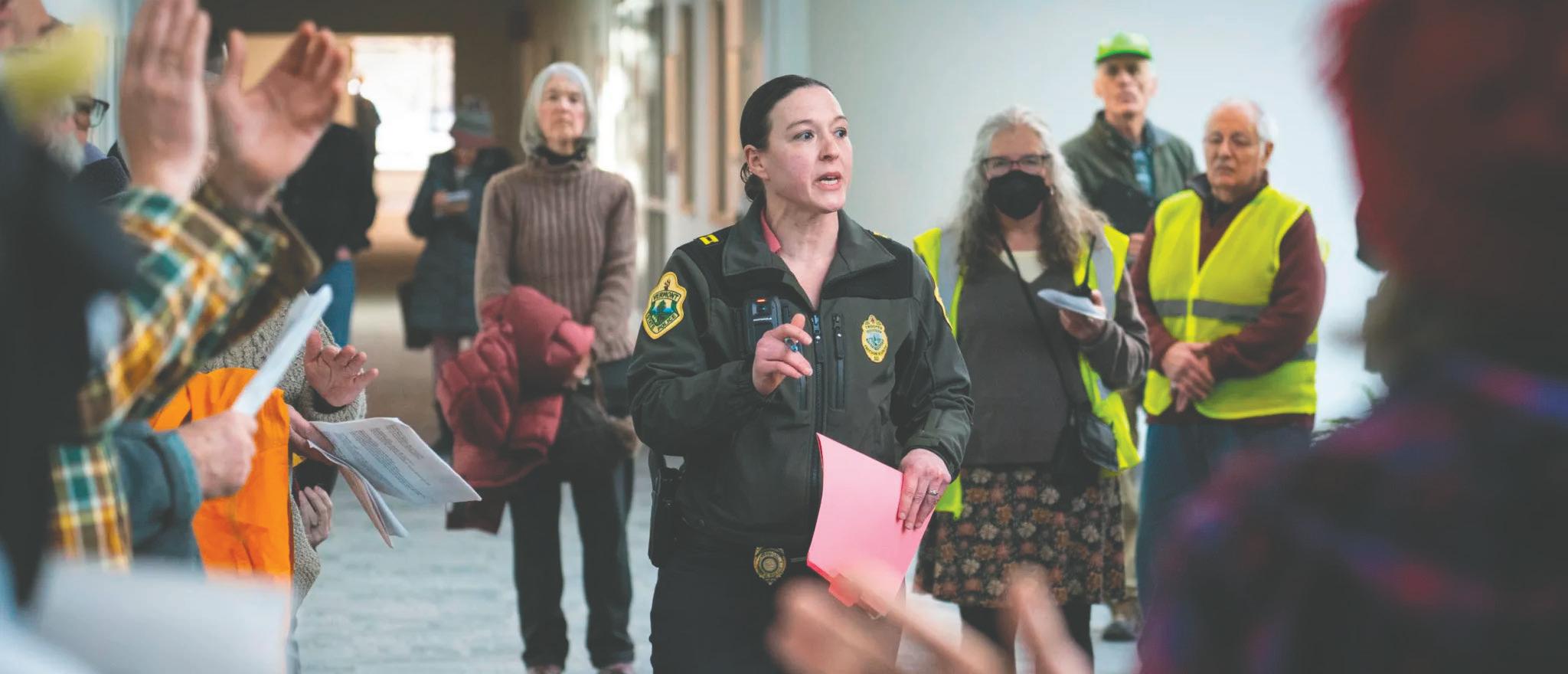
Matt Cohen spent 14 years with the Williston Police Department and is currently the interim chief of Richmond Police. He led a discussion last Thursday with comfort dog Duke on leash — for an overflow crowd of citizens in the community room at the Dorothy Alling Memorial Library. The event was organized by a newly formed group called Williston for Equity and Democracy. With Immigration and Customs Enforcement (ICE) clashes with protesters turning deadly last month in
Minnesota, the stakes are high.
“I’m giving you an education,” Cohen said. “You will have to make choices based on the information you have at hand. This is not legal advice.”
Cohen highlighted a key fact that may not be common knowledge: ICE and Customs and Border Protection agents have enhanced powers within 100 miles of the national border. Most of Vermont is within that zone.
The enhanced powers include the ability to search vehicles without probable cause, to establish fixed checkpoints along roads, and to use skin color and language as “reasonable suspicion” to stop, detain and investigate people.
“Local law enforcement can’t do that. They can,” Cohen said.
Cohen also explained that federal agents are enforcing different laws than local police. And while there can be collaboration, local officers can’t be commandeered by the feds.
11 arrested during ICE protest at Williston business park
BY AUDITI GUHA VTDigger
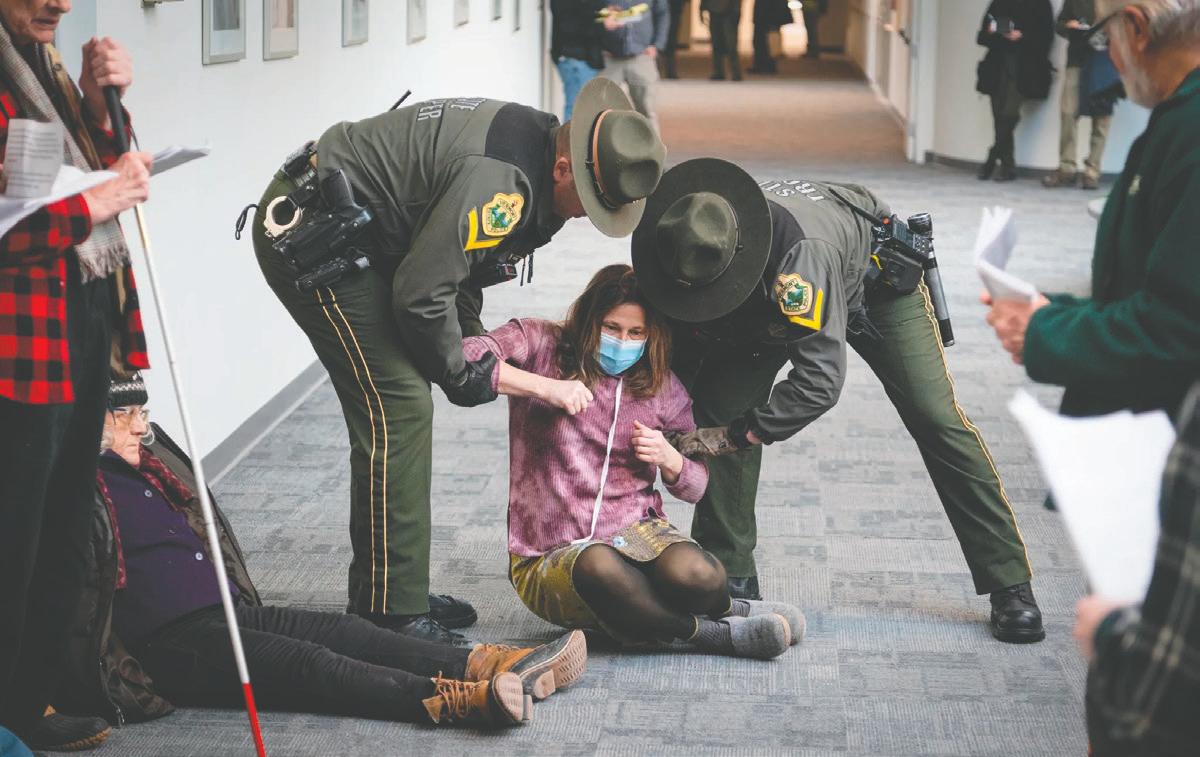
A group of adults were arrested Monday during a civil disobedience action in Williston’s White Cap Business Park, which houses a digital surveillance office run by U.S. Immigration and Customs Enforcement.
Eleven of about two dozen protesters were charged with trespassing, and two were issued citations and released after they declined to leave the private property and asked to be taken into custody, according to a State Police press release.
“Courage, my friend, you do not walk alone,” the protesters sang as participants were led out by state troopers.
The entire operation was nonviolent.
The 11 people arrested were Revell Allen, 75, of Middlebury; Karen Bixler, 83, of Bethel; Lexington Kennedy, 21, of New York; Donald Kollisch, 74, of Hanover; Dorothy Mammen, 70, of Middlebury; Henry Prensky, 79, of Burlington; Timothy Price, 71, of Ripton; Douglas Smith, 85, of Sharon; Roan Wade, 22, of Red Hook, New York; Jennifer Wasiura, 46, of Weybridge; and Sherri Wormser, 57, of Colchester, the release stated.
Peter Booth, 57, of Jericho and Laura Simon, 72, of White River Junction, were issued citations on a charge each of criminal trespass and released. They are all scheduled to be arraigned at 8:30 a.m. on March 2 at Vermont Superior Court in Burlington,
according to the release.
“This is the way we get our message out,” Simon said minutes after she was read her rights and escorted out of the atrium of the Industrial Avenue building.
“Every time people see us doing this, others realize they can also choose to stand up and exercise their rights,” she said. “I think more of this has to happen to create a change in government.”
“The Vermont State Police respects the right of people to protest and ensures those rights are protected, while also acknowledging that the owners of private buildings have the right to restrict people from entering and occupying their property,” the release read. “In this case, the property owner has requested that protesters not enter the
building to ensure users of the facility are able to access their office spaces.”
This was the second time a group of adults occupied the atrium at the office park that houses one of two ICE facilities in Williston. In a symbolic stance, the Williston Selectboard passed a resolution opposing ICE last month.
Shortly after 1 p.m. on Monday, protestors began occupying the atrium, which has doors leading into the office housing ICE’s National Criminal Analysis and Targeting Center.
They sang songs of protest and read names of people killed in ICE custody or by ICE agents. Some carried placards that
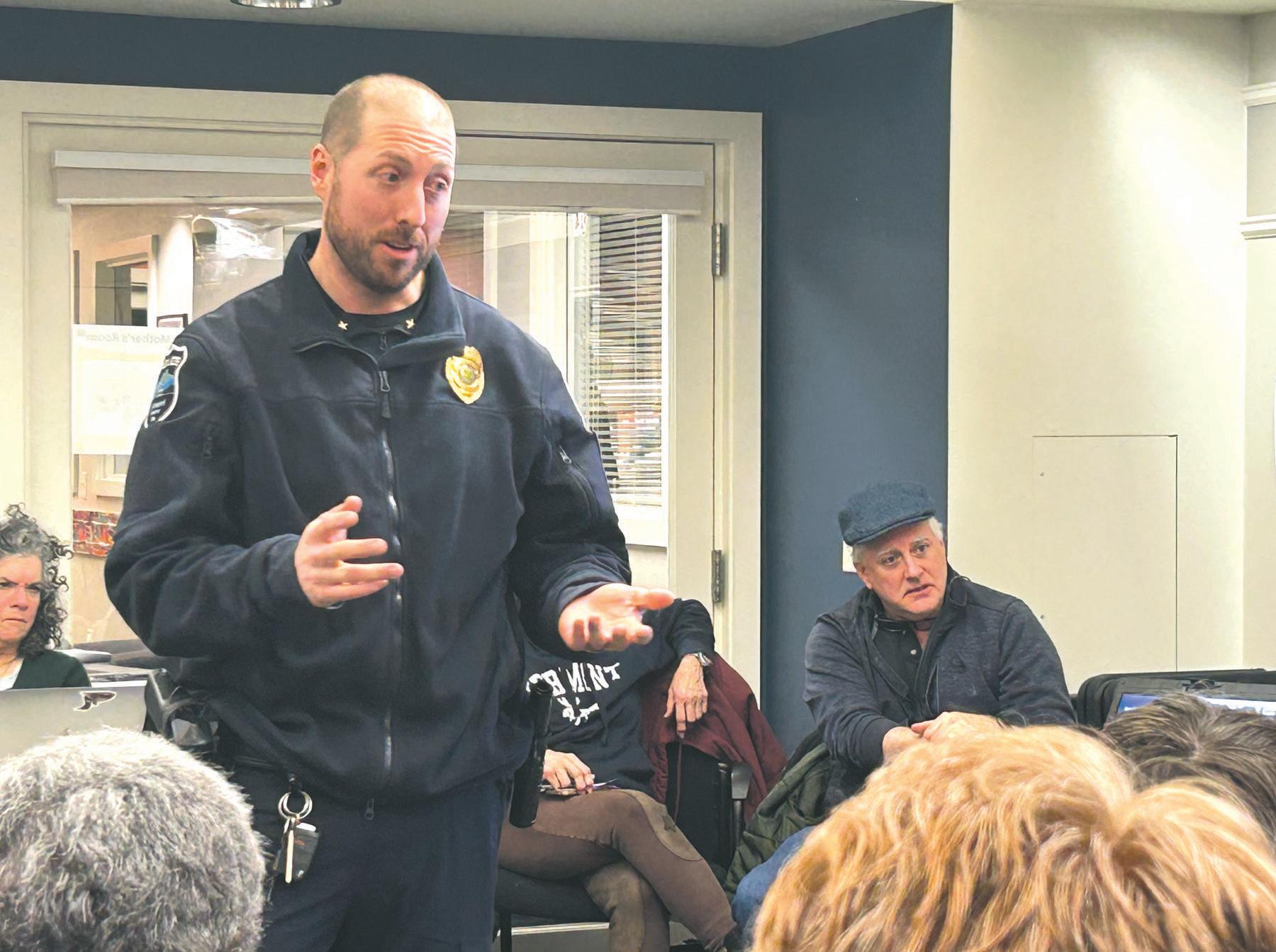
Interim Richmond Police Chief Matt Cohen meets with members of Williston for Equity and Democracy last Thursday at the Williston library to explain best practices for safely protesting ICE activities. OBSERVER PHOTO BY JASON STARR
Around Town
Prepping for CVU Class of ’76 reunion
The CVU Class of 1976 is planning its 50th reunion this summer. The reunion will take place Aug. 15 at Champlain College in Burlington. Contact the reunion committee to get on the email list for updates at ldr43@aim.com, and follow “Champlain Valley Union High School Class of 76” on Facebook.
Learn to transcend stress and ailments
Learn tips and resources to prevent and overcome health problems using individualized diet, exercise, weight management and stress reduction. Presentations by Vermont TM Center Director Janet Smith will take place Sunday, Feb. 22 at 1 p.m. on Zoom and Saturday, Feb. 28 at 2:30 p.m. at the Dorothy Alling Memorial Library.
RSVP to Smith by email at jsmith@ tm.org or call/text (802) 923-6782.
Smith also offers free Transcendental Meditation informational sessions, both over Zoom and in person.
Learn the history of Richmond’s Riverside Farm
Have you always admired Riverside Farm on Route 2 in Richmond? Would you like to learn about its history? Then save the date of March 8 and come to the Community Room in the Richmond Free Library at 3 p.m.
Several members of the Conant family, owners of the farm since 1854, are putting together a program on the history of the farm. Light refreshments will be served.
PROPERTY TRANSFERS — JAN. 2026
There will be a brief annual meeting of the Richmond Historical Society and election of officers prior to the program.
Arts for asylum seekers fundraiser planned
The Chittenden Asylum Seekers Assistance Network (CASAN) is organizing a fundraiser to celebrate creativity and support asylum seekers. It’s asking people to create works in any artistic medium writing, painting, photography, pottery, woodworking — and share it with CASAN to promote through its online channels.
Artists will seek sponsors and make a donation to CASAN. The fundraiser begins in April. For more details, visit www. casanvermont.org/arts-for-asylum-seekers.
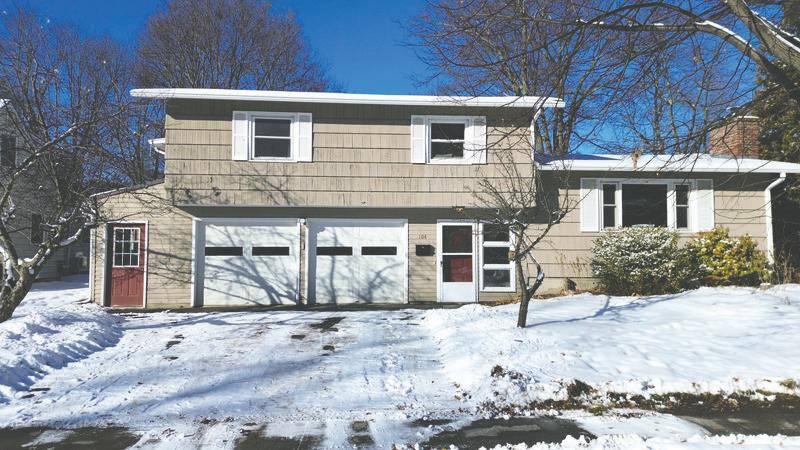
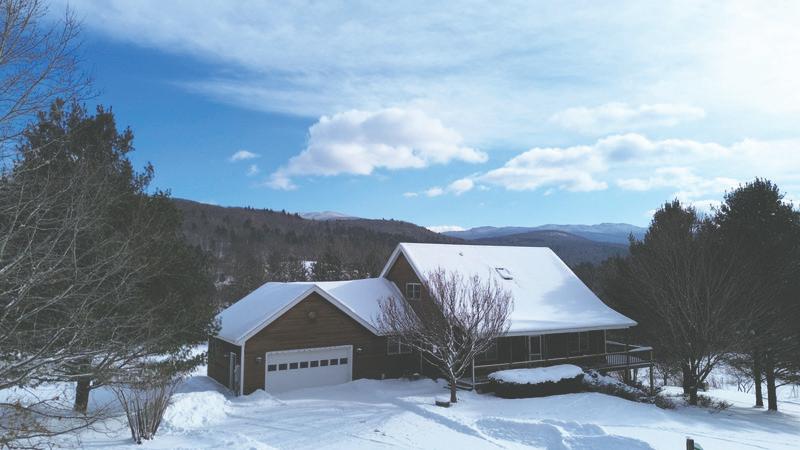
• Catt’s Office LLC bought a condominium on Williston Road from Cone of Silence LLC for $160,000.
• Olivia L. Morrow bought a home on Hickory Hill Road from the Norman R. Rapoport Trust for $449,000.
• Ash LLC bought 2 acres of commercial property on Blair Park Road from Kidder & Powell Inc. for $2.5 million.
• Bryor DeCell bought a home on 2 acres on Old Creamery Road from Leo Boutin for $425,000.
• Kailee Paquette bought a condominium on Chelsea Place from Cynthia Koehler for $465,000.
• 54 Echo Place LLC bought commercial property on 3 acres on Echo Place from Malcolm Willard for $3.5 million.
Reese Billings, Class of 2026, represented Vermont at a national student sports leadership summit. Read her story.
Student Voices Don’t Just Matter, They Lead!
At Rice, we give students the chance to lead - in sports, clubs, and the classroom. Senior Amarise Billings was selected to represent Vermont at a National Student Sports Leadership Summit. She returned with valuable skills to motivate, inspire, and empower. She’s already making an impact, running a successful charity walk and helping to plan a Mental Health Awareness Day for our school.
Actively enrolling for ‘26-’27 school year, schedule a tour or apply online!
• The Eklof Living Trust bought a condominium from the Estate of Steven Levings for $550,000.
• Luke Rixon bought a mobile home on Trillium Road from Laurie Lavallee for $221,000.
• C3H8 Holdings LLC bought commercial property on Avenue C from Paper Street Soap Company LLC for $875,000.
• PB Property Management Company LLC bought office buildings on Williston Road from Michael Kirick for $240,000.
• Cassandra Freese bought a mobile home on Stonehill Road from the Estate of Mary Sylver for $220,000.
• Asch Enterprises LLC bought 37 acres of commercial property on Marshall Avenue from The Miller Realty Group LLP for $30 million.
March 22, 2026
40% of Rice students qualify for financial aid!
802-862-6521x2246
bessette@rmhsvt.org rmhsvt.org Did you know?
COMMUNITY CALENDAR
EMAIL EVENT LISTINGS TO EDITOR@WILLISTONOBSERVER.COM
FRIDAY, FEB. 13
Education and Enrichment for Everyone series. “Whatever Happened to Checks and Balances in the U.S. Government.” 2-3 p.m. Faith United Methodist Church, South Burlington. More info at www.eeevermont.org.
TUESDAY, FEB. 17
Champlain Valley School Board meeting. 6 p.m. CVU. Agenda at cvsdvt.org.
Williston Selectboard meeting. 7 p.m. Town Hall. Agenda at town.williston.vt.us.
THURSDAY FEB. 19
Williston-Richmond Rotary Club breakfast meeting. Speakers Carol and Warren Coolidge, Toastmasters. 7:15 a.m. Williston Federated Church. RSVP to rotaryclubofwillistonvt@gmail. com.
SATURDAY, FEB. 28
Wellness and ailment prevention session. Tips to prevent and overcome health
problems and reduce stress. 2:303:30 p.m. Dorothy Alling Memorial Library. Presented by Janet Smith, Vermont TM Center. Register by emailing jsmith@tm.org or call/ text (802) 923-6782.
MONDAY, MARCH 2
Annual Town Meeting. 7 p.m. Williston Central School.
Champlain Valley School District Annual Meeting. 5 p.m. CVU High School.
TUESDAY, MARCH 3
Town Meeting Day. 7 a.m.-7 p.m. Voting at the National Guard Armory on Williston Road.
SUNDAY, MARCH 8
Richmond Historical Society presents Riverside Farm history. 3 p.m. Richmond Free Library.
THURSDAY, MARCH 5
SBA Vermont District Office Open House
Meet the new staff at SBA Vermont. 8a.m.-4:30 p.m. 400 Cornerstone Drive, Williston.
Activisim
continued from page 1
“We don’t have to work with them if we don’t want to,” Cohen said, adding that local officers have a duty to intervene if they witness use of excessive force.
In general, Cohen said, federal enforcement has been happening in Vermont without local help.
“They don’t communicate with us,” he said.
The Richmond Selectboard has tasked Cohen with tracking ICE activities in town and any requests ICE agents make of local officers — and reporting that back to the board.
Protests in Williston and the greater Burlington area have been consistent and well-attended but have thus far lacked the direct confrontations with ICE agents seen in Minneapolis. And while
“We can fight where we are supposed to fight — in court. I don’t want to fight on the side of the road.”
Matt Cohen Interim Richmond Police chief
the situation in Minneapolis has de-escalated — and President Donald Trump said in an interview with NBC News last week, “I learned that maybe we can use a little bit of a softer touch …” local activists are still preparing for conflict.
ICE has hired 12,000 new officers in the past year, swelling its ranks from 10,000 to 22,000, according to a January news release
from the Department of Homeland Security.
“It’s unfortunate there is fear that we can’t trust people to do their jobs,” Cohen said.
Cohen’s primary advice was to interact calmly, know the difference between a law enforcement request and an order, and comply with all orders.
“Don’t be the person who gets shot because you think you are right,” he said. “You may be right, but slowing things down and communicating can prevent a tragedy … If you don’t agree, we can fight where we are supposed to fight in court. I don’t want to fight on the side of the road.”
Cohen endorsed a suggestion from one of the event attendees, to continually ask agents: “Am I free to leave?”
“That is a great question to ask,” he said.
‘What
we saw was a city under occupation’
Vermont clergy join resistance in Minneapolis
BY SHAUN ROBINSON VTDigger
More than a dozen Vermont faith leaders traveled to Minneapolis at the end of January to see the impacts of the Trump administration’s immigration crackdown first-hand and bolster the ranks of people there who have protested against the government’s actions.
The group of 14 clergy were invited on the trip by local religious leaders. Some of the Vermont leaders were on their way to Minneapolis when federal agents fatally shot 37-year-old Alex Pretti, according to Vermont Interfaith Action, a group that helped coordinate the visit. Pretti’s killing sparked a wave of new protests across the city two and a half weeks after agents there shot and killed 37-year-old Renee Good.
A total of 3,000 U.S. Immigration and Customs Enforcement and U.S.
Customs and Border Protection agents were operating in the city in late January, a force roughly five times the size of the Minneapolis Police Department, according to CBS News. A top ICE official told CBS that federal agents had carried out about 3,400 arrests in and around the city, though did not say how many arrestees had criminal records.
The crackdown in Minnesota appears to be subsiding, though, with the departure of Greg Bovino, the controversial commander of U.S. Border Patrol, along with some agents, according to multiple news reports. Border Patrol is the roving law enforcement arm of Customs and Border Protection.
The Vermont clergy joined local organizers tracking federal immigration operations around the city and provided counseling support to those people and others watching nearby, they said. The clergy also joined an estimated tens of thousands of others marching in an “ICE Out of Minnesota” protest.
Vermont Clergy Making the January Trip to Minneapolis
Rev. Ava Bilton
First Congregational Church of Burlington, UCC
Catherine Bock
Burlington Quaker Meeting House
Rev. Jessica Derise
College Street Congregational Church in Burlington
Rev. Laura Engelken
former minister at Mallets Bay Congregational Church in Colchester
Rabbi David Fainsilber
Jewish Community of Greater Stowe
Rev. Joan Javier-Duval, Unitarian Church of Montpelier
“What we saw was a city under occupation. It was a city being occupied by the federal government — and a government that has turned violent,” said Jeannie Alexander, a reverend at EarthFire Abbey, an interfaith community in Pownal. “So, that was horrifying to see.”
Alexander said it was especially concerning to see how scared some people were to leave their homes. Some organizers the clergy worked alongside were tasked with bringing food and medicine to people who didn’t want to venture out, she said.
Karen Johnston, senior minister at First Unitarian Universalist Society of Burlington, recalled hearing about a colleague’s visit to a shopping center that serves as a hub for the city’s large Somali community. The Trump administration has pointed to a sweeping fraud scandal in
Rev. Becca Girrell
United Community Church, UCC in Morrisville
Rev. Elizabeth Gleich
The Congregational Church of Middlebury
Rev. Debbie Ingram a minister in the United Church of Christ
Rev. Susan McMillan
the Episcopal Diocese of Vermont
Grace Oedel of L’Chaim Collective, a statewide Jewish community
Rev. James Ross
First Congregational Church of Burlington, UCC
Minnesota that prosecutors allege largely involved Somali people as a justification for launching its immigration crackdown there at the end of last year.
“It’s a ghost town, because people cannot exercise their livelihood for fear of being abducted by ICE,” Johnston said of the complex.
Several of the clergy said they also used the trip as an opportunity to learn strategies for community organizing and nonviolent resistance that would help Vermonters document and respond to federal actions if there was a large-scale immigration crackdown here.
“I know Vermont is small — and we shouldn’t think that we’re next on the list, because there are plenty of places,” Johnston said. “But, we should not think that we are going to be immune.”
Showing up in solidarity
BY DEBBIE INGRAM Special to the Observer
Debbie Ingram is a former member of the Williston Selectboard and Vermont Senate. She is a United Church of Christ minister and currently serves on the Williston Housing Committee.
Like so many of us, my family and I have been following the news from Minnesota with horror, as we receive reports of the killings of a mother of three and of a VA nurse, the arrest of a grandfather taken from his home wearing shorts and no shirt in below freezing weather, the abduction of a 5-year-old boy to serve as bait to arrest his father, and other acts of cruelty and inhumanity by a government agency that purports to be engaged in law enforcement.
Therefore, when my wife and I, both of us clergy, were given the opportunity to join a faith-based community organizing group’s trip to provide support on a day of protest in Minneapolis, we jumped at the chance to do something meaningful and concrete.
We hastily made airplane reservations and arrived in Minneapolis on the afternoon of the day before the “Day of Fasting and Prayer for Truth and Freedom,” as the organizers were calling Friday, Jan. 23. The purpose of this day was for people to voluntarily engage in no work, no school, and no shopping, to which thousands of individuals and over 100 businesses committed.
We spent the afternoon after we arrived in discussion and planning at a Somali Community Center that provides a small café, meeting and worship space, and office space for a credit union and other services. This vital hub reminded us that the Somali community is a particular focus of ICE’s violence and cruelty.
Our host for the trip was the organization ISAIAH, which, like Vermont Interfaith Action (VIA) here at home (which I served as executive director of for 17 years), is a member of the national network Faith in Action.
There were eight of us from Vermont,
from the United Church of Christ, Episcopal, Quaker, and Unitarian Universalist faith traditions. (There were six other Vermont clergy who traveled under the auspices of another organization, called MARCH.) Our Vermont group gathered with several people from an organization working in the Washington, DC/Maryland/Virginia area and with others from POWER, based in Pennsylvania. All of us together made transportation and logistical plans to coordinate with the actions that ISAIAH and their allies in Minnesota had carefully prepared.
Part of our planning was to receive training that Thursday evening at a local church. Some of us attended a Marshals training, which included crowd management and de-escalation tactics, while others attended a preparatory session on civil disobedience specifically for clergy.
During the entire day on Friday, we had the opportunity to carry out our training and preparation. The ISAIAH organizers made two things explicit: 1) that we as outsiders were not to engage in any activity that would get us arrested, as they were not able to provide us legal support, and 2) that we would not be put in direct conflict with ICE, only with local law enforcement, who were far more reasonable and respectful.
In keeping with these principles, our day of action on Friday consisted of:
A remote national interfaith prayer service featuring inspirational messages from those of the Christian, Jewish, Islamic and Buddhist faith traditions
A protest at the Minneapolis Airport, which included approximately 350 people total, with 100 Minnesota clergy getting arrested by local police
A march in downtown Minneapolis to the Target Center that brought some 75,000 people out in the streets
A sit-in by 100 clergy in the lobby of the U.S. Bank headquarters, which handles much of the financing of the deportation system, to obtain a meeting with the CEO
Multiple closing worship services
The stated goals of these protests were to: Get ICE out of Minnesota
Ensure that the agent who killed Renee Good be properly investigated and prosecuted (this was the day before Alex Pretti was killed)
Ensure that Congress step up into its
oversight role and freeze funding of ICE until there is accountability for its actions
Urge corporations that have been benefitting from and colluding with ICE to take the side of their workers and customers instead, specifically calling out Target, Delta Airlines, Hilton, Home Depot and Enterprise Rental Car.
After a very full two days, we all headed to the airport on Saturday morning to come home to Vermont. During a layover we
learned of the murder of Alex Pretti. Although deeply saddened, we were undaunted, having been energized by being part of such a large, impactful gathering, gaining strength from others dedicated to justice.
We have heard that our presence made a difference to the courageous Minnesotans as well. We are all resolved to continue our efforts as long as it takes to restore respect, compassion and due process to our immigration system.
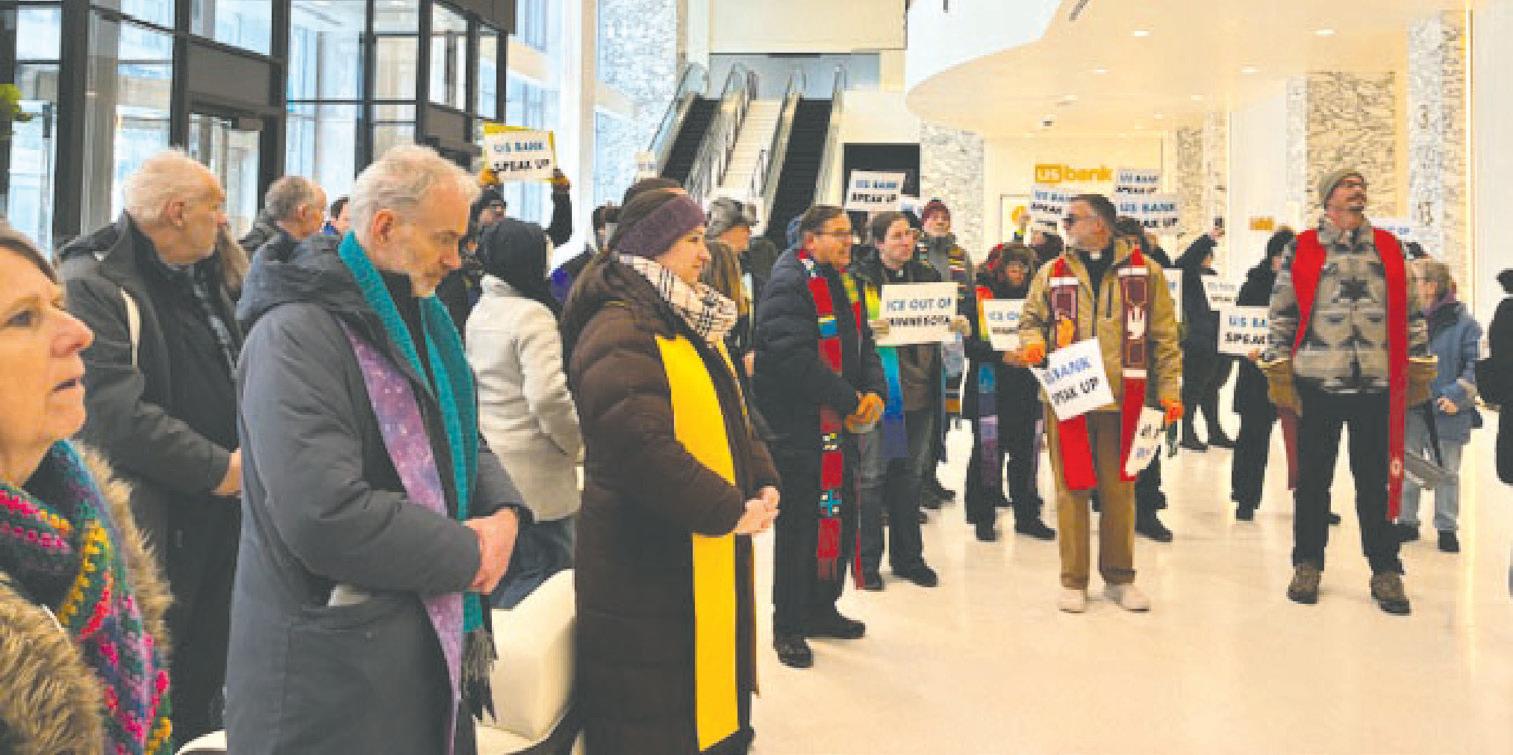
Clergy stage a sit-in in the lobby of U.S. Bank headquarters to push for a meeting with the CEO.
PHOTO BY DEBBIE INGRAM
Committing to the complex work ahead
BY REP. SHAWN SWEENEY
It’s a little bleak out there right now.
The cold snap has been, well, cold. But, what I am referring to is the political climate. It’s heartbreaking to see folks die while exercising their First Amendment rights of free speech and assembly in Minneapolis. Our federal administration is pushing the boundaries of our constitution, and it is demoralizing to know they are using their power to arrest, detain and deport mostly innocent people.
Do we have a problem with the way we deal with immigration in this country? Yes. Is this the way to fix it? No. Immigration and Customs Enforcement (ICE) has been allowed to trample on the Fifth Amendment, our right to due process. And in case you are wondering, the Fifth Amendment covers both citizens and non-citizens equally.
In Vermont, we are struggling as well. Affordability, which was bad when I got elected in 2024, has not gotten much better. We
are paying way too much for education, healthcare and housing. We are trying to work through these challenges in Montpelier, but after the first four weeks of the session, the fractures in the federal government are taking up most of the oxygen in the Statehouse. Cutting federal programs like the U.S. Department of Education and Medicaid, and imposing tariffs on most everything, is not helping matters here whatsoever. I’m not really sure what the administration’s end game is, but to me, this is not the best of who we are.
But all hope is not lost.
It was heartening to see such a large turnout last week in Burlington and around the entire state as Vermonters exercised their constitutional right to free speech and assembly. This shows how we as a state get it right.
While we all deal with the constant assault from Washington D.C., we in the Legislature are working diligently to protect Vermonters and save them money. In House Corrections and Institutions, the
Rick Cote, Associate Publisher rick@willistonobserver.com 802-373-2136
EDITOR
Jason Starr
editor@willistonobserver.com
PRODUCTION & DESIGN
Jan Kenney
jan@willistonobserver.com
PUBLISHER
Susan T. Cote
susan@willistonobserver.com
BILLING INQUIRIES
Michael McCaffrey
office@willistonobserver.com
Member:
ADVERTISING SPACE DEADLINE
Friday at 5 p.m. for the next Thursday issue rick@willistonobserver.com, 802-373-2136
CLASSIFIED ADS
Deadline is Friday 5 p.m. There is a fee for business, real estate, help wanted and legal ads. Free classifieds must be 25 words or fewer and are printed on a space available basis.
SUBMISSIONS & LETTERS
Deadline is Monday noon for Thursday issue. News/ story tips are welcomed. Letters to the Editor should be 300 words or fewer and include your name, address and a daytime phone number so that we can verify the letter’s author.
The Williston Observer reserves the right to edit or refuse submissions or advertising. Opinions expressed in the paper are those of the writer and do not necessarily reflect the opinion of the paper.
publication of Twin Ponds Publishing LLC
After the first four weeks of the legislative session, the fractures in the federal government are taking up most of the oxygen in the Statehouse.
committee I serve on, we are working on protecting our immigrant population and getting them the legal representation they have a constitutional right to.
We accomplished some
wonderful healthcare cost saving legislation last session, and we are lining up to do more this year with bills like H.577 — “an act relating to establishing the Vermont Prescription Drug Discount Card.” Passing the Community and Housing Infrastructure Program (CHIP) last session created a new state initiative to help finance infrastructure that will help build more primary residences of all kinds. I am also involved with other housing initiatives that are working their way through the legislative process. All are designed to help deal with our housing challenges.
Education is and will continue to be the greatest challenge we face this year and for the foreseeable future. Act 73 was passed last year, which included
a new foundation formula, school district consolidation, and independent school tuition reform. The Redistricting Task Force also came up with some incredibly thoughtful and cost saving ideas this past fall. I am working to see how we can blend the best ideas together to give Vermonters the savings they asked for without shortchanging our educators.
We need to step back and own some of these problems. We have not invested in the kind of housing we need in this state for way too long. We are one of three states in the country with a declining population. That is not going to help grow anything — not our grand list, our businesses, our tax base, our schools,
GUEST COLUMN
A school budget built to meet the moment
BY MEGHAN METZLER
On Tuesday, Jan. 20, the Champlain Valley School Board unanimously approved a $107.9 million budget to be presented to voters on Town Meeting Day.
In many ways, that moment felt anticlimactic. We’ve spent nearly five months building this budget. We’ve done so against the backdrop of intense political debate about public education — both locally and nationally — and the indisputable reality that more and more is being asked of our public schools and, therefore, of property taxpayers who support this system.
But behind that Tuesday evening vote was an enormous amount of careful work, difficult tradeoffs and deep reflection.
Over the past two years, we have cut over 82 full-time equivalent positions and made significant reductions in operational costs.
As a parent of two CVSD students, I see what those cuts look like in the day-to-day life of our schools — classes they wanted to take that are no longer offered and fewer adults available to support them and their peers. As chair of the school board, I hear directly from administrators, educators, students and families about what these changes mean in classrooms and hallways across our district. And as a taxpayer, I know — and feel — how much more I pay in property taxes than when I moved into my home 13 years ago.
All of those perspectives were in play as we worked through this year’s budget.
Our board asked the administration to build what we called a “level-ish service” budget: one that would preserve the core educational experience our students rely on, while still pushing to find every responsible efficiency possible. They did exactly that.
continued from page 6
nothing.
We got ourselves into this, and I truly believe we can get ourselves out of it. It is going to take time, it is going to take perseverance, it is going to take compromise. Most of all, it is going to take all of us. All of us caring for each other, caring for our neighbors and caring for everyone in our communities.
Now is the time to step up and lend a hand. Whether it’s volunteering, bringing a bag of food to your local town pantry,
The budget before voters reflects a 5% increase in overall education spending compared to this year, even as contractual obligations and health care costs alone grew by more than that. On a per-pupil basis — the measure that ultimately drives property tax rates — the increase is just 2.7%. For the past three years, this figure has been less than half the state average.
Those numbers matter. But so do the people behind them.
Despite careful planning and restraint in our budget — and following last year’s 4% decrease in education property tax rates across CVSD — the structure of Vermont’s education finance system means property taxes are still projected to increase this year. Without legislative action, the average increase across our five towns is estimated at 11%. If the Legislature and governor act, as appears likely, that increase will be lower.
I know that for many households, even a modest increase feels heavy. Groceries cost more. Heating costs more. Health care costs more. These pressures are real, and they are shared.
What I hope voters also see is this: Our board did not arrive at this budget casually. We arrived at it trying to balance responsibility with care — for taxpayers, and for the children who walk into our schools every day depending on the adults around them who give these students the opportunity to learn, grow and belong.
On Town Meeting Day, I ask you to join the board in supporting the CVSD school budget — not because it is perfect or easy, but because it is responsible, measured and rooted in a system that is committed to the growth and belonging of all of our students.
Meghan Metzler is chair of the Champlain Valley School Board.
giving to a needed charity or exercising your First Amendment rights. Everything will count.
As I represent St. George and Shelburne at the Statehouse, I am trying my best to find the middle, to develop relationships with every single member of the House and Senate. I believe everyone there is trying their best to do the right thing. What we must do, what you sent us there to do, is find solutions that work for Vermonters.
Shawn Sweeney represents St. George and Shelburne (Chittenden 7 District) in the Vermont House of Representatives.
OFFICIAL TOWN WARNING TOWN OF WILLISTON
MARCH 2 & 3, 2026
Please note the starting time Town Meeting Activities (March 2, 2026)
7:00 PM Official Town Meeting
Following Official Meeting:
- Town Australian Ballot Articles Public Information Hearing
- School Budget Presentation
The legal voters of the Town of Williston are hereby warned and notified to meet at the Williston Central School Auditorium in Williston, Vermont at 7:00 PM on Monday, March 2, 2026, for the Annual Town Meeting. Following the meeting, the Articles to be voted by Australian ballot will be reviewed during a public information hearing and there will be an opportunity for questions and comments.
Article 1: To elect a Moderator
Article 2: Shall the voters authorize that current taxes be paid to the Town Treasurer in three equal installments with due dates of August 18, November 16 and February 16 as authorized by 32 V.S.A. § 4871?
Article 3: Shall the voters of the Town of Williston accept the reports of the Town Officials as presented in the Town Report?
Article 4: To transact any other business to be brought before said meeting.
The legal voters of the Town of Williston are hereby further warned and notified to meet on Tuesday, March 3, 2026, at Vermont Army National Guard Armory located at 7846 Williston Road beginning at 7:00 AM, at which time the polls will open, until 7:00 PM, at which time the polls will close, to vote by Australian ballot upon the following articles:
Article 5: Shall the voters authorize General Fund Expenditures of $17,015,375 of which $9,010,000 shall be raised by taxes, for the year beginning July 1, 2026, and ending June 30, 2027?
Article 6: Shall the voters authorize renovation and expansion of the Dorothy Alling Memorial Library and associated improvements to the Village Green and the issuance of general obligation bonds or notes of the Town in an amount not to exceed Thirteen Million Nine Hundred Thousand and 00/100 Dollars ($13,900,000.00), subject to reduction by grants-in-aid and funds then available to the Town, to pay the capital costs and related other costs of the project?
Article 7: Shall the Town of Williston establish a reserve fund (which may be initially funded at some later date) to be used solely for the initial and recurrent training, certification, and recertification of emergency medical technicians, including, but not limited to, advanced emergency medical technicians, paramedics, and mobile integrated health care providers employed by the Williston Fire Department?
Article 8: Shall a tax of one half of one cent continue to be assessed on the grand list with the proceeds (estimated to be $110,000) to be deposited into the Town’s Environmental Reserve Fund for the purpose of permanent preservation and protection of open space areas and public lands within the Town of Williston?
Article 9: Shall the voters elect to the Selectboard one member for a term of two years beginning March, 2026?
Article 10: Shall the voters elect to the Selectboard one member for a term of three years beginning March, 2026?
Article 11: Shall the voters elect the office of Town Clerk for a term of three years beginning March, 2026?
Article 12: Shall the voters elect to the Board of Listers one member for a term of three years beginning March, 2026?
Article 13: Shall the voters elect to the Board of Listers one member for two years remaining on an unexpired three-year term that began in March, 2025?
Article 14: Shall the voters elect a representative to the Champlain Water District for a term of three years beginning March, 2026?
Article 15: Shall the voters elect to the Library Board of Trustees one member for a term of five years beginning March, 2026?
Article 16: Shall the voters elect to the Champlain Valley School District Board one director for a term of three years beginning March, 2026?
Article 17: Shall the town employ or contract a professionally qualified assessor and eliminate the office of elected lister by deleting the title and all of the present text in Section 14(c)(3) of the Charter of the Town of Williston and replacing them with the following underlined text?
§ 156-14. Local elected officials
(c) Elected officers; duties, responsibilities, and conduct
(3) Assessment of Propert y
(A) The Town shall employ or contract with a professionally qualified assessor who meets, prior to conducting any assessment work for the Town, the training requirements established by the Director of Property Valuation and Review under 32 V.S.A. § 4052 (as amended from time to time).
(B) The professionally qualified assessor hired or appointed in (A) above shall have the same powers, discharge the same duties, proceed in the discharge of those duties in the same manner, and be subject to the same liabilities as are prescribed for listers or the board of listers under the provisions of Title 32, Vermont Statutes Annotated.
(C) The term of office of any lister in office on the date the Town votes to eliminate the office of listers shall expire on the 45th day after the vote or the date upon which an assessor is hired or appointed pursuant to (A) above, whichever last occurs.
Copies of the complete Charter amendment proposal are on file for public inspection in the office of the Williston Town Clerk at the Town Offices and copies thereof shall be made available to members of the public upon request.
HOW TO REGISTER TO VOTE: There is no deadline to register to vote. You will be able to register to vote on the day of the election. You can register prior by visiting the Town Clerk’s Office or going online to vote.vermont.gov
REQUEST EARLY or ABSENTEE BALLOTS: You or a family member can request early or absentee ballots from the Town Clerk at any time during the year of the election at the Town Clerk’s Office in person, in writing, by telephone, email, or online at vote.vermont.gov
Dated this 20th day of January 2026.
Library expansion a worthy investment
When the Dorothy Alling Memorial Library Board of Trustees voted to renovate and expand the library at its current site, it was the most fiscally responsible option, according to a 2023 feasibility study that explored many different options for an expansion. Even so, with a price tag of $14.5 million, it is a big ask.
The last library renovation was 30 years ago, and since that time the population of Williston has doubled. This planned expansion and renovation is expected to last at least 50 years, will be more energy efficient, will improve parking and traffic flow, and will provide much needed meeting space that residents asked for in the scoping study. It is a worthwhile investment.
The larger space is expected to provide the following:
— Large, medium and small rooms for job interviews, book clubs, HOA meetings, tutoring, family reunions, organizational group meetings, poetry slams, and any number of things.
— More shelves for new books (currently, if we order a new book, an old book must be weeded out).
LETTERS TO THE EDITOR
— Space to have separate areas for teens and youth.
With all this, the library will continue as a safe and welcoming space where you can be seen and greeted warmly when you walk in.
On the Town Green, there will be a performance space for the Town Band and other groups to gather and share their talents.
If you are new to town or haven’t been to the library lately, come visit. You can see for yourself how cramped everything is. View the blueprints and ask questions.
The library holds an important role in our town, and the renovations will make sure it will continue to serve that role for years to come.
Karla Karstens Library Trustee
‘Junk Food’ ban would harm families, undermine dignity
The Scott Administration is seeking federal approval to restrict Vermonters from using 3SquaresVT to purchase undefined “junk food” items.
My mom spent more than 40 years working to feed the poor in Brattleboro and helping families get back on their
Floor
feet. She always told me: The food matters, but dignity matters just as much. When families are going through hard times, the last thing they need is the government taking away their choices and judging their decisions.
We all want healthier communities, but many families face inconsistent access to affordable, healthy food — depending on where they live, how they get to the store, and what their local store carries. The way to get there is by making healthy food more affordable and accessible, not by taking dignity away from people who are already doing their best to get by. This change won’t make anyone healthier, but it will make life harder for Vermonters.
About 67,000 Vermonters rely on 3SquaresVT, Vermont’s version of the federal Supplemental Nutrition Assistance Program (SNAP).
The state’s request follows a recent initiative from the Trump administration encouraging states to limit use of SNAP benefits to “healthy” foods. The order did not offer guidance on which foods would no longer qualify, creating confusion and leaving states like Vermont to establish and enforce their own eligibility standards.
Evidence that such a ban would lead to improved health outcomes is widely disputed.
The National Grocers Association estimates that “junk food” restrictions could lose food retailers billions in revenue — costs that would likely be passed to consumers through higher prices. The requirements would also limit food access in rural communities, where options, particularly for healthy foods, are fewer and further apart.
In addition to being costly and ineffective, a “junk food” ban would further stigmatize families who rely on the program to put food on the table.
This order from the Trump administration has nothing to do with making Americans healthier — it’s about dismantling SNAP, causing families shame at checkout, and making it harder for them to access food. In Vermont, we can be better than this and choose a different path, one that is true to our values, supports healthier communities, and treats our neighbors with the dignity they deserve.
Mike Pieciak Vermont State Treasurer
Election editorial policy
The Williston Observer welcomes election-related Guest Columns and Letters to the Editor submissions leading up to local, state and national elections. We refrain from publishing election-related material in the issue immediately preceding an election.
Vermont’s F-35s reportedly headed to Middle East
BY SHAUN ROBINSON VTDigger
Fighter jets from the Vermont National Guard were spotted landing at a Portuguese air force base in late January — likely en route to join other U.S. forces amassing for a potential attack on Iran, according to reports from defense industry publications.
The Vermont guard F-35s seen touching down at Lajes Field — which is in the Azores, a mid-Atlantic island chain controlled by Portugal — were previously deployed to Puerto Rico as part of the operation resulting in the capture of Venezuelan President Nicolás Maduro, reporting from The War Zone and The Aviationist said. Lajes Field is a frequent stopover for U.S. military aircraft traveling to the Middle East, Europe and Africa.
Both publications cited an image and video captured by a local photographer showing an F-35 bearing “VT” on its tailwing. The photographer identified a group of six such jets.
The public affairs office for the Vermont National Guard did not respond to a request for more information about the latest reported deployment of its planes.
The movement of the Vermont jets comes as President Donald Trump has ordered a large buildup of U.S. military forces around the Middle East in recent weeks as he threatens new military action against Iran. That includes what Trump has called a “massive armada” of ships, along with — according to publicly available flight data cited by the defense industry publications — other variations of U.S. fighter jets.
Trump has threatened to use force to compel Iran to agree to the U.S.’s demands over the Middle Eastern country’s nuclear program. Both sides have held recent diplomatic talks, at least indirectly, that also come as the Iranian government has brutally cracked down on nationwide protests there, killing thousands of people.
Vermont’s F-35s would give the U.S. the ability to strike military targets far inside Iran, according to The War Zone. Other F-35s — from a U.S. Air Force unit in Utah — played a major role in last June’s operation that, under Trump’s orders and together with the Israeli military, bombed three nuclear facilities in Iran.
It is not clear exactly what role the Vermont guard’s jets played in the operation that resulted in Maduro’s capture.
Vermont’s two U.S. senators told reporters at a press conference that they did not have any information about a possible deployment of the state’s jets to the Middle East. Both Independent Sen. Bernie Sanders and Democratic Sen. Peter Welch condemned Trump’s recent use of military force in and near Venezuela and said the president needs to consult Congress before entangling the U.S. in a war.
“Both Bernie and I are adamantly opposed to that executive overreach,” Welch said. “It’s extremely dangerous.”
An F-35 fighter jet from the Vermont Air National Guard’s fleet.
Public questions controlled burn plan in National Forest
BY GRETA SOLSAA VTDigger
The U.S. Forest Service’s plan to conduct controlled burning over the next 15 years in areas near popular recreation spots Lake Dunmore and Silver Lake has faced public opposition during a comment period that ends this week.
The project, called Northern Escarpment Ecological Restoration and Fire Resilience, is designed to promote the area’s resistance to wildland fires, pest infestations and drought, the Forest Service says. The project covers four areas spanning 2,770 acres of the Green Mountain National Forest in the towns of Leicester, Middlebury and Salisbury in Addison County and would begin in the spring of 2027.
Among the Forest Service’s expectations are that the project would reduce flammable materials and expand rare and uncommon native plant communities that depend on regular, low-intensity fire in the forests, according to U.S. Forest Service Public Affairs Officer Ethan Ready. This includes early azalea, natural red pine and oak, according to project documents.
“Decades of fire suppression have allowed other plant species to move in,
increasing competition and fuel buildup such as leaf litter, needles and woody debris,” Ready said.
In comments filed in recent weeks, many people have voiced concerns about lack of information about the impacts of prescribed fires damaging flora and fauna, as well as concerns about herbicide use harming wildlife and water quality.
Galina Chernaya, a Goshen resident, said the four sections of the project north and east of Lake Dunmore fall near popular recreation trails like Chandler Ridge Trail and Blueberry Hill. She’s worried about public access and ecological impacts of prescribed burns, and questioned whether the impacts are justifiable for wildfire mitigation.
Rep. Amy Sheldon, D-Middlebury, who chairs the House Environment Committee, outlined her concerns in a public comment, worrying that prescribed burns and other management methods may cause property damage, erosion and water contamination. Azalea has not decreased but spread in the area in the past 25 years, Sheldon added.
Brandon resident Karen Rhodes, who attended a public meeting on the project in Brandon on Jan. 21, questioned the active management strategy by the U.S. Forest Service.
“They want to burn back what they call problem trees and invasive trees which are also part of that habitat: hemlock, pine, different shrubs and herbs. They just want to burn it back so that the oak trees will thrive,” Rhodes said. “Why are they picking certain trees when nature seems to be taking care of itself.”
Vicki Disorda, said that she found the process “lacks transparency and opportunity for public input” after attending the meeting. Disorda questioned
why the public meeting was held on a snowy eve in Rutland County, instead of Middlebury where the project is taking place, and why there was not an online option to join the public meeting.
“Although the meeting was held in Rutland County, the Town of Brandon borders the project area and provided an accessible location and facility,” Ready wrote in response.
Bob Zaino, a natural communities
A view of the project area for a proposed series of controlled burns in the Green Mountain National Forest.
PHOTO COURTESY OF ZACK PORTER, EXECUTIVE DIRECTOR OF STANDING TREES
Richmond’s Cochran-Siegle scores Olympic silver in super-G
BY KEVIN O’CONNOR VTDigger
Vermont skier Ryan CochranSiegle, a second-generation Alpine racer from Cochran’s Ski Area in Richmond, repeated his Olympic medal-winning feat of four years ago by scoring silver in the men’s super-G on Wednesday at the 2026 Milan Cortina Winter Olympics in Italy.
“It’s an honor,” the 33-year-old could be heard saying as he received his latest medal on television after a race that combined the speed of downhill with the gate-dodging turns of giant slalom.
In 2022, Cochran-Siegle — who had broken his neck in a competition crash the winter before — missed out on gold by 0.04 of a second. On Wednesday, he skied third and watched racer after racer fail to beat him before top finisher Franjo von Allmen of Switzerland bested him by 0.13 of a second.
Four years ago, Cochran-Siegle’s mother — 1972 slalom gold medalist Barbara Ann Cochran — was home in her pajamas when she turned on a laptop to watch her son win his first silver in Beijing, China. This time, the 5-foot-1 Cochran matriarch was slopeside in Italy, cellphone camera in hand, as her 6-foot-1 son won his second medal.
Cochran-Siegle was raised at the namesake Richmond ski area that his grandfather, the late mechanical engineer Gordon “Mickey” Cochran, began in 1960 when he planted some poles, fastened a few pulleys,
Vermonter Ryan Cochran-Siegle celebrates Wednesday after finishing the men’s super-G Alpine ski race at the 2026 Winter Olympics in Italy.
PHOTO BY REBECCA BLACKWELL/ASSOCIATED PRESS
strung up some rope and hooked it all to a tractor engine to create its first rope tow.
“Mickey” Cochran went on to hew saplings into racing gates, never dreaming that several of his children and grandchildren would go on to the Olympics and turn the area into the nation’s first nonprofit slope upon his death in 1998.
Cochran-Siegle snagged his latest silver after suffering a bout of food poisoning and missing out on a medal in Saturday’s downhill.
“I was really happy with my ski today,” Cochran-Siegle told U.S. Ski & Snowboard after his Wednesday win. “I felt like I went out there, skied with a lot of heart … But the meaning? It hasn’t set in. I did not expect this.”
continued from page 10
ecologist with Vermont Fish & Wildlife, said the dry, rocky landscape in the Escarpment area is rare in Vermont and its susceptibility to lightning strikes and naturally occurring fires makes it a good candidate for the project. Fire suppression techniques have allowed less fire resistant, common species to grow up, changing the overall natural environment over time.
“What they’re proposing to do is just significantly broader and more aggressive than what would seem to be ecologically justified.”
Zack Porter Standing Trees
“The reintroduction of fire can be a way to bring that process back to those places,” Zaino said.
Prescribed burns can require multiple cycles to bring back fire-adapted species, like red pine, pitch pine, blueberries and huckleberries, which sprout in abundance
after fire, Zaino said.
Zack Porter, executive director of the forest conservation advocacy organization Standing Trees, said that there are some reasonable ecological benefits to the project’s fire resilience measures, but “what they’re proposing to do is just significantly broader and more aggressive than what would seem to be ecologically justified.”
If the prescribed burns do not create the desired effect in certain areas, the project allows the use of herbicides, including glyphosate, the active ingredient in the weed killer Roundup. This has sparked criticism from public commenters who worry about the potential harm to animals, humans and water quality.
Glyphosate is considered a probable carcinogen to humans by the World Health Organization’s International Agency of Research on Cancer, though the U.S. Environmental Protection Agency takes a different stance, asserting the herbicide is unlikely to cause harm to humans.
Porter said he considers it reckless to propose herbicide use, when there is not a full understanding of the risks of glyphosate contaminating waterways like Lake Dunmore, Silver Lake and tributaries.
“These are all public waters, and the Forest Service is proposing to put those waters in greater danger by using herbicides,” Porter said.
Winter blues? Add some greenery to your home
BY DEBORAH J. BENOIT Special to the Observer
Have the winter blues come to call? Take heart. Adding a bit of greenery to your surroundings just might help chase those blues away.
Each year, shorter daylight hours and colder temperatures send many of us retreating indoors. Less exposure to sunlight brings with it reduced levels of Vitamin D and a potential imbalance in our bodies of serotonin and melatonin, hormones important in controlling stress and regulating sleep.
For millions of people, dealing with Seasonal Affective Disorder (SAD), also popularly known as the winter blues, is no joke. It might manifest itself as a lack of energy and motivation, poor sleep quality, trouble getting out of bed in the morning, even general grumpiness. You might suffer from mental fatigue or find yourself unable to concentrate.
According to the theory of biophilia, humans are drawn to connect with nature. Depriving ourselves of such interaction can harm our wellbeing.
Adding plants to the rooms you frequent at home or work is one way to help cope with SAD — and it’s a natural choice for gardeners. Houseplants beautify our indoor spaces and lift our spirits year-round. During the winter months, houseplants can serve therapeutic roles as well. Just as
going for a walk in the woods or tending the garden can help boost our mood, so can caring for houseplants.
Consider adding a pot or two near a sunny window, providing a visually pleasing focal point in a room. Caring for houseplants can become a relaxing routine. Potted herbs under a grow light in the kitchen are both fragrant and satisfying to use when cooking.
Check out this link for tips on winter success with houseplants: https://go.uvm.edu/ wintercarehouseplant
Caring for houseplants provides a quiet time to relax and unwind. They reconnect us to nature during months when lush, green gardens and parks are sleeping beneath a blanket of snow. The simple, mindful routine of watering houseplants, cleaning dust from their foliage, pruning, or rotating pots can help focus our thoughts and reduce stress.
Sharing our space with plants provides more than a visual link with nature. Caring for them can help reduce anxiety, ease mental fatigue, and increase attention and cognitive performance.
anxiety and stress and act as an antidepressant.
Houseplants can help relieve stress by reducing the amount of cortisol (a stress hormone) in the body. Caring for houseplants stimulates the senses of sight, smell, touch — and taste if you’re growing edibles such as a tray of salad greens. The fragrance of flowering plants like jasmine can make a room smell like springtime.
Including plants in your home décor may also help improve air quality. During photosynthesis, plants take in carbon dioxide and release oxygen into the air. In addition, studies suggests that some common houseplants such as the peace lily can help reduce the amount of contaminants in the air.
If the winter blues have got you down, don’t grumble or threaten to hibernate until April. Bring your garden indoors to while away the winter hours. Spend some quality time tending to your houseplants, then bundle up and step outside into the sunshine. It won’t be long before spring is in the air.
Even potting soil has benefits. Research has shown that mycobacterium vaccae, a bacterium in soil, may prompt the release of serotonin in the body to reduce
Deborah Benoit is a UVM Extension Master Gardener who volunteers as a garden columnist and participates in Bennington County Extension Master Gardener Chapter activities.
The colors and textures of Rex begonias can bring visual interest to your home or work, and lift spirits during the winter months.
PHOTO BY DEBRA HELEBA
Wildcat woes
CLOCKWISE (left to right): The Williston Central School Wildcats’ Austin Gray gets the ball under control during the Wildcat boys B team 24-31 loss to Colchester Middle School on Feb. 3 in Williston. Jack Hamble (B team) fires from behind the arc. William Glock (B team) unleashes a jump shot.
Wildcat Grayson Sanford gets a contested layup during the Williston Central School boys A team 44-41 loss to Colchester Middle School on Feb. 3 in Williston. Sullivan Campbell takes aim at the basket. Jordan Paliling drives into the lane.
SPORTS
Dorothy Alling Memorial Library hours:
• Monday and Wednesday: 9 a.m.-7 p.m.
• Tuesday, Thursday, Friday: 9 a.m.-6 p.m.
• Saturday: 10 a.m.- 3 p.m. Visit www.damlvt.org to register for programs. Need help? Call 878-4918 or email daml@damlvt.org.
YOUTH PROGRAMS
Children in fourth grade and younger must be supervised by someone over 16 years of age.
STORYTIME
Tuesdays, Feb. 3 and 10. Drop in for stories, songs and fun.
10:30-11:30 a.m. Drop in for music, and stay to play.
SATURDAY STORYTIME
Saturday, Feb. 7, 10:30-11 a.m. Start your weekend off with Cindy’s Storytime.
AFTER SCHOOL MOVIE
Wednesday, Feb. 11, 2-3:35 p.m. Rated G. Go the distance in this classic-Greek-myth-meetsDisney epic!
MULTI-AGE PROGRAMS
READ TO A CAT (TROOPER)
Monday, Feb. 9, 3-4 p.m. Call to sign up for a 10-minute session to read to (or hang out with) Trooper the therapy cat.
READ TO A DOG (ROCKO)
Thursday, Feb. 12, 3-4 p.m. Call to sign up for a 10-minute session to read to (or hang out with) Rocko the therapy dog.
ADULT PROGRAMS
For online programs or to join a book club, email daml@damlvt.org.
ADULT WINTER BOOK BINGO
Turn in your bingo cards by Friday, Feb. 20 to be included in our prize drawing.
TEA CLUB: MILKY OOLONG
Each month, we will highlight a true tea (made with tea leaves) and provide a sample, a description of the tea’s history,
and instructions on brewing and tasting. While supplies last.
ADULT MEDITATION (ONLINE)
Friday, Feb. 13 and 20, 1212:30 p.m. Join our guided meditation to relax and re-center.
MAH-JONGG
Friday, Feb. 13 and 20, 1-3 p.m. All skill levels welcome.
FRENCH CONVERSATION
Saturday, Feb. 14, 12:4511:45 a.m. Drop in and brush up on your language skills. All abilities welcome.
BOOK CLUB BUFFET (ONLINE)
Tuesday, Feb. 17, 12:30-1:30 p.m. “Empire Falls” by Richard Russo.
COOK THE BOOK
Wednesday, Feb. 18, 12-1 p.m. Join us for our potluck as we try recipes from “Cool Beans” by Joe Yonan.
SPANISH CONVERSATION (ONLINE)
Wednesday, Feb. 18, 5-6 p.m. All skill levels welcome.
READER’S ROUNDTABLE
Tuesday, Feb. 24, 12:30-1:30 p.m. “The Light Pirate” by Lily Brooks-Dalton.
CURRENT EVENTS
Wednesday, Feb. 25, 10:30 a.m.-12 p.m. Meet up with community members to discuss timely topics.
Marlene Theresa Loomis
Marlene Theresa Loomis, of Williston, a beloved wife, mother, grandmother, sister, and friend, passed away on Jan. 25, 2026, at the McClure Miller Respite House, surrounded by her loving family.
Born Sept. 19, 1943, in Burlington, Marlene’s journey through life was filled with love, laughter, and dedication to those she cherished most.
Marlene began her career as a devoted homemaker, nurturing and raising her children with unwavering love and guidance. After several years, she transitioned to a rewarding career at IBM, where she worked for over 25 years, earning the respect and admiration of her colleagues. A proud graduate of the former Brigham Academy in Bakersfield,
see LOOMIS page 17
Loomis
her education laid the foundation for her determination and strong-willed personality that shone brightly throughout her life.
Known for her sense of humor, Marlene was a radiant presence who delighted in the joys of family life. She cherished every moment spent with her husband and snowbird partner, Howard, whom she shared a beautiful union with for 24 years. During the winter, they shared a home in Daytona, FL. They created a lifetime of memories through travels to warm destinations and exploring places like Florida, Maine, and a memorable tour of Tennessee. One of the highlights of their adventures was a cherished trip to Europe, where they visited the enchanting cities of London and Paris.
Marlene found immense joy in the simplest of things. She adored her grandchildren, who were a source of pride and joy for her. Her nurturing spirit extended beyond her biological family; she poured love into each knitting project, crafting blankets and gifts for those dear to her. Her green thumb brought life to her home, as she took great pleasure in caring for her spring flowers and feeding the local wildlife, including her beloved “Chipper.” Marlene’s collection of frogs, gnomes, and owls, along with her cherished dolls, provided her family with countless memories and sentimental value over the years.
Her passion for cooking and baking filled her home with warmth and delicious aromas. She was known as a healthy baker who delighted in sharing her creations. She also found enjoyment in playing cards, particularly her favorite game of “31,” and could often be found immersing herself in the soothing strains of country music.
In her later years, Marlene embraced an active lifestyle, reverting to her roots as a runner in her youth and transitioning to walking, relishing the beauty of Vermont’s fall foliage. Her home reflected her careful attention and effort to make it a beautiful haven for her family, a place where everyone was welcome.
Marlene is survived by her adoring husband Howard; her children, Tammy Castle and husband Randy, Todd Lagrow and wife Tina, Jodi Girouard and husband James, and John Lagrow and wife Ligia. She’s also remembered by her stepson Scott Loomis, twelve grandchildren, and six great-grandchildren. Marlene is mourned by sisters, Leone Lowery and her husband Jerome, and Priscilla Giles and her husband Doyle. She also leaves behind brotherin-laws Gayland and Durward Loomis Jr.
Preceding her in death are her parents, Alice and Leon Messier, her children’s father Zenneth Lagrow, and her sister, Marilyn Hunt. Marlene will forever be remembered for her acts of kindness, her laughter and the profound impact she made on all who knew her. Her legacy will continue to flourish in the hearts of her family and friends, a reminder of the beautiful journey she took and the love that remains.
A burial service will take place in the spring in Belvidere Cemetery.
OBITUARIES
Gary Glenn Mashia
Gary Glenn Mashia (61), of Essex Jct. VT, a beloved husband, father, papa, brother and friend, passed away Jan. 28, 2026, at Dartmouth Hitchcock Medical Center, following a short illness, surrounded by his loving family.
Born March 26, 1964, in Burlington, VT to William Oliver Mashia and Beverly Joyce Irish. Gary Graduated from C.V.U.H.S in 1982. Gary began his career at Lantman’s IGA in Hinesburg at the age of 16 working for Doug and Betty Lantman, then for Brian Busier and after Brian’s passing he worked for Brian’s sons Bryce and Kyle Busier. This was Gary’s only job and he was there for an astounding 45 years — he was a very dedicated employee.
Known for his sense of humor and infectious smile which you rarely saw him without. He was a kind, generous and caring man who knew and befriended everyone!
On Sept. 17, 1988, Gary married his high school sweetheart Pam Vezina. They shared 32 years together before divorcing for 7 years and then reuniting until his death. A true test of soul mates.
and a half with 100% success while inspiring others to better their lives as well.
Gary has left us all with such a void in our hearts since his passing that no one will ever be able to replace. His legacy and story will forever live on as he was an unforgettable human.
He leaves behind his family: the love of his life Pam Mashia; children Lauren Gilbert (partner Ben Whitcomb) and Tanner Mashia (partner Mariah Litchfield) his three beautiful grandchildren Wyatt andWrenna Gilbert and Bryson Mashia along with his two grand dogs Duke and Cooper all of whom will miss him more than words can say.
His is also survived by his six siblings; Cheryl Esty (Tom), Michael Mashia (Theresa), Ricky Mashia, Mark Mashia (Caroline), Laurie Meyer (Chris), Allen Mashia (Marylin) his brother in laws Ralph Vezina III (partner Jared Covell), Craig Hayford (Lisa), Chad Vezina, Sister in law Heather Vezina, Tracy Fisher (Ricky) along with and his many nieces and nephews who he loved dearly and had special bonds with each of them: Tracey, Matt, Erin, Jordan, Brooke, Jason, Eric, Natalie, Carlie, Stacey, Alexis, Justin, Christopher, Carter, Calvin, Abigail, Tiffaney, Steffaney, Brittaney, Whittaney, Ricky, Ameriah, Gavin, Aiden, Austin,
Gary was very proud of his children and grandchildren and loved them very much. He especially loved his role as their papa and whenever talking about his grandchildren you could tell he felt complete.
One of Gary’s passions was spending his free time on Lake Champlain with his family on his prize procession, his boat “Last Chance”. By the end of summer Gary would be as tanned as they come as he could never get enough sun. He also would take weekly drives to casinos in NH and NY with his brother Michael as he loved playing slots.
Mak, Tyler and many cousins and great-nieces and nephews.
He also leaves behind a few of his very close friends who he valued greatly. You all know who you are.
He is predeceased by his parents, grandparents, aunts and uncles, mother and father-in-law, a few close friends, his sister-in-law Lisa Mashia, and niece Izzy. He is finally reunited with his beloved boxers: Buck, Hooch and grandpup Oakley.
This void will not be filled until we meet again my love. Fly high and continue to shine down on all of us.
We would also like to take a moment to acknowledge the amazing staff at Dartmouth Hitchcock Medical Center for devotion, compassion and support through Gary’s illness and time spent there.
There will be a celebration of life in Gary’s honor on his birthday March 26, 2026, at the Buck Ridge Barn 8470 Route 116 Hinesburg, VT 05461 from 12 p.m.- 4 p.m. Parking will be limited, so carpooling is strongly encouraged.
In lieu of flowers make donations to The American Cancer Society (P.O. Box 6704 Hagerstown, MD 21741) and or The Hazelden Betty Ford Foundation (P.O. Box 860970 Minneapolis, MN 55486-0970)
His family is so very proud of him for his will to choose a healthier path in life as he decided to become sober in 2024. Gary accomplished this part of his life all on his own with the outpouring of support from his family and friends with no rehab intervention. This was a huge milestone for him, as most of you know how much Gary loved to drink. He was able to enjoy his new life of sobriety for a year
Citizen Scientists
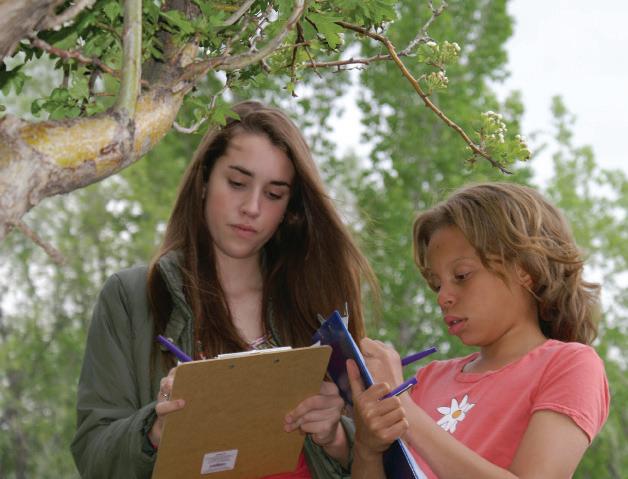
Last week, The Mini Page learned about the Great Backyard Bird Count, in which people all around the world help scientists learn about the bird population, but this work goes beyond just birds.
Hundreds of thousands of kids and adults are helping to solve the mysteries of Earth and beyond. They are known as citizen scientists
Although these volunteers are not professional scientists, they are making valuable scientific discoveries throughout the world. They are gathering data on thousands of subjects, ranging from monarch butterfly migration to galaxy shapes to water quality to penguin lifestyles.
Citizen detectives
Amateurs have been making important scientific discoveries for thousands of years. Since the late 1800s, professional scientists have been joining forces with these volunteers. The National Audubon Christmas Bird Count organized birders to gather data starting in 1900. It is the longest-running citizen scientist group survey in the world.
The number of citizen scientists has exploded in recent years. Technology, such as the internet, apps, smartphones and GPS, has made it much easier for everyone to join in the hunt for knowledge.
Helping the experts
Citizen scientists usually work closely with scientific experts. Often, professional scientists need help collecting or analyzing a lot of data
Try ’n’ Find
over a wide area and over a lot of time. Doing the actual research is exciting. Many students get their first real experiences in nature through citizen scientist projects.
It is especially important when kids become citizen scientists. The world needs people who have learned how to think creatively and to look for answers that are backed up by tests and research, experts say.
• In an NSF/NOAA project called CoCoRaHS (ko-koRAHS), observers measure precipitation that falls near their homes. When whole communities come together to monitor the precipitation, it gives groups such as the weather service, farmers, insurance companies, water supply managers and outdoor lovers a better idea of patterns. It helps them predict what to prepare for.
• Monarch Watch, based at the University of Kansas, helps monitor monarch butterflies and has started a Waystation Program. It encourages people to plant flowers that monarchs like and milkweed, which the larvae need.
Words that remind us of citizen scientists are hidden in this puzzle. Some words are hidden backward or diagonally, and some letters are used twice. See if you can find:
• Through the Chicago Botanic Garden’s Budburst, 35,000 citizen scientists are recording information on when plants start changing each season. For example, they record when leaves change color in the fall and when plants begin to flower in the spring.
This helps scientists monitor the effects of temperature changes and rainfall and gather information about climate change.
• In the NOAA LiMPETS* network, middle school, high school and college students monitor national marine sanctuary beaches in California. Students collect data on rocky intertidal areas and sandy beach areas. Intertidal areas are beach areas that are covered by the sea at high tide and uncovered at low tide. The information helps officials track the health of marine life.
Mini Jokes
Sam: What’s a nuclear scientist’s favorite lunch?
Sara: Fission chips!
Sonya: Why are chemists good at solving problems?
Stephen: They have most of the solutions!
Mini Fact: Students examine a Mexican butterfly weed, which is in the milkweed family.
Next Week: Girls in science
Founded by Betty Debnam
photo by Bruce Leventhal, Forest Lake High School, Forest Lake, Minnesota
A father and son measure rainfall in Concord, North Carolina, as part of CoCoRaHS.
Two students record observations for Budburst.
Students monitor Pacific mole crabs through the LiMPETS sandy beach network. They measure the crabs, check to see if they are male or female and if the females are carrying eggs.
photo by Henry Reges,
photo by Carlye Calvin, University Center for Atmospheric Research, courtesy Project BudBurst
photo by Aelfric Wolf, courtesy NOAA
Citizen scientists usually work closely with scientific experts. Often, professional scientists need help collecting or analyzing a lot of data
Try ’n’ Find
milkweed, which the larvae need.
Words that remind us of citizen scientists are hidden in this puzzle. Some words are hidden backward or diagonally, and some letters are used twice. See if you can find:
1. Combine cake mix, yogurt and eggs in a bowl. (Do not add oil or water.) Blend until moist, then beat 2 minutes at medium speed.
2. Gently stir in blueberries.
3. Spray a round tube cake pan with cooking spray. Pour batter into tube pan.
4. Bake in oven at 350 degrees for 40 minutes or until done. Cool for 15 minutes before removing from tube pan. Makes 8 to 12 servings.
A handful of galaxy frogs once hidden beneath a single fallen log in India’s Western Ghats mountain range may have vanished forever, not because of natural predators but because people wanted photographs. The tiny, endangered frogs disappeared after visitors overturned logs, trampled vegetation and handled the animals without gloves, actions that can easily kill amphibians that breathe through their skin. Melanobatrachus indicus is the only species in its family, an ancient line of life that cannot be replaced.
For later:
Look in your local newspaper for news about discoveries in any area of science.
By Jim Miller
Dear Savvy Senior,
What are the IRS income tax filing requirements for retirees this tax season? I didn’t file a tax return last year because my income was below the filing threshold, but I got a part-time job in 2025, so I’m wondering if I need to file this year.
Semi-retired Joe
Dear Joe,
Whether you need to file a federal income tax return this year depends on several factors: how much you earned in 2025, the source of your income, your age
and your filing status.
Here’s a quick guide to this year’s IRS filing thresholds. For most people, it’s straightforward: If your gross income (all taxable income, excluding Social Security benefits unless you’re married and filing separately) is below the threshold for your filing status and age, you generally do not need to file. But if it’s over, you do.
2025 IRS Federal Filing Thresholds:
— Single: $15,750 ($17,750 if you’re 65 or older by Jan. 1, 2026).
— Married filing jointly: $31,500 ($33,100 if one spouse is 65 or older; or $34,700 if you’re both over 65).
— Married filing separately: $5 at any age.
— Head of household: $23,625 ($25,625 if 65 or older).
— Qualifying surviving spouse: $31,500 ($33,100 if 65 or older).
For a detailed breakdown,
SAVVY SENIOR
including taxable vs. nontaxable income, you can request a free copy of the IRS “1040 and 1040SR Instructions for Tax Year 2025” by calling 800-829-3676, or view it online at IRS.gov/pub/irspdf/i1040gi.pdf.
CHECK HERE TOO
Be aware that there are other financial situations that can require you to file a tax return, even if your gross income falls below the IRS filing requirements. For example, if you earned more than $400 from self-employment in 2025, owe any taxes on an IRA, Health Savings Account or an alternative minimum tax, or get premium tax credits because you, your spouse or a dependent is enrolled in a Health Insurance Marketplace plan, you’ll need to file.
You may also need to file if you’re receiving Social Security benefits, and one-half of your benefits plus your other gross income and any tax-exempt interest exceeds $25,000, or $32,000 if you’re
married and filing jointly.
To figure all this out, the IRS offers an online tax tool that asks a series of questions that will help you determine if you’re required to file, or if you should file because you’re due a refund. It takes less than 15 minutes to complete.
You can access this tool at IRS.gov/help/ita. Click on “Filing Requirements — Do I need to file a tax return?” Or you can get assistance over the phone by calling the IRS helpline at 800-829-1040.
CHECK YOUR STATE
Even if you’re not required to file a federal tax return this year, don’t assume that you’re also excused from filing state income taxes. The rules for your state might be very different. Check with your state tax agency before assuming you’re off the hook. A complete list of state tax agencies is available at Taxadmin.org/fta-members.
TAX PREP HELP
If you find that you do need to
file a tax return this year, you can Free File at IRS.gov/freefile, which is a partnership program between the IRS and tax software companies. Your 2025 adjusted gross income must be below $89,000 to qualify.
If you need some help with your tax returns, the IRS sponsored Tax Counseling for the Elderly (TCE) program provides free tax preparation and counseling to middle and low-income taxpayers, age 60 and older. Call 800-906-9887 or visit IRS.treasury.gov/freetaxprep to locate services near you.
You can also get help through the AARP Foundation Tax-Aide service at AARP.org/findtaxhelp or call 888-227-7669. You don’t have to be an AARP member to use this service.
Send your questions or comments to questions@savvysenior.org, or to Savvy Senior, P.O. Box 5443, Norman, OK 73070.
TODAY’S HISTORY:
• In 1554, Lady Jane Grey, who reigned over England for nine days in 1553, was beheaded for treason.
• In 1909, the National Association for the Advancement of Colored People (NAACP) was founded in New York City.
• In 1999, the U.S. Senate voted to acquit President Bill Clinton on charges of perjury and obstruction of justice, bringing his impeachment trial to a close.
• In 2008, General Motors offered buyouts to its more than 70,000 union workers after posting a $39 billion loss in 2007.
TODAY’S FACT:
• Charles Darwin replaced Charles Dickens on Britain’s 10-pound note in 2000, reportedly in part because Darwin’s beard would make forgery more difficult.
SOLUTION FOUND ON PAGE 22
OBITUARIES
LEGAL NOTICE
Public Auction Under SelfStorage And Operators Lien
U-Haul Of Williston 5010 Williston Rd
The public hearing will be held to receive public comment on the draft town plan which has been prepared by the planning commission to replace the current town plan dated February 15, 2018.
Copies of the draft town plan (Draft Town Plan 1-28-26) can be found on the town’s website on the documents page at https://stgeorgevt.com or by stopping by the town hall to view a copy of the full text. The revisions proposed affect all of St. George. The section headings that include proposed edits and/or additions are as follows:
For further information please contact Connie Kendall, Planning Commission at PC@stgeorgevt.com
DIRECTORY
Williston, Vt . 05495
On February 26th at 9:00 am on www.storageauctions.com
The contents of the following units consisting of furniture, household goods and miscellaneous personal property will be SOLD to satisfy the lien of U-HAUL as self-storage operators. This Sale Is Held Under The Uniform Commercial Code Section 16a, Paragraph 7-210 Enforcement Of Vermont Self-Storage Lien.
Daniel Larose 0144
Travis Dashnow 2350
Tishonna Smith 1019
Chris Shelton 1064
Andre Joseph Martel
dairy farming. Andre took great pride in his farm, which became one of the last working farms in Williston, representing a way of life he deeply valued.
In his younger years, Andre enjoyed snowmobiling with the Williston Trail Blazers. After retirement, Andre and Pat joined the camping group Roadrunners, traveling across the United States with their fifth-wheel camper. They also enjoyed cruising to the Caribbean, and one of their favorite trips was a train ride to Alaska followed by a cruise back to Washington.
Andre is survived by his wife of 63 years, Patricia (Cota) Martel; his children, John Martel (wife Patty), David Martel (partner Ylan Roy), and Sandra Martel Barber (husband Travis); and his grandchildren, Danielle Kutches, Michelle Sterling, Rob Martel, Christine Martel (Poulos), Ryan Martel, Scott Martel, Joseph Barber, and Christopher Barber, as well as seven great-grandchildren. He is also survived by his sister, Irene (Rosaire) Longe, along with many beloved nieces and nephews.
HARDWOOD FLOORS
AUDIOLOGY
Steven Mermelstein 2020 & 0192
Andre Joseph Martel, 82, of Williston, Vt., passed away from lung cancer in the Williston farmhouse where he was born, surrounded by family. Andre was born on Sept. 29, 1943, the youngest of five children of Ernest and Marguerite (Jutras) Martel. He lived a life rooted in hard work, creativity, and deep love for his family.
Andre loved farming, fishing, and working with metal and wood. He was a creative soul and a natural inventor, best known for developing and patenting the Wing Cleaner alongside his brother Jerome, who helped design a tool to clean out barns. He took pride in building, fixing, and improving whatever was in front of him, always with a practical mind and skilled hands.
Andre was predeceased by his father, Ernest Martel; his mother, Marguerite (Jutras) Martel; his brother, Jerome Martel; and his sisters, Rita Martel and Ruth Martel.
To honor Andre, a viewing will be held at LaVigne Funeral Home in Winooski on Thursday, Feb. 19, from 5–7 p.m. A church service will be held at Immaculate Heart of Mary on Friday, Feb. 20 at 11 a.m. Andre will be laid to rest at Colchester Village Cemetery in the spring or summer.
Andre ran a dairy farm on Mountain View Road in Williston for over 30 years, working side-by-side with his wife, Patricia, who helped keep the farm running day in and day out. In his younger years, the farm was both a chicken and dairy operation. After the original barns burned, a new barn was designed by the University of Vermont specifically for
The family would like to extend heartfelt thanks to the hospice team who supported Andre’s home hospice care, and to the family members who helped grant his wish of passing peacefully in the home where his life began.
by Beltrami Studios, South Burlington, VT
Photo
Rabies is a deadly viral disease of the brain that infects mammals. It is most often seen in raccoons, skunks, foxes, and bats, but unvaccinated pets and livestock can also get rabies. The virus is
raccoons, skunks, foxes, and bats, but unvaccinated pets and livestock can also get rabies. The virus is spread through the bite of an infected animal or contact with its
continued from page 1
read “Resist Fascism.” One protester wore a colorful cloak that read, “Love Your Neighbor.” Two donned animal costumes — a polar bear and a black and white cow. A few protesters wore red knitted hats that have become a form of protest in Minnesota, in a nod to those Norwegians wore as a sign of resistance to Nazi occupation during World War II.
“The disturbance caused by our presence here is only a tiny fraction of the life-altering disruption that ICE visits on black and brown communities every day,” they chanted, reading from a prepared statement. “We know our action today can do nothing to bring back the more than 38 people killed by ICE in the past year or bring home the people who have already been deported.”
They were accompanied by legal observers and a communications expert who acted as liaisons between the anti-ICE activists, the property manager and law enforcement.
Vermont State Police troopers arrived around 2:45 p.m. and encouraged the group to leave of
their own accord and protest outside. Troopers informed them they were trespassing and warned they would issue three warnings asking them to leave the property before arresting them.
Capt. Debra Munson made the first announcement in the plantlined building atrium about 3:40 p.m., and a few protesters left. A few others followed after the second warning. After the third announcement, Munson gave orders for arrests for unlawful trespassing under Vermont statute.
“No human being will ever be illegal,” sang the remaining few, arms linked, as state troopers
announced their intent to start arresting them. Williston police arrived to help. The people arrested were read their rights and walked to a room near the entrance, patted down and given citations. Some of them were then led into a waiting van to be taken to the barracks for booking.
Outside the building, a group of protesters held up a large red “Abolish ICE” banner. Smaller “ICE OUT” placards were planted in the snow at the entrance of the office park. Inside, new no trespassing signs were pasted on the doors around the buildings, but protesters found a way in via one
Get up to $9,500 off
Vermont State Police Captain Debra Munson, left, warns demonstrators they face the risk of arrest at a protest at ICE’s National Criminal Analysis and Targeting Center in Williston on Monday. A demonstrator, below, is arrested at a protest at ICE’s National Criminal Analysis and Targeting Center in Williston on Monday.
PHOTOS BY GLENN RUSSELL/VTDIGGER
Protesters said Vermont should not be leasing to those who are conducting what they said are criminal actions in places like Minnesota and Maine. They said they’ve been compelled to act against what they
Stay warmer all winter and stop wasting the heat you’ve paid for!
Efficiency Vermont has incentives for comprehensive home air sealing and insulation projects:
• 75% off weatherization project costs, up to $4,000.
• Moderate-income Vermonters can get 75% off, up to $9,500.
• Low-income Vermonters can get 90% off, up to $9,500
• Financing starting at 0% interest, or add the monthly payment to your utility bill.
It’s possible to make your home more comfortable and energy efficient for around $50 a month. Income-eligible Vermonters may qualify for free weatherization services.
*Subject to availability and eligibility
see as state-sponsored violence since ICE killed two U.S. citizens in Minneapolis last month. As ICE raids continue in cities across the nation, the Vermont activists said it is time for people to put their bodies in line to stop the state from colluding with ICE.