Thank you for establishing a nonprofit fund at the Vermont Community Foundation!
This handbook is a guide to how your nonprofit fund is administered. We look forward to working with you.
The Vermont Community Foundation is pleased to provide you with this Nonprofit Fund Handbook.
We hope you find it a valuable resource and reference guide to better understand the structure of and access to the nonprofit fund your organization established at the Foundation.
As you review this handbook, please feel free to contact us with comments and questions.
How Your Nonprofit Endowment or Reserve Fund Was Established
1. Your organization’s board passed Resolutions in order to establish your Nonprofit Fund at the Vermont Community Foundation. The purposes in providing the Resolutions are:
To ensure that all board members are informed about the important basics of a Nonprofit Fund at the Foundation
To ensure understanding that a spending policy (see page 6 for definition) is applied to generate distributions from the Fund
To identify whether there are original donor restrictions on the assets being transferred to the Foundation—knowledge of any restrictions is helpful in the administration of the fund, now and into the future
Please see Appendices A and B for templates of the Resolutions. Please note that our establishing documents have been updated over the years and your board may not have been required to complete this Resolutions document when the fund was established.
2. Your organization signed a Fund Agreement that outlines the basic parameters for nonprofit fund administration.
Please see Appendices C and D for templates of the Agreements. Please note that our establishing documents have been updated over the years and your organization may not have been required to complete this same Agreement template when the fund was established.
Two important sections in the fund agreement:
1. Fund purpose: The default is to support the charitable purposes, programs, and operations of your organization. When the fund is established, the board or a donor may create a more specific fund purpose.
2. Contingency option under Variance Power (section 6c in the Endowment Fund agreement and section 5c in the Reserve Fund agreement): Your organization may have completed this section with the name of an organization or with a field of interest similar to your organization’s mission. This means that the assets of the fund will support that contingency in the event that your organization ceases to be a qualified 501c3 nonprofit. If there is no contingency organization or field of interest named, then the Foundation will support a qualified charitable organization with a similar mission and within a similar geographic area. In such an event, the Foundation may consult with your outgoing board to determine its preferences for the organization that the fund will support but the Foundation will not be bound by the board’s recommendations.
Fund agreements may not be modified after the fund has been established.
VCF PORTAL
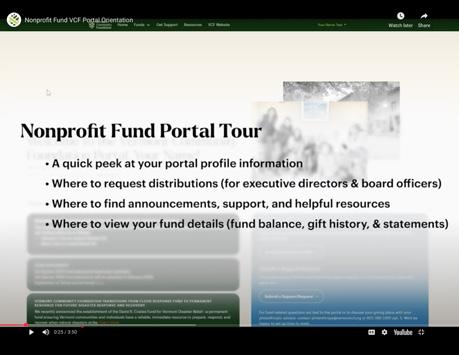
Nonprofit funds are viewed on our secure online portal. Access the portal by visiting vermontcf.org/donor-portal, where you can access detailed fund information—including the current balance and fund statements— submit distribution requests, and view distribution and gift history. More instructions and helpful tutorial videos can be found at vermontcf.org/donor-portal-resources
If you would like to give portal access to other staff or board members, please contact us through the support request form. We’ll set up their access for you, including view-only permissions if appropriate. Likewise, if someone is no longer with your organization, just let us know so we can remove their
A
Vermont Community Foundation Nonprofit Fund is established by a 501c(3) nonprofit organization using its own assets.
Additions to the Fund
Your organization may add to the fund at any time. If your organization would like to add a complex gift (such as real estate, closely-held securities, insurance policies, tangible personal property, or bequests) to the fund, please contact us to determine what support we can provide. Below are two important guidelines:
1. Gifts to a Nonprofit Fund From Private Donors
By definition, a Vermont Community Foundation Nonprofit Fund is established by a 501c(3) nonprofit organization using its own assets.
As a general rule, the source of all gifts to a nonprofit fund should be the nonprofit itself. However, there may be times when a gift intended for a nonprofit fund comes directly to the Foundation from a private donor. Two common examples of this are when anonymity is requested by the donor, or when the nonprofit is not able to process a stock gift. For accounting purposes, the Foundation will consider such gifts as coming directly from the nonprofit, and they should be reflected as such on the nonprofit’s financial statements. If the Foundation has knowledge of a private donor gift intending to be added to the nonprofit fund, the Foundation will contact the nonprofit to confirm that it wishes to have the gift added to the fund. If the gift is anonymous, the Foundation will not reveal the donor’s name to the nonprofit.
2. Fundraising
We recognize that a nonprofit fund at the Foundation is a valuable part of an organization’s operating budget. Please remember that legal restrictions prevent your organization from fundraising on behalf of the nonprofit fund itself. Your fundraising efforts must be conducted on behalf of your organization. Once you have processed all of your fundraising gifts, the Foundation will gladly accept the collective amount in one gift for your fund.
“The spending policy aims to grow the fund over the long term while supporting annual distributions, fees, and inflation.”
Spending Policy Calculations and Distributions from the Fund
The Foundation calculates annual distribution amounts according to a spending policy. The spending policy aims to grow the fund over the long term while supporting annual distributions, fees, and inflation.
To determine the annual distribution amount for your fund, in late January each year the Foundation calculates the average value of the fund over the past 36 months and applies a percentage (currently 5%) to that value. That amount is then available to your organization.
Please note that past investment performance is no guarantee of future results. Individual fund performance results will vary and the annual distribution amount may invade the original value of contributions to the fund based on actual performance.
Spending policy calculation for new funds
• First Year: At the end of the first year in which the establishing assets were received, we take the average of the fund balances (of the months during which the fund was invested) and apply the spending policy rate (currently 5%). For the first-year calculation, the month(s) in the quarter when the fund was not invested are not counted in averaging the fund balance.
• Second and Following Years: We calculate the average of the fund balance since the quarter in which the fund was established. We then apply the spending policy rate.
When a nonprofit fund is established, the fund is placed on either of the following two options, as requested by the nonprofit:
1. Automatic Reinvestment of Annual Spending Policy Calculations
• We will represent to you the amount of the Annual Spending Policy Calculation on your year-end fund statement produced in the first week of February.
• This Calculation (also known as Distribution Amount) is reinvested automatically and is shown to you in Reinvested Distributions on the VCF portal and on your quarterly fund statements.
• Reinvested Distributions are available for distribution at any time in the future using a simple request form found on the VCF portal.
• This is a good option for nonprofits who want to let the fund grow before taking a distribution.
2. Automatic Distribution of Annual Spending Policy Calculations
• We will represent to you the amount of the Annual Spending Policy Calculation on your year-end fund statement produced in the first week of February.
• This Calculation (also known as Distribution Amount) is removed from the investment pool and then automatically distributed to you in the form of a check at the end of February each year. There is no need to make an annual request.
• This is an efficient option for nonprofits who know the distribution from the fund will be needed on an annual basis.
• You can request a change in option at any time—the fund is never locked into one option or the other. Please make your request in writing.
Please note that all distributions will be made to the establishing organization for the purpose stated in the fund agreement. If the organization has more than one fund at the Foundation, distributions may not be made from one fund directly to another.
The Foundation will perform regular due diligence before making a distribution from a fund. This means that we will confirm on GuideStar, an online source of nonprofit information, that your organization is in good standing with the IRS. For nonprofit endowment fundholders, there may be a time when your organization wants to request a distribution that is more than the annual spending policy calculation. Please contact us to discuss the options and related process.
Submitting Distribution Requests
Distribution requests can be submitted through the VCF portal by the nonprofit organization’s Executive Director and a Board Officer, or two Board Officers. If you need to request access to the portal for your organization’s nonprofit fund, please contact us at philanthropy@vermontcf.org
For instructions on how to submit a request, please visit vermontcf.org/ fundholder-resources for portal user guides and video tutorials.
For instructions on how to submit a distribution request, please visit vermontcf. org/fundholderresources for portal user guides and video tutorials.
A NOTE ABOUT DESIGNATED FUNDS
Your organization may be the beneficiary of a donor designated fund at the Foundation. A designated fund is established by a donor and names your organization as the recipient of automatic annual distributions that support your programs and operations in perpetuity. Your organization may not modify the distribution schedule set by the Foundation and does not have access to amounts beyond the annual spending policy calculation unless specifically written into the fund agreement by the donor at the time the fund was established. Please let us know if you have questions regarding this fund type.
Fund Statements
Fund statements are uploaded quarterly to VCF Portal approximately four weeks after the end of the quarter. The announcements on the home page of the portal will be updated when statements have been posted. Please contact us if you would like access to the portal.
Why it does it take approximately four weeks after the end of the quarter to finalize fund balances?
The VCF Core Investment Pool has diversified portfolio and as a result we rely on multiple investment managers to report back to us before we are able to close our books for the month. In some cases these investments are in vehicles that require additional time for the managers to evaluate and place a valuation on the underlying investment. We rely on these valuations to value our own pool. Once we are able to gather all this data, reconcile it to our system, and allocate earnings amongst the funds in the pool, we are then able to report this information out to our fundholders.
Investments at the Vermont Community Foundation
The Vermont Community Foundation invests for lasting impact—balancing today’s needs with long-term sustainability. Our approach combines a diversified Core Investment Pool with Vermont-focused mission investments, creating opportunities for greater philanthropic impact. Together, these strategies complement grantmaking and help ensure we can respond to emerging needs.
Investment Objective and Strategy
Our objective is to keep grantmaking power growing by targeting returns that outpace inflation, fees, and a sustainable rate of grantmaking from the fund, all while carefully managing risk through a diversified portfolio. Our strategy stays steady through the ups and downs of the market, focusing on longterm goals, rather than short-term swings—so your fund can keep making an impact over time.
Investment Management
Our investment program is guided by a dedicated investment committee, a sub-committee of the board made up of board members and other experienced local professionals who bring deep expertise and a strong commitment to Vermont. The committee works closely with Foundation staff, the board, and our investment consultant, Crewcial Partners, to review asset allocation, monitor performance, and select managers. Crewcial specializes in advising foundations and nonprofits, providing comprehensive world-class investment and portfolio management. Together, this team ensures your fund is managed with care, transparency, and a focus on maximizing your philanthropy for the long term.
“The Vermont Community Foundation invests for lasting impact— balancing today’s needs with long-term sustainability.”
For more information regarding investments at the Foundation, please visit vermontcf.org/ investments or call us at 802-388-3355.
Vermont Community Foundation Core Investment Pool
The VCF Core Investment Pool is designed to deliver strong, long-term financial returns while investing in companies that demonstrate responsible practices toward the environment, communities, and leadership. We combine low-cost, passively screened investments with carefully chosen active managers who focus on both financial performance and positive social impact.
This approach reflects the VCF’s commitment to strengthening civil society, protecting natural resources, supporting community vitality, and promoting economic resilience. Our investment managers are selected based on their ability to deliver solid returns while aligning with these core values.
The pool is regularly evaluated through both quantitative data and thoughtful qualitative analysis to ensure it continues to meet our standards for financial results and social responsibility. Crewcial uses their proprietary scoring framework to assess investment managers and portfolio holdings, with a focus on climate impact, energy transition, and diverse leadership. This added layer of insight strengthens alignment with the Foundation’s values and helps guide conversations with managers about how their investments can contribute to a more just and sustainable future.
Mission Investing
Since 2001, the Vermont Community Foundation has been a leader in committing a portion of managed funds to mission investing—using assets to create positive social and environmental impact. When you have a fund with us, five percent of your assets are invested in the Vermont Investment Pool. This means your investment is actively helping revitalize downtowns, create affordable housing, support local businesses, promote clean energy, sustain the working landscape, and create jobs across Vermont.
Mission investing at VCF delivers a return that is far more than just financial. These investments work alongside grantmaking to close the opportunity gap and build stronger, more equitable communities, creating real change across Vermont.
For more information regarding investments at the Foundation, please visit vermontcf.org/investments or call us at 802-388-3355.
Protection of Nonprofit Fund Assets
The Foundation places a high priority on protecting the assets of all our component funds, including both types of Nonprofit Funds. Annually, the Foundation undergoes a financial audit, files our IRS Form 990 and is certified in Community Foundation National Standards. These specific activities help ensure the Foundation is following best practices of accounting, legal, and industry standards. In addition, the Foundation strives to have superior due diligence and monitoring policies for all of our assets including our investment pools. As it relates to investments, the Foundation has an investment committee and a third-party, independent investment consultant that helps management oversee this critical work. Our investment due diligence includes manager site visits, review of third party service providers used by our managers (custodians, administrators, auditors), valuation methodology reviews, and timely reconciliations of all accounts. Finally, the Foundation continually updates its internal controls and risk management policies to ensure that they mitigate risk and provide for a strong control environment. All of these practices combined ensure that the assets of the Foundation are protected now and into the future.
For information on how the Uniform Prudent Management of Institution Funds Act (UPMIFA) impacts a nonprofit fund, please see Appendix E .
“All of these practices combined ensure that the assets of the Foundation are protected now and into the future.”
Accounting for a Nonprofit Fund
When a nonprofit organization establishes a nonprofit fund with the Foundation, there are specific accounting standards that the nonprofit must follow.
Specifically, FASB ASC 958 (Financial Accounting Standards Board – Accounting Standards Codification topic #958) – Not-for-Profit Entities, defines the way the Vermont Community Foundation financially accounts for the Nonprofit Endowment and Reserve Funds. Note that the accounting treatment and legal treatment differ. We recommend nonprofits review the accounting and legal treatment with a qualified professional.
Existing Guidance
FASB ASC 958-605-25-33 and 958-605-55-110 provide accounting guidance in the case where a nonprofit entity transfers assets to a community foundation and specifies itself or its affiliate as the beneficiary of the assets. The transaction is deemed to be reciprocal because, at the time of the transfer, the nonprofit entity expects to receive future distributions. By acceptance of the transfer, the community foundation agrees to make distributions to the nonprofit entity. Due to this reciprocity, the nonprofit entity recognizes an asset and the community foundation recognizes a liability. The nonprofit is transferring its assets to the community foundation in exchange for future distributions. The community foundation, by its acceptance of the transfer, agrees that at the time of the transfer distributions to the nonprofit are capable of fulfillment and consistent with the foundation’s mission. Below are the entries FASB ASC suggests.
Accounting Entries for the Nonprofit Entity
We recommend that the accounting treatment be discussed with an accounting professional and have provided the suggested entries to record the transaction as outlined in FASB ASC 958.
Example #10 in FASB ASC 958-605-55 paragraphs 106-110 demonstrates that upon the transfer of assets to a community foundation, the nonprofit entity recognizes an asset on its books as a beneficial interest in assets held by the community foundation. Therefore, the following entry would be made upon transfer:
Creation of the Fund – Nonprofit Entity Books
Debit Beneficial Interest in Assets Held by Community Foundation Credit Cash/Investment
In addition, FASB 958-605-50-6 requires the nonprofit to disclose in its financial statements:
1. The identity of the community foundation
2. The terms under which the community foundation will distribute amounts to the nonprofit
3. A description of variance power granted to the community foundation
4. The aggregate amount reporting in the statement of financial position and how that amount is described
Fund Distributions During the Period – Nonprofit Entity Books
As the community foundation makes distributions to the nonprofit entity, the following entries are made on the nonprofit’s books:
Debit Cash
Credit Investment Income
• Distribution received from assets held at community foundation
Debit Beneficial Interest in assets held at community foundation
Credit Gain or Loss
• To adjust for changes in present value of expected cash flows –debit and credit could be reversed
Overview of Nonprofit Fund Types
There are two types of funds that the Foundation offers to Vermont nonprofit organizations: the Nonprofit Endowment Fund and the Nonprofit Reserve Fund. The main difference between these two fund types is your organization’s access to the assets in the fund. Below is a comparison chart that outlines the differences.
Nonprofit Endowment Fund
Description: A fund designed for nonprofit organizations that want to protect medium to long-term assets while receiving relatively even annual distributions, and that see value in having the Foundation limit access to the fund balance.
Nonprofit Reserve Fund
A fund designed for nonprofit organizations that want to protect medium to longterm assets while receiving relatively even annual distributions, but that also desire the flexibility of access to the full balance of the fund.
Ownership of Assets in the Fund:
The fund’s establishing assets and all subsequent additions to the fund become the property of the Vermont Community Foundation. A community foundation cannot manage assets it does not own.
Supporting Fees: 1.00% of the fund’s market value annually. The minimum fee is $250. The minimum fee will be assessed to funds with balances below $25,000.
Investment Fees: The Foundation incurs third-party investment related costs that are netted out of investment results before fund balances are reported to the fundholder. These costs currently range from .50%-.60%. These third party fees are subject to change based on the underlying asset allocation and fees charged by the third party managers, consultants, and custodians.
Establishing Assets and Subsequent Additions to the Nonprofit Fund:
Establishing assets and additions to the fund must be the property of the nonprofit before transfer to the fund. The Foundation will accept cash in the form of check or wire transfer. Please contact us if you have questions on other forms of additions to the fund.
Same as Nonprofit Endowment Fund
Same as Nonprofit Endowment Fund
Same as Nonprofit Endowment Fund
Same as Nonprofit Endowment Fund
Annual Spending Policy Amount:
Nonprofit Endowment Fund
Currently 5% of the fund’s 36-month rolling average balance is used to calculate the fund’s annual distribution amount. The spending policy for each investment pool is reviewed and set annually by the Foundation’s Board of Directors.
Please note that past investment performance is no guarantee of future results. Individual performance results will vary and the annual distribution amount may invade the original value of contributions to the Fund based on actual performance.
Same as Nonprofit Endowment Fund
How Are Regular Annual Distributions From the Fund Made?
Access to the Fund Balance Beyond the Annual Spending Policy Amount:
The annual spending policy calculation amount is represented in the year-end fund statement. If you have chosen “Automatic Distribution” for the fund, the distribution check will be mailed to you at the end of February. Your organization may choose to put this amount on Automatic Reinvest.
Distributions beyond the annual spending policy calculation amount can be made in circumstances of financial emergency or extreme need, upon submission of a resolution and request of the organization’s board and at the discretion of the Foundation’s board and staff.
At any time, using a distribution request form signed by both the Executive Director and an officer of the board, the organization may request distribution (minimum $250) amounts that were reinvested in past years without the above mentioned criteria or review process. Distributions are typically made within two weeks of the approval for the distribution.
Same as Nonprofit Endowment Fund
Minimum Distribution That Can Be Requested by the Organization:
Services Included With Your Nonprofit Fund:
$250
• Professional investment management
• Planned giving and endowment planning assistance
• Administration of additions to and distributions from the fund
• Quarterly fund statements
• VCF Portal, which provides the ability to view your fund(s) online
Using a distribution request form signed by both the Executive Director and an officer of the board, requests for distributions (minimum $250) may be made up to the full balance of the fund. The distributions are made at the discretion of the Foundation, and are subject to a review process by staff to ensure that the distribution will be used according the purpose of the fund.
Same as Nonprofit Endowment Fund
Same as Nonprofit Endowment Fund
Frequently Asked Questions About Your Fund
Q. What is the difference between a Nonprofit Endowment Fund and a Nonprofit Reserve Fund?
A. The difference is the process by which your organization may access the fund assets beyond the annual spending amount. Both fund types receive an annual spending amount that is available for distribution to your organization. The amount is based on a carefully-calculated formula called a spending policy—currently set at 5% of the average balance of the fund over the last 36 months.
For a Nonprofit Endowment Fund, fund assets beyond the annual spending amount may only be accessed in circumstances of financial emergency or extreme need; and then only at the request of the organization’s board and at the discretion of the Community Foundation. This fund type is suitable for organizations that intend to maintain assets in perpetuity, while providing annual support for programs and operations.
For a Nonprofit Reserve Fund, fund assets beyond the annual spending amount may be accessed without having to demonstrate circumstances of financial emergency or extreme need. Additional distributions are requested by the organization and are made at the discretion of the Foundation. Due to the nature of the investment pools, please note that this fund is not intended to be used as a “charitable checking account.” This fund type is suitable for organizations that intend to maintain assets in perpetuity, but want to have flexibility in accessing the entire fund balance.
Q. My organization currently has a Nonprofit Endowment Fund with the Foundation. Can we convert it to a Nonprofit Reserve Fund?
A. No. Once a fund is established, the original terms of a fund agreement cannot be rewritten to another type of fund. However, an organization may choose to establish a new Nonprofit Reserve Fund.
Q. Can my organization have both a Nonprofit Endowment Fund and a Nonprofit Reserve Fund?
A. Absolutely! Organizations may have both types of funds.
Q. What happens if our organization loses our nonprofit status or goes out of business?
A. In the event that your organization ceases to exist, loses its nonprofit status, or the original purpose of the fund becomes irrelevant, the Community Foundation board maintains “variance power” (a requirement of all community foundations) to change the beneficiary or purpose of the fund. Your organization may designate a “contingency” beneficiary organization or field of interest in the Variance Power section of the fund agreement when establishing the fund.
Q. Why are the assets of the fund required to become the property of the Foundation?
A. Per Securities and Exchange Commission regulations, a community foundation cannot manage assets that it does not own because community foundations are not registered investment advisors. A community foundation must demonstrate that
it retains legal ownership of the assets it invests, manages, and administers.
Q. My organization has a nonprofit endowment fund and would like to request a distribution larger than the annual spending policy calculation.
A. Please contact the Foundation to discuss your situation and we will determine what support we can provide.
Q. Does my nonprofit need to have an investment policy? What if our board has already adopted one?
A. No. Organizations with nonprofit funds at the Foundation do not need an investment policy. As a component fund of the Foundation, our investment policy will apply to your nonprofit fund.
Q. What happens to our nonprofit fund if the Vermont Community Foundation dissolves?
A. The Foundation’s Articles of Association provide that if it was determined that no other Vermont public charity could perform the role of the Foundation and steward its nonprofit funds, then the assets of those funds would be distributed to the organizations that established them.
Q. Can my organization use the assets of the nonprofit fund as collateral in a financial obligation?
A. No, the assets of the fund are the legal property of the Foundation and may not be bound in financial obligations.
Who To Contact
For questions on administration of nonprofit funds: Lydia Brownell, Director of Fund Administration lbrownell@vermontcf.org or 802-388-3355 ext. 227
For questions on our Planned Giving Partnership Program and other services offered to nonprofits: Philanthropy Team philanthropy@vermontcf.org 802-388-3355 opt. 5
Please let us know about a change in: The status of your organization or if the organization name changes (we will change the name of the fund accordingly) Contact information for staff and board members that are connected to the nonprofit fund
Resolutions of the Board to Establish a Nonprofit Endowment Fund at the Vermont Community Foundation
WHEREAS, the Board of Directors (or Board of Trustees) (the “Board”) of , a 501(c)(3) corporation under the nonprofit corporation law of the State of Vermont, (the “Nonprofit”) wishes to establish a fund at The Vermont Community Foundation, Inc. (“VCF”);
RESOLVED, that the Board hereby authorizes and directs the officers of the Nonprofit to establish the Fund (“the Fund”) within the VCF;
FURTHER RESOLVED, that the officers are hereby authorized and directed to transfer $ to the VCF to establish the Fund, to become the property of the VCF and to be managed according to the provisions outlined in the Agreement establishing the Fund within the VCF, asummary of the material terms of which (or a copy of which) has been previously circulated to the Board;
FURTHER RESOLVED, that the Board acknowledges that the Fund will be invested in the VCF Core Investment Pool. The Board has read the Investments at the Vermont Community Foundation and acknowledges the risks associated with that Pool. The Board acknowledges that past investment performance is no guarantee of future results and that individual performance results will vary, and the annual distribution amount may invade the original value of contributions to the Fund based on actual performance;
FURTHER RESOLVED, that in establishing the Fund, the Board recognizes that (i) the VCF is the legal owner of all assets contributed to the Fund and that the Fund is not a separate trust, (ii) in accordance with the spending policy in effect as set by the Board of Directors of the VCF, the VCF will, on an annual basis, calculate a percentage of the market value of the Fund which will be available to the Nonprofit for distribution, (iii) the spending policy rate (currently 5%) set by the VCF is subject to change and that the spending policy permits the application of the spending rate to the Fund;
FURTHER RESOLVED, that the officers of the Nonprofit are authorized to represent to the VCF as follows: The assets transferred to the Vermont Community Foundation to establish the Fund are freely transferrable by the Nonprofit and are designated or restricted as follows:
Board designated (the Board designates money in the Nonprofit’s possession that is not previously restricted for a specific purpose); or
Donor restricted (the Board transfers money in the Nonprofit’s possession that is previously restricted by a donor, or donors, for a specific purpose) as follows:
Officer of the Board:
By checking this box, I hereby represent that I am an authorized officer of the Board of the Nonprofit and intend to legally bind the Nonprofit to the terms of this document and agree that such action on my part constitutes my legally binding signature, binding in the same manner and in all respects as if I had executed this document in writing.
Name:
Title:
Date:
Resolutions of the Board to Establish a Nonprofit Reserve Fund at the Vermont Community Foundation
WHEREAS, the Board of Directors (or Board of Trustees) (the “Board”) of , a 501(c)(3) corporation under the nonprofit corporation law of the State of Vermont, (the “Nonprofit”) wishes to establish a fund at The Vermont Community Foundation, Inc. (“VCF”);
RESOLVED, that the Board hereby authorizes and directs the officers of the Nonprofit to establish the Fund (“the Fund”) within the VCF;
FURTHER RESOLVED, that the officers are hereby authorized and directed to transfer $ to the VCF to establish the Fund, to become the property of the VCF and to be managed according to the provisions outlined in the Agreement establishing the Fund within the VCF, a summary of the material terms of which (or a copy of which) has been previously circulated to the Board;
FURTHER RESOLVED, that the Board authorizes and directs the officers to request that the contributions (both original and subsequent) to the Fund be invested in the VCF’s Pool. The Board has read the Investments at the Vermont Community Foundation brochure and acknowledges the risks associated with each investment pool. The Board acknowledges that past investment performance is no guarantee of future results and that individual performance results will vary, and the annual distribution amount may invade the original value of contributions to the Fund based on actual performance;
FURTHER RESOLVED, that the officers are authorized to request from time to time, but not more than once per calendar year, that the VCF reallocate the Fund’s assets to a different investment pool within the options for nonprofit funds;
FURTHER RESOLVED, that in establishing the Fund, the Board recognizes that (i) the VCF is the legal owner of all assets contributed to the Fund and that the Fund is not a separate trust, (ii) in accordance with the spending policy in effect as set by the Board of Directors of the VCF, the VCF will, on an annual basis, calculate a percentage of the market value of the Fund which will be available to the Nonprofit for distribution, (iii) the spending policy rate (currently 5%) set by the VCF is subject to change and that the spending policy permits the application of the spending rate to the Fund;
FURTHER RESOLVED, that the Nonprofit’s Executive Director and an officer of the Nonprofit’s Board (or, in the absence of an Executive Director, two officers of the Board) will be authorized to request additional distributions (i.e., those beyond the annual spending policy calculation and up to the full amount of the Fund) from the Fund. At the time of the establishment of the Fund, these two positions are held by:
Executive Director:
Officer of the Board:
Title:
Second Officer of the Board (In the absence of an Executive Director):
Title:
FURTHER RESOLVED, that the officers of the Nonprofit are authorized to represent to the VCF as follows:
The assets transferred to the Vermont Community Foundation to establish the Fund are freely transferrable by the Nonprofit and are designated or restricted as follows:
Board designated (the Board designates money in the Nonprofit’s possession that is not previously restricted for a specific purpose); or
Donor restricted (the Board transfers money in the Nonprofit’s possession that is previously restricted by a donor, or donors, for a specific purpose) as follows:
Officer of the Board:
By checking this box, I hereby represent that I am an authorized officer of the Board of the Nonprofit and intend to legally bind the Nonprofit to the terms of this document and agree that such action on my part constitutes my legally binding signature, binding in the same manner and in all respects as if I had executed this document in writing.
Name:
Title:
Date:
Nonprofit Endowment Fund Agreement
Establishing The Fund within The Vermont Community Foundation, Inc
This Agreement is between the , a 501(c)(3) corporation under the nonprofit corporation law of the State of Vermont, with its principal location at , Vermont (the “Nonprofit”), and the Vermont Community Foundation, Inc. (“VCF”), a corporation organized under the nonprofit corporation law of Vermont with its principal location at Middlebury, Vermont.
WHEREAS, the parties have a common interest in the charitable and educational needs of the State of Vermont; and
WHEREAS, each party is classified under the Internal Revenue Code as a qualified charitable organization (as defined herein); and
WHEREAS, the Nonprofit, to encourage and enhance contributions, ensure perpetual continuity and provide for professional investment management, has determined by resolution of its board of directors to establish a fund within the VCF (hereinafter referred to as the “Fund”) designated solely and exclusively to support the charitable purposes, programs and operations of the Nonprofit.
NOW, THEREFORE, in consideration of the mutual covenants contained herein, the parties agree as follows:
1. Establishment of Fund. The Fund shall be established on the books of the VCF. The VCF acknowledges receipt of the property listed in Schedule “A” attached hereto and made a part hereof as the initial property of the Fund.
2. Property of the Fund. The Fund shall include the property received herewith, such property as may from time to time be transferred to the VCF by the Nonprofit for inclusion in the Fund, such property as may from time to time be transferred from any other source for inclusion in the Fund and accepted, in accordance with the gift acceptance policy of the VCF, as amended from time to time, and all undistributed earnings and appreciation on or from the foregoing property. The Fund shall be the exclusive property of the VCF, held by it in its corporate capacity and shall not be deemed a trust fund held by it in a trustee capacity. The VCF shall have the ultimate authority and control over all property in the Fund, and the earnings and appreciation derived there from, in accordance with the Articles of Incorporation and By-laws of the VCF (as they may be amended from time to time), and the terms of this Agreement applied in a manner not inconsistent with said Article and By-laws. Notwithstanding any other terms of this Agreement, at any time and from time to time the VCF may expend all or as much of the Fund as the VCF deems appropriate in the exercise of its sole and absolute discretion and in furtherance of the purpose for which the Fund was established.
3. Annual Distributions. In accordance with the spending policy in effect as set by the Board of Directors of the VCF (the “Board”), the VCF will, on an annual basis, calculate a percentage of the market value of the Fund (the “Amount”) which will be available to the Nonprofit for distribution. The Amount will be communicated to the Nonprofit at the beginning of each fiscal year of the VCF. Please see Schedule C attached.
4. Other Distributions. In the sole and absolute discretion of the VCF, distributions more than the Amount may be made to the Nonprofit within thirty (30) days after the vote of the board of directors of the Nonprofit after a finding by it of a financial emergency or circumstances of extreme need and then only for those purposes for which the fund of the Nonprofit was originally established by it. The Nonprofit shall be responsible for such applications. Requests by the Nonprofit for distributions more than the Amount shall be solely advisory and not binding on the VCF.
5. Request for Redistribution. At any time following the date of this Agreement, the Nonprofit may request (or the VCF may decide) that the Fund be returned to the Nonprofit. Requests for return of the Fund by the Nonprofit shall be solely advisory and not binding on the VCF. A decision by the VCF to return the Fund will be made if circumstance so occur that, in the sole and absolute discretion of the Board, make it desirable and in the best interest of the Nonprofit and/or the VCF for the funds to be returned. The VCF may make such transfers provided that the Board is satisfied that the transferee is at the time a tax-exempt charitable organization operating within Vermont and described in Section 501(c)(3) of the Internal Revenue Code (the “Code”) and publicly supported and not a private foundation within the meaning of Section 509(a) of the Code, and that the transferee will thereafter apply the Fund only for the charitable purposes set forth in this Agreement.
6. Variance Power.
a. This Agreement is subject to the VCF’s authority to vary the terms of the gift. Consistent with Section 5.8 of its By-Laws, whenever the Board decides that conditions or circumstances are such or have so changed since a restriction by a donor as to purpose, manner of distribution, or use or investment was imposed, that such restriction or condition is unnecessary, incapable of fulfillment or inconsistent with the charitable needs of the community or area served, the Board may, by affirmative vote of a majority of the Directors, order such variance from the restriction or condition and such application of the whole or any part of the funds, as in its judgment is then necessary to more effectively serve the charitable purposes of the VCF. In the event of any such variance, the Board shall apply the Fund in such manner as to most closely approximate the original purposes of the Fund. No such action of the Board shall require the approval of any investment managers, custodian, or agent of funds of the VCF.
b. If the VCF ceases to be a qualified charitable organization, or if the Board entertains a proposal to dissolve, the assets of the Fund shall, after payment or making provision for payment of any liabilities properly chargeable to the Fund, be distributed to the Nonprofit. If the Nonprofit is not then a qualified charitable organization, said assets shall be distributed in such manner and to such organization or organization in the Vermont community as satisfies the requirements of a qualified charitable organization and serves purposes like those of the Nonprofit.
If the Nonprofit ceases to be a qualified charitable organization, the VCF shall thereafter distribute the Amount to: (organization name or field of interest). If the preceding space is left blank, the VCF will distribute the Amount to a qualified charitable organization with a similar mission and within a similar geographic area.
7. Definitions and Construction.
a. As used in this Agreement-
1. “Qualified charitable organization” means an organization described in section 501(c)(3) of the Code which is other than a private foundation described in section 509(a) of the Code.
2. References to any provision of the Internal Revenue Code shall be deemed references to the U.S. Internal Revenue Code of 1986, as the same may be amended from time to time, and the corresponding provision of any future U.S. Internal Revenue Code.
b. It is intended that the Fund shall be a component part of the VCF and that nothing in this Agreement shall affect the status of the VCF as an entity which is a qualified charitable organization. This Agreement shall be interpreted in a manner consistent with the foregoing intention and to conform to the requirements of the Internal Revenue Code and any regulations issued pursuant thereto applicable to the intended status of the VCF.
8. Entire Agreement. This Agreement contains the entire understanding between the parties with respect to the fund established hereby and supersedes all prior agreements, written and oral, with respect to the subject matter of this Agreement.
9. Fees. The VCF shall assess the Fund a supporting fee reasonable to the effective adminis-tration of the Fund. Please see Schedule B attached.
IN WITNESS WHEREOF, the Parties hereto have executed this Agreement by their duly authorized officers.
Nonprofit I hereby represent the Nonprofit’s intent to be legally bound by the terms of this Agreement (once accepted by the VCF).
Name:
Title:
Date:
Name:
Title:
Date:
All pages of this Agreement must be submitted together. This Agreement is binding on all parties only when signed by VCF in acceptance of this Fund.
Vermont Community Foundation, Inc.
Schedule A
In consideration of one or more Dollars
Schedule B
At the time of the establishment of the Fund, the VCF fees are as follows:
1. Supporting fee: 1.00% annually
Minimum annual fee of $250 assessed to funds with balances below $25,000. Fund holders will be notified of any changes in the supporting fee.
2. Third-Party Investment management fees: VCF incurs third-party investment related costs that are netted out of investment results before fund balances are reported to the Fundholder. These costs reflect professional investment management and consultant services and custody of VCF’s assets. These third-party fees are subject to change based on the underlying asset allocation and fees charged by the third-party managers, consultants, and custodians. Please refer to the Investments Brochure on VCF’s website for current investment management.
Schedule C
Annual Distributions: Currently, the Spending Policy rate is 5% of the Fund’s 36-month rolling average balance and is used to calculate the Fund’s Annual Distribution Amount. The Spending Policy rate for each investment pool is reviewed and set annually by the Board of Directors of the VCF.
Please note that past investment performance is no guarantee of future results. Individual performance results will vary, and the Annual Distribution Amount may invade the original value of contributions to the Fund based on actual performance.
Nonprofit Reserve Fund Agreement
Establishing The Fund within The Vermont Community Foundation, Inc
This Agreement is between the , a 501(c)(3) corporation under the nonprofit corporation law of the State of Vermont, with its principal location at , Vermont (the “Nonprofit”), and the Vermont Community Foundation, Inc. (“VCF”), a corporation organized under the nonprofit corporation law of Vermont with its principal location at Middlebury, Vermont.
WHEREAS, the parties have a common interest in the charitable and educational needs of the State of Vermont; and
WHEREAS, each party is classified under the Internal Revenue Code as a qualified charitable organization (as defined herein); and
WHEREAS, the Nonprofit, to encourage and enhance contributions, ensure perpetual continuity and provide for professional investment management, has determined by resolution of its board of directors to establish a fund within the VCF (hereinafter referred to as the “Fund”) designated solely and exclusively to support the charitable purposes, programs and operations of the Nonprofit.
NOW, THEREFORE, in consideration of the mutual covenants contained herein, the parties agree as follows:
1. Establishment of Fund. The Fund shall be established on the books of the VCF. The VCF acknowledges receipt of the property listed in Schedule “A” attached hereto and made a part hereof as the initial property of the Fund.
2. Property of the Fund. The Fund shall include the property received herewith, such property as may from time to time be transferred to the VCF by the Nonprofit for inclusion in the Fund, such property as may from time to time be transferred from any other source for inclusion in the Fund and accepted, in accordance with the gift acceptance policy of the VCF, as amended from time to time, and all undistributed earnings and appreciation on or from the foregoing property. The Fund shall be the exclusive property of the VCF, held by it in its corporate capacity and shall not be deemed a trust fund held by it in a trustee capacity. The VCF shall have the ultimate authority and control over all property in the Fund, and the earnings and appreciation derived there from, in accordance with the Articles of Incorporation and By-laws of the VCF (as they may be amended from time to time), and the terms of this Agreement applied in a manner not inconsistent with said Article and By-laws. Notwithstanding any other terms of this Agreement, at any time and from time to time
the VCF may expend all or as much of the Fund as the VCF deems appropriate in the exercise of its sole and absolute discretion and in furtherance of the purpose for which the Fund was established.
3. Annual Distributions. In accordance with the spending policy in effect as set by the Board of Directors of the VCF (the “Board”), the VCF will, on an annual basis, calculate a percentage of the market value of the Fund (the “Amount”) which will be available to the Nonprofit for distribution. The Amount will be communicated to the Nonprofit at the beginning of each fiscal year of the VCF. Please see Schedule C attached.
4. Other Distributions. In the sole and absolute discretion of the Foundation, distributions in excess of the Amount may be made to the Corporation. Requests for such distributions may be made to the Foundation by the Executive Director and an officer of the board of the Corporation. Requests of the Corporation shall be solely advisory and not binding on the Foundation.
5. Variance Power.
a. This Agreement is subject to the VCF’s authority to vary the terms of the gift. Consistent with Section 5.8 of its By-Laws, whenever the Board decides that conditions or circumstances are such or have so changed since a restriction by a donor as to purpose, manner of distribution, or use or investment was imposed, that such restriction or condition is unnecessary, incapable of fulfillment or inconsistent with the charitable needs of the community or area served, the Board may, by affirmative vote of a majority of the Directors, order such variance from the restriction or condition and such application of the whole or any part of the funds, as in its judgment is then necessary to more effectively serve the charitable purposes of the VCF. In the event of any such variance, the Board shall apply the Fund in such manner as to most closely approximate the original purposes of the Fund. No such action of the Board shall require the approval of any investment managers, custodian, or agent of funds of the VCF.
b. If the VCF ceases to be a qualified charitable organization, or if the Board entertains a proposal to dissolve, the assets of the Fund shall, after payment or making provision for payment of any liabilities properly chargeable to the Fund, be distributed to the Nonprofit. If the Nonprofit is not then a qualified charitable organization, said assets shall be distributed in such manner and to such organization or organization in the Vermont community as satisfies the requirements of a qualified charitable organization and serves purposes like those of the Nonprofit.
c. If the Nonprofit ceases to be a qualified charitable organization, the VCF shall thereafter distribute the Amount to: (organization name or field of interest). If the preceding space is left blank, the VCF will distribute the Amount to a qualified charitable organization with a similar mission and within a similar geographic area.
6. Definitions and Construction.
a. As used in this Agreement-
1. “Qualified charitable organization” means an organization described in section 501(c)(3) of the Code which is other than a private foundation described in section 509(a) of the Code.
2. References to any provision of the Internal Revenue Code shall be deemed references to the U.S. Internal Revenue Code of 1986, as the same may be amended from time to time, and the corresponding provision of any future U.S. Internal Revenue Code.
b. It is intended that the Fund shall be a component part of the VCF and that nothing in this Agreement shall affect the status of the VCF as an entity which is a qualified charitable organization. This Agreement shall be interpreted in a manner consistent with the foregoing intention and to conform to the requirements of the Internal Revenue Code and any regulations issued pursuant thereto applicable to the intended status of the VCF.
7. Entire Agreement. This Agreement contains the entire understanding between the parties with respect to the fund established hereby and supersedes all prior agreements, written and oral, with respect to the subject matter of this Agreement.
8. Fees. The VCF shall assess the Fund a supporting fee reasonable to the effective administration of the Fund. Please see Schedule B attached.
IN WITNESS WHEREOF, the Parties hereto have executed this Agreement by their duly authorized officers.
Nonprofit I hereby represent the Nonprofit’s intent to be legally bound by the terms of this Agreement (once accepted by the VCF).
Type Name:
Title:
Date:
Vermont Community Foundation, Inc.
Type Name:
Title:
Date:
All pages of this Agreement must be submitted together. This Agreement is binding on all parties only when signed by VCF in acceptance of this Fund.
Schedule A
In consideration of One or more Dollars
Schedule B
At the time of the establishment of the Fund, the VCF fees are as follows:
1. Supporting fee: 1.00% annually
Minimum annual fee of $250 assessed to funds with balances below $25,000. Fund holders will be notified of any changes in the supporting fee.
2. Third-Party Investment management fees
VCF incurs third-party investment related costs that are netted out of investment results before fund balances are reported to the Fundholder. These costs reflect professional investment management and consultant services and custody of VCF’s assets. The costs vary by investment pool based on the underlying investment managers. These third-party fees are subject to change based on the underlying asset allocation and fees charged by the third-party managers, consultants, and custodians. Please refer to the Investments Brochure on VCF’s website for current investment management.
Schedule C
Annual Distributions: Currently, the Spending Policy rate is 5% of the Fund’s 36-month rolling average balance and is used to calculate the Fund’s Annual Distribution Amount. The Spending Policy rate for each investment pool is reviewed and set annually by the Board of Directors of the VCF.
Please note that past investment performance is no guarantee of future results. Individual performance results will vary, and the Annual Distribution Amount may invade the original value of contributions to the Fund based on actual performance.
Uniform Prudent Management of Institution Funds Act
The following is the summary of the Uniform Prudent Management of Institution Funds Act (UPMIFA) from the State of Vermont website: http://www.leg.state.vt.us/docs/2010/Acts/ ACT009sum.htm.
The full law is at: http://www.leg.state.vt.us/docs/2010/Acts/ACT009.pdf
Because the Foundation is not able to provide legal advice, we are including the following for informational purposes only. To determine the impact of UPMIFA for your organization’s nonprofit fund, please contact your legal counsel to determine the applicability of UPMIFA as it relates to the nonprofit fund held by the Foundation to benefit your organization.
The Uniform Prudent Management of Institutional Funds Act (UPMIFA) was drafted by the National Conference of Commissioners on Uniform State Laws (NCCUSL) over a period of four years and was ultimately recommended for enactment by state legislatures in 2006. UPMIFA is designed to replace the existing Uniform Management of Institutional Funds Act (UMIFA), approved by NCCUSL in 1972.
Both investment in assets and expenditure for charitable purposes have grown exponentially in the 35 years since UMIFA was drafted; asset management theory and practice have also advanced. UPMIFA, as an update and successor to UMIFA, establishes a more unified basis for charitable fund management than UMIFA.
Investment
UPMIFA incorporates the experience gained in the last 35 years under UMIFA by providing stronger guidance for investment management and enumerating a more exact set of rules for investing in a prudent manner. It requires investment “in good faith and with the care an ordinarily prudent person in a like position would exercise under similar circumstances.” It requires prudence in incurring investment costs, authorizing “only costs that are appropriate and reasonable.” Factors to be considered in investing are expanded to include, for example, the effects of inflation. UPMIFA emphasizes that investment decisions must be made in relation to the overall resources of the institution and its charitable purposes. No investment decision may be made in isolation, but must be made in light of the fund’s entire portfolio, and as a part of an investment strategy “having risk and return objectives reasonably suited to the fund and to the institution.” A charitable institution must diversify assets as an affirmative obligation unless “special circumstances” dictate otherwise. Assets must be reviewed within a reasonable time after they come into the possession of the institution in order to conform them to the investment strategy and objectives of the fund. Investment experts, whether in-house or hired for the purpose, are held to a standard of care consistent with that expertise. UMIFA initiated the era of modern portfolio management for charitable institutions.
Charitable institutions will have more precise standards to guide them. Courts will have more precise standards with which to measure prudence in the event of a challenge. The result should be more money for programs supported by charitable funds, including endowments.
Expenditure
UMIFA initiated the concept of total return expenditure of endowment assets for charitable program purposes, expressly permitting prudent expenditure of both appreciation and income and replacing the old trust law concept that only income (e.g., interest and dividends) could be spent. Thus, asset growth and income could be appropriated for program purposes, subject to the rule that a fund could not be spent below “historic dollar value.” UPMIFA builds upon UMIFA’s rule on appreciation, but it eliminates the concept of “historic dollar value.” UPMIFA, instead, provides new guidance on prudence and makes the need for a floor on spending unnecessary. UPMIFA states that the institution “may appropriate for expenditure or accumulate so much of an endowment fund as the institution determines to be prudent for the uses, benefits, purposes and duration for which the endowment fund is established.” Seven criteria guide the institution in its yearly expenditure decisions: “1) duration and preservation of the endowment fund; 2) the purposes of the institution and the endowment fund; 3) general economic conditions; 4) effect of inflation or deflation; 5) the expected total return from income and the appreciation of investments; 6) other resources of the institution; and 7) the investment policy of the institution.” These standards mirror the standards that apply to investment decision making, thus unifying both investment and expenditure decisions more concretely.
Release or Modification of Restrictions
UPMIFA recognizes and protects donor intent more broadly than UMIFA did, in part by providing a more comprehensive treatment of the modification of restrictions on charitable funds. Sometimes a restriction imposed by a donor becomes impracticable or wasteful or may impair the management of a fund. The donor may consent to release the restriction, if the donor is still alive and able to do so, but if the donor is not available, the charity can ask for court approval of a modification of the restriction. Under UMIFA, the only option was to release the restriction. UPMIFA instead authorizes a modification that a court determines to be in accordance with the donor’s probable intention. If the charity asks for court approval of a modification, the charity must notify the attorney general, who may participate in the proceeding.
UPMIFA adds a new provision that allows a charity to modify a restriction on a small (less than $50,000) and old (over 20 years old) fund without going to court. If a restriction has become impracticable or wasteful, the charity may notify the attorney general, wait 60 days, and then, unless the attorney general objects, modify the restriction in a manner consistent with the charitable purposes expressed in any documents that were part of the original gift.
Additional Services That The Foundation Provides To Nonprofits
Philanthropic Advisors
These staff members support Vermont donors and nonprofits by delivering an integrated approach to philanthropy. Each advisor works closely with donors to understand their passions and connect them with the innovative work nonprofits are undertaking.
Planned Giving Partnership
Planned gifts are one of the fastest growing vehicles in philanthropy, yet few nonprofits can afford a staff person for these programs. Organizations that have a nonprofit fund(s) at the Community Foundation can join our planned giving partnership program at no cost. The program provides advice and tools to offer planned gifts to their supporters. The Foundation also manages Charitable Gift Annuities and Charitable Remainder Trusts for nonprofits.
Competitive Grant Rounds
Each year the Foundation awards Community Fund grants around the state that address a broad range of issue areas. This grant process is managed by the Foundation staff and seeks to be responsive to the ever-changing needs of Vermont communities. We also oversee a small number of funds that make grants in specific interest areas. Our philanthropic advisors work with Vermont nonprofits to help them determine the best available grant opportunities.
Please feel free to contact our Philanthropy Team at philanthropy@vermontcf.org or 802-388-3355 opt. 5.