


December 2025 Volume 27 Issue 2

Palo Alto High School senior Amalia Tormala attempts to chip a press pass out of an ice block alongside various “frozen” student press freedom related pins in a photo taken by Editor-in-Chief Kensie Pao. Breaking the ice represents efforts to combat the “chilling effect.”
Publication policy
Verde Magazine, a news and features magazine published by the students in Palo Alto High School’s Magazine Journalism class, is a designated open forum for student expression and discussion of issues of concern to its readership. Verde is distributed to its readers and the student body at no cost.
Letters to the editors
The staff welcomes letters to the editors but reserves the right to edit all submissions for length, grammar, potential libel, invasion of privacy and obscenity. Send all letters to verdemagazine1@gmail. com or 50 Embarcadero Rd Palo Alto, CA 94301.
Advertising
The staff publishes advertisements with signed contracts providing they are not deemed by the staff inappropriate for the magazine’s audience. For more information about advertising with Verde, please contact our business manager at verdebusiness5@ gmail.com.
Printing & distribution
Verde is printed five times a year in October, December, February, April and May by Folger Graphics in Hayward, California. The Paly Parent Teacher Student Association mails Verde to every student’s home. All Verde work is available at verdemagazine.com.
Editors-in-Chief
Chloe Huang
Kensie Pao
Managing Editors
Eva Chang
Lilia Kuzmicheva
Lara Saslow
Features Editors
Chris Jeon Ryan Saket
Profiles Editors
Lilo Sayag
Yardenne Sternheim
Culture Editor
Tessa Berney
Perspectives
Editor
Stefan Erikkson
News Editors
Leela Kulkarni
Julie Yang
Manager of Business Operations
Stefan Erikkson
Social Media Managers
Ananya Adya
Angela Fang
Photo Director
Shaurya Thummalapalli
Art Director
Ethan Bradley
Cover Director
Yardenne Sternheim
Launch Editor
Keira Ling
Webmaster
Ethan Zhang
Staff Writers
Jacob Domingo
Jaron Leung
Ryan Shin
Adviser
Paul Kandell




From student journalists feeling pressured to depoliticize or refrain from publishing their op-eds, to student immigrants hesitating to speak out for fear of deportation, recent government rhetoric and actions have led U.S. residents of all ages and backgrounds to think twice before expressing their right to free speech. In our own newsroom, discussions of source and writer anonymity have taken place due to the potential for political retaliation.
This trend, dubbed the “chilling effect,” is the self-censorship of free speech due to fear of legal or social consequences. In our feature story “The chilling effect,” writers Leilani Chen, Chris Jeon, Shaurya Thummalapalli and Julie Yang interviewed a wide range of student journalists who have been subjected to this phenomenon.
This sad reality extends beyond the newsroom. In the verbatim story “Vote at 16?” Managing Editor Lara Saslow delves into another form of youth expression which some feel is suppressed: voting. Vote16USA Palo Alto, one chapter of an organization founded by local teens, aims to lower California’s voting age for civic elections to 16.
The stakes of this debate are underscored in the feature story “Prop 50” by Jaron Leung and Julie Yang, which unpacks California’s proposition to add five safe Democratic seats to the House of
Representatives in order to counter mid-decade partisan redistricting efforts by Republican-led states.
On a local level, within the Palo Alto Unified School District, some students feel that they are being underrepresented in their own education. In the feature story “Who are we becoming?,” Ananya Adya and Leela Kulkarni explore PAUSD’s evolving values and the lack of student voices in district decision-making.
With such consequential — and oftentimes polarizing — decisions being made across the country on both a political and educational scale, it’s more important than ever that we’re able to freely express our diverse values and beliefs.
As detailed in “The chilling effect,” the Stanford Daily is among the first student-led journalism publications to legally push back against the Trump Administration’s immigration enforcement strategy, which has frightened many international students at Stanford University into silence.
With all the quiet censorship occurring around us, it’s easy to feel isolated without explicit solidarity. We hope that this issue informs you of the actions the community is taking to encourage people to speak up. If there is one thing we hope you take away from this edition, it is that your voice still matters.
CHLOE, LILIA, KENSIE, LARA

Art by SOPHIE TANPHAICHITR
SCROLLING THROUGH Instagram Reels, Palo Alto
High School senior Akio Altekar-Okazaki pauses on a video of a dog spraying a geyser of water out of its mouth. This video isn’t real. It was generated by OpenAI’s Sora 2, an artificial intelligence video generation tool and social media app.
Sora 2’s release on Oct. 1 prompted widespread discussion from major media outlets about the ethics of AI-generated videos and their effect on our society’s trust in the media. An NPR article cautioned that, while OpenAI promised guardrails, these measures don’t seem strict enough and misinformative content can still be freely generated.
Sora AI and other AI video generation tools crosses an ethical boundary. They blur the line between truth and fabrication, and threaten personal privacy and media credibility. If videos can be fabricated at the drop of a hat, they will lose their power as trustworthy records of our reality. Regulations are needed to guarantee that these platforms are not used for harm and misinformation.
Altekar-Okazaki said that he has begun to see a rise in Sora AI generated videos on social media, a trend he finds concerning.
“I’ve seen AI videos when I’m scrolling through my Instagram Reels,” Altekar-Okazaki said. “In the ones I’ve seen, it’s … being used as a joke, but it can be misinterpreted as reality. I’ve looked at the comments, and some people do seem to think that they [AI-generated videos] are real. I’ve seen political messages … that do seem kind of real, especially for the older population, they’re more susceptible.”
Altekar-Okazaki believes that advances in AI video generation have made it harder to tell real and generated videos apart.
“It’s kind of scary, because a few years ago, it was super easy to tell, but now I have to look for the watermark, … and there’s not always a watermark,” Altekar-Okazaki said.
This new advancement in technology may be revolutionary, but it raises serious moral questions. Is it ethical to use a tool that creates a fake reality? Verde’s answer is no — at least not without proper regulations. Although this tool can be used positively and allows users to generate videos using their own creativity, it also carries the risk of spreading misinformation and creating misleading, harmful content.
The dangers of unchecked AI-generated video content can already be observed in real political contexts. On Nov. 10, Republican Rep. Mike Collins’ team posted a 20 second AI video of Democratic
Sen. Jon Ossoff on the platform X (formerly Twitter), with Ossoff saying that he voted to keep the government shut down because he didn’t care about farmers, and that he could never say “no” to Democratic Senate Minority Leader Chuck Schumer. The clip was viewed over 140,000 times on X.
Ossoff did not speak any of these words. The fake footage of Ossoff included a small and subtle water mark on the bottom right corner of the video labeled, “This video is AI-generated,” which could be easily missed or trimmed out. If this becomes a normalized practice, we may begin to see an increase in deceptive political campaigns that would make it difficult to trust what is on the internet.
According to Palo Alto High School history teacher Stephen Foug, AI generated clips like the Ossoff video may not even require viewing in order for their misinformation to spread.

“It might not even be people seeing the actual video,” Foug said. “Other people could see the video and just tell people they saw a video of something, and just the way rumors kind of get around like that.”
AI has no place in politics, and we should enforce regulations such as forcing AI companies to create large, visible watermarks for both audio and visuals.
Watermarks, which are often cropped out, shouldn’t be the only explicit indicator of AI content. The best way to limit the misinformation, distrust and high energy costs of these technologies is for the government to regulate AI companies and their tools before video loses its value as a record of reality.
Representative Dylan Chen
Q: What is the purpose of the town hall?
A: “We want to give students a platform to voice their opinions, concerns and thoughts on the multivariable calculus matters, which is going to be a board vote in December.”
Q: Why is it important for students to show up?
A: “Any increase in student engagement is more student centered democracy for district decision making process, especially when these decisions will be impacting student curriculum, mental health and their overall student life at Paly.”
Q: What effects would this town hall have on the school?
A: “It will let students acknowledge diverse perspectives, hear different points of view, and evaluate their own perspective.”

Across
2. Coins that might leave a smudge on your fingers
5. Spot where some smooch strategically
7. Stand with lights in December
8. Goddess likely to visit when lamps are lit
10. Striped holiday staple
11. Warm holiday drink… or the act of
singing for one Down
1. “A great miracle happened there”
3.Old-fashioned Christmas, or log subject
4. Candles symbolizing seven principles
6. Feast on the sixth day
9. Holder of seven lights
Text, art and design by
KEIRA LING

“It’s timeee!”
— Mariah Carey
“My favorite holiday tradition is ... a mix of Thanksgiving, Christmas and Hannukah. Most of my family as well as a lot of extended friends come over to our house for a party. It’s a cool way to connect with extended family and cuts down on a lot of travel by combining holidays.”
— Owen Popek, junior

“My favorite holiday tradition during winter is a tradition from Ukranian Christmas, where we make 12 different dishes on the night of Christmas. ... Caroling is also very common in Ukraine, especially during early December until early January.”
— Ivanka Kumar, junior
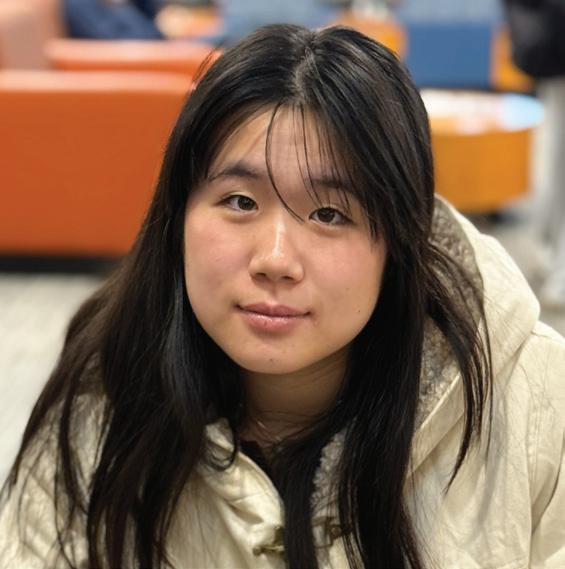
“My favorite holiday tradition is Christmas because I really like gift giving, where I get to buy things for myself and buy things for other people like my friends and family. I also like to travel during Christmas, which is always really fun.”
— Kathleen Wang, senior
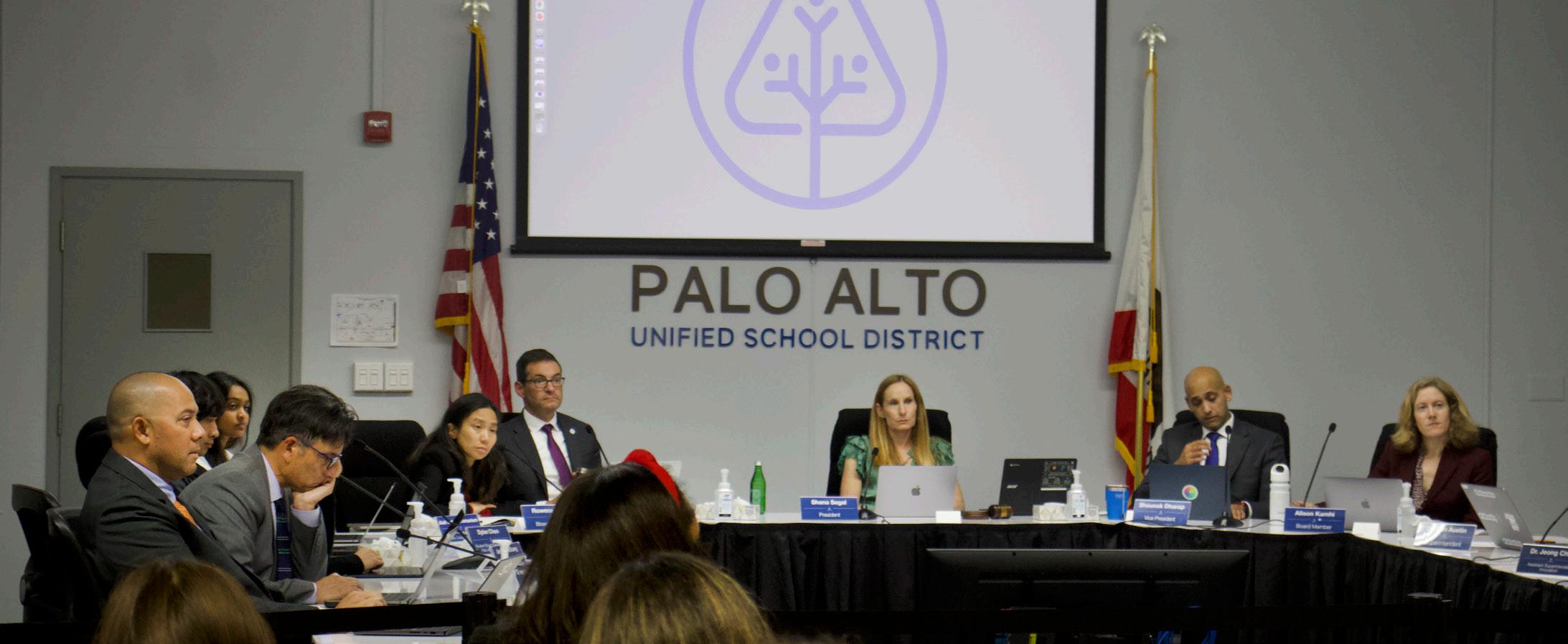
The potential renewal process for the Palo Alto Unified School District’s parcel tax is set to happen during the March school board meeting.
This is following a a discussion at the school board meeting on Nov. 4. In March, the district will review the description of the proposed parcel tax renewal, and potentially approve the official description of the proposed renewal, which will appear on the ballot for citizens in Palo Alto to consider in June.
The current parcel tax provides approximately $16.5 million per year in local
funding. If the parcel tax is not renewed, the district would face an estimated $17 million annual shortfall, starting in the 2026–27 school year, according to PAUSD Chief Business Officer Charen Yu.
The parcel tax supports roughly 79 full-time positions across classrooms and essential support programs in PAUSD. These positions help maintain manageable class sizes and sustain enrichment programs like Paly's visual and preforming arts programs.
The positions uphold a high quality of education, things that the Palo Alto com-
munity values according to a recent survey by True North Research presented at the school board meeting.
This loss of funding would immediately create structural deficits and shift the district’s three-year financial projection from balanced to deficit spending, requiring significant reductions to maintain financial stability.
The tax is currently set at $904.92 per parcel for the 2025-2026 school year.
A parcel is a local real estate tax that is a fixed amount of money per unit of land.
by RYAN SAKET
Palo Alto Seale Avenue homeowners, and others in the area, are bracing for changes as a new neighborhood tunnel and partial underpass advance in planning as part of a grade separation project.
Aiming to decrease traffic and maximize safety, the project would be designed to make sure railroads and roads don’t intersect at the Churchill crossing.
Instead, there would be a partial underpass where cars change elevation and go below the tracks while the train continues
on the same level. Pedestrians and cyclists would use a separate tunnel along Seale Avenue.
Ripon Bhatia, a senior engineer with the City of Palo Alto, noted that the project will reduce congestion and improve safety on Alma Street and Churchill Avenue.
“The partial underpass alternative will grade separate Churchill Avenue from the current Caltrain tracks using an underpass,” Bhatia wrote in an email. “There will no longer be through traffic on Churchill Av-
enue at the intersection with Alma Street.”
Bhatia said the start of construction is currently unknown, but is in the planning phase.
“The project is currently in the preliminary engineering stage,” Bhatia wrote in an email. “Construction timing will depend on the completion of environmental documentation, final design, priority and the availability of funding for grade separations projects in Palo Alto.”
by ANANYA ADYA
Palo Alto Unified School District high school students will be able to keep their phones during non-instructional time, following a decision made by the school board.
During the Nov. 4 school board meeting, members voted to approve a policy that would only restrict mobile phone use during instructional time.
According to the final policy, “students in high schools may use smartphones or other mobile communication devices on campus during noninstructional time as long as the device is utilized in accordance with law and any applicable school rules.”
Palo Alto High School senior Zoe Jovanovic is relieved that the phone policy will not be changed because of safety concerns.
“I get doing it [banning phones] during class, but I don't see why you would outside of class,” Jovanovic said.
Before the policy passed, Paly's Assistant Principal Jerry Berkson said the current policy of phone restriction during classroom time is enough of a rule for students.
“I personally don’t see a need to shut it down bell to bell,” Berkson said. “There’s already a cat and mouse game within the classroom, and we have better things to do than to chase students around for using their phone.”
According to Governor Gavin Newsom's website, a policy to limit on-campus phone usage in schools must be implemented by July 1.
PAUSD's new policy is in accordance with this state law.
by YARDENNE STERNHEIM
Edited and designed by LEELA KULKARNI and JULIE YANG

“I’m
wildlife before
Lfor
ocated on the shore of Harbor Marsh in the Palo Alto Baylands, the city of Palo Alto is in the construction process of the region’s first horizontal levee, a pilot project designed to balance flood protection and improvements in habitat and water quality.
Unlike traditional steep levees, this horizontal levee will be built as a wide, vegetated ecotone slope that absorbs wave energy, providing wildlife habitat and supporting natural adaptation to sea-level rise. The Palo Alto Levee Project aims to test whether this more eco-friendly approach can replace or enhance older flood-control infrastructure around the Bay.
According to the city website, the water stored by the levee will replicate historic freshwater seepage that once supported a variety of biomes, as the water moves through soil and plant roots before reaching the bay, also providing additional improvements to the environment by removing nitrogen and reducing contaminants of concern.
The City of Palo Alto and its partner, the San Francisco Estuary Partnership, are
or
collaborating with local universities, federal agencies and non-profit organizations to evaluate the success of the Horizontal Levee. Researchers are conducting vegetation surveys to study the restoration of native species, tracking how soil builds up on the levee slope to understand how it may respond to sea-level rise.
During construction, parts of the Baylands near Harbor Marsh are fenced off, limiting visitor access and altering hiking routes.
Edison Lee, a junior at Palo Alto High School, said he personally doesn’t find the construction too inconvenient, but does impact the way he enjoys the baylands when he visits weekly.
“The construction being done impedes the natural feel of the baylands during my Saturday morning runs,” Lee said.
The city emphasizes that one of the project’s goals is to maintain opportunities for recreation while upgrading resilience to sea-level rise.
by RYAN SHIN

SHARING OPINIONS Paly alumna Tess Manjarrez speaks at a community meeting regarding allcove's
tance of having affordable mental health services. "These services are essential, and I know money is
Youth mental health organization allcove is in danger of shutting down, following federal budget cuts that were reflected at a meeting on Oct. 28. Members of the community discussed the future of the program at an event held at the Palo Alto Art Center. Many say allcove is a necessary resource for supporting youth mental health.
Allcove is a program providing free mental health resources to those between the ages of 12 and 25. With incoming cuts to Medicaid through the "One Big Beautiful Bill," allcove’s existence and accessibility is in danger.
At the community meeting regarding the future of allcove, allcove leadership, a Stanford University psychology professor and allcove attendees addressed those gathered in-person and over a virtual call.
Allcove doesn’t charge for its services, so it relies entirely on government funding. An allcove representative at the meeting
said that without this funding, the future of allcove is uncertain. There’s a risk of closure, which attendees argued could be detrimental to the mental health of youth.
“The Mental Health Service Act is becoming the behavioral health services act at the end of this fiscal year, and the categories in the way that we are meant to spend that funding are changing. … The prevention part of the Mental Health Services Act is actually being taken away from counties,” an allcove representative explained in the discussion.
Shasank Joshi, a doctor and professor at the Stanford School of Medicine, believes that the closure of the allcove program has deeper connections to what modern society views of youth mental health.
“If we were to close allcove now, we would not just be closing a building,” Joshi said. “We'd be silencing a model of hope that young people have built from the ground up.”
Specifically in Palo Alto, the city’s high schools have historically had issues with youth mental health and suicides. Palo Alto High School Alumni Tess Manjarrez said that restricting access to mental health programs in the area could have detrimental effects on the student body.
“I went to Paly between 2015 and 2019. … I don't think there was anyone at Paly or Gunn who was more than two degrees separated from someone that took their own life,” Manjarrez said.
Kylie, a former member of the San Jose Palo Alto Youth Advisory Group, agreed that allcove and other accessible mental health services are important for young people.
“Every single year I get a text from someone saying, ‘did you hear? Did you hear what happened?’ Every single year, without fail,” Kylie said. “This is not a service to cut.”
by ETHAN BRADLEY
Palo Alto plans to reform bike lanes on San Antonio Road to promote safety, along with 16 other near-term projects detailed in the 2026 Bike and Pedestrian Transportation Plan.
According to the updated draft plan, the $4.2 million project would construct separated bikeways on San Antonio Road to replace the shared bike and car lanes.
The construction, if adopted by Palo Alto City Council in December, would be scheduled to be completed by 2028.
Palo Alto Senior Transportation Planner Ozzy Arce said the proposal to develop San Antonio Road bike lanes was prompted by an increase in housing units expected in the next few years.
“The City approved zoning for new housing units to be built in this area, and adequate biking and pedestrian infrastructure should also complement that development,” Arce said.
Arce emphasized that the city’s key objective is to implement infrastructure on light-traffic streets.
“The City is prioritizing the projects that are on the low-stress network, [mean-
ing] high comfort, tree-lined streets with fewer traffic emissions, lots of focus on bicycle boulevards,” Arce said.
Palo Alto Chief Transportation Official Ria Lo said the projects would improve safety for school commuters.
“It [BPTP] would be improving the attractiveness and the safety of those facilities,” Lo said.
According to Palo Alto Planning and Transportation Commission Chair Allen Akin, city planners incorporated community opinion from residents and advocacy organizations in their decisions.
With Palo Alto recognized as a Gold-Level Bicycle Friendly Community by the League of American Bicyclists, Arce stressed the importance of designing transportation networks that consider everyone.
“All ages and abilities covers school-age students, but it also covers older adults who want to remain active by biking — using it as a resource to get around and for recreational purposes as well,” Arce said. “If we're planning for all levels of bikers … then we create facilities that are inviting for all.”


SPEEDY SHARROW — A car drives next to a stencil on the ground indicating that San Antonio Road is shared by cyclists. Palo Alto Planning and Transportation Commission Chair Allen Akin said with new housing to come, the city intends to create a protected barrier between the bike lane and the cars. “We expect significant increases in vehicle traffic [and] increases in pedestrian and bike traffic, but it's not safely designed for that today,” Akin said.
Photo: Angela Fang by ANGELA FANG

Text by LEILANI CHEN, CHRIS JEON and JULIE YANG
RUMEYSA OZTURK, a Tufts University international student, was walking near her apartment in broad daylight last spring when multiple figures wearing hoods and
As a result, on a scale some say hasn’t been seen in this country for generations, student journalists are choosing to self-censor.
to argue that recent immigration enforcement actions by the U.S. government have created and amplified this same “chilling effect” colleges have observed in student

— GRETA REICH, The Stanford Daily editor-in-chief
The case, Stanford Daily vs. Marco Rubio, the secretary of state, argues that without intervention, the government’s use of immigration law provisions threatens to inflict long-lasting damage to student media as contributors and sources alike continue to go silent. In support, the Student Press Law Center organized a coalition of 55 student news organizations and leaders to provide information and arguments — in the form of an amicus brief — to prove the violation of free speech.
In an interview with the Freedom of the Press Foundation on Oct. 1, Greta Reich, editor-in-chief at the Daily, discussed the long-term implications of self-censorship among student journalists.
“With every resignation, declined assignment and refusal to speak on the record, we actively miss out on covering an entire group of students’ voices, as well as the many events and stories on campus that benefit from an international student’s perspective,” Reich said. “We are simply not able to conduct our business when speech is chilled like this. When an entire subsection of the student population doesn’t feel comfortable speaking with or writing for the Daily, we can’t know what stories are
being lost.”
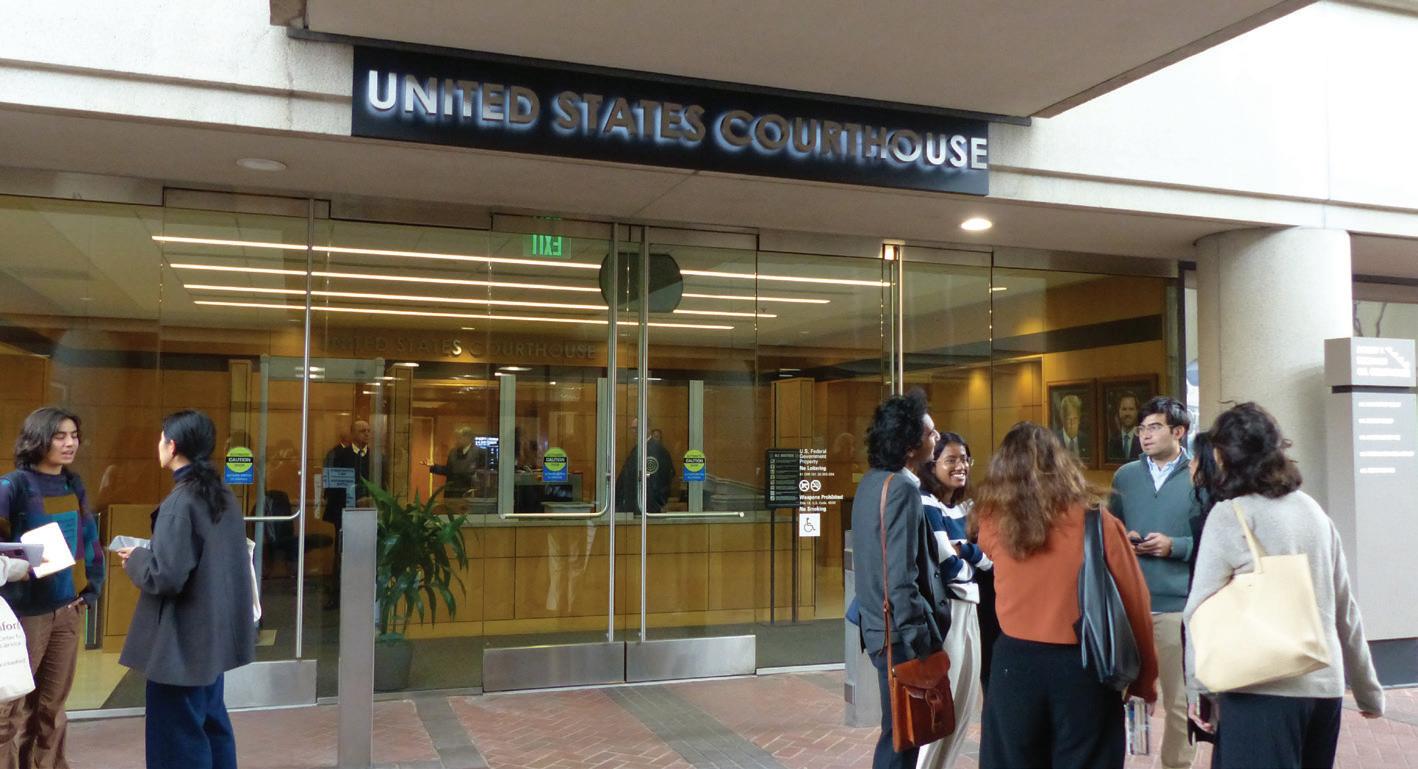
The Daily’s case is primarily focused on the “chilling effect” faced by college publications, but we wonder: Does this alleged “chilling effect” exist in high school journalism, too? To find the answer, members from Palo Alto High School’s Verde Magazine, Campanile and InFocus News interviewed students, advisers and experts from across the country at the Fall 2025 National High School Journalism Convention in Nashville from Nov. 13 to Nov. 16.
The simple answer is yes. Throughout the convention, we found that an overwhelming majority of attendees agreed with the Stanford Daily that they feel a “chilling effect” exists and has a profound and harmful impact on scholastic journalism today.
As of late, high-schoolers have been reaching out to the Student Press Law Center, which works to protect student press freedoms, expressing concerns about covering topics prone to receiving backlash.
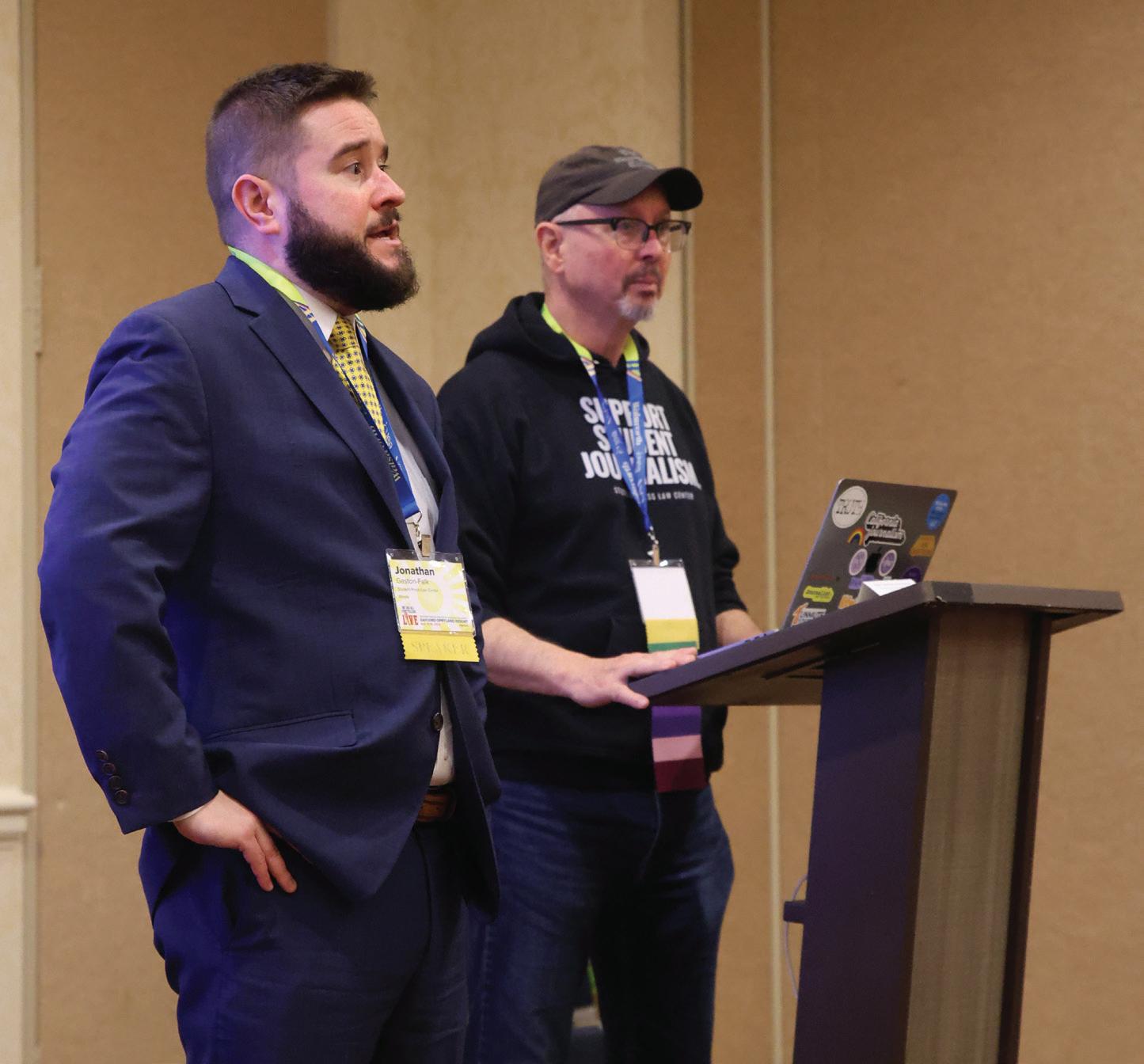
“They’re sort of quailing away from some of those stories because they’re worried about undermining the ability for their friends to remain in the country,” SPLC staff attorney Jonathan Gaston-Falk said. “We have seen evidence of the fact that student journalists and their sources are less willing to bring some of those concerns and complaints to light.”
According to Gary Green, executive director of the SPLC — which has seen a 42% increase over the past year in students seeking legal support and guidance to navigate censorship in their schools — the “chilling effect” is more prevalent in states without “New Voices” laws that protect the First Amendment rights of student journalists, as students are more fearful of suffering
negative consequences.
“If you have students in a state that do not have New Voices laws, they just give up, or they just self-censor because they know that they don’t have a lot of teeth to fight back with,” Green said.
But this fear has even caused journalists in states with strong student press laws, like California, to shy away from writing about more controversial topics such as immigration and political news.
In Cupertino, Calif., at Homestead High School’s newspaper, the Epitaph, reporter Luna Pitl said she was worried about the repercussions of coming off too political when writing about “Alligator Alcatraz,” the migrant detention center located in the Florida Everglades, pushing her to take a less charged stance.
“We were writing about how [Trump’s] policies are unfair, and how the facility unfairly holds a lot of people, and how, in general, it was a really unfair setting,” Pitl said. “We thought that it would show our distaste towards one political side too
much and feel like an attack against Donald Trump himself, so we changed the story. We chose to focus it more around the facility itself and mention the government less.”
The “chilling effect” and the fear of pushback from public opinion has also had influence on journalism covering the Israel-Palestine conflict, according to Mike Hiestand, senior legal counsel at the SPLC.
“I had one student in California who had done just an amazing attempt to provide the history of the [Israel-Palestine] conflict and also provide some of her views,” Hiestand said. “It was really good journalism. But as a result of her putting that out there, the pushback was so bad, she had people writing to a college she had been accepted into and demanding that the college revoke her admission.”
Even at Paly, stories of self-censorship in the past year are easy to find.
Julia Curtis, a journalist for The Paly Voice, earlier this fall pulled back a story about Jimmy Kimmel’s suspension from his ABC show, “Jimmy Kimmel Live!,” after comments he made about the death of right-wing activist Charlie Kirk.

“I was writing an article comparing Kimmel’s experience to the student journalist experience with censorship,” Curtis said. “I thought more about it, and because it was a very opinionated piece covering heated and intense opinions, I decided not to publish it.”
Curtis feared that people who disagreed with her opinion would react negatively to the story, potentially limiting future career opportunities.
“It was mostly pressure of not wanting it to affect me later,” Curtis said. “In Palo Alto, we live in a bubble of many people
having the same opinions and similar beliefs and views. But if I wanted to work or go to school in places where people have different beliefs, even though I’m proud of my beliefs, I wouldn’t want to be identified as someone with really strong opinions on those topics in case it would prevent me from achieving things I want to achieve.”
“ It was mostly pressure of not wanting it to affect me later.”
“I really wanted to cover the No Kings and abortion protests, to hear about how much people care and want to fight for what they believe is right,”
Alyssa said.
— JULIA CURTIS, Paly journalism student
Alyssa, a Paly journalism student who has chosen to use a pseudonym to protect her identity, chose to self-censor a story about protests because her family does not have a green card, and she worries publishing her name could prevent them from obtaining one.
“It puts a barrier between what I want to write and what I can write,” Alyssa said. “A lot of the time, the stories are political and about the president, and [the government] can use anything and everything to prevent me from getting a green card, so I need to be really careful.”
Alyssa expressed regret in not being able to write about topics that appealed to her.
“Unfortunately, it’s so controversial and it’s not good for me to come off as appealing to a certain side.”
Of course, student journalists continue to deal with traditional censorship as well.
In St. Louis, Missouri, Kirkwood High School was sued by parents after its newspaper, the Kirkwood Call, produced stories about hookup culture and student drug usage.
Shiloh Byers, a senior and business managing editor at the Kirkwood Call, said the court case prompted her to step down from her position as a breaking news writer to become business managing editor because she wasn’t able to cover the topics she wanted to write about.
“I would rather watch all of this from
afar than have to be about to be sued again,” Byers said. “[If I could write freely], I would cover things like affirmative action whenever it got banned, and I would love to cover things like fights around in other schools surrounding us, and the issues of drug use in St. Louis.”
At Alexandra City High School in Alexandria, Va., the student newspaper, Theogony, faced backlash from their school district, which threatened to pass policies limiting their First Amendment rights as student journalists, in which they would need to pass their stories through district personnel.
Rozalia Finkelstein, editor-in-chief at Theogony, was a part of the newspaper’s campaign against the district policies. Finkelstein said during the campaign, there were times they felt it would be better to self-censor to prevent creating greater damage.
“There were times where we felt it might be best to not ‘rock the boat’ with our articles in fear of making things worse for ourselves,” Finkelstein said. “Yet, there will be times when the importance outweighs the consequences. When that happens, you cross every ‘t,’ dot every ‘i,’ and publish anyway.”
But Cathy Kuhlmeier — who was the original respondent in the 1988 Supreme Court case Hazelwood School District v. Kuhlmeier that granted schools in most states the ability to censor school-sponsored speech — said journalists need to work hard not to give in to fear.
“It’s easier to shy away than ‘rock the boat,’” Kuhlmeier said. “If we keep self-censoring, then aren’t we just basically giving our rights away? It’s not going to stop any time soon. That’s why I encourage you guys to fight for what you believe in.”
As the Trump administration’s policies continue to put pressure on journalists nationwide, back at the convention, the SPLC’s Green said scholastic journalism needs students who are willing to express their opinions and report on difficult issues.
“We need heroes right now,” Green said. “There are challenges that people going into journalism today have to deal with that I didn’t have to. But we need courageous young people. We need to hear your voices.” v

IN THE PORTUGUESE NOVEL “The Alchemist,” a boy named Santiago, while on a quest to find lost treasure, meets a powerful alchemist who guides him on his personal journey. Meanwhile, in the Wellness Center, Palo Alto High School English teacher Bekki Casalco helps students create their own personal journey.
“We’re having them [students] identify people that are mentors or a support system in their lives, just like a hero,” Casalco said. “At the end of the activity, they have created a hero’s journey of their own: what their end goal is, who they hope to become, what tools they are using when times get hard, and who are they seeking guidance or support from?” Continues on next page
This year, Casalco is pioneering a different approach for her freshman English class by connecting social and emotional issues from the books they read, like “The Alchemist,” to real life scenarios.
Casalco collaborates with the Wellness Center in planning lessons to create meaningful and relatable experiences for her students.
“Although some stories can be in a different time period, the situations they face when they are transitioning from childhood to adulthood are all familiar and real,” Casalco said. “In one activity, we gave [students] a list of what the mental health resources were, and they got to choose which resource applied to
During the 2024-2025 school year, 83% of public schools in the United States offered individual-based mental health intervention, such as one-on-one counseling, according to the U.S. Department of Education.
However, since coming to Paly at the beginning of the semester, Casalco noticed a lack of students taking

English curriculum.
“They [SJSU professors] challenged you to be different,” Casalco said. “They challenged you to create your own way of viewing things and teaching things.”
“Not many students actually go to the Wellness Center after orientation.”
— BEKKI CASALCO, Paly english teacher


tal health resources, prompting her to take matters into her own hands.
“[Not many] students actually go to the [Wellness] Center after orientation,” Casalco said. “So if we were working toward removing the stigma of wellness, then we must use the opportunity to connect students with our content and the resources on
Casalco experienced firsthand how the lack of mental wellness can affect someone when her close friend from high school was pulled from the public school system due to mental
“After we graduated, she died by suicide, and it was super, super impactful,” Casalco said. “So for the rest of my life, I want to make sure that nobody sees that as an exit or as something they need to do. If I can play a role in helping students decrease stigma, or help students understand that it’s okay to not be okay, then for me, that’s a win.”
Casalco’s time as a student at San Jose State University also inspired her to combine mental health issues with the traditional
Casalco said that this open-minded way of thinking led her to become more flexible and creative with her lessons.
“When I was doing my master’s program, I noted how our professors pushed us to be creative in our lesson plans and help students make connections to everyday life and the campus body,” Casalco said. “In my research, I was really lucky to be partnered with a mentor who also saw the vision and not only believed in it, but practiced it.”
Through her efforts, Casalco hopes that more students will use the Wellness Center’s resources on a regular basis.
“I find the Wellness Center to be the heart of campus well-being,” Casalco said. “The more vibrant and alive the center is, the more students understand how to seek support and how to use it to become stronger academically, socially-emotionally and cognitively.”
With their first lesson at the Wellness Center on Oct. 9, Casalco’s students immediately had a positive outlook on her new teaching approach.
“I really liked it because I don’t go over to that area a lot, so I thought it was a good idea to get to know all the resources at the Wellness Center,” said freshman Claire Kim, one of Casalco’s students. “Now that I know what goes on there, I think I’ll use [the Wellness Center] more often.”
Freshman Lucas Chen also had a deep appreciation for the lesson, and said that the Wellness Center is a valuable resource at Paly.
“It opened my eyes to what the Wellness Center has to offer,” Chen said. “If

I ever feel down, I would definitely go.”
Casalco also saw signs that her methods were well-received by her students.
“They were asking questions to each therapist, and they were very curious about what each part of the center looked like,” Casalco said. “And I think that’s already a very significant response because it’s not every day do you get the opportunity to ask those questions.”
Integrating an innovative teaching style does not come without challenges, however. Casalco said presenting themes that could potentially go against her students’ beliefs and values can make it difficult to form relevant and meaningful connections with students.
“Every student is faced with different situations in their life and different upbringings,” Casalco said.

Art by ANGELIKA GERA
letting them know that it’s okay to do so.”
Casalco said she navigates such obstacles by encouraging a safe and supportive environment where students can ask questions.
“They say their opinions, they say their points of view while understanding that we’re all respecting each other, and so the discussions are more of a dialogue,” Casalco said. “At first it seemed like they were going against something that they viewed as normal. Now, not only do they do their work and stay on task, but they’re even open to questioning, asking, ‘But why?’”
“ I find the Wellness Center to be the heart of campus well-being.
— BEKKI CASALCO, Paly English teacher

“And I think the challenge is going up against what they may view wellness to be, whether it’s okay or not to reach out for help, and
Casalco hopes that her innovation serves as an inspiration for other educators to teach the next generation about mental health resources and how to navigate their lives.
“I hope that as I improve my teaching methods, the resources continue to grow and the partnerships continue to grow,” Casalco said. “This can even be trans-
lated over to the Social Justice Pathway, for example. It’ll be fun to see how this can actually become a study or even spread to other school districts, and to give exposure to the whole student population.”
Casalco says that learning about wellness can extend far beyond the English classroom and prepare her students for success after high school.
“My students aren’t just my students, they are part of a community,” Casalco said. “Whatever windows, doors and mirrors we hold up in our teaching, they will carry those experiences everywhere.” v
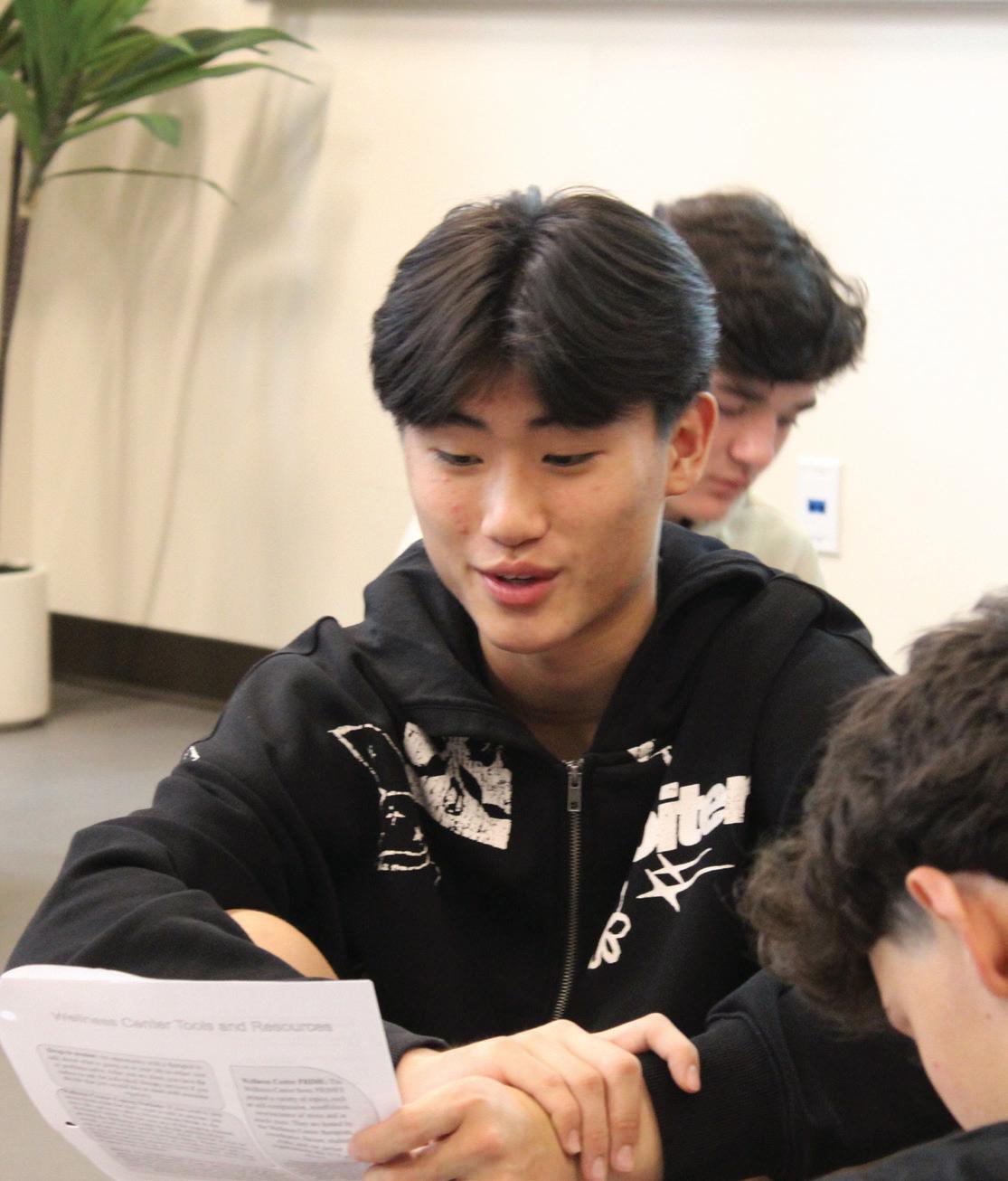
HELPING HAND (COVER) — Casalco talks with a student about their personal journey during a wellness activity. “I’m definitely excited about what we started and to take things a step further with all the resources we have here at Paly,” Casalco said.
ALL SMILES (LEFT) — Students in Casalco’s English class have fun during an activity in the Wellness Center. “It was cool that we got to link our normal English lessons with learning about what the Wellness Center provides,” freshman Andrew Walker said.
FOCUSED FRESHMAN (RIGHT) — Freshman Lucas Chen reads aloud a prompt during a wellness lesson. “I think the Wellness Center is a really great resource that the school has,” Chen said.
Trendsetters.” This is how Palo Alto Unified School District Superintendent Don Austin describes the district he leads in three words.
Recently, proposed changes by the school board to high school class requirements and policies have led to intense debates between members of the PAUSD community. From the implementation of the Ethnic Studies class to the removal of Biology Honors earlier this year, many of these controversial discussions have been spearheaded by parents and district administrators debating the appropriate level of academic rigor in PAUSD curricula.
Chen’s own role as a student board representative is a way to advocate for the student perspective, as he brings a younger voice to the panel of five non-student school board members. He said it’s important for parents and board members to remember that students are the ones directly affected by these decisions. To him, the inclusion of student voices keeps important student values in classes and prevents the administration from overriding student goals.
“When they [school board members] make important decisions at the school board, they make those decisions with account of student perspectives, with knowing what the students think and knowing what the students would see in the future,” Chen said.
“Our goal is to expand access and opportunity while maintaining academic excellence
— SHANA SEGAL, PAUSD school board president
PAUSD School Board President Shana Segal emphasized the importance of a school district with rigorous academics.
with a challenging, relevant curriculum that prepares them for college, career and civic life.”
The Advanced Diploma was a proposal meant to highlight student achievement, with specific requirements students needed to fulfill in order to obtain it. However, the proposal was nullified after students spoke against it at the board meeting, citing concerns about increased academic pressure and an imbalance in opportunities for students, which may outweigh the diploma’s goal to show academic excellence.
Ethnic Studies teacher and former Paly student Corbin Dodd sees the difference in the mindsets of students who are part of Paly’s academic environment.
“The academics here are really good, and that’s not the case everywhere,” Dodd said. “I’ve worked in other schools where the default is not that students are trying in their classes.”
He also talked about Paly students’ own drive to stay ambitious in their studies,
PAUSD is known for its academic excellence. According to Niche, PAUSD’s two high schools are ranked #9 in California. But recent changes regarding class offerings and requirements have caused the Palo Alto community to question what other values the district is trying to uphold.
Student Board representative and Palo Alto High School senior Dylan Chen urges more students to speak out for causes they believe in so that the values of the district can better reflect students’ needs. Chen believes that, oftentimes, parents speak out at board meetings with their own concerns, causing the school board to focus more on what parents want — not students.
“The right step starts with inclusion of more student voices and allowing students to directly voice their opinion at the board,” Chen said.
“Our goal is to expand access and opportunity while maintaining academic excellence,” Segal wrote in an email. “We want every student to engage


Art by ETHAN BRADLEY
which is a unique trait that not all schools have.
“I can tell you, as a teacher, that makes your job a whole lot easier when students are trying,” Dodd said. “And as a student, it’s a much more pleasant environment to be in as well, at least that’s the sense that I have from talking to students in those places.”
In his new Ethnic Studies classes, Dodd said he’s been able to learn a lot about his students on a genuine and personal level, creating a broader sense of community.
“Much of Ethnic Studies focuses on identity, especially the first unit, and since that is the very first thing that we work on with the students, it sort of doubles as a chance to get to know who’s in the room and learn students’ backgrounds,” Dodd said. “As a result, I feel like I know my students much better at this stage in the semester than I have in past years.”
Dodd said he’s glad that the new course adds to his students’ understanding of


different cultures, which allows them to connect with each other on a deeper level, highlighting the inclusion part of the PAUSD Promise — the set of official values created by the district.
“We felt like the history curriculum had gaps in it, and this [Ethnic Studies] seems to be addressing that,” Dodd said. “I think that’s wonderful.”
These developments underscore the initial goal that the course aimed to achieve, which was to enhance students’ multicultural awareness.
nic Studies would [have] resulted in yet another freshman class being deprived of the critical tools to understand systemic inequities and systemic racism,” Segal wrote in an email.
Chen says that although the district’s vision looks strong, recent changes like Ethnic Studies are not always being made with everyone’s input.
“The academics here are really good, and that’s not the case everywhere.”
— CORBIN DODD, Paly history and social science teacher
Before Ethnic Studies was implemented, there was debate about what should be in the curriculum and what should be left out. Segal emphasized the importance of making the course available as soon as possible.
“Delaying the implementation of Eth-
“On the board, I believe that ultimately, everyone is trying to give students the best education they can get,” Chen said. “Everyone has this common goal in mind, and that is to improve student life, academics and the student experience. However, there are, as evidently we’ve seen in the past year, disagreements on how to achieve this goal. While I cannot speak for other board members, personally, I think that should start with having more student voice on the board.”
Austin said that having civilized discussion is necessary for increased student involvement at school board meetings.

“I’d like to get to a place where people can be comfortable to the point where they don’t have to think about, are they going to be attacked for voicing a dissenting opinion,” Austin said.
PAUSD has a variety of unique factors that makes it a strong school district. The district, Austin added, is strengthened by the long-term commitment of its community.
“We have opportunities here, partly due to our location, partly due to our funding mechanisms, partly due to the reputation of the school district,” Austin said.
“People come here, and our best people don’t leave.” v
Don Austin, Dylan Chen, Shana Segal and Corbin Dodd (left
to right).
Text by TESSA BERNEY and SHAURYA THUMMALAPALLI
“
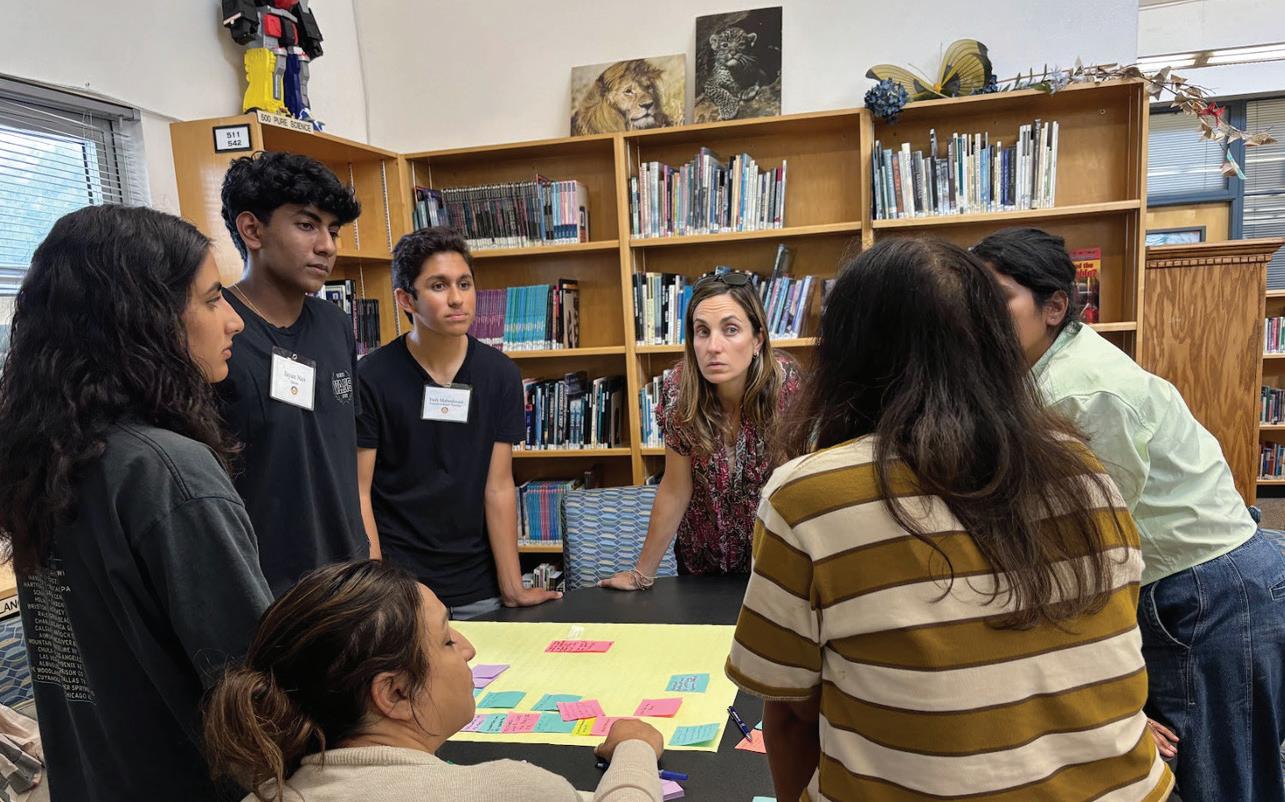
ILOVE USING AI.” For Yash Maheshwari, a junior at Mountain View High School, there are the benefits of deeply incorporating the use of artificial intelligence into his schoolwork. From generating practice tests to utilizing chatbots to teach confusing topics, Maheshwari even joined the MVHS Tech Interns to promote the positive impacts of AI. But even Maheshwari understands the need for AI guidelines in schools.
Since ChatGPT was first released to the public three years ago, the use of AI has rapidly advanced. Though AI can be used to accelerate a student’s learning abilities, the negative results of AI usage are evident. A study by Massachusetts Institute of Technology researchers on June 20 found that participants who exclusively used AI to help write essays showed reduced brain activity and memory.
To address the issue, Mountain View — Los Altos Union High School District Superintendent Eric Volta ap proached Dr. Kip Glaser, the principal of MVHS. Glaser has spoken at multiple AI conferences, acted as a guest editor on Literary Today in their literary and AI evolution edition and contributed to an AI insight and recommendations report issued by the Department of Education in May 2023.
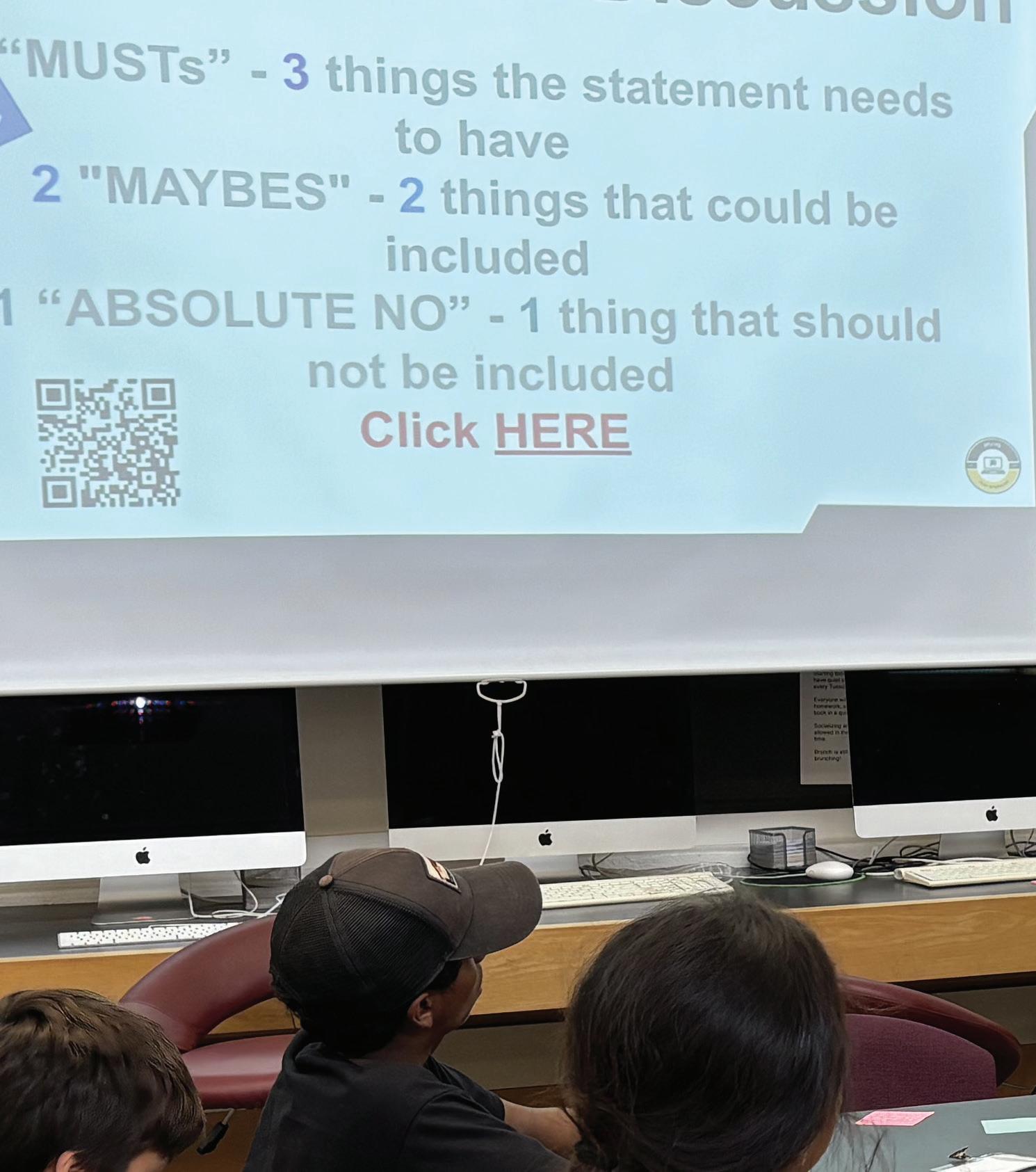
shop to facilitate discussion within a professional setting and has applied this strategy to bring teachers, administrators, parents and students across middle school and high school together to debate and draft an AI philosophy.
“You can see what we did from day one, day two and day three — it spirals, which is important so that we are hearing from a variety of voices,” Glaser said.
concept was derived by Glaser, the Tech Interns took a hands-on role in guiding conversations and developing activities to encourage brainstorming ideas for the philosophy amongst the groups.
Glaser created this group to “empower students to become confident leaders and innovators by providing opportunities to build valuable skills in technology, public speaking and event planning,” according to her website.

— YASH MAHESHWARI, Mountain View High School student “
How students currently view AI, use AI and want to use AI in the future is very different from what teachers are looking at.”
By allowing the Tech Interns to take a leadership role in the creation of an AI Philosophy, administrators are giving students more power over their education. Student associate bodies act as a universal way for students to voice opinions. However, the MVLA school district is taking it one step further by giving
Glaser has used a three-series work-
together to lead activities and dis cussions. The Tech Interns are a group of 25 MVHS students that Glaser assembled to collaborate and work on different projects, including the AI Philosophy.
Each of the Tech Interns brings unique skills and knowledge in technology that advances projects they work on. Though the
“I think that having a student perspective is exceptionally important, just due to the unique perspectives that everybody brings,” Maheshwari said. “How students currently view AI, use AI and want to use AI in the future is very different from what teachers are looking at.”
Verde was not given access to a copy of
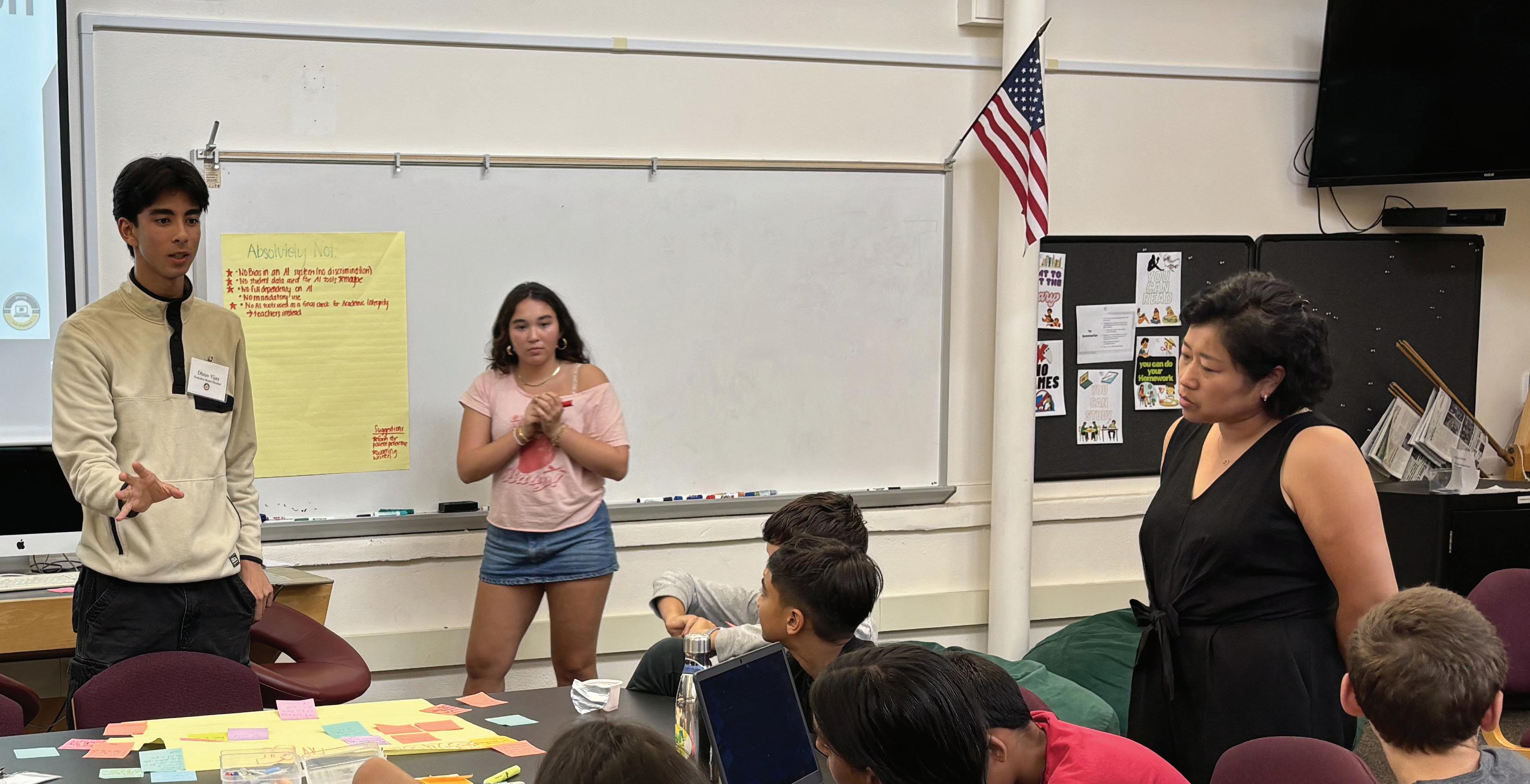
GUIDING THE YOUTH — Senior Dhruv Vijay leads a group discussion amongst students and staff to develop an AI philosophy. “I thought it was very insightful that these younger students were having that level of depth in their conversation and really thinking through how they wanted things to be written,” Vijay said.
the AI Philosophy. According to interviews with the Tech Interns, the AI Philosophy acts as a set of values rather than strict rules that teachers and students must follow so that the philosophy is more usable for other schools.

Glaser said the students had to go through a small process to become Tech Interns.
“They [the students] did apply, and it’s
— GRACE CHOI, MVLA Coordinator of Curriculum and Instruction “
This is one of the first steps.”
One of the philosophy’s purposes is to inform students on AI usage, as well as to protect their data and cre environment where students un derstand AI to prevent them from using it in the wrong way.
The AI Philosophy is a completed document not currently implemented in classrooms. However, in late November, the Tech Interns presented their AI Philosophy and hope to be approved by the school board for use in Los Altos School District K-8 classrooms.
The philosophy isn’t focused on rules regarding AI usage directly, and Maheshwari is happy with this outcome.
“One thing I love is we didn’t go into specific policy,” Maheshwari said. “We didn’t say this tool should or should not be allowed. We talked about the values we wanted to keep in mind.” their parents, their teachers and ad-
more like an interest survey to see if they will be interested in serving the community with their skills,” Glaser said. “We try to make sure that they know that it’s not really about high levels of coding or technology as much as leadership.”
The workshops, which Glaser organised, were student run and were developed in a way that gave students an easy way to voice their opinions.
This ensured the policy did not stem solely from what administrators desired, but also ideas students believed were paramount.
Dhruv Vijay, a senior and Tech Intern, helped guide discussions during the three workshops.
“Students are less inclined to, or younger students, are less inclined to speak up, especially when the rest of the room are
min,” Vijay said. “I think we bridged that gap by designing role-playing activities that really brought them into discussion and allowed them to reach that level of depth that we wanted them to reach in these discussions.”
The collaborative experience taught him the benefits of hearing from a range of perspectives. This included amplifying voices of younger peers through workshops and discussions.
“Getting the perspectives of administrators, especially [K-8] administrators, and also parents who are also concerned, was definitely very rewarding, because oftentimes these philosophy statements that we create, the largest audience are the parents,” Vijay said.
The entire project focused heavily on collaboration, and Maheshwari said he was proud of the participants’ ideas.
“Everybody was able to contribute in their own way,” Maheshwari said. “And I heard a lot of unique ideas that I wouldn’t have thought of individually.”
Grace Choi, the Coordinator of Curriculum and Instruction at MVLA, continues to work closely with the Tech Interns.
Looking ahead, the Tech Interns will attend national education conferences to share their AI Philosophy process with other school districts.
“We have a lot of work to do,” Choi said. “This is one of the first steps.” v

VOTERS STREAMED through the Rinconada library, dropping by to cast their ballots for the Nov. 4 election. This year’s ballot was defined by Proposition 50, a ballot measure to redistrict the California congressional map in favor of the Democratic Party.
Prop 50 was proposed in response to congressional redistricting in Texas that favored the Republican Party. Passed by Texas Gov. Greg Abbott on Aug. 29 and encouraged by President Donald Trump, the new Texas congressional map is projected to give Republicans five more seats in the House, according to the Brookings Institution.
In response, California democrats, led by Governor Gavin Newsom, began pushing for congressional redistricting in California that would favor Democrats. Prop 50 was their proposal.
Prop 50 appeared on the November 2025 California statewide election ballot.
It will give the California state legislature the ability to redraw the state’s congressional districts mid-decade in response to redistricting moves made by Republican-led states earlier this year in August. Previously, California was one of the few states where an independent commission of citizens drew congressional maps.
Within days post election, Prop 50 was passed by California voters. The measure will take effect 2026 and expire in 2030, where the California Citizens Redistricting Commission will take back power.
The proposition aims to add five additional safe Democratic seats in the House of Representatives.
A key difference between California and Texas’ redistricting is that while Texas changed the maps without asking voters, California only redistricted with voter approval, according to Palo Alto City Council Member Vicki Veenker. Additionally, Veenker said that California’s new maps are more compliant with anti voter suppression laws.
“I’m impressed with the proposed California maps because they are at least as compliant, if not more so, with the Voting Rights Act (VRA) and its provisions around representation,” Veenker said. “By contrast,
the congressional maps in Texas appear noncompliant with the VRA and get more so with recent changes.”
The VRA is a landmark constitutional law that prohibits voter discrimination and protects voter rights for all citizens eligible to vote.
While Prop 50 may be compliant with the VRA, it will nonetheless gerrymander California and make seats less competitive, according to Wesley Hussey, a political science professor at California State University, Sacramento.
Hussey said that the issue with safe political party seats is that they aren’t competitive, leading to less engagement from both parties in the new, gerrymandered districts.
“There will be very little chance for Republicans to win those seats [in California], but more importantly, it means that neither party really campaigns for those seats, and that there is not an effort to engage with voters on issues that voters care about,” Hussey said. “What voters care about in California is essential to how democracy works.”
Palo Alto voter Mamta Bhandari said that while she doesn’t believe Prop 50 is the right approach to get California better representation in the country, she will vote for
it because she believes a response is needed against what happened in Texas and hopes that voices will still be heard.
“I had to think about it [Prop 50] a little bit because two wrongs don’t make a right,” Bhandari said. “But at the same time, given what’s happening, it is really important that we have more representation from the Democrats.”
The California Citizens Redistricting Commission, used in California previously, guaranteed that voters themselves had a say in redistricting. Prop 50 bypasses this commission, aiming to reestablish legislative control over the redistricting process.
Hussey said that Newsom will temporarily suspend the Independent Redistricting Commission for the next few election cycles as a way of neutralizing what Republicans have done in Texas.
“Because the House is so close between the two parties right now, I think the Democrats felt they had a much better than average chance of retaking the House,” Hussey said. “But every state that the Republicans redistrict and gerrymander makes it harder for them to do that. … The only state they [Democrats] had power or control over that would give them a lot of seats to neutralize the Republicans was California.”
administration is pushing the boundaries of free and fair elections.
“We want as much fairness as possible in our voting,” Drewes said. “The fact that we are tossing that [Independent Districting Commission] out temporarily until 2030 makes me very nervous.”
Hussey said that he thinks that both parties will continue to engage in more and more gerrymandering to counteract the other.
“There’s a real chance that other states are going to gerrymander in the 2030 census, and California Democrats will be upset that California is not gerrymandering,” Hussey said. “For Democrats, they might try to go back on the ballot and eliminate the redistricting commission completely.”
“ I had to think about it [Prop 50] a little bit because two wrongs don’t make a right.”
Already, on Oct. 22, North Carolina Republicans approved a new congressional map that would create a more favorable environment for electing members of the Republican party to the House of Representatives.
— MAMTA BHANDARI, Palo Alto voter
Harry Philip Austin Blain, California State University, Sacramento assistant political science professor, said he believes that Prop 50 is speeding the country’s path to democratic decline.
electing Democrats to Congress.”
Already, Prop 50 has faced legal challenges from the Republican Party and the Trump Dept. of Justice, on the grounds that it violates the 14th Amendment.
Hussey reflects on how these recent changes, where the administration and states are willingly gerrymandering in order for their party to gain more seats, speaks for the moment of time.
“It encourages both sides and the dynamic to escalate to more and more polarized partisan politics, and that’s a real shame for democracy,” Hussey said. “It also undermines the very nature of having legislative districts if you draw them with advanced computers and statistics in a way that you pretty much guarantee which party is going to win. Why are we even having democracy [then]?”
Akash K., a voter from Santa Clara County, said that observing on both a local and national level, there isn’t a solely good option. He believes that in an ideal world, Prop 50 wouldn’t be needed.
“I’m hoping that at some point this reaches some standstill and we stop all the re-zoning,” Akash said. “My hope is that both sides see it as a pointless endeavor and scale back and find some other actual venue to get voters.” v
VOTING
Palo Alto High School History and Social Justice Pathway program teacher Caitlin Drewes said she thinks the current
“It [Prop 50] shows that both parties are increasingly playing ‘hardball,’ a bad thing for the stability and health of the country,” Blain said. “I fear we are destroying democracy here in the hope of somehow strengthening it across the country by
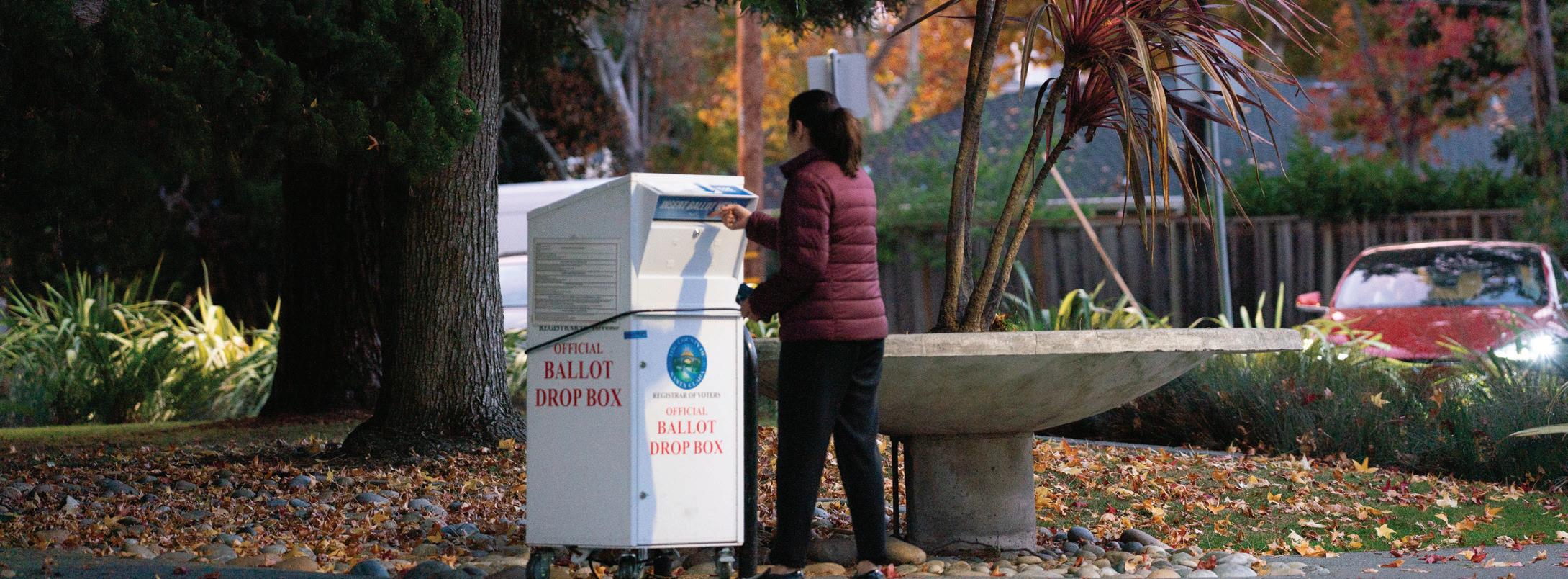
Mamta Bhandari drops off her ballot for the 2025 California Election. Bhandari voted yes on Prop 50. “Even though it may not be the right-most approach, at least we have to do something,” Bhandari said.
Text by YARDENNE STERNHEIM
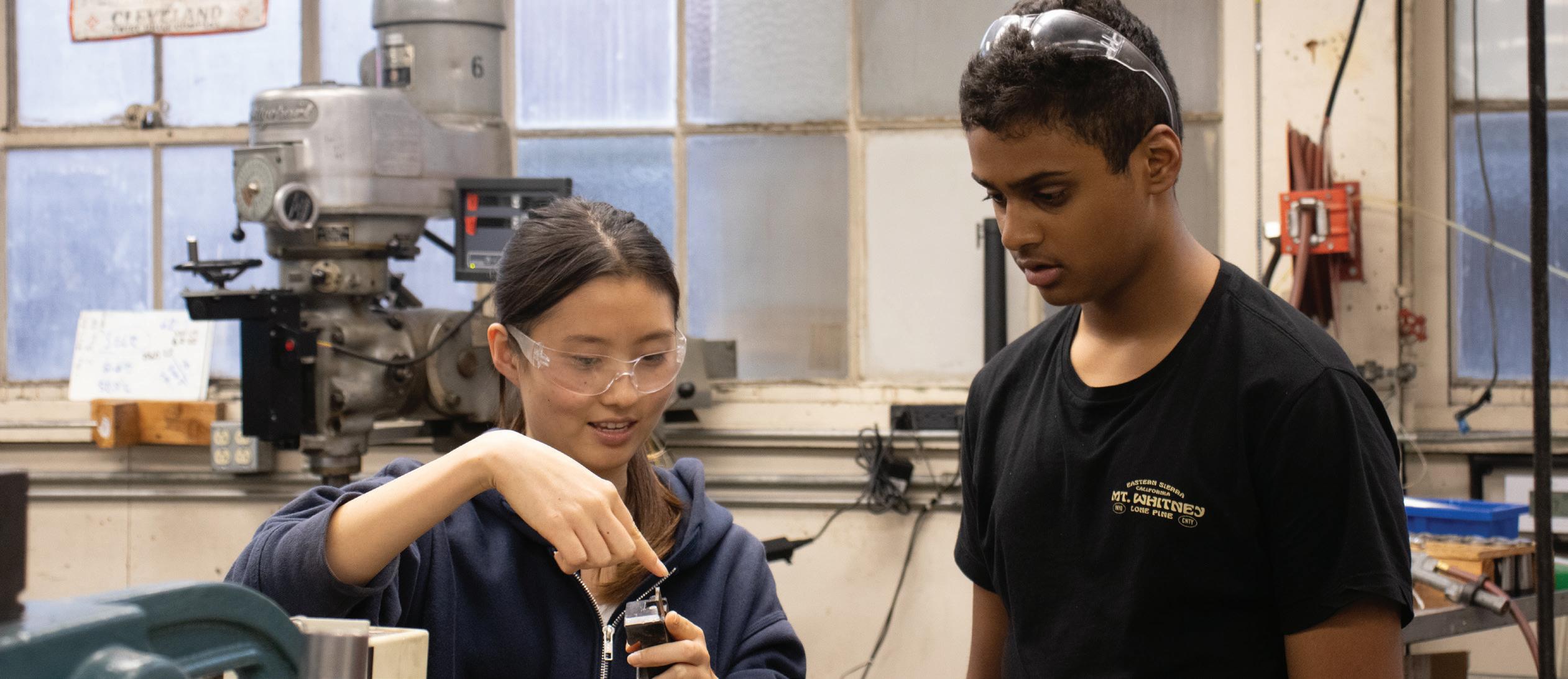
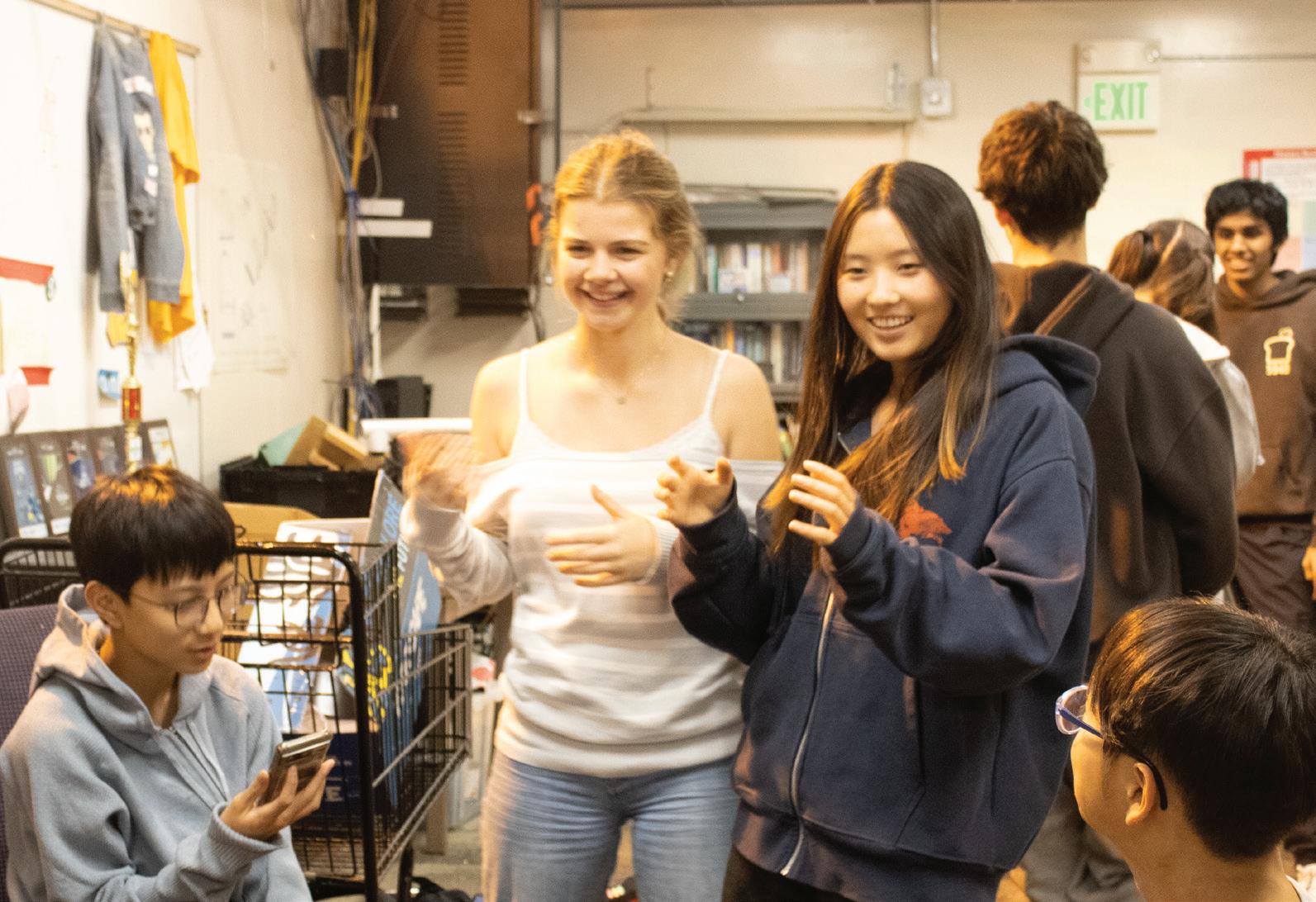
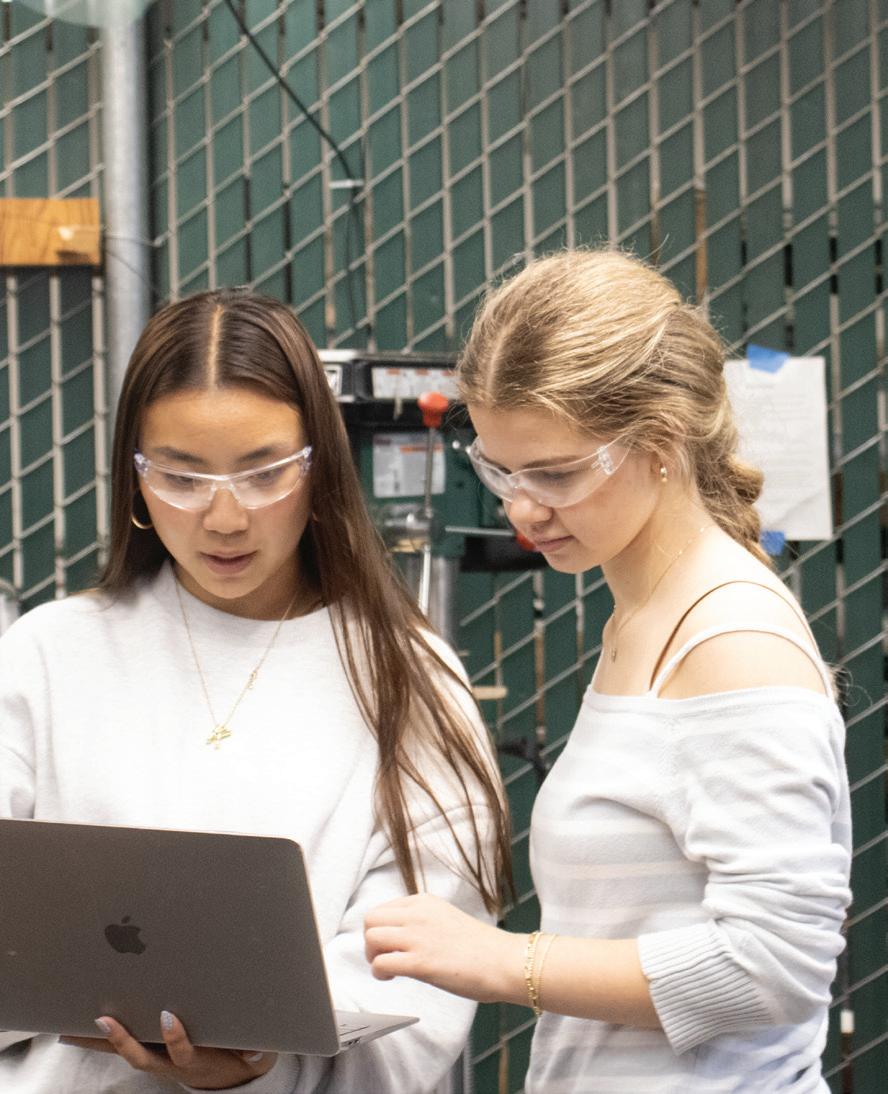
ALARGE ROBOT STANDS in the center of the lab, surrounded by a group of kids discussing ideas. In the middle of the crowd, surrounded by mostly boys, are three girls who lead the entire Palo Alto High School Robotics team: seniors Yuna Jeong, Brooke Chandler and Hana Kapadia.
Previously, Paly Robotics was led by and consisted mostly of males because not many girls were exposed to the opportunity. This year, however, robotics is led by three girls.
Through challenges of being the minority in the lab and competitions, Jeong, Chandler and Kapadia are eager to recruit and encourage more girls to join the program.
Since 1996, the Paly Robotics team has been led by males. In 2012, only one out of 27 Paly Robotics’ team members was
female, according to the Paly Robotics Diversity Plan.
Currently, Jeong and Chandler are the team’s co-captains, while Kapadia is the technical director. With boys and girls together, the leader and team are challenged to include everyone’s ideas regardless of grade, gender and skill.
As a mostly male-dominated field in professional careers, STEM hasn’t always been something that pulled women into joining, especially robotics teams.
There has never been an all girls leadership team in Paly Robotics history. So, the three girls are taking their role seriously to set an example for girls in younger generations.
Jeong joined the school’s robotics team her freshman year after her older sister had shared her robotics experiences as one of the only girls on the team, encouraging Jeong to join and represent girls.
According to Jeong, when girls come to join Paly Robotics, members and leaders of the team work together to make them feel supported and excited to stay involved. This change from a stereotypical environment of a male-dominated space, allows the team to have different gender perspectives.
“If they [girls] come, we show up with an eager mindset, we’re willing to teach anyone how to do anything, which I think
has been really great,” Jeong said.
Kapadia has been working with Jeong on the team since her freshman year and has witnessed the team’s motivation to growing diversity.
“Our team has always been very diverse, and it’s always been 50/50 between boys and girls so I’ve never felt isolated or alone,” Kapadia said.
In addition to the lengths of recruitment that Paly done to create a diverse group of people for the team, other Bay Area teams share the motivation to grow gender diversity.
One of Paly’s computer science teacher, Roxanne Lanzot started an all-girls robotics team while working at Notre Dame High School, an all-girls Catholic school.
At first, it was difficult to get her idea across administration for a robotics team because of the stigma against girls in STEM, but support from other teachers at the school encouraged her to continue to follow through with her vision.
The recruiting process for the new team proved difficult, as it was unconventional for girls to be working and learning in the STEM field. Building the team gave exposure to more girls who were shying away from subjects in STEM, and giving them freedom to explore their interests.
To solve this challenge, Lanzot and
some established members made the recruitment process fun. They designed merchandise people would be proud to wear, and gave themselves a nickname of the “Janksters.” She noticed that when this process was more fun there was a greater outcome of girls joining the team.
Through Lanzot’s commitment to creating an all-girls team, Notre Dame has built their own facility dedicated to STEM, giving opportunities for students of all grades and genders the ability to hone their passion for math, science and technology.
“They [the robotics team] have a wonderful team of mentors, and are still competing today,” Lanzot said, “And they’re much bigger and better than they were when I started the team.”
Just as Lanzot worked to introduce robotics to her students, Paly junior and Peninsula Robotics Media Lead, Mehr Thawani works to do the same.
The lack of female participation in robotics teams is often attributed to their minimal exposure to the STEM field and robotics due to the stereotypes against women participating in those types of subjects, according to Thawani.
Photos by YARDENNE STERNHEIM
like Peninsula Robotics.”
With attempting to recruit more girls for the robotics team, Thawani remembers and understands her hesitation to join the team due to the lacking of ratio of girls to boys, but regardless, she takes her job of recruitment seriously so that Peninsula robotics can become a diverse and inclusive team challenging the stigma of single-gender representation.
“I remember feeling really out of place during my first few months on the team,” Thawani said, “There were not many girls I could turn to, so it was difficult to participate and engage with the team.”
Kapadia agrees.
“There have been moments when I walked into a robotics event, looking around and realizing I was the only girl out of 12 teams there,” Kapadia said.
For Clara Manolache, Paly junior and Peninsula Robotics software developer, the key to closing the gender gap in STEM is making girls feel like they belong in those spaces and showing them that stereotypes can be broken.
“We’re a team. No matter what gender you are.”
— CLARA MANALOCHE, Peninsula Robotics captain
“I have noticed kids from Paly often lose hope or don’t want to participate in robotics anymore after being rejected from Paly Robotics,” Thawani said, “They are often unaware of the other options available
“I feel like a lot of guys just don’t know how to work with girls,” Manolache said. “Right now, in high school, it’s good for both of us to see ‘oh, we can work together.’ We’re like a team. No matter what gender you are.”
Now with social media being the most efficient and effective ways of influence,
Thawani uses platforms to reach the target audience of girls to join the team.
“Each year, our ‘media lead’ position member, promotes recruitment on our social media platforms so people are well informed about it,” Thawani said.
However, recruitment doesn’t only come from social media, Thawani also talks to her peers about joining the team.
Even with societal bias and the challenge of recruiting more women to robotics worldwide, Kapadia hopes to see more women in leading roles in the future of robotics.
“Just do it,” Kapadia said. “You’re going to find your people, you’re going to find your friends.” v
Additional reporting by Ethan Zhang
IN THE LAB (FAR LEFT) — In the robotics lab, co-captain Yuna Jeong explains how to work a certain machine. “A big part of having a good team culture where people feel excited to come to lab,” Jeong said.
DEEP DISCUSSION (MIDDLE RIGHT)
— Co-captains, Jeong and Brooke Chandler lead a team meeting. “Just do it [robotics], your’re going to find your people,” technical director Hana Kapdia said.
PLANNING PROGRESS (FAR RIGHT)
— Co-captain Brooke Chandler helps junior Katie Kim with her questions, “The three of us [Chandler, Jeong, and Kapdia] are a power trio,” Kapadia said.
Text by CHRIS JEON
Design by LARA SASLOW
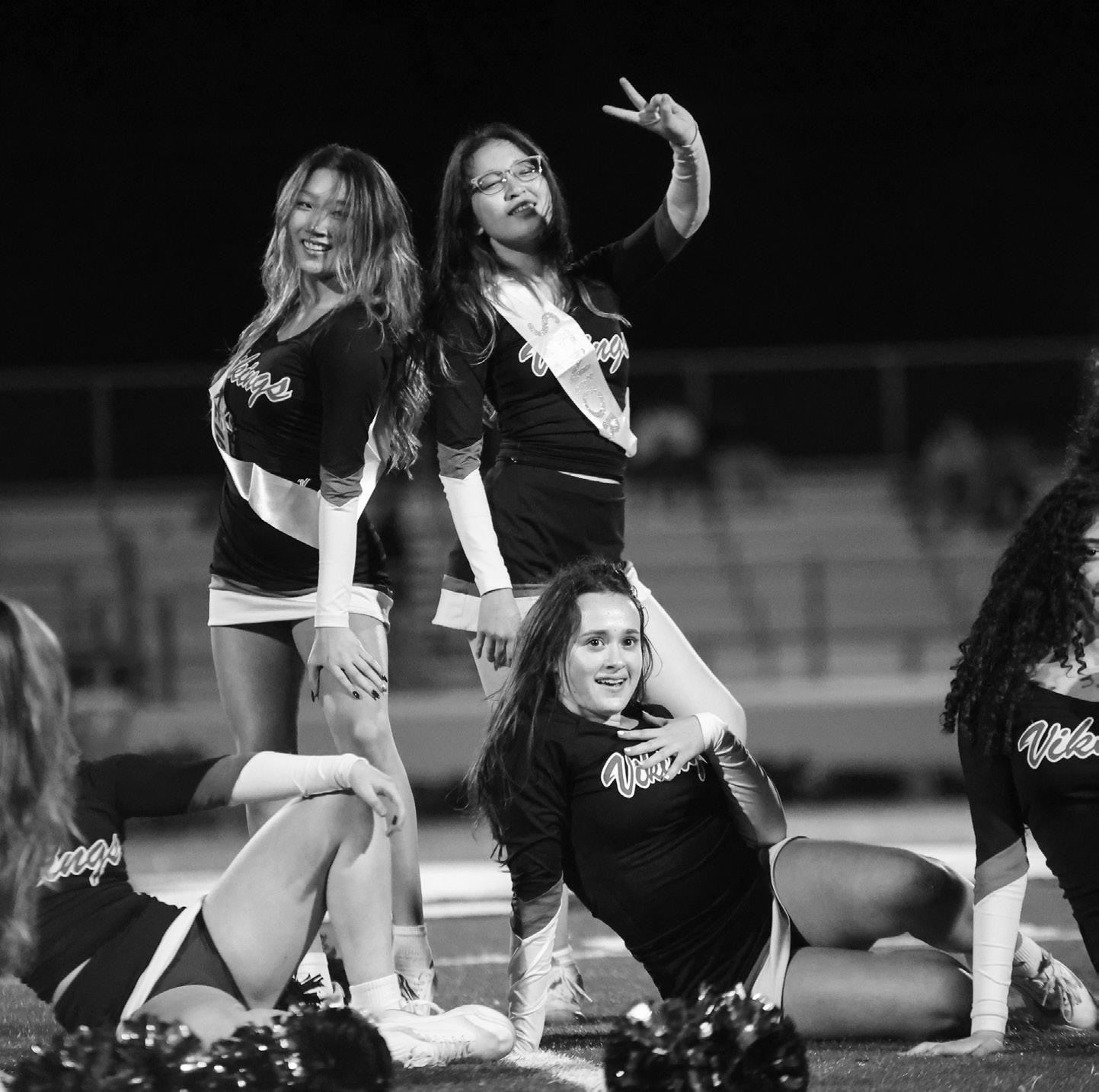
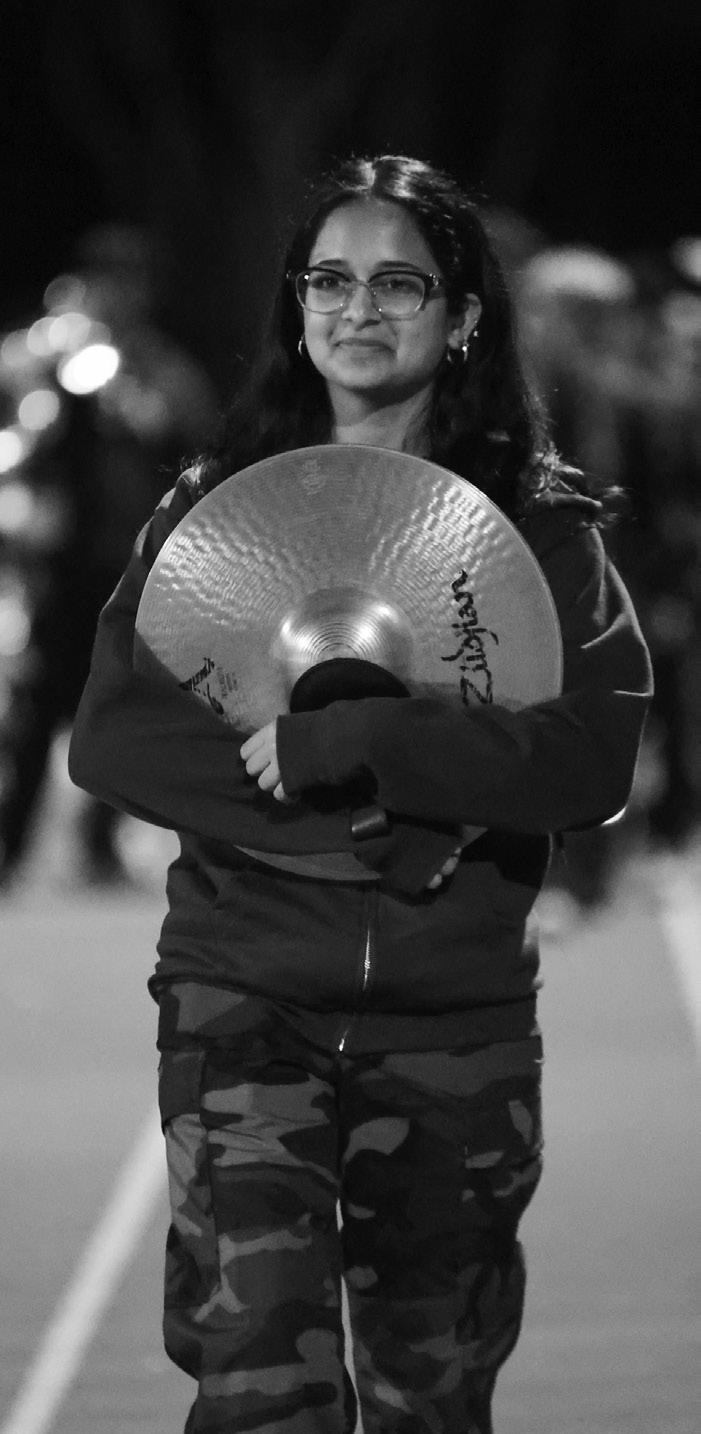
BRIGHT LIGHTS flooded the Earl Hansen Viking Stadium at Palo Alto High School as students and parents filed into the arena. On the track, seniors posed for pictures with family and friends while holding up handmade signs as teammates embraced each other tightly, marking the end of another era. In the stands, the Paly Pep Band’s lively anthem music accompanied the varsity dance and cheer teams for the final home
football game of the 2025 season.
This year’s varsity football Senior Night on Oct. 24 featured Paly playing against Menlo-Atherton High School, which was preceded by a ceremony celebrating seniors from football, band, cheer and dance. The Vikings entered the game still seeking their first win of the season, but lost 14 to 41 when the game ended abruptly with 1:45 remaining in the fourth quarter after a Menlo-Atherton player was injured.
Despite the loss in the final home match of his high school career, Paly senior and varsity defensive end Dominic Hernandez said he had no regrets regarding the outcome.
“I’m pretty proud of myself,” Hernandez said. “I gave it all that I had on the field, and at the end of the day, I’m satisfied with my work here over the past four years.”
Senior and varsity dancer Keira Mok
felt bittersweet about her last performance at a Paly football game.
“I’m really grateful for all the time I’ve had on the dance team,” Mok said. “Even though it ended kind of weird, it was fun to just dance with all my teammates one last time on the field. We still have a spring show coming up in May of next year, so I’ll get to dance with them for the very last time then.”
For senior and varsity center Danny Khan, the game was a chance to reflect on his time with Paly football.
“I was pretty emotional because I was able to reflect on the four years I proudly played in the Earl Hansen Viking Stadium in front of all my friends and family,” Khan said. “I will forever be proud of my teammates. I know that they tried their best and fought to the very end, and I’m so glad that I was able to fight alongside them.” v



Text by ETHAN BRADLEY and STEFAN ERIKSSON

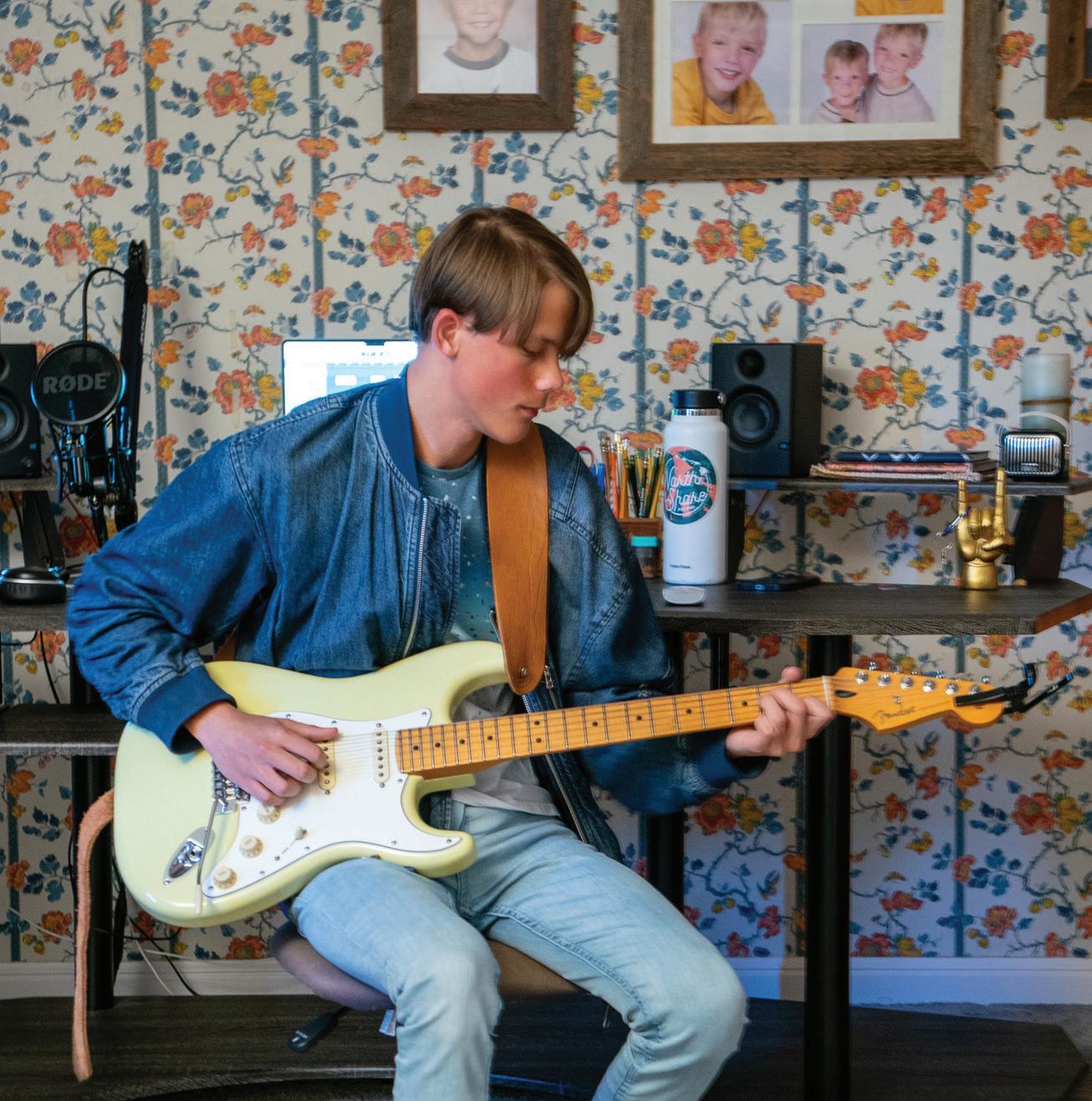
THE SMALL 1950’S HOUSE nestled near midtown Palo Alto hums with quiet life. Its faded wallpapers and narrow hallways carry the calm of another era, broken only by the sharp rhythm of Palo Alto High School sophomore Trevor Vaughan’s guitar echoing through the home.
At his desk, Vaughan sits poised over his guitar, — a lime-green Fender Stratocaster — fingers playing a riff as sunlight cuts across the strings.
As of May 2024, the melodies that
once filled Vaughan’s narrow hallways now echo across millions of screens. Online, Vaughan has struck gold.
In the last six months, Vaughan has amassed over 10 million views on Instagram. In his videos, Vaughan performs covers of pop songs and his own original pieces using electric guitars, acoustic guitars and an electronic keyboard.
Vaughan has loved music his whole life. He started writing music for the first time in sixth grade after gaining inspiration from pop artists like Olivia Rodrigo and Jason Derulo, leading to the release of his first song, “Flames,” at the end of eighth grade,
Known as Trevor V on Spotify, the aspiring singer
has three songs uploaded: “Flames,” “Lonely” and “Drop Dead.” His songs are a hybrid of synth and indie pop.
“Olivia Rodrigo inspired me to write music,” Vaughan said. “I was listening to her music and then also watching YouTube videos of how she made songs, so then I was like, I want to do something like that. I think it’s really cool.”
With his rise to popularity, Vaughan continues to post his content on social media because of his passion for musical production.
“Well, the reason I do it [post content] is just because I love music,” Vaughan said. “That’s kind of … my main inspiration, my main reason, I’m doing all of it.”

Vaughan’s grandmother Barbara Little has seen his musical development and observed his passion grow.
“He loves it so much and enjoys it so that it gets some recognition, I’d think he would like to learn every instrument there is,” Little said.
With his passion for music, Vaughan has aspirations to become a professional musician.
“In the future, I hope to make it my career, which is a really hard goal, but I want to try it anyway,” Vaughan said.
Little also sees Vaughan going far with music.
“I can see him doing it for life really,” Little said. “I think he’ll even choose his college according to their college programs.”
Through his virality, Vaughan has received both supportive and hateful comments on his videos. On a video of a Justin Bieber cover, he





















WHILE HIGH SCHOOL STUDENTS are relaxing and unwinding after a long week, Palo Alto High School seniors Camila Luz and Benji Patel are preparing for their shifts at two Michelin-recognized restaurants, where their passions for cooking meets their audiences.
Camila Luz works as a prep cook and food runner for Michelin Guide-featured Menlo Park restaurant Flea Street, which emphasizes fresh, sustainable ingredient sourcing.
Benji Patel stages at Protege, a one-Michelin-starred restaurant on California Avenue. As a Garde Manger, Patel manages the cold food station, cooking and plating appetizers that are then sent out to dinners. Continues on next page








together, which taught her that food can do more than just feed people — it can bring

Camila Luz, Flea Street
Like many passions, Luz’s love for cooking didn’t develop overnight. Rather, it was shaped by simple acts of sharing meals with her family. Since Luz was young, her family has always eaten dinner and lunch

Street’s kitchen, she discovered a new appreciation for cooking. Beyond her family, Luz realized she could bring joy to others through food.
“It’s ... like the Ratatouille moment ... where the tastes combine to create these amazing flavors.”
— BENJI PATEL, Paly senior
“There’s a feeling of satisfaction when I work in the restaurant because I know that I’m [benefiting] other people,” Luz said. “It feels really satisfying when I can make someone else happy by the food that they’re eating.”
Flea Street Executive Chef Isabelle Nunes, who mentors Luz, said her positive attitude enables her to excel in the kitchen.
“Camila is like having a little ray of sunshine go through your operation,” Nunes said. “Camila brings a desire to learn, and that’s always a great aspect and dynamic to have in a kitchen.”
Luz dabbles in a variety of roles at Flea Street, which involve preparing ingredients for cooking, as well as working at the front of the house to host guests and transport food to customers. According to Nunes, this provides her with a comprehensive experience.
could bring people together and form deeper connections.
“I grew up in a neighborhood in Brazil where it’s like a rural neighborhood,” Luz said. We didn’t have many people around us … and from that, I learned that food can bring good relationships and positivity.”
When Luz brought her passion to Flea
“Camila helps out day to day in two different areas of the restaurant, and it’s pretty cool to be able to prepare part of a dish that you then get to serve to a guest because you really know everything that there is to know about that dish,” Nunes said.
After moving to Palo Alto, Luz continued to develop her relationship with gardening through the Rinconada Community Garden, a resident-based garden that provides open plots to locals. Luz said that she works closely with her mother, who is





the garden’s liaison, bringing fresh produce to her own kitchen.
“I spend my time with her [at the garden], attending to her plot and picking fruits,” Luz said. “Whether it be picking carrots, my mom and I will develop recipes together like carrot cake.”
Luz said her experience in the garden has led her to identify with Flea Street’s farm-to-table ethos, a California-based philosophy that promotes the choice of fresh produce sourced directly from local farms. Flea Street proudly embraces the movement, continually adapting its menu to incorporate seasonal ingredients.
“Anything that comes with farm-totable fresh fruits, that’s the thing that I find most joy in,” Luz said. “It gives me a positive feeling, knowing that I grew that myself and took care of that food, and then I can bring it to the table for my family to enjoy.”
Not only is cooking a passion, but it is also a way for Luz to express herself.
“When I’m in the kitchen, I feel the adrenaline and satisfaction,” Luz said. “Cooking is my way of self-expression.”
Benji Patel, Protege Luz isn’t the only student turning a love for food into a real-world experience.
As Garde Manger at Protege, Patel manages the cold food station, cooking and plating appetizers that are then sent out to diners.
Patel’s love of food developed in his home kitchen, where he pulls inspiration from exquisite dishes of acclaimed chefs to learn by imitation.
“Everyone needs to eat, and since a young age, I’ve always loved the experi ence,” Patel said. “It’s almost like the Ra tatouille moment in Ratatouille, where the


tastes combine to create these amazing flavors. Now I’m in the stage of not only being fascinated by it, but trying to recreate it.”
Patel regularly worked at an apple stand at California Avenue’s Farmers’ Market, where he sold fresh produce and operated the booth every Sunday morning. In the process, Patel met Jeremy Wayne, the Chef de Cuisine, otherwise known as the head chef at Protege, who brought Patel to the restaurant.
“He comes to shop with us every week to buy for the restaurant,” Patel said. “We’ve been chatting since I started working four years ago.”
According to Patel, training at Protege has taught him habits that translate to other aspects of his life.
“Timing is key in the kitchen to make sure everything comes out on time and is hot and warm,” Patel said. “[I’m] bringing that not only to food I make at home, but also to all my school work. Timing is key.”
Protege, which was founded by two
former three-Michelin-star restaurant French Laundry chefs, boasts a prestigious culinary team with combined decades of experience. As a high school student working in that environment, Patel recognizes the standard that he is held to.
“I’m always trying to be as good as the people around me … to be on that level and making sure not to make a mistake, because I am serving food that goes to the customers,” Patel said.
Still, beneath the long hours and high expectations, Patel holds on to one simple
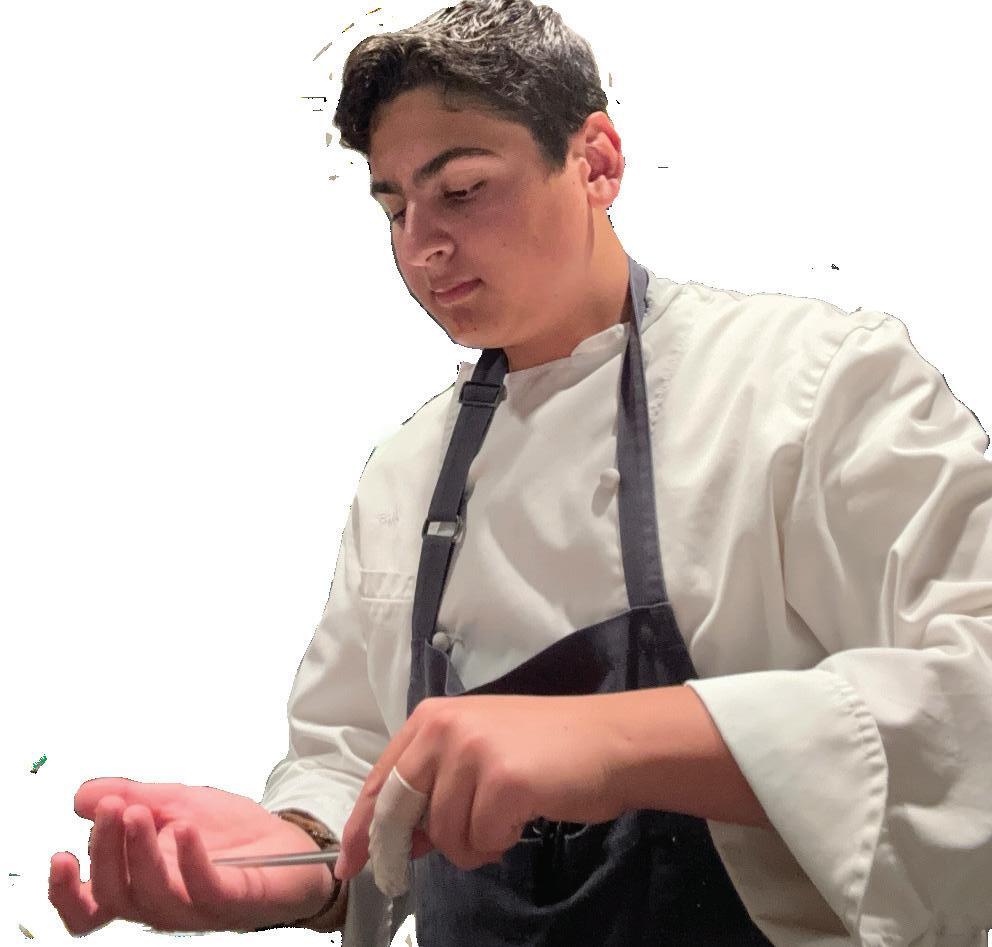





THE FILM BEGINS WITH the promise of a meaningful emotional story, drawing in viewers with its highly distinguished brand. When the story unfolds, the emotional impact it supposedly has doesn’t feel present, gradually weakening its momentum. By the end of the story, it had high expectations but seemingly fell short. What was meant to be a memorable movie is somewhat forgettable.
Pixar’s “Elio,” which was released this past summer, fell short from its studio’s usual standard of commercial success. The marketing for this movie was minimal and while the film followed Pixar’s traditional storytelling formula, it received mixed reviews. Elio’s box office numbers generated $154 million worldwide in comparison to its $150 million budget, according to The Numbers.
This underwhelming performance has been a trend for Pixar since the pandemic, as many of its releases have struggled to capture audiences at the box office due to poor release timing, and lacking audience appeal, with “Inside Out 2” in 2024 being the only exception.
In 2020, when the pandemic had hit, the film “Onward” was released just ten days prior to the COVID-19 lockdown,
which had accounted for its low box office numbers of $141 million, according to The Numbers. With the pandemic forcing theaters to close, Pixar’s next three films, “Soul,” “Luca” and “Turning Red,” had to be released through Disney+’s streaming services in order to ensure that these Pixar movies had an audience.
couple months after they’re out in theaters,” Johnson said.
“ A lot of people criticized people, and I would include myself.”
G. Allen Johnson, a film writer for the San Francisco Chronicle, says that in hindsight, Pixar should have released these films directly to theaters, when they started opening back up.
— G. ALLEN JOHNSON, film writer for the San Franscisco Chronicle
After three straight releases to Disney+, Pixar had to reestablish itself in the movie scene. Their next film, “Lightyear,” a spinoff of the franchise’s “Toy Story,” was set to be its first release in theaters since the COVID-19 pandemic. However, despite its strong connection to one of Pixar’s most successful series, “Lightyear” has struggled to appeal to audiences due to
“‘Soul’, which was expected to have an Academy Award push, and did win some Academy Awards, went straight to streaming,” Johnson said. “They didn’t even try any theatrical business. A lot of people criticized Pixar, and I would include myself. I think they do it on Soul, but they did it three in a row: ‘Soul’, ‘Luca’ and ‘Turning Red’.”
Johnson credits the success that the movies created for Disney subscriptions, but said it ultimately got people used to the idea of waiting for Pixar movies to be released on Disney+, instead of going to movie theaters.
“It got people used to the fact that all Pixar movies will be on Disney+ right away, or a

ry, even hiring a different actor,” Johnson said. They even hired Chris Evans to play Buzz Lightyear in this one, and they were trying to differentiate it by saying this is not a Toy Story movie.” The marketing had created confusion among its premise and its main target audience.
Pixar’s next release in 2023, “Elemental,” had an interesting course of action. During its opening weekend it had the lowest box office of only $29.6 million in Pixar’s history, according to Box Office Mojo. It was seen originally as a box office bust, but managed to bounce back from word of mouth that grew over time.
According to Johnson, there is a trend that he has noticed between existing intellectual property, original films and box office successes.
“Pixar has had this nowadays, especially since the pandemic, they’ve had this push and pull between existing IP [intellectual property] and the lack of [the ability] they used to be able to tell original stories that were not IP [intellectual property] and have them be box office gangbusters,” Johnson said.
So this brings up the question: why are other studios seeing success with their animated films while Pixar continues to
pulled in millions of ecstatic viewers, is no longer enough on its own to draw in large audiences. While Pixar leans on its old heartfelt, introspective studies, other studios are experimenting creatively in other ways that are new to modern audiences.
Johnson believes that the marketplace of movies is on the same level of creating original stories, and audiences gravitate towards more interactive movie styles.
“They [Sony and Dreamworks] are doing something differently in terms of … the way those stories are being told. I think it’s more for the interactive and game culture that Pixar is not doing,” Johnson said.
Sony Pictures Animation first impacted the animation universe with the release of “Spider-Man: Into the Spider-Verse” in 2018. The movie blended 2D hand-drawn style with 3D animation, but also tapped into more comic-book style of animation from its source material to enhance the storytelling. The film included instances of comic book panels, graphic thought bubbles and onomatopoeia corre-
Art by ETHAN BRADLEY
sponding to the sound effects.
Dreamworks Animation changed their animations as well, after years of relying on traditional 3D animation. The studio pivoted toward bolder more stylized visuals that stood apart from Pixar’s polished formula. Box-office hits like “Puss in Boots” adopted painterly textures, exaggerated expressions and choppier frames that resulted in a dynamic, energetic look that resonated with audiences who wanted animation that felt fresh and visually daring.
This wave of experimentation from other studios in the animation industry highlights Pixar’s core challenge: while Pixar continues to focus on emotional depth and character-detail driven storytelling, competitors are redefining the limits of what animation films can look like.
This is an issue for Pixar as many of its new films feel repetitive, the same plot that once felt groundbreaking now risks blending into a familiar pattern, especially when compared with studios that are constantly reinventing their visual styles. Younger audiences are gravitating towards styles that feel expressive and unique, approaches that deviate from the refined, cinematic process Pixar has formulated for decades.
Johnson cautions against the idea that the emotion itself is the problem. He argues that emotional connection remains the foundation of any successful film and is the reason Pixar became a defining studio to begin with.
“Any movie has to touch people emotionally,” Johnson said. “That’s what got Pixar where it is, and they should never lose that.”
“ I think it’s more for the interactive and game culture that Pixar is not doing.”
— G. ALLEN JOHNSON, film writer for the San Franscisco Chronicle
Johnson also believes Pixar needs to evolve visually.
“I think eventually they will have to adapt like everybody else, because hand-drawn Disney animation from the old days like ‘Pinocchio’ and ‘Dumbo’ grew into something else,” Johnson said.
As competitors push animation into new artistic territory and viewers become accustomed to watching Pixar releases at home, the studio must find another way to evolve without losing its identity. v




ANANYA ADYA and TESSA BERNEY

IMMEDIATELY AFTER STEPPING INTO Mamahuhu, it’s clear that this Chinese American restaurant is ahead of its time in flavor and design.
Located in Town and Country Palo Alto, the restaurant is decorated with beautiful drawings of traditional Chinese architecture, modern jade light fixtures and colorful yellow chairs to create an inviting but casual setting.
Continues on next page


Business entrepreneurs Anmao Sun, Ben Moore and Michelin-starred chef Brandon Jew are the three visionaries behind the restaurant.
Jew is the co-owner and executive chef of Mister Jiu’s, a Chinese American restaurant located in the heart of San Francisco’s Chinatown. Before Sun and Moore started Mamahuhu, they worked in Shanghai, collaborating on a farm-to-table grocery store that focused on transparency when sourcing their products called Hunter Gatherer.
“For the three of us, … Ben and Brandon and I, we always grew up eating this stuff,” Sun said. “[We] all landed around the importance of using really thoughtful ingredients, ingredients that are organic, that are made with people that you know, and we kind of craved seeing that ethos being used in this cuisine.”
Sun said the inspiration for a Chinese American restaurant sprouted from the initial amalgamation of the two cultures.
“Chinese American food is the specific cuisine that we’re focused on, and it’s very different from quintessential ‘authentic Chinese food,’” Sun said. “It’s a cuisine that very much was started by the immigrants that came here over the century and adapted cooking styles and adapted Chinese techniques to American palates.”
ly really resonated with that,” Sun said.
Mamahuhu also underscores its use of vegetables by creating vegetarian counterparts of its meat dishes.
“We decided from the beginning we want to be very vegetable-forward, just because we feel like it’s the way that we like to eat, and we find that a lot of folks appreciate that,” Sun said. “Over time, it naturally evolved to focusing on making vegetables, not like the afterthought, but a kind of partner in the dishes.”
For a restaurant that puts so much thought into their products, their name sounds contradictory. The proverb “mamahuhu (马马虎 虎)” directly translates to “horse horse tiger tiger” in Chinese. However, the more colloquial translation is “so-so.”
“It’s a cuisine that very much was started by the immigrants that ... adapted cooking styles and adapted Chinese techniques to American palates.”
— ANMAO SUN, Mamahuhu co-founder
When you think of Chinese American food, you probably picture a delicious but oily dish. That’s why when outlining the vision for Mamahuhu, the founders wanted to emphasize the use of fresh and ethically sourced ingredients that highlight the stories behind the meals.
“It was never a question of, ‘what should the menu be?’” Sun said. “In terms of cuisine, it was more about, out of this really rich history and this canon of food with all these dishes that people know, … which dishes should we feature by focusing on the ingredients.”
One way they try to highlight the ingredients is by flipping the traditional name of “beef and broccoli” to “broccoli and beef” to emphasize the quality of their vegetables, not just meat.
“We use dino kale and we use different kinds of brassicas [in our Broccoli & Beef], not just broccoli, we found that people actual-
“We try to have fun with it, not take ourselves too seriously,” Sun said. “But we take the craft very seriously.”
This theme is seen in their logo, which features a drawing of duck feet underwater.
The playfulness of this art hides the deeper meaning.
“When you look at a duck on a pond, or a lake, they’re really calm and they’re really serene,” Sun said. “It’s beautiful and calming, but underneath, they’re paddling like crazy, and they’re working really hard. You just don’t really see it.”
Hidden details like the background story behind the logo breathe life into Mamahuhu.
“They’re [Mamahuhu workers] just presenting themselves in a way where it’s putting the best foot forward, and so that’s kind of how we think about ourselves,” Sun said. “A lot of stuff that we do, we’re paddling like crazy, but what we strive to put forward is kind of a calmness and a place where we even show up as your best self.”
In the future, Sun has ambitious plans to bolster their Town and Country branch by increasing catering orders and expanding beyond the current four locations of Inner Richmond, Noe Valley, Mill Valley and Palo Alto.
“We are interested in continuing to build and grow in the Bay Area,” Sun said. “We continue to look at new locations. We are going to try to cater things to you [students] as much as we can.” v
This dish features fried chicken bites doused in sweet and sour sauce, tossed with charred onions and bell peppers. With each bite, the moist chicken bursts in your mouth, and the use of fresh ingredients shines through as the onions were noticeably more flavorful and thick. We felt the dish was overpoweringly sweet at times, and recommend you order a side of rice to accompany the dish.


Coated in the same sauce as the sweet and sour chicken, this dish is a meat-free alternative composed of crispy battered cauliflower. We favored this this vegetarian option over the meat choices. The cauliflower naturally releases water during the frying process, making it less crunchy compared to its chicken alternative, according to Palo Alto general manager Ariel Mahon. However, chefs drench the vegetables in cornstarch before cooking to help with the crunchiness. All rice plates at Mamahuhu come with your choice of any house special, served with a scoop of jasmine rice and crunchy cucumbers drizzled in sesame sauce. For us, the jasmine rice was quite dry while we were hoping for fluffy and slightly sticky rice.
Mamahuhu takes their own spin on a classic ice cream sundae with a banana oat milk dessert. All soft serve options, except the Malted Milk, are non-dairy. The sweetness from the banana adds a strong fruit flavor to the dessert, which is an unexpected twist to a nor mal sundae. Topped with candied nuts and malted milk pow der, the Chop Suey Sundae is the perfect way to add a touch of sweetness after a fresh and savory meal.
tomato GarliC Chow mein ($15)
Cooked to a soft, chewy texture, every noodle is soaked with a delicious mushroom and tomato gravy. Slightly charred cherry tomatoes add to the sweetness of the dish, balancing the rich garlic flavor. Hidden with in the woven noodles are small pieces of fried tofu that melt in your mouth. Together, the al dente noodles, juiceness from the tomatoes and softness of the tofu make this dish a hearty and filling meal.
(Previous page)

Text by ANGELA FANG and SHAURYA THUMMALAPALLI

“
ORGETTING’S A GIFT, thank you, God,” sings Ashton Simmonds, otherwise known as Daniel Caesar, in the closing track of his new album, alluding to the album’s focus on Caesar’s connection to God and his rough past with his father.
Daniel Caesar released his fourth album, “Son of Spergy,” on Oct. 24 after putting out three consecutive singles — “Call On Me,” “Have A Baby (With Me)” and “Moon.” In the album, Caesar explores his relationship with his father and his journey to becoming an adult.
“Son of Spergy” centers heavily around Caesar’s belief in Christianity. In a sneak peek Instagram post, Caesar references the biblical phrase: “Walk by faith, not by sight.” The message of letting God lead the way echoes in the song “Touching God,” affirming that “there’s a plan you won’t understand for now.” Caesar’s religion closely intertwines with familial themes as his father was a pastor and gospel singer.
Caesar shares his conflicted feelings about his father and the album’s namesake, Norwill “Spergy” Simmonds, in “Rain Down” and the final track “Sins Of The Father.” He recalls their clashes and tumbles during Caesar’s youth that led him to leave home at 17, but eventually lets these painful experiences dissolve in order for forgiveness to emerge, according to the Harvard Crimson newspaper.
The album, consisting of 12 songs, highlights Caesar’s ethos of quality over quantity. His warm instrumentals lay down a graceful foundation for each song. Specifically, Caesar’s strong emphasis on the guitar, both acoustic and electric, create catchy beats, which are most evident in “Call On Me” and “Root of all Evil.”
Palo Alto High School junior Samarth Karnam said he enjoys the
“It’s a very peaceful album,” Karnam said. “It was perfect study music. I was studying at the time, and I was really able to lock in and be




Before the release, Caesar embarked on a discreet pop-up tour across North America, surprising fans with free mini concerts in public parks to promote the upcoming album and connect with fans outside in nature. Announcing concert locations on social media barely an hour prior, Caesar said on his Instagram that he wanted to keep crowd sizes down.
No official tour for “Son of Spergy” has been announced, but for now, fans can bask in Caesar’s music through most online streaming plat-


Caesar steps outside his characteristic smooth feel in “Call On Me,” experimenting with the electric guitar to introduce a rougher sound, reminiscent of alternative rock, to his discography. The lyrics describe the


intense experience of loving someone unconditionally, even when that effort is not reciprocated. As the second pre-release single, the track’s unconventional feel sets the expectation for the rest of the album to take on new styles of music. While critics have long categorized Caesar as an R&B artist, “Call On Me” demonstrates the wide scope of his work.

The nearly eight-minute final track, “Sins Of The Father,” is packed with symbols reflecting on Caesar’s conflict between the right and wrong that his father had done while raising him, including his father’s alcohol addiction. Caesar sings, “I’ve got all this hate in my heart. … Tried to leave it behind, but I couldn’t / I need alchemical trans-

mutation.” Alchemical transmutation is the chemical process of turning basic metals into more valuable substances. Caesar implicitly refers to the profound change of a human within the heart, following his ongoing transformation into someone greater and his growth from resentment to reconciliation toward his father.

Following several entrancing tracks, “No More Loving (On Women I Don’t Love)” is unquestionably the album’s weakest song, as well as the least streamed on Spotify as of Nov. 2025. Recycling a melody that did not showcase distinctive instrumentals or vocals, “No More Loving” lacks climaxes or variation in sound, making the listening experience monotonous.

The deeply personal experiences entangled in religion and family behind each song made “Son of Spergy” Caesar’s most introspective and intimate album so far. Behind his soulful vocals lies a strong emphasis on raw instrumentals, giving the project a warm, stripped-


Caesar, along with British singer Sampha, opens the album with “Rain Down,” transcending simple chords into a rhythmic and soulful hymn. The track absorbs heavy gospel influence through elements like a church chorus and organ-led instrumentals that blend beautifully with Sampha’s falsetto.


“Touching God” brings forth a deep message through mellow yet ethereal vocals. Caesar describes leaning on faith in God through grief and hardship by holding ultimate trust in God’s guidance.

Warm, velvety instrumentals paired with Caesar’s gentle vocals on “Root of all Evil” sculpted a heavenly melody resembling the feeling of a bright sunlit morning. However, the angelic sound delivers a contrasting message in self-examination. Caesar contemplates the universal struggle of resisting human temptations, confessing that he is “too drawn to the evil.”
down feel.
Unfortunately, the tracks often leaned on simpler, safer song structures — an area where more experimental outros and overall flow could have felt fresher. That said, Caesar played with new genres like gospel, folk and alternative
rock that truly set this album apart in terms of sound. Within his discography, we rank “Son of Spergy” behind “Freudian” and “Never Enough,” but ahead of “Case Study 01” at a respectable third place.

IJOLTED AWAKE, disoriented. Why was there classical music playing at 3 a.m.? My heart pounded as Mozart’s “Turkish March” blared through the entire house, repeating over and over, echoing from the living room all the way to the second-floor bedroom where my brothers and I were sleeping. Confused at first, it took me a moment to realize it was my grandmother playing the piano.
That memory may seem unusual, but if I close my eyes and think of my late grandmother, most of my memories aren’t, at first glance. I remember reading books together, sharing meals and holding hands in the park.
However, what’s different from most people’s experiences is that by the time I was eight, I was the one reading books to her to keep her calm, bringing the spoon to her mouth to feed her dinner and making her hold my hand to keep her safe walking in the park. This relationship didn’t feel unusual to me because I grew up with a grandmother who had a form of dementia called Alzheimer’s disease.
However, as the years went on, her condition worsened. The disease didn’t just steal my grandmother’s memory. It also stole her away from me, long before she passed away in July of this year.
After being diagnosed in 2010, doctors tried various treatments and medications. But like the estimated 55 million people living worldwide with dementia, there is no cure for Alzheimer’s disease, its most common form, according to Alzheimer’s Disease International. The disease is a progressive condition, gradually causing damage to the brain, leading to dementia. The effects on an individual differ, however, leading to the loss of memory and organization skills. Eventually, Alzheimer’s blocks all mental and physical abilities.
It’s easy to forget what the statistics mean until those risks have names and faces you recognize or even worse, people you don’t recognize anymore.
Born during World War II, my grandmother lived her entire life in France, where I spent every summer since I was born.
reason. One genetic risk factor, having the APOE4 allele, increases the risk more in women than men.”
We don’t know whether this is a genetic trait in our family, but my grandmother was not the only one in my family with Alzheimer’s disease; both her sister and her female cousin also developed it.
It’s easy to forget what the statistics mean until those risks have names and faces you recognize or even worse, people you don’t recognize anymore.
However, there are changes and interventions people can implement, according to Dr. Sharon Sha, a clinical professor of neurology at Stanford University who specializes in Alzheimer’s research.
“Studies show that it [exercise] reduces the risk of developing Alzheimer’s disease and can slow progression,” Sha said. “Cognitive stimulation, eating healthy, sleeping well and social engagement are all key lifestyle factors as well.”
Sha also explained how gender plays a role in the risk of Alzheimer’s.
“Women are at higher risk and twothirds of people with Alzheimer’s disease are women,” Sha said. “We don’t know the
Everyone in my family loved a grandmother I never knew. As the youngest of her 11 grandchildren, I don’t have any memories of her without Alzheimer’s disease. By the time she was 60, my parents told me they noticed early signs, with her frequently misplacing or losing items such as her car keys or her backpack. She would have trouble finding the words she wanted to say and constantly forgot where she was going when she left the house, getting lost easily. As her memory loss progressed, she would try to cover up her symptoms.
One summer in the south of France, staying in an apartment by the beach, we woke up to find an empty bed and my grandmother was nowhere to be found. Panic set in as we all ran in different directions, dreading she had gone swimming alone or had wandered off. The local police found her walking along the winding road buzzing with traffic and luckily returned her safely.
At this point, she could no longer hide the effects of Alzheimer’s; my family realized she needed constant supervision, so a caregiver moved in with my grandparents. And when my grandfather passed away from COVID-19 in 2021, my aunt moved in. Eventually, three people provided around
tails.

Near the end, she had stopped recognizing my father — her own son — and me, her grandson, at all. That was the hardest part. Every summer I went to France to see my grandmother, only to be met by someone who saw me as a stranger.
I know my grandmother would want my memories of her to be more joyful, so I choose to think about the things Alzheimer’s couldn’t take.
Half way through my grandmother’s illness, my aunt discovered that keeping my grandmother occupied with manual activities, like knitting, kept her calm. So we took her knitting with us on vacation at the beach, but eventually she would use up all the yarn. Every night, my cousin and I would undo her work so she could start again the next day. One night we took apart
all of her knitting but realized none of us, including my grandmother who had forgotten, knew how to cast the yarn onto the knitting needles to start a new piece. My cousin and I went to ask total strangers for help on knitting a scarf at the beach. Looking back, it might have been slightly ridiculous, but despite the sadness, we shared a moment of happiness.
I also have fond memories of piling onto a small inflatable boat with my brothers and cousins while keeping watch over my grandmother swimming beside us, making sure she didn’t drift too far away. At that moment, we felt like a normal family.
One of the last things she could do functionally was play the piano. Mozart’s “Turkish March” that she would play in the middle of the night, was a technically demanding piano piece. It remained engraved in her memory even though Alzheimer’s had so disrupted her life that she no longer recognized the difference between day and night. My grandmother and I both shared a passion for the piano, and sometimes when I’m playing I think about how music was the last language she spoke.
Living halfway across the world from a relative with Alzheimer’s meant taking care of her was complicated. My father would leave us at times to go take care of her for a month or two to give her caregivers a break. While I needed my father at home and missed him, he set an example of what it means to take care of one’s parents.
Despite there being no cure, there was still a way to connect and reach out to her: through touch, through music, through the small moments of recognition that reminded me that she was still there, hiding beneath the illness. Watching a family member slowly deteriorate from Alzheimer’s made me question everything. I became aware of the fragility of health and memory. There have been moments when the fear of developing Alzheimer’s myself overwhelmed me. Everyone misplaces their keys sometimes, but in my house, the first thing we think is: is it Alzheimer’s? But rather than letting that fear become an obsession, I choose to focus on the things I can control. Most importantly, I can value the present by holding on to conversations, people, faces and laughter while I still can.
Alzheimer’s didn’t just take away my grandmother’s memories, it made me confront the purpose of mine. v
tries, I had to make new friends and I had to adapt to a new environment. But, through all that, one of the few consistent things in my life was my love for playing and watching soccer.
When I first arrived in the U.S., I began bonding with a lot of people over our mutual love for soccer, which made it a lot easier for me to adapt to a new
ing, soccer was still an activity I could ness, regardless of where I was and with who I was. So much so that a soccer team was one of the first things I joined after
thing that allowed me to stay connected to Brazilian culture; it allowed me to stay connected to friends back home by prompting conversations about games.
nity to hear Portuguese and learn about current Brazilian cultural news through
ued developing my skills playing for Palo Alto Soccer Club, where I made a lot of
During my junior year, however, I began feeling out of touch with the game. I still enjoyed playing, but practices had become less exciting and felt more like a
On top of that, I began feeling huge societal pressure to quit the sport because I wasn’t going to play in college. That pressure came in part from friends in school who had begun their recruitment process and teammates who also quit
I remember seeing people around me at school who had huge aspirations to play in college, making me feel like I was spending all this time on something
ting a job. And, though this had already become clear years prior, the growing pressure to perform well in school made me feel like playing soccer was nothing
tributed to my feeling of disconnect with
So, after discussing with my parents,

cided to stop playing soccer. I didn’t enroll with my club for the upcoming sea-
SOCCER SPRINTS — I sprint to to receive a through ball in a rainy game for my club soccer team, Palo Alto Soccer Club, in Santa Cruz. Photo courtesy of Victor Meyerfreund
GUNN HIGH SCHOOL students Rayla Chen and Iris Blanchet are founders of Vote16 Palo Alto, a chapter of Vote16USA, an organization that aims to lower the voting age of city elections to 16. If successful, the mission of Vote16 Palo Alto would allow for 16 and 17‐year‐olds to vote in city council elections and for local ballot measures. Gunn Senior Iris Blanchett is a director of Vote16 Palo Alto. He said that the goal of the organization is to increase youth civic engagement, and lowering voting age to 16 is the best way to do that. Vote16 Palo Alto is hoping to solicit enough signatures to qualify for the November 2026 ballot. “The best thing you can do is preregister to vote when you turn 16,” Blanchett said. v

“I think including a younger perspective could be really good for recognizing issues and opinions that aren’t represented as much outside of teenagers. At the same time I think there’s also a lot of immaturity and peer pressure still happening at our age and a lot of kids could potentially not take it seriously or [not] be informed about who they’re voting for.”
Paly history teacher
“I actually am in favor of it ... there are a lot of local ordinances and laws that have been passed that directly affect [16 and 17 year olds], particularly in terms of services that you use and resources that should be allotted. A couple years ago there was a lack of lifeguards, so they were going to severely limit the city pool access, which will affect younger people. … You also buy a lot in the city, so you pay a lot of sales tax with that. So [for] those things your voice could definitely shine a light on that.”
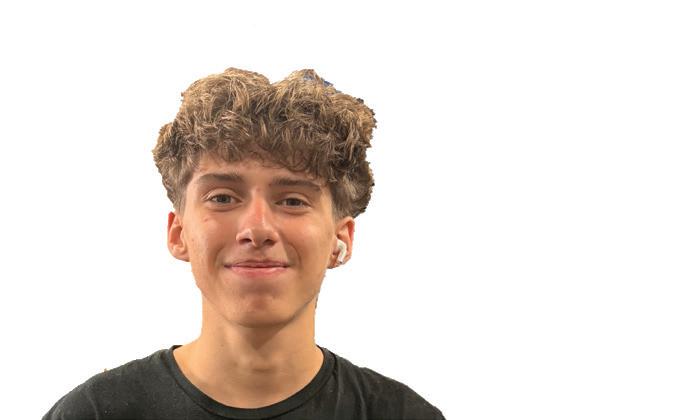
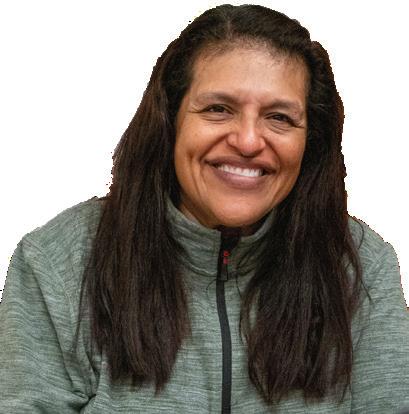
“I don’t think it’s a very smart idea, because I do think it takes time for the brain to develop and for your opinions to become more of your personal facts and your morals. I think we should wait until 18, what it is at right now.”
Monty Joshi
Paly parent
“I think 16 year olds hopefully have enough education to make informed decisions. So I would be supportive of 16 year olds. I think there should be civics education in high school for sure … and thats for everybody, all ages, because I feel like even adults, a lot of them just arent informed about politics.”
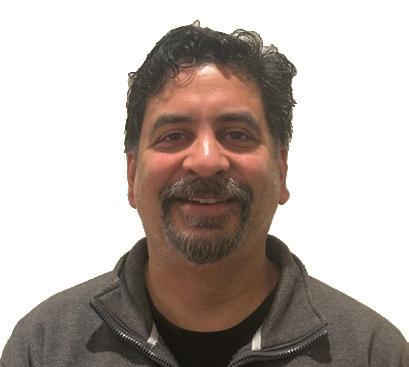
Palo Alto Unified School District
Palo Alto High School
50 Embarcadero Road
Palo Alto, CA, 94301